This post is just to visually work out some doubts I had about suitcase arrangement in container AVE 4041. The premise I've been thinking of is the two suitcases reported by John Bedford, taken as matching, and as both matching the single identified model - Samsonite Silhouette4000 series hardshell case, antique copper/maroony brown in color, 22x26 inch frame. (further details)
The official findings of the UK Air Accident Investigation Branch established the approximate blast center within the container. In Appexdix F of their 1990 report, Thomas Claiden placed the event near the outboard end, and near floor level - the most potent nexus, slosest to the plane's own fragile skin. Its height was found to be around ten inches above the pallet's floor level, in a suitcase placed on top of another, rather than on the floor itself. In general, I agree with these findings so far. The floor panel seems to have been shielded from the blast, and my own view will be generally the same, give or take a few inches.
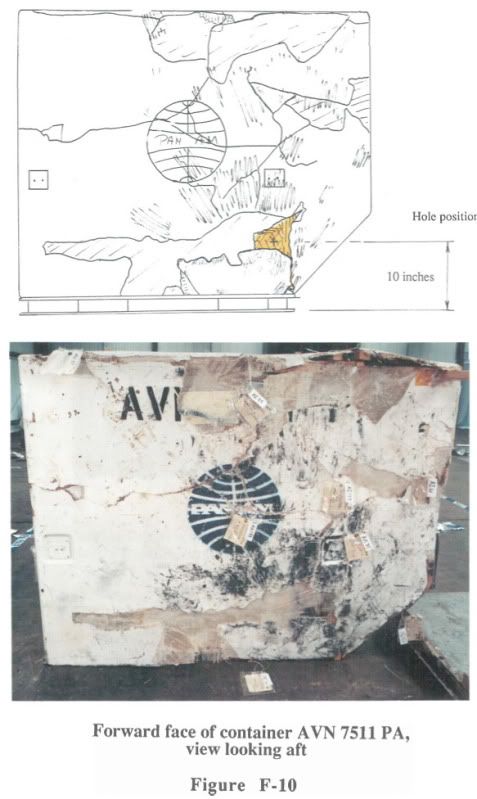
The neighboring container AVN 7511 bore a 5-inch hole straight across from this blast center. Some item(s) apparently entered the fiberglass back wall of 7511. A piece of AVE4041's aluminum outboard panel, and two fragments of the primary suitcase's hinge end wound up embedded in the luggage of Heathrow-originating passengers in the next container. The hole was centered 10 inches up, and was the main fact cited by the AAIB to establish the blast height. Below, a side-by-side. "CL Estimate" explained below (see "vertical difference")
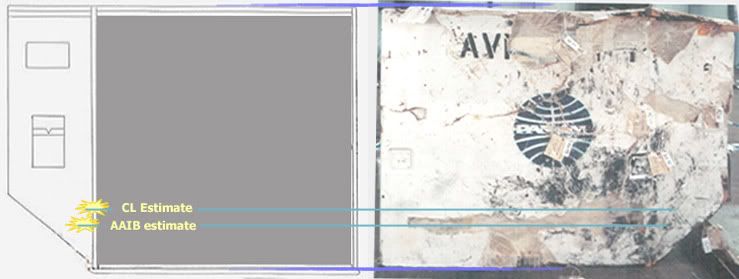
After some reflection I've decided the clue is more ambiguous than it seems. It presupposes a directly lateral blast with no vertcal angle - a 2-d solution to a 3-d problem. A normal explosion tends to be omnidirection of course, so debris and force can travel in any straight line, so long it's generally OUT. They really have no reason to be certain of the exact height.

Inboard-Outboard Placement
Claiden's official decision was that the blast was 2"outboard - that is, towards the hull - of the upright door edge member. That is shown in F-13 (right) and would put it just behind the small outboard panel, the only metal span on that whole face, near its bottom pointed end. The AAIB's Thomas Claiden decided this because the blast had to be outboard of the vertical door edge member. That bar suffered direct blast damage on the inner side, but not on its inboard face (right side here)
However, note in the comparison above, the outboard edge of that yellow-shaded hole in 7511 (left edge here) is a bit outboard (left) of the door edge. The two sketches did not fit exactly, so the degree is unsure. It's nearly 2"in, so it may be significant. The apparent center of the hole, marked "+" by Claiden, suggest a blast just barely inboard (right) of that member. If so, no metal was between the blast's dead center and that fiberglass wall, aside from the suitcase frame. And its blast line would then angle slightly left, and would explain the door edge's "shadow" being a bit outboard from straight across, as it seems to be.
However, note in the comparison above, the outboard edge of that yellow-shaded hole in 7511 (left edge here) is a bit outboard (left) of the door edge. The two sketches did not fit exactly, so the degree is unsure. It's nearly 2"in, so it may be significant. The apparent center of the hole, marked "+" by Claiden, suggest a blast just barely inboard (right) of that member. If so, no metal was between the blast's dead center and that fiberglass wall, aside from the suitcase frame. And its blast line would then angle slightly left, and would explain the door edge's "shadow" being a bit outboard from straight across, as it seems to be.

Vertical Difference
My proposal is of course a matching set of cases stacked one on the other, and so the thickness/depth of the model is important. At trial this was given as 8.9 inches, which I've rounded to nine. In fact, however, it might be rounded down, given the several cases stacked on top of them would cause a slight compression. This should be noted, because generally, two cases this thickseems a minor problem. If the blast height was10", it wouldhave to be centered at the very bottom of the upper case, rather than dead-center inside it.
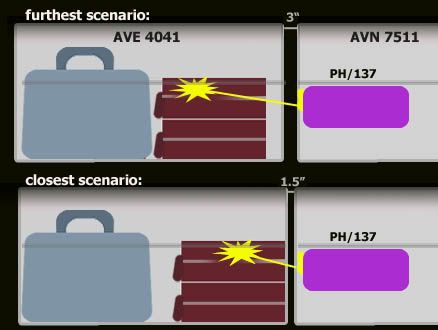
It's not a huge problem, obviously, but one I wanted to tackle. The explosive center of the bomb radio could have simply been placed right along the bottom. But one clue complicates that: a purple case dubbed PH/137, which was probably in AVN 7511, was apparently pierced by two pieces of the IED suitcase(s). Specifically, those pieces were from the case's magnesium alloy frame, which runs around the middle, base/hinge end. Bedfrod reported his Samsonite style brown cases as laid handle ends in, so bases towards ANV 7511. This is consistent with them being stacked but not rotated.
The distance between containers is unknown - I lost where I did the math on the forward hold in Fig F1, but it's not precise to begin with. It came out a tight squeeze - for eight rows of LD3 containers, leaves about 2 inches average between the rows. I used a 1.5" and 3" distance below, app. Considering both container distance and IED placement within the suitcase, these are the approximate closest and furthest scenarios below. Note that nether is implausible, and both put the neighboring damage lower than the blast center.
A Problem on the AVE 4041 Side
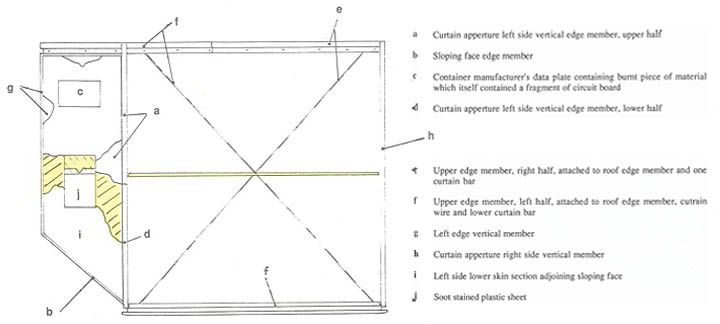
A possible complication arises from the face across from 7511. The closes (aft-facing) face of container AVE 4041 PA is shown diagram by Mr.Claiden, figure F-5, below. The outer frame and left-hand (outboard) panel, plus the bar across the middle, are all the metal here. The large middle span with the X would be a retractable door of blue tarp, easily shredded away by a Semtex blast.
Intriguingly, this is the only face with no photograph present in appendix F. The image below is a screen cap of an online re-showing of an old ABC News segment. It seems to show the same things about the outboard panel: top peeled back, a large span missing in the middle, and one solid sheet, bowed out a bit, in front of the bomb position.


But the intact panel is strangest of all. It is more consistent with my inboard blast center notion, in which the dead-center at least is not behind the panel. But it's not consistent enough. That too would at least tear that panel severely. And there was that piece of container skin that was found stuck in the heel of a shoe within the next container - where did it come from if not this span between the low-level bomb and the hole into AVN 7511?
Perhaps there's a simple explanation, but it eludes me for now.