Showing posts with label Kamboj S. Show all posts

After the Break-In

Connecting Manly's and Bedford's evidence with a two-phase operation
January 17 2011
last update Feb. 10

Note 2/6: See the comments below, which address half of "the middle part" below. Rolfe has soundly debunked the build-up introduction theory and its implied conspiracy. There is, however, the option of re-positioning of the cases at that location, by the same intruder, after their introduction at Interline. I've left the text alone however, so the article and comments become a continuous learning experience.

The Defense's "Missing" Link
I’ve previously explained the security breach at Heathrow airport’s terminal three, found and reported by guard Ray Manly in the first minutes of December 21. A lock to the secured airside area was broken, leaving the way open, perhaps, for a terrorist to place an explosive device amongst the luggage out there. There was no police intervention before the bombing of Flight 103 several hours later, and Manly’s police statement about it “disappeared” afterwards.

As noted in that article, the break-in is not some lone clue floating without any context. It is in fact central to the increasingly clear London origin theory. The explosion time – 38 minutes after leaving the airport – matches with the known altimeter-based weaponry of the most logical villains aside from Libya, if it were loaded at Heathrow. Before that, but following the break-in, a pair of suitcases eerily like the one that blew up were seen around 4:40 PM. Well before the investigation’s bomb in the same case could have arrived from Malta, these appeared mysteriously within the doomed luggage container AVE 4041.

And of special interest here is the fact that Heathrow is the most logical place to load a bomb onto a London-to-NY flight. A remote loading gives numerous chances for interception, and no control over final bomb placement within the container. The bomb did wind up in the only spot of AVE 4041 from which it could do its job (lower outboard corner – see graphics below), by sheer bad luck we’re told. But in fact we have good reason to suspect intelligent terrorist hands undercover at Heathrow airside, perhaps contravening normal rules of loading.

But these are more circumstantial points. It’s in connecting Ray Manly’s report of a break-in at terminal 3 and John Bedford’s report of what could well be the primary suitcase, that the defense case, and the London theory as argued on appeal in 2002, was based. As the appeal court judges considering this at one point put it, “the appellant [Megrahi] sought to link the damage to the padlock with the Bedford suitcases” [242]

[To clarify a side-point, I proceed here on a different assumption from most. A careful reading of Bedford suggests both mystery cases he saw were the same color and style. As he said: “They were hard cases, the type Samsonite make. One was brown in color and the other one, if it wasn’t the same color, it was similar.” This plus their appearance at the same time suggests – though it doesn’t prove - a matching set from one owner, and thus both suspicious. Somehow no one else seems to read him the same way, and focuses on one of the two (which one?) that matches the official style. But I go with what I see, causing the occasional disconnect between singular and plural forms below. [also: If the case(s) were bombing-related as many suspect, it’s possible that both contained bombs (one of which didn’t fully detonate?), or more likely one was a filler, added for realism, etc. I have good reason to suspect the “one case recovered” (actually less than half a case worth of fragments) was not the bomb bag, but on the floor, beneath it - Dr. Hayes once said so.]

In connecting the ‘round midnight report of the broken lock and the late afternoon suitcase sighting by Bedford, There is the problem of elapsed hours, as brought up by the prosecution and favored by the appeal judges. Why break in, plant a bomb bag among the luggage, and then leave, only to have it loaded to the last flight of the day about 17 hours later?

It’s a fair question but not a slam-dunk. If some would-be Lockerbie bomber were on the ground cutting locks at midnight, might he not be willing to come back for a second penetration? Below is a two-phase operation scenario that I think accounts for everything as well as everything can be accounted for. It’s about what I might try for if I knew as much as I imagine this guy knew, and was evil enough to carry out such a thing. I feel that it answers all the major problems pointed out during the appeal, which I will go over for comparison following the plot outline.

Phase one: Getting the bomb to the luggage place
We start around 11:45 PM on December 20, with the terrorist mastermind - Arabic in appearance, or Persian, or blond-haired and blue-eyed, depending. He's at terminal three, standing in front of door T32a, with no one else nearby. To force open a padlock, in general your options would be:
- Sledhehammer (Loud, ineffective against rubber doors like these.)
- Hacksaw (loud and slow)
- Crowbar (loud, crude, unsure)
- Powerful (long-handled) bolt cutters.
- Other (I’m not a tool guy really)

Bolt cutters seem the quickest and quietest – a polite cough might conceal the snip from anyone down the way. Heathrow was under serious maintenance in those days, with workers coming and going all over, according to airport employees speaking at trial. So a maintenance worker could be a good costume to explain the bulky tool, the work gloves (leaves no fingerprints), and the oversize toolbox that he wouldn’t want searched. So long as he isn’t caught in mid-snip, he’d be airside in the December dark within seconds.

He could then empty his toolbox at any number of spots – one he either planned out or picks at the time. Maybe some out-of-the-way spot around a corner from a corner, the kind of place you could sneak a pee with little chance of being seen, even in the day. And behind something else within that spot - an air vent cover, or a large machine with an accessible cavity. Or anywhere that two good-sized suitcases could hide unseen for half a day in a place only he knows.

They would be fully loaded, tagged for PA103, and ready to be smuggled among the outgoing luggage. But they weren’t to be placed yet. That’s too important to be left to chance.

In court, Ray Manly said of the break-in "if somebody had done their job then maybe, maybe [the bombing] may not have happened." But in this scenario, the police would not likely find anything even if they did show up and search the airside area. The whole place would have to be almost disassembled, and all the luggage out there double-checked for purity to be sure nothing untoward was there. At the point these activities were undertaken, the bombing may, sadly, have been unstoppable under normal circumstances.

At  least, until the cases re-surfaced and ran a chance of looking odd to eyes put on the alert....  

Phase Two: Turning the bomb into luggage
Phase one accomplished and no tracks left, the bomber would calmly depart the scene, ditching the empty toolbox and bolt-cutters, but not the gloves. In case this lock-cutting was reported and then caused an alarm (it didn’t), he might give them all day to relax again when nothing happens. He’d get some sleep and allow for at least one shift change at terminal three. He’d even have time to sleep in and have a nourishing brunch of brain food in the hotel lobby, with only one other thing planned for the day.

And that would be at the airport again, coming back in the early afternoon. He’d dress in a black-market Pan Am jumpsuit for a luggage-handling disguise. And he’s carrying nothing but his black-market airside pass (hundreds were missing), appropriate fake ID in a wallet with some cash, and perhaps a pocket-knife if that’s allowed and recovery will require un-screwing. He’s carrying no bags to search. No bombs. He's waved into the secured area where he's got his bomb hidden and ready to make-believe it's someone's matching suitcases.

Upon re-entry, he’d slide over to his hiding nook to retrieve them, maintaining supreme alertness to manage it unseen. Now in a new costume, Pan Am worker bee carrying two (misrouted, if anyone asks) copper Samsonites, he’d emerge on the tarmac and just blend in.

If possible, and in general, the next thing he’d do is manually place them in the lower outboard corner (see below) of a Pan Am container, hoping for the best from there (he may have gotten it).

The middle part: Interline or Build-Up?
The middle part, just where the container would ideally be when he made his move, is more “choose-your-own-adventure,” based on some uncertainty on my on part. It’s a little complicated, and most readers can just be skip to the last paragraph here.

My previous, almost gospel, interpretation, takes John Bedford’s amazing account as literally true. This has the suitcases introduced at the interline shed, the place for processing luggage from non-Pan Am connecting flights. He says his co-worker with Alert security, the ones who x-ray the bags, had placed the matching brown Samsonites in his brief absence, although the co-worker, Sulkash Kamboj, denies this.

In this version, the Lockerbie bomber at Heathrow would have Mr. Kamboj and his x-ray to deal with, which could be dealt with in at least two ways. He could just stand outside, put the Samsonites on the belt running into the shed like any luggage, let Kamboj scan them unseen by him, and just hope they pass and are placed by luck in the right corner. He could also Step into the shed, pay the x-ray man a wad of cash to ignore his job, suggest it’s drugs in there, not bombs, and try to place them himself in the right corner. The latter would offer a better chance of success, but still has its obvious dangers – like the guy taking the cash and then removing the bags for scrutiny anyway once the intruder was gone.

Another problem is the suitcase positions Bedford reported – position “A” in the image below, flat across the floor. The bomb was in a case of just this type, but by the evidence (and officially) in the upper of the two as shown in “B.” Both cases in B are ideally placed, against the sloped floor panel, which winds up nearest the curve of the airliner’s hull. This would only require a stacking of the two cases in “A”, nothing too extreme, really. However, that would make the one on the right in “A” the most likely to be holding the bomb (if there was only one). This is clearly not an ideal placement, suggesting the terrorist was unable to arrange them himself at interline.
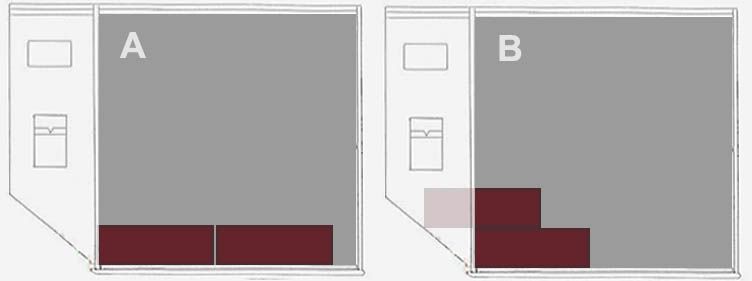
An alternate narrative involves the same two cases actually being inserted at the baggage build-up area. Here baggage from Heathrow-originating passengers was consolidated into containers, and occasionally a container started at interline would be topped off or await an incoming flight here. AVE4041 was one of those. If the cases were first spotted here, that might leave Bedford’s story both literally untrue and still relevant, in a cynical but plausible situation like this:

Peter Walker, who was in charge of the build-up area, goes to take AVE 4041 out to meet the German feeder flight to be filled. But as he steps to it, he sees and makes note of the two “Bedford suitcases,” which weren’t there when Bedford dropped it off. And they’re stacked against the outboard panel as shown in “B” above.

He sees this after sitting inside for around 40 minutes, never watching the container for a moment. No one else was guarding it, and it sat unattended and wide open for most of an hour. Perhaps for fear of causing trouble he ignores the anomaly and lets it slide. (There’s probably a good reason. It’s not like we’re on high alert following a break-in or anything.) It’s taken out to K16, and filled up with items from Frankfurt, none of them holding any explosives, and then is loaded onto 103.

But after the news of what happened less than an hour later, he’d put it together. Even the placement was a clue - the bomb was in one of those cases, ideally placed nearest the hull. So he compels someone else (Bedford) to say he saw them, way over there at interline, and that Indian guy “Camjob” (as Bedford calls him) is the one who placed them. They’d be x-rayed, one would presume. (But if not, hey… it was him, not either of us.) And further, they were reported by Bedford as flat on the floor, not stacked in that optimal way.

This is a rather convoluted thing to suspect, and requires some conspiracy, but it does explain a number of things. It should be noted that Walker provided Bedford’s alibi (a tea break together) for being absent when Kamboj placed the bags. And besides the Bedford/Kamboj disagreements, there are serious inconsistencies in Walker’s statements. To police in 1989 he swore he never saw or was aware of the container at all, contradicting Bedford. In 1990, he fixed this and confirmed that Bedford had brought it over, as they had agreed to over tea. At trial in 2000 he admitted the change in stories is strange, but he said for whatever reason, "I can’t explain it."

In this scenario, the suitcases memory in Bedford’s story is accurate enough to be a clue, even if it’s not his own memory, but transferred from one mind to another. It also allows for the flat position to be an additional fudging, so that not even Kamboj facilitated their potent stacking. (That was apparently someone later down the line, if it's decided that happened at all.)

Both options involve the danger of Kamboj, Walker, Bedford, or someone else reporting or removing the bags. Every London option has that danger, and that risk is tripled in the official story through three airports, making this still preferable. Logic says they’d choose Heathrow, and less clearly it suggests the bomber would choose build-up. But Bedford suggests he chose interline. Either way, the reference to brown, hard-shell Samsonites in the deadly corner of AVE4041 shouldn’t just be presumed to be a coincidence.

Appeal judgment addressed:
Following are some excerpts from the second “Opinion of the Court” from Camp Zeist, following the appeal of Feb. 2002.

"[244] ...Moreover, although readily discoverable evidence of the break-in had been left behind in the form of the damaged padlock, the hypothesis involved that the case was not introduced into the interline shed until some fifteen hours later..."
True, but it’s no problem for the two-phase explanation - it’s the basis of it. In fact, the build-up version involves an even longer span, by as much as an hour, than the one the judges half-considered.

"...Unless the risk of opening the case airside to set the timer was to be undertaken, the timer would have had to be set before the break-in..."
Ice-cube timers that blow around 38 minutes after takeoff don’t need to be set, of course. So this point doesn’t apply to my version, nor, I think, to the case made by the defense.

"... No method of arranging for the bag to pass through the system to the interline shed had been identified..."
Perhaps not by the defense, but I propose the method was manual placement supported by psychological deception.

"... The intruder would have required either to wait for fifteen hours himself, or to have the assistance of an accomplice..."
Either works. I’m betting on one well-trained operative with the requisite patience.

"... No place of concealment for the intruder or the suitcase had been identified..."
No place identified? I suspect the intruder was an out-of-towner, and concealed himself at a hotel for that time. As for the bomb suitcases, no one has shown any reason to rule out all potential hiding spots, like those mentioned above or a dozen others. Do they imagine there would be no suitable spots? Aren't they presuming they were "hidden" right inside the interline shed?

"... There was nothing in the evidence to explain why a suitcase, brought through T3-2A between 2205 and 0030 hours, would not be placed in the interline shed in time for either of the two earlier PanAm flights. On the hypothesis under examination, the suitcase had been tagged for flight PA103, although there were two earlier flights that would have involved a shorter period of concealment of a suitcase containing an armed explosive device... "
Again with "armed" and time spans. Unless the airport suddenly levitates a few thousand feet, the bomb is stable. Remember, it's altimeter-triggered, in this non-Libyan plot. If the bomb is concealed and ready for a phase two, no one but him will put it in the shed, on no timeline other than his own. There’s no need to rush things; even doing it the same day is unnecessary. And besides, they may have been targetting Flight 103 itself for some specific reason.

"... Yet there was no evidence that there was anything about flight PA103 or its passengers that singled it out as the target."
This is widely disputed, but for my part I take no stock in certain individuals (Charles McKee, etc.) being targeted. But here are other reasons I could see why they might choose to wait for this one, depending what they knew from advanced research:
- the plane’s age (it was one of the oldest around) and its brittle skin. (see this frightening video)
- its inhabitant’s average youth, to maximize the sense of loss.
- its lateness, last flight of the day. As explained above, giving time for security to relax, for sleep, and for a costume change.

"...Moreover, if an accomplice with airport identification, genuine or false, was involved, there was no need to break in to airside..."
Except to have no friggin' bomb on him when he showed his pass and perhaps was subjected to search prior to entering a secured area… which of course was not secure at this point, and he may have had a bomb waiting for him inside.

"...All that was required was to smuggle the components of the explosive device through an access point, such as T3-2A, where persons with appropriate identification were not searched..."
Even the  stray suitcases they're bringing in aren't searched? I don't know - I imagine a ready-made bombs aren't smart to bring through, and the judges agree, speculating "component parts" being smuggled and then assembled out on the tarmac somewhere. (???) For the bomb’s entry behind the perimeter, where worker-looking people are generally trusted, I think an unacknowledged sneak-job of the ready package would be wisest. A break-in at midnight would be genius.

"... The effect of all these points, the Advocate depute submitted, was to show that the hypothesis that the break-in at T3-2A was the means of infiltrating one of the Bedford suitcases was so weak and flawed that the additional evidence could not pass the Cameron test..."
My theory has it introducing both of them. I didn't read just what "the Cameron test is," but it's from a case involving someone named Cameron, and probably means a point doesn’t hold up under scrutiny, compared to something else already "established." At least, not when the scrutiny is as skewed as their Lordships' is. When they say “the Advocate depute submitted” they also seem to be saying “we think.” But the A.D.’s job is to argue his case, however unsupported, and their job is to judge fairly, not just agree with the one line of argument as if it were a self-evident truth.

"[251] In our view the Advocate depute was right in submitting that the additional evidence did not demonstrate any link between the break-in at T3-2A and the Bedford suitcases..."
Perhaps not, but now I have. A potential one at least.

"... It might be said that there was a temporal link, in the sense that the break-in occurred some fifteen hours before the Bedford suitcases appeared in the interline shed..."
Yes. In a 17-year career, the worst security breach Manly ever saw, and the worst terrorist bombing in UK history, happening within the same 17-hour span, is definitely a temporal connection.

"... It seems to us, however, that that interval of time, so far from pointing to a connection between the two events, casts considerable doubt on whether they can have been connected..."
"Can have been connected?" Wow. No imagination at all.

"...The lapse of time after a readily detectable break-in, creating a period during which the infiltrator and the case (or, if there was an accomplice, the unaccompanied case) would require to be concealed in the airside area, points away from a connection..."
Again, the lapse of time after the detectable event is explained by me as a cool down period in case the detection raised an alarm. Sixteen or so hours is, if anything, a bit short for this purpose, but it apparently worked.

"...Moreover, any attempt to link the Bedford suitcases with the break-in raises unanswered questions as to why the infiltrator ignored the baggage build-up area, and introduced the cases into the considerably more remote interline shed..."
Any attempt? Not my variation where the bomb is introduced at build-up. They're the same suitcases then, just the "Walker suitcases" instead of the Bedford ones.

In addition, given the evidence as to the ability of a person with airport identification to pass through T3-2A during the day without being subjected to search, and given the evidence led at the trial and mentioned by the trial court in para [24] about the substantial number of such passes unaccounted for, it is not clear why a break-in would have been seen as necessary, since the components of the explosive device could have been smuggled through an access point.
Repeated just to emphasize the bolded, to remind the reader how easy it would be for a terrorist to sneak back into the airside area where he'd earlier hidden the bomb he meant to get onto Flight 103.

Addendum: Completely unaware of the break-in that changes the whole scene for the imagine Heathrow intruder, the Zeist judges put the situtation pretty well in their paragraph 24 (in its entirety)
[24] It emerges from the evidence therefore that a suitcase which could fit the
forensic description of the primary suitcase was in the container when it left the interline shed. There is also a possibility that an extraneous suitcase could have been introduced by being put onto the conveyor belt outside the interline shed, or introduced into the shed itself or into the container when it was at the build-up area. To achieve that, the person placing the suitcase would have had to avoid being detected, but the evidence indicates that a person in possession of a pass for the airside area would not be likely to be challenged, and there were a very large number of passes issued for Heathrow, a substantial number of which were not accounted for. The person placing the suitcase would also have required to know where to put it to achieve the objective.
---

Visualizing the Bedford Story

last edits 3 November 2010

This post will help establish a visual grasp of the evidence of Pan Am luggage loader John Bedford, and its possibly huge relevance to the Lockerbie bombing. [general post: the Bedford suitcase(s)] This is best understood if one has read the statements Bedford and a coworker made to London police shortly after the attack. The timeline of 21 December at the interline shed is also pivotal, but will be worked into this post as we go. In short, on that afternoon, a pair of brown, hard-shell Samsonite suitcases appeared in the same luggage container the blast would later occur in. And that has been ruled to be a brown hard-shell Samsonite case. No other such bags were found in that container. Neither of the two baggage handlers who worked at interline would say just where these bags came from, as their stories conflicted and shifted over time.  

So just to be able to better "see" what this might mean...

The Container
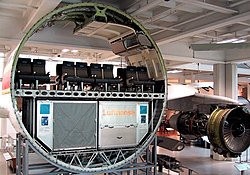
The aircraft in question, known as Clipper Maid of the Seas, was a Boeing 747-121 model. According to Wikipedia, a 747-121 holds 30 cargo containers of the LD1 or LD3 style, fifteen along each side of the hold. A cross-section photo there helps explain the containers' non-rectangular shape - the lower outer corners are "cut off," creating a slanted portion of floor on the outboard (closer to the hull) end of the container.

Container AVE 4041 was blown out at just that end, the unluckiest of spots as far as the plane and those in it are concerned. To visualize this, AVE 4041 was a Pan Am-owned model LD3 container (or load device unit), of aluminum contruction, with the following dimensions, per a Wikipedia page:
base width / overall width - 61.5 / 79 inches
depth - 60.4 inches
height - 64 inches
The dimensions given in the AAIB report of 1990 are slightly different, and included in the figure below. The opened loading side is secured for flight with a blue sheet attached to cables that pulls down and latches. This open side is called the front by Loaders.

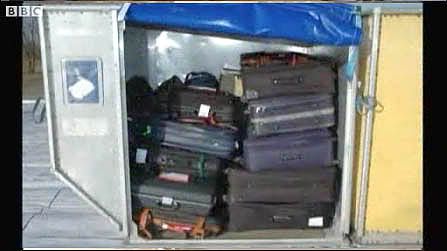
Below is one of these containers, used by Dr. John Wyatt in his recent fragment survivability tests. He's filled it with luggage and one case with a bomb, for the finale of a 20-test series. Note here the cases are not stacked spines down but flat-down. It's possible anyone could have rearraged the bags after Bedford's and Kamboj's placements - and a flat-stacked approach seems the best fit for the evidence - in the position here of the second lowest left-hand case, if slid to the left a bit. This image also helps establish a rough average suitcase thickness of around 8 inches, which I use below.

Visualizations
Using the dimensions of the pallet's base, as seen from above, it's possible to get some grasp of hw this would actually look. Below I've done some muck-ups, using the floor damage sketches from the AAIB's appendix F. The post linked there is another important part of being able to visualize this scenario. The blast damage to the container is crucial to understanding where inside of it the blast happened.


First, just the base we'll be working with. On the main floor, the blue area is the outer edge of floor deformation from the blast itself; other deformations were likely from the fall and the landing. The yellow is an "area of intense distortion, influenced by aircraft structure under panel." This was apparently shielded from direct blast effects by the lower suitcase beneath the primary one. Red is the area where the base edge member is "severely blast damaged." Areas slant-shaded are those never found (I re-did the overhang to ignore Claiden's silly PI/100 inclusion). Most of this panel was obliterated and never found, the rest  was blown outward.

At left is the container as Bedford left it around 4pm, to have tea with his boss Peter Walker, leaving his coworker Kamboj alone at the Pan Am station. The exact number of bags he placed has never been pinned down, "four or five" total (per Kamboj), or a high "8-10" after Kamboj's two additions (per Bedford). Five to start plus the two is the estimation I chose. "Spines down handles up" was Bedford's style, he said, and placing them "along the back of the container" is best read as shown here. A left-to-right order isn't specified or necessary, but it does fit the other clues a bit better than right-to-left scheme.

The sample size I'm using for these filler cases is 16x24x8 inches. It's reasonable but quite imprecise, and in reality different bags will be different sizes and shapes. Please note the rough correlation of the area covered by these and the area not as blast-warped. The yellow and blue tend to a circular pattern radiating from the center, except where these upright bags were. These would transfer force much differently from flat laid cases beneath the bomb.

Upon Bedford's return around 4:40 pm the arrangement was something like this. Two new "hard cases, the type Samsonite make" had been added on the floor as shown here. I'm using the primary case dimensions - silhouette 4000 series, 26x22x9 inches (see link at top, above the video). We cannot say that's not what he saw. With the same style and color (brown or maroony brown) and their appearance together they might well be a matching set, which is worthy of note (and yet little noted thus far). Laid side by side, at the front of the container, to the left, handles pointing towards the back, "they took up the remaining base area of the tin," Bedford told police. These do just that.

We know they weren't left here, so close to the later explosion, or they'd turn up bomb damaged, which they didn't. Or perhaps they did, as this whole exercises is premised on wondering...

To conserve space, a later worker may have rearranged the cases like the mock-up at left: stacked together and slid left and back against the other cases and the overhang floor. Geometrically, it puts the upper case's (approximate) middle in the IED location (the flare here). Given the nearly-square shape of the primary case, there is little difference between them ending up long end sticking outboard (as shown here) or the other way around (as shown below). In both arrangements, a 180 degree rotation is also just as good a fit, giving us four possible variations.

The arrangement at left with an added 90-degree rotation (this or its base-out inversion) has the blast area more high-centered than left, and makes a little more sense in a way. But good clues I stumbled across suggest the above image or its reverse might have to be it. It seems that parts from both the handle and hinge (bottom) ends of the case left pieces blasted into surrounding luggage. Pieces of the lock wound up in a suitcase from within this container, and a piece of the bottom wound up in the container over (down as shown here), and apparently piercing a "purple holdall." Both are consistent with handles-in placement like Bedford saw.

Finally, the obvious point that we're visualizing two cases, while only the remains of one were recovered. So it seems. Consider this hypothesis - approximately one-and-a-half of these two cases was basically vaporized by a blast maybe 50% more powerful than believed. Highly energized suitcase material wouldn't disappear, but may alight in a variety of states you'd never recover: drifting flakes of melted plastic, and small non-descript "pebbles" that vanish into sandy mud. Drifting might continue to the North sea, or into a loch.

Larger pieces can and would be recovered, and here we see a couple dozen bits less than an inch in size, but most of these were found blasted into other suitcases, not laying in the grass, or caught in a tree's canopy. The nearly 1/2 of an entire suitcase assembled (mock-up at left) is primarily just five fragments, one nearly a foot square. And there is a 20-inch span of gossamer fabric lining. Which half of the primary case could that be from?   Top or bottom? Any takers? Why the asymmetry?

And that large chunk at upper left, PI/911, has an extremely interesting history of its own - RARDE first said it was from a case beneath the primary one and was touching the floor. Wait 'til you see why that changed.

Investigators had no way of knowing such rearrangements didn't happen, but by accepting Bedford's story, had to presume these cases had been near that corner and were then moved somewhere. They were never able to find where these cases went  to if not where these above images show. Yet they ruled out the possibility by concluding a bomb case that wasn't touching the (main) floor, and had to have come from Frankfurt, in a third brown hard-shell Samsonite to have occupied that corner.

It's utter hogwash thinking of a suspiciously wishful sort.  How early did the police bosses know London must be cleared, and for what reason?
---

The Bedford Suitcase(s): master list

last edits Feb 17 2011

If we are to consider the possibility of a bomb introduction at Heathrow Airport, clearly we have to consider the account of Mr. John Bedford, longtime Pan Am luggage loader/driver at the airport. Bedford selected and was responsible for the initial loading of luggage container AVE4041PA, from which the blast would later originate. It’s been officially decided the bomb was in a reddish-brown hadshell Samsonite style suitcase, coming of a feeder from Germany and put in that container after Bedford left for the day.

However, only two suitcases of that type were seen in or destined for container 4041 – and these were the by Bedford himself, in roughly the spot the bomb would later detonate, well before the luggage from Germany arrived. An unabashed look at the simplest explanation would make one of the Bedford bags the source of that explosion, but the possibility was completely ruled out, on the official level, with ruthless force. Officially, Bedford's bags meant nothing - as much a coincidence as the Helsinki warning.

This post will serve to cover all relevant aspects of the two brown hardshell Samsonited John Bedford reported in container 4041. Most issues will be dealt with briefly here and in depth at the provided links.

Bedford statement to Detective Constable Adrian Dixon, January 9 1989
"I went to see Peter Walker in baggage build-up leaving Camjob in interline. I returned about 4.40 p.m., Camjob [sic] told me two further suitcases had arrived for PA 103 which he had put in the tin. I looked inside the tin and saw the suitcases that I had put in the tin still in the same position. Lying on their sides in front of the other suitcases, handles pointing towards the back of the tin, were two suitcases. They were hard suitcases, the type Samsonite make. One was brown in colour, and the other one, if it wasn't the same colour, it was similar. In size, they took up the remaining base area of the tin. [day 44, p 6463-65]
Please note he cites these two bags, introduced at the same time in his absence, as of the the same Samsonite hardshell style. And a careful reading shows they're apparently the same color. The qualifier "if not ... similar" may just be Bedford second-guessing his presumption this was a matching set of luggage. The Bedford suitcases.

Somehow in official pronouncements, presumptions, and future questioning I've seen, and even most of the critics and free-thinkers have rendered the plural is singular. John Bedford, it's said, reported a brown Samsonite, and another suitcase of a similar, but not same, color. Then it becomes "the suitcase" he saw. Below all is singular, but be aware that's by some human convention and not actual reported fact.

The posts

A Smoking Gun Left in Plain Sight
Feb. 17, 2011: An exhaustive explanation of what the Bedford bags were and weren't. In summary, they were extremely like the bomb bag, but not Megrahi's bomb from Malta. They were never found after the bombing, were called interline luggage, were by deduction not interlie luggage, or any passenger's luggage. They were sidelined at every chance, and yet remain the best of clue to what really happened on December 21 and just where and when.


Visualizing the Bedford story
Detailed graphics explaining the geometry of it all, based on direct quotes. 


Video: Two Hard Cases Solve Another
A well-scored 10-minute video explaining in part the Bedford evidence, with to-scale animations and the two-cases problem addressed head-on.  


Dr. Hayes aft first felt this square-foot chunk of solid suitcase material, quite large to be from the bomb case, was beneath the bomb and resting on the floor. Later he noticed it must have been resting on other luggage and been the bomb bag. Hmmm...   

Bedford on the color of that Brown Samsonite
His fading - or broken? - memory of the highly relevant color of that (singular) hard case in the bomb corner. 

Arguments scientific and logical, all faulty, about why Bedford's cases should be ignored. Multiple sub-posts linked here, a lot of information. 

Contradictory and shifting accounts to Met police in 1989, to the Fatal Accident Inquiry in 1990, and at Camp Zeist in 2000. Long quotes, minimal notes. 

Interline shed chronology
From trial transcripts, events as reported by Bedford, Kamboj, and others, distilled into one timeline for the afternoon of December 21. 

Yet another Red Flag From Heathrow
The only thing that has made me doubt any of the Bedford story is the shifting testimony of his boss, Peter Walker. That doubt is explored in more detail in the link below ("after..."), but mostly debunked in the comments there. 


After the break-In
Tying together Ray Manly's story of a cut lock to airside with Bedford's report. What might have happened in the 16 hours between them to have these clues unified in a London origin plot? One plausible narrative (albeit with two possibilities outlined for the middle part) traces my own best guess.  

Interline Shed Chronology

Posted long ago
last edits Feb 10 2011


In the interest of sorting out the Bedford suitcases story, below is a timeline of the afternoon around the interline shed of Heathrow's terminal three and the bomb-ruptured luggage container AVE4041.

Some notes on procedures: The interline shed in question handled luggage transferring from one airline's flight to another. Bags were placed on a single long conveyor belt sticking out of the building that took it inside for sorting. Workers from different airlines stood inside picking out bags from all airlines destined for one of their flights. Pan Am's crew consisted of a variable number of Pan Am employees who took the bags off the belt and set them in containers. Between these actions, another crew from Alert Security (a Pan Am subsidiary) would x-ray the bags for anything suspicious they could recognize (apparently a small list). Usually two Alert personnel worked in tandem - one read the screen, the other placed a security sticker on it and handed it back to the Pan Am people.

In early police interviews, Mr. Kamboj strenuously denies he'd ever place a bag in a container himself. But at trial in 2000, he recalled they would do this on occasion, as Mr. Bedford always said.

12:30 am – break-in discovered at Terminal three. No one knows if anyone took advantage of this aaccess to facilitate getting an IED suitcase into the luggage system. Thirteen hours pass.

2:00 pm – John Bedford is the lone Pan Am employee working in the interline shed.
Q … in the morning, were there other Pan Am workers helping you?
A Yes, sir.
[…]
Q By the afternoon, was it busy or quiet?
A Reasonably quiet, sir.
Q … would that mean that fewer bags were coming in?
A Yes, sir.
Q Would it mean that there were fewer workers there?
A Yes, sir.
Q And
Q By the afternoon, and say by about 2.00, were there any other Pan Am workers left in the interline shed?
A No, sir. … just myself.
[Day 44, pp 6441-42]

2:00-4:00 – Bedford and Alert employees Kamboj and Parmar together intercept, scan, and place app. 4-5 suitcases in the container Bedford selected: AVE4041.
Q Were there still people working for Alert?
A Yes, sir.
Q Do you remember who?
A Mr. Kamboj and Mr. Parmar.

?? - Parmar goes home
Questions put to Mr. Kamboj by Turnbull:
Q Did Mr. Parmar stay in the interline shed as long as you did?
A Yes, sir.
Q What time did you finish; do you remember?
A No, sir.
Q Did Mr. Parmar finish at the same time?
A Usually, yes, sir.
Q And on that day, the 21st of December, do you remember if he finished at the same time as you?
A Yes sir.
Cross-examination, Mr. Davidson, minutes later:
Q Is it your recollection, Mr. Kamboj, that you and Mr. Parmar finished work on that day, the 21st December '88 --
A Yes, sir, we worked together.
Q Sorry, the red light is flashing – that you finished work at the same time that day?
A I don't remember, sir.
Q You don't remember.
A Yes.
Q Do you remember having a break for a meal or a snack of some description that afternoon?
A Yes, sir.
…
Q Do you remember going back to work in the interline shed after your break?
A Yes, sir.
Q Do you remember Mr. Parmar leaving work at that time and you staying on?
A I don't remember, sir.
Q You don't remember. All right. [pp 6411-12]
Bedford confirms Parmar left at some point before Kamboj:
Q Who had been left in the interline shed when you went to visit Mr. Walker?
A Mr. Kamboj, sir.
Q Anyone else?
A No, sir.
app 4:10 - Bedford takes a break, 30 minutes
Trial testimony, 2000:
Q After you had put some bags into the container that afternoon, did you go to see Mr. Walker?
A Yes, sir.
Q Was that at the baggage build-up area?
A Yes, sir.
Q And did you have a cup of tea with him?
A Yes, sir.
[...]
Q How long do you suppose you were away from the interline area visiting Mr. Walker?
A I don't remember that, sir.
Q Can you give me an approximation?
A Half an hour.
[p 6446]
4:40 – approx return from break time
Bedford to police, Jan 9 1989:
"I went to see Peter Walker in baggage build-up leaving Camjob in interline. I returned about 4.40 p.m., Camjob told me two further suitcases had arrived for PA 103 which he had put in the tin. ..."
We wonder why they so closely match the case that held the bomb for style, color, and location in that very container.
4:45-55? - Bedford takes AVE4041 to baggage buildup.
Q All right. Did there come a stage when you took the container away from the interline shed?
A Yes, sir.
Q Where did you take it to?
A To the build-up area, sir.
Q Why did you take it there?
A Because that's where my supervisor [Walker] was, and that's where he asked me to bring it.
[p 6450]
5:02 - Bedford clocks out and goes home
Q Were you planning on leaving work early that day?
A No, sir.
Q What was your normal finishing time that day -- supposed to be for that day?
A I think it was 6.00, sir.
Q You weren't at -- you went off work at two minutes past 5.00, didn't you, sir?
A Yes, sir.
Q Why did you leave early?
A Because Mr. Walker said the 103 would be late and take me past my time, so I could finish early.
[pp 6470-71]

app. 5:35 - AVE4041 Taken to meet 103A and filled with luggage piled on top of whatever was placed in there at interline. It's quickly loaded onto PA 103.

6:04 PA 103 departs the gate, starts taxiing (four minutes behind schedule).

6:25 PA 103 takes off from the runway.

7:02 – PA 103 blows up 38 minutes after take-off.

Bedford and Kamboj Statements: Primary Evidence

Last edit June 8 2010

In the interest of clarifying what’s been said by whom in the Bedford/Kamboj controversy at Heathrow, I’m compiling as much as I can find of statements by the two. Below, from trial transcripts Day 44, (August 25 2000) are original police interviews from 1988-1990, and Fatal Accident Inquiry testimony, read back in court at Camp Zeist, along with some interesting testimony from Zeist. The descriptions and follow up questions are as stated in court, in black here, condensed. Original source material, apparently given in direct quotation, is in green. Each was affirmed with the witnesses Kamboj and Bedford - neither could remember the details nor anything they said, nor having said it, but they each agreed on every quote that if it's there they said it and if they said it it's true to the best of their knowledge at the time.

For comparison, see also Peter Walker's statements.

Sulkash Kamboj, statement taken "by a Detective Sergeant Downs on the 28th of December '88"
"I was involved with x-raying the interline baggage ... throughout my tour of duty, and all I do, once I've x-rayed the baggage, is to put a security band round them."

John Bedford statement “taken on the 3rd of January 1988, probably wrong -- should be 1989, obviously, by constable – detective constable called Adrian Dixon"
"I have been asked if it would be – if it would have been possible for anything other than the bags that should be in the tin to be put in there, and I would say yes. […] Whilst dealing with other baggage from other flights, it's not possible to keep the tin in my view all the time." [day 44 p 6479]

Sulkash Kamboj, to A. Dixn, 6 January 1989.
"Earlier in the afternoon, John Bedford had brought into interline a
metal tin into which PA 103 luggage was to be placed. I did not place any luggage in the PA 103 tin on that day."
Bedford 9 Jan 1989 – to Adrian Dixon
"I went to see Peter Walker in baggage build-up leaving Camjob in interline. I returned about 4.40 p.m., Camjob told me two further suitcases had arrived for PA 103 which he had put in the tin. I looked inside the tin and saw the suitcases that I had put in the tin still in the same position. Lying on their sides in front of the other suitcases, handles pointing towards the back of the tin, were two suitcases. They were hard suitcases, the type Samsonite make. One was brown in colour, and the other one, if it wasn't the same colour, it was similar. In size, they took up the remaining base area of the tin."

"... a statement, Mr. Kamboj, that has been taken from you by a police officer called Mr. Hogg, and it would appear to have been taken from you on a date which is not terribly legible … the date is recorded there as 23rd of August 1990"
"I did not load any bags into the container that day in the interline shed, as it is -- as I do not load containers." [6421-22]

Kamboj questioning and testimony, Fatal Accident Inquiry “in about November of 1990”
Q And an interline bag comes through into the shed and you put it through your machine. Is it possible that in those circumstances, in the absence of the loader, you would simply remove the bag from the machine and put it into the tin?
A No. We only remove the bag from the belt, as you can see in picture 59.
[…]
Q I am interested in the loading of containers. You have described to us how the normal practice was for the loader to do this job.
A Yes.
Q You have also told us a number of times that you didn't regard it as part of your job?
A Yes.
Q To load containers?
A Yes.
Q Did you ever put a bag in a container? Have you ever done that in the whole of your time with Alert?
A No, I don't, never.
Q You took a little time to think about it. Is it possible you may have done that?
A No, no.
Q Have you ever seen other Alert Security staff not only x-raying a bag but also putting it into a container?
A I have never seen.
[…]
Q If Mr. Bedford were to tell us at this inquiry that he went away from the interline area some time during the afternoon and that when he came back, you told him that you had put a couple of cases into the tin, might he be right in that?
A No, I can't say that would be right.
Q I am sorry.
A No.
Q You are not happy about that?
A No.

[6423-27]

Bedford, Fatal Accident Inquiry, 1990:
Q Can you recall whether on 21st December, 1988 any of the luggage that you dealt with or saw at the interline shed destined for Pan Am 103 was a bronze Samsonite case?
A Yes, sir.
Q Did you see a bronze Samsonite case?
A A maroony-brown Samsonite case, yes.
Q Where was that tin when you saw it?
A In the front of the container, lying down
Q Again in relation to the photograph that we have looked at in Production 42, photograph 1, can you point to where that case was when you saw it?
A Just there?
Q Indicating the left-hand case which is lying flat on the floor in the
front of the container?
A Yes, sir.
Q Now, I wonder if I could get in a bit more detail of the colour. What is your recollection about the colour of the case lying in that position?
A I think it was a brown or maroony colour, hard-backed suitcase.
Q I also used the word "Samsonite." What is your position about that?
A I couldn't say that it was Samsonite, only that it was a hard-backed suitcase, a Samsonite type.
Q But as far as colour is concerned, can you be any more precise than you have been in your evidence?
A No, sir, I am sorry.

[pp 6482-85]
Q I think it's fair to say that you have been seen on a number of occasions by police and other investigating agencies; is that right?
A Yes, sir.
Q And as far as the colour of that particular case is concerned, have you always expressed the same view as to what the colour was?
A To my knowledge, I have.
Q Isn't it fair to say that on different occasions you thought it was brown or maroon, and at one point you were quite certain it was maroon?
A Yes.
Q Again this is no criticism of you, but I am anxious to know what the state of your evidence is about colour. In view of the different expressions of view over the period, are you able to be clear at all as to what the colour of that case was?
A No.
Q With regard to the suitcase that you saw lying down flat to the left side of the container, I would like you to think back as best you can. Could that suitcase have been a blue suitcase with a maroon or brown trim?
A I couldn't say.
Q You don't know whether it was or not?
A No, sir.
Q But it could have been?
A It could have been.
Bedford, Camp Zeist, Aug 25 2000:
Q When you left the interline shed to go to Mr. Walker's for a cup of tea ... There were no bags at the front of that tin, that container?
A No, sir.
[...]
Q You didn't see the two bags that you are referring to being put in that container ... Your only knowledge of how they got there was what you say Mr. Kamboj told you, namely, that he had put them in?
A Yes, sir.
Q Can you help us with this, please, Mr. Bedford. Mr. Kamboj gave a number of statements to police in the weeks following the date of this disaster in which he maintained that he had never put any bags in that tin at all. Can you help explain that discrepancy?
A No, sir, I can't help you to explain that.
[pp 6460-61]
Worse, of course - he vehemently insisted he never would have done that, essentially calling Bedford a big fat liar. But then his story had changed by the time of the Zeist trial. Examination in chief by Mr Turnbull for the Crown:
Q Did the Alert workers ever put bags into containers after they'd passed through the x-ray machine?
A No, sir.
Q Why was that?
A That's not the job of the security.
Q I see. Was that never done, even as a favour or to help out?
A Yes, in the case of if somebody is, like, if it's a quiet time and somebody going for restroom or toilet, and bags come, you do the favour. But it's not normal routine, because we worked together, so if somebody not -- we just maybe – but it's not a normal routine.
Q I see that. So it's not the normal routine, but it did happen?
A Yes, sir.
Q And in particular it might happen if there was a quiet time?
A Yes, sir.
Q And if somebody was in the restroom or away somewhere?
A Yes, sir.
Q And you mean by that, if the airline worker was in the restroom or away?
A Yes.
[6403-04]
Turnbull/Kamboj, examination in chief:
Q Do you remember if you helped [Mr. Bedford] out at all in the later part of that afternoon?
A I don't remember, sir.
Q Well, do you remember if you helped him out by putting two suitcases into a container for him?
A I don't remember, sir.
Q Doing that, perhaps, whilst he was away for a little while?
A I don't remember, sir.
Q All right. Is it possible you might have done that, Mr. Kamboj?
A Yes, sir, possibility, yes.
Q Do you remember, in fact, telling Mr. Bedford that you had done that for him?
A I don't remember, sir.
Q If Mr. Bedford remembers you telling him that you had helped him out by putting two suitcases into a container, would you quarrel with him over that?
A If he said that, or whatever -- I mean, it's a possibility, as I already said before, and I can't actually remember now. So if he said -- I mean, I will admit that, yes; but if I did, that maybe had to go through the proper security procedure, and then --
Q Of course. Of course. But if Mr. Bedford has a recollection of you telling him that, would you say he was wrong?
A I won't say he was wrong, no.
[6406-07]
Kamboj admits they also sometimes picked bag off the line for Pan Am, under questioning from Lord Sutherland:
Q ... So somebody has to watch the conveyor belt all the time and then pick off any bags which are destined for Pan Am flights; is that right?
A Yes, sir.
Q And who would that be?
A It's the airline employee, and sometimes when we are by the machine. That's right.
Q Yes. So would that be Mr. Bedford, if he was normally in the shed?
A Yes, sir, he was normally in the shed, yeah.
[6433-34]
---

Bedford on the Color of that Brown Samsonite

(incomplete)
last edits 2/26/10

The official findings of the Lockerbie investigation have always held that the primary suitcase (the bomb bag) was inside cargo container number AVE 4041, and was a hard-sided type of Samsonite make, "brown" in color. Quite or exactly like the model at left used as a control sample, with a reddish cast, it could be called "maroony-brown." It’s not remarkable itself and might be expected to slip through an entire system without anyone noticing it at any particular spot. But an unusual bag might wind up standing out a little.

Of the dozens of items that would be loaded into 4041 for loading onto Flight 103, the only case matching this that was both seen and remembered is the one seen by John Bedford, a Pan Am loader / driver at Heathrow International Airport. He saw it there, in AVE 4041 a thousand miles from Malta, over an hour before the arrival of the feeder flight that allegedly brought the primary suitcase. It stood out because it was placed there in his absence, along with another bag of similar type, by a co-worker, Mr. Kamboj. I'll cover these details elsewhere, here I'd like to focus on the color and the official acceptance of that aspect of his evidence.

Police reports: 1989
Bedford gave at least two statements to police Detective Constable Adrian Dixon on 3 January and 9 January 1989. One would presume earlier interviews as well, but none that I've seen yet. The first of these two isn’t directly quoted in Court, at least regarding color, but the second includes an incorrect spelling of Kamboj and I will quote it in part as:
"I went to see Peter Walker in baggage build-up leaving Camjob in interline. I returned about 4.40 p.m., Camjob told me two further suitcases had arrived for PA 103 which he had put in the tin. I looked inside the tin and saw the suitcases that I had put in the tin still in the same position. Lying on their sides in front of the other suitcases, handles pointing towards the back of the tin, were two suitcases. They were hard suitcases, the type Samsonite make. One was brown in colour, and the other one, if it wasn't the same colour, it was similar. In size, they took up the remaining base area of the tin. [day 44, p 6463-65]
Please note he cites them both as the same Samsonite hardshell style, and apparently the same color. The qualifier "if not ... similar" may just be Bedford second-guessing his presumption this was a matching set of luggage. The Bedford suitcases.

Fatal Accident Inquiry, 1990/91
The UK Government's Fatal Accident Inquiry made no mention of Mr. Bedford, or anything indicating Heathrow origin in the slightest, in their final report of 1991. They did however realize a bag of the same type was used, and however they dismissed it from their findings, they did question Bedford about his report to the effect of seeing one. Some of the questions posed there, regarding color, were read out at trial in 2000 by Mr. Davidson for the defense. He called up “a transcript of a Fatal Accident Inquiry where you gave evidence in Dumfries.” Each of the points below was generally agreed by Mr. Bedford that he said these things and did so believing them to be true. Therefore I’ll again quote the reading of the original Q and A as if I had those transcripts. [from pages 6482-85]
"Q Can you recall whether on 21st December, 1988 any of the luggage that you dealt with or saw at the interline shed destined for Pan Am 103 was a bronze Samsonite case?
A Yes, sir.
Q Did you see a bronze Samsonite case?
A A maroony-brown Samsonite case, yes.
...
Q Now, I wonder if I could get in a bit more detail of the colour. What is your recollection about the colour of the case lying in that position?
A I think it was a brown or maroony colour, hard-backed suitcase.
...
Q But as far as colour is concerned, can you be any more precise than you have been in your evidence?
A No, sir, I am sorry."
He needn't be more precise - he starts here with a clear enough memory of a maroony brown case to correct a slightly different description. But of course that's the color and style of the bomb bag, and in roughly its position, and so the re-questioning continued, chiseling away at the color question and his memory. My boldings here indicating unusually directive words, that just in text (without voice inflection aids) seem to communicate displeasure with the witness' answers and a desire to see them change:
Q I think it's fair to say that you have been seen on a number of occasions by police and other investigating agencies; is that right?
A Yes, sir.
Q And as far as the colour of that particular case is concerned, have you always expressed the same view as to what the colour was?
A To my knowledge, I have.
Q Isn't it fair to say that on different occasions you thought it was brown OR maroon, and at one point you were quite certain it was maroon?
A Yes.
Q Again this is no criticism of you, but I am anxious to know what the state of your evidence is about colour. In view of the different expressions of view over the period, are you able to be clear at all as to what the colour of that case was?
A No.
Q With regard to the suitcase that you saw lying down flat to the left side of the container, I would like you to think back as best you can. Could that suitcase have been a blue suitcase with a maroon or brown trim?
A I couldn't say.
Q You don't know whether it was or not?
A No, sir.
Q But it could have been?
A It could have been.
I know I imagine things into the evidence sometimes, but I can't help but read that as Bedford's memory being broken. No, he finally admits, he doesn't know what he's talking about at all. Blue with brown trim compared to all reddish-brown is an exaggerated distinction, when suggesting burgundy or dark tan might suffice to confuse the report away. Whatever this said the the witness, at the beginning he remembered a set color, and the end no more - it might've been "any colour you like," good sir, to paraphrase Pink Floyd.

I would presume it was on this basis the FAI finally decided these cases were somehow irrelevant, alongside the dubious reasoning that the bag was too high up and couldn't have gotten that way unless it had come in from Germany first.

Zeist Trial, 2000
Mr. Bedford was unable to recall any details of the bag or of what happened around it, or talking to police afterwards, by the time of the Zeist trial in 2000. Aged 60 at the time, it was perhaps just natural memory loss at work, or perhaps more – he seems plenty lucid on some points, but defiantly unable to recall other memories. He did affirm for the defense details of his story, as if it were relevant to the investigation, by agreeing he had probably said those things and was presumably being truthful. But he could not then testify to their truth again. The Zeist Judges did accept his story - color, style, placement by Kamboj in his absence, without badgering it as they'd only be arguing with police reports. Then they calmly dismissed its relevance based, as we've seen, on "could haves."

Re-examination by Mr. Turnbull, p 6489
Q Can I ask you about two things, please, Mr. Bedford. The first is the colour of the suitcase that was at the front of the container. You remember being asked some questions a moment ago about that?
A Yes, sir.
Q What is your recollection now as to what colour that suitcase was?
A None at all, sir.
Q All right. Did you have much of a recollection as to its colour by the time you gave evidence at the Fatal Accident Inquiry?
A Yes, sir.
Turnbull then tried to jump right to the last two questions from the FAI quesioning above, where he professed uncertainty about the color. Mr. Taylor for the defense swiftly objected that unless the preceding questions were read out, rather than just seen on-screen, it would be absent from the record and put “an unfair gloss … on the witness's recollection.” Lord Sutherland agreed and had Turnbull reread the previous passages which seem to have directed Mr. Bedford to become so indecisive.

... rest coming
but that might be about it. I'm soliciting comment - can anyone play devil's advocate and find a reasonable cause to push the color issue like that? What patterns does anyone else see in this?