(incomplete)
last edits 13 November 2010
The Basics and Prosecution’s Case
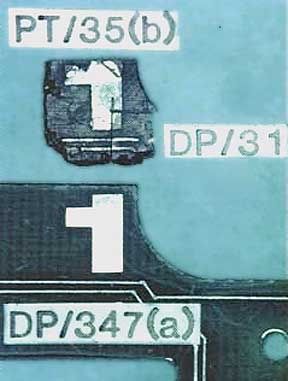
One of the key forensic clues that pointed to Libyan orchestration in the Lockerbie investigation was a small piece of circuit board from a specific model of timer called MST-13, a very special product of Swiss firm Mebo. The remnant was recorded as being first discovered by RARDE scientist Dr. Thomas Hayes in May 1989, within a previously logged, explosion-damaged piece of cloth. This "fragment of green circuit board" was deemed to be from within the bomb-radio that ruptured the plane (radio case and user's manual debris was also found in the same piece of cloth).
It took another year from that point for American FBI special agent James "Tom" Thuman to match it up with a CIA-held sample of a MST-13 confiscated from Libyan agents.From there the manufacturer, Mebo ltd. of Zurich Switzerland, was decided and contacted. Sure enough, they sold 20 of these units - the only 20 ever made - to Libyan intelligence JSO in the mid-1980s. Mebo founders Meister and Bollier became prime prosecution witnesses as "JSO agent" Megrahi, who had separate connections to Mebo, by the way, was decided to have held a bomb containing one of these, and sent it off to PA103 on December 21 1988.
Problems with the Evidence
The problems with this fragment are absolutely epic.
1) discovery discrepancies
First there are controversies with the discovery and labeling of damaged shirt collar PI/995, most notably "Cloth (charred) being written over with "Debris (charred)." This may or may not be a clue, but is covered in the post PI/995 Label Issues
Dr. Hayes' notebook page 51: On this apparently backdated page, Hayes tells how the various radio materials were separated out and "raised" as PT/35, "assorted materials recovered from damaged clothing PI/995," with the timer fragment raised as (b) of that set.
See: PT/35(b) Papers, Photos, details
2) Handling of evidence
Various reasons have been given for the lack of explosive residue testing carried out on the fragment. Its small size, the relative cost and effort involved, the obvious explosion involvement (it was found inside bomb damaged clothes) have all been cited. Having skimmed Alan Feraday's testimony in 2000, it seems a nexus of all three convinced him not to bother.
The fragment's movements to Germany (forensic cutting), and US (comparison to a CIA model, done by agent Thurman), were not properly documented. This seems to me a fairly minor point, but to some others, it's seemed a big deal, so perhaps it is.
(more forthcoming in this section)
3) Illogical timing for a timer
A fairly obvious tactical problem arises with the Anglo-American answer. The Libyans were thought to be hiding their role, not broadcasting it, yet the clues like the timer were found in the hills of Scotland. If a flexible timer was used to target PA103, and its schedule would be known, and they had a several hour window over the Atlantic, why not bury the evidence at sea and prevent such finds?
The delayed-flight theory so widely cited simply doesn't cut it. PA103 was off only about 15 minutes behind schedule, depending how one defines it. It was at least that far short of the coastline (probably more like 30 min, by planned flight path) at detonation. This would meaning the alleged planners had deliberately set the timer for just short of the coastline. Even if they meant to aim right at the shore or a bit past, considering further possible delays at London or anywhere, prevailing easterly winds in the area, and that the best bomb evidence would scatter first and farthest, this would not count as an attempt at burial at sea. Setting the timer for 7:03 PM instead of, say, midnight, was an a major blunder. They either failed to realize any evidence would survive, or they wanted to get caught.
Or...
4) Risky for Libyans
The MST-13 had been encountered at least twice by the CIA, both times in Africa, and it had been classified as coming from Libyan intelligence. (another post I've been meaning to do for months). The Libyan authorities likely knew this, or at least that some of their hardware was unaccounted for. There were supposedly only 20 of these things on the planet, highly specialized and incredibly traceable back to them. So they decided to use one in this bombing they've planned over Scotland. Indeed, knowing their own technology was likely known, with a world of other options, they used the MST-13 and set it so early that any surviving fragment would fall to rare earth rather than anywhere on the enormous Atlantic Ocean.
Or...
5) Unlikely to Exist if Genuine
The first and foremost point this blog supports about PT/35(b) is that, given the official explosion of at least 450 grams of Semtex-H set less than two inches from the timer, a piece so big (1cm sq) is highly unlikely to have survived. Simple common sense was recently backed up by repeated tests by explosives expert Dr. John Wyatt. (see IED fragment survivability tests and this follow-up with more detail)
The fact that it turned up itself indicates PT/35(b) was planted outright. If the bomb had put it there, it'd be in unreadable slivers or dust. This conclusion is obviously controversial within the skeptic community, but I see no reason to dispute what Dr. Wyatt says he's found.
The investigators say nothing on the issue except, implicitly, that they do believe it's from the bombing. Obviously. If it's a statistical miracle, well, they'll claim that as their natural right. There are many other "miracles" in this case.
Or, if it's not a miracle...
6) Most Recognizable Part of the MST-13
That the miraculous surviving bit would also be just the corner of the board with a meaningful symbol (the number one, and double-underlined at that), sttill readable and making it astonishingly recognizable, must rank as a further bizarre coincidence.
Or...
7) Mebo, the board's makers
After providing useful evidence against the accused, while asking for money, Mebo co-founder Edwin Bollier has turned over a new leaf and is now pushing his own implausible version of a frame-up of Megrahi. His most qualified area, the alleged MST-13 fragment, he disputes with charges of substitution of one planted MST-13 fragment with a nearly exact duplicate, apparently based in part on being color-blind. Naturally, this hasn't gone much of anywhere, despite the ridiculous affidavit his subordinate swore to that effect (see link).
Back-Up Arguments Addressed
Other sources besides Libya
Some have argued that Mebo had also supplied MST-13 boards to the East German Stasi. And the Stasi sometimes supplied terrorists, like maybe the PFLP-GC, who seem to have been involved in Lockerbie. That's quite a stretch for a few reasons. One, the allegation of a Stasi MST-13 link is based on things said by Bollier, who's not reliable. Second, even that only has two handmade prototypes delivered, on brown board. For the green machine-milled one we see, the Stasi would have to have made their own copies first. Third, the issues of timing relative to the ocean, as addressed above, apply to anyone using a flexible timer like this. And the question of fragment survivability is the same.
It says Libya and that's it
Don't be stupid. Review the above. It's bad evidence. It's key to the case. That's a bad case.
Showing posts with label Lumpert. Show all posts
PT/35(b): Altered but Not Swapped
Adam Larson / Caustic Logic
First posted October 21 2009
Edited and re-posted March 8 2010
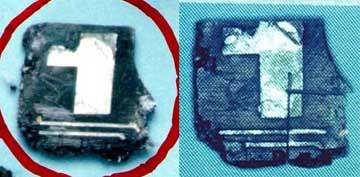
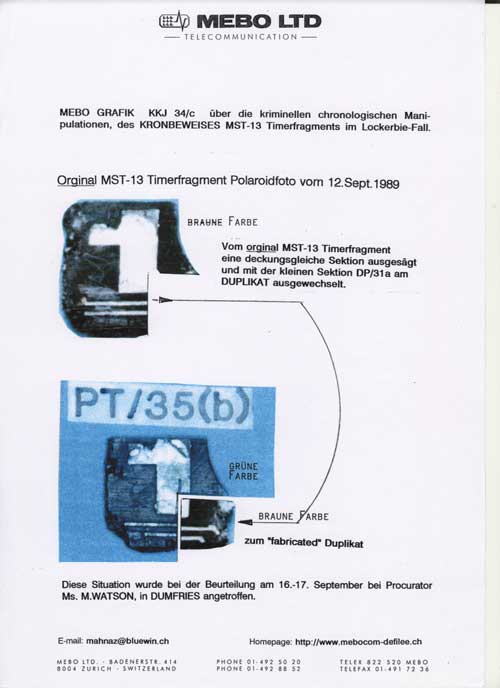
I turn my attention to false or dubious claims pushed by MEBO co-founder Edwin Bollier about the timer fragment PT/35(b) being changed or swapped-out after its discovery. His claims on the board being different colors at different times are too convoluted to fully explore here, but Bollier has been swearing lately that a brown prototype handed to Swiss authorities had been used as the evidence, somehow clearly visible in the first known photograph from 1989 (left), while the later photo (mid-1990, right) of an altered PT35(b) are of a replacement green board.
The MTS-13’s designer at Mebo, Ulrich Lumpert (alt Uelli Lumpart), apparently spawned this with his 2007 affidavit, by which he handed the brown board over to Swiss investigators who in turn gave it to SCOTBOM, who used it as evidence. The official story is of course that it’s always been the same green fragment they found in the wreckage of 103.
It is true that green here seems to mean blue, and the later photo is more blue than the first. However, this (as I found it online) shows clear signs of photo-tinting (blue ink on blue paper?) and once corrected, the color matches up quite well with the original – dark muted green-gray, like a green/blue board that had been burnt. It does seem possible some of the carbonized surface material has been cleaned off in the latter view, but otherwise there is no hint of brown I can see in either of these photos, and no color-based sign of meaningful alteration or replacement.
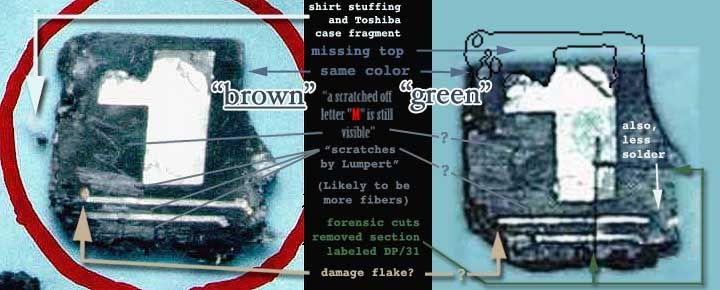
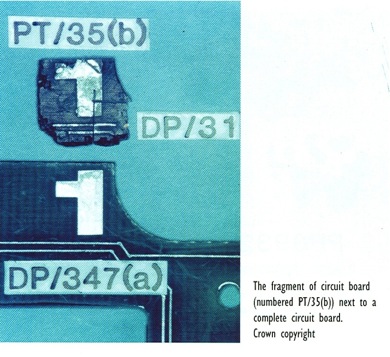
Considering comparison photos of PT/35(b) alongside an intact model board (links above), There are allegations of the curved edge not matching or the “1” touchpad and its relation to the “true edge” differing. But when the outlines are superimposed to scale (right), we find a perfect fit presuming the fragment is missing a sliver off the top. And here we can see a difference with the first photos and later ones – the top is present at first, giving it the right curve of an intact board. Later, it’s gone. Two prominent cuts at right angles also appear, apparently part of forensic examination carried out so controversially in Munich, to check the board’s layering style. This apparently severed a corner piece, put back in place and displayed as separate evidence item DP/31. But the removed top is not so displayed. It’s reasonable to surmise this tiny section – app. 1cm by 1/8cm – was simply ground off to get a profile, but mysteries remain... It's not clear how many layers were really found, but as it appears a green machine-made board, I'm guessing nine.
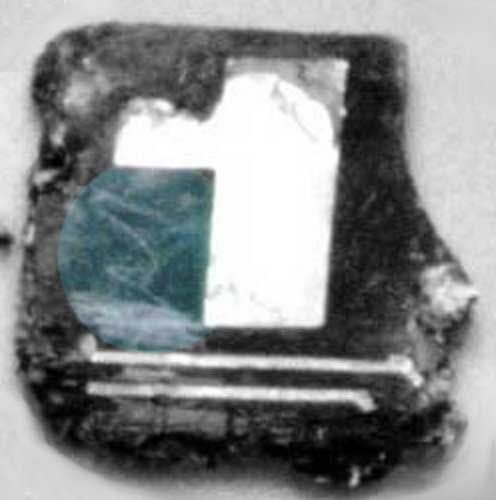
Among Mebo the clown’s most enthusiastic claims of proven forgery is how “the letter "M" was carved into” the original “brown” item sideways next to the touch pad, while “in the duplicate no. PT/35(b) (fake) it can be clearly seen that no letter “M” was carved into it!” Lumpert mentioned but disowned this in his affidavit: “I had nothing to do with the letter "M" (possibly an abbreviation of Muster 'sample'), which appears." To true scale (at left), this tiny M seems strangely small to use as a marking, nestled in next to the “1.” In reality, as JREF forum member Ambrosia showed with the enhancement below, the M casts a faint but visible shadow, and would seem to be a 3-D object, a tiny ziggy fiber of presumably shirt stitching.

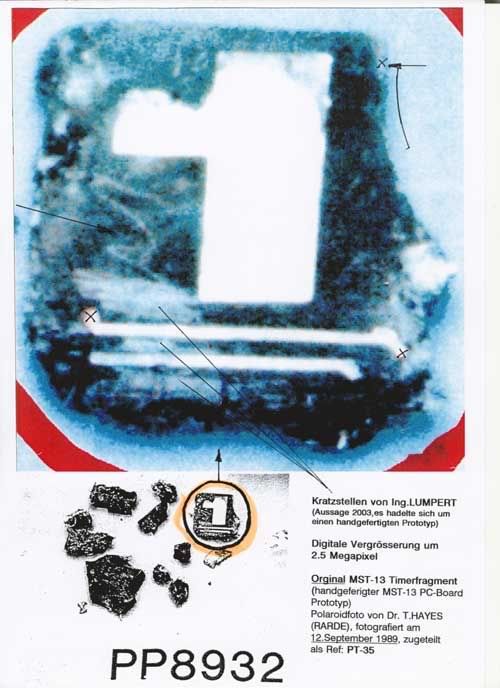
Beneath this alleged etching are three small light patches bracketing the solder lines, visible above. Of these Lumpert said “I clearly recognize the scratched remnants of the soldering tracts on this enlarged digital police photograph.” A poster available online shows a blowup with German text, perhaps based on something, labeling these as “Kratzstellen von Ing Lumpert,” scratches by Lumpert. That any villains would have chosen to cut out and display as evidence just the small corner that Lumpert had marked with random micro-abrasions and could identify raises some questions.
What exactly these really are is a minor mystery – perhaps more fibers of a different kind snagged on the solder. Whatever they are they’re as gone later as the M – either the political engineers sanded these off or painted them over, or replaced the board down to he tiniest details except for these scratches, as alleged by recent Mebo pages, or they were some inconsequential surface debris since removed.
And for a preview of what lies at the bottom of this rabbit hole, realize Bollier's claiming a green replacement for a brown original fake of an alleged green Libyan timer; A 'technical report' commissioned on actual graph paper suggests for no reason I can fathom the final PT/35(b) photo is of the green replacement except the corner DP/31, which is actually a matching corner from the original Lumpert-supplied brown fake! And they didn't even use the corner with the irreplaceable "M!" (lower right corner of right view below - the part that's the same blue/green as the rest).

So to summarize, as the graphic above pretty well does, the verifiable changes were the removal of surface debris, perhaps removal of some of the charred layer, loss of a small bit of solder, an apparent flake of damaged plastic (tan under-layer?), minor changes to the touch pad surface, and the obvious cuts and/or grinding to the board consistent with cross-section analysis. Nothing else about it changed, and there’s no evidence that anything misleading was done with this after its initial fraudulent insertion into the evidence chain.
Did everyone catch that? Don’t get distracted, then, is the main point here. There are still intelligent questions to ask.
First posted October 21 2009
Edited and re-posted March 8 2010
The MTS-13’s designer at Mebo, Ulrich Lumpert (alt Uelli Lumpart), apparently spawned this with his 2007 affidavit, by which he handed the brown board over to Swiss investigators who in turn gave it to SCOTBOM, who used it as evidence. The official story is of course that it’s always been the same green fragment they found in the wreckage of 103.
It is true that green here seems to mean blue, and the later photo is more blue than the first. However, this (as I found it online) shows clear signs of photo-tinting (blue ink on blue paper?) and once corrected, the color matches up quite well with the original – dark muted green-gray, like a green/blue board that had been burnt. It does seem possible some of the carbonized surface material has been cleaned off in the latter view, but otherwise there is no hint of brown I can see in either of these photos, and no color-based sign of meaningful alteration or replacement.
Beneath this alleged etching are three small light patches bracketing the solder lines, visible above. Of these Lumpert said “I clearly recognize the scratched remnants of the soldering tracts on this enlarged digital police photograph.” A poster available online shows a blowup with German text, perhaps based on something, labeling these as “Kratzstellen von Ing Lumpert,” scratches by Lumpert. That any villains would have chosen to cut out and display as evidence just the small corner that Lumpert had marked with random micro-abrasions and could identify raises some questions.
What exactly these really are is a minor mystery – perhaps more fibers of a different kind snagged on the solder. Whatever they are they’re as gone later as the M – either the political engineers sanded these off or painted them over, or replaced the board down to he tiniest details except for these scratches, as alleged by recent Mebo pages, or they were some inconsequential surface debris since removed.
And for a preview of what lies at the bottom of this rabbit hole, realize Bollier's claiming a green replacement for a brown original fake of an alleged green Libyan timer; A 'technical report' commissioned on actual graph paper suggests for no reason I can fathom the final PT/35(b) photo is of the green replacement except the corner DP/31, which is actually a matching corner from the original Lumpert-supplied brown fake! And they didn't even use the corner with the irreplaceable "M!" (lower right corner of right view below - the part that's the same blue/green as the rest).
So to summarize, as the graphic above pretty well does, the verifiable changes were the removal of surface debris, perhaps removal of some of the charred layer, loss of a small bit of solder, an apparent flake of damaged plastic (tan under-layer?), minor changes to the touch pad surface, and the obvious cuts and/or grinding to the board consistent with cross-section analysis. Nothing else about it changed, and there’s no evidence that anything misleading was done with this after its initial fraudulent insertion into the evidence chain.
Did everyone catch that? Don’t get distracted, then, is the main point here. There are still intelligent questions to ask.
Subscribe to:
Posts (Atom)