Showing posts with label Fhimah LK. Show all posts

Abdusamad on Malta

"The Biggest Lie" They Could Find
8 November 2010
last edits 14 Nov

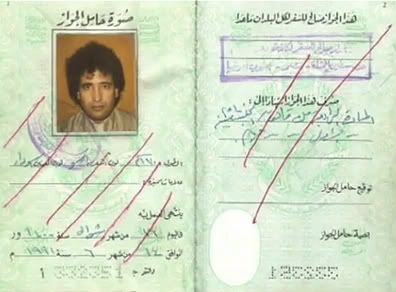
It's no longer a secret that "Lockerbie bomber" Abdelbaset Ali al Megrahi was on the island nation of Malta on 20 and 21 December, 1988. But his passing through Luqa airport there on the morning of the bombing of Pan Am 103 was a secret at the time, since he was traveling under a false identity created by the Libyan government - Ahmed Khlaifa Abdusamad. (see passport below).

We can thus presume that Megrahi was on a secret mission of some sort, on behalf of Tripoli, and likely something illegal. No one can be certain just what his mission was, and there's been to this day no satisfactory explanation from the Libyan side.

It's not sure just who first learned that Abdusamad and Megrahi were the same person, nor when this happened. But if it was found out early enough, and by the CIA, it could well have been the deciding factor to drag the Libyan into the spotlight of suspicion, his hated nation training behind.

In their 2001 Opinion of the Court accompanying Megrahi's conviction, the Zeist judges explain the false identity's origin and early use:
On 15 June 1987 the first accused was issued with a passport with an expiry date of 14 June 1991 by the Libyan passport authority at the request of the ESO who supplied the details to be included. The name on the passport was Ahmed Khalifa Abdusamad. Such a passport was known as a coded passport.  There was no evidence as to why this passport was issued to him. It was used by the first accused on a visit to Nigeria in August 1987, returning to Tripoli via Zurich and Malta, travelling at least between Zurich and Tripoli on the same flights as Nassr Ashur who was also travelling on a coded passport. It was also used during 1987 for visits to Ethiopia, Saudi Arabia and Cyprus.  [paragraph 87]
The earlier indictments of Megrahi and Fhimah, issued November 1991, gave different uses of the identity. On 22 August, 1987, "Abdusamad" flew from Zurich to Malta, stayed at the Holiday Inn there, and returned to Tripoli the next day. This trip was made "along with the said Nassr Ashur, who was then using a passport in the false name and using the false identity of Nassr Ahmed Salem." [points (e) (m)]

And then after a long break, he went out as Abdusamad only once in 1988 - on 20 December, when he flew with Fhimah from Tripoli to Malta, and again the next morning for the return trip, this time with Mohammed Abouagela Masud. [point (p)] The Zesit judges agreed that "the only use of this passport in 1988 was for an overnight visit to Malta on 20/21 December, and it was never used again." [para 87]

A supposedly key piece of evidence for Megrahi's guilt occurred only some days after the 14 November public announcement of the indictments. In a November 1991 interview with Pierre Salinger (I can't pin down the date), Megrahi denied being Abdusamad or being on Malta the day of the bombing. This was presented, for one, in the recent STV documentary Lockerbie Bomber: Sent Home To Die [23:18]
"You accuse me falsely. ... On 20 December and 21, at that time I wasn't there. Believe me, I was here in Tripoli with my family."
The editors had FBI lead investigator Richard Marquise follow the clip by saying "I realize that being a liar doesn't make you a terrorist murderer. But I think, again, it adds credibility to all the other factors that we led up to at that point." And Marquise is quick to offer up this lie, as one of his two or three points, nearly every chance he gets. This repeat play is itself a sign that he knows "all the other factors" need all the help they can get. At least once, he's called this "the biggest lie" the Libyan had told.
Megrahi denied being a member of the Libyan Intelligence Service; he did not know Abdusamad; and he did not know MEBO. All were proven at trial to be lies. However, his biggest lie was his claim that on December 20-21 he had not been in Malta: "I was here in Tripoli with my family believe me." Why should anyone believe any of his claims today after his lies in 1991? [source]
This early repudiation has been a verbal rope used by Marquise and many others, time and again over the years, to tie Megrahi to the bombing. In retrospect, he should probably have come clean as much as possible, but bare days after the shocking announcement, and revelation of his secret presence, that didn't happen. It seems cover-up won, at least for a moment. Perhaps it was reflexive on Megrahi's part, not grasping the reality of the charges against him, or a firm order from callous superiors despite Megrahi's own pleas. Either way, it was an unfortunate move on the part of the accused to say these words to a watching world, and one of the few things he actually did that contributed to his conviction.

The Zeist judges, considering in 2000 and 2001, referred to the 1991 interview in lieu of live testimony, which both accused declined to offer (they felt it was wiser to let the lawyers do the talking henceforth). Referring to the crucial visit, the judges mused:
It is possible to infer that this visit under a false name ... was a visit connected with the planting of the [explosive] device. Had there been any innocent explanation for this visit, obviously this inference could not be drawn. The only explanation that appeared in the evidence was contained in his interview with Mr Salinger, when he denied visiting Malta at that time and denied using the name Abdusamad or having had a passport in that name. Again, we do not accept his denial. [paragraph 88]
He was of course no longer denying his presence at the time, his representatives having surrendered to the Crown the passport with his photo and stamped 20 December, Malta. But Megrahi's, his counsel's, and his government's continued silence over this mission, presumably not bombing-related, allowed this inference that it was bombing-related to be possible (or does simple imagination do that? See comments below).

Besides pretending to genius status for rejecting a moot denial made to someone else a decade ago, the judges managed to bolster it with the other weak points to collectively sort-of-justify saying "guilty." An act of imagination, and otherwise it was down to the evidence that he actually was planning a bombing at the time.

And it's this class of clues, as Mr. Marquise likely knows, that needs some help. He called on the same imaginative reading of "Abdusamad" as support for the evidentiary case. But in reality there's much to suggest the oppposite - the hard evidence may have been planted and bribed into being in order to support the fabricated case against that suspicious-looking Megrahi and his false passport.

"Take Taggs From Air Malta"

The Case Against Fhimah, part one
May 30 2010

edits June 5

Everyone who accepts Abdelbaset Ali al Megrahi's guilt for the PA103 bombing agrees he couldn't have acted alone. Speculation runs primarily upward to Col. Gaddafi, but also sidewise to his imagined ground level accomplices. Only one was ever clearly fingered, originally as a JSO (Libyan intelligence) operative: Lamin Khalifah Fhimah. It was decided he was working with Libyan Arab Airlines at Malta’s Luqa airport only as cover for his JSO plotting with Megrahi on Malta.

The 1991 indictments against both accused are based on Fhimah penetrating the airport system, up to and including getting the bomb case onto Air Malt flight KM180. As of the 2000 trial, the final Opinion of the Court says, “the Crown no longer suggest that the second accused was a member of the Libyan Intelligence Service,” though his LAA "cover" employment was still acknowledged. Aside from this curious reversal, the Crown maintained a string of “inferences” regarding Fhimah’s December 1988 activity. The Zeist judges considered these claims and rightly dismissed them as “speculation rather than inference.”

These supporting points will be dealt with separately, with this article focused on what the judges called “the principal piece of evidence against [Fhimah],” being the clues read from “two entries in his 1988 diary.” One of these pages is shown below.

It was in April 1991 that Scottish police retrieved Fhimah’s work diary “from the offices of Medtours, a company which had been set up by the second accused and Mr Vassallo.” with the best quote miners around, the investigation managed to glean these two entries, described in the final opinion's paragraph 84:
At the back of the diary there were two pages of numbered notes. The fourteenth item on one page is translated as “Take/collect tags from the airport (Abdulbaset/Abdussalam)”. The word ‘tags’ was written in English, the remainder in Arabic.

On the diary page for 15 December there was an entry, preceded by an asterisk, “Take taggs from Air Malta”, and at the end of that entry in a different coloured ink “OK”. Again the word ‘taggs’ (sic) was in English.
These were taken as a careless plotter jotting down clues of his plot in a diary he kept. He even wrote “tags” in English lettering to make sure the Brits he was targeting could come back and read it easily. The judges explain further:
The Crown maintained that the inference to be drawn from these entries was that the second accused had obtained Air Malta interline tags for the first accused, and that as an airline employee he must have known that the only purpose for which they would be required was to enable an unaccompanied bag to be placed on an aircraft.
The three Scottish judges rightly dismissed the bolded assertion: "it would be going too far to infer that he was necessarily aware that they were to be used for the purpose of blowing up anaircraft." Finally, they summarized their opinion on this evidence and inferences in paragraph 85:
There is no doubt that the second accused did make the entries in the diary to which we have referred. In the context of the explosive device being placed on KM180 at Luqa in a suitcase which must have had attached to it an interline tag to enable it to pass eventually on to PA103, these entries can easily be seen to have a sinister connotation, particularly in the complete absence of any form of explanation.
[…]
Had it been necessary to resolve this matter, we would have found it a difficult problem.
However due to a lack of any single clear outside clue, they could not read much into it. Giaka had stories, but the judges didn’t believe them, and otherwise it was nothing but Crown speculation:
While therefore there may well be a sinister inference to be drawn from the diary entries, we have come to the conclusion that there is insufficient other acceptable evidence to support or confirm such an inference, […] In these circumstances the second accused falls to be acquitted.
If the judges had sufficient clues before forcing them back to consider these entries, it sounds like they could well have accepted his guilt; they cite the entries as fairly suspicious given the “absence of any form of explanation.” But that’s a silly thing to expect – these are quick notes by Fhimah to Fhimah, to access his own brain. Of course he’s not going to explain the background of each note.

But some clues could be gathered by snooping around a bit, as famed reporter Ed Bradley did for a 60 Minutes segment in 1999 [transcript]. After explaining the supposed importance of the diary entries, and covering the lack of evidence for any suspicious suitcase coming from Malta, Bradley returned to those odd entries.
People here who knew Fhimah say he wanted to get his airline’s [Libyan Arab Airlines] baggage tags printed in Malta for less than it cost to print them in Libya. That way he could make a commission on the deal. They say he wanted the Air Malta tags as a sample to show the printer. And there are other notations in this diary that support that story. On December 10th Fhimah wrote “go to the printer.” Another note in the back of the diary says “contact the printer.”
It’s not jotted down right next to his alleged slip-up, but the non-terrorist explanation is to be found. The unusual lettering might suggest he was going to an English-speaking printer on Malta (Maltese and English are the official languages there). This distinct possibility lessens the clarity and importance of the central alleged clue. The other supporting guesses were weaker yet as evidence, and clearly it was no mere technicality that Fhimah was acquitted. There really was “no case to answer” as he plead. A little known fact is that Scots law allows judges three rulings: guilty, not guilty, and not proven (meaning likely guilty but not clear enough to say so). The judges chose the clearer statement “not guilty.”

And if Megrahi’s necessary airside accomplice were truly innocent of the charges, that leaves us with nothing but speculation as to who did assist the bomber. Because Megrahi couldn’t have acted alone, if he acted at all.

A Three-Year Test Drive, Parked 8 Years, and then a High-Speed Crash, pt 1

A.M. GIAKA'S SKELETON OF FANTASY 
written January 22 2010
re-posted September 20 


 Note: what follows is the first half of a looong working essay I just had to see up even before it's done. It covers from Giaka's defection to the start of trial preparations in 1999. Part two will be long-delayed, but will call on Giaka's direct testimony via trial transcripts. This was previously (also) posted at a separate blog. 


A Missing Link
Among the sources collecting the evidence against Abdelbaset al Megrahi (and/or his accused accomplice Lamin Fhimah), most mention the same three “keys to the solution of the case” given by the FBI’s lead investigator on the SCOTBOM case, Richard Marquise, in his 2006 book. He gives these as Tony Gauci, “the Mebo chip,” and the souvenir printout of the Frankfurt luggage records taken by Bogomiras Erac, which was strangely “the only record” anyone could find of this vital information. [Marquise p 210] There are other peripheral clues of importance, but few with the resonance, clarity, and specificity of these three as indicators of Libya’s guilt, via the two accused.

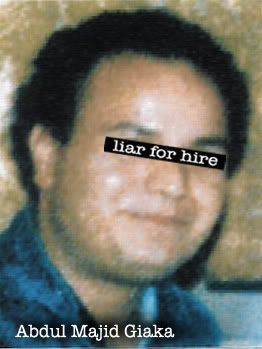
 But missing from such formulations is a fourth and most important key – Abdul Majid Giaka [different spellings have been used], a Libyan intelligence defector turned intelligence asset for the U.S. side of the investigation. In fact, in coming on board four months before the Lockerbie bombing, Giaka’s connections with Malta, Luga Airport, and Libyan intelligence put him in a prime position to be the first to mention both accused - to his CIA handlers - in the first place. The majority of everything he said has by now been discredited and shown to be fabrication – at best enabled and at worst demanded by his American friends.

Giaka’s intelligence was transformed to evidence with some CIA/FBI alchemy, tying several loose ends together and, in essence, providing the skeleton for the ‘Libyan villains’ case to stand on. The defector’s tales underpinned the US/UK joint indictment, the years-long extradition wrangle, and was finally brought as far as the Scottish Court as Camp Zeist in 2000. But as we’ll see, it went no further and has been mentioned as little as possible since.

Effective Defector Detected
Abdul Majid started this journey as a self-described disaffected Libyan perturbed by Tripoli’s terroristic ways and Gaddafi’s Masonic schemes. A low-level intelligence agent with the JSO, and stationed on Malta, he approached the US embassy there in August 1988 offering his services. Paul Foot’s seminal 2000 booklet Lockerbie: Flight From Justice explains how this started a “long series of meetings with American intelligence officials in Malta,” 41 secret meetings total, spanning almost three years from “September 1988, the same month he started getting regular payments from the CIA.” [Foot]

For $1,000 US per month, rising to $1,500, he wasn't a huge payback at first. “His information was patchy and unreliable,” Foot reported. “He pretended he was a senior official in the Libyan intelligence organisation JSO though in reality (as the Americans quickly realised) he was a former garage mechanic who helped to maintain JSO vehicles.” The BBC Conspiracy Files program in 2008 treated this subject fairly, and summed up “not so much double-oh-seven, more WD40.” [CF 44:20] He had however “graduated to the exalted position of assistant station manager for Libyan Arab Airlines,” Foot concedes, work carried out at Luqa International Airport, on the island's near-south side.

Giaka was given the code-name "puzzle piece" by his CIA handlers, [CF, 43:29] at least one which also worked at the airport, under cover as a baggage handler. [LTBU 8/29] The agent kept tabs on him, writing cables back to the CIA that named the subject in code as “P/1” (and referred to the JSO as ESO). P/1’s job there involved aircraft security, “but he is also obliged to assist ESO operatives transitting or on missions to Malta,” according to a copy shown on the Conspiracy Files. That’s a reasonably rich source for intel reports, but the agent noted Giaka “has been a “shirker” while in Malta, generally dodging ESO assignments since his Luqa appointment.” [CF 44:12]

Whatever the defector’s shortfalls, in October 1988 he reported his first big lead – Lamin Fhimah, a “JSO agent” also working at the airport, kept eight pounds of TNT in a locked desk drawer of an office. Paul Foot again relates how two months later in December (whether before or after the Lockerbie bombing is unclear) “he was asked about the movements of JSO officials through Luqa airport. He replied that a man he regarded as a senior JSO officer, Abdelbasset Ali Mohamed Al Megrahi, had passed through Luqa airport on 7 December.” [Foot] The names may not have meant much at first among Giaka’s other intelligence, but as soon as investigators were willing to consider a Libyan link, and it was found that both were also present on Malta December 20, the eventual suspects were clearly on file and ready to drop in place even before 1988 had closed.

Giaka and America Rescue Each Other
By the beginning of September 1989 the investigation’s scope was narrowing in, of all places, on Malta. The oddly-delayed Frankfurt printout revealed in mid-August an unaccompanied bag from Malta had apparently gone onto PA103A. At the same time, the tattered Maltese clothes from inside that bag had led to Maltese shopkeeper Tony Gauci, who gave his first statement about the buyer on September 1. But Giaka was probably not told these things as, on September 4th Foot maintains, “his CIA handlers in Malta told Giaka he was “on trial” until the next New Year (1990).” [Foot]

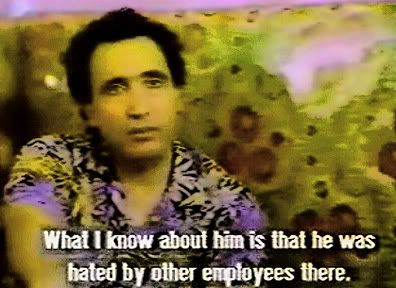
The informant likely grew nervous as his bridges to America became more precarious, his bridges on Malta stood burned, and his bridges back to Libya were threatening. The 1994 film The Maltese Double Cross featured interviews with both accused, who indeed knew Giaka, at least in passing. Megrahi confirmed he did security work there, and “he was hated by other employees there.” Fhimah added “He behaved badly towards the employees working with us, in dealing with passengers. The Maltese airport authorities know this.” [MDC 1:28:10-1:31:28] Some bias might be expected of course, but others interviewed for the film vouched that he was irresponsible, a partier and amasser of debts. And he wasn’t going to be getting any more popular trying to sell intelligence to the CIA.

One anonymous Libyan related for the film how Giaka was put up for transfer at some point: “they asked him to return back to Libya because his contract finished, for his staying in Malta.” Apparently desperate to maintain his situation there and his possible ticket away from Libya, Giaka asked the CIA to pay for a surgery to injure his arm so he wouldn’t be called away to serve in the Libyan Army. [Foot] They apparently consented and “after a few days,” the anomymous source said “[Giaka] came here after the hotel and he had a plaster on his hand” which he said was from falling down the stairs. This seemed to help him “get an extension of around three or four months to stay here.” [MDC 1:31:15]

By 1991, the regular cables were describing P/1 as “a shattered person” who “does not want to be part of the security apparatus and is certainly milking any of his contacts, including us, for whatever he can get.” [NYT] The Americans were ready to milk back - the fruit was ripe and dripping with urgent ‘get-me-outta-here’ intel possibilities. Perhaps realizing that Giaka really was the best they were going to get, the decision was made by July 11, when the Department of Justice told Mr. Giaka they would “accept or reject him" as a witness "based on his response to their Inquiries,” which would be done at leisure within the United States. The very next day, Foot writes,
“Giaka, to his intense gratification, was taken off Malta by an American warship, and interrogated there by an FBI officer, Hal Hendershot. Before long he was safe in the US where he was later joined by his wife. He was paid a regular salary in exchange for constant interrogations by the CIA and the FBI. What he told them plainly satisfied them. In October, in conditions of great secrecy, he gave evidence to a US Grand Jury. The result, in November 1991, was a detailed indictment charging Megrahi and Fhimah with murder by planting a bomb in a suitcase on a flight from Malta to Frankfurt and thence to London – and the explosion over Lockerbie.” [Foot]
The World Dances to the Fantasist Tune (Played Real Loud) The United States government for this point forward until now, without interruption, has accepted the core of this indictment as unassailable truth. The findings of Libyan guilt via al Megrahi and Fhhimah and others not named, the findings found primarily in Giaka’s words, has been the basis of economic sanction, diplomatic pressures, approval of clandestine operations, public vilification of Libya allowing more of the same to pass, and so on.

Most of the world was rather surprised at the turn of events, running counter to all the old evidence that made more sense and involved no Libyans. And was, of course, highly inconvenient for the Americans. Naturally, suspicions of cover-up flourished, especially in the UK. This was primarily channeled into an intriguing “CIA drug-running” cluster of theories (which this author considers a huge distraction) that got its biggest boost with an April 1992 cover story in Time magazine.

A Department of State press release from the same month sought to counter growing confusion at home and abroad by calmly laying out the facts in a press release. The Suitcase itself, fairly non-descript and not directly accounted for anywhere in the luggage records of three airports, was prime evidence at the time, thanks to Giaka’s incredible contributions.
“Forensic analysis has identified the bag that contained the Pan Am 103 bomb as a brown, hard-sided Samsonite suitcase. The following evidence links Al-Megrahi and Fhimah to the suitcase: -- Al-Megrahi, traveling in alias, arrived in Valletta with Fhimah from Libya on the evening of 20 December 1988--the day before the bombing. Fhimah, the former manager of the LAA office in Valletta, retained full access to the airport. Al-Megrahi and Fhimah brought a large, brown hard-sided Samsonite suitcase with them into Malta on that occasion.” [DoS]
They make it sound like the Fact they had such a suitcase is evidence they planted the bomb, but in reality, Giaka’s intelligence was the only evidence they had such a suitcase. This emerges chronologically, below. That his stories wound up matching the emerging evidence at the scene is highly troubling – the similarities are from neither truth (as we’ll see) nor likely from coincidence. It seems Mr P/1 served as a two-way intelligence conduit - milking the CIA so they could re-milk him – helping them launder propaganda into intelligence and, via FBI acceptance of that, into evidence ready for trial.


The top man who promoted Giaka as evidence, and the most likely to be fully aware of such unethical activities, would have been Vincent Cannistraro, senior director of the CIA’s own Lockerbie investigation until October 1990 [Ashton] . He continued promoting the story line he'd helped write in the years between indictment and trial. For a 1995 BBC program, he described the case modestly as:
“… overwhelming … conclusive … tremendous amount of evidence … mind boggling amount of detail … that will allow the prosecutors to present the chronology of the operation from its very inception … describe and in almost excruciating detail exactly how they made the bomb, how they secreted it, how they got it on board the aircraft, and I think that's a fairly strong case.” [FS]
His favorite part that he singled out for emphasis in that interview was “they have a live witness for one thing, who would be presented in a court of law.” [FS] Cannistraro bravely spoke to The Maltese Double Cross, again pimping Giaka, just not yet by name: “a former member of the Libyan Intelligence Service who has defected” into Justice Department witness protection, “so he would be used in a trial of Fhimah and Megrahi.” [MDC, 1:28:25]

Such a trial was demanded, in the US or Scotland, based the much-hyped amazing case. The demand was repeated often, and with force, befitting a mighty nation’s drive for truth and justice for the 270 dead. Faced with such confidence, people and whole nations started falling for it. Those comprising the UN Security Council at the moment, in particular, were collectively convinced enough to enforce the indictment with sanctions.

In 1992 and 1993, Security Council resolutions 748 and 883 imposed and tightened embargoes, diplomatic restrictions, and various other punishments. Aircraft equipment and supplies in particular were squeezed on, putting al Megrahi to work on the gray market (the likely cause behind his "suspicious" Zurich office and Swiss bank account). It was under this prolonged duress that Libya eventually relented to a compromise solution. By late 1998 the framework of a trial was established, and in April 1999 the accused were flown to the special Scottish court in neutral Netherlands. Megrahi and Fhimah were arrested at “Camp Zeist” and set to await their trial. Sanctions were immediately suspended, under threat of re-enforcement.

All this was based on an alarming mass acceptance of the American/Scottish case, in turn largely built up on “accepting” Giaka’s intelligence as evidence. The suspects, the suitcase, the materials, the plans, and the evil behind the Pan Am 103 plot were all attested to by a desperate defector, in trade for a steady paycheck, a maimed hand, and a new life in America. It had all wowed the grand jury and secured the indictment, but now that Cannistraro’s dares had paid off, it would be challenged for once, and before the whole world at that. At stake were these claims, in "job resume" format. Most of these were unknown to the public at the time, but about to see the light of day:

 - Giaka’s own credentials/authority: JSO agent, high-level, secret files department – related to former King Idriss - hates Gaddafi - aware of Masonic plots between Libya and Malta.

 - Has a long-standing friendship with Ezzadin Hinshiri, director of the central security section, JSO (allegedly involved in buying the MST-13 timers as used in the bombing, including an order placed for 40 more just two days before the bombing!)

 - Long-standing friendship with Said Rashid, head of the operations section, JSO (also involved, allegedly, in timer acquisition and other wickedness)

 - Acquaintance with Abdullah Senussi, the head of operations administration for the JSO. (convicted in absentia in 1989 for using that role to blow up an airplane (not 103). Also, Gaddafi's brother-in-law.)

 – Can describe the high-level JSO connections of the accused – worked directly under the first accused – hated his boss - can testify to their movements at the airport – able to read clues from them, ranging from subtle to fictitious, revealing their plot.

 - Was asked by Said Rashid, in 1986, to write a report on whether a bomb cold be put on a British plane - had someone else look, who said yeah so he wrote the report saying so. The upper levels mulled the idea over...

 - Turned said report in via his boss, “Lockerbie bomber” Megrahi, who definitely saw it. Megrahi later mentioned the idea back to Giaka and said “don’t rush things.”

 - Can testify to Fhimah’s personal handling of explosives, in his desk, which were overseen by Megrahi, for the JSO.

 - Was invited to the final plotters’ meeting as Megrahi and Fhimah met at Luqa airport on the day of the Lockerbie bombing, with a suitcase just like the one that would do that explosion hours later, after having come in from Malta (other evidence covered that, obviously). That’s the clincher for sure.

 - Has defected safely from the murderous regime, after a grueling three-year initiation, and can therefore finally reveal the secrets he held of the devious, random, and surprisingly unselfconscious scheming that climaxed five miles above Scotland four days before Christmas. That - is - evil. Thank God they've got a witness who saw it all, ready to go before the judges...
 ---
Sources: [Ashton] http://www.copi.com/articles/lockerbie.html [CF] "The Conspiracy Files: Lockerbie." Prod/Dir Guy Smith, Ex Prod Sam Anstiss, Narr Caroline Catz. BBC Two. First Aired 31 August 2008. http://video.google.com/videoplay?docid=-327765978162851498&hl=en# [Foot] Foot, Paul, Lockerbie: Flight From Justice. Published 2000 by Private Eye. https://secure2.subscribeonline.co.uk/PEYE/digital_downloads.cfm [FS] Frontline Scotland: "Silence Over Lockerbie" Reporter: Shelley JofreProducer: Murdoch Rodgers. Aired 1995. Transcript accessed at: http://plane-truth.com/Aoude/geocities/silence.html [LTBU 8/29] Connelly, Clare. "Controversy Over CIA Cables Continues." 29 August 2000. Lockerbie Trial Briefing Unit. .doc link: http://www.gla.ac.uk/media/media_78571_en.doc [MDC] The Maltese Double Cross. Produced, written, and directed by Allan Francovich, Hemar Enterprises, November 1994. http://video.google.com/videoplay?docid=7160854996287567609&ei=EAtQS8iUNYOYqQPjnaka&q=Maltese+Double+Cross+&hl=en [Marquise] Marquise, Richard. SCOTBOM: Evidence and the Lockerbie Investigation, Algora Publishing. Sept. 1, 2006. 268 pages. http://books.google.com/books?id=JKLT360G_zAC&pg=PA119&lpg=PA119&dq=Marquise+SCOTBOM&source=bl&ots=WGsIBNTRDo&sig=ZkD5iwHr [NYT] McNeil, Donald, Jr. “Defense in Lockerbie Trial Undermines a Key Witness.” New York Times. September 28, 2000. Accessed at: http://plane-truth.com/Documents/Defense%20in%20Lockerbie%20Trial%20Undermines%20a%20Key%20Witness.htm

Star Witness Giaka

(incomplete - last edit 9 Nov 2010)

Basics and Prosecution Case
It seems the first faint outlines of the Megrahi/Fhimah plot "proven" at Camp Zeist was first sketched out by Libyan defector turned CIA/FBI informant/fabricator. Named Abdul Majid Giaka, he had first made contact with the CIA a few months before Lockerbie, and soon proved useful in pinning the blame on Libya. Giaka entered DoJ witness protection in mid-1991, and his evidence given to a grand jury a few months later sealed the deal for an indictment in mid-November, leading to UN sanctions, more sanctions, and later the Camp Zeist trial and Libya's "admission of responsibility."

There are plenty other sources out there on Giaka, but one of my own can be read here:
A Three-Year Test Drive, Parked 8 Years, and then a High-Speed Crash, pt 1 A detailed article I wrote in January, chronicling his emergence from a CIA informant to FBI witness.
I still haven't done part 2, which would cover his credibility being thrashed at trial in 2000. His own late-appearing fantastical stories and the CIA's embarrasing revealed admissions that they didn't trust him either both contributed to this. Nearly all his testimony was discarded, aside from his identifying Megrahi as an agent of Libya's JSO intelligence agency. The reason given for dismissing the "star witness" are essentially as follows:
"It is also in our view clear that whatever may have been his original reason for defection, his continued association with the American authorities was largely motivated by financial considerations. […] Information provided by a paid informer is always open to the criticism that it may be invented in order to justify payment, and in our view this is a case where such criticism is more than usually justified." [para 42]
And yet they seem to accept he was doing the inventing all on his own, or that no one else on the prosecution side had the same thought and just naively assumed his info was genuine. The judges seem to take in good faith that the Crown and its associates were not farming Giaka for framing Megrahi, and that no "Contempt of Court" had occurred in this probable con operation. The Judges' decision then considered the following evidence of most importance.

- They didn't even know about his $2 million payment from the Department of Justice, covered, along with payments to the Gaucis, in the post Rewards for Injustice, and covered better yet by "Rolfe" in the post Rewards and Bribery.

- The CIA's central role in framing al Megrahi centers on their use of Giaka, an issue explored in the essay "As the layers are peeled away..." The context there is former CIA personnell urging a "narrow" inquiry into Megrahi's release - nothing earlier than that should be looked at at all.

- A further unusual post collects the responses of many to Richard Marquise's lame insistence, in 2010, that Giaka was telling the truth.

FROM LOCKERBIE TO ZEIST (via Tripoli, Tunis and Cairo)

*Note: What follows is an article on the establishment of the Camp Zeist Trial written by Professor Robert Black. It was previously published in a Maltese book edited by Joe Mifsud - Lockerbie: Qabel il Verdet (Before the Verdict), released in 2000.  It was sent in to me by Robert Forrester, and with Prof. Black's express permission, here it is, and interesting broad-sweep view of a years-long campaign to implement the trial the Americans had been demanding. (- C.L. March 2 '10)*

FROM LOCKERBIE TO ZEIST 
(via Tripoli, Tunis and Cairo)
by
Robert Black QC
Professor of Scots Law
The University of Edinburgh

"Call the diet: Her Majesty's Advocate against Abdelbaset Ali Mohmed al-Megrahi and Al Amin Khalifa Fhima."  

It was with those words that on Wednesday 3 May 2000 the long-delayed Lockerbie trial opened in the High Court of Justiciary sitting at Kamp van Zeist near Utrecht in the Netherlands.  There were those who predicted that this trial would never take place and there were those who worked tirelessly, but ultimately unsuccessfully, to try to ensure that it would not.  My purpose in this paper is to give you an account of my part in attempting to secure, over some rather powerful opposition, that there would in fact be a trial.

The Event
On Wednesday, 21 December 1988 at 7:03 pm GMT a Boeing 747 airliner owned and operated by Pan American World Airlines and cruising at 31,000 feet exploded above the small town of Lockerbie.  Pan Am Flight 103 had taken off from London Heathrow some 38 minutes before and was en route to JFK Airport in New York.  Aboard the aircraft were 243 passengers and a crew of sixteen.  None survived.  The vast majority of those on board were United States citizens, but other nationalities represented included British, French, Israeli, Hungarian, Canadian, German, Spanish, Belgian and Norwegian. Although the disaster occurred only four days before Christmas and every other transatlantic flight was fully booked, this particular aircraft was more than one-third empty, only 243 out of 412 seats being occupied.

Debris from the explosion completely demolished three houses in Sherwood Crescent, a small street of privately owned detached houses, and eleven townspeople were killed instantly.

The Investigation
Within a week it had become apparent to the joint team of British and American investigators that this had been no accident and that the cause of the destruction of the aircraft had been a bomb.  There then followed the most extensive criminal investigation ever conducted in Scotland -- or, it seems probable, anywhere else -- into an act of terrorism.  The investigation was under the control of the Dumfries and Galloway police -- the smallest force in Scotland.  Also closely involved in the investigation were other United Kingdom police forces and personnel from the British, United States, and west German intelligence services.

Around and to the south of Lockerbie some 845 square miles of land were combed for debris.  Over a period of several years more than 15,000 people were questioned; information and evidence were sought in more than 30 different countries.  The aircraft had been some thirty minutes late in leaving Heathrow.  Had it been on schedule, the bomb (assuming that it was detonated by a timing mechanism) would have exploded over the Atlantic Ocean, sparing the town of Lockerbie but making investigation of the accident and recovery of physical evidence very much more difficult.

In mid-1990 it was reported (in the Washington Post and the London Times among other places) that sources within the US Central Intelligence Agency were indicating that the evidence pointed towards the atrocity's having been committed by Ahmed Jibril's Syrian-backed Popular Front for the Liberation of Palestine-General Command (PFLP-GC).  The theory was that this group had been commissioned and paid by Ayatollah Khomeini to destroy an American airliner in revenge for the American warship Vincennes shooting down in the Persian Gulf an Iranian Airbus containing pilgrims to Mecca on 3 July 1988 resulting in the death of all 290 people on board.

Libya Enters the Frame
It will therefore be appreciated that it came a something of a surprise when on 14 November 1991 the prosecution authorities in Scotland and the United States simultaneously announced that they had brought criminal charges against two named Libyan nationals who were alleged to be members, and to have been acting throughout as agents, of the Libyan intelligence service.

According to the Scottish and American prosecutors, what had happened was this.  The two Libyans had manufactured a bomb using a Toshiba cassette recorder, Semtex explosive and a digital electric timer (supplied and manufactured by a Swiss company, MeBo AG).  The device had been placed in a brown Samsonite suitcase in Malta, along with items of clothing purchased for the purpose from a particular shop (Mary's House) in Sliema.  Using stolen Air Malta luggage tags, the Libyans (one of whom had occupied the post of station manager for Libyan Arab Airlines in Malta) introduced the suitcase into Luqa  airport's inter-line baggage system as unaccompanied luggage on Air Malta Flight KM 180 from Malta to Frankfurt, with directions for its onward transmission (first) on to a feeder flight (PA  103A)  to Heathrow and (second) on to Pan Am Flight 103 from Heathrow to JFK in New York.

On 27 November 1991 the governments of the United Kingdom and the United States each issued a statement calling upon the Libyan government to hand over the two accused to either the Scottish or the American authorities for trial.  Requests for their extradition were transmitted to the government of Libya through diplomatic channels.  No extradition treaties are in force between Libya on the one hand and United Kingdom and the United States on the other.

Libyan internal law, in common with the laws of many countries in the world, does not permit the extradition of its own nationals for trial overseas.  The government of Libya accordingly contended that the affair should be resolved through the application of the provisions of a 1971 civil aviation Convention concluded in Montreal to which all three relevant governments are signatories.  That Convention provides that a state in whose territory persons accused of terrorist offences against aircraft are resident has a choice aut dedere aut judicare, either to hand over the accused for trial in the courts of the state bringing the accusation or to take the necessary steps to have the accused brought to trial in its own domestic courts.  In purported compliance with the second of these options, the Libyan authorities arrested the two accused and appointed a Supreme Court judge as examining magistrate to consider the evidence and prepare the case against them.  Not surprisingly, perhaps, the UK and US governments refused to make available to the examining magistrate the evidence that they claimed to have amassed against the accused, who remained under house arrest until they were eventually handed over in April 1999 for trial at Kamp van Zeist.

The United Nations
The United Nations Security Council (of which the UK and the USA are, of course, permanent members) first became involved in the Lockerbie affair on 21 January 1992 when it passed Resolution 731 strongly deploring the government of Libya's lack of co-operation in the matter and urging it to respond to the British and American requests contained in their statements of 27 November 1991.  This was followed by Security Council Resolution 748 (31 March 1992)  requiring Libya to comply with the requests within a stipulated period of time, failing which a list of sanctions specified in the Resolution would be imposed.  Compliance was not forthcoming and sanctions (including trade and air transport embargos) duly came into effect in April 1992.  The range and application of these sanctions was  extended by a further Resolution passed on 11 November 1993.  The imposition of sanctions under these last two Resolutions was justified by the Security Council by reference to Chapter 7 of the Charter of the United Nations on the basis that Libya's failure to extradite the accused constituted a threat to world peace.

An Attempt to Resolve the Impasse
I first became involved in the Lockerbie affair in early 1993.  I was approached by representatives of a group of British businessmen whose desire to participate in major engineering works in Libya was being impeded by the UN sanctions.  They asked if I would be prepared to provide (on an unpaid basis) independent advice to the government of Libya on matters of Scottish criminal law,  procedure and evidence with a view (it was hoped) to persuading them that their two citizens would obtain a fair trial if they were to surrender themselves to the Scottish authorities.  This I agreed to do, and submitted material setting out the essentials of Scottish solemn criminal procedure and the various protections embodied in it for accused persons. 

In the light of this material, it was indicated to me that the Libyan government was satisfied regarding the fairness of a criminal trial in Scotland but that since Libyan law prevented the extradition of nationals for trial overseas, the ultimate decision on surrender for trial would have to be one taken voluntarily by the accused persons themselves, in consultation with their independent legal advisers.  For this purpose a meeting was convened in Tripoli in October 1993 of the international team of lawyers which had already been appointed to represent the accused.  This team consisted of lawyers from Scotland, England, Malta, Switzerland and the United States and was chaired by the principal Libyan lawyer for the accused, Dr Ibrahim Legwell.  The Libyan government asked me to be present in Tripoli while the team was meeting so that the government itself would have access to independent Scottish legal advice should the need arise.  However, the Libyan government expectation was clearly that the outcome of the meeting of the defence team would be a decision by the two accused voluntarily to agree to stand trial in Scotland.

I am able personally to testify to how much of a surprise and embarrassment it was to the Libyan government when the outcome of the meeting of the defence team was an announcement that the accused were not prepared to surrender themselves for trial in Scotland.  In the course of a private meeting that I had a day later with Dr Legwell, he explained to me that the primary reason for the unwillingness of the accused to stand trial in Scotland was their belief that, because of unprecedented pre-trial publicity over the years, a Scottish jury could not possibly bring to their consideration of the evidence in this case the degree of impartiality and open-mindedness that accused persons are entitled to expect and that a fair trial demands.  A secondary consideration was the issue of the physical security of the accused if the trial were to be held in Scotland.  Not that it was being contended that ravening mobs of enraged Scottish citizens would storm Barlinnie prison, seize the accused and string them up from the nearest lamp posts.  Rather, the fear was that they might be snatched by special forces of the United States, removed to America and put on trial there (or, like Lee Harvey Oswald, suffer an unfortunate accident before being put on trial).

 The Libyan government attitude remained, as it always had been, that they had no constitutional authority to hand their citizens over to the Scottish authorities for trial.  The question of voluntary surrender for trial was one for the accused and their legal advisers, and while the Libyan government would place no obstacles in the path of, and indeed would welcome, such a course of action, there was nothing that it could lawfully do to achieve it.

An Innocent Abroad
My journeys to and from Tripoli in October 1993 were interesting.  Because of UN sanctions, air travel to Tripoli was out of the question.  The normal procedure at that time was to fly from Europe to the nearest Tunisian airport on the holiday island of Djerba and then travel by car along the coast road to Tripoli, a frightening five-hour journey at the best of times but especially so when being driven at breakneck speed in a Libyan government black Mercedes whose driver clearly regarded it as the duty of every other road user to get out of the path of his vehicle and refused to concede even the possibility that any  road user, Tunisian or Libyan, might fail to do so. 

On my return journey I was unable to get a flight from Djerba to any European airport and so took an internal flight from Djerba to Tunis in the naive belief that flights to European destinations would be more frequent from the Tunisian capital.  On arrival in Tunis at 5pm I discovered that there were no further flights to any European destination that day.  I made a booking for an early flight to London the following morning and proceeded to try to find accommodation for the night.  It was only then that I discovered that a meeting of the Council of the PLO was taking place in Tunis and that there was accordingly not a single room to be had in any of the major hotels in the city.  Eventually, however, my taxi driver indicated that he had a friend who ran a small hotel and that he was sure that I would be able to find accommodation there.  He was indeed correct, though I suspect that I am the only guest in the history of the establishment who has ever paid for a room there other than by the hour.

The Neutral Venue Proposal
Having mulled over the concerns expressed to me by Dr Legwell in October 1993, I returned to Tripoli and on 10 January 1994 presented a letter to him suggesting a means of resolving the impasse created by the insistence of the governments of the United Kingdom and United States that the accused be surrendered for trial in Scotland or America and the adamant refusal of the accused to submit themselves for trial by jury in either of these countries.  This was a detailed proposal, but in essence its principal elements were: that a trial be held outside Scotland, ideally in the Netherlands, in which the governing law and procedure would be that followed in Scottish criminal trials on indictment but with this major alteration, namely that the jury of 15 persons which is a feature of that procedure be replaced by a panel of judges who would have the responsibility of deciding not only questions of law but also the ultimate question of whether the guilt of the accused had been established on the evidence beyond reasonable doubt.

In a letter to me dated 12 January 1994, Dr Legwell stated that he had consulted his clients,  that this scheme was wholly acceptable to them and that if it were implemented by the government of the United Kingdom the suspects would voluntarily surrender themselves for trial before a tribunal so constituted.  By a letter of the same date the Deputy Foreign Minister of Libya stated that his government approved of the proposal and would place no obstacles in the path of its two citizens should they elect to submit to trial under this scheme.

The UK Government's Initial Attitude
On my return to the United Kingdom I submitted the relevant documents to the Foreign Office in London and the Crown Office (the headquarters of the Scottish prosecution service) in Edinburgh.  Their immediate response was that this scheme was impossible, impracticable and inherently undesirable, with the clear implication that Professor Black had taken leave of what few senses nature had endowed him with. That remained the attitude of successive Lord Advocates and Foreign Secretaries for four years and seven months.  During this period the British government's stance remained consistent: United Nations Security Council Resolutions placed upon the government of Libya a binding international legal obligation to hand over the accused for trial to the UK or the US authorities.  Nothing else would do.  If Libyan law did not currently permit the extradition of its own nationals to stand trial overseas, then Libya should simply alter its law (and, if necessary, its Constitution) to enable it to fulfil its international duty.

Over the years British government sources put forward six specific objections to my proposal.  There was no merit in any of these objections, as I think I have conclusively demonstrated in an article published in November 1997: see “The Lockerbie Proposal”  1997 Scots Law Times (News) 304.

Delay
For almost five years successive governments of the United Kingdom (of both old Conservative and New Labour political persuasions) consistently and fervently maintained that the "neutral venue" scheme which I had proposed and which had been accepted by the Libyan government and defence lawyers in January 1994, was totally and absolutely unsatisfactory and could provide no resolution to the Lockerbie impasse.  For a flavour of the vehemence of  government opposition to the scheme, as recently as early 1998, reference may be made to the article by the then Lord Advocate,  Lord Hardie “The Lockerbie Trial” 1998 Scots Law Times (News) 9, to the statement made in the UN Security Council on 20 March 1998 by the UK Permanent Representative, Sir John Weston (see www.britain-info.org/bistext/ukmis/speeches/20mar98.stm) and to the  statement in the House of Commons on 29 April 1998 by Foreign Office Minister Derek Fatchett (see HC Hansard, 29/04/1998, cols 299-302).

President Nelson Mandela of South Africa expressed his strong support for the proposal during his attendance at the Commonwealth Heads of Government Conference in Edinburgh in October 1997.  But that seemed to cut no ice with Robin Cook, the new Foreign Secretary who, admittedly, probably had other more personal matters on his mind at the time.  

Not surprisingly, Libyan patience at the refusal of the United Kingdom and the United States even to contemplate the “neutral venue” solution eventually began to wear thin.

In April 1998 Dr Jim Swire (the spokesman for the relatives group UK Families Flight 103) and I had a meeting in Cairo with the Secretary-General of the League of Arab Nations, Dr Esmet Abdul Majid, and were informed that in the light of more than four years of British and American intransigence the Libyans were seriously considering announcing withdrawal of their support for the proposal.  It was suggested to us by Dr Majid that it might be appropriate for us, if we wished to avoid this outcome, to make yet another trip to Tripoli.  This we did, and in a meeting with Dr Ibrahim Legwell were assured that it remained the position of the suspects that they would surrender for trial if such a court were established.  It was the Libyan government that was apparently, because of British and American procrastination, having second thoughts about permitting its citizens to leave the country to stand trial voluntarily before such a tribunal. 

The Libyan Foreign Ministry committee, with whom all of my previous dealings had been, arranged for Dr Swire and me to have a meeting with Colonel Gaddafi and this took place on 20 April 1998 at his reinforced concrete tent on the outskirts of Tripoli.  The meeting was initially a frosty one, with the Colonel refusing to make eye contact but instead staring straight ahead with his arms folded and making lengthy pronouncements about the inflexibility and intransigence over more than four years of the British government.  When eventually he interrupted his monologue to take breath, we were able to dive in with comments to the effect that the Labour government had been in office for less than a year, was still finding its feet in foreign affairs and that it was possible to detect some signs that its position over the Lockerbie issue might just be somewhat more flexible than that of its Conservative predecessor.  Gaddafi then made a few highly complimentary remarks about Tony Blair, and the remainder of the meeting was held in a much more friendly atmosphere.  After about an hour, we departed with the reassurance that the Libyan government’s policy in relation to a “neutral venue” trial would remain unchanged for at least a further six months.  As we were leaving Gaddafi's compound the then Libyan Foreign Minister, Omar al-Muntasser, who had been present at the meeting, said to us: "You made the Leader laugh three times!  Someone will pay for that!"  I think he was joking.

The Volte-face
From about late July 1998, there began to be leaks from UK government sources to the effect that a policy change over Lockerbie was imminent, and on 24 August 1998 the governments of the United Kingdom and United States announced that they had reversed their stance on the matter of a "neutral venue" trial.  In a letter of that date to the Secretary-General of the United Nations, Kofi Annan, the British and American Acting Permanent Representatives to the UN stated:

 "....  in the interest of resolving this situation in a way which will allow justice to be done, our Governments are prepared, as an exceptional measure, to arrange for the two accused to be tried before a Scottish court sitting in the Netherlands.  After close consultation with the Government of the Kingdom of the Netherlands, we are pleased to confirm that the Government of the Kingdom of the Netherlands has agreed to facilitate arrangements for such a court.  It would be a Scottish court and would follow normal Scots law and procedure in every respect except for the replacement of the jury by a panel of three Scottish High Court judges.  The Scottish rules of evidence and procedure, and all the guarantees of fair trial provided by the law Scotland, would apply."

The details of the arrangement -- the fine print -- are to be found in two documents: a British Order in Council (SI 1998 No 2251), made on 16 September 1998, conferring the necessary legal authority for Scottish criminal proceedings against the two Libyan suspects to be conducted in the Netherlands, and an international agreement between the Government of the Kingdom of the Netherlands and the Government of the United Kingdom, concluded on 18 September 1998, making the diplomatic arrangements necessary for the "neutral venue" trial to take place.  The scheme set out in these two documents differs in detail from that which I proposed, and to which I had obtained Libyan assent, in January 1994; but the framework is the same.

Pitfalls along the Route
Although the British proposal was announced in late August 1998, it was not until 5 April 1999 that the two suspects actually arrived in the Netherlands for trial before the Scottish court.  Why the delay?  The answer is that some of the fine print in the two documents was capable of being interpreted, and was in fact interpreted, by the Libyan defence team and the Libyan government as having been deliberately designed to create pitfalls to entrap them.  And since the governments of the United Kingdom and United States resolutely refused to have any direct contact with either the Libyan government or the Libyan defence lawyers, these concerns could be dealt with only through an intermediary, namely the Secretary-General of the United Nations. 

Between 20 and 22 September 1998, Dr Swire and I were again in Tripoli and were able to provide to the Libyan government and the Libyan defence team a measure of reassurance regarding some of the issues that concerned them.  However, it was we  who (having received the information hot off the presses from a journalist in The Hague) had to inform the Libyan government that the chosen location in the Netherlands for trial was Kamp van Zeist, a former NATO base to which the air force of the United States still had extant treaty rights of access.  I anticipated that this information would cause the Libyans to renounce the "neutral venue" concept in high dudgeon and complain of the lack of good faith demonstrated by Her Majesty's Government in selecting, or agreeing to, such a site.  But they did not do so.  This, more than anything else, convinced me that the Libyan government and the Libyan defence lawyers genuinely wished a trial to take place and that the concerns they had expressed regarding details of the scheme now on offer were genuine concerns, not merely a colourable pretext for evading their earlier commitment to such a solution.

On 22 September we had a further meeting with the Leader of the Revolution.  On this occasion the meeting took place not in Tripoli but 400 kilometres to the east in a genuine (not reinforced concrete) Bedouin tent in a desert location inland from the town of Sirte.  Surrounded by sand dunes and noisily ruminating camels, Colonel Gaddafi, Dr Swire and I  discussed the details of the British scheme.  He accepted my assurance that at least some of the concerns that Libyan government lawyers had raised were unwarranted and that it would be worthwhile to continue to seek clarifications and reassurances through the office of the Secretary-General of the United Nations regarding the remaining issues. 

Incidentally, this meeting with Gaddafi was held on the day that President Clinton's deposition in the Monica Lewinsky case was televised.  In the course of the pleasantries that took place before we all got down to business, Gaddafi informed us that he had spent the morning watching the President's performance on CNN television.  What most shocked him, he said, was the revelation that on occasions while Miss Lewinsky was dutifully serving her President, the latter was speaking to foreign Heads of State on the telephone.    Gaddafi's comment  was that he thought that the President should have it cut off.

Conclusion
Although many within the governments of Britain and the United States and within the media were sceptical, the suspects did eventually, on 5 April 1999, surrender themselves for trial before the Scottish court at Kamp van Zeist.  That trial, after lengthy delays necessitated by the defence's need for adequate time to prepare, started on Wednesday 3 May 2000. 

I feel a distinct measure of pride in the part that I, a Lockerbie boy born and bred, and a simple professor of law, played in bringing it about.  I have reason to suspect, however, that my government feels  no  sense of gratitude towards me.   And I feel no pride whatsoever in the outcome of the proceedings.  The conviction of Abdelbaset al-Megrahi on the evidence led at the trial constitutes, in my view, a flagrant miscarriage of justice, and one that I hope to live to see rectified.

The Magnitude And Firstness of the Lockerbie Bombing

Adam Larson/Caustic Logic
March 9 2010
last edit March 10 2am


This post is for those too young to remember or too unclear or numbed to understand or feel the significance of the bombing of Pan Am 103 and the geopolitical maneuvers following it. At 7:00 PM on December 21, 1988, the darkest day of the year, Pan Am flight 103 was just reaching cruising altitude nearly six miles above southern Scotland. The Boeing 747 was carrying 243 passengers and a crew of sixteen, mostly returning home for Christmas. 38 minutes after they had left from London’s Heathrow airport to New York’s JFK, at a hair before 7:03, a bomb detonated in the forward cargo hold and ruptured the hull. What followed can best be understood by viewing this amazing and probably quite accurate animation:

Prior to the 9/11 attacks in New York and Washington, the bombing of Pan Am 103 had stood as the deadliest ever terrorist attack on American civilians, and it still holds a distant second place. 270 people died in the attack, 189 of them Americans, including many military service members, college students, and young children. Eleven residents of Lockerbie, Scotland were killed when the main part of the plane plowed into the Sherwood Crescent neighborhood.

What followed the crash was “the largest mass murder trial in British history,” first covering the 800 sq. miles of debris and later the global mazes of a cross-border plot. [NYT] Naturally, the Scottish police backed by the American FBI and other US and UK agencies led the investigation.

The responsible airline, Pan American Airways, had been until the 1980s an American giant of aviation, the World Trade Center of the skies. After Lockerbie, they were vilified, bankrupted and destroyed by a string of lawsuits filed over their egregious security breaches at Frankfurt Airport. This doesn’t even count the still unacknowledged security breach at Heathrow that allowed the bomb to slip onto PA103 there.

The actual perpetrators were also pursued; “Lockerbie was perhaps the first truly global terrorism investigation.” [Time] This gave American and British authorities more people than usual to tell how things are. Germany, Malta, Jordan, Switzerland, and Sweden especially had significant roles in forming or following the investigation’s course. This had led to Libya with the joint Scots-American indictments of al Megrahi and Fhimah in November 1991.

After that the case moved to another level and witnessed, in 1992, the United Nations Security Council demanding the two accused be handed over for trial in the U.S. Sanctions were imposed when the demand was (inevitably) refused. “This is the first time the Security Council has ever demanded the extradition of citizens of one country to stand trial in another or implicitly accused a member government of involvement in terrorism.” [NYT] When the two accused were eventually handed over in 1999 for a compromise trial the Americans had prevented for years, obviously it was the first time such a demand was honored.

Alan Gerson was involved with pressing lawsuits against Libya for victims’ families, wrote a book with Jerry Adler (The Price of Terror, 2001) that explained a massive first - the unprecedented rulings and Congressional act establishing that a “rogue state” like Libya was exempt from the coverage of the Foreign Sovereign Immunities Act, “a much bigger change than the families had ever sought, or perhaps needed.”
“Early on, Gerson and Zaid had intended merely to carve out the narrowest possible exception to the rule of sovereign immunity. […] they never sought to achieve a new world order based on the rule of law […] Instead the government got the FSIA amendment, which […] opened the doors for individuals to take on foreign governments for a much wider range of offenses, with consequences no one quite anticipated.” [p 295]
The way to suing foreign governments for alleged violence against Americans opened by these Lockerbie-led rulings has since been used in cases against Iran, Cuba, and other unloved nations, besides Libya.

The trial of Megrahi and Fhimah itself was held at “Kamp van Zeist” in “neutral” Netherlands. It was “the first time a patch of overseas soil has been designated Scottish to allow such an event.” [NYT] It was also perhaps the first time such a trial had been held in “a former NATO base to which the air force of the United States still had extant treaty rights of access.” [Robert Black]

Assorted firsts of the Lockerbie trial at Camp Zeist:
“… the first time a Scottish court has sat on foreign territory. Unusually, there was no jury.” [BBC]
“…the first Scottish murder trial to use judges instead of a jury. […] the first time a trial in what is nominally Britain has attracted the wide attention usually associated with the American courts." [NYT]
"'In many senses this trial is unique,' said John P. Grant, who leads a team of law professors from the University of Glasgow studying the trial and helping journalists understand Scottish law. 'It may become the longest trial in British history. It certainly will be the most expensive.'" [NYT]
“...the first time that LiveNote software has been used in a Scottish court to produce simultaneous transcripts; […] the most expensive and possibly the longest trial in Scottish legal history, employing the largest prosecution and investigation team without even including US Department of Justice personnel; […] held in what is quite possibly the most secure and most high-tech courthouse ever built." [Jurist]
The testimony of Libyan defector, CIA asset, FBI star witness, and obvious fabricator "Abdul Majid Giaka" was another first. As Gerson and Adler put it, “never before had the CIA permitted one of its intelligence sources to testify in open court about his work, and his testimony quickly showed why.” [p 282-83] The judges were forced to dismiss the tales that originally provided the skeleton of the case against Libya, while accepting the boneless mass that remained.

Following the guilty/not Guilty verdict of January 31 2001, Libya eventually negotiated a settlement with victims’ families – eventually settled in 2003 at $2.7 billion plus an admittedly hollow statement of “responsibility” for things Libyan agents actually do. Jim Kriendler of law firm Kriendler & Kriendler (New York), who represented some of the victim’s families (none too well says Gerson), called it “the first time that any of the states designated as sponsors of terrorism have offered compensation to families of terror victims." [UNWire] When Americans and the BBC use that agreement and mammoth settlement as evidence that the Libyans really did it, obviously that’s the first time such an original gesture was twisted in such a way.

In these and other ways, long before the controversial release and "Hero's welcome" granted to the "convicted bomber" in 2009, this Lockerbie attack and its long fallout are highly relevant and worthy of careful scrutiny. Considering the case underpinning all of the above is so full of questions, it becomes doubly so. It may stand nowhere near first among issues of global justice that demand action, but it's certainly one among many and a fascinating one at that.
---

Camp Zeist – Perils and Pitfalls of a Designer Trial

What follows is a commentary by Barry Walker submitted to the Lockerbie Divide
Posted 19 February 2010
---
I thought Robert Forrester’s article “Circumstantial Jigsaw Puzzle” of the 5th February 2010 raised interesting points. It is his belief (and that of other supporters who regard Mr Megrahi as the principal victim of Lockerbie) that he should not have been convicted on the evidence presented at Camp Zeist.

He quotes Professor Black (para.10) that in his view “it constituted the worst miscarriage of justice perpetrated by a Scottish Criminal Court since 1909.” As this was also the first time in which the experiment concept of a Scottish Court sitting on neutral territory had been attempted I wondered if there was a connection between the two.

I would therefore pose the fundamental question - why was Megrahi convicted if the evidence against him was so flimsy?

As the article notes the “evidence” of Majid Giaka was rejected and the evidence against Megrahi was almost entirely circumstantial. Why was it that at every point where the prosecution case was challenged their Lordships decided in favour of the prosecution case despite compelling evidence to the contrary (The conclusion, despite the meteorological evidence, that the clothing was purchased on the 7.12.88, the “identification” of Megrahi as the purchaser, the absence of evidence of a bag smuggled onto KM180, the conclusion a suitcase had been transferred at Frankfurt, ignoring the evidence a brown Samsonite was introduced at Heathrow ect. He also points out the crucial issue of the renumbering of RARDE’s notes concerning the discovery of the MST-13 timer although the notes were those of Dr Hayes not Alan Feraday.)

There was also in this Camp Zeist trial the quite astonishing reversal of the burden of proof and the mystery of the “missing” witnesses that a Jury may have found curious.

Mr Forrester had a lot to say about the absence of a Jury. (para.2)
“It is truly hard to believe that if a Scots jury of fifteen ordinary citizens had been employed to reach a verdict, they would have arrived at the same conclusion as their Lordships.”
He raises the incongruity of any “self respecting bomber” introducing a bomb at Luqa and transferring it twice to explode after take-off from Heathrow. It is a point to which the Judges were indifferent but a Jury employing common-sense may rightly have come to a different conclusion.

“Never again” he writes “should the Crown be in the position where it performs the role of prosecutor, Judge and Jury”. In view of the outcome of “Camp Zeist” it is unlikely that any defendant anywhere would chose such an option – that may have been the object of the conviction. He speculates that the result would have been different if there were a “Jury drawn from citizenry at Zeist”. But the key feature of “Camp Zeist” was the discarding of a Jury. With a Jury what would be the point of moving the trial to Camp Zeist – indeed what objective was served by having the trial at Camp Zeist at all save to give the illusion that this was a negotiation not a surrender?

Mr Forrester’s article implies that in some way the Jury was disposed of by some Government decree. Mr Forrester writes “it is clear that he (Professor Robert Black) agrees that one of the reasons why we have a Jury of fifteen ordinary citizens in criminal trials, and do not utilise a form of Diplock Court in Scotland is in order that a degree of common sense might prevail in arriving at a verdict.” This is quite true but whose idea was it to try this case as a “Diplock Court” without benefit of a “degree of common sense”? It was the defence “team” and the Libyan Government who thought the defendants chances were improved by abolishing the Jury. Messrs Fhimah and Magrahi (to the extent that they had any say in the process) were given some pretty lousy advice. The Libyan Government were also badly advised and fell into a trap set by the West by responding in a thoroughly predictable manner. (As with Iraq while sanctions were bad news for the people they were not necessarily bad for the regime.)

At para.10 Mr Forrester writes “There is no criticism whatsoever of Professor Black (Mr Forrester’s colleague in the Justice for Megrahi campaign) how could anyone have imagined that such a Pandora’s box be opened?

Well some people did imagine this outcome prior to the trial and wanted a proper investigation and the right defendants charged. However I for one was astonished that their Lordship’s still managed to convict Mr Megrahi after rejecting Giaka’s evidence. I thought it was the defendants who were “bonkers” to agree to be tried for mass murder in a Judicial experiment the central feature of which was the abolition of a Jury.

I take the view, completely without empirical evidence, that the Scottish bench is composed of individuals who are deeply conservative (with a small “c”) who regarded “Camp Zeist” as an abomination an overt politicisation of the Judicial process in which they were expected to conduct a show trial on foreign soil and come to the pre-determined verdict of “not proven”.

I suspect they found it intolerable that a defendant or defendants would negotiate the form of tribunal before which he would deign to appear (presumably in the expectation that they would gain some advantage from it) and were determined that this Judicial experiment would not be repeated, an objective I suspect that has been achieved. In the circumstances were they ever going to give the defendants an even break?

“Camp Zeist” was a disaster for Mr Al-Megrahi as, for reasons that escape me, he gave up his right to a Jury and elected instead to be tried (and have his 1st appeal heard) before a panel of Judges determined that the defence should not benefit from “Camp Zeist”. How could “anyone imagine that such a Pandora’s box be opened?” I suggest someone of reasonable intelligence might have predicted the attitude of the Legal Establishment to a “designer” trial.

One should recognise that “Camp Zeist” was likely a factor in Mr Megrahi’s conviction.