Showing posts with label Abu Elias. Show all posts

Abu Elias: Guarded by Power?

6 October 2010
last update 10 October


Abu Elias was a potentially central figure in the actual bombing of Pan Am 103, a supposed nephew of PFLP-GC founder Ahmed Jibril. Some evidence says he may well have slipped through the police dragnet called Autumn Leaves, ferrying the "fifth device" that may ultimately have gotten onto Pan Am 103. This is largely based on the second-hand account of Marwan Khreesat via an FBI agent (best explanation here), and is open to question. For the sake of exploration, however, I've chosen to proceed as if Khreesat's tale of Abu Elias is true.

In my first post on his post-Lockerbie history ended with the credible allegation that Abu Elias was now living in the United States. Member of Scottish Parliament (MSP) for the South of Scotland, Christine Grahame, revealed this in parliamentary session, citing legal documents secured by Megrahi's defense team. She said he was living under the name Basel Bushnaq, who's listed as residing in Reston Virginia, near the nation's capitol and the monument to the victims of flight 103 at Arlington cemetery.

I still don't know what to do with that allegation, but toss it aside reflexively I cannot. A second post on name analysis suggests nothing concrete, but offers some reason to wonder. Basel, meaning "kingly," is evocative of Abu Elias' original true name, Kaisar (meaning, of course, Caesar). Bushnaq is a legitimate Arabic family name, meaning Bosnian/Bosniac, but coincidentally it's also the only Arabic name with "Bush" in it. The data I've collected on Bushnaq starts suddenly in mid-2001, with nothing before.

I've gathered additional information on Mr. Bushnaq, none of which has forced me to rule out what Ms. Grahame said over there in Scotland. Some of it is personal enough I should continue sitting on it, but some is publicly available and widely seen already. In general, online commentery under his name (or variant BaBushnaq) suggest a background in Syria, a nuanced view of the Baath party, animosities with the Muslim Brotherhood, and no particular religious fervor. This could well be consistent with Abu Elias - a conservative Lebanese Christian working in a mainly Muslim milieu.

In 2008, the Investigative Project on Terrorism captured on audio “jailed former leader of the American Muslim Council (AMC), Abdurahman Alamoudi, expressing his support for Hamas and Hizballah.” Mr. Bushnaq commented, on October 15 2008:
“American system was too good for him. He lived in fancy house in Virginia paid for from contribution money he used to collect from Saudi Arabia and Golf countries. He used all privileges of freedom of speech and movement.
[...] Eventually he could not hide his real mission; influenced by emotional moment, he disclosed his reality in public. [...] I am happy that this episode of crime and terror is over, hope he will learn in jail the minimum amount of decency.”
[source]
Just after Megrahi's release from prison on 20 August, 2009, the "Lockerbie bomber" publicly threatened to name the real bomber. On the 23rd, the Sunday Express (Scotland) published an e-mail from an unnamed suspect “X” who had reportedly been Abu Elias. They had asked him if they could publish his name, and Bushnaq responded:
“Sorry, I don’t think that I can help in this case. It is a clear case of either mistaken identity and/or fabrication. I don’t wish my name to be mentioned in any capacity in the press. I am sure you understand the sensitivity of this matter since I have a family and children.”[source]
On September 2 Christine Grahame named this mysterious suspect anyway, in open session. Bushnaq was immediately contacted by Channel 4 News, via his Facebook page, and made a comment that was seen across much of the UK and parts of the world:
"It has been brought to my attention that she has been repeating allegations against my name. I suggest that she stops this unless she has solid legal ground. It is not advisable to (go) recklessly slandering others, especially when this comes from MSP."[source]
One might expect a sudden change of tone from Mr. Bushnaq following this unsettling and unexpected episode. And in fact, the next “comment” I’ve found, from ten days later, is rather peculiar. On September 12, Bushnaq joined a site called “Mepeace,” apparently a Middle East peace-oriented Myspace knock-off, with Arabic and Hebrew lettering. Immediately after joining and thus declaring he was peace, Bushnaq posted the following photo and caption:

Peace must be guarded by power.

As far as I can tell that was his purpose for joining; his meager activity at Mepeace lasted but two days after that. It does have a slightly chilling effect. The same photo has been used since for his Facebook and Twitter avatars at least, where additional clues might reside. (indeed - the post "Bosnian in What Way?" starts there)

David Leppard on Abu Elias

February 13 2011
slight edits 2/15

I’m delighted to add a very strange new point to the body of knowledge and/or lore surrounding “Abu Elias,” the apparent builder and controller of the Lockerbie bomb. (see: all threads about Abu Elias) This latest is from David Leppard’s highly interesting riddle of a book On the Trail of Terror (April 1991). It was among the first privileged works allowed to announced the turn to Libya in detail, months ahead of the sanctions. It drew on insider sources and related - in great detail - all the relevant clues that didn’t specify al-Megrahi or Fhimah - the Frankfurt printout, the Maltese clothes, the timer fragment, etc.

In fact, the original lead from 1988-1990, the Iranian-backed plotting of the Syririan-based PFLP-GC (Jibril network), is still tied in here. That's good for Leppard because he earned his spots reporting on just that lead in 1989 and '90. After he “changed his spots,” as Paul Foot put it, Leppard’s take became the same as that proposed by CIA Lockerbie chief Vincent Cannistraro in the early 1990s. It was the same Iranian-backed PFLP-GC plot everyone had, with good reason, suspected, just taken over by Libyan intelligence following the October 1998 "Autumn Leaves" bust.

In this series of raids, the bomb-making PFLP-GC cell near Frankfurt, their massive weapons cache, and tangle of targets, was disrupted by German feds who then set almost everyone free. Only the cell's weapons master Ghadanfar and its ring-leader Dalkamouni were kept in lock-up. The bomb-maker, Marwan Khreesat, was a double agent and flew back to his bosses in Amman, Jordan.

This version, where the Libyans picked up the slack, modified the rogue bomb with one of their timers, and arranged for the Malta plot to send it on to PA103, was the insider’s favorite for a while. But after some time, the original portion withered and fell off for lack of official recognition or further repetition (this part, if not the whole shift, can be chalked up to Gulf War-era re-orientation). Lockerbie gradually became a Libyan plot alone, presumably motivated by the nearly three-year-old U.S. air raids on Libya. As President Bush put it in 1992 or so (from memory), the original suspects “took a bum rap” in ever being suspected.

And all this despite the Autumn Leaves bust being quite possibly irrelevant to the original plot. One of the five bombs and one of the plotters escaped the raids entirely, together it seems and moving towards something. No one has ever explained what stopped them, or what they needed any Libyan help for. All that really needed done from there was likely carried out, by whom exactly we don't know, at terminal three Heathrow between 0:00 and 17:00 on December 21.

I thought I’d already checked Leppard’s book for reference to airport security expert Abu Elias, but missed this sole entry until just the other day. In its last three pages, the book concludes with its only mention of this highly relevant fugitive, as a part of the “Libyan connection.”
One final question mark for the Lockerbie team is the identity of the man Jibril asked to liaise with the Libyans in the eight weeks between Operation Autumn Leaves and the night of the bombing. The Scots, the Germans, and the Americans now believe that after 26 October 1988, with Dalkamouni in prison, another leading Jibril operative, called Abu Elias, may have played an important role in arranging the tie-up with Libyan agents and directing at least part of the Maltese end of the conspiracy.
There’s been no other mention of, nor evidence for, this notion of Abu Elias meeting with Libyans. At least, not that I’ve run across yet. It’s a very strange way to end a book to fuse the new direction with perhaps the best lead of the old, this young relative of Ahmed Jibril’s who apparently didn't trust Khreesat. Leppard adds some details consistent with other reports that would emerge:
The FBI have a photofit picture of Elias which shows the handsome features of a blond 25-year old Palestinian who heads the PFLP-GC’s military section in Damascus.
25 years old is new to me - nothing I'd seen before gave an age. This almost certainly refers to the Jordanian GID's sketch, apparently made after Khreesat's first (and, I think, only) meeting with the mysterious operative in 1985. As the 1989 report by FBI agent Marshman says:
The GID officers produced a composite sketch of Abu Elias that was done by Khreesat some time ago. Khreesat examined the composite and affirmed that the likeness was that of Abu Elias who he met in Damascus, Syria. This composite is attached to this FD302. [source: trial transcripts]
If he were a bare 25 years of age in 1985, to head the military section in Damascus (as others report) even by 1988 is clearly young. It's a bit too young to be Basel Bushnaq of Virginia, read literally. He's allegedly the same person as Abu Elias, but his records show he was born in late 1955, making him 29 or 30 at the time of any 1985 meeting. But if that’s not his original name, as Christine Grahame MSP alleges, it’s probably not his real birth date or even year.

And perhaps the 25-year-old estimate, whoever's it was, was erred on that end. This age addition is close enough to be consistent with the other disturbing clues that Ms. Grahame might be right, but is not apparently much of a clue in itself.

Leppard continues:
Dalkamouni admitted in his prison interviews that he had met Elias at the Front’s offices in Damascus. But he has denied seeing him in Germany.
Ah! Khreesat says he never saw Abu Elias in Germany, but that Dalkamouni did, something he was told of repeatedly. Abu Elias had studied Khreesat’s work in 1987, and could perhaps spot a fake, like he was instructed by Amman to build. He might inspect the work being done for the big Iranian job.

And Khreesat says that of the five armed “Khreesat bombs” made under this threat, one was not his at all, and only appeared at the same time Dalkamouni said Abu Elias had arrived. Khreesat was asked to finish it by soldering two wires, and then it disappeared again, presumably back to whoever had brought it.
Nevertheless, the BKA surveillance report on Dalkamouni’s prison meeting with his sister-in-law in July 1989 contains a dascinating reference to Elias. After denouncing Kkhreesat as an informer for the West, Dalkamouni was overheard telling Somaia about Abu Elias. ‘He [Dalkamouni] only gave Khreesat the name Abu Elias once. When referring to this name it concerns a “Phantom” name, and only Khreesat could therefore reveal this name.’ Dalkamouni’s comments suggest that Elias played an important, although unspecified role, which Dalkamouni regretted revealing to Khreesaat., the suspected double agent. ‘It is not a bad guess to say that Abu Elias has played a role,’ said one senior Western intelligence official. But that role is remains a mystery.
That part is interesting, and may refer to a real conversation that Dalkamouni probably knew was being recorded. I’m not sure what to make of it. But investigators still felt Abu Elias was involved, or told Leppard they did, right up to the eve of the indictments, after which he vanished again. They were puzzling over his role, it’s said, but if he had one at all, it didn’t involve Libyans or Malta. That’s all 1990’s cartoon nonsense.

Whatever happened between October 26 and December 21, the bomb clearly left the ground at London. We have real evidence for that, not “intelligence sources now believe” crap. All along, they "now believed" whatever helped shift us gradually from one evidence-led track to another, led by new and more politically convenient evidence, generally oozing from Vincent Cannistraro's end of things and into media reports. And all along the real evidence, partly known to us and partly covered-up, has remained just the same. That is because the murder of those 270 people still happened the same way it actually happened. That can only be re-written on paper.
---

Bosnian in What Way?

Abu Elias, Yugoslavia, and the Bosnian
10 October 2010


In my informal investigation into alleged Lockerbie bomber Basel Bushnaq, the first thing that pops out is his unusual family name. It of course means Bosniac (from Bosnia) rendered in Arabic, and here converted back to English in one of several possible ways.

And it's the only Arabic name with Bush in it, and it doesn't appear anywhere I can find prior to June 2001. Basel mentions at Facebook his favorite politicians - top-tier Republicans including Reagan, Palin, and McCain, but excluding any Bushes. Conversely, his bio section lists only one thing - the reason his name makes no such exclusion. For additional detail or realism, he added there:
"Rooted to Lakisic family (prounced Lakjitch) from Mostar, Bosnia. Never been there. My grandfather’s Mosque is well known Landmark in Mostar."

That's it. Nothing about him except that odd name explained. So I look up the family name Lakisic in relation to Mostar. There's a town, Lakišić Kula, 16.5 km from Mostar. [source] There seem to be people of that family name around, at least one living in Mostar. And there's a link centered around a mosque (Basel's grandpa's?) One site I  found quickly, listing Yugoslavian war crimes in Bosnia, mentions over a dozen mosques in Mostar alone either damaged or destroyed. Interestingly one entry said:
"Hadji-Ahmed aga Lakisic Mosque in Mostar, [built] 1650, was heavily damaged in May, 1992." [source]
The conflict that spawned such destruction was of course between Muslim separatists and Serb forces, one of several conflicts that marked the disintegration of Yugoslavia in the 1990s. One interesting report on this era mentions that "the PFLP-GC had networks and offices in Yugoslavia that also housed HizbAllah operatives," among the facts that made Bosnia, to the authors, "Iran's European springboard." That might have been of relevance as Iran sought to avenge its downed airbus in Europe, 1988. The same report, by Bodiansky and Forrest, also states some of the foreign terrorists engaged in false-flag attacks on Muslim civilians, and heinous ones, designed "to win world sympathy and military intervention." It cites these as beginning in May 1992.

So while that last report is something I can't vouch for, and while Basel says he's never been to Bosnia, it seems entirely possible Abu Elias was. At any rate, we know he was in Yugoslavia. FBI Agent Marshman's report (partial, re-created from transcripts) relates Khreesat's experience with this PFLP-GC bigwig. No exact explanation is read out,  but it seems the double agent's first trip to Yugoslavia, right before his big job in Germany, was to meet with Abu Elias.
"Khreesat did not know the function of Abu Elias in Yugoslavia, nor did he know the purpose of the meeting that was to be held in Yugoslavia."
FBI chief investigator Richard Marquise has presumably read the whole report, and his informative 2006 book SCOTBOM agreed:
In September 1988, Dalkamouni summoned Khreesat to Yugoslavia. ... Khreesat ... recalled they were supposed to meet with Abu Elias, but they never met. ... Elias was supposed to have been in Yugoslavia the previous month, but failed to appear." [SCOTBOM, p 54]
And another verification comes from Pierre Salinger - admittedly not the best source - investigating sometime after the 1991 indictments against the Libyans. It started with an interview he'd done with Khreesat in 1989, where he had been told about Abu Elias. Under questioning at trial in 2000, he said the following:
Q Were you given any information as to where Abu Elias was going to be coming from?
A I don't know where he was from, but at one point, when Marwan Khreesat was in Germany, he was told by -- that Abu Elias was coming to Germany to see him. That's -- Dalkamoni did that. But that didn't work. And so when all these people got arrested -- you remember that?
Q Well, before you go any further, I don't want to explore hearsay.
...
Q Did you subsequently make inquiries in Yugoslavia in connection with Abu Elias.
...
A I made questions in Yugoslavia. I've got papers that were given to the National Security Council and -- by Sandy Berger. That's the most important thing that I gave him. And when these lawyers came to Washington and asked me to get those papers back, they refused to give them.
Q I see. So you say that you recovered certain papers from Yugoslavia which you handed over to the National Security Council?
A Correct.
Q And they still have those papers?
A They still have those papers.
And they were about Abu Elias. These documents have never been found or publicized, but I tend to think they do exist and show, at the very least, that our mysterious fugitive was in Yugoslavia before, and perhaps after Lockerbie. They might even show he was in Bosnia in 1992, around the time the Lakisic mosque in Mostar was bombed, but that clearly is just speculation.

Certainly anywhere along his work in the Yugoslav disintegration, our man could have learned that Bushnaq means Bosnian, which is funny given the former US president's name. He could learn of the town Mostar and a family Likisic, and later somehow relocate to be right by the CIA. A new identity needing a name, another Bush in power, a need to explain his Arabic accent and Syrian background along with his fair looks ... so he says his people were Bosnian. It might just have been too clever to pass up, and it's too late to undo it now. Bad decisions do happen.

Basel to Basil: a Kubaissi Link?

7 October 2010

Now this has just got to be a coincidence, or so I hope, as I'm putting it right out there on the Internet. But it's just so weird and sends a chill down my imaginative spine, that I felt I should share it with others.

Basel Bushnaq is hopefully just amused by now at the false mythology building up around his quiet suburban life. Since being named as former PFLP-GC terrorist fugitive "Abu Elias," aka Khaisar (Kaiser) Haddad, I've re-posted that charge, done a name analysis between the three, and some online commentary analysis. So far it seems possibly consistent to me, but still within the range of likely coincidence. I've certainly seen weirder.

Unfortunately, some of that is attached to this same case. For what I think will be a final bizarre installment in the Bushnaq line, I need to bring his wife into it, or her name anyway. The source I'll cite to start with is openly available at DC blockshopper.com. It's also the earliest reference I've found to Bushnaq himself. On 12 June, 2001, a Washington DC apartment (on M Street SW), owned by the couple Basel A Bushnaq and Raghad Kubaissi, was sold for $89,000. [source]

Basel's cohabitant in all later homes is listed is Raghad K. Bushnaq, suggesting they were married shortly after this sale. It's her maiden name that is the source of the coincidence in question. One site lists 31 people named Kubaisi (single s) living in the United States at some point, but only one Kubaissi – Raghad. [source] This would presumably be zero after the marriage, but for what it's worth, at least one other was here later - Sanad Kubaissi, a young Saudi-American guy, who starred in a US reality TV show about immigrants in 2007-2008. [source]

So her name as rendered is rare in the United States, but the small pool yields one prominent name from the past with a yankee link: Dr. Basil al-Kubaissi, a Palestinian terrorist organizer assassinated by Israeli spies in 1973. He was a US-educated Law professor, and was teaching at the American University in Beirut at the time. A 2005 book by two Israelis described him as “one of Black September’s most secret and ambitious leaders,” but appearing respectable and above suspicion. He specialized in failure, trying to kill Golda Meir twice in the 1960s. Earlier he failed to kill Iraq’s king Hussein in 1956. Afterward, Kubaissi would usually flee to New York. [Bar-Zohar, Michael and Eitan Haber. Masacre in Munich. 2005. pp 156-58. Google books]

Later, Al-Kubaissi joined the Popular Front for the Liberation of Palestine (PFLP), and became “a trusted lieutenant of Gerorge Habash,” placed “in charge of the arsenal of the [Black September] organization in Europe” The "Mossad" assassins prowling Europe for plotters of the Munich Massacre stumbled upon Kubaissi by a fluke as he dropped into Paris. On the night of April 6 1973, after doing a deal with a local prostitute it's said, the professor was felled in the street by two men, with nine silenced shots. [source - see above]

It's nothing at the moment but curious that Mr. Bushnaq wound up with the approximate first name, and Raghad the last name, of this same prominent terrorist leader - until they married in America. Just by names it’s possible she is actually his daughter, and it can't be ruled out by age - Mrs. Bushnaq is just old enough to have been a baby daughter to Basil, somewhere between one and two years of age, at the time of his death.

As for the PFLP-GC mover Abu Elias in this possibility, this could be consistent if he wound up falling for an American girl named Kubaissi. The professor's daughter or not, he might well take the reminder of an earlier hero of the PFLP clan, and pick a variant of Basil for his new name.

Logical constructions aside, this would be too obvious a thing to do, like Keyser (Kaiser) Söze in The Usual Suspects stringing together "Quartet" and "Skokie, Illinois" in the same non-seqitur. In a movie, it works. In real life? Probably not. This apparent verbal hint must just be another slightly odd thing about Mr. Bushnaq, who probably is clean and a Bosnian from the Mostar Lakisic clan as he says.

Perhaps he was just singled out to be picked on for these random coincidences that could make him seem all sinister. Some things about "Lockerbie bomber" al Megrahi stood out as well, and that doesn't mean it was right to fake evidence and blame him. It wouldn't be right for that innocent man and his defense team to take it out like this on another unusual but innocent bystander, releasing his name to that jabberjaw Christine Grahame. But that must be what's going on here. I hope.

On the other hand, if their darker inklings and mine are even partly true, all I can say to those who are scrambling on the damage control is - please don't kill me. It's a little too open for that by now, isn't it? Just call this one a pan and give him another new life somewhere else. And like that - poof. He's gone.

But really, name games don't usually add up to much, do they?

Evidence Reconsidered: Abu Talb

Abu Talb: Unindicted Co-conspirator, or Practice Megrahi?
23 August 2010

Note 23 August: This post was originally put up months ago but left undated and incomplete. Previously it had a bunch of incomplete, semi-organized text, which I've copied into a word doc to sort out better and update. I will split this into a few sub-posts that I'll link to here when they're up.

Breifly, Mohammed Abu Talb is an Egyptian-born struggler/terrorist with a long rap sheet of fighting and bombings. He claims he foreswore violence and fled from the fray to Sweden with his wife in the early 1980s, and opened a store. But he was jailed there in May 1989, on suspicion of a mini-string of pointless terror bombings in Copenhagen, Denmark in 1985 that killed, I believe, one. By the time he was convicted for his part in these - on December 21 1989 - he was also widely suspected of involvement in the the Pan Am 103 bombing exactly one year earlier, and he was soon named as the primary suspect.

Abu Talb wound up being exonerated for the Lockerbie incident, but found guilty of the other bombings, and like Megrahi protests his innocence of all charges. He was later called as a prosecution witness, apparently to clear him of suspicion. To read the Zeist judges' summation, he deserved it. However, and again like Megrahi, Mr. Abu Talb does have a body of circumstantial clues, assembled back when he was the prime suspect.

Most recently, on Saturday (20 August 2010), Swedish authorities for the first time acknowledged that Abu Talb had been freed from custody and had slipped from view and the reach of investigators. The allegation of just that was first aired by the obviously well-connected Scottish Law magazine/site The Firm almost a year ago.
The Firm understands Talb was quietly released in early September, only weeks after Abdelbaset Ali Mohmed Al Megrahi was released from jail in Scotland and returned to Libya.

As noted by Lucy Adams (first link above) in the Herald (Scotland):
The Herald has previously revealed that Talb could be tried if Megrahi were to be formally cleared. An appeal against Megrahi’s conviction could still be mounted even after the death of the Libyan, who is terminally ill with prostate cancer.
This apparent, possible, contingency planning is highly interesting, and sure to attract more scrutiny in the coming days. Therefore I'll seek to quickly bring what I can into a more organized discussion.

The posts:
Abu Talb and Tony Gauci

Abu Talb: Practice Megrahi?

Where in the World is "Abu Elias"?

March 24 2010
major update April 4
(props to Baz, see comments)

last edits 22 September

The Bomb Man Who Got Away
It's time to consider an amazing allegation I'd glossed over before as too complex. "Abu Elias" was a central and elusive figure in the PFLP-GC cell in Neuss tasked with downing an American airliner. The Neuss bomb-maker, Jordanian double-agent Marwan Khreesat, mentioned "Elias" in interviews with the FBI as essentially the fly in the ointment. Khreesat was supposed to keep live bombs out of terrorist hands, but this PFLP-GC higher-up was sent to inspect his work and then take possession of it and sneak it onto a plane (this is explained in detail elsewhere). One live bomb and "Abu Elias," at least, evaded the German police net just six weeks before the PA103 bombing.

For a while, he was a very wanted man. But then the Libyan villains were indicated instead, and by now, reportedly, "Abu Elias" is living safely in Washington DC with a government job and a desire to keep quiet. Below is a partial compendium of claims I haven't yet (or can't) rigorously verify. Much of this could be wrong but the picture that emerges is too amazing to miss seeing in its entirety.
Version One, 1992 - Khaisar Haddad 
No big surprise, "Abu Elias” was an alias, and and the first alleged true name attached to it was Khaisar Haddad. Most Internet postings of this simply repeat the conclusion of the Aangirfan blog (“Reportedly, Khaisar Haddad, known as Abu Elias, was an agent of the US government…”) [1] Otherwise the sources giving this name are old and of the questionable early 1990s revisionism of Juval Aviv, Lester Coleman, et al.

But these cite a clear external source, a report from Yassar Arafat’s PLO shortly after the indictments of Megrahi and Fhimah. An early mention was  Time magazine’s controversial “Why Did They Die?” cover story, in April 1992. “Last month the Palestine Liberation Organization reported that [the bomb] was built by Khaisar Haddad (a.k.a. Abu Elias).” [2] By this telling, our subject built the bomb that wound up back in his hands, perhaps after being modified by Khreesat, who apparently made the other four himself (as linked above, see this post). Coleman and Goddard discussed this report in Trail of the Octopus:
In an 80-page report leaked to the press on both sides of the Atlantic, the PLO described a number of meetings between Ali Akbar Mohtashemi, the Iranian minister of the interior, Ahmed Jibril of the PFLP-GC and other officials in the late summer of 1988 to plan a revenge attack on an American airliner. According to the PLO's sources, the Toshiba radio-cassette bomb used to destroy Flight 103 had been built by Khaisar Haddad, also known as Abu Elias, a blond, blue-eyed Lebanese Christian member of the PFLP-GC, who passed the completed device on to an Iranian contact in Beirut. [3]
One must wonder if his fair appearance was part of his tool kit for getting past European security. But here Haddad just handed it off in Lebanon, counter to what Khreesat's story suggested. By the book's implausible narrative, the bomb was then slipped into Lebanese-American Khalid Jaafar's luggage using the CIA-protected heroin smuggling system at Frankfurt Airport.

Version Two: Goben to Megrahi
The identity of "Abu Elias" again surfaced at the Zeist trial in 2000 with vague news of the supposed deathbed confessions of PFLP-GC member Mobdi Goben ("Goben Memorandum") This reportedly explains how the enigma sneaked the bomb (directly it seems) into Khalid Jaafar's luggage, using just the system alleged in Trail of the Octopus.  Beyond what the PLO's report said, Goben adds that "Elias" was a close relative of PFLP-GC founder Ahmed Jibril. [4] The defense wanted to explore it further, but Lord Advocate Colin Boyd, who was able to read the memo, blocked this as a "fishing expedition." [5]

The alleged true bomber formed part of Megrahi's 2002 appeal and the second appeal granted in 2007. The second time triggered a report from UK Sunday Express, announcing "Finger of Blame for Lockerbie Pointed at American Citizen." This "Abu Elias" sounds like the Goben version, described as a nephew of Jibril but as of summer 2007 anyway living in America and enjoying "a new identity the Sunday Express cannot divulge." [6]

The charge was repeated again by Megrahi and his legal team on the convict's compassionate release in August 2009. Again it was heralded by a story in the Express headlined "I'll Reveal True Identity of Bomber."
"The man Megrahi believes was Abu Elias now lives in a suburban neighbourhood near Washington’s Dulles airport, just a few miles from the White House and the Lockerbie memorial at Arlington National Cemetery. He even has his own Facebook social network page. ... He is the nephew of Syrian terror warlord Ahmed Jibril ... works as a schools engineer for the US government ..." [7]
The paper's team followed the name given (and hopefully more precise clues) and found him at home in suburban Washington. The man denied any involvement and asked to remain unnamed due to "the sensitivity of this matter," as he put it. But the paper reported "he has connections to at least two international terrorists,” one of which, interestingly, is Mohammed Abu Talb. Both Abus had lived in Sweden and had PFLP-GC links, and Abu Talb was the owner of some Maltese clothes similar to those inside the bomb suitcase, and onetime lead suspect for the Lockerbie bombing.

Besides these and his links to the PFLP-GC, the paper also said the Virginian had unspecified "links to the US intelligence services." He was known to the FBI and interviewed by them in August 1988, the report also says, and gives excerpts of a Megrahi appeal document that states: “The FBI had apparently investigated ‘X’ and knew he was the nephew of Ahmed Jibril ..." [8]

Poof, He's in Bush Land
Like the fictional Keyser Söze in The Usual Suspects it almost seems our Khaisar Haddad (?) walked right out of the 'police station' of suspicion as Keaton (Libya) burned for the crime. "And like that, poof. He's gone," down to the Olive Garden with the missus. On Megrahi’s release Member of Scottish Parliament Christine Grahame, who had met and campaigned for the prisoner, described the suspect as “living safely in Washington," possibly as an "intelligence asset." The man, whose new name she too knows, "must be deeply relieved that Megrahi was forced to drop his appeal and that he will never face justice for this atrocity.” [9]

However, according to the Express, Grahame was “believed to be considering naming the man in the Scottish Parliament chamber.” And two weeks later, she delivered, as this video from Channel 4 News and the official record of Scottish parliament for September 2 shows:
“Why have the US authorities not queried the true identity of Basel Bushnaq alias Abu Elias, a senior figure in the PFLP-GC at the time of the bombing and nephew of Ahmed Jibril, former head of that terrorist organisation? Basel Bushnaq currently resides in Washington DC and is in the employ of the schools division.” [10]
(See the video of her speech within this channel 4 production)

“Bushnaq” is an interesting choice of names, likely made while George W. Bush was president. It’s not the most anonymous choice. (see What's in a Name? for a closer look) More4 News in the UK contacted Mr Bushnaq about the allegations, and he replied, calling Grahame’s charges “reckless slander” and suggested "she stops this unless she has solid legal ground." [11] Speaking to the program, Ms Grahame explained “the name was presented in papers from the Scottish Criminal Case Review Commission, again as I said, evidence never seen in a Scottish court,” and will now apparently never be released. Having seen them herself, however, she was confident “the name I have given is a relevant name.” [12]

A different American Basel Bushnaq seems unlikely, as all listings of this unusual name I see give similar details – Basel or Basel A Bushnaq, of Washington DC, Herndon VA, and Franklin TN, age 53 or 54. [13] That’s the kind of variability one should expect within a slapdash record of one person rather than two getting mixed up. There is much left unknown here on how “Abu Elias” really translates to Khaisar Haddad and/or Basel Bushnaq, and Abu Elias' own true role in the bombing remains uncertain. I don’t want to be suckered into a false lead, but presuming he ever existed, Abu Elias got to somewhere, and D.C. makes a certain kind of sense. This could all be a mammoth mix-up as the suspect has said, either by goof or design of the “disinfo/distraction” type. Or it could be a genuine, festering clue of US acquisition and re-branding of the Lockerbie plot. It deserves being sorted out.

If this confusion is easily explained, Mr. Bushnaq, feel free to pop in and help us out – I’d be honored to host the death of a false lead and clear up the suspicion hovering over you if that’s easily enough done. If it is somehow more complex and sensitive than all that, I’ll take that as a sign of something but hold judgment about just what.

---
Sources:
[1] Anonymous. "Reportedly, Khaisar Haddad, known as Abu Elias, was an agent of the US government and carried out the Lockerbie Bombing." Aangirfan. August 23 2009. http://aangirfan.blogspot.com/2009/08/reportedly-khaisar-haddad-known-as-abu.html
[2] "Why Did They Dies?" Time. April __ 1992. http://www.time.com/time/magazine/article/0,9171,159523,00.html
[3] Trail of the Octopus. Online Posting, Chapter 13
[4]De Braeckeleer, Ludwig. "Dialog of a Vengeance Foretold part 107: The Goben Memorandum." Canada Free Press. October 17 2008. http://www.canadafreepress.com/index.php/article/5902
[5,6] Lambie, Derek. “Finger of Blame for Lockerbie Pointed at American Citizen.” Sunday Express. July 8 2007. http://janus.netro42.net/posts/view/12732
[7,8, 9] Borland, Ben. "I'll Reveal True Identity of Bomber." Sunday Express. August 23,2009 http://www.express.co.uk/posts/view/122299/-I-ll-reveal-true-identity-of-bomber%20UK%20NEWS
[10] Grahame, Christine (South of Scotland) (SNP). Remarks in Scottish Parliament, Official Report 2 September 2009. Col 19053 http://www.scottish.parliament.uk/business/officialreports/meetingsparliament/or-09/sor0902-02.htm
[11, 12] More 4 News. “Was Megrahi really the Lockerbie bomber?” 2 September 2009. http://www.channel4.com/news/article.jsp?id=3329697&time=181158
[13] http://www.123people.com/s/basel+bushnaq

PFLP-GC Radio Recycling and the Khreesats' Luggage

Coincidences, or Clues of a frame-Up?
May 28 2010


Onetime suspect in the Lockerbie bombing, Jordanian double-agent Marwan Khreesat, has quite a fascinating tale, laid out in an 1989 interview with FBI special agent Edward Marshman [PDF download] and other sources. Two minor but interesting threads of the story are a curious set of five recurring Toshiba radios, and a matching set of luggage that eerily resembles another I’ve been wondering about.

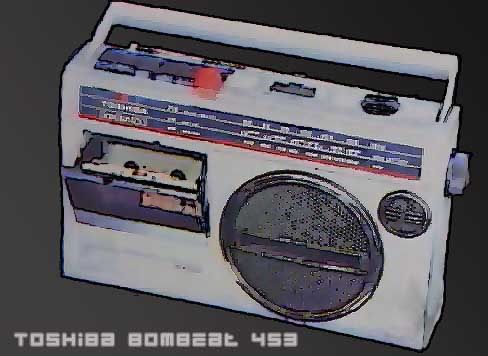
The Toshibas originated when Khreesat was summoned to Damascus in 1985 and tasked with building five hidden altimeter bombs to show to PFLP-GC leader Ahmed Jibril. Khreesat says he bought five of the same model radio-cassette player - the aptly-named BomBeat 453 – on “Smuggler’s row” in Syria. [p 10] (model at left, but Khreesat's were black) He also secured his own timers and altimeters - four of each - but the pivotal and pricey detonators were apparently provided. [p 32] Khreesat left one bomb radio absent its altimeter and timer, two ready but for loose wires needing soldered, and two fully ready to go. A pin pushed in would arm them, and a sustained climb past a certain altitude would cause the detonation. [p 10]

After Khreesat built these devices, they were shown to Ahmed Jibril, who approved them. Khreesat then disassembled the devices (aside from one shown in 1987 to Jibril’s nephew Abu Elias) “and the components were taken back to the PFLP-GC office,” the report states. [p 10] “The radios themselves were left in Khreesat's cousin's house.” Compared to America’s culture of disposable electronics, these five boom boxes were treated like golden heirlooms passing from hand to hand. Someone was later sent to retrieve them, but the cousins were allowed to keep one and “only four were picked up.” Of these, Khreesat insists he “saw one in an office in Syria being used as a regular radio.” [p 10] The one kept by Khreesat’s cousins “stayed upstairs at the house,” the report continues, until “Khreesat's wife later reclaimed this radio.” [p 10]

Now when he arrived in Neuss, West Germany in mid-October, Khreesat brought his wife with him; he explains that she wanted to visit her brother in prison there, a wish Dalkamouni granted. [p 5]. David Leppard in On the Trail of Terror (1991) reported that they brought a matching luggage set – two brown hardshell Samsonites - and inside Khreesat’s case was a black BomBeat 453. “He had brought it from Damascus,” Leppard writes. [p 6]

But by Khreesat’s story to agent Marshman, it was the wife who had brought this radio from Jordan, after reclaiming it from Syria, “to give to her brother, who was in prison” in Germany. She was reportedly “unable to give this radio to her brother, and this radio was left in Hashem Abassi's house,” where they stayed while in Neuss. “This radio was clean,” Khreesat advised, and he “assumes that it was seized by the Germans.” [p 10] There is a Yaesu FT-211RH that was seized but found to be unmodified [Zeist trial, day 72, pp 8829-31], but I’ve seen no mention of a clean 453 found.

The only sample of that familiar model the BKA are known to have seized was rigged for altitude-based killing and in the trunk (boot) of Dalkamouni’s car when he and Khreesat were arrested on October 26. This was the unit studied by BKA scientists, with Dr. Rainer Gobel measuring time delays between 35 and 45 minutes after the pressure switch.

Leppard seems to have decided that was the BomBeat that Khreesat brought in his case, but the bomb maker’s own story conflicts with that. He says it was yet another of his omnipresent 1985 radios. On October 18 or 19, on returning to his room at Abassi’s place, he found all his supplies laid out across the bed, including his original timers and altimeters, and that Toshiba. [p 17] He didn’t know how any of this got there, but it was presumably brought by Dalkamouni, who handled all his supplies. All the timers and altimeters were the same he used in 1985 [p 32] and the radio “was one of these five radios that he worked on in 1985,” [p 10] while he and his wife just happened to have another of the five there with them.

It’s not clear what this might mean, but for one thing we should wonder if it’s completely accurate. Was Khreesat more involved than he lets on, and brought his own 453 radio to modify? And if his wife really brought one, did he really just leave it in the Abassi home, or did it disappear, say, along with Abu Elias?

And then there are the suitcases – what if these were stolen and used for the bombing? Here we have the bombmaker with brown, hardshell Samsonite suitcases, forensics on the other end suggesting the 103 bomb was in such a case, and between them one credible report - John Bedford’s story - widely noted as seeing one such case quite near the blast area of fateful container 4041. However, few realize he describes two such cases, apparently a matching set. Like the Khressats' (per Leppard). This must be either a fairly steep coincidence, an error by Leppard, or a clue of something else. Khreesat doesn’t mention any missing luggage, and Leppard reports clues that the wife took her bag when she returned home on the 22nd, which of course makes sense.

But other clues point to the infiltrator being essentially framed by the PFLP-GC. Khreesat didn’t even build the bomb that may have done in 103; at least by his own telling, all four of his  own products were (eventually) taken in by the BKA. The fifth device that Abu Elias escaped with was apparently of his own making, and not a black BomBeat 453 (Khreesat thinks it was a bronze Toshiba RT-F423). [p 37] Its modifications were apparently mimicked based on earlier study (1987) of the master's work, and Dalkamouni only had Khreesat do a token finish on this unit (solder two wires) before taking it back to its maker, perhaps just passing it through the Jordanian’s workshop to get his “fingerprints” on it.

Such co-option is one way to respond to an infiltrator in their midst, if they had found that out. If so, Abu Elias might also have secured his own copy of the double-agent’s double Samsonites and put his “Khreesat bomb” in one. It would also do to snag the extra 453 unit (if there indeed was one) to put in the other case.

Even without awareness of this spooky suitcase match, I can imagine how investigators would be apoplectic seeing BomBeat 453 debris at Lockerbie after the famous Khreesat bust weeks earlier. There’s no evidence of such debris and I’m not arguing for this. However, it's an interesting thought, and  if it had been there it would be reflexively covered up with rigor. And otherwise the possibility stand that a clever PFLP-GC worked right around Khreesat, doing the bombing themselves but making it appear like the West's agent had done it.  Embarrassment upon embarrassment as cover, and no surprise, it wasn't looked into.
---

Just a Passing Magic Touch, and the Rest Unseen

Khreesat, Abu Elias, and the Fifth Device
April 15 2010
last edits May 24


ref throughout: Khreesat Advises, PDF

Two Men, Tangled
Setting aside the cartoon storyline of Libyan guilt and dealing with the surprisingly coherent body of discarded facts along the SCOTBOM highway, we’re left with a separate and well-known set of most-likely villains. A cell of the Popular Front for the Liberation of Palestine, General Command (PFLP-GC) had formed in Germany in October 1988, convened on behalf of Iran and $10 million to avenge the U.S. shoot-down of Iran Air Flight 655 in July. The cell was not-quite-thwarted with the “Autumn Leaves” raids of October 26; one airliner altimeter bomb and an expert in getting it onto a plane had slipped away, just weeks before Flight 103 blew up in exactly the way it would if the missing bomb had been loaded at Heathrow.

This is a all a common and familiar theme here and elsewhere, but amidst this, there is some confusion over the relative roles and culpability between Jordanian ‘double agent’ bomb-maker Marwan Khreesat and elusive PFLP-GC member “Abu Elias,” supposedly the expert set to sneak the device(s) onto aircraft. The tangle cannot be sorted out with much certainty, as almost all we have is Khreesat’s word, as told in November 1989 to FBI special agent Edward Marshman. Based on his debriefings, Khreesat’s bosses with the General Intelligence Directorate (GID) “produced a composite sketch of Abu Elias,” Marshan noted, and attached a copy to his own report. Khreesat had examined this “and affirmed that the likeness was that of Abu Elias who [sic] he met in Damascus, Syria.” [p 29]

The two met again before Khreesat’s assignment with the PFLP-GC cell in Germany, when he took a separate trip to Yugoslavia. There he was met by Mobdi Goben, the PFLP-GC coordinator for that country, whom he knew as Abu Fuad. Khreesat’s GID case officer had “instructed him not to arm any explosive devices while in Yugoslavia,” and that ”he would be protected while in Yugoslavia.” He didn’t build any bombs while there, but did meet Hafez Dalkamouni, right-hand man to PFLP-GC founder Ahmed Jibril, and (allegedly) Jibril’s nephew Khaisar Haddad, whom Khreesat knew as Abu Elias.

“Khreesat did not know the function of Abu Elias in Yugoslavia,” Marshman’s report notes, “nor did he know the purpose of the meeting that was to be held in Yugoslavia.” [p 5] The meeting itself must be described in the pages not shared at trial, but apparently it was where he was assigned to the cell forming for the big revenge job. “Dalkamoni introduced Khreesat to Abu Elias,” the report states, and “said that Abu Elias was an expert in airport security," and he learned that "in 1987 Abu Elias was shown one of the BomBeat 453s that Khreesat worked on in 1985.” [p 10]

Khreesat's Bench Work
The 1985 job was, as Khreesat related it, to come to Syria and work up five altimeter bombs, similar to those he’d been making since 1970, but inside Toshiba BomBeat 453 model radios. These were for demonstration purposes only, and in different states when inspected. Two were ready to arm, one had no altimeter or timer in it, and "the other two needed two wires to be connected," Marshman recorded. [p 5] Khreesat went to great detail on the later history of each radio unit after being disassembled, but one was apparently kept intact for Jibril to show his nephew, and I'm guessing it was one of the two-wire-short ones (see below).

Strangely, Khreesat's original four altimeters and four timers were brought back to him after he arrived in Germany on October 13 1988, to rebuild as part of his new batch of four bombs. He's not as clear on the pricey detonators.  One of the five 1985 radio housings was also handed back to Khreesat; this completely recycled BomBeat 453 is the unit he and Dalkamouni were arrested with on the 26th. The other IEDs that were intercepted months later, two Ultrasound radios and a computer monitor, were bought by Khreesat and Dalkamouni at a second-hand shop on October 18, according to the report. The fifth device we’ll discuss below.

Abu Elias as Watcher
“Khreesat never saw Abu Elias in Germany,” he told Marshman, but was made well aware of his presence. For October 22 Khreesat recalled Dalkamouni leaving him at the zoo for an hour before taking him back home. Following this:
“There was a lot of traffic on the way home, and on the trip Dalkamoni mentioned that Abu Elias had arrived in Germany that day. Previously Dalkamoni had said that Abu Elias was coming to Germany. Khreesat asked Dalkamoni why Khreesat was there if Abu Elias was such an expert. Dalkamoni replied that Abu Elias was an expert in airport security and Khreesat was the expert in building the IEDs. Abu Elias was of concern to Khreesat because Khreesat felt that he could not render the IEDs inoperable as Abu Elias would probably know it.”
This last is of great importance, as Khreesat started to work on the bombs later that evening. He had presumably taken the same directions from the GID about keeping his bombs dud that he’d been given before Yugoslavia. But here he feels he’s being watched closely and must not disappoint. Thus were born five live altimeter bombs, one of which most likely tore down PA103 two months later. According to Khreesat, Abu Elias was the reason for that.

Following his arrest along with the others on October 26, Khreesat “told the Germans that they should have waited one more day to make the arrests, as Dalkamoni was on the way to meet Abu Elias when they were arrested.” [p 2] Just from the read portions, we have Khreesat repeating this anticipated meeting four times in the report (p 2, 7, 22, 23) Yet “the Germans also asked Khreesat about Abu Elias. Khreesat advised that he did not tell the Germans anything about Abu Elias,” other than he was on his way to meet him, obviously.

The Fifth Device
This trip to bring the mystery man a bomb on the 26th is curious, considering he already got hold of the one he needed – the “fifth device” - two days earlier. This isn’t known but inferred; Marshman’s report has for October 24:
“Around 2.00 p.m. Khreesat took a shower. When Khreesat was in the shower, Dalkamoni knocked on the door and said that he was leaving to go to Frankfurt. After getting out of the shower, Khreesat went back to work on the IEDs. At this time he noticed that the fifth device was no longer in the workroom. He did not pay a lot of attention to this, as he was thinking about the upcoming meeting with Abu Elias. Khreesat speculated that Dalkamoni took the fifth device with him, as only Khreesat and Dalkamoni ever went into the room. After working on the IEDs until late that evening, Khreesat went to bed.” [p 23]
It was only the following day that the agent again called his case officer and said “that he had prepared a device and given it to Abu Elias. Khreesat advised that he had assumed that the fifth device went to Abu Elias, as related above.” [p 24]

The unit used for that escaped IED was brought into the Abbasi home the 22nd in some boxes with the other devices and tools. “Also in the boxes was the fifth device, which was a Toshiba radio/cassette recorder. This device is further described infra. Khreesat does not know where the radio came from. It was not in a new box.” [p 21] He later described it, after looking at a catalog, as a bronze-colored RT-F423 model. [p 37]

The next day, October 23, “Dalkamoni came into the workroom with the fifth device. Dalkamoni told Khreesat that two wires had to be soldered together. Khreesat. […] soldered the two wires together.” He also noted for Marshman numerous strange modifications, some involving cardboard, and said that he “told Dalkamoni that the device was not very good, as the authorities could very easily discover that the radio had been altered into an IED.” The altimeter could be seen beneath the cassette relay. [p 22]

The bomb maker did not know where it came from but thought it might have been “obtained by Dalkamoni when he left Khreesat at the zoo for the hour” the day before. “Khreesat speculated that Dalkamoni may have met Abu Elias, as on the way back to Neuss from the zoo, Dalkamoni mentioned that Abu Elias was in Germany.” [p 20]

It was Built by Abu Elias
Indeed, it’s a decent guess that the interloper brought the fifth device with its (reportedly) sloppy work, and considering his earlier inspections of Khreesat's work, it's even possible he built the thing himself. Some unspecified intelligence held by Arafat’s PLO (among PFLP-GC’s competitors) said as much in 1992, as reported in Time:
The bomb that ended up on the Pan Am jet could have been assembled by Khreesat. However, last month the Palestine Liberation Organization reported that it was built by Khaisar Haddad (a.k.a. Abu Elias), who is also a member of Jibril's Popular Front. Haddad purchased the detonator, the P.L.O. said, on the Beirut black market for more than $60,000. [source]
All this helps clarify what first seemed a rather confusing statement in Marshman’s report.
Khreesat advised that he does not know what type of device was used to bring down Pan Am Flight 103 on December 21, 1988. Khreesat advised that he does not think he built the device responsible for Pan Am 103, as he only built the four devices in Germany which are described herein. [p 37]
If Abu Elias built that bomb, then indeed Khreesat only built four devices, none of them the one that apparently escaped with Abu Elias. It almost seems that Khreesat himself suspects the fifth IED - that he only finalized - to have brought down Flight 103, as so many others suspected.

The interloper was apparently to take his work back after Khreesat’s modification and slip away to do his real work. But the modification was one even Dalkamouni knew – solder two wires. Why didn’t Abu Elias just solder it up himself? Why insist on Khreesat’s token touch? If Khreesat’s tales are true, we’re faced with a clue and a mystery about the thinking of Jibril and Dalkamouni. If not, we’re faced with a compound mystery and a lot of small uncertain clues. The issue can now be considered “explored” but nowhere near “resolved.”
---

What's in a Name?

"Abu Elias" and his Alleged Names
April 13 2010
last edits 4/30


Abu Elias was the terrorist-world code-name of a certain high-ranking member of the PFLP-GC as of late 1988. Though a blond Christian born with blue eyes in Lebanon, he was reportedly the nephew of the dark-haired, nominally Muslim PFLP-GC leader and founder Ahmed Jibril, and working for him in Syria in violent opposition to Israel. “Abu Elias” is also suspected by many (including myself) to be the real Lockerbie bomber, but was never caught after making off with Khreesat’s fifth bomb. The fugitive was eventually forgotten by investigators as some Libyans took the blame, but as explained in another post, he wasn’t forgotten by everyone. “Abu Elias” was reported in 1992 to have the real name of Khaisar Haddad, and to have built that fifth bomb himself, and in 2009 he was mentioned again as being re-named Basel Bushnaq and living safely in Washington DC with a government job.

I’m not sure yet what to do with this knowledge, considering Basel A Bushnaq is still sitting over there and I could easily get his phone number. As I mull it over, or wait for him to step up himself, or for him to start over again with a new town and name, I thought it might be interesting to explore some available information, including the three names that have been attached to the same guy. Who - again - was an expert in airport security, sent by his uncle we hear to make sure the bomb was live and got onto a plane, just two months before success over Lockerbie.

Abu Elias:
Literally, this name means “Father of Elias,” with Abu being a form for ‘father of’ in Arabic, popular among terrorists, and Elias being the Greek rendering for the prophet Elijah. Elijah in Hebrew means “Yahweh is my God,” and Wikipedia says Elias is a common name among Middle Eastern Christians, especially in Lebanon. Elijah/Elias is of course a major, major figure in the Judaic/biblical mythology, and one with no known father. He’s said to be able to raise the dead and work other miracles, classed near Moses among the revered ghosts, and expected to return to Earth to herald Christ’s return and the apocalypse. (Or has returned, if you’re Mormon). Judging by his chosen name, no small ambitions had this one.

Khaisar Haddad:
This name was reported by Arafat's PLO in a 1992 report as the real name of Abu Elias, Lockerbie bomber. The family name ‘Haddad’ means ‘blacksmith,’ and is also the name of a Pre-Islamic Semitic storm god. Wikipedia says the name is held largely by Middle Eastern Christians, and the most common single surname in Lebanon. Sounds like a plausible real family name for a Lebanese Christian.

The given name Khaisar doesn’t appear much, or at all, in Arabic names as far as I’ve been able to find. The same spelling, however, was once a Beluchi word for the Tamarix tree. This I learned from an old book Google's got, explaining how dense growths of such trees was said to have given a name to the Khaisar Lora river in Baluchistan, modern-day Pakistan. (p 33). That's probably not it.

In English and other “Christian” languages, Khaisar of course sounds just like Kaiser, the German variant of Caesar (Russian is Czar). Please note how a person could get used to having a grandiose name that means emperor, king, etc. It also echoes (or is echoed by?) the fictional Keyser Söze, elusive super-villain of The Usual Suspects (1995).

Basel Bushnaq
The latest alleged “family” name held by this guy called “alias Abu Elias” is Bushnaq. If we're looking at the same guy, it's clearly a name of choice, not birth. Otherwise... This seems to be Arabic for “Bosnian,” as per an article on Lofti Bouchnaq, a renowned composer, oud player and singer, born 1954 in Tunis. His family name (with given variants Bushnaq, Boushnak, and Bouchnak) “in Arabic means “Bosnian,” suggesting that his family may have arrived in Tunisia from Europe as slave-soldiers from Bosnia during the period of Ottoman Turkish rule.” So also says the “Bushnak International Union” page at Myspace; “every one of us is a refugee from our dear and beloved countrey [sic] Bosnia.” Basel A. has not popped in yet. I don’t think Khaisar Haddad has any Bosnian ancestry, but it’s possible.

One other unusual feature of this name, importing the foreign “Bushn” from Bosnia, makes it among the very few (or only?) plausible Arabic family name that contains "Bush", when one or another of that family may have overseen Basel A’s assimilation as a Virginian. An honorary nod to his new benefactors? (At Myspace he lists many prominent Republicans as his favorites, but avoids this contrast by excluding the Bushes)

The suspect’s first name “Basel” (as pronounced by its revealor Christine Graham, anyway) is most obviously evocative of the city of just that name in Switzerland – an international hub in a famously neutral country. One site does offer Basel, probably pronounced different, as an “African-Muslim name popular in Sudan, meaning 'brave.'” The name name Basel does pop up with unsure origins in a Google search attached to at least one Palestinian and one Jordanian. I also hear it's fairly common in Syria, where both Abu Elias and Basel Bushnaq (judging from online commentary) have roots. In all, it probably means the same as in Sudan. It would take a brave man to blow up PA103 and then, without state help, take up residence so near the US capitol.

Most importantly for our purposes, Basel is first on Wikipedia’s list of variants on Basil, meaning royal or kingly, from the Greek Vassillos, meaning King. That original spawned names for the herb Basil, the structure Basilica, and people like Czars Vassili I, II, III. and IV of Russia. Thus Basel continues to be a decent replacement if one’s old name had been Kaiser and the new one still had to sound okay in Arabic. There it means courageous.

So ‘emperor blacksmith’ becomes terrorist mover ‘father of Elijah’, and all that carries, then he allegedly starts a new life as ‘brave Bosnian’ and/or ‘kingly vassal of the Kaisers Bush.’ That’s a heck of a lot of reading into it, but there is a compelling psycho-logic to the whole string. It goes on the "hmmmm" pile.

"Ramzi Diab"

Posted April 5 2010

Role in the Bomb Plot
Ramzi Diab, as he’s known and called herein, is actually an alias for Salah Kwikas [1], born 24 Sept. 1959, Nazareth [2], and in 1988 a terrorist connected to the Popular Front for the Liberation of Palestine, General Command (PFLP-GC). Diab was one of over 1,000 Palestinian prisoners released in exchange for three Israelis in 1985 - an agreement negotiated by PFLP-GC veteran Hafez Dalkamouni. [3] In the fall of 1988, he converged with other GC players, under Dalkamouni’s leadership, in Neuss and Frankfurt West Germany for the plot to destroy American airliners with altimeter bombs.

David Leppard writes how cell ringleader Dalkamouni, after his arrest, told BKA police “he was given the second Toshiba on about 18 October by a man called Ramzi Diab in Frankfurt. It also contained two pressure boxes, two clocks and two platinum plates. Diab, Dalkamouni said, was a member of the military section of the PFLP-GC.” [4] Ludwig DeBraeckeleer writes that on October 22, the day Khreesat started his bomb-making work with that radio and four other units, “Dalkamoni and Khreesat travel to Frankfurt […] At 2pm, they meet Ramzi Diab,” for uncertain reasons. [5] The same author notes the earlier meeting, October 18 at 5:10 PM.
In his early thirties, Diab is a member of Jibril PFLP-GC. After their meeting, Diab left in a car that belongs to Bassam Radi, a member of Adnan Younis terrorist cell. Younis, aka Abu Tarek, is also a member of the PFLP-GC. [6]
Dalkamouni later identified Diab as “a key player in the Lockerbie operation,” wrote Emerson and Duffy. “a courier of some of the bomb-making materials.” [7] Two witnesses, Diab’s flatmate Angelika Berner and his “German instructor, a kindly man named German Hoch” recalled a trip to Vienna Austria that Diab said he took in about mid-October. Both later told Emerson and Duffy that the BKA left them with a feeling Diab was thought to have “transported … the materials … to make the bombs,” or “transported the explosive material … of the type that exploded at Lockerbie.” [8]

Arrest, Release, Flight
When the mass arrests happened on October 26, Ramzi Diab was found at his house on Querstrasse 4, Frankfort-Main. [9] His documents were deemed fake, and there was no information on his arrest report other than birthdate. [10] “Under questioning by the BKA, Diab adamantly denied knowing Dalkamouni or being a member of the PFLP-GC,” wrote Emerson and Duffy in 1990. He then recalled meeting the boss, in passing, when presented with photos of him with Dalkamouni. [11]

He was released the very next day, along with most of those hauled in, for “lack of evidence.” The guns and bombs and any plots were all decided to be on Dalkamouni, Khreesat, and Ghadanfar alone. Like so many others, he fled upon release; Leppard cited a later BKA report that Diab “left the Federal Republic of Germany a few days after being released, present whereabouts unknown, possibly Austria.” [12]

This flight was probably guessed from the stories of Diab’s acquaintances Berner and Hoch, testifying to an earlier trip thataway. “One witness, a student called German Hock,” Leppard fumbled, “said he had seen Diab leaving Frankfurt on a train to Vienna. Under his arm was a Toshiba radio.” [13] That’s rather a twist, and unclear if this was the pre-arrest trip or his flight after. At trial, BKA officer Anton Van Treek was asked “when [Diab] was released, was he in possession of a radio/cassette recorder?” and responded simply “I am unable to say anything on that.” [14] The transcripts also offer a full list of October 26 arrestees, including Diab, released the following day, and, interestingly, his teacher friend German Hoch was among those hauled in, also released on the 27th. [15]

Diab is sometimes cited as the man who brought in one radio for modification and slipped away with one armed – both tasks also attributed to “Abu Elias.” An anonymous online comment says “one of Khreesat's bombs however, had been smuggled out of the West German apartment by the PFLP-GC terrorist Ramzi Diab.” [16] In his 1989 series of articles in the Sunday Times, David Leppard explained that the missing fifth bomb made by Khreesat “was smuggled to Malta by a known PFLP-GC terrorist called Ramzi Diab, and handed over to a Palestinian cell there.” [17] This whole theory died in its infancy, but not before spawning a TV movie.

Wherever he got away to and whatever with, as Emerson and Duffy wrote in early 1990 “Lockerbie investigators would like to find Diab, but they have been unable to do so.” But he wasn’t universally considered a villain; “some senior officials” had suspected that Diab called in the BKA raid, and “the Germans were told by Diab’s handlers that everything was under control” with the one bomb seized. “If Ramzi Diab was the second informant, as some investigators believe, he may not have known about Khreesat’s other four bombs, and if that is so, German authorities would would have been using Diab’s partial truth to confirm Khreesat’s wholesale lie.” [18] Further, the writers mused:
“For whom was Diab really working? Again, as with Marwan Khreesat, American investigators are not sure. Some believe that he had convinced the Germans that he was genuinely working for them. Others believe he may have been an informant for Israel. Some intelligence officials believe that, in an even stranger twist, there were Syrian informants in or connected to Dalkamouni’s network … just in case [Jibril] was not as forthcoming as he had promised.”[19]
David Leppard’s slightly later work On the Trail of Terror stated “the CIA had discovered that the other ‘mole’ inside Dalkamouni’s cell was Ramzi Diab.” The Agency, via lead investigator Vincent Cannistraro, believed Diab may have secured Khreesat’s fifth bomb and “may have taken it back to Syria.” It didn’t go well if so - on his return, Leppard writes, “Jibril is understood to have held a tribunal: he wanted to know how the BKA had managed so comprehensively to wind up his European network” Though Dalkamouni blamed Khreesat, “Jibril drew his own conclusions. Ramzi Diab was executed shortly afterwards.” [20] DeBraeckeleer says “the tribunal established that Diab was a mole for the MOSSAD.” [21] It was after this execution, Cannistraro told Leppard, that Jibril contracted with the Libyans to finish the job. [22]
---

Sources:
[1, 3, 10, 11] Emerson and Duffy. pp 134-135
[2, 4, 9] Leppard, David. pp 10-11
[5] De Breackeleer, Ludwig. “Abu Elias Arrives in Germany: Diary of a Vengeance Foretold, part 112.” Canada Free Press. October 22 2008. http://www.canadafreepress.com/index.php/article/6194
[6] De Breackeleer, Ludwig. “What a Tragedy, What A Mess… Diary of a Vengeance Foretold, part 108.” Canada Free Press. October 18 2008.
[7] Emerson and Duffy p 262
[8] E+D pp 209-211
[12, 13] Leppard 13
[14] Day 76, p 8718
[15] p 9358
[16] http://scotlandonsunday.scotsman.com/ViewArticle.aspx?articleid=3298349
comment 29.
[17] Foot, p 6
[18, 19] Emerson and Duffy p 262
[20, 22] Leppard pp 211-212
[21] PFLP-GC Tribunal Sentences Ramzi Diab to death. Part 124 – NOVEMBER 3 1988
http://canadafreepress.com/index.php/article/6746

Marwan Khreesat: How Many Times an Agent?

Caustic Logic 
Completed March 4 2010
last edit June 1


Note, June 1: I'm leaving thispost as-is, but much of it must be qualified by later findings. The text in red below is that explained better in later posts, primarily "A Passing Magic Touch..."
---
A Suspect at Large
Iran’s non-involvement in the Pan Am 103 bombing is one of the few points Washington and Tehran can publicly agree on, while both secretly knowing better. Following the July 1988 shoot-down of Iran Air flight 655, "accident" was not accepted and vengeance was vowed. And as former Iranian president Abdulhassan Bani Sadr told The Maltese Double Cross in 1994, “Iran ordered the attack and Ahmed Jibril carried it out.” [1]

If Ahmed Jibril, leader of the Popular Front for the Liberation of Palestine – General Command (PFLP-GC), did carry out the attack, as it seems he was planning, it was through his right-hand man Hafez Dalkamouni. And Dalkamouni’s known plans to that end, operating in West Germany in October 1988, relied on the airliner-bombs made by the experienced Jordanian expert Marwan Khreesat (alt Kreeshat, Khreeshat).

Khreesat reportedly produced five improvised explosive devices (IEDs) in Germany during late October 1988. These were apparently all triggered by an altimeter and timer so that the detonation would occur once the plane was well airborne, around 35-45 minutes after takeoff. Pan Am 103 fell apart 38 minutes after taking off from Heathrow. Scottish police and FBI did reject this direct clue as they decided the bomb had first come in from Frankfurt and probably somewhere else before that, and didn’t blow up then. But Scottish police did continue to suspect that a Khreesat bomb, with some hypothesized modification, had gone aboard in Germany.

Paul Foot, in Lockerbie: The Flight from Justice (2001), cited a report compiled by the Dumfries and Galloway police in March 1989, referring to Khreesat, then living freely in Jordan after fleeing from Germany, as "a suspect” they’d like to interview. “There can be little doubt that Khreesat is the bomb-maker for the PFLP-GC," the report is quoted, "and there is a possibility that he prepared the explosive device which destroyed Pan Am 103. As such he should not be at liberty.” [2]

Off The Hook: He’s One of Ours
By now of course Khreesat has been officially absolved of suspicion and remains fully at Liberty. To be sure, he made five deadly altimeter-triggered airliner bombs on behalf of the PFLP-GC, just weeks before the bombing of Pan Am 103. But he did so undercover, for friendly Jordanian intelligence, the General Intelligence Directorate (GID). In testimony at the Camp Zeist trial on December 5 2000, FBI Special Agent Edward Marshman confirmed that Khreesat “would be what we refer to as a -- commonly as a double agent, yes.” [3]

Originally listed as Crown witness 1157, Khreesat declined the invitation to trial, and a report written by Marshman took the place of Khreesat’s testimony. Based on Scots/FBI interviews with the bomb-maker on Nov 12 and 13 1989, the report passes on Khreesat's word that "he was sent to Europe in order to infiltrate the Popular Front for the Liberation of Palestine General Command; he was sent by the GID and was acting as an agent of the GID at all times” [4]

Scots police officer John Crawford, in The Lockerbie Incident: A Detective's Tale (2002) concluded “there is little doubt that he was a double-agent working for the Jordanian Intelligence Service.” Further, Crawford spoke of “the integrity of Marwan Khreesat, who had assisted [Jordanian authorities] to help the West escape a bombing campaign in the late eighties.” [5] It's highly ironic that he did this by building five airliner bombs, one of which was possibly slipped onto Flight 103. But they were supposed to be phony. Marshman’s Report, referring to a stay in Yugoslavia prior to entering Germany, stated:
“Before Khreesat left for Yugoslavia, he met his GID case officer, who instructed him not to arm any explosive devices while in Yugoslavia. He was told to build any improvised explosive device necessary, but he was instructed to alter the device so that it would not detonate even if used against an Israeli target. Khreesat was told by his case officer that he would be protected while in Yugoslavia.”[6]
Apparently he was to assemble the bombs there ahead of delivery, but it seems the actual work was done later in Germany, and as we’ll see, they were indeed armed to the teeth. The Zeist judgment of 2001 explained: “the cell’s principal bomb-maker was one Marwan Khreesat who was in fact an agent who infiltrated the cell on behalf of the Jordanian Intelligence Service.” They also expanded the geographical scope of his ordered harmlessness: “His instructions from [GID] were that any bomb he made must not be primed.” [7]

Even tough he did arm the bombs he made, for whatever reason, it seems almost impossible to deny - if the Jordanian authorities are all in agreement and corroborated his employment and mission - then he was indeed official and undercover. So what did he do within that role?

Field Work
At Jibril’s request, Dalkamouni’s crew had gathered at Hashem Abbasi's flat in Neuss, West Germany (near Frankfurt) in early October to work on the airliner bombing plot. Khreesat first appeared at their flat on October 13 [8] German authorites watched the men for the next two weeks in Operation: Autumn Leaves. They were seen purchasing electronics and mysterious brown stuff, and meeting different people for unheard conversations. [9]

Khreesat’s history with the PFLP-GC was a key alarm; Steve Emerson and Brian Duffy wrote in 1990 “according to Israeli intelligence files, it is almost certain that Jibril, in 1970, was responsible for the very first plane bombing carried out with a barometer-triggered explosive,” and this was done by “Merwad Abd Rezak Mufti Kreeshat” AKA Marwan Khreesat. On Feb 21 1970 two flights from Europe to Israel were bombed the same day with radio-based IEDs. One crashed 15 minutes after takeoff, killing all 47 aboard, while the other was able to land. Khreesat struck again on August 19 1972, with an El Al flight, Rome to Tel Aviv, that again failed to destroy the plane in mid-flight. Khreesat’s work there was decided to be concealed in a record player. [10] [more details]

It’s not clear if he was a double or single agent at the time, but he did some more work in 1985, similarly modifying five Toshiba radios, model BomBeat 453. These were apparently just demos – Jibril was shown how they were done, then Khreesat disassembled them, according to Marshman’s report. [11] And here he was three years later, apparently doing something again. On October 19, Dalkamouni made an intercepted phone call to contacts in Syria, and Khreesat popped on the line to announce “changes in the medicine” that had so far shown a high failure rate. [12] It was like the 1985 operation but for real - five concealed live bombs that were not meant to be broken back down.

According to Marshman’s report, only on October 22nd did Khreesat get to work on building the bombs, after receiving five new electronic items, including “a Toshiba radio/cassette recorder … not in a new box.” [13] As for the model, he was later shown a catalog and decided it “looked exactly like a model RT-F423 radio/cassette recorder. It was bronze in colour just like the model in the catalogue” that he was shown.” He did specify some knob modifications in the one he saw. [14]

That same day, another player arrived in Nuess; “Khreesat never saw Abu Elias in Germany,” Marshman’s report states, “but was told by Dalkamoni that Abu Elias had arrived. (This occurred on October the 22nd, 1988)” [15] This mysterious terrorist was to link up with Khreesat’s bombs and arrange the airport security end, or how to get the IEDs onto the aircraft. [16]

It never was determined which target(s) they had in mind, but the police made their move on the evening of October 26. Khreesat and Dalkamouni were arrested on their way to meet Elias, with one altimeter bomb in the trunk of their car. It was in a black Toshiba Bombeat 453 radio cassette recorder, with an altimeter set to detonate 312 grams of Semtex-H.[17] The base apartment and another were raided and over a dozen suspects taken in, along with a huge weapons and explosives cache, the largest “ever found in the Federal Republic” [18]

All the apartment arrestees but one – eleven total – were released by a Judge for lack of evidence. Besides Dalkamouni and Khreesat, only Abdel Ghadanfar, who claimed the weapons cache (educational props, he said), remained in custody. [19] And then Khreesat made his one phone call and soon the German authorities were getting a call from Jordanian intelligence asking for their man back. And he was sent back, leaving two of fourteen.

And that's just the people. Only the altitude-triggered bomb radio in Dalkamouni’s car was recovered. As far as anyone knew, all that trouble had been to build only one deadly bomb, and that was safely in custody.

Lost in the Shuffle?
Then, less than two months after Marwan Khreesat stepped off the plane back in Jordan, another plane was destroyed just after leaving Heathrow airport in London on the Winter Solstice. The Autumn Leaves had been shaken down, raked, sorted, and bagged, it had seemed. Now one could wonder if a stray leaf had drifted across the channel and lighted in the belly of Pan Am 103. What if those Neuss bombers had made a second bomb?

Emerson and Duffy reported that unspecified U.S. intelligence officials learned “in the early part of February [1989],” that “Marwan Kreeshat had surfaced,” and was ready to help. “And this is what the man said: He had made five bomb in Germany, not one. At least that’s what the Jordanians told the U.S. officials.” [20] A sworn statement followed to clarify that's what he meant to say, stating that if they hadn’t been intercepted already, the remaining IEDs were still in the Neuss flat - the one that was raided for suspected bomb-radio-type work.

This spurred the FBI to urge the German BKA to find the remaining bombs. After initially insisting there could be no more, they finally re-checked the Abbassi home (or rather, his storage by then) and found two suspect radio tuners on April 13 [21]. In an inexplicable episode at BKA headquarters, a bomb tech named Sonntag was killed and another (Ettinger) was maimed while trying to defuse one of these on April 17 [22] Following this unusual scare, the BKA destroyed the other bomb in revenge rather than study it, and again checked Abbasi’s storage for anything electronic at all. They netted another IED, again with Semtex and altimeter, this time concealed in a computer monitor. [23]

On April 26 Hafez Dalkamouni, still in custody, was told he might be charged with the murder of Sonntag and agreed to talk. But then he said the bombs were to go back to Israel to kill Israelis in the high mountains. [24] Khreesat in Jordan was giving them details but they weren’t encouraging; if indeed there were five airliner bombs built, the tally is thus – one captured in October, three found later in Neuss, leaving a fifth one unaccounted for. Writing in early 1990, Emerson and Duffy filled in the gap with “the fifth bomb, investigators believe, blew up […] over Lockerbie.” [25] So how did, or would, this slip through the double-agent’s careful control? Marshman’s report, again from Khreesat’s own self-exculpation, said for 24 October:
“Around 2.00 p.m. Khreesat took a shower. When Khreesat was in the shower, Dalkamoni knocked on the door and said that he was leaving to go to Frankfurt. After getting out of the shower, Khreesat went back to work on the IEDs. At this time he noticed that the fifth device was no longer in the workroom. He did not pay a lot of attention to this, as he was thinking about the upcoming meeting with Abu Elias. Khreesat speculated that Dalkamoni took the fifth device with him, as only Khreesat and Dalkamoni ever went into the room. After working on the IEDs until late that evening, Khreesat went to bed." [26]
[…]
"[The following day] Khreesat told his case officer that he had prepared a device and given it to Abu Elias. Khreesat advised that he had assumed that the fifth device went to Abu Elias, as related above."
[27]
So believing Elias was already given one bomb on the 24th, and telling his handlers on the 25th, Agent Marwan went along to bring a second one on the 26th until he was intercepted by the BKA. “Khreesat told the Germans that they should have waited one more day to make the arrests,” Marshman’s report noted, “as Dalkamoni was on the way to meet Abu Elias when they were arrested.” [28] The arrest being too soon might be a good complaint if he was talking minutes and miles - they could've ambushed them right and got all three. But he said "one more day," by which time Elias might well be gone with his two bombs. Khreesat had met Elias before, in Syria he says, and was able to help the GID make a composite sketch. [29] He’s never been found.

If this is undercover work, it’s sloppy, and sloppy with bombs is no good. For whatever reason, Khreesat clearly broke the rule against making live bombs, left them lying around amongst known terrorists who wanted to use them, and waited a day before alerting anyone that one of his pieces had disappeared. Khreesat may have been working to help the West, but certainly not with any coordination to ensure a tight net collected all the bombs and runners. The German BKA had no idea of his supposed operation, and didn’t even know there were plural devices. Neither Khreesat nor the GID apparently let them know this basic fact, as a note on the way out or at any time until after the Lockerbie bombing. Such negligence could easily lead to a tragedy like that, and to charges of being a triple agent – only playing at playing the PFLP-GC.

But however murky all of this is, the FBI and the Scots agreed with Khreesat that his bombs were not responsible, and there is one overriding reason for this.

Just Not His Style
The main things that helped the case shift away from a Khreesat bomb was the physical evidence that had been involved in the explosion. Or at least said to have been. Again, the official device was probably 450-650 grams Semtex-H, triggered by a Libyan-linked MST-13 timer, set in a Libya-linked Toshiba RT-SF16 model radio. We can be sure since the whole front page of its manual survived.

The manual is what convinced the judges of the radio make, and its supposed Libya clues helped them, in small part, hand down the guilty verdict for al Megrahi. As to why they could easily brush the PFLP-GC and its bomb-maker aside, they explained:
“Moreover, while he himself did not give evidence, there was evidence of a statement given by him to FBI agents (production 1851) in which he said that he never used radio cassette players with twin speakers (such as the Toshiba RT-SF 16 had) to convert into explosive devices.” [30]
Please! He's used radios, record players, computer monitors, vacuum cleaners for all we know. But he couldn't possibly use a radio cassette player with two speakers? Near the trial’s end, the Crown’s Mr. Campbell re-explained how
“[A]n examination of the evidence makes it clear that the components available to the PFLP-GC were of a quite different variety. The radios were of a single-speaker version, and indeed the fifth device described by Khreesat was of a single-speaker type.

The timer used by the PFLP-GC was known as an ice-cube timer and was used in conjunction with a barometric device. It was a very unsophisticated and unstable device. Mr. Orkin of the CIA explained the difference between such a timer and the highly sophisticated MST-13 timer on day 71, 8804."
[31]
After discounting the possible Stasi link that some have wondered as a route to get the timers to the PFLP-GC, Campbell summarized “there is, therefore, in my submission, no evidence that would raise a reasonable doubt in Your Lordships' mind with respect to” the PFLP-GC and their friend Mr. Khreesat as suspects. [32]

Marshman’s report concluded “Khreesat advised that he does not know what type of device was used to bring down Pan Am Flight 103 “ and that “he does not think he built the device responsible for Pan Am 103, as he only built the four devices in Germany which are described herein.” [33] As Paul Foot aptly noted “‘Described herein’, however, were not four devices but five, and the missing one was disguised as a Toshiba cassette recorder.” [34] It wasn’t a RT-SF16, so that point is a bit moot, but still he admitted there was a bomb missing. DI John Crawford described a later trip to Jordan, in mid-2000. This “walking-on-eggshells job” was described thus:
“It was obvious that what was required was for him to testify that he had no part in building the bomb that blew up Pan Am 103, it was a totally different bomb than the ones he had built in the 1970s and 1980s, the timer was also much different from the ones he favoured in his bombs.” [35]
Indeed, what was found by RARDE folks like Hayes and Feraday was not Agent Marwan’s style. He did not use Libyan-linked RT-SF16s with two speakers, small spaces, and indestructiable paper manuals. He didn’t use Libyan-linked MST-13 timers to send the bomb from Malta through Frankfurt to London, by way of Libyan agents using the brown suitcase Giaka saw. His bombs had no special powers to blank out Frankfurt's luggage records, nor to replace the Bedford suitcases in their corner of AVE4041. This, in fact, makes them more real, and dangerous, and worth consideration.

There is no real disconnect between the PFLP-GC’s bomb and the one on 103 if we accept the following: one Khreesat bomb slipped away, was packed into a copper-brown hardshell Samsonite and transported by surface to London. There it was slipped into he most dangerous corner of AVE4041 two hours before the plane took off. All we need then for all the evidence to match up is to disappear the remains of that RT-F423-like radio (around 550 grams of Semtex might do that) and introduce the implausibly large timer and radio chunks that indicate Libya with such cartoonish clarity (certain RARDE operatives might do that).
---
[1] The Maltese Double Cross. Produced, written, and directed by Allan Francovich, Hemar Enterprises, released November 1994. 2 hours, 36 minutes. Quote at 34:00 mark. Google Video
[2] Foot, Paul. Lockerbie: The Flight From Justice. Private Eye, 2001. 30 pages.
[3] IN THE HIGH COURT OF JUSTICIARY AT CAMP ZEIST - Case No: 1475/99: HER MAJESTY’S ADVOCATE v ABDELBASET ALI MOHMED AL MEGRAHI and AL AMIN KHALIFA FHIMAH. Camp Zeist (Kamp van Zeist), The Netherlands, 3 May 2000 to 31 January 2000. Computerised transcription of the proceedings using LiveNote. 10,241 pages in 86 volumes. Copyright 2000, Scottish Court Service. Anonymous donation to The Lockerbie Divide. Day 76, December 5 2000. Edward Marshman, witness no. 540. p 9259
[4] ibid. p 9272
[5] Crawford, John. The Lockerbie Incident: A Detective's Tale Trafford Publishing 2002. 351 pages. Gogle Books pp 160, 163
[6] See [3], p 9273
[7] Opinion of the Court. Delivered 31 January 2001. PDF link: http://www.scotcourts.gov.uk/library/lockerbie/docs/lockerbiejudgement.pdf
[8]Emerson, Steven and Brian Duffy “The Fall of Pan Am 103: Inside the Lockerbie Investigation” New York, G. P. Putnam’s Sons. 1990. p 208.
[9] ibid. pp 128-29
[10] ibid. pp 114-115
[11] Transcripts, Day 76, pp 9275-76
[12] Emerson and Duffy, p 129
[13] Transcripts, Day 76, pp 9254-55
[14] Transcripts, Day 76, p 9268
[15] Transcripts, Day 76, p 9244
[16] Transcripts, Day 76, 9250
[17] Transcripts, Day 72 (November 20 2000), pp 8829-31, also Leppard p. 11
[18] Emerson and Duffy p 132
[19] Emerson and Duffy p 133
[20] Emerson and Duffy pp 176-77
[21] Emerson and Duffy p 206
[22], [23] Emerson and Duffy p 208
[24] Emerson and Duffy p 209-10
[25] Emerson and Duffy p 255
[26] Transcripts, Day 72 p 9258
[27] Transcripts, Day 72 p 9260
[28] Transcripts, Day 72 p 9244
[29] Transcripts, Day 72 p 9264
[30] See [7]
[31], [32] Transcripts, Day 79 (January 10, 2001), p 9525-26
[32] 9525-26
[33] Transcripts, Day 76, p 9268
[34] Foot, Paul. Lockerbie: The Flight From Justice. Private Eye, 2001. 30 pages. p 23.
[35] Crawford, p 160