Showing posts with label Bedford J. Show all posts

Two Secondary Suitcases?

June 13/14, 2011

The Soft, Blue and Maroon Case
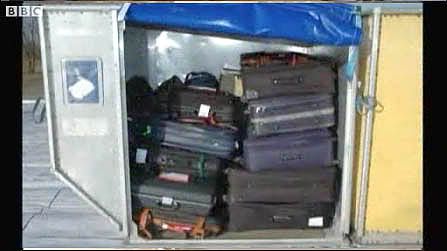
Below is a screen capture from al Jazeera's new video, of a severely blasted suitcase, gathered back together for investigator's cameras following the bombing of PA103. This piece of luggage was listed in the examination notes of Dr. Hayes as item 4.2.14, a blue soft-shell American Tourister case.

It was owned by passenger Patricia Coyle, who interlined from Germany on the feeder PA103A, which also officially carried the bomb (although other evidence suggests it was manually placed in London).  By RARDE's questionable and belated finding, it was placed just beneath the bomb suitcase, on the floor of luggage container AVE 4041. It looks just about blown-up enough to have been the primary case - the one containing the bomb. But it was what I'll call "secondary", next to and touching the primary one.

I recognized the photo even without a label from the description given of the unique remains in the trial transcripts, and the readable item numbers support that call. This case had always sounded supremely blast-damaged and largely unaccounted-for, and this elusive photograph 76 shows about what I expected, if even more so. The examination notes (culled as read-back from transcripts) explain:
"The following 27 items, the larger fragments of which are collectively shown in photograph 76, were identified as component parts of a blue American Tourister brand softshell suitcase. The severe overall damage to the identified component parts is consistent with this suitcase having been located in contact with the suitcase that contained the improvised explosive device at the moment of explosion."
The case had been supported by a simple wire frame, with flexible plastic of blue, maroon, and black filling it in the body and trim. TSH/346 is the large piece wrapping around the outside, essentially the whole middle band of the case. It was said to have been blasted at least partly into the neighboring container, AVN 7511, along with some pieces of the container and of the primary suitcase.

There are only about ten further pieces not shown, all very small. As can be seen, the majority of that base material didn't turn up, left in the tiniest tatters lost to wind, sea, and mud if not to the fireball of the explosion itself.

The Hard, Antique Copper One
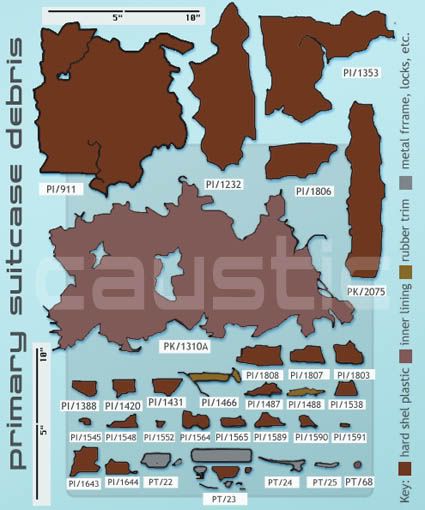
Here, at left, is what was assembled and called the primary suitcase. It was a different type entirely, a brown or antique copper colored hard-shell Samsonite, Silhouette 4000 series. Given in the report as luggage item 4.1.2, its remains were described thus:
The following 56 items were examined and identified as the component parts of one of the hardshell Samsonite brand suitcases from the Silhouette 4000 range. It was also established beyond any doubt that this item of luggage had been subjected to a violent internal explosion and thus had originally contained an improvised explosive device. Except where noted, all of the items examined below are collectively shown in photograph 49.
The bolded part is the one I here contend. Very similar damage, considering the material differences, had the American Tourister declared as just beneath the bomb. Here, Hayes seems a little too certain for comfort that this extremely splintered suitcase was wrapped around the explosion itself.

As with the other case, the pieces not shown are the smallest ones, especially the many fragments of the cardboard divider from the middle of the suitcase, closest to the alleged bomb (PT/68 in the lower corner is the one sample of that shown).

The delicate suitcase lining fabric not much further away is represented by one nearly-complete side of the stuff - the giant 22-inch PK/1310A, stretched across the middle of the photo. The combined effect of this gauze, the surviving cardboard, and the other very large fragments of shell plastic, is that this case experienced a very asymmetrical blast involvement, with one whole side - and even the middle, it seems - shielded by something - like the upper half of the case and half the primary case and its contents above that.

Among this possible lower half, PI/911 in the upper left is nearly a foot square, and at one point (January 1989) Dr. Thomas Hayes of RARDE had concluded it was from was from "the lower side of a suitcase, compressed and fractured in a manner suggesting it was in contact with a luggage pallet's base and subjected to explosive forces from above." This means beneath the bomb suitcase, which was on level two and blasted from within, not above. (see: the Monster of Newcastelton Forest)

That opinion changed at some uncertain later point - by the time of the final report in 1990, PI/911 was said to have flecks of blue plastic stuck to it, suggesting it had rested on the American Tourister, not the container's floor.

Two Brown Hard-Shells?
This all has direct relevance to the story of John Bedford, the luggage loader at Heathrow now famous for seeing and reporting a brown hard-shell Samsonite case - or perhaps two - inside the container's lower corner. In part, he told police in January 1989:
“They were [both] hard cases, the type Samsonite make. One was brown in color and the other one, if it wasn't the same color, it was similar.”
No passengers on Flight 103 carried any such luggage and only the one shown above was recovered after. Yet here is at least one, and possibly two, such cases confirmed in the container before a second or third such case came in from Malta on the German feeder. This was around two hours after Bedford's sighting, and officially, it was set on top of the Coyle case, in the same exact spot the Bedford bag(s) just vanished from, never to be seen again. Officially, that's what happened.

If he described two cases of the same exact color and style, where did the other one go when only the remains of one turned up?

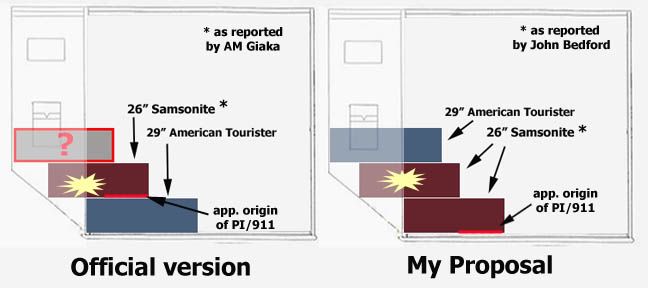
One possibility I've aired before is the one we've seen is not the primary suitcase. Rather, it might be another secondary case, like ms. Coyle's, with the primary case having effectively vanished under the force of its own more-powerful-than-thought explosion. At right is a graphic (all to scale and accurate) that illustrates that arrangement.

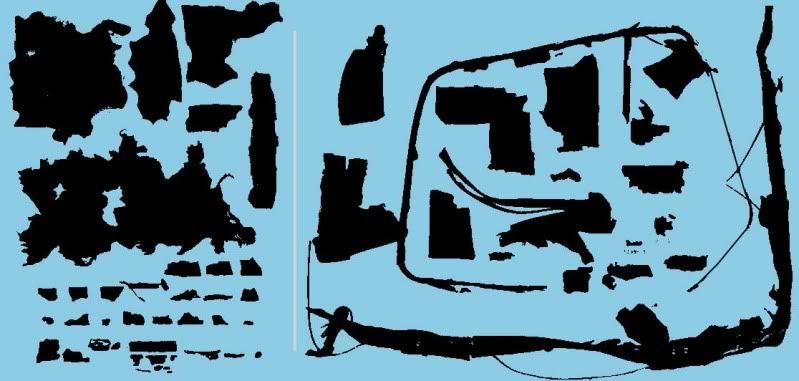
I had backed off a bit on the idea of two matching cases, for the sake of simplicity. But this new image of suitcase 4.2.14 changes things, showing me that  both of the suitcases in question are comparable for extreme damage. Below I've placed both images, fragments in silhouette, side-by-side to approximately the same scale. Seeing them together like this, it's hardly obvious the left one is the most obliterated. Soft-shell vs. hard-shell construction will give different results, and the total number of recovered fragments - 56 compared to 27 - suggests that, in fact, more of Ms. Coyle's less durable case material was lost to the explosion and the elements than were  lost from the primary case that should have seen by far the worst of it.

Really, seeing this image re-affirms to me the idea that these are both cases that had been situated next to the primary one, which was presumably the other Bedford suitcase, worse off yet - gone into dust, along with everything in it. This would mean the clothes, the bomb radio, timer, umbrella, everything deemed to be from the primary case, were either from one of the neighboring cases, or were planted. Considering how neatly they pointed to Libya and Megrahi, and how plagued they are with plausibility issues and handling anomalies, I'm going with planted.

After the Break-In

Connecting Manly's and Bedford's evidence with a two-phase operation
January 17 2011
last update Feb. 10

Note 2/6: See the comments below, which address half of "the middle part" below. Rolfe has soundly debunked the build-up introduction theory and its implied conspiracy. There is, however, the option of re-positioning of the cases at that location, by the same intruder, after their introduction at Interline. I've left the text alone however, so the article and comments become a continuous learning experience.

The Defense's "Missing" Link
I’ve previously explained the security breach at Heathrow airport’s terminal three, found and reported by guard Ray Manly in the first minutes of December 21. A lock to the secured airside area was broken, leaving the way open, perhaps, for a terrorist to place an explosive device amongst the luggage out there. There was no police intervention before the bombing of Flight 103 several hours later, and Manly’s police statement about it “disappeared” afterwards.

As noted in that article, the break-in is not some lone clue floating without any context. It is in fact central to the increasingly clear London origin theory. The explosion time – 38 minutes after leaving the airport – matches with the known altimeter-based weaponry of the most logical villains aside from Libya, if it were loaded at Heathrow. Before that, but following the break-in, a pair of suitcases eerily like the one that blew up were seen around 4:40 PM. Well before the investigation’s bomb in the same case could have arrived from Malta, these appeared mysteriously within the doomed luggage container AVE 4041.

And of special interest here is the fact that Heathrow is the most logical place to load a bomb onto a London-to-NY flight. A remote loading gives numerous chances for interception, and no control over final bomb placement within the container. The bomb did wind up in the only spot of AVE 4041 from which it could do its job (lower outboard corner – see graphics below), by sheer bad luck we’re told. But in fact we have good reason to suspect intelligent terrorist hands undercover at Heathrow airside, perhaps contravening normal rules of loading.

But these are more circumstantial points. It’s in connecting Ray Manly’s report of a break-in at terminal 3 and John Bedford’s report of what could well be the primary suitcase, that the defense case, and the London theory as argued on appeal in 2002, was based. As the appeal court judges considering this at one point put it, “the appellant [Megrahi] sought to link the damage to the padlock with the Bedford suitcases” [242]

[To clarify a side-point, I proceed here on a different assumption from most. A careful reading of Bedford suggests both mystery cases he saw were the same color and style. As he said: “They were hard cases, the type Samsonite make. One was brown in color and the other one, if it wasn’t the same color, it was similar.” This plus their appearance at the same time suggests – though it doesn’t prove - a matching set from one owner, and thus both suspicious. Somehow no one else seems to read him the same way, and focuses on one of the two (which one?) that matches the official style. But I go with what I see, causing the occasional disconnect between singular and plural forms below. [also: If the case(s) were bombing-related as many suspect, it’s possible that both contained bombs (one of which didn’t fully detonate?), or more likely one was a filler, added for realism, etc. I have good reason to suspect the “one case recovered” (actually less than half a case worth of fragments) was not the bomb bag, but on the floor, beneath it - Dr. Hayes once said so.]

In connecting the ‘round midnight report of the broken lock and the late afternoon suitcase sighting by Bedford, There is the problem of elapsed hours, as brought up by the prosecution and favored by the appeal judges. Why break in, plant a bomb bag among the luggage, and then leave, only to have it loaded to the last flight of the day about 17 hours later?

It’s a fair question but not a slam-dunk. If some would-be Lockerbie bomber were on the ground cutting locks at midnight, might he not be willing to come back for a second penetration? Below is a two-phase operation scenario that I think accounts for everything as well as everything can be accounted for. It’s about what I might try for if I knew as much as I imagine this guy knew, and was evil enough to carry out such a thing. I feel that it answers all the major problems pointed out during the appeal, which I will go over for comparison following the plot outline.

Phase one: Getting the bomb to the luggage place
We start around 11:45 PM on December 20, with the terrorist mastermind - Arabic in appearance, or Persian, or blond-haired and blue-eyed, depending. He's at terminal three, standing in front of door T32a, with no one else nearby. To force open a padlock, in general your options would be:
- Sledhehammer (Loud, ineffective against rubber doors like these.)
- Hacksaw (loud and slow)
- Crowbar (loud, crude, unsure)
- Powerful (long-handled) bolt cutters.
- Other (I’m not a tool guy really)

Bolt cutters seem the quickest and quietest – a polite cough might conceal the snip from anyone down the way. Heathrow was under serious maintenance in those days, with workers coming and going all over, according to airport employees speaking at trial. So a maintenance worker could be a good costume to explain the bulky tool, the work gloves (leaves no fingerprints), and the oversize toolbox that he wouldn’t want searched. So long as he isn’t caught in mid-snip, he’d be airside in the December dark within seconds.

He could then empty his toolbox at any number of spots – one he either planned out or picks at the time. Maybe some out-of-the-way spot around a corner from a corner, the kind of place you could sneak a pee with little chance of being seen, even in the day. And behind something else within that spot - an air vent cover, or a large machine with an accessible cavity. Or anywhere that two good-sized suitcases could hide unseen for half a day in a place only he knows.

They would be fully loaded, tagged for PA103, and ready to be smuggled among the outgoing luggage. But they weren’t to be placed yet. That’s too important to be left to chance.

In court, Ray Manly said of the break-in "if somebody had done their job then maybe, maybe [the bombing] may not have happened." But in this scenario, the police would not likely find anything even if they did show up and search the airside area. The whole place would have to be almost disassembled, and all the luggage out there double-checked for purity to be sure nothing untoward was there. At the point these activities were undertaken, the bombing may, sadly, have been unstoppable under normal circumstances.

At  least, until the cases re-surfaced and ran a chance of looking odd to eyes put on the alert....  

Phase Two: Turning the bomb into luggage
Phase one accomplished and no tracks left, the bomber would calmly depart the scene, ditching the empty toolbox and bolt-cutters, but not the gloves. In case this lock-cutting was reported and then caused an alarm (it didn’t), he might give them all day to relax again when nothing happens. He’d get some sleep and allow for at least one shift change at terminal three. He’d even have time to sleep in and have a nourishing brunch of brain food in the hotel lobby, with only one other thing planned for the day.

And that would be at the airport again, coming back in the early afternoon. He’d dress in a black-market Pan Am jumpsuit for a luggage-handling disguise. And he’s carrying nothing but his black-market airside pass (hundreds were missing), appropriate fake ID in a wallet with some cash, and perhaps a pocket-knife if that’s allowed and recovery will require un-screwing. He’s carrying no bags to search. No bombs. He's waved into the secured area where he's got his bomb hidden and ready to make-believe it's someone's matching suitcases.

Upon re-entry, he’d slide over to his hiding nook to retrieve them, maintaining supreme alertness to manage it unseen. Now in a new costume, Pan Am worker bee carrying two (misrouted, if anyone asks) copper Samsonites, he’d emerge on the tarmac and just blend in.

If possible, and in general, the next thing he’d do is manually place them in the lower outboard corner (see below) of a Pan Am container, hoping for the best from there (he may have gotten it).

The middle part: Interline or Build-Up?
The middle part, just where the container would ideally be when he made his move, is more “choose-your-own-adventure,” based on some uncertainty on my on part. It’s a little complicated, and most readers can just be skip to the last paragraph here.

My previous, almost gospel, interpretation, takes John Bedford’s amazing account as literally true. This has the suitcases introduced at the interline shed, the place for processing luggage from non-Pan Am connecting flights. He says his co-worker with Alert security, the ones who x-ray the bags, had placed the matching brown Samsonites in his brief absence, although the co-worker, Sulkash Kamboj, denies this.

In this version, the Lockerbie bomber at Heathrow would have Mr. Kamboj and his x-ray to deal with, which could be dealt with in at least two ways. He could just stand outside, put the Samsonites on the belt running into the shed like any luggage, let Kamboj scan them unseen by him, and just hope they pass and are placed by luck in the right corner. He could also Step into the shed, pay the x-ray man a wad of cash to ignore his job, suggest it’s drugs in there, not bombs, and try to place them himself in the right corner. The latter would offer a better chance of success, but still has its obvious dangers – like the guy taking the cash and then removing the bags for scrutiny anyway once the intruder was gone.

Another problem is the suitcase positions Bedford reported – position “A” in the image below, flat across the floor. The bomb was in a case of just this type, but by the evidence (and officially) in the upper of the two as shown in “B.” Both cases in B are ideally placed, against the sloped floor panel, which winds up nearest the curve of the airliner’s hull. This would only require a stacking of the two cases in “A”, nothing too extreme, really. However, that would make the one on the right in “A” the most likely to be holding the bomb (if there was only one). This is clearly not an ideal placement, suggesting the terrorist was unable to arrange them himself at interline.
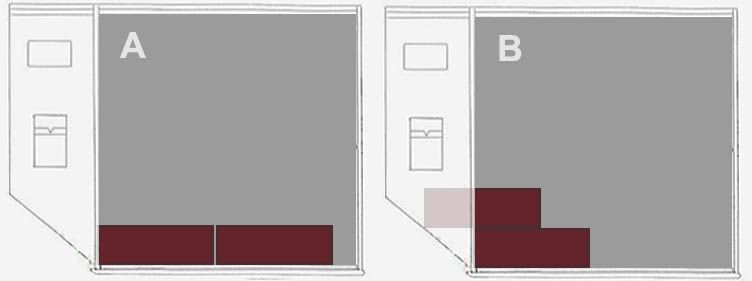
An alternate narrative involves the same two cases actually being inserted at the baggage build-up area. Here baggage from Heathrow-originating passengers was consolidated into containers, and occasionally a container started at interline would be topped off or await an incoming flight here. AVE4041 was one of those. If the cases were first spotted here, that might leave Bedford’s story both literally untrue and still relevant, in a cynical but plausible situation like this:

Peter Walker, who was in charge of the build-up area, goes to take AVE 4041 out to meet the German feeder flight to be filled. But as he steps to it, he sees and makes note of the two “Bedford suitcases,” which weren’t there when Bedford dropped it off. And they’re stacked against the outboard panel as shown in “B” above.

He sees this after sitting inside for around 40 minutes, never watching the container for a moment. No one else was guarding it, and it sat unattended and wide open for most of an hour. Perhaps for fear of causing trouble he ignores the anomaly and lets it slide. (There’s probably a good reason. It’s not like we’re on high alert following a break-in or anything.) It’s taken out to K16, and filled up with items from Frankfurt, none of them holding any explosives, and then is loaded onto 103.

But after the news of what happened less than an hour later, he’d put it together. Even the placement was a clue - the bomb was in one of those cases, ideally placed nearest the hull. So he compels someone else (Bedford) to say he saw them, way over there at interline, and that Indian guy “Camjob” (as Bedford calls him) is the one who placed them. They’d be x-rayed, one would presume. (But if not, hey… it was him, not either of us.) And further, they were reported by Bedford as flat on the floor, not stacked in that optimal way.

This is a rather convoluted thing to suspect, and requires some conspiracy, but it does explain a number of things. It should be noted that Walker provided Bedford’s alibi (a tea break together) for being absent when Kamboj placed the bags. And besides the Bedford/Kamboj disagreements, there are serious inconsistencies in Walker’s statements. To police in 1989 he swore he never saw or was aware of the container at all, contradicting Bedford. In 1990, he fixed this and confirmed that Bedford had brought it over, as they had agreed to over tea. At trial in 2000 he admitted the change in stories is strange, but he said for whatever reason, "I can’t explain it."

In this scenario, the suitcases memory in Bedford’s story is accurate enough to be a clue, even if it’s not his own memory, but transferred from one mind to another. It also allows for the flat position to be an additional fudging, so that not even Kamboj facilitated their potent stacking. (That was apparently someone later down the line, if it's decided that happened at all.)

Both options involve the danger of Kamboj, Walker, Bedford, or someone else reporting or removing the bags. Every London option has that danger, and that risk is tripled in the official story through three airports, making this still preferable. Logic says they’d choose Heathrow, and less clearly it suggests the bomber would choose build-up. But Bedford suggests he chose interline. Either way, the reference to brown, hard-shell Samsonites in the deadly corner of AVE4041 shouldn’t just be presumed to be a coincidence.

Appeal judgment addressed:
Following are some excerpts from the second “Opinion of the Court” from Camp Zeist, following the appeal of Feb. 2002.

"[244] ...Moreover, although readily discoverable evidence of the break-in had been left behind in the form of the damaged padlock, the hypothesis involved that the case was not introduced into the interline shed until some fifteen hours later..."
True, but it’s no problem for the two-phase explanation - it’s the basis of it. In fact, the build-up version involves an even longer span, by as much as an hour, than the one the judges half-considered.

"...Unless the risk of opening the case airside to set the timer was to be undertaken, the timer would have had to be set before the break-in..."
Ice-cube timers that blow around 38 minutes after takeoff don’t need to be set, of course. So this point doesn’t apply to my version, nor, I think, to the case made by the defense.

"... No method of arranging for the bag to pass through the system to the interline shed had been identified..."
Perhaps not by the defense, but I propose the method was manual placement supported by psychological deception.

"... The intruder would have required either to wait for fifteen hours himself, or to have the assistance of an accomplice..."
Either works. I’m betting on one well-trained operative with the requisite patience.

"... No place of concealment for the intruder or the suitcase had been identified..."
No place identified? I suspect the intruder was an out-of-towner, and concealed himself at a hotel for that time. As for the bomb suitcases, no one has shown any reason to rule out all potential hiding spots, like those mentioned above or a dozen others. Do they imagine there would be no suitable spots? Aren't they presuming they were "hidden" right inside the interline shed?

"... There was nothing in the evidence to explain why a suitcase, brought through T3-2A between 2205 and 0030 hours, would not be placed in the interline shed in time for either of the two earlier PanAm flights. On the hypothesis under examination, the suitcase had been tagged for flight PA103, although there were two earlier flights that would have involved a shorter period of concealment of a suitcase containing an armed explosive device... "
Again with "armed" and time spans. Unless the airport suddenly levitates a few thousand feet, the bomb is stable. Remember, it's altimeter-triggered, in this non-Libyan plot. If the bomb is concealed and ready for a phase two, no one but him will put it in the shed, on no timeline other than his own. There’s no need to rush things; even doing it the same day is unnecessary. And besides, they may have been targetting Flight 103 itself for some specific reason.

"... Yet there was no evidence that there was anything about flight PA103 or its passengers that singled it out as the target."
This is widely disputed, but for my part I take no stock in certain individuals (Charles McKee, etc.) being targeted. But here are other reasons I could see why they might choose to wait for this one, depending what they knew from advanced research:
- the plane’s age (it was one of the oldest around) and its brittle skin. (see this frightening video)
- its inhabitant’s average youth, to maximize the sense of loss.
- its lateness, last flight of the day. As explained above, giving time for security to relax, for sleep, and for a costume change.

"...Moreover, if an accomplice with airport identification, genuine or false, was involved, there was no need to break in to airside..."
Except to have no friggin' bomb on him when he showed his pass and perhaps was subjected to search prior to entering a secured area… which of course was not secure at this point, and he may have had a bomb waiting for him inside.

"...All that was required was to smuggle the components of the explosive device through an access point, such as T3-2A, where persons with appropriate identification were not searched..."
Even the  stray suitcases they're bringing in aren't searched? I don't know - I imagine a ready-made bombs aren't smart to bring through, and the judges agree, speculating "component parts" being smuggled and then assembled out on the tarmac somewhere. (???) For the bomb’s entry behind the perimeter, where worker-looking people are generally trusted, I think an unacknowledged sneak-job of the ready package would be wisest. A break-in at midnight would be genius.

"... The effect of all these points, the Advocate depute submitted, was to show that the hypothesis that the break-in at T3-2A was the means of infiltrating one of the Bedford suitcases was so weak and flawed that the additional evidence could not pass the Cameron test..."
My theory has it introducing both of them. I didn't read just what "the Cameron test is," but it's from a case involving someone named Cameron, and probably means a point doesn’t hold up under scrutiny, compared to something else already "established." At least, not when the scrutiny is as skewed as their Lordships' is. When they say “the Advocate depute submitted” they also seem to be saying “we think.” But the A.D.’s job is to argue his case, however unsupported, and their job is to judge fairly, not just agree with the one line of argument as if it were a self-evident truth.

"[251] In our view the Advocate depute was right in submitting that the additional evidence did not demonstrate any link between the break-in at T3-2A and the Bedford suitcases..."
Perhaps not, but now I have. A potential one at least.

"... It might be said that there was a temporal link, in the sense that the break-in occurred some fifteen hours before the Bedford suitcases appeared in the interline shed..."
Yes. In a 17-year career, the worst security breach Manly ever saw, and the worst terrorist bombing in UK history, happening within the same 17-hour span, is definitely a temporal connection.

"... It seems to us, however, that that interval of time, so far from pointing to a connection between the two events, casts considerable doubt on whether they can have been connected..."
"Can have been connected?" Wow. No imagination at all.

"...The lapse of time after a readily detectable break-in, creating a period during which the infiltrator and the case (or, if there was an accomplice, the unaccompanied case) would require to be concealed in the airside area, points away from a connection..."
Again, the lapse of time after the detectable event is explained by me as a cool down period in case the detection raised an alarm. Sixteen or so hours is, if anything, a bit short for this purpose, but it apparently worked.

"...Moreover, any attempt to link the Bedford suitcases with the break-in raises unanswered questions as to why the infiltrator ignored the baggage build-up area, and introduced the cases into the considerably more remote interline shed..."
Any attempt? Not my variation where the bomb is introduced at build-up. They're the same suitcases then, just the "Walker suitcases" instead of the Bedford ones.

In addition, given the evidence as to the ability of a person with airport identification to pass through T3-2A during the day without being subjected to search, and given the evidence led at the trial and mentioned by the trial court in para [24] about the substantial number of such passes unaccounted for, it is not clear why a break-in would have been seen as necessary, since the components of the explosive device could have been smuggled through an access point.
Repeated just to emphasize the bolded, to remind the reader how easy it would be for a terrorist to sneak back into the airside area where he'd earlier hidden the bomb he meant to get onto Flight 103.

Addendum: Completely unaware of the break-in that changes the whole scene for the imagine Heathrow intruder, the Zeist judges put the situtation pretty well in their paragraph 24 (in its entirety)
[24] It emerges from the evidence therefore that a suitcase which could fit the
forensic description of the primary suitcase was in the container when it left the interline shed. There is also a possibility that an extraneous suitcase could have been introduced by being put onto the conveyor belt outside the interline shed, or introduced into the shed itself or into the container when it was at the build-up area. To achieve that, the person placing the suitcase would have had to avoid being detected, but the evidence indicates that a person in possession of a pass for the airside area would not be likely to be challenged, and there were a very large number of passes issued for Heathrow, a substantial number of which were not accounted for. The person placing the suitcase would also have required to know where to put it to achieve the objective.
---

A Smoking Gun Left in Plain Sight

Bedford's Bags: What They Were and Weren't
February 17 2011

last edits Feb 20

The bag that blew up
It’s been accepted for over 22 years that the explosive device responsible for destroying Pan Am 103 was within a brown (antique copper), hard-shell Samsonite suitcase, Silhouette 4000 series by its partial remains. This was eventually connected, in an extended fit of fevered imagination, to Libyan agent al-Megrahi, based at the time on the island of Malta.

The suitcase was “found” on flimsy evidence to have traveled unaccompanied from Malta, tagged for PA103, and transferred in Germany to a Pan Am feeder flight, 103A. When the feeder arrived in London at around 5:35 pm, it was decided, the death package was re-loaded into the luggage container AVE 4041, which was then loaded onto the 747 Flight 103, which took off into the sky at 6:25.

The explosion inside the Silhouette 4000 shortly thereafter caused damage to the container suggesting the case was in the lower outboard corner, apparently in the second layer of luggage. Investigators were quite certain this put it among the majority of items loaded from the feeder, but at the very bottom of that batch – just above the few suitcases loaded before the feeder landed, at terminal three’s “interline shed.”

And it’s there we find our smoking gun.

The bags Bedford saw
The plot from Malta is complicated by on-the-ground evidence at Heathrow: the report of baggage loader John Bedford. He was in charge of Pan Am’s operations at the interline shed of terminal three, where luggage from other airlines connecting onto PA flights was re-screened and loaded into containers. Employees of Alert security ran the x-ray part, while Bedford, in this case, placed the items into the “tin” in question.

Of all the cases passing into AVE4041 through the shed that afternoon, none stood out to Bedford except for a pair he reported to the police when they interviewed him in early January 1989. (see: the Bedford suitcase(s)) He described them as brown or maroony-brown, hard-sided Samsonite-style cases. That’s a remarkable fit with the primary suitcase, although apparently in duplicate.


[To clarify a side-point, I proceed here on a different assumption from most. A careful reading of Bedford suggests both mystery cases he saw were the same color and style. As he said: “They were [both] hard cases, the type Samsonite make. One was brown in color and the other one, if it wasn’t the same color, it was similar.” This plus their appearance at the same time suggests – though it doesn’t prove - a matching set from one owner, and thus both suspicious. Somehow no one else seems to read him the same way, and focuses on one of the two (the left one is specified somewhere) that matches the official style. But I go with what I see, causing the occasional disconnect between singular and plural forms below, as well as apparent complications addressed partly in this post.]

The cases appeared in his absence, Bedford said, but were vouched for by the Alert security x-ray man Sulkash Kamboj. But Kamboj himself denied this to police, and so no one can attest to seeing either one of these bags cleared for safety or placed in the container. This is in itself a minor mystery that raises some questions about what that luggage really was and how it got there.

What they weren’t: Megrahi’s luggage
A crucial aspect of Bedford’s story is its timeline. They mysterious hard-shells appeared around 4:40 pm, about an hour before the feeder 103A, carrying the fabled Libyan Samsonite, had landed in London. There’s no ambiguity possible here; Bedford clocked out right after the incident, and took his eyeballs home at 5:02, over a half hour before the feeder touched down. So clearly, neither one of the bags could be a stray sighting of that Maltese-origin packet-o-clues, which would be the third, or at least the second, brown hard-shell case accepted as going into the lower levels of AVE 4041.

What they weren’t: recovered later
The position Bedford saw the cases in was side-by-side, flat across the front half of the container floor. (see "Visualizing the Bedford story"). Unless they were moved, these would have become damaged by the explosion, accepted as centered about one inch above the left-hand twin. The bomb was powerful enough that nearly half the cases in the container, 25 out of 55 or so, showed signs of explosives damage, so clearly as they were reported, neither of the mystery cases was far enough away to escape harm.

But as the Zeist judges summed it up in 2001, “the evidence did not disclose that any fragments of a hard-shell Samsonite-type suitcase had been recovered, apart from those of the primary suitcase itself.” In fact, neither brown fragments of nor any intact cases of that style with the slightest bomb damage were found, except the one.

To explain this lack of damaged Bedford bags in the evidence, the UK Fatal Accident Inquiry in 1990, bafflingly, did nothing. The judge (Sheriff Principal), John Mowat QC, had in his evidence two brown hard-shells flat on each other, with the upper one from Malta blowing up to be recovered in bits, and the other, still on the floor … vanishing entirely, it seems.
"I am therefore satisfied that the suitcase in which the explosive device was contained was among those transferred from Flight 103A to Flight 103 […] On all the evidence I consider it is probable that bags from flight 103A were placed on top of the two interline bags lying flat at the front of the container.” [FAI 1.rtf]
This last is a clear reference to the ones Bedford spotted, although the determination gives no description of the cases that just fell through the gaps in Mowat’s logic. He did hear in the proceedings (re-read at the Zeist trial) a badgered “admission” from Bedford that the twice-affirmed “maroony brown” bag “could have been” a completely different color, blue even. It’s not clear what effect, if any, this forced appearance of vagueness had on Mowat’s decision. (the lead-up to this memory lapse, which I read as "badgering," is fascinating reading, but the voice inflection and cadence we don't now have might reveal so much more).

The Camp Zeist judges, in their 2001 Opinion of the Court [PDF] fared a little better with explaining its absence from the pool of damaged luggage. They accepted Bedford’s original report on the color of the mystery case, but speculated that it “might have been placed at some more remote corner of the container” just before the re-loading from 103A. It’s a neat thought, but only the upper corners are remote enough to work when half the luggage in there wound up damaged. And those spots obviously were not available until the end of loading from 103A.

Further, there’s no reason to rule out a move to the near corner, just a few inches away, where a case just like that blew up.

Further, the judges’ speculation founders on the fact that apparently no non-damaged case that could fit the description turned up either. The best they could do was say this:
“[W]hile the forensic evidence dealt with all the items recovered which showed direct explosive damage, twenty-five in total, there were many other items of baggage found which were not dealt with in detail in the evidence in the case.”
If the prosecution could find and explain the non-damaged, non-explosive Bedford bag(s), anywhere in the police records, the judges would have heard about it. Yet they’re left having us presume such a case must have been buried by oversight in that quiet bone yard.

Simply put, the investigation and the trial judges accept with bland resignation that the maroony-brown suitcase(s) never turned up. In real life, things don’t just disappear when it’s convenient for them to. In the mind of SCOTBOM, or Camp Zeist, however, it appears everything is permitted in deciding what is and isn’t true.

What they were called: interline luggage
The Scottish police ruled early on that the Bedford suitcases, like all of the luggage in AVE4041 before the feeder landed, was from interline passengers on flight 103. On March 28 1989 Senior Investigating Officer John Orr told investigators gathered at the Lockerbie Incident Control Center (LICC) that:
“Evidence from witnesses is to the effect that the first seven pieces of luggage in the container belonged to Interline passengers and the remainder was Frankfurt luggage.”
“Seven pieces” included five suitcases Bedford first lined up along the container’s back (quite likely it was a few more than this), plus the two mystery cases. The "effect" that this was all interline baggage was not from "evidence from witnesses" - who all swear they don’t know where the cases came from - but from the name of the shed (interline) where the suspect bags were inserted.

The FAI and the Zeist judges, by their wording, agree in calling all pre-103A bags interline, and it’s been the blanket classification ever since. This inherently rules out a Khreesat bomb, the early suspect device built with only one take-off before it blows. If the missing one of those had interlined to London, it wouldn’t get there - it would be scattered along with a plane and its passengers on some field not far from the first airport.

But my article “After the Break-in” outlines how a Heathrow intruder in the airside area of terminal three – which had its security breached in the early minutes of December 21, by the way - could make an introduced bomb appear wherever he managed to sneak it into the flow. If he weren’t caught in the act and the items were tagged right (perhaps even with an sticker saying it was X-rayed), it would wind up looking like, for example, interline luggage. It would run the danger of appearing mysteriously and catching someone’s attention, and of course, something was noticed on December 21 that matches the bomb bag style. So that leaves us … still spooky.

What they weren’t: interline luggage
The presumption that luggage appearing at the interline shed would be interline is only natural. But other possibilities exist, so it should be double-checked before being presumed. If they really belonged there, just whom did this case or these cases, so similar to the Libyan Samsonite, belong to?

Investigators did in fact try to figure it out. Scots detective John Crawford wrote in his 2006 book about analyzing the “first fifteen of the interline passengers” to locate any possible link to the bombing. [JREF link] He said these were high-profile or secret-mission people who might be targeted, have their luggage swapped, etc. Researcher Rolfe has decided instead this was likely all of the interline passengers he looked at, only some being special targets. But these fifteen at least would have any luggage switch from “Air whatever” to the interline shed to be x-rayed and then placed by Bedford. Some of them must have gone elsewhere than AVE 4041, however, as there were no more than eight cases in there before the mystery set appeared. Apparently Crawford found no sign that any of the fifteen possessed such luggage, or it would have clearly explained away Bedford’s story.

The four “Larnaca interline: passengers,” the most targetable subset of Crawford’s list, are of special interest. Major Charles McKee, Dan O’Connor, Mathew Gannon, and Ronald LaRiviere all came in on an Air Cyprus flight, all on sensitive missions related to embassy security and hostages in Lebanon. The four were shown to have held four cases between them, with one (O’Connor’s) left off the flight and sent later to New York. [JREF link] Thus they account for three of the 5-8 bags Bedford placed along the back of 4041: A blue softshell Samsonite and two gray hard-shell cases. All three were recovered and showed signs of explosive damage, especially one of McKee’s case, which also has its own mysteries attached.

Again by the silence we can presume that among the other half of the genuine interline passengers whose cases were in 4041, none had such a case to explain the still-unexplained sighting.

What they weren’t: passenger luggage at all
We can further infer that no such luggage should have been interlined to that container from the fact that no passenger on flight 103 was found to own such a case. Sherriff Mowat issued a finding in his FAI determination that meant one thing there but becomes very interesting in the current context:
I am therefore satisfied that the suitcase in which the explosive device was contained was among those transferred from Flight 103A to Flight 103. I am also satisfied on a balance of probabilities that it was not associated with any of the passengers who boarded Flight 103 at Heathrow. This decision is based upon the evidence of Detective Constable Henderson who analysed the baggage which was recovered and those pieces which were not recovered and where possible linked each piece with the person accompanying it. He gave evidence to the effect that none of the descriptions given by relatives of the baggage which they expected the victims to have been carrying fitted this suitcase.
As Rolfe sums up: “This makes Bedford's left-hand bag very mysterious indeed. […] So if there was no legitimate suitcase answering the description of the bomb bag, what the hell was it that Bedford saw if it wasn't the bomb bag? Of course this evidence was not led at Zeist.” [JREF link] Indeed, as we've seen, the judges there did not rule them out like this, but left the impression they were innocent interline luggage. Unlike at the FAI, the Malta bag and its Megrahi genesis was well-defined by then and separated itself well enough for the judges to forgo such games.

Therefore, besides the color and style description and location, we must add another disturbing shared trait between these mystery cases and the primary one – all of them were something other than passenger luggage. That’s an important point to consider as the odds steepen into sheer cliffs.

And to state it again in shorter form, FBI lead investigator Richard Marquise, in his own 2006 book, affirms no one on the plane at all owned such a case.
Quote:
"Interviews of the American relatives as well as those who had last seen the passengers who boarded the aircraft revealed little additional information. None of them owned or had a brown hard-sided Samsonite suitcase." [p 41]
Marquise was trying, as Mowat was, to isolate the Libyan suitcase from Malta, but he’s unwittingly chased it into a closet already stuffed with one or both of the cases Bedford reported. None of these two or perhaps three brown hard-shell Samsonites was passenger luggage.

What they remain: sidelined yet relevant
The Bedford suitcases remain to this day unexplained, and equally sidelined and declared irrelevant in every conceivable way. That what he described was the bomb suitcase is the first thing one should have suspected comparing it to the physical evidence and known terrorist weaponry and motivations. All this was available to investigators before the Spring thaw of 1989, yet it was the first option British investigators denied and found against at every available chance, using whatever was at hand.

First, SIO John Orr and his people found that the larger number of Frankfurt origin items in the container (aside from the bottom) led to “balance of probabilities” conclusion it came from Frankfurt. Soon it was established that the blast was slightly too high in the container (not right on the floor) to be one of the bottom interline bags. These were incapable of being stacked or otherwise re-arranged into a slightly higher position (this has never been stated, but always implied).

Then the primary case was found by the esteemed "political scientists" at RARDE to have been on top of a blue soft-shell case from Frankfurt, which had replaced the left-hand Bedford case on the floor. This forensic “fact” was absent on Dr, Hayes' first examination in 1989, and indeed unknown to the 1990 FAI, seeming to appear only later, and supported by contradictory and suspect clues. (see “the Monster of Newcastleton Forest”)

And finally, the Malta link to Libya was established. In August 1989, an unaccompanied bag from Malta was noticed, and later it was decided Megrahi bought the clothes inside of it. Megrahi was at Malta airport as that item appeared to have left, under an alias no less, and was "seen" by witness Giaka in possession of the case. Bingo, the Bedford evidence was finally history. Too bad that construct, elaborate as it was, is now in tatters, held together only by legal convention and increasingly willful denial of reality.

And the clues that rag pile obscures suggest one coherent narrative – a Khreesat bomb loaded in London to help the Iranians get their vengeance for Iran Air 655. One of the key London clues, Security guard Ray Manly’s report of a break-in at terminal three, was completely erased by police (on accident, they say) and never considered as the debate raged over whose airport screwed up (the Brits won).

On reviewing this awkward tribal dance around Bedford’s story, it’s evident that, like Manly’s report, it would have been much easier to dance over its unmarked grave. But for one reason or another this likely smoking gun of the Lockerbie bombing was kept in the public record, in plain sight but overlooked by the eyes with power. Even as it’s been divorced from relevance to legal truth, the unusual insertion spotted at 4:40 pm may still be more than an amazing compound coincidence. It might in fact be central to the physical reality that took 270 lives two and a half hours later.
---

Video: Two Hard Cases Solve Another

January 31 2011

Here is my latest Youtube video, relating the account of John Bedford and its potential relevance to the bombing.


It's not the most visually interesting, and the music's a little weird. But I think the soundtrack adds some drama to a pretty detailed narrative. I hope it all comes together well enough to raise a few new question marks - or even exclamation marks - out there.

See also the actual Youtube page for the video to help get the views up. Comments open to all here and there, welcoming constructive criticism and all. I plan to remake all my videos some day, or something to that effect, so feedback is always valued.

The Monster of Newcastleton Forest

PI/911 and its Mixed Clues
May 2 2010

last edits 1 September

Among the interesting artifacts of the Pan Am 103 crash strewn across southern Scotland, is a particular large fragment of suitcase presumed to be from the bomb bag. Its police label PI/911 designates when and where it was found, roughly; “P” means property (evidence) and “I” designates the search sector it was found in. These were lettered A-K, generally west-to east with sectors A, B and C in Lockerbie itself, and K up to the North Sea. I sector, where most suitcase debris was found, was centered on and around Newcastelton Forest. The numbers after are sequential, so PI/911 is ostensibly the 911th item found in that area.

Like the dozens of other primary suitcase pieces recovered and examined by Dr. Thomas Hayes of RARDE, it matched the construction of the control sample, a Samsonite Silhouette 4000 series hardshell case, antique copper in color. Hayes read back from his final report (Production 181) at trial in 2000. PI/911 was the first item described in the report, and he concluded in part:
“This is a distorted and severely heat-affected irregularly shaped fragment of rigid plastics sheet. When examined, it was found to have a twin plastics layer construction [...] with a thickness of 2.5 millimetres. It consisted of an outer skin of bronze-coloured plastics with a simulated leather patterned finish covering a thicker underlayer of grey plastics having a smooth finish.”
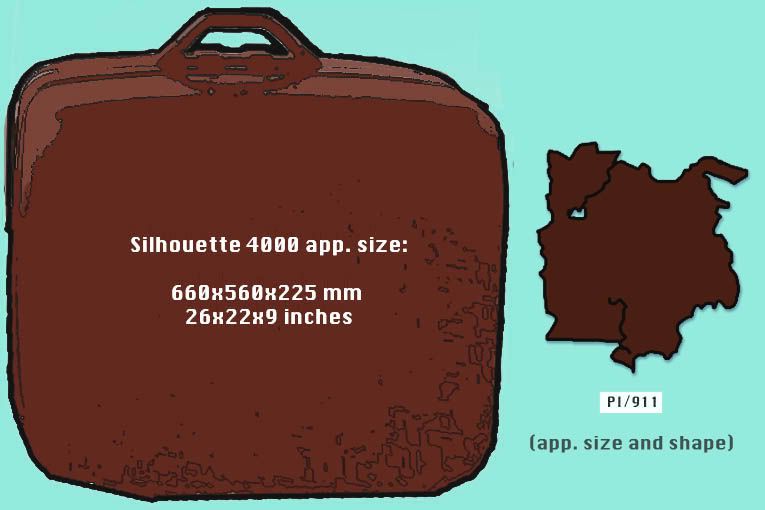
The main distinction of this fragment is its size; the largest found at “approximately 280 millimetres by 260 millimetres,” or about 10.5 by 11 inches. That’s nearly one fourth of a whole side of the 22x26x9 inch case. Just from the size one might wonder if this even could be from the primary suitcase, no more than a few inches from a Semtex blast of probably more than 500 grams power.
PI/911 shape traced off of a Corbis photo (that's probably not allowed either). Sized to scale rel to the control case. That's a big old chunk and, as that photo shows, it's not the only one.

Other clues strengthen the impression; Hayes also noted “the smooth inner surface was lined in one area with the partially charred remains of a brown woven fabric which had a cream-coloured thin reticulated plastics foam underlay.” A nanosecond later, two feet away, the weakened blast was removing airplane skin from its rivets. The Crown’s Mr. Campbell, to his credit, turned to Dr. Hayes’ earlier examination notes (Production 1497) and revealed further doubts this was the primary case.
Q …were these written by you as you carried out your examinations?
A Yes, they were, sir.
Q And we see that you have made notes and made a sketch of the item.
A Yes, sir.
Q And was that the way in which you generally approached the exercise?
A Yes, it was, sir.
Q And we see a date at the top right-hand, which is 21 -- 26, rather -- 1/89?
A Yes, sir.
Q And this is a note of your examination of PI/911. And could I draw your attention to the writing that we see to the right-hand side of the drawing, where you describe the article as: "A severely distorted irregular-shaped sheet of rigid plastics," and go on to say: "Apparently the lower side of a suitcase, compressed and fractured in a manner suggesting it was in contact with a luggage pallet's base and subjected to explosive forces from above."
Now, is that an observation that you made when you were examining this article in January of1989?
A Yes, it was, sir.
Q And was that at quite an early stage in the course of examining articles?
A Yes, it was.
This is an amazing insight. Elsewhere we’ve learned, from official findings that this blogger agrees with, that the primary case was not in contact with the base but laid flat on another flat-laid case in contact with and protecting the floor, putting the blast center around ten inches up. There is also reason to wonder about two suitcases of about the primary style, reported by John Bedford very near that corner of the container. If these had been stacked up one such case could have detonated while the other shielded the floor.

And here’s lead scientist Hayes suspecting this one was in contact with the floor and had a blast above it. Mr. Campbell further questioned Hayes on his reasoning for this:
Q What was it about the item that suggested to you that it was in contact with the luggage pallet's base and subjected to explosive forces from above?
A On the assumption that it might have been part of the suitcase containing a bomb, firstly the residual size of the fragment, which is quite large, and also the fact it appeared to have been supported in some substantial way by a relatively immoveable surface.
The wording is a little ambiguous – if we read that as starting "on questioning the assumption..." it makes more sense and fits with my own thoughts. Otherwise, much here is lining up; other large chunks of ten inches or more on a side, and a 20-inch uninterrupted span of lining material (more coming), suggest one whole side of a suitcase just like the bomb bag broke up very unlike how the bomb bag would. Almost as if there were two bag of the same type, one on the floor and another with a bomb on top of it.

But Hayes had one other clue, in the final report if not his exam notes, that changes all of that:
“Small flecks of a blue foamed plastics material with a cross-hatch-patterned blue plastics skin were found strongly adhering to the simulated leather surface. This finding indicates that at the moment of detonation of the explosive device, this bronze suitcase was in direct contact with one containing a foamed blue plastics material. The items recovered from PI/911 were removed and raised collectively as item PT/42. “
Blue foamed plastic pressed into copper-brown material should have been readily visible to Dr. Hayes, and a tip-off that side of PI/911 wasn’t in contact with the aluminum container base. Therefore, his January decision is curious, unless the blue stuff only appeared later. Now that it’s there, this must be the bomb bag, matching its style, and on the second level up from the floor after all, above a blue case says Hayes… He explained away the discrepancy to Mr. Campbell
Q If you assume that the -- this suitcase was not on the floor of the pallet but was on the next level up -- that is to say, on top of other luggage -- are you able to explain what you see here on that basis?
A Yes, I am. Quite satisfactorily, to my own mind.
Q How would you do that?
A By considering that if a suitcase had resided beneath this one, then the surface of that suitcase, whether of a soft material or a hardshell material, could have similarly acted as a relatively immoveable surface if it, in turn, had been supported beneath, and in view of the tremendous speed of the detonation shock front.
A solid suitcase behaving enough like a floor to mimic this effect is, indeed, credible - if not obvious or necessarily true. The size of a fragment in turn could be affected by the flexibility of its support. But a soft case is unlikely to hold up like a metal floor, and all this still fails to explain the survival of so much inner lining of the case. Nor does anything yet revealed explain away the two bags Bedford saw on 'level one' of container 4041; they had to go somewhere, and these two Samsonites, on levels one and two of the container, had to come from somewhere.
---
Updates, 1 Sept: PT/42 was given above as "small flecks of a blue foamed plastics material with a cross-hatch-patterned blue plastics skin." I checked in the final report (signed by both Hayes and Feraday) for PT/42, the number given to all debris removed from PI/911. Strangely, PT/42(a) is described as a singular "fragment of black plastics sheet bearing a diamond-shaped embossed pattern on one face.” This type of fragment, of which there are several, is distinct from the very few pieces of soft blue outer plastic or foam underlay. While it is “similar to that present on the fragment(s) of American Touristster suitcase,” and is duly listed as a fragment of it (the only one listed from PI/911), the discrepancy between several pieces of blue materials and a single black fragment is notable.

Below for visualization purposes is what I see as RARDE's version vs. my own proposal. The American Tourister was in contact with the bomb bag, but above it. Below was its mate in Bedford's recollection, of which PI/911 is the largest known remnant. It just seems too big to be from the primary case.
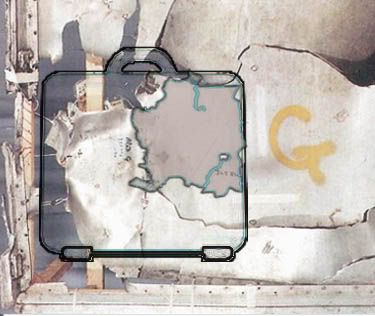
21 September: I tried a scaled image comparison - PI/911 within the most likely lower-case placement, and damage to AVE 4041's floor. The placement could vary - I'm also working with other large fragments on the hunch they might all be from the same lower side of the lower case, the chunks that shielded the floor from gas pitting. Do note the size of this supposed primary case fragments is consistent with the flaps of metal torn through just after the lower case. 
 

Appeal Court Dismissal of the Heathrow Theory

February 10, 2010
last update Jan 14 2011

The judges considering Abdelbaset al Megrahi's appeal of conviction in February 2002 [PDF] had to give the London introduction theory a listen - they had the Bedford bags, the 38-minute clue, and the recently revealed, long-suppressed break-in evidence to consider. They did some thinking about this it seems. I invite comments to criticize this ridiculous word salad.

[244] In assessing whether the additional evidence supported the hypothesis that the break-in at T3-2A provided the route by which one of the Bedford suitcases was infiltrated, the Advocate depute made a number of points. First, he submitted that an individual carrying a suitcase and, presumably, lock-breaking equipment would be rather conspicuous in Terminal 3 between 2200 and 0030 hours, since normally no members of the public would be around at that time. Secondly, setting aside speculation, for a suitcase brought airside through the forced door at T3-2A to be one of the Bedford suitcases, it required to be infiltrated into the baggage handling system at the interline shed. For that purpose it would require an interline tag. That was particularly so if it was accepted, as the Advocate depute [prosecution] submitted it should be, that the Bedford suitcases were probably placed in the container by Mr Kamboj. He would not have placed them in the container if they had not been bearing appropriate interline tags.

Okay, someone would have to have put Pan Am tags on them. That's not much of a de-bunk. They got some tags, however people do that.

... despite the fact that the trial court’s preference of Mr Bedford over Mr Kamboj (on the question of whether Mr Kamboj told Mr Bedford that he had placed the suitcases in the container) did not constitute evidence that Mr Kamboj had in fact so placed them, the natural inference was that the cases were put into the container by Mr Kamboj, whose job it was to x-ray PanAm interline baggage, rather than by some interloper. Why would an intruder through T3-2A choose to introduce a case containing an explosive device at the interline shed? He had, on the hypothesis under examination, broken in to airside at a point adjacent to the very area (the baggage build-up area) where most bags were handled. Yet he had spurned the opportunity of introducing the case into the baggage handling system there, andhad opted for the interline route which introduced the additional risk of detection when the interline baggage was x-rayed.

What if they had an inside helper, like one of the guys who ran the x-ray machines, and would vouch for it being okay? Or, as I've wondered, Bedford's story isn't directly true, but only reflects someone else's witnessing of these bags at, of all places, the wide-open and unsecured baggage build-up area?

Moreover, although readily discoverable evidence of the break-in had been left behind in the form of the damaged padlock, the hypothesis involved that the case was not introduced into the interline shed until some fifteen hours later. Unless the risk of opening the case airside to set the timer was to be undertaken, the timer would have had to be set before the break-in. No method of arranging for the bag to pass through the system to the interline shed had been identified. 
If I had  hidden two brown Samsonites, say, behind an air vent cover at midnight, I'd come back at the end of the day in Pan Am costume, retrieve the bags, and either
1) pay an Indian guy at Interline some money to let me place them on the floor and make him agree to vouch for them but not to move them, or
2) set them in myself at build-up, where the container sat completely unattended for almost 45 minutes.
I'd also have tags, since that would help thm not stand out otherwise.
The intruder would have required either to wait for fifteen hours himself, or to have the assistance of an accomplice. No place of concealment for the intruder or the suitcase had been identified. There was nothing in the evidence to explain why a suitcase, brought through T3-2A between 2205 and 0030 hours, would not be placed in the interline shed in time for either of the two earlier PanAm flights. On the hypothesis under examination, the suitcase had been tagged for flight PA103, although there were two earlier flights that would have involved a shorter period of concealment of a suitcase containing an armed explosive device. Yet there was no evidence that there was anything about flight PA103 or its passengers that singled it out as the target. Moreover, if an accomplice with airport identification, genuine or false, was involved, there was no need to break in to airside. All that was required was to smuggle the components of the explosive device through an access point, such as T3-2A, where persons with appropriate identification were not searched. The effect of all these points, the Advocate depute submitted, was to show that the hypothesis that the break-in at T3-2A was the means of infiltrating one of the Bedford suitcases was so weak and flawed that the additional evidence could not pass the Cameron test.
[245] The third stage at which the Advocate depute suggested the significance of the additional evidence might be tested was in the context of all the other evidence led at the trial, not merely the other evidence bearing on events at Heathrow airport. The critical issue at the trial was not a simple competition between infiltration at Heathrow and infiltration at Luqa. It was in any event wrong to say, as Mr Taylor did, that the evidence of Heathrow infiltration was no worse than the evidence of Luqa infiltration.
To better Mr. Taylor, it's physically demonstrated to a high degree (see next paragraph), while even the Luqa theorists' best hypotheses are barely verbalized. They just don't bother. They musta snuck it, since a piece of paper shows a thing kinda like maybe the thing Giaka saw, or whatever... As they explain in this ridiculous paragraph: :
There was evidence, which the trial court had accepted, that an unaccompanied and unaccounted for bag had travelled from Malta on flight KM180, had transferred at Frankfurt to flight PA103A, and had thence been loaded on flight PA103. There was evidence associating the bag containing the explosive device with Malta. On the other hand, in respect of Heathrow there was evidence that a door from landside to airside was forced, and evidence that a suitcase matching the description of the primary suitcase was placed in container AVE 4041. There was no evidence that the explosive device was in that suitcase.
Uh... How can one piece of paper, that went missing for a month and says only B8849, station 206, 1307, show all the stuff these judges say it shows? Because that AWOL printout is the only evidence for such a bag at three airports. As for London, we have a credible visual ID of a bag of the right type (two actually) placed in that precise corner of AVE4041 soon after blown up by a bomb (or bombs) in just that kind of case. As for evidence that case(s) had a bomb(s) inside, see the previous sentence, dummy.
[246] There were nine components in the evidence before the trial court, the Advocate depute submitted, which were unaffected by the additional evidence. They were:
(1) The clothing in the primary suitcase was purchased by a Libyan, and the timer was supplied to the Libyan secret service. The trial court concluded that the plot was promoted by the Libyan secret service.
(2) The clothes were purchased in Malta, showing that a Libyan had gone to Malta in furtherance of the plot.
(3) The records of Frankfurt airport were shown to be capable of allowing the origin of baggage transferred there to be tracked.
(4) Those records demonstrated the carriage of an unaccompanied bag from Malta on flight KM180. The evidence of Mr Borg did not rule out the possibility of that happening. It was to be remembered that the Crown case was that the security measures at Luqa had been deliberately circumvented by a criminal act.
And no proof save that lonely printout?

(5) The clothing in the primary suitcase suggested that it had been sent from Malta.
(6) The promoters of the plot, the Libyan secret service, had a presence at Luqa airport.
(7) The appellant, a member of the JSO and the purchaser of the clothing, flew into Malta the evening before the carriage of the unaccompanied bag on flight KM180. He did so using a false identity obtained for him by that organisation.
(8) The appellant was again present at Luqa airport the following morning, during some of the time when flight KM180 was loading. He then left on the first available flight for the safety of Tripoli, and never again used the false identity.
(9) Malta, because of its proximity, provided an airport to and from which Libyans could easily travel.
None of those nine features of the evidence was affected by the additional evidence. They all supported the Crown case. No feature of the additional evidence was consistent with the promotion of the plot by the Libyan secret service.

And that last about sums it up. "The new evidence challenges our preconceptions. It casts doubt on the accused's guilt. That's crazy. Whaddyou think this is, an appeal? Come back with something rational that blames Gadhafi or if possible Megrahi, and then we'll talk..."

Visualizing the Bedford Story

last edits 3 November 2010

This post will help establish a visual grasp of the evidence of Pan Am luggage loader John Bedford, and its possibly huge relevance to the Lockerbie bombing. [general post: the Bedford suitcase(s)] This is best understood if one has read the statements Bedford and a coworker made to London police shortly after the attack. The timeline of 21 December at the interline shed is also pivotal, but will be worked into this post as we go. In short, on that afternoon, a pair of brown, hard-shell Samsonite suitcases appeared in the same luggage container the blast would later occur in. And that has been ruled to be a brown hard-shell Samsonite case. No other such bags were found in that container. Neither of the two baggage handlers who worked at interline would say just where these bags came from, as their stories conflicted and shifted over time.  

So just to be able to better "see" what this might mean...

The Container
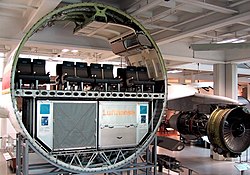
The aircraft in question, known as Clipper Maid of the Seas, was a Boeing 747-121 model. According to Wikipedia, a 747-121 holds 30 cargo containers of the LD1 or LD3 style, fifteen along each side of the hold. A cross-section photo there helps explain the containers' non-rectangular shape - the lower outer corners are "cut off," creating a slanted portion of floor on the outboard (closer to the hull) end of the container.

Container AVE 4041 was blown out at just that end, the unluckiest of spots as far as the plane and those in it are concerned. To visualize this, AVE 4041 was a Pan Am-owned model LD3 container (or load device unit), of aluminum contruction, with the following dimensions, per a Wikipedia page:
base width / overall width - 61.5 / 79 inches
depth - 60.4 inches
height - 64 inches
The dimensions given in the AAIB report of 1990 are slightly different, and included in the figure below. The opened loading side is secured for flight with a blue sheet attached to cables that pulls down and latches. This open side is called the front by Loaders.

Below is one of these containers, used by Dr. John Wyatt in his recent fragment survivability tests. He's filled it with luggage and one case with a bomb, for the finale of a 20-test series. Note here the cases are not stacked spines down but flat-down. It's possible anyone could have rearraged the bags after Bedford's and Kamboj's placements - and a flat-stacked approach seems the best fit for the evidence - in the position here of the second lowest left-hand case, if slid to the left a bit. This image also helps establish a rough average suitcase thickness of around 8 inches, which I use below.

Visualizations
Using the dimensions of the pallet's base, as seen from above, it's possible to get some grasp of hw this would actually look. Below I've done some muck-ups, using the floor damage sketches from the AAIB's appendix F. The post linked there is another important part of being able to visualize this scenario. The blast damage to the container is crucial to understanding where inside of it the blast happened.


First, just the base we'll be working with. On the main floor, the blue area is the outer edge of floor deformation from the blast itself; other deformations were likely from the fall and the landing. The yellow is an "area of intense distortion, influenced by aircraft structure under panel." This was apparently shielded from direct blast effects by the lower suitcase beneath the primary one. Red is the area where the base edge member is "severely blast damaged." Areas slant-shaded are those never found (I re-did the overhang to ignore Claiden's silly PI/100 inclusion). Most of this panel was obliterated and never found, the rest  was blown outward.

At left is the container as Bedford left it around 4pm, to have tea with his boss Peter Walker, leaving his coworker Kamboj alone at the Pan Am station. The exact number of bags he placed has never been pinned down, "four or five" total (per Kamboj), or a high "8-10" after Kamboj's two additions (per Bedford). Five to start plus the two is the estimation I chose. "Spines down handles up" was Bedford's style, he said, and placing them "along the back of the container" is best read as shown here. A left-to-right order isn't specified or necessary, but it does fit the other clues a bit better than right-to-left scheme.

The sample size I'm using for these filler cases is 16x24x8 inches. It's reasonable but quite imprecise, and in reality different bags will be different sizes and shapes. Please note the rough correlation of the area covered by these and the area not as blast-warped. The yellow and blue tend to a circular pattern radiating from the center, except where these upright bags were. These would transfer force much differently from flat laid cases beneath the bomb.

Upon Bedford's return around 4:40 pm the arrangement was something like this. Two new "hard cases, the type Samsonite make" had been added on the floor as shown here. I'm using the primary case dimensions - silhouette 4000 series, 26x22x9 inches (see link at top, above the video). We cannot say that's not what he saw. With the same style and color (brown or maroony brown) and their appearance together they might well be a matching set, which is worthy of note (and yet little noted thus far). Laid side by side, at the front of the container, to the left, handles pointing towards the back, "they took up the remaining base area of the tin," Bedford told police. These do just that.

We know they weren't left here, so close to the later explosion, or they'd turn up bomb damaged, which they didn't. Or perhaps they did, as this whole exercises is premised on wondering...

To conserve space, a later worker may have rearranged the cases like the mock-up at left: stacked together and slid left and back against the other cases and the overhang floor. Geometrically, it puts the upper case's (approximate) middle in the IED location (the flare here). Given the nearly-square shape of the primary case, there is little difference between them ending up long end sticking outboard (as shown here) or the other way around (as shown below). In both arrangements, a 180 degree rotation is also just as good a fit, giving us four possible variations.

The arrangement at left with an added 90-degree rotation (this or its base-out inversion) has the blast area more high-centered than left, and makes a little more sense in a way. But good clues I stumbled across suggest the above image or its reverse might have to be it. It seems that parts from both the handle and hinge (bottom) ends of the case left pieces blasted into surrounding luggage. Pieces of the lock wound up in a suitcase from within this container, and a piece of the bottom wound up in the container over (down as shown here), and apparently piercing a "purple holdall." Both are consistent with handles-in placement like Bedford saw.

Finally, the obvious point that we're visualizing two cases, while only the remains of one were recovered. So it seems. Consider this hypothesis - approximately one-and-a-half of these two cases was basically vaporized by a blast maybe 50% more powerful than believed. Highly energized suitcase material wouldn't disappear, but may alight in a variety of states you'd never recover: drifting flakes of melted plastic, and small non-descript "pebbles" that vanish into sandy mud. Drifting might continue to the North sea, or into a loch.

Larger pieces can and would be recovered, and here we see a couple dozen bits less than an inch in size, but most of these were found blasted into other suitcases, not laying in the grass, or caught in a tree's canopy. The nearly 1/2 of an entire suitcase assembled (mock-up at left) is primarily just five fragments, one nearly a foot square. And there is a 20-inch span of gossamer fabric lining. Which half of the primary case could that be from?   Top or bottom? Any takers? Why the asymmetry?

And that large chunk at upper left, PI/911, has an extremely interesting history of its own - RARDE first said it was from a case beneath the primary one and was touching the floor. Wait 'til you see why that changed.

Investigators had no way of knowing such rearrangements didn't happen, but by accepting Bedford's story, had to presume these cases had been near that corner and were then moved somewhere. They were never able to find where these cases went  to if not where these above images show. Yet they ruled out the possibility by concluding a bomb case that wasn't touching the (main) floor, and had to have come from Frankfurt, in a third brown hard-shell Samsonite to have occupied that corner.

It's utter hogwash thinking of a suspiciously wishful sort.  How early did the police bosses know London must be cleared, and for what reason?
---

Yet another Red Flag From Heathrow

The Evidence of Peter Walker
June 8 2010


Previously at this site, the various accounts of two Pan Am employees, John Bedford and Sulkash Kamboj, have been laid out. While Bedford's statements offer an invaluable clue, collectively their testimonies were riddled with inconsistencies. Both insisted they always told the truth before, even when two truths conflicted, and their memory is too hazy now to help. Recounting the events in the interline shed of terminal three - on the afternoon before Pan Am 103 fell apart upon leaving there - should have been of immense importance. But with attention drawn to points east, these and other Heathrow clues were left hanging and clouded.

Yet another red flag appears just down the way from their workplace, with Mr. Peter Walker, who ran the “baggage build-up area” at terminal three. Here baggage from Heathrow-originating passengers was consolidated into containers, and occasionally a container from interline would be topped off or await an incoming flight here. Walker was mentioned previously as Bedford’s supervisor and casual friend. By Bedford’s story, the two had tea together in the late afternoon of December 21, and Walker gave Bedford leave to go home around 5pm, telling him to bring near-empty container AVE4041 to build-up on his way out.

The main thing about this is the container just sitting there, in the open, not visible inside the build-up office, but accessible to any terrorist who could blend in. Bedford's clues point to the bomb getting in the tin back at interline, but the extra opportunity of this long unattended span (perhaps 45 minutes) must be considered by those thinking about London origin.

But my point here is an inconsistency in Walker’s testimony that eerily recalls Beford and Kamboj. JREF forum member “Buncrana” tipped me off that in this case, Walker first swore he made no such arrangement with Bedford and had no clue a container (“tin”) had been left at build-up at all. And yet a year and a half later casually claimed to recall just what Bedford had said.

[Source throughout: Camp Zeist trial transcripts. Day 43, August 24 2000.
pp 6246-6292]

(from) Production 1227; statement of Peter Walker to DC Adrian Dixon. January 10, 1988 [sic] Original reference number S2206
I have been asked about an AVE tin that came from interline to baggage build-up. I understand that a tin was brought round from interline, but I have no knowledge of who brought it round or what time this would have been. I can't recall seeing it in baggage build-up.

Earlier that afternoon, I think about 3.30 p.m., John Bedford, the loader working in interline, came to my office. This is a quiet period in interline, and he came for a cup of tea. I did not make any arrangements with John about him bringing the tin across from interline.

I again saw John Bedford at about 5.00 p.m.. He was on his way home.
I have been informed * that an AVE tin came from interline to luggage build-up and then to Kilo 16, where it was filled with Frankfurt to New York baggage. I have no knowledge of this and do not recall seeing this AVE tin.
* Q Then part of the next sentence appears to be deleted:
I have been told ... And then it goes on instead: I have been informed -- do you see that? --
A Yes.

(from) Production 1221
Transcript of the Fatal Accident Inquiry, 1990
Peter Walker testimony, page 4170


Q Did you see Mr. Bedford at any time in the course of that afternoon?
A Yes, I did.
Q What time was that at?
A Approximately 3.30, 3.45.
Q And was there any particular reason for his visit at that point?
A We had a cup of tea together.
Q It was simply a social call?
A A social call, yes.

Q Did you see him again in the course of that afternoon?
A Yes, I did.
Q And what time was that at?
A Somewhere between 5.00 and 5.15.
Q And what was the reason for his visit then?
A He brought some bags round that he had at the interline, and then he went home.
Q Were these bags which were simply lying individually, or were they in a container?
A They were in a container. 
Q Did you see the container that Mr. Bedford brought round?
A Yes, I did.
Q Where did he leave that container?
A Outside my office.
Q Did you have a clear view?
A Not clearly entirely, no.
Q Did you see how many bags were in the container?
A I was told; I didn't see them personally. I was told there was approximately six.
Q Was that information Mr. Bedford gave you?
A Yes, he did.
Camp Zeist Trial, Cross-examination by Mr. Davidson for the accused, following police statement
Q Now, did you say that to the police?
A Yes.
Q And that was the truth?
A Yes.
Q And to remind ourselves, this was on the 10th of January 1989, I think we can safely assume?
A Yes.
Q So as of that date, Mr. Bedford [sic], you are effectively saying to the police that you didn't know anything from your own knowledge about any such tin, or through any conversation with John Bedford?
A Yes.

Mr. Davidson, following FAI testimony
Q Now, do you accept that you made all these answers to these questions, Mr. Bedford [sic]?
A Yes, sir.
Q Do you accept, then, Mr. Bedford [sic], that that represents quite a significant departure from the position that you adopted when first interviewed by the police on the date already quoted -- I think it was the 10th of January 1989.
A Yes.
Q Are you able to explain for the Court's benefit, please, Mr. Walker, what it was that caused such a change of position on your part?
A I can't answer that.
Q You've already told us that you didn't have any discussion with Mr. Bedford of any significant nature about this disaster; is that correct?
A Yes.
Q And, I take it, it follows from that answer that you didn't have any discussion with him about what he could recollect about that day in relation to containers from the interline shed and when he brought it and what number of bags he told you, none of that --
A Yeah.
Q -- occurred by way of conversation with Mr. Bedford; is that so?
A Yes.
Q But, apart from that, you are not able to assist us, explain this apparent change of position?
A I can't explain it.
Q You can't. Would you accept, on the face of it, it seems a bit unusual?
A Yes.

Q So is the position this, Mr. Walker: That you did not see any container that afternoon brought around from interline shed destined for the New York flight by Mr. Bedford?
A I can't honestly remember, sir.
Q You see, when you were interviewed by the police, and you effectively told them that, you said that that was the truth that you told the police?
A Yes.
Q A matter of three weeks, perhaps, approximately, after the incident?
A Yes.
Q Is that correct? And for some unexplained reason your position changed quite radically by the time you came to give evidence --
A I can't explain that. I'm sorry, I don't know why that happened.
Q All right, Mr. Walker. Thank you.
By all accounts, Walker would have to approve Bedford going home, and even in the first, most distanced version, he admits seeing Bedford going home. He would have been aware of timetables, and that flight 103A hadn’t arrived yet, so whatever Bedford had been loading at interline wouldn’t be out on the tarmac meeting it yet and it wouldn't be left alone at interline. He swore he knew nothing of a container at build-up, but simple deduction should have left Walker suspecting one was sitting out there.

And besides the logic of his police statement, there’s Walker telling a different story, one consistent with Bedford’s, to the FAI in 1990. He says he told the truth both times, but can’t explain how that’s possible, and can’t now remember what happened at all. So we’re left on our own.

Early ’89 and late 1990 are two quite different times, and I’m inclined to favor the latter statement as more truthful. One salient difference is that in January, Walker wouldn’t know that a Heathrow origin for the bomb would be ruled out. By the later testimony, everyone knew it came in from Frankfurt with its abysmal security. So there was less pressure to disavow anything you had thought might have to do with the bomb.

We know that when he talked to the cops, Peter Walker knew more about AVE4041 and its contents than he told them. The pertinent question now is how much more did he know?
---