Showing posts with label BKA. Show all posts

Thirty-Eight Minutes

The Bomb-Timing Clue for London Intro
First posted March 28 2010

Completely re-written Jan. 18 2011

Five Altimeter Bombs
It was a well-placed bomb detonation in the forward hold of PA103 that sealed the fate of 270 people on the evening of December 21, 1988. To be precise, the UK Air Accidents Investigation Branch (AAIB) decided it had detonated at 19.02:50 (7:03pm) – almost exactly thirty-eight minutes after it left the ground from London’s Heathrow Airport at 6:25.

This time span, officially decided on by Libyan plotters for unclear reasons, is an uncanny fit with another technology, controlled by another group entirely – Ahmed Jiibril’s PFLP-GC. To recap, Marwan Khreesat is a Jordanian intelligence operative and long-practicing maker of airliner-killing bombs for Jibril (with exact allegiance unclear in a chicken-and-egg sort of way). Khreesat’s bombs were triggered by altitude (air pressure) and hidden inside consumer electronics – usually radio-cassette players. In the fall of 1988 he was called in again by the PFLP-GC on a mission for Iran – avenge the US destruction of Iran Air flight 655 by destroying an American airliner themselves.

Khreesat was hired to make or modify five bombs, and contrary to GID orders (as we've heard them), compelled to make them fully armed. Only one radio-IEDs of the five was intercepted on the arrest of Khreesat and the whole cell on October 26 1988. Three more of these were found later by German authorities and studied, given the numbers below. All seized Khreesat devices, in order of discovery:

1) Toshiba BomBeat 453 radio-cassette
2) Sanyo computer monitor
3) Ultrasound radio
4) Ultrasound radio

The fifth device, which Khreesat says he only soldered two wires on after someone else constructed it, was a different Toshiba radio (not the BomBeat seized nor the Libyan BomBeat SF-16 officially accepted). The someone else who made it was likely "Abu Elias," a relative of Jibril’s and a senior PFLP-GC operative. Khreesat thinks Abu Elias worked by copying his own work, perhaps recycling some parts from the fifth test model he made for Jibril back in 1985.

This one hasn’t been studied, as it officially never turned up. Many, however, still suspect it did surface – on Pan Am flight 103. So we’ll return to it at the end, after grasping the four that were definitely never used.

Gobel and Khreesat explain the time aspect
[Note: a separate post details the hardware end of these bombs in a little more detail.]
David Leppard’s curious 1991 book On the Trail of Terror describes the work done by German investigators on the four bombs found in Germany, and summarized the findings of BKA scientist “W. A. Gobel." This looked at how the altimeter and time delay modifications worked. Here he refers only to unit 1, the seized BomBeat 453:
“Gobel had tested the performance of the pressure pick-up gauge in a vacuum chamber. The circuit would close at a pressure between 940 and 950 milibars - equivalent to an altitude of about 2,400 feet. The contact point was connected by a wire to a condenser which acted as a time delay switch. The condenser was an insulator, absorbing the electrical charge until it fired. At this point the circuit closed, detonating the bomb.”
The condenser here is what’s elsewhere called an ice-cube timer – a simple metal circuit, coiled-up, I believe, and encased in a cube of translucent resin (looks like an ice-cube made with dingy water).
"When the necessary operating height has been reached the fall in pressure connected with it will start the timing mechanism, and when the delay period has elapsed the detonator will be activated. […] The time delay of the electronic component fluctuates over a wide margin since the structure of the circuit is relatively simple. Time delays between 35 and 45 minutes were measured." [p 11-12]
This 35-45 minute range is often cited, wrongly I think, as the range of times to be expected in field usage. But a passage from Khreesat's interview with the FBI in November 1989 explained that the variability comes from repeated tests on the circuit in a lab setting:
"Khreesat advised that the times are not exact and the time changes depending upon how long the timers have been tested after last being used. They usually reset to zero after a day. He used to test the timers three times in a row before installing the timer in a device. He found that in each test the time decreased. When this happened, he put the timers aside, and the next day when he tested them, they would run for the same time as when he had first started them." [Marshman report, page 32, PDF p 19]
The variability then, with repeated testing, is downward from a long baseline time. Absent repeated tests, which might be unwise in an assembled explosive device, the timers would all have, as the designer described them as having, one set time each, and it would be the long time. So in use, the device Gobel analyzed would detonate about 45 minutes after triggering. This would be more than 50 minutes, not 38, from takeoff.

That certainly doesn’t mean it’s not a fit. Khreesat also told the FBI that the timers were not the same from one unit to the next:
"One of the timers was a half-hour timer, one was for three-quarters of an hour, and one was for one hour. Khreesat does not recall what time the fourth timer was set for. None of the timers were for more than one hour."  [Marshman report, p 32]
These seem to go in nice 15-minute increments - 30, 45, 60. His early bombs in 1970 and 1972 blew up too early - about 15 minutes after triggering - leaving two of three planes able to safely re-land. Thus for "stronger medicine" in the 1980s, he went for increments at or higher than 30 minutes. By deduction, the fourth unit was a repeat of one of the other three.

Three more to consider
Herr Gobel at the BKA, as we’ve seen above, made a close study of Khreesat device number 1, apparently housing the (or a) 45-minute ice-cube timer. He also looked at number two, the IED hidden inside a Sanyo computer monitor. This was armed with Semtex-H like the others, and rigged with the same basic altimeter-timer arrangement. “Calculated on the basis of the values of the built-in components,” Gobel wrote, “the delay time is put at between 30 and 35 minutes.” [Zeist transcripts p 8769] It's unclear if he means test variability or range of estimates for its one field-use time.

Leppard bemoans the German’s presumptions based on only one bomb sample to study, but they had units 1 and 2 and also, at one point, two other such devices. Numbered 3 and 4, these were both housed in Ultrasound radios, both found after the Sanyo monitor in a third raid, and were both destroyed under grim circumstances.

In April 1989, one of the Ultrasound IEDs inexplicably detonated while in the hands of a highly experienced BKA bomb technician, killing him and maiming an assistant. The other of the two (it’s not clear which is 3 and which is 4) was then destroyed rather than be studied, for obvious safety and psychological reasons.

But despite the British alarm over this German “sloppiness,” it wasn’t a complete scientific loss. Aside from what was missing in the rubble, which was safe enough to examine, the BKA’s forensics section ST33 noted on what remained from one the two:
“[T]he accompanying capacitor is of is of the same value as in 1 and 2, but has however, jumped out of circuit. […] it can be assumed from the remains of the circuit that the time delay was in the same region as 1 and 2." [p 144]
From four intercepted IEDs, we have three capacitors, all apparently of the vague 30-45 minutes “region.” This comports reasonably with Khreesat’s list of 30, 45, 60, and one repeat. It seems to be lacking anything with a longer time like one hour, but one device, likely the one that killed a bomb tech, was not studied like this. Perhaps that was the one-hour unit.

The results are not 100% conclusive with the information I have, but it remains consistent enough between Khreesat and the Germans to say we have a double-corroborated explanation, more-or-less, of what to expect with each of the four seized devices.

And the Fifth?
Khreesat felt that all four bombs he was tasked with re-used the timers and altimeters from his 1985 test run. But that involved five radios, one of which he says was kept intact by Jibril to study. It’s worth wondering if these same parts, fitting the same patterns, were later used to build Abu Elias’ fifth device. But wondering aside, we can’t be certain.

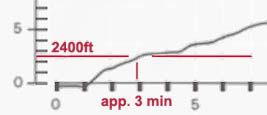
We can examine the facts of December 21 to see whether or not it’s compatible. Below is a graphic from the AAIB's report on the bombing, based on Flight 103’s data recorder. The key line here is altitude, of course labeled “ALT.” The other is some measure of airspeed. The left bar gives feet above sea level (add three zeroes) and the bottom gives time in minutes from data start.
In the marked-up detail at left, note that the altitude doesn’t change for the first minute – takeoff is at minute one, not zero. We can see here that 2,400 feet, the outside pressure that would trigger the timer, is really not very high, and was reached about two or three minutes in. If this pressure decided things for the 38-minute detonation, we’d be looking at a 35 or 36-minute timer, something not within the Khreesat arsenal.

But inside the plane, where the suitcases were, the pressure is controlled and drops more slowly. The work of Rainer Gobel, as related by Leppard, is also confirmed by Paul Foot, writing in 2001 in Lockerbie: The Flight from Justice, as addressing the expected rate where it matters:
"A clearer description of this ice-cube timer was given the same day by Rainer Gobel, physicist for the German police, the BKA. He had a remarkable insight into how long such a timer would take to set off an explosion. “Pressure change in the cabin,” he said, “is regulated automatically. It happens more slowly than the drop of pressure in the air through which the plane is flying, which means, according to the documents which were provided to me, in a plane of the aforementioned class, about seven minutes after take-off the pressure within the cabin will have dropped to such an extent that 950 millibars or hectopascals will have been reached at which the barometric gauge would be involved and a circuit, a current, would be activated.” [p 19]
Some would protest, and fairly I think, that we can't be certain that even if the PFLP-GC's bombs were involved, that this one used the same altimeter setting, or altimeter, or even timer style, as the units examined. But considering the group's reliance on Khreesat’s formula and available materials (the fifth device from 1985), it seems possible enough that it would. And Gobel's "about seven minutes" is quite a nice fit with the roughly eight required to make this fit into Khreesat’s 30, 45, 60 framework. Thus the strong possibility that cannot be reasonably discounted here is that Flight 103’s ascent triggered another ice-cube timer, of the 30-minute size, about eight minutes after wheels-up.
---

Germans link Heathrow with Lockerbie bomb

... back in '89
The Scots-German War over Airport Security, part 3 of 2 (addendum)
April 5 2011


Below is an article I would have found important in the two-parts of the Scots-German War over Airport Security (part one), but only heard of it later. Props to Patrick Haseldine mentioning it, and to "Buncrana" for finding me the article.  It's not factually acurate in the numbers-based finer points, which I've flagged in red, with corrections in [brackets]. But the general idea is still spot on, and his background facts are as accurate as any account I've read. Barring the Bedford suitcase story (apparently unknown to the world until David Leppard's 1991 book) and the Heathrow break-in (unknown 'til Ray Manly's revelation in 2001), the 38 minute "coincidence" referred to here, with a different number of minutes, is the best evidence to call on for a London origin for the bomb. Hat's off to Mr. Pallister for an excellent article from the archives
---
Germans link Heathrow with Lockerbie bomb
By DAVID PALLISTER

The Guardian (London)
November 9, 1989

WEST German forensic experts have discovered evidence which suggests that the bomb which brought down Pan Am flight 103 over Lockerbie last December could have been loaded at Heathrow.
The evidence comes from an examination of three other bombs made by the Palestinian group believed to be responsible for the attack. It casts serious doubt on the theory that the bomb was placed on an earlier connecting flight.

All three devices were identically constructed, with electronic timers set to detonate the Semtex explosive within 43 to 46 minutes of being activated by a barometric pressure trigger at about 3,000 feet. [see more correct version here - each one was different] The West German police believe they were destined for El Al planes or flights to Tel Aviv.

If the Lockerbie bomb was the same, it would have had to have been placed on board the jumbo at Heathrow, rather than at Frankfurt, Malta or Cyprus - the three possibilities so far publicly canvassed.

The bombs have been connected with the terrorist cell run in West Germany by the Popular Front for the Liberation of Palestine-General Command. The first was found in October 1988 in a radio cassette player in a car driven by Hafez Dalkamoni, who has been identified as a senior member of the PFLP-GC. He is awaiting trial in Frankfurt for a bomb attack on a railway in Lower Saxony in August 1987.

The discovery of the cassette bomb led to warnings from the West Germans to airlines and other western governments in November.

In April this year West German police found three more devices in the basement of a house owned by one of Dalkamoni's relatives in the town of Neuss. One exploded at the Wiesbaden headquarters of the BKA, the federal criminal investigation agency, killing a bomb disposal expert.

The three unexploded devices were all made by the same man. The BKA thinks he was the man arrested with Dalkamoni, Marwan Khreesat, who was mysteriously released without charge two weeks later, along with 12 other Palestinians arrested in October. Khreesat, it has been alleged, was probably an agent working for either Jordanian or West German intelligence, or both.
[all correct, but the fifth device is unmentioned]

The forensic experts, working for the BKA, believe the devices were designed to withstand examination by El Al's pressure chambers which are used to screen baggage.

Dr Jim Swire, the spokesman for the UK Families-Flight 103 group, believes the findings could point to the Lockerbie bomb, which was also in a cassette player, being loaded at Heathrow.

The plane took off at 6.25pm and disappeared off the radar screens between 53 and 54 minutes later [38 minutes later, of course, at 7:03]. It takes between seven and 10 minutes to climb to 3,000 feet [I have about 7 minutes and 2,400 feet - see again this link], which fits in precisely with the timing system on the other bombs. [it would fit perfectly if it were a 30-minute timer, which was among those used - 30, 45, and 60 minutes. see again this link.]
---

What Did The Germans Know?

The Scots-German War Over Airport Security, part 2 of 2
June 23 2010

last edits 21 November

The following is part-essay, part compilation of long quotes. Two early books are drawn from throughout:
[E+D] Emerson, Steven and Brian Duffy “The Fall of Pan Am 103: Inside the Lockerbie Investigation” New York, G. P. Putnam’s Sons. April 1990. 283 pages.
[L] Leppard, David.On the Trail of Terror: The Inside Story of the Lockerbie Investigation. London, Jonathan Cape. May 1991. 221 pages.
The views expressed by those writers are not necessarily shared by this blogger – the exercise is to gather facts and attitudes, the zeitgeist, of this minor 1989 struggle of wills between two erstwhile allies in a major investigation.

---
Vehement Vengeance
Part one explained the unfounded British decisions to rule out London origin for the bomb while repeatedly insisting it must have come in from Frankfurt. “Smarting from the accusation that sloppy West German security had allowed this terrible act of terrorism,” Emerson and Duffy explain, “Germany would begin to strike at the British with a vengeance.” [E+D161] It was the first of January 1989, the day after the inflammatory Times story (Disaster Bomb placed on Jumbo in Frankfurt), that the first response was heard. As the book explains:
“West German Interior Ministry spokesman Michael Andreas Butz was convening a news conferencet to respond to the Times account of the day before. “There is no indication,” Butz declared stiffly, “that the explosives could have been put on board at Frankfurt airport.” In fact, he added ominously, “there is evidence which is contradictory.”

What did the Germans know that the Americans and the Scots didn’t?”

Butz went on to assert, with some vehemence, that German agents had determined that the “Disaster Bomb” had been smuggled aboard the 103 in London. The German agents had proof of it, Butz said."
[E+D161]
Five days later, it seems the Germans were ready to show what they knew or didn't know. Reuters in London, citing “West German security sources,” reported on January 6 that “an airport worker at Heathrow had planted the bomb in the forward luggage hold of the 103.” A bizarre explanation followed:
"According to the sources quoted by Reuters, investigators had arrived at the Heathrow link because of the “fact” that the bomb that had blow up the 103 weighed “at least sixty-six pounds.” Luggage restrictions limited carry-on bags to seventy pounds, but the sources cited in the Reuters account said that the bomb was loaded aboard by an airport worker. What the sources evidently didn’t say is why the airport worker couldn’t have been in Frankfurt instead of London." [E+D165-66]
That explanation fails to make sense in numerous ways (the bomb likely weighed less that 66 ounces, for one), and doesn’t sound like what any thinking German would really say. But this wasn’t their only counter-charge passed on in The Fall of Pan Am 103:
“In a matter of days, news stories began to leak from Bonn and Frankfurt that security at Heathrow was far worse than at Frankfurt. British authorities were outraged. For days and weeks, as the families of those killed on the 103 watched this ugly game of diplomatic Ping-Pong, Britain and Germany fought a nasty proxy war through their TV networks and newspapers. Clearly, the feud was based on more than a technical dispute among forensic specialists. Some went so far as to assert that the bitterness of the dispute showed the extent to which the age-old cultural animosities between the two nations had still not abated after two world wars.” [E+D 161]
The authors Emerson, Duffy, and Leppard have the Germans trying to deny both a Khreesat bomb (their botched police work) and the German bomb infiltration (their airport security failure), often confusing and conflating the two drives. On the other side, it’s clear that the Scots and Americans tried at every juncture to put all failures in Germany. David Leppard writes “the bitter argument […] persisted throughout the long hot summer of 1989” [135] and “the German BKA were to spend more than a year publicly claiming that the bomb must have been put aboard at London.” [60]

So Just What Did They know?
Such persistent denial could be motivated, as the Brits and Americans charged, by German fear of accepting the horrible truth about their epic shortcomings. But to be fair, the Germans in fact knew some actual evidence supporting their claims, and should have been given more credit.

Emerson and Duffy’s telling shows hardly a hint of this, with its cited argument that a 66-pound bomb somehow implies Heathrow origin. But the West Germans had to have noticed the lucky bag placement within the container, that could only have been more than luck if it was placed in London. They probably did not know of John Bedford’s story of suitcases matching the IED style seen at about that spot of that container - well before the 727 arrived from Frankfurt. Had they known, they likely would have said so.

The break-in at Heathrow’s Terminal Three the morning before the bombing was surely concealed from German ears as it was from the whole world up to and including the Zeist trial in 2000. On top of the generally lax security at Heathrow, this additional bit of information could only have added to the German resistance against the first script changes.

It was enough at first to know that both alleged German failures - a Khreesat bomb and Frankfurt ingestion - could not be true at the same time as the Yanks and Brits insisted. At least, not without a fair amount of speculation.

The German BKA actually did some work along these lines to help their colleagues understand, as David Leppard shares in some detail. They knew the Khreesat altimeter bomb better than anyone, having overseen the raid that caught only one of five, having had another one later kill one of their bomb technicians, just before they destroyed yet another in revenge. Leppard rails along with the Scots at these scientific losses and such fatal sloppiness. But he also misrepresents the number of samples they once held (it was four, not three), and the readable remains they had at the end of the explosions (three partial and two complete samples, not one). These were, however, studied as far as possible.
“In May the Germans decided to prepare a detailed scientific rebuttal of RARDE’s theory that the bomb had been made by Khreesat […] and put aboard at Frankfurt. The BKA asked its forensic section, ST33, to prepare a report on the three Khreesat bombs so far recovered.” [L142]
They shortly issued a final report called "Comment on the ignition Devices,” which said their remit was “to test and report if [Khreesat bombs] were suitable for surviving the flight from Frankfurt to London […] and exploding 38 minutes after take-off in London.” [L142] The answer, delivered with “bland Teutonic logic,” was No. Rather, they realized and explained one of the best London-origin clues. 
“The rundown of the functioning on the ignition devices … can be brought into line very well with the circumstances during take-off and pahse 1 of flight PA103 London to New York.
[…]
Presupposing that an explosive device of the same construction was used in the attack, then it must have been taken board for the first time in London, or at least made acute [armed -ed] by insertion of the master switch.”
[L145]
Leppard dismisses the report as "a compendium of fudge and obfuscation." They had “only one [sic] fully functioning example of Khreesat's bombs,” Leppard complained, “but this did not prevent them concluding all three bombs had a time delay of between 30 and 45 minutes." The reality is in fact a little more complex it seems than the BKA’s report lets on, but the noted similarity of the timing style is still completely valid. The 38-minute detonation after leaving there really does look a lot like a Khreesat device loaded there.

War’s End
Upon seeing that insolent ST33 report, SIO John Orr “was furious,” writes Leppard.
“As the Kamboj episode showed, there had always been the outside chance that a bag had been smuggled into the container at Heathrow. That possibility aside, Orr had effectively ruled out Heathrow within three weeks of the bombing. Much to the relief of British security chiefs, the Met’s Special Branch had long since stopped investigating the Heathrow theory. Now the Germans were suggesting they were all wrong.” [L145]
They launched back in June with a rebuttal. “Harry Bell was tasked with getting RARDE to research a reply” to this ST33 report, writes Leppard. “It took five weeks to come up with a convincing response.” Finished before June was out, it mostly poked holes the uncertainties of the report, like using “only one working device” to decide the time delay. It offered no solid alternative, quibbled over climb rates, postulated a simple electrical error, and closed condescendingly:
“In conclusion the ST33 report deals with presumptions and presuppositions and it is respectfully pointed out that only factual evidence will be acceptable in the furtherance of the inquiry to bring to justice the bombers of Flight PA103.” [L146-48]
The Scots and Americans, on the other hand, were never able to shake the fact that London was always the far better fit for just the bomb style that everyone first suspected. And they could show no support for what they insisted on: a Khreesat bomb loaded and triggered in Germany but with a speculated two-hour timer to carry it just past London.

In short the authorities and investigators of the West German Federal Republic knew some of the same clues their counterparts across the channel did. They could see the general logic of London introduction, the detonation timing, and the expected British ass-covering. After all, as Leppard put it:
“Certainly, if Heathrow had been to blame, the ramifications would have been severe […] Fortunately for the British, no such evidence was ever uncovered. All the political embarrassment would fall on the Germans.” [p 60]
The embarrassment would then somehow shift off of them onto Malta and thence Libya, in a fascinating leapfrog action. But early on, we can see the Germans had circumstantial clues - if only half as many as the Brits held - that the bomb actually started in London. They could be called jumpy or defensive to leap to the conclusions they did so fervently based on such limited information. But now, with more information, we can see that they were probably right all along.

Evidence Reconsidered: The Bag from Malta

The Basics and Prosecution’s Case
The prosecution (Crown) case regarding the bomb bag was fully accepted by the Judges ruling in the 2000 trial. Their summary, paragraph 17 of their final "opinion of the Court," reads:
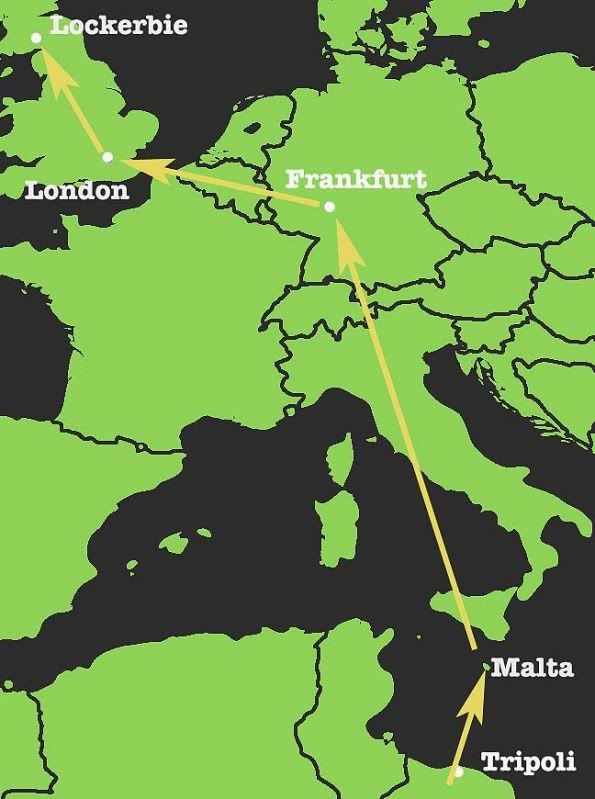
"[T]he primary suitcase was carried on an Air Malta flight KM180 from Luqa Airport in Malta to Frankfurt, that at Frankfurt it was transferred to PanAm flight PA103A, a feeder flight for PA103, which carried it to London Heathrow Airport, and that there, in turn, it was transferred to PA103. This case is largely dependent on oral and documentary evidence relating to the three airports. From this evidence, it is alleged, an inference can be drawn that an unidentified and unaccompanied item of baggage was carried on KM180 and transferred to PA103A at Frankfurt and PA103 at Heathrow." [Opinion of the Court, para 17]
The judges do acknowledge that "The Malta documentation for KM180 does not record that any unaccompanied baggage was carried," [para 31] and that Luqa Airport's security measures "seem to make it extremely difficult for an unaccompanied and unidentified bag to be shipped on a flight out of Luqa." [para 38] They had also dismissed as fabrication witness Giaka's tale of seeing the accused with the exact model suitcase the day of the bombing. [OoC para 44]
"[T]he absence of an explanation as to how the suitcase was taken into the system at Luqa is a major difficulty for the Crown case but after taking full account of that difficulty, we remain of the view that the primary suitcase began its journey at Luqa. The clear inference which we draw from this evidence is that the conception, planning and execution of the plot which led to the planting of the explosive device was of Libyan origin." [para 82]
In the end, the Court was swayed by the compelling evidentiary narrative presented by the Crown. As we've seen, the story is a bit weak in the beginning, with the introduction to KM180 being unsubstantiated and in fact directly contradicted by the relevant evidence. The final alleged transfer, to Maid of the Seas at Heathrow, was not clearly documented; luggage from Frankfurt was considered good-to-go but late, and hastily loaded with no further securiy or scrutiny. The only brown Samsonite suitcase reported in the primary luggage container was seen by handler John Bedford, and it was loaded before the Frankfurt feeder had arrived.

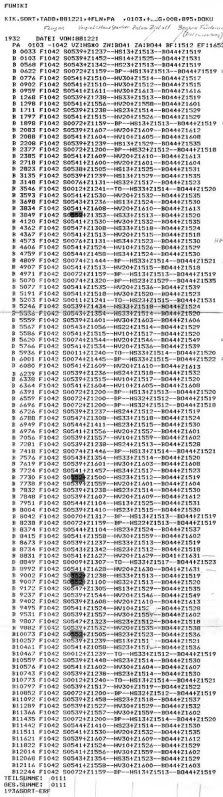
Otherwise the case that such a suitcase made the journey does look reasonably good on paper, and it's at the middle link of Frankfurt where the item is glimpsed briefly. Off-loading records for KM180 were not available to give a number for comparison with Air Malta's records, and the loading papers for PA103A seem to have gone missing as well, along with the entire central luggage system's computer data. (Another page explains the missing computer data more fully) With the middle and outer parts of the middle link equally blank about this bag, it was only some alleged luck that an employee, Bogomira Erac, and no one else, had printed a copy of just the data investigators needed, luggage destined for 103A, as a personal souvenir. Apparently she realized police had never gotten a copy, and then surrendered hers at the end of January 1989. (Another post yet deals in more detail with the circumstances of this save) [Trial Transcripts, Day 47, 30 August 2000, pages 6659-6671 - see also Erac testimony]

What this unusual and unsubstantiated record showed was a luggage item "coded" into container no. 8849, at coding station 206, 13:07 local time. Station 206 was logged as processing KM180's luggage from 1304-1310 local, suggesting the bag was from that flight. Item 8849 was then logged through storage and up to the correct loading gate to go on PA103A. (For more detail on the actual records, and lack thereof, and what they say or don't, see the post Primary Evidence: Frankfurt Airport Records.)

Also, the public indoctrination about this item on the printout is quite interesting. Well before it was decided libyans were responsible, a year or so was spent telling the world via David Leppard, a Granada/HBO TV movie, and other sources, that the Palestinians working for Iran in Germany had taken their altimeter bomb to Malta and sent it through three ups and downs before it blew up over Lockerbie. Only later did they realize they had a piece of the timer ...

Problems with the Evidence
- Contradicted by Air Malta's records
Stand-alone Post: Primary Evidence: Air Malta's Records for KM180
In terms of air security, an unaccompanied bag being waved through the system was considered a major and embarrassing breach. When the notion of such a bomb was visualized in a Granada/HBO movie, released December 1990, Paul Foot explains:
"This was too much for Air Malta, who sued Granada for libel. Norton Rose, the London commercial solicitors, compiled a huge dossier detailing almost everything about the flight from Malta to Frankfurt on the day of the Lockerbie bombing and proving that all 55 bags checked in on the flight could be ascribed to passengers, none of whom travelled on to London. The evidence was so powerful that Granada settled the action before it got to court. They paid Air Malta £15,000 damages and all the costs of the case. The only time these matters had been tested in a legal action, the Maltese connection to the bomb suitcase was comprehensively demolished." [Foot p 7]

- Supported by nothing else
Stand-alone Post: Frankfurt Airport's Missing Computer Records


- Ambiguity of its Evidence
Stand-alone Post: Coding Station Reliability
Station 206 at 1307 does not actually mean that an item from KM180 really entered the system tagged for PA103A. While this blogger accepts that's the single most likely thing indicated, such a conclusion runs up against both the Air Malta records having no 56th bag to fill the slot. It's quite possible, as widely argued, that another item altogether, from somewhere else, could have been piggy-backed in on KM180's load.

- Questionable Authenticity


- Operational Security (circumstantial)
Three airports circumvented ...
Frankfurt Airport had been put on alert,and vigilant against radio units that might have bombs inside.

See also: Randi forum (JREF0 discussion thread, started by me but taken over to amazing effect by Rolfe. Unaccompanied bag from Malta - evidence?

Frankfurt Airport's Missing Computer Records

Adam Larson / Caustic Logic
finished March 9 2010
last edit March 10 1am


An Urgent Inquiry?
Following the historic fall of Pan Am 103 onto Scotland, the world’s law enforcers and investigators sprang into action to sort out what had happened and how. A short six days after the bombing, on December 27 1988, a news article reported that:
“The New York-bound flight originated as a Boeing 727 from Frankfurt, West Germany, with a change of planes at London’s Heathrow airport. Federal police in West Germany and the commander of Scotland Yard’s anti-terrorist squad last week began investigations at those airports.” [1]
More properly, an official feeder flight called PA103A, a Boeing 727, brought 47 passengers and their luggage from Frankfurt to London, where 103 itself (a 747, Clipper Maid of the Seas, with 243 passengers) originated. So about 20% of the flight originated in Germany, and if Pan Am had let a bomb through, it was at one of these two airports. So no surprise agents were swarming on both before Christmas Eve.

One German whose opinion matters here was airport employee Bogomira Erac, whose diligence seems to have solved the troubles we’ll deal with below. At the Zeist rtrial in 2000 she related first learning of PA103’s explosion en route to NY after work that night. “On the news it said the plane came from Frankfurt,” she testified. “I thought it was a direct flight. I didn't know anything more than that.” [2] The better informed police knew the tragic flight had a partial start point at Frankfurt airport, and should have gone there looking for exactly one thing: data on the luggage sent onto the plane that blew up.

German federal authorities with the BKA (BundesKriminalAmt) had at their disposal Frankfurt Main’s world-class computerized luggage system. This routed many thousands of bags a day on mechanized conveyors, every movement controlled and recorded by a central computer. All bags routed to 103A could be identified and tracked with some precision, compared with other flights and with paper logs. All of this should have been just a print command away.

The Eight-Month Blank Spot
The BKA came away empty-handed, it seems. Even working closely with their German counterparts, for eight months neither the Scottish police nor the FBI had direct record of the day’s luggage routing, not even for the feeder flight they were increasingly suspecting. Investigators were already, on their own, fudging away John Bedford’s story with unfounded forensic decisions about luggage arrangement to disprove a London origin. They were already speculating about a Khreesat bomb with modifications to fit it a journey from Frankfurt or beyond, without the hard data that would later back it up.

It wasn’t until mid-August 1989 that the “Frankfurt printout” saved the day, and since then is touted as the revolutionary evidence proving the bomb came from Malta, through Germany, and only briefly passed through Heathrow. The blind interim of nearly eight months is often ignored, and when mentioned it’s usually pinned on mysterious German failings. David Leppard wrote that Senior Investigating Officer John Orr had been asking for the 103A records “since early January,” and noted “the delay was never satisfactorily explained by the BKA.” [3] Leppard also mentioned the BKA’s own, earlier “work on the baggage-loading list, and wrote, damningly “had the BKA drawn the proper conclusions from their work […] it is likely that the bombers of PA103 would today be behind bars.” [4]

As noted by Leppard, the BKA reports attached to the printout, the careful work showing a Malta origin bag with no passenger, were both dated February 2 1989. This does show a puzzling delay of six-and-a-half months before surrendering it to the Scots that has got to have an interesting explanation. However, another puzzle glossed over by Leppard and nearly everyone else on all sides of the Lockerbie issue, is why the BKA themselves didn’t get the printout until over a month after the crash.

It’s no secret that Mrs. Erac, who printed this evidence as a personal keepsake the day after the attack, was never asked for it or offered it up until late January 1989. [5] This means the BKA reports indeed were done upon belated receipt of the evidence.And the related and larger question is, since all agree that stray souvenir wound up being THE evidence for what went onto PA103A, why does no one seem to wonder or much care why that was the case? Why hadn’t police gotten the relevant data right off the central computer on, say, December 22, like Bogomira did?

Live Data
From various readings and reasoning on my own part, the luggage routing system ran thus: each item of luggage was placed in a tray (“coded”), each with a unique number (or code, running approximately 00000-12000). [6] The central computer would reconcile each tray number with a flight destination from the luggage tags. As the items kept in constant motion on mechanized conveyors, the central computer would read periodic scanner returns and direct the machinery to route each tray where it needed to go. Every signal sent to or from the computer could be stored in its active memory.

As the Zeist Court gave their understanding, in 2001: “it was possible, for a limited period, to identify all the items of baggage sent through the system to a particular flight. After some time, however, that information would be lost from the system.” [7] A November 1991 article from the UK Observer, revealing the role of Mrs. Erac’ for the first time, explained:
“The vital computer evidence […] would have been lost forever if the woman operator had not kept her own record. […] She knew records relating to baggage loaded on to flights were kept in the system for only a limited time [eight days] before being wiped.” [8]
To be quite clear, the computers were running and recording on December 21, and the information was able to be printed, says the printout of the key data from the next day. That was held in the computer for eight days or a week in normal circumstances. Investigators were there by three days after a major airliner bombing presumably looking for a copy of just this data.

Printouts and Data Tapes
Now if we accept that the BKA had forgotten to snag this data on their presumed visit, we have a separate poor decision by the airport authority. The FAG (Frankfurt Airport Group) also must have failed to make an official copy before the memory was cleared. Legendary Lockerbie researcher Ian Ferguson was able to speak with an anonymous man described as “The expert who helped design the baggage system in place at Frankfurt airport in 1988 and familiar with the operating software”
"He was puzzled when he saw how short the printout out was and explained that there was no need to print a very small extract from the baggage system traffic, as a full back-up tape was made. This would have shown all the baggage movements at Frankfurt airport that day." [9]
Ferguson explained to the expert “that the system was purged every few days and that no back-up tape existed,” he responded: "This is not true." He admitted "of course it is possible no back-up tape was made for that particular day,” but explained that the FAG would usually keep such records simply to meet insurance claims for lost baggage. [10] And they would surely learn within hours that a flight originating from there had exploded, and that a backup was still not ordered by them, on top of the failure of the feds to make a copy is… let’s just say troubling.

In contrast to the expert’s recollection, Mrs. Erac said in 2000 “it would be possible then to copy the data onto disks.” [11] Somehow tape sounds more plausible in a system first set up in the mid-1970s, but disc storage, and perhaps a dual system would make sense. That this central brain would wind up blank by accident just when it was needed most seems unlikely.

Erac also spoke to routine paper printouts that would be kept on file for some time. A few days after her return from holiday, she recalls, “Mr. Berg just asked me to take a look in the archive in order to see whether there were teletype printouts. These were the things which came automatically from the computer. But I couldn't find anything.” [12] Routine prints gone. Special official prints not done. Tape or disk backup, routine or investigative, failed to appear. Police copies, nil.

But a personal memento copy, out of the investigative loop for weeks, altered for all we know, and certainly with no other copies to check against, is later acknowledged and accepted despite its broken chain of custody.

Listless in Pursuit of the List?
The only mentions one will find of the lack of early knowledge is in connection with the problem being solved by Bogomira’s Printout. The Observer’s introductory article of 1991 said that after her return from holiday in mid-January, “she was surprised to learn that no one had shown any interest in the computer records.” [13] Each has their own way of couching this odd failure; the BBC’s 2008 Conspiracy Files episode said "after the crash, surprisingly, the German police hadn’t fully investigated all the luggage records at the airport." [14] Having looked at all available information, I can safely say it’s a guess that the police just didn’t fully look – they either didn’t look at all for the one part they needed, or it wasn’t there when they looked, or they found it and then covered it up. It’s never been clarified which of these happened.

Whatever the book got wrong, Coleman and Goddard’s Trail of the Octopus is useful in this area, summarizing the due incredulity over this development:
"If the new Malta/Libyan theory was to replace the established Iran/PFLP-GC scenario, it was necessary, first of all, to believe that no one thought to ask for the baggage-loading lists for Flight 103A as soon as terrorist action was suspected -- which was almost at once.

It was necessary to believe that no one in any of the British, German and American police, intelligence and accident inquiry agencies who had a hand in investigating the disaster, or anyone who was in any way involved with airport management or security at Frankfurt or London, thought to secure the baggage lists as the one indispensable tool that would be needed to unravel the mystery of how the bomb got aboard.

It was necessary to believe that the only person who considered the lists to be at all important was a lowly computer operator at Frankfurt airport."
[15]
And finally, none too helpful is a discrepancy revealed in Leppard’s book regarding the February 1989 reports attached to the printout. For these, the BKA had interviewed Gunther Kasteleiner, in charge of baggage flow to 103A. His interviewer wrote into the report “by a coincidence, the record of baggage transported […] for flight PA103 on 21.12.88 is still stored in the computer.” [16] This report then is in stark contrast to the story we now have that it was all wiped well before then and the souvenir saved the day. Leppard does however say “the BKA had obtained a print-out of this record from Kurt Berg.” [17] This, we now know, was Bogomira’s supervisor, to whom she handed the printout and by whom it was taken to the BKA at the end of January. But investigators were saying that Berg had gotten this off the computer itself, a month after the police couldn’t find it there. That could be a simple erred presumption, or a sign that a shifting cover-story was attached to this, and it changed later.

Sources:
[1]“Crash Investigators Studying Suitcase; bodies identified.” The Arizona Republic December 27, 1988. Accessed March 5 2010 at:
http://plane-truth.com/Aoude/geocities/az3.html
[2] Camp Zeist trial transcription, Day 47, 30 August 2000. p 6662.
see also: full testimony, on-line posting.
[3] Leppard, David.On the Trail of Terror: The Inside Story of the Lockerbie Investigation. London, Jonathan Cape . 1991. 221 pages. p 151
[4] ibid. p 157.
[5] Erac testimony, p 6666
[6] Using the Erac printout as representative and randomly spread, its sequential tray numbers (with no connection to coding time) top off at 12224.
[7] In the High Court of Justiciary at Camp Zeist. Case no. 1475/99. Opinion of the Court. Delivered 31 January 2001. Paragraph 27. PDF link: http://www.scotcourts.gov.uk/library/lockerbie/docs/lockerbiejudgement.pdf
[8] Coleman, Lester and Donald Goddard. Trail of the Octopus - From Beiruit to Lockerbie, Inside the DIA. 1993. Online posting, chapter 7, unpaginated. http://11syyskuu.net/octopus/trail.ch.7.htm
[9], [10] Ferguson, Ian. The Judges Got it Wrong. Sunday Times (Malta) 10 May 2009. Re-post: http://lockerbiecase.blogspot.com/2009/05/from-sunday-times-malta.html
[11], [12] Erac testimony p 6668, 6666-67
[13] See 8.
[14] "The Conspiracy Files: Lockerbie." Prod/Dir Guy Smith, Ex Prod Sam Anstiss, Narr Caroline Catz. BBC Two. First Aired 31 August 2008. 25:12
[15] See 8.
[16], [17] Leppard, p 152

"Ramzi Diab"

Posted April 5 2010

Role in the Bomb Plot
Ramzi Diab, as he’s known and called herein, is actually an alias for Salah Kwikas [1], born 24 Sept. 1959, Nazareth [2], and in 1988 a terrorist connected to the Popular Front for the Liberation of Palestine, General Command (PFLP-GC). Diab was one of over 1,000 Palestinian prisoners released in exchange for three Israelis in 1985 - an agreement negotiated by PFLP-GC veteran Hafez Dalkamouni. [3] In the fall of 1988, he converged with other GC players, under Dalkamouni’s leadership, in Neuss and Frankfurt West Germany for the plot to destroy American airliners with altimeter bombs.

David Leppard writes how cell ringleader Dalkamouni, after his arrest, told BKA police “he was given the second Toshiba on about 18 October by a man called Ramzi Diab in Frankfurt. It also contained two pressure boxes, two clocks and two platinum plates. Diab, Dalkamouni said, was a member of the military section of the PFLP-GC.” [4] Ludwig DeBraeckeleer writes that on October 22, the day Khreesat started his bomb-making work with that radio and four other units, “Dalkamoni and Khreesat travel to Frankfurt […] At 2pm, they meet Ramzi Diab,” for uncertain reasons. [5] The same author notes the earlier meeting, October 18 at 5:10 PM.
In his early thirties, Diab is a member of Jibril PFLP-GC. After their meeting, Diab left in a car that belongs to Bassam Radi, a member of Adnan Younis terrorist cell. Younis, aka Abu Tarek, is also a member of the PFLP-GC. [6]
Dalkamouni later identified Diab as “a key player in the Lockerbie operation,” wrote Emerson and Duffy. “a courier of some of the bomb-making materials.” [7] Two witnesses, Diab’s flatmate Angelika Berner and his “German instructor, a kindly man named German Hoch” recalled a trip to Vienna Austria that Diab said he took in about mid-October. Both later told Emerson and Duffy that the BKA left them with a feeling Diab was thought to have “transported … the materials … to make the bombs,” or “transported the explosive material … of the type that exploded at Lockerbie.” [8]

Arrest, Release, Flight
When the mass arrests happened on October 26, Ramzi Diab was found at his house on Querstrasse 4, Frankfort-Main. [9] His documents were deemed fake, and there was no information on his arrest report other than birthdate. [10] “Under questioning by the BKA, Diab adamantly denied knowing Dalkamouni or being a member of the PFLP-GC,” wrote Emerson and Duffy in 1990. He then recalled meeting the boss, in passing, when presented with photos of him with Dalkamouni. [11]

He was released the very next day, along with most of those hauled in, for “lack of evidence.” The guns and bombs and any plots were all decided to be on Dalkamouni, Khreesat, and Ghadanfar alone. Like so many others, he fled upon release; Leppard cited a later BKA report that Diab “left the Federal Republic of Germany a few days after being released, present whereabouts unknown, possibly Austria.” [12]

This flight was probably guessed from the stories of Diab’s acquaintances Berner and Hoch, testifying to an earlier trip thataway. “One witness, a student called German Hock,” Leppard fumbled, “said he had seen Diab leaving Frankfurt on a train to Vienna. Under his arm was a Toshiba radio.” [13] That’s rather a twist, and unclear if this was the pre-arrest trip or his flight after. At trial, BKA officer Anton Van Treek was asked “when [Diab] was released, was he in possession of a radio/cassette recorder?” and responded simply “I am unable to say anything on that.” [14] The transcripts also offer a full list of October 26 arrestees, including Diab, released the following day, and, interestingly, his teacher friend German Hoch was among those hauled in, also released on the 27th. [15]

Diab is sometimes cited as the man who brought in one radio for modification and slipped away with one armed – both tasks also attributed to “Abu Elias.” An anonymous online comment says “one of Khreesat's bombs however, had been smuggled out of the West German apartment by the PFLP-GC terrorist Ramzi Diab.” [16] In his 1989 series of articles in the Sunday Times, David Leppard explained that the missing fifth bomb made by Khreesat “was smuggled to Malta by a known PFLP-GC terrorist called Ramzi Diab, and handed over to a Palestinian cell there.” [17] This whole theory died in its infancy, but not before spawning a TV movie.

Wherever he got away to and whatever with, as Emerson and Duffy wrote in early 1990 “Lockerbie investigators would like to find Diab, but they have been unable to do so.” But he wasn’t universally considered a villain; “some senior officials” had suspected that Diab called in the BKA raid, and “the Germans were told by Diab’s handlers that everything was under control” with the one bomb seized. “If Ramzi Diab was the second informant, as some investigators believe, he may not have known about Khreesat’s other four bombs, and if that is so, German authorities would would have been using Diab’s partial truth to confirm Khreesat’s wholesale lie.” [18] Further, the writers mused:
“For whom was Diab really working? Again, as with Marwan Khreesat, American investigators are not sure. Some believe that he had convinced the Germans that he was genuinely working for them. Others believe he may have been an informant for Israel. Some intelligence officials believe that, in an even stranger twist, there were Syrian informants in or connected to Dalkamouni’s network … just in case [Jibril] was not as forthcoming as he had promised.”[19]
David Leppard’s slightly later work On the Trail of Terror stated “the CIA had discovered that the other ‘mole’ inside Dalkamouni’s cell was Ramzi Diab.” The Agency, via lead investigator Vincent Cannistraro, believed Diab may have secured Khreesat’s fifth bomb and “may have taken it back to Syria.” It didn’t go well if so - on his return, Leppard writes, “Jibril is understood to have held a tribunal: he wanted to know how the BKA had managed so comprehensively to wind up his European network” Though Dalkamouni blamed Khreesat, “Jibril drew his own conclusions. Ramzi Diab was executed shortly afterwards.” [20] DeBraeckeleer says “the tribunal established that Diab was a mole for the MOSSAD.” [21] It was after this execution, Cannistraro told Leppard, that Jibril contracted with the Libyans to finish the job. [22]
---

Sources:
[1, 3, 10, 11] Emerson and Duffy. pp 134-135
[2, 4, 9] Leppard, David. pp 10-11
[5] De Breackeleer, Ludwig. “Abu Elias Arrives in Germany: Diary of a Vengeance Foretold, part 112.” Canada Free Press. October 22 2008. http://www.canadafreepress.com/index.php/article/6194
[6] De Breackeleer, Ludwig. “What a Tragedy, What A Mess… Diary of a Vengeance Foretold, part 108.” Canada Free Press. October 18 2008.
[7] Emerson and Duffy p 262
[8] E+D pp 209-211
[12, 13] Leppard 13
[14] Day 76, p 8718
[15] p 9358
[16] http://scotlandonsunday.scotsman.com/ViewArticle.aspx?articleid=3298349
comment 29.
[17] Foot, p 6
[18, 19] Emerson and Duffy p 262
[20, 22] Leppard pp 211-212
[21] PFLP-GC Tribunal Sentences Ramzi Diab to death. Part 124 – NOVEMBER 3 1988
http://canadafreepress.com/index.php/article/6746

Marwan Khreesat: How Many Times an Agent?

Caustic Logic 
Completed March 4 2010
last edit June 1


Note, June 1: I'm leaving thispost as-is, but much of it must be qualified by later findings. The text in red below is that explained better in later posts, primarily "A Passing Magic Touch..."
---
A Suspect at Large
Iran’s non-involvement in the Pan Am 103 bombing is one of the few points Washington and Tehran can publicly agree on, while both secretly knowing better. Following the July 1988 shoot-down of Iran Air flight 655, "accident" was not accepted and vengeance was vowed. And as former Iranian president Abdulhassan Bani Sadr told The Maltese Double Cross in 1994, “Iran ordered the attack and Ahmed Jibril carried it out.” [1]

If Ahmed Jibril, leader of the Popular Front for the Liberation of Palestine – General Command (PFLP-GC), did carry out the attack, as it seems he was planning, it was through his right-hand man Hafez Dalkamouni. And Dalkamouni’s known plans to that end, operating in West Germany in October 1988, relied on the airliner-bombs made by the experienced Jordanian expert Marwan Khreesat (alt Kreeshat, Khreeshat).

Khreesat reportedly produced five improvised explosive devices (IEDs) in Germany during late October 1988. These were apparently all triggered by an altimeter and timer so that the detonation would occur once the plane was well airborne, around 35-45 minutes after takeoff. Pan Am 103 fell apart 38 minutes after taking off from Heathrow. Scottish police and FBI did reject this direct clue as they decided the bomb had first come in from Frankfurt and probably somewhere else before that, and didn’t blow up then. But Scottish police did continue to suspect that a Khreesat bomb, with some hypothesized modification, had gone aboard in Germany.

Paul Foot, in Lockerbie: The Flight from Justice (2001), cited a report compiled by the Dumfries and Galloway police in March 1989, referring to Khreesat, then living freely in Jordan after fleeing from Germany, as "a suspect” they’d like to interview. “There can be little doubt that Khreesat is the bomb-maker for the PFLP-GC," the report is quoted, "and there is a possibility that he prepared the explosive device which destroyed Pan Am 103. As such he should not be at liberty.” [2]

Off The Hook: He’s One of Ours
By now of course Khreesat has been officially absolved of suspicion and remains fully at Liberty. To be sure, he made five deadly altimeter-triggered airliner bombs on behalf of the PFLP-GC, just weeks before the bombing of Pan Am 103. But he did so undercover, for friendly Jordanian intelligence, the General Intelligence Directorate (GID). In testimony at the Camp Zeist trial on December 5 2000, FBI Special Agent Edward Marshman confirmed that Khreesat “would be what we refer to as a -- commonly as a double agent, yes.” [3]

Originally listed as Crown witness 1157, Khreesat declined the invitation to trial, and a report written by Marshman took the place of Khreesat’s testimony. Based on Scots/FBI interviews with the bomb-maker on Nov 12 and 13 1989, the report passes on Khreesat's word that "he was sent to Europe in order to infiltrate the Popular Front for the Liberation of Palestine General Command; he was sent by the GID and was acting as an agent of the GID at all times” [4]

Scots police officer John Crawford, in The Lockerbie Incident: A Detective's Tale (2002) concluded “there is little doubt that he was a double-agent working for the Jordanian Intelligence Service.” Further, Crawford spoke of “the integrity of Marwan Khreesat, who had assisted [Jordanian authorities] to help the West escape a bombing campaign in the late eighties.” [5] It's highly ironic that he did this by building five airliner bombs, one of which was possibly slipped onto Flight 103. But they were supposed to be phony. Marshman’s Report, referring to a stay in Yugoslavia prior to entering Germany, stated:
“Before Khreesat left for Yugoslavia, he met his GID case officer, who instructed him not to arm any explosive devices while in Yugoslavia. He was told to build any improvised explosive device necessary, but he was instructed to alter the device so that it would not detonate even if used against an Israeli target. Khreesat was told by his case officer that he would be protected while in Yugoslavia.”[6]
Apparently he was to assemble the bombs there ahead of delivery, but it seems the actual work was done later in Germany, and as we’ll see, they were indeed armed to the teeth. The Zeist judgment of 2001 explained: “the cell’s principal bomb-maker was one Marwan Khreesat who was in fact an agent who infiltrated the cell on behalf of the Jordanian Intelligence Service.” They also expanded the geographical scope of his ordered harmlessness: “His instructions from [GID] were that any bomb he made must not be primed.” [7]

Even tough he did arm the bombs he made, for whatever reason, it seems almost impossible to deny - if the Jordanian authorities are all in agreement and corroborated his employment and mission - then he was indeed official and undercover. So what did he do within that role?

Field Work
At Jibril’s request, Dalkamouni’s crew had gathered at Hashem Abbasi's flat in Neuss, West Germany (near Frankfurt) in early October to work on the airliner bombing plot. Khreesat first appeared at their flat on October 13 [8] German authorites watched the men for the next two weeks in Operation: Autumn Leaves. They were seen purchasing electronics and mysterious brown stuff, and meeting different people for unheard conversations. [9]

Khreesat’s history with the PFLP-GC was a key alarm; Steve Emerson and Brian Duffy wrote in 1990 “according to Israeli intelligence files, it is almost certain that Jibril, in 1970, was responsible for the very first plane bombing carried out with a barometer-triggered explosive,” and this was done by “Merwad Abd Rezak Mufti Kreeshat” AKA Marwan Khreesat. On Feb 21 1970 two flights from Europe to Israel were bombed the same day with radio-based IEDs. One crashed 15 minutes after takeoff, killing all 47 aboard, while the other was able to land. Khreesat struck again on August 19 1972, with an El Al flight, Rome to Tel Aviv, that again failed to destroy the plane in mid-flight. Khreesat’s work there was decided to be concealed in a record player. [10] [more details]

It’s not clear if he was a double or single agent at the time, but he did some more work in 1985, similarly modifying five Toshiba radios, model BomBeat 453. These were apparently just demos – Jibril was shown how they were done, then Khreesat disassembled them, according to Marshman’s report. [11] And here he was three years later, apparently doing something again. On October 19, Dalkamouni made an intercepted phone call to contacts in Syria, and Khreesat popped on the line to announce “changes in the medicine” that had so far shown a high failure rate. [12] It was like the 1985 operation but for real - five concealed live bombs that were not meant to be broken back down.

According to Marshman’s report, only on October 22nd did Khreesat get to work on building the bombs, after receiving five new electronic items, including “a Toshiba radio/cassette recorder … not in a new box.” [13] As for the model, he was later shown a catalog and decided it “looked exactly like a model RT-F423 radio/cassette recorder. It was bronze in colour just like the model in the catalogue” that he was shown.” He did specify some knob modifications in the one he saw. [14]

That same day, another player arrived in Nuess; “Khreesat never saw Abu Elias in Germany,” Marshman’s report states, “but was told by Dalkamoni that Abu Elias had arrived. (This occurred on October the 22nd, 1988)” [15] This mysterious terrorist was to link up with Khreesat’s bombs and arrange the airport security end, or how to get the IEDs onto the aircraft. [16]

It never was determined which target(s) they had in mind, but the police made their move on the evening of October 26. Khreesat and Dalkamouni were arrested on their way to meet Elias, with one altimeter bomb in the trunk of their car. It was in a black Toshiba Bombeat 453 radio cassette recorder, with an altimeter set to detonate 312 grams of Semtex-H.[17] The base apartment and another were raided and over a dozen suspects taken in, along with a huge weapons and explosives cache, the largest “ever found in the Federal Republic” [18]

All the apartment arrestees but one – eleven total – were released by a Judge for lack of evidence. Besides Dalkamouni and Khreesat, only Abdel Ghadanfar, who claimed the weapons cache (educational props, he said), remained in custody. [19] And then Khreesat made his one phone call and soon the German authorities were getting a call from Jordanian intelligence asking for their man back. And he was sent back, leaving two of fourteen.

And that's just the people. Only the altitude-triggered bomb radio in Dalkamouni’s car was recovered. As far as anyone knew, all that trouble had been to build only one deadly bomb, and that was safely in custody.

Lost in the Shuffle?
Then, less than two months after Marwan Khreesat stepped off the plane back in Jordan, another plane was destroyed just after leaving Heathrow airport in London on the Winter Solstice. The Autumn Leaves had been shaken down, raked, sorted, and bagged, it had seemed. Now one could wonder if a stray leaf had drifted across the channel and lighted in the belly of Pan Am 103. What if those Neuss bombers had made a second bomb?

Emerson and Duffy reported that unspecified U.S. intelligence officials learned “in the early part of February [1989],” that “Marwan Kreeshat had surfaced,” and was ready to help. “And this is what the man said: He had made five bomb in Germany, not one. At least that’s what the Jordanians told the U.S. officials.” [20] A sworn statement followed to clarify that's what he meant to say, stating that if they hadn’t been intercepted already, the remaining IEDs were still in the Neuss flat - the one that was raided for suspected bomb-radio-type work.

This spurred the FBI to urge the German BKA to find the remaining bombs. After initially insisting there could be no more, they finally re-checked the Abbassi home (or rather, his storage by then) and found two suspect radio tuners on April 13 [21]. In an inexplicable episode at BKA headquarters, a bomb tech named Sonntag was killed and another (Ettinger) was maimed while trying to defuse one of these on April 17 [22] Following this unusual scare, the BKA destroyed the other bomb in revenge rather than study it, and again checked Abbasi’s storage for anything electronic at all. They netted another IED, again with Semtex and altimeter, this time concealed in a computer monitor. [23]

On April 26 Hafez Dalkamouni, still in custody, was told he might be charged with the murder of Sonntag and agreed to talk. But then he said the bombs were to go back to Israel to kill Israelis in the high mountains. [24] Khreesat in Jordan was giving them details but they weren’t encouraging; if indeed there were five airliner bombs built, the tally is thus – one captured in October, three found later in Neuss, leaving a fifth one unaccounted for. Writing in early 1990, Emerson and Duffy filled in the gap with “the fifth bomb, investigators believe, blew up […] over Lockerbie.” [25] So how did, or would, this slip through the double-agent’s careful control? Marshman’s report, again from Khreesat’s own self-exculpation, said for 24 October:
“Around 2.00 p.m. Khreesat took a shower. When Khreesat was in the shower, Dalkamoni knocked on the door and said that he was leaving to go to Frankfurt. After getting out of the shower, Khreesat went back to work on the IEDs. At this time he noticed that the fifth device was no longer in the workroom. He did not pay a lot of attention to this, as he was thinking about the upcoming meeting with Abu Elias. Khreesat speculated that Dalkamoni took the fifth device with him, as only Khreesat and Dalkamoni ever went into the room. After working on the IEDs until late that evening, Khreesat went to bed." [26]
[…]
"[The following day] Khreesat told his case officer that he had prepared a device and given it to Abu Elias. Khreesat advised that he had assumed that the fifth device went to Abu Elias, as related above."
[27]
So believing Elias was already given one bomb on the 24th, and telling his handlers on the 25th, Agent Marwan went along to bring a second one on the 26th until he was intercepted by the BKA. “Khreesat told the Germans that they should have waited one more day to make the arrests,” Marshman’s report noted, “as Dalkamoni was on the way to meet Abu Elias when they were arrested.” [28] The arrest being too soon might be a good complaint if he was talking minutes and miles - they could've ambushed them right and got all three. But he said "one more day," by which time Elias might well be gone with his two bombs. Khreesat had met Elias before, in Syria he says, and was able to help the GID make a composite sketch. [29] He’s never been found.

If this is undercover work, it’s sloppy, and sloppy with bombs is no good. For whatever reason, Khreesat clearly broke the rule against making live bombs, left them lying around amongst known terrorists who wanted to use them, and waited a day before alerting anyone that one of his pieces had disappeared. Khreesat may have been working to help the West, but certainly not with any coordination to ensure a tight net collected all the bombs and runners. The German BKA had no idea of his supposed operation, and didn’t even know there were plural devices. Neither Khreesat nor the GID apparently let them know this basic fact, as a note on the way out or at any time until after the Lockerbie bombing. Such negligence could easily lead to a tragedy like that, and to charges of being a triple agent – only playing at playing the PFLP-GC.

But however murky all of this is, the FBI and the Scots agreed with Khreesat that his bombs were not responsible, and there is one overriding reason for this.

Just Not His Style
The main things that helped the case shift away from a Khreesat bomb was the physical evidence that had been involved in the explosion. Or at least said to have been. Again, the official device was probably 450-650 grams Semtex-H, triggered by a Libyan-linked MST-13 timer, set in a Libya-linked Toshiba RT-SF16 model radio. We can be sure since the whole front page of its manual survived.

The manual is what convinced the judges of the radio make, and its supposed Libya clues helped them, in small part, hand down the guilty verdict for al Megrahi. As to why they could easily brush the PFLP-GC and its bomb-maker aside, they explained:
“Moreover, while he himself did not give evidence, there was evidence of a statement given by him to FBI agents (production 1851) in which he said that he never used radio cassette players with twin speakers (such as the Toshiba RT-SF 16 had) to convert into explosive devices.” [30]
Please! He's used radios, record players, computer monitors, vacuum cleaners for all we know. But he couldn't possibly use a radio cassette player with two speakers? Near the trial’s end, the Crown’s Mr. Campbell re-explained how
“[A]n examination of the evidence makes it clear that the components available to the PFLP-GC were of a quite different variety. The radios were of a single-speaker version, and indeed the fifth device described by Khreesat was of a single-speaker type.

The timer used by the PFLP-GC was known as an ice-cube timer and was used in conjunction with a barometric device. It was a very unsophisticated and unstable device. Mr. Orkin of the CIA explained the difference between such a timer and the highly sophisticated MST-13 timer on day 71, 8804."
[31]
After discounting the possible Stasi link that some have wondered as a route to get the timers to the PFLP-GC, Campbell summarized “there is, therefore, in my submission, no evidence that would raise a reasonable doubt in Your Lordships' mind with respect to” the PFLP-GC and their friend Mr. Khreesat as suspects. [32]

Marshman’s report concluded “Khreesat advised that he does not know what type of device was used to bring down Pan Am Flight 103 “ and that “he does not think he built the device responsible for Pan Am 103, as he only built the four devices in Germany which are described herein.” [33] As Paul Foot aptly noted “‘Described herein’, however, were not four devices but five, and the missing one was disguised as a Toshiba cassette recorder.” [34] It wasn’t a RT-SF16, so that point is a bit moot, but still he admitted there was a bomb missing. DI John Crawford described a later trip to Jordan, in mid-2000. This “walking-on-eggshells job” was described thus:
“It was obvious that what was required was for him to testify that he had no part in building the bomb that blew up Pan Am 103, it was a totally different bomb than the ones he had built in the 1970s and 1980s, the timer was also much different from the ones he favoured in his bombs.” [35]
Indeed, what was found by RARDE folks like Hayes and Feraday was not Agent Marwan’s style. He did not use Libyan-linked RT-SF16s with two speakers, small spaces, and indestructiable paper manuals. He didn’t use Libyan-linked MST-13 timers to send the bomb from Malta through Frankfurt to London, by way of Libyan agents using the brown suitcase Giaka saw. His bombs had no special powers to blank out Frankfurt's luggage records, nor to replace the Bedford suitcases in their corner of AVE4041. This, in fact, makes them more real, and dangerous, and worth consideration.

There is no real disconnect between the PFLP-GC’s bomb and the one on 103 if we accept the following: one Khreesat bomb slipped away, was packed into a copper-brown hardshell Samsonite and transported by surface to London. There it was slipped into he most dangerous corner of AVE4041 two hours before the plane took off. All we need then for all the evidence to match up is to disappear the remains of that RT-F423-like radio (around 550 grams of Semtex might do that) and introduce the implausibly large timer and radio chunks that indicate Libya with such cartoonish clarity (certain RARDE operatives might do that).
---
[1] The Maltese Double Cross. Produced, written, and directed by Allan Francovich, Hemar Enterprises, released November 1994. 2 hours, 36 minutes. Quote at 34:00 mark. Google Video
[2] Foot, Paul. Lockerbie: The Flight From Justice. Private Eye, 2001. 30 pages.
[3] IN THE HIGH COURT OF JUSTICIARY AT CAMP ZEIST - Case No: 1475/99: HER MAJESTY’S ADVOCATE v ABDELBASET ALI MOHMED AL MEGRAHI and AL AMIN KHALIFA FHIMAH. Camp Zeist (Kamp van Zeist), The Netherlands, 3 May 2000 to 31 January 2000. Computerised transcription of the proceedings using LiveNote. 10,241 pages in 86 volumes. Copyright 2000, Scottish Court Service. Anonymous donation to The Lockerbie Divide. Day 76, December 5 2000. Edward Marshman, witness no. 540. p 9259
[4] ibid. p 9272
[5] Crawford, John. The Lockerbie Incident: A Detective's Tale Trafford Publishing 2002. 351 pages. Gogle Books pp 160, 163
[6] See [3], p 9273
[7] Opinion of the Court. Delivered 31 January 2001. PDF link: http://www.scotcourts.gov.uk/library/lockerbie/docs/lockerbiejudgement.pdf
[8]Emerson, Steven and Brian Duffy “The Fall of Pan Am 103: Inside the Lockerbie Investigation” New York, G. P. Putnam’s Sons. 1990. p 208.
[9] ibid. pp 128-29
[10] ibid. pp 114-115
[11] Transcripts, Day 76, pp 9275-76
[12] Emerson and Duffy, p 129
[13] Transcripts, Day 76, pp 9254-55
[14] Transcripts, Day 76, p 9268
[15] Transcripts, Day 76, p 9244
[16] Transcripts, Day 76, 9250
[17] Transcripts, Day 72 (November 20 2000), pp 8829-31, also Leppard p. 11
[18] Emerson and Duffy p 132
[19] Emerson and Duffy p 133
[20] Emerson and Duffy pp 176-77
[21] Emerson and Duffy p 206
[22], [23] Emerson and Duffy p 208
[24] Emerson and Duffy p 209-10
[25] Emerson and Duffy p 255
[26] Transcripts, Day 72 p 9258
[27] Transcripts, Day 72 p 9260
[28] Transcripts, Day 72 p 9244
[29] Transcripts, Day 72 p 9264
[30] See [7]
[31], [32] Transcripts, Day 79 (January 10, 2001), p 9525-26
[32] 9525-26
[33] Transcripts, Day 76, p 9268
[34] Foot, Paul. Lockerbie: The Flight From Justice. Private Eye, 2001. 30 pages. p 23.
[35] Crawford, p 160