Showing posts with label compassionate release. Show all posts

20 August 2009

MacAskill’s Two-Track Railroad: part 10/10
Leaving Glasgow
20 August 2010


Note, August 20 2011: One year ago I posted this, to mark the one year anniversary of al-Megrahi's release. Two years on, he's still alive as Libya is murdered over rumors (like sniping children, "bombing his own people," etc.), and people are still mad about what Libya's "gotten away with." Anyway, this day marks another one of shame in the long and sad history of the grinding down of Libya and its people. Mr. al-Megrahi flew home permanently guilty. The events of Agust two years ago explain how. We know why. The saga starts, as I told it a year ago, on August 3. That post is below, and links carry one through the sickening process from there.

Note, Oct. 16: I just noticed again that August 20, that fatefully two-year anniversary, was the start date of the final rebel push on Tripoli that seemed to succeed in only two days. Uncanny timing, that.

<< Previous: 19 August

One year ago today Kenny MacAskill announced and enacted the decision he made the previous day - to release Abdelbaset al Megrahi to his native Libya. At midday the BBC announced:
[Megrahi] will be flown home to Tripoli from Glasgow this afternoon following an announcement by Justice Secretary Kenny MacAskill. ... A spokesman for the administration insisted the decision had been reached "on the basis of clear evidence and on no other factors.
The promised appeearance came across the airwaves an hour later, at 1300 BST, from the Scottish Government's ministerial headquarters in Edinburgh. MacAskill was in top form, explaining the decision with flourishes like "compassion and mercy are about upholding the beliefs that we seek to live by, remaining true to our values as a people..." It droned on for a bit.

Another BBC story later in the day explained what came next:
A police convoy left Greenock Prison, where Megrahi was serving his sentence, just an hour after the announcement of his release was made.

It was greeting by angry jeers from a small group of local residents.

Megrahi was taken to Glasgow Airport where he boarded an Afriqiyah Airways Airbus plane bound for Tripoli, wearing a white track suit and clutching his prison release papers.
With a white scarf across his face to protect from infection, Megrahi labored up the ramp, looking like a human white flag of surrender flapping in the breeze. The colorful Libyan jet took off at 1530 BST, just two-and-a-half hours after MacAskill first opened his mouth to explain. It muscled up into the sky, away from Glasgow, and banked south towards home.

That was hardly the end of the story, but it is the end of this series of articles.

3 August 2009

MacAskill’s Two-Track Railroad: part 1/10
3 August 2010


Note: The posts in this series are not conclusive, but rather what I was able to learn before the anniversary arrived, sporadically updated later. Any suggestions from knowledgeable readers to improve the content will be gladly appreciated.

Next: 5 August >>

One year ago today, "Lockerbie bomber" Abdelbaset al Megrahi was still imprisoned in Scotland, convicted for the murder of 270, with an appeal of that endlessly stalled, and advanced prostate cancer drawing the grave closer to him. He was desperate to return home to Libya before the end, and the Libyan government was nearly as set on getting him back.

One way home had presented itself up to that point - a Prisoner Transfer Agreement (PTA) that had been Libya's brainchild, sponsored by Libya-UK business interests, and adopted by the UK government. One of the keen provisions of the PTA was that all legal proceedings - like Megrahi's dangerous second appeal - had to be closed first.

Another provision of the agreement, ratified on 5 May 2009, was its 90-day life span [1], which expired on this day last year, August 3. But Justice Secrtary Kenny MacAskill, had already "extended the deadline of the prisoner transfer request,” despite its being implausible to execute. [2]

Curiously, the same day one track was slated to stop (but didn't), a second way home came within reach. Megrahi had formally applied for Compassionate Release less than two weeks earlier, in late July. His original prognosis had been only in September 2008, when he was given “an informal mid-estimate of 18-24 months.” [3] Compassionate Release rules, first set-up in 1993, have no firm life expectancy standard, but do cite three months as a reasonable guideline.

By some time in July 2009, a "firm consensus" was reached by "a range of specialists" that Megrahi's cancer had become "hormone resistant," and so the prognosis has "has now moved to the lower end of expectations from ten months ago." [3] That had been 18-24 months, so minus ten from the low end leaves about eight months left.

An unnamed consulting doctor for the Scottosh Prison Service (SPS) looked Megrahi over again a year ago today [3]. This is widely believed to be Karol Sikora,  but is apparently not. [4] (see also comments, below) Having last seen the prisoner on 26 July, the specialist - not paid by Libya that we know of - reported an alarming deterioration in the short interim. A report from a week later explained "the clinical assessment, therefore, is that a 3 month prognosis is now a reasonable estimate for this patient." [3]

The 10 August report that passes this on was from Scottish Prison Services health director, and expressed his own and a general agreement that the prisoner was suitable for compassionate release. There was no other specific agreement with three months offered. And of course none was needed; as explained above, that  benchmark is a guideline, not a requirement.

But it was an important guideline, and it was on the record to inform the choice in Mr. MacAskill's hands alone. He had two tracks to consider now, one of which (the PTA) would cost Megrhi's appeal if used, and the other of which (compassion) could leave the way open to challenge the tenuous conviction...

Sources:
[1] http://www.libya-watanona.com/news/n2009/may/0509nwsc.htm
[2] Times Online. 21 August 2009. http://www.timesonline.co.uk/tol/news/uk/scotland/article6804645.ece
[3] Medical Report, 10 August 2009. PDF download page: http://www.scotland.gov.uk/Topics/Justice/legal/lockerbie/CompassionateReleasePro/medical-report
[4] STV. 6 Sept.2009. http://news.stv.tv/scotland/121060-scots-govt-libyan-paid-doctors-did-not-influence-megrahi-release/

No Laughing Matter

Response to Roger Simon
February 13 2011

small edits 2/14

The following started out as a comment beneath an article by Roger Simon in the Chicago Sun Times called "Lockerbie Bomber Having a good laugh." I've fixed some typos and errors and addressed a couple more of his, in addition to the general history I laid down for Chicago's readers.
---

I’ve read Mr. Simon's article, and noticed a shedload of errors of fact and presumption that will need more correction than I have space for here. For one, Megrahi is almost certainly not laughing. However premature that prognosis was, he is by now in a coma, last I heard, and only technically alive. And the whole decade of wrongful incarceration, the cruelty of justice made a mockery for his and his family’s and his nation’s torment, has, I understand, left him less than giddy. Even after the obvious relief of going home.

When I wrote about this at the time, I asked why, if a mass murderer had only weeks to live, not just let him die in prison?
The law in Scotland says he should be released if that's the case. Like Mr. Simon, the U.S. government asked that MacAskill should break the law and force this prisoner to die in prison. Conservatives ripped on the White House for having the temerity to even acknowledge the possibility the Scots would follow the law and release him to a non-prison hospital. They insisted it be in Scotland, not Libya.

A former Libyan intelligence agent, Megrahi was arrested and charged and then used every detail, wrinkle and technicality afforded by Western justice to escape his fate.

Proceedings dragged on for years, and it wasn’t until Jan. 31, 2001, that a three-judge Scottish panel finally convicted him. Megrahi was sentenced to life in prison.

Mr. al-Megrahi was arrested in the Netherlands, where he and his co-accused Mr. Fhimah had surrendered themselves in April 1999, on finally having a chance in a third country venue all parties could agree to. It was the deadlock over unreasonable demands from Washington, not the trial, that took years. Megrahi wanted to beat the rather silly charges, but feared that he'd be tried unfairly and then killed in a U.S. trial as demanded. Further, Gaddafi forbade him to go that route. So, sanctions, thousands dead, but let's just gloss over that part...

Both Libyans were in prison for over a year before the trial started in May 2000, running about eight months total, with frequent breaks. The bizarre verdict was Fhimah not guilty, mostly because everything the star witness said was a lie and even the judges said so. And Megrahi, the man with no known accomplice when he needed at least one to have done it, was indeed sentenced to life.

The wrinkles most definitely worked against him.

A life sentence in Scotland is different than in America, a point not explained in Simon's article. There, it means until you're ruled within three months of death. Even if that prognosis is flawed, it's made by the prison doctor (Dr. Andrew Fraser in this case) and the Secretary is required to release the prisoner ... after something mysterious is worked out, in this case.

What makes Simon's whining about procedures or prognoses he doesn't like any better than that of Jim Swire, Robert Black, Hans Koechler, Michael Mansfield, Oliver Miles, Robert Baer, etc., when they question the verdict reached? If the law means guilty is guilty, then dying is dying, and everyone knows no prognosis is perfect. You alleging a conspiracy? Hey, so are some of us!

But otherwise, let’s skip the specifics so crookedly scribbled into this article, and consider what it is really about. It’s full of protest, but I note that no amount of complaining will have Megrahi returned to prison now. Something else seems to be animating this.

Some of us know that the real picture behind the scenes is Megrahi’s well-known innocence of the ridiculous charges he was amazingly convicted over. The legal reality must seem the same at the physical one, no matter how tricky that is. Thus his promising second appeal, granted by the official legal body SCCRC to address its concerns of a “miscarriage of justice,” was quietly the main area of focus. Fellow Americans – never even heard of it, have you?

The Labor Brits duplicitously did all they could for a Prisoner Transfer Agreement, which, among other things, required abandoning all appeals. And the scape-goated Scots, all but entrapped into the situation, despised the PTA deal and pulled off a miracle – their own way home (“compassion”) for the “bomber,” made mysteriously conditional on an appeal surrender. Megrahi said he was led to believe that was the case, and while the SNP insist no way, he was released for non-appeal-related reasons only after - two whole days after - the appeal was dead. His own choice, for s#!%s and giggles, we're to presume.

And then back to this article and the many like it: now that they’ve served their purpose regarding Megrahi, the SNP are expendable – the stick we used to scrape some dog crap off our shoes. U.S. and U.K media are now freely serving their nations’ foreign policy goals of smearing the SNP who, coincidentally, are pursuing a program towards independence from the U.K.. That’s not something we hear much about in the states, but I suspect it’s the real reason they’re so hated. We encourage the Yugoslavias of the world to fragment, not the United Kingdoms.

Feathering the SNP in their Megrahi-tar to assist the foreign policy objective is a goal that could still be served by extended ill-iformed whine sessions like Mr. Simon’s. Serving justice is not, not when there’s such a serious likelihood the real bombers were never once caught and sent to jail for even a day, escaping under the cover our blame-Libya cartoon detour. Talk about “giving comfort to terrorists around the world,” huh?
---

Saunders' Spinsulation

13 January 2010

San Francisco Chronicle writer Debra J. Saunders, who bills herself as the paper's “token conservative,” is also a self-appointed (??) expert on the “Lockerbie bomber” Abdelbaset al-Megrahi and the feckless handling of his captivity by non-Americans. It’s not normally my style to pick on token people, but I've opted to take note of her lush layers of spinsulation - a fluffy confection of filtered snippets of reality, melted with industrial-scale hot air, and with some added color, blown up with political spin. It's a familiar commodity here, long used to rile up the public on the right issues and in the right way.

Somehow, in her pontifications on British buckling to Libya's "commercial warfare," this stuff has become jammed thick and tight between her words and the actual truth at every available point. It sure doesn’t take much to be a "journalist" using her formula.

Below is the main attraction, a two-part post collaborative with a rare guest writer. The first and scholarly half by Michael Follon deals with Saunders' wrong assertions about al-Megrahi's release. This is from an e-mail sent to her and then to me, responding to a re-printing of her article “Libya, Lockerbie, and commercial warfare.” The second part is by myself, from a comment I posted on the same article.
---
8 January 2011

Debra J. Saunders,
San Francisco Chronicle.

Dear Ms Saunders,

I am writing concerning an article "Pan Am bomber freed by 'commercial warfare'" written by you which appeared in the 'Gaston gazette' on Jan 03, 2011.
'On Aug. 20, 2009, Scottish Justice Minister Kenny MacAskill authorized the "compassionate" release of al-Megrahi on the grounds that prostrate cancer left al-Megrahi with less than three months to live.'
FACT: The decision to release Abdelbaset Ali Mohmed al-Megrahi on compassionate grounds was made in accordance with Section 3 of the Prisoners and Criminal Proceedings (Scotland) Act 1993.

FACT: The Medical Report did not specify that al-Megrahi had less than three months to live. The three month period was an estimate NOT a definitive statement as to life expectancy.

From the Medical Report -
'It is very difficult to be precise on matters of prognosis for any disease and Mr Megrahi's condition is no different.'
'the report found that "Scottish officials ignored their own prostrate cancer experts, none of whom would agree to a three-month prognosis."'
FACT: From the Medical Report:
'Consensus on prognosis, therefore, has now moved to the lower end of expectations from 10 months ago. Reviewing the total picture, the concluding specialist view is that, in the absence of a good response to treatment, survival could be in the order of 'months' and, no longer 'many months'. Whether or not prognosis is more or less than 3 months, no specialist "would be willing to say"...The clinical assessment, therefore, is that a 3 month prognosis is now a reasonable estimate for this patient.'
'There was talk of releasing al-Megrahi a year before he was diagnosed with cancer.'
FACT: In June 2007, it became public knowledge that a Prisoner Transfer Agreement (the 'deal in the desert') was being negotiated between the UK and Libyan governments (at the instigation of the then UK Prime Minister Tony Blair MP). Megrahi was the only Libyan prisoner being held in gaol anywhere in the UK. The SNP government in Scotland sought to have Megrahi specifically excluded from any such agreement. The UK government advised that this was not possible.

'The Menendez report also found that the British Labour government played a role in MacAskill's decision.'
FACT: The very suggestion that the British government had a role in the decision shows a total lack of understanding of the political, legal and jurisdictional realities as well as the relationship between the current Scottish government and the UK government.

FACT: At the end of the trial at Camp Zeist in Holland the prosecution conceded that it had been unable to prove how the bomb, which destroyed Pan Am 103, got into the baggage system and onto the aircraft.

- Lockerbie - Information relating to decision on Mr Abdelbaset Ali Mohmed Al-Megrahi 
- Medical Report on Megrahi
- Lockerbie decision
- Lockerbie release - Parliamentary Statement
- Justice Committee Official Report - Inquiry into Decision on Abdelbaset al-Megrahi
- Meeting with Senate Delegation - 16 September 2010
- Protecting patient confidentiality
- Herald Scotland - 'Megrahi's gold'
- Herald Scotland - 'History of controversial Megrahi release'
- Blogpost: THE LOCKERBIE CASE - 'Scottish Government statement following Senate Foreign Relations Committee Hearing'
- THE LOCKERBIE DISASTER
- THE LOCKERBIE TRIAL AND APPEAL
- LOCKERBIE PRE-TRIAL REVIEW NOTES
- Blogpost: THE LOCKERBIE DIVIDE - 'Some Background on Karol Sikora'

Yours sincerely,

Michael Follon
---

First, on the above, the clearly flawed prognosis and questionable decision to release al-Megrahi, in my opinion, do seem a bit shady. I'm glad he got to go home, since I'm certain he's innocent. But the people deciding were not, ostensibly, motivated by mercy for an innocent man, nor likely by mercy at all. So I'd consider the motive category open, perhaps populated by more than one, and trade is likely in there somewhere. Of course, they killed his second appeal along the way, so maybe "trade considerations" aren't to blame for this – at least, not solely or even primarily. [To see my take on what happened there, see my chronology of August 2009, "MacAskill's two-track railroad"]

Then, my comment at Saunders' article, emphasizing Megrahi's likely innocence, here slightly edited and with links.
---
Posted by: CausticLogic 2:47 PM on January 7, 2011

I've noticed that Debra J. Saunders has been writing a lot about the "Lockerbie bombrer" and shady deals by non-Americans who live outside our little Island of virtue here, in that cold, weak-willed, terrorism-coddling world.

First, there's no doubt in reviewing convictions, appeals (heard and not), etc. that Megrahi is legally guilty and all this protest is legally justified.

But legal and physical reality are sometimes different. Take this case - a review of the best evidence suggests - strongly, coherently - that Megrahi was either framed or just wrongly convicted on accident.

So long as the distinction doesn't matter, carry on. Otherwwise, I reccommend to millions of Americans to take their own look at the facts:
- Tony Gauci's "identification" of Megrahi (different hair, face, height, build, age, and buying the clothes on a day when Megrahi wasn't on Malta at all)
- Abdul Majid Giaka's contributions to the indictments and his acceptance at trial ("liar")
- Edwin Bollier's role (google Bollier + "catch-letter")
- The many millions of $$ paid out to Gauci, another Gauci, Giaka, and perhaps Bollier (but declined by Vassallo)
- The list of important witnesses against Megrahi (precisely Gauci, Giaka, and Bollier)
- Bogomira's printout (Prod. 1060) with no verification (why no verification?)
- John Wyatt's forensics tests
- the records of political "scientists" Thomas Hayes, Allen Feraday, and Tom Thurman
- the London origin clues, Iran and the PFLP-GC as actual perps never caught.

Just in case reality, which evidence gives us a glimpse of, matters anywhere near as much as a cherished legal technicality. See about a hundred credible people that have made the right stand, with reality and against miscarried justice: "No one seriously doubts the Libyan's guilt?"

---

One Last Time: Sikora was not THE Doctor

13 September 2010
last edits 14 Sept

I just stumbled onto a New York Daily News article from a month back titled "Lockerbie bomber Abdelbaset al-Megrahi's cancer doc: I would've been more vague on terrorist's fate." This in reference to a Dr. Karol Sikora, who is widely perceived as the or a doctor whose advice to the Scottish government was paid for by Libya and freed Megrahi a year ago.
A cancer doctor who predicted Lockerbie bomber Abdelbaset al-Megrahi had just three months to live now thinks he should have hedged his bets. [...] "If I could go back in time, I would have probably been more vague and tried to emphasize the statistical chances and not hard fact," Dr.Karol Sikora, one of several experts who examined Megrahi, told Britain's Observer newspaper.
This has been repeated by many, many others before and after that and widely taken as fact - a characterization Sikora himself did nothing to discourage. A later article of 1 September in the Charleston, SC Post and Courier said "according to a Scottish doctor paid by Libya, he had only months to live. [... MacAskill later] released al-Megrahi, citing the doctor's opinion."

No one can know what really happens in the shadows, but there's no reason to believe Sikora was actually relevant to the decision made. The image of such is like cotton candy - a little sugar, no nourishment, some color, hot air, and abundant spin.   

The Illusion
Dr. Sikora (pictured at left posing with a large book) has a colorful history in medical consultancy. He's apparently something of a hired gun, or acts like one, and has worked with an American political campaign to counter the move towards "socialized medicine." He was first mentioned in connection with the Megrahi case by Herald Scotland, 20 August 2009, just hours before MacAskill's announcement.  After speaking with him, Lucy Adams reported (incorrectly as it turns out):

"...the assessment given by Professor Karol Sikora goes some way to explain why the Justice Secretary may have reached the decision he has. 
Dr Sikora, who visited Megrahi in prison, had called for an "urgent" decision on the future of the Lockerbie bombing prisoner before his condition worsens further. "We believe he has only a very short period of time to live," said Dr Sikora, who assessed Megrahi last month."
Around 6 September, a few weeks after the release, the Sunday Telegraph reported that the Libyans had paid for the medical advice of three doctors including Sikora and "encouraged" them to form the opinion that Abdelbaset Ali Mohmed Al Megrahi had just three months to live.  ( The Daily Mail) Coincidentally, at least one of them quite vocally did. 

Seven months later in April, as all other involved doctors remained fairly quiet, Sikora said the clues suggested Megrahi "will be dead within four weeks." (Times) Twelve weeks later, on July 4, he gave an interview with the UK Sunday Times (unavailable online, but re-quoted by the Daily Mail and many others).  Sikora found it "embarrassing" his irrelevant three-month call was so wrong. He acknowledged that he was aware of what the prognosis meant,:
"It was clear that three months was what they [the Libyans] were aiming for. Three months was the critical point. On the balance of probabilities, I felt I could sort of justify (that). [...] There was a 50 per cent chance that he would die in three months, but there was also a 50 per cent chance that he would live longer."
Scottish Denials
Sikora did in fact receive money from Libya and tried to lobby Kenny MacAskill - but the justice secretary had already decided based on another prognosis by proper authorities with no such (known) conflict of interest.

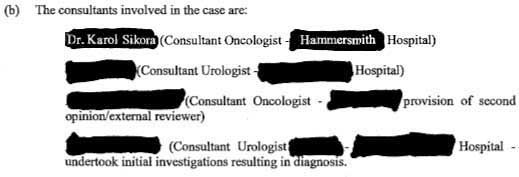
There was a summary of medical reports that was publicly available, but it did little to clear up the issue, with all the names of all relevant consultants redacted. Sikora either fits or comes darn close for the first listed oncologist. (this only fits with Hammersmith hospital, where he served 12 years as clinical director of cancer research - source - but he seems to have moved onto other things before August 2009)
But as pointed out to me, this would be a rather stupid and unwarranted thing to do, including Libya's consultant in the official decision. They specifically denied this shortly after the release last year. In the Daily Mail's 6 September article about the suspect three, they included this response from the Scottish government:
The Director of Health and Care at the Scottish Prison Service drew on expert advice from a number of cancer specialists in coming to his clinical assessment that a three month prognosis is now a reasonable estimate for the patient.

These included two consultant oncologists, two consultant urologists and a number of other specialists, including a palliative care team, who had reviewed and contributed to the clinical management of the patient.

They did not include Karol Sikora, Jonathan Waxman or Ibrahim Sherif, whose assessments played no part in considerations – including no part in the report submitted by the Scottish Prison Service Director of Health and Care.
I had originally been taken by the confusion as well, and called Sikora the responsible doctor. But with prompting from "Jo G," I corrected that to "unnamed doctor" on 7 August  (see comments here). As the articles we started with shows, some journalists are still behind in coming to their senses here. A conscious media campaign could hardly have done a better job of helping create the illusion (which does persist here heavily) that Scotland under the dread SNP freed the bomber based on Libya's paid prognosis. 

The Actual Relevant Doctor
Before the health director, Dr. Andrew Fraser made his decision to call three months reasonable, he read one opinion to that effect from an unnamed "primary care physician" of al-Megrahi's. He examined Megrahi on 26 July 2009 and again on 3 August. The deterioration he perceived between the two is what led him to state "the clinical assessment, therefore, is that a 3 month prognosis is now a reasonable estimate for this patient." [PDF source]

Peter Kay rather is the name, rudely announced 15 August, the day before the NYDN article we started with. the UK Express reported on the actual doctor who made the crucial call.

Dr Peter Kay can now be named as the primary care doctor at Greenock Prison from the time Abdelbaset Ali Mohmed al-Megrahi’s prostate cancer was discovered in autumn 2008 to his release one year ago this week.
And while official records – published in the aftermath of the decision to send Megrahi home – revealed four specialists were unwilling to say how long the bomber had left to live, it was a prognosis by Dr Kay that his condition had “declined significantly” that led to his eventual release.
Interestingly, the article manages to raise questions even about this doctor, who was found to be shy of attention:
Allegations have also surfaced the relatively inexperienced GP, believed to be in his late 30s, may even have been put under pressure by Megrahi and the Libyan authorities after he initially described the symptoms as “minor”.
I've seen anonymous US family member "Bunntamas" suggest just this, but that person has a vivid imagination and littlegrasp of the facts. But that's another issue - this post is about chatterbox Sikora.

Sikora's Actual Involvement
As our oncologist explained to the Daily Mail "I got invited (by the Libyan government) because I had been to Tripoli a few times." Once on the job:
"At first sight I thought it was more likely that his life expectancy was six to 18 months. But we went up there and saw him, and looked at everything, talked with the prison doctor. After that, I thought it would be three months, and I stand by that."
Sikora's last look at the prisoner was on July 28, meeting prison doctor (presumably Dr. Kay) two days after Kay's most recent check. Sikora came along with Ibrahim Sheriff from the Tripoli medical centre, and Dr Abdulrahman Swessi (or Abdullah Swissi), Libya's consul-general in Scotland. (Herald Scotland) Sikora's report, specifying three months, was apparently lodged soon thereafter, but as the Daily Mail reported:
"The Scottish government claimed the advice arrived too late to be considered by Justice Secretary Kenny MacAskill, but Professor Sikora said he doubted this. 'We submitted our report three weeks before his return so I think there was plenty of time to consider it.'"
That would be somewhere around the beginning of August - just about when Dr. Kay himself decided three months on the 3rd. It seems the timing wasn't so much the issue as the source, but this first or second opinion, depending, was officially irrelevant.

Conclusion
From all the above, a clear pattern has emerged of a Libya-tainted man whose thoughts paralleled a separate decision, and has attached himself to the case, dug in like a tick. He's persistently taken every chance to re-affirm the illusion of his relevance to the media, and occasionally has added other fuel to the fire along the way. As he says, his report was submitted in time, and so he may genuinely believe he's involved. But the effect is not the intent is hugely dishonest.

In his 4 July statement Sikora, trying to explain the uncertainties of diagnosing cancer, unfortunately stated:
"There was always a chance he could live for ten years, 20 years ... But it's very unusual."
This was widely and predictably taken by the American media to say the ten or 20 year "prognosis" was more real than the "sort of justified" three month one. That a doctor they believed responsible so "erred," pleasing his Libyan customers, enraged the empty-headed poseurs in the U.S. Senate. Armed with Sikora's nonsense plus a revived, post-spill reminder of the BP angle, within days Senators Lautenberg, Schumer, Menendez, and Gillibrand were urging an inquisition into the black magic that freed Megrahi. Within days of that, Sikora stated with annoyance that his recent talk of decades was taken out of context, but it fell on deaf ears as the Senate Foreign Relations Committee set to requesting audiences.

Again on 14 August NYDN repeated as relevant that Sikora "added that the released terrorist could even survive another 10 years." And he speaks of time travel that would give him today's knowledge then, in which case he "would have probably been more vague." It was less than comforting, especially given that his decision still didn't matter. "Some families of the victims," who fail to grasp this, "were livid over Sikora's musings," NYDN reported.
"This is an added kick in the face and another example of them throwing rocks in the face of the families," said Susan Cohen of Cape May Court House, N.J., who lost a daughter, Theodora, 20, in the attack.
The effect of this behavior,  which Mrs. Cohen senses most acutely in the face, is keeping the American victims and public nice and angry, feeding into confusing misinformation and pressure for the proposed Senate investigation into the release. This is ultimately a probe into the imaginary conspiracy theory that has arisen to explain the "terrorist's unjust release." Again, as usual, Sikora's antics are convenient for someone, but not for the purpose of calmly establishing truth.

Another Shameful Propaganda Piece

3 September 2010

Here I'd like to comment on a recent editorial (unattributed) in the Post and Courier (Charleston, SC) called "Post-Lockerbie Shame." Below are some quotes from it and my comments/corrections.

The "compassionate release" of a convicted PanAm bomber in 2009 was an affront to justice...
No quotation marks are needed here - compassion is the actual basis of the law justifying Megrahi's release. That process and decision in implementing that law are complex and murky and open to criticism. But as usual for America's slavish media units, this block of anonymous text makes no mention whatsoever of the mountain of evidence all but proving Megrahi was framed and wrongly convicted in the first place.

This is irresponsible journalism, treating this as a one-sided issue when it just is not. There have been doubts (at the least) expressed so widely by informed parties that one wearies of repeating them. Put in short form, there are two relevant rulings by Scottish judicial bodies - the 2001 conviction, and the 2007 ruling by the Scottish Criminal Case Review Commission. The conviction has been ruled, by the SCCRC review, to be a "possible miscarriage of justice." The SCCRC decision, which has not been so challenged, had authorized a second appeal which was never heard, lost in the shuffle of cancer and release.

The Post's "Post-Lockerbie Shame" cites the challenged conviction and ignores the unchallenged SCCRC ruling and the avoided appeal it unleashed. That's slanted reporting and gives a false impression of the legal standing of Megrahi's guilt. Officially in place, but crumbling.

Libya has paid billions in reparations to victims' families in acknowledgement of its role in the bombing, but Col. Gadhafi has never expressed the slightest remorse.
Is this sloppy journalism or the willfully deceptive kind? There is no "acknowledgment" in the 2003 letter to the UN, the settlement money, or anywhere, of Libya's involvement in the bombing. They are, and insist they are, uninvolved. Hence no remorse. Get it? The money and acknowledged word play were to end the unfair sanctions crippling their nation. "Acknowledged ... but no remorse." That's just cheap, folks.

According to a Scottish doctor paid by Libya, he had only months to live. [... MacAskill later] released al-Megrahi, citing the doctor's opinion.
Dr. Kay was paid by Libya? Or is the unnamed writer still confused by chatterbox Sikora's attempts at insinuating himself into the situation? Please double-check yourselves there. It is pretty confusing.

The freed terrorist is now living the good life in Tripoli, and BP is drilling in waters off the Libyan coast.
And the real bombers of Pan Am 103 are aging gracefully in their own corners of this sick world, never serving a day in jail for this murder of 270 people after the CIA decided to blame Libya.

Also, suffering from cancer but not dead yet, in a nice house, with family and supporters, equals the good life? Relative to jail, obviously so. But what evidence can anyone show that his conviction for this heinous crime was reasonable or sustainable? Why should we actually be mad that a man is dying slower and in more comfort than he might otherwise be?

The Senate rightly wants to know ...
No they don't.

The comment thread for this article has been closed.
Before any comments were even posted? Were they afraid I was coming?

Time Magazine - seriously - addresses five serious questions

23 August 2010

An amazing and heartening article on the Time website, marking the one year anniversary of Megrahi's controversial release, has taken an insanely intelligent stance for such a prominent mainstream American publication. Penned by Vivienne Walt, this article I missed all weekend (props to Professor Black for noting it first) poses "five questions about the Lockerbie bomber's release." These are listed below, and may be quite surprising, so be sure to sit down.

1) Where's the document proving a BP-Libya deal?
"Still missing, however, is written proof of a freedom-for-business deal..."
The lack of direct proof is not much of a counter-argument, so Walt Seems open to the circumstantial clues, in a way I'm inclined to consider a bigger factor than I had before.

2) Did Scotland distort Al-Megrahi's medical report?
"...how that prognosis whittled down to three months remains a mystery."
While it's possible the lone three month "reasonable" low-end estimate is entirely in good faith, its elevation to the forefront is suspect. The more interesting part is the why behind such a possible distortion - aside from trade nterests as mentioned above, there's another factor I;m more interested in.

3) Did Scottish officials persuade Al-Megrahi to drop his legal appeal before going home?
With no explanation, Al-Megrahi dropped his appeal against his conviction shortly before he was freed. Some relatives of Lockerbie victims suspect Scottish officials might have persuaded Al-Megrahi to end his appeal — possibly in exchange for a smoother release [...]
Two British family members of PA103 victims were interviewed: John Mosey and Jim Swire.
"Most of us here feel that there is something extremely murky, which the U.S. and British governments don't want to come out," John Mosey, a British pastor whose 19-year-old daughter died aboard the Pan Am plane, tells TIME. Jim Swire, whose 24-year-old daughter was killed in the Lockerbie attack, says Scotland's Justice Secretary Kenny MacAskill did something "very unwise. He went to see Al-Megrahi in prison ... then Al-Megrahi dropped his appeal, and then MacAskill decided to send him home." Swire, who has fought a long campaign to reveal the truth behind the Lockerbie attack, says that suggests possible persuasion. But, so far, there's no proof of any.
Again, no proof is a pretty weak counter-point to the neat appearance and logic of appeal-for-release - perhaps in addition to release-for-oil.

4) Could Al-Megrahi have been innocent?
This follows logically off question three, and both are routinely ignored by the American media.
U.S. Senators are not aiming for a retrial, but they might focus on the controversies surrounding Al-Megrahi's imprisonment. Swire, Mosey, and former U.N. Secretary General Kofi Annan's envoy to the Lockerbie trial, Austrian law professor Hans Köchler, are among those who have long argued that the trial leading to Al-Megrahi's conviction was deeply flawed. In 2007, the Scottish Criminal Cases Review Commission, a publicly funded body that investigates possible wrongful convictions, issued an 800-page report listing several grounds for an appeal by Al-Megrahi, including inconsistencies in the testimony of the key prosecution witness and the existence of CIA documents about the Swiss-made timer for the bomb, which defense lawyers had not seen. So far, the full report has not been released publicly.

5) How is Al-Megrahi still alive?
This sort of points back to the issues raised in question 2 - was he just misdiagnosed a year ago? It allows the piece to close on a different note, with Dr. Swire ignoring this obvious possibility to speak glowingly of "some new technology" that might be behind the "hopeless" Libyan's continued survival.

Yes, the all-American news magazine founded by Henry Luce, has seen fit to allow the view that's swelling towards unanimity in thee UK and it still ruthlessly denied here in the states. Megrahi could be innocent, and that may help explain the mystery of his release. Walt is spot-on in just about every point, and unfortunately that usually dooms an article in many American minds as some conspiracy theorist nonsense, probably paid for by Libya. But with its accession (in the first points) to existing American suspicions, and closing on a gentle jab at Dr. Swire, it becomes palatable - part of a continuum of cynicism and (apparent) naiveté. Cleverly formulated as they are, and still grasping the humming livewire of hidden truth, and these five questions should give serious pause to anyone not excessively gripped by cognitive dissonance.

19 August 2009

MacAskill’s Two-Track Railroad: part 9/10
Repentance and Decision
19 August 2010

small edits 2 Sept.

Note: The posts in this series are not conclusive, but rather what I was able to learn before the anniversary arrived, sporadically updated later. Any suggestions from knowledgeable readers to improve the content will be gladly appreciated.

<< Previous: 18 August
Next: 20 August >>

Both Tracks Come to an End
After months of confusing pursuit of two separate repatriation routes for the “Lockerbie bomber,” one year ago today, Scotland’s Justice Secretary Kenny MacAskill made his final decision on al Megrahi’s fate. It was a private process for the minister, though he did alert family members that he'd decided on something, and would tell them - along with the world - what it was the following day. [BBC, 19 August]

Again, the twin options, which MacAskill had opted to consider and decide on at the same time, were a prisoner transfer (PTA) worked out between the UK and Libya, and release on compassion grounds due to advanced prostate cancer. His judgment, as announced the following day (see 20 August), was to reject the former and grant the latter.

The only reason he would give for denying the PTA option was the ”understanding,” held by the U.S. government and American family members, that al Megrahi would serve his sentence in Scotland. On the latter, effectively ending the sentence and sending him back to Libya on medical grounds, he cited the 10 August report of Dr. Andrew Fraser that included an arrant three-month prognosis anchoring the low end of the life expectancy range.

One can only wonder just why the decision could only happen on the 19th and not before. The American families’ understanding was communicated clearly to him back on July 9 (see representations PDF), and the US government’s similar view, calling on this understanding, came a month later, on file now for a week.

Further, the appeal situation was still unsatisfactory, as Mr. Burgess’ advice had pointed out. The Crown’s appeal for longer sentence still stood, even as Megrahi’s was closing down. This had been the main legal reason given to reject the PTA, but MacAskill neglected to mention it on the 20th as a factor in his thinking.

The 18 August ruling that the appeal of conviction was no more might just explain why MacAskill finally decided the following day. The strange fact is that only once this key term of the PTA was fulfilled was it finally ruled out. And this segues perfectly with the notion that the PTA’s continued pursuit served but one purpose for Scottish Justice – to kill the appeal. If so, it was appropriately tossed aside once its job was complete.

Signaling Repentance
From the little we can know, the crudest construct, a direct and spoken trade of appeal for release, seems to be unfounded. The secret meeting where this was thought to be laid out did mention dropping the appeal. But this was recorded as only for the improbable PTA, not as a condition on medical release (see 5 August). But things line up so one might still expect some more subtle or circuitous set-up. For an unusual insight, consider the following:

The 6 August release of famous criminal Ronnie Biggs on compassion grounds has been suggested as a possible signal regarding Megrahi. To start with, this release date was set well ahead of time, back in early 2009, and one could well question the reliability of any such signal; Labor’s government at Westminster could not usually count on the devolved Scottish one at Hollyrood to follow its cues. But there is much we cannot clearly see, and the possibility can’t be ruled out. Let us consider it as a hypothetical.

The obvious overall message that some have seen is approval of compassionate release for high-profile criminals, like the ailing Megrahi. And keeping the shackles on Biggs - a debilitated and fading folk-hero who was never supposed to die in jail - while a “mass-murdering terrorist” walked would be, well, a bit awkward. The Englishman’s release thus made it (somewhat) more plausible to do the same with the Libyan two weeks later.

In addition to smoothing the way, there might be additional information “encoded” in this possible signal. Biggs had a period where he seemed to qualify for compassionate release, even if he wasn’t quite at death’s door. After a series of strokes in January 2009, he had his walk date scheduled for 6 August –two days prior to his 80th birthday. Yet U.K. Justice Secretary Jack Straw, given a chance to let him out just a month early as the parole board was recommending, refused on 1 July, as the prisoner had evaded justice for decades and still remained “wholly unrepentant.”

This was a startling and unusual move in itself; many could see a cheap ”tough on crime” stance and chasing headlines. But the headlines were mostly negative and he was seen as just mean. Was this a badly planned PR maneuver? Or did he have another motive altogether?

A month later his scheduled release date called and Biggs was wheeled out to hospital, perhaps having established his contrition, perhaps not. Straw only cited that he was quite sick, specifying pneumonia. Biggs’ son called his father a “political prisoner” during this last month, and the phrase could be more apt than he realized. Whether intended or not, the notion was inserted, and starkly, that a lack of remorse or of respect for the judgment imposed was suitable grounds for rejecting compassionate release.

Mr. Al-Megrahi too was unrepentant in his way, in fact as  of 6 August brazenly insisting his innocence and trying to establish that as legal truth with his second appeal. It’s not much further from there to wonder if Mr. MacAskill managed to construe it this way, equating the appeal with Biggs' globe-trotting defiance. He might call on Straw’s message for a temporary philosophy: Megrahi had to be broken and made subservient by surrendering that appeal, as some equivalent to showing repentance for his sins.

This is a rather nebulous thought, and it's hard to imagine MacAskill spelling it out openly. But it might have worked its way into his own internal dialogs and those considered rationalizations that politicians have to become so adept with. Or were these signals directed at Megrahi? It’s an interesting parallel to consider, at any rate, since we’re already on the lookout for some unseen but palpable link by which Megrahi’s release consumed his appeal’s rightful place in the courts.
---
Extra:
Blether with Brian, Brian Taylor, BBC NEws Scotland Correspondent, 19 August 2009:
"It would seem that, in one respect at least, the interests of the United Kingdom government and security services have already been served by the ending of the Megrahi appeal. London does not want the disclosure of further documents relating to the case, as demanded by Megrahi's legal team.

How about the United States? Just as with London, it is conceivable that there are interests in Washington who welcome the final closure of the case, the ending of the appeal.

[...]

Remember that Scottish ministers are adamant that there has been no deal, there will be no deal. They insist that the issues of Megrahi's fate and the abandonment of his appeals against conviction and sentence are entirely separate.

Plus they argue that the Scottish Government - by contrast with others - has no interest in securing the abandonment of the appeals.

If we accept that at face value, then that means that the Scottish Government does not seek to claim any gain from the ending of the Megrahi appeal. No governmental interest is served."

13/14 August 2009

MacAskill’s Two-Track Railroad: Part 8/10
14 August 2010


Note: The posts in this series are not conclusive, but rather what I was able to learn before the anniversary arrived, sporadically updated later. Any suggestions from knowledgeable readers to improve the content will be gladly appreciated.

<< Previous: 12/13 August
Next: 18 August >>

The previous post left off on 13 August with responses the day after Megrahi filed to drop his appeal. The same day, a BBC article suddenly expressed as fact that the convict was going to be released. The core information, included in the sidebar, was this short dispatch from Glenn Campbell, BBC Scotland political correspondent
I understand preparations for Mr Megrahi's release are being made in time for him to be home with his family in Libya by Ramadan, which starts next Friday. The Parole Board for Scotland has been asked to give its opinion on compassionate release. The Libyan authorities - who have held high level talks with the Scottish justice secretary in recent days - have also been advised to make plans to fly Mr Megrahi back to Tripoli. The Scottish Government is right to say "no decision has been taken" - but that should change in the next few days and the likelihood is Mr Megrahi will return to Libya by next weekend.

Elsewhere in the article it was said these talks were "over Megrahi's appeal against his conviction." This could mean the meeting of the day before where the Libyans were reportedly told Megrahi would have to surrender it before being released. (see 12 August) Any direct connection between the appeal and the imminent decision remained unstated in the article. But comparing two sections, the language reflects the kind of confusion Megrahi may have been experiencing at the very moment:

The Libyan man convicted of the Lockerbie bombing is likely to be freed on compassionate grounds next week, the BBC understands. [...] A prisoner transfer cannot take place if criminal proceedings are active, meaning Megrahi would have to drop his latest appeal against his conviction in order to be sent home.

And the whole article's premise was that someone with inside info he couldn't explain was sure that Megrahi would be sent home on compassion grounds - just as the appeal was surrendered.

One year ago today, on the afternoon of 14 August 2009, Kenny MacAskill received his “final advice from my officials” on the legal options for release/transfer. This came as two documents, one on prisoner transfer advice and one on Compassionate Release (CR), both penned by W. George Burgess of the Criminal Law and Licensing Division.

Both documents set out “mechanical criteria” and a longer section on legal, structural, and public relations considerations. All discussions with U.S. government counterparts and some points from the UK foreign Office are redacted. Both say for “timing: Urgent. This advice should be considered alongside advice on the Libyan Government’s application under the PTA.” The PTA advice document added between the sentences "the 90 day guideline in the Prisoner Transfer Agreement finished on 3 August 2009." The was reportedly extended (see 3 August) and if so, proved no barrier.

The CR document explains requests are usually passed through a ”prison governor” who considers all facts and then applies for the prisoner. But in this case Megrahi was allowed to lobby straight to the top, with Prison Services only consulted after. All were in agreement, however - the Governor, Medical Officer, and Prison Social Work Unit. All in all, Burgess found no reason to deny the request or even to keep Megrahi on Great Britain. Paragrahph 17 reasons he would not be allowed to travel freely outside the country, but Libya, instead of the UK, could be the country he'd have to stay in.

All the mechanical criteria for PTA had been met "bar the criterion of 'finality of judgment.'" Both appeals were in force, but "we understand that Mr Al-Megrahi has lodged a notice of abandonment." And yet, an incomplete sentence explains "the fact that this criterion on finality of judgment, in itself, is reason to refuse the transfer." The heinousness of the crime he was accepted as guilty of - extremely heinous - was itself reasoned to be no obstacle to a transfer. But his appeal surrender not being finished yet, and/or the Crown's appeal for longer sentence (due to heinousness), were sufficient. Bizarre.

Shockingly, Burgess also said the Crown's outstanding appeal for longer sentence was enough to bolock the PTA despite Megrahi's own surrendered appeal. Precisely the sharpest danger that faced the prisoner in the surrender process was recognized and suggested in this strategy paper.

The PTA advice section "public confidence in the justice system" is highly interesting. Its two points (paragraphs 15 and 16) address a “perception that the appeal and the PTA application are linked,” and pursuing the PTA “could be seen as influencing Mr. Al-Megrahi’s decision on whether to continue his appeal.” Burgess was happy with macAskill’s solution so far; “to avoid this, you have been at pains throughout the process to avoid discussion or consideration of the appeal,” while proceeding on a course that seems to have silently destroyed it. “Finality of judgment” is all that was ever mentioned, a phrase meaning all proceedings - including appeals – must be closed.

MacAskill's ongoing refusal or inability to decide against the transfer - when he would have to rule against it eventually - might constitute actual influence on Megrahi's decision-making, if managing to avoid the perception of it. Even after 12-14 August, Mr. MacAskill continued to put off the inevitable decision, as if he were waiting for some final piece to fall into place.

12/13 August 2009

Megrahi Files to Drop his Appeal
12 August 2010
last edits 13 August

<< previous: 10 August
Next: 13/14 August >>

On this day one year ago, al-Megrahi and his legal team filed to drop the hard-won second appeal of conviction. The convicted terrorist had been pursuing this as swiftly as the court would allow (which was slowly) since mid-2007. Its scope had been expanded beyond the initial six grounds of possible miscarriage of justice, and was thus ripe with potential.

But Megrahi had just learned, on 3 August, that he was likely to die well before the appeal's end - in fact maybe before the second of three phases even began in November. But whatever his own life span, surrendering this fight was anathema to al-Megrahi's known wishes. Compassionate release, which was now all-but ensured (or so it seems in retrospect), would allow the appeal to live on under a successor to clear his family's name. And here he was surrendering it for no clear reason, unless...

Scottish law magazine / website The Firm stepped in during this process on 12 August with an editorial publicly asking Kenny MacAskill's Justice Department the following:
“Before this decision is made, reassurance must be provided to the Scottish people and the world that Megrahi’s return home is not being made conditional upon his dropping his appeal. Justice must be done, though the heavens may fall. That time, surely, is now.”
The following day, a governmant spokesman responded “In answer to the simple question posed by The Firm, the answer is “No."" [source]

But a meeting of 12 August between Libyan delegates and "the Minister" offered a clue, according to “sources within the Scottish Government Justice Department” that spoke with The Firm. The Libyan attendees were told “if Megrahi is to be granted compassionate release he must first drop his appeal […] This was the rammed home to the Libyans at their meeting with the Minister yesterday,” the source said in a follow-up article of 13 August (see above link).

For that they also spoke with Dr. Hans Köchler, one of the UN's international observers at the Zeist trial. He said “certain quarters confronted [Megrahi] with the alternative of either giving up his appeal in order to be sent back to Libya" under the PTA's terms, "or die in a Scottish jail.” Köchler further urged MacAskill to “act without further delay” to simply grant compassionate release and so “allow the appeal to continue and avoid the circumstances of emotional blackmail" inherent in the existing, and confusing, arrangement.

The overall tone of the 13 August article suggests the PTA's provisions would have to be met before the compassion appeal would be considered on its own merits; the final decision would be medically based, but only after a clearly non-medical decision was made. This would probably be illegal, and was of course denied by the Justice Department. But something clearly happened here, and one year ago today Megrahi applied to surrender his appeal. That is just a mysterious move that still cries out for an explanation.

The appeal was not yet dead, and neither was it alone in blocking the exit via PTA. He had only applied, or requested, to have appeal nullified. Officials would have to review and grant this request for permanent legal guilt before it would be effective. It's not certain whether Megrahi any longer had the power to cancel the application once filed, but the fact is he never did. And even after  this decision, an additional legal proceeding - the Scottish Crown's appeal of sentence, seeking to lengthen Megrahi's stay - remained in force. 12 August and after was, therefore, a period of great vulnerability for for the dying Libyan.

And finally, the same day, 12 August, U.S. ambassador LeBaron handed over the letter relating his government's position on the release issue (see 9 August). They urged no release if possible, but if he left jail, it should be no more than three months and nowhere but Scotland. This missive arrived on the same day as Megrahi's filing, but offered no guidance about Washington's view on either appeal. If pressed, they'd probably have advised the following:
- accept the application to surrender the appeal of conviction
- deny the request for compassionate release
- deny the prisoner transfer arrangement
- hear out the appeal of sentence, and let the guilty bastard die wherever in that process he does.

We Americans, after all, are always about the justice. And it comes down hard.

10 August 2009

10 August 2010

<< previous: 9 August
next: 12 August >>

One year ago today a pivotal report on Abdelbaset al-Megrahi's health was signed and handed over to Scotland's Justice Secretary Kenny MacAskill. The relevant section 3, progress record, was later released [PDF download page]. This is a three-page summary of separate medical reports, attached in a sealed envelope (not released). It was prepared and signed by Dr. Andrew Fraser, "Head of Health" for Scottish Prison Sevices at the time. His name is redacted in the online letter, but mentioned by Mr. MacAskill the same day in Scottish parliament.

Dr. Fraser's report dealt with Megrahi's advanced prostate cancer, mentioned the recent general consensus on its hormone resistance, and the resultant lowered life expectancy. This gave him a duration measured in months, generally around eight. But there was the one mention, on 3 August, of three months being "reasonable." Regardless of estimates, all relevant parties - prison social and health workers - stated they felt the "patient" was eligible for release on compassionate grounds. Dr. Fraser concurred and endorsed the idea.

Some of the language in the report would surely appall American family of the dead or the United States government, opposed to his going home any way but dead. (see 9 August). Doctors felt a return home to the bosom of his family "would benefit the patient," who was otherwise known as the convicted Lockerbie bomber. Such a repatriation would counter his "feeling of isolation," and they even consider Megrahi's belief that mood effects health. It was also noted his loving family would benefit from having the convict near at hand again.

All these things are doubtless true, and factors in his improved health and prolonged lingering. The report reflected a medical decision, not a political or even legal one. Mr. MacAskill would be the one to make the legal decision. And the one he finally made would appear, on the face of it, to be apolitical or politically damaging, by virtue of upsetting the Americans. As of 10 August he still had the power to say no to the recommendation, but was now armed with the advice that would allow him to say yes to sending Megrahi home.

9 August 2009

9 August 2010
last edits 8/10

<< previous: 6 August
Next: 10 August >>

One year ago today the US government (unspecified) weighed in on the UK's moves to send the "Lockerbie bomber" back home, either under a Prisoner Transfer Agreement or on compassion grounds. The 9 August letter was passed to US ambassador in London, Richard LeBaron, who passed it on three days later in a letter recently declassified. [1]

Addressed to the Scottish Justice ministry, it first mentions Megrahi's potential "transfer," and then acknowledges Scotland's rules on compassionate release, noting "as a matter of practice such release is not granted unless the prisoner has a life expectancy of less than three months." It's not clear if the writer was aware just such a prognosis had come in six days earlier (see 3 August). While acknowledging the decision was Scotland's to make, the letter passed on these concerns:
"The United States is not prepared to support Megrahi's release on compassionate release or bail. [...] it would be most appropriate for Megrahi to remain imprisoned for the entirety of his sentence. This was the understanding and expectation at the time arrangements were made for his trial in Scottish Court in the Netherlands, were he or his confederate to be convicted and their appeals upheld."

The part that got the Obama administration in trouble with conservatives was entertaining the "if" of a release despite these pleas:
"Nevertheless, if Scottish authorities come to the conclusion that Megrahi must be released from Scottish custody, the U.S. position is that conditional release on compassionate grounds would be a far preferable alternative to prisoner transfer, which we strongly oppose."


This was quickly portrayed and repeated as American "double-talk" - they decried the "compassionate" release, yet had said they approved it, thus in some minds allowing the decision that followed. It's clearly a ludicrous line to take, and has since faded to the background.

The letter then listed two conditions which "would be very important to the United States and would partially mitigate the concerns of the American victims' families." One was a clear medical consensus that three months really means that or less, with exam results "made available to the United States and the families of the victims of Pan Am 103." And secondly, he was not to leave Scotland. "We believe that the welcoming reception that Megrahi might receive if he is permitted to travel abroad would be extremely inappropriate..."

So in short, the US government poisition was that Megrahi should not leave jail if at all possible, and any "freedom" should be for no longer than the last three months. He should leave Scotland under no circumstances, aside from burial. Any return to Libya, as a swapped prisoner or as a free man, would be a black eye for Washington.

Megrahi's own hope had always been to return home in a third and unstated way - a free man declared innocent, after a fair hearing of his second appeal. That would be less a black eye than a broken arm to the United States' reputation, but the choice for that officially was in the hands of one man - Megrahi himself. He could surrender the appeal he was granted, as required for the PTA, or keep it open to be carried on after his death. And he was given no clear sign whether either of these ways home would be permitted.
---

6 August 2009

MacAskill’s Two-Track Railroad: part 3/10
Ronnie Biggs
6 August 2010


Note: The posts in this series are not conclusive, but rather what I was able to learn before the anniversary arrived, sporadically updated later. Any suggestions from knowledgeable readers to improve the content will be gladly appreciated.

<< previous: 5 August
next: 9 August >>

One year ago today infamous English criminal Ronnie Biggs was released from prison on compassionate grounds. Way back in 1963 he and a small gang had waylaid a mail train and made off with several million pounds in cash. One man, conductor Jack Mills, was quite severely beaten in the process, but no one was actually killed. Biggs was caught for this audacious venture, the famous Great Train Robbery, and jailed for 30 years. But only a year in he escaped prison in 1965, fled overseas and changed his face. He continued his globetrotting exile for decades, becoming something of a folk hero and cutting records with punk bands to flaunt his continued freedom. [source on Biggs throughout: Wikipedia]

As he aged, Biggs finally changed his tune and, hoping to return home one way or another, voluntarily surrendered in mid-2001. Coincidentally, this was just a few months after al-Megrahi was convicted and sentenced for his apparently solo "role"in the bombing of Pan Am 103. Their parallel imprisonment is interesting. In reality, neither man killed anyone, though one nearly did, and the others' conviction was for killing scores of innocents. As they started out in 2001, the Libyan had a light 27 years to life, and Biggs had 28 remaining of an original 30-year sentence. Both had turned themselves over to authorities, one expecting to continue his sentence, one expecting to be acquitted of the false charges.

Unlike Megrahi, Biggs had health problems from the beginning - circulatory issues and heart attacks. He began serious lobbying for release on compassion grounds in 2007, two years before Megrahi did. In January 2009 he suffered a series of strokes, and it was announced he would be released later that year, in August. A parole board tried to shift this up to 4 July, but UK Justice Secretary Jack Straw vetoed it - Biggs was still "wholly unrepentant." He was only released on 6 August, just before his 80th birthday. Mr. Straw stood down that time - repentance or another month would suffice it seems.

As Biggs was wheeled out of the jail, Megrahi was awaiting the same decision. Just three days earlier he'd gotten the magical 3-month ticket to bolster his two-week old application. Unlike Biggs, Megrahi had an appeal full of terrifying promise - bribed witnesses, flawed evidence, unsound judgments. Under compassionate release, this could stand and be pursued by a successor after Megrahi's death, unless voluntarily surrendered, and that was not to be hoped for. He wanted to go home sick if necessary, but innocent and free if at all possible. But that was not to be.

The final parallels are the two men's unexpected early release on compassionate grounds at remarkably similar times - Megrahi would walk out only two weeks after the train robber - and their failure to die soon afterwards. Biggs had no specific 3-month prognosis, but his health improved on release and he's still alive now a year afterwards. Megrahi is nearing his own one-year mark and seems likely to match it - and that dire August prognosis can be considered seriously challenged.

As for the relevance of these two stories unfolding jointly like this, I cite "Rolfe" on an intriguing potential subtext:
[W]e released a notorious criminal (coincidentally not called Barabbas) who had been refused compassionate release, just to smooth the path for Megrahi's possibly cruelly-premature release. Biggs was refused compassionate release on 1st July 2009. Might have been difficult to release Megrahi if Biggs was still banged up. The Scottish government was known to be resistant to the prisoner transfer deal. So Biggs was released on 6th August, so Megrahi's release on 20th August could go ahead. [source]
---
Addendum: a little deeper on the Biggs story:
Jack Straw's 1 July refusal to allow the man his early freedom was a startling and unusual move in itself. Recalling that he had voluntarily turned himself in to "face the music," had suffered a series of strokes, was unable to speak or walk, had broken his hip, and had pneumonia. He had an ambiguous folk-hero status, for the most famous robbery in recent history. He was never intended to die in jail. Yet he wasn't quite sorry enough for his actions which, again, never ended a single life.

The Daily Mail, which reported “shock” at the news in its (original) headline quoted a Tory MP in disbelief “'The prisons are bursting at the seams … but one fairly doddery and very frail old man is being kept in prison.” Biggs’ lawyer called the ruling “perverse,” and his son called him a “political prisoner.” Many more could see a cheap ”tough on crime” stance and chasing headlines, but the headlines were mostly bad and he was seen as just mean. A badly planned attempt at toughness? Or another motive altogether? (see 19 August)

Despite the toughness, ironically, the scheduled release date of 6 August had the strange advantage of coming out as a birthday gift to Biggs – two days shy of his 80th, and of 46th anniversary of the robbery itself, Biggs’ 34th birthday gift to himself.

"The Advice of Just One Doctor..."

Who said Megrahi had Three Months?
July 13 2010
last edit August 8


This post will address, if not resolve, some of the confusion about just who was responsible for that controversial decision that Abdelbaset al Megrahi was likely to die within three months or less. As the span since then stretches to a year, the pressure has risen to investigate just how this decision was made in the first place.


First, the "three months" benchmark, while important, is over-stated in its importance. The rules on Compassionate Release state as one of its main criteria:
"Those suffering from a terminal illness and death is likely to occur soon. There are no fixed time limits but life expectancy of less than three months may be considered an appropriate period."
Scottish Government Website, Sept. 1 2009


That is, the "bomber" could have been sent home even without this supposedly pivotal prognosis. To actually do so would court criticism that the 3-month guideline hadn't been met, however, so it was useful in that regard.

One Doctor = Sikora
The recent slew of press reports is a little vague and confused on the number and identity of the doctors responsible for the prognosis in question. But the over-arching impression is most sources originally citing "one unnamed doctor," who later seemed to be questionable cancer expert-for-hire, Karol Sikora. He was paid by “Libyan officials,” and so, as one comment grossly summed it up, Scotland allowed “one terrorist diagnose another terrorist.”


MSNBC, July 4 2010
The doctor who said he would maybe only have three months to live now says he could live another ten years.”


CNN, July 5 2010
"... the Sunday Times said it could only find one doctor who admits giving three months to live. Dr. Karol Sikora was hired by Libyan officials, who asked him to assess the patient. He told the Times, "It was clear that three months was what they were aiming for"...


Daily Fail, 5 July
"The cancer expert who predicted the Lockerbie bomber would die within three months of his release from prison has admitted he could live for another ten years or more."


New York Daily News, July 7:
"It's bad enough that Megrahi still hasn't died. It's even more stomach-turning that the doctor who provided the convenient initial prognosis now says the released terrorist might live 10 years, maybe even 20. That's the latest word from cancer specialist Dr. Karol Sikora ..."


SF Gate, July 7:
"Megrahi's doctor [sic], Professor Sikura [sic], was the only expert who would assert Megrahi had only three months to live."


Scotsman, July 8
The senators [Schumer, Lautenberg, Menendez, Gilibrand] wrote: "The doctor responsible for the key medical opinion has told the media that not only could Mr al-Megrahi live another ten years, but that the Libyan government had commissioned the doctor to make his assessment, expressly because the Libyan government hoped for a three-month prognosis. This is outrageous."


A Panel and No Sikora
Four senators, including a Kirsten Gilibrand, wrote to the UK ambassador in DC, Nigel Sheinwald,asking for answers about what Sikora had said. NY Daily News, Mouth of the Potomac:
Sheinwald denies the physician influenced the release at all, saying a panel of doctors made the recommendation. “This group did not include Prof. Sikora,” Sheinwald wrote in a letter to Gilibrand obtained by The Mouth.
http://www.nydailynews.com/blogs/dc/2010/07/brits-deny-docs-libyan-tale.html


Earlier, the Scottish government had said the same thing:
"The Sunday Telegraph reported that the Libyans had paid for the medical advice of three doctors and "encouraged" them to form the opinion that Abdelbaset Ali Mohmed Al Megrahi had just three months to live.
A [Scottish Government] spokesman said: "This report is false and factually incorrect.

“The Director of Health and Care at the Scottish Prison Service drew on expert advice from a number of cancer specialists in coming to his clinical assessment that a three month prognosis is now a reasonable estimate for the patient.

These included two consultant oncologists, two consultant urologists and a number of other specialists, including a palliative care team, who had reviewed and contributed to the clinical management of the patient.

They did not include Karol Sikora, Jonathan Waxman or Ibrahim Sherif, whose assessments played no part in considerations – including no part in the report submitted by the Scottish Prison Service Director of Health and Care."

http://news.stv.tv/scotland/121060-scots-govt-libyan-paid-doctors-did-not-influence-megrahi-release/

One Man = Andrew Fraser and/or an Unnamed Doctor
Besides MacAskill, at least one other decision-maker in the Scottish justice system, who is in fact a doctor, did make the, or a, crucial call in all this:


Daily Record, August 26:
"Four specialists said in June and July that Abdelbaset al-Megrahi could live for up to 10 months and was not sick enough to be released.
But less than a month later,
prison service medical director Andrew Fraser told MacAskill that in his opinion, Megrahi's prostate cancer had got much worse.
He said it was now "reasonable" to predict that he would be dead within three months."


The Times, August 28 2009
"The final report on al-Megrahi's condition, which went to Kenny MacAskill, the Justice Secretary, was drawn up by Dr Andrew Fraser, director of health and care with the Scottish Prison Service."
It seems worth wondering if Andrew Fraser is that "one doctor" whose opinion was relied on. But it seems there was another one consulting, who supported or informed this endorsement.


Daily Mail,28 August 2009
"It emerged that the doctor who advised that Abdel Baset Ali al-Megrahi had fewer than three months to live was not an expert in prostate cancer.
[…]
The report to Mr MacAskill […] contains a reference to an
unnamed doctor who 'dealt with him prior to, during and following the diagnosis of metastatic prostate cancer'. It added: 'Having seen him during each of these stages, his clinical condition has declined significantly over the last week [26 July to 3 August]. The clinical assessment, therefore, is that a three month prognosis is now a reasonable estimate for this patient.'"


Telegraph, August 25
Bill Aitken, Scottish Tory justice spokesman, said: “In June and July, there was a consensus on prognosis of eight months. Where is that consensus now? ”We only have the opinion of one anonymous individual - not the range of medical experts promised.”
[...]
Dr Simpson [...said] ”Kenny MacAskill released him apparently on the advice of
just one doctor whose status is not clear and who is not named.”
Following Fraser'sreport, but just prior to MacAskill's decision, a clue emerges:
Daily Record, August 26:
On August 20, the day before MacAskill announced Megrahi's release, a cancer specialist asked by Libya to examine the bomber told the minister to make an "urgent" decision.
Professor Karol Sikora said: "We believe he has only a very short period of time to live."
Sikora said he visited Megrahi in Greenock jail on July 28, along with Professor Ibrahim Sheriff from the Tripoli medical centre and Dr Abdulrahman Swessi, Libya's consul-general in Scotland.
Telegraph, 4 July 2010
"The Scottish government insists Kenny MacAskill, the justice minister who took the final decision to release Megrahi, based his ruling on a medical report by Dr Andrew Fraser, director of health and care at the Scottish Prison Service (SPS). A spokesman said Professor Sikora’s advice to Libya “had no part to play in considerations on the Megrahi case."
A Panel With Sikora
Many sources in fact cite or collectively suggest a panel of four doctors, voting either 3/4 or 4/4 against three months, but overridden by Dr. Fraser and/or the fourth doctor.  The balance suggests Dr. Sikora was the dissenter.


At least one of these reports stands out for differing. From early April, well between "three months" and "ten or 20 years":


Scotsman, April 5 2010:
"Karol Sikora was one of three specialists who refused to concur with the prognosis by a prison doctor last August that Abdelbaset Ali Mohmed Al Megrahi had just three months to live when he was released last year.
[…]
"I say he will be dead
within four weeks," said Mr Sikora, the medical director of Cancer Partners and Dean of Buckingham University medical school."


This last oddball aside, it seems Dr.Sikora was indeed the one doctor on a panel of four, once anonymous but now named, who gave Fraser a possible 3-month message. And urgently, according to the Daily Record's report. From there, of course, it had to be accepted by Fraser and reccommended in his report to the Justice Secretary. And from there, Secretary MacAskill had to make the decision  that he alone claims responsibility for - to release what he considered to be a man responsible for the murder of 270 souls.


Libya's payments to Karol Sikora do little to explain any of that. Other interests must be considered to get even the faintest understanding of how compassionate release was leveraged here. Looming above all considerations, I suspect, was Megrahi's second appeal and its ominous threat to the Scottish Justice system. Perhaps a magic ticket like Dr. Fraser proposed, with strings attached (or rather implied) by that system's guardian, Mr. MacAskill, could be used as the lever to pry that appeal away from its rightful owner. If one also considers the urgency of death some months off, and a conspicuously stalled appeal process, stretching out like a sunset shadow well past the grave, it becomes clear just how absolutely ripe the situation was to exploit this way. As Rolfe puts it:
If it was actually possible to infect someone with prostate cancer, I'd suspect Kenny MacAskill (or his predecessor, since the diagnosis was actually made in 2008) of doing just that. It's the most convenient diagnosis since Socrates swallowed the hemlock.
---