Bedford's Bags: What They Were and Weren't
February 17 2011
last edits Feb 20
The bag that blew up
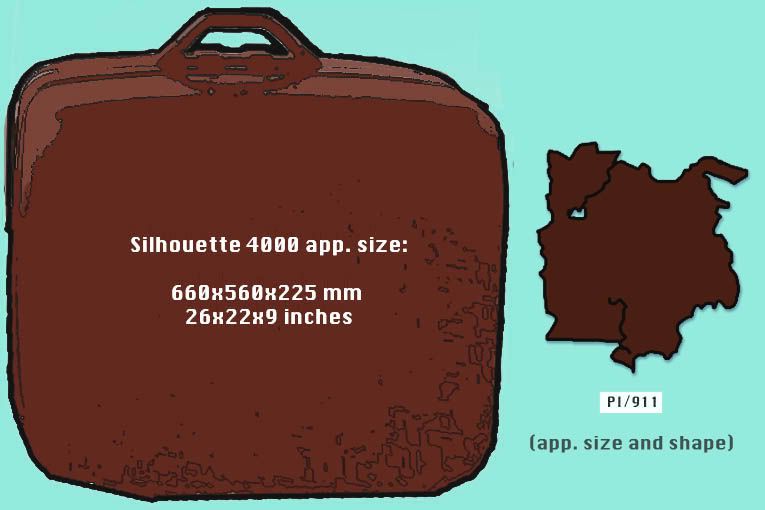
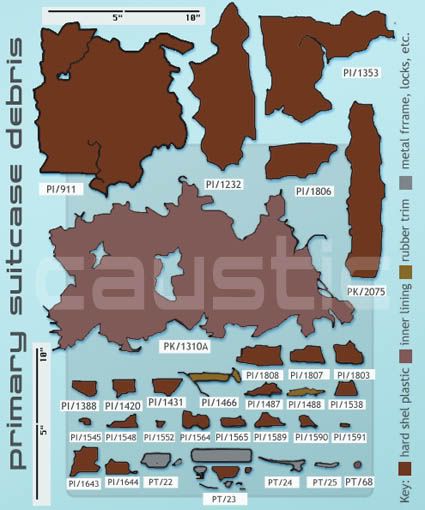
It’s been accepted for over 22 years that the explosive device responsible for destroying Pan Am 103 was within a brown (antique copper), hard-shell Samsonite suitcase, Silhouette 4000 series by its partial remains. This was eventually connected, in an extended fit of fevered imagination, to Libyan agent al-Megrahi, based at the time on the island of Malta.
The suitcase was “found” on flimsy evidence to have traveled unaccompanied from Malta, tagged for PA103, and transferred in Germany to a Pan Am feeder flight, 103A. When the feeder arrived in London at around 5:35 pm, it was decided, the death package was re-loaded into the luggage container AVE 4041, which was then loaded onto the 747 Flight 103, which took off into the sky at 6:25.
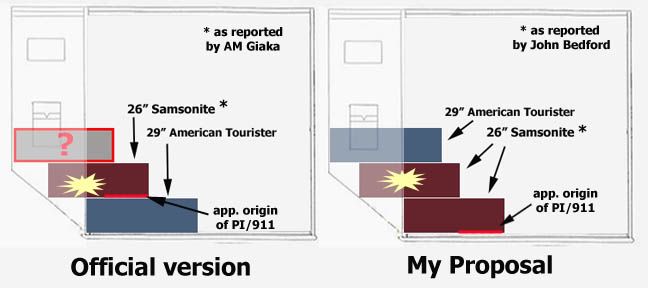
The explosion inside the Silhouette 4000 shortly thereafter caused damage to the container suggesting the case was in the lower outboard corner, apparently in the second layer of luggage. Investigators were quite certain this put it among the majority of items loaded from the feeder, but at the very bottom of that batch – just above the few suitcases loaded before the feeder landed, at terminal three’s “interline shed.”
And it’s there we find our smoking gun.
The bags Bedford saw
The plot from Malta is complicated by on-the-ground evidence at Heathrow: the report of baggage loader John Bedford. He was in charge of Pan Am’s operations at the interline shed of terminal three, where luggage from other airlines connecting onto PA flights was re-screened and loaded into containers. Employees of Alert security ran the x-ray part, while Bedford, in this case, placed the items into the “tin” in question.
Of all the cases passing into AVE4041 through the shed that afternoon, none stood out to Bedford except for a pair he reported to the police when they interviewed him in early January 1989. (see: the Bedford suitcase(s)) He described them as brown or maroony-brown, hard-sided Samsonite-style cases. That’s a remarkable fit with the primary suitcase, although apparently in duplicate.
[To clarify a side-point, I proceed here on a different assumption from most. A careful reading of Bedford suggests both mystery cases he saw were the same color and style. As he said: “They were [both] hard cases, the type Samsonite make. One was brown in color and the other one, if it wasn’t the same color, it was similar.” This plus their appearance at the same time suggests – though it doesn’t prove - a matching set from one owner, and thus both suspicious. Somehow no one else seems to read him the same way, and focuses on one of the two (the left one is specified somewhere) that matches the official style. But I go with what I see, causing the occasional disconnect between singular and plural forms below, as well as apparent complications addressed partly in this post.] |
The cases appeared in his absence, Bedford said, but were vouched for by the Alert security x-ray man Sulkash Kamboj. But Kamboj himself denied this to police, and so no one can attest to seeing either one of these bags cleared for safety or placed in the container. This is in itself a minor mystery that raises some questions about what that luggage really was and how it got there.
What they weren’t: Megrahi’s luggage
A crucial aspect of Bedford’s story is its timeline. They mysterious hard-shells appeared around 4:40 pm, about an hour before the feeder 103A, carrying the fabled Libyan Samsonite, had landed in London. There’s no ambiguity possible here; Bedford clocked out right after the incident, and took his eyeballs home at 5:02, over a half hour before the feeder touched down. So clearly, neither one of the bags could be a stray sighting of that Maltese-origin packet-o-clues, which would be
the third, or at least the second, brown hard-shell case accepted as going into the lower levels of AVE 4041.
What they weren’t: recovered later
The position Bedford saw the cases in was side-by-side, flat across the front half of the container floor. (see "
Visualizing the Bedford story"). Unless they were moved, these would have become damaged by the explosion, accepted as centered about one inch above the left-hand twin. The bomb was powerful enough that nearly half the cases in the container, 25 out of 55 or so, showed signs of explosives damage, so clearly as they were reported, neither of the mystery cases was far enough away to escape harm.
But as the Zeist judges summed it up in 2001, “the evidence did not disclose that any fragments of a hard-shell Samsonite-type suitcase had been recovered, apart from those of the primary suitcase itself.” In fact, neither brown fragments of nor any intact cases of that style with the slightest bomb damage were found, except the one.
To explain this lack of damaged Bedford bags in the evidence, the UK Fatal Accident Inquiry in 1990, bafflingly, did nothing. The judge (Sheriff Principal), John Mowat QC, had in his evidence two brown hard-shells flat on each other, with the upper one from Malta blowing up to be recovered in bits, and the other, still on the floor … vanishing entirely, it seems.
"I am therefore satisfied that the suitcase in which the explosive device was contained was among those transferred from Flight 103A to Flight 103 […] On all the evidence I consider it is probable that bags from flight 103A were placed on top of the two interline bags lying flat at the front of the container.” [FAI 1.rtf]
This last is a clear reference to the ones Bedford spotted, although the determination gives no description of the cases that just fell through the gaps in Mowat’s logic. He did hear in the proceedings (re-read at the Zeist trial) a badgered “admission” from Bedford that the twice-affirmed “maroony brown” bag “could have been” a completely different color, blue even. It’s not clear what effect, if any, this forced appearance of vagueness had on Mowat’s decision. (the lead-up to this memory lapse, which I read as "badgering,"
is fascinating reading, but the voice inflection and cadence we don't now have might reveal so much more).
The Camp Zeist judges, in their 2001 Opinion of the Court [
PDF] fared a little better with explaining its absence from the pool of damaged luggage. They accepted Bedford’s original report on the color of the mystery case, but speculated that it “might have been placed at some more remote corner of the container” just before the re-loading from 103A. It’s a neat thought, but only the upper corners are remote enough to work when half the luggage in there wound up damaged. And those spots obviously were not available until
the end of loading from 103A.
Further, there’s no reason to rule out a move to the
near corner, just a few inches away, where a case just like that blew up.
Further, the judges’ speculation founders on the fact that apparently
no non-damaged case that could fit the description turned up either. The best they could do was say this:
“[W]hile the forensic evidence dealt with all the items recovered which showed direct explosive damage, twenty-five in total, there were many other items of baggage found which were not dealt with in detail in the evidence in the case.”
If the prosecution could find and explain the non-damaged, non-explosive Bedford bag(s), anywhere in the police records, the judges would have heard about it. Yet they’re left having us presume such a case must have been buried by oversight in that quiet bone yard.
Simply put, the investigation and the trial judges accept with bland resignation that
the maroony-brown suitcase(s) never turned up. In real life, things don’t just disappear when it’s convenient for them to. In the mind of SCOTBOM, or Camp Zeist, however, it appears everything is permitted in deciding what is and isn’t true.
What they were called: interline luggage
The Scottish police ruled early on that the Bedford suitcases, like all of the luggage in AVE4041 before the feeder landed, was from interline passengers on flight 103. On March 28 1989 Senior Investigating Officer John Orr told investigators gathered at the Lockerbie Incident Control Center (LICC) that:
“Evidence from witnesses is to the effect that the first seven pieces of luggage in the container belonged to Interline passengers and the remainder was Frankfurt luggage.”
“Seven pieces” included five suitcases Bedford first lined up along the container’s back (quite likely it was a few more than this), plus the two mystery cases. The "effect" that this was all interline baggage was
not from "evidence from witnesses" - who all swear they don’t know where the cases came from - but from the
name of the shed (interline) where the suspect bags were inserted.
The FAI and the Zeist judges, by their wording, agree in calling all pre-103A bags interline, and it’s been the blanket classification ever since. This inherently rules out
a Khreesat bomb, the early suspect device built with only one take-off before it blows. If the missing one of those had interlined to London, it wouldn’t get there - it would be scattered along with a plane and its passengers on some field not far from the first airport.
But my article “
After the Break-in” outlines how a Heathrow intruder in the airside area of terminal three – which had its security breached in the early minutes of December 21, by the way - could make an introduced bomb appear wherever he managed to sneak it into the flow. If he weren’t caught in the act and the items were tagged right (perhaps even with an sticker saying it was X-rayed),
it would wind up looking like, for example, interline luggage. It would run the danger of appearing mysteriously and catching someone’s attention, and of course, something
was noticed on December 21
that matches the bomb bag style. So that leaves us … still spooky.
What they weren’t: interline luggage
The presumption that luggage appearing at the interline shed would be interline is only natural. But other possibilities exist, so it should be double-checked before being presumed. If they really belonged there, just whom did this case or these cases, so similar to the Libyan Samsonite, belong to?
Investigators did in fact try to figure it out. Scots detective John Crawford wrote in
his 2006 book about analyzing the “first fifteen of the interline passengers” to locate any possible link to the bombing. [
JREF link] He said these were high-profile or secret-mission people who might be targeted, have their luggage swapped, etc. Researcher Rolfe has decided instead this was likely
all of the interline passengers he looked at, only some being special targets. But these fifteen at least would have any luggage switch from “Air whatever” to the interline shed to be x-rayed and then placed by Bedford. Some of them must have gone elsewhere than AVE 4041, however, as there were no more than eight cases in there before the mystery set appeared. Apparently Crawford found no sign that any of the fifteen possessed such luggage, or it would have clearly explained away Bedford’s story.
The four “Larnaca interline: passengers,” the most targetable subset of Crawford’s list, are of special interest. Major Charles McKee, Dan O’Connor, Mathew Gannon, and Ronald LaRiviere all came in on an Air Cyprus flight, all on sensitive missions related to embassy security and hostages in Lebanon. The four were shown to have held four cases between them, with one (O’Connor’s) left off the flight and sent later to New York. [
JREF link] Thus they account for three of the 5-8 bags Bedford placed along the back of 4041: A blue softshell Samsonite and two gray hard-shell cases. All three were recovered and showed signs of explosive damage, especially one of McKee’s case, which also has
its own mysteries attached.
Again by the silence we can presume that among the other half of the genuine interline passengers whose cases were in 4041, none had such a case to explain the still-unexplained sighting.
What they weren’t: passenger luggage at all
We can further infer that no such luggage should have been interlined to that container from the fact that
no passenger on flight 103 was found to own such a case. Sherriff Mowat issued a finding in his FAI determination that meant one thing there but becomes very interesting in the current context:
I am therefore satisfied that the suitcase in which the explosive device was contained was among those transferred from Flight 103A to Flight 103. I am also satisfied on a balance of probabilities that it was not associated with any of the passengers who boarded Flight 103 at Heathrow. This decision is based upon the evidence of Detective Constable Henderson who analysed the baggage which was recovered and those pieces which were not recovered and where possible linked each piece with the person accompanying it. He gave evidence to the effect that none of the descriptions given by relatives of the baggage which they expected the victims to have been carrying fitted this suitcase.
As Rolfe sums up: “This makes Bedford's left-hand bag very mysterious indeed. […] So if there was no legitimate suitcase answering the description of the bomb bag,
what the hell was it that Bedford saw if it wasn't the bomb bag? Of course this evidence was not led at Zeist.” [
JREF link] Indeed, as we've seen, the judges there did not rule them out like this, but left the impression they were innocent interline luggage. Unlike at the FAI, the Malta bag and its Megrahi genesis was well-defined by then and separated itself well enough for the judges to forgo such games.
Therefore, besides the color and style description and location, we must add another disturbing shared trait between these mystery cases and the primary one – all of them were
something other than passenger luggage. That’s an important point to consider as the odds steepen into sheer cliffs.
And to state it again in shorter form, FBI lead investigator Richard Marquise, in
his own 2006 book, affirms no one on the plane at all owned such a case.
Quote:
"Interviews of the American relatives as well as those who had last seen the passengers who boarded the aircraft revealed little additional information. None of them owned or had a brown hard-sided Samsonite suitcase." [p 41]
Marquise was trying, as Mowat was, to isolate the Libyan suitcase from Malta, but he’s unwittingly chased it into a closet already stuffed with one or both of the cases Bedford reported. None of these two or perhaps three brown hard-shell Samsonites was passenger luggage.
What they remain: sidelined yet relevant
The Bedford suitcases remain to this day unexplained, and equally sidelined and declared irrelevant in every conceivable way. That what he described was the bomb suitcase is the first thing one should have suspected comparing it to the physical evidence and known terrorist weaponry and motivations. All this was available to investigators before the Spring thaw of 1989, yet it was the first option British investigators denied and found against at every available chance, using whatever was at hand.
First, SIO John Orr and his people found that the larger number of Frankfurt origin items in the container (aside from the bottom) led to “balance of probabilities” conclusion it came from Frankfurt. Soon it was established that the blast was slightly too high in the container (not
right on the floor) to be one of the bottom interline bags. These were incapable of being stacked or otherwise re-arranged into a slightly higher position (this has never been stated, but always implied).
Then the primary case was found by the esteemed
"political scientists" at RARDE to have been on top of a blue soft-shell case from Frankfurt, which had replaced the left-hand Bedford case on the floor. This forensic “fact” was absent on Dr, Hayes' first examination in 1989, and indeed unknown to the 1990 FAI, seeming to appear only later, and supported by contradictory and suspect clues. (see “
the Monster of Newcastleton Forest”)
And finally, the Malta link to Libya was established. In August 1989, an unaccompanied bag from Malta was noticed, and later it was decided Megrahi bought the clothes inside of it. Megrahi was at Malta airport as that item appeared to have left,
under an alias no less, and was "seen" by
witness Giaka in possession of the case. Bingo, the Bedford evidence was finally history. Too bad that construct, elaborate as it was, is now in tatters, held together only by legal convention and increasingly willful denial of reality.
And the clues that rag pile obscures suggest one coherent narrative – a Khreesat bomb
loaded in London to help the Iranians get their vengeance for
Iran Air 655. One of the key London clues, Security guard Ray Manly’s
report of a break-in at terminal three, was completely erased by police (on accident, they say) and never considered as
the debate raged over whose airport screwed up (the Brits won).
On reviewing this awkward tribal dance around Bedford’s story, it’s evident that, like Manly’s report,
it would have been much easier to dance over its unmarked grave. But for one reason or another this likely smoking gun of the Lockerbie bombing was kept in the public record, in plain sight but overlooked by the eyes with power. Even as it’s been divorced from relevance to legal truth, the unusual insertion spotted at 4:40 pm
may still be more than an amazing compound coincidence. It might in fact be central to the physical reality that took 270 lives two and a half hours later.
---


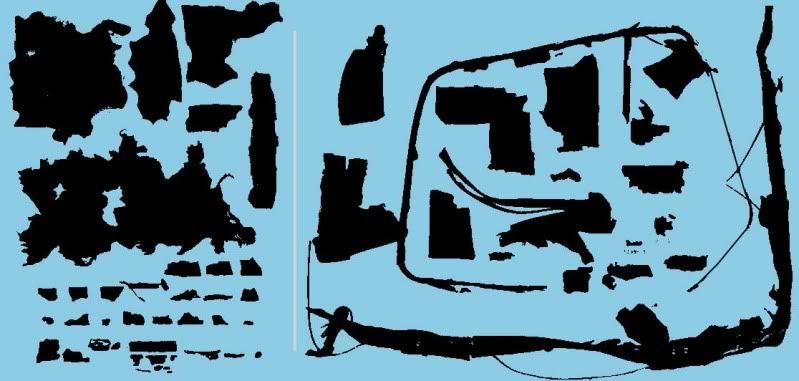
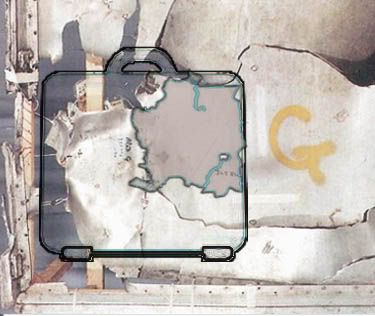
 Here, at left, is what was assembled and called the primary suitcase. It was a different type entirely, a brown or antique copper colored hard-shell Samsonite, Silhouette 4000 series. Given in the report as luggage item 4.1.2, its remains were described thus: