
last update Jan 31 2011
The Basics and Prosecution’s Case
The heart of this Improvised Explosive Device (IED) that tore down Flight 103 was Semtex-H, in an amount that can only be estimated. Official guesses at the weight are not widely reported, but Professor Christopher Peel of the Royal Aeronautical Society, at the Zeist Trial in June 2000, testified to his calculations; around 450 grams was used, and wound up a bare 25 inches from the plane's fragile skin. These findings were challenged by the Defense, according to the Scotland Herald, but Peel doesn't stand alone. [Source]
There were also forensics tests, reported by David Leppard in his 1991 book On the Trail of Terror, that are said to confirm "RARDE's initial assessment that the bomb had contained about 400 grammes of Semtex high explosive - less than a 2lb. bag of sugar." These were the Indian Head tests carried out April 89 in the USA by RARDE's Ferraday and FBI's J. "Tom" Thurman. Interestingly, Leppard cites this confirmation as "the explosive charge used to bring down the plane was 'in all probability' about 454 to 680 grammes or 1 to 1 1/2 pounds of Semtex." [p 139-141]
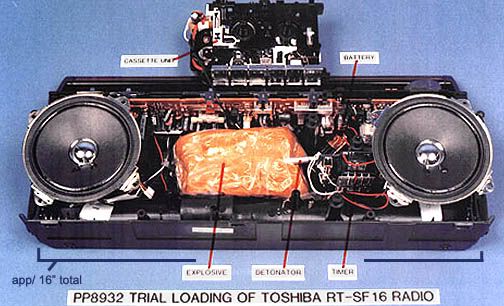
I'm no expert on how much energy is unleashed by 454-680 grams of this legendarily powerful compound. But consider the "trial loading" below used at trial (image found here and improved the labels a bit, added width notation). This is the alleged bomb - a Toshiba RT-SF16 "BomBeat" radio with explosive, a detonator rod, battery and MST-13 timer without waterproof casing, all fitting in a remarkably small case, about 16 inches across. It has the cassette assembly, about 4 inches wide, removed to allow the pat of semtex. This makes the timer, it seems, no more than two inches from that origin of the blast - inches of mostly air, not lead.
According to the officially accepted evidence of what actually survived these circumstances, refer to the following crucial evidence attested to.
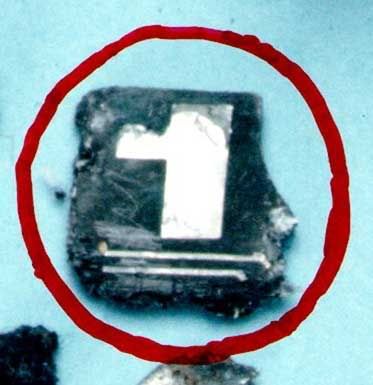
Obviously, the half-inch square fragment of circuit board named PT/35(b) was a crucial clue to Libyan guilt, as seen on TV with its identifier "Tom" Thurman. This is the part people have been questioning in recent years. This led to Swiss makers Mebo, who only made a few of these ever, for Libyan intelligence JSO.
These were fairly small, fragmented, melted, lumped together in far-flung luggage. The radio remains are not implausible, but didn't prove the radio type. Consistent with but not exclusive to the RT-SF16.

- Fragments of radio instruction manual
This nearly-intact cover page saying Toshiba RT-SF16, was supposedly found in a field and brought in by citizens. This and other page fragments clumped together were consistent with a RT-SF16 manual, and convinced the Zeist judges of the model. This was presumably in a plastic sleeve, packed snugly in the radio box, perhaps three inches from the explosive center. Result - crumpled and torn a bit, slight singeing.
If it's bizarre, it's proportionally useful; the radio model itself is said to indicate Libyan guilt. It's not very conclusive, but 3/4 of the small run of RT-SF16s were sold to a company said to be connected to Libyan intelligence.
A Challenge: Dr. Wyatt's tests
Over the years, critics have contended the amount of explosive really used, their type, their placement, and whaether or not i would be strong enough to rupture an aircraft, or too strong to have left the clues that were found. The last question was brought to the fore, and left there it seems, by recently announced experimental evidence. Repeated tests simulating the alleged conditions indicated that larger items like, in particular, the famous bomb-timer fragment that nailed Libya, would have never been found if they were in the explosion. This was aired by, of all parties, the BBC program Newsnight, on 8 January, 2010. The program is currently viewable at this BBC page and definitely worth a watch. The tests were carried out by Dr. John Wyatt, an explosives expert retired from the British Army, now running a security consulting company called SDS, and is a blast consultant for the United Nations (Europe and North Africa region). The details behind how he came to test the official scenario – twenty times over - is unclear at the moment, and so far there’s been no detailed report of his methodology and precise findings, but just what the program shares is compelling enough.
 From what Marshall explains in voice-over, Dr. Wyatt carried out his twenty tests over time, starting with the radio bomb detonated by itself. One sample he showed the cameras is at right, a suitcase filled with random clothes, and a radio (different model than alleged, a bit larger), rigged as a bomb and set in a homemade cardboard box. Another he showed contained yet another type of radio, bright red, and a suicase he says is the same model used for PA103 (Samsonite hardside). Both were soon after blown up with the pat of plastic explosives tucked inside. Of the consistent results, Wyatt told Newsnight:
“I must admit, since the quantity of explosives we were using was only three or four hundred grams, I thought there were going to be some remnants of the radio left. But it – it – (chuckling) it just totally disintegrated. I mean really just went into tiny, tiny bits."Please note that he was using amounts, if this accurate, of 300-400 grams, when the Indian Head Tests considered 454-680 grams the likely force behind the half-inch readable chunk "found" in the Scottish countryside. Wyatt elaborated a bit on method to The Times of Malta, specifying a separate timer was included and considered, as well as the general radio unit, and that the tests were done in varying conditions.
"We tried exploding the device on its own; in a radio similar to the one it was supposed to have been planted in; in a suitcase with and without clothes; surrounded by other suitcases and, eventually, in a container. In all tests, the timer and the circuit board were completely destroyed."
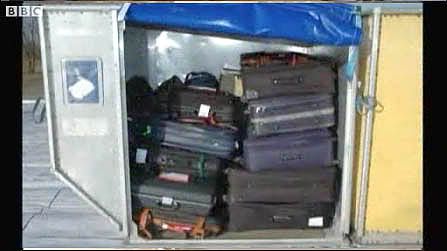 He later “built the tests up” to a finale – a dozen or so pieces of luggage piled in an airliner luggage container, arranged among other containers, and detonated in a field, videotaped from several viewpoints. This last was the only outdoors test; he told the Times he had done the other 19 indoors, “to make sure we could collect all the evidence.” Collecting the remains is what it was all about, of course, and so they used sparse concrete rooms (rather than a hundreds of square km countryside) and “we even painted the circuit board bright yellow to make it easier to identify any fragments among the debris. In no circumstance did we find any fragment," Dr Wyatt explained. Presumably he means no fragments of the scale of PT/35(b), since elsewhere he does mention “tiny tiny bits.” Perhaps the yellow was simply cooked off in all cases?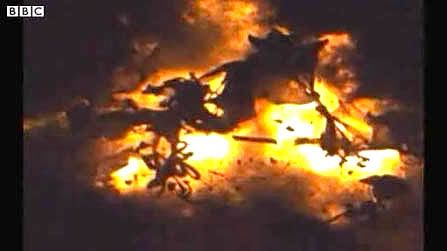
Above is a dramatic image from one of the tests, in a darkened room and greatly slowed down. The curly stuff is presumably the "hard-side" suitcase material, the little bars parts of its frame. The white-hot cluster at center is that 3-400 grams of explosive, semtex it should be, consuming the whole radio and vaporizing/weaponizing everything around it. Do consider that the bomb penetrated the plane's hull, after losing force bursting from the luggage container, after tearing through the suitcase lining, surrounding clothes, cardboard box, and the radio's plastic casing. The timer would be got to right away, before any energy was lost in an of those battles. Is Wyatt's testing just an elaborate (and expensive) way of proving the patently obvious?
Presented by Newsnight host Peter Marshall with the official story again - that a 1cm square chunk of circuit board so near the blast survived inside a small piece of cloth, and was found on the ground, during manual searches, 35 km from Lockerbie? Dr. Wyatt stopped precisely this far short of calling it all a grand farce:
"Obviously these things are not impossible, we only carried out 20 tests, we didn't carry out 100 or 1,000 tests, but in every of those 20 tests we found absolutely no sign at all. So I find it highly improbable that you would find anything like that, particularly at 10,000 feet when bits are dropping into long wet grass over hundreds of miles. […] I do find it quite extraordinary and I think highly improbable, and most unlikely that you would find a fragment like that – I mean, it is unbelievable.” [emphasis as spoken]
Response and counter-response
- Crown Response / Indian Head Forensic Tests
A Scottish Crown Office response quickly followed. It started with a standard appeals to 'we already won, he was convicted,' which have no bearing on the issue at hand, which cuts to the how of the conviction. They note irrelevant facts like "Dr John Wyatt has never examined the timer fragment (PT 35)." Indeed, only certain scientists who have a history of "political" science (Feraday, Thurman) were allowed touch this one and decide it was indeed from the Libyan explosion. Erroneously, the Crown Office state "conclusive forensic evidence proved that the fragment was part of the timer ... at the time of the explosion which destroyed Pan Am 103." Such tests apparently consisted of finding it in a burnt piece of shirt. They did not test it for explosives residue, or do anything to prove it was not planted for them to find. Most interesting and relevant, the press release stated:
"In fact, extensive explosives tests were carried out in the United States in 1989, some time before the fragment PT35 was extracted by the forensic experts, as part of the Lockerbie investigation. The purpose of these tests was:This fragment survivability aspect is not mentioned in Leppard's book, but hinted at with the note that the clothing within the IED case was “sprayed with a distinctive colour of paint for ease of identification.” [p 139] The Crown office release continued to explain what was found:
o to estimate the amount and location of the explosives used on PA103;
o to establish the extent of damage to the improvised explosive device ( IED ), the adjacent suitcases and their contents; and
o to ascertain what parts of the IED and its contents it was possible to recover and identify." COPFS original posting
"After a number of test explosions a detailed search was made and circuit board fragments, radio cassette casing and parts, fragments of instruction manual, the suitcase and clothing were all recovered in a condition which was consistent with the debris recovered in relation to the Lockerbie disaster."The results of these tests have never been formally publicized to my knowledge, making verification impossible. David Leppard does cite a varying amount of explosive in each test - from 360 to 680 grams. [p 140] Interestingly, Alan Feraday had overseen the low end test, and probably recovered the debris from a 360-gram blast "in a condition which was consistent with the debris" that started being found and identified by Mr. Feraday himself and his scientists, right afterwards. RT-8016 radios were used in the US tests, exactly like the model later identified from 103's wreckage, except for case color - the 8016 is white, the SF16 black. The best identifier of the radio model, aside from the amazing manual, was AG/145, a lump of material including a tiny but identifiable bit of internal circuit board. This was consistent with either Toshiba model.
Conclusion: More Information Needed
If indeed there's something in the Indian Head tests that clearly contradicts Dr. Wyatt's findings, and large fragments (up to 1cm square) were indeed recovered from an equivalent blast, the details should now be brought forward. Dr. Wyatt insists 300-400 grams of semtex disntegrates the whole radio, and shown us at least some of the methodology. On the other hand, we've got a few lines in an error-filled Crown Office press release suggesting that Thurman and Feraday did it right and got big chunks similar to what they found - and that they felt was after a blast of 454-680 grams.
That is a serious discrepancy. Obviously the laws of physics are immutable and unchanging, so if two sets of tests produced different results, then some variable was set up differently (wrong) between them. So far Dr Wyatt's is more open, better illustrated, makes more sense, and reeks less of politically-driven obfuscation, but Id like to see more documentation on that as well.
---
Update: A little more information has come out on the tests since the first article. See "On Planted Evidence"
Update Jan 2011: Dr. Wyatt's findings and credibility are in some question. See later comments below.


