Showing posts with label bomb/IED. Show all posts

Two Secondary Suitcases?

June 13/14, 2011

The Soft, Blue and Maroon Case
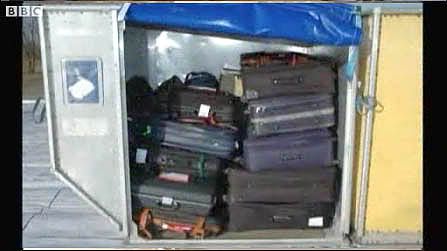
Below is a screen capture from al Jazeera's new video, of a severely blasted suitcase, gathered back together for investigator's cameras following the bombing of PA103. This piece of luggage was listed in the examination notes of Dr. Hayes as item 4.2.14, a blue soft-shell American Tourister case.

It was owned by passenger Patricia Coyle, who interlined from Germany on the feeder PA103A, which also officially carried the bomb (although other evidence suggests it was manually placed in London).  By RARDE's questionable and belated finding, it was placed just beneath the bomb suitcase, on the floor of luggage container AVE 4041. It looks just about blown-up enough to have been the primary case - the one containing the bomb. But it was what I'll call "secondary", next to and touching the primary one.

I recognized the photo even without a label from the description given of the unique remains in the trial transcripts, and the readable item numbers support that call. This case had always sounded supremely blast-damaged and largely unaccounted-for, and this elusive photograph 76 shows about what I expected, if even more so. The examination notes (culled as read-back from transcripts) explain:
"The following 27 items, the larger fragments of which are collectively shown in photograph 76, were identified as component parts of a blue American Tourister brand softshell suitcase. The severe overall damage to the identified component parts is consistent with this suitcase having been located in contact with the suitcase that contained the improvised explosive device at the moment of explosion."
The case had been supported by a simple wire frame, with flexible plastic of blue, maroon, and black filling it in the body and trim. TSH/346 is the large piece wrapping around the outside, essentially the whole middle band of the case. It was said to have been blasted at least partly into the neighboring container, AVN 7511, along with some pieces of the container and of the primary suitcase.

There are only about ten further pieces not shown, all very small. As can be seen, the majority of that base material didn't turn up, left in the tiniest tatters lost to wind, sea, and mud if not to the fireball of the explosion itself.

The Hard, Antique Copper One
Here, at left, is what was assembled and called the primary suitcase. It was a different type entirely, a brown or antique copper colored hard-shell Samsonite, Silhouette 4000 series. Given in the report as luggage item 4.1.2, its remains were described thus:
The following 56 items were examined and identified as the component parts of one of the hardshell Samsonite brand suitcases from the Silhouette 4000 range. It was also established beyond any doubt that this item of luggage had been subjected to a violent internal explosion and thus had originally contained an improvised explosive device. Except where noted, all of the items examined below are collectively shown in photograph 49.
The bolded part is the one I here contend. Very similar damage, considering the material differences, had the American Tourister declared as just beneath the bomb. Here, Hayes seems a little too certain for comfort that this extremely splintered suitcase was wrapped around the explosion itself.

As with the other case, the pieces not shown are the smallest ones, especially the many fragments of the cardboard divider from the middle of the suitcase, closest to the alleged bomb (PT/68 in the lower corner is the one sample of that shown).

The delicate suitcase lining fabric not much further away is represented by one nearly-complete side of the stuff - the giant 22-inch PK/1310A, stretched across the middle of the photo. The combined effect of this gauze, the surviving cardboard, and the other very large fragments of shell plastic, is that this case experienced a very asymmetrical blast involvement, with one whole side - and even the middle, it seems - shielded by something - like the upper half of the case and half the primary case and its contents above that.

Among this possible lower half, PI/911 in the upper left is nearly a foot square, and at one point (January 1989) Dr. Thomas Hayes of RARDE had concluded it was from was from "the lower side of a suitcase, compressed and fractured in a manner suggesting it was in contact with a luggage pallet's base and subjected to explosive forces from above." This means beneath the bomb suitcase, which was on level two and blasted from within, not above. (see: the Monster of Newcastelton Forest)

That opinion changed at some uncertain later point - by the time of the final report in 1990, PI/911 was said to have flecks of blue plastic stuck to it, suggesting it had rested on the American Tourister, not the container's floor.

Two Brown Hard-Shells?
This all has direct relevance to the story of John Bedford, the luggage loader at Heathrow now famous for seeing and reporting a brown hard-shell Samsonite case - or perhaps two - inside the container's lower corner. In part, he told police in January 1989:
“They were [both] hard cases, the type Samsonite make. One was brown in color and the other one, if it wasn't the same color, it was similar.”
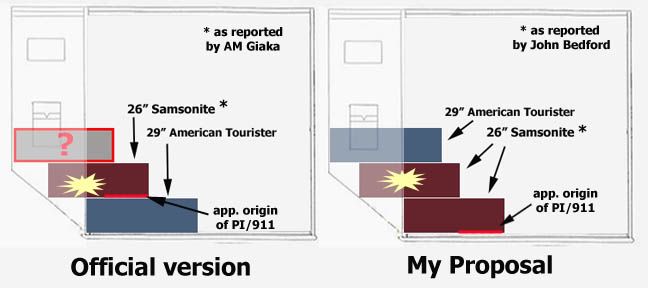
No passengers on Flight 103 carried any such luggage and only the one shown above was recovered after. Yet here is at least one, and possibly two, such cases confirmed in the container before a second or third such case came in from Malta on the German feeder. This was around two hours after Bedford's sighting, and officially, it was set on top of the Coyle case, in the same exact spot the Bedford bag(s) just vanished from, never to be seen again. Officially, that's what happened.

If he described two cases of the same exact color and style, where did the other one go when only the remains of one turned up?

One possibility I've aired before is the one we've seen is not the primary suitcase. Rather, it might be another secondary case, like ms. Coyle's, with the primary case having effectively vanished under the force of its own more-powerful-than-thought explosion. At right is a graphic (all to scale and accurate) that illustrates that arrangement.

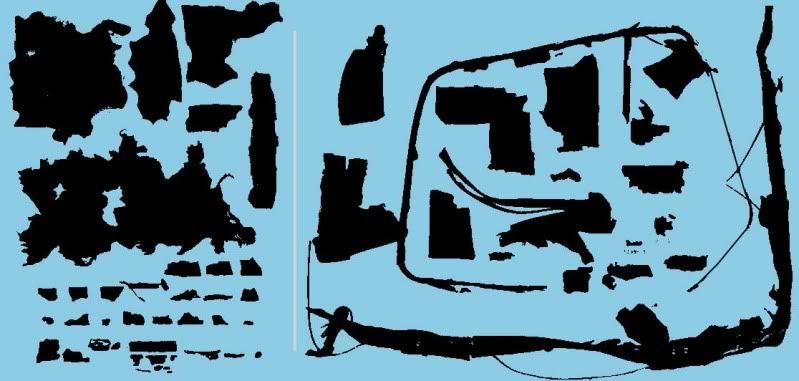
I had backed off a bit on the idea of two matching cases, for the sake of simplicity. But this new image of suitcase 4.2.14 changes things, showing me that  both of the suitcases in question are comparable for extreme damage. Below I've placed both images, fragments in silhouette, side-by-side to approximately the same scale. Seeing them together like this, it's hardly obvious the left one is the most obliterated. Soft-shell vs. hard-shell construction will give different results, and the total number of recovered fragments - 56 compared to 27 - suggests that, in fact, more of Ms. Coyle's less durable case material was lost to the explosion and the elements than were  lost from the primary case that should have seen by far the worst of it.

Really, seeing this image re-affirms to me the idea that these are both cases that had been situated next to the primary one, which was presumably the other Bedford suitcase, worse off yet - gone into dust, along with everything in it. This would mean the clothes, the bomb radio, timer, umbrella, everything deemed to be from the primary case, were either from one of the neighboring cases, or were planted. Considering how neatly they pointed to Libya and Megrahi, and how plagued they are with plausibility issues and handling anomalies, I'm going with planted.

Thirty-Eight Minutes

The Bomb-Timing Clue for London Intro
First posted March 28 2010

Completely re-written Jan. 18 2011

Five Altimeter Bombs
It was a well-placed bomb detonation in the forward hold of PA103 that sealed the fate of 270 people on the evening of December 21, 1988. To be precise, the UK Air Accidents Investigation Branch (AAIB) decided it had detonated at 19.02:50 (7:03pm) – almost exactly thirty-eight minutes after it left the ground from London’s Heathrow Airport at 6:25.

This time span, officially decided on by Libyan plotters for unclear reasons, is an uncanny fit with another technology, controlled by another group entirely – Ahmed Jiibril’s PFLP-GC. To recap, Marwan Khreesat is a Jordanian intelligence operative and long-practicing maker of airliner-killing bombs for Jibril (with exact allegiance unclear in a chicken-and-egg sort of way). Khreesat’s bombs were triggered by altitude (air pressure) and hidden inside consumer electronics – usually radio-cassette players. In the fall of 1988 he was called in again by the PFLP-GC on a mission for Iran – avenge the US destruction of Iran Air flight 655 by destroying an American airliner themselves.

Khreesat was hired to make or modify five bombs, and contrary to GID orders (as we've heard them), compelled to make them fully armed. Only one radio-IEDs of the five was intercepted on the arrest of Khreesat and the whole cell on October 26 1988. Three more of these were found later by German authorities and studied, given the numbers below. All seized Khreesat devices, in order of discovery:

1) Toshiba BomBeat 453 radio-cassette
2) Sanyo computer monitor
3) Ultrasound radio
4) Ultrasound radio

The fifth device, which Khreesat says he only soldered two wires on after someone else constructed it, was a different Toshiba radio (not the BomBeat seized nor the Libyan BomBeat SF-16 officially accepted). The someone else who made it was likely "Abu Elias," a relative of Jibril’s and a senior PFLP-GC operative. Khreesat thinks Abu Elias worked by copying his own work, perhaps recycling some parts from the fifth test model he made for Jibril back in 1985.

This one hasn’t been studied, as it officially never turned up. Many, however, still suspect it did surface – on Pan Am flight 103. So we’ll return to it at the end, after grasping the four that were definitely never used.

Gobel and Khreesat explain the time aspect
[Note: a separate post details the hardware end of these bombs in a little more detail.]
David Leppard’s curious 1991 book On the Trail of Terror describes the work done by German investigators on the four bombs found in Germany, and summarized the findings of BKA scientist “W. A. Gobel." This looked at how the altimeter and time delay modifications worked. Here he refers only to unit 1, the seized BomBeat 453:
“Gobel had tested the performance of the pressure pick-up gauge in a vacuum chamber. The circuit would close at a pressure between 940 and 950 milibars - equivalent to an altitude of about 2,400 feet. The contact point was connected by a wire to a condenser which acted as a time delay switch. The condenser was an insulator, absorbing the electrical charge until it fired. At this point the circuit closed, detonating the bomb.”
The condenser here is what’s elsewhere called an ice-cube timer – a simple metal circuit, coiled-up, I believe, and encased in a cube of translucent resin (looks like an ice-cube made with dingy water).
"When the necessary operating height has been reached the fall in pressure connected with it will start the timing mechanism, and when the delay period has elapsed the detonator will be activated. […] The time delay of the electronic component fluctuates over a wide margin since the structure of the circuit is relatively simple. Time delays between 35 and 45 minutes were measured." [p 11-12]
This 35-45 minute range is often cited, wrongly I think, as the range of times to be expected in field usage. But a passage from Khreesat's interview with the FBI in November 1989 explained that the variability comes from repeated tests on the circuit in a lab setting:
"Khreesat advised that the times are not exact and the time changes depending upon how long the timers have been tested after last being used. They usually reset to zero after a day. He used to test the timers three times in a row before installing the timer in a device. He found that in each test the time decreased. When this happened, he put the timers aside, and the next day when he tested them, they would run for the same time as when he had first started them." [Marshman report, page 32, PDF p 19]
The variability then, with repeated testing, is downward from a long baseline time. Absent repeated tests, which might be unwise in an assembled explosive device, the timers would all have, as the designer described them as having, one set time each, and it would be the long time. So in use, the device Gobel analyzed would detonate about 45 minutes after triggering. This would be more than 50 minutes, not 38, from takeoff.

That certainly doesn’t mean it’s not a fit. Khreesat also told the FBI that the timers were not the same from one unit to the next:
"One of the timers was a half-hour timer, one was for three-quarters of an hour, and one was for one hour. Khreesat does not recall what time the fourth timer was set for. None of the timers were for more than one hour."  [Marshman report, p 32]
These seem to go in nice 15-minute increments - 30, 45, 60. His early bombs in 1970 and 1972 blew up too early - about 15 minutes after triggering - leaving two of three planes able to safely re-land. Thus for "stronger medicine" in the 1980s, he went for increments at or higher than 30 minutes. By deduction, the fourth unit was a repeat of one of the other three.

Three more to consider
Herr Gobel at the BKA, as we’ve seen above, made a close study of Khreesat device number 1, apparently housing the (or a) 45-minute ice-cube timer. He also looked at number two, the IED hidden inside a Sanyo computer monitor. This was armed with Semtex-H like the others, and rigged with the same basic altimeter-timer arrangement. “Calculated on the basis of the values of the built-in components,” Gobel wrote, “the delay time is put at between 30 and 35 minutes.” [Zeist transcripts p 8769] It's unclear if he means test variability or range of estimates for its one field-use time.

Leppard bemoans the German’s presumptions based on only one bomb sample to study, but they had units 1 and 2 and also, at one point, two other such devices. Numbered 3 and 4, these were both housed in Ultrasound radios, both found after the Sanyo monitor in a third raid, and were both destroyed under grim circumstances.

In April 1989, one of the Ultrasound IEDs inexplicably detonated while in the hands of a highly experienced BKA bomb technician, killing him and maiming an assistant. The other of the two (it’s not clear which is 3 and which is 4) was then destroyed rather than be studied, for obvious safety and psychological reasons.

But despite the British alarm over this German “sloppiness,” it wasn’t a complete scientific loss. Aside from what was missing in the rubble, which was safe enough to examine, the BKA’s forensics section ST33 noted on what remained from one the two:
“[T]he accompanying capacitor is of is of the same value as in 1 and 2, but has however, jumped out of circuit. […] it can be assumed from the remains of the circuit that the time delay was in the same region as 1 and 2." [p 144]
From four intercepted IEDs, we have three capacitors, all apparently of the vague 30-45 minutes “region.” This comports reasonably with Khreesat’s list of 30, 45, 60, and one repeat. It seems to be lacking anything with a longer time like one hour, but one device, likely the one that killed a bomb tech, was not studied like this. Perhaps that was the one-hour unit.

The results are not 100% conclusive with the information I have, but it remains consistent enough between Khreesat and the Germans to say we have a double-corroborated explanation, more-or-less, of what to expect with each of the four seized devices.

And the Fifth?
Khreesat felt that all four bombs he was tasked with re-used the timers and altimeters from his 1985 test run. But that involved five radios, one of which he says was kept intact by Jibril to study. It’s worth wondering if these same parts, fitting the same patterns, were later used to build Abu Elias’ fifth device. But wondering aside, we can’t be certain.

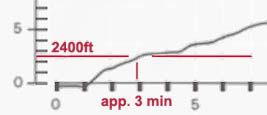
We can examine the facts of December 21 to see whether or not it’s compatible. Below is a graphic from the AAIB's report on the bombing, based on Flight 103’s data recorder. The key line here is altitude, of course labeled “ALT.” The other is some measure of airspeed. The left bar gives feet above sea level (add three zeroes) and the bottom gives time in minutes from data start.
In the marked-up detail at left, note that the altitude doesn’t change for the first minute – takeoff is at minute one, not zero. We can see here that 2,400 feet, the outside pressure that would trigger the timer, is really not very high, and was reached about two or three minutes in. If this pressure decided things for the 38-minute detonation, we’d be looking at a 35 or 36-minute timer, something not within the Khreesat arsenal.

But inside the plane, where the suitcases were, the pressure is controlled and drops more slowly. The work of Rainer Gobel, as related by Leppard, is also confirmed by Paul Foot, writing in 2001 in Lockerbie: The Flight from Justice, as addressing the expected rate where it matters:
"A clearer description of this ice-cube timer was given the same day by Rainer Gobel, physicist for the German police, the BKA. He had a remarkable insight into how long such a timer would take to set off an explosion. “Pressure change in the cabin,” he said, “is regulated automatically. It happens more slowly than the drop of pressure in the air through which the plane is flying, which means, according to the documents which were provided to me, in a plane of the aforementioned class, about seven minutes after take-off the pressure within the cabin will have dropped to such an extent that 950 millibars or hectopascals will have been reached at which the barometric gauge would be involved and a circuit, a current, would be activated.” [p 19]
Some would protest, and fairly I think, that we can't be certain that even if the PFLP-GC's bombs were involved, that this one used the same altimeter setting, or altimeter, or even timer style, as the units examined. But considering the group's reliance on Khreesat’s formula and available materials (the fifth device from 1985), it seems possible enough that it would. And Gobel's "about seven minutes" is quite a nice fit with the roughly eight required to make this fit into Khreesat’s 30, 45, 60 framework. Thus the strong possibility that cannot be reasonably discounted here is that Flight 103’s ascent triggered another ice-cube timer, of the 30-minute size, about eight minutes after wheels-up.
---

Toshiba RT-SF 16 Radios and Libyan Guilt

Undated
last edit March 1 2011

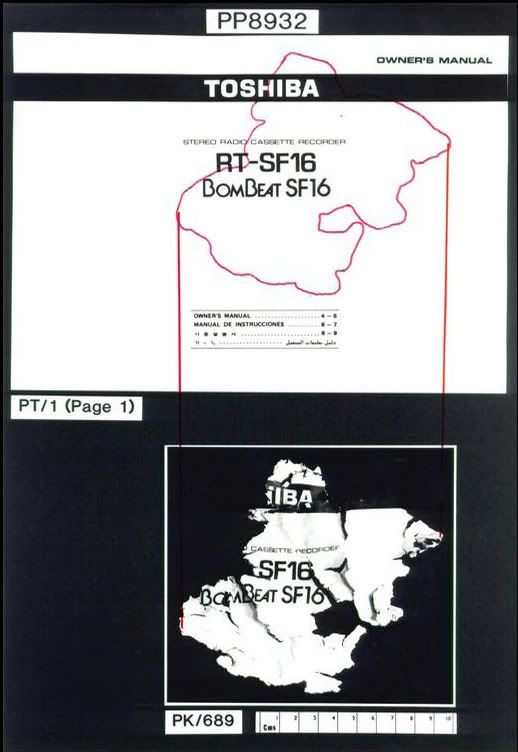
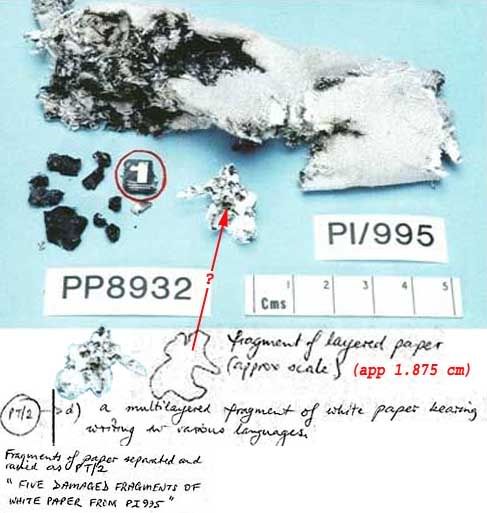
It was forensically determined that the model of radio carrying the bomb that brought down PA103 was a Toshiba RT-SF16 BomBeat radio cassette player, a small black-cased unit with twin-speakers. The radio was identified, in an often bizarre process as it's recorded, by fragments of circuit board and melted case plastics found blasted into surrounding clothes and luggage. And it was confirmed by fragments from the paper user's manual, one a full sheet pronouncing the model plain as day, torn up badly by the thousands-degree Semtex supernova a few inches away (below, left).

That last find, called PK/689, is just too much. Decky Horton thought it had been completely intact when she turned it in, and said so under oath at Camp Zeist. It's been explained the damage to the sheet might have been from forensics testing, and the bomb, apparently, did just about nothing to it.

The science was said to find the manual was not folded at the time of blast, meaning it was outside its narrow box, perhaps way out amongst the clothes. That becomes a bit more plausible. But then why were other bits of the same manual blasted into the blue babygro thought to be wrapped directly around the bomb radio box? Of all the fishy clues that suggest planting, this fishy plant would surely grow the most fish if planted.

These clues appeared to me before the context. I was asking why it had to be the RT-SF16 that wound up in the rubble, to necessitate something so obviously foul? The answer I found is put forth by, for example, the esteemed Richard Marquise, onetime overseer of the FBI's investigation. In a "letter to" Lucy Adams, Marquise pointed out how the model of radio itself indicates Libyan guilt:
"It was a senior Libyan official who had ordered the majority of all the Toshiba radios similar to that which carried the bomb. This official also talked in 1986 about putting a bag on a British or American flight from Malta. Ask why?"
As for the talk of bombing planes, Mr. Marquise will be aware that was a dubious claim of desperate defector A.M. Giaka. The official referred to is Said Rashid, head of JSO operations section, who "asked" Giaka himself - a driver for the JSO - to write a report about bombing planes. It's clearly a rubbish claim, among those first offered on the FBI's boat in mid-1991 in order to win witness protection for him and his wife and impending baby. It was dismissed by the Zeist judges, along with Giaka in general, and virtually everything else he said.

As for Rashid's company's purchase of the radios in question, another unbiased expert, Lord Advocate (prosecution) for the Scottish Crown at trial, Lord Colin Boyd, said in remarks on 28 August 2001:
"As if in confirmation of Libya's involvement during the preparation for the trial evidence was obtained from Toshiba which showed that during October 1988 20,000 black Toshiba RT-SF 16 radio cassettes, the type used in the Pan Am bomb, were shipped to Libya. Of the total world-wide sales of that model 76% were sold to General Electric Company of Libya whose chairman was Said Rashid.

Accordingly, its clear that the move of interest by investigators away from the PFLPGC and towards Libya was as a result of the evidence which was discovered and not as a result of any political interference in the investigation."
October 1988, just two month before the bombing, they made sure to conspicuously corner the market on the exact radio they'd turn into a bomb. Not wise, unless you're framing yourself. Some confirmation of the Libyan BomBeat connection did come from the trial:
"Two employees of Toshiba confirmed in their evidence that their company had supplied 20,000 Toshiba RT SF 16 Bombeat radio cassette recorders to Libya in October 1988. It is alleged that the bomb was contained within such a cassette recorder." LTBU daily report, 26 July 2000
Well that certainly depends on how pure the evidence itself was to begin with. But if we accept this claim, there would seem to be a rough correlation - all things being equal - that if you find a SF-16, it's about 76% likely to be JSO-owned, at least until it was stolen from them. That still leaves a 24% rate of non-JSO probability, and of course all things are not equal.

So the allegation per Lord Boyd is that the Libyans first branded this one radio model - and its amazingly durable manuals - as JSO material. And then they made one of those, of all the models on Earth they could have chosen, into a bomb for such a major operation. And they'd do this using a highly-identifiable and exclusive timer set so it would blow up over land and leave the clues to find. Including the conspicuously purchased Maltese clothing tied right to Megrahi. Packed in the case the Giaka "saw" Megrahi holding the day before the bombing. Sent through three airports unaccompanied but without a single trace at the one airport of them that had excellent security and delivered all their evidence.

It's an insane plot, and standard fare for this investigation. Another stupid move by the villains or, depending on your point of view, another sign of frame-up, with no opportunity to lost to emphasize the direction. Libyan-exclusive everything. I don't think that's normally how terrorists work when they're writing their own script.

A Smoking Gun Left in Plain Sight

Bedford's Bags: What They Were and Weren't
February 17 2011

last edits Feb 20

The bag that blew up
It’s been accepted for over 22 years that the explosive device responsible for destroying Pan Am 103 was within a brown (antique copper), hard-shell Samsonite suitcase, Silhouette 4000 series by its partial remains. This was eventually connected, in an extended fit of fevered imagination, to Libyan agent al-Megrahi, based at the time on the island of Malta.

The suitcase was “found” on flimsy evidence to have traveled unaccompanied from Malta, tagged for PA103, and transferred in Germany to a Pan Am feeder flight, 103A. When the feeder arrived in London at around 5:35 pm, it was decided, the death package was re-loaded into the luggage container AVE 4041, which was then loaded onto the 747 Flight 103, which took off into the sky at 6:25.

The explosion inside the Silhouette 4000 shortly thereafter caused damage to the container suggesting the case was in the lower outboard corner, apparently in the second layer of luggage. Investigators were quite certain this put it among the majority of items loaded from the feeder, but at the very bottom of that batch – just above the few suitcases loaded before the feeder landed, at terminal three’s “interline shed.”

And it’s there we find our smoking gun.

The bags Bedford saw
The plot from Malta is complicated by on-the-ground evidence at Heathrow: the report of baggage loader John Bedford. He was in charge of Pan Am’s operations at the interline shed of terminal three, where luggage from other airlines connecting onto PA flights was re-screened and loaded into containers. Employees of Alert security ran the x-ray part, while Bedford, in this case, placed the items into the “tin” in question.

Of all the cases passing into AVE4041 through the shed that afternoon, none stood out to Bedford except for a pair he reported to the police when they interviewed him in early January 1989. (see: the Bedford suitcase(s)) He described them as brown or maroony-brown, hard-sided Samsonite-style cases. That’s a remarkable fit with the primary suitcase, although apparently in duplicate.


[To clarify a side-point, I proceed here on a different assumption from most. A careful reading of Bedford suggests both mystery cases he saw were the same color and style. As he said: “They were [both] hard cases, the type Samsonite make. One was brown in color and the other one, if it wasn’t the same color, it was similar.” This plus their appearance at the same time suggests – though it doesn’t prove - a matching set from one owner, and thus both suspicious. Somehow no one else seems to read him the same way, and focuses on one of the two (the left one is specified somewhere) that matches the official style. But I go with what I see, causing the occasional disconnect between singular and plural forms below, as well as apparent complications addressed partly in this post.]

The cases appeared in his absence, Bedford said, but were vouched for by the Alert security x-ray man Sulkash Kamboj. But Kamboj himself denied this to police, and so no one can attest to seeing either one of these bags cleared for safety or placed in the container. This is in itself a minor mystery that raises some questions about what that luggage really was and how it got there.

What they weren’t: Megrahi’s luggage
A crucial aspect of Bedford’s story is its timeline. They mysterious hard-shells appeared around 4:40 pm, about an hour before the feeder 103A, carrying the fabled Libyan Samsonite, had landed in London. There’s no ambiguity possible here; Bedford clocked out right after the incident, and took his eyeballs home at 5:02, over a half hour before the feeder touched down. So clearly, neither one of the bags could be a stray sighting of that Maltese-origin packet-o-clues, which would be the third, or at least the second, brown hard-shell case accepted as going into the lower levels of AVE 4041.

What they weren’t: recovered later
The position Bedford saw the cases in was side-by-side, flat across the front half of the container floor. (see "Visualizing the Bedford story"). Unless they were moved, these would have become damaged by the explosion, accepted as centered about one inch above the left-hand twin. The bomb was powerful enough that nearly half the cases in the container, 25 out of 55 or so, showed signs of explosives damage, so clearly as they were reported, neither of the mystery cases was far enough away to escape harm.

But as the Zeist judges summed it up in 2001, “the evidence did not disclose that any fragments of a hard-shell Samsonite-type suitcase had been recovered, apart from those of the primary suitcase itself.” In fact, neither brown fragments of nor any intact cases of that style with the slightest bomb damage were found, except the one.

To explain this lack of damaged Bedford bags in the evidence, the UK Fatal Accident Inquiry in 1990, bafflingly, did nothing. The judge (Sheriff Principal), John Mowat QC, had in his evidence two brown hard-shells flat on each other, with the upper one from Malta blowing up to be recovered in bits, and the other, still on the floor … vanishing entirely, it seems.
"I am therefore satisfied that the suitcase in which the explosive device was contained was among those transferred from Flight 103A to Flight 103 […] On all the evidence I consider it is probable that bags from flight 103A were placed on top of the two interline bags lying flat at the front of the container.” [FAI 1.rtf]
This last is a clear reference to the ones Bedford spotted, although the determination gives no description of the cases that just fell through the gaps in Mowat’s logic. He did hear in the proceedings (re-read at the Zeist trial) a badgered “admission” from Bedford that the twice-affirmed “maroony brown” bag “could have been” a completely different color, blue even. It’s not clear what effect, if any, this forced appearance of vagueness had on Mowat’s decision. (the lead-up to this memory lapse, which I read as "badgering," is fascinating reading, but the voice inflection and cadence we don't now have might reveal so much more).

The Camp Zeist judges, in their 2001 Opinion of the Court [PDF] fared a little better with explaining its absence from the pool of damaged luggage. They accepted Bedford’s original report on the color of the mystery case, but speculated that it “might have been placed at some more remote corner of the container” just before the re-loading from 103A. It’s a neat thought, but only the upper corners are remote enough to work when half the luggage in there wound up damaged. And those spots obviously were not available until the end of loading from 103A.

Further, there’s no reason to rule out a move to the near corner, just a few inches away, where a case just like that blew up.

Further, the judges’ speculation founders on the fact that apparently no non-damaged case that could fit the description turned up either. The best they could do was say this:
“[W]hile the forensic evidence dealt with all the items recovered which showed direct explosive damage, twenty-five in total, there were many other items of baggage found which were not dealt with in detail in the evidence in the case.”
If the prosecution could find and explain the non-damaged, non-explosive Bedford bag(s), anywhere in the police records, the judges would have heard about it. Yet they’re left having us presume such a case must have been buried by oversight in that quiet bone yard.

Simply put, the investigation and the trial judges accept with bland resignation that the maroony-brown suitcase(s) never turned up. In real life, things don’t just disappear when it’s convenient for them to. In the mind of SCOTBOM, or Camp Zeist, however, it appears everything is permitted in deciding what is and isn’t true.

What they were called: interline luggage
The Scottish police ruled early on that the Bedford suitcases, like all of the luggage in AVE4041 before the feeder landed, was from interline passengers on flight 103. On March 28 1989 Senior Investigating Officer John Orr told investigators gathered at the Lockerbie Incident Control Center (LICC) that:
“Evidence from witnesses is to the effect that the first seven pieces of luggage in the container belonged to Interline passengers and the remainder was Frankfurt luggage.”
“Seven pieces” included five suitcases Bedford first lined up along the container’s back (quite likely it was a few more than this), plus the two mystery cases. The "effect" that this was all interline baggage was not from "evidence from witnesses" - who all swear they don’t know where the cases came from - but from the name of the shed (interline) where the suspect bags were inserted.

The FAI and the Zeist judges, by their wording, agree in calling all pre-103A bags interline, and it’s been the blanket classification ever since. This inherently rules out a Khreesat bomb, the early suspect device built with only one take-off before it blows. If the missing one of those had interlined to London, it wouldn’t get there - it would be scattered along with a plane and its passengers on some field not far from the first airport.

But my article “After the Break-in” outlines how a Heathrow intruder in the airside area of terminal three – which had its security breached in the early minutes of December 21, by the way - could make an introduced bomb appear wherever he managed to sneak it into the flow. If he weren’t caught in the act and the items were tagged right (perhaps even with an sticker saying it was X-rayed), it would wind up looking like, for example, interline luggage. It would run the danger of appearing mysteriously and catching someone’s attention, and of course, something was noticed on December 21 that matches the bomb bag style. So that leaves us … still spooky.

What they weren’t: interline luggage
The presumption that luggage appearing at the interline shed would be interline is only natural. But other possibilities exist, so it should be double-checked before being presumed. If they really belonged there, just whom did this case or these cases, so similar to the Libyan Samsonite, belong to?

Investigators did in fact try to figure it out. Scots detective John Crawford wrote in his 2006 book about analyzing the “first fifteen of the interline passengers” to locate any possible link to the bombing. [JREF link] He said these were high-profile or secret-mission people who might be targeted, have their luggage swapped, etc. Researcher Rolfe has decided instead this was likely all of the interline passengers he looked at, only some being special targets. But these fifteen at least would have any luggage switch from “Air whatever” to the interline shed to be x-rayed and then placed by Bedford. Some of them must have gone elsewhere than AVE 4041, however, as there were no more than eight cases in there before the mystery set appeared. Apparently Crawford found no sign that any of the fifteen possessed such luggage, or it would have clearly explained away Bedford’s story.

The four “Larnaca interline: passengers,” the most targetable subset of Crawford’s list, are of special interest. Major Charles McKee, Dan O’Connor, Mathew Gannon, and Ronald LaRiviere all came in on an Air Cyprus flight, all on sensitive missions related to embassy security and hostages in Lebanon. The four were shown to have held four cases between them, with one (O’Connor’s) left off the flight and sent later to New York. [JREF link] Thus they account for three of the 5-8 bags Bedford placed along the back of 4041: A blue softshell Samsonite and two gray hard-shell cases. All three were recovered and showed signs of explosive damage, especially one of McKee’s case, which also has its own mysteries attached.

Again by the silence we can presume that among the other half of the genuine interline passengers whose cases were in 4041, none had such a case to explain the still-unexplained sighting.

What they weren’t: passenger luggage at all
We can further infer that no such luggage should have been interlined to that container from the fact that no passenger on flight 103 was found to own such a case. Sherriff Mowat issued a finding in his FAI determination that meant one thing there but becomes very interesting in the current context:
I am therefore satisfied that the suitcase in which the explosive device was contained was among those transferred from Flight 103A to Flight 103. I am also satisfied on a balance of probabilities that it was not associated with any of the passengers who boarded Flight 103 at Heathrow. This decision is based upon the evidence of Detective Constable Henderson who analysed the baggage which was recovered and those pieces which were not recovered and where possible linked each piece with the person accompanying it. He gave evidence to the effect that none of the descriptions given by relatives of the baggage which they expected the victims to have been carrying fitted this suitcase.
As Rolfe sums up: “This makes Bedford's left-hand bag very mysterious indeed. […] So if there was no legitimate suitcase answering the description of the bomb bag, what the hell was it that Bedford saw if it wasn't the bomb bag? Of course this evidence was not led at Zeist.” [JREF link] Indeed, as we've seen, the judges there did not rule them out like this, but left the impression they were innocent interline luggage. Unlike at the FAI, the Malta bag and its Megrahi genesis was well-defined by then and separated itself well enough for the judges to forgo such games.

Therefore, besides the color and style description and location, we must add another disturbing shared trait between these mystery cases and the primary one – all of them were something other than passenger luggage. That’s an important point to consider as the odds steepen into sheer cliffs.

And to state it again in shorter form, FBI lead investigator Richard Marquise, in his own 2006 book, affirms no one on the plane at all owned such a case.
Quote:
"Interviews of the American relatives as well as those who had last seen the passengers who boarded the aircraft revealed little additional information. None of them owned or had a brown hard-sided Samsonite suitcase." [p 41]
Marquise was trying, as Mowat was, to isolate the Libyan suitcase from Malta, but he’s unwittingly chased it into a closet already stuffed with one or both of the cases Bedford reported. None of these two or perhaps three brown hard-shell Samsonites was passenger luggage.

What they remain: sidelined yet relevant
The Bedford suitcases remain to this day unexplained, and equally sidelined and declared irrelevant in every conceivable way. That what he described was the bomb suitcase is the first thing one should have suspected comparing it to the physical evidence and known terrorist weaponry and motivations. All this was available to investigators before the Spring thaw of 1989, yet it was the first option British investigators denied and found against at every available chance, using whatever was at hand.

First, SIO John Orr and his people found that the larger number of Frankfurt origin items in the container (aside from the bottom) led to “balance of probabilities” conclusion it came from Frankfurt. Soon it was established that the blast was slightly too high in the container (not right on the floor) to be one of the bottom interline bags. These were incapable of being stacked or otherwise re-arranged into a slightly higher position (this has never been stated, but always implied).

Then the primary case was found by the esteemed "political scientists" at RARDE to have been on top of a blue soft-shell case from Frankfurt, which had replaced the left-hand Bedford case on the floor. This forensic “fact” was absent on Dr, Hayes' first examination in 1989, and indeed unknown to the 1990 FAI, seeming to appear only later, and supported by contradictory and suspect clues. (see “the Monster of Newcastleton Forest”)

And finally, the Malta link to Libya was established. In August 1989, an unaccompanied bag from Malta was noticed, and later it was decided Megrahi bought the clothes inside of it. Megrahi was at Malta airport as that item appeared to have left, under an alias no less, and was "seen" by witness Giaka in possession of the case. Bingo, the Bedford evidence was finally history. Too bad that construct, elaborate as it was, is now in tatters, held together only by legal convention and increasingly willful denial of reality.

And the clues that rag pile obscures suggest one coherent narrative – a Khreesat bomb loaded in London to help the Iranians get their vengeance for Iran Air 655. One of the key London clues, Security guard Ray Manly’s report of a break-in at terminal three, was completely erased by police (on accident, they say) and never considered as the debate raged over whose airport screwed up (the Brits won).

On reviewing this awkward tribal dance around Bedford’s story, it’s evident that, like Manly’s report, it would have been much easier to dance over its unmarked grave. But for one reason or another this likely smoking gun of the Lockerbie bombing was kept in the public record, in plain sight but overlooked by the eyes with power. Even as it’s been divorced from relevance to legal truth, the unusual insertion spotted at 4:40 pm may still be more than an amazing compound coincidence. It might in fact be central to the physical reality that took 270 lives two and a half hours later.
---

Explosives Revisionism and "No One Did It" Theories

18 September 2010
last update Feb. 13 2011

I recently asked for help with the contents of this site, soliciting input from the community, and as expected the most interest came from those I'm least inclined to agree with. I'd like to expand the voice of the Divide, but there are some things I just can't bring myself to support with publication here. Where the different theories fall relative to each other and what I accept and why is explained in part here.

Two groups of claims questioning what happened on the plane have become mixed together in my mind and jointly ignored until now. Those who propose a drastically different bomb detonation than alleged took down Flight 103, and those who say it wasn't a detonation at all, but an accident.


Inherently I agree the explosive force as stated is not necessarily correct, although I do suspect it's reasonably close. First, it's not clearly decided anywhere. The Zeist judges wound up taking away a median of 400 grams of Semtex-H, give or take 50, so 350-450. But the Indian Head forensic tests of 1989 found the container damage observed was consistent with the blasts done using between 454-680 grams, and not the lower amounts. There is reason to believe the higher end of that is closer to reality.

And more recently Dr. John Wyatt's unusual tests say that only a blast as low as 150 grams or less might possibly have have left the electonics remains investigators found. And to make PK/689 legitimate evidence, the bomb might have to be more like 20 grams.

I'm not going to argue the bomb was so small it couldn't rupture a suitcase - the clear solution to this is to suspect the poorly fitting evidence was planted poorly. But clearly there is a lot of room for fudging between the intact paper and the ruptured cargo pallet and plane.

As I recall, there are also some genuine-sounding mysteries over residue testing that seemed to suggest a different explosive than Semtex-H (or in addition to?) was responsible. If anyone is excited to explain this a bit better, feel free to do so in the comment section below. I'll try and dredge it up myself if and when time allows.

The rest of this post, however, is stuff just I don't buy. Partly because I don't trust these theories or theorists to get it straight for me, and partly because I don't know the science to be sure myself, I must call these theories worthy of discussion - in the comments section below and nowhere else on my blog (until further notice anyway).

John Parkes on the bomb's power
As reported in Scottish lawyer's magazine the Firm, August 2006.
John Parkes, an explosives engineer present at the crash site in December 1988, who reported damage indicating the carriage of munitions on the plane. Parkes helped in the rescue operation when the Boeing 747 came down on part of the town, killing 259 on board and 11 on the ground. He claims wounding he observed on three bodies recovered from the crash site, and on one young female victim in particular, were not caused by Semtex-based explosives as claimed in the trial.

"Every munitions or explosives device has its own characteristic signature," Parkes says. "The signature I saw was not consistent with the device they maintained was used. There was not enough power or heavy material around that device to have gone through the luggage and floor and through the back of an aircraft seat to inflict these wounds."

[Dr. Jim] Swire has asked the Crown Office to explain why this testimony was not included in the Air Accident Investigation Board report, asking "whether the AAIB gave any reason for rejection of Mr Parkes's ideas, and if so what that reason might have been".

I have great respect for Dr. Swire, but sometimes...

Well, just off the top of my head, Parkes reported the injuries to a girl he felt were consistent only with explosives coming up through her seat, injuring her feet and backside. First, it's unfortunately gruesome and sad as a "smoking gun," and for obvious reasons unverifiable. Second, I'm not convinced Parkes knows what to look for in such an unusual case, and could just be confusing a tree impact after the fall with shrapnel tears from before.

We could check by looking at damage to the floor panels this shrapnel would have to tear through. I had imagined most of this would have been found, perhaps warpedby he overpressure, but not torn up. But according to the AAIB report, many floor beams were fractured and none of the panels in the immediate blast area were recovered (that they admit!). So we can't say one way or the other.
The cabin floor structure was badly disrupted, particularly in the general area above the explosion, where the floor beams had suffered localised upward loading sufficient to fracture them, and the floor panels were missing. Elsewhere, floor beam damage was mainly limited to fractures at the outer ends of the beams and at the centreline, leaving sections of separated floor structure comprising a number of half beams joined together by the Nomex honeycomb floor panels.
Admittedly, that sounds worse than I'd expect, but then again, those beams can't be too solid. Planes rely on lightness, and simple gas over pressure might break up some beams and tear some flooring loose, without ripping through it with shrapnel. To send material tearing up through several filled suitcases, the container top. bay liner, cabin floor, and the seat structure to just stop at injuring this girl - rather than slicing through her - would require a truly massive explosion with supreme control. The focused 20-inch fuselage hole just two feet from the explosion cannot be consistent with such a blast, nor the luggage container or anything in it. I can't buy that's all faked.

Different bomb location
The above theory may also imply a different location even than the missing panels, depending where the girl was seated. I don't think this was ever sorted out, as she was to my knowledge never identified to Parkes.

Then there's temper tantrum Blogger Charles Norrie and his CIA bomb on top of an Iranian one. He cites a statement from Parkes, perhaps reflecting the seating issue above, that "a minimum of two high explosive events took place inboard Pan Am 103." Norrie also points to the twin debris fields, north and south, which could have many explanations in a complex breakup like that of Flight 103,even without another bomb.

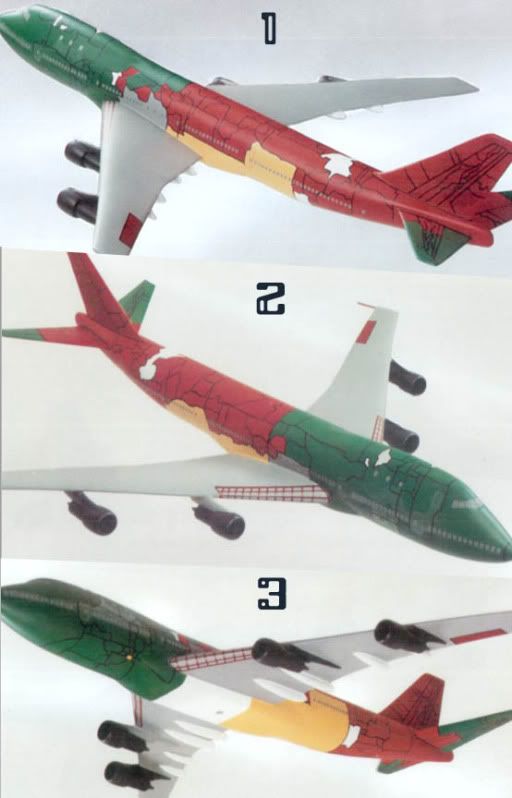
For the location of the second blast, Norrie cites a missing section near the rear cargo area which must have been all vaporized by a "brisant explosion." See the image at left (new window for larger view), of the AAIB's painted model. Those sections coded in white were never recovered. Charles would be referring to the section on the lower rear of the craft (seen in view 3). But many other sections at random spots were missing as well, in at least seven apparent "brisant explosions" all over the plane. For whole panels of aluminum to disappear in Scotland might seem odd, but there are a lot of lochs that maybe weren't fully dredged, and the North Sea's not that far off for high-drag items. Perhaps a few still linger in private collections, bought from enterprising rural Scots.

But more prominently, a number of experty people have made themselves quite sure that mathematics prove the bomb was just a foot away from where it was reported, just outside container AVE4041, rather than inside it. These include onetime AAIB investigator named Protheroe, who now says the "mach stem" effect was calculated wrongly, suggesting 25 inches was between the bomb and the airplane skin. This distance, which fits with the physical evidence of the luggage container, is supposedly trumped by his new numbers saying 12 inches. This would mean the container evidence must be faked to appear the bomb was inside it. It also suggests someone planted the device directly in the plane, rather than remotely in luggage, as generally accepted. No explanation, Just math.

Edwin Bollier started trying to sell Libyan clues to the CIA within days of the bombing, was listed as one of the three important witnesses at Camp Zeist against Megrahi. Now he champions Libya and Megrahi as "wrongly accused," with mostly bogus claims, and he supports Protheroe's 12" revisionism.

I had thought further support could be found from Canadian researcher Ludwig de Breackeleer, but thankfully not, on closer look. Most of his other work on the issue is great, and as a science guy at heart (physics), the contribution he's most qualified for questions the official blast size, which is valid. He concludes, based on actual shown math and presumptions I haven't double-checked:
As the explosion of one pound of SEMTEX H inside the luggage container does not generate a blast wave sufficiently powerful to fracture the skin of the fuselage, we have little choice but to conclude that the verdict appears scientifically implausible.
One pound being about 450 grams, that's the upper edge of what's officially accepted. Dr. Ludwig's science fits with what I already observed at the top - something significantly over that seems a better fit with the most believable physical clues. (though I'd wager not enormously higher - perhaps 150-200% of that). I'm heartened to learn this.

No One Did It
The accident theory has two variations. The first proposes an unintended detonation of military munitions being carried secretly on the plane. This is advanced by one "Robbie the Pict" in the UK.

The other proposes no explosives at all, but a failure-induced decompression, and is advocated by a John Barry Smith in the US and also I believe this was the thesis of Carl Davies, proprietor of the Plane Truth website.

Further commentary for and against these theories can be submitted in the comments form below. Any highlights I feel worthy I may pull up and include in the post.

(more text, links, etc. forthcoming)
---
Update 2/13/11: I have some gripes from Robbie the Pict, which I still need to address re: the above and see if he's got a point. Otherwise, I have to revise my above take on deBraeckeleer. I hear he's been incommunicado for a couple of years now, but I didn't realize that as I tried to e-mail him recently as follows:

Dear. Dr. deBreackeleer,

Greetings. Adam Larson aka Caustic Logic of the Lockerbie Divide here. I've been appreciating your works for quite some time now, especially the interviews and original quotes. Some great work on the Khreesat and Autumn Leaves angles. I've been meaning to get in touch with you, just to see what that might yield.

I'm most interested in where your expert credential are most relevant, with your analysis of the force required to rupture the plane's hull in the first place, as explained in this article: http://www.canadafreepress.com/index.php/article/8920

I have in the apparently misunderstood that article twice now, in two different ways. I just reviewed it again prior to writing, and decided I should just ask you directly what's unclear to me here. The abstract says location is the issue, and that's an issue I have some problems with.

Unfortunately for the stated goal of reaching the masses with simplicty, I have a hard time following it. Positive impulse? Critical time, wavelength, greek letters... Perhaps I should go study up on this, but actually, cutting to the last portion seems adequate for my purposes.
The outside wall of the AVE 4041 container was located at 16 inches from the skin of the plane. At this closest possible distance in the light most favorable to the original investigators, experimental data indicate that one pound of explosive will generate a positive impulse of less than 20 psi-ms against the fuselage. [27]
So from this it seems the force on the skin would be dependent on original power and distance. Correct? The force you've taken is 450 grams, which is the upper end of the range the judges accepted: 400 grams, give or take 50. Since "at this closest possible distance" is the qualifier for the inadequacy.
As this value is well below the critical impulse calculated above, namely 50 psi-ms, we have little choice but to conclude that the Lockerbie verdict is scientifically implausible.
And the AAIB decided on 25" from the hull, not 16, strengthening the point. I'd defer on what I can't verify, and concur in general. But I have a hard time seeing the blast being much closer. The luggage container appears to be blown outward in all regards, and that's one piece of evidence I tend to accept. In fact, I've never seen anyone come out and argue or allege it was faked, even as it's been implied over and over, including by an AAIB scientist himself, no less.

I'm not trying to get you endorse any theory or another, but in your scientific opinion, is it possible that the location is about as reported but the blast force was simply higher than reported? Could a wave emitted from, say, 700 grams (or maybe 900?), but from the AAIB's rough placement well inside the container, make it plausible by these same methods?

I do have some reason from other quarters to suspect the blast weight was fudged way down, in part I surmise to half-explain the manual cover and other - erm - dubious clues. The primary suitcase we've been shown might not be that at all, for one thing...
V—ADDITIONAL COMMENTS
In the immediate aftermath of the tragedy, researchers at the Center for Explosives Technology Research in Socorro, New Mexico, estimated that up to 30 pounds of explosive was needed to destroy a Boeing 747 if the explosion had occurred in the container. [28] We agree with that estimate.
30 pounds? If I could decipher it, I'd ask to see the math on that. Investigators got it wrong by a factor of 30? I would have suspected a factor of maybe 2 or 3, so as to not appear amazingly ridiculous to other scientists like yourself. Did their models have it placed in the relevant spot, or stuffed in the middle of the container, or the upper corner?

Clearly your point here is to suggest that it was not in the luggage container, but isn't that a bit hyperbolic? Maybe unwarranted?

Beyond that, if you're at all inclined after that, I'd be interested in interviewing you by e-mail for my blog. It might increase your profile a bit, give you a few new viewers. I have Slovenian viewers out my ears all of a sudden. And either way, kudos on some very valuable contributions to a worthy field.

Best,

Adam.
---

IED Fragment Survivability Tests

(incomplete)
last update Jan 31 2011

The Basics and Prosecution’s Case
The heart of this Improvised Explosive Device (IED) that tore down Flight 103 was Semtex-H, in an amount that can only be estimated. Official guesses at the weight are not widely reported, but Professor Christopher Peel of the Royal Aeronautical Society, at the Zeist Trial in June 2000, testified to his calculations; around 450 grams was used, and wound up a bare 25 inches from the plane's fragile skin. These findings were challenged by the Defense, according to the Scotland Herald, but Peel doesn't stand alone. [Source]

There were also forensics tests, reported by David Leppard in his 1991 book On the Trail of Terror, that are said to confirm "RARDE's initial assessment that the bomb had contained about 400 grammes of Semtex high explosive - less than a 2lb. bag of sugar." These were the Indian Head tests carried out April 89 in the USA by RARDE's Ferraday and FBI's J. "Tom" Thurman. Interestingly, Leppard cites this confirmation as "the explosive charge used to bring down the plane was 'in all probability' about 454 to 680 grammes or 1 to 1 1/2 pounds of Semtex." [p 139-141]

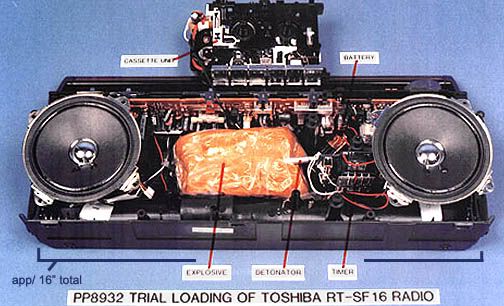
I'm no expert on how much energy is unleashed by 454-680 grams of this legendarily powerful compound. But consider the "trial loading" below used at trial (image found here and improved the labels a bit, added width notation). This is the alleged bomb - a Toshiba RT-SF16 "BomBeat" radio with explosive, a detonator rod, battery and MST-13 timer without waterproof casing, all fitting in a remarkably small case, about 16 inches across. It has the cassette assembly, about 4 inches wide, removed to allow the pat of semtex. This makes the timer, it seems, no more than two inches from that origin of the blast - inches of mostly air, not lead.

According to the officially accepted evidence of what actually survived these circumstances, refer to the following crucial evidence attested to.
- Fragment of bomb timer circuit board
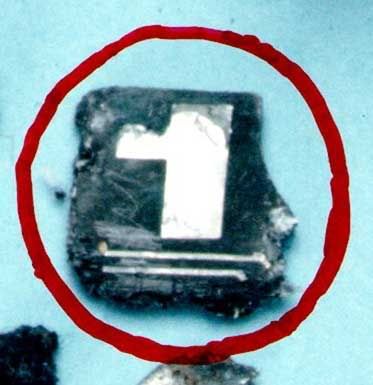
Obviously, the half-inch square fragment of circuit board named PT/35(b) was a crucial clue to Libyan guilt, as seen on TV with its identifier "Tom" Thurman. This is the part people have been questioning in recent years. This led to Swiss makers Mebo, who only made a few of these ever, for Libyan intelligence JSO.

- Fragments of radio housing, circuit board, etc.
These were fairly small, fragmented, melted, lumped together in far-flung luggage. The radio remains are not implausible, but didn't prove the radio type. Consistent with but not exclusive to the RT-SF16.


- Fragments of radio instruction manual

This nearly-intact cover page saying Toshiba RT-SF16, was supposedly found in a field and brought in by citizens. This and other page fragments clumped together were consistent with a RT-SF16 manual, and convinced the Zeist judges of the model. This was presumably in a plastic sleeve, packed snugly in the radio box, perhaps three inches from the explosive center. Result - crumpled and torn a bit, slight singeing.

If it's bizarre, it's proportionally useful; the radio model itself is said to indicate Libyan guilt. It's not very conclusive, but 3/4 of the small run of RT-SF16s were sold to a company said to be connected to Libyan intelligence.

A Challenge: Dr. Wyatt's tests
Over the years, critics have contended the amount of explosive really used, their type, their placement, and whaether or not i would be strong enough to rupture an aircraft, or too strong to have left the clues that were found. The last question was brought to the fore, and left there it seems, by recently announced experimental evidence. Repeated tests simulating the alleged conditions indicated that larger items like, in particular, the famous bomb-timer fragment that nailed Libya, would have never been found if they were in the explosion. This was aired by, of all parties, the BBC program Newsnight, on 8 January, 2010. The program is currently viewable at this BBC page and definitely worth a watch. The tests were carried out by Dr. John Wyatt, an explosives expert retired from the British Army, now running a security consulting company called SDS, and is a blast consultant for the United Nations (Europe and North Africa region). The details behind how he came to test the official scenario – twenty times over - is unclear at the moment, and so far there’s been no detailed report of his methodology and precise findings, but just what the program shares is compelling enough.

From what Marshall explains in voice-over, Dr. Wyatt carried out his twenty tests over time, starting with the radio bomb detonated by itself. One sample he showed the cameras is at right, a suitcase filled with random clothes, and a radio (different model than alleged, a bit larger), rigged as a bomb and set in a homemade cardboard box. Another he showed contained yet another type of radio, bright red, and a suicase he says is the same model used for PA103 (Samsonite hardside). Both were soon after blown up with the pat of plastic explosives tucked inside. Of the consistent results, Wyatt told Newsnight:
“I must admit, since the quantity of explosives we were using was only three or four hundred grams, I thought there were going to be some remnants of the radio left. But it – it – (chuckling) it just totally disintegrated. I mean really just went into tiny, tiny bits."
Please note that he was using amounts, if this accurate, of 300-400 grams, when the Indian Head Tests considered 454-680 grams the likely force behind the half-inch readable chunk "found" in the Scottish countryside. Wyatt elaborated a bit on method to The Times of Malta, specifying a separate timer was included and considered, as well as the general radio unit, and that the tests were done in varying conditions.
"We tried exploding the device on its own; in a radio similar to the one it was supposed to have been planted in; in a suitcase with and without clothes; surrounded by other suitcases and, eventually, in a container. In all tests, the timer and the circuit board were completely destroyed."

He later “built the tests up” to a finale – a dozen or so pieces of luggage piled in an airliner luggage container, arranged among other containers, and detonated in a field, videotaped from several viewpoints. This last was the only outdoors test; he told the Times he had done the other 19 indoors, “to make sure we could collect all the evidence.” Collecting the remains is what it was all about, of course, and so they used sparse concrete rooms (rather than a hundreds of square km countryside) and “we even painted the circuit board bright yellow to make it easier to identify any fragments among the debris. In no circumstance did we find any fragment," Dr Wyatt explained. Presumably he means no fragments of the scale of PT/35(b), since elsewhere he does mention “tiny tiny bits.” Perhaps the yellow was simply cooked off in all cases?

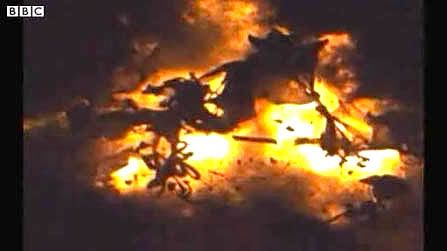
Above is a dramatic image from one of the tests, in a darkened room and greatly slowed down. The curly stuff is presumably the "hard-side" suitcase material, the little bars parts of its frame. The white-hot cluster at center is that 3-400 grams of explosive, semtex it should be, consuming the whole radio and vaporizing/weaponizing everything around it. Do consider that the bomb penetrated the plane's hull, after losing force bursting from the luggage container, after tearing through the suitcase lining, surrounding clothes, cardboard box, and the radio's plastic casing. The timer would be got to right away, before any energy was lost in an of those battles. Is Wyatt's testing just an elaborate (and expensive) way of proving the patently obvious?

Presented by Newsnight host Peter Marshall with the official story again - that a 1cm square chunk of circuit board so near the blast survived inside a small piece of cloth, and was found on the ground, during manual searches, 35 km from Lockerbie? Dr. Wyatt stopped precisely this far short of calling it all a grand farce:
"Obviously these things are not impossible, we only carried out 20 tests, we didn't carry out 100 or 1,000 tests, but in every of those 20 tests we found absolutely no sign at all. So I find it highly improbable that you would find anything like that, particularly at 10,000 feet when bits are dropping into long wet grass over hundreds of miles. […] I do find it quite extraordinary and I think highly improbable, and most unlikely that you would find a fragment like that – I mean, it is unbelievable.” [emphasis as spoken]

Response and counter-response

- Crown Response / Indian Head Forensic Tests
A Scottish Crown Office response quickly followed. It started with a standard appeals to 'we already won, he was convicted,' which have no bearing on the issue at hand, which cuts to the how of the conviction. They note irrelevant facts like "Dr John Wyatt has never examined the timer fragment (PT 35)." Indeed, only certain scientists who have a history of "political" science (Feraday, Thurman) were allowed touch this one and decide it was indeed from the Libyan explosion. Erroneously, the Crown Office state "conclusive forensic evidence proved that the fragment was part of the timer ... at the time of the explosion which destroyed Pan Am 103." Such tests apparently consisted of finding it in a burnt piece of shirt. They did not test it for explosives residue, or do anything to prove it was not planted for them to find. Most interesting and relevant, the press release stated:
"In fact, extensive explosives tests were carried out in the United States in 1989, some time before the fragment PT35 was extracted by the forensic experts, as part of the Lockerbie investigation. The purpose of these tests was:
o to estimate the amount and location of the explosives used on PA103;
o to establish the extent of damage to the improvised explosive device ( IED ), the adjacent suitcases and their contents; and
o to ascertain what parts of the IED and its contents it was possible to recover and identify." COPFS original posting
This fragment survivability aspect is not mentioned in Leppard's book, but hinted at with the note that the clothing within the IED case was “sprayed with a distinctive colour of paint for ease of identification.” [p 139] The Crown office release continued to explain what was found:
"After a number of test explosions a detailed search was made and circuit board fragments, radio cassette casing and parts, fragments of instruction manual, the suitcase and clothing were all recovered in a condition which was consistent with the debris recovered in relation to the Lockerbie disaster." 
The results of these tests have never been formally publicized to my knowledge, making verification impossible. David Leppard does cite a varying amount of explosive in each test - from 360 to 680 grams. [p 140] Interestingly, Alan Feraday had overseen the low end test, and probably recovered the debris from a 360-gram blast "in a condition which was consistent with the debris" that started being found and identified by Mr. Feraday himself and his scientists, right afterwards. RT-8016 radios were used in the US tests, exactly like the model later identified from 103's wreckage, except for case color - the 8016 is white, the SF16 black. The best identifier of the radio model, aside from the amazing manual, was AG/145, a lump of material including a tiny but identifiable bit of internal circuit board. This was consistent with either Toshiba model.

Conclusion: More Information Needed
If indeed there's something in the Indian Head tests that clearly contradicts Dr. Wyatt's findings, and large fragments (up to 1cm square) were indeed recovered from an equivalent blast, the details should now be brought forward. Dr. Wyatt insists 300-400 grams of semtex disntegrates the whole radio, and shown us at least some of the methodology. On the other hand, we've got a few lines in an error-filled Crown Office press release suggesting that Thurman and Feraday did it right and got big chunks similar to what they found - and that they felt was after a blast of 454-680 grams.

That is a serious discrepancy. Obviously the laws of physics are immutable and unchanging, so if two sets of tests produced different results, then some variable was set up differently (wrong) between them. So far Dr Wyatt's is more open, better illustrated, makes more sense, and reeks less of politically-driven obfuscation, but Id like to see more documentation on that as well.
---
Update: A little more information has come out on the tests since the first article. See "On Planted Evidence"

Update Jan 2011: Dr. Wyatt's findings and credibility are in some question. See later comments below.

1980s Boom Boxes and Ice Cubes

The Evolution of the Khreesat Bomb, part two: 1985-88
May 31 2010


Audition, Performance, Recycling
Part one covered the early years of Marwan Khreesat’s bomb-making career in the early 1970s. After reportedly leaving Jibril’s PFLP-GC group in 1973, Khreesat remained quiet for twelve years. Then in 1985 he was reactivated by Jibril, and summoned to Syria to show his old altimeter-based skills with current technology.

Khreesat bought five Toshiba BomBeat 453 units, which have their own little story, but for our purposes they were housing only, and good sized. It’s the timers and altimeters – only four of each - that mattered to Khreesat, and he selected these himself. The pricey detonators, tens of thousands of dollars apiece, were presumably provided. It was enough to re-create his fear-inducing 1970s innovation; he described the end results to FBI special agent Edward Marshman in November 1989:
“Of the five, two were almost ready to go; they only needed to have the pins pulled to arm them. One had only explosives inside with no altimeter or timer. The other two needed two wires to be connected. After Khreesat built these devices, they were shown to Ahmed Jibril, who approved them. Khreesat then disassembled the devices, and the components were taken back to the PFLP-GC office.”
Just when Khreesat started working for Jordanian intelligence is not clear, but when he was summoned again to Neuss in mid 1988, Khreesat came with instructions from his GID bosses in Amman. The people who in turn met with friends at the CIA, MI6, etc. told him to only build fake bombs while working undercover within the PFLP-GC. But things didn’t work out so smoothly – by Khreesat’s story, the terrorists gave him something more concrete than these instructions.

By Abu Elias he was given a sense that he’d be caught making fake bombs, and from cell leader Hafez Dalkamouni he was given his old materials from 1985. The timers and altimeters were the same, and the five detonators were probably also the same. He was also given one of his five BomBeat453s to re-wire, so one IED was of completely recycled materials.

Working between October 22 and 25, Khreesat thus made four Ialtimeter bombs total in Neuss: this 453 unit, two hidden in Ultrasound radios, and one inside a Sanyo computer monitor. All three of these housings were bought in two second-hand shops in Dusseldorf on October 18, says Khreesat. [p16] The rigged 453 was seized on October 26 in the Autumn Leaves raid, when Khreesat and Dalkamouni were arrested. The other three IEDs were only found months later in 1989. Only the “fifth device,” which Khreesat barely touched (he says) is unaccounted for. First we’ll look at the specs of Khrresat’s four bombs, element-by-element, and then briefly at what can be gleaned about the other one.

Detonators
In addition to the BomBeat radio, monitor, Ultrasound tuners, timers, and altimeters brought to Khreesat on October 22, my portion of Marshman’s report makes no mention of “detonators.” It does however say “Dalkamoni also brought in four blasting caps that were electrical. [p17] I’m not explosives expert enough to know if that means detonators. All I know is they’re the expensive part of the bomb, and the part Khreesat seems less interested in.

Altimeters
These were provided to Khreesat in neuss. He mentions in his report
Four altimeters which were made in Japan. [p 17]
Marshman’s report specified “the altimeters are the same ones he had in 1985,” and Khreesat “does not know how, when, or by whom these altimeters were smuggled into Germany.” [p 32] He does however note that Dalkamouni was the last stop, handling all Khreesat’s supply needs.

I’ve seen nothing to differentiate the altimeters one from another, and at the risk of error will consider them to all work the same. All I have at the moment to show how they were set is from David Leppard’s On the Trail of Terror. The altimeter from the 453 was tested by the BKA’s Dr. Rainer Gobel in a vacuum chamber. “The circuit would close at a pressure between 940 and 950 milibars - equivalent to an altitude of about 2,400 feet.” [p 11-12] It’s tentative, and Leppard is sometimes wrong, but I can work with this for now.

Ice-Cube Timers
The timers are of interest here, and somewhat more complex. The units themselves were basic – a simple electrical capacitor encased in clear plastic resin, its appearance led to the nickname “ice cube timer”. The timer’s built size determines its resistance to electrical charge and thus the time until it “discharges.” Precise details of that process aside, the time delay is unchangeable but reliable.

These Khreesat picked up himself, as he told agent Marshman. “The timers were made by the Fatah group in Damascus. He first saw these timers at the PFLP-GC camp in Syria and four of them were good, so he took them to use.” [p32] Like the altimeters, they came back to him iin Germany but he doesn’t know how. Where it gets complex is when Khreesat explains how the times vary one unit to the next as far as time delay:

One of the timers was a half-hour timer, one was for three-quarters of an hour, and one was for one hour. Khreesat does not recall what time the fourth timer was set for. None of the timers were for more than one hour. […] Of the four timers he used in the IEDs in Germany, he is not sure of the exact times each one was set for, or which device which timer was put into.
It’s possible to tackle the question of “which device which timer was put into,” but first we must address another issue. Just from the seized BomBeat 453’s timer we have a range, not a set time. Again, David Leppard cites Dr. Gobel’s findings: "The time delay of the electronic component fluctuates over a wide margin since the structure of the circuit is relatively simple. Time delays between 35 and 45 minutes were measured." [p 11-12]

This variation of a supposedly set-in-stone delay might be explained by Khreesat, again via Marshman:
"Khreesat advised that the times are not exact and the time changes depending upon how long the timers have been tested after last being used. They usually reset to zero after a day. He used to test the timers three times in a row before installing the timer in a device. He found that in each test the time decreased. When this happened, he put the timers aside, and the next day when he tested them, they would run for the same time as when he had first started them."
Time delay then varies, with a starting baseline (long time) and shortening with repeated tests carried out too soon. Unless someone was testing it in the field just before use, the long time is what would elapse before detonation.

Timer/Housing Reconciliation
Therefore if Göbel found a range35-45 min for one timer, and Khreesat’s roster can be trusted, that’s the 45 minute unit. That was in the seized BomBeat, leaving for the other three a 30 minute one, a 60 minute, and another he can’t remember, but one hour at most.

The Sanyo monitor was seized intact and just as available for study, but its results are less clear. Dr. Gobel’s notes were read back in part at the Camp Zeist trial, and he include this on the Sanyo's ice cube: “Calculated on the basis of the values of the built-in components, the delay time is put at between 30 and 35 minutes.” [Zeist transcripts p 8769] That’s not a range of test results, but a range of estimates based on, it seems, looking at the circuit. If Khreesat is right, this would most likely be the 30 minute unit.

The two Ultrasound radios were not read as clearly – one defied a top BK explosives expert (Sonntag) and blew him to bits, while nearly killing an assistant. Perhaps some clues from that chain of events could tell us if this is the 60 minute timer or the mystery one. The other Ultrasound was purposefully destroyed, for safety and psychological reasons. But one of the two Ultrasounds (it’s unclear which) did yield enough of its timer for Gobel to note:
“[T]he accompanying capacitor is of the same value as in 1 [BomBeat] and 2 [monitor], but has however, jumped out of circuit. […] it can be assumed from the remains of the circuit that the time delay was in the same region as 1 and 2." [Leppard p 144]

To fit with the above, that’s a possible 30 or 45 minute timer, which are both represented by Gobel’s units 1 and 2. This out-of-circuit timer would be the one Khreesat didn’t remember, likely a duplicate of either the 30 or 45. The other Ultrasound then contained the 60 minute timer, if this should all tie up so neatly (don’t count on it).

The Fifth Device
All of the ahe above is fairly academic for understanding the Lockerbie bombing. As noted, all four of these units were intercepted by police, three of them without fatalities. The fifth mystery bomb is the only suspect here for that atrocity, and this bomb was apparently built by Abu Elias rather than by Khrresat. But his work is said to have informed Abu Elias.

Khreesat does give some details of this unit, which help very little in understanding it. He mentions an altimeter, partly visible under the cassette bay, no mention of timer, but parts of the circuit board and transformer were removed, and some modifications concealed under little cardboard boxes. Khreesat was unable to study it closer, as Dalkamouni stood over him the whole time he soldered two simple wires. This bomb has never been tested in a laboratory setting to determine its settings.

If used on Flight 103, however, the results can be observed from what happened on that December night. If we presume the same altimeter setting, which I did earlier but now seems unjustified, it would start the ice cube charging at about 2400 feet altitude. This low level was reached about two minutes after leaving the ground, according to the AAIB report’s altitude profile (see Thirty-Eight Minutes).

The bomb detonated 36 minutes after that point, so if we also presume a Khreesat-style ice cube timer, and presuming this hadn’t been tested before deployment, 36 or perhaps 35 minutes would be its baseline time. It doesn’t even have to fit Khreesat’s four from the Fatah factory, in their neat quarter-hour time units. Perhaps there was no timer, just an altimeter set to 31,000 feet. But whatever exactly was going on inside it, it is apparently modeled after Khreesat’s 1980s work, and might then be expected to behave about like one of his bombs. And of course whatever blew up PA103 behaved in just that way.
---

Primary Evidence: Toshiba Owner's Manual

(incomplete)
last update 23 October

Dedicated posts: 
Toshiba RT-SF 16 Radios and Libyan Guilt - why this is a clue at all
Timeline: Toshiba Radio Identification - Just try to make sense of this detailed chronology
Decky Horton and Her Find Details on that unusual evidence PK/689 (see below) and the possibility it is  other than what was  found after the crash.

Debris in Detail
Following are direct quotes, with minimal notes, from the trial transcripts. Testimony of Dr. Thomas Hayes and Mr. Allan Feraday, variously questioned by prosecution and defense. Primarily they are reading from their examination notes.

Overview of manual fragments from Feraday’s final report, read out:
"Many fragments originating from the owner's manual of a Toshiba RT-SF16 radio/cassette recorder have been recovered. These fragments, which are detailed below, are damaged consistent with their close involvement in a powerful explosion. They have been identified by a detailed comparison with the control sample of the owner's manual PT/1 (PR/111) which was removed from the box containing the sample Toshiba RT-SF16 radio/cassette recorder (PR/105). The original positions of the fragments upon each page clearly indicate that the manual was not folded at the moment of explosion, apart from at its original stapled centre fold." [transcripts, day 20, pp 3093-3094]

"These sheets appeared to have been violently impacted and disrupted and bore localised areas of blackening and scorching consistent with their close explosives involvement." [p 3098]
Control: PT/1 (PR/1111): Feraday's report, read out:
This consists of the owner's manual extracted from the Toshiba RT-SF16 radio/cassette recorder marked as item PR/105 (above). This manual, shown in photograph 236, was originally included with the radio inside its packing box and was extracted for investigational reasons and given the productions number PT/1."
[...] "The item was later renumbered by the Lockerbie police as Production No. PR/111."
[...] "The manual consists of a white paper booklet measuring 26 centimetres by 19 centimetres and incorporating three complete sheets of paper which are folded and stapled together in the centre to produce a booklet of twelve sides of paper. This booklet contains user instructions and diagrams in several different languages. The front cover of the booklet bears the title `Owner's Manual, Toshiba stereo radio/cassette recorder, RT-SF16 BomBeat SF16.' The manual was originally contained, together with the black mains lead, within a polythene bag inside the proprietary packing box of item PR/105."
[day 20, p 3079]
Ferraday's science guy, Dr. Thomas Hayes, carried out what little actual forensics work was done. He testified, under questioning by Mr. Keen for the defense on day 17, about some of the manual fragments he studied. [pp 2687 and onward]

- PK/689: Recieved RARDE 11 May, examined by Dr. Hayes 16 May by examination notes.
"When originally received at this laboratory, this item was apparently an irregularly shaped single fragment of paper, shown in photograph 266, which measured approximately 135 millimetres by 125 millimetres. Detailed examination revealed the fragment to consist of two overlaid sheets lightly adhering together, having the same irregular shape.

On the upper surface of the two sheets, shown in photograph 267, were depicted (a) the legend "... Hiba ... O cassette recorder ... SF16 ... BomBeat SF16" and (b) apparent sets of operating instructions printed in several languages."
[p 3079]
""... the two-page fragment of paper appears to have survived a close-range explosion involvement." [p 2544]

Above: PK/689 (bottom) compared to control model PT/1. RARDE photo, undated...
[alternate image source: Conspiracy Files, 38:41]
"Q What it is saying there is that this item was received at RARDE on 11/5/89, and then passed to a DC Jordan on the same date for non-destructive fingerprints, and then returned to RARDE on 16th May, passed to DC Jordan on 16th May for chemical treatment after photography –
A [Hayes] It does say all of that, yes, sir.
Q And would that chemical treatment, rather than chemical analysis, be a means of preserving the piece of paper? Perhaps I should simply ask, Dr. Hayes, do you know what is meant there by "chemical treatment"?
A I'm guessing, so I really can't answer your question, I'm afraid.
Q But it is in your hand?
A Oh, yes. Yes, I wrote it."
[p 2687]
On its discovery by Decky Horton and her Zeist testimony. It was completely intact when she turned it in. See also "Conspiracy Files" link above.

Another possible inconsistency from On the Trail of Terror (1991) by David Leppard:
"Incredibly, none of the search teams had noticed a partly burnt Toshiba radio instruction manual for a Bombeat SF 16 which had been recovered from the crash site. It was to be left lying in Superintendent Roxburgh's property store at the Dexstar warehouse for months. [...] Details had been logged on to the HOLMES computer, but were left forgotten, buried in a mass of data until August." [p 81]
Leppard is known to make both frequent mistakes and, on occasion, obliquely ingenious observations. Considering Hayes' record of examinations in May, the claim that PK/689 was at Dexstar until is August could be interesting. Proper paperwork suggests a third date yet between the two for reciept of an item that could only be PK/689:

"Q [Keen] If we look at page 107, halfway down, we see that what the report tells us is that "on 30th June 1989 some explosively damaged paper fragments which bore indications that they originated from the owner's instruction manual for a Toshiba were received at this laboratory, thus conclusively establishing which of the seven models of the Toshiba had been employed in the Lockerbie bomb. 

[…] 
Q But we know that all of the dates predate the 30th of June. We've just looked at them, Dr. Hayes. 
A [Hayes] In which case we might reasonably assume that the date listed in this report is in error.
[…] 
Q Well, there appear to be two alternatives, do there not, Dr. Hayes? One, page 107 of the report is referring to different fragments to those which you found during your forensic examination.
[…]
Q The alternative is that the -- this part of the report is simply completely erroneous in ascribing to the 30th of June the receipt of any fragments of the Toshiba owner's manual?
A It could be the date is in error, yes, sir." [p 2692-2697]

- PT/2: 12 May
For what it's worth, the exam notes show other remains of the manual appearing in the following days of May. But the next one is featured on the famous page 51, and that page seems clearly to have been inserted after the fact. By the scan of that page we can see this item was originally and more logically dubbed PT/35(d). Why it was changed is unclear, but it makes two totally different classes of evidence - a control sample and a surprise find from afield - end up numbered PT/1 and PT/2. It works as a nickname, and seems to have no relevance of its own, but the oddity is noteworthy. Perhaps that's a clue to the unusual re-classification of the manual, eventually changed to PR/1111.
"PT/2, fragments of white paper with writing in various languages. "This fragment was recovered from item PI/995 (a fragment of grey-coloured `Slalom' brand shirt (section 5.1.3)), together with other fragments identified as being of particular explosives significance.

"Photograph 273 shows what originally appeared to be a single fragment of paper (encircled) after its extraction from item PI/995. Detailed examination showed that the fragment consisted of five overlaid sheets of paper lightly adhering together. The five sheets appeared to have been violently impacted together and disrupted and bore localised areas of blackening and scorching consistent with their close explosives involvement."
[3098-99]
The above image superimposes Hayes' famous page 51 notes for PT/2 before being separated. It's a match for size and shape with the lump in the photo. However accurate the lab entry's date, the photo was apparently taken before the lump was spread out into numerous sheets of type matching the manual in control sample PT/1 perfectly.

- PT/34: 16 May - “includes … pieces of paper … later thought to be parts of a Toshiba owner's manual” Same day the examination of PK/689 is recorded by Hayes. (I chose its earliest noted received date so it could start us off with a bang)

- ???: 18 May? "One small fragment of white paper bearing black printing" found in "the same blue and white Slalom shirt" PH/999 from which PT/40(b) was pulled. [day 20 p 3116] This would presumably be PT/40(something), and I don't have the time to figure out why I didn't figure this one out before.

- PT/56: 22 May
Feraday: "This consists of two very small blackened fragments of paper bearing a black printed legend. The fragments were recovered from a small fragment of the blue Babygro (item PI/1421, Section 5.1.8) and were identified as most probably having originated from the owner's manual for the Toshiba RT-SF16 radio." [day 20 p 3110]

- PT/31: 1 June 1989
"These ten small fragments of paper were separated from a fragment of the blue Babygro (item PK/2209, Section 5.1.8) along with other fragments of explosives significance, as shown in photograph 281. The ten fragments of paper are all approximately 2 millimetres square and appear to have been violently impacted and disrupted, bearing localised areas of blackening and scorching consistent with their close explosives involvement." [day 20 p 3105-06]
Three of these bore printing that, ittle surprise, also matched control sample PT/1 (PR/1111). Bits of the polythene bag were also found stuck to some of these fragments.

Zeist Judges on the Toshiba manual
forthcoming (volunteers? Opinion of the Court will do - check for reference to the cover PK/689.)