
January 17 2011
last update Feb. 10
Note 2/6: See the comments below, which address half of "the middle part" below. Rolfe has soundly debunked the build-up introduction theory and its implied conspiracy. There is, however, the option of re-positioning of the cases at that location, by the same intruder, after their introduction at Interline. I've left the text alone however, so the article and comments become a continuous learning experience.
The Defense's "Missing" Link
I’ve previously explained the security breach at Heathrow airport’s terminal three, found and reported by guard Ray Manly in the first minutes of December 21. A lock to the secured airside area was broken, leaving the way open, perhaps, for a terrorist to place an explosive device amongst the luggage out there. There was no police intervention before the bombing of Flight 103 several hours later, and Manly’s police statement about it “disappeared” afterwards.
As noted in that article, the break-in is not some lone clue floating without any context. It is in fact central to the increasingly clear London origin theory. The explosion time – 38 minutes after leaving the airport – matches with the known altimeter-based weaponry of the most logical villains aside from Libya, if it were loaded at Heathrow. Before that, but following the break-in, a pair of suitcases eerily like the one that blew up were seen around 4:40 PM. Well before the investigation’s bomb in the same case could have arrived from Malta, these appeared mysteriously within the doomed luggage container AVE 4041.
And of special interest here is the fact that Heathrow is the most logical place to load a bomb onto a London-to-NY flight. A remote loading gives numerous chances for interception, and no control over final bomb placement within the container. The bomb did wind up in the only spot of AVE 4041 from which it could do its job (lower outboard corner – see graphics below), by sheer bad luck we’re told. But in fact we have good reason to suspect intelligent terrorist hands undercover at Heathrow airside, perhaps contravening normal rules of loading.
But these are more circumstantial points. It’s in connecting Ray Manly’s report of a break-in at terminal 3 and John Bedford’s report of what could well be the primary suitcase, that the defense case, and the London theory as argued on appeal in 2002, was based. As the appeal court judges considering this at one point put it, “the appellant [Megrahi] sought to link the damage to the padlock with the Bedford suitcases” [242]
[To clarify a side-point, I proceed here on a different assumption from most. A careful reading of Bedford suggests both mystery cases he saw were the same color and style. As he said: “They were hard cases, the type Samsonite make. One was brown in color and the other one, if it wasn’t the same color, it was similar.” This plus their appearance at the same time suggests – though it doesn’t prove - a matching set from one owner, and thus both suspicious. Somehow no one else seems to read him the same way, and focuses on one of the two (which one?) that matches the official style. But I go with what I see, causing the occasional disconnect between singular and plural forms below. [also: If the case(s) were bombing-related as many suspect, it’s possible that both contained bombs (one of which didn’t fully detonate?), or more likely one was a filler, added for realism, etc. I have good reason to suspect the “one case recovered” (actually less than half a case worth of fragments) was not the bomb bag, but on the floor, beneath it - Dr. Hayes once said so.]
In connecting the ‘round midnight report of the broken lock and the late afternoon suitcase sighting by Bedford, There is the problem of elapsed hours, as brought up by the prosecution and favored by the appeal judges. Why break in, plant a bomb bag among the luggage, and then leave, only to have it loaded to the last flight of the day about 17 hours later?
It’s a fair question but not a slam-dunk. If some would-be Lockerbie bomber were on the ground cutting locks at midnight, might he not be willing to come back for a second penetration? Below is a two-phase operation scenario that I think accounts for everything as well as everything can be accounted for. It’s about what I might try for if I knew as much as I imagine this guy knew, and was evil enough to carry out such a thing. I feel that it answers all the major problems pointed out during the appeal, which I will go over for comparison following the plot outline.
Phase one: Getting the bomb to the luggage place
We start around 11:45 PM on December 20, with the terrorist mastermind - Arabic in appearance, or Persian, or blond-haired and blue-eyed, depending. He's at terminal three, standing in front of door T32a, with no one else nearby. To force open a padlock, in general your options would be:
- Sledhehammer (Loud, ineffective against rubber doors like these.)
- Hacksaw (loud and slow)
- Crowbar (loud, crude, unsure)
- Powerful (long-handled) bolt cutters.
- Other (I’m not a tool guy really)
Bolt cutters seem the quickest and quietest – a polite cough might conceal the snip from anyone down the way. Heathrow was under serious maintenance in those days, with workers coming and going all over, according to airport employees speaking at trial. So a maintenance worker could be a good costume to explain the bulky tool, the work gloves (leaves no fingerprints), and the oversize toolbox that he wouldn’t want searched. So long as he isn’t caught in mid-snip, he’d be airside in the December dark within seconds.
He could then empty his toolbox at any number of spots – one he either planned out or picks at the time. Maybe some out-of-the-way spot around a corner from a corner, the kind of place you could sneak a pee with little chance of being seen, even in the day. And behind something else within that spot - an air vent cover, or a large machine with an accessible cavity. Or anywhere that two good-sized suitcases could hide unseen for half a day in a place only he knows.
They would be fully loaded, tagged for PA103, and ready to be smuggled among the outgoing luggage. But they weren’t to be placed yet. That’s too important to be left to chance.
In court, Ray Manly said of the break-in "if somebody had done their job then maybe, maybe [the bombing] may not have happened." But in this scenario, the police would not likely find anything even if they did show up and search the airside area. The whole place would have to be almost disassembled, and all the luggage out there double-checked for purity to be sure nothing untoward was there. At the point these activities were undertaken, the bombing may, sadly, have been unstoppable under normal circumstances.
At least, until the cases re-surfaced and ran a chance of looking odd to eyes put on the alert....
Phase Two: Turning the bomb into luggage
Phase one accomplished and no tracks left, the bomber would calmly depart the scene, ditching the empty toolbox and bolt-cutters, but not the gloves. In case this lock-cutting was reported and then caused an alarm (it didn’t), he might give them all day to relax again when nothing happens. He’d get some sleep and allow for at least one shift change at terminal three. He’d even have time to sleep in and have a nourishing brunch of brain food in the hotel lobby, with only one other thing planned for the day.
And that would be at the airport again, coming back in the early afternoon. He’d dress in a black-market Pan Am jumpsuit for a luggage-handling disguise. And he’s carrying nothing but his black-market airside pass (hundreds were missing), appropriate fake ID in a wallet with some cash, and perhaps a pocket-knife if that’s allowed and recovery will require un-screwing. He’s carrying no bags to search. No bombs. He's waved into the secured area where he's got his bomb hidden and ready to make-believe it's someone's matching suitcases.
Upon re-entry, he’d slide over to his hiding nook to retrieve them, maintaining supreme alertness to manage it unseen. Now in a new costume, Pan Am worker bee carrying two (misrouted, if anyone asks) copper Samsonites, he’d emerge on the tarmac and just blend in.
If possible, and in general, the next thing he’d do is manually place them in the lower outboard corner (see below) of a Pan Am container, hoping for the best from there (he may have gotten it).
The middle part: Interline or Build-Up?
The middle part, just where the container would ideally be when he made his move, is more “choose-your-own-adventure,” based on some uncertainty on my on part. It’s a little complicated, and most readers can just be skip to the last paragraph here.
My previous, almost gospel, interpretation, takes John Bedford’s amazing account as literally true. This has the suitcases introduced at the interline shed, the place for processing luggage from non-Pan Am connecting flights. He says his co-worker with Alert security, the ones who x-ray the bags, had placed the matching brown Samsonites in his brief absence, although the co-worker, Sulkash Kamboj, denies this.
In this version, the Lockerbie bomber at Heathrow would have Mr. Kamboj and his x-ray to deal with, which could be dealt with in at least two ways. He could just stand outside, put the Samsonites on the belt running into the shed like any luggage, let Kamboj scan them unseen by him, and just hope they pass and are placed by luck in the right corner. He could also Step into the shed, pay the x-ray man a wad of cash to ignore his job, suggest it’s drugs in there, not bombs, and try to place them himself in the right corner. The latter would offer a better chance of success, but still has its obvious dangers – like the guy taking the cash and then removing the bags for scrutiny anyway once the intruder was gone.
Another problem is the suitcase positions Bedford reported – position “A” in the image below, flat across the floor. The bomb was in a case of just this type, but by the evidence (and officially) in the upper of the two as shown in “B.” Both cases in B are ideally placed, against the sloped floor panel, which winds up nearest the curve of the airliner’s hull. This would only require a stacking of the two cases in “A”, nothing too extreme, really. However, that would make the one on the right in “A” the most likely to be holding the bomb (if there was only one). This is clearly not an ideal placement, suggesting the terrorist was unable to arrange them himself at interline.
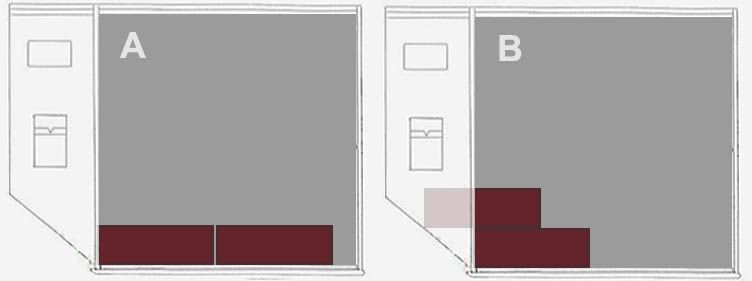
Peter Walker, who was in charge of the build-up area, goes to take AVE 4041 out to meet the German feeder flight to be filled. But as he steps to it, he sees and makes note of the two “Bedford suitcases,” which weren’t there when Bedford dropped it off. And they’re stacked against the outboard panel as shown in “B” above.
He sees this after sitting inside for around 40 minutes, never watching the container for a moment. No one else was guarding it, and it sat unattended and wide open for most of an hour. Perhaps for fear of causing trouble he ignores the anomaly and lets it slide. (There’s probably a good reason. It’s not like we’re on high alert following a break-in or anything.) It’s taken out to K16, and filled up with items from Frankfurt, none of them holding any explosives, and then is loaded onto 103.
But after the news of what happened less than an hour later, he’d put it together. Even the placement was a clue - the bomb was in one of those cases, ideally placed nearest the hull. So he compels someone else (Bedford) to say he saw them, way over there at interline, and that Indian guy “Camjob” (as Bedford calls him) is the one who placed them. They’d be x-rayed, one would presume. (But if not, hey… it was him, not either of us.) And further, they were reported by Bedford as flat on the floor, not stacked in that optimal way.
This is a rather convoluted thing to suspect, and requires some conspiracy, but it does explain a number of things. It should be noted that Walker provided Bedford’s alibi (a tea break together) for being absent when Kamboj placed the bags. And besides the Bedford/Kamboj disagreements, there are serious inconsistencies in Walker’s statements. To police in 1989 he swore he never saw or was aware of the container at all, contradicting Bedford. In 1990, he fixed this and confirmed that Bedford had brought it over, as they had agreed to over tea. At trial in 2000 he admitted the change in stories is strange, but he said for whatever reason, "I can’t explain it."
In this scenario, the suitcases memory in Bedford’s story is accurate enough to be a clue, even if it’s not his own memory, but transferred from one mind to another. It also allows for the flat position to be an additional fudging, so that not even Kamboj facilitated their potent stacking. (That was apparently someone later down the line, if it's decided that happened at all.)
Both options involve the danger of Kamboj, Walker, Bedford, or someone else reporting or removing the bags. Every London option has that danger, and that risk is tripled in the official story through three airports, making this still preferable. Logic says they’d choose Heathrow, and less clearly it suggests the bomber would choose build-up. But Bedford suggests he chose interline. Either way, the reference to brown, hard-shell Samsonites in the deadly corner of AVE4041 shouldn’t just be presumed to be a coincidence.
Appeal judgment addressed:
Following are some excerpts from the second “Opinion of the Court” from Camp Zeist, following the appeal of Feb. 2002.
"[244] ...Moreover, although readily discoverable evidence of the break-in had been left behind in the form of the damaged padlock, the hypothesis involved that the case was not introduced into the interline shed until some fifteen hours later..."
True, but it’s no problem for the two-phase explanation - it’s the basis of it. In fact, the build-up version involves an even longer span, by as much as an hour, than the one the judges half-considered.
"...Unless the risk of opening the case airside to set the timer was to be undertaken, the timer would have had to be set before the break-in..."
Ice-cube timers that blow around 38 minutes after takeoff don’t need to be set, of course. So this point doesn’t apply to my version, nor, I think, to the case made by the defense.
"... No method of arranging for the bag to pass through the system to the interline shed had been identified..."
Perhaps not by the defense, but I propose the method was manual placement supported by psychological deception.
"... The intruder would have required either to wait for fifteen hours himself, or to have the assistance of an accomplice..."
Either works. I’m betting on one well-trained operative with the requisite patience.
"... No place of concealment for the intruder or the suitcase had been identified..."
No place identified? I suspect the intruder was an out-of-towner, and concealed himself at a hotel for that time. As for the bomb suitcases, no one has shown any reason to rule out all potential hiding spots, like those mentioned above or a dozen others. Do they imagine there would be no suitable spots? Aren't they presuming they were "hidden" right inside the interline shed?
"... There was nothing in the evidence to explain why a suitcase, brought through T3-2A between 2205 and 0030 hours, would not be placed in the interline shed in time for either of the two earlier PanAm flights. On the hypothesis under examination, the suitcase had been tagged for flight PA103, although there were two earlier flights that would have involved a shorter period of concealment of a suitcase containing an armed explosive device... "
Again with "armed" and time spans. Unless the airport suddenly levitates a few thousand feet, the bomb is stable. Remember, it's altimeter-triggered, in this non-Libyan plot. If the bomb is concealed and ready for a phase two, no one but him will put it in the shed, on no timeline other than his own. There’s no need to rush things; even doing it the same day is unnecessary. And besides, they may have been targetting Flight 103 itself for some specific reason.
"... Yet there was no evidence that there was anything about flight PA103 or its passengers that singled it out as the target."
This is widely disputed, but for my part I take no stock in certain individuals (Charles McKee, etc.) being targeted. But here are other reasons I could see why they might choose to wait for this one, depending what they knew from advanced research:
- the plane’s age (it was one of the oldest around) and its brittle skin. (see this frightening video)
- its inhabitant’s average youth, to maximize the sense of loss.
- its lateness, last flight of the day. As explained above, giving time for security to relax, for sleep, and for a costume change.
"...Moreover, if an accomplice with airport identification, genuine or false, was involved, there was no need to break in to airside..."
Except to have no friggin' bomb on him when he showed his pass and perhaps was subjected to search prior to entering a secured area… which of course was not secure at this point, and he may have had a bomb waiting for him inside.
"...All that was required was to smuggle the components of the explosive device through an access point, such as T3-2A, where persons with appropriate identification were not searched..."
Even the stray suitcases they're bringing in aren't searched? I don't know - I imagine a ready-made bombs aren't smart to bring through, and the judges agree, speculating "component parts" being smuggled and then assembled out on the tarmac somewhere. (???) For the bomb’s entry behind the perimeter, where worker-looking people are generally trusted, I think an unacknowledged sneak-job of the ready package would be wisest. A break-in at midnight would be genius.
"... The effect of all these points, the Advocate depute submitted, was to show that the hypothesis that the break-in at T3-2A was the means of infiltrating one of the Bedford suitcases was so weak and flawed that the additional evidence could not pass the Cameron test..."
My theory has it introducing both of them. I didn't read just what "the Cameron test is," but it's from a case involving someone named Cameron, and probably means a point doesn’t hold up under scrutiny, compared to something else already "established." At least, not when the scrutiny is as skewed as their Lordships' is. When they say “the Advocate depute submitted” they also seem to be saying “we think.” But the A.D.’s job is to argue his case, however unsupported, and their job is to judge fairly, not just agree with the one line of argument as if it were a self-evident truth.
"[251] In our view the Advocate depute was right in submitting that the additional evidence did not demonstrate any link between the break-in at T3-2A and the Bedford suitcases..."
Perhaps not, but now I have. A potential one at least.
"... It might be said that there was a temporal link, in the sense that the break-in occurred some fifteen hours before the Bedford suitcases appeared in the interline shed..."
Yes. In a 17-year career, the worst security breach Manly ever saw, and the worst terrorist bombing in UK history, happening within the same 17-hour span, is definitely a temporal connection.
"... It seems to us, however, that that interval of time, so far from pointing to a connection between the two events, casts considerable doubt on whether they can have been connected..."
"Can have been connected?" Wow. No imagination at all.
"...The lapse of time after a readily detectable break-in, creating a period during which the infiltrator and the case (or, if there was an accomplice, the unaccompanied case) would require to be concealed in the airside area, points away from a connection..."
Again, the lapse of time after the detectable event is explained by me as a cool down period in case the detection raised an alarm. Sixteen or so hours is, if anything, a bit short for this purpose, but it apparently worked.
"...Moreover, any attempt to link the Bedford suitcases with the break-in raises unanswered questions as to why the infiltrator ignored the baggage build-up area, and introduced the cases into the considerably more remote interline shed..."
Any attempt? Not my variation where the bomb is introduced at build-up. They're the same suitcases then, just the "Walker suitcases" instead of the Bedford ones.
In addition, given the evidence as to the ability of a person with airport identification to pass through T3-2A during the day without being subjected to search, and given the evidence led at the trial and mentioned by the trial court in para [24] about the substantial number of such passes unaccounted for, it is not clear why a break-in would have been seen as necessary, since the components of the explosive device could have been smuggled through an access point.
Repeated just to emphasize the bolded, to remind the reader how easy it would be for a terrorist to sneak back into the airside area where he'd earlier hidden the bomb he meant to get onto Flight 103.
Addendum: Completely unaware of the break-in that changes the whole scene for the imagine Heathrow intruder, the Zeist judges put the situtation pretty well in their paragraph 24 (in its entirety)
[24] It emerges from the evidence therefore that a suitcase which could fit the---
forensic description of the primary suitcase was in the container when it left the interline shed. There is also a possibility that an extraneous suitcase could have been introduced by being put onto the conveyor belt outside the interline shed, or introduced into the shed itself or into the container when it was at the build-up area. To achieve that, the person placing the suitcase would have had to avoid being detected, but the evidence indicates that a person in possession of a pass for the airside area would not be likely to be challenged, and there were a very large number of passes issued for Heathrow, a substantial number of which were not accounted for. The person placing the suitcase would also have required to know where to put it to achieve the objective.


