Showing posts with label MST-13. Show all posts

"But Flight 103 was Behind Schedule..."

December 31 2010
lat edits Jan 3 2011

Note throughout: This post, text and graphics, are imprecise and not fleshed out with detailed research. The concepts are general enough, however, that this is acceptable. Do see beneath comments from Rolfe, who has looked at this better and offers more in a few long submissions.
---

"But Flight 103 was Behind Schedule" is one of the most persistent myths of the Lockerbie bombing. It's the standard answer when anyone asks why the Libyans set their timer so early. For example, the BBC Conspiracy Files episode on the bombing (2008) starts out:
In the end, it came down, as most things do, to a simple twist of fate. 600 seconds. That's all that was in it. Had the bomb which destroyed the Pan Am exploded just ten minutes later, the plane would have been over open water, and all the evidence most likely lost at the bottom of the sea. But as it was, the bomb blew up over land, and the small town of Lockerbie became a by-word for the worst act of terrorism ever to take place in Britain.
A montage of the effects is shown, and the next words, curiously, are: "the investigation turned on one tiny piece of evidence ... this fragment [shown, of an MST-13 timer] was the breakthrough that cracked the case." The time of explosion over land - 7:03 pm, just 38 minutes after takeoff - wasn't caused by "a simple twist of fate." It was a time set intentionally on a timer to achieve the goal of destroying the plane and, we've always been told, ditching the evidence at sea.

Of course the twist of fate in mind is the fabled delay in take-off that supposedly made the jet miss its date with anonymity. The  show specified ten minutes from the coast, suggesting a delay of at least that, if this interpretation is of any value.

First, if it is of any value, it isn't much. Consider the large span the plane was to take - crossing the entire Atlantic, on a northern great circle path from London to New York, something a bit like the image below. It was first to be vectored out over the northern length of Great Britain, a standard route for this flight (see below). After this long pass over Airstrip One,  there followed thousands of miles, several hours, of nothing but deep, icey ocean passing beneath. A host of minutes, aside from 7:03, were there to pick from between Novia Scotia and the original Scotland, ideally somewhere way out there between them.

Instead we learn the plane was ten minutes from the coast and the plotters had aimed for the coast. By the official story, they had an immense picture window of opportunity available, but they aimed only for just over the lower sill, and missed. It's a simple enough concept no picture is needed, but in case anyone wants to double-check the scale and how easy it is to hit that window, there it is. Put simply, green is smart, orange is stupid. Official story supporters clearly think nothing of the intelligence of the Libyans who they believe planned out the murder of so many Americans.

But was the plane behind schedule at all? Excerpt from the trial transcripts, speaking with air traffic controller Ronald Brown, Day 1, May 3 2000. [pp 154-158]
A [...] "1800" is the planned departure time of this flight.
Q What exactly does a planned departure time mean?
A The time at which an aircraft is expected to shut its doors and be ready for -- to make its
departure.
Q Now, I take it it's not the same time as the time that it actually takes off from the ground?
A It's not the same time as it would take off from the ground. It is the time that the aircraft is expected to shut its doors. It will then have to request start-up clearance. It will then have to start its engines. It will have to get taxi clearance and -- before it can possibly take off.

The plane then "departed" - pushed away from the gate - at 6:04, four minutes behind schedule. The feeder flight PanAm 103A was fairly late in arriving, and threatened to delay the whole operation. This flight was carrying about 1/4 of 103's passengers and luggage - including the bomb, we were told - but this was managed swiftly and flight 103 was only the slightest bit behind schedule at this point.

It did take 21 minutes then, including a second last-minute loading at a separate gate, before wheels up at 6:25. That may have been slightly longer than average, but not by much from my limited airport experience. It should easily have been foreseen by any sane plotter. But the Libyans aren't sane, we've been told, and must have simply confused departure with takeoff time, aside from presuming no delays. This must be what caused them to hit so far below the windowsil - a full 25 minutes in this case.

Otherwise, it's worth wondering if the blast timed to be over land really was a fluke. Did the plottes set it up that way? Maybe they wanted to be found? Nah, that sounds stupid. No wonder no one has argued that yet.

To establish the flight Path across the UK, I return to the conversation with ATC Brown:
Q And then A20 route?
A It was a low level airway from London Heathrow going through a reporting point called
Trent, which is TNT.
Q And then, "upper alfa 2 Pole Hill UB for [156] Margo direct Glasgow."
A That's the route that the aircraft would continue to take. After Trent, it would proceed via Upper Humber 2, via Pole Hill, upper Bravo 4 to Margo, flight direct from Margo to Glasgow, and then follows the upper air route 590 to 59 north and 10 west.
Q And then we see, "/ mach No. 0.84." What does that refer to?
A As it crosses the oceanic boundary and comes under oceanic control, the separation on
the ocean is made by reference to a mach number rather than a physical speed and knot.
And therefore the aircraft had planned to fly at mach decimal 84.
Q Mach being the speed of sound?
A Mach being the speed of sound.
Q And then "estimated elapsed times," what does that refer to?
A The estimated elapsed time in number 5 are -- it takes him one hour 24 minutes to get to
10 degrees west
. To 20 west is two hour nine minutes. To 30 west is two hour 47 minutes.
So it's cumulative times as it proceeds across the north Atlantic.
Q Thank you very much.
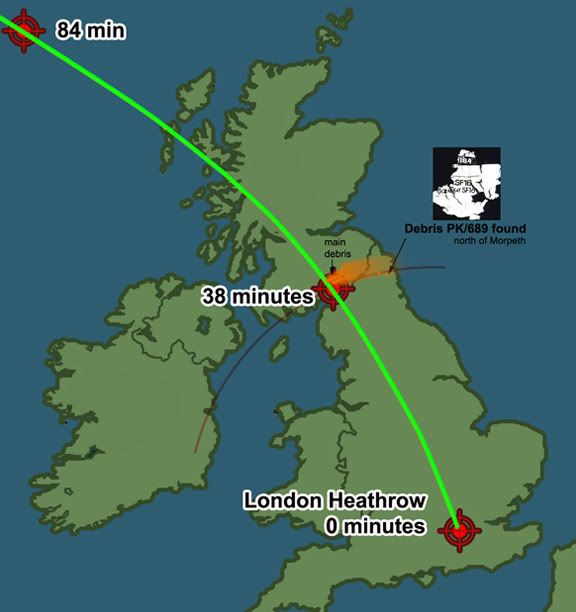
Some posters at the JREF forum helped me sort this out [link]. Something like a great circle-based fight path, still standard today, but from local weather problems arcing around Ireland, northeast across Great Britain to its rocky far corner. The flight plan passes roughly over Glasgow and, as "Rolfe" noted, nearly over the fabled Isle of Skye. This is my own rough graphic, tracing what others had found and noted. ATC Brown mentions the coordinates 59N and 10W. I fudged the path a bit north of the paths traced from, but it's still a bit south of the 59 line. So this is only approximately the spot to mark as a planned 84 minutes out.

But in general terms, we can see that Flight 103 would not be over even the loosest sense of ocean until approximately one hour after leaving ground - over 20 minutes later than it did, as opposed to the "600 seconds" cited by the Conspiracy Files.

Ocean would come sooner on a more southerly path, also standard. But 38 minutes out from expected take-off, marked here with a faint arc, is only over southern Scotland or Northern Ireland, depending. The orange smudge would be at least partly over land no matter the exact route, set for 7:03 like that.

And further, one would be a fool to just pinpoint the coastline. Clearly deep water is preferable to shallow coastal waters for hiding evidence, but more importantly, one should think in three dimensions and consider what six miles of elevation and air movement within it can do. Prevailing inland winds and early scatter of some bomb debris, giving the farthest spread to some of the best clues, could be foreseen. What happened over a small patch near Lockerbie left a trail of evidence extending tens of miles east clear across Scotland into northern England and to the North Sea (orange in image). Ironically, the only evidence delivered to Neptune would have been on the other side of the land. One would want to clear the last shore by at least that width to keep everything over the ocean.

As we started out, there is no reason not to aim for somewhere closer to above the mid-Atlantic ridge. But if one is impatient and needs the bomb to blow right after passing through three airports undetected, around the edge of the map is about the earliest point one should have aimed for. Even that is hoping for only slight delays, but considering effectively none, they undershot by a good 30 minutes at least. Stupid Libyans.

Stupider than you can know, we've been told in different words and even in "forensic science." They were using one of the most exclusive timers ever to fail with, a unit that pointed right to them and had blabbermouth Bollier fused into the story.  A 1/2" miracle  fragment of the MST-13 survived and fell on land, just as programmed. And they used a radio for their anonymous hidden bomb that, among all models on earth, was perhaps the only one to be associated mostly with the Libyan market. Several fragments of casing, circuit board, and the paper manual cover survived and fell on land. And the brown suitcase that witness Giaka saw the accused with the day before the bombing held all this together along with the clothes that Megrahi bought on December 7, brand new at a small shop that doesn't usually cater to Arabs. He did this at and past closing time, to maximize the memorability of his 6-foot-seeming frame looming over the Maltese man, together hallucinating rainfall in the shadow of confusing Christmas lights.

And they put this all, with the umbrella, into one spotted package, and opted to just drop it all on Scotland at 7:03. Or so we were told.

Or, for those who aren't aware of what this early 38-minute detonation means, vis-a-vis a more rational explanation, see the post Thirty-Eight Minutes. The time was selected by a combination of crude devices, designed of necessity, and relying on the friggin' Semtex-H blast to destroy all clues. This most likely did happen, prior to other clues (see above) replacing them well after the fact.

The "One" on PT/35(b)

Number One on Top: A Sign From On High?
Caustic Logic
original posting 1/1/10 - updates 1/28


There's a plot device I must've seen once in a horror movie - a whole village, space station, whatever, was wiped out by something horrible, left desolate and stumbled on by a ragtag group of (4-7) likable misfits banded together by fate or conscription. Among the ruins they find one survivor - perhaps a young girl - who miraculously survived. The wandering Samaritans take her in of course as they moved on to whatever their new plan became. Up front I'm wondering, hey, just how did she survive? Only too late will they learn what I shouted twelve minutes in ... she IS the disguised monster that killed the (village, space station, etc) and then kills most (but not all) of the characters we had earlier bonded with through subtle cues.

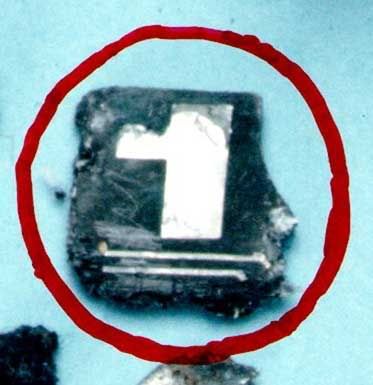
Anyway, that feeling is similar to one I get about at least two of the crucial few bits of evidence against Libya, one being that timer fragment PT/35(b). Its very existence is odd, considering the nature of the blast and the timer's proximity to it. As Dr. Wyatt's tests and common sense suggest, fiberglass circuit board set 1.5 to 2 inches from about 12 ounces of Semtex detonating is not likely to yield a 1cm chunk (see it below, they're serious!). Then it's odd for being found on land when it was fully capable of hiding itself in the deep ocean. And then its loneliness - parts of the radio itself were found (somewhat more plausibly), but nothing else from what was added. RARDE scientist Alan Feraday's final report noted "this piece of circuit board is the sole recovered fragment originating from the mechanism of the IED itself." Now if the explosion were not strong enough to vaporize everything, I would expect a few surviving pieces, with this probably the largest. Rather it's the single and only. Luckily it was a piece of the highly-identifiable and highly-Libya-linked MST-13 circuit board that timed the bomb's early detonation, says the official papers.

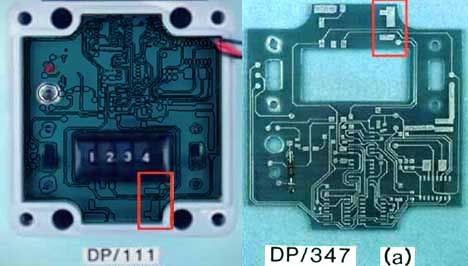
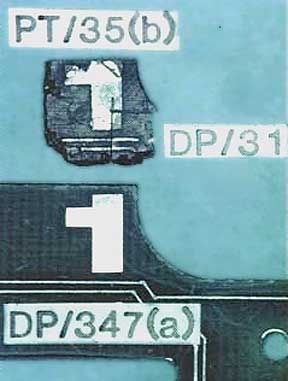
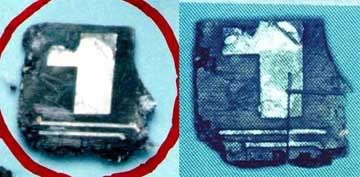
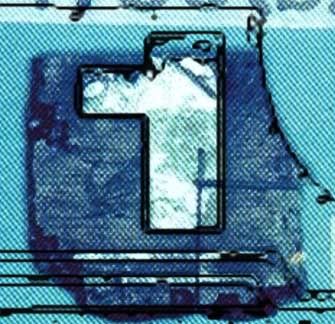
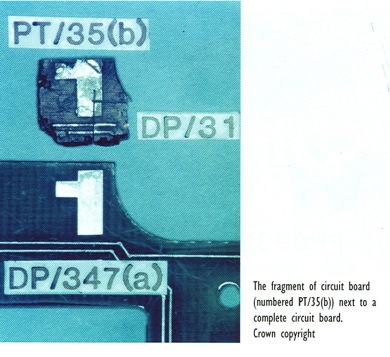
Discovered within a piece of (apparently)exploded clothing, the fragment of fiberglass circuit board, about a millimeter thick, itself looks hardly exploded. Note its fracture lines, left, bottom, and lower right edges - are all straight lines at right angles to each other. I imagine there are reasonable explosion-related causes for this, but it strikes me as unnatural, FWIW. Approximately one cm square (hugely magnified above), its printed surface is dominated by a touch pad that uncanilly resembles an upright number one, and double-underlined at that. Considering the entire board (below, right - color adjusted, touch pad area outlined), there is no other spot on the board that contains a recognizable symbol. There are plenty of spots with little lines that might be shown to match, but they don't seem to really say anything. When you're like Tom Thurman, searching with intrepid zeal for the one clue you need, that must be almost a religious experience to see... bam. THE ONE, telling its discoverers "There is but one way to conviction, and it is by me. I shall be thine number one evidence, and only savior." Subtly, it evokes the PA one-oh-three it was alleged to have brought down, and whispers in our left ear "we're number one" for solving this most awesome forensics puzzle and getting the baddies. Or less hyperbolically, when one sees this, the temptation is too much to turn it so that's visible. But in fact, the boxed MST-13 trial exhibit DP/111 (above left) shows the readout from the front (circuitry traced here for reference). We've been reading it upside down. Consider the other trial photo at right, with upside-down board, and the area of PT35(b) indicated in red, apparently on top and to the right. What a better place for an underlined number one could there be? Bottom sucks. Left, evil. Turn the whole world upside down if need be to make sure we're number one, double underlined, on the right and at the top. And can "prove" libya did it in the process. Who's writing this stuff? Random fate? Really? You aren't believing in God by now?

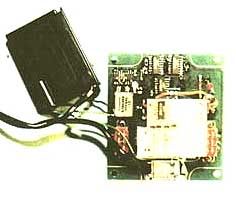
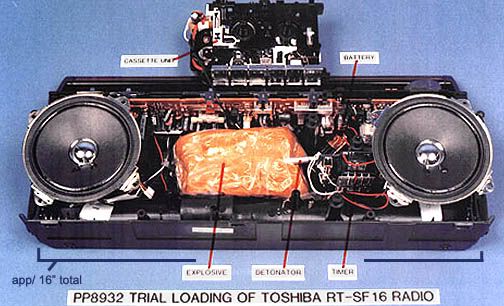
At left is a duplicate MST-13 with elements attached. The photo is from the website of a Mr. Byers, who claims the CIA was making these fake MST-13s in Florida. At any rate, I don't know what these things all do or are called I've even been told but it didn't sink in. Do note the largest block is the timer dispaly, seen here from the back, and set just south of middle. The rest is surely capacitors, flux inhibitionists, and some grommets around the outer parts. Some of these things are probably made of metal and materials stronger and thicker than fiberglass board and could possibly shield our PT/35(b) in the chaos of explosion. But if something like that happened, then where is that protector now? Did it vaporize itself? Or plunge irrecoverably into the mud at the bottom of a Scottish loch? Maybe, but then all elements of the bomb except this "number one" corner of that Mebo-traceable, indictment-enabling layout wind up disappearing into the ether?

I'm a reasonable chap but I find that harder to swallow than what so many other clues are already saying - the rest was cut or blown off elsewhere, and only THE ONE was ever near this crime scene, after being carefully selected for the job. I can't see just why fate would have any interest in making sure the evidence "says something to us." However, a false god playing with reality and feeling immune in orbit might just take the chance. At least, it would increase the odds from negligible to actually happening this way. As happened.

Why Bollier Suspected the Libyans

The MEBO Files, part 2
July 4 2010
last updates/edits July 10


In the early 1990s, long before he came out of the closet as a Libya-Megrahi supporter with reams of accusations against Scots-American investigators, Swiss merchant Edwin Bollier sneakily told these same authorities that he actually believed the Libyans were behind the bombing. Now, he had said just that in early 1989 with his semi-famous “catch-letter,” but that was only because a shadowy CIA man had told him to do it.

But his continuing charade, as he explains his helpful phase, went beyond the terms behind that note and raises questions. For example, was it the same agent’s nefarious demands each time he spoke up, or was there a whole team steering the poor man towards implicating Libya? Or was he, as the rest of this article presumes, more self-motivated than all that?

In a January 14 1991 interview with the FBI and Swiss authorities, Bollier said he had written that letter two years earlier to get the investigators “away from the wrong track and to bring them onto the Libyan track." It goes beyond giving the mystery man what he demanded; Bollier says (up to 2000 anyway) that on Jan 5 he himself felt that Libya was the right track to investigate.

Something Was Going On
It was a gut-feeling Swiss suspicion, or “Swisspicion” as it will now be called, that prompted a phone call to his acquaintance Abdelbaset al Megrahi, somewhere around Christmas (see below). He was driven partly by an odd “impression that something was going on,” he recalled at trial a decade later, and cited two powerful clues while apparently meaning to cite only one. “[W]hen this mystery man came along -- or when I found that the timer had been programmed, we ourselves,” meaning he and Mebo co-founder Erwin Meister, “believed that the Libyans were involved.”

The reason he started giving was the mystery man and his alleged visit on the morning of December 30, which was of course after the call in question. The man, who perhaps didn’t exist, had started by telling Edwin that he’d been selling timers to Tripoli for years, and had just been there to sell more right as Lockerbie happened. Chilled to the bone to realize the CIA was monitoring arms sales to Libya, Bollier was then told, as he recalled at trial, “and I can tell you that the Libyans are connected with this attack." All he needed Edwin to do was write a fabricated letter to the CIA telling them what they were already sure of. And this he finds convincing?

No, he had cut himself off, remembering it was the timer re-set, not the CIA man’s statement, that had sparked up his swisspicion. This requires some explaining.

The Olympic Clue
Around December 1, Bollier says (unconfirmed as far as I know) the Libyans told Mebo they wanted 40 more MST-13 units like the ones thay had bought 20 of in 1985. He didn’t have any handy and couldn’t make any more soon enough, so he bought 40 Olympus timers (sometimes translated as “watches” during the trial) on the open market. As he was getting this story on record with the FBI in January ’91, Bollier said “prior to my departure, I did a final check on all timers and reset them to zero."

As he flew out December 18, Bollier brought these fully blank timers in his carry-on luggage (his checked luggage being its own story). He tried to sell them to the Libyans, marked up too much. They wanted MST-13s, these were too expensive, they would keep them anyway, and Abdelbaset al Megrahi would hand over the money, he was told (this allegation will also be addressed separately). He left the timers with alleged Libyan bigwig Ezzadin Hinshiri the 19th, but then had Megrahi flake out on the money meeting. Not having been paid, Bollier says he collected the timer/watches back from Hinshiri in the morning, and wound up bringing back home in failure on December 20, the day before Lockerbie.

Within a few days after this trip, Bollier told investigators, he had looked at one of these fully blank units handled by Hinshiri and found its screen showed a peculiar setting: “Wednesday,” being December 21, and a time - 7:30 pm - exactly 27 minutes after the detonation on board PA103. This could only come from Hinshiri’s hands, connected to his brain, and his brain to the bombing plot, Bollier apparently deduced.

At trial in June 2000 (Day 26) Edwin still swore by this find; “That is true. Yes. That the timer was programmed; that is true.” He says he removed the battery and told his partner, Mr. Meister about the unusual setting but did not show it to him. Meister, however, had already recalled at trial (Day 22) Bollier actually showing him the timer with its setting, which he agreed said Wednesday and 7:30. As the Zeist judges summarized in their Opinion of the Court, paragraph [46]:
We do not accept the evidence of either of these two witnesses about this alleged discovery. It was established, and Mr Meister was forced to accept, that the Olympus timer was incapable of showing a date. Moreover, the evidence of both witnesses about what they claimed to have seen and the circumstances in which they claimed to have made the discovery was so inconsistent that we are wholly unable to accept any of it.
---
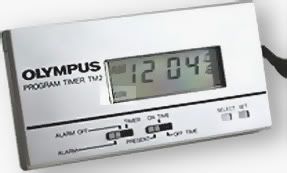
Update July 7: Bollier alerts me the Zeist judges were wrong to dismiss this clue. He sent me a low resolution picture (inset, cleaned up a bit) of the model in question, TM2. There is no date display as in 21/12, but that not what He and Meister said. It was the day name Wednesday. Bollier cites: "LC Display Window ; Display selector switsch; Mode selector; Select button; Set button; Hours>>Minutes (: Seconds); ON Time, Off Time; AM > PM; At the bottom left hand corner > Day of the week = ( SUN > MON > TUE >WED >THU >FRI > SAT" Indeed. The one shown seems to say "SUN" (highlighted). So, Bollier stands by his claim of what he saw, that someone other than him entered this day/time - and not necessarily a Libyan (see comments below)
---
This was therefore not accepted as evidence against the Libyan Hinshiri, but it wasn’t for a lack of trying on Mebo’s part. Now if they had accepted it as consistent, it might seem a fair reason for Bollier to suspect Libyan involvement, ring them up suspiciously, and then compliantly write a letter on his imaginary friend’s advice. (The judges do also dismiss the “mystery man” as fiction of the “spy thriller” sort). Just what that clue would mean, if accepted, is a little less promising. All I can see in it is one of four possibilities:

A) It was coincidence based on the visit’s timing; Hinshiri wanted to see if it could be set for, say, two days from now – which just happened to be the day that PA103 blew up. (the time mismatch would support this)

B) Hinshiri, a PA103 plotter, was practicing to see if this Olympus timer/watch would work for the bombing two days away, but then let it go as too expensive for the destruction of an American airliner. And just forgot to re-set it to zero.

C) Less directly, he was just typing the bombing time into unrelated electronics at random to make sure he has it memorized (he didn't - 27 minutes off), or something to that effect. And again, he just forgets to re-set it to zero before he hands it back, knowing the bombing will shock the world two days later.

D) As Bollier now says (see comments below) "someone else" aside from a Libyan, might have put that data there for him to see.

I’m unsure if he was trying to imply option B) or C) above, but Bollier would apparently have the Judges believe that Hinshiri had just handed him a major clue to sell to the Americans. I rather prefer the version where he counterfeited this bill of exchange from thin air.

Something Had Happened
Set ablaze by his timer discovery, Bollier says, he placed unusual phone calls (unverified) to both Ezzadin Hinshiri and the man he knew as Abdelbaset, perhaps one week after the Lockerbie bombing. He emphasizes at trial that he was calling to complain about not being paid – for the timers he had brought back with him. But he had complex reasons for these calls, he told Swiss authorities, including:
“I had a feeling that there was a connection between Libya and the crash of Pan Am 103. I wanted to hear them. Experience has shown me that people can no longer be reached when something has happened. This was certainly the case after the American air strike on Libya.”
Or, conversely, after a hypothetical Libyan air strike against America. He couldn’t recall the exact date, but it was “between the 21st -- or between Christmas and New Year,” but prior to the mystery man, so December 29 at the latest. On the call to Megrahi, he said “I telephoned, and he wasn't there. Somebody took the telephone off the hook. But I cannot confirm 100 percent whether it was Mr. Abdelbaset's voice. Anyway, I was told that he was not there.” Well, if people can’t be reached after something has happened, it would seem that something had happened - some unknown event involving timers and December 21 and, apparently, both Hinshiri and Megrahi.
---

Thurman's Photo Quest

1 November 2010
last edits 9 Nov

The post PT/35(b) move claims covered the 2008 interviews revealed in Tegenlight: Lockerbie Revisited, which showed a contradiction in whether the fragment of circuit board, PT/35(b) was taken to the United States. FBI SCOTBOM chief Richard Marquise and identifying FBI special agent James “Tom” Thurman both told interviewer Gideon Levy that the fragment was brought to Washington and examined there. Conversely, British authorities and Marquise (after a short-lived change of memory) refuted the claim, insisting it stayed in the UK.

It appears now that it did indeed cross the pond, without proper documentation. While this unacknowledged movement is unusual, the ultimate relevance of it remains unclear. Some have speculated the thing might have been "tampered with" or altered while in America. But I for one suspect the worst that was done with PT/35(b) was when it was planted in the evidence chain the previous year.

What we have in Thurman's case, with or without the actual piece of evidence, was the crucial identification. And one point that's consistent throughout is that he held a photo only when he found the match. The question at hand is how long it took him to find it and to determine its meaning vis-a-vis who carried out the bombing.

Tom Gets a Green Light
On the 10th of January 1990 new Senior Investigating Officer Stuart Henderson (who replaced John Orr) presented at a meeting of investigators in the UK. He did not openly mention the circuit board fragment PT/35(b), an amazing find UK investigators had been puzzling over for four months. But off to the side, he told FBI chief investigator Richard Marquise about it, Marquise says in his 2006 book SCOTBOM. [1 p58] He expressed interest in helping find a match, but Henderson insisted on going it alone. “This decision cost us six months,” writes Marquise.

It was at a later conference in Virginia, on 11 June, when Marquise relates how the Scots finally made their puzzlement known to all, having blindly checked 55 companies to no avail. Given the opening, special Agent Thurman “approached Henderson and asked if he could take photographs of PT-35 and attempt to identify it. Henderson, who believed the Scots had done all they could do, agreed.” [1, p60] This passage is crucial to move claims, and rather ambiguous. It seems to read that Thurman, in Arlington, was allowed to snap a pic of evidence SIO Henderson had there with him. Then perhaps it means he took some of the prints they had brought.

Either way, he walked away with a picture or pictures of this crucial and curious evidence, a half-inch square, perfectly readablemammoth of implausibility. The "forensic explosives expert" didn't balk at it, just ran with it. Or crawled, as he suggests.

"Months, Literally" or 2-4 Days?
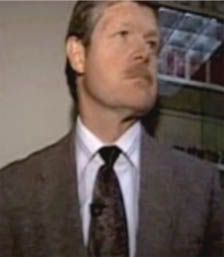
A 1991 Miami Herald article, based on interview with Thurman (left, from a 1991 video), reported that he had “meticulously compared the picture of the fragment to hundreds of other devices,” a lengthy-sounding process. [2] Affirming this, Thurman himself told the adoring program Air Crash Investigation in 2008:
“I spent, uh, months, literally, looking through all about the files of the FBI on other examinations that we had, uh, conducted over many many many years. […] After a period I just ran out of leads. And at that point I said, okay now we need to go outside the physical FBI laboratory.” [3]
And it was there, in a CIA facility, that he found the long-sought answer.

But Marquise said “what Thurman did yielded fruit within two days. […] Henderson and his colleagues were on an airplane headed back to Scotland” when Thurman set to work. They had barely settled back in at home before his efforts “would turn Henderson around quicker than he ever imagined,” putting him back stateside, along with electronics fiend Allen Feraday, within 24 hours of the discovery. [1 p60]

Further evidence against Thurman’s "months" claim is his own well-memorized “day that I made the identification,” recalling it as one would a wedding anniversary: June 15 1990. He had four days tops to get this grueling season of cross-checking out of the way after the 11 June conference (perhaps a multi-day event) where Marquise has him first learning of the thing.

Who He Ran To
What Thurman did, Marquise sums up, is know where to look. He took the photo to a CIA explosives and timers expert code-named John Scott Orkin (real name unknown - he testified under this name at Camp Zeist). [1 p60] Thurman mentions him only as an unnamed "contact" in the 2008 ACI interview. [3] From the vast photo files on hand, "Orkin" helped locate an obvious fit with the blow-up of PT/35(b). If you were Tom Thurman and knew about John Orkin, would you waste even one afternoon scrounging in the FBI's files, or go right to him?

Nothing I've seen specifies this match-up was achieved in only one visit on a single day, but that makes the most sense, as does starting right there. That would give us no more than "hours, literally" to describe the search duration. And either way we're at the point of days at most.

The matching circuit board was found in a timer confiscated in the African nation Togo in 1986. This device, assembled in a small plastic case, was physically available for Thurman to look at. He was given permission to take it apart and examine the main board inside. Upon confirming again the obvious similarities, “within a few minutes, literally, I started getting cold chills,” he told Air Crash Investigation. [3] He's also described as declaring "I have you now!" [1 p60] and other variations. In a 2010 interview, he said "I could not believe it under any circumstances, and it was there." [4]

That he got these chills only after getting access to the CIA’s special stores is noteworthy, and the Agency is right to claim much of the credit, as they have in places. An AFIO newsletter from just after the Zeist verdict purred that “the CIA’s most important contribution in helping secure the conviction” was “when a CIA engineer was able to identify the timer […] shifting the focus of the probe from a Palestinian terrorist group to Libya.” [5] (This report's oblique reference to the CIA's less brilliant offering, Giaka, is also worth a read.)

As the overall story tells it, this was clearly a collaborative CIA-FBI effort, via Thurman and "Orkin", that neither side can claim sole credit for. And without this coming together, we're to infer, the naming of this planted piece of Libyan black magic would be delayed or impossible for both Scottish and American investigators. The power of cooperation, between intelligence and law enforcement, and across the Atlantic - a running theme of the 103 investigation - is nicely illustrated here.

The Slow Link to Mebo
Besides the Togo unit, the CIA knew about a 1988 French seizure of two MST-13s found in Senegal, in possession of Libyan operatives. (If I'm not mistaken, one of the Senegal timers held in Paris had gone missing by this time) But Thurman at the CIA facility makes it seem like this was a mystery device he had to analyze from scratch.

A smaller circuit board within the Togo timer's box featured four partially scratched-out characters. Thurman explained to ABC News in 1991, just after the indictments were issued, how he and others labored over this, contacting numerous manufacturers trying to identify “M580” for some time. [6] They finally accepted that it said MEBO, the name of a known Swiss firm supplying timers to rogue governments, including Libya. Thurman told ABC they had “some inkling that’s what it was from the beginning, but we didn’t want to say okay, it’s Mebo’s exclusive, anything else, until we were absolutely certain." [6] Then they decided it was definitely Mebo’s exclusive for Libya only and only usable by Libyans and unable to fall into anyone else’s hands. Except the CIA and their French counterparts, obviously.

And we're to believe the CIA hadn't already managed to trace these African timers to their Swiss makers? A company suspected of their own CIA links, and documented as trying to implicate the Libyans to them since January 1989? Thurman was left to puzzle over those four characters himself? Sorry, but I don't believe that. Mr. "Orkin" could surely have told him these African timers were made by Mebo and supplied by Libya. This "M580" search is quite likely a made-up story, full of needless rigor and theatrics, and again suggestions of long expanses of time.

On top of the fictional months-long search at FBI before turning to the CIA, this little final touch of reported caution belies the focus and speed beneath the whole June transaction. Nine month of dead-end searches in Scotland were trumped within four days by Thurman's knowledge of just the man to talk to. It also goes against the hint he gave in his ABC interview, commenting upon his discovery: "I knew at that point what it meant. Because, if you will, I'm an investigator as well as a forensic examiner. I knew where that would go." [6] The whole country had just learned that it went right to Tripoli.

More to the point, he's a political scientist rather than a scientific one. His main skill here is knowing people, CIA types. One can be excused for wondering if Special Agent Thurman knew where it would go even before Orkin told him, or before he got his hands on a that picture to bring over.
---
Sources:
[1] Marquise, Richard. SCOTBOM: Evidence and the Lockerbie Investigation, Algora Publishing. Sept. 1, 2006. 268 pages. Mostly page 60. Google books link.
[2] Roser, Ann. “'Nuts and Bolts’ Work Pays Off in Lockerbie Probe.” The Miami Herald. Published November 30, 1991. Link.
[3] Air Crash Investigation: Lockerbie. Season 6, ep one, aired 2008. Hosted video page. Skip to part four, halfway in.

[4] Sent Home To Die. STV documentary, aired August 2010. Youtube link.
[5] Association of Former Intelligence Officers. Weekly Intelligence Notes, February 2001. http://www.afio.com/sections/wins/2001/2001-06.html
[6] The Maltese Double Cross - Lockerbie. Film, Hemar Enterprises, 1994, 156 minutes. Written, produced, and directed by Allan Francovich. Hosted video page. (1hr, 6 min in) 

PT/35(b) MOVE CLAIMS, pt. one

"IT WAS NEVER IN THE UNITED STATES?"
23 October 2009
re-posted here March 23 2010
last edits 31 October 2010


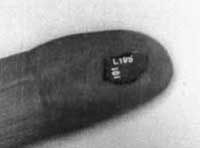
The recent hubbub regarding overly-mobile Lockerbie evidence started with Dutch journalist Gideon Levy’s early 2009 video Tegenlicht: Lockerbie Revisited. It’s a well-made video, with good music, some informative bits, and an unusual format of having interviewees watch and respond to recordings of others. Its prime focus was the crucial evidence PT/35(b), the Mebo timer fragment “tying” the bombing back to Libya. It’s therefore a little embarrassing that Levy announces another famous fragment, of general Toshiba circuit board displayed on a fingertip – as the article in question. This confusion surfaces elsewhere in the film, but manages to not become a big deal.

The main attraction that has generated some buzz was a curious discrepancy revealed and captured regarding the whereabouts of this historic find during the course of the investigation. As evidence from Scottish soil it was, should have been, in control of the Scottish police investigation, headed by the Senior Investigating Officer (SIO), a spot first held by Detective Chief Superintendent (DCS) John Orr (Strathclyde police, now Sir John Orr), and then by Orr's deputy, DCS Stuart Henderson (Lothian and Borders police, whom we meet below). The Scots would work in tandem with – but not give their evidence to – the American FBI's task force for the "SCOTBOM" investigation.

Officially the fragment was definitely taken outside Scotland - in the proper hands - to a RARDE lab at Kent, England and, as we’ve more recently had confirmed, to a private lab in Germany, both times for forensics testing. The understanding of then-Lord Advocate Lord Fraser of Carmyllie, which should have been quite good: “As far as I’m aware it’s always been in the UK,” he told Levy’s camera in 2008. He obviously didn’t know everything.

Besides the trips to England and Germany, which neither Lord Fraser nor Gideon Levy seemed aware of, there’s an alleged journey by this little blue key across the big blue sea to the United States. In the first of two interviews with Levy, FBI SCOTBOM chief Dick Marquise casually states that this one crucial piece of evidence, and nothing else, physically was brought to the FBI’s main lab in Washington.
“I’ll just tell you, not one piece - no I shouldn’t say that – the evidence – no, I’m not choosing my words carefully, I just want to make sure I say the right thing – all the evidence that was found in Lockerbie never made its way to be examined by the FBI laboratory. PT/35, as far as I remember, was the only piece of evidence that made its way to the laboratory, in the possession of a RARDE examiner. He brought it, he did the comparison, and he’s a scientist, and he took it back.”

Well that's an interestingly worded twist to the story. FBI Special Agent James “Tom” Thurman, the man publicly credited with making the identification of the fragment as from a Libyan-supplied MST-13 timer, on June 15 1990, also made an appearance. Levy caught up with him, wearing his years well in retirement, at a December 2008 ceremony to marking the 20th anniversary of the Lockerbie disaster. Levy came across a bit wormy, in my opinion, using the solemn ceremony mostly to make Thurman squirm and deny he was dismissed from the FBI for altering evidence. More to the point, he challenged Thurman if comparing with a photo – as he has previously stated – was really scientific. Thus provoked, he responded:
Thurman: I did the real thing ... I had the real piece of evidence.
Levy: That pointed to Libya.
Thurman: Absolutely. Absolutely. The photograph was the first thing, then the real piece of evidence was brought over. And at that point –
Levy: It was – it was on your finger, the chip was on.
Thurman: At that point - then there was a one-to-one identification made. The real piece of evidence, to the timer, the MST-13 timer, was made in the FBI laboratory. It wasn’t just a photograph. The photograph started it, and then the authorities from England brought over the real piece of evidence. That piece of evidence was examined in the FBI laboratory, along with the MST-13. That examination was verified in the forensic science laboratory, in England. So, it wasn’t only my examination, it was verified by other peoples’ examination as well.
Suspicions condensing around the Thurman link here is natural; PT/35(b) was apparently taken outside normal channels to his lab, and put under the grip of a known manipulator of evidence. Problem is, the charges against him were not over physically altering physical evidence, but for his explosives unit allowing conclusions to be overstated in the prosecution’s favor, in multiple instances unrelated to this one. Agent Fred Whitehurst told Levy how Thurman altered his reports when he deemed that his own political science training trumped Whitehurst’s chemistry smarts.

This will and certainly should cast doubt on Thurman's general investigative even-handedness and his certainties over his own lab work (“I knew we had it,” it "absolutely, absolutely" implicates Libya, etc.). In fact why Thurman was selected is beyond me – any idiot with the two photos could affirm they’re the same, and this selectee has become a real liability. All the rage at the 1991 indictment, he was discredited and never called as a witness by the time of the big trial at camp Zeist in 2000.

But presenting this side-by-side with concerns over the “tampering with” of this evidence once taken somewhere dangerous is quite leading. The fact is, I can see no sign of tampering with the evidence, nor much of a reasons to suspect it. The problem is the thing itself, not where it was taken and who touched it in these dark corners.

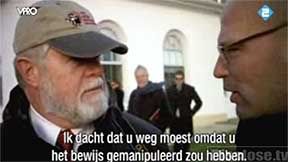
At that same chilly cemetery, as the people were leaving to more private venues, Levy caught up again with Mr. Marquise, as it so happened accompanied by his Scottish counterpart DCS Henderson. When standing side-by-side with the prime guardian of that fragment Marquise was of a different recollection altogether from his first interview. Levy was granted an answer to one question, and that's about what he asked, for almost four minutes.
Levy: When I asked Lord Fraser about the circuit board, he said something that contradicted what you said. He said it had never been to the United States. And if it was in the United States, then he would have known.
Marquise: No, I don’t know that I told you the circuit board was in the United States.
Henderson: The circuit board was never in the United States.
Marquise: Let’s back up, we’re talking two different things. There was a circuit board of MST-13 timer in the United States, but the fragment PT/35 was never in the United States. Photographs of it were in the United States.”
Levy: It was never in the United States? (murmured agreement) Oh, I thought it was…
Marquise: No the fragment never came to the United States, but the circuit board was in the United States, because we had the MST-13 timer, which we turned over to the police in Scotland.
Levy: Ah, but but… Tom Thurman, who was here today, also said it was in the United States.
Marquise: No, he never said that.
Levy: No?
Marquise: The fragment PT/35 was not in the United States.
Levy: But it was in England, but it came…
Marquise: It never came to the United States
Levy: It never came to the United States.
Marquise: I don’t believe so – I’m 100% sure it was not here.
Levy: Oh, it has never been here.
Henderson: Never released out of evidence control of ourselves. Couldn’t afford to let something like that …
Levy: I thought it was brought in the possession of Alan Feraday.
Marquise: Feraday’s over in RARDE. He’s in England. It’s in his possession.
Levy: Yes, yes, but I thought he came – I thought you told me that it came in his possession to the United States.
Marquise: I don’t know that…
Henderson: His possession and my possession. But it was never released for any reason (inaudible).
Levy: And who are you?
Henderson: Detective Chief Superintendent Henderson, I conducted the investigation.
Levy: Okay. My name’s Gideon Levy, and I’m from Holland - from the Dutch television. So it has never been in the United States.
Henderson: Confirmed

From the video: Levy, Henderson, Marquise (l-r) discuss whether or not it was ever in the United States. But it wasn't? No, wasn't it?
Levy: At all.
Henderson: Couldn’t be, ‘cause it was such an important point of evidence it wasn’t possible to release it. It had to be contained to be produced to the Court, therefore you couldn’t afford to have it waved around for everybody to see because it could have got interfered with.
Levy: Aha
Henderson: So it was far too valuable to be other than made available – couldn’t be.
Levy: Okay
Henderson: Very valuable piece of evidence.
Levy: (shouting over) But you said it was in the possession of Alan Feraday and brought to the United States.
Marquise: You know, its – you’ll have to talk to Alan Feraday about what he brought to the United States. I don’t remember…
Henderson: Alan Feraday had it in his possession with me, but he did not release it to anyone
Marquise: No, no, no, he said bring it with him. Did he bring it to the, I don’t remember.
Henderson: No, they came to us to see it.
Marquise: Yes. I saw it – I saw it in London.
Levy: Oh, you saw it in London?
Henderson: They came to where we had it, see. Because it wasn’t possible to remove any evidence out of the jurisdiction of the – Scottish control.
Levy: So you were the same – you were the FBI investigator and you were the Scotish investigator. Ultimate inestigators.
Both: affirmations
Levy: Okay.
Henderson: That’s why I’m here, to go and see the relatives.
Marquise: We need to go.
Henderson: We’ll have to go. Pleasure to meet you, gentlemen.
Levy: Thank you very much.
Henderson: And by the way, there is no hidden holes to find because the culprit is in custody. (with a smile and wink) Take my word for it. Okay?

So I would come away from this with an impression that it may well have not been in the United States, whatever Marquise and Thurman said to same guy ten minutes earlier. But I’m weird hat way, denying Henderson’s bait that I imagine was dangling there. A more normal reaction would be to get a little confused, and for many to solve that by taking their own default position. Some would just dismiss this all as faulty memory two decades on, while others will surely latch onto it as more proof of a cover-up, or at least something to make some more noise over.

My main concern with PT/35(b) is that this much-fretted over fragment may have been planted outright to begin with, or at least has been overstated as direct evidence pointing only to Libya. This hullabaloo about where the possible fraud was carted to adds little to an understanding of either level of worthwhile inquiry.

Update, 10/28: Something I saw later that fits best here: Marquise's unacknowledged about face here was short-lived. In September 2009, months later with Henderson not present, he again affirmed an American trip. This was in a response to Gareth Peirce, and sent into Robert Black's blog. I haven't been able to verify it, so do please take a grain of salt:
Once he identified the fragment, he asked Alan Feraday to come to Washington. Feraday brought the original fragment of the timer with him and they both examined it under a microscope. They independently agreed it was identical to the MEBO timer. The fragment was never out of the control of Mr. Feraday and returned with him to the lab at RARDE.


Second update, Nov 24 2009: Mr. Marquise responds to the confusion that indeed the fragment did come to the US, and he and Henderson were both confused by the tone of Levy's Arlington ambush. Again from Black's Lockerbie Blog:
With regard to the "travel" of PT-35-- once again-- it was the sharing of information which led to the solution of this case. If the fragment had remained behind in Scotland, never shared, it would possibly be unidentified today. No one would ever have discovered it was a piece of one of 20 timers given to Libyan intelligence. It is clear no one ever attempted to "cover" that up-- I freely admitted it in my book, Mr. Henderson stated such in his precognition and I again said so to Mr. Levy. My "confusion" at Arlington last December over whether it had come to the US or not, was due more to the tone of the question, the setting and the allegation I may have lied to him when he first interviewed me. Unlike Mr. Megrahi, I do not tell lies when it comes to the evidence in this case. I said it right when Mr. Levy first interviewed me. We had nothing to hide because we did the right thing and there has never, never, never been one scintilla of proof that PT-35 was altered or changed in any way.

In his 2006 book, Marquise relates how it was at an investigator’s conference in Virginia on June 11 1990 that the Scottish authorities finally made their puzzlement over the fragment known to all. 55 companies had been checked to no avail. At this point, four days before his identification, that Thurman “approached Henderson and asked if he could take photographs of PT-35 and attempt to identify it. Henderson, who believed the Scots had done all they could do, agreed.” [2, p 60]

This passage is crucial to move claims, and rather ambiguous. It seems to read that Thurman, in Arlington, was allowed to take a picture of evidence Henderson had there with him. It could also mean a request to retain one of the photo-prints there, or to take a picture of the single photo they brought, or fly to Scotland to photograph PT/35(b). The last option seems out, given the mechanics of identification that followed. I remain agnostic on the reading here, and on its value as one of Mr. Marquise’s sometimes confused recollections. (and there is a hell of a lot of confusion and amnesia surrounding this investigation)

A Suitcase for Hinshiri

The MEBO Files, Part 3 
July 6 2010

Note: This post is longer than the others, more rambling and with more loose ends. Apologies, it's just a lot to figure out and organize.
Cited throughout: Camp Zeist trial transcripts, days 25 and 26, June 21/22 2000.

A Letter to Hinshiri
Mebo co-founder and Libya-implicator Edwin Bollier started giving – or trying to give - bogus intelligence about the Lockerbie bombing to American investigators at the beginning of 1989. He didn’t become important, however, until the discovery in June 1990 that a Mebo timer (MST-13) was amongst the wreckage from Lockerbie. Before the year was out and well into 1991 Edwin went “on the record” with a string of stories about the timers and his dealing with Tripoli. One Bollier-FBI meeting occurred in Zurich on January 14 1991 and, among other things, helped set in motion the “fact” (a fact Bollier later renounced) that his MST-13 timers were sold only to Libya. But at the time, this important distinction helped tighten the noose. That fragment really does 99% prove Libyan authorship, as Bollier had told them from the beginning.

Shortly after this, on Feb. 6 1991 the Swiss jabberjaw wrote a letter to his friend Ezzadin Hinshiri of the Libayn JSO intelligence agency. At the Zeist trial in 2000 he explained this was “to make it clear to these people what was going on, what was happening, because our timer was in question.” Mr. Turnbull for the Crown questioned Bollier about this letter:

Q Was this in any sense designed to be a threat to Mr. Hinshiri?
A No. No. We simply wanted to inform him that something big was coming towards us, and that also the Libyan military security might be involved. We just wanted to inform him.

Q But, you see, the first thing that you explained to him in the letter is that you'd been spoken to by the police. And then you go on to tell him that you told the police that [the 20 MST-13s] had been sold to a gentleman in Beirut. Is that correct? Is that what you said in the letter?
A That is correct. Yes.

Q Was that true, what you said in the letter?
A No. We haven't sold any to Beirut. I remember now. This letter also was about telling people and that they wouldn't think that we were testifying against them, because at the time the matter was being covered in the media. We just wanted to explain to them that something was in the offing that might be of interest to them, and simply they were our business friends, after all.

Q Was it designed to be a warning to Mr. Hinshiri?
A No. I just wanted to orient him.

Q You see, because after telling him the lie about saying to the police you'd sold timers to Mr. Khouri in Beirut, you went on in the letter to give Mr. Hinshiri some more information […] about the suitcase that you had taken to Libya for Badri Hassan.”
A That is correct. Yes. […] We informed him briefly what was happening. And this is precisely what we wrote.
It was neither warning nor threat, just a friendly tip-off that they were in the process of being framed by someone. The additional about a certain suitcase read, in part: "I remembered myself that this suitcase was brought by Mr. Badri to our office, and he asked me to take it to Tripoli. He mentioned the suitcase contains clothes for a friend."

Under Crown questioning in 2000, Bollier explained “I wrote to him that the police had asked about that suitcase. […] I just wanted to explain to him, and tell him what the police had asked about.” Mysteriously, he managed to squeeze this in before being cut off again:
"The police told me that if I were to go to Libya, I was not actually going on orders of the police to Libya. And this is why I mentioned it in the letter, so that they wouldn't think that we had made up the story in order to accuse the Libyans. That was the reason for the letter.”

The Case, its Contents, and Journey
Having cleared that up, we turn to the suitcase itself. Bollier says he first saw it on December 17, 1988, in the hands of “Mr. Badri,” or Badri Hassan - a business associate of his and of al Megrahi’s. Bollier was leaving in the morning to take a batch of Olympus timers to Tripoli, and Hassan, who shuttled back and forth himself routinely, wanted the Mebo boss to take this case with him. “He brought it to the MEBO firm premises,” Bollier explained at Camp Zeist. “It stayed there over the night, and in the morning I took it with me on my trip.”

Just as he was careful to re-set all his brand-new timers to zero before leaving, he says he took stock of this suitcase. As he said at trial, “one should always inspect luggage one is taking for somebody else into a plane […] because something dangerous may be contained in the luggage.” Nothing dangerous was inside – nothing but an odd assortment of men’s women’s and children’s clothing like Hassan said. “Badri told me they were new children's clothes which he wanted to send to a friend who owned a boutique in Libya.” Elsewhere he says it was for a friend with a family, or “was to be for a wedding.” After the Libyan had left into the Zurich evening, Bollier “opened the case and checked what was in it. It was not locked,” he explained. “It was a brown leather suitcase with an additional leather security strap.”

Knowing Bollier’s style and seeing lines like “I didn't know what was finally going to happen to the suitcase” suggest he was going to call it a brown hardshell Samsonite. But he says it was a leather case instead, which is a relief – unless he were to recall it only had a brown leathery surface but was made of hard plastic. That in fact sounds like the kind of thing Herr Bollier might suddenly remember somewhere. But he did manage to faintly tie its content to the bombing (see below).

In his December 17 1990 interview, records relating to his travels were referred to:
Q … it can be seen that you checked in a piece of luggage weighing 19 kilos. What was this?"
A I took my personal luggage into the cabin with me as hand luggage in a large briefcase, including the timers. The case in question which I checked in was a suitcase with new children's clothes, which I was taking to Tripoli […] Badri Hassan […] asked me to deliver the suitcase and its contents to Ezzadin [Hinshiri]'s office in Tripoli.
At the airport, he was handed an additional note before leaving Zurich. It was from Mr. Hassan to Mr. Hinshiri, “and at the front of the letter there was an address, to which the suitcase was to be brought.” Unsealed, of course, it was written mostly in Arabic, but with a section in English he could read, more or less, to say “that it was for a friend – that these garments were for a friend, something like that.”

As instructed, Bollier left the case and the note with “the driver, Mr. Ali,” he explained at trial. It was understood tat Mr. Ali would deliver it to Hinshiri. Elsewhere, “I had to take the suitcase along, and that the suitcase was then deposited in [Hinshiri’s] office. And later on the driver took it again. This is the only link.” The last two lines are ambiguous, but this does suggest a link he was allowed to see in detail – the clothes for the bomb bag, and perhaps the bomb bag itself, sent via a talkative Swissman.
Q I see. Now, over the years since you've been explaining your involvement in this incident to people, has there grown some confusion about one of the items that was in the suitcase?
A No. Later on, it was quite clear that there was no umbrella in that suitcase. We compared that, because there's another suitcase involved in the Lockerbie case, and the question arose as to whether the garments have anything to do with this. And that is why one dealt with that suitcase as well.
Q Well, was there a child's suit in the suitcase, Mr. Bollier?
A There was no child's suit in the suitcase…

The Blue Baby Suit
The “blue babygro” is a relatively famous piece of evidence in the Lockerbie case. It was originally a blue full-body pajama-type suit, perhaps of stretch material (hence “gro”), with foot covers built in, and a lamb design on the front. Bits and fibers of it were found everywhere in the blast-damaged luggage, suggesting it was in the bomb bag. It stands out as a morbid reminder that the plotters knew children might be killed.

Enough of the tiny body suit’s tag remained to show it was made in Malta, and it was one of the more memorable items (along with the umbrella) that shopkeeper Tony Gauci recalled selling to the “mystery shopper” some weeks prior to the bombing. Bollier claims he was the source of this item, or at least of one remarkably similar.

A ... What I did was to add a blue baby's overall for the driver, Mr. Ali.
Q So was that a present from you?
A That was a present for Mr. Ali and, in fact, for his son. He asked me for it.
Q He asked you for it?
A That is correct. Because a year before, I already gave him such a little suit, which was apparently too small. So he asked me to bring another one, and cigarettes.
[...]
Q All right. Now, over the years that you've been discussing your involvement in this incident, have you become a bit confused sometimes about how the child's suit got to Tripoli?
A Yes. I would say yes. This is the second mysterious story, and I need to explain it to you.

Seems like a good cut point to explain in his interview of Jan 14 1991 he said "the suitcase contained new ladies' and men's clothes from the Jemoli store. […] Specifically, I can only remember a blue children's suit and Jemoli labels."” (Jemoli is a department store in Zurich) He’s saying here it was among the items he saw inside the case after opening it. It was the one that stood out, among the items he did not buy.

At Zeist he stammered “perhaps I put the baby overall in Badri's suitcase when I went to Tripoli.” That really doesn’t explain his statement. He says investigators sent him a “film” to explain how the blue baby suit was supposed to be bought on Malta, not at Jemoli. And the “second mysterious story:”
“[T]his testimony that most likely I had put the suit into the suitcase all the way to Tripoli wasn't left and corrected, but instead it was deleted on the computer. Sometimes I would make a mistake when a record was being taken, and each and every time the sentence was left standing and was typed again. But that time they didn't even want to know it. They deleted that sentence. And this was the third mysterious story in this whole Lockerbie incident.”
Oops, sorry, missed a mystery. But one allegedly missing sentence out of hundreds - of complete bulls*** - is not a compelling clue of cover-up. Bollier was then confronted with the earlier statement that he first saw it clearly standing out amongst the clothing Hassan had sent – he agreed he had said it, and signed it, but disagreed that it was true.
A No. That is not true. We corrected that later on. This is what is so mysterious. I was then being asked whether I didn't just see that on the film, and I was being sent by the federal police a film about Lockerbie so that I could see that there was no blue children's overall -- or that a blue overall was being bought in Malta. And I was convinced of something else then.

Q We understand that you think there is a mystery, but what I am asking you is simply – the question I asked.

Ever So Helpful
In a previous post, I mentioned Bollier’s “helpful phase” regarding the Lockerbie investigation. He responded “My helpful phase of support for Libya in the Lockerbie Case, from February 1991 till now and is to prove that Libya and Abdelbaset Al Megrahi do not have anything to do with the Lockerbie-Tragedy.” Why Febrruary? “After the visit of the Swiss federal police (BUPO) with MEBO, I informed Libya of the investigation against Libya in the case of Lockerbie (MST-13 timer). See Kamp van Zeist, Prod. 291, this letter is written in February 1991, and the date is February the 6th.”

Authorities had been speaking with him about the case for at least three months by then, and his first tip-off to Tripoli is the letter this article opened with. In this case his help consisted of alerting Mr. Hinshiri that police were asking about the timers and also about “that suitcase,” presumably because he had told the police about it in the first place.

I would presume there was never any response, and like his earlier phone calls to Hinshiri and Megrahi, Herr Bollier probably took the silence as alarming. He probably hoped the investigation – to which he sent a copy of the letter - would find it just as suspicious. Perhaps they did, but being a Bollier lead, it was apparently too kooky to follow up on.
---
Postscript: From the archives, referring to Meister's, not Bollier's, testimony.
http://plane-truth.com/Aoude/geocities/week8.html


The defence also accused Mr Meister and Mr Bollier of trying to blackmail one of their Libyan business contacts, Ezzadin Hinshiri, in February 1991 after they had received a visit from the Swiss police about the Lockerbie affair. Mr Meister acknowledged they wrote a letter informing Hinshiri of the police inquiries and offering to tell the authorities the timers were sold to someone in Beirut, not Libya. They ended the letter asking if any more business was possible with Libya.

"Wasn't this a blatant attempt to extract business, lucrative business, in exchange for telling lies?" Mr Burns asked. Mr Meister denied this, saying they had only written the letter to placate Mr Hinshiri since they feared for their safety.

Meister did admit that MEBO was in the process of arranging loans from Libya during the time of the early investigations into the crash. Challenged by the defence that he and MEBO had offered to cover for Libya by stating that they had sold timers to an extremist group in Beirut, Meister denied this.

Evidence Reconsidered: The Timer Fragment

(incomplete)
last edits 13 November 2010 

The Basics and Prosecution’s Case
One of the key forensic clues that pointed to Libyan orchestration in the Lockerbie investigation was a small piece of circuit board from a specific model of timer called MST-13, a very special product of Swiss firm Mebo. The remnant was recorded as being first discovered by RARDE scientist Dr. Thomas Hayes in May 1989, within a previously logged, explosion-damaged piece of cloth. This "fragment of green circuit board" was deemed to be from within the bomb-radio that ruptured the plane (radio case and user's manual debris was also found in the same piece of cloth).

It took another year from that point for American FBI special agent James "Tom" Thuman to match it up with a CIA-held sample of a MST-13 confiscated from Libyan agents.From there the manufacturer, Mebo ltd. of Zurich Switzerland, was decided and contacted. Sure enough, they sold 20 of these units - the only 20 ever made - to Libyan intelligence JSO in the mid-1980s. Mebo founders Meister and Bollier became prime prosecution witnesses as "JSO agent" Megrahi, who had separate connections to Mebo, by the way, was decided to have held a bomb containing one of these, and sent it off to PA103 on December 21 1988.

Problems with the Evidence
The problems with this fragment are absolutely epic.

1) discovery discrepancies
First there are controversies with the discovery and labeling of damaged shirt collar PI/995, most notably "Cloth (charred) being written over with "Debris (charred)." This may or may not be a clue, but is covered in the post PI/995 Label Issues
Dr. Hayes' notebook page 51: On this apparently backdated page, Hayes tells how the various radio materials were separated out and "raised" as PT/35, "assorted materials recovered from damaged clothing PI/995," with the timer fragment raised as (b) of that set.
See: PT/35(b) Papers, Photos, details

2) Handling of evidence
Various reasons have been given for the lack of explosive residue testing carried out on the fragment. Its small size, the relative cost and effort involved, the obvious explosion involvement (it was found inside bomb damaged clothes) have all been cited. Having skimmed Alan Feraday's testimony in 2000, it seems a nexus of all three convinced him not to bother.

The fragment's movements to Germany (forensic cutting), and US (comparison to a CIA model, done by agent Thurman), were not properly documented. This seems to me a fairly minor point, but to some others, it's seemed a big deal, so perhaps it is.

(more forthcoming in this section)

3) Illogical timing for a timer
A fairly obvious tactical problem arises with the Anglo-American answer. The Libyans were thought to be hiding their role, not broadcasting it, yet the clues like the timer were found in the hills of Scotland. If a flexible timer was used to target PA103, and its schedule would be known, and they had a several hour window over the Atlantic, why not bury the evidence at sea and prevent such finds?

The delayed-flight theory so widely cited simply doesn't cut it. PA103 was off only about 15 minutes behind schedule, depending how one defines it. It was at least that far short of the coastline (probably more like 30 min, by planned flight path) at detonation. This would meaning the alleged planners had deliberately set the timer for just short of the coastline. Even if they meant to aim right at the shore or a bit past, considering further possible delays at London or anywhere, prevailing easterly winds in the area, and that the best  bomb evidence would scatter first and farthest, this would not count as an attempt at burial at sea. Setting the timer for 7:03 PM instead of, say, midnight, was an a major blunder. They either failed to realize any evidence would survive, or they wanted to get caught.

Or...

4) Risky for Libyans
The MST-13 had been encountered at least twice by the CIA, both times in Africa, and it had been classified as coming from Libyan intelligence. (another post I've been meaning to do for months). The Libyan authorities likely knew this, or at least that some of their hardware was unaccounted for. There were supposedly only 20 of these things on the planet, highly specialized and incredibly traceable back to them.  So they decided to use one in this bombing they've planned over Scotland. Indeed, knowing their own technology was likely known, with a world of other options, they used the MST-13 and set it so early that any surviving fragment would fall to rare earth rather than anywhere on the enormous Atlantic Ocean.

Or...

5) Unlikely to Exist if Genuine
The first and foremost point this blog supports about PT/35(b) is that, given the official explosion of at least 450 grams of Semtex-H set less than two inches from the timer, a piece so big (1cm sq) is highly unlikely to have survived. Simple common sense was recently backed up by repeated tests by explosives expert Dr. John Wyatt. (see IED fragment survivability tests and this follow-up with more detail)


The fact that it turned up itself indicates PT/35(b) was planted outright. If the bomb had put it there, it'd be in unreadable slivers or dust. This conclusion is obviously controversial within the skeptic community, but I see no reason to dispute what Dr. Wyatt says he's found.

The investigators say nothing on the issue except, implicitly, that they do believe it's from the bombing. Obviously. If it's a statistical miracle, well, they'll claim that as their natural right. There are many other "miracles" in this case.

Or, if it's not a miracle...

6) Most Recognizable Part of the MST-13
That the miraculous surviving bit would also be just the corner of the board with a meaningful symbol (the number one, and double-underlined at that), sttill readable and making it astonishingly recognizable, must rank as a further bizarre coincidence.

Or...

7) Mebo, the board's makers
After providing useful evidence against the accused, while asking for money, Mebo co-founder Edwin Bollier has turned over a new leaf and is now pushing his own implausible version of a frame-up of Megrahi. His most qualified area, the alleged MST-13 fragment, he disputes with charges of substitution of one planted MST-13 fragment with a nearly exact duplicate, apparently based in part on being color-blind. Naturally, this hasn't gone much of anywhere, despite the ridiculous affidavit his subordinate swore to that effect (see link). 

Back-Up Arguments Addressed

Other sources besides Libya
Some have argued that Mebo had also supplied MST-13 boards to the East German Stasi. And the Stasi sometimes supplied terrorists, like maybe the PFLP-GC, who seem to have been involved in Lockerbie.  That's quite a stretch for a few reasons. One, the allegation of a Stasi MST-13 link is based on things said by Bollier, who's not reliable. Second, even that only has two handmade prototypes delivered, on brown board. For the green machine-milled one we see, the Stasi would have to have made their own copies first. Third, the issues of timing relative to the ocean, as addressed above, apply to anyone using a flexible timer like this. And the question of fragment survivability is the same. 

It says Libya and that's it
Don't be stupid. Review the above. It's bad evidence. It's key to the case. That's a bad case.

PT/35(b): Altered but Not Swapped

Adam Larson / Caustic Logic
First posted October 21 2009
Edited and re-posted March 8 2010


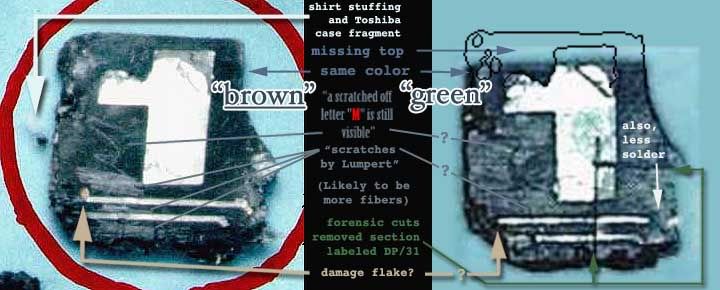
I turn my attention to false or dubious claims pushed by MEBO co-founder Edwin Bollier about the timer fragment PT/35(b) being changed or swapped-out after its discovery. His claims on the board being different colors at different times are too convoluted to fully explore here, but Bollier has been swearing lately that a brown prototype handed to Swiss authorities had been used as the evidence, somehow clearly visible in the first known photograph from 1989 (left), while the later photo (mid-1990, right) of an altered PT35(b) are of a replacement green board.

The MTS-13’s designer at Mebo, Ulrich Lumpert (alt Uelli Lumpart), apparently spawned this with his 2007 affidavit, by which he handed the brown board over to Swiss investigators who in turn gave it to SCOTBOM, who used it as evidence. The official story is of course that it’s always been the same green fragment they found in the wreckage of 103.

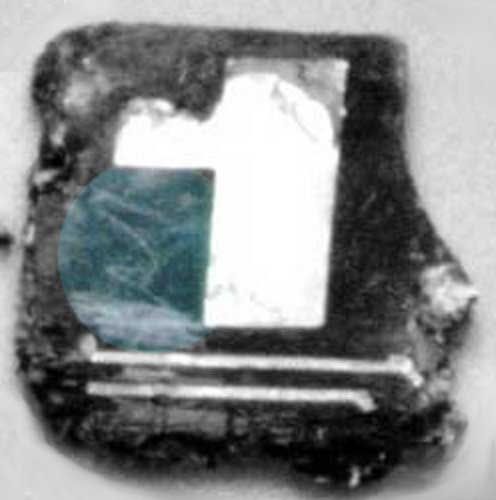
It is true that green here seems to mean blue, and the later photo is more blue than the first. However, this (as I found it online) shows clear signs of photo-tinting (blue ink on blue paper?) and once corrected, the color matches up quite well with the original – dark muted green-gray, like a green/blue board that had been burnt. It does seem possible some of the carbonized surface material has been cleaned off in the latter view, but otherwise there is no hint of brown I can see in either of these photos, and no color-based sign of meaningful alteration or replacement.

Considering comparison photos of PT/35(b) alongside an intact model board (links above), There are allegations of the curved edge not matching or the “1” touchpad and its relation to the “true edge” differing. But when the outlines are superimposed to scale (right), we find a perfect fit presuming the fragment is missing a sliver off the top. And here we can see a difference with the first photos and later ones – the top is present at first, giving it the right curve of an intact board. Later, it’s gone. Two prominent cuts at right angles also appear, apparently part of forensic examination carried out so controversially in Munich, to check the board’s layering style. This apparently severed a corner piece, put back in place and displayed as separate evidence item DP/31. But the removed top is not so displayed. It’s reasonable to surmise this tiny section – app. 1cm by 1/8cm – was simply ground off to get a profile, but mysteries remain... It's not clear how many layers were really found, but as it appears a green machine-made board, I'm guessing nine.

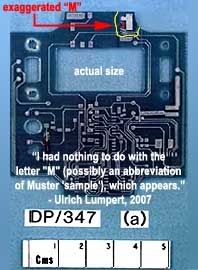
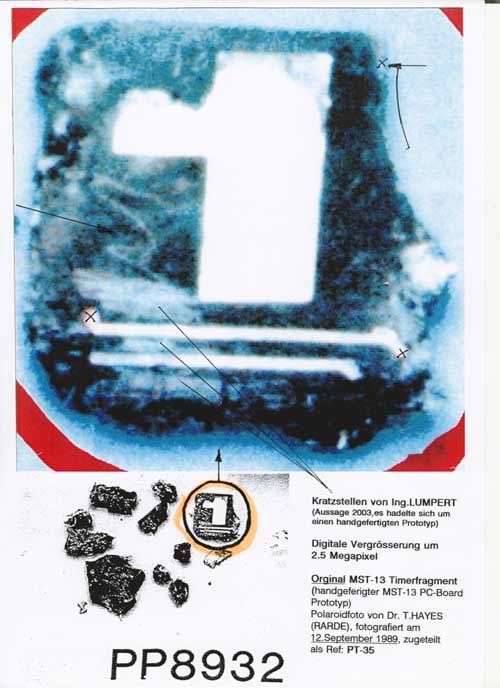
Among Mebo the clown’s most enthusiastic claims of proven forgery is how “the letter "M" was carved into” the original “brown” item sideways next to the touch pad, while “in the duplicate no. PT/35(b) (fake) it can be clearly seen that no letter “M” was carved into it!” Lumpert mentioned but disowned this in his affidavit: “I had nothing to do with the letter "M" (possibly an abbreviation of Muster 'sample'), which appears." To true scale (at left), this tiny M seems strangely small to use as a marking, nestled in next to the “1.” In reality, as JREF forum member Ambrosia showed with the enhancement below, the M casts a faint but visible shadow, and would seem to be a 3-D object, a tiny ziggy fiber of presumably shirt stitching.

Beneath this alleged etching are three small light patches bracketing the solder lines, visible above. Of these Lumpert said “I clearly recognize the scratched remnants of the soldering tracts on this enlarged digital police photograph.” A poster available online shows a blowup with German text, perhaps based on something, labeling these as “Kratzstellen von Ing Lumpert,” scratches by Lumpert. That any villains would have chosen to cut out and display as evidence just the small corner that Lumpert had marked with random micro-abrasions and could identify raises some questions.

What exactly these really are is a minor mystery – perhaps more fibers of a different kind snagged on the solder. Whatever they are they’re as gone later as the M – either the political engineers sanded these off or painted them over, or replaced the board down to he tiniest details except for these scratches, as alleged by recent Mebo pages, or they were some inconsequential surface debris since removed.

And for a preview of what lies at the bottom of this rabbit hole, realize Bollier's claiming a green replacement for a brown original fake of an alleged green Libyan timer; A 'technical report' commissioned on actual graph paper suggests for no reason I can fathom the final PT/35(b) photo is of the green replacement except the corner DP/31, which is actually a matching corner from the original Lumpert-supplied brown fake! And they didn't even use the corner with the irreplaceable "M!" (lower right corner of right view below - the part that's the same blue/green as the rest).


So to summarize, as the graphic above pretty well does, the verifiable changes were the removal of surface debris, perhaps removal of some of the charred layer, loss of a small bit of solder, an apparent flake of damaged plastic (tan under-layer?), minor changes to the touch pad surface, and the obvious cuts and/or grinding to the board consistent with cross-section analysis. Nothing else about it changed, and there’s no evidence that anything misleading was done with this after its initial fraudulent insertion into the evidence chain.

Did everyone catch that? Don’t get distracted, then, is the main point here. There are still intelligent questions to ask.

From Zurich to Malta to Tripoli to Malta to...

A DECEMBER DANCE OF ACCUSER AND ACCUSED
Adam Larson / Caustic Logic


Note: this was first posted November 16 2009 at my previous blog. It's one of the more opinion-oriented pieces that gets at the heart of my distrust of Bollier and Mebo, despite their claims of sympathy with the framed Libyans.
---
One of the stranger patterns I’ve seen recently in connection to the Lockerbie case is the tight web of alleged movements of the two accused - and of Mebo co-founder Edwin Bollier - in the days preceding the PA103 attack. To start with, the close connection between the first accused, al Megrahi, and Mr. Bollier’s company is no secret. From the Camp Zeist Opinion of the Court [hereafter "verdict", paragraphs 54 and 88]:
[54] We also accept Mr Bollier’s evidence, supported by documentation, that MEBO rented an office in their Zurich premises some time in 1988 to the firm ABH in which the first accused and one Badri Hassan were the principals. They explained to Mr Bollier that they might be interested in taking a share in MEBO or in having business dealings with MEBO. …
[88] [Megrahi] also appears to have been involved in military procurement. He was involved with Mr Bollier, albeit not specifically in connection with MST timers, and had along with Badri Hassan formed a company which leased premises from MEBO and intended to do business with MEBO.

The questionable choreography begins when the Libyans had just finished employing the Mebo MST-13 in a carefully packed Malta-themed gift bag they had set to drop bits all across western Great Britain. In case the trail wasn’t obvious enough, they decided then to bring the talkative Mr. Bollier back to remind him with a new attempt to purchase a double order of the same nifty gadgets. The court cited Bollier’s evidence that Badri Hassan, Megrahi’s partner in ABH, “came to MEBO’s offices in Zurich at the end of November or early in December 1988 and asked the firm to supply forty MST-13 timers for the Libyan Army.” [verdict, para 46] Megrahi was apparently on a visit to Zurich at the same time, and from there the dance begins. Below is a timeline, compiled from a variety of sources, to illustrate how strange the patterns are.

- Nov 20 – Dec 20 Megrahi and Fhimah “did between 20 November and 20 December 1988, both dates inclusive, at the said premises occupied by MEBO AG, in Zurich aforesaid, … order and attempt to obtain delivery of 40 further such timers from the said firm of MEBO AG [indictment, para J]
- Around Dec 1 – Hassan’s order, in Zurich, for forty MST-13 timers. [Verdict, para 88]
- Early December - Megrahi had “traveled to Zurich in early December.” [Wallace]
- Dec 7-9 - Megrahi stays at the Holiday Inn in Silema, Malta. December 7 is the date the court decided he bought the Maltese clothes from talkative shopkeeper Tony Gauci at nearby Mary's House. [verdict, para 88]
- Dec 5 and 15 – Having no MST-13 timers on hand, Bollier buys 40 of the Olympus make instead, in two batches, on the open market. [verdict, para 88]
- Dec 15 – Fhimah diary entry “Abdelbaset coming from Zurich” [Lockerbie.ch]
- Dec 16 Bollier books a flight to Tripoli to bring the wrong timers [Verdict, para 88]
- Dec 17 – Megrahi returns to Malta on the 17th “and then on to Tripoli Libya, where Lamen Fhimah joined him.” [Wallace]
- Dec 18 - Bollier flies to Tripoli, meets no one, leaves timers at office of one Ezzadin Hinshiri [Verdict, para 88]
- Dec 19 - Hinshiri said that he wanted MST-13 timers and that the Olympus timers were too expensive. “Nevertheless, he retained the timers and directed Mr Bollier to go to the first accused’s office in the evening in order to get payment for them. From about 6.00pm Mr Bollier sat outside that office for two hours,” but “did not see the first accused,” being of course Megrahi. [Verdict, para 88]
- Dec 18-20 “in Tripoli aforesaid, and elsewhere in Switzerland and Libya,” Megrahi and Fhimah did “order and attempt to obtain delivery of 40 further such [MST-13] timers from the said firm of MEBO AG.” [indictment, para J]
- Dec 18-20 “we accept that Mr Bollier visited Tripoli between 18 and 20 December in order to sell timers to the Libyan army, because that is substantially vouched by documentary evidence and it was not challenged in evidence.” [Verdict, para 88]
- Dec 20 – “Al Megrahi was instructed by his boss Ibrahim Bishari to travel to Malta on December 20, 1988 for a security order (not in connection with the bombing of PanAm 103)” [Bollier]
- Dec 20 – “Abdel Baset and Lamen Fhimah returned to Malta on 20 December” with an alias for Megrahi and the bomb suitcase. [Wallace]
- Dec 20 – After a final dispute with Hinshiri, Bollier returns home with his Olympus timers, “flying by direct flight to Zurich rather than via Malta (as he had expected) where he would have had to spend that night.” [Verdict, para 88]
- Dec 20 (presumably) – “On his return to Zurich Mr Bollier claimed to have discovered that one of the timers had been set for a time and a day of the week which were relevant to the time when there was an explosion on board PA103.” Herr Meister confirmed this to the court. Libyans had been fiddling with them, absent-mindedly… the court dismissed Mebo’s claims as “so inconsistent that we are wholly unable to accept any of it.” [verdict, para 46]
- Dec 20: Upon returning to Zurich, Bollier is said to have testified in 2000 "a suitcase which had been in the Mebo office prior to Mr Bollier's departure, which the witness understood belonged to Mr Badri Hassan, was not seen again after Mr Bollier left on this trip." [LTBU]
- Dec 20: [indictment, (m)] (both accused) “did on 20 December 1988 at Luqa Airport, Malta enter Malta” with Megrahi under alias Abdusamad, and both “did there and then cause a suitcase to be introduced to Malta.”
- Dec 20-21: [Indictment, (n)] Megrahi “did on 20 and 21 December 1988 reside at the Holiday Inn, Sliema, aforesaid under the false identity of Ahmed Khalifa Abdusamad.


Bollier has added to this tight web of movements across the Mediterranean in those fateful days, in response to recent comments by myself and others at Professor Black’s Lockerbie case blog (this post, in comments beneath). His messages there are a complex mix of German and mixed English; one relevant part in German renders roughly as “today we know that the new order at the end of 1988 "to produce for the Libyan army, immediately further 40 pieces of MST-13 timers from a person; H.B." on behalf same western security services one made!” H.B. could be Badri Hassan, but this seems to imply that a Western agency placed the order (through him?). Perhaps these were the same folks who compelled Hinshiri or whoever to program PA103’s explode time into one of his Olympuses. And what ever DID happen to that suitcase, Mr. Bollier?
Documents indicate that originally the CIA and an other western intelligence service planned also to involve Edwin Bollier (MEBO Ltd.) together with Mr. Abdelbaset Al Megrahi into the PanAm 103 plot!

Edwin Bollier was told at the check-in at Tripoli airport that his already booked direct flight with Swissair to Zurich on December 20,1988 was fully booked and he should travel via Malta to Switzerland on the same day - the same flight on which Abdelbaset Al Megrahi was booked (*flight KM 107, on December 20, 1988 from Tripoli to Malta). According to a new statement Megrahi did not know that Bollier was planned to travel on the same flight as he was !

Bollier was suspicious because he didn't see many people on the airport and went to the Swissair Station Manager who told him that there were many empty seats on the Swissair flight to Zurich. So he took the direct flight to Zurich on December 20, 1988. Only Abdelbaset Al Megrahi (alias Ahmed Khalifa Abdusamad) traveled with flight KM 107 from Tripoli to Malta on December 20, 1988.

Therefore Bollier was not in Malta on the same day as Abdelbaset Al Megrahi. The CIA was confronted with a new situation and the same intelligence people decided to involve the station manager of 'Libyan Arab Airways' , Mr. Lamin Khalifa Fhimah, into the complot.

*Al Megrahi was instructed by his boss Ibrahim Bishari to travel to Malta on December 20, 1988 for a security order (not in connection with the bombing of PanAm 103) ...
On September 14, 1997 former foreign minister, Ibrahim Bishari, died in a car crash in Egypt ...
[Bollier]

Strangely for someone so nearly “framed” in the web set for Libya, Bollier was the first to try implicating Libya for the bombing of Flight 103 at all, with a letter delivered to American authorities in January 1989, well before they started finding any clues pointing that way. [see for example, verdict, para 47] This he claims he was compelled to write by - gasp! - Western agencies acting then through him to implicate Libya, a claim he’s made before and elaborates on in the same comments (worth a read for serious scholars). This letter and the claims around it will deserve their own post eventually, but something is entirely not level here, and Bollier is entirely too at the center of it. Somehow this whole byzantine Mediterranean waltz leaves me with the words and mood of the 80s poets Wham in Careless Whispers:
"Now I'm never gonna dance again, guilty feet have got no rhythm. Though it's easy to pretend, I know you're not a fool..."

---
Sources:
[verdict]
[Wallace] Rodney Wallace Lockerbie the story and the lessons 2001 page 62
[Lockerbie.ch]
[Indictment] Actually I think that's a verdict http://www.terrorismcentral.com/Library/Legal/HCJ/Lockerbie/TheIndictment.html
[Bollier]
[LTBU] Lockerbie Trial Briefing Unit: report 78554 - 16th June 2000. Original site:
http://www.gla.ac.uk/departments/schooloflaw/news/lockerbietrialbriefingunit/
text doc direct link: http://www.gla.ac.uk/media/media_78554_en.doc