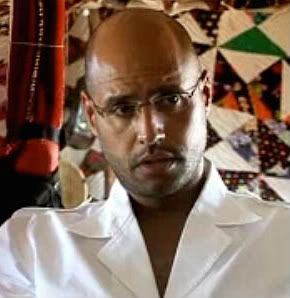
Showing posts with label Gaddafi M. Show all posts

Once Upon a Time, there was Lockerbie

Spot the Problem
By Robert Forrester,

Secretary, Justice For Megrahi Campaign 
Special to The Lockerbie Divide
March 28 2011


In 1958 President Eisenhower was so concerned about the prevailing hatred for the United States amongst the peoples of the Middle East that he commissioned a report in the hope that better minds than his could explain what seemed to have flummoxed him. In 1953, Eisenhower, supported by Churchill and later Eden, sanctioned Operation Ajax. Operation Ajax was regime change at its cheapest and most effective. It cost a mere $1,000,000 to run, involved buying off the Iranian military and employing gangs of Teherani thugs to create civil disorder and achieved its desired result of overthrowing the popular Iranian prime minister Mohamed Moussadeq. Why did he do this? Because Moussadeq was showing unfortunate socialist tendencies whilst at the same time as sitting on some rather desirable oil supplies. In fact, the man actually had the gall to suggest that Iran should be controlling its own mineral wealth and selling at prices the Iranian people felt appropriate, not those which the UK and USA felt like paying. Happily, everything went according to plan. Moussadeq ended up under house arrest for the rest of his days, the Iranians were subjected to thirty years of murder, torture and political repression by the West’s man of the hour, Shah Mohammad Reza Pahlavi, and we got the fuel to fund our casino economies at our prices, at least until Ayatollah Khomeini flew home to roost. Eisenhower’s National Security Council, in its report to the president, explained that the people of the Middle East seemed to have run away with the bizarre notion that the US is only interested in supporting tyrannical despots in their region who are willing provide cheap mineral resources. It is tempting to ponder whether Eisenhower’s illuminating report cost more than Operation Ajax.

Saddam Hussein proved to be a tad more awkward to deal with however. But once he had gone past his sell by date (he never did manage to club those dashed mullahs over the border despite all the help we gave him), and despite the weaponry we’d supplied him with, he really didn’t stand a chance. All that was needed was to await a convenient source of outrage, in his case the Al Qaeda attack on the World Trade Centre, to creatively stitch him into, trample all over the UN, then let him have it. Abracadabra. Ignoring the appalling cost in lives, a country that was once an example to the region in terms of its social services and state run enterprises was bombed back into surviving in open sewers. But hey, they got democracy, plus, the oil was free again, just like the 1920s.

So now it’s Libya’s turn. Gaddafi stands even less of a chance than Saddam. It’s hard to imagine the bookies taking bets on anything other than the precise hour and minute of when the rope will go round his neck. How can the rebels lose? They have copious amounts of the very best that modern air power, intelligence gathering and command and control can provide taking out any and all opposition they would otherwise have fallen victim to. They simply have to pick up the pieces, follow the instructions and keep shambling on towards Tripoli. Neither the Chinese nor the Russians have shown any real signs of stepping in. Even the US has estimated that it really doesn’t need to take such a prominent role in affairs and handed it all on to NATO. In any case, the US already has enough on it’s plate what with commitments in Iraq and Afghanistan, whilst at the same time having to keep a weather eye on other developments in the region: not least on the fact that Syria is getting a little frayed round the edges, and, although Israel is doubtless smiling, it won’t be sleeping. Furthermore, oil is marginally less of a lure to the States where Libya is concerned. Not so however with the UK. Let’s not forget Tony Blair’s ‘Deal in the Desert’, the BP contract and all the embarrassing mud that is sticking over the revelations that have come out concerning Gordon Brown’s government’s attempts to help Tripoli negotiate the legal hurdles of Mr al-Megrahi’s repatriation.

Despite the distress caused to anyone directly connected to the Pan Am 103 incident,
it almost seems wrong to draw a spotlight on to the Lockerbie/Zeist case at a time when Libya is being torn apart by civil war. Nevertheless, David Cameron has chosen to do just that recently in seeking to justify his belligerence by saying of Muammar al-Gaddafi: "The people of Lockerbie know what this man is capable of." (David Cameron - 21/3/2011). Justice Secretary Ken Clark is also now playing the Lockerbie card by saying that we have to bring Gaddafi down to prevent him from seeking another Lockerbie in revenge for the UK’s support of the rebels.

It is always much healthier if you can draw on some moral high ground to justify your cause in the public eye. We tried it on in Afghanistan with how we were lifting the Afghans out of their feudal political system by waving our magic wand of democracy over them. Now, with Libya, it is Lockerbie and terrorism. Ever since Libya’s ex justice minister, Mustafa Abdel-Jalil, set himself up as leader of Eastern Libya in February with claims that he had proof that Gaddafi was behind Lockerbie, this has provided the opportunity to indulge in a bit of sleight of hand and massaging of public opinion. Lockerbie combines public ignorance, terrorism, fear and righteousness, and, it sells papers into the bargain. Abdel-Jalil’s claims are simply that, claims. After a month, he has yet to produce one iota of substance. Is he saying that he was negligent enough to leave the documents back in Tripoli? Once Tripoli falls and no documents are produced, are we then going to hear that Gaddafi must have destroyed them? Perhaps though, documents will be produced, however, we all know what is said about truth and the fog of war. Even today, and despite the payments the Telegraph had to make to George Galloway concerning the documents that were allegedly found in Baghdad proving his complicity with Saddam’s government, their origin is still not settled. In any case, it surely comes as no surprise to anyone that Gaddafi would have been behind an action such as Lockerbie if one of his countrymen had carried it out. But, did Abdelbaset al-Megrahi do it? Therein lies the rub.

To say that the case against Mr al-Megrahi has one or two problems would be arch understatement.

  • There was a break in to Heathrow airside giving access to Pan Am 103’s loading bay area shortly before take off. This incident was reported to the Heathrow authorities at the time but not made public until after the verdict was passed twelve years later.
  • There is no evidence of any unaccompanied luggage leaving on flight KM180 from Malta’s Luqa airport.
  • There are question marks over the provenance of documentary evidence provided by Frankfurt Airport ( the transit point from Luqa to Heathrow).
  • Along with other alleged inducements, the Crown’s star witness, Mr Tony Gauci (the proprietor of a Maltese clothes outlet) and his brother, Paul, are accused of having been in receipt of payments of $2,000.000 and $1,000,000 respectively under an American rewards for justice scheme for their testimony (a practice understandably alien to Scots Law, and presumably sufficient to dismiss both Tony and Paul Gauci as witnesses. The US authorities have yet to deny this deal). Tony Gauci’s testimony falls considerably short of being conclusive in terms of his eye witness account, which attempts to match up the identity of the purchaser of clothes from his shop, on account of key discrepancies with regard to the date of the purchase and the height, weight, age and build of the purchaser. Even though he had been prompted by numerous photo spreads containing pictures of Mr al-Megrahi and privy to media photographs of the accused prior to the trial, Mr Gauci could do little better than say that the man in the dock “resembled” the purchaser of the clothes.
  • Serious doubts also arise over the provenance of the fragment of circuit board alleged to have been part of a triggering device for a bomb which brought down pan Am 103. How did it (along with a sample of Mr Gauci’s clothes) survive temperatures of around 4,000ºC at the heart of a Semtex explosion? Why was it not tested for explosive residue? Why was forensic testimony accepted from representatives of the Royal Armament Research and Development Establishment (RARDE), who had in previous terrorist trials been pilloried for the nature and standard of their testimony? Why were alterations to the discrepancies in the notebooks of the RARDE forensic witnesses not made more of in the trial? Why was the fact that a Crown witness, Mr Ulrich Lumpert, signed a sworn affidavit in 2007 retracting his Zeist testimony relating to the fragment of circuit board as effectively being a pack of lies not pursued? Why was the fragment sent to the US and allowed to leave Scottish jurisdiction, surely this would disqualify it as evidence?
  • Suspicions are also rife concerning what influence the FBI and the US Department of Justice had over the Scottish led police investigation and the trial under the auspices of the High Court of Justiciary.


The above simply serve to illustrate some of the more prominent worries over the safety of the conviction. To compound this, the judges chose to believe a tale of how the bombing was carried out that defies what any normal person could accept as credible, namely: that Mr al-Megrahi contrived to place an unaccompanied luggage item on to flight KM180 from Malta which was then subsequently transferred at Frankfurt to a feeder flight to Heathrow, again unaccompanied, where it was finally loaded on to Pan Am 103, unaccompanied. Thus defying three security regimes in three separate countries, and the bomb still managed to blow up its target and not either one of the first two flights despite the inevitability of delays etc which would have been par for the course around Christmas time. It is truly hard to believe that 15 lay Scottish jurors could reach anything other than a not guilty verdict in such circumstances. Although impeccably qualified as judges, their Lordships, MacLean, Sutherland and Coulsfield, in arriving at their guilty verdict, displayed an absence of experience when it comes to the role of being a juror. Indeed to give credence at all to the story of the Luqa-Frankfurt-Heathrow connection, especially as it was presented at Zeist, demonstrates a complete inability to imagine how paramilitaries operate.

It also cannot be ignored that the structure of trial itself could well have contributed to the conviction in that the Crown played the role of prosecutor, judge and jury. The litany goes on.

Mr al-Megrahi’s first appeal failed, this is true. However, in their judgement, the judges were at pains to point out that they took no account of the sufficiency of evidence since the defence did not require them to do so. The Scottish Criminal Cases Review Commission (SCCRC) then referred the case back to the Court of Appeal on six grounds suggesting that no reasonable court would have reached a guilty verdict on the basis of the evidence laid before the Crown by the prosecution. This appeal was then, unnecessarily, dropped by Mr al-Megrahi in his attempt to gain compassionate release. There has been much speculation regarding the possibility that he may have come under pressure to do so even though the terms of compassionate release do not require an appeal to be dropped to become a beneficiary of it. The long and the short of it is, therefore, that this conviction has not yet been fully tested in law in the interests of justice. The best that the Crown, in the form of the Lord Advocate, Elish Angiolini, has been able to offer as a counter to these concerns is a mind-boggling merry-go-round of circular polemic which amounts to little more than: he was convicted, therefore, he did it. So parlous are the arguments offered up by the Crown that one almost feels bound to ask what qualifications are required for the job of Lord Advocate. To reassure us all that the Crown and the police are still taking the Lockerbie Zeist affair seriously though, even at a point ten years after the conviction, Angiolini also claims that the Dumfries and Galloway police are conducting an on-going review of the investigation. It, in fact, transpires that this is being carried out by one sole officer. In the words of Christine Grahame MSP, this constitutes little better than “file management.”

Recently, on Auntie Beebs weekly vox pop mainstay, Question Time (broadcast from Edinburgh on the 10th of March) we were again treated to the predictable and tedious question of how Mr al-Megrahi must be laughing now that he is back in Libya. I imagine the member of the public who posed the question will be reduced to stitches if he ever contracts a malignant carcinoma. In order to kick the SNP bashing off, Douglas Alexander was straight in with claims that Mr al-Megrahi was currently being chauffeured around Tripoli in a Lamborghini (presumably to make him a more awkward target for the coalition missiles). Annabel Goldie took the biscuit though in bemoaning the damage that the compassionate release had done to the good name of Scottish justice, completely ignoring the profound and legitimate concerns over the safety of the conviction. Clearly, a potential miscarriage of justice does no harm at all.

There are of course differences between the histories of Iran and Libya, however, the salient threads of Western foreign policy run through both. In the case of Libya, we have the Italian genocide of the late 20s and early 30s (accounting for upwards of 50,000 deaths in camps), the Second World War, and then a monarchy (supported by Italy, the UK and the US) that pocketed Libya’s wealth until overthrown by Gaddafi. Much like Khomeini was viewed later in Iran, Gaddafi was seen in the late 60s as someone who would stand up to Western depredations. The surprising thing is that he managed to survive being a thorn in the side of the West for as long as he has: Reagan’s bombs, sanctions and all the rest. In pitting himself against such power, he, of course, subjected his people to his own brand of Gestapo for decades. Ex justice minister Abdel-Jalil’s claims, therefore, should be seen in this light. Anyone who managed to negotiate the perils to attain such a position under such a tyrannical regime is bound to have washed his hands in the people’s blood on a fairly regular basis. To that extent he doubtless has every reason to make the types of claims he is making in the hope of protecting his own skin.

It is hard to see Gaddafi going anywhere now except to follow Saddam to the gallows. The West will do what it knows best and install someone who is suitably on message until the oil runs out. Who knows what may become of Mr al-Megrahi? A one way ticket to the US’s Guantánamo rest home perhaps? Whatever transpires, it will make no difference to the case being put before the Scottish parliament by justice campaigners. No amount of dissembling mendacity claimed by politicians and others can ever change the documented historical fact of what took place at Zeist. This conviction simply does not stack up, no matter how good your gas mask.

Terrorists 1 and 2! Ah, I see you’ve met!

Reflections on the Libya conflict, Gaddafi, bin Laden, and their shared history
March 21
edits March 22

Note: I only come across as so totaly pro-Gaddafi in the sense of shouting what others won't even whisper. I mean to excuse no atrocity or abuse by Gaddafi's regime that is real and unwarranted in the circumstances. I only seek to add just this, below, to the global discussion on the Libya conflict.
---
Paul Hudson, father of a Lockerbie victim and co-president of the Families of Pan Am 103/Lockerbie – a separate group from Victims of Pan Am 103 Inc. - posted a press release about a week ago, on the eve of the UN vote about a no-fly zone over Libya. It’s a pretty militant dispatch filled with minor inaccuracies (Libya was not on Bush's “axis of evil,” for one) and the usual annoying spin the U.S. family members of 103 victims are so well-known for. Something about believing that their children were killed by Gaddafi’s regime might have something to do with that.

As others have been doing, he seems to believe every report from the rebel side and hears none from the other, and falls back on alarmist tactics to urge sterner measures against the Gaddafi regime. He called for immediate military strikes and recognition of the new government in Benghazi, to prevent a “genocide” against the “peaceful protesters.” Out inaction in this war has the danger of "starting a war," he cautioned.

Hudson’s advice and the thousands who share the same view has apparently made it happen. The United States, UK, and France pushed through a 10-0 vote at the United Nations security council on the imposition of an enforced no-fly zone. And it has just-now-noticed additions specifying Gaddafi’s forces can also not drive tanks, or do anything ground based that threatens “civilian targets.” The meaning of civilian is unclear; it seems by the news reports of actions taken so far to include protesters, and also the half of Libya now under rebel control, and also their advancing forces. Witness the famously photographed rebel fighter jet shot down over Benghazi. Officially (by rebel accounts) this was shot down by Gaddafi's forces, who were close enough to both shoot it and to be threatened by it. They were guilty of breaking the cease-fire, an unprecedented one-sided one, with an open-ended military license to back it up, in the middle of a rather sudden mass defection and war that is not clearly understood by most people (myself included).

Clearly what’s needed is to rush into this fray before we can figure out what the hell’s going on there. Make no mistake, supporting the protesters is an urgent and a humanitarian impulse, we’re told by the US ambassador to the UN: "the violence must stop, the killing must stop, and the people of Libya must be protected and have the opportunity to express themselves freely." And as a French government spokesman clarified, the “free expression” referred to is "go(ing) all the way in their drive for freedom, which means bringing down the Kadhafi regime." [source]

What a novel concept, sure to be introduced here or there, in the heartlands of revolutionary enlightenment freedom themselves. Following this overseas trial run, of course. Or perhaps not.

It's not an entirely savory bunch we are going in to protect, either. There are the deep-east-Libyan Arab racists among them, identifying African “mercenaries” often just by skin color, venting their dislike of Gaddafi’s pan-African ideas by cutting down immigrant workers and lifetime citizens alike in the dozens, according to a number of reports. [see here and here] Many others escaped such harm only by fleeing quickly enough.

But then there’s Daffy Qadhafi’s loony charge that al Qaeda, its north African branch at least, is behind the revolt. He said this from the beginning, to a general response in the west of hysterical laughter. As impassioned commentator David Rothscum aptly put it “ we consider him to be a schizophrenic autistic nutcase of course.” It doesn't help that he added that they were tripping on hallucinogens, of course, in a surreal and contradictory twist.

Again on the eve of serious bombardment, Gaddafi tried to explain to the world: "If you come here to carry out air strikes, you are not coming to protect the human rights of civilians, you are... going to be opening the door to al Qaeda." Strangely, as President Obama orders missiles, his anti-terrorism Czar John Brennan, for one, concedes there is cause for just that concern, as with any Muslim nation being destabilized. Or perhaps more so. Early on in the Libyan uprising, it was reported on CNN and elsewhere that Al Qaeda's North African wing offered through a website to "do whatever we can to help" the rebels. This tends to go against Gaddafi's idea they had initiated the revolt. But just now, they've issued a "warning against America" to the rebels of their stripe.

Brennan was however all but sure of renewed terrorism if Gaddafi remains. Indeed, he might be more angry, for some reason, and so must go, opening the door for someone. And clearly Gaddafi’s death machine and bin Laden’s are in the same group to Americans and the French – Arabic speaking airliner-scale terrorist bad guys, and the worst two among them. As Mr. Hudson noted
"[Gaddafi is] the admitted No. 2 international terrorist, second only to Osama Bin Laden, having caused the murder of hundreds of Americans, French, UK and other innocent citizens in the bombings of U.S. bound Pan Am 103 killing 270, UTA flight 772 killing 170, the La Belle Disco bombing in Berlin, dozens of other terrorist attacks, and delivering large shipments of plastic explosives for IRA terrorist bombings, plus killing thousands of his own people who regularly disappear into his torture chambers or are assassinated abroad. (...)
I’m confident some portion of that list is true, but at the very least the deadliest among them and the one that brought Mr. Hudson into such impartial and scholarly contact with this ring of terror, has been sadly misattributed. (see: the rest of this site).

The two Libyan agents accused of bombing Flight 103, Abdelbaset al Megrahi and Lamin Fhimah, were indicted in 1991 on flimsy and dubious evidence. Of three witnesses against the accused, at least two were paid $2 million each, and still managed to provide almost zero credible evidence between them.   The trial judges themselves in 2000 dismissed one of them, the star witness Giaka, for likely mass-fabrication, and acquitted the accomplice, convicting Megrahi alone for a crime he couldn't do alone. This itself was decided on reasoning seriously questioned on official review in 2007. Gaddafi and Libya never did "admit" to this crime, this alleged Libyan plot on Malta. There’s also much better circumstantial evidence and a truckload of cover-up indicators pointing elsewhere.

Nonetheless, back in the early 1990s, the politically leveraged indictments led into demands for a trial Libya couldn’t agree to, leading to a UN air embargo and steep sanctions. These caused an unknown number – reportedly thousands - of preventable Libyan deaths, possibly included in Mr. Hudson’s numbers as Gaddafi’s fault. This only ended after the two accused surrendered for a compromise trial in 1999. Mr. Hudson noted an agreement to limit the trial’s fallout, unjustly he thinks.
Prior to turnover of the Pan Am 103 indicted terrorists for trial, a letter by former UN Secretary Kofi Annan stated that the U.S. and UK had agreed not to pursue the case so as to destabilize the Gaddafi regime.
Yes, political assassination was a genuine concern, as that was likely the US and UK goal in framing and pursuing the two Libyan agents. And this wasn’t the only thing the Anglo-American alliance has used to destabilize or kill the colonel. Cruise missile accidentally hit his house in 1986, killing a a bay daughter of his. Another thisng once used, a decade later, was the no. 1 terrorist on Hudson’s list – Osama bin Laden and his once obscure al Qaeda network.

David Shayler is our troublesome source for this, a former MI5 officer, who is now certifiably nuts. But this 2002 article by Martin Bright in the UK Guardian makes quite clear that he had at least one dynamite conspiracy find earlier on: the UK MI6 (foreign intelligence) worked in the mid-1990s with al Qaeda's north African network, in Libya, on a plot to assassinate Gaddafi. The cell there, called the Libyan Islamic Fighting Group (LIFG), included one Anas al-Liby ("the Libyan"), a fairly senior member close to bin Laden in his days in Sudan. As Bright explained the LIFG's bold and British-sponsored move:
The assassination attempt on Gadaffi was planned for early 1996 in the Libyan coastal city of Sirte. It is thought that an operation by the Islamic Fighting Group in the city was foiled in March 1996 and in the gun battle that followed several militants were killed. In 1998, the Libyans released TV footage of a 1996 grenade attack on Gadaffi that they claimed had been carried out by a British agent.
The west played that down, and the escaped British agent al-Liby took part in the US embassy bombings in Kenya and Tanzania in August 1998. For this he was indicted in 2000 and fled, from asylum in the UK (Manchester). With a $25 million bounty on his head, he wound up in the Afghanistan area, joining the post-9/11 Jihad.

Shayler was on trial for revealing some genuine secret or other (I'm unclear what), and his explanation of why, this Libya plot he had to expose, was called “pure fantasy” by the government. But during the trial amazing lengths were gone to to keep it all quiet. Public Interest Immunity certificates were issued, Mr. Shayler was barred from saying or entering anything about it, the media was gagged from reporting on it, and so on. The article explained:
Astonishingly, despite suspicions that he was a high-level al-Qaeda operative, al-Liby was given political asylum in Britain and lived in Manchester until May of 2000 when he eluded a police raid on his house and fled abroad. The raid discovered a 180-page al-Qaeda 'manual for jihad' containing instructions for terrorist attacks.
The MI6 officer who ran this fiasco were named, but thought to be relocated and re-named by then. The operation is said to have hampered Libya's efforts to arrest Osama himself, or take a hard-line against his nascent network. Indeed, Muammar Gaddafi's terrorist regime was the first in the world, in May 1998, to declare bin Laden a wanted criminal. Shayler had insisted it, and supporting evidence came out in the 2002 book Forbidden Truth by Dasquie and Brisard. Thus, the West's obsession with Gaddafi could have had some role in allowing the attacks of September 11, 2001 and others, before and since.

Al-Liby remained in the fight until he was killed in Pakistan, in 2008. But some of his affiliates remained in Libya, mostly the heavily Islamist western half that now, it's proudly boasted, "has never accepted Gaddafi's rule." In fact, he's sometimes referred to there, perhaps literally, as the "anti-Christ." Many eastern citizens were crushed following the 1996 plot, in a harsh crackdown that saw record executions in excess of 1,000.

The government has taken a different tone on the LIFG today, a softer one, to respect international criticism of human rights abuses. Now they are "rehabilitating" the terrorists rather than executing as before. Nonetheless, as reported, "the LIFG in 2007 reaffirmed its determination to topple Kadhafi's regime and to replace it with an Islamic state, and also stated its affiliation to Al-Qaeda."

Under these peoples' influence, parts of neglected western Libya have spawned at least two things of note in the last decade. One is the highest rate of al Qaeda volunteers, per capita, in the Arab world, and now the mutiny against Gaddafi.  A further 110 rehabilitated LIFG members were released, as scheduled, a day before the planned "day of rage" that started the revolt in February. And now, some of al-Liby's offspring are, or had better be, planning a coalition government over Africa’s largest oil deposits, if they are to replace a long-despised “terrorist” regime. Or just hold onto what the allies up north seem to think they have a right to.

Now of course, all the rebels are not al Qaeda fanatics, but just how many are is unclear. As David Wood reported for the Huffington Post:
U.S. officials declined to discuss the make-up of the anti-Gaddafi forces in eastern Libya, and U.S. intelligence agencies declined to comment publicly.
It’s presumably hoped that the "undesirable elements" will be co-opted or weeded out one way or another after things have settled and freedom is realized.

And similarly, not all of the protesters we're protecting are war criminals. But some apparently are. An amateur video (view with discretion) shows rows of dead Libyan soldiers "who refused to obey orders to shoot their fellow Libyans and they were executed by the regime and its mercenaries.” it was the major incident you heard about, the one near al-Baida, where 130 of Gaddafi's soldiers were killed somehow, surely added to the figures against him, and claimed by the rebels as a platoon of martyrs for their freedom fight. Refusing orders to kill innocents, faces blown off. The world was moved.

But another video, shown on Libyan state TV from footage intercepted somehow, shows a number of the same soldiers (apparently, by clothing, build, etc.) and their captors before the killing. From that it seems the rebels themselves themselves blew the heads off of these helpless prisoners, and passed off the edited cut to an accepting world * as another predictable Gaddafi slaughter. Or we have to give the regime very high marks for rapid and convincing video fakery. (Please see the explanation of this at my favorite skeptics forum).

Well, now with some help from northerners, seizing the sky again from a murderous tyrant, the rebels might have the whole regime on its way to being just as bound and helpless as those claimed “martyrs”  near al-Baida. Amid the pools of blood at slaughter's end, we’ll hear the explanation – as usual, it was all Gaddafi’s fault. The world will cheer for the freedom fighters. And then some other things will happen, who knows what.

* (Previously I’d noted here the alleged work of the extra-brutal Palestinian terror group PFLP-GC in Bosnia, fighting alongside proto-al Qaeda elements for Bosnian freedom from Serbian rule. Starting in May 1992, some of these terrorist elements reportedly killed civilians and conducted other false flag atrocities blamed on Serb forces and used to help win NATO air support to protect human rights. [source] It is my belief that the PFLP-GC also organized or at least equipped the murder of Mr. Hudson’s daughter in 1988, despite Libya taking the blame.) 

Libya's "Admissions of Guilt"

By Caustic Logic
completed February 15 2010
last update March 23 2011


But They Admitted It!"
For those who believe in Libya's guilt for the Flight 103 bombing, among the hardest points to get around is how Libya is perceived to have admitted their guilt. When whole governments act on it as fact, and the villain government finally confesses, well that would seem to confirm one's beliefs and show they had been on the right track all along.

It's a reasonably reasonable conclusion to arrive at, but a lazy one based on reading the headlines and not the main text or the footnotes and sources. Those who would like to maintain such assurances should read and be sure they can account for the following points, referring to the 2003 official admission of "responsibility" to the United Nations, an alleged 1993 confession from Colonel Gaddafi himself, and two other lesser examples sometimes cited.

Under Prolonged Duress
Following he indictment of Libyan agents al Megrahi and Fhimah in late 1991, the UN Security Council under Anglo-American leadership moved to enforce the official truth with sanctions. Resolution 748 of 31 March 1992 imposed an arms and air embargo on Libya, supported with diplomatic restrictions, and establishment of a sanctions committee. The committee’s work then led to Resolution 883 of 11 November 1993, toughening sanctions. This measure “approved the freezing of Libyan funds and financial resources in other countries,” reports globalpolicy.org, “and banned the provision to Libya of equipment for oil refining and transportation.” [1] Eventually all air traffic to and from the nation was barred, all U.S. and French trade with Libya was forbidden, and although a total oil exports embargo was considered too hard on others, their sales shrank as the industry suffered a lack of supplies.

An award of up to $4 million was offered by the US Justice Department in 1993 for help in bringing the suspects to justice (poster at left). It seems this reward stemmed from Bruce Smith, a Pan Am pilot and husband of a 103 victim, who first assembled a prize from airline pilot groups and other sources, including his own retirement account, eventually totaling $4 million. [2] The reward was renewed in 1995, and according to the Washington Post:
"[The FBI] also placed the pair, believed to be in Libya, on its 10 Most Wanted List. Seeking to rekindle international interest in the bombing, the FBI and State Department said they will work with the U.S. Information Agency to communicate with persons in Libya who might assist in bringing the suspects to court." [3]
Col. Gaddafi in fact showed great eagerness to help in that process, seeing a trial as their way out of sanctions, just as the (publicly announced) goal was suppossed to be. But as a 2001 book by Allan Gerson and Jerry Adler summed up the real thinking in Washington, "it was desirable to leave things just as they were," with Libya seeming intransigent and thus deserving of more squueezing. Rather than try thhe perpetrators with their amazing evidence, many felt "Libya would be their prison, and the United States would do its best to keep Kaddafi in there with them." Not to mention the Libyan people who also lived under these long-running punishments. And never mind the families of Flight 103's victims, who wanted to get what they percieved as justice. But this was never an open policy - the sanctions were an unfortunate effect of Tripoli's refusal to comply with terms the book says "appear to have been chosen to make it as difficult as possible for Kaddafi to comply." [4]

In October 1995, Libyan officials cited a "tragic toll" from sanctions, a $19 billion dollar wound damaging their agricultural sector significantly, and causing as many as 21,000 preventable deaths since their inception. [4.5] Such reports might be prone to exaggeration, but others started wondering if there were any deaths what the sanctions were about when the Libyans were ready to deal. Pope John Paul II, Nelson Mandela, even Tony Blair started suggesting a little flexibility. Perhaps a trial of the suspects really would be doable outside the United States.

By late August 1998 the framework of a trial was established, and used as the measure of Resolution 1192, agreeing to suspend sanctions once the suspects were handed over to the special Scottish court in the Nehterlands at Camp Zeist. Tripoli made it happen, with help from luminaries like Prince Sultan of Saudi Arabia and Nelson Mandela of Africa and the venue ideas of Robert Black QC, of Lockerbie. Megrahi and Fhimah were finally flown on a special flight to the Netherlands in early April, and on the 6th were official arrested at Camp Zeist and set to await their trial. Sanctions on Libya were immediately suspended, under threat of re-enforcement (that never did materialize). [5]

1993: Involved and Framed?
During this time of intense pressure to get the Libyans to publicly admit their guilt or at least help a court to “prove” it, a remarkable admission was reportedly taken in 1993, taken down by a prominent American journalist with suspected CIA links, Arnaud de Borchgrave. But it was not mentioned in public for over a decade, it would seem. In an article for NewsMax, from January 2004, de Borchgrave first revealed “Gadhafi’s Secret Message”:
"On July 6, after a lengthy interview, he went off the record and asked me to deliver a message to the director of Central Intelligence in Washington. He admitted Libya's guilt for the downing of Pan Am 103, but made clear that it was originally an Iranian retaliatory terrorist attack for the downing by the U.S. Navy of a peaceful Iran Air Airbus
[...]
“So the Iranians subcontracted part of the job to a Syrian intelligence service, which, in turn, asked the Libyan Mukhabarat to handle part of the assignment," Col. Gadhafi explained.“
[6]
Mr. De Borchgrave says he did report this behind the scenes to the CIA immediately on returning home from the interview. Vincent Cannistraro, who had headed the CIA's Lockerbie probe in its earliest (shiftiest) phase, continued throughout the 1990s as a voice for Libyan guilt. He has alluded to Libya taking the Iran contract from the Syrians, following the Autumn Leaves operation, but did not give de Borchgrave as a source nor give col. Gaddafi any credit. [7]

Again on Megrahi’s release, in late August 2009, de Borchgrave wrote about the interview, explaining how he asked Gaddafi “to explain, off the record, his precise involvement in the bombing of Pan Am Flight 103.” The Colonel “dismissed all the aides in his tent” and went candid, “in halting English without benefit of an interpreter.” Mostly he decried terrorism and offered to assist the West fight bin Laden-type terror networks. Again, he explained the bombing as payback for the shoot-down of Iran Air 655, an act the Arab world could not accept as an accident:
"[R]etaliation, he said, was clearly called for. Iranian intelligence subcontracted retaliation to one of the Syrian intelligence services (there are 14 of them), which, in turn, subcontracted part of the retaliatory action to Libyan intelligence (at that time run by Abdullah Senoussi, Gaddafi's brother-in-law). "Did we know specifically what we were asked to do?" said Gaddafi. "We knew it would be comparable retaliation for the Iranian Airbus, but we were not told what the specific objective was," Gaddafi added." [8]
So why, when Libya is usually reported as "always insisting on their innocence," did de Borchgrave’s story and its propaganda power sit in the dark for the crucial years of pressure? Is it the prominent Iranian and Syrian elements? Were the Americans holding out for a Libya-only storyline? That is roughly how it turned out. Interestingly, the colonel reportedly used this “admission” to reiterate Libya did not lead the operation.
“If we had initiated the plot, we would have made sure the accusing finger was pointed in the other direction and we would have picked Cyprus, not Malta, where some of the organization was done. The others picked Malta presumably to frame us.""
This isn't really a big help when your official storyline is that two Libyan JSO operatives, commanded by their JSO higher-ups, had specifically targetted PA103 via Malta airport, picked because Malta was their own "back door to the West." The JSO got the timers and the radio and the semtex, made the bomb, did up their own feasibility studies we were told, and had their two real movers buy the clothes, secure the suitcase, steal the luggage "taggs" to write that death sentence on, and personally shove it off from Malta on D-day. There is no "framed by the Syrians" in that scenario.

And all this when the real evidence Gaddafi may or may not have known about highly suggests the bomb went on PA103 way up in London, with nothing physically to do with Malta at all. Is this just another Libyan non-admission admission? Or worse - an attempt to hijack the West's fantasy narrative and steer it back away from himself?

99/01: Two Other Admission-ish things
Allan Gerson and Jerry Adler’s 2001 book The Price of Terror failed to mention this account of de Borchgrave while citing the available hints that Gaddafi “might have been suffering from a guilty conscience.” In a private 1999 interview with another journalist, Milton Viorst, Gaddafi “edged towards a kind of confession,” the book notes. As Viorst reported it, the leader said"
“Whether we were responsible for bringing down the French plane [UTA 772] will be decided by a French court. We don’t say anything about it. The same is true of Lockerbie. I can’t answer as to wether Libya was responsible. Let’s let the court decide.” 
[9]
That's not a full denial, but nowhere near an admission. But it was ambiguous enough that an aide later told Viorst Gaddafi “was not talking officially” and referred him to the Foreign Minister for the government's official story (few realize that Gaddafi is not really the government of Libya). Not being published in the book, we can presume this was the same claim of innocence Libya has always maintained.

In spring 2001, the book continues, Gaddafi reportedly slipped again, and confessed to diplomat Michael Steiner that Libya had been behind the Lockerbie bombing as well as the LaBelle disco bombing in Germany, but had since stopped terrorism and wanted to make up. The source for this was a cable of a top-level meeting with German and American leaders, including President Bush and Chancellor Schroder. A New York Times article from May 23 cites the leaked cable thus:
"Steiner reported on his talks with Qaddafi in Libya. Qaddafi admitted that Libya took part in terrorist actions (La Belle, Lockerbie). He clarified that he had abandoned terrorism and seeks the opportunity to make Libya's new position known. Qaddafi, too, is worried about fundamentalist trends."
Americans were upset this was leaked to the public, and it caused quite a row between Steiner, a flamboyant attention-seeker, and others in the German government, but they confirmed “that "La Belle" and "Lockerbie" were specifically mentioned by Mr. Steiner in this context.” Whatever exactly that proves. [10]

Owning Up in '03?
Many suspect the Zeist trial was never supposed to happen, as the evidence behind the indictment was too weak to stand up at Trial. The Crown's prosecutors managed to swing it somehow, but it took nearly two years from the handover, and a display of mental gymnastics worthy of the Realpolitik Olympics in the scale and skill of it. On January 31 2001, the three-judge panel made it official – Megrahi was legally guilty for the plot, and Fhimah was not guilty.

From there, many insisted sanctions should be lifted to reflect Libya’s good faith through this process. But Bush and Blair balked, demanding an admission of guilt and contrition, plus compensation to victims’ families, before they went past suspension. It was a letter, dated 15 August 2003, from Libya’s Permanent Representative to the President of the Council Ahmed A. Own, that paved the way. Own's letter explains “the Libyan Arab Jamahiriya,” as Libya calls itself, “has sought to cooperate in good faith throughout the past years” on solving the problems made theirs “resulting from the Lockerbie incident.” It was in this spirit that they “facilitated the bringing to justice of the two suspects charged with the bombing of Pan Am 103 and accepts responsibility for the actions of its officials.” [11] Presumably they mean real actions, making this another dodge in some minds.

But the letter also pledged Libya to cooperate with any further investigations, and to settle all compensation claims with haste, and to join the international “War on Terrorism.” It was widely (and reservedly) hailed as a bold… statement. But still evasive. It doesn’t clearly state anywhere the suspects or any Libyans were in any way actually guilty of the “incident.” Nonetheless, after a month of discussion in the Security Council, sanctions were lifted on Sept. 12 2003. France and the US insisted on abstaining, but it was otherwise a unanimous vote of 13. The United States’ own sanctions would remain in full force due to the general evilness of col. Gaddafy, US officials made clear. (Additional normalizations did happen in 2007).

There’s been much oxymoronic harping on this 2003 letter in the West as both an admission of guilt and an arrogant refusal to admit their guilt. The BBC’s 2008 Conspiracy Files episode on Lockerbie is a brilliant example. “For those that believe al Megrahi was framed,” snarls the narrator, Carolyn Katz, “one fact remains hard to explain away. Libya agreed to award substantial compensation for Lockerbie. Sanctions were then lifted.” [12] Well, ignoring that they just answered their own stumper of a question, it’s a good question. Why would they agree on their responsibility and get sanctions lifted unless they knew they were guilty? Just to get sanctions lifted? The movie continues: “Tripoli accepted responsibility for what it called “the Lockerbie incident.” But does it admit guilt?” Of course not, and by pretending there’s some disconnect, they’ve primed the audience to see the darkest of cynicism at work.

No Other Solution
Despite his portrayals as a crazed prophet of death, Moammar Gadaffi proved a shrewd and patient pragmatist in all this. He can't have ever believed his nation actually did the crime, but against "guilty" as a legal truth, he accepted they had no choice but to do “the time.” It’s a type of bind known to breed passive-aggressive tendencies. The Colonel’s son and likely successor Saif al Islam al Gaddafi (left) seems to understand the dilemma. When he was interviewed at home for the same Conspiracy Files program (latter minutes), he was respectably candid, but came across strangely anyway.
Q - Does Libya accept responsibility for the attack on Lockerbie?
A - Yes. We wrote a letter to the Security Council, saying that we are responsible for the acts of our employees, or people. But it doesn’t mean that we did it, in fact.
Q - So to be very clear on this, what you’re saying is that you accept responsibility, but you’re not admitting that you did it.
A - Of course.
(edit)
Q - That’s… to many people will sound like a very cynical way to conduct your relationship with the outside world.
A - What can you do? Without writing that letter, you will not be able to get out of the sanction.
Q - So this statement was just word play. It wasn’t an admission of guilt.
A - No. I admit that we play with the words. And we had to. We had to. There was no other… solution.
[13]
The BBC are masters, among others, of careful editing, and it helped bolster their whole “you don’t admit you’re guilty” thing where people have to explain there’s nothing to “admit” (or fail to explain that, as happened here). Thus he could, with a little imagination, appear to be saying “we don’t admit it, buuuuut of course we did it, you already know that.” Note the cut that removed some of his words from the middle of the exchange, unlikely to have been irrelevant. Thus is clearly established a cynical payout ($2.7 billion) and bit of semantics to buy up and slough off their non-admitted guilt so they could resume trade. They got away with Lockerbie using money and words and are laughing at us and making more money!

Immediately after “there was no other solution,” the video cuts right to the interviewer asking “so it was like blood money if you like,” which seems to be referring to what was just shown. But really it refers to the American victims' families, whose “money, money, money, money” attitude (well-known and spearheaded by Victims of PA103 Inc.) was “materialistic,” “greedy,” and amounted to “trading with the blood of their sons and daughters.” It's tactless statement, but with the magic of editing, it can seem to mean so much more!
---
Sources:
[1] History of UN Sanctions on Libya. href="http://www.globalpolicy.org/component/content/article/195-libya/42383.html
[2] Gerson, Allan and Jerry Adler. "The Price of Terror: Lessons of Lockerbie for a World on the Brink. Harper Collins, 2001.
[3] Thomas, Pierre and Thomas W. Lippman. $4 Million Reward Offered in Pan Am Case. Washington Post. March 24 1995. http://www.washingtonpost.com/wp-srv/inatl/longterm/panam103/stories/reward032495.htm
[4] Gerson and Adler pp 101-102
[4.5] "Case Studies in Sanctions and Terrorism: Libya" The Peterson Institute. Date given as October 14 1996, Source given as International Herald Tribune, 14 October 1995, 13. http://www.petersoninstitute.org/research/topics/sanctions/libya.cfm
[5] http://archive.newsmax.com/archives/articles/2004/1/8/23958.shtml
[6] http://archive.newsmax.com/archives/articles/2004/1/8/23958.shtml
[7] Biewen, John and Ian Ferguson. "Mass Murder Over Scotland." Shadow over Lockerie series. American Radio Works, 2000. http://americanradioworks.publicradio.org/features/lockerbie/story/printable_story.html
[8] http://www.acus.org/new_atlanticist/honor-among-terrorists
[9] Gerson and Adler, pp 290-291
[10] Cohen, Roger. "German cable on Qaddafi sets off dispute." The New York Times. May 23 2001. http://www.nytimes.com/2001/05/23/world/german-cable-on-qaddafi-sets-off-dispute.html?pagewanted=all
[11] UN Security Council. Letter dated 15 August 2003... http://www.undemocracy.com/S-2003-818.pdf
[12] UN Security Council. 12 September 2003/ Press Release SC/7868: Security Council Lifts Sanctions Imposed on Libya. http://www.un.org/News/Press/docs/2003/sc7868.doc.htm
[13] The Conspiracy Files: Lockerbie." Prod/Dir Guy Smith, Ex Prod Sam Anstiss, Narr Caroline Catz. BBC Two. First Aired 31 August 2008. 52:49 mark. http://video.google.com/videoplay?docid=-327765978162851498&hl=en#
[14] see 13, 53:40 mark

Rats, Sinking Ship, etc,

On Abdel-Jalil's "Revelation"
February 26 2011


In the last week or so, as everyone now knows, the Gaddafi regime in Libya has started falling apart. The Facebook Arab revolutions of 2011 have spread to Tripoli, and the colonel for one is not stepping aside demurely. Many hundreds or even a few thousand are now dead in by far the harshest response yet, with fighter jets strafing peaceful protestors, we hear reported (or at least suggested).

And then, somehow, the peaceful protestors have also come into control of half the country. Gaddafi and his sons have sworn to fight to the bitter end, “martyred” in a possible “civil war” Washington is still calling “protest.” Anyone else feel like we’re missing something here?

As it so happens, all this has coincided on my end with being swamped with urgent things that haven’t given me the time to catch up or comment. But I don’t have much of value to say on the situation in Libya anyway, now or in the past. I’m not deeply informed on the facts of the regime itself, and not sure how much of the track record of murder, repression, and terrorism leveled is actually true.

It’s standard form for revisionists to clarify how wicked and brutal Gaddafi is, but I only know what I’ve looked into so far, and the evidence suggests Libya was framed for perhaps the largest act among them, the bombing of Pan Am 103. So I’m confident the evil of the regime is exaggerated by at least that hefty margin. Otherwise, I’ll defer to the consensus that what’s happening there is a taking out of the trash, framed for Lockerbie or not.

But for the record numbers of new viewers visiting the Divide in recent days, I should finally comment on one bit of this that’s germane to my areas of study. It was prophesized by an anonymous commentator at professor Black’s Lockerbie Case blog on the 22nd:
What’s the betting that, sometime in the next few weeks, the following happens:

1. In the burned out ruins of a Libyan government building, someone finds definitive documentary ‘proof’ that Libya and Megrahi were responsible for Lockerbie, and/or

2. A Libyan official reveals, ‘we did it’.

The official case is now so thin that only such concoctions can save it (although it’s also crossed my mind that a prisoner will come forward who says ‘Megrahi confessed to me' – another hallmark of paper-thin cases).
[source]
Two days later we learned that it was already coming true. Mustafa Abdel-Jalil, Libya’s Justice Minister, had resigned over the regime’s response to the protest/war, and suddenly revealed a dark secret he implicitly had held for years. He told this to a reporter from a Swedish newspaper, Expressen, in an unnamed Libyan city as the regime started crumbling around him. As translated for the UK Daily Fail:
“I have proof that Gaddafi gave the order about Lockerbie.” [source]
This is nothing new to most people. The whole motive was supposed to be revenge for the death of Gaddafi’s adopted baby daughter in the U.S. air raids of 1986 that were meant to kill him. And being autocratic Libya, if any Libyan agent did anything in response, it was obviously complied with orders from on high.

The “if” part is key. The obvious and glaring problem with his “revelation” is that is claims proof of a plot that there otherwise isn’t even any credible evidence for. Further, as even the Fail noted, “He did not give details of this evidence.” I’d add that he probably never will. Mr. Abdel-Jalil’s supporting reasoning is not promising either. As the Fail reported, he said the following:
“To hide it, he [Gaddafi] did everything in his power to get al-Megrahi back from Scotland.”
Hide it? Like the world would forget about their accepted guilt for such a heinous act if the man convicted was simply moved? Most people had already presumed that it ran to the top, and just the suspicion of it had Libya sanctioned heavily for eight years.

The only thing really changed with Megrahi’s move, aside from the relative lack of punishment, was the abandonment of his second appeal of conviction. There was nothing in the appeal papers about proving Gaddafi ordered the bombing. It was in fact all about how his supposed agent for that attack clearly didn’t do it – nearly the opposite.

And as far as “everything in his power,” the Fail’s story has an interesting take. They note that the eventual avenue home was compassionate release “on the grounds that he was suffering from prostate cancer and would die soon.” Did Gaddafi engineer the cancer? Of course not. “He is still alive,” they note, suggesting the grounds are faulty and the cancer perhaps fake. In context, the inference is that Gaddafi managed the early prognosis with bribes, to get his man home in order to somehow “hide” that he had ordered the Lockerbie bombing.

And why weren’t the Libyans concerned with hiding their role in the bombing at the time of the bombing itself? According to the official story this clown supports, Megrahi chose to fill his bomb luggage with Maltese clothes he bought himself, brand-new, at a small shop that serves few Arabs. He was the only customer at the time, and quite conspicuous, coming in right at closing and forcing the shopkeeper to stay open late for his notably random and suspicious shopping spree. Naturally, he was remembered when a tag on some pants was followed from the factory right to the shop where the alleged brainfart occurred.

For the IED, Megrahi or whoever chose to use the only radio in the world just made “theirs” when a company linked to the JSO (Libyan intel agency) largely cornered the market for it. They filled this JSO radio with a Semtex bomb running on a MST-13 timer, only 20 of which ever existed, all held by the JSO, we hear. The one advantage to offset the MST-13's traceability is that it could easily be set, like any number of other timers, to hit the giant target of the Atlantic ocean and bury the clues. But they chose to set it for 7:03 pm, when Flight 103 was, and was scheduled to be, twenty minutes from even the edge of open sea.

As set up before delivery on December 21, the fabled Libyan bomb bag was set to explode over land and lead investigators right to the perps in at least three amazingly precise ways. And there was no shortage of planning time - Megrahi waited for nearly three years to get this comeuppance, until just after the Iranians had sworn in-kind revenge for an airliner of theirs we shot down. (It also just so happens one of the bomb the Iranians had commissioned for this went missing weeks before the bombing, and had a style that would detonate exactly when the Libyan bomb on Flight 103 did, if it had been used. Small world!)

In addition to perfectly mimicking the revenge Iran never got, that bastard al-Megrahi might well have consciously framed himself and thus his country with his sloppy plot. If Jalil’s account and that ridiculous case argued at Camp Zeist is true, Gaddafi could only want the bomber back to strangle him. But he had the whole 1990s to do that, and as noted with outcries everywhere, the idiot who mucked up the mission was enshrined in a crystal palace for his final (years?). Something doesn't add up here.

The Daily Fail again:
If what Mr Abdel-Jalil is true, it would undermine the long-held scepticism by some in the UK that Libya and al-Megrahi were responsible for the outrage.
That’s a big if, and no. His story sews up nicely only with the paper version, where a word – guilty – defines things. The skeptics are focused on the 3-D version of the attack that actually killed people. That leaves signs that have always pointed away from Libya, and still do (Of course as we've seeen, some clues do point to Libya, but with far too many exclamation and question marks). Just because some guy in a desperate situation says something contrary does not change the evidence behind this case one bit.

If what Mr. Abdel-Jalil says were somehow true, it would suggest this:
1) Gaddafi, personally, ordered Megrahi, personally, to bomb Flight 103, or some American plane.
2) Megrahi was on Malta the day of the bombing, which is a stupid place to bomb a plane from, and has no credible evidentiary link to the bombing. He failed to follow through, after all the orders and investments, just as someone else was planting a brown hard-shell suitcase in AVE4041 up in London at about 4:30.
4) Megrahi was framed anyway, with obviously planted evidence and bribed witnesses.

That is clearly absurd, but he says he has proof of the first part. Clearly he's distancing himself from what he sees as a sinking ship, and he’s not swimming. He’s got this floatation device to reach a Western shore and bargain for asylum. As usual, such a device is filled with hot air, and floating on this one we see only a frightened and damp rat, stuttering out just what the West wants to hear.

This inflammatory and well-timed “revelation” has been widely re-broadcast, and so will make a deep impression and strengthening the fuzzy certainty over this case that grips the public mind still. I predict we’ll never see this “proof,” and perhaps 1% of the outlets running these stories now will ever run the proper follow-up article, “ex-Libyan justice minister shown to be a suck-up and a fraud.”
---
Update: Please see Ian Bell's excellent analysis of this situation. He's done it like I would have if I'd known of the second damp rat with the same allegation, and other disturbing similarities between them suggesting they're less frightened than tapped into something big behind the scenes (the something we're missing).

Update March 1: Nor seeking asylum geographically - the distancing is from the old order only, and towards the new. Mustapha Abdel-Jalil has been made the head of the new alternate government of "free Libya," laying out an ambitious national program and vision (drafted with amazing speed unless it was started before the revolt). He's rejected (overt) foreign help, and predicted with Libyan hands alone Gaddafi would "go like Hitler." And in another interview, he clarified the "to hide it" part of his Lockerbie claim, clarifying that Megrahi blackmailed Gaddafi, threatening to reveal the very role that, again, was presumed all along. This proves to many that Megrahi blackmailed Gaddafi to bribe the prison doctors to trick Kenny MacAskill into releasing him. Rube Goldberg would be just as proud of that as he would be Megrahi's bombing plot from Malta.

And further, contrary to the gist of what was found at Camp Zeist, Megrahi didn't actually do the bombing, we learn from Jalil. The convicted "Lockerbie bomber" was only "involved in facilitating things for those who did." Despite being nonsense, this too is being taken as literal truth by many, supported by a renewed "revelation" from Abu Nidal Org. terrorist Abu Bakr that Gaddafi ordered it all, the ANO was involved, and Megrahi oly peripheral. What the hell is going on here?

Libya Blamed by "American" Six Weeks After Bombing

June 28 2010
updates/edits/links 6/30


Early 1989 was a time of intense recrimination between German authorities and their British and American counterparts over whose airport security failed on December 21 1988. One of the lesser charges hurled at the time also bears a then-oddball but now-familiar stamp of blame. On February 3 1989, based on what someone had told them, CBS News reported that Libyans may have been behind the whole thing. The Herald (Scotland) reported on this, and I thank to JREF forum member Spitfire IX for the tip.

Libyan link to Lockerbie blast
3 February 1989
“INVESTIGATORS believe that employees of Libyan Arab Airways in Frankfurt planted the bomb which destroyed a PanAm Jumbo jet four days before Christmas, killing 270 people in and around Lockerbie, according to the American television network CBS News.”

This is far too early for any of the bogus clues against Megrahi to have emerged. It’s also far too early to be motivated by Gulf War alliances mandating a blind eye to Syria, as some assess the motive. It doesn’t appear to be based on any evidence (see below), but it must have been based on something or it wouldn’t have been said.

“CBS said that at least 100 Libyan airline employees are intelligence operatives under the command of Abdullah Senoussi, who is related to the country's leader Colonel Muammar Gaddafi. Senoussie reportedly has a printing plant which produces forged luggage tags, among other documents.”

That certainly would not explain accused Fhimah’s later plot to flat steal Air Malta tags for the bombing, a "clue" that wouldn’t emerge for over two years. In fact, these sounds like hollow points of speculation, maybe just a handy occasion to again draw attention to Frankfurt while floating a novel solution to the embarrassing truth. Of course, only a few people would know this soon just how embarrassing that would be.

“The bomb, said by CBS to contain 20lbs of plastic explosives, was in a suitcase falsely labelled to fly to New York, via London, on flight 103. It was not searched, x-rayed, or even weighed-in at Frankfurt airport, where it was smuggled in through a ''back door,'' the TV report said, citing an American source.

CBS said the device was believed to be identical to a suitcase bomb found by West German police, in the days before the Lockerbie disaster, when they arrested 14 members of Jibril's Popular Front for the Liberation of Palestine - General Command.”


There is no likeness, "identical" or otherwise, implied in the given description. Mot obviously, the ones seized were designed to blow up within 30-45 minutes or an hour (it's complicated) of leaving the ground, which has never fitted with an origin at Frankfurt or further out. Not with the blast 38 minutes after leaving London. Further, the only one of the PFLP-GC devices known of at the time contained 312 grams of Semtex-H, or well under one pound. Three found later were comparable, and the bomb used on 103 was at least that weight, and perhaps as high as 680 grams, based on the container damage. Again nowhere near this alleged 20 pound Libyan monster.

In fact, such small amounts of explosive could only work as fatally as happened on Soltice ’88 with the choicest placement within the luggage container - against the sloping outboard floor panel just two feet from the plane's skin. This is entirely possible by random baggage loading, but far less than a 50/50 shot. There’s still no guarantee, but at least a good 50/50, if the luggage is actually arranged by a terrorists who knows of the sweet spot. Someone else could then move it, or not move it. And of course that could only happen at Heathrow where the container was loaded, hundreds of miles from those dastardly Libyans at Frankfurt and their "back door" antics that still have never been elaborated.

That unspecified “American source” would have presumably been someone involved in an investigation. And we know the CIA’s probe into 103 was headed by Vincent Cannistraro, head of Agency’s counter-terrorism center. Previously, Cannistraro was one of Reagan’s make-s***-up-about-Libya men (See Maltese Double Cross – 42:40 mark). Along with Ollie North and Howard Teicher at the NSC, he used input from CIA and Deprtment of Defense to seed disinformation in the media to justify a policy of covert U.S. harassment of Col. Gaddafi up to coup plans and attempted assassination by Cruise missile, in 1986.

I’d bet money that Vincent Cannistraro was the source for this allegation. He’s friendly with the press, and always eager to tell them whatever’s convenient at the moment with some flair and no compunctions. The story had Libyan intel agents working through LAA at an airport connected to the Lockerbie bombing. The CIA at that time had Abdul Majid Giaka’s stories on file, mentioning both Megrahi and Fhimah as just such agents, but attachedto LAA at Luqa airport on Malta.

Of course, no further moves were made for quite a while, as investigators spent all of 1989 and 1990 at least publicly pushing the PFLP-GC leads - and increasingly Malta leads. Even the suspicious, possibly backdated evidence pointing at Libya was dated around May ’89 and not generally understood for around a year. If this is indeed an early stirring of Vince’s Libya solution, it was too early after waking from the haze of no leads that can be pursued. Libyan guilt rather than PFLP-GC/Syria/Iran probably did look nice and comforting passing through the national news, but just six weeks after the bombing, it was clearly something to come back to after a cup of coffee and a fistful of planted clues.

FROM LOCKERBIE TO ZEIST (via Tripoli, Tunis and Cairo)

*Note: What follows is an article on the establishment of the Camp Zeist Trial written by Professor Robert Black. It was previously published in a Maltese book edited by Joe Mifsud - Lockerbie: Qabel il Verdet (Before the Verdict), released in 2000.  It was sent in to me by Robert Forrester, and with Prof. Black's express permission, here it is, and interesting broad-sweep view of a years-long campaign to implement the trial the Americans had been demanding. (- C.L. March 2 '10)*

FROM LOCKERBIE TO ZEIST 
(via Tripoli, Tunis and Cairo)
by
Robert Black QC
Professor of Scots Law
The University of Edinburgh

"Call the diet: Her Majesty's Advocate against Abdelbaset Ali Mohmed al-Megrahi and Al Amin Khalifa Fhima."  

It was with those words that on Wednesday 3 May 2000 the long-delayed Lockerbie trial opened in the High Court of Justiciary sitting at Kamp van Zeist near Utrecht in the Netherlands.  There were those who predicted that this trial would never take place and there were those who worked tirelessly, but ultimately unsuccessfully, to try to ensure that it would not.  My purpose in this paper is to give you an account of my part in attempting to secure, over some rather powerful opposition, that there would in fact be a trial.

The Event
On Wednesday, 21 December 1988 at 7:03 pm GMT a Boeing 747 airliner owned and operated by Pan American World Airlines and cruising at 31,000 feet exploded above the small town of Lockerbie.  Pan Am Flight 103 had taken off from London Heathrow some 38 minutes before and was en route to JFK Airport in New York.  Aboard the aircraft were 243 passengers and a crew of sixteen.  None survived.  The vast majority of those on board were United States citizens, but other nationalities represented included British, French, Israeli, Hungarian, Canadian, German, Spanish, Belgian and Norwegian. Although the disaster occurred only four days before Christmas and every other transatlantic flight was fully booked, this particular aircraft was more than one-third empty, only 243 out of 412 seats being occupied.

Debris from the explosion completely demolished three houses in Sherwood Crescent, a small street of privately owned detached houses, and eleven townspeople were killed instantly.

The Investigation
Within a week it had become apparent to the joint team of British and American investigators that this had been no accident and that the cause of the destruction of the aircraft had been a bomb.  There then followed the most extensive criminal investigation ever conducted in Scotland -- or, it seems probable, anywhere else -- into an act of terrorism.  The investigation was under the control of the Dumfries and Galloway police -- the smallest force in Scotland.  Also closely involved in the investigation were other United Kingdom police forces and personnel from the British, United States, and west German intelligence services.

Around and to the south of Lockerbie some 845 square miles of land were combed for debris.  Over a period of several years more than 15,000 people were questioned; information and evidence were sought in more than 30 different countries.  The aircraft had been some thirty minutes late in leaving Heathrow.  Had it been on schedule, the bomb (assuming that it was detonated by a timing mechanism) would have exploded over the Atlantic Ocean, sparing the town of Lockerbie but making investigation of the accident and recovery of physical evidence very much more difficult.

In mid-1990 it was reported (in the Washington Post and the London Times among other places) that sources within the US Central Intelligence Agency were indicating that the evidence pointed towards the atrocity's having been committed by Ahmed Jibril's Syrian-backed Popular Front for the Liberation of Palestine-General Command (PFLP-GC).  The theory was that this group had been commissioned and paid by Ayatollah Khomeini to destroy an American airliner in revenge for the American warship Vincennes shooting down in the Persian Gulf an Iranian Airbus containing pilgrims to Mecca on 3 July 1988 resulting in the death of all 290 people on board.

Libya Enters the Frame
It will therefore be appreciated that it came a something of a surprise when on 14 November 1991 the prosecution authorities in Scotland and the United States simultaneously announced that they had brought criminal charges against two named Libyan nationals who were alleged to be members, and to have been acting throughout as agents, of the Libyan intelligence service.

According to the Scottish and American prosecutors, what had happened was this.  The two Libyans had manufactured a bomb using a Toshiba cassette recorder, Semtex explosive and a digital electric timer (supplied and manufactured by a Swiss company, MeBo AG).  The device had been placed in a brown Samsonite suitcase in Malta, along with items of clothing purchased for the purpose from a particular shop (Mary's House) in Sliema.  Using stolen Air Malta luggage tags, the Libyans (one of whom had occupied the post of station manager for Libyan Arab Airlines in Malta) introduced the suitcase into Luqa  airport's inter-line baggage system as unaccompanied luggage on Air Malta Flight KM 180 from Malta to Frankfurt, with directions for its onward transmission (first) on to a feeder flight (PA  103A)  to Heathrow and (second) on to Pan Am Flight 103 from Heathrow to JFK in New York.

On 27 November 1991 the governments of the United Kingdom and the United States each issued a statement calling upon the Libyan government to hand over the two accused to either the Scottish or the American authorities for trial.  Requests for their extradition were transmitted to the government of Libya through diplomatic channels.  No extradition treaties are in force between Libya on the one hand and United Kingdom and the United States on the other.

Libyan internal law, in common with the laws of many countries in the world, does not permit the extradition of its own nationals for trial overseas.  The government of Libya accordingly contended that the affair should be resolved through the application of the provisions of a 1971 civil aviation Convention concluded in Montreal to which all three relevant governments are signatories.  That Convention provides that a state in whose territory persons accused of terrorist offences against aircraft are resident has a choice aut dedere aut judicare, either to hand over the accused for trial in the courts of the state bringing the accusation or to take the necessary steps to have the accused brought to trial in its own domestic courts.  In purported compliance with the second of these options, the Libyan authorities arrested the two accused and appointed a Supreme Court judge as examining magistrate to consider the evidence and prepare the case against them.  Not surprisingly, perhaps, the UK and US governments refused to make available to the examining magistrate the evidence that they claimed to have amassed against the accused, who remained under house arrest until they were eventually handed over in April 1999 for trial at Kamp van Zeist.

The United Nations
The United Nations Security Council (of which the UK and the USA are, of course, permanent members) first became involved in the Lockerbie affair on 21 January 1992 when it passed Resolution 731 strongly deploring the government of Libya's lack of co-operation in the matter and urging it to respond to the British and American requests contained in their statements of 27 November 1991.  This was followed by Security Council Resolution 748 (31 March 1992)  requiring Libya to comply with the requests within a stipulated period of time, failing which a list of sanctions specified in the Resolution would be imposed.  Compliance was not forthcoming and sanctions (including trade and air transport embargos) duly came into effect in April 1992.  The range and application of these sanctions was  extended by a further Resolution passed on 11 November 1993.  The imposition of sanctions under these last two Resolutions was justified by the Security Council by reference to Chapter 7 of the Charter of the United Nations on the basis that Libya's failure to extradite the accused constituted a threat to world peace.

An Attempt to Resolve the Impasse
I first became involved in the Lockerbie affair in early 1993.  I was approached by representatives of a group of British businessmen whose desire to participate in major engineering works in Libya was being impeded by the UN sanctions.  They asked if I would be prepared to provide (on an unpaid basis) independent advice to the government of Libya on matters of Scottish criminal law,  procedure and evidence with a view (it was hoped) to persuading them that their two citizens would obtain a fair trial if they were to surrender themselves to the Scottish authorities.  This I agreed to do, and submitted material setting out the essentials of Scottish solemn criminal procedure and the various protections embodied in it for accused persons. 

In the light of this material, it was indicated to me that the Libyan government was satisfied regarding the fairness of a criminal trial in Scotland but that since Libyan law prevented the extradition of nationals for trial overseas, the ultimate decision on surrender for trial would have to be one taken voluntarily by the accused persons themselves, in consultation with their independent legal advisers.  For this purpose a meeting was convened in Tripoli in October 1993 of the international team of lawyers which had already been appointed to represent the accused.  This team consisted of lawyers from Scotland, England, Malta, Switzerland and the United States and was chaired by the principal Libyan lawyer for the accused, Dr Ibrahim Legwell.  The Libyan government asked me to be present in Tripoli while the team was meeting so that the government itself would have access to independent Scottish legal advice should the need arise.  However, the Libyan government expectation was clearly that the outcome of the meeting of the defence team would be a decision by the two accused voluntarily to agree to stand trial in Scotland.

I am able personally to testify to how much of a surprise and embarrassment it was to the Libyan government when the outcome of the meeting of the defence team was an announcement that the accused were not prepared to surrender themselves for trial in Scotland.  In the course of a private meeting that I had a day later with Dr Legwell, he explained to me that the primary reason for the unwillingness of the accused to stand trial in Scotland was their belief that, because of unprecedented pre-trial publicity over the years, a Scottish jury could not possibly bring to their consideration of the evidence in this case the degree of impartiality and open-mindedness that accused persons are entitled to expect and that a fair trial demands.  A secondary consideration was the issue of the physical security of the accused if the trial were to be held in Scotland.  Not that it was being contended that ravening mobs of enraged Scottish citizens would storm Barlinnie prison, seize the accused and string them up from the nearest lamp posts.  Rather, the fear was that they might be snatched by special forces of the United States, removed to America and put on trial there (or, like Lee Harvey Oswald, suffer an unfortunate accident before being put on trial).

 The Libyan government attitude remained, as it always had been, that they had no constitutional authority to hand their citizens over to the Scottish authorities for trial.  The question of voluntary surrender for trial was one for the accused and their legal advisers, and while the Libyan government would place no obstacles in the path of, and indeed would welcome, such a course of action, there was nothing that it could lawfully do to achieve it.

An Innocent Abroad
My journeys to and from Tripoli in October 1993 were interesting.  Because of UN sanctions, air travel to Tripoli was out of the question.  The normal procedure at that time was to fly from Europe to the nearest Tunisian airport on the holiday island of Djerba and then travel by car along the coast road to Tripoli, a frightening five-hour journey at the best of times but especially so when being driven at breakneck speed in a Libyan government black Mercedes whose driver clearly regarded it as the duty of every other road user to get out of the path of his vehicle and refused to concede even the possibility that any  road user, Tunisian or Libyan, might fail to do so. 

On my return journey I was unable to get a flight from Djerba to any European airport and so took an internal flight from Djerba to Tunis in the naive belief that flights to European destinations would be more frequent from the Tunisian capital.  On arrival in Tunis at 5pm I discovered that there were no further flights to any European destination that day.  I made a booking for an early flight to London the following morning and proceeded to try to find accommodation for the night.  It was only then that I discovered that a meeting of the Council of the PLO was taking place in Tunis and that there was accordingly not a single room to be had in any of the major hotels in the city.  Eventually, however, my taxi driver indicated that he had a friend who ran a small hotel and that he was sure that I would be able to find accommodation there.  He was indeed correct, though I suspect that I am the only guest in the history of the establishment who has ever paid for a room there other than by the hour.

The Neutral Venue Proposal
Having mulled over the concerns expressed to me by Dr Legwell in October 1993, I returned to Tripoli and on 10 January 1994 presented a letter to him suggesting a means of resolving the impasse created by the insistence of the governments of the United Kingdom and United States that the accused be surrendered for trial in Scotland or America and the adamant refusal of the accused to submit themselves for trial by jury in either of these countries.  This was a detailed proposal, but in essence its principal elements were: that a trial be held outside Scotland, ideally in the Netherlands, in which the governing law and procedure would be that followed in Scottish criminal trials on indictment but with this major alteration, namely that the jury of 15 persons which is a feature of that procedure be replaced by a panel of judges who would have the responsibility of deciding not only questions of law but also the ultimate question of whether the guilt of the accused had been established on the evidence beyond reasonable doubt.

In a letter to me dated 12 January 1994, Dr Legwell stated that he had consulted his clients,  that this scheme was wholly acceptable to them and that if it were implemented by the government of the United Kingdom the suspects would voluntarily surrender themselves for trial before a tribunal so constituted.  By a letter of the same date the Deputy Foreign Minister of Libya stated that his government approved of the proposal and would place no obstacles in the path of its two citizens should they elect to submit to trial under this scheme.

The UK Government's Initial Attitude
On my return to the United Kingdom I submitted the relevant documents to the Foreign Office in London and the Crown Office (the headquarters of the Scottish prosecution service) in Edinburgh.  Their immediate response was that this scheme was impossible, impracticable and inherently undesirable, with the clear implication that Professor Black had taken leave of what few senses nature had endowed him with. That remained the attitude of successive Lord Advocates and Foreign Secretaries for four years and seven months.  During this period the British government's stance remained consistent: United Nations Security Council Resolutions placed upon the government of Libya a binding international legal obligation to hand over the accused for trial to the UK or the US authorities.  Nothing else would do.  If Libyan law did not currently permit the extradition of its own nationals to stand trial overseas, then Libya should simply alter its law (and, if necessary, its Constitution) to enable it to fulfil its international duty.

Over the years British government sources put forward six specific objections to my proposal.  There was no merit in any of these objections, as I think I have conclusively demonstrated in an article published in November 1997: see “The Lockerbie Proposal”  1997 Scots Law Times (News) 304.

Delay
For almost five years successive governments of the United Kingdom (of both old Conservative and New Labour political persuasions) consistently and fervently maintained that the "neutral venue" scheme which I had proposed and which had been accepted by the Libyan government and defence lawyers in January 1994, was totally and absolutely unsatisfactory and could provide no resolution to the Lockerbie impasse.  For a flavour of the vehemence of  government opposition to the scheme, as recently as early 1998, reference may be made to the article by the then Lord Advocate,  Lord Hardie “The Lockerbie Trial” 1998 Scots Law Times (News) 9, to the statement made in the UN Security Council on 20 March 1998 by the UK Permanent Representative, Sir John Weston (see www.britain-info.org/bistext/ukmis/speeches/20mar98.stm) and to the  statement in the House of Commons on 29 April 1998 by Foreign Office Minister Derek Fatchett (see HC Hansard, 29/04/1998, cols 299-302).

President Nelson Mandela of South Africa expressed his strong support for the proposal during his attendance at the Commonwealth Heads of Government Conference in Edinburgh in October 1997.  But that seemed to cut no ice with Robin Cook, the new Foreign Secretary who, admittedly, probably had other more personal matters on his mind at the time.  

Not surprisingly, Libyan patience at the refusal of the United Kingdom and the United States even to contemplate the “neutral venue” solution eventually began to wear thin.

In April 1998 Dr Jim Swire (the spokesman for the relatives group UK Families Flight 103) and I had a meeting in Cairo with the Secretary-General of the League of Arab Nations, Dr Esmet Abdul Majid, and were informed that in the light of more than four years of British and American intransigence the Libyans were seriously considering announcing withdrawal of their support for the proposal.  It was suggested to us by Dr Majid that it might be appropriate for us, if we wished to avoid this outcome, to make yet another trip to Tripoli.  This we did, and in a meeting with Dr Ibrahim Legwell were assured that it remained the position of the suspects that they would surrender for trial if such a court were established.  It was the Libyan government that was apparently, because of British and American procrastination, having second thoughts about permitting its citizens to leave the country to stand trial voluntarily before such a tribunal. 

The Libyan Foreign Ministry committee, with whom all of my previous dealings had been, arranged for Dr Swire and me to have a meeting with Colonel Gaddafi and this took place on 20 April 1998 at his reinforced concrete tent on the outskirts of Tripoli.  The meeting was initially a frosty one, with the Colonel refusing to make eye contact but instead staring straight ahead with his arms folded and making lengthy pronouncements about the inflexibility and intransigence over more than four years of the British government.  When eventually he interrupted his monologue to take breath, we were able to dive in with comments to the effect that the Labour government had been in office for less than a year, was still finding its feet in foreign affairs and that it was possible to detect some signs that its position over the Lockerbie issue might just be somewhat more flexible than that of its Conservative predecessor.  Gaddafi then made a few highly complimentary remarks about Tony Blair, and the remainder of the meeting was held in a much more friendly atmosphere.  After about an hour, we departed with the reassurance that the Libyan government’s policy in relation to a “neutral venue” trial would remain unchanged for at least a further six months.  As we were leaving Gaddafi's compound the then Libyan Foreign Minister, Omar al-Muntasser, who had been present at the meeting, said to us: "You made the Leader laugh three times!  Someone will pay for that!"  I think he was joking.

The Volte-face
From about late July 1998, there began to be leaks from UK government sources to the effect that a policy change over Lockerbie was imminent, and on 24 August 1998 the governments of the United Kingdom and United States announced that they had reversed their stance on the matter of a "neutral venue" trial.  In a letter of that date to the Secretary-General of the United Nations, Kofi Annan, the British and American Acting Permanent Representatives to the UN stated:

 "....  in the interest of resolving this situation in a way which will allow justice to be done, our Governments are prepared, as an exceptional measure, to arrange for the two accused to be tried before a Scottish court sitting in the Netherlands.  After close consultation with the Government of the Kingdom of the Netherlands, we are pleased to confirm that the Government of the Kingdom of the Netherlands has agreed to facilitate arrangements for such a court.  It would be a Scottish court and would follow normal Scots law and procedure in every respect except for the replacement of the jury by a panel of three Scottish High Court judges.  The Scottish rules of evidence and procedure, and all the guarantees of fair trial provided by the law Scotland, would apply."

The details of the arrangement -- the fine print -- are to be found in two documents: a British Order in Council (SI 1998 No 2251), made on 16 September 1998, conferring the necessary legal authority for Scottish criminal proceedings against the two Libyan suspects to be conducted in the Netherlands, and an international agreement between the Government of the Kingdom of the Netherlands and the Government of the United Kingdom, concluded on 18 September 1998, making the diplomatic arrangements necessary for the "neutral venue" trial to take place.  The scheme set out in these two documents differs in detail from that which I proposed, and to which I had obtained Libyan assent, in January 1994; but the framework is the same.

Pitfalls along the Route
Although the British proposal was announced in late August 1998, it was not until 5 April 1999 that the two suspects actually arrived in the Netherlands for trial before the Scottish court.  Why the delay?  The answer is that some of the fine print in the two documents was capable of being interpreted, and was in fact interpreted, by the Libyan defence team and the Libyan government as having been deliberately designed to create pitfalls to entrap them.  And since the governments of the United Kingdom and United States resolutely refused to have any direct contact with either the Libyan government or the Libyan defence lawyers, these concerns could be dealt with only through an intermediary, namely the Secretary-General of the United Nations. 

Between 20 and 22 September 1998, Dr Swire and I were again in Tripoli and were able to provide to the Libyan government and the Libyan defence team a measure of reassurance regarding some of the issues that concerned them.  However, it was we  who (having received the information hot off the presses from a journalist in The Hague) had to inform the Libyan government that the chosen location in the Netherlands for trial was Kamp van Zeist, a former NATO base to which the air force of the United States still had extant treaty rights of access.  I anticipated that this information would cause the Libyans to renounce the "neutral venue" concept in high dudgeon and complain of the lack of good faith demonstrated by Her Majesty's Government in selecting, or agreeing to, such a site.  But they did not do so.  This, more than anything else, convinced me that the Libyan government and the Libyan defence lawyers genuinely wished a trial to take place and that the concerns they had expressed regarding details of the scheme now on offer were genuine concerns, not merely a colourable pretext for evading their earlier commitment to such a solution.

On 22 September we had a further meeting with the Leader of the Revolution.  On this occasion the meeting took place not in Tripoli but 400 kilometres to the east in a genuine (not reinforced concrete) Bedouin tent in a desert location inland from the town of Sirte.  Surrounded by sand dunes and noisily ruminating camels, Colonel Gaddafi, Dr Swire and I  discussed the details of the British scheme.  He accepted my assurance that at least some of the concerns that Libyan government lawyers had raised were unwarranted and that it would be worthwhile to continue to seek clarifications and reassurances through the office of the Secretary-General of the United Nations regarding the remaining issues. 

Incidentally, this meeting with Gaddafi was held on the day that President Clinton's deposition in the Monica Lewinsky case was televised.  In the course of the pleasantries that took place before we all got down to business, Gaddafi informed us that he had spent the morning watching the President's performance on CNN television.  What most shocked him, he said, was the revelation that on occasions while Miss Lewinsky was dutifully serving her President, the latter was speaking to foreign Heads of State on the telephone.    Gaddafi's comment  was that he thought that the President should have it cut off.

Conclusion
Although many within the governments of Britain and the United States and within the media were sceptical, the suspects did eventually, on 5 April 1999, surrender themselves for trial before the Scottish court at Kamp van Zeist.  That trial, after lengthy delays necessitated by the defence's need for adequate time to prepare, started on Wednesday 3 May 2000. 

I feel a distinct measure of pride in the part that I, a Lockerbie boy born and bred, and a simple professor of law, played in bringing it about.  I have reason to suspect, however, that my government feels  no  sense of gratitude towards me.   And I feel no pride whatsoever in the outcome of the proceedings.  The conviction of Abdelbaset al-Megrahi on the evidence led at the trial constitutes, in my view, a flagrant miscarriage of justice, and one that I hope to live to see rectified.