
19 October 2010
<< part one
Holding Them Accountable
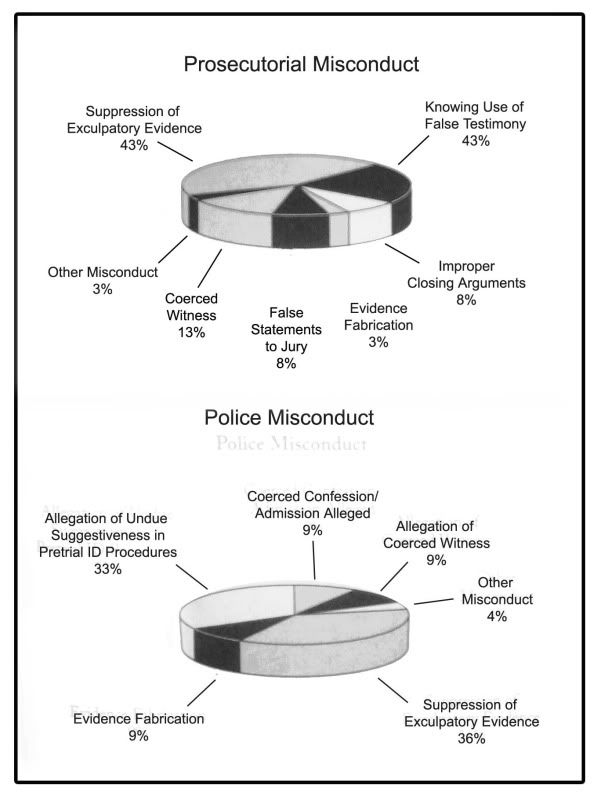 “For 63 percent of the DNA exonerations analyzed by the Innocence Project study,” the book reports, “misconduct by police or prosecutors played an important role in the convictions.” That is, in a solid majority of cases, procedures that are either illegal or improper, as opposed to simple mistake, contribute to wrongful conviction. The degree and even definitions may vary, but this figure could be as easily conservative as it could be inflated. See the pie charts from the book, at left, for breakdown of misconduct type, including outright evidence fabrication by police in one case out of ten.
Even in the frequent cases where such wrongdoing is partially exposed, it’s rarely if ever dealt with properly. One exception that proves the rule, in part, is the case of trooper Fred Zain, on which the previous post closed. One man that Zain’s pseudo-science helped put away was Glen Dale Woodall, given a sentence of 335 years plus two life terms for two 1987 rapes. He was eventually exonerated by DNA, had rather strange leading of the witnesses exposed, and was released about an eternity earlier than planned.
Woodall was also given a hasty and unexplained cash bonus by West Virginia. A State auditor looking into the Zain brand of political science wrote in undisguised alarm: “based on that investigation, I have recommended that the case be settled as quickly and quietly as possible, as the potential exposure is catastrophic.” To avoid a trial, Woodall was offered and took $1 million to much public protest. The “reign of error” over the lives of many was exposed anyway, and other exonerations followed, with larger settlements yet and increasingly quiet complaints. The West Virginia Supreme Court in 1992 found Zain’s 0% science record “shocking and egregious,” and ruled him and his work invalid within the entire state. He was already operating out of Texas by then.
The above is an extreme example, and another came a couple states over in Illinois. In the spring of 1999, a handful police investigators and prosecutors from DuPage county, seven total, were formally charged and tried for perjury and a rare little crime called obstruction of justice. This was following the disastrous exposure of their epic railroading of Rolando Cruz for a brutal 1983 child-killing. The usual slate of bad evidence did the trick, starting with several leads from “crazy Alex” Hernandez, who offered the police several names, including Rolando Cruz, to earn the big reward. They chose to indict both Cruz and Hernandez plus a third man whose role faded with time. It was announced on “the eve of the Republican primary for the DuPage County state’s Attorney.”
The case at first had no evidence aside from the standard “scientific” clues “linking” them to the crime, like so many others have been wrongly linked in the past. The most important clue the police swore by at trial was how Cruz obliquely confessed, by admitting a dream or vision with forensically exact details of the attack. Reading the account of it, it really is hard to conclude otherwise, but they had made no record of this May 1983 discussion at the time. They further let Cruz walk away after this admission, and made no mention of it at the later grand jury hearings issuing the indictments against the two.
Prosecutors only learned of this smoking gun evidence on the eve of the trial, which suddenly changed into something formidable. “More than a vision, the statement was nearly a miracle,” the book muses. The defense tried to block the account as evidence, but failed. The procedings were complex, with both men tried and sentenced together to life, then tried again separately, turning Cruz' life term to a death sentence. On appeal, both convictions were thrown out dur to “mistakes,” not misconduct. The state pressed on through it all, blocking appeals and re-trying the mistrials.
The case started falling apart early on. A shoeprint analysis done voluntarily by Nike, confirmed by an internal criminologist finding, destroyed one prosecution clue. This was concealed from the court. And more to the point, another child rapist admitted to the very crime and verified neither Latino was involved (and DNA later confirmed this), but stubborn officials pushed on, even as the people they sent out to do it started resigning.
A detective had been cited to support the vision story, but was only called to testify for Cruz’ third trial in 1995. Expected to corroborate the miracle, at the last minute he “searched his mind” and admitted he was on vacation at the time. He was summarily dropped from the prosecution's witness list, which was the last straw for the judge. The book describes the end of that ugly road:
For judge Ronald Mehling, that was enough. […] He held a picture Jeanine Nicarico up in the courtroom. For twelve years, longer than the little girl’s entire life, the state of Illinois had pursued Rolando Cruz, with highly suspicious testimony and outright fakery. The case was over.Following this unusual and devastating reversal, the law started looking at itself a little bit, and hence the 1999 trials. Some grand jurors had sworn that there had been off-the-record murmurs of the dream confession at the time, and the judgment found fault only with the police failing to write down the confession dream, avoiding the obvious question of whether they made it up and colluded to present it as true.
Of course, no convictions were finally brought in the case, with no willful misconduct found. Lucky for the state treasury, faced with monster lawsuits over the sick episode. The authors note even this near-miss with accountability was “a singular event, done at great cost and turmoil, and unlikely to be repeated.” So only the most “shocking” and “egregious” violations have ever come close to having serious consequences. And as the high conviction records across the nation for tough crimes shows, there’s every reason to go ahead and twist the case to fit whoever will suffice. I’ll let the reader do the math on that.
Victim: Walter Snyder
19-year-old Walter T. Snyder of Virginia was sentenced in 1986 to 45 years for attacking a neighborhood woman. She was raped in her home by a black male with short hair and a “musky” smell. She never got a good look at him, but police practice helped enhance her certainty. Detective Barry Shiftic somehow took a photo of Snyder, her neighbor across the street, within days of the crime. He presented it that same day to the victim along with others, and she didn’t recognize any. But she came back to Snyder’s photo indecisively, and was informed that he lived in her neighborhood. Three days later she just happened to look out a window she rarely did to see the same man washing his car right across the street, for the first time she later said, and just knew it was him.
Back at the start of this rapid coalescence, on the day after the crime, the victim responded to Shiftic, “I know exactly what kind of hairdo you are talking about. In fact, there is a fellow that lives right across the street that is very much like what I am talking about, and he has a hairdo like that.” [p 59] This starting point was instantly and thereafter denied by both victim and detective, but it’s on the record – she mentioned him first, then the photo and the ensuing multi-day ... charade?
At the station following his unorthodox identification, officers coached Mr. Snyder to admit the rape, posing hypothetical cases with her starting it. Besides insisting his innocence, he recalled mentioning to the detective that whoever did it must have been out of his mind. However, “by Shiftic’s account, Snyder spoke about being physically present at the rape but his mind not being there.” There was no record to clear up the different readings. The detective instantly arranged a dramatic and improper one-on-one “show-up” identification. The victim arrived to see Shiftic but first passed “her attacker” who’d just “confessed” minutes before. With great terror she fingered him again, and the kid was arrested. He also suffered three broken ribs in a disputed incident, and reportedly said he was Jesus Christ.
Evidence like shorts he owned (red as she said, when shown inside out like they were in court) and a hair analysis that wasn’t even a match were taken as supports. The showstopper however was the victim’s emotional certainty, arrived at as described above. As the book sums up, “the case against him was built on evidence that was, by any reasonable standards, compromised, corrupted, and unsafe.”
Both the victim and the detective denied steering things to Snyder, but as we can see above they clearly did one way or another and other things shifted around suspiciously. She originally said the rapist had smelled “musky,” like “sweat and alcohol and possibly cigarette smoke.” After learning the man she identified lived in his mother’s basement and worked in the fuel oil business, she suddenly remembered he smelled “musky … a combination of oil and a basement – a musty smell.” [p 56] Thereafter, Snyder’s known work with oil became a prime prosecution point.
The young man was convicted and remained behind bars for years, even well after DNA tests were finally successful, all but bankrupting his hardworking family along the way. No one could argue Snyder was guilty, but due to limits on new evidence (a tragic 21 days in Virginia at the time) the Governor had to pardon the innocent, and he refused to do so until public pressure mounted on him. After his release, detective Shiftic remained convinced of Snyder’s guilt, wondering if the DNA samples had been altered in some conspiracy. And even if he were innocent, Shiftic told the authors “I have no remorse for anyone that I have ever arrested.”
Victim: Abdelbaset al Megrahi?
This is not in the book, obviously, but in context, it’s worth thinking about. A re-analysis of the shady details of the “investigation” is too much for this post but it’s well covered in many others, The overall evidence is perhaps best addressed in toto at the guided tour of the case against Megrahi.
One consistent theme in the book that may reflect on al Megrahi's conviction is prosecutors’ desperate refusal to admit when a killer simply got away with it. They are seen as needing to convict someone, and do it, wrongly if necessary. No one ever gets framed for shoplifting when the thief makes it away and isn’t identified. But something that shocks the community like the rape and murder of a child, or blowing up an airliner with 259 people on board, requires a head on a platter. If the right one can’t (or just won’t) be identified, then look out fringe people from easily-maligned groups, engaging in anything unusual at all the day of the crime.
The Scottish version of the UK Criminal Cases Review Commission, which Actual Innocence cites as a model for a possible American institution, has reviewed the case against Megrahi. After almost four years of laborious study, the SCCRC found, on six grounds, that the conviction may well have been a miscarriage of justice. No one million dollar settlement would suffice here, after Libya was forced to pay out $2.7 billion on the verdicts premise. Luckily for some, that appeal was never heard, due to something very confusing that happened in August 2009.
There is no DNA sample to re-examine in this case, so both hard science and Project Innocence might seem to have little to offer. So what’s our DNA test proving innocence? What could even hypothetically suffice?
Reconciliation, Sort Of
Ronald Cotton is yet another victim of a miscarriage of justice, convicted of two rapes and later exonerated. One of the victims who had helped misidentify him spoke with the authors, and the media at large, about her complex feelings. She felt repudiated and hated for putting an innocent man way and even though another man, Bobby Poole, was later identified by DNA as her assailant. “When I have nightmares about the rape, I still don’t see Bobby Poole,” she explained.
It’s still Mr. Cotton haunting her mind forever despite a face-to-face meeting she arranged with him and his wife after learning of his innocence. He forgave her for the mistake that cost part of his life, and expressed sympathy for her own shattered years. She told the authors “It’s weird, I hated him so much I wanted to watch him die. And now I care a lot about him. He taught me grace and forgiveness.”
Any of these victims who had wrongly identified someone, who lunged at them across the witness table and convinced a jury to send him off for half a lifetime (or half of a small town's lifetimes), could have asked questions. They had or should have had the right to go back and review their own case, to be sure the right process was followed and the right man punished. Depressingly few do so, preferring to move on in whatever direction has been established. They only face the error and its implications - as well as they can - once it’s proven without doubt. If even then.
In the Lockerbie bombing, at least one victim isn’t waiting for the far-off or unreachable exoneration. On his own, Dr. Jim Swire has re-assessed the case against his daughter’s convicted murderer, as he was being tried. The far-seeing Dr. Swire says the evidence led at trial in 2000 convinced him the men in the dock were innocent, and helped him see just who was likely behind it – the PFLP-GC, with a Khreesat bomb loaded at London, as an increasing number are now accepting. He literally fainted at the verdict of guilty.
Meeting Megrahi again in 2010, a year after his controversial release, Swire said of the "Lockerbie bomber"
"We are friends. I believe he is the 271st victim of Lockerbie. We know enough about the other to be confident to know we're trying to achieve the same thing - a re-examination of the verdict [… and] of the available evidence which led to a verdict we believe was reached under political pressure rather than the rules of justice.”Is this case different, or what?
---
(emphasis mine throughout)


