Showing posts with label Feraday A. Show all posts

Feraday's Forensic Follies, Section Sixty-Seven

June 11 2010
last updates June 11/13 2011

A few days ago I posted a collected timeline of forensic finds and coclusions from RARDE's "scientists" Dr. Thomas Hayes and Mr. Allen Feraday. These were supposed to have led to the identification of a vaguely Libyan radio model holding the bomb - Toshiba BomBeat RT-SF16. The end result is bizarre, with a hundred implied complications, like those presented by a tiny bit of blasted circuit board dubbed PT/30.

This 3mm x 4mm  fragment was allegedly found on June 8 1989 by Dr. Hayes, or June 18 by Feraday, depending. Both versions match on where it was found - embedded in a piece of soft blue American Toursiter suitcase owned by victim Karen Noonan and labeled PK/2128. [Leppard p207] Its PT number is lower than the famous PT/35 found weeks earlier (on paper), as noted by the defence at trial. This would be unusual if not for all the rest being just as out of order (see PT/31, PT/56, etc...). Stranger yet, Dr. Hayes' examination notes of PT/30 read in part:
It has been partially delaminated by the blast and, hence, does not possess the expectedgreen lacquer and/or solder tracking upon its rear face as this has been ripped completely away. The upper [brown] face of the fragment bears part of the white painted characters C32 and a depiction of an electrical resistor.
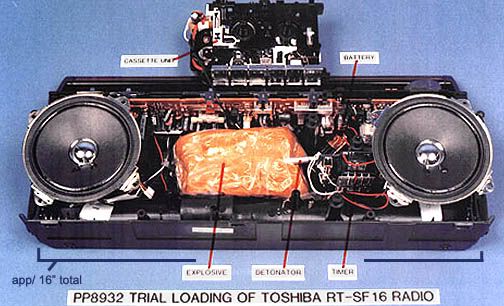
Consider the sample loading of the alleged bomb (below) in a normally-assembled RT-SF16 radio (minus its cassette assembly). The main circuit board is the one seen along the top, brown-colored component side down. This surfaces is that painted with little white markings that survived the blast of that Semtex about one inch distant. It was the inverse side, green lacquered and tracked with solder, that was blasted away. Was the board backwards?

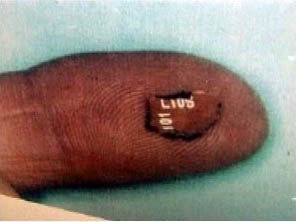
PT/30 is not alone in having its painted face survive readable and unburnt. Consider this largest portion of the earlier find AG/145 (at right). Its markings "L106" and "101" are plain as day, and only the edges are burnt a little. The smaller part of AG/145 is similarly marked, with "02." It would thus seem the terrorists allegedly scraped off all those little  components off their contacts and flipped the board backwards to fit it back in. Except that the AG/145 fragments also had nice green backsides that showed no sign of blast either, and allowed the first identification in February.

Anyway, to bring this back to Feraday, he was reportedly excited about PT/30 turning up. The radio model RT-SF16 was already identified on May 11, we hear, and this fit it just as perfectly as the AG/145 fragments did, and was noted immediately by Hayes on June 8. So Mr. Feraday reportedly waited a few months, and then in September took the thing to the evidence holding facility Dexstar to see if it could match anything there.

Later, in December, DI William Williamson sent SIO Henderson a memo describing this: "On his visit to Dexstar on 14 September 1989 Mr Feraday viewed a large number of items of circuitry which had been withdrawn for his examination; none of these items was a match for PT 30." [Leppard p 207] (note: PT 30 is just Leppard's way of writing PT/30 - space instead of slash. It's the same item)

Williamson went on to ask Henderson to look into inspecting evidence held by the Germans to see if a match could be found to Khreesat's work - particularly some alarm clocks he was known to have bought. Feraday had "on a number of occasions repeated his keen interest in any item of circuitry," Williamson explained, "or indeed in any digital clocks or other similar items which could contain a circuit board for examination and comparison at RARDE against produsction PT 30." [Leppard 207-208]

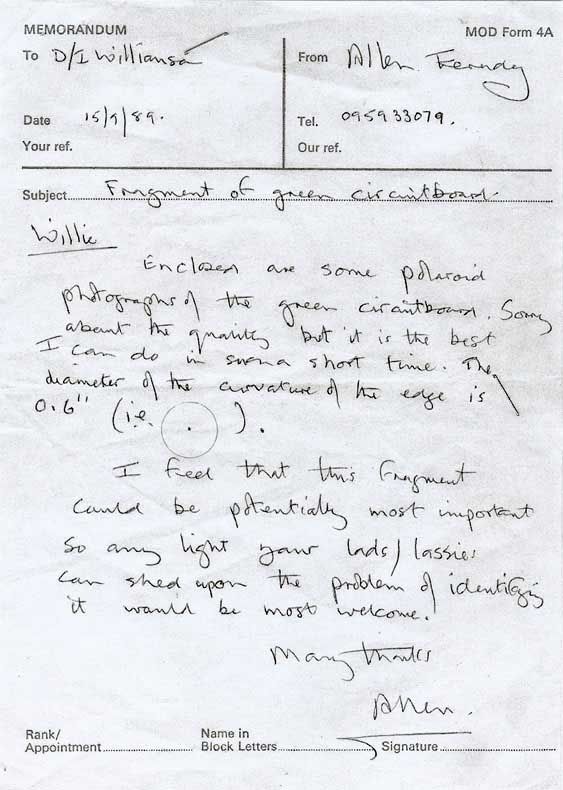
Earth to Allen, your science guy Hayes has May 11 as the date he IDd the radio, and on June 8 found that PT/30 matches it. Why the running around drama in mid-September looking for some whole other fit? The obvious answers somehow elude this blogger, but one thing I notice is the timing of this fevered search relative to a more fruitful circuitry quest: PT/35(b), the lucky corner of a Libyan MST-13 timer main board. The day after Feraday's reported inquest at Dexstar, evidencing that "keen interest" in circuit board clues, he sent a memo to the same DI Williamson cited above. This was regarding a four-month old (on paper) find by Dr. Hayes.
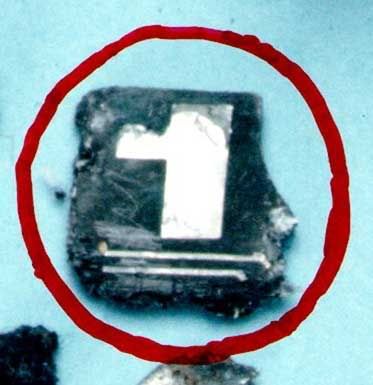
In retrospect, this memo is rather vague, not mentioning PT/35(b) by name or giving many direct clues. It could almost be about PT/30, except for the cited curve. Only the mammoth MST-13 chunk and its double-underlined #1 is large enough for that detail. By my rough measurement of a scaled MST-13 jpeg the curve at upper right has a 0.5" diameter. I'd defer to Feraday here.

So this is a letter about that amazing but yet unidentified clue PT/35(b), keenly ignored it seems until that date - four months after the paperwork shows it found. But only one day after Feraday's own foray over the already identified PT/30 (says the same Williamson months later).

Or am I just making too much out of a simple mix up? Not likely, as that memo of December 19, just ahead of the anniversary, shows Feraday behind the scenes urging yet more bogus action over the already identified circuitry. Over six months following its match-up with the known bomb radio, he was pestering Williamson to pester Henderson about trying to find a match for PT/30 over in Germany if possible.

If all these things are the true exploits of professional and even-handed investigators ... my God, what kind of MKULTRA experiments were they doing with the ventilation at RARDE? No, these "facts" must have appeared as they were convenient, with little regard for those which came before or after. It's the only sane explanation.
---
Update June 11/13, 2011
Some amazing screen grabs from Al Jazeera English's new video.

AG/145 fragments, separated and partly cleaned, hugely magnified and looking less burnt to ash than ever:
Here's the second largest fragment, placed against its spot of origin on the brown/orange, lettered, blast-ward side of the board.
And here is the backside of the larger one against the green, shielded, solder-tracked side.
It's this precise match-up, Allen Feraday said, that helped him at least narrow down the radio model by mid-February 1989. In both images, note the material - flimsy, paper-fiber-and-resin, not fiberglass.

As we can see comparing the first and third of these images, neither side of that largest bit shows any sign of blast damage (extreme heat, for example). But where on the board are these fragments from? The middle, just one inch from the Semtex supernova? Or at one of the ends, a couple of inches away? There's an image that clears that up, and they showed it as well in the video, bless them. I compared it to the assembled IED mock-up, rotated so features matched. I then indicated the rough areas for both AG/145 and PT/30.
That gives at most about 1.5 inches for the blast wave to chill-out, and nothing but the flimsy little capacitors (or ??) attached to those spots to shield the face. The left-hand one is in as good a spot as it gets to survive, but still, I can't cite the measure of the force of this blast except that it ruptured an airliner's hull at two feet distant, after being slowed by the luggage container, the suitcase, the clothing, and the radio's case. Before all of these, at 1.5 inches, tops, fresh and full-force ... No way.

Beyond that, do recall, as explained above, that Hayes found PT/30 had the wrong side - the green one - blasted away, while all of AG/145 shows damage to neither side. Another oddity is that both AG/145 at PT/30 would go about the same direction in the blast wave - out from the center in all directions. If PT/30 were blasted straight down, AG/145 should go down and to the left pretty much.

Officially PT/30 wound up wedged into the outer frame segment (IIRC) of the blue softshell on the container floor, just beneath the bomb bag - if so, why would AG/145 wind up, as Mr. Thomas Claiden testified, blasted into a fold of the data plate, on the outside of the container, halfway up its side, two feet or more above the bomb bag?
---

IED Fragment Survivability Tests

(incomplete)
last update Jan 31 2011

The Basics and Prosecution’s Case
The heart of this Improvised Explosive Device (IED) that tore down Flight 103 was Semtex-H, in an amount that can only be estimated. Official guesses at the weight are not widely reported, but Professor Christopher Peel of the Royal Aeronautical Society, at the Zeist Trial in June 2000, testified to his calculations; around 450 grams was used, and wound up a bare 25 inches from the plane's fragile skin. These findings were challenged by the Defense, according to the Scotland Herald, but Peel doesn't stand alone. [Source]

There were also forensics tests, reported by David Leppard in his 1991 book On the Trail of Terror, that are said to confirm "RARDE's initial assessment that the bomb had contained about 400 grammes of Semtex high explosive - less than a 2lb. bag of sugar." These were the Indian Head tests carried out April 89 in the USA by RARDE's Ferraday and FBI's J. "Tom" Thurman. Interestingly, Leppard cites this confirmation as "the explosive charge used to bring down the plane was 'in all probability' about 454 to 680 grammes or 1 to 1 1/2 pounds of Semtex." [p 139-141]

I'm no expert on how much energy is unleashed by 454-680 grams of this legendarily powerful compound. But consider the "trial loading" below used at trial (image found here and improved the labels a bit, added width notation). This is the alleged bomb - a Toshiba RT-SF16 "BomBeat" radio with explosive, a detonator rod, battery and MST-13 timer without waterproof casing, all fitting in a remarkably small case, about 16 inches across. It has the cassette assembly, about 4 inches wide, removed to allow the pat of semtex. This makes the timer, it seems, no more than two inches from that origin of the blast - inches of mostly air, not lead.

According to the officially accepted evidence of what actually survived these circumstances, refer to the following crucial evidence attested to.
- Fragment of bomb timer circuit board
Obviously, the half-inch square fragment of circuit board named PT/35(b) was a crucial clue to Libyan guilt, as seen on TV with its identifier "Tom" Thurman. This is the part people have been questioning in recent years. This led to Swiss makers Mebo, who only made a few of these ever, for Libyan intelligence JSO.

- Fragments of radio housing, circuit board, etc.
These were fairly small, fragmented, melted, lumped together in far-flung luggage. The radio remains are not implausible, but didn't prove the radio type. Consistent with but not exclusive to the RT-SF16.


- Fragments of radio instruction manual

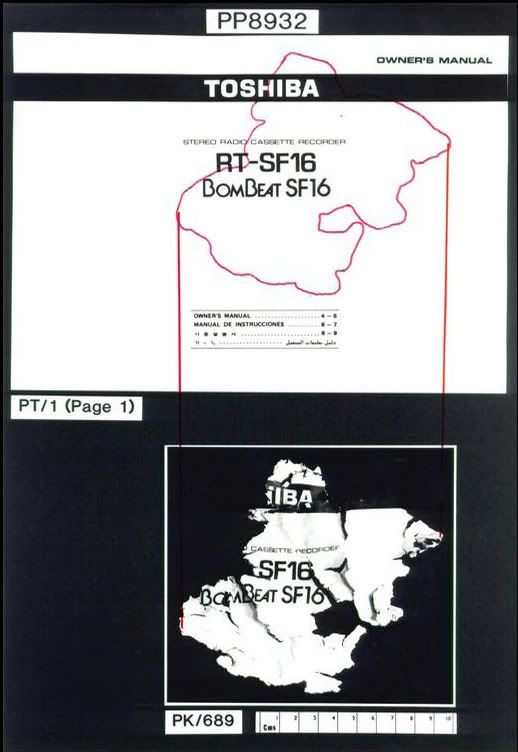
This nearly-intact cover page saying Toshiba RT-SF16, was supposedly found in a field and brought in by citizens. This and other page fragments clumped together were consistent with a RT-SF16 manual, and convinced the Zeist judges of the model. This was presumably in a plastic sleeve, packed snugly in the radio box, perhaps three inches from the explosive center. Result - crumpled and torn a bit, slight singeing.

If it's bizarre, it's proportionally useful; the radio model itself is said to indicate Libyan guilt. It's not very conclusive, but 3/4 of the small run of RT-SF16s were sold to a company said to be connected to Libyan intelligence.

A Challenge: Dr. Wyatt's tests
Over the years, critics have contended the amount of explosive really used, their type, their placement, and whaether or not i would be strong enough to rupture an aircraft, or too strong to have left the clues that were found. The last question was brought to the fore, and left there it seems, by recently announced experimental evidence. Repeated tests simulating the alleged conditions indicated that larger items like, in particular, the famous bomb-timer fragment that nailed Libya, would have never been found if they were in the explosion. This was aired by, of all parties, the BBC program Newsnight, on 8 January, 2010. The program is currently viewable at this BBC page and definitely worth a watch. The tests were carried out by Dr. John Wyatt, an explosives expert retired from the British Army, now running a security consulting company called SDS, and is a blast consultant for the United Nations (Europe and North Africa region). The details behind how he came to test the official scenario – twenty times over - is unclear at the moment, and so far there’s been no detailed report of his methodology and precise findings, but just what the program shares is compelling enough.

From what Marshall explains in voice-over, Dr. Wyatt carried out his twenty tests over time, starting with the radio bomb detonated by itself. One sample he showed the cameras is at right, a suitcase filled with random clothes, and a radio (different model than alleged, a bit larger), rigged as a bomb and set in a homemade cardboard box. Another he showed contained yet another type of radio, bright red, and a suicase he says is the same model used for PA103 (Samsonite hardside). Both were soon after blown up with the pat of plastic explosives tucked inside. Of the consistent results, Wyatt told Newsnight:
“I must admit, since the quantity of explosives we were using was only three or four hundred grams, I thought there were going to be some remnants of the radio left. But it – it – (chuckling) it just totally disintegrated. I mean really just went into tiny, tiny bits."
Please note that he was using amounts, if this accurate, of 300-400 grams, when the Indian Head Tests considered 454-680 grams the likely force behind the half-inch readable chunk "found" in the Scottish countryside. Wyatt elaborated a bit on method to The Times of Malta, specifying a separate timer was included and considered, as well as the general radio unit, and that the tests were done in varying conditions.
"We tried exploding the device on its own; in a radio similar to the one it was supposed to have been planted in; in a suitcase with and without clothes; surrounded by other suitcases and, eventually, in a container. In all tests, the timer and the circuit board were completely destroyed."

He later “built the tests up” to a finale – a dozen or so pieces of luggage piled in an airliner luggage container, arranged among other containers, and detonated in a field, videotaped from several viewpoints. This last was the only outdoors test; he told the Times he had done the other 19 indoors, “to make sure we could collect all the evidence.” Collecting the remains is what it was all about, of course, and so they used sparse concrete rooms (rather than a hundreds of square km countryside) and “we even painted the circuit board bright yellow to make it easier to identify any fragments among the debris. In no circumstance did we find any fragment," Dr Wyatt explained. Presumably he means no fragments of the scale of PT/35(b), since elsewhere he does mention “tiny tiny bits.” Perhaps the yellow was simply cooked off in all cases?

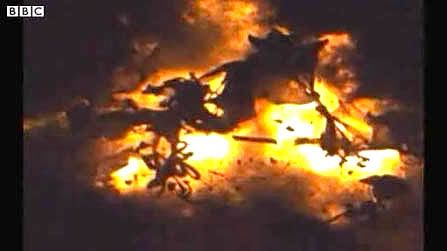
Above is a dramatic image from one of the tests, in a darkened room and greatly slowed down. The curly stuff is presumably the "hard-side" suitcase material, the little bars parts of its frame. The white-hot cluster at center is that 3-400 grams of explosive, semtex it should be, consuming the whole radio and vaporizing/weaponizing everything around it. Do consider that the bomb penetrated the plane's hull, after losing force bursting from the luggage container, after tearing through the suitcase lining, surrounding clothes, cardboard box, and the radio's plastic casing. The timer would be got to right away, before any energy was lost in an of those battles. Is Wyatt's testing just an elaborate (and expensive) way of proving the patently obvious?

Presented by Newsnight host Peter Marshall with the official story again - that a 1cm square chunk of circuit board so near the blast survived inside a small piece of cloth, and was found on the ground, during manual searches, 35 km from Lockerbie? Dr. Wyatt stopped precisely this far short of calling it all a grand farce:
"Obviously these things are not impossible, we only carried out 20 tests, we didn't carry out 100 or 1,000 tests, but in every of those 20 tests we found absolutely no sign at all. So I find it highly improbable that you would find anything like that, particularly at 10,000 feet when bits are dropping into long wet grass over hundreds of miles. […] I do find it quite extraordinary and I think highly improbable, and most unlikely that you would find a fragment like that – I mean, it is unbelievable.” [emphasis as spoken]

Response and counter-response

- Crown Response / Indian Head Forensic Tests
A Scottish Crown Office response quickly followed. It started with a standard appeals to 'we already won, he was convicted,' which have no bearing on the issue at hand, which cuts to the how of the conviction. They note irrelevant facts like "Dr John Wyatt has never examined the timer fragment (PT 35)." Indeed, only certain scientists who have a history of "political" science (Feraday, Thurman) were allowed touch this one and decide it was indeed from the Libyan explosion. Erroneously, the Crown Office state "conclusive forensic evidence proved that the fragment was part of the timer ... at the time of the explosion which destroyed Pan Am 103." Such tests apparently consisted of finding it in a burnt piece of shirt. They did not test it for explosives residue, or do anything to prove it was not planted for them to find. Most interesting and relevant, the press release stated:
"In fact, extensive explosives tests were carried out in the United States in 1989, some time before the fragment PT35 was extracted by the forensic experts, as part of the Lockerbie investigation. The purpose of these tests was:
o to estimate the amount and location of the explosives used on PA103;
o to establish the extent of damage to the improvised explosive device ( IED ), the adjacent suitcases and their contents; and
o to ascertain what parts of the IED and its contents it was possible to recover and identify." COPFS original posting
This fragment survivability aspect is not mentioned in Leppard's book, but hinted at with the note that the clothing within the IED case was “sprayed with a distinctive colour of paint for ease of identification.” [p 139] The Crown office release continued to explain what was found:
"After a number of test explosions a detailed search was made and circuit board fragments, radio cassette casing and parts, fragments of instruction manual, the suitcase and clothing were all recovered in a condition which was consistent with the debris recovered in relation to the Lockerbie disaster." 
The results of these tests have never been formally publicized to my knowledge, making verification impossible. David Leppard does cite a varying amount of explosive in each test - from 360 to 680 grams. [p 140] Interestingly, Alan Feraday had overseen the low end test, and probably recovered the debris from a 360-gram blast "in a condition which was consistent with the debris" that started being found and identified by Mr. Feraday himself and his scientists, right afterwards. RT-8016 radios were used in the US tests, exactly like the model later identified from 103's wreckage, except for case color - the 8016 is white, the SF16 black. The best identifier of the radio model, aside from the amazing manual, was AG/145, a lump of material including a tiny but identifiable bit of internal circuit board. This was consistent with either Toshiba model.

Conclusion: More Information Needed
If indeed there's something in the Indian Head tests that clearly contradicts Dr. Wyatt's findings, and large fragments (up to 1cm square) were indeed recovered from an equivalent blast, the details should now be brought forward. Dr. Wyatt insists 300-400 grams of semtex disntegrates the whole radio, and shown us at least some of the methodology. On the other hand, we've got a few lines in an error-filled Crown Office press release suggesting that Thurman and Feraday did it right and got big chunks similar to what they found - and that they felt was after a blast of 454-680 grams.

That is a serious discrepancy. Obviously the laws of physics are immutable and unchanging, so if two sets of tests produced different results, then some variable was set up differently (wrong) between them. So far Dr Wyatt's is more open, better illustrated, makes more sense, and reeks less of politically-driven obfuscation, but Id like to see more documentation on that as well.
---
Update: A little more information has come out on the tests since the first article. See "On Planted Evidence"

Update Jan 2011: Dr. Wyatt's findings and credibility are in some question. See later comments below.

The Political Scientists of Lockerbie: An Overview

3 November 2010

Science Well Done, Answers that Make Sense
Following the bombing and fall of Pan Am Flight 103, and the sudden deaths of 270 people, quite a a number of extremely important questions needed answered. Many of these were best addressed by the rigors of physical science - gathering and analyzing the debris of the crash to form as clear a picture as possible of just what happened to that aircraft  The aircraft debris and break-up analysis was tasked to Mick M. Charles et al. at the UK Air Accidents Investigation Branch (AAIB). I see no reason to dispute their findings or methods. (AAIB report) It showed where the initial failure occurred, petaled-out panels indicating a powerful explosion in the vicinity of cargo hold station 14L.

Container AVE4041PA, the luggage "pallet" that occupied station 14L, also showed signs of extreme blast damage and was ruled by the AAIB to have held the primary (bomb) suitcase: The container was studied in particular by Thomas Claiden at AAIB. There are some minor points of strangeness with his findings (and they're named AI/100 and AG/145), but on balance his findings seem sound. It established the approximate blast center, most likely in a case laid flat, with one case between it and the floor, at the outboard end of the container.

Likewise, the Scottish police and their allies should by default be trusted in their painstaking collection of thousands of blast-related pieces of evidence from across hundreds of square miles. And after the in-gathering, their own book-keeping should be presumed to show signs of tampering if such even conceivably happened at their end. For example, Detective Douglas Roxburgh, who headed the store house at Dexstar, would have noted debris being removed without a proper cataloging. In fact, he did report this to his superiors at the time.

At trial in 2000 he didn't seem to recall this removal being a big deal or anything nefarious. Nonetheless, there are certainly ways, from the inside or the outside, to alter the police records to accommodate evidence slipped into certain key spots. This may sound like an absurd consideration to many, but on further reading one can see why it's worth keeping in mind.

A Critical Three 
The most relevant material to determining who was responsible for the bombing also happens to be the evidence with a cloud of questions surrounding them. The accepted evidence from closest to the bomb, and three particular scientists at the heart of it - two with the UK military's RARDE agency, one a special agent with the FBI, all known for returning politically useful but scientifically questionable decisions. Hence the "political" scientists of Lockerbie.

The Royal Armaments Research and Development Establishment (RARDE), a branch of the UK military, had an explosives forensics lab (sometimes called EC3) that had helped in previous terrorism cases involving the IRA. The blast science side of the Lockerbie inquiry was assigned to EC3. Journalist David Leppard, a huge RARDE fan, wrote in early 1991:
"The Lockerbie case team was led by two men who were considered the best in Britain. They were Dr Thomas Hayes, the senior forensic scientist, and Allan Feraday, his deputy. The remarkable work which the two men were to undertake over the next two years was to provide the cornerstone of the entire investigation.” [p74]
Just who among Hayes and Feraday did what neither could recall - they both signed off on the final report of 1990, but remembered nothing specific at trial in 2000.

Part 1: Thomas Hayes
Dr. Hayes was the head investigator at EC3 during most of the time debris was being studied there. He had previously been involved in the Maguire Seven case of 1976, signing off for science that helped put away seven people for supplying the explosives used in a string of IRA bombings. On review in 1990, the basic science was found to be consciously skewed to secure the convictions, which were all overturned. It was apparently this review that led Hayes to vacate EC3's top spot, leaving his deputy Feraday to take his place.

Part 2: Allen Feraday
Mr. Allen Feraday (no PhD) headed the lab from late 1989 to RARDE's elimination in 1995. He had not a single prior case that would fall apart - he had four. A mass-murdering IRA bomb mastermind, a supplier of Syrian terrorists, a Libyan planning to supply someone for bombs, and three IRA terrorists who deserved to be shot by the SAS because they could have blown a bomb. All these opinions were later questioned or tossed out by courts. For decades Feraday served the Crown loyally and robotically, with an eye to political objectives of his superiors rather than to science and truth. In one case it seems an innocent man was targeted in lieu of a known IRA bombmaker whose prints all over the device were ignored. Feraday helping terrorists get away?

All the above cases hinged on Ferraday's supposedly vast understanding of electronics and circuitry, and he showed the same interests in the Lockerbie case. He made a project of identifying the radio model used, and months later, identifying the fragment of Libyan timer that turned up. This he personally escorted on its mid-1990 journey to the United States (see below). In these and other ways unseen he played a key role, in ambiguous collaboration with Dr. Hayes, laying the "cornerstones" of an investigation that most impartial observers recognize as horribly crooked and geared towards securing a rather ludicrous conviction.

Part 3: "Tom" Thurman 
Among the American experts brought in was FBI special agent James "Tom" Thurman, described by mainstream reports as "one of the bureau's best explosives technicians." Others have said he has no formal explosives training, but rather a degree in, literally, political science. The reality may be in the middle - I'm still sorting that out.

Agent Thurman was ordered to Scotland, along with other folks from the FBI and FAA, on the night of the crash. Starting soon after, he helped locate and assess the blast-damaged clues. There's reason to guess he might have been the guy that set off Roxburgh's alarm bells. Otherwise, I see no great reason to question his findings here. Again, it's closer to the blast center that the clues get weird.

The Scottish police handled most of the rest, and Hayes and Feraday zoomed in on the analysis of the bomb-damaged luggage. Thurman was however called on to make a second appearance in mid-1990. In June he helped identify the crucial timer fragment PT/35(b), in a remarkably short and focused quest. Upon making the link with top-secret CIA help, Thurman then had a look at the actual fragment, brought over by EC3 chief scientist Allen Feraday. Both eminent minds agreed this was a piece of a Mebo MST-13 timer, sold only to Libya in a tiny batch of 20.  Convenient.

The fragment's genuine blast origin was doubted by neither of these two supposed explosives experts, nor by Dr. Hayes. Not all scientists outside their little loop agrees, however. Consider Dr. John Wyatt, involved in tearing down Feraday's work before, who later found in a dramatic series of twenty tests that even at a fraction of the official blast power, all surviving remains were many times smaller than PT/35(b).

As the dedicated post will explain, Thurman has been widely criticized for his lack of real knowledge and lack of credentials. That I could forgive if his science was solid. But he was later drummed out of the FBI crime lab for misleading practices, which is clearly more problematic. His other cases are high-profile - including the 1989 Libyan bombing of UTA 772, and the 1995 right-winger bombing of the Murrah federal building in Oklahoma City. Potentially troubling stuff, which I also haven't got sorted out enough to comment on yet.

Allen Feraday

The Political Scientists of Lockerbie, part 2/3
First Posted 26 October 2010
last edits 29 October


Introducing Allen Feraday  
At the time of the Pan Am 103 bombing, Allen William Feraday was the top deputy to Dr. Thomas Hayes, head of the forensic explosives laboratory for RARDE, the Royal Armament Research and Development Establishment. Following Hayes’ departure in latter 1989 - to become a foot doctor - Feraday took his position as the lab‘s director. Both men were formative in the science of the Lockerbie bomb suitcase, as officially understood. Their work on that ran parallel to the shuffling about, which was apparently connected to a probe of Hayes’ involvement in the shady Maguire Seven case of 1976 (see link above).

Patrick Haseldine’s famously deleted Wikipedia page on Alan Feraday sums up nicely that he “has appeared as an expert witness at criminal trials leading to convictions in at least four high-profile cases, three of which were subsequently overturned on appeal. The appeal in the fourth case is ongoing.” [1] Of course that last is no longer pending, as of August 2009 when Abdelbaset al-Megrahi surrendered his appeal of conviction for the bombing of flight 103. I’m not entirely sure how many other cases he’s been involved in and how these turned out, but the four are interesting and I’ll opt to show the same basic bias, aside from mention of a fifth case that has been challenged but not to my knowledge overturned.

On the other side of the spectrum of opinion, David Leppard, in On the Trail of Terror, offers effusive praise for the man erroneously named in the index as “Dr. Allen Feraday.” [2] It’s been widely acknowledged he has no formal training on a doctorate level, only a Higher National Certificate in Applied Physics and Electronics that was apparently pretty old; according to Leppard, the good “doctor” had beneath his belt a solid “34 years explosives experience” as of writing in 1991 (or since 1957, by my math). [2 p74] A 2005 article by Michael Tierney and run in the Herald (Scotland) said Feraday was then “in his sixties,” and had retired a decade earlier with “42 years” experience. [3] If that’s all true, he could be born no later than 1935, and started work with bombs in 1953, at around age 18 at the oldest.

Just what he was doing there for the decades before the 1980s is unclear from available evidence. But he acts like a paranoid spook, as Leppard’s book expands:
"Not surprisingly both Feraday and Hayes were high on the IRA’s death list. ‘He’s very, very good, so obviously he’s subject to high-level security precautions,’ said a Scotland Yard Bomb Squad expert who has worked closely with Feraday on IRA cases.  
Feraday is the archetype of the secret scientist. He travels to work in a hire car which he changes every week. Even some of his closest colleagues do not know where he lives; just that he has a wife and family and they live somewhere in the south of England.” [2 p74-75]
Fighting Terrorism with Circuitry
But the phase of his career under consideration here is less about bombs than about electronics. The oldest of the high profile cases in question was only in 1983, with the prosecution of businessman John Berry, a former Royal Marine Commando. His company was selling electronic timers to the Syrian government. He didn’t seem to know what exactly they were to be used for, but it could have been anything, he and his defense argued. But the judge didn’t buy it after hearing the Crown's lone expert witness, the eminent Allen Feraday.
"I am of the opinion that they have most probably been specifically designed and constructed for terrorist purposes. I am unable to contemplate their use other than in a bombing context." [3]
As Michael Tierny described it in his amazing 2005 Herald article, Feraday’s assertion was that “the absence of safety devices in the timers prevented their use for legitimate purposes.” [3] Mr. Berry was sentenced to eight years for arming Arab terrorists, later reduced to six. He served less than four before he was released, Tierny reports, but was left legally guilty in his broken life. [3]

Another man locked up for supplying terrorists was a businessman named Hassan Assali, originally from Libya, but British for twenty years. He was accused, again, of constructing electronic timers for the sole purpose of making bombs. Almost robotically, the Crown’s sole scientific witness – Feraday – affirmed their case: "I am unable to contemplate their use in other than terrorist bombs.” [3] On 24 May, 1985, Assali was convicted based on this scientific basis and sentenced to a middling term. His appeal against conviction was rejected in 1986, and he served nearly seven years before managing an early release in 1992. [3] [1] While free, he remained legally guilty like Berry.

Neither of these cases involved any actual bombs going off and killing anyone, but Feraday's next case would ratchet up his profile and the gravity of his magic. In 1986 came a break in the four-year-old Hyde Park bombing by unknown elements of the Irish Republican Army. The July 1982 blast of a 25lb. nail bomb during a military ceremony, along with a near-synchronous sister bombing at Regents Park, took nearly a dozen lives, wounded many, killed several horses, and damaged much property. This was indeed a shocking crime the IRA claimed credit for, but the exact perpetrators remained unidentified for years.

An arms cache found in the woods was eventually found to feature a nondescript circuit board which was - according to Feraday - similar to the one used in the bomb at Hyde Park. Thus linking the cache to the bombing, attention turned to the few readable fingerprints on the intact board. These were actually on the tape used on the board, and were matched to one Danny McNamee, an electronics engineer in Northern Ireland.

McNamee was arrested on 16 August 1986, and tried at the Old Bailey in 1987, presented as the bombing’s mastermind. Aside from the fingerprints, Tierney writes, “the Crown's key scientific witness, Allen Feraday, said the two [boards] were matched in design and "artwork" and therefore made by the same master bombmaker.” [3] It seems there was no other class of valid evidence against McNamee – he denied IRA involvement, and the IRA backed him up. [4] But the board, the tape, and the prints, made it clear who had done it, the Crown maintained.

Electronics expert Michael Scott. PhD spoke in the documentary film The Maltese Double Cross (1994). The McNamee case was Dr. Scott’s first view of Feraday’s work. Invited to observe from the gallery, he was able to see the same pattern the RARDE man had used in the first two cases:
“I watched Feraday and I gradually became aware that he was giving the evidence a certain emphasis that really wasn't justified, that technically couldn't be justified. […] Allen Feraday maintained, wrongly in my view, that the electronics was intrinsically sinister. [… and in handling the board, McNamee] had to be knowingly involved in bomb construction.” [5]
Mr. McNamee, his planned wedding obviously cancelled, was sentenced to 25 years. His appeal of conviction was denied in 1991, and an attempted escape in 1994 didn’t help his chances of being cleared or freed. [6]

So in at least three cases prior to Lockerbie, old-time explosives expert Allen Feraday had been able to convince judges, with his advanced science and royal credentials, that any scrap of that newfangled electronics could be proven to show terrorist intent. Taken as indisputable science, his voodoo informed the legal realities created in all three cases. Men who would later be found innocent were made guilty.

Top of His Game: Gibralter and Lockerbie
In his 1991 book, David Leppard glossed over all three cases above, only claiming erroneously that Feraday had “helped Scotland Yard trap the IRA gang” responsible for the Hyde park bombing, and he did it in 1982. Instead, he wrote that “Feraday first came to public notice six years later, in 1988, during the inquest in Gibralter into the deaths of three unarmed IRA terrorists gunned down by soldiers from the Special Air Services (SAS).” [2 p74] It was a controversial action the SAS explained by each of the three reaching for their pockets or purse, presumably to detonate a car bomb they feared might exist nearby. There were no detonators, no bomb, no other weapons. Just dead IRA members, murdered, some said.

Leppard explains the role of Feraday’s testimony at the inquest was “giving a scientific rationale to the controversial decision.” [2 p74] The counter-argument, accepting the apparent plans to build a car bomb,  was that the three were too far from the car in question to have triggered it, and the SAS men should have known that. But Feraday claimed from his vast knowledge of such things that the device, as Tierney puts it, “could have been triggered from anywhere in Gibraltar, or even from Spain.” [3] Dr. Michael Scott was called on in this inquest, and told the Maltese Double Cross:
"Particularly my experience in the Gibralter casse, one thing that struck me then at the time, very strongly - the British government employs hundreds of people, extraordinarily well qualified, in the areas of radio communications and electronics. Alan Feraday is not qualified, yet they use him? I mean, I have to ask the question 'why?'" [5]
Leppard notes how Prime Minister Margaret Thatcher took an interest in Feraday following this favorable inquest. “Clearly grateful for his efforts, [she] arranged that he be awarded an OBE in the 1988 New Year’s honours list.” [2 p75] Tierney reports that this was in June 1989, for “the Queen's birthday honours.” [3] OBE is not a doctorate, it’s the Order of the British Empire, an elite club based on some type of chivalry, dating from World War I. Motto: For God and the Empire. [7]

At the same end of that celebrated year, Mr. Feraday OBE found himself taking a leading role in his most historic case yet. For an article already this expansive, a detailed look at Feraday’s involvement in the Lockerbie investigation would be rather excessive. In brief however, he again showed a fascination with the electronics end of things and what could be discerned from the radio parts and other circuitry recovered. Unlike his earlier cases against Berry and Assali, the apparent blast origin of these fragments show the terrorist intent in itself – unless, as I suspect, all electronics were planted to fit a master script. Feraday had to rely on the electronics evidence signed off for by Dr Thomas Hayes who, for what it’s worth, has been known to sign off for sham science in the Maguire Seven case.

At the moment, some glimpses of the insanity of Feraday’s science can be found in these existing articles:

"Lightly explosion damaged" deals at length with an apparently irrelevant sideline of nonsense - obvious explosion damage that must be something else. But Hayes’ rambling under questioning reveals much about the nature of his collaboration with Feraday that makes it often hard to pin down just where the one scientist ends and the other begins.

Timeline: Toshiba radio identification covers Feraday's convoluted assembly of clues to what radio was used. The model settled on finally was the same as his first guess, but with a black case instead of white. It would be found to suggest Libyan authorship.

The Indian Head forensic tests were held in Maryland, spring 1989, with Tom Thurman of FBI and Harry Bell of the Scottish police. These bomb tests were carried out with five devices made by Feraday, using the radio model he had identified at the time. These helped investigators rule out a Heathrow introduction.

Feraday's forensic follies, section sixty-seven looks at the confused timeline between the pivotal Libya-catching timer fragment PT/35(b) and a piece of radio circuit board called PT/30. He didn’t mention the former until four months after its alleged discovery, and the day after looking into the latter, whose identity was already known months ago.

And when PT/35(b) finally went across the pond to controversially visit agent Thurman in the United States, it was reportedly in the possession of Alan Feraday. This is a point I havem't sorted out, but some support can be found in this post.

Feraday’s 'backseat driver' Dr. Scott, cited twice above, was talking this whole time to a documentary about the Lockerbie investigation. On this core subject, he said:
“I haven’t seen the Lockerbie evidence, so I can’t comment on that directly. The involvement of Alan Feraday – Hmmm - that worries me.” [He mentions the Gibralter case here, as cited above, ending with] “yet they use him? I mean, I have to ask the question ‘why?’”

Post Lockerbie – Work Undone
Our anti-hero continued running the forensic explosives lab at RARDE through the early 1990s, all five of the high-profile cases above safe and sound as legal reality. David Leppard tried to interview Feraday for his 1991 book, but “the Ministry of Defence press office, citing national security, declined to give the author clearance to interview him.” [2 p74-75]

In 1992 his earliest victim, John Berry, was granted an appeal of his conviction. He was a free man by then, but wanted his name back. John Tierney describes his amazing appeal, with a roster of impressive experts assembled by his legal team. These names, which appear elsewhere in connection to the Lockerbie case, were listed as:
“Major Owen Lewis (retired), who served with the Royal Signals for 22 years […] Lt Colonel John Wyatt (retired; a 23-year veteran of the Royal Engineers, involved in bomb disposal and counter terrorist operations) […] Dr. Bora." [3]
These experts ridiculed Feraday’s lone assertion that Berry’s timers could only be used for explosive mayhem. They were simply timers and could easily be used for turning on the cameras or sprinklers, or a hot water heater. The Court of Appeals quashed Mr. Berry's conviction in 1993, noting that Feraday’s evidence was both wrong and “extremely dogmatic […] uncompromising and incriminating." [3]

In 1995 RARDE was re-organized into the less regal-sounding Defence Evaluation and Research Agency (DERA), and ceased to exist. Feraday capped his decades and retired with it, but his legacy would continue unraveling for at least a decade more. In September of that same year the European Court of Human Rights found that the Gibralter incident showed excessive force by the SAS men. [8] "Excessive" suggests that court rejected the previous justification - Feraday’s claim that what the killers claimed made scientific sense.

In 1998, the United Kingdom established a Criminal Cases Review Commission (CCRC), to review possible wrongful convictions that had survived the normal single appeal. This reflected the worldwide tend towards freeing innocents, largely based on the success of new DNA tests as pursued by Project Innocence in the United States. Among those to apply for review by the CCRC was Danny McNamee. After a review of his case, they approved it for another try in the court of appeals.

He was defended at different time by both Gareth Peirce and Michael Mansfield, prominent and effective defenders of the innocent. Professor Michael Scott, among others, gave evidence for the defense. [3] The nature of the electronics intent was secondary to the fingerprints in this case, but something interesting turned up there. Someone else's prints. A report from the BBC outlined it so:
Crucially, his defence was unaware that many more prints had been discovered belonging to Desmond Ellis, a self-confessed IRA member who had been extradited to the UK from Ireland to stand trial for a series of bombings. The case against Ellis collapsed when his defence successfully argued that he had already saved six years of an eight year sentence in Ireland for explosives offences relating to the bombing equipment found in Berkshire, aided by photos which showed that the equipment was indeed the same. 
The connection with Ellis was only made when Ms Pierce, who had represented him, took on Mr McNamee's case. In a submission to the Home Office, she pointed out because there were so [few] of McNamee's prints on the equipment, there were no grounds for describing him as the "master bombmaker." [9]
How on earth did the best terrorism experts at RARDE miss the flurry of prints from Ellis in order to go after the one with only a couple? He was serving time for the same equipment McNamee was later convicted for being the mastermind behind? I'm afraid I may just be confused at this point, as that makes no sense.

At any rate, McNamee's actual release was as a guilty man, coming on 17 December 1998. This was as part of a mass release of IRA suspected prisoners, ordered following the "Good Friday agreement." [10] His appeal was quashed apparently just after this, before the month was out, and Feraday's politically useful "dogma" took another gut shot.

No surprise that the Libyan Hassan Assali also applied to the CCRC in 1998. His legal team assembled an impressive roster of experts to counter Feraday’s work yet again. [1] Tierney lists these as Major Lewis, Lt.Col. Wyatt, and "Squadron Leader Michael Hoyes (retired; a chartered engineer who spent 22 years with the RAF).” [3] Again, their opinions varied from Feraday’s stale “inability to contemplate” what was evident to most. According to the Appeal Court judgment:
"There is no doubt that an important part of the Crown's case against the appellant [Assali] depended on the evidence of Mr Feraday . . . He examined all the devices that had been recovered. His evidence supported the Crown's case with regard to the nature of those devices." [3]
But the case was deeply and obviously flawed, and this time the judge recognized it. Assali's conviction was quashed in July 2005, triggering the epic Herald article so heavily cited here. Of Allen Feraday, Assali simply says: "he's a very, very experienced evidence giver. If his evidence managed to convince a judge, he must have been bloody good." [3] Been bloody good ... past tense. After this case, the Guardian reported, "the Lord Chief Justice [Woolf] finally ruled that Feraday should not be allowed to present himself as an expert in the field of electronics." [11] He had retired from RARDE, of course, a decade before. But this decision left his expert testimony in past cases just a legal inch from becoming well-burnt toast.

The final case in our exploration, the conviction of Libyan agent al-Megrahi, has famously not been overturned. In this instance where, perhaps not coincidentally, powerful (American) interests are at stake, trial, appeal, and the CCRC-second-appeal path all failed. He was convicted in January 2001, with his single and expected appeal rebuffed in 2002. In latter 2003 he applied Scotland's separate criminal case review commission (SCCRC), and they examined the evidence of the case in great detail for nearly four years.

The complexity came from the fact that Megrahi was convicted based on many points of dubious evidence, not just the opinions of trash witness Feraday. In fact the clearest causes for dismissing the case come from the evidence of Tony Gauci, which it turns out absolutely does not implicate Megrahi as the purchaser of clothing inside the bomb case. Their full findings are still secret, but the Commission did announce in June 2007 that they had found a conservative six grounds for a possible miscarriage of justice - four concerning Tony Gauci and two secret points.

The SCCRC referred his case to the appellate courts, which Megrahi pursued fruitlessly for two years before abandoning his appeal. This unprecedented move has still not been adequately explained by anyone involved and remains another mystery of the Lockerbie case, like his contemporaneous release on apparently flawed medical advice.

We do know the cause of his innocence has attracted the support of many thousands worldwide, including some of the solicitors and experts listed above. Gareth Peirce and Michael Mansfield have both made statements about the farce of Megrahi's conviction (see the big quotes post). Major Owen Lewis has publicly criticized the timer evidence (although he did so poorly), as has Lt. Col. Wyatt (brilliantly, with his twenty bomb tests). Presuming this is the same person as "Dr. John Wyatt," his tests are covered on this blog, in one post covering the BBC Newsnight episode about them, and another on a follow up article with more details.

If the legal process had ben allowed to unfold, it seems undeniable the world’s view of Megrahi would at least be rather confused, as opposed to the certainty of his guilt still held by millions. The mainstream masses have been deeply imprinted with the fantasy image based on evidence vouched for, in part, by Allen Feraday. And as we can see, he is in fact “really, really good,” even "bloody good," at being “unable to contemplate” anything but the case the Crown wants to make. For God and the Empire, against all enemies – the Irish, the Arabs, and especially the truth.
---
Sources:
[1] The Lockerbie Case: Alan Feraday and Wikipedia. http://lockerbiecase.blogspot.com/2009/06/alan-feraday-and-wikipedia.html
[2] Leppard, David.On the Trail of Terror: The Inside Story of the Lockerbie Investigation. London, Jonathan Cape . 1991. 221 pages.
[3] Tierney, Michael “So Could the Lockerbie Bomber be Freed Next?” Herald (Scotland). 26 November 2005. Awkward url
[4] Danny McNamee Wikipedia entry. http://en.wikipedia.org/wiki/Danny_McNamee
[5] The Maltese Double Cross. (1994) On-site video embed - Interview with Michael Scott, in segments starting at 59:15
[6]http://news.bbc.co.uk/2/hi/uk_news/236912.stm
[7] http://en.wikipedia.org/wiki/Order_of_the_British_Empire
[8] Mills, Heather, Colin Brown, and David McKittrick. "Tory anger as European Court condemns Gibraltar killings" The Independent. 28 September 1995. http://www.independent.co.uk/news/tory-anger-as-european-court-condemns-gibraltar-killings-1603179.html
[9] http://www.bbc.co.uk/politics97/news/07/0703/mcnamee.shtml
[10] http://news.bbc.co.uk/2/hi/uk_news/236912.stm
[11] http://www.guardian.co.uk/uk/2007/jun/17/politics.lockerbie1

PT/35(b) MOVE CLAIMS, pt. one

"IT WAS NEVER IN THE UNITED STATES?"
23 October 2009
re-posted here March 23 2010
last edits 31 October 2010


The recent hubbub regarding overly-mobile Lockerbie evidence started with Dutch journalist Gideon Levy’s early 2009 video Tegenlicht: Lockerbie Revisited. It’s a well-made video, with good music, some informative bits, and an unusual format of having interviewees watch and respond to recordings of others. Its prime focus was the crucial evidence PT/35(b), the Mebo timer fragment “tying” the bombing back to Libya. It’s therefore a little embarrassing that Levy announces another famous fragment, of general Toshiba circuit board displayed on a fingertip – as the article in question. This confusion surfaces elsewhere in the film, but manages to not become a big deal.

The main attraction that has generated some buzz was a curious discrepancy revealed and captured regarding the whereabouts of this historic find during the course of the investigation. As evidence from Scottish soil it was, should have been, in control of the Scottish police investigation, headed by the Senior Investigating Officer (SIO), a spot first held by Detective Chief Superintendent (DCS) John Orr (Strathclyde police, now Sir John Orr), and then by Orr's deputy, DCS Stuart Henderson (Lothian and Borders police, whom we meet below). The Scots would work in tandem with – but not give their evidence to – the American FBI's task force for the "SCOTBOM" investigation.

Officially the fragment was definitely taken outside Scotland - in the proper hands - to a RARDE lab at Kent, England and, as we’ve more recently had confirmed, to a private lab in Germany, both times for forensics testing. The understanding of then-Lord Advocate Lord Fraser of Carmyllie, which should have been quite good: “As far as I’m aware it’s always been in the UK,” he told Levy’s camera in 2008. He obviously didn’t know everything.

Besides the trips to England and Germany, which neither Lord Fraser nor Gideon Levy seemed aware of, there’s an alleged journey by this little blue key across the big blue sea to the United States. In the first of two interviews with Levy, FBI SCOTBOM chief Dick Marquise casually states that this one crucial piece of evidence, and nothing else, physically was brought to the FBI’s main lab in Washington.
“I’ll just tell you, not one piece - no I shouldn’t say that – the evidence – no, I’m not choosing my words carefully, I just want to make sure I say the right thing – all the evidence that was found in Lockerbie never made its way to be examined by the FBI laboratory. PT/35, as far as I remember, was the only piece of evidence that made its way to the laboratory, in the possession of a RARDE examiner. He brought it, he did the comparison, and he’s a scientist, and he took it back.”

Well that's an interestingly worded twist to the story. FBI Special Agent James “Tom” Thurman, the man publicly credited with making the identification of the fragment as from a Libyan-supplied MST-13 timer, on June 15 1990, also made an appearance. Levy caught up with him, wearing his years well in retirement, at a December 2008 ceremony to marking the 20th anniversary of the Lockerbie disaster. Levy came across a bit wormy, in my opinion, using the solemn ceremony mostly to make Thurman squirm and deny he was dismissed from the FBI for altering evidence. More to the point, he challenged Thurman if comparing with a photo – as he has previously stated – was really scientific. Thus provoked, he responded:
Thurman: I did the real thing ... I had the real piece of evidence.
Levy: That pointed to Libya.
Thurman: Absolutely. Absolutely. The photograph was the first thing, then the real piece of evidence was brought over. And at that point –
Levy: It was – it was on your finger, the chip was on.
Thurman: At that point - then there was a one-to-one identification made. The real piece of evidence, to the timer, the MST-13 timer, was made in the FBI laboratory. It wasn’t just a photograph. The photograph started it, and then the authorities from England brought over the real piece of evidence. That piece of evidence was examined in the FBI laboratory, along with the MST-13. That examination was verified in the forensic science laboratory, in England. So, it wasn’t only my examination, it was verified by other peoples’ examination as well.
Suspicions condensing around the Thurman link here is natural; PT/35(b) was apparently taken outside normal channels to his lab, and put under the grip of a known manipulator of evidence. Problem is, the charges against him were not over physically altering physical evidence, but for his explosives unit allowing conclusions to be overstated in the prosecution’s favor, in multiple instances unrelated to this one. Agent Fred Whitehurst told Levy how Thurman altered his reports when he deemed that his own political science training trumped Whitehurst’s chemistry smarts.

This will and certainly should cast doubt on Thurman's general investigative even-handedness and his certainties over his own lab work (“I knew we had it,” it "absolutely, absolutely" implicates Libya, etc.). In fact why Thurman was selected is beyond me – any idiot with the two photos could affirm they’re the same, and this selectee has become a real liability. All the rage at the 1991 indictment, he was discredited and never called as a witness by the time of the big trial at camp Zeist in 2000.

But presenting this side-by-side with concerns over the “tampering with” of this evidence once taken somewhere dangerous is quite leading. The fact is, I can see no sign of tampering with the evidence, nor much of a reasons to suspect it. The problem is the thing itself, not where it was taken and who touched it in these dark corners.

At that same chilly cemetery, as the people were leaving to more private venues, Levy caught up again with Mr. Marquise, as it so happened accompanied by his Scottish counterpart DCS Henderson. When standing side-by-side with the prime guardian of that fragment Marquise was of a different recollection altogether from his first interview. Levy was granted an answer to one question, and that's about what he asked, for almost four minutes.
Levy: When I asked Lord Fraser about the circuit board, he said something that contradicted what you said. He said it had never been to the United States. And if it was in the United States, then he would have known.
Marquise: No, I don’t know that I told you the circuit board was in the United States.
Henderson: The circuit board was never in the United States.
Marquise: Let’s back up, we’re talking two different things. There was a circuit board of MST-13 timer in the United States, but the fragment PT/35 was never in the United States. Photographs of it were in the United States.”
Levy: It was never in the United States? (murmured agreement) Oh, I thought it was…
Marquise: No the fragment never came to the United States, but the circuit board was in the United States, because we had the MST-13 timer, which we turned over to the police in Scotland.
Levy: Ah, but but… Tom Thurman, who was here today, also said it was in the United States.
Marquise: No, he never said that.
Levy: No?
Marquise: The fragment PT/35 was not in the United States.
Levy: But it was in England, but it came…
Marquise: It never came to the United States
Levy: It never came to the United States.
Marquise: I don’t believe so – I’m 100% sure it was not here.
Levy: Oh, it has never been here.
Henderson: Never released out of evidence control of ourselves. Couldn’t afford to let something like that …
Levy: I thought it was brought in the possession of Alan Feraday.
Marquise: Feraday’s over in RARDE. He’s in England. It’s in his possession.
Levy: Yes, yes, but I thought he came – I thought you told me that it came in his possession to the United States.
Marquise: I don’t know that…
Henderson: His possession and my possession. But it was never released for any reason (inaudible).
Levy: And who are you?
Henderson: Detective Chief Superintendent Henderson, I conducted the investigation.
Levy: Okay. My name’s Gideon Levy, and I’m from Holland - from the Dutch television. So it has never been in the United States.
Henderson: Confirmed

From the video: Levy, Henderson, Marquise (l-r) discuss whether or not it was ever in the United States. But it wasn't? No, wasn't it?
Levy: At all.
Henderson: Couldn’t be, ‘cause it was such an important point of evidence it wasn’t possible to release it. It had to be contained to be produced to the Court, therefore you couldn’t afford to have it waved around for everybody to see because it could have got interfered with.
Levy: Aha
Henderson: So it was far too valuable to be other than made available – couldn’t be.
Levy: Okay
Henderson: Very valuable piece of evidence.
Levy: (shouting over) But you said it was in the possession of Alan Feraday and brought to the United States.
Marquise: You know, its – you’ll have to talk to Alan Feraday about what he brought to the United States. I don’t remember…
Henderson: Alan Feraday had it in his possession with me, but he did not release it to anyone
Marquise: No, no, no, he said bring it with him. Did he bring it to the, I don’t remember.
Henderson: No, they came to us to see it.
Marquise: Yes. I saw it – I saw it in London.
Levy: Oh, you saw it in London?
Henderson: They came to where we had it, see. Because it wasn’t possible to remove any evidence out of the jurisdiction of the – Scottish control.
Levy: So you were the same – you were the FBI investigator and you were the Scotish investigator. Ultimate inestigators.
Both: affirmations
Levy: Okay.
Henderson: That’s why I’m here, to go and see the relatives.
Marquise: We need to go.
Henderson: We’ll have to go. Pleasure to meet you, gentlemen.
Levy: Thank you very much.
Henderson: And by the way, there is no hidden holes to find because the culprit is in custody. (with a smile and wink) Take my word for it. Okay?

So I would come away from this with an impression that it may well have not been in the United States, whatever Marquise and Thurman said to same guy ten minutes earlier. But I’m weird hat way, denying Henderson’s bait that I imagine was dangling there. A more normal reaction would be to get a little confused, and for many to solve that by taking their own default position. Some would just dismiss this all as faulty memory two decades on, while others will surely latch onto it as more proof of a cover-up, or at least something to make some more noise over.

My main concern with PT/35(b) is that this much-fretted over fragment may have been planted outright to begin with, or at least has been overstated as direct evidence pointing only to Libya. This hullabaloo about where the possible fraud was carted to adds little to an understanding of either level of worthwhile inquiry.

Update, 10/28: Something I saw later that fits best here: Marquise's unacknowledged about face here was short-lived. In September 2009, months later with Henderson not present, he again affirmed an American trip. This was in a response to Gareth Peirce, and sent into Robert Black's blog. I haven't been able to verify it, so do please take a grain of salt:
Once he identified the fragment, he asked Alan Feraday to come to Washington. Feraday brought the original fragment of the timer with him and they both examined it under a microscope. They independently agreed it was identical to the MEBO timer. The fragment was never out of the control of Mr. Feraday and returned with him to the lab at RARDE.


Second update, Nov 24 2009: Mr. Marquise responds to the confusion that indeed the fragment did come to the US, and he and Henderson were both confused by the tone of Levy's Arlington ambush. Again from Black's Lockerbie Blog:
With regard to the "travel" of PT-35-- once again-- it was the sharing of information which led to the solution of this case. If the fragment had remained behind in Scotland, never shared, it would possibly be unidentified today. No one would ever have discovered it was a piece of one of 20 timers given to Libyan intelligence. It is clear no one ever attempted to "cover" that up-- I freely admitted it in my book, Mr. Henderson stated such in his precognition and I again said so to Mr. Levy. My "confusion" at Arlington last December over whether it had come to the US or not, was due more to the tone of the question, the setting and the allegation I may have lied to him when he first interviewed me. Unlike Mr. Megrahi, I do not tell lies when it comes to the evidence in this case. I said it right when Mr. Levy first interviewed me. We had nothing to hide because we did the right thing and there has never, never, never been one scintilla of proof that PT-35 was altered or changed in any way.

In his 2006 book, Marquise relates how it was at an investigator’s conference in Virginia on June 11 1990 that the Scottish authorities finally made their puzzlement over the fragment known to all. 55 companies had been checked to no avail. At this point, four days before his identification, that Thurman “approached Henderson and asked if he could take photographs of PT-35 and attempt to identify it. Henderson, who believed the Scots had done all they could do, agreed.” [2, p 60]

This passage is crucial to move claims, and rather ambiguous. It seems to read that Thurman, in Arlington, was allowed to take a picture of evidence Henderson had there with him. It could also mean a request to retain one of the photo-prints there, or to take a picture of the single photo they brought, or fly to Scotland to photograph PT/35(b). The last option seems out, given the mechanics of identification that followed. I remain agnostic on the reading here, and on its value as one of Mr. Marquise’s sometimes confused recollections. (and there is a hell of a lot of confusion and amnesia surrounding this investigation)

Primary Evidence: Toshiba Owner's Manual

(incomplete)
last update 23 October

Dedicated posts: 
Toshiba RT-SF 16 Radios and Libyan Guilt - why this is a clue at all
Timeline: Toshiba Radio Identification - Just try to make sense of this detailed chronology
Decky Horton and Her Find Details on that unusual evidence PK/689 (see below) and the possibility it is  other than what was  found after the crash.

Debris in Detail
Following are direct quotes, with minimal notes, from the trial transcripts. Testimony of Dr. Thomas Hayes and Mr. Allan Feraday, variously questioned by prosecution and defense. Primarily they are reading from their examination notes.

Overview of manual fragments from Feraday’s final report, read out:
"Many fragments originating from the owner's manual of a Toshiba RT-SF16 radio/cassette recorder have been recovered. These fragments, which are detailed below, are damaged consistent with their close involvement in a powerful explosion. They have been identified by a detailed comparison with the control sample of the owner's manual PT/1 (PR/111) which was removed from the box containing the sample Toshiba RT-SF16 radio/cassette recorder (PR/105). The original positions of the fragments upon each page clearly indicate that the manual was not folded at the moment of explosion, apart from at its original stapled centre fold." [transcripts, day 20, pp 3093-3094]

"These sheets appeared to have been violently impacted and disrupted and bore localised areas of blackening and scorching consistent with their close explosives involvement." [p 3098]
Control: PT/1 (PR/1111): Feraday's report, read out:
This consists of the owner's manual extracted from the Toshiba RT-SF16 radio/cassette recorder marked as item PR/105 (above). This manual, shown in photograph 236, was originally included with the radio inside its packing box and was extracted for investigational reasons and given the productions number PT/1."
[...] "The item was later renumbered by the Lockerbie police as Production No. PR/111."
[...] "The manual consists of a white paper booklet measuring 26 centimetres by 19 centimetres and incorporating three complete sheets of paper which are folded and stapled together in the centre to produce a booklet of twelve sides of paper. This booklet contains user instructions and diagrams in several different languages. The front cover of the booklet bears the title `Owner's Manual, Toshiba stereo radio/cassette recorder, RT-SF16 BomBeat SF16.' The manual was originally contained, together with the black mains lead, within a polythene bag inside the proprietary packing box of item PR/105."
[day 20, p 3079]
Ferraday's science guy, Dr. Thomas Hayes, carried out what little actual forensics work was done. He testified, under questioning by Mr. Keen for the defense on day 17, about some of the manual fragments he studied. [pp 2687 and onward]

- PK/689: Recieved RARDE 11 May, examined by Dr. Hayes 16 May by examination notes.
"When originally received at this laboratory, this item was apparently an irregularly shaped single fragment of paper, shown in photograph 266, which measured approximately 135 millimetres by 125 millimetres. Detailed examination revealed the fragment to consist of two overlaid sheets lightly adhering together, having the same irregular shape.

On the upper surface of the two sheets, shown in photograph 267, were depicted (a) the legend "... Hiba ... O cassette recorder ... SF16 ... BomBeat SF16" and (b) apparent sets of operating instructions printed in several languages."
[p 3079]
""... the two-page fragment of paper appears to have survived a close-range explosion involvement." [p 2544]

Above: PK/689 (bottom) compared to control model PT/1. RARDE photo, undated...
[alternate image source: Conspiracy Files, 38:41]
"Q What it is saying there is that this item was received at RARDE on 11/5/89, and then passed to a DC Jordan on the same date for non-destructive fingerprints, and then returned to RARDE on 16th May, passed to DC Jordan on 16th May for chemical treatment after photography –
A [Hayes] It does say all of that, yes, sir.
Q And would that chemical treatment, rather than chemical analysis, be a means of preserving the piece of paper? Perhaps I should simply ask, Dr. Hayes, do you know what is meant there by "chemical treatment"?
A I'm guessing, so I really can't answer your question, I'm afraid.
Q But it is in your hand?
A Oh, yes. Yes, I wrote it."
[p 2687]
On its discovery by Decky Horton and her Zeist testimony. It was completely intact when she turned it in. See also "Conspiracy Files" link above.

Another possible inconsistency from On the Trail of Terror (1991) by David Leppard:
"Incredibly, none of the search teams had noticed a partly burnt Toshiba radio instruction manual for a Bombeat SF 16 which had been recovered from the crash site. It was to be left lying in Superintendent Roxburgh's property store at the Dexstar warehouse for months. [...] Details had been logged on to the HOLMES computer, but were left forgotten, buried in a mass of data until August." [p 81]
Leppard is known to make both frequent mistakes and, on occasion, obliquely ingenious observations. Considering Hayes' record of examinations in May, the claim that PK/689 was at Dexstar until is August could be interesting. Proper paperwork suggests a third date yet between the two for reciept of an item that could only be PK/689:

"Q [Keen] If we look at page 107, halfway down, we see that what the report tells us is that "on 30th June 1989 some explosively damaged paper fragments which bore indications that they originated from the owner's instruction manual for a Toshiba were received at this laboratory, thus conclusively establishing which of the seven models of the Toshiba had been employed in the Lockerbie bomb. 

[…] 
Q But we know that all of the dates predate the 30th of June. We've just looked at them, Dr. Hayes. 
A [Hayes] In which case we might reasonably assume that the date listed in this report is in error.
[…] 
Q Well, there appear to be two alternatives, do there not, Dr. Hayes? One, page 107 of the report is referring to different fragments to those which you found during your forensic examination.
[…]
Q The alternative is that the -- this part of the report is simply completely erroneous in ascribing to the 30th of June the receipt of any fragments of the Toshiba owner's manual?
A It could be the date is in error, yes, sir." [p 2692-2697]

- PT/2: 12 May
For what it's worth, the exam notes show other remains of the manual appearing in the following days of May. But the next one is featured on the famous page 51, and that page seems clearly to have been inserted after the fact. By the scan of that page we can see this item was originally and more logically dubbed PT/35(d). Why it was changed is unclear, but it makes two totally different classes of evidence - a control sample and a surprise find from afield - end up numbered PT/1 and PT/2. It works as a nickname, and seems to have no relevance of its own, but the oddity is noteworthy. Perhaps that's a clue to the unusual re-classification of the manual, eventually changed to PR/1111.
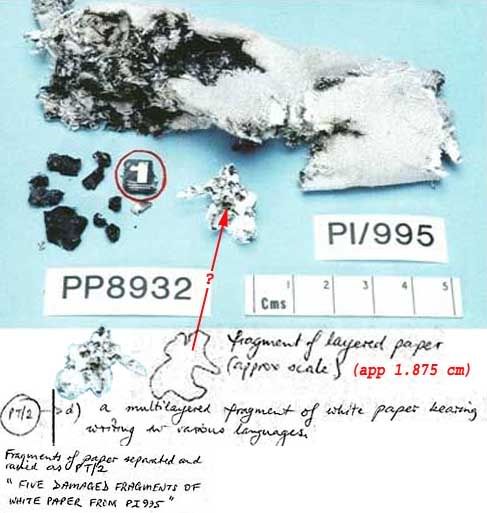
"PT/2, fragments of white paper with writing in various languages. "This fragment was recovered from item PI/995 (a fragment of grey-coloured `Slalom' brand shirt (section 5.1.3)), together with other fragments identified as being of particular explosives significance.

"Photograph 273 shows what originally appeared to be a single fragment of paper (encircled) after its extraction from item PI/995. Detailed examination showed that the fragment consisted of five overlaid sheets of paper lightly adhering together. The five sheets appeared to have been violently impacted together and disrupted and bore localised areas of blackening and scorching consistent with their close explosives involvement."
[3098-99]
The above image superimposes Hayes' famous page 51 notes for PT/2 before being separated. It's a match for size and shape with the lump in the photo. However accurate the lab entry's date, the photo was apparently taken before the lump was spread out into numerous sheets of type matching the manual in control sample PT/1 perfectly.

- PT/34: 16 May - “includes … pieces of paper … later thought to be parts of a Toshiba owner's manual” Same day the examination of PK/689 is recorded by Hayes. (I chose its earliest noted received date so it could start us off with a bang)

- ???: 18 May? "One small fragment of white paper bearing black printing" found in "the same blue and white Slalom shirt" PH/999 from which PT/40(b) was pulled. [day 20 p 3116] This would presumably be PT/40(something), and I don't have the time to figure out why I didn't figure this one out before.

- PT/56: 22 May
Feraday: "This consists of two very small blackened fragments of paper bearing a black printed legend. The fragments were recovered from a small fragment of the blue Babygro (item PI/1421, Section 5.1.8) and were identified as most probably having originated from the owner's manual for the Toshiba RT-SF16 radio." [day 20 p 3110]

- PT/31: 1 June 1989
"These ten small fragments of paper were separated from a fragment of the blue Babygro (item PK/2209, Section 5.1.8) along with other fragments of explosives significance, as shown in photograph 281. The ten fragments of paper are all approximately 2 millimetres square and appear to have been violently impacted and disrupted, bearing localised areas of blackening and scorching consistent with their close explosives involvement." [day 20 p 3105-06]
Three of these bore printing that, ittle surprise, also matched control sample PT/1 (PR/1111). Bits of the polythene bag were also found stuck to some of these fragments.

Zeist Judges on the Toshiba manual
forthcoming (volunteers? Opinion of the Court will do - check for reference to the cover PK/689.)

Blue Babygro Controversies

July 8 2010
(incomplete)
last update Oct 31


The “blue babygro” is a relatively famous piece of evidence in the Lockerbie case. It was originally a full-body pajama-type suit, perhaps of stretch material (hence “gro”), with foot covers built in. It bore a lamb motif in fluffy material across the chest. Bits and fibers of it were found everywhere in the blast-damaged luggage, suggesting it was in the bomb bag and perhaps wrapped around the bomb radio. It stands out as a morbid reminder that the plotters knew children might be killed, depending on the investigative phase a poignant in reflecting either Gaddafi’s infant daughter terminated by American bombs in 1986, or of the many children on Iran Air 655 more recently sent into the Persian Gulf by a Navy warship.

Among the numerous fragments of the item is the tiny body suit’s tag (left, from a video screen capture, "fire" line enhanced). Dubbed PK/669, it remained to show it was made in Malta (bottom line), spurring an early and fruitless visit to the island in the spring of 1989. On a second try in September spurred by the Frankfurt printout, investigators found that it was one of the more memorable items (along with the umbrella) that shopkeeper Tony Gauci recalled selling to the “mystery shopper” some weeks prior to the bombing. It was a breakthrough.

The following article from 2005 discusses arguments that Megrahi's lawyers were making to the Scottish Criminial Case Review Commission. The SCCRC was in the middle of a three year probe that resulted in a 2007 recommendation for a second appeal). Props to Buncrana at JREF for the tip.
Forensic mix-up casts fresh Lockerbie doubt
Tony Thompson
The Observer, Sunday 9 October 2005
http://www.guardian.co.uk/business/2005/oct/09/theairlineindustry.libya
Dramatic new evidence of forensic errors could see the man accused of planting the Lockerbie bomb win a new appeal against his conviction, The Observer has learned. Lawyers acting on behalf of Abdelbaset Ali Mohmed al-Megrahi are said to have uncovered anomalies suggesting vital evidence used to convict their client came from tests conducted months after the terror attack.
This refers to the Indian Head Forensic Tests, run largely by RARDE's Allen Feraday, a notorious manipulator of evidence. He oversaw the low end test and did not keep notes detailing the results and debris, relying instead on the notes of Scots policeman Harry Bell.

"Megrahi's lawyers now believe material produced during these tests was mistakenly presented to the court as if it were the original suitcase. One source told The Observer: 'To say that the evidence recovered from the ground at Lockerbie and the material produced during the tests became mixed up would be something of an understatement. They became thoroughly confused.

'It casts serious doubts over the prosecution case because certain items that should have been destroyed if they were in the case containing the bomb are now known to have survived the blast.'

In one instance a charred Babygro was produced as evidence that it had been used to wrap the bomb. However, new evidence has emerged which suggests the garment was completely undamaged when it was found. Instead, a similar Babygro used during the explosive tests was presented to the court.
[...]
Further tests are now set to be conducted to see how the mix-up happened.
The "new evidence" has never been explained that I know of, but it might be quite good. It's not clear what sort of "test"could find out why Allen Feraday might have slipped his test debris into the crash debris. If this mix-up happened, a "mistake' is one theory, but not the best.

SCCRC Findings:
At the time it may have seemed the SCCRC would follow such clues of frame-up, but in the end they denied all planting evidence allegations, their four public grounds (out of six total, two secret) all dealt with Tony Gauci's "identification"of Megrahi.

SCCRC news release, 28 June 2007
(PDF link)
"Main grounds that were rejected by the Commission [...] do not form part of the grounds of referral." The defense had "sought to challenge the origin of various items which the trial court accepted were within the primary suitcase,” including “a babygro” as well as the Slalom shirt, Yorkie trousers, and Toshiba manual.
“Underlying each of them was a suspicion about the conduct of the investigating authorities who, it was alleged, had manipulated, altered or fabricated statements, productions and other records in order to make out a case against the applicant. The Commission conducted extensive investigations into each of the allegations and is satisfied there is no proper basis for any of them. The allegations were further undermined by records recovered by the Commission from the Forensic Explosives Laboratory."
They presumably trusted the documents, so the finding is less than ideal. They did good by questioning Gauci's evidence, but get weak-kneed when it comes to active fabrication of evidence. How they could look at PK/689, hear Mrs. Horton's recall of it being even less vaporized when she found it, and still decide it really was in the bomb bag is beyond me, unless they were determined to avoid such a charge, to the point of being willfully obtuse.

Intact Discovery
I'll return when I've found the best sources that support the allegation the babygro was found in one piece at first.

Lab Notes
(Perhaps what the SCCRC looked at)
also forthcoming.