
Showing posts with label Orr J. Show all posts

Primary Evidence: Frankfurt Airport Records

First Posted 20 January 2010
last edits June 25, 2011


The System
[Analysis by Caustic Logic, based on wide but uncited skimming - may not be 100% accurate, but intended only to help understand the records below]

Frankfurt Airport in 1988 was the busiest air hub in Europe, serving many thousands of flights a day between Europe, the near east, nort Africa, and North America. The baggage handling system in 1988 was both state of the art and sloppy. Its workings can be understood as broken down to two parts, loosely termed outer and inner.

The outer portion was where luggage arrived at and left from the airport - a zone of tarmac and taxiing aircraft, wagons and luggage containers. From the planes, luggage was carted to a coding station, where items were placed on bar-code numbered trays (containers), one item per tray, and fed into the inner portion. Hard paperwork was apparently normally kept for transactions between aircraft and coding stations, both inclusive.

The Zeist Court explained “baggage for most airlines was handled by the airport authority, but PanAm had their own security and baggage handling staff.” Thus the airport and the airline each would then have responsibility for keeping track of their own efforts, and both should be called on in the investigation. The Frankfurt Airport Group would be in charge of unloading KM180, and Pan Am's people would handle loading and screening of luggage coming onto the outbound feeder flight.

The inner portion then is what the Court described as “a computer controlled automated baggage handling system” running beneath the airport. This vast electro-mechanic system automatically routed coded items along roller conveyors and through switching stations, at key spots scanned and logged. This system connected coding stations to the various stores, where luggage circulated until needed, and apparently up to loading gates. After this, they re-emerged topside and then to the connecting aircraft’s hold, where again, a record would be kept of loading procedures.

Primary Evidence
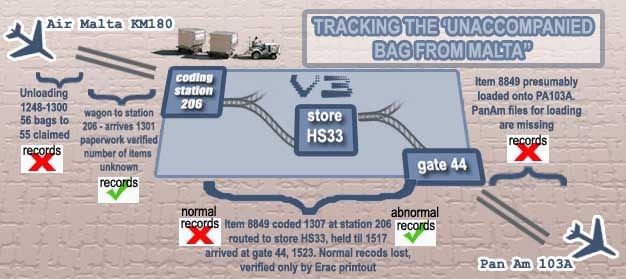
The relevant central computer data was produced, if under questionable circumstances, showing one particular item was coded at 13:07 into container no. 8849. It was then routed down to store for two hours until moved at 15:17 to gate B044, from which 103A loaded before its 16:53 departure. No passenger transferred from the air Malta flight to the PanAm one, so the bag thus illustrated was of the dreaded “unaccompanied” variety.

Apparently, no direct record of PA103A's loading was available to corroborate this. The unloading records for the Air Malta flight (KM180) that bag apparently came from, likewise do not figure in the evidence. And the mammoth central computer file aside from the items sent to 103A is missing without explanation. But the arrival of each flight at the airport, and the coding of one's luggage, were presented, aside from the crucial and curious "Frankfurt printout." Below are all available documents relevant to the claim of an unaccompanied bag, from flight KM180, being sent on to Flight 103A at Frankfurt. These will be given by the "production number" assigned them as evidence during the trial, and briefly explained. All images were originally found at Mebo pages, but seem to be genuine and unaltered. (see "Sources" at end)

Production 1068: The Opinion of the Court's paragraph 29 denotes this for “the evidence of Joachim Koscha, who was one of the managers of the baggage system at Frankfurt in 1988” It was his evidence that established KM180’s arrival and unloading time, 12:48-13:00. They do also cite a “record,” but provided no direct citation.

Production Null: This is the designation – none – given to KM180 unloading papers in the trial. Denis Phipps, former head of security, British Airways, has closely inspected the primary records of different airlines and airports connected to the disaster. He said in The Maltese Double Cross [video, 1994] “the records from Frankfurt were by no means complete." Among his concerns:
“There was no record of who unloaded that flight KM180 when it arrived at Frankfurt. We don't know who the loaders were. There was no record of the number of bags that were actually unloaded from that flight. There were no records that I could find.” 

It isn’t entirely clear if paperwork normally was kept for this – it might have been a policy to determine the number of bags from the computer system, which could count the number of items coded at a certain station and time and take that as the number from the flight coded then. It would be a grossly imperfect system, considering the reliability of this method, as mentioned above. But it would line up with the known laxness of procedure there, and mean one less suspiciously missing record.

Production 1092: This is an “interline writer’s sheet” filled out by Andreas Schreiner, who was in charge of monitoring the arrival of baggage at V3 That bears to record one wagon of baggage from KM180 arriving at V3 at 13:01.Within V3 are seven coding stations, where luggage is placed into bar-code numbered trays to enter bottomside. They cite the sheet’s contents in table form and it seems like they had these records at hand. No number of bags in that wagon is given.
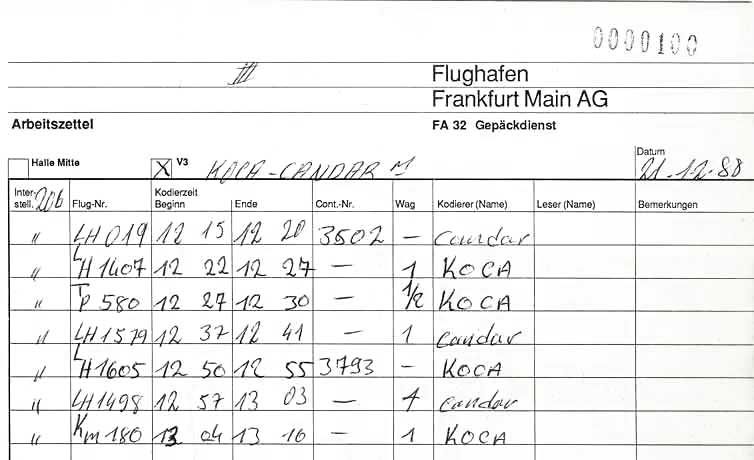
This brings us to the reliability of coding station logs in determining where a particular item really came from. The Zeist judges heard testimony that “luggage was always delivered from one flight only” at any given time." [Opinion of the Court, para 29] Taking this literally would mean a station's log saying flight X was handled from 1:00-1:05 means an item shown in the computer system as coded there at 1:01 is clearly from flight X. 

But this is not completely sound. Dennis Phipps noted the unreliability of these logs in the Maltese Double Cross, and it's been widely noted that lapses of stray bags being inserted during another flight's coding are not only possible but recorded, and common sense itself suggests such a presumption is, at the least, not guaranteed to be right. The degree of correlation between coding time and flight number is certainly higher than zero and less than 100%, and debatable from there. A separate post, Coding Station Reliability, will address this controversy, but generally below it should remain an open question.

Production 1061: This document (above) was identified by witnesses Mr Schreiner and Mr Koscha “as a work sheet completed by a coder to record baggage with which he dealt.” The name of the coder in question was Koca, who was not called as a witness.” Pity, since the document shows us little detail. The signatures alternate Koca and Candar, listing either container numbers or numbers of wagons of luggage, the flight number it’s from, time they started coding, and stop time. The relevant line is the last one – one wagon of luggage from KM180 started coding at 13:04, and ended at a time disputed as 13:10 or 13:16. (13:10 yields a time closer to those previously noted, and it's what the Court decided. The difference is six minutes of time, which could have increased the likelihood of a stray bag being introduced. Again, refer to the post on coding station reliability.

Production 1062: This is the court’s code for some unspecified “documentary evidence” that “the aircraft used for PA103A arrived from Vienna (as flight PA124) and was placed at position 44, from which it left for London at 1653.”
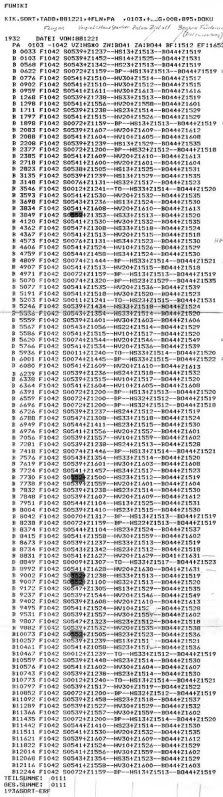
Production 1060 (at left - r-click/new window for readable view) This is the famous computer printout, the single document that allows “the inference," drawn by the Scottish Judges, "that an item which came in on KM180 was transferred to and left on PA103A.” It's a list of items routed to PA103A, taken by airport employee Bogomira Erac for personal reasons and handed over to investigators only a month after the disaster.

It was the first time they'd seen it. What's highly unusual about this evidence is that the German federal police (BKA) were unable to secure their own copy, right off the computer, in the days after the crash. In the end, we had to rely on a memento copy from someone’s locker, which existed only by sheer luck. It was that close to having a whole airport's luggage records go completely missing, right after such a massive event demanded that information. The troubling case of the missing records is worthy of a detailed stand-alone post. Another interesting question is why the BKA then made the official investigators in Scotland and Washington wait another six months before sharing it with them. It wasn't until mid-August 1989 that Scottish police were able to see this pivotal record that wound up turning the investigation around to Malta and thence Libya.

Whatever the book got wrong, Trail of the Octopus is helpful on this issue.
"On 17 August 1989, eight months after the disaster, Chief Detective Superintendent John Orr received from the BKA what was said to be a computer print-out of the baggage-loading list for Pan Am Flight 103A from Frankfurt to London on the afternoon of 21 December 1988. Attached to this were two internal reports, dated 2 February 1989, describing the inquiries that BKA officers had made about the baggage-handling system at the airport. Also provided were two worksheets, one typewritten, the other handwritten, that were said to have been prepared on 21 December by airport workers at key points on the conveyor-belt network." [Coleman/Goddard]

Mrs. Erac' testimony at Camp Zeist in 2000 clarified that the printout was not taken to the BKA until approximately the last week of January, so a 1 February foray is a perfect match for being spurred by the printout. Any records of any earlier efforts, fruitful or not, remain under wraps. Upon getting the papers in August, Orr and his men quickly investigated the airport themselves, and also got more serious about previous clues leading to Malta.

What the printout shows, briefly, is 111 items listed numerically by container number. The relevant portions are highlighted in the condensed version below. PA103A is referred to herein as F1042. The relevant item 8849 was coded at station S0009, which it’s been determined means station 206, at 1307. That is a fit with KM180’s load. It then goes to Gate B044 at 1523, the same few-minute span most of 103's luggage arrived. What happened from there is outside the computerized system and not recorded here. But according to this, two late-coded items were sent to a separate gate B041, and curiously, these two items bracket the apparent bomb bag, numerically speaking, and so are visible below. All 108 items not shown here were sent to gate 44.
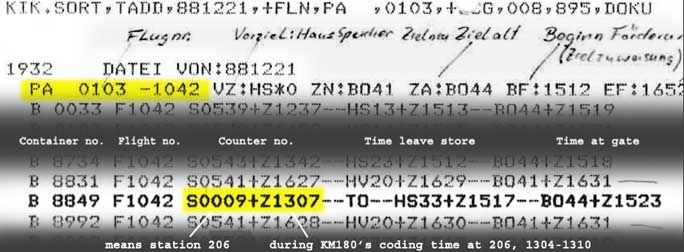
So broadly there are three possibilities:
- If it could be certain that station 209 at 1307 means KM180 and nothing else, this would be solid evidence of a bag from that flight.
- It could have been an item of another origin passing through there at just the right time to appear as from KM180. This does require a certain acceptance of coincidence, but cannot be ignored.
- The data could clearly mean to say KM180, but itself be fraudulent. This would explain the printout's appearance and the primary data's disappearance. Perhaps the two were not really unrelated bad and good luck, but two halves of a bait-and-switch routine, perhaps carried out by the BKA for uncertain reasons.

Production Null: The normal, official, system-wide, right from the computer luggage records.
As has been mentioned, for some reason the primary data of luggage movements was lost, but avoided making a big noise once a copy was luckily found. So it was no loss, we might presume. But how would we know?

There may never be answers to the riddle of the lost computer data, but a dedicated post is warranted to explore what we do and don't know about it.

Production Null: PanAm’s loading records for flight 103A.


---
Sources:
Image: Prod 1092
Image: Prod 1060
(other images by Caustic Logic)
[Coleman/Goddard] TRAIL OF THE OCTOPUS -- FROM BEIRUT TO LOCKERBIE -- INSIDE THE DIA. Chapter 7. Online posting.
[Opinion of the Court] PDF download link

What Did The Germans Know?

The Scots-German War Over Airport Security, part 2 of 2
June 23 2010

last edits 21 November

The following is part-essay, part compilation of long quotes. Two early books are drawn from throughout:
[E+D] Emerson, Steven and Brian Duffy “The Fall of Pan Am 103: Inside the Lockerbie Investigation” New York, G. P. Putnam’s Sons. April 1990. 283 pages.
[L] Leppard, David.On the Trail of Terror: The Inside Story of the Lockerbie Investigation. London, Jonathan Cape. May 1991. 221 pages.
The views expressed by those writers are not necessarily shared by this blogger – the exercise is to gather facts and attitudes, the zeitgeist, of this minor 1989 struggle of wills between two erstwhile allies in a major investigation.

---
Vehement Vengeance
Part one explained the unfounded British decisions to rule out London origin for the bomb while repeatedly insisting it must have come in from Frankfurt. “Smarting from the accusation that sloppy West German security had allowed this terrible act of terrorism,” Emerson and Duffy explain, “Germany would begin to strike at the British with a vengeance.” [E+D161] It was the first of January 1989, the day after the inflammatory Times story (Disaster Bomb placed on Jumbo in Frankfurt), that the first response was heard. As the book explains:
“West German Interior Ministry spokesman Michael Andreas Butz was convening a news conferencet to respond to the Times account of the day before. “There is no indication,” Butz declared stiffly, “that the explosives could have been put on board at Frankfurt airport.” In fact, he added ominously, “there is evidence which is contradictory.”

What did the Germans know that the Americans and the Scots didn’t?”

Butz went on to assert, with some vehemence, that German agents had determined that the “Disaster Bomb” had been smuggled aboard the 103 in London. The German agents had proof of it, Butz said."
[E+D161]
Five days later, it seems the Germans were ready to show what they knew or didn't know. Reuters in London, citing “West German security sources,” reported on January 6 that “an airport worker at Heathrow had planted the bomb in the forward luggage hold of the 103.” A bizarre explanation followed:
"According to the sources quoted by Reuters, investigators had arrived at the Heathrow link because of the “fact” that the bomb that had blow up the 103 weighed “at least sixty-six pounds.” Luggage restrictions limited carry-on bags to seventy pounds, but the sources cited in the Reuters account said that the bomb was loaded aboard by an airport worker. What the sources evidently didn’t say is why the airport worker couldn’t have been in Frankfurt instead of London." [E+D165-66]
That explanation fails to make sense in numerous ways (the bomb likely weighed less that 66 ounces, for one), and doesn’t sound like what any thinking German would really say. But this wasn’t their only counter-charge passed on in The Fall of Pan Am 103:
“In a matter of days, news stories began to leak from Bonn and Frankfurt that security at Heathrow was far worse than at Frankfurt. British authorities were outraged. For days and weeks, as the families of those killed on the 103 watched this ugly game of diplomatic Ping-Pong, Britain and Germany fought a nasty proxy war through their TV networks and newspapers. Clearly, the feud was based on more than a technical dispute among forensic specialists. Some went so far as to assert that the bitterness of the dispute showed the extent to which the age-old cultural animosities between the two nations had still not abated after two world wars.” [E+D 161]
The authors Emerson, Duffy, and Leppard have the Germans trying to deny both a Khreesat bomb (their botched police work) and the German bomb infiltration (their airport security failure), often confusing and conflating the two drives. On the other side, it’s clear that the Scots and Americans tried at every juncture to put all failures in Germany. David Leppard writes “the bitter argument […] persisted throughout the long hot summer of 1989” [135] and “the German BKA were to spend more than a year publicly claiming that the bomb must have been put aboard at London.” [60]

So Just What Did They know?
Such persistent denial could be motivated, as the Brits and Americans charged, by German fear of accepting the horrible truth about their epic shortcomings. But to be fair, the Germans in fact knew some actual evidence supporting their claims, and should have been given more credit.

Emerson and Duffy’s telling shows hardly a hint of this, with its cited argument that a 66-pound bomb somehow implies Heathrow origin. But the West Germans had to have noticed the lucky bag placement within the container, that could only have been more than luck if it was placed in London. They probably did not know of John Bedford’s story of suitcases matching the IED style seen at about that spot of that container - well before the 727 arrived from Frankfurt. Had they known, they likely would have said so.

The break-in at Heathrow’s Terminal Three the morning before the bombing was surely concealed from German ears as it was from the whole world up to and including the Zeist trial in 2000. On top of the generally lax security at Heathrow, this additional bit of information could only have added to the German resistance against the first script changes.

It was enough at first to know that both alleged German failures - a Khreesat bomb and Frankfurt ingestion - could not be true at the same time as the Yanks and Brits insisted. At least, not without a fair amount of speculation.

The German BKA actually did some work along these lines to help their colleagues understand, as David Leppard shares in some detail. They knew the Khreesat altimeter bomb better than anyone, having overseen the raid that caught only one of five, having had another one later kill one of their bomb technicians, just before they destroyed yet another in revenge. Leppard rails along with the Scots at these scientific losses and such fatal sloppiness. But he also misrepresents the number of samples they once held (it was four, not three), and the readable remains they had at the end of the explosions (three partial and two complete samples, not one). These were, however, studied as far as possible.
“In May the Germans decided to prepare a detailed scientific rebuttal of RARDE’s theory that the bomb had been made by Khreesat […] and put aboard at Frankfurt. The BKA asked its forensic section, ST33, to prepare a report on the three Khreesat bombs so far recovered.” [L142]
They shortly issued a final report called "Comment on the ignition Devices,” which said their remit was “to test and report if [Khreesat bombs] were suitable for surviving the flight from Frankfurt to London […] and exploding 38 minutes after take-off in London.” [L142] The answer, delivered with “bland Teutonic logic,” was No. Rather, they realized and explained one of the best London-origin clues. 
“The rundown of the functioning on the ignition devices … can be brought into line very well with the circumstances during take-off and pahse 1 of flight PA103 London to New York.
[…]
Presupposing that an explosive device of the same construction was used in the attack, then it must have been taken board for the first time in London, or at least made acute [armed -ed] by insertion of the master switch.”
[L145]
Leppard dismisses the report as "a compendium of fudge and obfuscation." They had “only one [sic] fully functioning example of Khreesat's bombs,” Leppard complained, “but this did not prevent them concluding all three bombs had a time delay of between 30 and 45 minutes." The reality is in fact a little more complex it seems than the BKA’s report lets on, but the noted similarity of the timing style is still completely valid. The 38-minute detonation after leaving there really does look a lot like a Khreesat device loaded there.

War’s End
Upon seeing that insolent ST33 report, SIO John Orr “was furious,” writes Leppard.
“As the Kamboj episode showed, there had always been the outside chance that a bag had been smuggled into the container at Heathrow. That possibility aside, Orr had effectively ruled out Heathrow within three weeks of the bombing. Much to the relief of British security chiefs, the Met’s Special Branch had long since stopped investigating the Heathrow theory. Now the Germans were suggesting they were all wrong.” [L145]
They launched back in June with a rebuttal. “Harry Bell was tasked with getting RARDE to research a reply” to this ST33 report, writes Leppard. “It took five weeks to come up with a convincing response.” Finished before June was out, it mostly poked holes the uncertainties of the report, like using “only one working device” to decide the time delay. It offered no solid alternative, quibbled over climb rates, postulated a simple electrical error, and closed condescendingly:
“In conclusion the ST33 report deals with presumptions and presuppositions and it is respectfully pointed out that only factual evidence will be acceptable in the furtherance of the inquiry to bring to justice the bombers of Flight PA103.” [L146-48]
The Scots and Americans, on the other hand, were never able to shake the fact that London was always the far better fit for just the bomb style that everyone first suspected. And they could show no support for what they insisted on: a Khreesat bomb loaded and triggered in Germany but with a speculated two-hour timer to carry it just past London.

In short the authorities and investigators of the West German Federal Republic knew some of the same clues their counterparts across the channel did. They could see the general logic of London introduction, the detonation timing, and the expected British ass-covering. After all, as Leppard put it:
“Certainly, if Heathrow had been to blame, the ramifications would have been severe […] Fortunately for the British, no such evidence was ever uncovered. All the political embarrassment would fall on the Germans.” [p 60]
The embarrassment would then somehow shift off of them onto Malta and thence Libya, in a fascinating leapfrog action. But early on, we can see the Germans had circumstantial clues - if only half as many as the Brits held - that the bomb actually started in London. They could be called jumpy or defensive to leap to the conclusions they did so fervently based on such limited information. But now, with more information, we can see that they were probably right all along.

The London Origin Theory

The First Causualty of the Investigation was Truth
(incomplete)
last update July 30 2010


“I want to know when the bomb was placed on the plane and by whom. We have to look more closely into the "London theory" – that the bomb was placed on the plane at Heathrow and not in Malta.” - Hans Köchler, independent UN observer at Zeist trial, 21 Aug 2009 (Source)


"If I was determined to bring down an airplane, I would have put [the bomb] on in London." - Robert Baer, 'former' CIA agent and weapons expert, who doesn't buy the Libyans-did-it story line.

The London Origin theory has emerged as the most logical explanation for what happened to Pan Am 103 on December 21 1988. The official story, all the most widely-seen revisionist arguments, and even Megrahi's defense team's curious "special defense of incrimination" drew on elements of the drug swap theory, with the bomb coming in from Germany or further afield. Megrahi's counsel William Taylor QC did however give reasons to suspect a  London origin (some below) to the trial judges and summarized at trial's end in 2001:
“My submission is that all of the above render the choice of Heathrow a much more likely one [than Malta]. And when that possibility is considered, one finds that there is a compelling body of evidence that points to Heathrow as being the point of ingestion.” [day 82 p 9862]

But in the earliest days of the investigation, January and February 1989, British investigators labored to clear Heathrow Airport of any lapses and ensure that the bomb's origin would have to be found elsewhere. Years of confusion ensued... (see "Counter-Arguments" below for more on the dismissal of the London theory).

Direct Evidence For the Theory
Among the first clues came from finding where the plane failed, and what luggage container the blast originated in. Container AVE4041 in forward left cargo hold, position 14L, was decided within a few days. The container's blasted out remains were found and reassembled enough to show the blast was down at the bottom of the container, in the aft outboard corner. It had been in the spot closest to the hull, only 25" from the thin and aged skin of Maid of the seas.

Unfortunately, the exact placement, origin, or even number of suitcases in that box was hard to pin down. Records and witnesses helped decide 4041 was loaded with a few bags (6-8 or so) of (apparently) interline luggage, then filled up with a few dozen cases from the feeder/first leg flight 103A out of Frankfurt. But within this generally imprecise body of memories, one stands out as of amazing possible significance.

The Bedford Suitcase(s)
This was always the hard part to get around in order to reject the initially obvious Heathrow introduction theory. A Pan Am worker mentioned to police right after the attack said he saw two brown hardshell samsonite suitcases, placed on the floor of container 4041. The position of these was side-by-side from the far left of the floor, at the (loading) front of the container. If the bags had been later stacked one on the other and the top bag slid a few inches left, it would be in the perfect spot to match the explosion center - aft outboard corner, second suitcase from the bottom - where just such case detonated.

An amazing lead, investigators almost seem to have tried to not follow this one.  Since the cases Bedford saw were on the floor when he saw them, and the blast seemed to have happened one layer up from that, they decided these cases were a coincidence. They must have been moved across the container, and replaced in that lower corner with an identical case from Germany, on top of some other damaged Frankfurt-originating luggage. The leaps of faith here are simply alarming.

The Bedford story is covered in great detail at this site, with the works so far compiled at the link above.

> Break-in Reported
A security Guard at heathrow Airport reported a break-in at terminal 3 around 12:30 am on  December 21. Ray Manly's report, of a padlock on the floor "cut like butter" was covered up for over a decade. Even at trial in 2000, the defense was not allowed to know of this. Manly came forward in 2001 with the story, soon verified by the long-suppressed police reports. A post is up but empty - anyone care to help? I'll get to it later.

Mentioned in: Appeal Court Dismissal of the Heathrow Theory

Circumstantial Evidence For the Theory


The 38-Minute Coincidence
Aside from its crew and perhaps some cargo that (probably) doesn't matter here, the 747 Clipper Maid of the Seas landed empty at London's Heathrow airport mid-day December 21, 1988. There the plane took on a load of 243 passengers and their luggage, and took off at 6:25 PM for New York as Pan Am Flight 103. Clearly, the bomb went on the plane at London, but the question that comes quickly behind it is where did it come from before that? A van in the parking lot, or another plane?

Such clues were vital to tracking down the perpetrators, and should be embraced when they're found. The time of explosion itself is a valuable clue - 38 minutes after leaving the ground - is a known hallmark of the altimeter bombs made just weeks earlier by terrorist bomb-maker and "double agent" Marwan Khreesat. He had produced four altimeter-triggered, radio-disguised bombs, set to detonate less than an hour after takeoff. Each of the others was a bit different, but the one that was captured and tested thoroughly would have blown up about 45-50 minutes after takeoff.  

The timing compatibility with a Khreesat bomb loaded at London notwithstanding, it's been officially decided and legally established that was a Libyan-ordered and set MST-13 timer that told the bomb to go off over Lockerbie. Officially, legally, by the evidence led at trial, it's an asbolute coincidence the timing so resembles the method first suspected. 

> Operational Security
When confronted with the official story of a Malta-Germany-London, the most obvious averse reaction of those who know air travel operations is to ridicule the notion that an airline bomb would make any sense being trusted to so many switches. Any functional security screen or time delay along the way coulld screw up the whole operation with a timer-based device as alleged. A trip from Frankfurt only is often suggested to replace this, but it too has one too many stops for a Khreesat bomb, and still a high chanced of the bomb being delayed or intercepted. If one could pierce security at any of the three airports, and it obviously happened at one of them, Heathrow would give one the best chance for success and the only way for a Khreesat bomb to have done what happened.  

Former head of security for British Airways, Denis Phipps, Maltese Double Cross:
“If a device had been infiltrated into the system at Malta, it would have been necessary for that device to have been carried in an aircraft in the sector from Malta to Frankfurt, to have gone through a handling process, been carried on an aircraft through the sector from Frankfurt to Heathrow, and then timed to detonate during the final sector, Heathrow to New York, presumably whilst the aircraft was over the ocean to avoid discovery of forensic evidence …  one has to say, um, are - terrorists  - idiots? Don’t terrorists plan to have a reasonable degree of success?"  

> Explosive Efficacy
If one places a device at the airport the target leaves from, rather than remotely through multiple flights, a new ppossibility is opened up - depending on the nature and depth of his penetration, a determined terrorist could place the bag himself and chose where in the container it went. As it happened, the bomb in PA103 was placed in the best spot (for the terrorists), and one of the few that could have even worked - the lower outboard quadrant, more or less on the sloping floor nearest the hull. Figure F13 (below) of the AAIB's report shows the deduced center of explosion that officially was achieved by accident. Considering even there, all that was blows from the hull was a chunk the size of a dinner plate. That's all it took, but it wouldn't happen at all if the bomb had wound up in the upper inboard corner, or even in the middle.

It is true, as some have pointed out, that there'd be no guarantee any cases placed in that deadly corner would stay there. But terrorists simply can't wait for guarantees. Certainly having it in the right spot, for sure, at one point, is better than relying on pure chance. Perhaps with this in mind, famous former CIA agent Robert Baer, who may have direct experience in this for all we know, has said:
"I used to teach explosives. The last thing you want to do is put a bomb on in a place like Malta and have two stops along the way ... you couldn't count on this thing hitting its target. ... Malta would not have been my first choice. It would have been London. If I was determined to bring down an airplane, I would have put it on in London." Flight into Darkness video, part two, 5:25

Counter Arguments Addressed
Forensics and the Frankfurt Link to the Rescue
UK and Germany had both been unsettled by the possibility their security forces had allowed the horror of Lockerbie to pass through. Some of their early wrangling is addressed in the post "What did the Germans Know?" British investigators decided the blast - 10 inches above the container floor - was above any possible non-Frankfurt luggage and therefore had to be some other brown, hardshell Samsonite from the one(s) Bedford described, that must have been from the feeder 103A. It was unsound reasoning and wishful thinking until the Erac printout emerged months later, showing an item apparently coming from Malta, to PA103, via Frankfurt.

The Malta Link to the Rescue
The Erac printout, emerging months after the attack from an employee's locker after all official copies somehow disappeared, sealed the deal for Malta origin. But the tiny island nation had already been mentioned in the evidence, as the place of manufacture for some of it. As it so happened, the Erac (Frankfurt) printout in August 1989 spurred a closer look, and the clothes were traced to a store on Malta where Tony Gauci was found...

Malta-based Libyan defector Abdul Majid Giaka was already on file with the culprits - Megrahi and Fhimah - that some hoped Tony saw one of. By late February 1991, they had a sort of identification of Megrahi from the shopkeeper.  A few months later, Giaka was finally removed to safety and first mentioned the suitcase - possibly the same model Bedford reported - seen on Malta the day before it reappeared on that dubious printout leaving there. The story is clearly false, but formed one basis of the U.S. indictment against Megrahi and Fhimah in November 1991.

And finally, Air Malta has airtight records that the 55 bags on flight 180 were all claimed by its 39 passengers. They've shown this in court, like in their libel suit against Granada television. How the bomb was sneaked around Air Malta's system was never explained or substantiated even back when Fhimah was accepted as an accomplice. Investigators tried to find evidence of Maltese collusion or corruption or incompetence, but came up only with 'well, they must have done it somehow.' After the dismissal of Giaka's Malta stories, the Zeist judges  found that accomplice not guilty, further complicating the feat for Megrahi. They admit it's hard to see just how he did it, but he must have. Guilty.

See also: JREF Forum discussion thread on the London Evidence - great discussion

The "Elimination" of the Bedford Suitcase(s)

(almost complete article in progress)

Note: Having a look now at David Leppard's book, I've decided to split the old post into two new ones, joined here. The first comments below reflect the previous version. This post will discuss both tracks, an official report and a dramatic blowing-up of things by political scientists, in general terms, how they relate in altering the course of the investigation. The switch was from an obvious and useful lead that neither the Americans nor Brits wanted to follow. And it was to a confusing muck in which a new plot could eventually be "discovered" and followed.

Also, here I'll address the decidedly non-scietific aspect in how this valid forensics work was twisted to insist something it simply couldn't do - "the bomb bag had to have come from Frankfurt and before that... we'll think of something. Just give us some time, okay?"

Shuffling Aside Bedford's Baggage
Not a whisker of the Libyan guilt storyline could have emerged if not for a key decision made early on about where the bomb came in from before being loaded onto PA 103. The official presumption was that the bomb had arrived in London on Pan Am 103A, a feeder flight / flirst-leg originating in Frankfurt, West Germany. Acceptance of this premise allowed a bag from Malta, and all that was attached to that, and eventually a guilty verdict for al Megrahi,

It was clear which luggage container had held the bomb; that was named AVE4041PA, and had been loaded first with various luggage at Heathrow, then filled with bags from PA 103A. As it was finally loaded, most luggage in 4041 was from Frankfurt, so by sheer numbers the bomb would more likely be in the majority batch. Perhaps riding on that wave of thought, on March 28 1989 Senior Investigating Officer (top Scot) John Orr told investigators gathered at the Lockerbie Incident Control Center (LICC):
“Evidence from witnesses is to the effect that the first seven pieces of luggage in the container belonged to Interline passengers and the remainder was Frankfurt luggage. […] To date 14 pieces of explosive-damaged baggage have been recovered and enquiries to date suggest that on the balance of probabilities the explosive device is likely to be amongst the Frankfurt baggage items. Of all the currently identified explosion-damaged luggage all but one item originated from Frankfurt.” [1, bold was LICC italics in original]
In this Frankfurt/London distinction for those damaged, one must wonder how he categorized the “primary suitcase,” the only brown, hardshell Samsonite among them. It matched the description and approximate location (see below) of the two maroony-brown hardshell Samsonites John Bedford reported as being in the container. These were loaded well before the German feeder arrived, and as blogger "Baz" points out, the "effect" that this was all interline baggage was not from "evidence from witnesses" but from the name of the shed (interline) where the suspect bags were inserted. They therefore constituted unwanted baggage that would have to be factually shuffled aside before the eventual story could unfold as it did.

The Sciencey Stuff - Two Tracks
Two tracks we can assess in some detail are covered that way in separate posts. First I recommend
part 1
the investigation, images, and explanations of Mr. Thomas Claiden. He assembled appendix F for the UK Air Accident Investigation Branch report on the Lockerbie non-accident. Based on decent forensics reasoning, he concluded the suitcase with the bomb was almost certainly not directly on the main floor panel, but otherwise at almost floor level, outboard aft quarter, or just above the left-hand Bedford suitcase, and slid a little left into the sloped-floor overhang area. This was only published in 1990, but it's more visual, which helps one form their own opinion from the damage. I don't disagree with anything of the essence here, it just doesn't say anything.

Track two is the Indian Head Forensics Tests of 1989. The tests showed that the reading inherent in the AAIB report was correct - the bomb was one layer up and not on the main floor. So the results were the same, if more dramatic and less public in their documentation.

Ultimately, the conclusion that Frankfurt was indicated relies on a stated assumption that the Bedford cases could not possibly have been stacked one on the other. If someone had stacked them, perhaps to make room for their feet as they prepared to load from 103A, the top one would be in the exact spot of the detonation. I suspect that's what happened.

Zeist Judges' Speculation
The judges at the 2000 trial explained the significance, by universal custom taking Bedford's cases as singular, in their final opinion.
It was argued on behalf of the accused that the suitcase described by Mr Bedford could well have been the primary suitcase, particularly as the evidence did not disclose that any fragments of a hard-shell Samsonite-type suitcase had been recovered, apart from those of the primary suitcase itself. [para 25]
Bedford then took container 4041 with 6-7 cases, to the "build-up area" and went home. It was taken to meet Pan Am 103A, and the case against Megrhahi was based on the "primary suitcase" being loaded from that luggage, and that based on the fact that it wasn't on the floor. For such an important aspect of the case, the exact details of where such a bag would end up later are hard to predict well, and impossible to predict with certainty. The judges are clearly aware of this:
"It was submitted that there was evidence that an American Tourister suitcase, which had travelled from Frankfurt, fragments of which had been recovered, had been very intimately involved in the explosion and could have been placed under the suitcase spoken to by Mr Bedford."
That might seem like a good clue why this bag wasn’t on the floor, but with a usual spherical propagation, the blast could cause the same damage if this suitcase was above it, below it, or beside it, depending on how they were arranged. That non sequitur leads to mental gymnastics to the effect that if a Frankfurt bag got under the ones Bedford saw, then anything is possible and two Samsonites are thus smeared out of relevance to make way for their brown Samsonite (I'm fairly sure it's the one reported by Giaka).
"That would have required rearrangement of the items in the container, but such rearrangement could easily have occurred when the baggage from Frankfurt was being put into the container on the tarmac at Heathrow. It is true that such a rearrangement could have occurred, but if there was such a rearrangement, the suitcase described by Mr Bedford might have been placed at some more remote corner of the container."
They might have been pushed over there, and never seen since, who knows. But we're quite certain they were not simply stacked up and pushed a few inches to the nearest 'corner.' The only thing solid they seemed to have was “the effect of forensic evidence was that the suitcase could not have been directly in contact with the floor of the container.” Emphasis mine, wishful reasoning theirs. See the above section for what that was all about.

Nowhere along the line were intact suitcases matching Mr. Bedford's story ever been produced intact and explained away. It's as if they both just disappeared. Or blew into tiny bits.