May 2 2010
last edits 1 September
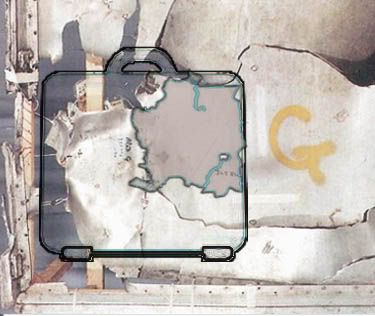
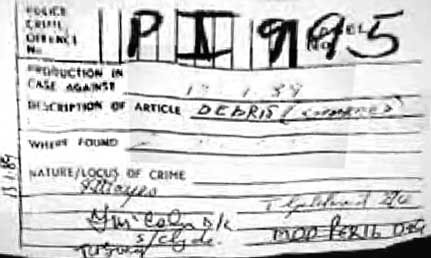
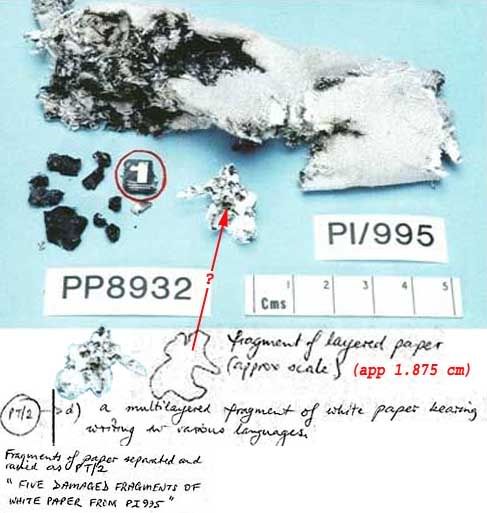
Among the interesting artifacts of the Pan Am 103 crash strewn across southern Scotland, is a particular large fragment of suitcase presumed to be from the bomb bag. Its police label PI/911 designates when and where it was found, roughly; “P” means property (evidence) and “I” designates the search sector it was found in. These were lettered A-K, generally west-to east with sectors A, B and C in Lockerbie itself, and K up to the North Sea. I sector, where most suitcase debris was found, was centered on and around Newcastelton Forest. The numbers after are sequential, so PI/911 is ostensibly the 911th item found in that area.
Like the dozens of other primary suitcase pieces recovered and examined by Dr. Thomas Hayes of RARDE, it matched the construction of the control sample, a Samsonite Silhouette 4000 series hardshell case, antique copper in color. Hayes read back from his final report (Production 181) at trial in 2000. PI/911 was the first item described in the report, and he concluded in part:
“This is a distorted and severely heat-affected irregularly shaped fragment of rigid plastics sheet. When examined, it was found to have a twin plastics layer construction [...] with a thickness of 2.5 millimetres. It consisted of an outer skin of bronze-coloured plastics with a simulated leather patterned finish covering a thicker underlayer of grey plastics having a smooth finish.”The main distinction of this fragment is its size; the largest found at “approximately 280 millimetres by 260 millimetres,” or about 10.5 by 11 inches. That’s nearly one fourth of a whole side of the 22x26x9 inch case. Just from the size one might wonder if this even could be from the primary suitcase, no more than a few inches from a Semtex blast of probably more than 500 grams power.
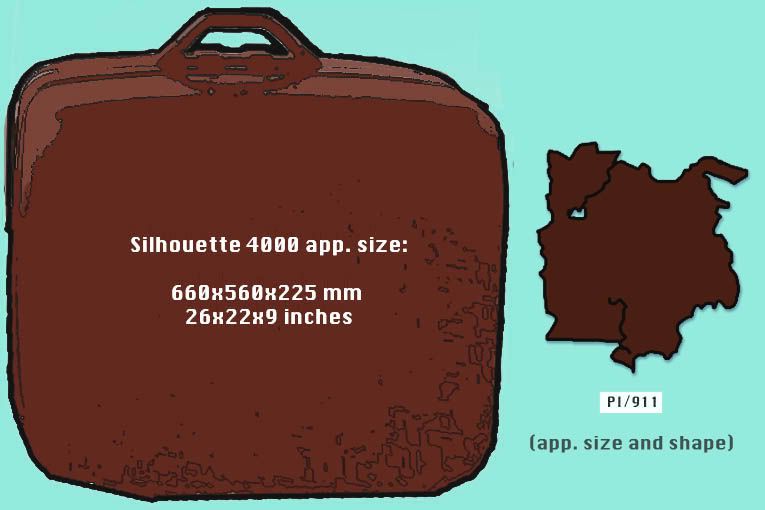
Other clues strengthen the impression; Hayes also noted “the smooth inner surface was lined in one area with the partially charred remains of a brown woven fabric which had a cream-coloured thin reticulated plastics foam underlay.” A nanosecond later, two feet away, the weakened blast was removing airplane skin from its rivets. The Crown’s Mr. Campbell, to his credit, turned to Dr. Hayes’ earlier examination notes (Production 1497) and revealed further doubts this was the primary case.
Q …were these written by you as you carried out your examinations?This is an amazing insight. Elsewhere we’ve learned, from official findings that this blogger agrees with, that the primary case was not in contact with the base but laid flat on another flat-laid case in contact with and protecting the floor, putting the blast center around ten inches up. There is also reason to wonder about two suitcases of about the primary style, reported by John Bedford very near that corner of the container. If these had been stacked up one such case could have detonated while the other shielded the floor.
A Yes, they were, sir.
Q And we see that you have made notes and made a sketch of the item.
A Yes, sir.
Q And was that the way in which you generally approached the exercise?
A Yes, it was, sir.
Q And we see a date at the top right-hand, which is 21 -- 26, rather -- 1/89?
A Yes, sir.
Q And this is a note of your examination of PI/911. And could I draw your attention to the writing that we see to the right-hand side of the drawing, where you describe the article as: "A severely distorted irregular-shaped sheet of rigid plastics," and go on to say: "Apparently the lower side of a suitcase, compressed and fractured in a manner suggesting it was in contact with a luggage pallet's base and subjected to explosive forces from above."
Now, is that an observation that you made when you were examining this article in January of1989?
A Yes, it was, sir.
Q And was that at quite an early stage in the course of examining articles?
A Yes, it was.
And here’s lead scientist Hayes suspecting this one was in contact with the floor and had a blast above it. Mr. Campbell further questioned Hayes on his reasoning for this:
Q What was it about the item that suggested to you that it was in contact with the luggage pallet's base and subjected to explosive forces from above?The wording is a little ambiguous – if we read that as starting "on questioning the assumption..." it makes more sense and fits with my own thoughts. Otherwise, much here is lining up; other large chunks of ten inches or more on a side, and a 20-inch uninterrupted span of lining material (more coming), suggest one whole side of a suitcase just like the bomb bag broke up very unlike how the bomb bag would. Almost as if there were two bag of the same type, one on the floor and another with a bomb on top of it.
A On the assumption that it might have been part of the suitcase containing a bomb, firstly the residual size of the fragment, which is quite large, and also the fact it appeared to have been supported in some substantial way by a relatively immoveable surface.
But Hayes had one other clue, in the final report if not his exam notes, that changes all of that:
“Small flecks of a blue foamed plastics material with a cross-hatch-patterned blue plastics skin were found strongly adhering to the simulated leather surface. This finding indicates that at the moment of detonation of the explosive device, this bronze suitcase was in direct contact with one containing a foamed blue plastics material. The items recovered from PI/911 were removed and raised collectively as item PT/42. “Blue foamed plastic pressed into copper-brown material should have been readily visible to Dr. Hayes, and a tip-off that side of PI/911 wasn’t in contact with the aluminum container base. Therefore, his January decision is curious, unless the blue stuff only appeared later. Now that it’s there, this must be the bomb bag, matching its style, and on the second level up from the floor after all, above a blue case says Hayes… He explained away the discrepancy to Mr. Campbell
Q If you assume that the -- this suitcase was not on the floor of the pallet but was on the next level up -- that is to say, on top of other luggage -- are you able to explain what you see here on that basis?A solid suitcase behaving enough like a floor to mimic this effect is, indeed, credible - if not obvious or necessarily true. The size of a fragment in turn could be affected by the flexibility of its support. But a soft case is unlikely to hold up like a metal floor, and all this still fails to explain the survival of so much inner lining of the case. Nor does anything yet revealed explain away the two bags Bedford saw on 'level one' of container 4041; they had to go somewhere, and these two Samsonites, on levels one and two of the container, had to come from somewhere.
A Yes, I am. Quite satisfactorily, to my own mind.
Q How would you do that?
A By considering that if a suitcase had resided beneath this one, then the surface of that suitcase, whether of a soft material or a hardshell material, could have similarly acted as a relatively immoveable surface if it, in turn, had been supported beneath, and in view of the tremendous speed of the detonation shock front.
---
Updates, 1 Sept: PT/42 was given above as "small flecks of a blue foamed plastics material with a cross-hatch-patterned blue plastics skin." I checked in the final report (signed by both Hayes and Feraday) for PT/42, the number given to all debris removed from PI/911. Strangely, PT/42(a) is described as a singular "fragment of black plastics sheet bearing a diamond-shaped embossed pattern on one face.” This type of fragment, of which there are several, is distinct from the very few pieces of soft blue outer plastic or foam underlay. While it is “similar to that present on the fragment(s) of American Touristster suitcase,” and is duly listed as a fragment of it (the only one listed from PI/911), the discrepancy between several pieces of blue materials and a single black fragment is notable.
Below for visualization purposes is what I see as RARDE's version vs. my own proposal. The American Tourister was in contact with the bomb bag, but above it. Below was its mate in Bedford's recollection, of which PI/911 is the largest known remnant. It just seems too big to be from the primary case.
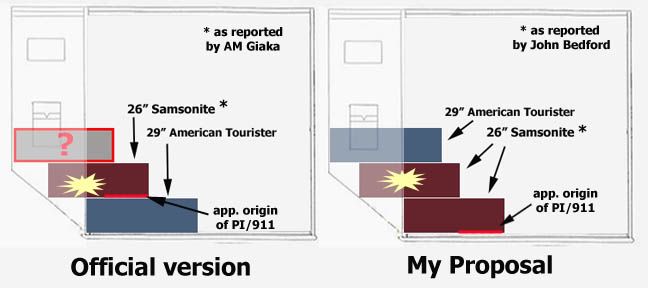
21 September: I tried a scaled image comparison - PI/911 within the most likely lower-case placement, and damage to AVE 4041's floor. The placement could vary - I'm also working with other large fragments on the hunch they might all be from the same lower side of the lower case, the chunks that shielded the floor from gas pitting. Do note the size of this supposed primary case fragments is consistent with the flaps of metal torn through just after the lower case.