
Showing posts with label Libya Sanctions. Show all posts

Libya's "Admissions of Guilt"

By Caustic Logic
completed February 15 2010
last update March 23 2011


But They Admitted It!"
For those who believe in Libya's guilt for the Flight 103 bombing, among the hardest points to get around is how Libya is perceived to have admitted their guilt. When whole governments act on it as fact, and the villain government finally confesses, well that would seem to confirm one's beliefs and show they had been on the right track all along.

It's a reasonably reasonable conclusion to arrive at, but a lazy one based on reading the headlines and not the main text or the footnotes and sources. Those who would like to maintain such assurances should read and be sure they can account for the following points, referring to the 2003 official admission of "responsibility" to the United Nations, an alleged 1993 confession from Colonel Gaddafi himself, and two other lesser examples sometimes cited.

Under Prolonged Duress
Following he indictment of Libyan agents al Megrahi and Fhimah in late 1991, the UN Security Council under Anglo-American leadership moved to enforce the official truth with sanctions. Resolution 748 of 31 March 1992 imposed an arms and air embargo on Libya, supported with diplomatic restrictions, and establishment of a sanctions committee. The committee’s work then led to Resolution 883 of 11 November 1993, toughening sanctions. This measure “approved the freezing of Libyan funds and financial resources in other countries,” reports globalpolicy.org, “and banned the provision to Libya of equipment for oil refining and transportation.” [1] Eventually all air traffic to and from the nation was barred, all U.S. and French trade with Libya was forbidden, and although a total oil exports embargo was considered too hard on others, their sales shrank as the industry suffered a lack of supplies.

An award of up to $4 million was offered by the US Justice Department in 1993 for help in bringing the suspects to justice (poster at left). It seems this reward stemmed from Bruce Smith, a Pan Am pilot and husband of a 103 victim, who first assembled a prize from airline pilot groups and other sources, including his own retirement account, eventually totaling $4 million. [2] The reward was renewed in 1995, and according to the Washington Post:
"[The FBI] also placed the pair, believed to be in Libya, on its 10 Most Wanted List. Seeking to rekindle international interest in the bombing, the FBI and State Department said they will work with the U.S. Information Agency to communicate with persons in Libya who might assist in bringing the suspects to court." [3]
Col. Gaddafi in fact showed great eagerness to help in that process, seeing a trial as their way out of sanctions, just as the (publicly announced) goal was suppossed to be. But as a 2001 book by Allan Gerson and Jerry Adler summed up the real thinking in Washington, "it was desirable to leave things just as they were," with Libya seeming intransigent and thus deserving of more squueezing. Rather than try thhe perpetrators with their amazing evidence, many felt "Libya would be their prison, and the United States would do its best to keep Kaddafi in there with them." Not to mention the Libyan people who also lived under these long-running punishments. And never mind the families of Flight 103's victims, who wanted to get what they percieved as justice. But this was never an open policy - the sanctions were an unfortunate effect of Tripoli's refusal to comply with terms the book says "appear to have been chosen to make it as difficult as possible for Kaddafi to comply." [4]

In October 1995, Libyan officials cited a "tragic toll" from sanctions, a $19 billion dollar wound damaging their agricultural sector significantly, and causing as many as 21,000 preventable deaths since their inception. [4.5] Such reports might be prone to exaggeration, but others started wondering if there were any deaths what the sanctions were about when the Libyans were ready to deal. Pope John Paul II, Nelson Mandela, even Tony Blair started suggesting a little flexibility. Perhaps a trial of the suspects really would be doable outside the United States.

By late August 1998 the framework of a trial was established, and used as the measure of Resolution 1192, agreeing to suspend sanctions once the suspects were handed over to the special Scottish court in the Nehterlands at Camp Zeist. Tripoli made it happen, with help from luminaries like Prince Sultan of Saudi Arabia and Nelson Mandela of Africa and the venue ideas of Robert Black QC, of Lockerbie. Megrahi and Fhimah were finally flown on a special flight to the Netherlands in early April, and on the 6th were official arrested at Camp Zeist and set to await their trial. Sanctions on Libya were immediately suspended, under threat of re-enforcement (that never did materialize). [5]

1993: Involved and Framed?
During this time of intense pressure to get the Libyans to publicly admit their guilt or at least help a court to “prove” it, a remarkable admission was reportedly taken in 1993, taken down by a prominent American journalist with suspected CIA links, Arnaud de Borchgrave. But it was not mentioned in public for over a decade, it would seem. In an article for NewsMax, from January 2004, de Borchgrave first revealed “Gadhafi’s Secret Message”:
"On July 6, after a lengthy interview, he went off the record and asked me to deliver a message to the director of Central Intelligence in Washington. He admitted Libya's guilt for the downing of Pan Am 103, but made clear that it was originally an Iranian retaliatory terrorist attack for the downing by the U.S. Navy of a peaceful Iran Air Airbus
[...]
“So the Iranians subcontracted part of the job to a Syrian intelligence service, which, in turn, asked the Libyan Mukhabarat to handle part of the assignment," Col. Gadhafi explained.“
[6]
Mr. De Borchgrave says he did report this behind the scenes to the CIA immediately on returning home from the interview. Vincent Cannistraro, who had headed the CIA's Lockerbie probe in its earliest (shiftiest) phase, continued throughout the 1990s as a voice for Libyan guilt. He has alluded to Libya taking the Iran contract from the Syrians, following the Autumn Leaves operation, but did not give de Borchgrave as a source nor give col. Gaddafi any credit. [7]

Again on Megrahi’s release, in late August 2009, de Borchgrave wrote about the interview, explaining how he asked Gaddafi “to explain, off the record, his precise involvement in the bombing of Pan Am Flight 103.” The Colonel “dismissed all the aides in his tent” and went candid, “in halting English without benefit of an interpreter.” Mostly he decried terrorism and offered to assist the West fight bin Laden-type terror networks. Again, he explained the bombing as payback for the shoot-down of Iran Air 655, an act the Arab world could not accept as an accident:
"[R]etaliation, he said, was clearly called for. Iranian intelligence subcontracted retaliation to one of the Syrian intelligence services (there are 14 of them), which, in turn, subcontracted part of the retaliatory action to Libyan intelligence (at that time run by Abdullah Senoussi, Gaddafi's brother-in-law). "Did we know specifically what we were asked to do?" said Gaddafi. "We knew it would be comparable retaliation for the Iranian Airbus, but we were not told what the specific objective was," Gaddafi added." [8]
So why, when Libya is usually reported as "always insisting on their innocence," did de Borchgrave’s story and its propaganda power sit in the dark for the crucial years of pressure? Is it the prominent Iranian and Syrian elements? Were the Americans holding out for a Libya-only storyline? That is roughly how it turned out. Interestingly, the colonel reportedly used this “admission” to reiterate Libya did not lead the operation.
“If we had initiated the plot, we would have made sure the accusing finger was pointed in the other direction and we would have picked Cyprus, not Malta, where some of the organization was done. The others picked Malta presumably to frame us.""
This isn't really a big help when your official storyline is that two Libyan JSO operatives, commanded by their JSO higher-ups, had specifically targetted PA103 via Malta airport, picked because Malta was their own "back door to the West." The JSO got the timers and the radio and the semtex, made the bomb, did up their own feasibility studies we were told, and had their two real movers buy the clothes, secure the suitcase, steal the luggage "taggs" to write that death sentence on, and personally shove it off from Malta on D-day. There is no "framed by the Syrians" in that scenario.

And all this when the real evidence Gaddafi may or may not have known about highly suggests the bomb went on PA103 way up in London, with nothing physically to do with Malta at all. Is this just another Libyan non-admission admission? Or worse - an attempt to hijack the West's fantasy narrative and steer it back away from himself?

99/01: Two Other Admission-ish things
Allan Gerson and Jerry Adler’s 2001 book The Price of Terror failed to mention this account of de Borchgrave while citing the available hints that Gaddafi “might have been suffering from a guilty conscience.” In a private 1999 interview with another journalist, Milton Viorst, Gaddafi “edged towards a kind of confession,” the book notes. As Viorst reported it, the leader said"
“Whether we were responsible for bringing down the French plane [UTA 772] will be decided by a French court. We don’t say anything about it. The same is true of Lockerbie. I can’t answer as to wether Libya was responsible. Let’s let the court decide.” 
[9]
That's not a full denial, but nowhere near an admission. But it was ambiguous enough that an aide later told Viorst Gaddafi “was not talking officially” and referred him to the Foreign Minister for the government's official story (few realize that Gaddafi is not really the government of Libya). Not being published in the book, we can presume this was the same claim of innocence Libya has always maintained.

In spring 2001, the book continues, Gaddafi reportedly slipped again, and confessed to diplomat Michael Steiner that Libya had been behind the Lockerbie bombing as well as the LaBelle disco bombing in Germany, but had since stopped terrorism and wanted to make up. The source for this was a cable of a top-level meeting with German and American leaders, including President Bush and Chancellor Schroder. A New York Times article from May 23 cites the leaked cable thus:
"Steiner reported on his talks with Qaddafi in Libya. Qaddafi admitted that Libya took part in terrorist actions (La Belle, Lockerbie). He clarified that he had abandoned terrorism and seeks the opportunity to make Libya's new position known. Qaddafi, too, is worried about fundamentalist trends."
Americans were upset this was leaked to the public, and it caused quite a row between Steiner, a flamboyant attention-seeker, and others in the German government, but they confirmed “that "La Belle" and "Lockerbie" were specifically mentioned by Mr. Steiner in this context.” Whatever exactly that proves. [10]

Owning Up in '03?
Many suspect the Zeist trial was never supposed to happen, as the evidence behind the indictment was too weak to stand up at Trial. The Crown's prosecutors managed to swing it somehow, but it took nearly two years from the handover, and a display of mental gymnastics worthy of the Realpolitik Olympics in the scale and skill of it. On January 31 2001, the three-judge panel made it official – Megrahi was legally guilty for the plot, and Fhimah was not guilty.

From there, many insisted sanctions should be lifted to reflect Libya’s good faith through this process. But Bush and Blair balked, demanding an admission of guilt and contrition, plus compensation to victims’ families, before they went past suspension. It was a letter, dated 15 August 2003, from Libya’s Permanent Representative to the President of the Council Ahmed A. Own, that paved the way. Own's letter explains “the Libyan Arab Jamahiriya,” as Libya calls itself, “has sought to cooperate in good faith throughout the past years” on solving the problems made theirs “resulting from the Lockerbie incident.” It was in this spirit that they “facilitated the bringing to justice of the two suspects charged with the bombing of Pan Am 103 and accepts responsibility for the actions of its officials.” [11] Presumably they mean real actions, making this another dodge in some minds.

But the letter also pledged Libya to cooperate with any further investigations, and to settle all compensation claims with haste, and to join the international “War on Terrorism.” It was widely (and reservedly) hailed as a bold… statement. But still evasive. It doesn’t clearly state anywhere the suspects or any Libyans were in any way actually guilty of the “incident.” Nonetheless, after a month of discussion in the Security Council, sanctions were lifted on Sept. 12 2003. France and the US insisted on abstaining, but it was otherwise a unanimous vote of 13. The United States’ own sanctions would remain in full force due to the general evilness of col. Gaddafy, US officials made clear. (Additional normalizations did happen in 2007).

There’s been much oxymoronic harping on this 2003 letter in the West as both an admission of guilt and an arrogant refusal to admit their guilt. The BBC’s 2008 Conspiracy Files episode on Lockerbie is a brilliant example. “For those that believe al Megrahi was framed,” snarls the narrator, Carolyn Katz, “one fact remains hard to explain away. Libya agreed to award substantial compensation for Lockerbie. Sanctions were then lifted.” [12] Well, ignoring that they just answered their own stumper of a question, it’s a good question. Why would they agree on their responsibility and get sanctions lifted unless they knew they were guilty? Just to get sanctions lifted? The movie continues: “Tripoli accepted responsibility for what it called “the Lockerbie incident.” But does it admit guilt?” Of course not, and by pretending there’s some disconnect, they’ve primed the audience to see the darkest of cynicism at work.

No Other Solution
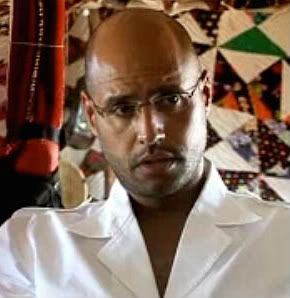
Despite his portrayals as a crazed prophet of death, Moammar Gadaffi proved a shrewd and patient pragmatist in all this. He can't have ever believed his nation actually did the crime, but against "guilty" as a legal truth, he accepted they had no choice but to do “the time.” It’s a type of bind known to breed passive-aggressive tendencies. The Colonel’s son and likely successor Saif al Islam al Gaddafi (left) seems to understand the dilemma. When he was interviewed at home for the same Conspiracy Files program (latter minutes), he was respectably candid, but came across strangely anyway.
Q - Does Libya accept responsibility for the attack on Lockerbie?
A - Yes. We wrote a letter to the Security Council, saying that we are responsible for the acts of our employees, or people. But it doesn’t mean that we did it, in fact.
Q - So to be very clear on this, what you’re saying is that you accept responsibility, but you’re not admitting that you did it.
A - Of course.
(edit)
Q - That’s… to many people will sound like a very cynical way to conduct your relationship with the outside world.
A - What can you do? Without writing that letter, you will not be able to get out of the sanction.
Q - So this statement was just word play. It wasn’t an admission of guilt.
A - No. I admit that we play with the words. And we had to. We had to. There was no other… solution.
[13]
The BBC are masters, among others, of careful editing, and it helped bolster their whole “you don’t admit you’re guilty” thing where people have to explain there’s nothing to “admit” (or fail to explain that, as happened here). Thus he could, with a little imagination, appear to be saying “we don’t admit it, buuuuut of course we did it, you already know that.” Note the cut that removed some of his words from the middle of the exchange, unlikely to have been irrelevant. Thus is clearly established a cynical payout ($2.7 billion) and bit of semantics to buy up and slough off their non-admitted guilt so they could resume trade. They got away with Lockerbie using money and words and are laughing at us and making more money!

Immediately after “there was no other solution,” the video cuts right to the interviewer asking “so it was like blood money if you like,” which seems to be referring to what was just shown. But really it refers to the American victims' families, whose “money, money, money, money” attitude (well-known and spearheaded by Victims of PA103 Inc.) was “materialistic,” “greedy,” and amounted to “trading with the blood of their sons and daughters.” It's tactless statement, but with the magic of editing, it can seem to mean so much more!
---
Sources:
[1] History of UN Sanctions on Libya. href="http://www.globalpolicy.org/component/content/article/195-libya/42383.html
[2] Gerson, Allan and Jerry Adler. "The Price of Terror: Lessons of Lockerbie for a World on the Brink. Harper Collins, 2001.
[3] Thomas, Pierre and Thomas W. Lippman. $4 Million Reward Offered in Pan Am Case. Washington Post. March 24 1995. http://www.washingtonpost.com/wp-srv/inatl/longterm/panam103/stories/reward032495.htm
[4] Gerson and Adler pp 101-102
[4.5] "Case Studies in Sanctions and Terrorism: Libya" The Peterson Institute. Date given as October 14 1996, Source given as International Herald Tribune, 14 October 1995, 13. http://www.petersoninstitute.org/research/topics/sanctions/libya.cfm
[5] http://archive.newsmax.com/archives/articles/2004/1/8/23958.shtml
[6] http://archive.newsmax.com/archives/articles/2004/1/8/23958.shtml
[7] Biewen, John and Ian Ferguson. "Mass Murder Over Scotland." Shadow over Lockerie series. American Radio Works, 2000. http://americanradioworks.publicradio.org/features/lockerbie/story/printable_story.html
[8] http://www.acus.org/new_atlanticist/honor-among-terrorists
[9] Gerson and Adler, pp 290-291
[10] Cohen, Roger. "German cable on Qaddafi sets off dispute." The New York Times. May 23 2001. http://www.nytimes.com/2001/05/23/world/german-cable-on-qaddafi-sets-off-dispute.html?pagewanted=all
[11] UN Security Council. Letter dated 15 August 2003... http://www.undemocracy.com/S-2003-818.pdf
[12] UN Security Council. 12 September 2003/ Press Release SC/7868: Security Council Lifts Sanctions Imposed on Libya. http://www.un.org/News/Press/docs/2003/sc7868.doc.htm
[13] The Conspiracy Files: Lockerbie." Prod/Dir Guy Smith, Ex Prod Sam Anstiss, Narr Caroline Catz. BBC Two. First Aired 31 August 2008. 52:49 mark. http://video.google.com/videoplay?docid=-327765978162851498&hl=en#
[14] see 13, 53:40 mark

Of Grasshoppers and Skyscrapers

Some Thoughts on Truth, Belief, and Stakes
5 October 2010

last edits 1 November

No Bee Whisperer/What If?
Those who follow this site will know I posted a “debate call” recently to anyone who could defend the official story in a detailed, evidence-based way. As of yet, I’ve gotten no response from across the divide of the kind I was hoping for.

For one thing, my often caustic and provocative style is apparently not effective at scaring up debate or discussion. Recently I had it suggested to me, by U.S. family member of a PA103 victim (posting as Bunntamas) that I’d catch more bees with honey than with vinegar. It's a worthy point, but I'm not sure what "honey" would be in this situation. So far I've been less than sure anything would catch the bees that most need caught, and here's why: in short, the stakes are enormous.

What I've written up below is perhaps not honey, but something I hope is useful. For this I’ll need (from a few readers I hope) another or a first act of imagination. Carefully consider the notion that Libya – or at least Megrahi - was in fact wrongly pursued while the real killers were left free. It might be difficult, but really try to approach it with an open mind.

Let’s imagine it was just proven by the most believable panel of experts and they explained it all to your satisfaction in a detailed 60-minute TV program. Everyone in the world has hailed it as amazing and is convinced. The following would be the next things to think about.

The cost to Libya
The case that emerged against Megrahi and Fhimah could hardly happen wrongly by accident, and a conspiracy is strongly implied. The actual cabal to sex-up or fake evidence needn’t be massive, but the cover-up and/or conspiracy of silence would be titanic. Call it unlikely if you will, but for a moment call it possible that some number of people decided where to lead the case with faked evidence to follow. Others followed up on it compliantly, and no one had officially recognized anything untoward along the way, until this amazing commission and its TV show we're imagining.

No one should disagree that the material effects on Libya were severe. Following the indictments in 1991, US and UN sanctions reportedly killed thousands, and cost many billions in lost revenue. The hard-won trial that allowed this to start ending was a gargantuan operation that took years to arrange and carry out, with hundreds of witnesses flown in to a specially-built complex for the 9-month proceedings. And, in this what-if scenario, it led to two men being wrongly imprisoned for nearly two years, one of them, as a convicted mass murderer, for a further eight. An additional $2.7 billion was paid out by Libya to family of the victims in compensation, on false pretenses as we’re imagining it.

Do you pay them back, or what? How much?

The real killers
And if we knew the Libyans weren't responsible after all, and wanted to punish those who really did it, we’d have to extract the punishment all over again. This would most likely, on examination, be from elements in the Iranian regime at the time, and certain Arab terrorist leaders. It would acknowledge and perhaps continue a once-declined tit-for-tat that started with the bizarre USS Vincennes incident and the sinking of Iran Air 655. It's an ugly scene. We might have to hunt down and bring to trial suspects who currently reside under state protection in places like Damascus, Syria and Reston, Virginia.

In this scenario, all the cynical misdirection towards Tripoli was undertaken to fake a search for justice. And at that, for one of the most heinous terrorist attacks ever against English-speakers, with 270 killed under horrifying circumstances. All the costs of the blame-Libya line would be underwritten by a further sacrifice of true justice on that scale, with the real killers consciously allowed to go free (or to be gotten back some other way, but not the right way).

Who, if anybody, decided to make these trade-offs? How many could or should sense the injustice happening? Did they not see, or just not say? It’s preposterous, on the face of it. A normal person’s “what-if” should have worn off by now. Usually, of course, it does.

I've been wrong before...
For what it's worth, I should remind my readers - and myself – that I was once a “9/11 Truther.” For years I half-suspected an inside job behind the attacks on New York and Washington, perhaps with remote control and demolitions. Either way, I was fairly certain the government at least allowed the outside attack to happen for the very advantages I saw them brazenly capitalizing on.

The uneasy feeling about the event and its abuse remains, but the supposed facts that once suggested so much so clearly have nearly all melted away after scrutiny that first came from others. In that case, I was embarrassed but ultimately relieved, and I know what it’s like to see a reality I believed fall apart and leave me wondering what the hell I was thinking.

Perhaps these more recent conclusions I’ve reached about Pan Am 103 are just as wrong. There’s a precedent for it, anyway. Inherent distrust and ego-driven desire to be right when everyone else is wrong, some skewed understandings, ignored counterpoints, making connections that only seem to be warranted, plus group reinforcement. All can lead to false certainty that can be amazingly convincing when you're on the inside of it.

It’s possible that the bomb that killed Bunntamas' father and so many others really did travel on KM 180. The records of Air Malta contradicting that might have been altered to do so, and all the strangeness around the Frankfurt data might be just plain irrelevant. That would suggest Megrahi, in a way, except that he was busy boarding another flight as the loading happened. Maybe Fhimah really did manage the actual bomb placement as alleged, despite no evidence and his being found not guilty.

Maybe in fact the timer and radio fragments and manual cover found on land are really from the blast, despite tests that confirm what seems to me common sense. Science is complex, and these items do point pretty clearly to Libya. It could be that the Libyan plotters really did set their MST-13 timer for 7:03 pm, less than an hour after scheduled takeoff, not caring if their clues survived the blast and fell on land. And I can't rule out that that this stupid plan  just happens to mimick the PFLP-GC's known bomb style if one were loaded at London.

It's not unthinkable that Tony Gauci’s recall of the buyer and day of purchase really did start out confused and fuzzy in 1989 but got sharper at trial 11 years later, nabbing Megrahi on the 7th of December. It’s even possible that Abdul Majid Giaka’s clues weren’t made up, or the facts they convey happen to be true despite the carrier. That could mean any of the following is true: Megrahi commissioned a report on bombing a plane (and had Giaka himself write it), both accused handled explosives at the airport (which Giaka was allowed to see), and they brought a suitcase of the style used for the bomb from Tripoli to Malta the day before the bombing, again right in front of the blabbermouth. Any one of those would be pretty convincing if I were more inclined to believe it.

I can even see all or most of these being true at the same time, as the investigation had at one point decided. It's a logical possibility, though it’s obviously distant and hard for me to credit at the moment. That’s the part I’d need some help with.

... but it's less likely now.
I am a better conspiracy theorist now for the 9/11 Truth experience, and less inclined to leap on something just because it makes a certain kind of sense. I received much of my debunking at the JREF forum's conspiracy theory section (learning from others’ mistakes more than my own). The epic nemesis of 9/11 Truthers and other CT nutters, full of government agents to hear the latter speak, helped me learn the rational and rigorous approach more in line with my older half-ass training as a historian. Having come full-circle, I now consider myself part promoter and part debunker of conspiracy theories, trying to get each side to consider the other a little more.

But that forum has been unable to say much against what I, along with Rolfe, Buncrana, and many others see in the Lockerbie case. All things considered, over perhaps two dozen threads and hundreds of thousands of words, we’re debunking the official story. Its alleged machinations and miracles fail to rise past the lower threshold of plausibility. Nothing aside from legal technicalities and conventional belief supports it.

Or so it seems, and if this is wrong, I’ll be unable to shake it on my own. And my growing circle of fellow thinkers won’t be any help, nor likely my adversaries; no one else at that esteemed forum of rationality nor anywhere else has pulled together any convincing debunk. Ignorant or self-serving repetitions from on high that the the guy was convicted so he's guilty are sliding off of us. Details will be required.

A Big Lie?
Finally, I return to one of the stumbling blocks to directly confronting the strong case for something wrong. There's still that temptation to rule the whole thing too ridiculous to contemplate. Just how have the mainstream media, multiple governments and hundreds of investigators, and the public at large, all at the same time, failed to “figure it out” yet?

Perhaps the failures aren't as separate as they might seem, and the governments' decisions informed the media's (compliant) ignorance, which of course shaped the public's? Is it that simple?

Further, we could be seeing the "Große Lüge” or Big Lie effect, as Hitler outlined in Mein Kampf. A deception so enormous that ordinary people could perceive it about as much as a grasshopper could grasp what's inside a skyscraper. It's only the logical extension of my theory of what happened, that continued failure to see can best be explained that way. There are precedents, anyway.

So in short, the vast mainstream mind may just be failing to see a very large and smelly pachyderm filling most of the room. Now that that charge is on the record, how is anyone going to respond to it? By simply insisting again that it's been legally established there is no stinking elephant?

To be sure, no matter how much debating and convincing anyone does, the legal-political status quo will try hard not to change - legal reality will stay what it is and the ineffectual "cranks" will remain just that. But physical reality is what it is, and the evidence from the 3-D world contests the official story at every major juncture. Much of it is actually documented and can be seen in black and white. Lawyers and experts and family members will continue mentioning this for some time, and history is sure to get it right eventually. But barring some major change in the halls of power, don’t expect the change anytime soon.

My aim here, especially when I get provocative, is not to up and win this thing and convince anyone with mere ("supposed") facts, but to help get it really started. It will be an epic struggle for the throne of legal truth and I urge as much calm and patience as possible on all sides. But it needs to happen. One very large body of people or another has a lot of learning to do.

Another Shameful Propaganda Piece

3 September 2010

Here I'd like to comment on a recent editorial (unattributed) in the Post and Courier (Charleston, SC) called "Post-Lockerbie Shame." Below are some quotes from it and my comments/corrections.

The "compassionate release" of a convicted PanAm bomber in 2009 was an affront to justice...
No quotation marks are needed here - compassion is the actual basis of the law justifying Megrahi's release. That process and decision in implementing that law are complex and murky and open to criticism. But as usual for America's slavish media units, this block of anonymous text makes no mention whatsoever of the mountain of evidence all but proving Megrahi was framed and wrongly convicted in the first place.

This is irresponsible journalism, treating this as a one-sided issue when it just is not. There have been doubts (at the least) expressed so widely by informed parties that one wearies of repeating them. Put in short form, there are two relevant rulings by Scottish judicial bodies - the 2001 conviction, and the 2007 ruling by the Scottish Criminal Case Review Commission. The conviction has been ruled, by the SCCRC review, to be a "possible miscarriage of justice." The SCCRC decision, which has not been so challenged, had authorized a second appeal which was never heard, lost in the shuffle of cancer and release.

The Post's "Post-Lockerbie Shame" cites the challenged conviction and ignores the unchallenged SCCRC ruling and the avoided appeal it unleashed. That's slanted reporting and gives a false impression of the legal standing of Megrahi's guilt. Officially in place, but crumbling.

Libya has paid billions in reparations to victims' families in acknowledgement of its role in the bombing, but Col. Gadhafi has never expressed the slightest remorse.
Is this sloppy journalism or the willfully deceptive kind? There is no "acknowledgment" in the 2003 letter to the UN, the settlement money, or anywhere, of Libya's involvement in the bombing. They are, and insist they are, uninvolved. Hence no remorse. Get it? The money and acknowledged word play were to end the unfair sanctions crippling their nation. "Acknowledged ... but no remorse." That's just cheap, folks.

According to a Scottish doctor paid by Libya, he had only months to live. [... MacAskill later] released al-Megrahi, citing the doctor's opinion.
Dr. Kay was paid by Libya? Or is the unnamed writer still confused by chatterbox Sikora's attempts at insinuating himself into the situation? Please double-check yourselves there. It is pretty confusing.

The freed terrorist is now living the good life in Tripoli, and BP is drilling in waters off the Libyan coast.
And the real bombers of Pan Am 103 are aging gracefully in their own corners of this sick world, never serving a day in jail for this murder of 270 people after the CIA decided to blame Libya.

Also, suffering from cancer but not dead yet, in a nice house, with family and supporters, equals the good life? Relative to jail, obviously so. But what evidence can anyone show that his conviction for this heinous crime was reasonable or sustainable? Why should we actually be mad that a man is dying slower and in more comfort than he might otherwise be?

The Senate rightly wants to know ...
No they don't.

The comment thread for this article has been closed.
Before any comments were even posted? Were they afraid I was coming?

Debate Call: Brian Flynn

August 8 2010

Yesterday a unique article appeared at a news site I’m unfamiliar with – The Daily Beast – with the story of Brian Flynn’s educated rage that “the Lockerbie bomber” was set free by a corrupt Scottish system and then "recovered." Mr. Flynn’s brother, John Patrick, was killed on PA103. I’ve observed a moment’s silence to reflect on that, and realizing it’s futile to even try and grasp the loss and moving on, I’d like to address to Mr. Flynn directly.

Mr. Flynn, you mention your early work helping your mother with research, and that she "served on both presidential commissions that investigated the causes of the bombing and improved airline security." And with your help, she “lobbied Congress to enact the Iran Libya Sanctions Act, which ultimately put enough pressure on Libya to hand over the indicted Libyan agents...” I can admire this channeling of grief into action, and I’m sure you all did so in good faith and with the best intentions, based on what you knew, to ensure John did not die in vain.

As you may know, the sanctions placed on Libya did hurt and sent a message – some sources say 20,000 or more died from these, but I’m sure it was more than 270 anyway. You might realize that the original American demand – a trial in the US – was never met and could never be. It was only reluctantly that Washington agreed to the only trial that could happen – a compromise one, in a third country, under Scots law.

What was your position during that debate? Did you side with those trying for any trial that could work, or with those demanding full Libyan compliance even at the cost of no trial? The sanctions were not lifted until after the surrender of the suspects, after nearly a decade in place. Even some official sources acknowledge the US government did not actually desire a trial at all - just a reason for sanctions against Libya.

“Eventually, Abdel Baset al Megrahi was convicted and sentenced to life in prison. And although he would be the only man to pay for the atrocity, we felt in a small way that some justice had been served. [...] When Megrahi was released ... this blatant act of betrayal robbed us of that one shred of justice.”
I can understand why it’s upsetting if one believes in Megrahi’s guilt, or even just in the integrity of court decisions, to have a convicted murderer go free. But the Scottish system does that, irrespective of guilt. And I really am sorry to have to say this, but I believe you were badly misled on the guilt part.

I gather you desire to have no doubts about this at all, and that is your right. But you say you’ve done the research, while I and many, many others remain less than convinced, even after some study. Maybe we’re just not looking deep enough? What do you think accounts for the difference?

“Like many of our Irish ancestors,” you point out, “we Flynns like a fight.” I see you have stepped into the ring again with some pretty bold words. You even took the time to address a critical comment beneath your article. As your compatriot Bunntamas points out elsewhere (comments), you're highly evolved in the facts domain, studying in-depth for decades, whereas I've just been skimming fringe info for a year. So you should easily wipe the floor with me and score a victory for truth and against the “conspiracy theorists.” Or you could take some cop-out reason to turn down the offer - something about “waste of time” is standard.

We could debate here via comments, at the anti-Conspiracy Theory JREF forum (forums.randi,org) or wherever else you feel more comfortable, like e-mails. I would like to publish the results of course as I don't want to be accused of hushing up any loss I may suffer. Whether you agree or not, I’ll start off in the comments, springing off of points made in your article and one detailed response. Feel free to pick any points to respond to.

Thanks for any consideration
- Adam Larson
aka Caustic Logic
to whom you owe nothing
but shouldn't ignore anyway

(commenting tips in sidebar - if you show an interest I'll turn off comment moderation to speed it up.)

"To Support Justice" - The Congressional Consensus

A Tough Sell on Capitol Hill, part one
May 18 2010


Compared to This...
Following the destruction of the American airliner Flight 103 over the Scottish town of Lockerbie, there were quite a few voices in the United Kingdom’s house of Commons, and even Lords, and regional assemblies, who both supported victims' search for truth, and questioned or even rejected the official story of the bombing.

Some have championed this nuanced stance with great and vocal conviction; Tam Dalyell, a long-serving Scottish MP (Labor), staunchly anti-war and anti-Imperialism, has called 17 “adjournment debates” on Lockerbie down the years. [1] He's floated some seriously heavy notions, like a "Faustian pact" where the U.S. sacrificed one plane to prevent multiple attacks. [2] His views are not widely held, but intelligently put, generally spot-on, and heard regularly.

More recently Member of Scottish Parliament Christine Grahame (SNP, South of Scotland) in 2009 visited convicted “bomber” al Megrahi in prison, spoke up of belief in his his innocence, called for a new investigation, [3] questioned key evidence in the old one, [4] and gave the current name of the possible true bomber, protected in the United States. [5] The last was within the parliament chamber of Scotland.

...the American Mainstream
Across the pond, within just a few miles of that person and of Arlington National Cemetery and its monument for the 189 American killed in the bombing, we have the gathered US congress. Over the decades, many senators and representatives have done their bit publicly lobbying for the bereaved families of 103, predictably earning approval points on the way. Congressional support included urging an investigation, calling hearings, pushing related bills, and saying the right things at the right times.

Alan Gerson and Jerry Adler’s 2000 book The Price of Terror lists Congressional players from both houses and both sides of the aisle (alphabetically here): Al D’Amato, Bob Dole, Dante Fascell, Benjamin Gilman, Orrin Hatch, Henry Hyde, Edward Kennedy, Frank Lautenberg, George Mitchell, Frank Murkowski, and Arlen Specter. [6 p 307] Kennedy was “the senator who probably worked the hardest and longest on Pan Am 103” [6 p 60] Lautenberg also stands out, and both he and D’Amato served on President Bush’s 1989-90 President's Commission on Airline Security and Terrorism, (PCAST) to partially investigate the attack (mostly Pan Am's alleged failures at Frankfurt). [6 p 64]

“[W]hat pressure there was” to broaden and tighten sanctions enforcement on Libya, Gerson and Adler wrote, “came from Congress, especially from Kennedy and Lautenberg,” [6 p 258] Others like Phil Gramm (R-TX) took their turn with the tough stick, championing the families as they went. [6 p 293] Holding then and continuing on to many lofty positions, these folks all have stayed in the comfortable norms – to seek justice and truth is, to them, synonymous with prosecuting the Libyans as was done.

When it came time for an actual trial, they were less involved – and besides, sanctions over the impasse had always served U.S. interests better. But after the trial and al Megrahi’s conviction, the congressional fostering of the politically correct justice continued quietly with the status quo, until talk started of the "bomber" being released from prison. In August 2009 Seven senators (Gillibrand, Kerry, Kennedy, Lautenberg, Leahy, Menendez, and Schumer), alarmed at the possibility of compassionate release, urged the Scots to keep Megrahi in jail ‘til he was dead, in part “to support justice.” [7] They apparently failed to realize this would violate normal Scottish standards and would be arguably illegal.

And apparently none of them harbors even the faintest doubt about the man’s guilt, as continuing to hold him would clearly show that Scotland “oppose[d] acts of terrorism.” [7] We now know just how dubious the official findings are at their factual core, but that was always encased in an elaborate façade of procedural verification. Investigation, trial, and conviction is all the Senators needed to see, and that’s usually a sound approach. Further, the official story remains a safely non-partisan issue – the whole system wants to help the families and believes in the case heading to Zeist.

So clearly this kind of widespread acceptance of a “Big Lie” doesn’t require any systemic conspiracy. It does, however, indicate at the least a lack of truly rigorous independent thought. And those very few on Capitol Hill who have dared speak up in question of that process somehow wind up being less than convincing and wind up in deep trouble of someone’s making.
---
next: part two - Trafficant’s Transporter Override
---
Sources:
[1] Wikipedia. Tam Dalyell. http://en.wikipedia.org/wiki/Tam_Dalyell
[2] http://news.scotsman.com/comment/Tam-Dalyell-Lockerbie-papers-may.5575560.jp
[3] Wikipedia. Christine Grahame. http://en.wikipedia.org/wiki/Christine_Grahame
[4] http://lockerbiecase.blogspot.com/2009/10/key-lockerbie-evidence-unsafe-claims.html
[5] http://lockerbiedivide.blogspot.com/2010/03/where-in-world-is-abu-elias.html
[6] Gerson, Allan and Jerry Adler. The Price of Terror: Lessons of Lockerbie for a World on the Brink. New York, Harper Collins, 2001. First edition. 302 pages.
[7] http://news.bbc.co.uk/2/hi/uk_news/scotland/south_of_scotland/8206458.stm

FROM LOCKERBIE TO ZEIST (via Tripoli, Tunis and Cairo)

*Note: What follows is an article on the establishment of the Camp Zeist Trial written by Professor Robert Black. It was previously published in a Maltese book edited by Joe Mifsud - Lockerbie: Qabel il Verdet (Before the Verdict), released in 2000.  It was sent in to me by Robert Forrester, and with Prof. Black's express permission, here it is, and interesting broad-sweep view of a years-long campaign to implement the trial the Americans had been demanding. (- C.L. March 2 '10)*

FROM LOCKERBIE TO ZEIST 
(via Tripoli, Tunis and Cairo)
by
Robert Black QC
Professor of Scots Law
The University of Edinburgh

"Call the diet: Her Majesty's Advocate against Abdelbaset Ali Mohmed al-Megrahi and Al Amin Khalifa Fhima."  

It was with those words that on Wednesday 3 May 2000 the long-delayed Lockerbie trial opened in the High Court of Justiciary sitting at Kamp van Zeist near Utrecht in the Netherlands.  There were those who predicted that this trial would never take place and there were those who worked tirelessly, but ultimately unsuccessfully, to try to ensure that it would not.  My purpose in this paper is to give you an account of my part in attempting to secure, over some rather powerful opposition, that there would in fact be a trial.

The Event
On Wednesday, 21 December 1988 at 7:03 pm GMT a Boeing 747 airliner owned and operated by Pan American World Airlines and cruising at 31,000 feet exploded above the small town of Lockerbie.  Pan Am Flight 103 had taken off from London Heathrow some 38 minutes before and was en route to JFK Airport in New York.  Aboard the aircraft were 243 passengers and a crew of sixteen.  None survived.  The vast majority of those on board were United States citizens, but other nationalities represented included British, French, Israeli, Hungarian, Canadian, German, Spanish, Belgian and Norwegian. Although the disaster occurred only four days before Christmas and every other transatlantic flight was fully booked, this particular aircraft was more than one-third empty, only 243 out of 412 seats being occupied.

Debris from the explosion completely demolished three houses in Sherwood Crescent, a small street of privately owned detached houses, and eleven townspeople were killed instantly.

The Investigation
Within a week it had become apparent to the joint team of British and American investigators that this had been no accident and that the cause of the destruction of the aircraft had been a bomb.  There then followed the most extensive criminal investigation ever conducted in Scotland -- or, it seems probable, anywhere else -- into an act of terrorism.  The investigation was under the control of the Dumfries and Galloway police -- the smallest force in Scotland.  Also closely involved in the investigation were other United Kingdom police forces and personnel from the British, United States, and west German intelligence services.

Around and to the south of Lockerbie some 845 square miles of land were combed for debris.  Over a period of several years more than 15,000 people were questioned; information and evidence were sought in more than 30 different countries.  The aircraft had been some thirty minutes late in leaving Heathrow.  Had it been on schedule, the bomb (assuming that it was detonated by a timing mechanism) would have exploded over the Atlantic Ocean, sparing the town of Lockerbie but making investigation of the accident and recovery of physical evidence very much more difficult.

In mid-1990 it was reported (in the Washington Post and the London Times among other places) that sources within the US Central Intelligence Agency were indicating that the evidence pointed towards the atrocity's having been committed by Ahmed Jibril's Syrian-backed Popular Front for the Liberation of Palestine-General Command (PFLP-GC).  The theory was that this group had been commissioned and paid by Ayatollah Khomeini to destroy an American airliner in revenge for the American warship Vincennes shooting down in the Persian Gulf an Iranian Airbus containing pilgrims to Mecca on 3 July 1988 resulting in the death of all 290 people on board.

Libya Enters the Frame
It will therefore be appreciated that it came a something of a surprise when on 14 November 1991 the prosecution authorities in Scotland and the United States simultaneously announced that they had brought criminal charges against two named Libyan nationals who were alleged to be members, and to have been acting throughout as agents, of the Libyan intelligence service.

According to the Scottish and American prosecutors, what had happened was this.  The two Libyans had manufactured a bomb using a Toshiba cassette recorder, Semtex explosive and a digital electric timer (supplied and manufactured by a Swiss company, MeBo AG).  The device had been placed in a brown Samsonite suitcase in Malta, along with items of clothing purchased for the purpose from a particular shop (Mary's House) in Sliema.  Using stolen Air Malta luggage tags, the Libyans (one of whom had occupied the post of station manager for Libyan Arab Airlines in Malta) introduced the suitcase into Luqa  airport's inter-line baggage system as unaccompanied luggage on Air Malta Flight KM 180 from Malta to Frankfurt, with directions for its onward transmission (first) on to a feeder flight (PA  103A)  to Heathrow and (second) on to Pan Am Flight 103 from Heathrow to JFK in New York.

On 27 November 1991 the governments of the United Kingdom and the United States each issued a statement calling upon the Libyan government to hand over the two accused to either the Scottish or the American authorities for trial.  Requests for their extradition were transmitted to the government of Libya through diplomatic channels.  No extradition treaties are in force between Libya on the one hand and United Kingdom and the United States on the other.

Libyan internal law, in common with the laws of many countries in the world, does not permit the extradition of its own nationals for trial overseas.  The government of Libya accordingly contended that the affair should be resolved through the application of the provisions of a 1971 civil aviation Convention concluded in Montreal to which all three relevant governments are signatories.  That Convention provides that a state in whose territory persons accused of terrorist offences against aircraft are resident has a choice aut dedere aut judicare, either to hand over the accused for trial in the courts of the state bringing the accusation or to take the necessary steps to have the accused brought to trial in its own domestic courts.  In purported compliance with the second of these options, the Libyan authorities arrested the two accused and appointed a Supreme Court judge as examining magistrate to consider the evidence and prepare the case against them.  Not surprisingly, perhaps, the UK and US governments refused to make available to the examining magistrate the evidence that they claimed to have amassed against the accused, who remained under house arrest until they were eventually handed over in April 1999 for trial at Kamp van Zeist.

The United Nations
The United Nations Security Council (of which the UK and the USA are, of course, permanent members) first became involved in the Lockerbie affair on 21 January 1992 when it passed Resolution 731 strongly deploring the government of Libya's lack of co-operation in the matter and urging it to respond to the British and American requests contained in their statements of 27 November 1991.  This was followed by Security Council Resolution 748 (31 March 1992)  requiring Libya to comply with the requests within a stipulated period of time, failing which a list of sanctions specified in the Resolution would be imposed.  Compliance was not forthcoming and sanctions (including trade and air transport embargos) duly came into effect in April 1992.  The range and application of these sanctions was  extended by a further Resolution passed on 11 November 1993.  The imposition of sanctions under these last two Resolutions was justified by the Security Council by reference to Chapter 7 of the Charter of the United Nations on the basis that Libya's failure to extradite the accused constituted a threat to world peace.

An Attempt to Resolve the Impasse
I first became involved in the Lockerbie affair in early 1993.  I was approached by representatives of a group of British businessmen whose desire to participate in major engineering works in Libya was being impeded by the UN sanctions.  They asked if I would be prepared to provide (on an unpaid basis) independent advice to the government of Libya on matters of Scottish criminal law,  procedure and evidence with a view (it was hoped) to persuading them that their two citizens would obtain a fair trial if they were to surrender themselves to the Scottish authorities.  This I agreed to do, and submitted material setting out the essentials of Scottish solemn criminal procedure and the various protections embodied in it for accused persons. 

In the light of this material, it was indicated to me that the Libyan government was satisfied regarding the fairness of a criminal trial in Scotland but that since Libyan law prevented the extradition of nationals for trial overseas, the ultimate decision on surrender for trial would have to be one taken voluntarily by the accused persons themselves, in consultation with their independent legal advisers.  For this purpose a meeting was convened in Tripoli in October 1993 of the international team of lawyers which had already been appointed to represent the accused.  This team consisted of lawyers from Scotland, England, Malta, Switzerland and the United States and was chaired by the principal Libyan lawyer for the accused, Dr Ibrahim Legwell.  The Libyan government asked me to be present in Tripoli while the team was meeting so that the government itself would have access to independent Scottish legal advice should the need arise.  However, the Libyan government expectation was clearly that the outcome of the meeting of the defence team would be a decision by the two accused voluntarily to agree to stand trial in Scotland.

I am able personally to testify to how much of a surprise and embarrassment it was to the Libyan government when the outcome of the meeting of the defence team was an announcement that the accused were not prepared to surrender themselves for trial in Scotland.  In the course of a private meeting that I had a day later with Dr Legwell, he explained to me that the primary reason for the unwillingness of the accused to stand trial in Scotland was their belief that, because of unprecedented pre-trial publicity over the years, a Scottish jury could not possibly bring to their consideration of the evidence in this case the degree of impartiality and open-mindedness that accused persons are entitled to expect and that a fair trial demands.  A secondary consideration was the issue of the physical security of the accused if the trial were to be held in Scotland.  Not that it was being contended that ravening mobs of enraged Scottish citizens would storm Barlinnie prison, seize the accused and string them up from the nearest lamp posts.  Rather, the fear was that they might be snatched by special forces of the United States, removed to America and put on trial there (or, like Lee Harvey Oswald, suffer an unfortunate accident before being put on trial).

 The Libyan government attitude remained, as it always had been, that they had no constitutional authority to hand their citizens over to the Scottish authorities for trial.  The question of voluntary surrender for trial was one for the accused and their legal advisers, and while the Libyan government would place no obstacles in the path of, and indeed would welcome, such a course of action, there was nothing that it could lawfully do to achieve it.

An Innocent Abroad
My journeys to and from Tripoli in October 1993 were interesting.  Because of UN sanctions, air travel to Tripoli was out of the question.  The normal procedure at that time was to fly from Europe to the nearest Tunisian airport on the holiday island of Djerba and then travel by car along the coast road to Tripoli, a frightening five-hour journey at the best of times but especially so when being driven at breakneck speed in a Libyan government black Mercedes whose driver clearly regarded it as the duty of every other road user to get out of the path of his vehicle and refused to concede even the possibility that any  road user, Tunisian or Libyan, might fail to do so. 

On my return journey I was unable to get a flight from Djerba to any European airport and so took an internal flight from Djerba to Tunis in the naive belief that flights to European destinations would be more frequent from the Tunisian capital.  On arrival in Tunis at 5pm I discovered that there were no further flights to any European destination that day.  I made a booking for an early flight to London the following morning and proceeded to try to find accommodation for the night.  It was only then that I discovered that a meeting of the Council of the PLO was taking place in Tunis and that there was accordingly not a single room to be had in any of the major hotels in the city.  Eventually, however, my taxi driver indicated that he had a friend who ran a small hotel and that he was sure that I would be able to find accommodation there.  He was indeed correct, though I suspect that I am the only guest in the history of the establishment who has ever paid for a room there other than by the hour.

The Neutral Venue Proposal
Having mulled over the concerns expressed to me by Dr Legwell in October 1993, I returned to Tripoli and on 10 January 1994 presented a letter to him suggesting a means of resolving the impasse created by the insistence of the governments of the United Kingdom and United States that the accused be surrendered for trial in Scotland or America and the adamant refusal of the accused to submit themselves for trial by jury in either of these countries.  This was a detailed proposal, but in essence its principal elements were: that a trial be held outside Scotland, ideally in the Netherlands, in which the governing law and procedure would be that followed in Scottish criminal trials on indictment but with this major alteration, namely that the jury of 15 persons which is a feature of that procedure be replaced by a panel of judges who would have the responsibility of deciding not only questions of law but also the ultimate question of whether the guilt of the accused had been established on the evidence beyond reasonable doubt.

In a letter to me dated 12 January 1994, Dr Legwell stated that he had consulted his clients,  that this scheme was wholly acceptable to them and that if it were implemented by the government of the United Kingdom the suspects would voluntarily surrender themselves for trial before a tribunal so constituted.  By a letter of the same date the Deputy Foreign Minister of Libya stated that his government approved of the proposal and would place no obstacles in the path of its two citizens should they elect to submit to trial under this scheme.

The UK Government's Initial Attitude
On my return to the United Kingdom I submitted the relevant documents to the Foreign Office in London and the Crown Office (the headquarters of the Scottish prosecution service) in Edinburgh.  Their immediate response was that this scheme was impossible, impracticable and inherently undesirable, with the clear implication that Professor Black had taken leave of what few senses nature had endowed him with. That remained the attitude of successive Lord Advocates and Foreign Secretaries for four years and seven months.  During this period the British government's stance remained consistent: United Nations Security Council Resolutions placed upon the government of Libya a binding international legal obligation to hand over the accused for trial to the UK or the US authorities.  Nothing else would do.  If Libyan law did not currently permit the extradition of its own nationals to stand trial overseas, then Libya should simply alter its law (and, if necessary, its Constitution) to enable it to fulfil its international duty.

Over the years British government sources put forward six specific objections to my proposal.  There was no merit in any of these objections, as I think I have conclusively demonstrated in an article published in November 1997: see “The Lockerbie Proposal”  1997 Scots Law Times (News) 304.

Delay
For almost five years successive governments of the United Kingdom (of both old Conservative and New Labour political persuasions) consistently and fervently maintained that the "neutral venue" scheme which I had proposed and which had been accepted by the Libyan government and defence lawyers in January 1994, was totally and absolutely unsatisfactory and could provide no resolution to the Lockerbie impasse.  For a flavour of the vehemence of  government opposition to the scheme, as recently as early 1998, reference may be made to the article by the then Lord Advocate,  Lord Hardie “The Lockerbie Trial” 1998 Scots Law Times (News) 9, to the statement made in the UN Security Council on 20 March 1998 by the UK Permanent Representative, Sir John Weston (see www.britain-info.org/bistext/ukmis/speeches/20mar98.stm) and to the  statement in the House of Commons on 29 April 1998 by Foreign Office Minister Derek Fatchett (see HC Hansard, 29/04/1998, cols 299-302).

President Nelson Mandela of South Africa expressed his strong support for the proposal during his attendance at the Commonwealth Heads of Government Conference in Edinburgh in October 1997.  But that seemed to cut no ice with Robin Cook, the new Foreign Secretary who, admittedly, probably had other more personal matters on his mind at the time.  

Not surprisingly, Libyan patience at the refusal of the United Kingdom and the United States even to contemplate the “neutral venue” solution eventually began to wear thin.

In April 1998 Dr Jim Swire (the spokesman for the relatives group UK Families Flight 103) and I had a meeting in Cairo with the Secretary-General of the League of Arab Nations, Dr Esmet Abdul Majid, and were informed that in the light of more than four years of British and American intransigence the Libyans were seriously considering announcing withdrawal of their support for the proposal.  It was suggested to us by Dr Majid that it might be appropriate for us, if we wished to avoid this outcome, to make yet another trip to Tripoli.  This we did, and in a meeting with Dr Ibrahim Legwell were assured that it remained the position of the suspects that they would surrender for trial if such a court were established.  It was the Libyan government that was apparently, because of British and American procrastination, having second thoughts about permitting its citizens to leave the country to stand trial voluntarily before such a tribunal. 

The Libyan Foreign Ministry committee, with whom all of my previous dealings had been, arranged for Dr Swire and me to have a meeting with Colonel Gaddafi and this took place on 20 April 1998 at his reinforced concrete tent on the outskirts of Tripoli.  The meeting was initially a frosty one, with the Colonel refusing to make eye contact but instead staring straight ahead with his arms folded and making lengthy pronouncements about the inflexibility and intransigence over more than four years of the British government.  When eventually he interrupted his monologue to take breath, we were able to dive in with comments to the effect that the Labour government had been in office for less than a year, was still finding its feet in foreign affairs and that it was possible to detect some signs that its position over the Lockerbie issue might just be somewhat more flexible than that of its Conservative predecessor.  Gaddafi then made a few highly complimentary remarks about Tony Blair, and the remainder of the meeting was held in a much more friendly atmosphere.  After about an hour, we departed with the reassurance that the Libyan government’s policy in relation to a “neutral venue” trial would remain unchanged for at least a further six months.  As we were leaving Gaddafi's compound the then Libyan Foreign Minister, Omar al-Muntasser, who had been present at the meeting, said to us: "You made the Leader laugh three times!  Someone will pay for that!"  I think he was joking.

The Volte-face
From about late July 1998, there began to be leaks from UK government sources to the effect that a policy change over Lockerbie was imminent, and on 24 August 1998 the governments of the United Kingdom and United States announced that they had reversed their stance on the matter of a "neutral venue" trial.  In a letter of that date to the Secretary-General of the United Nations, Kofi Annan, the British and American Acting Permanent Representatives to the UN stated:

 "....  in the interest of resolving this situation in a way which will allow justice to be done, our Governments are prepared, as an exceptional measure, to arrange for the two accused to be tried before a Scottish court sitting in the Netherlands.  After close consultation with the Government of the Kingdom of the Netherlands, we are pleased to confirm that the Government of the Kingdom of the Netherlands has agreed to facilitate arrangements for such a court.  It would be a Scottish court and would follow normal Scots law and procedure in every respect except for the replacement of the jury by a panel of three Scottish High Court judges.  The Scottish rules of evidence and procedure, and all the guarantees of fair trial provided by the law Scotland, would apply."

The details of the arrangement -- the fine print -- are to be found in two documents: a British Order in Council (SI 1998 No 2251), made on 16 September 1998, conferring the necessary legal authority for Scottish criminal proceedings against the two Libyan suspects to be conducted in the Netherlands, and an international agreement between the Government of the Kingdom of the Netherlands and the Government of the United Kingdom, concluded on 18 September 1998, making the diplomatic arrangements necessary for the "neutral venue" trial to take place.  The scheme set out in these two documents differs in detail from that which I proposed, and to which I had obtained Libyan assent, in January 1994; but the framework is the same.

Pitfalls along the Route
Although the British proposal was announced in late August 1998, it was not until 5 April 1999 that the two suspects actually arrived in the Netherlands for trial before the Scottish court.  Why the delay?  The answer is that some of the fine print in the two documents was capable of being interpreted, and was in fact interpreted, by the Libyan defence team and the Libyan government as having been deliberately designed to create pitfalls to entrap them.  And since the governments of the United Kingdom and United States resolutely refused to have any direct contact with either the Libyan government or the Libyan defence lawyers, these concerns could be dealt with only through an intermediary, namely the Secretary-General of the United Nations. 

Between 20 and 22 September 1998, Dr Swire and I were again in Tripoli and were able to provide to the Libyan government and the Libyan defence team a measure of reassurance regarding some of the issues that concerned them.  However, it was we  who (having received the information hot off the presses from a journalist in The Hague) had to inform the Libyan government that the chosen location in the Netherlands for trial was Kamp van Zeist, a former NATO base to which the air force of the United States still had extant treaty rights of access.  I anticipated that this information would cause the Libyans to renounce the "neutral venue" concept in high dudgeon and complain of the lack of good faith demonstrated by Her Majesty's Government in selecting, or agreeing to, such a site.  But they did not do so.  This, more than anything else, convinced me that the Libyan government and the Libyan defence lawyers genuinely wished a trial to take place and that the concerns they had expressed regarding details of the scheme now on offer were genuine concerns, not merely a colourable pretext for evading their earlier commitment to such a solution.

On 22 September we had a further meeting with the Leader of the Revolution.  On this occasion the meeting took place not in Tripoli but 400 kilometres to the east in a genuine (not reinforced concrete) Bedouin tent in a desert location inland from the town of Sirte.  Surrounded by sand dunes and noisily ruminating camels, Colonel Gaddafi, Dr Swire and I  discussed the details of the British scheme.  He accepted my assurance that at least some of the concerns that Libyan government lawyers had raised were unwarranted and that it would be worthwhile to continue to seek clarifications and reassurances through the office of the Secretary-General of the United Nations regarding the remaining issues. 

Incidentally, this meeting with Gaddafi was held on the day that President Clinton's deposition in the Monica Lewinsky case was televised.  In the course of the pleasantries that took place before we all got down to business, Gaddafi informed us that he had spent the morning watching the President's performance on CNN television.  What most shocked him, he said, was the revelation that on occasions while Miss Lewinsky was dutifully serving her President, the latter was speaking to foreign Heads of State on the telephone.    Gaddafi's comment  was that he thought that the President should have it cut off.

Conclusion
Although many within the governments of Britain and the United States and within the media were sceptical, the suspects did eventually, on 5 April 1999, surrender themselves for trial before the Scottish court at Kamp van Zeist.  That trial, after lengthy delays necessitated by the defence's need for adequate time to prepare, started on Wednesday 3 May 2000. 

I feel a distinct measure of pride in the part that I, a Lockerbie boy born and bred, and a simple professor of law, played in bringing it about.  I have reason to suspect, however, that my government feels  no  sense of gratitude towards me.   And I feel no pride whatsoever in the outcome of the proceedings.  The conviction of Abdelbaset al-Megrahi on the evidence led at the trial constitutes, in my view, a flagrant miscarriage of justice, and one that I hope to live to see rectified.

The Magnitude And Firstness of the Lockerbie Bombing

Adam Larson/Caustic Logic
March 9 2010
last edit March 10 2am


This post is for those too young to remember or too unclear or numbed to understand or feel the significance of the bombing of Pan Am 103 and the geopolitical maneuvers following it. At 7:00 PM on December 21, 1988, the darkest day of the year, Pan Am flight 103 was just reaching cruising altitude nearly six miles above southern Scotland. The Boeing 747 was carrying 243 passengers and a crew of sixteen, mostly returning home for Christmas. 38 minutes after they had left from London’s Heathrow airport to New York’s JFK, at a hair before 7:03, a bomb detonated in the forward cargo hold and ruptured the hull. What followed can best be understood by viewing this amazing and probably quite accurate animation:

Prior to the 9/11 attacks in New York and Washington, the bombing of Pan Am 103 had stood as the deadliest ever terrorist attack on American civilians, and it still holds a distant second place. 270 people died in the attack, 189 of them Americans, including many military service members, college students, and young children. Eleven residents of Lockerbie, Scotland were killed when the main part of the plane plowed into the Sherwood Crescent neighborhood.

What followed the crash was “the largest mass murder trial in British history,” first covering the 800 sq. miles of debris and later the global mazes of a cross-border plot. [NYT] Naturally, the Scottish police backed by the American FBI and other US and UK agencies led the investigation.

The responsible airline, Pan American Airways, had been until the 1980s an American giant of aviation, the World Trade Center of the skies. After Lockerbie, they were vilified, bankrupted and destroyed by a string of lawsuits filed over their egregious security breaches at Frankfurt Airport. This doesn’t even count the still unacknowledged security breach at Heathrow that allowed the bomb to slip onto PA103 there.

The actual perpetrators were also pursued; “Lockerbie was perhaps the first truly global terrorism investigation.” [Time] This gave American and British authorities more people than usual to tell how things are. Germany, Malta, Jordan, Switzerland, and Sweden especially had significant roles in forming or following the investigation’s course. This had led to Libya with the joint Scots-American indictments of al Megrahi and Fhimah in November 1991.

After that the case moved to another level and witnessed, in 1992, the United Nations Security Council demanding the two accused be handed over for trial in the U.S. Sanctions were imposed when the demand was (inevitably) refused. “This is the first time the Security Council has ever demanded the extradition of citizens of one country to stand trial in another or implicitly accused a member government of involvement in terrorism.” [NYT] When the two accused were eventually handed over in 1999 for a compromise trial the Americans had prevented for years, obviously it was the first time such a demand was honored.

Alan Gerson was involved with pressing lawsuits against Libya for victims’ families, wrote a book with Jerry Adler (The Price of Terror, 2001) that explained a massive first - the unprecedented rulings and Congressional act establishing that a “rogue state” like Libya was exempt from the coverage of the Foreign Sovereign Immunities Act, “a much bigger change than the families had ever sought, or perhaps needed.”
“Early on, Gerson and Zaid had intended merely to carve out the narrowest possible exception to the rule of sovereign immunity. […] they never sought to achieve a new world order based on the rule of law […] Instead the government got the FSIA amendment, which […] opened the doors for individuals to take on foreign governments for a much wider range of offenses, with consequences no one quite anticipated.” [p 295]
The way to suing foreign governments for alleged violence against Americans opened by these Lockerbie-led rulings has since been used in cases against Iran, Cuba, and other unloved nations, besides Libya.

The trial of Megrahi and Fhimah itself was held at “Kamp van Zeist” in “neutral” Netherlands. It was “the first time a patch of overseas soil has been designated Scottish to allow such an event.” [NYT] It was also perhaps the first time such a trial had been held in “a former NATO base to which the air force of the United States still had extant treaty rights of access.” [Robert Black]

Assorted firsts of the Lockerbie trial at Camp Zeist:
“… the first time a Scottish court has sat on foreign territory. Unusually, there was no jury.” [BBC]
“…the first Scottish murder trial to use judges instead of a jury. […] the first time a trial in what is nominally Britain has attracted the wide attention usually associated with the American courts." [NYT]
"'In many senses this trial is unique,' said John P. Grant, who leads a team of law professors from the University of Glasgow studying the trial and helping journalists understand Scottish law. 'It may become the longest trial in British history. It certainly will be the most expensive.'" [NYT]
“...the first time that LiveNote software has been used in a Scottish court to produce simultaneous transcripts; […] the most expensive and possibly the longest trial in Scottish legal history, employing the largest prosecution and investigation team without even including US Department of Justice personnel; […] held in what is quite possibly the most secure and most high-tech courthouse ever built." [Jurist]
The testimony of Libyan defector, CIA asset, FBI star witness, and obvious fabricator "Abdul Majid Giaka" was another first. As Gerson and Adler put it, “never before had the CIA permitted one of its intelligence sources to testify in open court about his work, and his testimony quickly showed why.” [p 282-83] The judges were forced to dismiss the tales that originally provided the skeleton of the case against Libya, while accepting the boneless mass that remained.

Following the guilty/not Guilty verdict of January 31 2001, Libya eventually negotiated a settlement with victims’ families – eventually settled in 2003 at $2.7 billion plus an admittedly hollow statement of “responsibility” for things Libyan agents actually do. Jim Kriendler of law firm Kriendler & Kriendler (New York), who represented some of the victim’s families (none too well says Gerson), called it “the first time that any of the states designated as sponsors of terrorism have offered compensation to families of terror victims." [UNWire] When Americans and the BBC use that agreement and mammoth settlement as evidence that the Libyans really did it, obviously that’s the first time such an original gesture was twisted in such a way.

In these and other ways, long before the controversial release and "Hero's welcome" granted to the "convicted bomber" in 2009, this Lockerbie attack and its long fallout are highly relevant and worthy of careful scrutiny. Considering the case underpinning all of the above is so full of questions, it becomes doubly so. It may stand nowhere near first among issues of global justice that demand action, but it's certainly one among many and a fascinating one at that.
---