
Showing posts with label wrongful conviction. Show all posts

Exposing Guilty Projects, part two

Continuation on review of Actual Innocence
19 October 2010


<< part one

Holding Them Accountable
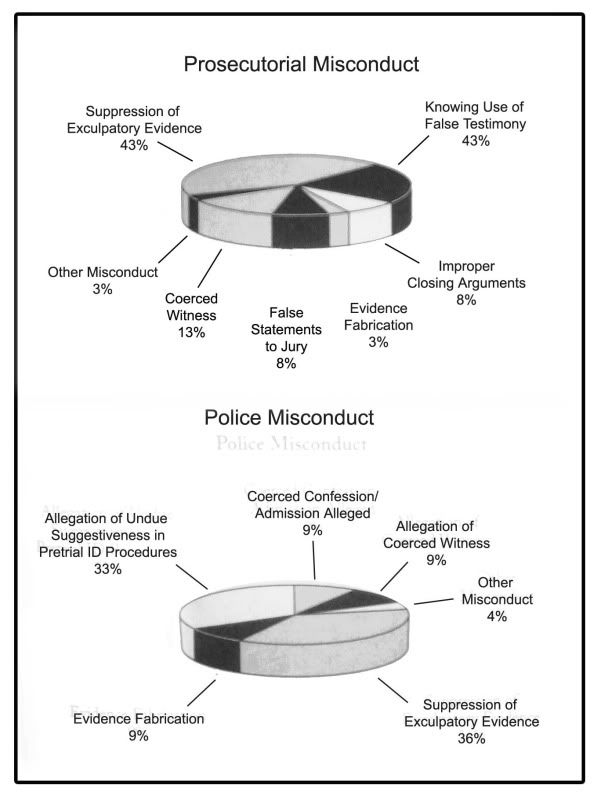
“For 63 percent of the DNA exonerations analyzed by the Innocence Project study,” the book reports, “misconduct by police or prosecutors played an important role in the convictions.” That is, in a solid majority of cases, procedures that are either illegal or improper, as opposed to simple mistake, contribute to wrongful conviction. The degree and even definitions may vary, but this figure could be as easily conservative as it could be inflated. See the pie charts from the book, at left, for breakdown of misconduct type, including outright evidence fabrication by police in one case out of ten.

Even in the frequent cases where such wrongdoing is partially exposed, it’s rarely if ever dealt with properly. One exception that proves the rule, in part, is the case of trooper Fred Zain, on which the previous post closed. One man that Zain’s pseudo-science helped put away was Glen Dale Woodall, given a sentence of 335 years plus two life terms for two 1987 rapes. He was eventually exonerated by DNA, had rather strange leading of the witnesses exposed, and was released about an eternity earlier than planned.

Woodall was also given a hasty and unexplained cash bonus by West Virginia. A State auditor looking into the Zain brand of political science wrote in undisguised alarm: “based on that investigation, I have recommended that the case be settled as quickly and quietly as possible, as the potential exposure is catastrophic.” To avoid a trial, Woodall was offered and took $1 million to much public protest. The “reign of error” over the lives of many was exposed anyway, and other exonerations followed, with larger settlements yet and increasingly quiet complaints. The West Virginia Supreme Court in 1992 found Zain’s 0% science record “shocking and egregious,” and ruled him and his work invalid within the entire state. He was already operating out of Texas by then.

The above is an extreme example, and another came a couple states over in Illinois. In the spring of 1999, a handful police investigators and prosecutors from DuPage county, seven total, were formally charged and tried for perjury and a rare little crime called obstruction of justice. This was following the disastrous exposure of their epic railroading of Rolando Cruz for a brutal 1983 child-killing. The usual slate of bad evidence did the trick, starting with several leads from “crazy Alex” Hernandez, who offered the police several names, including Rolando Cruz, to earn the big reward. They chose to indict both Cruz and Hernandez plus a third man whose role faded with time. It was announced on “the eve of the Republican primary for the DuPage County state’s Attorney.”

The case at first had no evidence aside from the standard “scientific” clues “linking” them to the crime, like so many others have been wrongly linked in the past. The most important clue the police swore by at trial was how Cruz obliquely confessed, by admitting a dream or vision with forensically exact details of the attack. Reading the account of it, it really is hard to conclude otherwise, but they had made no record of this May 1983 discussion at the time. They further let Cruz walk away after this admission, and made no mention of it at the later grand jury hearings issuing the indictments against the two.

Prosecutors only learned of this smoking gun evidence on the eve of the trial, which suddenly changed into something formidable. “More than a vision, the statement was nearly a miracle,” the book muses. The defense tried to block the account as evidence, but failed. The procedings were complex, with both men tried and sentenced together to life, then tried again separately, turning Cruz' life term to a death sentence. On appeal, both convictions were thrown out dur to “mistakes,” not misconduct. The state pressed on through it all, blocking appeals and re-trying the mistrials.

The case started falling apart early on. A shoeprint analysis done voluntarily by Nike, confirmed by an internal criminologist finding, destroyed one prosecution clue. This was concealed from the court. And more to the point, another child rapist admitted to the very crime and verified neither Latino was involved (and DNA later confirmed this), but stubborn officials pushed on, even as the people they sent out to do it started resigning.

A detective had been cited to support the vision story, but was only called to testify for Cruz’ third trial in 1995. Expected to corroborate the miracle, at the last minute he “searched his mind” and admitted he was on vacation at the time. He was summarily dropped from the prosecution's witness list, which was the last straw for the judge. The book describes the end of that ugly road:
For judge Ronald Mehling, that was enough. […] He held a picture Jeanine Nicarico up in the courtroom. For twelve years, longer than the little girl’s entire life, the state of Illinois had pursued Rolando Cruz, with highly suspicious testimony and outright fakery. The case was over.
Following this unusual and devastating reversal, the law started looking at itself a little bit, and hence the 1999 trials. Some grand jurors had sworn that there had been off-the-record murmurs of the dream confession at the time, and the judgment found fault only with the police failing to write down the confession dream, avoiding the obvious question of whether they made it up and colluded to present it as true.

Of course, no convictions were finally brought in the case, with no willful misconduct found. Lucky for the state treasury, faced with monster lawsuits over the sick episode. The authors note even this near-miss with accountability was “a singular event, done at great cost and turmoil, and unlikely to be repeated.” So only the most “shocking” and “egregious” violations have ever come close to having serious consequences. And as the high conviction records across the nation for tough crimes shows, there’s every reason to go ahead and twist the case to fit whoever will suffice. I’ll let the reader do the math on that.

Victim: Walter Snyder
19-year-old Walter T. Snyder of Virginia was sentenced in 1986 to 45 years for attacking a neighborhood woman. She was raped in her home by a black male with short hair and a “musky” smell. She never got a good look at him, but police practice helped enhance her certainty. Detective Barry Shiftic somehow took a photo of Snyder, her neighbor across the street, within days of the crime. He presented it that same day to the victim along with others, and she didn’t recognize any. But she came back to Snyder’s photo indecisively, and was informed that he lived in her neighborhood. Three days later she just happened to look out a window she rarely did to see the same man washing his car right across the street, for the first time she later said, and just knew it was him.

Back at the start of this rapid coalescence, on the day after the crime, the victim responded to Shiftic, “I know exactly what kind of hairdo you are talking about. In fact, there is a fellow that lives right across the street that is very much like what I am talking about, and he has a hairdo like that.” [p 59] This starting point was instantly and thereafter denied by both victim and detective, but it’s on the record – she mentioned him first, then the photo and the ensuing multi-day ... charade?

At the station following his unorthodox identification, officers coached Mr. Snyder to admit the rape, posing hypothetical cases with her starting it. Besides insisting his innocence, he recalled mentioning to the detective that whoever did it must have been out of his mind. However, “by Shiftic’s account, Snyder spoke about being physically present at the rape but his mind not being there.” There was no record to clear up the different readings. The detective instantly arranged a dramatic and improper one-on-one “show-up” identification. The victim arrived to see Shiftic but first passed “her attacker” who’d just “confessed” minutes before. With great terror she fingered him again, and the kid was arrested. He also suffered three broken ribs in a disputed incident, and reportedly said he was Jesus Christ.

Evidence like shorts he owned (red as she said, when shown inside out like they were in court) and a hair analysis that wasn’t even a match were taken as supports. The showstopper however was the victim’s emotional certainty, arrived at as described above. As the book sums up, “the case against him was built on evidence that was, by any reasonable standards, compromised, corrupted, and unsafe.”

Both the victim and the detective denied steering things to Snyder, but as we can see above they clearly did one way or another and other things shifted around suspiciously. She originally said the rapist had smelled “musky,” like “sweat and alcohol and possibly cigarette smoke.” After learning the man she identified lived in his mother’s basement and worked in the fuel oil business, she suddenly remembered he smelled “musky … a combination of oil and a basement – a musty smell.” [p 56] Thereafter, Snyder’s known work with oil became a prime prosecution point.

The young man was convicted and remained behind bars for years, even well after DNA tests were finally successful, all but bankrupting his hardworking family along the way. No one could argue Snyder was guilty, but due to limits on new evidence (a tragic 21 days in Virginia at the time) the Governor had to pardon the innocent, and he refused to do so until public pressure mounted on him. After his release, detective Shiftic remained convinced of Snyder’s guilt, wondering if the DNA samples had been altered in some conspiracy. And even if he were innocent, Shiftic told the authors “I have no remorse for anyone that I have ever arrested.”

Victim: Abdelbaset al Megrahi?
This is not in the book, obviously, but in context, it’s worth thinking about. A re-analysis of the shady details of the “investigation” is too much for this post but it’s well covered in many others, The overall evidence is perhaps best addressed in toto at the guided tour of the case against Megrahi.

One consistent theme in the book that may reflect on al Megrahi's conviction is prosecutors’ desperate refusal to admit when a killer simply got away with it. They are seen as needing to convict someone, and do it, wrongly if necessary. No one ever gets framed for shoplifting when the thief makes it away and isn’t identified. But something that shocks the community like the rape and murder of a child, or blowing up an airliner with 259 people on board, requires a head on a platter. If the right one can’t (or just won’t) be identified, then look out fringe people from easily-maligned groups, engaging in anything unusual at all the day of the crime.

The Scottish version of the UK Criminal Cases Review Commission, which Actual Innocence cites as a model for a possible American institution, has reviewed the case against Megrahi. After almost four years of laborious study, the SCCRC found, on six grounds, that the conviction may well have been a miscarriage of justice. No one million dollar settlement would suffice here, after Libya was forced to pay out $2.7 billion on the verdicts premise. Luckily for some, that appeal was never heard, due to something very confusing that happened in August 2009.

There is no DNA sample to re-examine in this case, so both hard science and Project Innocence might seem to have little to offer. So what’s our DNA test proving innocence? What could even hypothetically suffice?

Reconciliation, Sort Of
Ronald Cotton is yet another victim of a miscarriage of justice, convicted of two rapes and later exonerated. One of the victims who had helped misidentify him spoke with the authors, and the media at large, about her complex feelings. She felt repudiated and hated for putting an innocent man way and even though another man, Bobby Poole, was later identified by DNA as her assailant. “When I have nightmares about the rape, I still don’t see Bobby Poole,” she explained.

It’s still Mr. Cotton haunting her mind forever despite a face-to-face meeting she arranged with him and his wife after learning of his innocence. He forgave her for the mistake that cost part of his life, and expressed sympathy for her own shattered years. She told the authors “It’s weird, I hated him so much I wanted to watch him die. And now I care a lot about him. He taught me grace and forgiveness.”

Any of these victims who had wrongly identified someone, who lunged at them across the witness table and convinced a jury to send him off for half a lifetime (or half of a small town's lifetimes), could have asked questions. They had or should have had the right to go back and review their own case, to be sure the right process was followed and the right man punished. Depressingly few do so, preferring to move on in whatever direction has been established. They only face the error and its implications - as well as they can - once it’s proven without doubt. If even then.

In the Lockerbie bombing, at least one victim isn’t waiting for the far-off or unreachable exoneration. On his own, Dr. Jim Swire has re-assessed the case against his daughter’s convicted murderer, as he was being tried. The far-seeing Dr. Swire says the evidence led at trial in 2000 convinced him the men in the dock were innocent, and helped him see just who was likely behind it – the PFLP-GC, with a Khreesat bomb loaded at London, as an increasing number are now accepting. He literally fainted at the verdict of guilty.

Meeting Megrahi again in 2010, a year after his controversial release, Swire said of the "Lockerbie bomber"
"We are friends. I believe he is the 271st victim of Lockerbie. We know enough about the other to be confident to know we're trying to achieve the same thing - a re-examination of the verdict [… and] of the available evidence which led to a verdict we believe was reached under political pressure rather than the rules of justice.”
Is this case different, or what?
---
(emphasis mine throughout)

The Political Scientists of Lockerbie: An Overview

3 November 2010

Science Well Done, Answers that Make Sense
Following the bombing and fall of Pan Am Flight 103, and the sudden deaths of 270 people, quite a a number of extremely important questions needed answered. Many of these were best addressed by the rigors of physical science - gathering and analyzing the debris of the crash to form as clear a picture as possible of just what happened to that aircraft  The aircraft debris and break-up analysis was tasked to Mick M. Charles et al. at the UK Air Accidents Investigation Branch (AAIB). I see no reason to dispute their findings or methods. (AAIB report) It showed where the initial failure occurred, petaled-out panels indicating a powerful explosion in the vicinity of cargo hold station 14L.

Container AVE4041PA, the luggage "pallet" that occupied station 14L, also showed signs of extreme blast damage and was ruled by the AAIB to have held the primary (bomb) suitcase: The container was studied in particular by Thomas Claiden at AAIB. There are some minor points of strangeness with his findings (and they're named AI/100 and AG/145), but on balance his findings seem sound. It established the approximate blast center, most likely in a case laid flat, with one case between it and the floor, at the outboard end of the container.

Likewise, the Scottish police and their allies should by default be trusted in their painstaking collection of thousands of blast-related pieces of evidence from across hundreds of square miles. And after the in-gathering, their own book-keeping should be presumed to show signs of tampering if such even conceivably happened at their end. For example, Detective Douglas Roxburgh, who headed the store house at Dexstar, would have noted debris being removed without a proper cataloging. In fact, he did report this to his superiors at the time.

At trial in 2000 he didn't seem to recall this removal being a big deal or anything nefarious. Nonetheless, there are certainly ways, from the inside or the outside, to alter the police records to accommodate evidence slipped into certain key spots. This may sound like an absurd consideration to many, but on further reading one can see why it's worth keeping in mind.

A Critical Three 
The most relevant material to determining who was responsible for the bombing also happens to be the evidence with a cloud of questions surrounding them. The accepted evidence from closest to the bomb, and three particular scientists at the heart of it - two with the UK military's RARDE agency, one a special agent with the FBI, all known for returning politically useful but scientifically questionable decisions. Hence the "political" scientists of Lockerbie.

The Royal Armaments Research and Development Establishment (RARDE), a branch of the UK military, had an explosives forensics lab (sometimes called EC3) that had helped in previous terrorism cases involving the IRA. The blast science side of the Lockerbie inquiry was assigned to EC3. Journalist David Leppard, a huge RARDE fan, wrote in early 1991:
"The Lockerbie case team was led by two men who were considered the best in Britain. They were Dr Thomas Hayes, the senior forensic scientist, and Allan Feraday, his deputy. The remarkable work which the two men were to undertake over the next two years was to provide the cornerstone of the entire investigation.” [p74]
Just who among Hayes and Feraday did what neither could recall - they both signed off on the final report of 1990, but remembered nothing specific at trial in 2000.

Part 1: Thomas Hayes
Dr. Hayes was the head investigator at EC3 during most of the time debris was being studied there. He had previously been involved in the Maguire Seven case of 1976, signing off for science that helped put away seven people for supplying the explosives used in a string of IRA bombings. On review in 1990, the basic science was found to be consciously skewed to secure the convictions, which were all overturned. It was apparently this review that led Hayes to vacate EC3's top spot, leaving his deputy Feraday to take his place.

Part 2: Allen Feraday
Mr. Allen Feraday (no PhD) headed the lab from late 1989 to RARDE's elimination in 1995. He had not a single prior case that would fall apart - he had four. A mass-murdering IRA bomb mastermind, a supplier of Syrian terrorists, a Libyan planning to supply someone for bombs, and three IRA terrorists who deserved to be shot by the SAS because they could have blown a bomb. All these opinions were later questioned or tossed out by courts. For decades Feraday served the Crown loyally and robotically, with an eye to political objectives of his superiors rather than to science and truth. In one case it seems an innocent man was targeted in lieu of a known IRA bombmaker whose prints all over the device were ignored. Feraday helping terrorists get away?

All the above cases hinged on Ferraday's supposedly vast understanding of electronics and circuitry, and he showed the same interests in the Lockerbie case. He made a project of identifying the radio model used, and months later, identifying the fragment of Libyan timer that turned up. This he personally escorted on its mid-1990 journey to the United States (see below). In these and other ways unseen he played a key role, in ambiguous collaboration with Dr. Hayes, laying the "cornerstones" of an investigation that most impartial observers recognize as horribly crooked and geared towards securing a rather ludicrous conviction.

Part 3: "Tom" Thurman 
Among the American experts brought in was FBI special agent James "Tom" Thurman, described by mainstream reports as "one of the bureau's best explosives technicians." Others have said he has no formal explosives training, but rather a degree in, literally, political science. The reality may be in the middle - I'm still sorting that out.

Agent Thurman was ordered to Scotland, along with other folks from the FBI and FAA, on the night of the crash. Starting soon after, he helped locate and assess the blast-damaged clues. There's reason to guess he might have been the guy that set off Roxburgh's alarm bells. Otherwise, I see no great reason to question his findings here. Again, it's closer to the blast center that the clues get weird.

The Scottish police handled most of the rest, and Hayes and Feraday zoomed in on the analysis of the bomb-damaged luggage. Thurman was however called on to make a second appearance in mid-1990. In June he helped identify the crucial timer fragment PT/35(b), in a remarkably short and focused quest. Upon making the link with top-secret CIA help, Thurman then had a look at the actual fragment, brought over by EC3 chief scientist Allen Feraday. Both eminent minds agreed this was a piece of a Mebo MST-13 timer, sold only to Libya in a tiny batch of 20.  Convenient.

The fragment's genuine blast origin was doubted by neither of these two supposed explosives experts, nor by Dr. Hayes. Not all scientists outside their little loop agrees, however. Consider Dr. John Wyatt, involved in tearing down Feraday's work before, who later found in a dramatic series of twenty tests that even at a fraction of the official blast power, all surviving remains were many times smaller than PT/35(b).

As the dedicated post will explain, Thurman has been widely criticized for his lack of real knowledge and lack of credentials. That I could forgive if his science was solid. But he was later drummed out of the FBI crime lab for misleading practices, which is clearly more problematic. His other cases are high-profile - including the 1989 Libyan bombing of UTA 772, and the 1995 right-winger bombing of the Murrah federal building in Oklahoma City. Potentially troubling stuff, which I also haven't got sorted out enough to comment on yet.

Allen Feraday

The Political Scientists of Lockerbie, part 2/3
First Posted 26 October 2010
last edits 29 October


Introducing Allen Feraday  
At the time of the Pan Am 103 bombing, Allen William Feraday was the top deputy to Dr. Thomas Hayes, head of the forensic explosives laboratory for RARDE, the Royal Armament Research and Development Establishment. Following Hayes’ departure in latter 1989 - to become a foot doctor - Feraday took his position as the lab‘s director. Both men were formative in the science of the Lockerbie bomb suitcase, as officially understood. Their work on that ran parallel to the shuffling about, which was apparently connected to a probe of Hayes’ involvement in the shady Maguire Seven case of 1976 (see link above).

Patrick Haseldine’s famously deleted Wikipedia page on Alan Feraday sums up nicely that he “has appeared as an expert witness at criminal trials leading to convictions in at least four high-profile cases, three of which were subsequently overturned on appeal. The appeal in the fourth case is ongoing.” [1] Of course that last is no longer pending, as of August 2009 when Abdelbaset al-Megrahi surrendered his appeal of conviction for the bombing of flight 103. I’m not entirely sure how many other cases he’s been involved in and how these turned out, but the four are interesting and I’ll opt to show the same basic bias, aside from mention of a fifth case that has been challenged but not to my knowledge overturned.

On the other side of the spectrum of opinion, David Leppard, in On the Trail of Terror, offers effusive praise for the man erroneously named in the index as “Dr. Allen Feraday.” [2] It’s been widely acknowledged he has no formal training on a doctorate level, only a Higher National Certificate in Applied Physics and Electronics that was apparently pretty old; according to Leppard, the good “doctor” had beneath his belt a solid “34 years explosives experience” as of writing in 1991 (or since 1957, by my math). [2 p74] A 2005 article by Michael Tierney and run in the Herald (Scotland) said Feraday was then “in his sixties,” and had retired a decade earlier with “42 years” experience. [3] If that’s all true, he could be born no later than 1935, and started work with bombs in 1953, at around age 18 at the oldest.

Just what he was doing there for the decades before the 1980s is unclear from available evidence. But he acts like a paranoid spook, as Leppard’s book expands:
"Not surprisingly both Feraday and Hayes were high on the IRA’s death list. ‘He’s very, very good, so obviously he’s subject to high-level security precautions,’ said a Scotland Yard Bomb Squad expert who has worked closely with Feraday on IRA cases.  
Feraday is the archetype of the secret scientist. He travels to work in a hire car which he changes every week. Even some of his closest colleagues do not know where he lives; just that he has a wife and family and they live somewhere in the south of England.” [2 p74-75]
Fighting Terrorism with Circuitry
But the phase of his career under consideration here is less about bombs than about electronics. The oldest of the high profile cases in question was only in 1983, with the prosecution of businessman John Berry, a former Royal Marine Commando. His company was selling electronic timers to the Syrian government. He didn’t seem to know what exactly they were to be used for, but it could have been anything, he and his defense argued. But the judge didn’t buy it after hearing the Crown's lone expert witness, the eminent Allen Feraday.
"I am of the opinion that they have most probably been specifically designed and constructed for terrorist purposes. I am unable to contemplate their use other than in a bombing context." [3]
As Michael Tierny described it in his amazing 2005 Herald article, Feraday’s assertion was that “the absence of safety devices in the timers prevented their use for legitimate purposes.” [3] Mr. Berry was sentenced to eight years for arming Arab terrorists, later reduced to six. He served less than four before he was released, Tierny reports, but was left legally guilty in his broken life. [3]

Another man locked up for supplying terrorists was a businessman named Hassan Assali, originally from Libya, but British for twenty years. He was accused, again, of constructing electronic timers for the sole purpose of making bombs. Almost robotically, the Crown’s sole scientific witness – Feraday – affirmed their case: "I am unable to contemplate their use in other than terrorist bombs.” [3] On 24 May, 1985, Assali was convicted based on this scientific basis and sentenced to a middling term. His appeal against conviction was rejected in 1986, and he served nearly seven years before managing an early release in 1992. [3] [1] While free, he remained legally guilty like Berry.

Neither of these cases involved any actual bombs going off and killing anyone, but Feraday's next case would ratchet up his profile and the gravity of his magic. In 1986 came a break in the four-year-old Hyde Park bombing by unknown elements of the Irish Republican Army. The July 1982 blast of a 25lb. nail bomb during a military ceremony, along with a near-synchronous sister bombing at Regents Park, took nearly a dozen lives, wounded many, killed several horses, and damaged much property. This was indeed a shocking crime the IRA claimed credit for, but the exact perpetrators remained unidentified for years.

An arms cache found in the woods was eventually found to feature a nondescript circuit board which was - according to Feraday - similar to the one used in the bomb at Hyde Park. Thus linking the cache to the bombing, attention turned to the few readable fingerprints on the intact board. These were actually on the tape used on the board, and were matched to one Danny McNamee, an electronics engineer in Northern Ireland.

McNamee was arrested on 16 August 1986, and tried at the Old Bailey in 1987, presented as the bombing’s mastermind. Aside from the fingerprints, Tierney writes, “the Crown's key scientific witness, Allen Feraday, said the two [boards] were matched in design and "artwork" and therefore made by the same master bombmaker.” [3] It seems there was no other class of valid evidence against McNamee – he denied IRA involvement, and the IRA backed him up. [4] But the board, the tape, and the prints, made it clear who had done it, the Crown maintained.

Electronics expert Michael Scott. PhD spoke in the documentary film The Maltese Double Cross (1994). The McNamee case was Dr. Scott’s first view of Feraday’s work. Invited to observe from the gallery, he was able to see the same pattern the RARDE man had used in the first two cases:
“I watched Feraday and I gradually became aware that he was giving the evidence a certain emphasis that really wasn't justified, that technically couldn't be justified. […] Allen Feraday maintained, wrongly in my view, that the electronics was intrinsically sinister. [… and in handling the board, McNamee] had to be knowingly involved in bomb construction.” [5]
Mr. McNamee, his planned wedding obviously cancelled, was sentenced to 25 years. His appeal of conviction was denied in 1991, and an attempted escape in 1994 didn’t help his chances of being cleared or freed. [6]

So in at least three cases prior to Lockerbie, old-time explosives expert Allen Feraday had been able to convince judges, with his advanced science and royal credentials, that any scrap of that newfangled electronics could be proven to show terrorist intent. Taken as indisputable science, his voodoo informed the legal realities created in all three cases. Men who would later be found innocent were made guilty.

Top of His Game: Gibralter and Lockerbie
In his 1991 book, David Leppard glossed over all three cases above, only claiming erroneously that Feraday had “helped Scotland Yard trap the IRA gang” responsible for the Hyde park bombing, and he did it in 1982. Instead, he wrote that “Feraday first came to public notice six years later, in 1988, during the inquest in Gibralter into the deaths of three unarmed IRA terrorists gunned down by soldiers from the Special Air Services (SAS).” [2 p74] It was a controversial action the SAS explained by each of the three reaching for their pockets or purse, presumably to detonate a car bomb they feared might exist nearby. There were no detonators, no bomb, no other weapons. Just dead IRA members, murdered, some said.

Leppard explains the role of Feraday’s testimony at the inquest was “giving a scientific rationale to the controversial decision.” [2 p74] The counter-argument, accepting the apparent plans to build a car bomb,  was that the three were too far from the car in question to have triggered it, and the SAS men should have known that. But Feraday claimed from his vast knowledge of such things that the device, as Tierney puts it, “could have been triggered from anywhere in Gibraltar, or even from Spain.” [3] Dr. Michael Scott was called on in this inquest, and told the Maltese Double Cross:
"Particularly my experience in the Gibralter casse, one thing that struck me then at the time, very strongly - the British government employs hundreds of people, extraordinarily well qualified, in the areas of radio communications and electronics. Alan Feraday is not qualified, yet they use him? I mean, I have to ask the question 'why?'" [5]
Leppard notes how Prime Minister Margaret Thatcher took an interest in Feraday following this favorable inquest. “Clearly grateful for his efforts, [she] arranged that he be awarded an OBE in the 1988 New Year’s honours list.” [2 p75] Tierney reports that this was in June 1989, for “the Queen's birthday honours.” [3] OBE is not a doctorate, it’s the Order of the British Empire, an elite club based on some type of chivalry, dating from World War I. Motto: For God and the Empire. [7]

At the same end of that celebrated year, Mr. Feraday OBE found himself taking a leading role in his most historic case yet. For an article already this expansive, a detailed look at Feraday’s involvement in the Lockerbie investigation would be rather excessive. In brief however, he again showed a fascination with the electronics end of things and what could be discerned from the radio parts and other circuitry recovered. Unlike his earlier cases against Berry and Assali, the apparent blast origin of these fragments show the terrorist intent in itself – unless, as I suspect, all electronics were planted to fit a master script. Feraday had to rely on the electronics evidence signed off for by Dr Thomas Hayes who, for what it’s worth, has been known to sign off for sham science in the Maguire Seven case.

At the moment, some glimpses of the insanity of Feraday’s science can be found in these existing articles:

"Lightly explosion damaged" deals at length with an apparently irrelevant sideline of nonsense - obvious explosion damage that must be something else. But Hayes’ rambling under questioning reveals much about the nature of his collaboration with Feraday that makes it often hard to pin down just where the one scientist ends and the other begins.

Timeline: Toshiba radio identification covers Feraday's convoluted assembly of clues to what radio was used. The model settled on finally was the same as his first guess, but with a black case instead of white. It would be found to suggest Libyan authorship.

The Indian Head forensic tests were held in Maryland, spring 1989, with Tom Thurman of FBI and Harry Bell of the Scottish police. These bomb tests were carried out with five devices made by Feraday, using the radio model he had identified at the time. These helped investigators rule out a Heathrow introduction.

Feraday's forensic follies, section sixty-seven looks at the confused timeline between the pivotal Libya-catching timer fragment PT/35(b) and a piece of radio circuit board called PT/30. He didn’t mention the former until four months after its alleged discovery, and the day after looking into the latter, whose identity was already known months ago.

And when PT/35(b) finally went across the pond to controversially visit agent Thurman in the United States, it was reportedly in the possession of Alan Feraday. This is a point I havem't sorted out, but some support can be found in this post.

Feraday’s 'backseat driver' Dr. Scott, cited twice above, was talking this whole time to a documentary about the Lockerbie investigation. On this core subject, he said:
“I haven’t seen the Lockerbie evidence, so I can’t comment on that directly. The involvement of Alan Feraday – Hmmm - that worries me.” [He mentions the Gibralter case here, as cited above, ending with] “yet they use him? I mean, I have to ask the question ‘why?’”

Post Lockerbie – Work Undone
Our anti-hero continued running the forensic explosives lab at RARDE through the early 1990s, all five of the high-profile cases above safe and sound as legal reality. David Leppard tried to interview Feraday for his 1991 book, but “the Ministry of Defence press office, citing national security, declined to give the author clearance to interview him.” [2 p74-75]

In 1992 his earliest victim, John Berry, was granted an appeal of his conviction. He was a free man by then, but wanted his name back. John Tierney describes his amazing appeal, with a roster of impressive experts assembled by his legal team. These names, which appear elsewhere in connection to the Lockerbie case, were listed as:
“Major Owen Lewis (retired), who served with the Royal Signals for 22 years […] Lt Colonel John Wyatt (retired; a 23-year veteran of the Royal Engineers, involved in bomb disposal and counter terrorist operations) […] Dr. Bora." [3]
These experts ridiculed Feraday’s lone assertion that Berry’s timers could only be used for explosive mayhem. They were simply timers and could easily be used for turning on the cameras or sprinklers, or a hot water heater. The Court of Appeals quashed Mr. Berry's conviction in 1993, noting that Feraday’s evidence was both wrong and “extremely dogmatic […] uncompromising and incriminating." [3]

In 1995 RARDE was re-organized into the less regal-sounding Defence Evaluation and Research Agency (DERA), and ceased to exist. Feraday capped his decades and retired with it, but his legacy would continue unraveling for at least a decade more. In September of that same year the European Court of Human Rights found that the Gibralter incident showed excessive force by the SAS men. [8] "Excessive" suggests that court rejected the previous justification - Feraday’s claim that what the killers claimed made scientific sense.

In 1998, the United Kingdom established a Criminal Cases Review Commission (CCRC), to review possible wrongful convictions that had survived the normal single appeal. This reflected the worldwide tend towards freeing innocents, largely based on the success of new DNA tests as pursued by Project Innocence in the United States. Among those to apply for review by the CCRC was Danny McNamee. After a review of his case, they approved it for another try in the court of appeals.

He was defended at different time by both Gareth Peirce and Michael Mansfield, prominent and effective defenders of the innocent. Professor Michael Scott, among others, gave evidence for the defense. [3] The nature of the electronics intent was secondary to the fingerprints in this case, but something interesting turned up there. Someone else's prints. A report from the BBC outlined it so:
Crucially, his defence was unaware that many more prints had been discovered belonging to Desmond Ellis, a self-confessed IRA member who had been extradited to the UK from Ireland to stand trial for a series of bombings. The case against Ellis collapsed when his defence successfully argued that he had already saved six years of an eight year sentence in Ireland for explosives offences relating to the bombing equipment found in Berkshire, aided by photos which showed that the equipment was indeed the same. 
The connection with Ellis was only made when Ms Pierce, who had represented him, took on Mr McNamee's case. In a submission to the Home Office, she pointed out because there were so [few] of McNamee's prints on the equipment, there were no grounds for describing him as the "master bombmaker." [9]
How on earth did the best terrorism experts at RARDE miss the flurry of prints from Ellis in order to go after the one with only a couple? He was serving time for the same equipment McNamee was later convicted for being the mastermind behind? I'm afraid I may just be confused at this point, as that makes no sense.

At any rate, McNamee's actual release was as a guilty man, coming on 17 December 1998. This was as part of a mass release of IRA suspected prisoners, ordered following the "Good Friday agreement." [10] His appeal was quashed apparently just after this, before the month was out, and Feraday's politically useful "dogma" took another gut shot.

No surprise that the Libyan Hassan Assali also applied to the CCRC in 1998. His legal team assembled an impressive roster of experts to counter Feraday’s work yet again. [1] Tierney lists these as Major Lewis, Lt.Col. Wyatt, and "Squadron Leader Michael Hoyes (retired; a chartered engineer who spent 22 years with the RAF).” [3] Again, their opinions varied from Feraday’s stale “inability to contemplate” what was evident to most. According to the Appeal Court judgment:
"There is no doubt that an important part of the Crown's case against the appellant [Assali] depended on the evidence of Mr Feraday . . . He examined all the devices that had been recovered. His evidence supported the Crown's case with regard to the nature of those devices." [3]
But the case was deeply and obviously flawed, and this time the judge recognized it. Assali's conviction was quashed in July 2005, triggering the epic Herald article so heavily cited here. Of Allen Feraday, Assali simply says: "he's a very, very experienced evidence giver. If his evidence managed to convince a judge, he must have been bloody good." [3] Been bloody good ... past tense. After this case, the Guardian reported, "the Lord Chief Justice [Woolf] finally ruled that Feraday should not be allowed to present himself as an expert in the field of electronics." [11] He had retired from RARDE, of course, a decade before. But this decision left his expert testimony in past cases just a legal inch from becoming well-burnt toast.

The final case in our exploration, the conviction of Libyan agent al-Megrahi, has famously not been overturned. In this instance where, perhaps not coincidentally, powerful (American) interests are at stake, trial, appeal, and the CCRC-second-appeal path all failed. He was convicted in January 2001, with his single and expected appeal rebuffed in 2002. In latter 2003 he applied Scotland's separate criminal case review commission (SCCRC), and they examined the evidence of the case in great detail for nearly four years.

The complexity came from the fact that Megrahi was convicted based on many points of dubious evidence, not just the opinions of trash witness Feraday. In fact the clearest causes for dismissing the case come from the evidence of Tony Gauci, which it turns out absolutely does not implicate Megrahi as the purchaser of clothing inside the bomb case. Their full findings are still secret, but the Commission did announce in June 2007 that they had found a conservative six grounds for a possible miscarriage of justice - four concerning Tony Gauci and two secret points.

The SCCRC referred his case to the appellate courts, which Megrahi pursued fruitlessly for two years before abandoning his appeal. This unprecedented move has still not been adequately explained by anyone involved and remains another mystery of the Lockerbie case, like his contemporaneous release on apparently flawed medical advice.

We do know the cause of his innocence has attracted the support of many thousands worldwide, including some of the solicitors and experts listed above. Gareth Peirce and Michael Mansfield have both made statements about the farce of Megrahi's conviction (see the big quotes post). Major Owen Lewis has publicly criticized the timer evidence (although he did so poorly), as has Lt. Col. Wyatt (brilliantly, with his twenty bomb tests). Presuming this is the same person as "Dr. John Wyatt," his tests are covered on this blog, in one post covering the BBC Newsnight episode about them, and another on a follow up article with more details.

If the legal process had ben allowed to unfold, it seems undeniable the world’s view of Megrahi would at least be rather confused, as opposed to the certainty of his guilt still held by millions. The mainstream masses have been deeply imprinted with the fantasy image based on evidence vouched for, in part, by Allen Feraday. And as we can see, he is in fact “really, really good,” even "bloody good," at being “unable to contemplate” anything but the case the Crown wants to make. For God and the Empire, against all enemies – the Irish, the Arabs, and especially the truth.
---
Sources:
[1] The Lockerbie Case: Alan Feraday and Wikipedia. http://lockerbiecase.blogspot.com/2009/06/alan-feraday-and-wikipedia.html
[2] Leppard, David.On the Trail of Terror: The Inside Story of the Lockerbie Investigation. London, Jonathan Cape . 1991. 221 pages.
[3] Tierney, Michael “So Could the Lockerbie Bomber be Freed Next?” Herald (Scotland). 26 November 2005. Awkward url
[4] Danny McNamee Wikipedia entry. http://en.wikipedia.org/wiki/Danny_McNamee
[5] The Maltese Double Cross. (1994) On-site video embed - Interview with Michael Scott, in segments starting at 59:15
[6]http://news.bbc.co.uk/2/hi/uk_news/236912.stm
[7] http://en.wikipedia.org/wiki/Order_of_the_British_Empire
[8] Mills, Heather, Colin Brown, and David McKittrick. "Tory anger as European Court condemns Gibraltar killings" The Independent. 28 September 1995. http://www.independent.co.uk/news/tory-anger-as-european-court-condemns-gibraltar-killings-1603179.html
[9] http://www.bbc.co.uk/politics97/news/07/0703/mcnamee.shtml
[10] http://news.bbc.co.uk/2/hi/uk_news/236912.stm
[11] http://www.guardian.co.uk/uk/2007/jun/17/politics.lockerbie1

Exposing Guilty Projects, part one

15 October 2010
last update 16 October

In this post and one more I’d like to discuss a fascinating and horrifying book I just read - Actual Innocence by Barry Schick and Peter Neufeld of the Innocence Project (with Jim Dwyer). [Amazon.com links for the 2000 edition I'm reading, and the 2003 re-issue] It details some of their victories in using new (at the time) DNA technologies to overturn wrongful convictions in the United States. As such, it offers only indirect light of the Lockerbie investigation and trial, but a perhaps useful frequency.

Actual Innocence interweaves topical expositions with gripping personal stories of injustice. Each innocent victim is followed through the nightmarish process of becoming legally guilty and paying the price with years in prison and up to cusp of execution. All were saved or freed early by the inspirational characters who are of course writing about themselves.

The sad parallel is the number of cases where innocents have had their lives taken by jail or execution with no exoneration possible or affected in time. Only when hard scientific proof is found and presented does rescue become possible, if not inevitable. Consider Kevin Byrd, convicted of rape in Texas, but later exonerated by DNA. Governor George W. Bush’s office said in refusing the pardon, despite clear scientific proof, the victim still felt Byrd was her rapist. Under political pressure Bush eventually signed off.

The book is not just about individual cases, but systemic injustice seen along the way. Politicians and their prosecutors needing to appear tough on crime and protective of the voters, as in Byrd’s case, is just one branch of a rotten tree. The men wrongly convicted in the book were exonerated by advanced science and, it often seems, honesty of process that were both unavailable at the time of conviction.

Victim: Robert Lee Miller
A shocking pattern emerges in Ada, Oklahoma, starting in late 1986: Two very elderly women were raped and smothered to death after an intruder pulled the phone line and broke in. Three “Negroid” hairs found at one of the scenes had nearly 200 black men in the neighborhood tested for blood type to match.

As one of many matches, Robert Lee Miller was later approached. “He was a regular user of drugs,” the book notes (as would his blood,), and at the moment they arrived, “he believed that someone had slipped PCP into something he had ingested.” He was willing to help anyway, and did so at the station. “I’ve got these powers,” he said by way of helping. “I can see things through the killer’s eyes.” Oops.

The 12-hours of video-taped interrogation following became prime evidence in more ways than one. The suspect’s guided drug visions morphed into demonic exorcism and the detectives' pleas to Jesus to clear his view of the crime. Miller said his Choctaw grandmother's spirit was telling him someone was trying to frame him.

They tried frantically to get him to remember something “only the killer could know,” like the Fruit of the Loom underwear left at one crime scene. Miller was asked if the killer left anything behind, steering him from weapons to clothes. After at least a dozen wrong guesses, Miller said at one point “maybe it was underwear.” They returned to this:
“And you told me that, ah, you this uh, was his underpants, his shorts, that he left at one of them… what kind, what kind of underwear was it? ... What kind of underwear do you have on?”
It was his brand all right. This smoking gun would cap the closing arguments just before Miller was sentenced to two death penalties plus 725 years, whatever the hell that means. The menace was locked away and the community felt safer.

That is, until two more rapes happened after Miller was locked up, almost exactly like the ones he was convicted for. This time both victims were a bit younger, neither died, and one clubbed the attacker with a gun, which he took. Ronald Lott still had it when police arrested him. He had the same blood and hair type as the original rapist. He confessed to other such “attacks” (plural) in the same neighborhood. The police had their rapist finally.

But this information was kept from the defense and the judges in the unfolding trial, even as the same attorney worked the Prosecution in both the Miller and Lott cases and could see the parallels (he later admitted so, just that it dawned on him slowly, and near the end). Miller was finally able to contact the Innocence Project with the help of friends on the outside. DNA tests were conducted on the remaining samples and found to match Lott only. The science said Miller had raped no one.

But the state wouldn’t back down. “The DNA tests do not erase the statements given by Mr. Miller himself concerning these crimes,” explained assistant DA Ray Elliot. It only proved he was not the "donor" of the semen, but was still one of "two rapists." Barry Schick swears that when he ran into the assistant DA in Denver, he gloated “we’re gonna needle your client." He knew about Lott at the time, but later said he “believed” that man had been ruled out from the first two rapes. Or perhaps they were both involved, with Lott as the actual rapist in all four cases, Miller as some sort of accomplice in the first two. The position became fuzzy.

Since the first two victims had died, Miller was still tacked with the twin death sentences and ten life sentences, while Lott was originally given only 40 years for the two later rapes. Ray Elliot offered him a plea deal - implicate Miller as an accomplice in his first two, and he’d face no further charges – for those same deadly rapes he was known to have committed. If he’d taken the deal, who knows what Elliot had planned. But the rapist's refusal to play along finally convinced Elliot, he says, that Miller wasn’t even a lookout. But he was heard to complain when Miller was freed that they should have killed him sooner. He denies he said that.

Repeat Offenders
Certain themes pop up time and again in the tragedies relayed in the book. Some are built into the court system itself and come across as natural and unavoidable. Incompetent or ineffective counsel undermines many trials and helps send innocents away. There are rules to protect against this, but they are set extremely loose and rarely enforced. In essence, so long as the lawyer is alive and breathing, his or her failings are usually deemed to be no matter as far as due process goes.

And once a guilty verdict is wrongly reached, the supposed protection of the appeals process seldom does any good. In numerous instances highlighted in the book, appellate courts as a rule give ultimate credence to and side with the prosecutorial “good guys.” Unless faced with something egregiously obvious they’d look foolish to accept, they rule seemingly independent of the facts before them and the facts they learn were withheld from them. Lies are upheld time and again, and innocent people continue to rot in prison, for structural reasons that are hard to trace with certainty.

But the pivotal practices are those that bring the wrong people before the court to begin with – flawed investigations, like the one against Walter Miller above.

Jailhouse “snitches” are central in a couple of the cases reviewed in Actual Innocence. These are not the kind that rat out the tidbits they actually hear, but those like Leslie Vernon White, who once showed astonished detectives how easy it was to concoct false confessions. They were amazed to find he’d been lying to them, skating through numerous sentences by selling a dozen others up the river. [128] The use of snitches continues unabated despite (or because of?) this knowledge.

Ronald Williamson in Oklahoma went down based on a “confession” reported by prisoner Terri Holland, a serial check forger, serial murder-confession-reporter, and serial early releasee. In fact, Oklahoma detectives intently sought her out in a New Mexico prison to see if she'd heard anything on Williamson back in OK. She gave it to them, inaccurate details and all, and her prey was sentenced to die for the crime he had “confessed” to as she skated out early again. [135]

Perhaps that was honest mistake, but the same authorities took drastic measures to get a confession from Williamson’s detained “accomplice,” Dennis Fritz. They sent a spy, more or less, working for the prison (off the records at the time) to coax a confession of any kind. Williamson's old friend, dragged in by a shady hair analysis, only insisted his innocence, and the spy (named Tenney) had to make something up. He did so, and the case was solved with a second confession-based conviction and a life sentence. [137, 141]

Both men were exonerated years later by Innocence Project DNA analysis, and the same science showed the true rapist/killer was Glenn Gore, a prosecution witness who had first identified Williamson as a suspect and started this rush for confessions.

Interrogation methods to secure confessions are addressed. From the little I know, PCP-assisted questioning like that used on Walter Miller is seldom used on chance or purpose. And absent the “third degree” beatings of old, forced confessions are rare. In the same place now, we usually see claimed admissions with no record, as with Fritz above, or semantic ones based on twisting aspects of what the witness said, as we’ll see in part two. When unambiguous records do not exist, the victims dispute the police, and the court sides against the victim.

Bad science also helps in the process with alarming regularity in this age of scientist-worship, and not always on accident. Crackpot “experts” are on file, who will say whatever you want for a price about hairs, shoe prints, blood samples, whatever. Like a lacquer, prosecutors can pour this nonsense over anything they want to give it a nice veneer. Take Ralph Erdmann in Texas, who used to boast of conducting 400 autopsies a year. Exhumations showing he rarely made even a single incision, but the book notes “Erdmann often would want to know the police theory of the death before he wrote up his report … to keep his story straight.” [p 117]

That is, this scientist was a political one – he wanted to know the official story, and play-acted that science supported that. He was exposed repeatedly, including by Ed Bradley on 60 Minutes, and finally it was too many times. His license was suspended for a decade, then revoked after he was arrested with a houseful of machine guns. [119] Less extreme versions of Erdmann that haven’t self-destructed still operate freely.

Another extreme case is trooper Fred Zain, “a cop in a lab coat,” who was for years used by police and prosecutors in West Virginia and several other states to bring pseudo-science to bear in court. Later audits showed the amazing tests he swore to carrying out were rarely or never done, and his lab was physically incapable of much of what he claimed from it.

But Zain would blithely brandish his supposed authority with theatrical flair that brought the convictions steadily in. In dozens of cases, people were put away based largely on his acting, some for life. As long as unsolvable high-profile crimes needed solved, and he knew how it had to be solved, he'd do it, and suffered no shortage of work or appreciation.  One fellow officer wrote in and praised Zain’s work and vowed to “assist” him with the inevitable “bleeding hearts” "dripping" on his lab coat. [121]

[... to be continued in part two ... we're not done with Zain]

See also: Innocence Project Case Files