Showing posts with label Leppard D. Show all posts

David Leppard on Abu Elias

February 13 2011
slight edits 2/15

I’m delighted to add a very strange new point to the body of knowledge and/or lore surrounding “Abu Elias,” the apparent builder and controller of the Lockerbie bomb. (see: all threads about Abu Elias) This latest is from David Leppard’s highly interesting riddle of a book On the Trail of Terror (April 1991). It was among the first privileged works allowed to announced the turn to Libya in detail, months ahead of the sanctions. It drew on insider sources and related - in great detail - all the relevant clues that didn’t specify al-Megrahi or Fhimah - the Frankfurt printout, the Maltese clothes, the timer fragment, etc.

In fact, the original lead from 1988-1990, the Iranian-backed plotting of the Syririan-based PFLP-GC (Jibril network), is still tied in here. That's good for Leppard because he earned his spots reporting on just that lead in 1989 and '90. After he “changed his spots,” as Paul Foot put it, Leppard’s take became the same as that proposed by CIA Lockerbie chief Vincent Cannistraro in the early 1990s. It was the same Iranian-backed PFLP-GC plot everyone had, with good reason, suspected, just taken over by Libyan intelligence following the October 1998 "Autumn Leaves" bust.

In this series of raids, the bomb-making PFLP-GC cell near Frankfurt, their massive weapons cache, and tangle of targets, was disrupted by German feds who then set almost everyone free. Only the cell's weapons master Ghadanfar and its ring-leader Dalkamouni were kept in lock-up. The bomb-maker, Marwan Khreesat, was a double agent and flew back to his bosses in Amman, Jordan.

This version, where the Libyans picked up the slack, modified the rogue bomb with one of their timers, and arranged for the Malta plot to send it on to PA103, was the insider’s favorite for a while. But after some time, the original portion withered and fell off for lack of official recognition or further repetition (this part, if not the whole shift, can be chalked up to Gulf War-era re-orientation). Lockerbie gradually became a Libyan plot alone, presumably motivated by the nearly three-year-old U.S. air raids on Libya. As President Bush put it in 1992 or so (from memory), the original suspects “took a bum rap” in ever being suspected.

And all this despite the Autumn Leaves bust being quite possibly irrelevant to the original plot. One of the five bombs and one of the plotters escaped the raids entirely, together it seems and moving towards something. No one has ever explained what stopped them, or what they needed any Libyan help for. All that really needed done from there was likely carried out, by whom exactly we don't know, at terminal three Heathrow between 0:00 and 17:00 on December 21.

I thought I’d already checked Leppard’s book for reference to airport security expert Abu Elias, but missed this sole entry until just the other day. In its last three pages, the book concludes with its only mention of this highly relevant fugitive, as a part of the “Libyan connection.”
One final question mark for the Lockerbie team is the identity of the man Jibril asked to liaise with the Libyans in the eight weeks between Operation Autumn Leaves and the night of the bombing. The Scots, the Germans, and the Americans now believe that after 26 October 1988, with Dalkamouni in prison, another leading Jibril operative, called Abu Elias, may have played an important role in arranging the tie-up with Libyan agents and directing at least part of the Maltese end of the conspiracy.
There’s been no other mention of, nor evidence for, this notion of Abu Elias meeting with Libyans. At least, not that I’ve run across yet. It’s a very strange way to end a book to fuse the new direction with perhaps the best lead of the old, this young relative of Ahmed Jibril’s who apparently didn't trust Khreesat. Leppard adds some details consistent with other reports that would emerge:
The FBI have a photofit picture of Elias which shows the handsome features of a blond 25-year old Palestinian who heads the PFLP-GC’s military section in Damascus.
25 years old is new to me - nothing I'd seen before gave an age. This almost certainly refers to the Jordanian GID's sketch, apparently made after Khreesat's first (and, I think, only) meeting with the mysterious operative in 1985. As the 1989 report by FBI agent Marshman says:
The GID officers produced a composite sketch of Abu Elias that was done by Khreesat some time ago. Khreesat examined the composite and affirmed that the likeness was that of Abu Elias who he met in Damascus, Syria. This composite is attached to this FD302. [source: trial transcripts]
If he were a bare 25 years of age in 1985, to head the military section in Damascus (as others report) even by 1988 is clearly young. It's a bit too young to be Basel Bushnaq of Virginia, read literally. He's allegedly the same person as Abu Elias, but his records show he was born in late 1955, making him 29 or 30 at the time of any 1985 meeting. But if that’s not his original name, as Christine Grahame MSP alleges, it’s probably not his real birth date or even year.

And perhaps the 25-year-old estimate, whoever's it was, was erred on that end. This age addition is close enough to be consistent with the other disturbing clues that Ms. Grahame might be right, but is not apparently much of a clue in itself.

Leppard continues:
Dalkamouni admitted in his prison interviews that he had met Elias at the Front’s offices in Damascus. But he has denied seeing him in Germany.
Ah! Khreesat says he never saw Abu Elias in Germany, but that Dalkamouni did, something he was told of repeatedly. Abu Elias had studied Khreesat’s work in 1987, and could perhaps spot a fake, like he was instructed by Amman to build. He might inspect the work being done for the big Iranian job.

And Khreesat says that of the five armed “Khreesat bombs” made under this threat, one was not his at all, and only appeared at the same time Dalkamouni said Abu Elias had arrived. Khreesat was asked to finish it by soldering two wires, and then it disappeared again, presumably back to whoever had brought it.
Nevertheless, the BKA surveillance report on Dalkamouni’s prison meeting with his sister-in-law in July 1989 contains a dascinating reference to Elias. After denouncing Kkhreesat as an informer for the West, Dalkamouni was overheard telling Somaia about Abu Elias. ‘He [Dalkamouni] only gave Khreesat the name Abu Elias once. When referring to this name it concerns a “Phantom” name, and only Khreesat could therefore reveal this name.’ Dalkamouni’s comments suggest that Elias played an important, although unspecified role, which Dalkamouni regretted revealing to Khreesaat., the suspected double agent. ‘It is not a bad guess to say that Abu Elias has played a role,’ said one senior Western intelligence official. But that role is remains a mystery.
That part is interesting, and may refer to a real conversation that Dalkamouni probably knew was being recorded. I’m not sure what to make of it. But investigators still felt Abu Elias was involved, or told Leppard they did, right up to the eve of the indictments, after which he vanished again. They were puzzling over his role, it’s said, but if he had one at all, it didn’t involve Libyans or Malta. That’s all 1990’s cartoon nonsense.

Whatever happened between October 26 and December 21, the bomb clearly left the ground at London. We have real evidence for that, not “intelligence sources now believe” crap. All along, they "now believed" whatever helped shift us gradually from one evidence-led track to another, led by new and more politically convenient evidence, generally oozing from Vincent Cannistraro's end of things and into media reports. And all along the real evidence, partly known to us and partly covered-up, has remained just the same. That is because the murder of those 270 people still happened the same way it actually happened. That can only be re-written on paper.
---

IED Fragment Survivability Tests

(incomplete)
last update Jan 31 2011

The Basics and Prosecution’s Case
The heart of this Improvised Explosive Device (IED) that tore down Flight 103 was Semtex-H, in an amount that can only be estimated. Official guesses at the weight are not widely reported, but Professor Christopher Peel of the Royal Aeronautical Society, at the Zeist Trial in June 2000, testified to his calculations; around 450 grams was used, and wound up a bare 25 inches from the plane's fragile skin. These findings were challenged by the Defense, according to the Scotland Herald, but Peel doesn't stand alone. [Source]

There were also forensics tests, reported by David Leppard in his 1991 book On the Trail of Terror, that are said to confirm "RARDE's initial assessment that the bomb had contained about 400 grammes of Semtex high explosive - less than a 2lb. bag of sugar." These were the Indian Head tests carried out April 89 in the USA by RARDE's Ferraday and FBI's J. "Tom" Thurman. Interestingly, Leppard cites this confirmation as "the explosive charge used to bring down the plane was 'in all probability' about 454 to 680 grammes or 1 to 1 1/2 pounds of Semtex." [p 139-141]

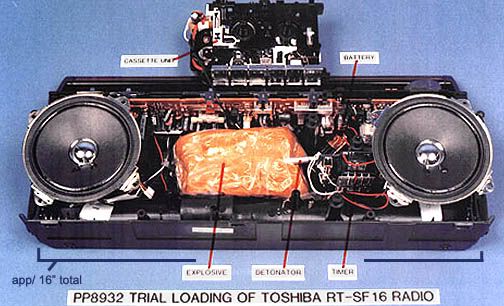
I'm no expert on how much energy is unleashed by 454-680 grams of this legendarily powerful compound. But consider the "trial loading" below used at trial (image found here and improved the labels a bit, added width notation). This is the alleged bomb - a Toshiba RT-SF16 "BomBeat" radio with explosive, a detonator rod, battery and MST-13 timer without waterproof casing, all fitting in a remarkably small case, about 16 inches across. It has the cassette assembly, about 4 inches wide, removed to allow the pat of semtex. This makes the timer, it seems, no more than two inches from that origin of the blast - inches of mostly air, not lead.

According to the officially accepted evidence of what actually survived these circumstances, refer to the following crucial evidence attested to.
- Fragment of bomb timer circuit board
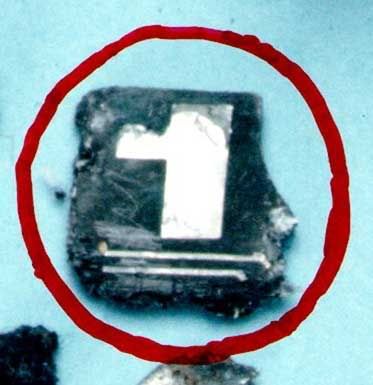
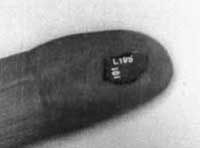
Obviously, the half-inch square fragment of circuit board named PT/35(b) was a crucial clue to Libyan guilt, as seen on TV with its identifier "Tom" Thurman. This is the part people have been questioning in recent years. This led to Swiss makers Mebo, who only made a few of these ever, for Libyan intelligence JSO.

- Fragments of radio housing, circuit board, etc.
These were fairly small, fragmented, melted, lumped together in far-flung luggage. The radio remains are not implausible, but didn't prove the radio type. Consistent with but not exclusive to the RT-SF16.


- Fragments of radio instruction manual

This nearly-intact cover page saying Toshiba RT-SF16, was supposedly found in a field and brought in by citizens. This and other page fragments clumped together were consistent with a RT-SF16 manual, and convinced the Zeist judges of the model. This was presumably in a plastic sleeve, packed snugly in the radio box, perhaps three inches from the explosive center. Result - crumpled and torn a bit, slight singeing.

If it's bizarre, it's proportionally useful; the radio model itself is said to indicate Libyan guilt. It's not very conclusive, but 3/4 of the small run of RT-SF16s were sold to a company said to be connected to Libyan intelligence.

A Challenge: Dr. Wyatt's tests
Over the years, critics have contended the amount of explosive really used, their type, their placement, and whaether or not i would be strong enough to rupture an aircraft, or too strong to have left the clues that were found. The last question was brought to the fore, and left there it seems, by recently announced experimental evidence. Repeated tests simulating the alleged conditions indicated that larger items like, in particular, the famous bomb-timer fragment that nailed Libya, would have never been found if they were in the explosion. This was aired by, of all parties, the BBC program Newsnight, on 8 January, 2010. The program is currently viewable at this BBC page and definitely worth a watch. The tests were carried out by Dr. John Wyatt, an explosives expert retired from the British Army, now running a security consulting company called SDS, and is a blast consultant for the United Nations (Europe and North Africa region). The details behind how he came to test the official scenario – twenty times over - is unclear at the moment, and so far there’s been no detailed report of his methodology and precise findings, but just what the program shares is compelling enough.

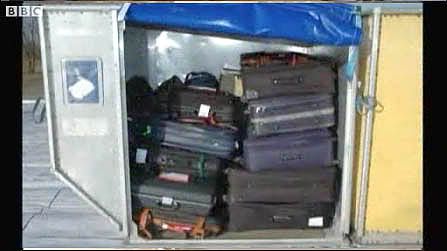
From what Marshall explains in voice-over, Dr. Wyatt carried out his twenty tests over time, starting with the radio bomb detonated by itself. One sample he showed the cameras is at right, a suitcase filled with random clothes, and a radio (different model than alleged, a bit larger), rigged as a bomb and set in a homemade cardboard box. Another he showed contained yet another type of radio, bright red, and a suicase he says is the same model used for PA103 (Samsonite hardside). Both were soon after blown up with the pat of plastic explosives tucked inside. Of the consistent results, Wyatt told Newsnight:
“I must admit, since the quantity of explosives we were using was only three or four hundred grams, I thought there were going to be some remnants of the radio left. But it – it – (chuckling) it just totally disintegrated. I mean really just went into tiny, tiny bits."
Please note that he was using amounts, if this accurate, of 300-400 grams, when the Indian Head Tests considered 454-680 grams the likely force behind the half-inch readable chunk "found" in the Scottish countryside. Wyatt elaborated a bit on method to The Times of Malta, specifying a separate timer was included and considered, as well as the general radio unit, and that the tests were done in varying conditions.
"We tried exploding the device on its own; in a radio similar to the one it was supposed to have been planted in; in a suitcase with and without clothes; surrounded by other suitcases and, eventually, in a container. In all tests, the timer and the circuit board were completely destroyed."

He later “built the tests up” to a finale – a dozen or so pieces of luggage piled in an airliner luggage container, arranged among other containers, and detonated in a field, videotaped from several viewpoints. This last was the only outdoors test; he told the Times he had done the other 19 indoors, “to make sure we could collect all the evidence.” Collecting the remains is what it was all about, of course, and so they used sparse concrete rooms (rather than a hundreds of square km countryside) and “we even painted the circuit board bright yellow to make it easier to identify any fragments among the debris. In no circumstance did we find any fragment," Dr Wyatt explained. Presumably he means no fragments of the scale of PT/35(b), since elsewhere he does mention “tiny tiny bits.” Perhaps the yellow was simply cooked off in all cases?

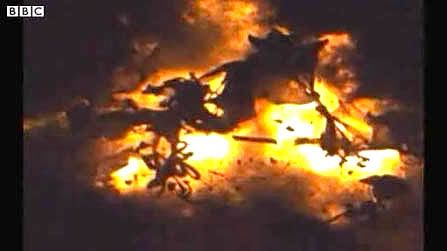
Above is a dramatic image from one of the tests, in a darkened room and greatly slowed down. The curly stuff is presumably the "hard-side" suitcase material, the little bars parts of its frame. The white-hot cluster at center is that 3-400 grams of explosive, semtex it should be, consuming the whole radio and vaporizing/weaponizing everything around it. Do consider that the bomb penetrated the plane's hull, after losing force bursting from the luggage container, after tearing through the suitcase lining, surrounding clothes, cardboard box, and the radio's plastic casing. The timer would be got to right away, before any energy was lost in an of those battles. Is Wyatt's testing just an elaborate (and expensive) way of proving the patently obvious?

Presented by Newsnight host Peter Marshall with the official story again - that a 1cm square chunk of circuit board so near the blast survived inside a small piece of cloth, and was found on the ground, during manual searches, 35 km from Lockerbie? Dr. Wyatt stopped precisely this far short of calling it all a grand farce:
"Obviously these things are not impossible, we only carried out 20 tests, we didn't carry out 100 or 1,000 tests, but in every of those 20 tests we found absolutely no sign at all. So I find it highly improbable that you would find anything like that, particularly at 10,000 feet when bits are dropping into long wet grass over hundreds of miles. […] I do find it quite extraordinary and I think highly improbable, and most unlikely that you would find a fragment like that – I mean, it is unbelievable.” [emphasis as spoken]

Response and counter-response

- Crown Response / Indian Head Forensic Tests
A Scottish Crown Office response quickly followed. It started with a standard appeals to 'we already won, he was convicted,' which have no bearing on the issue at hand, which cuts to the how of the conviction. They note irrelevant facts like "Dr John Wyatt has never examined the timer fragment (PT 35)." Indeed, only certain scientists who have a history of "political" science (Feraday, Thurman) were allowed touch this one and decide it was indeed from the Libyan explosion. Erroneously, the Crown Office state "conclusive forensic evidence proved that the fragment was part of the timer ... at the time of the explosion which destroyed Pan Am 103." Such tests apparently consisted of finding it in a burnt piece of shirt. They did not test it for explosives residue, or do anything to prove it was not planted for them to find. Most interesting and relevant, the press release stated:
"In fact, extensive explosives tests were carried out in the United States in 1989, some time before the fragment PT35 was extracted by the forensic experts, as part of the Lockerbie investigation. The purpose of these tests was:
o to estimate the amount and location of the explosives used on PA103;
o to establish the extent of damage to the improvised explosive device ( IED ), the adjacent suitcases and their contents; and
o to ascertain what parts of the IED and its contents it was possible to recover and identify." COPFS original posting
This fragment survivability aspect is not mentioned in Leppard's book, but hinted at with the note that the clothing within the IED case was “sprayed with a distinctive colour of paint for ease of identification.” [p 139] The Crown office release continued to explain what was found:
"After a number of test explosions a detailed search was made and circuit board fragments, radio cassette casing and parts, fragments of instruction manual, the suitcase and clothing were all recovered in a condition which was consistent with the debris recovered in relation to the Lockerbie disaster." 
The results of these tests have never been formally publicized to my knowledge, making verification impossible. David Leppard does cite a varying amount of explosive in each test - from 360 to 680 grams. [p 140] Interestingly, Alan Feraday had overseen the low end test, and probably recovered the debris from a 360-gram blast "in a condition which was consistent with the debris" that started being found and identified by Mr. Feraday himself and his scientists, right afterwards. RT-8016 radios were used in the US tests, exactly like the model later identified from 103's wreckage, except for case color - the 8016 is white, the SF16 black. The best identifier of the radio model, aside from the amazing manual, was AG/145, a lump of material including a tiny but identifiable bit of internal circuit board. This was consistent with either Toshiba model.

Conclusion: More Information Needed
If indeed there's something in the Indian Head tests that clearly contradicts Dr. Wyatt's findings, and large fragments (up to 1cm square) were indeed recovered from an equivalent blast, the details should now be brought forward. Dr. Wyatt insists 300-400 grams of semtex disntegrates the whole radio, and shown us at least some of the methodology. On the other hand, we've got a few lines in an error-filled Crown Office press release suggesting that Thurman and Feraday did it right and got big chunks similar to what they found - and that they felt was after a blast of 454-680 grams.

That is a serious discrepancy. Obviously the laws of physics are immutable and unchanging, so if two sets of tests produced different results, then some variable was set up differently (wrong) between them. So far Dr Wyatt's is more open, better illustrated, makes more sense, and reeks less of politically-driven obfuscation, but Id like to see more documentation on that as well.
---
Update: A little more information has come out on the tests since the first article. See "On Planted Evidence"

Update Jan 2011: Dr. Wyatt's findings and credibility are in some question. See later comments below.

Abu Talb: Practice Megrahi?

25 August 2010

The early suspicion that Mohammed Abu Talb was involved in the PA103 bombing was based on bomb-blasted clothes allegedly bought on Malta in late 1988, ties to one or another force capable of such grand terrorism, and circumstantial clues pointing to something important happening on December 21, 1988. The same and similar clues would later point to Libyan Abdelbaset al-Megrahi. It’s quite curious, in fact, how these two very different suspects wound up fitting the same clues.

For what it's worth, Abu Talb wound up being exonerated for Lockerbie but found guilty of other bombings, and like Megrahi protests his innocence of all charges. This blogger for one is half-inclined to believe him, at least on the larger charge.

A Week of Sundays in '89
Writing for the Murdoch-owned Sunday Times and working from insider police reports, David Leppard wrote a widely-read series of six articles on the Lockerbie investigation, leading up to the one-year anniversary in December 1989. Paul Foot summarized these for his 2001 book Lockerbie: The Flight From Justice.

The first installment from 29 October announced “Disaster Trail Leads to Malta,” based on the Frankfurt printout and Maltese clothes found at the scene. The trail still led to a PFLP-GC cell there, working with Dalkamouni’s German cell acting out Iran’s vengeance for IA 655. It would be a week before Talb’s role was introduced in the second article of November 5. As Foot summarizes:
"Dalkamoni and “another Palestinian terrorist” called Abu Talb. then went to Malta and “instructed the cell to plant the bomb on an Air Malta flight bound for Frankfurt.” This second article ended with some criticism of the German police for the bungling of the investigation, and especially for the release of the bomb-maker Khreesat. In a huge, rather repetitive, article Khreesat was said to be suspected of being “a triple agent” who intended to bomb Flight PA 103. The chief suspects, therefore, were Dalkamoni, Khreesat, Talb and a Libyan explosives expert known as The Professor."
November 12 saw the third part, informing its readers that the indomitable Scottish police were planning to visit Abu Talb in his jail cell in Sweden, where he was charged for an unrelated string of pointless bombings. "The detail of the story was shifting all the time," Foot noted, "probably because of new information available to Leppard’s security sources."
The fifth article (on 5 December 1989) was finally certain about one of the main suspects. LOCKERBIE TRIAL FOR ‘BOMB MAN’ was the headline over a Leppard article from Uppsala, Sweden, which stated boldly that Abu Talb was about to be extradited from Sweden to Britain to stand charges over the Lockerbie bombing: “The Sunday Times which first named Talb as a suspect last month, can reveal that he has been positively identified as the person who bought the clothes from a shop in Malta which have been linked by British forensic scientists to the suitcase bomb.

Leppard, who was presumably present outside the court, then reported: “During a 90-minute closed court session Ulf Forsberg the Uppsala district prosecutor told the presiding magistrate that the owner of a boutique in Sliema, Malta, had identified Talb as the man to whom he sold the clothes.”
As explained in a separate post, such an identification either didn't happen or was entertained only briefly. On 5 December Leppard was reporting a positive ID by the shopkeeper, but it was established later at Camp Zeist that "Mr Gauci had been shown on 6 December 1989 a selection of photographs which included a photograph of Abo Talb, but he made no identification of anyone from these photographs."

And behind the scenes, we can now see, it was the Times' own prior reporting that would only later give the shopkeeper the idea that the "BOMBER" Abu Talb might have been the man. The Zeist Judges noted "at about the end of 1989 or the beginning of 1990 [Gauci's] brother showed him an article in a newspaper ... there was a photograph of a man with the word “Bomber” also across it," which Tony thought might be "the man who had bought the [clothing] articles from him." With some help from irresponsible investigators and Swedish prosecutors, it would seem, Leppard's reportage would keep trying to come full-circle as a self-fulfilling prophecy.

The Birthday Suspect
Just as this series was wrapping up the dramatic finale of Abu Talb's imminent indictment, a Swedish paper also revealed some damning clues. The New York Times reported from Uppsala Sweden, on the anniversary of the bombing, that Talb was “convicted today along with three co-defendants,” all convicted for three alleged attacks in the region in the mid-80s, and all four “acquitted in a fourth incident in Stockholm in 1986.”

Abu Talb was sentenced to life in prison, expected as 20 years followed by expulsion. “ The verdicts were delivered on the first anniversary of the bombing of Flight 103 over Lockerbie,” and a Swedish newspaper, Dagens Nyheter, “said today that new evidence had come to light linking Mr. Abu Talb to the attack, including a calendar found in his apartment with the date Dec. 21 circled.”

Well what kind of timing is that, getting the ‘guilty of terrorism’ seal plus Lockerbie clues right on the red-circled anniversary? It was later reported this was the date his sister was due to deliver a baby, and the Zeist Judges decided the actual delivery happened just past midnight on the 22nd, in Sweden. This gives Mohammed a tentative approximate alibi (watching the kids as his wife helped the delivery) for the planting of the bomb at Malta, or London. But thanks to this curious timing, Abu Talb was bound to stick in our minds as the certain villain.

The date emphasis certainly does seem a nice coincidence, on top of the Maltese clothes, much like the ones that would later link Megrahi to the bombing. The article explained the garments seized in Sweden were flown to Malta for analysis, but apparently “Scottish detectives were disappointed with the results of the examination in Malta,” a faint suggestion that this line would not last.

However, the Times added:
“[Dagens Nyheter reported] Mr. Abu Talb's wife also was recorded in a wiretapped telephone call warning another Palestinian, who was not identified, to "get rid of the clothes immediately." The police later seized a suitcase from the family she had called, the paper added.”  
Apparently nothing further came of this supposed warning. And apparently no one warned the wife to get rid of the clothes in her own home that would be found right there to incriminate her husband. It seems just as likely that she was urging an acquaintance to help them sell (get rid of) these clothes Mohammed had burdened them with.  But someone else on the Swedish end of things was clearly trying hard at that point to make it all come together.

The One Leads to the Other
Ultimately Mr. Abu Talb’s alleged central role faded from view, and he was replaced with the Libyan al-Megrahi. It was the shift of attention to Malta - enabled by the scorched clothes, the Frankfurt printout, and Abu Talb – that finally “led” to Megrahi. Or was it the other way around?

The clothes traced to that Maltese shop were only much later decided to be bought by Megrahi. That was the nail in the coffin, which was itself built much earlier, mostly in 1989. Libyan defector A.M. Giaka was already on file, with his assignment to Malta’s Luqa airport. He made his knowledge of Megrahi and his supposed accomplice Fhimah known to the CIA even before the bombing of PA103. Megrahi was soon after that found to be at Luqa, under a pseudonym, on the morning of the bombing. Later, in August 1989, the Frankfurt printout emerged, suggesting an apparent unaccompanied bag destined for PA103, and coming off a flight that left Luqa during Megrahi’s clandestine presence there.

It’s entirely possible, given the mysteries surrounding the printout, that it was custom-made to point at Megrahi. Eventually Giaka and Gauci would be compelled (perhaps by the promised multi-million dollar reward) to add details fleshing out Megrahi as the main actor in the plot. He was seen with the suitcase and with the clothes that went in it!

My study of this case reveals or at least suggests duplicity, cover-up, and misdirection, at every turn. The real perpetrators were to be ignored in favor of the cover-up, and this went back to the beginning, as the clues of Heathrow origin were denied, skewing the whole investigation horribly and necessitating a false narrative sooner or later.

Given this, it stands to reason that any "primary suspect" in this case the CIA/FBI/Scottish/Swedish police ever publicly pointed to is suspect in a different way. Given the intensive denial of truth in operation, investigators would not want to point, even then, at someone they genuinely believed was involved.

They pointed at Abu Talb, and the main effect was that it helped them get closer to Megrahi.

Evidence Reconsidered: Abu Talb

Abu Talb: Unindicted Co-conspirator, or Practice Megrahi?
23 August 2010

Note 23 August: This post was originally put up months ago but left undated and incomplete. Previously it had a bunch of incomplete, semi-organized text, which I've copied into a word doc to sort out better and update. I will split this into a few sub-posts that I'll link to here when they're up.

Breifly, Mohammed Abu Talb is an Egyptian-born struggler/terrorist with a long rap sheet of fighting and bombings. He claims he foreswore violence and fled from the fray to Sweden with his wife in the early 1980s, and opened a store. But he was jailed there in May 1989, on suspicion of a mini-string of pointless terror bombings in Copenhagen, Denmark in 1985 that killed, I believe, one. By the time he was convicted for his part in these - on December 21 1989 - he was also widely suspected of involvement in the the Pan Am 103 bombing exactly one year earlier, and he was soon named as the primary suspect.

Abu Talb wound up being exonerated for the Lockerbie incident, but found guilty of the other bombings, and like Megrahi protests his innocence of all charges. He was later called as a prosecution witness, apparently to clear him of suspicion. To read the Zeist judges' summation, he deserved it. However, and again like Megrahi, Mr. Abu Talb does have a body of circumstantial clues, assembled back when he was the prime suspect.

Most recently, on Saturday (20 August 2010), Swedish authorities for the first time acknowledged that Abu Talb had been freed from custody and had slipped from view and the reach of investigators. The allegation of just that was first aired by the obviously well-connected Scottish Law magazine/site The Firm almost a year ago.
The Firm understands Talb was quietly released in early September, only weeks after Abdelbaset Ali Mohmed Al Megrahi was released from jail in Scotland and returned to Libya.

As noted by Lucy Adams (first link above) in the Herald (Scotland):
The Herald has previously revealed that Talb could be tried if Megrahi were to be formally cleared. An appeal against Megrahi’s conviction could still be mounted even after the death of the Libyan, who is terminally ill with prostate cancer.
This apparent, possible, contingency planning is highly interesting, and sure to attract more scrutiny in the coming days. Therefore I'll seek to quickly bring what I can into a more organized discussion.

The posts:
Abu Talb and Tony Gauci

Abu Talb: Practice Megrahi?