Showing posts with label Claiden T. Show all posts

The Political Scientists of Lockerbie: An Overview

3 November 2010

Science Well Done, Answers that Make Sense
Following the bombing and fall of Pan Am Flight 103, and the sudden deaths of 270 people, quite a a number of extremely important questions needed answered. Many of these were best addressed by the rigors of physical science - gathering and analyzing the debris of the crash to form as clear a picture as possible of just what happened to that aircraft  The aircraft debris and break-up analysis was tasked to Mick M. Charles et al. at the UK Air Accidents Investigation Branch (AAIB). I see no reason to dispute their findings or methods. (AAIB report) It showed where the initial failure occurred, petaled-out panels indicating a powerful explosion in the vicinity of cargo hold station 14L.

Container AVE4041PA, the luggage "pallet" that occupied station 14L, also showed signs of extreme blast damage and was ruled by the AAIB to have held the primary (bomb) suitcase: The container was studied in particular by Thomas Claiden at AAIB. There are some minor points of strangeness with his findings (and they're named AI/100 and AG/145), but on balance his findings seem sound. It established the approximate blast center, most likely in a case laid flat, with one case between it and the floor, at the outboard end of the container.

Likewise, the Scottish police and their allies should by default be trusted in their painstaking collection of thousands of blast-related pieces of evidence from across hundreds of square miles. And after the in-gathering, their own book-keeping should be presumed to show signs of tampering if such even conceivably happened at their end. For example, Detective Douglas Roxburgh, who headed the store house at Dexstar, would have noted debris being removed without a proper cataloging. In fact, he did report this to his superiors at the time.

At trial in 2000 he didn't seem to recall this removal being a big deal or anything nefarious. Nonetheless, there are certainly ways, from the inside or the outside, to alter the police records to accommodate evidence slipped into certain key spots. This may sound like an absurd consideration to many, but on further reading one can see why it's worth keeping in mind.

A Critical Three 
The most relevant material to determining who was responsible for the bombing also happens to be the evidence with a cloud of questions surrounding them. The accepted evidence from closest to the bomb, and three particular scientists at the heart of it - two with the UK military's RARDE agency, one a special agent with the FBI, all known for returning politically useful but scientifically questionable decisions. Hence the "political" scientists of Lockerbie.

The Royal Armaments Research and Development Establishment (RARDE), a branch of the UK military, had an explosives forensics lab (sometimes called EC3) that had helped in previous terrorism cases involving the IRA. The blast science side of the Lockerbie inquiry was assigned to EC3. Journalist David Leppard, a huge RARDE fan, wrote in early 1991:
"The Lockerbie case team was led by two men who were considered the best in Britain. They were Dr Thomas Hayes, the senior forensic scientist, and Allan Feraday, his deputy. The remarkable work which the two men were to undertake over the next two years was to provide the cornerstone of the entire investigation.” [p74]
Just who among Hayes and Feraday did what neither could recall - they both signed off on the final report of 1990, but remembered nothing specific at trial in 2000.

Part 1: Thomas Hayes
Dr. Hayes was the head investigator at EC3 during most of the time debris was being studied there. He had previously been involved in the Maguire Seven case of 1976, signing off for science that helped put away seven people for supplying the explosives used in a string of IRA bombings. On review in 1990, the basic science was found to be consciously skewed to secure the convictions, which were all overturned. It was apparently this review that led Hayes to vacate EC3's top spot, leaving his deputy Feraday to take his place.

Part 2: Allen Feraday
Mr. Allen Feraday (no PhD) headed the lab from late 1989 to RARDE's elimination in 1995. He had not a single prior case that would fall apart - he had four. A mass-murdering IRA bomb mastermind, a supplier of Syrian terrorists, a Libyan planning to supply someone for bombs, and three IRA terrorists who deserved to be shot by the SAS because they could have blown a bomb. All these opinions were later questioned or tossed out by courts. For decades Feraday served the Crown loyally and robotically, with an eye to political objectives of his superiors rather than to science and truth. In one case it seems an innocent man was targeted in lieu of a known IRA bombmaker whose prints all over the device were ignored. Feraday helping terrorists get away?

All the above cases hinged on Ferraday's supposedly vast understanding of electronics and circuitry, and he showed the same interests in the Lockerbie case. He made a project of identifying the radio model used, and months later, identifying the fragment of Libyan timer that turned up. This he personally escorted on its mid-1990 journey to the United States (see below). In these and other ways unseen he played a key role, in ambiguous collaboration with Dr. Hayes, laying the "cornerstones" of an investigation that most impartial observers recognize as horribly crooked and geared towards securing a rather ludicrous conviction.

Part 3: "Tom" Thurman 
Among the American experts brought in was FBI special agent James "Tom" Thurman, described by mainstream reports as "one of the bureau's best explosives technicians." Others have said he has no formal explosives training, but rather a degree in, literally, political science. The reality may be in the middle - I'm still sorting that out.

Agent Thurman was ordered to Scotland, along with other folks from the FBI and FAA, on the night of the crash. Starting soon after, he helped locate and assess the blast-damaged clues. There's reason to guess he might have been the guy that set off Roxburgh's alarm bells. Otherwise, I see no great reason to question his findings here. Again, it's closer to the blast center that the clues get weird.

The Scottish police handled most of the rest, and Hayes and Feraday zoomed in on the analysis of the bomb-damaged luggage. Thurman was however called on to make a second appearance in mid-1990. In June he helped identify the crucial timer fragment PT/35(b), in a remarkably short and focused quest. Upon making the link with top-secret CIA help, Thurman then had a look at the actual fragment, brought over by EC3 chief scientist Allen Feraday. Both eminent minds agreed this was a piece of a Mebo MST-13 timer, sold only to Libya in a tiny batch of 20.  Convenient.

The fragment's genuine blast origin was doubted by neither of these two supposed explosives experts, nor by Dr. Hayes. Not all scientists outside their little loop agrees, however. Consider Dr. John Wyatt, involved in tearing down Feraday's work before, who later found in a dramatic series of twenty tests that even at a fraction of the official blast power, all surviving remains were many times smaller than PT/35(b).

As the dedicated post will explain, Thurman has been widely criticized for his lack of real knowledge and lack of credentials. That I could forgive if his science was solid. But he was later drummed out of the FBI crime lab for misleading practices, which is clearly more problematic. His other cases are high-profile - including the 1989 Libyan bombing of UTA 772, and the 1995 right-winger bombing of the Murrah federal building in Oklahoma City. Potentially troubling stuff, which I also haven't got sorted out enough to comment on yet.

A Tale of Three Atrocities

A Decidedly Different Take
20 August 2010 (incomplete)
last edits 27 August

A tale of three atrocities is the name of an unusual little book written by an interesting acquaintance, Mr. Charles Norrie, as of recently available in an on-line form. Mr. Norie is an English family member of an alleged Libyan atrocity, having lost his brother to the 1989 bombing of UTA 772 over Niger.

While he does accept Libyan guilt in that attack, Norrie has taken a major interest in the lack of a case for Libyan guilt in a second atrocity, the Lockerbie bombing. His unusual position has brought him to sign, along with myself and others, the most recent petition of the Justice For Megrahi campaign.

First, I’m one of the few people Charles has blessed with a hard copy of the mythic "green ATOTA," and I think I’ve read all of it by now, but never all at once. It's a neat little book, slick design, size and shape like a small company's annual report. The layout is tasteful, with full color photographs and glossy finish. (see image at left, atop my small Lockerbie library).

That's what you can't see in the Blogspot posting, but the text is the same (I presume) and can finally be seen by a wider audience. The writing is decent, with spots of genius and others of just cleverness. The actual ideas, the methodology and presumptions behind them, are more problematic for me. I’ll attempt to summarize a bit clumsily from my half-understanding.

Much of what’s in ATOTA is well-reasoned - especially when it comes to spotting problems with the official story against Megrahi, or with linking the 103 bombing to the third "atrocity" of the title. Along with myself and many others, Norrie believes the cause of Lockerbie to have been the 1988 downing of Iran Air Flight 655. While he suspects the associated PFLP-GC clues were just as fake as the Libyan ones (they were the original "scapegoat"), his concept of the “Qesas” revenge code is compelling. This would mean an Iranian hand was required to “pull the trigger,” perhaps a family member of an IA 655 victim.

London is the place this was done, apparently for operational security reasons. Would terrorists be so daft as to introduce their bomb two airports away and trust fate to pass it through each screening? I happen to agree on London introduction, in part for the same reason, and Iran Air’s terminal was in Terminal three at Heathrow, not far from where the bomb was finally loaded, via container AVE 4041.

The technical details ATOTA proposes are what get confusing. It  seems he’s saying the bomb was not inside of luggage at all, but rather attached/built into the luggage container to resemble a repair patch. To not stand out, he agrees it would have to be, at most, one inch thick, this explosive device with an ice cube timer, and faced in rough aluminum. He reasons "if the bomb was in a suitcase it would have been spotted on the morning of 21st December by Heathrow baggage handlers." Well, it was, apparently as part of a  matching set.

It almost seems Norrie is adding a shape-charge aspect to the 1/2” thick bomb notion. As he explains:
The official explanation for Lockerbie is that a bomb was concealed in a suitcase. Yet a bomb in a suitcase would explode in all directions. In contrast, the hole in the side of the plane seemed to indicate a unidirectional explosion. This makes sense if a bomb was attached to the side of a luggage container, slightly above the bottom.
Actually, the blast that’s alleged would be fairly uni-directional, relative to the nearest hull metal - inside pointing out. In fact, being inside the container and a bit lower than shown (at left, from AAIB report) could explain the low cut-off of damage (red hatching). It could be cut off by the layer of bags above.

This supporting passage has me scratching my head still:
Peter Claydon told the court the bomb created an 8-inch square hole in AVE4041 PA and a 20-inch square hole in the skin of the aircraft.
I’ve read Mr. Claiden’s testimony and found no such statement. This would have to be a very unidirectional explosive device to leave a square hole after detonating, and the same size as the 8” square repair patch he shows in a photo on page 13. In fact, the damage to the outboard panels was measured in feet.

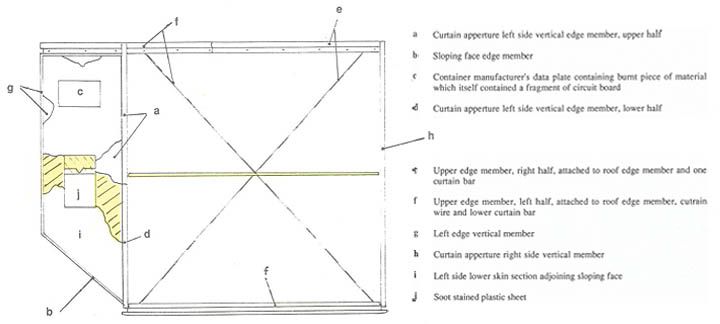
The closest thing I can see to an 8-inch hole is the opposite - a chunk of metal about that size that Claiden felt was from the middle of a huge span of completely missing metal (labeled "e" at right, from AAIB report). This was at almost exactly the bomb position, and his hunch that this intact metal is from there remains bizarre and inexplicable.

Norrie’s theory also goes deeper than Iranian involvement, suggesting the Americans were involved in the plot as well - to ensure its success. The primary evidence he cites for this is the second explosion, at the other end of the plane and triggered 14 seconds later, it had to be an independent device that proves "Megrahi cannot be guilty."
I now believe the cause of the additional blast was a CIA 'insurance bomb'. Its purpose was to guarantee no one survived the bombing, ensuring the Iranians would be completely satisfied with the operation, and the Qesas condition fulfilled.
I think this was to deflect wider promised attacks.


To support the second bomb theory, he cites an unsupported statement from apparently loon John Parkes that "a minimum of two high explosive events took place inboard Pan Am 103." And he points to the twin debris fields, north and south, as pre and post-second bomb. I'm not certain of the right answer to there being two fields, but I should think it could have many explanations in a complex breakup like that of Flight 103, even without a second detonation. 

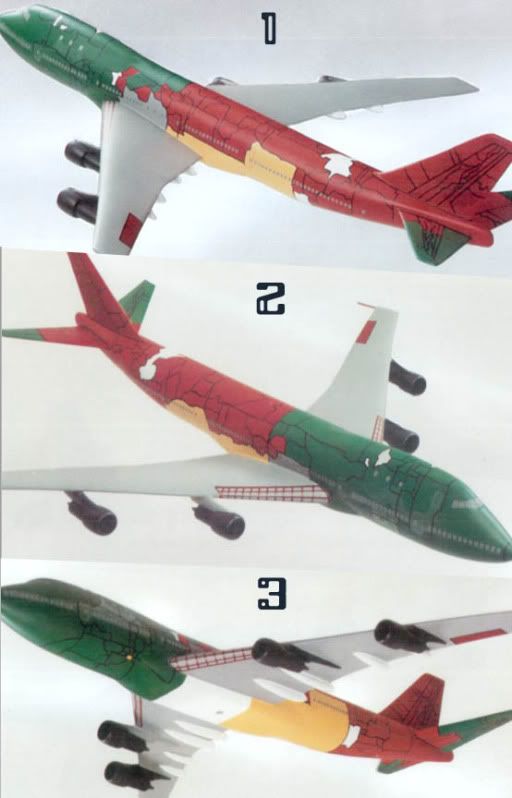
For the location of the second bomb, Norrie cites a missing section near the rear cargo area which must have been all vaporized by a "brisant explosion." See the image at left (new window for larger view), of the AAIB's painted model. Those sections coded in white were never recovered. Charles would be referring to the section on the lower rear of the craft (seen in view 3). But many other sections at random spots were missing as well, in at least seven apparent "brisant explosions" all over the plane. For whole panels of aluminum to disappear in Scotland might seem odd, but there are a lot of lochs that maybe weren't fully dredged, etc...


---
more perhaps forthcoming ...

I give Charles Norrie the comments section below to help us grasp what he’s got here.

Note 3 Sept. - he opted not to use that much, but took it to the JREF and, at Rolfe's invitation, proceded to ...  well to fail, for one.

Note 19 September: I've decided to breach e-mail confidentiality to confirm that  Charles'  ridiculous behavior at the JREF was part of a strategy to accrue yet more"suppression"of the the ype he's encountered at Wikipedia and now at Prof.Black's blog (first ever banning there I know of).

Container Geometry and Blast Location

July 14

This post is just to visually work out some doubts I had about suitcase arrangement in container AVE 4041. The premise I've been thinking of is the two suitcases reported by John Bedford, taken as matching, and as both matching the single identified model - Samsonite Silhouette4000 series hardshell case, antique copper/maroony brown in color, 22x26 inch frame. (further details)

The official findings of the UK Air Accident Investigation Branch established the approximate blast center within the container. In Appexdix F of their 1990 report, Thomas Claiden placed the event near the outboard end, and near floor level - the most potent nexus, slosest to the plane's own fragile skin. Its height was found to be around ten inches above the pallet's floor level, in a suitcase placed on top of another, rather than on the floor itself. In general, I agree with these findings so far. The floor panel seems to have been shielded from the blast, and my own view will be generally the same, give or take a few inches.

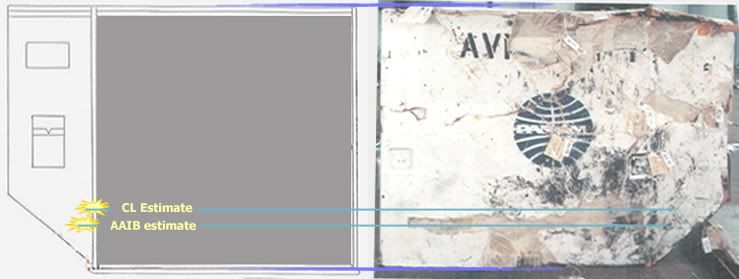
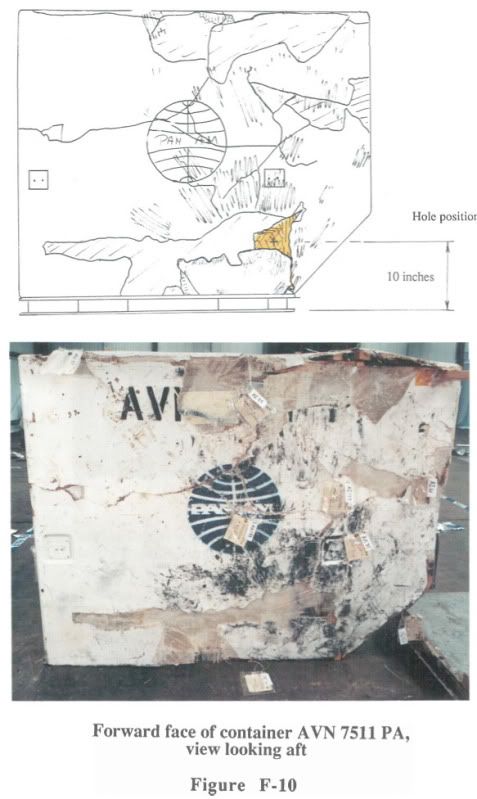
The neighboring container AVN 7511 bore a 5-inch hole straight across from this blast center. Some item(s) apparently entered the fiberglass back wall of 7511. A piece of AVE4041's aluminum outboard panel, and two fragments of the primary suitcase's hinge end wound up embedded in the luggage of Heathrow-originating passengers in the next container. The hole was centered 10 inches up, and was the main fact cited by the AAIB to establish the blast height. Below, a side-by-side. "CL Estimate" explained below (see "vertical difference")  

After some reflection I've decided the clue is more ambiguous than it seems. It presupposes a directly lateral blast with no vertcal angle - a 2-d solution to a 3-d problem. A normal explosion tends to be omnidirection of course, so debris and force can travel in any straight line, so long it's generally OUT. They really have no reason to be certain of the exact height.

This comparison of Claiden's figures F-10 (inverted) and F-13 show how much ambiguity there is in the "official story." F-13 is working with an extra 25" measure to aircraft skin, which would be a bit further if that red dot were also shown 10"above the floor as labeled, not 7.5" as shown.  Compare the two10"lines at left and right F-10 is also wrong in the report, but corrected in this remix (left,backwards) At right is F-13's wrong measure.)

Inboard-Outboard Placement
Claiden's official decision was that the blast was  2"outboard - that is, towards the hull - of the upright door edge member. That is shown in F-13 (right) and would put it just behind the small outboard panel, the only metal span on that whole face, near its bottom pointed end. The AAIB's Thomas Claiden decided this because the blast had to be outboard of the vertical door edge member. That bar suffered direct blast  damage on the inner side, but not on its inboard face (right side here)

However, note in the comparison above, the outboard  edge of that yellow-shaded hole in 7511 (left edge here) is a bit outboard (left) of the door edge. The two sketches did not fit exactly, so the degree is unsure. It's nearly 2"in, so it may be significant. The apparent center of the hole, marked "+" by Claiden, suggest a blast just barely inboard (right) of that member. If so, no metal was between the blast's dead center and that fiberglass wall, aside from the suitcase frame. And its blast line would then angle slightly left, and would explain  the door edge's "shadow" being a bit outboard from straight across, as it seems to be.     

This wouldn't really conflict with Claiden's damage-based assessment, and the image at right, of different positions in the container, shows why. He called it 2"outboard only because the inboard face of the door edge member was not blast-damaged (image), and center #1 is roughly what Claiden decided. Clearly it would not impact the right hand face of that bar, but neither really would blast center #2,  which I propose. The inboard face would  technically recieve the blast, but only glancingly, not enough interference to invite pitting or burning of any notable degree. The green arrow here leads (roughly) to the sudden edge of the hole in AVN7511, a bit outboard of the blast. Only center 3 as shown here would clearly conflict with Claiden's findings and really blast that inner surface. I'm sure this isn't precise, and in fact I ammend my proposal to a hair left of the #2 as shown. But that's the concept to consider.

Vertical Difference
My proposal is of course a matching set of cases stacked one on the other, and so the thickness/depth of the model is important. At trial this was given as 8.9 inches, which I've rounded to nine. In fact, however, it might be rounded down, given the several cases stacked on top of them would cause a slight compression. This should be noted, because generally, two cases this thickseems a minor problem. If the blast height was10", it wouldhave to be centered at the very bottom of the upper case, rather than dead-center inside it.

It's not a huge problem, obviously, but one I wanted to tackle. The explosive center of the bomb radio could have simply been placed right along the bottom. But one clue complicates that: a purple case dubbed PH/137, which was probably in AVN 7511,  was apparently pierced by two pieces of the IED suitcase(s). Specifically, those pieces were from the case's magnesium alloy frame, which runs around the middle, base/hinge end. Bedfrod reported his Samsonite style brown cases as laid handle ends in, so bases towards  ANV 7511. This is consistent with them being stacked but not  rotated.

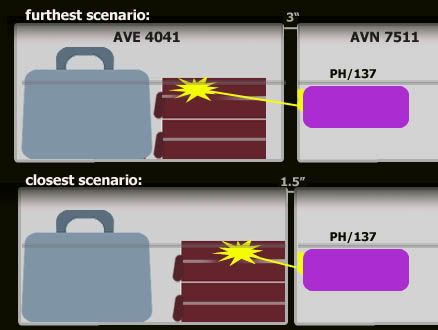
The distance between containers is unknown - I lost where I did the math on the forward hold in Fig F1, but it's not precise to begin with. It came out a tight squeeze - for  eight rows of LD3 containers, leaves about 2 inches average between the rows. I used a 1.5" and 3" distance below, app. Considering both container distance and IED placement within the suitcase, these are the approximate closest and furthest scenarios below. Note that nether is implausible, and both put the neighboring damage lower than the blast center.

The relevant line passes through the middle frame to carry a piece through that hole and intoPH/137. This is now about 15 or 16 inches above the container floor. It's way off from what the AAIB said, but  can anyone show how it must be wrong?

A Problem on the AVE 4041 Side
A possible complication arises from the face across from 7511. The closes (aft-facing) face of container AVE 4041 PA is shown diagram by Mr.Claiden, figure F-5, below. The outer frame and left-hand (outboard) panel, plus the bar across the middle, are all the metal here. The large middle span with the X would be a retractable door of blue tarp, easily shredded away by a Semtex blast. 

Intriguingly, this is the only face with no photograph present in appendix F. The image below is a screen cap of an online re-showing of an old ABC News segment. It seems to show the same things about the outboard panel: top peeled back, a large span missing in the middle, and one solid sheet, bowed out a bit, in front of the bomb position.
Why was that upper middle span never recovered? Was there another bomb on the fourth level up? And why is the lower portion, right in front of half the explosion, in one piece?  At the very very bottom, a foot below the bomb, one small spot seems missing from the outside. But one solid sheet, not even torn by the bomb so near, rests above it. From the inside, the bottom couple inches of the vertical bar are severely pitted. This is shown at right, with the mysterious panel not attached (so no interior view of it). This extremely low damage is puzzling in any scenario I favor so far.

But the intact panel is strangest of all. It is more consistent with my inboard blast center notion, in which the dead-center at least is not behind the panel. But it's not consistent enough. That too would at least tear that panel severely. And there was that piece of container skin that was found stuck in the heel of a shoe within the next container  - where did it come from if not this span between the low-level bomb and the hole into AVN 7511?

Perhaps there's a simple explanation, but it eludes me for now.

AVN 7511 PA and its Clues

June 25 2010

This site has previously covered aluminum luggage container AVE 4041 PA, which clearly had contained the explosive device that destroyed Flight 103. Of the many other container in the hold as the bomb went off, only one has any investigative importance – AVN 7511, same model but made of fiberglass, was parked next to the blast container, immediately aft, in position 21L.

Below are two illustrations from the AAIB’s report – a sketch by Mr. Claiden, and a photograph. This what would normally be called the back face of the container’s back wall, but was forward-facing when loaded. This surface was just inches from AVE 4041’s front side when the blast happened.
A container’s front (loading) side is open – apart from a small outboard side panel, it’s essentially one absent wall, with the bags secured in flight using a retractable blue tarp door that latches at the bottom. This would provide little protection to AVN 7511, but might help cause the dark spatters at lower right, directly opposite the blast zone. The marked cut-off of the mess on the right-hand side is the edge of the door/flap, where the metal side panel starts.

This whole container wall is cracked in several areas, and exactly what here is blast damage vs. damage from the fall and landing is unsure. But we know the bomb suitcase in the lower outboard corner of its container, roughly ten inches above floor level. Note a span of damage near the bottom, starting at about that height (I measured it). The outer layer of glossed fiberglass is removed, leaving the fibrous under-layer exposed. And at the right end of that, something seems to have punched a small hole clear through the container’s back wall (highlighted yellow in Claiden’s sketch).

This damage is in fact directly across from the precise blast center. Its sudden right vertical edge marks about the dead center, again cut-off by the door edge. Claiden cites this five-inch hole as the main clue establishing the level of the blast inside AVE 4041, consistent with a flat-laid case on the second level up. The reasoning seems sound enough. The hole itself by my measurement starts ten inches up, and its center is about 12.5 iches, suggesting the blast center is a tad higher than Claiden found, which I already suspected.

What punched the hole?
One explanation mentioned for this puncture is the securable metal end of AVE 4041’s retractable tarp door. This seems to ne the main explanation, and seems plausible enough, but this lone entry has some competition for what made it.

One piece of damaged luggage – a purple canvas carryall labeled PH/137 – held a clue. Actually it held two clues, pieces of magnesium suitcase frame called PT/22, found to be from the bottom (hinge) end of the primary suitcase. PH/137 was the subject of some contention at trial, being both London-origin luggage and apparently blast-damaged. It’s generally thought that all damaged luggage was in container AVE 4041 and none of that was of London origin. (This will be explained better elsewhere).

I’ve already posted some strangely evasive statements by Allen Feraday about his and Dr. Hayes’ treatment of this case. In the broader discussion I hadn’t seen then, the nagging question no one could answer clearly was whether this bag had been inside AVE 4041 or AVN 7511. No one can say for sure, but it does seem possible that those bits called PT/22 created that hole before burying themselves in that purple bag next door. Otherwise, it was in the same container, and raises some questions about what was in 4041.

A stranger culprit can be found in TSH/346, a severely distorted steel suitcase frame, found to be 2030 millimetres in length. That’s 80 inches, nearly seven feet. It was originally from a 29-inch blue, softshell American Tourister brand suitcase, apparently blasted open and flayed out. This important piece of luggage (as explained in a separate post) is thought to have been right under the bomb suitcase.

But among the items removed from this mammoth TSH/346 was PT/39(c), “a fragment of fibreglass/plastics from AVN 7511 PA.” Is it possible this whole length of frame was hurled across and smacked the top off that fiberglass? The whole broad strip of damage runs across about 55 inches, or nearly the whole door width.

Unlikely. The rough strip is neither above nor below the blast, as that American Tourister was thought to be. What should hit along that line is superheated debris from the Samsoinite holding the bomb, high-pressure explosive gasses, and a shower of melting tarp. Perhaps TSH/346 just partially impacted that lower portion in the center. And perhaps there’s a bit of theater in that fiberglass find. It wouldn’t be the first time something shady happened around that luggage.

Timeline: Toshiba Radio Identification

June 4/5 2010

The following is a detailed timeline of the establishment of the radio model used for the IED that took down Flight 103. Led by Mr. Allen Feraday and Dr. Thomas Hayes of RARDE in 1989, the model they decided on was a black Toshiba BomBeat RT-SF16, was sold largely (76%) to a Libyan company. Thus, the very radio model became another clue of Libyan guilt, and like the rest became full of strange inconsistencies suggestive of a fraudulent investigation.

The dates are as given. Fudging and backdating cannot always be ruled out. There is in fact a serious and obvious insertion of pages within pages and apparently a missing original page 50 (a new twist on an old anomaly, to be explained soon). This affects the alleged timeline May 12-15. Emphasis is on radio case plastics, main circuit board, and user's manual. Speaker mesh, speaker magnets, a screw, some wires, and other bits appear sporadically but not worth this level of dredging for you or for me.

Note on evidence labeling: In example item PI/995, the "P" means property (evidence), the “I” indicates search sector it was found in (sectors ran A-K), and the number should mean the 995th item found or logged in I sector. PT however means evidence removed from other items (PT/35 was found inside PI/995, for example). Again, the numbers within the PT category are supposed to be sequential – PT/35 should be found right after PT/34. Such a label is often attached to all debris found within a piece, subdivided by letter (ex: PT/35(a), PT/35(b), etc.)
---
  • Late Dec and into 1989: Dr. Hayes’ examinations work (mostly) alphabetically, from PA/ to PB/ etc. It will take a while to get to PH/, PI/ and PK/ where the bomb damaged material and radio remains will be concentrated.
  • mid-Jan (date not noted): Thomas Claiden at AAIB finds a lump of materials, trapped in a fold of a data plate for container AVE4041. He hands it back to the police.
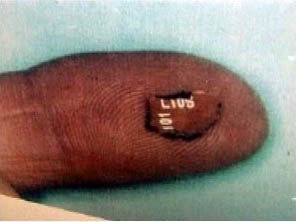
  • Jan 17: This is received by RARDE, and designated evidence AG/145. The largest fragment (left) is app. 10x6 mm, and another marked “02” was about 5mm sq.
  • Jan 17-22: Feraday: "very early on, I thought we'd probably got a white case, because I'd got white fragments with that AG/145 fragment." No others would surface ever.
  • Jan 23-25: Mr. Feraday takes a trip to Germany “to compare the Lockerbie circuit board fragments (AG/145) with the radio/cassette device recovered in Germany [Khreesat’s BomBeat 453].” No match. For one, Khreesat’s was black.
  • Feb 2: Feraday goes to Toshiba UK headquarters at Camberley, Surrey. He examined “over 130” service data sheets and found the AG/145 pattern “was tentatively identified as originating from a Toshiba brand portable radio/cassette player, model number RT-8016.” A same-day physical examination of that model supported that.[3023-24]
  • Feb 3: Feraday sends a memo to Senior Investigating Officer John Orr: “I am completely satisfied that these fragments originate from a Toshiba brand radio stereo cassette recorder types RT-8016 or RT-8026 […with] a white plastics case.”
  • March 15: last entry in Dr. Hayes’ examination notes for two months - next entries are in mid-May.
  • April 18-21: Indian Head forensics tests, Maryland. Five blasts in luggage containers are set up by Feraday. He prepares all the devices, using the RT-8016 in all. He personally oversees the low-end test, using 360 grams Semtex-H. He makes no detailed report, relying on DCI Bell’s police report, which he’s not even sure RARDE got a copy of.
  • April 23-May 1: Feraday visits Toshiba HQ, Japan, learns the board he’s looking at was put in seven different models. One and only one of these is, surprisingly, given the BomBeat title - the RT-SF16. Identical to the 8016 except for the black case. And it had its Libya links
  • ??: Control sample PR/105 is obtained – RT-SF16 new in its box. The owner’s manual is “removed” from this “evidence” and dubbed PT/1. PT otherwise means actual blown-up evidence removed from other real evidence. Here they emphasize the “removal “ of PT/1 from “evidence” PR/105. 
  • May 11: radio manual cover PK/689 is received at RARDE. Supposedly from the bomb and found in a field in K sector near the North Sea, it’s ripped but can be read to announce “..Hiba … o cassette recorder … SF16 … BomBeat SF16.” It matched the control PT/1. Gosh, why didn't they call this in earlier? Afterwards, items are said to be from the RT-SF16. However, see June 30.
  • May 12 (by lab notes): “PT/2” is discovered – five crumpled bits of paper, consistent with same spot on most pages of PT/1. Found in clothing PI/995, along with (but not included in) PT/35. PT/35 included 11 bits of black plastics PT/35(a), the famous PT/35(b) (non-radio), and speaker mesh PT/35(c).
  • May 15: Hayes discovers black case plastics PT/41(a), and PT/42(c). 
  • May 16: Hayes examines PK/689 (above, left). “And I've concluded there that the two-page fragment of paper appears to have survived a close-range explosion involvement.” Hayes discovers case plastics PT/34(b), manual papers PT/34(c).
  • May 18: Hayes discovers case plastics PT/38(b), PT/40(b), PT/48(b), PT/78. Manual PT/40(c)
  • Mid-May, presumably (dates unavailable) – Hayes discovers case plastics PT/32(b), PT/33(b), PT/36(d), PT/37(a), PT/53(a), PT/56(a), and PT/61(b).
  • May 22: Hayes finds manual scraps PT/56(c).
  • June 1: Hayes finds PT/31, ten tiny bits of RT-SF16 manual, examining the 'blue Babygro' PK/2209.
  • June 8: Hayes discovers tiny radio circuit board fragment PT/30 embedded in suitcase fragment PK/2128. It’s about 4mm square.
  • June 18: DI Williamson claims in a letter to SIO Henderson that Feraday discovered the ”potentially most important” PT/30 this day examining PK/2128 [Leppard 207] Either way, it was shown to fit the same Toshiba board as AG/145 did (all labeled together in a prosecution photo). Clearly RT-SF16.
  • June 30: Feraday notes: "On the 30th of June 1989, some explosively damaged paper fragments [PK/689] were received at this laboratory, thus conclusively establishing which of the seven models of the Toshiba radio had been employed in the Lockerbie bomb.” He meant May 11. “It's a mistake that I made when I wrote the reports," he explained under questioning, "because sometimes items would come and go to the laboratory several times.”
  • July: Feraday attends a second set of four blast tests in the U.S., again using RT-8016 radios.“Mr. Feraday, you referred earlier in your evidence to having taken part in explosion trials in the United States in April and July of 1989 … nine in total…”
  • Aug 17: Dr. Hayes does an examination on AG/145. (first ever?) "A small quantity of aggregated partly carbonised material from which many fragments were recovered."
  • September 14: Feraday visits Dextar looking for matches to PT/30 (no luck) [Leppard 208] See also, Forensic Follies.
  • Late 1989 (date unclear): Dr. Hayes retires from RARDE. His slot as head of the explosives division is taken by Mr. Feraday. Hayes continues unofficially as a "consultant" for three month, then extended.
  • Nov 12, 13 1989: FBI interview with Marwan Khreesat in Jordan – the RT-SF16 has been decided on. Khreesat says he’d never use such a radio, is absolved of suspicion.
  • Dec 19 1989: date of DI Williamson’s letter regarding PT/30 cited above. He’s asking for more evidence from Germany – alarm clocks - to see if it can match up with PT/30. [Leppard 207]
  • ... 1990 ... 1991 ...
  • Nov 15 1991 - Indictments read out against Megrahi and Fhimah, using the identified RT-SF16 as part of its evidence. The rest is history.
---
Sources:
Leppard, David.On the Trail of Terror: The Inside Story of the Lockerbie Investigation. London, Jonathan Cape. 1991. 221 pages.
Testimony of Allen Feraday and Thomas Hayes, Camp Zeist NL. Days 16-21, June 6-15 2000. Too varied to cite individually.
Others explained at provided links

The "Elimination" of the Bedford Suitcase(s)

(almost complete article in progress)

Note: Having a look now at David Leppard's book, I've decided to split the old post into two new ones, joined here. The first comments below reflect the previous version. This post will discuss both tracks, an official report and a dramatic blowing-up of things by political scientists, in general terms, how they relate in altering the course of the investigation. The switch was from an obvious and useful lead that neither the Americans nor Brits wanted to follow. And it was to a confusing muck in which a new plot could eventually be "discovered" and followed.

Also, here I'll address the decidedly non-scietific aspect in how this valid forensics work was twisted to insist something it simply couldn't do - "the bomb bag had to have come from Frankfurt and before that... we'll think of something. Just give us some time, okay?"

Shuffling Aside Bedford's Baggage
Not a whisker of the Libyan guilt storyline could have emerged if not for a key decision made early on about where the bomb came in from before being loaded onto PA 103. The official presumption was that the bomb had arrived in London on Pan Am 103A, a feeder flight / flirst-leg originating in Frankfurt, West Germany. Acceptance of this premise allowed a bag from Malta, and all that was attached to that, and eventually a guilty verdict for al Megrahi,

It was clear which luggage container had held the bomb; that was named AVE4041PA, and had been loaded first with various luggage at Heathrow, then filled with bags from PA 103A. As it was finally loaded, most luggage in 4041 was from Frankfurt, so by sheer numbers the bomb would more likely be in the majority batch. Perhaps riding on that wave of thought, on March 28 1989 Senior Investigating Officer (top Scot) John Orr told investigators gathered at the Lockerbie Incident Control Center (LICC):
“Evidence from witnesses is to the effect that the first seven pieces of luggage in the container belonged to Interline passengers and the remainder was Frankfurt luggage. […] To date 14 pieces of explosive-damaged baggage have been recovered and enquiries to date suggest that on the balance of probabilities the explosive device is likely to be amongst the Frankfurt baggage items. Of all the currently identified explosion-damaged luggage all but one item originated from Frankfurt.” [1, bold was LICC italics in original]
In this Frankfurt/London distinction for those damaged, one must wonder how he categorized the “primary suitcase,” the only brown, hardshell Samsonite among them. It matched the description and approximate location (see below) of the two maroony-brown hardshell Samsonites John Bedford reported as being in the container. These were loaded well before the German feeder arrived, and as blogger "Baz" points out, the "effect" that this was all interline baggage was not from "evidence from witnesses" but from the name of the shed (interline) where the suspect bags were inserted. They therefore constituted unwanted baggage that would have to be factually shuffled aside before the eventual story could unfold as it did.

The Sciencey Stuff - Two Tracks
Two tracks we can assess in some detail are covered that way in separate posts. First I recommend
part 1
the investigation, images, and explanations of Mr. Thomas Claiden. He assembled appendix F for the UK Air Accident Investigation Branch report on the Lockerbie non-accident. Based on decent forensics reasoning, he concluded the suitcase with the bomb was almost certainly not directly on the main floor panel, but otherwise at almost floor level, outboard aft quarter, or just above the left-hand Bedford suitcase, and slid a little left into the sloped-floor overhang area. This was only published in 1990, but it's more visual, which helps one form their own opinion from the damage. I don't disagree with anything of the essence here, it just doesn't say anything.

Track two is the Indian Head Forensics Tests of 1989. The tests showed that the reading inherent in the AAIB report was correct - the bomb was one layer up and not on the main floor. So the results were the same, if more dramatic and less public in their documentation.

Ultimately, the conclusion that Frankfurt was indicated relies on a stated assumption that the Bedford cases could not possibly have been stacked one on the other. If someone had stacked them, perhaps to make room for their feet as they prepared to load from 103A, the top one would be in the exact spot of the detonation. I suspect that's what happened.

Zeist Judges' Speculation
The judges at the 2000 trial explained the significance, by universal custom taking Bedford's cases as singular, in their final opinion.
It was argued on behalf of the accused that the suitcase described by Mr Bedford could well have been the primary suitcase, particularly as the evidence did not disclose that any fragments of a hard-shell Samsonite-type suitcase had been recovered, apart from those of the primary suitcase itself. [para 25]
Bedford then took container 4041 with 6-7 cases, to the "build-up area" and went home. It was taken to meet Pan Am 103A, and the case against Megrhahi was based on the "primary suitcase" being loaded from that luggage, and that based on the fact that it wasn't on the floor. For such an important aspect of the case, the exact details of where such a bag would end up later are hard to predict well, and impossible to predict with certainty. The judges are clearly aware of this:
"It was submitted that there was evidence that an American Tourister suitcase, which had travelled from Frankfurt, fragments of which had been recovered, had been very intimately involved in the explosion and could have been placed under the suitcase spoken to by Mr Bedford."
That might seem like a good clue why this bag wasn’t on the floor, but with a usual spherical propagation, the blast could cause the same damage if this suitcase was above it, below it, or beside it, depending on how they were arranged. That non sequitur leads to mental gymnastics to the effect that if a Frankfurt bag got under the ones Bedford saw, then anything is possible and two Samsonites are thus smeared out of relevance to make way for their brown Samsonite (I'm fairly sure it's the one reported by Giaka).
"That would have required rearrangement of the items in the container, but such rearrangement could easily have occurred when the baggage from Frankfurt was being put into the container on the tarmac at Heathrow. It is true that such a rearrangement could have occurred, but if there was such a rearrangement, the suitcase described by Mr Bedford might have been placed at some more remote corner of the container."
They might have been pushed over there, and never seen since, who knows. But we're quite certain they were not simply stacked up and pushed a few inches to the nearest 'corner.' The only thing solid they seemed to have was “the effect of forensic evidence was that the suitcase could not have been directly in contact with the floor of the container.” Emphasis mine, wishful reasoning theirs. See the above section for what that was all about.

Nowhere along the line were intact suitcases matching Mr. Bedford's story ever been produced intact and explained away. It's as if they both just disappeared. Or blew into tiny bits.

Claiden's Appendix F

Forensic Elimination of the Bedford Suitcase(s), part 1
Feb 21
last edits July 14


Protecting the Floor
The official report on the crash compiled by the Air Accidents Investigation Branch (AAIB) in 1989-90, explained the essence of this finding:
“[T]he lack of direct blast damage […] on most of the floor panel in the heavily distorted area suggested that this had been protected by, presumably, a piece of luggage. […] This supported the view that the item of baggage containing the IED had been positioned fairly close to the floor but not actually placed upon it.” [5]
This is the core of the dismissal of a bomb placed before 103A’s load. Those must touch “the floor,” and this one didn’t. To understand how much merit this really has, we must consider the container itself. It was a model LD3, with the following dimensions, per a Wikipedia page:
base width / overall width - 61.5 / 79 inches
depth - 60.4 inches
height - 64 inches [6]
At left are the dimensions given in the AAIB report with a schematic. The open side on the left here would be facing the rear of the plane when loaded, and is below called “aft.” The slanted side fits against the curve of the hull, making it the “outboard” end of the container. This "overhang area" to maximize space is the part the explosion is thought to have happened in – the “aft, outboard quarter” and near floor level. The lowest surface of this is sometimes called the lower panel of the outboard facing end, but considering that things could rest on it, this could also be called a sloped floor, as I tend to do. The distinction may be important, as the blast seems to have been centered just on or against the lowest aft corner of that sloped panel, just above the arrow attached to “W” here.

The author of appendix F, the AAIB’s Mr. Thomas Claiden, was questioned at camp Zeist trial in 2000. Mr. Claiden apparently has no explosives training or expertise, but is an engineer who knows about aircraft failures, and has some common sense it seems. He makes one firm, science-based distinction in discussing explosion height or anything about the floor. One one hand there are physical deformations – warping, bending, fractures, tears, and broken welds. On the other hand, there are explosives-type damage “or what I consider to be blast effects” like cratering, blackening, signs of explosive chemical contact. The distinction is very important for his findings and the elimination of Heathrow as the point-of-origin. [7]

Blast-Damaged Members
Figure 9 of the AAIB report’s appendix F, at left, shows a photo Claiden took of two vertical-ish members – one due vertical, the other sloping up at a 45 degree angle along the outboard floor panel. Where they meet, or did meet before being blasted apart, in a V shape is at the bottom of the container, where sloping floor meets level floor, and it’s here the black, corroded look of blast damage is most visible. Claiden’s main focus is the absence of pitting on the inboard faces of the vertical bar, and I concur this tends to indicate a blast origin a bit outboard (right) of that line.

Now, in the above photo, imagine a line running from where the members meet towards the camera. This line would mark the edge between the level and sloped floors, a line followed by the outboard edge of the main floor panel. This was found to shows signs of trauma, its frame warped downward chaotically and broken near the aft side (right here), and “severely blast damaged,” meaning to Claiden unprotected by any luggage.
The two halves this came to court in were labeled AG 151 (the aft portion) and AG 152, the larger forward portion (left here). The damage end of AG 152 was “blackened … eroded,” Claiden told the judges. “There's quite a few little pits in the surface.” There was also “similar damage, but not quite so extensive, on the forward edge of AG 151.” Between them was a small section of about six inches that was “missing which I never saw or I believe was not recovered.” [8]

The Shiny Stuff
In talking with the Zeist Court, Mr. Claiden truly seems to relish using and explaining non-expert language to discuss the deformation of the floor panel. “Sandbagging,” for example, is an effect “very much as if a very heavy sandbag had been dropped on it.” Other parts appeared “guillotined” “concertinaed,” or “dished,” which is similar to sandbagged and joins warping, tearing, and the like, all of which to him imply physical force but not explosives contact. After discussing these distortions of the main floor panel, he further explained:
"There's one other aspect, I thought, to it, and that is the surface -- condition of the surface of the -- the upper surface of the floor panel in that area, which was very different, again, in character to the edge member, in that it was still – I won't say smooth and polished, but it's normal for a baggage container, because they do get heavily scratched, and they are dirty. But essentially it was smooth surface, shiny, with that proviso, and just did not have the appearance of having been pitted, blackened, eroded, or -- or burnt, for want of a better word." [9]

"[T]he first thought that came to mind -- and it's very difficult to prove it from that alone, or prove it, indeed -- but the first thought was that that surface had been protected, and I presumed by a piece of baggage, part of a piece of baggage, or whatever, but something that did not allow the direct effects of an explosion to actually impinge upon that surface." [10]

"Now, had it been in a suitcase placed directly on the floor, I think, I would have expected to seen more blackening, pitting, and shattering damage of the floor, and I don't see that." [11]
Above is a photo of the main floor after reconstruction. Indeed from this view it seems the metal is not bomb-burnt to any noticeable degree. At left is figure 4 from Claiden's appendix. Do note from the legend that a few good chunks of this, showing violent tearing from some sharp corner, were never recovered. Luckily, a nice big, not-too-torn piece was found from the middle of that, right under the left-hand Bedford bag's original position, and it too showed mechanical distortion but no pitting. Considering the shenanigan’s I’ve seen so far in the PA103 investigation, I’m not entirely confident all these chunks really belong where Claiden put them, but otherwise I’ve got no specific reason to doubt his work here.

Considering the sharp divide between intact but distorted floor panel and blasted frame, Claiden reasonably surmised, as I hope I've related with the illustration:
“…it seemed more reasonable to me that had the centre of such an explosion been, let's say, in the suitcase above the one on the floor, but was overhanging the edge of that suitcase -- which, from the geometry of the container, I think, is quite likely […] rather the device, wherever it was in that suitcase, was totally or partially overhanging the edge of the lower suitcase, then it seemed more reasonable to me that we would see the damage we have, where the edge member would be exposed directly to the underside of a suitcase containing the device, whilst the lower suitcase protected the surface from blast effects…” [12]
I agreed with Claiden's finding the blast center was outboard of the vertical beam, and this means it was outboard of the level floor he's obsessed with. So what would be directly underneath this outboard explosion? How did that patch of floor fare?

The Other Floor
If the overhanging bag in the arrangement pictured above were slid any further over, It would come to rest against the sloped floor nearest the hull, a section that Claiden spent far less time studying. According to the diagram of figure F13, below, it was indeed right up against that portion of floor, with little room for anything beneath it.
The vertical/lateral placement shown here was bound by three measurements, labeled. The 25 inches from the skin is derived from a mathematical construct using the “Mach Stem effect,” explained in Appendix G. I’m not sure who did it or how, and its results have been questioned in questionable ways. I’d rather not get into it. The 10” boundary seems to be established by damage to a neighboring container, AVN 7511. While my own rough measurements, based on container proportions, are a bit different, the placement of this ominous brown Samsonite seems fairly close to where the damage suggests, and in turn not far from where Mr. Bedford had seen TWO just like it.

“If we can now consider the outboard side of the overhang of the container,” the Crown's Mr. Turnbull led the witness, “we would be looking at the two panels ... one sloping and the other vertical.” He correctly noted “these would be the two panels which would be the nearest parts of the container to the aircraft skin,” especially the lower panel/floor. It would thus be the best possible spot for a bomb to be rested.
The major upper half of the upper panel, with Pan Am logo and AVE4041PA label, “became free from the whole structure,” Claiden explained, but not before being pushed and folded well out and up. 1496 Re-attached here it’s just blown out like a wind-rippled flag caught in freeze-frame. The lower section of that face was in turn roughly halved, the forward (left here) portion remained attached to the frame and petalled outward/downward. The lower aft (right) portion was not accounted for or available to examine. This would seem the closest part to the primary suitcase.

The horizontal member separating the upper and lower panels is present, but broken about 1/4 in from the aft end – remarkably similar to the base edge member’s failure point. As for the lower panel beneath that, not much can be seen. The rounded section hanging down at left is from the upper face, and the actual remaining sloped floor is a little hard to see, about 40% of it blow out and crumpled forward, wiggling off to the left here. Designated AI 84, Claiden explained the fragment:
"A Well, this is folded back with two significant bends. At the edge, which is torn or fractured, there are some very tight bends, and in the context of what we are looking at here, fairly ragged edges.
Q And which direction is it bent in?
A Well, to me it looks as if it's moved -- the fractured end has moved from aft to forwards. And in doing so, I think it's come up against a bit of the aircraft structure. There's an imprint there of one of the structural elements of the aircraft.
Q If we revisit figure 3.5, do we see that this part of the panel is depicted as taking up a little under half of what would have been the original panel?
A Yes."
Of all parts of the container, this would be the closest of all to the bomb that would pierce the plane itself. Not surprisingly, “about 60 percent of the lower panel,” from the aft edge forward, “was not recovered” and again unavailable to study. That’s why it’s shaded yellow in figure F6, inset here. But for some ephemeral reason, Mr. Claiden did “suspect” he got a piece of it after all, the one floating in the middle of that span, here labeled “e.”
"Q Was any of the panel which would have occupied the right-hand side of the diagram recovered?
A I think the straightforward answer is no, but there was one fragment we did recover, which was small, and it's labelled AI 100, which I had strong suspicions may have come from that part, or indeed the panel above. Because those areas were missing, it was very difficult, if not impossible, to be absolutely positive.
Q Was there any other part of panel to fracture-match it to?
A No. Well, there was the edge. I did look, but it didn't appear to fit.
Q Yes. So that's a small portion, described in your report as AI 100, about which you had suspicions but were not able to take those further?
A Yes. The suspicions were generated from -- really from the shape and the size of the fragment. As you can see, generally, from the panels on this reconstruction, they tend to be fairly large sections, damaged, bent, whatever, that tear a small, roughly circular -- it wasn't circular, but very roughly circular."
For some reason, that doesn’t convince this blogger of anything in particular except that this chunk was probably NOT from a spot maybe eight inches from the center of detonation. AI 100 remains an open mystery - the transcripts reveal no secrets as to why this oddball chunk was drawn in right there. And I'm at a loss for an explanation myself.

Summation
All in all Thomas Claiden’s Appendix F is a decent and informative study, credentials or not. It does support well its claim the lower floor was protected, and doesn’t itself seem to read anything into this conclusion.
Sources:
[5] Air Accidents Investigation Branch “Report no. 2/90 of the accident … at Lockerbie…” Signed Charles, M.M. Inspector of Accidents, Department of Transport, July 1990
Appendix F: Baggage Container examination, reconstruction, and relationship to the aircraft structure.
http://www.aaib.gov.uk/cms_resources.cfm?file=/2-1990%20N739PA%20Append.pdf
[6] Wikipedia: Unit Load Device http://en.wikipedia.org/wiki/Unit_Load_Device
[7] Testimony of Thomas Claiden – witness no. 317, May 25, 30 2000. Trial transcripts, day 10 pp1340-1381, day 11 pp1518-1627
[8] Claiden testimony, day 10 p 1442-43
[9] Claiden testimony, day 11, pp1510-11
[10] ibid. p 1512
[11] ibid. p 1515
[12] ibid. pp 1516-17