Showing posts with label Erac B. Show all posts

Primary Evidence: Frankfurt Airport Records

First Posted 20 January 2010
last edits June 25, 2011


The System
[Analysis by Caustic Logic, based on wide but uncited skimming - may not be 100% accurate, but intended only to help understand the records below]

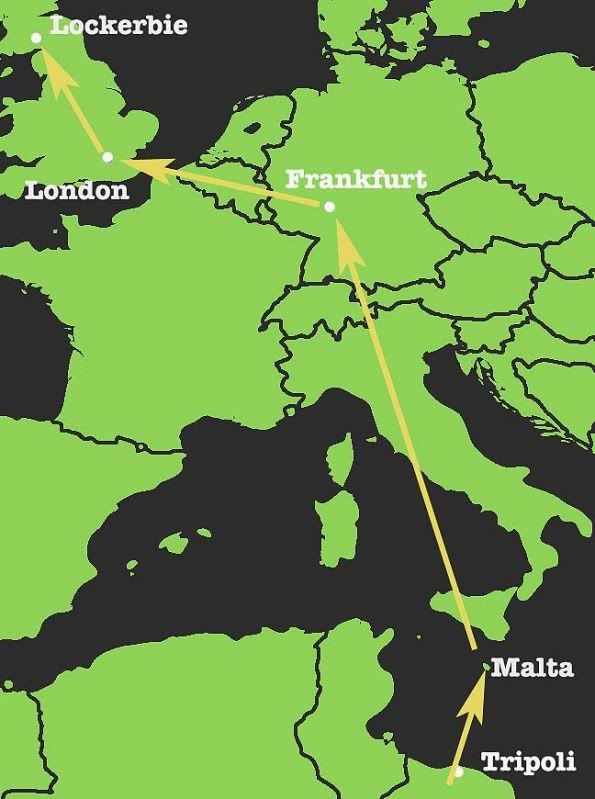
Frankfurt Airport in 1988 was the busiest air hub in Europe, serving many thousands of flights a day between Europe, the near east, nort Africa, and North America. The baggage handling system in 1988 was both state of the art and sloppy. Its workings can be understood as broken down to two parts, loosely termed outer and inner.

The outer portion was where luggage arrived at and left from the airport - a zone of tarmac and taxiing aircraft, wagons and luggage containers. From the planes, luggage was carted to a coding station, where items were placed on bar-code numbered trays (containers), one item per tray, and fed into the inner portion. Hard paperwork was apparently normally kept for transactions between aircraft and coding stations, both inclusive.

The Zeist Court explained “baggage for most airlines was handled by the airport authority, but PanAm had their own security and baggage handling staff.” Thus the airport and the airline each would then have responsibility for keeping track of their own efforts, and both should be called on in the investigation. The Frankfurt Airport Group would be in charge of unloading KM180, and Pan Am's people would handle loading and screening of luggage coming onto the outbound feeder flight.

The inner portion then is what the Court described as “a computer controlled automated baggage handling system” running beneath the airport. This vast electro-mechanic system automatically routed coded items along roller conveyors and through switching stations, at key spots scanned and logged. This system connected coding stations to the various stores, where luggage circulated until needed, and apparently up to loading gates. After this, they re-emerged topside and then to the connecting aircraft’s hold, where again, a record would be kept of loading procedures.

Primary Evidence
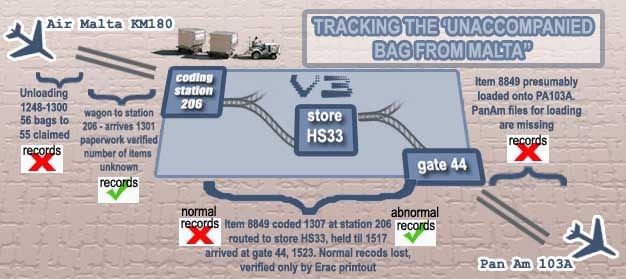
The relevant central computer data was produced, if under questionable circumstances, showing one particular item was coded at 13:07 into container no. 8849. It was then routed down to store for two hours until moved at 15:17 to gate B044, from which 103A loaded before its 16:53 departure. No passenger transferred from the air Malta flight to the PanAm one, so the bag thus illustrated was of the dreaded “unaccompanied” variety.

Apparently, no direct record of PA103A's loading was available to corroborate this. The unloading records for the Air Malta flight (KM180) that bag apparently came from, likewise do not figure in the evidence. And the mammoth central computer file aside from the items sent to 103A is missing without explanation. But the arrival of each flight at the airport, and the coding of one's luggage, were presented, aside from the crucial and curious "Frankfurt printout." Below are all available documents relevant to the claim of an unaccompanied bag, from flight KM180, being sent on to Flight 103A at Frankfurt. These will be given by the "production number" assigned them as evidence during the trial, and briefly explained. All images were originally found at Mebo pages, but seem to be genuine and unaltered. (see "Sources" at end)

Production 1068: The Opinion of the Court's paragraph 29 denotes this for “the evidence of Joachim Koscha, who was one of the managers of the baggage system at Frankfurt in 1988” It was his evidence that established KM180’s arrival and unloading time, 12:48-13:00. They do also cite a “record,” but provided no direct citation.

Production Null: This is the designation – none – given to KM180 unloading papers in the trial. Denis Phipps, former head of security, British Airways, has closely inspected the primary records of different airlines and airports connected to the disaster. He said in The Maltese Double Cross [video, 1994] “the records from Frankfurt were by no means complete." Among his concerns:
“There was no record of who unloaded that flight KM180 when it arrived at Frankfurt. We don't know who the loaders were. There was no record of the number of bags that were actually unloaded from that flight. There were no records that I could find.” 

It isn’t entirely clear if paperwork normally was kept for this – it might have been a policy to determine the number of bags from the computer system, which could count the number of items coded at a certain station and time and take that as the number from the flight coded then. It would be a grossly imperfect system, considering the reliability of this method, as mentioned above. But it would line up with the known laxness of procedure there, and mean one less suspiciously missing record.

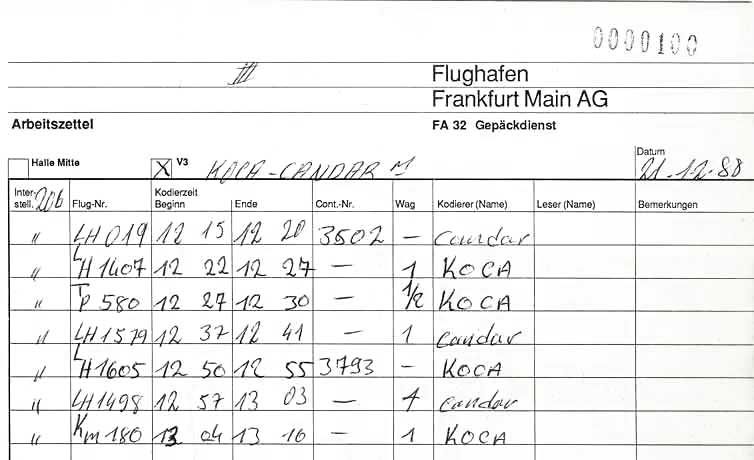
Production 1092: This is an “interline writer’s sheet” filled out by Andreas Schreiner, who was in charge of monitoring the arrival of baggage at V3 That bears to record one wagon of baggage from KM180 arriving at V3 at 13:01.Within V3 are seven coding stations, where luggage is placed into bar-code numbered trays to enter bottomside. They cite the sheet’s contents in table form and it seems like they had these records at hand. No number of bags in that wagon is given.
This brings us to the reliability of coding station logs in determining where a particular item really came from. The Zeist judges heard testimony that “luggage was always delivered from one flight only” at any given time." [Opinion of the Court, para 29] Taking this literally would mean a station's log saying flight X was handled from 1:00-1:05 means an item shown in the computer system as coded there at 1:01 is clearly from flight X. 

But this is not completely sound. Dennis Phipps noted the unreliability of these logs in the Maltese Double Cross, and it's been widely noted that lapses of stray bags being inserted during another flight's coding are not only possible but recorded, and common sense itself suggests such a presumption is, at the least, not guaranteed to be right. The degree of correlation between coding time and flight number is certainly higher than zero and less than 100%, and debatable from there. A separate post, Coding Station Reliability, will address this controversy, but generally below it should remain an open question.

Production 1061: This document (above) was identified by witnesses Mr Schreiner and Mr Koscha “as a work sheet completed by a coder to record baggage with which he dealt.” The name of the coder in question was Koca, who was not called as a witness.” Pity, since the document shows us little detail. The signatures alternate Koca and Candar, listing either container numbers or numbers of wagons of luggage, the flight number it’s from, time they started coding, and stop time. The relevant line is the last one – one wagon of luggage from KM180 started coding at 13:04, and ended at a time disputed as 13:10 or 13:16. (13:10 yields a time closer to those previously noted, and it's what the Court decided. The difference is six minutes of time, which could have increased the likelihood of a stray bag being introduced. Again, refer to the post on coding station reliability.

Production 1062: This is the court’s code for some unspecified “documentary evidence” that “the aircraft used for PA103A arrived from Vienna (as flight PA124) and was placed at position 44, from which it left for London at 1653.”
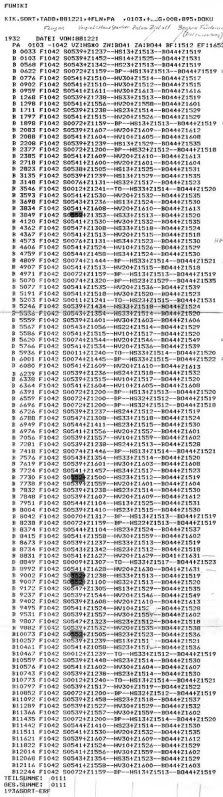
Production 1060 (at left - r-click/new window for readable view) This is the famous computer printout, the single document that allows “the inference," drawn by the Scottish Judges, "that an item which came in on KM180 was transferred to and left on PA103A.” It's a list of items routed to PA103A, taken by airport employee Bogomira Erac for personal reasons and handed over to investigators only a month after the disaster.

It was the first time they'd seen it. What's highly unusual about this evidence is that the German federal police (BKA) were unable to secure their own copy, right off the computer, in the days after the crash. In the end, we had to rely on a memento copy from someone’s locker, which existed only by sheer luck. It was that close to having a whole airport's luggage records go completely missing, right after such a massive event demanded that information. The troubling case of the missing records is worthy of a detailed stand-alone post. Another interesting question is why the BKA then made the official investigators in Scotland and Washington wait another six months before sharing it with them. It wasn't until mid-August 1989 that Scottish police were able to see this pivotal record that wound up turning the investigation around to Malta and thence Libya.

Whatever the book got wrong, Trail of the Octopus is helpful on this issue.
"On 17 August 1989, eight months after the disaster, Chief Detective Superintendent John Orr received from the BKA what was said to be a computer print-out of the baggage-loading list for Pan Am Flight 103A from Frankfurt to London on the afternoon of 21 December 1988. Attached to this were two internal reports, dated 2 February 1989, describing the inquiries that BKA officers had made about the baggage-handling system at the airport. Also provided were two worksheets, one typewritten, the other handwritten, that were said to have been prepared on 21 December by airport workers at key points on the conveyor-belt network." [Coleman/Goddard]

Mrs. Erac' testimony at Camp Zeist in 2000 clarified that the printout was not taken to the BKA until approximately the last week of January, so a 1 February foray is a perfect match for being spurred by the printout. Any records of any earlier efforts, fruitful or not, remain under wraps. Upon getting the papers in August, Orr and his men quickly investigated the airport themselves, and also got more serious about previous clues leading to Malta.

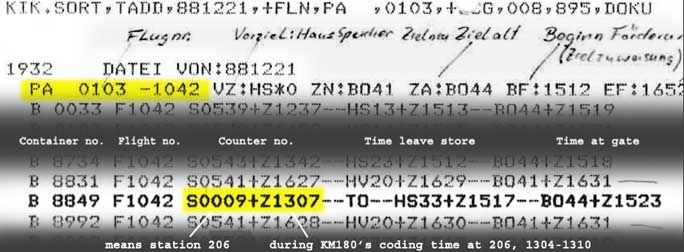
What the printout shows, briefly, is 111 items listed numerically by container number. The relevant portions are highlighted in the condensed version below. PA103A is referred to herein as F1042. The relevant item 8849 was coded at station S0009, which it’s been determined means station 206, at 1307. That is a fit with KM180’s load. It then goes to Gate B044 at 1523, the same few-minute span most of 103's luggage arrived. What happened from there is outside the computerized system and not recorded here. But according to this, two late-coded items were sent to a separate gate B041, and curiously, these two items bracket the apparent bomb bag, numerically speaking, and so are visible below. All 108 items not shown here were sent to gate 44.
So broadly there are three possibilities:
- If it could be certain that station 209 at 1307 means KM180 and nothing else, this would be solid evidence of a bag from that flight.
- It could have been an item of another origin passing through there at just the right time to appear as from KM180. This does require a certain acceptance of coincidence, but cannot be ignored.
- The data could clearly mean to say KM180, but itself be fraudulent. This would explain the printout's appearance and the primary data's disappearance. Perhaps the two were not really unrelated bad and good luck, but two halves of a bait-and-switch routine, perhaps carried out by the BKA for uncertain reasons.

Production Null: The normal, official, system-wide, right from the computer luggage records.
As has been mentioned, for some reason the primary data of luggage movements was lost, but avoided making a big noise once a copy was luckily found. So it was no loss, we might presume. But how would we know?

There may never be answers to the riddle of the lost computer data, but a dedicated post is warranted to explore what we do and don't know about it.

Production Null: PanAm’s loading records for flight 103A.


---
Sources:
Image: Prod 1092
Image: Prod 1060
(other images by Caustic Logic)
[Coleman/Goddard] TRAIL OF THE OCTOPUS -- FROM BEIRUT TO LOCKERBIE -- INSIDE THE DIA. Chapter 7. Online posting.
[Opinion of the Court] PDF download link

Evidence Reconsidered: The Bag from Malta

The Basics and Prosecution’s Case
The prosecution (Crown) case regarding the bomb bag was fully accepted by the Judges ruling in the 2000 trial. Their summary, paragraph 17 of their final "opinion of the Court," reads:
"[T]he primary suitcase was carried on an Air Malta flight KM180 from Luqa Airport in Malta to Frankfurt, that at Frankfurt it was transferred to PanAm flight PA103A, a feeder flight for PA103, which carried it to London Heathrow Airport, and that there, in turn, it was transferred to PA103. This case is largely dependent on oral and documentary evidence relating to the three airports. From this evidence, it is alleged, an inference can be drawn that an unidentified and unaccompanied item of baggage was carried on KM180 and transferred to PA103A at Frankfurt and PA103 at Heathrow." [Opinion of the Court, para 17]
The judges do acknowledge that "The Malta documentation for KM180 does not record that any unaccompanied baggage was carried," [para 31] and that Luqa Airport's security measures "seem to make it extremely difficult for an unaccompanied and unidentified bag to be shipped on a flight out of Luqa." [para 38] They had also dismissed as fabrication witness Giaka's tale of seeing the accused with the exact model suitcase the day of the bombing. [OoC para 44]
"[T]he absence of an explanation as to how the suitcase was taken into the system at Luqa is a major difficulty for the Crown case but after taking full account of that difficulty, we remain of the view that the primary suitcase began its journey at Luqa. The clear inference which we draw from this evidence is that the conception, planning and execution of the plot which led to the planting of the explosive device was of Libyan origin." [para 82]
In the end, the Court was swayed by the compelling evidentiary narrative presented by the Crown. As we've seen, the story is a bit weak in the beginning, with the introduction to KM180 being unsubstantiated and in fact directly contradicted by the relevant evidence. The final alleged transfer, to Maid of the Seas at Heathrow, was not clearly documented; luggage from Frankfurt was considered good-to-go but late, and hastily loaded with no further securiy or scrutiny. The only brown Samsonite suitcase reported in the primary luggage container was seen by handler John Bedford, and it was loaded before the Frankfurt feeder had arrived.

Otherwise the case that such a suitcase made the journey does look reasonably good on paper, and it's at the middle link of Frankfurt where the item is glimpsed briefly. Off-loading records for KM180 were not available to give a number for comparison with Air Malta's records, and the loading papers for PA103A seem to have gone missing as well, along with the entire central luggage system's computer data. (Another page explains the missing computer data more fully) With the middle and outer parts of the middle link equally blank about this bag, it was only some alleged luck that an employee, Bogomira Erac, and no one else, had printed a copy of just the data investigators needed, luggage destined for 103A, as a personal souvenir. Apparently she realized police had never gotten a copy, and then surrendered hers at the end of January 1989. (Another post yet deals in more detail with the circumstances of this save) [Trial Transcripts, Day 47, 30 August 2000, pages 6659-6671 - see also Erac testimony]

What this unusual and unsubstantiated record showed was a luggage item "coded" into container no. 8849, at coding station 206, 13:07 local time. Station 206 was logged as processing KM180's luggage from 1304-1310 local, suggesting the bag was from that flight. Item 8849 was then logged through storage and up to the correct loading gate to go on PA103A. (For more detail on the actual records, and lack thereof, and what they say or don't, see the post Primary Evidence: Frankfurt Airport Records.)

Also, the public indoctrination about this item on the printout is quite interesting. Well before it was decided libyans were responsible, a year or so was spent telling the world via David Leppard, a Granada/HBO TV movie, and other sources, that the Palestinians working for Iran in Germany had taken their altimeter bomb to Malta and sent it through three ups and downs before it blew up over Lockerbie. Only later did they realize they had a piece of the timer ...

Problems with the Evidence
- Contradicted by Air Malta's records
Stand-alone Post: Primary Evidence: Air Malta's Records for KM180
In terms of air security, an unaccompanied bag being waved through the system was considered a major and embarrassing breach. When the notion of such a bomb was visualized in a Granada/HBO movie, released December 1990, Paul Foot explains:
"This was too much for Air Malta, who sued Granada for libel. Norton Rose, the London commercial solicitors, compiled a huge dossier detailing almost everything about the flight from Malta to Frankfurt on the day of the Lockerbie bombing and proving that all 55 bags checked in on the flight could be ascribed to passengers, none of whom travelled on to London. The evidence was so powerful that Granada settled the action before it got to court. They paid Air Malta £15,000 damages and all the costs of the case. The only time these matters had been tested in a legal action, the Maltese connection to the bomb suitcase was comprehensively demolished." [Foot p 7]

- Supported by nothing else
Stand-alone Post: Frankfurt Airport's Missing Computer Records


- Ambiguity of its Evidence
Stand-alone Post: Coding Station Reliability
Station 206 at 1307 does not actually mean that an item from KM180 really entered the system tagged for PA103A. While this blogger accepts that's the single most likely thing indicated, such a conclusion runs up against both the Air Malta records having no 56th bag to fill the slot. It's quite possible, as widely argued, that another item altogether, from somewhere else, could have been piggy-backed in on KM180's load.

- Questionable Authenticity


- Operational Security (circumstantial)
Three airports circumvented ...
Frankfurt Airport had been put on alert,and vigilant against radio units that might have bombs inside.

See also: Randi forum (JREF0 discussion thread, started by me but taken over to amazing effect by Rolfe. Unaccompanied bag from Malta - evidence?

Frankfurt Airport's Missing Computer Records

Adam Larson / Caustic Logic
finished March 9 2010
last edit March 10 1am


An Urgent Inquiry?
Following the historic fall of Pan Am 103 onto Scotland, the world’s law enforcers and investigators sprang into action to sort out what had happened and how. A short six days after the bombing, on December 27 1988, a news article reported that:
“The New York-bound flight originated as a Boeing 727 from Frankfurt, West Germany, with a change of planes at London’s Heathrow airport. Federal police in West Germany and the commander of Scotland Yard’s anti-terrorist squad last week began investigations at those airports.” [1]
More properly, an official feeder flight called PA103A, a Boeing 727, brought 47 passengers and their luggage from Frankfurt to London, where 103 itself (a 747, Clipper Maid of the Seas, with 243 passengers) originated. So about 20% of the flight originated in Germany, and if Pan Am had let a bomb through, it was at one of these two airports. So no surprise agents were swarming on both before Christmas Eve.

One German whose opinion matters here was airport employee Bogomira Erac, whose diligence seems to have solved the troubles we’ll deal with below. At the Zeist rtrial in 2000 she related first learning of PA103’s explosion en route to NY after work that night. “On the news it said the plane came from Frankfurt,” she testified. “I thought it was a direct flight. I didn't know anything more than that.” [2] The better informed police knew the tragic flight had a partial start point at Frankfurt airport, and should have gone there looking for exactly one thing: data on the luggage sent onto the plane that blew up.

German federal authorities with the BKA (BundesKriminalAmt) had at their disposal Frankfurt Main’s world-class computerized luggage system. This routed many thousands of bags a day on mechanized conveyors, every movement controlled and recorded by a central computer. All bags routed to 103A could be identified and tracked with some precision, compared with other flights and with paper logs. All of this should have been just a print command away.

The Eight-Month Blank Spot
The BKA came away empty-handed, it seems. Even working closely with their German counterparts, for eight months neither the Scottish police nor the FBI had direct record of the day’s luggage routing, not even for the feeder flight they were increasingly suspecting. Investigators were already, on their own, fudging away John Bedford’s story with unfounded forensic decisions about luggage arrangement to disprove a London origin. They were already speculating about a Khreesat bomb with modifications to fit it a journey from Frankfurt or beyond, without the hard data that would later back it up.

It wasn’t until mid-August 1989 that the “Frankfurt printout” saved the day, and since then is touted as the revolutionary evidence proving the bomb came from Malta, through Germany, and only briefly passed through Heathrow. The blind interim of nearly eight months is often ignored, and when mentioned it’s usually pinned on mysterious German failings. David Leppard wrote that Senior Investigating Officer John Orr had been asking for the 103A records “since early January,” and noted “the delay was never satisfactorily explained by the BKA.” [3] Leppard also mentioned the BKA’s own, earlier “work on the baggage-loading list, and wrote, damningly “had the BKA drawn the proper conclusions from their work […] it is likely that the bombers of PA103 would today be behind bars.” [4]

As noted by Leppard, the BKA reports attached to the printout, the careful work showing a Malta origin bag with no passenger, were both dated February 2 1989. This does show a puzzling delay of six-and-a-half months before surrendering it to the Scots that has got to have an interesting explanation. However, another puzzle glossed over by Leppard and nearly everyone else on all sides of the Lockerbie issue, is why the BKA themselves didn’t get the printout until over a month after the crash.

It’s no secret that Mrs. Erac, who printed this evidence as a personal keepsake the day after the attack, was never asked for it or offered it up until late January 1989. [5] This means the BKA reports indeed were done upon belated receipt of the evidence.And the related and larger question is, since all agree that stray souvenir wound up being THE evidence for what went onto PA103A, why does no one seem to wonder or much care why that was the case? Why hadn’t police gotten the relevant data right off the central computer on, say, December 22, like Bogomira did?

Live Data
From various readings and reasoning on my own part, the luggage routing system ran thus: each item of luggage was placed in a tray (“coded”), each with a unique number (or code, running approximately 00000-12000). [6] The central computer would reconcile each tray number with a flight destination from the luggage tags. As the items kept in constant motion on mechanized conveyors, the central computer would read periodic scanner returns and direct the machinery to route each tray where it needed to go. Every signal sent to or from the computer could be stored in its active memory.

As the Zeist Court gave their understanding, in 2001: “it was possible, for a limited period, to identify all the items of baggage sent through the system to a particular flight. After some time, however, that information would be lost from the system.” [7] A November 1991 article from the UK Observer, revealing the role of Mrs. Erac’ for the first time, explained:
“The vital computer evidence […] would have been lost forever if the woman operator had not kept her own record. […] She knew records relating to baggage loaded on to flights were kept in the system for only a limited time [eight days] before being wiped.” [8]
To be quite clear, the computers were running and recording on December 21, and the information was able to be printed, says the printout of the key data from the next day. That was held in the computer for eight days or a week in normal circumstances. Investigators were there by three days after a major airliner bombing presumably looking for a copy of just this data.

Printouts and Data Tapes
Now if we accept that the BKA had forgotten to snag this data on their presumed visit, we have a separate poor decision by the airport authority. The FAG (Frankfurt Airport Group) also must have failed to make an official copy before the memory was cleared. Legendary Lockerbie researcher Ian Ferguson was able to speak with an anonymous man described as “The expert who helped design the baggage system in place at Frankfurt airport in 1988 and familiar with the operating software”
"He was puzzled when he saw how short the printout out was and explained that there was no need to print a very small extract from the baggage system traffic, as a full back-up tape was made. This would have shown all the baggage movements at Frankfurt airport that day." [9]
Ferguson explained to the expert “that the system was purged every few days and that no back-up tape existed,” he responded: "This is not true." He admitted "of course it is possible no back-up tape was made for that particular day,” but explained that the FAG would usually keep such records simply to meet insurance claims for lost baggage. [10] And they would surely learn within hours that a flight originating from there had exploded, and that a backup was still not ordered by them, on top of the failure of the feds to make a copy is… let’s just say troubling.

In contrast to the expert’s recollection, Mrs. Erac said in 2000 “it would be possible then to copy the data onto disks.” [11] Somehow tape sounds more plausible in a system first set up in the mid-1970s, but disc storage, and perhaps a dual system would make sense. That this central brain would wind up blank by accident just when it was needed most seems unlikely.

Erac also spoke to routine paper printouts that would be kept on file for some time. A few days after her return from holiday, she recalls, “Mr. Berg just asked me to take a look in the archive in order to see whether there were teletype printouts. These were the things which came automatically from the computer. But I couldn't find anything.” [12] Routine prints gone. Special official prints not done. Tape or disk backup, routine or investigative, failed to appear. Police copies, nil.

But a personal memento copy, out of the investigative loop for weeks, altered for all we know, and certainly with no other copies to check against, is later acknowledged and accepted despite its broken chain of custody.

Listless in Pursuit of the List?
The only mentions one will find of the lack of early knowledge is in connection with the problem being solved by Bogomira’s Printout. The Observer’s introductory article of 1991 said that after her return from holiday in mid-January, “she was surprised to learn that no one had shown any interest in the computer records.” [13] Each has their own way of couching this odd failure; the BBC’s 2008 Conspiracy Files episode said "after the crash, surprisingly, the German police hadn’t fully investigated all the luggage records at the airport." [14] Having looked at all available information, I can safely say it’s a guess that the police just didn’t fully look – they either didn’t look at all for the one part they needed, or it wasn’t there when they looked, or they found it and then covered it up. It’s never been clarified which of these happened.

Whatever the book got wrong, Coleman and Goddard’s Trail of the Octopus is useful in this area, summarizing the due incredulity over this development:
"If the new Malta/Libyan theory was to replace the established Iran/PFLP-GC scenario, it was necessary, first of all, to believe that no one thought to ask for the baggage-loading lists for Flight 103A as soon as terrorist action was suspected -- which was almost at once.

It was necessary to believe that no one in any of the British, German and American police, intelligence and accident inquiry agencies who had a hand in investigating the disaster, or anyone who was in any way involved with airport management or security at Frankfurt or London, thought to secure the baggage lists as the one indispensable tool that would be needed to unravel the mystery of how the bomb got aboard.

It was necessary to believe that the only person who considered the lists to be at all important was a lowly computer operator at Frankfurt airport."
[15]
And finally, none too helpful is a discrepancy revealed in Leppard’s book regarding the February 1989 reports attached to the printout. For these, the BKA had interviewed Gunther Kasteleiner, in charge of baggage flow to 103A. His interviewer wrote into the report “by a coincidence, the record of baggage transported […] for flight PA103 on 21.12.88 is still stored in the computer.” [16] This report then is in stark contrast to the story we now have that it was all wiped well before then and the souvenir saved the day. Leppard does however say “the BKA had obtained a print-out of this record from Kurt Berg.” [17] This, we now know, was Bogomira’s supervisor, to whom she handed the printout and by whom it was taken to the BKA at the end of January. But investigators were saying that Berg had gotten this off the computer itself, a month after the police couldn’t find it there. That could be a simple erred presumption, or a sign that a shifting cover-story was attached to this, and it changed later.

Sources:
[1]“Crash Investigators Studying Suitcase; bodies identified.” The Arizona Republic December 27, 1988. Accessed March 5 2010 at:
http://plane-truth.com/Aoude/geocities/az3.html
[2] Camp Zeist trial transcription, Day 47, 30 August 2000. p 6662.
see also: full testimony, on-line posting.
[3] Leppard, David.On the Trail of Terror: The Inside Story of the Lockerbie Investigation. London, Jonathan Cape . 1991. 221 pages. p 151
[4] ibid. p 157.
[5] Erac testimony, p 6666
[6] Using the Erac printout as representative and randomly spread, its sequential tray numbers (with no connection to coding time) top off at 12224.
[7] In the High Court of Justiciary at Camp Zeist. Case no. 1475/99. Opinion of the Court. Delivered 31 January 2001. Paragraph 27. PDF link: http://www.scotcourts.gov.uk/library/lockerbie/docs/lockerbiejudgement.pdf
[8] Coleman, Lester and Donald Goddard. Trail of the Octopus - From Beiruit to Lockerbie, Inside the DIA. 1993. Online posting, chapter 7, unpaginated. http://11syyskuu.net/octopus/trail.ch.7.htm
[9], [10] Ferguson, Ian. The Judges Got it Wrong. Sunday Times (Malta) 10 May 2009. Re-post: http://lockerbiecase.blogspot.com/2009/05/from-sunday-times-malta.html
[11], [12] Erac testimony p 6668, 6666-67
[13] See 8.
[14] "The Conspiracy Files: Lockerbie." Prod/Dir Guy Smith, Ex Prod Sam Anstiss, Narr Caroline Catz. BBC Two. First Aired 31 August 2008. 25:12
[15] See 8.
[16], [17] Leppard, p 152

Primary Evidence: Bogomira Erac Testimony

The following is the full testimony, before the special Scottish Court at Camp Zeist , of Frankfurt Airport employee Bogomira Erac. This somewhat short discussion is extracted from Day 47 (of 86 days) of the full digital transcripts I just received copies of. Transcripts: Day 47, 30 August 2000, pages 6659-6671 (re-formatted with page numbers marking page breaks)

"6659
MR. TURNBULL: The next witness, My Lords, is number 787 on the list, Bogomira Erac, who will give evidence in German.
THE MACER: Witness number 787 on the Crown list, Your Lordship, Bogomira Erac.
WITNESS: BOGOMIRA ERAC, sworn
LORD SUTHERLAND: Advocate Depute.
EXAMINATION IN CHIEF BY MR. TURNBULL:
Q Are you Bogomira Erac?
A Yes.
Q And do you live in Germany?
A Yes.
Q What age are you?
A 57.
Q Where were you born, please?
A In Crnomelj, Slovenia, in ex-Yugoslavia.
Q And did you live there for some time before living in Germany?
A I lived in Slovenia until '66.
Q Thank you. Do you now work at Frankfurt Airport?
A Since the 1st of January 2000, I am no longer working at Frankfurt Airport.
Q When did you begin working at Frankfurt

6660
Airport?
A On the 1st of May 1974 I started to work for a firm, and then in '75, I started to work for the Frankfurt Airport directly.
Q When you worked -- I'm sorry, was the firm you mentioned called ISI?
A Yes. The first firm was ISI from Berlin, and the one which I now work for is the FAG, Frankfurt.
Q What was your job when you worked with ISI at Frankfurt?
A I was a programmer when I worked for ISI. I also did some operating. And when I started out with FAG, I started out as a programmer, and later I did operating.
Q Did the firm ISI develop the software that was used to control the baggage conveyancing system at Frankfurt Airport?
A Yes.
Q So from your first involvement with Frankfurt Airport, have you worked with the baggage

6661
conveyancing system?
A Yes.
Q And were you working at Frankfurt Airport in December of 1988?
A Yes.
Q And did you work as an operator in the computer system at that time?
A Yes. Yes.
Q Was that the same department as Kurt Berg?
A Yes.
Q Was he your supervisor?
A Yes, he was my supervisor.
Q In December of 1988, was it possible to ask the computer to print out information about the baggage sent to a particular flight?
A Could you please repeat the question once again?
Q Was it possible to ask the computer to print out details of the baggage sent to an outgoing flight?
A Yes, that was possible.
Q And for how long would that information be kept in the computer?
A The information was kept in the computer

6662
for a few days; however, for various appraisal processes, we copied the data onto two boards. We switched between one and the other.
Q All right. Were you working in the computer department on the 21st of December of 1988?
A Yes, I was on the late shift.
Q And what time did you finish?
A Officially, we stopped at 22.00 hours, but we finished around about a quarter of an hour earlier, and so we were allowed to leave earlier, if we had finished our work earlier.
Q When did you hear about the crash of flight 103?
A I heard about it in my car when I was driving away from the airport.
Q And did you realise that that was a flight that had been handled during your shift?
A On the news it said the plane came from Frankfurt, and actually, I didn't know anything further about it. I thought it was a direct flight. I didn't know anything more than that.
Q And did you think that it had been one of the flights that had been dealt with during your shift?
A I was sure about that time, the

6663
afternoon we had dealt with all of the planes which were leaving Frankfurt in the afternoon.
Q Were you working the next day?
A Yes, I was doing the late shift the next day as well.
Q And did people at the airport speak about the crash?
A Yes, we talked a lot about this crash. In fact, that was virtually all that people talked about.
Q Did you decide to do something with the computer?
A Well, actually, it was quite late on. We've got -- we had a television in our unit. It's the news, I saw the images.
Q And did you then decide to make an inquiry in the computer system?
A Well, I was actually curious about that flight. A day earlier there had not been any problems, so I was interested to see how much luggage there had been. And so it was really because I was curious that I made a printout.
Q What did you make a printout of?
A I've got a KIK computer, and I made a

6664
printout of the plane from the day before, on the 21st of December.
Q Would you look at the screen with me, to Production 1060, image 1, please. Can we magnify to the top, please. Thank you. Do you recognise this document, Mrs. Erac?
A One moment, please. I've got to put my spectacles on.
Q Can we see the flight number?
A Yes. Yes, you can see the flight number.
Q And is it flight Pan Am 103?
A Yes, it's flight Pan Am 103, 1988, from December 21st was the date. It indicates the counter where the luggage for Pan Am 103 was checked in.
Q And is this the information that you asked the computer to print out?
A Yes, that's the information I wanted about the luggage which went through the luggage transportation system for that flight.
Q What did you do with the computer printout?
A Well, I took a look at it, and I was really surprised that so few pieces of luggage had been checked in whilst there were so many passengers on

6665
board. Generally, at that time of the year -- at that time, anyway -- Americans had much more luggage. I took a look to see whether all of the items of luggage came out of the system, the ones that had been checked in, and whether they were on time. And I saw that as far as the computer was concerned, nothing remained in Frankfurt.
Q Did you realise at the time that the Frankfurt flight had connected with a larger aircraft in London?
A No, I only found out about that later on.
Q All right. So once you had finished looking at the computer printout, did you give it to anyone?
A No. No. I didn't see anything problematic.
Q What did you do with the computer printout, then?
A No one instructed me to make this computer printout. I just did it for myself because I was curious about the way in which the flight had been dispatched, so I took a look at it, and then I kept it as a souvenir, one might say. I hung it up in my cupboard.

6666
Q Were you due to take some holiday leave about this time?
A A few days later, I went to Slovenia. That was what I did every year; I went to Slovenia for the New Year.
Q Do you recollect when you returned to Frankfurt?
A I think it would have been around about the 15th of January, perhaps one day before that.
Q Did there come a stage when you told Mr. Berg that you had the printout?
A That was around a week later. When I went to Frankfurt again, I was on the early shift. It was sometime between the 20th and the 25th of January.
Q Thank you. Did you give the printout to Mr. Berg at that time?
A Yes, I gave Mr. Berg this printout, because I'd realised that there was actually no other documentation available.
Q Did he ask you to check the computer at that stage to see if there was any more information available?
A In the computer -- well, there was -- the data was there for one week, and after that they were written over. Mr. Berg just asked me to take a

6667
look in the archive in order to see whether there were teletype printouts. These were the things which came automatically from the computer. But I couldn't find anything.
Q Would there be any record of the baggage sent to flight 103 if you hadn't made this printout?
A Not so far as I know.
Q Thank you.
LORD SUTHERLAND: Mr. Taylor.
MR. TAYLOR: I think Mr. Davidson is leading on this issue, My Lord, but I have no questions.
LORD SUTHERLAND: Mr. Davidson.
MR. BURNS: I have a number of questions, My Lord.
LORD SUTHERLAND: Very well, Mr. Burns.
CROSS-EXAMINATION BY MR. BURNS:
Q Mrs. Erac, can I ask you, please, something about the procedure in relation to the computers.
A Yes, go ahead.
Q In 1988, am I right in thinking that at the beginning of each day the baggage conveyancing system computers needed to be switched on?
A The computers were all switched on. We didn't switch them off at all, but every day we started

6668
anew, working with the standardized state, so that was with the baggage -- I believe it was a KIK computer where the data were stored. They were stored in that computer for a few days, and it would be possible then to copy the data onto disks.
Q All right. What I really am interested in knowing is whether, at the beginning of each day, the time needed to be entered into the computer system.
A Yes, at the start, the date and the time had to be put into the computer.
Q And the time would be taken, would it, from the person's watch, or an office clerk, at the time when the time was entered into the computer?
A I'm afraid I haven't quite understood what you mean with this question. Could you please repeat the question?
Q Where would the operator get the time which was entered into the computer at the stage we are talking about?
A You get the time from the main clock in the computer, or from one's own watch, or from another clock.
Q Now, during the course of the day, would the time that the computer showed start to deviate from the time that the clock showed, for instance?

6669
A Yes, that's correct, but it's a physical phenomenon. Computer time, after about 4.00 or 5.00 in the afternoon, one would note differences of two or three minutes, let's say. It's a physical phenomenon. We were aware of this. It's because of the frequencies.
Q All right. So because of the electrical frequencies that powered the computer --
A Yes.
Q -- the computer time would deviate from other times shown on, for instance, clocks or watches; is that the position?
A Yes, there were small deviations.
Q Do you know whether the power company had been -- by December 1988 had been contacted about these problems in the power -- in the electrical frequencies?
A Well, I wasn't actually in charge of that. I didn't deal with the hardware side of things. I don't know whether they had been contacted.
Q Could the deviation between computer and clock time increase beyond three minutes?
A Well, you have to know which time you are referring to; not in such general terms, but at what time are you referring to?

6670
Q Well, you've told us that by 4.00 or 5.00, the time difference would be two or three minutes. What I am interested to know is whetherit's -- the difference ever became more than three minutes.
A Well, I didn't really pay much attention to these differentials, because I was in charge of the luggage side of things for the software, not of the hardware.
Q Thank you very much indeed.
LORD SUTHERLAND: Mr. Davidson.
MR. DAVIDSON: No questions, My Lord.
LORD SUTHERLAND: Advocate Depute.
RE-EXAMINATION BY MR. TURNBULL:
Q Can I ask you one more thing, please,
Mrs. Erac. Whose job was it to set the time on the computer in the morning?
A Well, it was the operators when we started the computers.
Q Did you sometimes do it?
A Yes, almost every morning, either my colleague or myself.
Q When you were doing it, where did you get the time to enter into the computer?
A Well, from the clock in the computer, or

6671
sometimes from my watch. But that was identical, really. I presume, anyway.
Q Was there another computer, then, apart
from the one that you were setting the time for?
A Well, I'd like to know exactly what computer you are referring to when you refer to this other computer.
Q You mentioned, I think, getting the time from the clock in the main computer; is that correct?
A Well, in the central computer we entered the time, and the central computer then transmitted the time to the KIK computer, or the other computers.
Q I see. Thank you.
LORD SUTHERLAND: Thank you, Mrs. Erac. That's all."