Showing posts with label CIA. Show all posts

Once Upon a Time, there was Lockerbie

Spot the Problem
By Robert Forrester,

Secretary, Justice For Megrahi Campaign 
Special to The Lockerbie Divide
March 28 2011


In 1958 President Eisenhower was so concerned about the prevailing hatred for the United States amongst the peoples of the Middle East that he commissioned a report in the hope that better minds than his could explain what seemed to have flummoxed him. In 1953, Eisenhower, supported by Churchill and later Eden, sanctioned Operation Ajax. Operation Ajax was regime change at its cheapest and most effective. It cost a mere $1,000,000 to run, involved buying off the Iranian military and employing gangs of Teherani thugs to create civil disorder and achieved its desired result of overthrowing the popular Iranian prime minister Mohamed Moussadeq. Why did he do this? Because Moussadeq was showing unfortunate socialist tendencies whilst at the same time as sitting on some rather desirable oil supplies. In fact, the man actually had the gall to suggest that Iran should be controlling its own mineral wealth and selling at prices the Iranian people felt appropriate, not those which the UK and USA felt like paying. Happily, everything went according to plan. Moussadeq ended up under house arrest for the rest of his days, the Iranians were subjected to thirty years of murder, torture and political repression by the West’s man of the hour, Shah Mohammad Reza Pahlavi, and we got the fuel to fund our casino economies at our prices, at least until Ayatollah Khomeini flew home to roost. Eisenhower’s National Security Council, in its report to the president, explained that the people of the Middle East seemed to have run away with the bizarre notion that the US is only interested in supporting tyrannical despots in their region who are willing provide cheap mineral resources. It is tempting to ponder whether Eisenhower’s illuminating report cost more than Operation Ajax.

Saddam Hussein proved to be a tad more awkward to deal with however. But once he had gone past his sell by date (he never did manage to club those dashed mullahs over the border despite all the help we gave him), and despite the weaponry we’d supplied him with, he really didn’t stand a chance. All that was needed was to await a convenient source of outrage, in his case the Al Qaeda attack on the World Trade Centre, to creatively stitch him into, trample all over the UN, then let him have it. Abracadabra. Ignoring the appalling cost in lives, a country that was once an example to the region in terms of its social services and state run enterprises was bombed back into surviving in open sewers. But hey, they got democracy, plus, the oil was free again, just like the 1920s.

So now it’s Libya’s turn. Gaddafi stands even less of a chance than Saddam. It’s hard to imagine the bookies taking bets on anything other than the precise hour and minute of when the rope will go round his neck. How can the rebels lose? They have copious amounts of the very best that modern air power, intelligence gathering and command and control can provide taking out any and all opposition they would otherwise have fallen victim to. They simply have to pick up the pieces, follow the instructions and keep shambling on towards Tripoli. Neither the Chinese nor the Russians have shown any real signs of stepping in. Even the US has estimated that it really doesn’t need to take such a prominent role in affairs and handed it all on to NATO. In any case, the US already has enough on it’s plate what with commitments in Iraq and Afghanistan, whilst at the same time having to keep a weather eye on other developments in the region: not least on the fact that Syria is getting a little frayed round the edges, and, although Israel is doubtless smiling, it won’t be sleeping. Furthermore, oil is marginally less of a lure to the States where Libya is concerned. Not so however with the UK. Let’s not forget Tony Blair’s ‘Deal in the Desert’, the BP contract and all the embarrassing mud that is sticking over the revelations that have come out concerning Gordon Brown’s government’s attempts to help Tripoli negotiate the legal hurdles of Mr al-Megrahi’s repatriation.

Despite the distress caused to anyone directly connected to the Pan Am 103 incident,
it almost seems wrong to draw a spotlight on to the Lockerbie/Zeist case at a time when Libya is being torn apart by civil war. Nevertheless, David Cameron has chosen to do just that recently in seeking to justify his belligerence by saying of Muammar al-Gaddafi: "The people of Lockerbie know what this man is capable of." (David Cameron - 21/3/2011). Justice Secretary Ken Clark is also now playing the Lockerbie card by saying that we have to bring Gaddafi down to prevent him from seeking another Lockerbie in revenge for the UK’s support of the rebels.

It is always much healthier if you can draw on some moral high ground to justify your cause in the public eye. We tried it on in Afghanistan with how we were lifting the Afghans out of their feudal political system by waving our magic wand of democracy over them. Now, with Libya, it is Lockerbie and terrorism. Ever since Libya’s ex justice minister, Mustafa Abdel-Jalil, set himself up as leader of Eastern Libya in February with claims that he had proof that Gaddafi was behind Lockerbie, this has provided the opportunity to indulge in a bit of sleight of hand and massaging of public opinion. Lockerbie combines public ignorance, terrorism, fear and righteousness, and, it sells papers into the bargain. Abdel-Jalil’s claims are simply that, claims. After a month, he has yet to produce one iota of substance. Is he saying that he was negligent enough to leave the documents back in Tripoli? Once Tripoli falls and no documents are produced, are we then going to hear that Gaddafi must have destroyed them? Perhaps though, documents will be produced, however, we all know what is said about truth and the fog of war. Even today, and despite the payments the Telegraph had to make to George Galloway concerning the documents that were allegedly found in Baghdad proving his complicity with Saddam’s government, their origin is still not settled. In any case, it surely comes as no surprise to anyone that Gaddafi would have been behind an action such as Lockerbie if one of his countrymen had carried it out. But, did Abdelbaset al-Megrahi do it? Therein lies the rub.

To say that the case against Mr al-Megrahi has one or two problems would be arch understatement.

  • There was a break in to Heathrow airside giving access to Pan Am 103’s loading bay area shortly before take off. This incident was reported to the Heathrow authorities at the time but not made public until after the verdict was passed twelve years later.
  • There is no evidence of any unaccompanied luggage leaving on flight KM180 from Malta’s Luqa airport.
  • There are question marks over the provenance of documentary evidence provided by Frankfurt Airport ( the transit point from Luqa to Heathrow).
  • Along with other alleged inducements, the Crown’s star witness, Mr Tony Gauci (the proprietor of a Maltese clothes outlet) and his brother, Paul, are accused of having been in receipt of payments of $2,000.000 and $1,000,000 respectively under an American rewards for justice scheme for their testimony (a practice understandably alien to Scots Law, and presumably sufficient to dismiss both Tony and Paul Gauci as witnesses. The US authorities have yet to deny this deal). Tony Gauci’s testimony falls considerably short of being conclusive in terms of his eye witness account, which attempts to match up the identity of the purchaser of clothes from his shop, on account of key discrepancies with regard to the date of the purchase and the height, weight, age and build of the purchaser. Even though he had been prompted by numerous photo spreads containing pictures of Mr al-Megrahi and privy to media photographs of the accused prior to the trial, Mr Gauci could do little better than say that the man in the dock “resembled” the purchaser of the clothes.
  • Serious doubts also arise over the provenance of the fragment of circuit board alleged to have been part of a triggering device for a bomb which brought down pan Am 103. How did it (along with a sample of Mr Gauci’s clothes) survive temperatures of around 4,000ºC at the heart of a Semtex explosion? Why was it not tested for explosive residue? Why was forensic testimony accepted from representatives of the Royal Armament Research and Development Establishment (RARDE), who had in previous terrorist trials been pilloried for the nature and standard of their testimony? Why were alterations to the discrepancies in the notebooks of the RARDE forensic witnesses not made more of in the trial? Why was the fact that a Crown witness, Mr Ulrich Lumpert, signed a sworn affidavit in 2007 retracting his Zeist testimony relating to the fragment of circuit board as effectively being a pack of lies not pursued? Why was the fragment sent to the US and allowed to leave Scottish jurisdiction, surely this would disqualify it as evidence?
  • Suspicions are also rife concerning what influence the FBI and the US Department of Justice had over the Scottish led police investigation and the trial under the auspices of the High Court of Justiciary.


The above simply serve to illustrate some of the more prominent worries over the safety of the conviction. To compound this, the judges chose to believe a tale of how the bombing was carried out that defies what any normal person could accept as credible, namely: that Mr al-Megrahi contrived to place an unaccompanied luggage item on to flight KM180 from Malta which was then subsequently transferred at Frankfurt to a feeder flight to Heathrow, again unaccompanied, where it was finally loaded on to Pan Am 103, unaccompanied. Thus defying three security regimes in three separate countries, and the bomb still managed to blow up its target and not either one of the first two flights despite the inevitability of delays etc which would have been par for the course around Christmas time. It is truly hard to believe that 15 lay Scottish jurors could reach anything other than a not guilty verdict in such circumstances. Although impeccably qualified as judges, their Lordships, MacLean, Sutherland and Coulsfield, in arriving at their guilty verdict, displayed an absence of experience when it comes to the role of being a juror. Indeed to give credence at all to the story of the Luqa-Frankfurt-Heathrow connection, especially as it was presented at Zeist, demonstrates a complete inability to imagine how paramilitaries operate.

It also cannot be ignored that the structure of trial itself could well have contributed to the conviction in that the Crown played the role of prosecutor, judge and jury. The litany goes on.

Mr al-Megrahi’s first appeal failed, this is true. However, in their judgement, the judges were at pains to point out that they took no account of the sufficiency of evidence since the defence did not require them to do so. The Scottish Criminal Cases Review Commission (SCCRC) then referred the case back to the Court of Appeal on six grounds suggesting that no reasonable court would have reached a guilty verdict on the basis of the evidence laid before the Crown by the prosecution. This appeal was then, unnecessarily, dropped by Mr al-Megrahi in his attempt to gain compassionate release. There has been much speculation regarding the possibility that he may have come under pressure to do so even though the terms of compassionate release do not require an appeal to be dropped to become a beneficiary of it. The long and the short of it is, therefore, that this conviction has not yet been fully tested in law in the interests of justice. The best that the Crown, in the form of the Lord Advocate, Elish Angiolini, has been able to offer as a counter to these concerns is a mind-boggling merry-go-round of circular polemic which amounts to little more than: he was convicted, therefore, he did it. So parlous are the arguments offered up by the Crown that one almost feels bound to ask what qualifications are required for the job of Lord Advocate. To reassure us all that the Crown and the police are still taking the Lockerbie Zeist affair seriously though, even at a point ten years after the conviction, Angiolini also claims that the Dumfries and Galloway police are conducting an on-going review of the investigation. It, in fact, transpires that this is being carried out by one sole officer. In the words of Christine Grahame MSP, this constitutes little better than “file management.”

Recently, on Auntie Beebs weekly vox pop mainstay, Question Time (broadcast from Edinburgh on the 10th of March) we were again treated to the predictable and tedious question of how Mr al-Megrahi must be laughing now that he is back in Libya. I imagine the member of the public who posed the question will be reduced to stitches if he ever contracts a malignant carcinoma. In order to kick the SNP bashing off, Douglas Alexander was straight in with claims that Mr al-Megrahi was currently being chauffeured around Tripoli in a Lamborghini (presumably to make him a more awkward target for the coalition missiles). Annabel Goldie took the biscuit though in bemoaning the damage that the compassionate release had done to the good name of Scottish justice, completely ignoring the profound and legitimate concerns over the safety of the conviction. Clearly, a potential miscarriage of justice does no harm at all.

There are of course differences between the histories of Iran and Libya, however, the salient threads of Western foreign policy run through both. In the case of Libya, we have the Italian genocide of the late 20s and early 30s (accounting for upwards of 50,000 deaths in camps), the Second World War, and then a monarchy (supported by Italy, the UK and the US) that pocketed Libya’s wealth until overthrown by Gaddafi. Much like Khomeini was viewed later in Iran, Gaddafi was seen in the late 60s as someone who would stand up to Western depredations. The surprising thing is that he managed to survive being a thorn in the side of the West for as long as he has: Reagan’s bombs, sanctions and all the rest. In pitting himself against such power, he, of course, subjected his people to his own brand of Gestapo for decades. Ex justice minister Abdel-Jalil’s claims, therefore, should be seen in this light. Anyone who managed to negotiate the perils to attain such a position under such a tyrannical regime is bound to have washed his hands in the people’s blood on a fairly regular basis. To that extent he doubtless has every reason to make the types of claims he is making in the hope of protecting his own skin.

It is hard to see Gaddafi going anywhere now except to follow Saddam to the gallows. The West will do what it knows best and install someone who is suitably on message until the oil runs out. Who knows what may become of Mr al-Megrahi? A one way ticket to the US’s Guantánamo rest home perhaps? Whatever transpires, it will make no difference to the case being put before the Scottish parliament by justice campaigners. No amount of dissembling mendacity claimed by politicians and others can ever change the documented historical fact of what took place at Zeist. This conviction simply does not stack up, no matter how good your gas mask.

Rewards for Injustice

A Shocking Trail of Witnesses Paid Millions for Misinformation
July 25 2010
last edits July 30


The early release from Scottish prison of “Lockerbie bomber” Abdelbaset al Megrahi has been getting much airplay and page space the last three weeks. A myth that he might live for decades more, and the “news” that Gulf-despoilers BP (British!) had also lobbied for the “bomber’s” release back in 2007, stuck together for indignorant Americans. This spurred a flurry of commentary and Congressional calls for investigations, summoning foreign CEOs and ministers to explain themselves, as the Brtis say with annoyance, like naughty schoolchildren before the headmaster.

This will surely settle down before long, and amid the furor, one crucial issue will still lie in the dust, unseen by most. And that is the assassination of Megrahi’s hard-won second appeal of conviction. Many informed commentators have been bringing up the appeal in a more recent backlash, but so far It’s hardly even a side note in the US - just a trifle the “bomber” was “allowed to drop” right before going home to live way more than three months.

Three Important Witnesses
And so the appeal’s secrets were buried, for the moment The central point of the surrendered challenge, soon submitted to the court of public opinion, was the reliability and credibility of eyewitness Anthony “Tony” Gauci. The scope of this article will be wider and consider two other witnesses who share three key features with Gauci.

Upon finding Megrahi guilty for the bombing on January 31, 2001, the three judge panel ruling at Camp Zeist issued an 87-page Opinion of the Court (PDF link) to explain their thinking. Among the points in setting up the evidence against Megrahi was this short list:
“In relation to the first accused, there are three important witnesses, Abdul Majid, Edwin Bollier and Tony Gauci.” [paragraph 41]
To those who know enough about the case, that line is itself hilarious, the punch-line to a sick joke. To those who don’t know enough (and that’s who this article is for), it take a little explaining. Besides being the only three with anything truly incriminating to say against Megrahi, each of these has in common two further points:
1) The evidence they provided is questionable in many cases, and unquestionably fraudulent in others.
2) They were all offered (or have said they were offered) millions of dollars, and at least two apparently collected.

“Abdul Majid”
Abdul Majid Giaka (an alias, true name unknown, called ”Abdul Majid” by the Zeist judges) was a Libyan intelligence agent with the JSO, Libya’s CIA. He was very low level and knew almost nothing, but from August 1988 he had been able to draw money from the CIA ($1,000 a month, increased to $1,500) selling them small tidbits. The CIA called Giaka code-name “Puzzle Piece.”

The defector was stationed at Luqa airport on Malta, where the JSO and Libyan Arab Airlines mingled. At some point after Pan Am 103 fell to Earth in December, two of the people he’d named as high JSO agents working on Malta – Megrahi and his “accomplice” Fhimah – came to the center of suspicion. Strange clues emerged suggesting Libyan authorship, and a Malta link that pointed right to Megrahi. By early 1991, the other puzzle pieces (including Gauci and Bollier) were all in place, and they needed a witness closer to the perps.

It seems the Libyans were by then tired of Abdul Majid’s strange behavior on Malta and ready to call him back to Tripoli. The CIA threatened to cut him off and let him go unless he said something good, and if it was good enough, he might say it to the FBI. So in the summer, he met with agent Hal Hendershot and laid down a whole new version of the previous years in which Megrahi and Fhimah had plotted the bombing in the open and he saw half of it himself.

Hendershot liked what he heard, and Giaka went straight to Washington, with his pregnant wife fetched from Malta soon after. He testified to a grand jury in October 1991, telling of the brown Samsonite case he’d seen the Libyans with on December 20, of the report he (Giaka) was asked to write about bombing a “British plane,” the TNT they kept in a desk at the airport…

As the indictments were sealed and put in place on November 14, the defector Giaka was re-settled somewhere under a new name and witness protection, and paid handsomely. Megrahi’s appeal documents reveal, from DCI Harry Bell's diary, January 8 1992: “Bhiel states DOJ (Department of Justice) will give Magid [Giaka] $2 million dollars. Advised of our concern." This seems to have been dispensed under a US DoJ “Rewards for Justice Program."

When the millionaire was presented as the star witness at Camp Zeist in 2000, it was an unprecedented event – the first time a CIA asset had testified in open court (his voice was disguised and he was hidden behind a screen). The judges were not told about the $2 million, but they did know of his CIA paychecks, other arrangements and efforts to secure money, and his relocation to America, which was clearly of immense value to the witness. They noted how Abdul Majid’s best stories about late 1988 only appeared in mid-1991, and learned along the way that the CIA themselves didn’t believe his information, and had tried to conceal that fact. Therefore, they explained, rather timidly:

“Information provided by a paid informer is always open to the criticism that it may be invented in order to justify payment, and in our view this is a case where such criticism is more than usually justified […] we are unable to accept Abdul Majid as a credible and reliable witness on any matter except his description of the organisation of the JSO and the personnel involved there.” [para 42, 43]

This is an embarrassing rebuke - the most crucial witness to the whole Libyan plot was found to be almost entirely a fraud. It was this loss that led to a total lack of Fhimah clues and the judges having to find the “accomplice” not guilty. And then there was the $2 million they didn’t even know about, as the Crown either didn’t know or didn’t pass it on. And Giaka wasn’t the only witness considered at Zeist who was given this princely sum and had the fact successfully concealed.

Tony (and Paul) Gauci
This now-famous refugee shopkeeper from Malta, clearly a man of simple intellect, was able to recall the exact sale (in different exact versions) of some odd clothes that were later “found at Lockerbie.” Anthony Gauci's original performance recalling the sale was convincing enough, and it seems likely, barring a very elaborate set-up, that he really did sell these clothes to some particular man, on November 23 1988, and they wound up in the bomb bag.

But Megrahi was not on the island that day, so the second-best fit of December 7 (a distant second) was chosen by investigators as what the man meant to describe. By “six feet or more in height,” he meant 5’8” like Megrahi. By around 50, he meant 36. By raining enough to warrant an umbrella, he meant no rain. Etc. But Gauci is touted as identifying a photo of Megrahi, on February 1991, as “similar” to the buyer but ”ten years” too young. Even Tony himself noted the obvious slant of the lineup in question. “The first impression I had was that all the photographs were of men younger than the man who bought the clothing.” With the police’s help, he picked the oldest one shown – Megrahi.

Payments to Mr. Gauci, and to his brother Paul, who assisted somehow behind the scenes, are covered in detail elsewhere, but Megrahi’s appeal documents note the earliest American mention of money is from September 28, 1989, just weeks after the brothers were first approached. “The FBI discussed with the Scottish Police an offer of unlimited money to Tony Gauci, with $10,000 being available immediately." It's not clear if any of this ever came through, but as Giaka was being put up for a reward in 1992, the Scottish police lobbied for Tony to get the same. "I also clarified with him about the Gauci reward and the response was only if he gave evidence."

Tony had his chance to give evidence in mid-2000 and he performed well, considering, fudging everything possible. Under 6 feet, under 60, I don't know, raining a little, not really, no, maybe. Mysteriously, the Judges bought it and Megrahi’s fate was sealed.

The day after the verdict, February 1 2001, the Scottish police started the application for the brothers’ rewards – they had realized specific arrangements couldn’t be discussed until after the judgment, had no explicit promises, had delivered well, and deserved their money now. Paul’s assistance upholding his brother’s “resolve” was noted - but so was his evident desire for money. For some reason they had to wait until the appeal was over as well, and only in April 2002 was “a meeting held with the US Department of Justice where the reward was discussed and supported by the FBI,” say the appeal papers. Further, a suggestion was made there “that the sums applied for - $2m for Tony Gauci and $1m for Paul Gauci - could be increased."

The Scottish review board found all this, and that at some time after the appeal (date redacted) the two were paid some amount under the US DoJ "Rewards for Justice" program. And that is why the appeal they authorized had to be killed.

Edwin Bollier
The third witness is a Swiss electronics merchant, supposed supplier to Libyan JSO of the only 20 MST-13 timers ever made. When an implausibly large chunk of one was “found at Lockerbie” and identified in mid-1990, Bollier’s 18-month-old campaign to sell evidence to the CIA paid off. Much of what he said before and during the trial was dismissed as an obvious bunch of rubbish, but the 1991 indictments did feature his info for points (a), (b), and (j).

Bollier is quite different from the other two “important witnesses.” First, he has not disappeared as a protected witness and made silent. Quite the contrary; He has continued to claim a leading role in the fight to clear Megrahi (comments as "ebol"), and claimed in a 2008 interview that this is to secure a $200 million prize from Libya. [Video, 41:10]. Mr. Bollier reminds me (see comments below) the BBC cut out Q: "Will Libya pay you for your work in the Lockerbie case?" A: "No, if we win the case and the compensation for the victims (US$ 2.7 billion) is refunded I will get a success honorary of US$ 200 million." If the victims pay Libya back, Bollier says he gets almost 8%. To this end, he uses illogical or unsupported claims and exclamation marks, and hasn’t even bothered learning to write in English for a campaign this ambitious.

And unlike Giaka and Gauci, there is no evidence I’m aware of that Bollier was ever paid by investigators for his own evidentiary offerings. He does claim a measly 1% of Libya’s later offering, $2 million - was offered to him in January 1991 by a FBI legal attaché in Switzerland named Fanning. This sounds entirely plausible, actually. But in the same interview linked above [33:35], he says FBI chief Richard Marquise personally doubled the offer just a couple weeks later, “up to $4 million and a new identity” merely to say that this fragment was from a Libyan timer. But they already knew this, and he says he refused anyway (Marquise firmly denies this offer).

Bollier’s oddball account isn’t to be trusted, and he hasn’t been. But he’s served a useful role since the conviction, as a lightning rod to safely channel revisionist thought down blind alleys. Someone really should pay him if they haven't yet.

A Tentative Tally
So far it appears the Scots-CIA-FBI Lockerbie witness pipeline brought in all three “important" but unreliable witnesses against Megrahi. The DoJ payout was at least $5 million to Giaka and the Gaucis plus possible money to Bollier that we just don’t know of. There would be administration, manpower, paid dinners, car rentals and air travel, and assorted overhead for arranging all this, some under FBI, others under CIA or Scottish police. All told, we’re dealing with at least $8 million for just this aspect of what seems like an intelligence operation masquerading as a criminal investigation. The whole case was bigger than this but no squarer, and the other, wider costs of the resulting miscarriage of justice will defy all efforts at calculation.

Thurman's Photo Quest

1 November 2010
last edits 9 Nov

The post PT/35(b) move claims covered the 2008 interviews revealed in Tegenlight: Lockerbie Revisited, which showed a contradiction in whether the fragment of circuit board, PT/35(b) was taken to the United States. FBI SCOTBOM chief Richard Marquise and identifying FBI special agent James “Tom” Thurman both told interviewer Gideon Levy that the fragment was brought to Washington and examined there. Conversely, British authorities and Marquise (after a short-lived change of memory) refuted the claim, insisting it stayed in the UK.

It appears now that it did indeed cross the pond, without proper documentation. While this unacknowledged movement is unusual, the ultimate relevance of it remains unclear. Some have speculated the thing might have been "tampered with" or altered while in America. But I for one suspect the worst that was done with PT/35(b) was when it was planted in the evidence chain the previous year.

What we have in Thurman's case, with or without the actual piece of evidence, was the crucial identification. And one point that's consistent throughout is that he held a photo only when he found the match. The question at hand is how long it took him to find it and to determine its meaning vis-a-vis who carried out the bombing.

Tom Gets a Green Light
On the 10th of January 1990 new Senior Investigating Officer Stuart Henderson (who replaced John Orr) presented at a meeting of investigators in the UK. He did not openly mention the circuit board fragment PT/35(b), an amazing find UK investigators had been puzzling over for four months. But off to the side, he told FBI chief investigator Richard Marquise about it, Marquise says in his 2006 book SCOTBOM. [1 p58] He expressed interest in helping find a match, but Henderson insisted on going it alone. “This decision cost us six months,” writes Marquise.

It was at a later conference in Virginia, on 11 June, when Marquise relates how the Scots finally made their puzzlement known to all, having blindly checked 55 companies to no avail. Given the opening, special Agent Thurman “approached Henderson and asked if he could take photographs of PT-35 and attempt to identify it. Henderson, who believed the Scots had done all they could do, agreed.” [1, p60] This passage is crucial to move claims, and rather ambiguous. It seems to read that Thurman, in Arlington, was allowed to snap a pic of evidence SIO Henderson had there with him. Then perhaps it means he took some of the prints they had brought.

Either way, he walked away with a picture or pictures of this crucial and curious evidence, a half-inch square, perfectly readablemammoth of implausibility. The "forensic explosives expert" didn't balk at it, just ran with it. Or crawled, as he suggests.

"Months, Literally" or 2-4 Days?
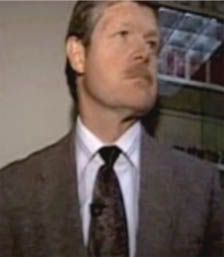
A 1991 Miami Herald article, based on interview with Thurman (left, from a 1991 video), reported that he had “meticulously compared the picture of the fragment to hundreds of other devices,” a lengthy-sounding process. [2] Affirming this, Thurman himself told the adoring program Air Crash Investigation in 2008:
“I spent, uh, months, literally, looking through all about the files of the FBI on other examinations that we had, uh, conducted over many many many years. […] After a period I just ran out of leads. And at that point I said, okay now we need to go outside the physical FBI laboratory.” [3]
And it was there, in a CIA facility, that he found the long-sought answer.

But Marquise said “what Thurman did yielded fruit within two days. […] Henderson and his colleagues were on an airplane headed back to Scotland” when Thurman set to work. They had barely settled back in at home before his efforts “would turn Henderson around quicker than he ever imagined,” putting him back stateside, along with electronics fiend Allen Feraday, within 24 hours of the discovery. [1 p60]

Further evidence against Thurman’s "months" claim is his own well-memorized “day that I made the identification,” recalling it as one would a wedding anniversary: June 15 1990. He had four days tops to get this grueling season of cross-checking out of the way after the 11 June conference (perhaps a multi-day event) where Marquise has him first learning of the thing.

Who He Ran To
What Thurman did, Marquise sums up, is know where to look. He took the photo to a CIA explosives and timers expert code-named John Scott Orkin (real name unknown - he testified under this name at Camp Zeist). [1 p60] Thurman mentions him only as an unnamed "contact" in the 2008 ACI interview. [3] From the vast photo files on hand, "Orkin" helped locate an obvious fit with the blow-up of PT/35(b). If you were Tom Thurman and knew about John Orkin, would you waste even one afternoon scrounging in the FBI's files, or go right to him?

Nothing I've seen specifies this match-up was achieved in only one visit on a single day, but that makes the most sense, as does starting right there. That would give us no more than "hours, literally" to describe the search duration. And either way we're at the point of days at most.

The matching circuit board was found in a timer confiscated in the African nation Togo in 1986. This device, assembled in a small plastic case, was physically available for Thurman to look at. He was given permission to take it apart and examine the main board inside. Upon confirming again the obvious similarities, “within a few minutes, literally, I started getting cold chills,” he told Air Crash Investigation. [3] He's also described as declaring "I have you now!" [1 p60] and other variations. In a 2010 interview, he said "I could not believe it under any circumstances, and it was there." [4]

That he got these chills only after getting access to the CIA’s special stores is noteworthy, and the Agency is right to claim much of the credit, as they have in places. An AFIO newsletter from just after the Zeist verdict purred that “the CIA’s most important contribution in helping secure the conviction” was “when a CIA engineer was able to identify the timer […] shifting the focus of the probe from a Palestinian terrorist group to Libya.” [5] (This report's oblique reference to the CIA's less brilliant offering, Giaka, is also worth a read.)

As the overall story tells it, this was clearly a collaborative CIA-FBI effort, via Thurman and "Orkin", that neither side can claim sole credit for. And without this coming together, we're to infer, the naming of this planted piece of Libyan black magic would be delayed or impossible for both Scottish and American investigators. The power of cooperation, between intelligence and law enforcement, and across the Atlantic - a running theme of the 103 investigation - is nicely illustrated here.

The Slow Link to Mebo
Besides the Togo unit, the CIA knew about a 1988 French seizure of two MST-13s found in Senegal, in possession of Libyan operatives. (If I'm not mistaken, one of the Senegal timers held in Paris had gone missing by this time) But Thurman at the CIA facility makes it seem like this was a mystery device he had to analyze from scratch.

A smaller circuit board within the Togo timer's box featured four partially scratched-out characters. Thurman explained to ABC News in 1991, just after the indictments were issued, how he and others labored over this, contacting numerous manufacturers trying to identify “M580” for some time. [6] They finally accepted that it said MEBO, the name of a known Swiss firm supplying timers to rogue governments, including Libya. Thurman told ABC they had “some inkling that’s what it was from the beginning, but we didn’t want to say okay, it’s Mebo’s exclusive, anything else, until we were absolutely certain." [6] Then they decided it was definitely Mebo’s exclusive for Libya only and only usable by Libyans and unable to fall into anyone else’s hands. Except the CIA and their French counterparts, obviously.

And we're to believe the CIA hadn't already managed to trace these African timers to their Swiss makers? A company suspected of their own CIA links, and documented as trying to implicate the Libyans to them since January 1989? Thurman was left to puzzle over those four characters himself? Sorry, but I don't believe that. Mr. "Orkin" could surely have told him these African timers were made by Mebo and supplied by Libya. This "M580" search is quite likely a made-up story, full of needless rigor and theatrics, and again suggestions of long expanses of time.

On top of the fictional months-long search at FBI before turning to the CIA, this little final touch of reported caution belies the focus and speed beneath the whole June transaction. Nine month of dead-end searches in Scotland were trumped within four days by Thurman's knowledge of just the man to talk to. It also goes against the hint he gave in his ABC interview, commenting upon his discovery: "I knew at that point what it meant. Because, if you will, I'm an investigator as well as a forensic examiner. I knew where that would go." [6] The whole country had just learned that it went right to Tripoli.

More to the point, he's a political scientist rather than a scientific one. His main skill here is knowing people, CIA types. One can be excused for wondering if Special Agent Thurman knew where it would go even before Orkin told him, or before he got his hands on a that picture to bring over.
---
Sources:
[1] Marquise, Richard. SCOTBOM: Evidence and the Lockerbie Investigation, Algora Publishing. Sept. 1, 2006. 268 pages. Mostly page 60. Google books link.
[2] Roser, Ann. “'Nuts and Bolts’ Work Pays Off in Lockerbie Probe.” The Miami Herald. Published November 30, 1991. Link.
[3] Air Crash Investigation: Lockerbie. Season 6, ep one, aired 2008. Hosted video page. Skip to part four, halfway in.

[4] Sent Home To Die. STV documentary, aired August 2010. Youtube link.
[5] Association of Former Intelligence Officers. Weekly Intelligence Notes, February 2001. http://www.afio.com/sections/wins/2001/2001-06.html
[6] The Maltese Double Cross - Lockerbie. Film, Hemar Enterprises, 1994, 156 minutes. Written, produced, and directed by Allan Francovich. Hosted video page. (1hr, 6 min in) 

Richard Marquise Disputes the Findings of the Zeist Court

18 October 2010
edits 20 October

Special Agent Richard Marqise was the FBI's chief investigator on the Pan Am 103 (SCOTBOM) case during its formative turn (following the evidence, of course) to focus on Libya. He's also the author of SCOTBOM: Evidence and the Lockerbie investigation (2006), frequent giver of video interviews, and infrequent internet commentator.

He emerged recently for a short post at Professor Black's blog (The Lockerbie Case) refering to an article about "star witness" Abdul Majid Giaka. Giaka is of course the Libyan defector who fed a whole lot of specific information against Megrahi and his "accomplice" Fhimah. His stories were central to the 1991 indictments, but were famously dismissed, and rightly so, by the judges at Camp Zeist for being unrealiable in a number of ways.

I wouldn't have been so surprised to see Mr. Marquise comment on the article, if I'd realized his book from six years after Zeist dedicates at least five chapters to the subject ("Lockerbie and Giaka," "TNT and a Brown Suitcase" "Mrs. Giaka," "the CIA cables," ""Star" witness"). Much of this in unreadable in the limited Google books preview, and for a couple reasons would rather not buy a copy. So do note I didn't know that yesterday while commenting (as Caustic Logic) in response to Mr. Marquise, who appears in comments 2 and 19. The many responses were brilliant and informative and all 30 so far, spanning a couple days with me only catching it at the end, are reproduced below (slightest edits only).

I take his point that constantly saying "star witness" and saying it in quotes is not the best practice. I will take that to heart, but otherwise, his performance is depressing. There really is no spark of sanity left in the bankrupt and unseaworthy position he's chained himself and so many others to.
---
1 - Rolfe said...
This article raises an interesting question. Giaka was the star witness, on which the entire case was founded. Without his evidence, they would never even have got the indictment. The rest of the evidence was way too circumstantial to support anything - Tony Gauci's "identification" of Megrahi as the purchaser was fraught with uncertainty, and the evidence that the bomb travelled on KM180 thin to the point of insubstantiality. So, once Giaka's evidence was dismissed, why did the judges convict?

I liken this to model-building. The investigtors laid out the pieces of actual evidence (Gauci's evidence, the Erac printout, Megrahi's presence at Luqa as "Abdusamad", plus more circumstantial matters such as the timer fragment and the radio model) in a particular pattern that implicated Megrahi in the bombing. However, these pieces of evidence wouldn't hold together to form a substantial construct.

So they brought in Giaka, as we all know, and threatened/bribed him to "remember" stuff that would provide a solid framework for that construct of the evidence. If Megrahi and Fhimah were seen on Malta that morning (or the previous day, whatever) with the bomb suitcase, then everything held together. That strengthened Gauci's tentative "looks a bit like but too young" identification into "probably him, really", and turned B8849 into yes, that will be the bomb on its way from KM180. If Giaka's evidence had been true, these inferences would have been legitimate.

The problem was that everybody had got so used to loking at the evdence laid out in that pattern, that when the framework that supported it was taken away, they allowed the pattern to remain - even though by all logic it should have collapsed in a heap. The defence's alternative pattern, that of Megrahi and Fhimah getting on with whatever they were doing at Malta that day quite independently, the clothes buyer being someone else unidentified, and B8849 being a simple coding anomaly - while 1,000 miles away at Heathrow airport a completely different terrorist was sneaking an extra suitcase or two into AVE4041, was too unfamiliar to gain acceptance.

It's a bit like the cricket story of the batsman being clean-bowled with the ball taking out the centre stump - but the bails don't fall because the hot sun has melted the varnish and stuck them together.

2 - Richard Marquise said...
Once again, The Firm has played loose with the facts using Mr. MacKechnie as the source. I would like to know who--that is normally a person--"not intelligence agencies" informed the Crown that Giaka was a "star witness." That term was unfortunately coined by some less that brilliant UK reporter during the course of the trial. No intelligence agencies were involved in the "debrief/interview" of Giaka and no one of those who did ever said he was a witness to the loading of the bomb suitcase. The facts were the facts--not speculation--- and Mr. Mackechnie knew this because I was with him when he was able to interview Mr. Giaka in America--long before the trial. This would not be the first time Mr. Mackechnie distorted the facts. His description of his ride to see and then interview Giaka which was reported in the UK media before trial was at odds in a big way with the facts of what really happened.

Those who believe that somehow American intelligence agencies were somehow involved with the outcome of the trial have no clue either.

I realize it is a losing battle to try and convince those of you who blog on this site of the truth, but at least be sure you report information which is correct and factual.

3 - Matt Berkley said...
Is this correct and factual?

"The charges are based on evidence that directly and conclusively links Abd al-Basit al-Maqrahi...and Lamin Fhimah...and other unidentified co-conspirators to the suitcase containing the bomb and to its insertion into the baggage system leading to Pan Am flight 103."
Source: State Department Deputy Spokesman Richard Boucher
1:05 PM, Washington, DC
Nov 14, 1991

Secondly, was the description "filing details" given by the CIA to censored passages relating to Mr Giaka, purely for the eyes of the defence and the judges, accurate?

Thirdly, was that not contempt of court?

4 - Jo G said...
Mr Marquise, for you to dare utter the sentence "played loose with the facts" would be hilarious if this case was anything remotely close to a laughing matter. The facts already in the public domain establish, BEYOND ALL REASONABLE DOUBT, that the conviction of Megrahi was deeply unsafe. Furthermore the part the US government played in bribing witnesses all over this case screams how unsafe it was and what a complete set up it was. I recently saw you on a UK TV programme trying to avoid admitting that yes indeed Gauci was paid! Incidentally it was TWO MILLION DOLLARS the US paid him.

And finally, if you are so sure of your case you surely can have no objection whatsoever when the time comes and that appeal can be resurrected and heard - as it should have been three years ago long before your country threw a massive wobbler because a Scottish Government dared to release the man the US framed.

5 - Jo G said...
Oh and Mr Marquise, I doubt you would recognise the truth if it walked up to you and introduced itself.

6 - Matt Berkley said...
If Mr Marquise thinks the judges said things which were beyond reason, why did he trust their verdict?

http://archive.maltatoday.com.mt/2009/08/26/t9.html
Marquise: "a senior Libyan official asked a Libyan Arab Airline (LAA) employee about the feasibility of getting a “bag” onto an American or British flight leaving Malta."
Judges: "we are quite unable to accept this story"....

Marquise: "Evidence was elicited that the Station manager of LAA in Malta kept explosives in his desk..."
Judges: "we are unable to place any reliance on this account"

Marquise: "This board was traced to timers, only 20 of which were ever made. All had been given to Libyan officials."
Judges: "the two prototypes were delivered by Mr Bollier to the Stasi..."...

Marquise: "He was described as carrying a “brown suitcase” similar to that which blew up Pan Am Flight 103..."
Judges: "We are ... quite unable to accept the veracity of this belated account"

7 - Jo G said...
Sorry. That line posted itself before the rest followed.

My point about the truth is that a person can read the trial transcripts and see, repeatedly, decisions being made by judges which fly in the face of the evidence presented.

Gauci did not ever positively identify Megrahi.

Gaika's evidence was rejected utterly by the judges. (Gaika who had implicated Megrahi and his co-accused)

Air Malta proved an unaccompanied suitcase did NOT travel from Luqa.

Even those working for the Lord Advocate seemed desperate to get a conviction when they went so far to keep from the defence - and from the judges - the contents of those cables exchanged between the prosecution and the US authorities where Gaika's contribution was basically trashed.

And since the verdict....

We had a report issued by the Scottish Criminal Case Review Commission raising SIX grounds to suspect a miscarriage of justice could have taken place.

We had the UK government falling over itself to ensure certain info was withheld from Megrahi's appeal. One lot of evidence involved the break-in at Heathrow. We had other evidence, to do with the timer, withheld using Data Protection law. And of course we had the bribing of Gauci with two million US dollars, something that would not have been permitted in any Scottish court of law ever! We had the date Megrahi is alleged to have visited the shop and the fact that the weather doesn't fit in with the story.

In short we have a complete shambles of a case Mr Marquise. And can I remind you that on the basis of that evidence the US would have executed Megrahi had it been given half a chance! And you talk about truth?

8 - bensix said...
Mr Marquise chides readers of this blog for using information which is less than factual. Might we return the favour? As Matt Berkley points out he's used "evidence" which had long been dismissed by the Court. In another piece, for the Times, he relied on the statements of Tony Gauci, long after the SSCRC dispatched them. He also asserted that Libya "accept[s] "responsibility"", despite appearing months before on a programme where Saif Gaddafi claimed that it had been "just wordplay". Ex-FBI Special Agent, investigate thyself?

9 - Rolfe said...
I made a post last night that has vanished this morning, but by the greatest of good luck it was still on my clipboard from my "insurance" copy. I'll re-post it in two parts, because length seems to be what's causing the disappearing acts.
_________________________

I realise this is just another of Mr. Marquise's hit-and-run posts filled with inaccuracies and sidestepping the real issues, which will lie there undefended. But still.
Once again, The Firm has played loose with the facts using Mr. MacKechnie as the source. I would like to know who--that is normally a person--"not intelligence agencies" informed the Crown that Giaka was a "star witness." That term was unfortunately coined by some less that brilliant UK reporter during the course of the trial.
"Star witness" seems an appropriate enough term for Giaka, irrespective of who coined it. I've heard "supergrass" as well. Objecting to perfectly reasonable terminology on spurious grounds is always a useful smokescreen though.
No intelligence agencies were involved in the "debrief/interview" of Giaka
Do you take us for complete idiots?
and no one of those who did ever said he was a witness to the loading of the bomb suitcase.
And The Firm didn't say he was. Nor did I, in my first post on this thread. He placed Megrahi and Fhimah at the centre of events by placing them on Malta with a suitcase of the correct description, at the appropriate time. That is the point being made. Evasion and lies about claims that "he was a witness to the loading of the bomb suitcase" noted.

10 - Rolfe said...
The facts were the facts--not speculation--- and Mr. Mackechnie knew this because I was with him when he was able to interview Mr. Giaka in America--long before the trial. This would not be the first time Mr. Mackechnie distorted the facts. His description of his ride to see and then interview Giaka which was reported in the UK media before trial was at odds in a big way with the facts of what really happened.
When it comes to distorting the facts, I have to go with what I see in front of my eyes. And what I see is Richard Marquise both in person on TV and in blog comments like this, distorting in a manner that would put the Hall of Magic Mirrors to shame.

The FACTS about Giaka's evidence and how it was obtained and why it was dismissed by the judges are available to anyone who can read the Zeist transcripts. It's a shameful catalogue of bribery and threats to elicit evidence implicating Megrahi and Fhimah, to order.
Those who believe that somehow American intelligence agencies were somehow involved with the outcome of the trial have no clue either.
You're probably right, at that. No clue as to just how deep these claws of deception and control really dig. Come on, we can read Hans Kochler's report too. Was he hallucinating the US DoJ officials constantly directing the prosecution team?
I realize it is a losing battle to try and convince those of you who blog on this site of the truth, but at least be sure you report information which is correct and factual.
You mean, don't take your example? Have you any response to what Matt posted above, showing all the incorrect, non-factual pronouncements you've been making recently?

If you want to convince us of anything, you could start by telling us what evidence you rely on to support your belief that Megrahi was involved in the bombing. Giaka was lying, we know that. Tony Gauci didn't sell these clothes to Megrahi, by any reading of his evidence. Tray B8849 at Frankfurt could easily have been a coding anomaly, and the strength of the evidence from Malta (which you couldn't dent) proves it to be such.

There's no evidence at all that the bomb travelled on KM180 (bloody stupid plot if ever there was one), and no evidence that Megrahi had anything to do with it.

And that is the correct, factual information.

12 - tomcyrus said...
With what is known about how the FBI works and conducts itself, especially regarding international issues, should it be added to the UK's list of terorrist groups?.

13 - ebol said...
MISSION LOCKERBIE:

FBI Special Agent Richard A. Maquise led the U.S. Task Force which included the FBI, Department of Justice and the Central Intelligence Agency CIA, managed all aspects of the investigation on the PanAm 103 attack.
With the untruthful claims in his "Log Book" (Lies Book) Scotbom: Evidence and the Lockerbie Investigation, it wants to cover up the true facts and the fatal investigations errors of FBI, Scottish- and Swiss police...

Giaka, Abdul Majid Giaka, was the fundamental crucial witness, number 684, together with rouge CIA agents, in the "Lockerbie case" against Libya's Leader Moammar Gaddafi. Its criminal work started with a story claimed that there had been a complaint of sexual harassment with a Egyptian woman against Lamen Fhimah...

+++
Excerpt of court in Kamp van Zeist:
Q And that was in case you got into trouble because of the incident involving the Egyptian lady at the airport, wasn't it, Mr. Giaka?
A When I asked her to get in touch with the embassy, I didn't know what the incident was, and I didn't know why -- what was in the telegram. I hadn't seen the telegram. All I knew was that Fhimah and myself were being called back to Tripoli. We were supposed to go back on the same day. And this was scary...
Q The lady at the airport who acted as interpreter agreed to help you?
A Yes.
Q And I take it that you were grateful to her for the help that she was prepared to give you in these circumstances? A Yes.
Q And you explained to her the high-minded principles that were driving you to go to the Central Intelligence Agency, didn't you, Mr. Giaka?
A I don't remember exactly. I can't say.
Q You see, I was wondering, Mr. Giaka, why did you go to so much trouble to hide from her the fact that you were taking money from the Central Intelligence Agency? Can you explain that? 
A Try to avoid what?
Q You tried to hide from her the fact that you were taking money from the Central Intelligence Agency, didn't you, Mr. Giaka?
A I didn't hide anything from her. We didn't talk about this subject.
Q You are a liar, Mr. Giaka.
A I do not lie. I AM NOT LYING ABOUT THIS !!!
+++
continuation down >>>

14 - ebol said...
continuation MISSION LOCKERBIE >>>

Giaka went to see the CIA for the first time on 10th August 1988. The dirty business between Giaka and CIA against Libya was started...

Abdul Majid Giaka was interviewed by officers of the CIA, which is the Criminal Intelligence Agency of the United States of America over a period of months from the 10th of August of 1988 to the 31st of August of 1989. And productions numbers 104 -- 804 to 828 are a total of 25 cables which were sent by operatives of that intelligence organisation from Malta to their masters in the United States informing the U.S. Intelligence community of information handed over by the man Giaka.

A undisclosed cables to CIA which is cable number 32, is dated the 21st of December 1990, and relating to a meeting with Giaka on the 20th of December at 1990 in Malta. On paragraph 6. are the notes:
At the end of an hour-long meeting, Giaka asked if he was still receiving his salary. The case officer responded negative, but because of his willingness to recontact during this trip to Malta, he gave him 200 Maltese money, which is estimated as $700 U.S.
Giaka wondered aloud if it would be possible for him to obtain $2,000 U.S. to purchase bananas in Malta for his return to Libya where they sell at three or four times the Maltese price. The case officer again replied negative, since Washington is unsure of Giaka's sincerity in assisting against terrorism. They would not approve such money without more detailed information.
The case officer added, though, that he would raise the issue with the proper authorities, who might recompense him if he would be willing to be completely debriefed.
Giaka was becoming desperate as he searches for his role in life in his post-ESO world. And he is certainly milking all of his contacts and was construct lie-storys during this transition period with CIA.
The full Story: Why CIA have needed Giaka's lie information, publishes soon.

by Edwin and Mahnaz Bollier, MEBO Ltd. Switzerland
our webpage: www.lockerbie.ch

15 - Jo G said...
Only dropped in to see if he'd been back yet. I see he hasn't. Hmmm.

16 - Rolfe said...
He replied to me once. I considered myself privileged.

The question I asked then was the same as the question I asked this time. Please give us a short outline of the evidence on which you base your assertion that the right man was convicted.

Unfortunately all he said was that the judges brought in a guilty verdict and that was enough for him.

That was one of my major "no, they really don't have anything, do they" moments.

17 - bensix said...
Unfortunately all he said was that the judges brought in a guilty verdict and that was enough for him.

Pretty low considering he ignores them elsewhere!

18 - FullInquiry said...
Vincent Cannistraro, former CIA Head of Counter Terrorism, said the following long before the Trial:
"Oh! I think the evidence available to the Department of Justice in their case, which they’re keeping under wraps, is overwhelming, it’s conclusive. I think it is mid boggling in the amount of detail that they have. They have also….they have a live witness for one thing, who would be presented in a court of law. I think there is a tremendous amount of evidence that will allow the prosecutors to present the chronology of the operation from its very inception, and that chronology would start even before Malta and then… you know…describe and in almost excruciating detail exactly how they made the bomb, how they secreted it, how they got it on board the aircraft, and I think that’s a fairly strong case".
I can only assume, based on Richard Marquise's comments above, that Vinny had no clue either - certainly no witness at the Trial ever explained in any detail how the accused made the bomb and got it on board the Air Malta flight let alone doing so in "excruciating detail" or in a "mindboggling" manner.

The only thing that boggles the mind in this case is how anyone could conclude the accused is guilty based on such flimsy evidence.

But such statments by Vinny and others like him definitely had an affect on public opinion, and therefore on the Trial, its outcome, and public acceptance of the verdict against Megrahi.

As such, CIA actions did in fact have an effect on the outcome of the trial, which clearly shows Marquise is himself, clueless or simply and conveniently ignoring the facts.

When a head investigator gives the appearance of ignoring facts (which also include payoffs to witnesses) his credibility automatically goes down the tube.

As a result, Mr. Marquise has little more credibility than his Star Witness Giaka.

I wonder if and when he got to see the redacted portions of the Giaka cables? Surely Vinny had access to all the cables in their unredacted form but still held Giaka out to be a key witness.

What about Edwin Bollier's claim that Marquise offered him money for his testimony that MST-13's were sold only to Libya? Will Marquese address that? Who is one to believe? Marquise or Bollier? What a choice!

Please do enlighten us Mr. Marquise and back up your claims in a credible manner.

19 - Richard Marquise said...
Quite a few more misstatements here. Cannistraro was never head of the CIA CT Center--he was deputy and retired before the EVIDENCE led to Libya. As a result he was not involved in any aspect of Giaka or his statements. Anything he ever said was based on his opinion alone-- not on information he may have had access to from the investigation.

I have --many times addressed the issue of payments to witnesses--none--none--including Bollier--ever requested, or were offered or paid any money in exchange for them to tell investigators what we wanted to hear. It is my belief that all the witnesses told what they believed to be the truth at trial (except for one--not Giaka) and what they said was consistent with what they had always said. I realize I am a loner on this site with regard to Giaka but unlike all here--I am the only one who had the opportunity to speak with him and examine all his statements (I did not do original interview of him).

With regard to Giaka and the CIA file mess, I covered this quite explicitly in my book in Chapter 34. I had not seen them prior to the trial nor did I know they existed--I spoke about second guessing myself in this regard.

I would also imagine most on this site spent little (any) time at the trial and probably have read neither the trial transcripts nor my book so it is easy to criticize what you think rather than what you know. I know what the intelligence agencies contributed --early and late---I also know the role they played at trial--it was only to assist with accessing all the info contained in the cables--not influencing the outcome of the trial.

We know what we did-- the facts were obtained in a righteous manner and in accodance with the laws of the US and Scotland. They were presented to an impartial panel of judges and the facts were weighed by them and they reached their decison.

I remain amazed that so many seemingly intelligent people would continue to support someone who claimed to not be a member of Libyan intelligence, "believe me, I was here in Tripoli with my family (12/20-21)," and I never heard of MEBO or Abdusamad.... As we now know the facts are somewhat different. Mind boggling.

20 - Rolfe said...
Oh dear. Anyone who lies to a jourmalist must be guilty of mass murder, is that it?

Frankly, under the circumstances, I'm not at all surprised Megrahi went into "deny everything" mode when confronted by Salinger. Even if he wasn't under instructions from on high to do exactly that, which he might well have been.

And yes, I've read the trial transcripts (want a pdf of the whole thing, single-spaced? - ask me nicely), and as much of your book as Google Books will let me read for free since I'm certainly not paying out any money that might go into your pocket, that's for sure.

If you can seriously maintain that Giaka was telling the truth, I'm not quite sure what you're smoking, but can I have some?

21 - Rolfe said...
And another thing.

I have --many times addressed the issue of payments to witnesses--none--none--including Bollier--ever requested, or were offered or paid any money in exchange for them to tell investigators what we wanted to hear.
You've many times addressed the matter of payments to witnesses. You use different wording every time. It used to be that nobody was paid any money. Then nobody was paid any money before the trial. Then nobody was promised any money before the trial. Then nobody asked for any money.

The more information emerged, the more these various versions fell over like dominoes. Now, we've got a new one. Nobody was paid "to tell investigators what we wanted to hear."

That's neat. Because it's completely unverifiable. How can anyone know whether or how any witness altered their testimony with an eye to the main chance, once they realised there was money on offer?

A reward for a good lead to a perpetrator whose guilt can be proven by independent means is one thing - usually offered to criminals to grass on their mates of course. But paying out millions to witnesses who were independently identified by police investigation, simply to relate the details of a particular incident as well as they could remember it? This is some idea of due process you have in America, I must say. Round here, you might get your bus fare to the court, if you fill in the right forms in triplicate.

Did you make Bogomira Erac a rich woman? She at least came forward independently with her evidence.

22 - Jo G said...
Mr Marquise. Simple question. HOW MUCH DID THE US PAY TO GAUCI? ANSWER PLEASE.

You did not answer the question in the STV documentary about Lockerbie. Please answer now. I've helped you. Scroll back. I gave you the amount your government paid him!

23 - Jo G said...
TWO MILLION DOLLARS!

24 - Rolfe said...
Cannistraro was never head of the CIA CT Center--he was deputy and retired before the EVIDENCE led to Libya.
Yes, some of us know that. Vinnie was high up in the investigation at the start. For example, a week into it, when Reagan went off on one against Libya on absolutely no evidence at all, no? A month into it, when our mutual friend Edwin was writing strange letters on Spanish typewriters accusing Libyans?

Perhaps not. Quite irrelevant, no doubt.

But he was right in there during the summer of 1989, when the bits of "evidence" that eventually seemed to point to Libya were mysteriously appearing in the chain of custody, with some very peculiar provenance. Wasn't he?

He was just out of it by the time these things went live a year later, and the general public saw the shift to Libya. Which was based on "evidence" that had appeared in mid-1989.

Some people might find that awfully interesting, you know. I couldn't possibly comment of course.

25 - Rolfe said...
TWO MILLION DOLLARS!
Be fair, Jo. The notes said they couldn't be sure exactly how much either of the brothers had been paid. They said it might actually have been more than the $3 million between them that was the estimated (or promised?) figure.

Nice work if you can get it.

I still think it would have been awfully unfair if they didn't give Bogomira anything at all, after making the Gaucis rich like that. She even volunteered her evidence, and it was just as important (and just as completely non-incriminating, though that's another story) as Tony Gauci's.

26 - bensix said...
...what they said was consistent with what they had always said...
Richard, if that were the case the Christmas lights were both off and on; Megrahi was both too young and a lot like the customer.

Still, an intelligence agent was a bit dishonest? Well, that clinches it. A startling anomaly like that is hard to justi --- kidding.

27 - Caustic Logic said...
Richard Marquise:
... at least be sure you report information which is correct and factual.
LOL. Isn't the whole dodged point here the FBI's acceptance and promotion of an obvious fabricator of convenient evidence?

Nitpick about quoting "star witness," we never said that. Not in so many words, perhaps not. But you have even til recently cited Giaka's bogus evidence as supporting Megrahi's guilt. He was clearly the centerpiece of the grand jury hearings, was cited by Cannistraro in whatever capacity as
- scratch it, full inquiry beat me to it.

That's equivalent of star witness to me, semantics aside. And he was a major liar, telling you guys what you wanted to hear, wasn't he, sir? You needn't admit to knowing that at the time, but isn't it evident by now?

28 - Caustic Logic said...
It is my belief that all the witnesses told what they believed to be the truth at trial (except for one--not Giaka)
That's it. So you do feel, to this very day, that Abdul Majid Giaka was telling the truth, and nothing but, as he saw it? Do you realize how stupid that sounds? You're going against the Zeist judges for what reason other than a vested one?

On the rewards:
none--none--including Bollier--ever requested, or were offered or paid any money in exchange for them to tell investigators what we wanted to hear.
By the doubling of none, I'll take that as the strong and unassailable part of your statement. What seems in disppute is your understanding of the words "requested," "offered," "paid," and especially "in exchange for them to tell investigators what we wanted to hear."

All: Can we agree that everything but "not" are the potential fudge words in this semantics-based denial?
Extract from DCI Bell Diary (HOLMES version) (28/9/1989) [SCCRC Appendix: chapter 23/3] which indicates that on 28th September 1989 the FBI discussed with the Scottish Police an offer of unlimited money to Tony Gauci, with $10,000 being available immediately. Thereafter there is a comment about challenging Murray as to what he thought Gauci could give in return that he was not already giving.
Where does that fit in to such a denial?
Memo from DCI Bell to DSIO Gilchrist (21/2/91) [SCCRC Appendix: chapter 23/1] which states that Tony Gauci had expressed an interest in receiving money in recent meetings and that "if a monetary offer was made to Gauci this may well change his view and allow him to consider a witness protection programme as a serious avenue"
We can see here the attempt to backpedal and convince the brothers they won't be paid, except maybe, if Tony talks right and there's a conviction. It did seem an unlikely prospect until it happened, didn't it?

Strathclyde Police Witness Protection Report of June 10, 1999:
(a) the frustration of Tony Gauci that he will not be compensated
(b) that in respect of Paul Gauci "It is apparent from speaking to him for any length of time that he has a clear desire to gain financial benefit from the position he and his brother are in relative to the case. As a consequence he exaggerates his own importance as a witness and clearly inflates the fears he and his brother have. He is anxious to establish what advantage he can gain from the Scottish police. Although demanding, Paul Gauci remains an asset to the case but will continue to explore any means he can to identify where financial advantage can be gained.
(c) that the Gauci family had financial problems
Where is the clarity in that? Where is Stuart Henderson's "he was well aware that there was no such thing as a reward being handed to him ... Didn't enter his head."

No response needed or expected.

29 - FullInquiry said...
I appreciate Mr. Marquise commenting on my post. Perhaps he will address the following?

Michael Scharf, who is said to have been legal counsel the the US counter-terrorism bureau at the time of 0the idictment was quoted in an article by Liam McDougal published in the Sunday Herald, November 12, 2006. Some excerts of the article are:
Michael Scharf, who was the counsel to the US counter-terrorism bureau when the two Libyans were indicted for the bombing, described the case as “so full of holes it was like Swiss cheese” and said it should never have gone to trial".
He claimed the CIA and FBI had assured State Department officials there was an “iron-clad” case against Abdelbaset al-Megrahi and al-Amin Khalifa Fimah, but that in reality the intelligence agencies had no confidence in their star witness and knew well in advance of the trial that he was “a liar.”
Scharf branded the case a “whitewash” and added: “It was a trial where everybody agreed ahead of time that they were just going to focus on these two guys, and they were the fall guys.”
It was largely based on this inside guy [Libyan defector Abdul Majid Giaka]. It wasn’t until the trial that I learned this guy was a nut-job and that the CIA had absolutely no confidence in him and that they knew he was a liar.
Mr. Marquise posted above he did not know about the existence of the Giaka CIA cables until the Trial. Apparently Michael Scharf was similarly unaware.

So one can reasonably conclude that the CIA withheld the Giaka cables from virtually everyone involved in the investigation until the Trial (and hoped the redacted sections never had to be revealed).

Questions for Mr.Marquise:

1. Who exactly is the person you feel lied in their testimony at the trial?

2. Do you believe that the investigation was misled by the CIA, either diliberately or by way of them withholding the contents of the Giaka cables?

3. How important is the credibility of Giaka?

My personal opinion is that if an "intellegence" agency like the CIA is involved in a criminal investigation, any outcome of such investigation becomes highly suspect by way of the very nature of what intellegence agencies do. This is particularly true if the FBI or any of the prosecuting authorities actually felt the CIA was a trustworthy source.

In any event Michael Scharf and the Trial Judges clearly have a different take on Giaka than Mr. Marquise does. I can only conclude that Mr. Marquise was rather gullible if he believed anything Giaka had to say.

Believing Giaka is a long way from following the "EVIDENCE" in my book.

Like Rolfe, I will try to find Chapter 34 if I can do so without paying Mr. Marquise for it.

Beyond having a basic belief in the need for justice and the belief that the full and real truth has yet to emerge in this matter, I have a huge personal problem with the fact that Giaka was a key factor in the UN Sanctions being imposed on Libya. Such sanctions were imposed largely on the basis of what a known liar told a Grand Jury in private. One can only conclude the CIA wanted such sanctions imposed and was willing to withhold key facts to accomplish that end and that the Grand Jury did not have access to the Giaka cables either. The UN Security Council certainly was never informed of all the evidence.

30 - FullInquiry said...
Oh and in addition Mr. Marquise:

I did follow this matter long before the trial, followed the trial, read all the transcripts from the trial daily that I could obtain, and most importanty I READ THE TRIAL JUDGEMENT, WHICH DID NOT MAKE SENSE AND BASED ON WHICH NO REASONABLE PERSON COULD CONVICT MEGRAHI, at least in my reasonably-informed opinion.

And I lived the effects of the Sanctions and still do. I'm no armchair second-guesser. People like you that were involved in the investigation and played a part are accountable in my book. You had and still have a duty to at least acknowledge where the investigation was misled or could have made mistakes.

My concerns are that you were (and still are) more concerned with obtaining a conviction than with seeking the truth or justice and are a patriot. But I guess that is what your job was and what you were paid to do. That doesn't make the outcome the proper one even if you did follow the laws of the US, Scotland, or Timbuktu.

Charles McKee's Suitcase

17 September 2010
(incomplete)

In the recent murder trial of two Libyans for the Lockerbie bombing, reference was made to the fact that a suitcase belonging to Major Charles McKee, a senior CIA agent who had been involved in the negotiations for the release of hostages in Beirut, had been mysteriously carried away from the piles of wreckage left by the crash and even had a large hole cut into it before it was returned to the investigators. The specific intention of cutting the hole, it was agreed, was to inspect the contents of the suitcase long before its evidential value could be established.
- Paul Foot, Flight From Justice, page 9

The enigmatic major McKee is central to the discredited drug swap theory - the main target, in fact, for planning to rat out the CIA protection of a terrorist heroin pipeline. This was supposed to be related to freeing the hostages in Lebanon, which McKee was also working on in a high-level manner. McKee's targeting by the CIA is also central, in a different way, to Charles Norrie's theory; as his book A Tale of Three Atrocities explains:
The explanation came to me very quickly indeed. Poor McKee was killed by his colleagues. Unknown to him, his last duty was to help them locate baggage container AVE4041 PA among the debris, by using the transpondered suitcase he was carrying. [...] Transpondered suitcases must have a basis in fact since they appear frequently in fiction, for example in recent film No Country for Old Men.
As for why, he writes:
Once the CIA had used McKee's suitcase transponder to locate it, it must have been easy to determine which baggage container was AVE4041 PA. [...] In the remains of AVE4041 PA, the CIA placed a pre-blown suitcase, the remains of a Toshiba cassette recorder and various miscellaneous items. They hoped that, when the Lockerbie investigation team found the suitcase, they would follow the concocted evidence to a suitable CIA selected target, which would become Libya.
Norrie believes the CIA approved this operation, so it might have been better to include pre-blown materials in a suitcase to be placed right next to the bomb. Done. This tromping around in the open after the fact seems to me incompatible with someone who was in on the set-up.

More to the point, there was no intact "luggage container" near McKee's bag. Pieces of AVE4041 were scattered across many square miles. Likewise the suitcase fragments would have to planted across H, I, and K sectors - a wide swathe indeed. McKee's suitcase is described as item PD/889, suggesting it was found in D sector, near Lockerbie itself and miles west of the Samsonite remains.

All you'd need a transponder for is to locate a bag with sensitive (???) you didn't expect to become compromised. But you were prepared for the unexpected - you follow the bag's signal, remove and conceal the sh*t, then put it back before anyone notices, if possible. In fact, it seems that's what happened, except for the part about not being noticed. For one, they didn't just open the bag, they cut it open in a way that was clearly not from the explosion, nor likely there before. The scientific report from RARDE, signed by Hayes and Feraday noted:
PD/889. This is a partially disrupted grey hardshell suitcase. The suitcase measured 685 millimetres by 510 millimetres by 190 millimetres and was constructed from a rigid dark grey sheet plastics with a simulated leather finish, lined with a woven cream-coloured material backed with a white fibrous material which adhered to the grey plastics skin. The suitcase was fitted with a rigid plastics handle, bright metal trim and locks, which were devoid of any proprietary or owner's identification. A rectangular hole had been cut in the hard shell above the handle.


The left-hand edge of the suitcase showed evidence of having been damaged by an explosion, with disruption and blackening of the outer skin and bright metal body frame.

This had come up in a JREF discussion of Norrie's theory. Therein a notion was mentioned that the cutting was "to remove a secondary security lock that incorporated some kind of anti tamper device that would destroy the contents if activated." That would be a better explanation that removal of the transponder, which would only require the lock picked or opened with the known combination. Such a special lock mechanism would require special manufacture, perhaps by a CIA proprietary company. This then could explain the removal of all identifying markings (why a secret company's labels would ever be there is, however, left un-answered).

RARDE Dr. Thomas Hayes gave interesting details about the bag in his evidence at Camp Zeist in 2000 (day 16, pp 2637-2641).

Q Now, I would just like to examine your contemporaneous note of this case a little further, Dr. Hayes. If we look to the right of your diagram, we see the reference "Unidentified suitcase"; is that right?
A Yes, it is.
Q And then the entry "Labels, name tag, brand name apparently removed."
A Yes.
Q All of these items had been removed from the suitcase. And then, if we look to the left at the diagram, we can see the notation "Hole cut"?
A Yes, we can.
Q Do you recollect this case and its examination, Dr. Hayes?
A No more clearly than any other examination, I'm afraid.
[...snip - discussion on whether "sawn" or "cut" was the better word for the obvious rectangular hole...]
Q Taken together with the removal of all labels, name tags, brand names, would that perhaps attract your attention, Dr. Hayes?
A Yes, it would.
Q And if we go on in your notes, after you record "clear indications of explosives involvement", do we see in the margin towards the bottom of the page "PD/889 attached above"?
A Yes, we do.
Q And then plastics bag and contents with attached ID label marked "Contents of grey suitcase belonging to Charles McKee."
A Yes, I see that.
Q Was it disclosed to you that Charles McKee referred to there was in the service of the United States government?
A No, it wasn't.
Q Or that this case had been returning from Beirut?
A No.
Following this, he was asked about his description of the case's contents.

Q I see. You then make this entry: "Contents: Assorted clothing with [sic] unlike the suitcase from which it was supposedly taken showed little evidence of explosives involvement."
A Yes, I did.
Q Now, I see the use of the word "supposedly" employed by you, Dr. Hayes. And I take it you chose that word with care?
A Yes, I did.
Q And was that intended to convey that in your own mind the assorted clothing which had been passed to you labelled as the contents did not appear on the face of it to represent the contents of the suitcase which had been damaged in the way already described?
A Yes, that's certainly one interpretation.
Q Indeed, looking to this case and the examination note on page 22 as a whole, the reasonable inference, is it not, is that some party has interfered with the case following the disaster and prior to it being made available to you for forensic examination?
A That is an inference that could be drawn.
---
This is certainly an interesting story in its right, but I for one suspect it's no clue to the attack itself or the larger cover-up. More likely it's simply a nexus of two separate paths of clandestine mystery, and until I change my mind on that, the subject probably won't come up much around here. McKee's unusual profile make him useful to attach new fictions to - reminiscent in fact of Abdelbaset al Megrahi's clandestine  appearance on Malta earlier that day.

"As the layers are peeled away..."

AFIO and Poteat on Megrahi's Release
31 August 2010

last edit 1 September

Leading up to, upon, and following the 20 August anniversary of Abdelbaset al Megrahi's release from Scottish prison, and with the man still stubbornly surviving, calls went up on both sides of the Lockerbie divide. Last week, former FBI SCOTBOM chief investigator Richard Marquise spoke with a writer for the Christian Science Monitor (critique link). The self-serving result, to the effect that they got the right man, joined a chorus of media reports obediently repeating the Libyan guilt storyline without regard to the other side.

From that other side comes Dr Swire's story on stage in Scotland, JFM's petition to Scotland putting Salmond "on the spot," Michael Mansfield QC repeating his conviction that the conviction was "entirely unsustainable," plus a steady show of support from the UK public for the "bomber's" release, and generally for his innocence. Even in the states, Time's article on "five big questions" conveys with some conviction the "british"position. Americans, previously assured their reality was the real one, were in danger of growing confused amid these mixed messages.

"During the 1970s the Intelligence Community was buffeted by a number of leaks and revelations, culminating in the Church and Pike Congressional investigations. CIA officer David Atlee Phillips took early retirement in 1975 to respond to the growing sentiment that the CIA was a “rogue elephant.” As part of this effort, Phillips founded this organization, known then as the Association of Retired Intelligence Officers (ARIO). Although much attacked at the time when many people called for the dismantlement of the CIA, Phillips toured the world to speak out in favor of the need for a strong intelligence community. He was subsequently personally accused of being a participant in the Kennedy and Letelier assassinations... " Source: AFIO - About AFIO
Quickly on the heels of the Monitor-hosted FBI re-affirmation came a similar show of solidarity from the intelligence community, via their trusted affiliate, the Association of Former Intelligence Officers (AFIO - see box at right for more). With a membership drawn about one fourth from former CIA agents, the group's president Gene Poteat spoke with Jeff Stein of the Washington Post's "blog" Spy Talk (27 August). The column also mentions an AFIO statement (which I cannot find elsewhere) supporting recent moves by members of the Senate to investigate Mr. al-Megrahi's release. Poteat explained "the families of the murdered intelligence officers – and indeed all of the families – deserve no less than a full airing of the facts..."

Unfortunately, the sentence ended "...around Mr. al-Megrahi’s release." Silently, he affirms in the negative, a full airing of the circumstances behind Megrahi's framing for the bombing is not worthy of the same scrutiny.

This is suspected by most observers who are informed, but not implicated in an operation that was apparently headed by the CIA more than any other party. Their investigation into the bombing fell to counter-terrorism director Vincent Cannistraro, one of Reagan's experts on blaming and smearing Libya for political reasons. It's only to be expected from Cannistraro and his colleagues to defend the case that sanctioned Libya and put Megrahi away, and even to go on the offensive as a show of confidence against  any undue leniency.
In its statement, AFIO expressed strong support for the Senate committee’s investigation and called on “the UK and Scottish Governments to launch independent inquiries into the release of Mr. al-Megrahi to ensure that commercial and/or political interests did not lead to Mr. al-Megrahi’s freedom. ... CIA Director Leon Panetta, NSA Director Keith Alexander, Secretary of State Hillary Clinton, and Attorney General Eric Holder [should] direct their staffs to fully cooperate with the Senators’ investigation.”

Obviously the foreign governments are requested to explain what they already have in letters and statements, so far refusing to come in person. As I've said before, I can see their annoyance at American ignorance and presumptuousness, and the principle behind not "crawling" to Washington. But however justified, this stance is counterproductive and really is strengthening stand-offishness over here, as Mr. Poteat and the AFIO have just shown.

At least as noteworthy is the association's suggested "narrow focus" for this desirable investigation:
AFIO "also called for U.S. government agencies “to assist in providing minimally redacted operational cables and intelligence reports to cleared Senate staff in a secure environment. All documents should be narrowly focused on al-Megrahi’s release in order to protect sources and methods of collection.”
Whatever light the US government could shed on the decision by Scotland's justice secretary is minimal, and that lack of relevant sources is quite protective of anything relevant. And in case anyone was confused, the Association of "Former" Intelligence Officers recommends you be careful to avoid accidentally requesting information on the "sources and methods of collection” behind the bullsh*t story that put Megrahi away in the first place. They're all surely just as unanimous on the justness of the conviction as they are on the unjustness of his release, as Poteat put it:

“There have been few clear-cut issues where so many of us agree as we do on this one ... The decision triggering al-Megrahi’s release was a shock, and had a strong whiff of manipulation and back-room deals.”

The only back room - or rather prison cell - deal that I've sensed lurking in the release decision was the indirect way by which Megrahi's appeal of conviction and his return to Libya were linked, and that's almost surely not the same scent they're onto. Rather, its more likely something like the deals some former intelligence officers arranged in 1989-91, that made the latter batch necessary (kill the appeal to obscure the frame-up). The most informed among the AFIO's members would know there are secrets just beneath the surface that are better left there, and one would almost expect more discretion that calling for an investigation of Lockerbie anything.

The apparent CIA personnel scouring the Scottish countryside from day one could be explained by normal, uptight, agency protocol - secure all secrets.  But the 2 February 1989 news report citing an "American" source, suggesting Libyan operatives at Frankfurt carried out the bombing - is harder to explain. Quite likely from Cannistraro or a like-minded colleague, this would be based on no evidence that ever was mentioned again (ie, made up), but did help prepare the field for the replacement story that would evolve.

The first key to the eventual Libyan narrative was the identification on Malta of Libyan agent al-Megrahi, aka Khalifah Abdusamad. It's unclear just when his presence there on December 21, under the alias, was known to the CIA. But it was by early 1989 most likely and they'd be the first to know. Since even before the bombing they were getting original tips from liar for hire Abdul Majid Giaka, who was recieving $1500 a month from the agency for his slim, low-level info. On the CIA's urging,  this onetime literature student was accepted by DoJ as a witness, just after he fabricated a major portion of the evidence in the 1991 indictments - all the really specific stuff. He was apparently paid $2 million in 1992 for his efforts as well as being resettled with his family in the US.

Among a handful of other allegations lodged against the CIA, one of interest is how their bomb timer expert "Orkin" helped FBI's "Tom" Thurman identify the suspicious PT/35(b), under mysterious circumstances. It was found to be from a MST-13 timer, made by Mebo, whose founder Edwin Bollier first stepped up in a January 1989 note to the CIA offering to blame Libya for money. His clues were bizarre, but he had supplied the highly specific and identifiable timers, like the one months later "found at Lockerbie." The later yet ID seems to be accurate, but something fishy abides in that transaction and perhaps others unseen. Thurman was physically there on the scene and behind the scenes at the beginning and frequently thereafter, for example. And the fragment is forensically almost certain to have been involved in no such explosion. The timer fragment also was reportedly the subject of a document -requested by Megrahi's defense - that was sealed by the UK government to protect the interests of an unnamed friendly nation.

But the vital heart of the provable intelligence frame-up was Giaka; even after leaving the agency, Vincent Cannistraro continued into the 1990s with ignorant or dishonest public pimping of the secret witness and his amazing ability to bust the case open. The agency's ignorance or dishonesty (as with the Scottish Crown) continued into insisting to the Zeist judges in 2000 that the witness was credible, and that the redacted parts of CIA cables held no secrets. In fact, they revealed that the agency knew Giaka's was a bogus story. They had already chosen to push it anyway, to create a false reality by which crippling and deadly sanctions on Libya were justified.

Mr. Poteat further prophesized to Stein, "As the layers are peeled away, we will see what was at the center of the early, and unexpected release, of this malingering convicted terrorist.” These professionals will surely know just when to stop peeling that onion and it'll be well before the rotten center. Just beneath the surface is not faked cancer, but Megrahi's assassinated second appeal. Just beneath that is evidence that the CIA, among others, manipulated the investigation to fit the crime to the selected villains.

The AFIO's origin was as a public relations face to help "explain" CIA excesses of the Cold War. They served to counter criticism of coups, cover-ups, operations gone sour, deception and disinformation. The AFIO is therefore a less than credible source when it comes to another apparent CIA cover-up - Vincent Cannistraro's brainchild, the Libya did it story line. If indeed the best-informed among them were involved in this almost mind-bogglingly bold confidence scheme, we can take no comfort that their public face at the AFIO is publicly expressing confidence in the operation.