Showing posts with label altimeter. Show all posts

Thirty-Eight Minutes

The Bomb-Timing Clue for London Intro
First posted March 28 2010

Completely re-written Jan. 18 2011

Five Altimeter Bombs
It was a well-placed bomb detonation in the forward hold of PA103 that sealed the fate of 270 people on the evening of December 21, 1988. To be precise, the UK Air Accidents Investigation Branch (AAIB) decided it had detonated at 19.02:50 (7:03pm) – almost exactly thirty-eight minutes after it left the ground from London’s Heathrow Airport at 6:25.

This time span, officially decided on by Libyan plotters for unclear reasons, is an uncanny fit with another technology, controlled by another group entirely – Ahmed Jiibril’s PFLP-GC. To recap, Marwan Khreesat is a Jordanian intelligence operative and long-practicing maker of airliner-killing bombs for Jibril (with exact allegiance unclear in a chicken-and-egg sort of way). Khreesat’s bombs were triggered by altitude (air pressure) and hidden inside consumer electronics – usually radio-cassette players. In the fall of 1988 he was called in again by the PFLP-GC on a mission for Iran – avenge the US destruction of Iran Air flight 655 by destroying an American airliner themselves.

Khreesat was hired to make or modify five bombs, and contrary to GID orders (as we've heard them), compelled to make them fully armed. Only one radio-IEDs of the five was intercepted on the arrest of Khreesat and the whole cell on October 26 1988. Three more of these were found later by German authorities and studied, given the numbers below. All seized Khreesat devices, in order of discovery:

1) Toshiba BomBeat 453 radio-cassette
2) Sanyo computer monitor
3) Ultrasound radio
4) Ultrasound radio

The fifth device, which Khreesat says he only soldered two wires on after someone else constructed it, was a different Toshiba radio (not the BomBeat seized nor the Libyan BomBeat SF-16 officially accepted). The someone else who made it was likely "Abu Elias," a relative of Jibril’s and a senior PFLP-GC operative. Khreesat thinks Abu Elias worked by copying his own work, perhaps recycling some parts from the fifth test model he made for Jibril back in 1985.

This one hasn’t been studied, as it officially never turned up. Many, however, still suspect it did surface – on Pan Am flight 103. So we’ll return to it at the end, after grasping the four that were definitely never used.

Gobel and Khreesat explain the time aspect
[Note: a separate post details the hardware end of these bombs in a little more detail.]
David Leppard’s curious 1991 book On the Trail of Terror describes the work done by German investigators on the four bombs found in Germany, and summarized the findings of BKA scientist “W. A. Gobel." This looked at how the altimeter and time delay modifications worked. Here he refers only to unit 1, the seized BomBeat 453:
“Gobel had tested the performance of the pressure pick-up gauge in a vacuum chamber. The circuit would close at a pressure between 940 and 950 milibars - equivalent to an altitude of about 2,400 feet. The contact point was connected by a wire to a condenser which acted as a time delay switch. The condenser was an insulator, absorbing the electrical charge until it fired. At this point the circuit closed, detonating the bomb.”
The condenser here is what’s elsewhere called an ice-cube timer – a simple metal circuit, coiled-up, I believe, and encased in a cube of translucent resin (looks like an ice-cube made with dingy water).
"When the necessary operating height has been reached the fall in pressure connected with it will start the timing mechanism, and when the delay period has elapsed the detonator will be activated. […] The time delay of the electronic component fluctuates over a wide margin since the structure of the circuit is relatively simple. Time delays between 35 and 45 minutes were measured." [p 11-12]
This 35-45 minute range is often cited, wrongly I think, as the range of times to be expected in field usage. But a passage from Khreesat's interview with the FBI in November 1989 explained that the variability comes from repeated tests on the circuit in a lab setting:
"Khreesat advised that the times are not exact and the time changes depending upon how long the timers have been tested after last being used. They usually reset to zero after a day. He used to test the timers three times in a row before installing the timer in a device. He found that in each test the time decreased. When this happened, he put the timers aside, and the next day when he tested them, they would run for the same time as when he had first started them." [Marshman report, page 32, PDF p 19]
The variability then, with repeated testing, is downward from a long baseline time. Absent repeated tests, which might be unwise in an assembled explosive device, the timers would all have, as the designer described them as having, one set time each, and it would be the long time. So in use, the device Gobel analyzed would detonate about 45 minutes after triggering. This would be more than 50 minutes, not 38, from takeoff.

That certainly doesn’t mean it’s not a fit. Khreesat also told the FBI that the timers were not the same from one unit to the next:
"One of the timers was a half-hour timer, one was for three-quarters of an hour, and one was for one hour. Khreesat does not recall what time the fourth timer was set for. None of the timers were for more than one hour."  [Marshman report, p 32]
These seem to go in nice 15-minute increments - 30, 45, 60. His early bombs in 1970 and 1972 blew up too early - about 15 minutes after triggering - leaving two of three planes able to safely re-land. Thus for "stronger medicine" in the 1980s, he went for increments at or higher than 30 minutes. By deduction, the fourth unit was a repeat of one of the other three.

Three more to consider
Herr Gobel at the BKA, as we’ve seen above, made a close study of Khreesat device number 1, apparently housing the (or a) 45-minute ice-cube timer. He also looked at number two, the IED hidden inside a Sanyo computer monitor. This was armed with Semtex-H like the others, and rigged with the same basic altimeter-timer arrangement. “Calculated on the basis of the values of the built-in components,” Gobel wrote, “the delay time is put at between 30 and 35 minutes.” [Zeist transcripts p 8769] It's unclear if he means test variability or range of estimates for its one field-use time.

Leppard bemoans the German’s presumptions based on only one bomb sample to study, but they had units 1 and 2 and also, at one point, two other such devices. Numbered 3 and 4, these were both housed in Ultrasound radios, both found after the Sanyo monitor in a third raid, and were both destroyed under grim circumstances.

In April 1989, one of the Ultrasound IEDs inexplicably detonated while in the hands of a highly experienced BKA bomb technician, killing him and maiming an assistant. The other of the two (it’s not clear which is 3 and which is 4) was then destroyed rather than be studied, for obvious safety and psychological reasons.

But despite the British alarm over this German “sloppiness,” it wasn’t a complete scientific loss. Aside from what was missing in the rubble, which was safe enough to examine, the BKA’s forensics section ST33 noted on what remained from one the two:
“[T]he accompanying capacitor is of is of the same value as in 1 and 2, but has however, jumped out of circuit. […] it can be assumed from the remains of the circuit that the time delay was in the same region as 1 and 2." [p 144]
From four intercepted IEDs, we have three capacitors, all apparently of the vague 30-45 minutes “region.” This comports reasonably with Khreesat’s list of 30, 45, 60, and one repeat. It seems to be lacking anything with a longer time like one hour, but one device, likely the one that killed a bomb tech, was not studied like this. Perhaps that was the one-hour unit.

The results are not 100% conclusive with the information I have, but it remains consistent enough between Khreesat and the Germans to say we have a double-corroborated explanation, more-or-less, of what to expect with each of the four seized devices.

And the Fifth?
Khreesat felt that all four bombs he was tasked with re-used the timers and altimeters from his 1985 test run. But that involved five radios, one of which he says was kept intact by Jibril to study. It’s worth wondering if these same parts, fitting the same patterns, were later used to build Abu Elias’ fifth device. But wondering aside, we can’t be certain.

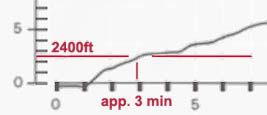
We can examine the facts of December 21 to see whether or not it’s compatible. Below is a graphic from the AAIB's report on the bombing, based on Flight 103’s data recorder. The key line here is altitude, of course labeled “ALT.” The other is some measure of airspeed. The left bar gives feet above sea level (add three zeroes) and the bottom gives time in minutes from data start.
In the marked-up detail at left, note that the altitude doesn’t change for the first minute – takeoff is at minute one, not zero. We can see here that 2,400 feet, the outside pressure that would trigger the timer, is really not very high, and was reached about two or three minutes in. If this pressure decided things for the 38-minute detonation, we’d be looking at a 35 or 36-minute timer, something not within the Khreesat arsenal.

But inside the plane, where the suitcases were, the pressure is controlled and drops more slowly. The work of Rainer Gobel, as related by Leppard, is also confirmed by Paul Foot, writing in 2001 in Lockerbie: The Flight from Justice, as addressing the expected rate where it matters:
"A clearer description of this ice-cube timer was given the same day by Rainer Gobel, physicist for the German police, the BKA. He had a remarkable insight into how long such a timer would take to set off an explosion. “Pressure change in the cabin,” he said, “is regulated automatically. It happens more slowly than the drop of pressure in the air through which the plane is flying, which means, according to the documents which were provided to me, in a plane of the aforementioned class, about seven minutes after take-off the pressure within the cabin will have dropped to such an extent that 950 millibars or hectopascals will have been reached at which the barometric gauge would be involved and a circuit, a current, would be activated.” [p 19]
Some would protest, and fairly I think, that we can't be certain that even if the PFLP-GC's bombs were involved, that this one used the same altimeter setting, or altimeter, or even timer style, as the units examined. But considering the group's reliance on Khreesat’s formula and available materials (the fifth device from 1985), it seems possible enough that it would. And Gobel's "about seven minutes" is quite a nice fit with the roughly eight required to make this fit into Khreesat’s 30, 45, 60 framework. Thus the strong possibility that cannot be reasonably discounted here is that Flight 103’s ascent triggered another ice-cube timer, of the 30-minute size, about eight minutes after wheels-up.
---

1980s Boom Boxes and Ice Cubes

The Evolution of the Khreesat Bomb, part two: 1985-88
May 31 2010


Audition, Performance, Recycling
Part one covered the early years of Marwan Khreesat’s bomb-making career in the early 1970s. After reportedly leaving Jibril’s PFLP-GC group in 1973, Khreesat remained quiet for twelve years. Then in 1985 he was reactivated by Jibril, and summoned to Syria to show his old altimeter-based skills with current technology.

Khreesat bought five Toshiba BomBeat 453 units, which have their own little story, but for our purposes they were housing only, and good sized. It’s the timers and altimeters – only four of each - that mattered to Khreesat, and he selected these himself. The pricey detonators, tens of thousands of dollars apiece, were presumably provided. It was enough to re-create his fear-inducing 1970s innovation; he described the end results to FBI special agent Edward Marshman in November 1989:
“Of the five, two were almost ready to go; they only needed to have the pins pulled to arm them. One had only explosives inside with no altimeter or timer. The other two needed two wires to be connected. After Khreesat built these devices, they were shown to Ahmed Jibril, who approved them. Khreesat then disassembled the devices, and the components were taken back to the PFLP-GC office.”
Just when Khreesat started working for Jordanian intelligence is not clear, but when he was summoned again to Neuss in mid 1988, Khreesat came with instructions from his GID bosses in Amman. The people who in turn met with friends at the CIA, MI6, etc. told him to only build fake bombs while working undercover within the PFLP-GC. But things didn’t work out so smoothly – by Khreesat’s story, the terrorists gave him something more concrete than these instructions.

By Abu Elias he was given a sense that he’d be caught making fake bombs, and from cell leader Hafez Dalkamouni he was given his old materials from 1985. The timers and altimeters were the same, and the five detonators were probably also the same. He was also given one of his five BomBeat453s to re-wire, so one IED was of completely recycled materials.

Working between October 22 and 25, Khreesat thus made four Ialtimeter bombs total in Neuss: this 453 unit, two hidden in Ultrasound radios, and one inside a Sanyo computer monitor. All three of these housings were bought in two second-hand shops in Dusseldorf on October 18, says Khreesat. [p16] The rigged 453 was seized on October 26 in the Autumn Leaves raid, when Khreesat and Dalkamouni were arrested. The other three IEDs were only found months later in 1989. Only the “fifth device,” which Khreesat barely touched (he says) is unaccounted for. First we’ll look at the specs of Khrresat’s four bombs, element-by-element, and then briefly at what can be gleaned about the other one.

Detonators
In addition to the BomBeat radio, monitor, Ultrasound tuners, timers, and altimeters brought to Khreesat on October 22, my portion of Marshman’s report makes no mention of “detonators.” It does however say “Dalkamoni also brought in four blasting caps that were electrical. [p17] I’m not explosives expert enough to know if that means detonators. All I know is they’re the expensive part of the bomb, and the part Khreesat seems less interested in.

Altimeters
These were provided to Khreesat in neuss. He mentions in his report
Four altimeters which were made in Japan. [p 17]
Marshman’s report specified “the altimeters are the same ones he had in 1985,” and Khreesat “does not know how, when, or by whom these altimeters were smuggled into Germany.” [p 32] He does however note that Dalkamouni was the last stop, handling all Khreesat’s supply needs.

I’ve seen nothing to differentiate the altimeters one from another, and at the risk of error will consider them to all work the same. All I have at the moment to show how they were set is from David Leppard’s On the Trail of Terror. The altimeter from the 453 was tested by the BKA’s Dr. Rainer Gobel in a vacuum chamber. “The circuit would close at a pressure between 940 and 950 milibars - equivalent to an altitude of about 2,400 feet.” [p 11-12] It’s tentative, and Leppard is sometimes wrong, but I can work with this for now.

Ice-Cube Timers
The timers are of interest here, and somewhat more complex. The units themselves were basic – a simple electrical capacitor encased in clear plastic resin, its appearance led to the nickname “ice cube timer”. The timer’s built size determines its resistance to electrical charge and thus the time until it “discharges.” Precise details of that process aside, the time delay is unchangeable but reliable.

These Khreesat picked up himself, as he told agent Marshman. “The timers were made by the Fatah group in Damascus. He first saw these timers at the PFLP-GC camp in Syria and four of them were good, so he took them to use.” [p32] Like the altimeters, they came back to him iin Germany but he doesn’t know how. Where it gets complex is when Khreesat explains how the times vary one unit to the next as far as time delay:

One of the timers was a half-hour timer, one was for three-quarters of an hour, and one was for one hour. Khreesat does not recall what time the fourth timer was set for. None of the timers were for more than one hour. […] Of the four timers he used in the IEDs in Germany, he is not sure of the exact times each one was set for, or which device which timer was put into.
It’s possible to tackle the question of “which device which timer was put into,” but first we must address another issue. Just from the seized BomBeat 453’s timer we have a range, not a set time. Again, David Leppard cites Dr. Gobel’s findings: "The time delay of the electronic component fluctuates over a wide margin since the structure of the circuit is relatively simple. Time delays between 35 and 45 minutes were measured." [p 11-12]

This variation of a supposedly set-in-stone delay might be explained by Khreesat, again via Marshman:
"Khreesat advised that the times are not exact and the time changes depending upon how long the timers have been tested after last being used. They usually reset to zero after a day. He used to test the timers three times in a row before installing the timer in a device. He found that in each test the time decreased. When this happened, he put the timers aside, and the next day when he tested them, they would run for the same time as when he had first started them."
Time delay then varies, with a starting baseline (long time) and shortening with repeated tests carried out too soon. Unless someone was testing it in the field just before use, the long time is what would elapse before detonation.

Timer/Housing Reconciliation
Therefore if Göbel found a range35-45 min for one timer, and Khreesat’s roster can be trusted, that’s the 45 minute unit. That was in the seized BomBeat, leaving for the other three a 30 minute one, a 60 minute, and another he can’t remember, but one hour at most.

The Sanyo monitor was seized intact and just as available for study, but its results are less clear. Dr. Gobel’s notes were read back in part at the Camp Zeist trial, and he include this on the Sanyo's ice cube: “Calculated on the basis of the values of the built-in components, the delay time is put at between 30 and 35 minutes.” [Zeist transcripts p 8769] That’s not a range of test results, but a range of estimates based on, it seems, looking at the circuit. If Khreesat is right, this would most likely be the 30 minute unit.

The two Ultrasound radios were not read as clearly – one defied a top BK explosives expert (Sonntag) and blew him to bits, while nearly killing an assistant. Perhaps some clues from that chain of events could tell us if this is the 60 minute timer or the mystery one. The other Ultrasound was purposefully destroyed, for safety and psychological reasons. But one of the two Ultrasounds (it’s unclear which) did yield enough of its timer for Gobel to note:
“[T]he accompanying capacitor is of the same value as in 1 [BomBeat] and 2 [monitor], but has however, jumped out of circuit. […] it can be assumed from the remains of the circuit that the time delay was in the same region as 1 and 2." [Leppard p 144]

To fit with the above, that’s a possible 30 or 45 minute timer, which are both represented by Gobel’s units 1 and 2. This out-of-circuit timer would be the one Khreesat didn’t remember, likely a duplicate of either the 30 or 45. The other Ultrasound then contained the 60 minute timer, if this should all tie up so neatly (don’t count on it).

The Fifth Device
All of the ahe above is fairly academic for understanding the Lockerbie bombing. As noted, all four of these units were intercepted by police, three of them without fatalities. The fifth mystery bomb is the only suspect here for that atrocity, and this bomb was apparently built by Abu Elias rather than by Khrresat. But his work is said to have informed Abu Elias.

Khreesat does give some details of this unit, which help very little in understanding it. He mentions an altimeter, partly visible under the cassette bay, no mention of timer, but parts of the circuit board and transformer were removed, and some modifications concealed under little cardboard boxes. Khreesat was unable to study it closer, as Dalkamouni stood over him the whole time he soldered two simple wires. This bomb has never been tested in a laboratory setting to determine its settings.

If used on Flight 103, however, the results can be observed from what happened on that December night. If we presume the same altimeter setting, which I did earlier but now seems unjustified, it would start the ice cube charging at about 2400 feet altitude. This low level was reached about two minutes after leaving the ground, according to the AAIB report’s altitude profile (see Thirty-Eight Minutes).

The bomb detonated 36 minutes after that point, so if we also presume a Khreesat-style ice cube timer, and presuming this hadn’t been tested before deployment, 36 or perhaps 35 minutes would be its baseline time. It doesn’t even have to fit Khreesat’s four from the Fatah factory, in their neat quarter-hour time units. Perhaps there was no timer, just an altimeter set to 31,000 feet. But whatever exactly was going on inside it, it is apparently modeled after Khreesat’s 1980s work, and might then be expected to behave about like one of his bombs. And of course whatever blew up PA103 behaved in just that way.
---

The Birth of Airborne Death

The Evolution of the Khreesat Bomb, part one: 1970-73
May 30 2010


Marwan Abd Rezak Mufti Khreesat has a long and unusual career as a bomb-maker spanning nearly two decades. He was employed by the radical babykillers Popular Front for the Liberation of Palestine, General Command (PFLP-GC) in two distinct phases with a long pause between – the early 1970s and mid-late 1980s, culminating with the “Autumn Leaves” operation a few weeks before the bombing of Pan Am Flight 103.

His formula, the Khreesat magic, was to wire a barometric switch to a plastic explosive IED hidden inside consumer electronics. The result was altimeter bomb, triggered by falling air pressure, revolutionizing airline terrorism. It avoided a problem with timers on much-delayed flights – this would not blow until airborne, maximizing the chance of mass fatalities.

Emerson and Duffy reported in a 1990 book that “according to Israeli intelligence files, it is almost certain that Jibril [the PFLP-GC], in 1970, was responsible for the very first plane bombing carried out with a barometer-triggered explosive,” and the bombs were built by Khreesat. [1] Two flights from Europe to Israel were bombed the same day (February 21) with radio-based IEDs. These first two were gotten onto the plane by being sent as Air Mail to Israel – so the carriers, not the bombers, chose the flights that would be hit. [1] One of these killed no one, and the other left none alive.

An Austrian airliner (Australian per Emerson and Duffy) from Frankfurt to Vienna and then Tel Aviv, Israel, detonated at 10,000 feet. All 38 aboard survived, following an emergency landing at Frankfurt. [1] But the same day, Swiss Air Flight 330 “blew up 15 min after leaving Zurich for Tel Aviv,” Emerson and Duffy wrote, at an altitude of 14,000 feet. [1] The pilots tried to re-land, but thick smoke and then power failure caused them to crash in the woods at Würenlingen. All 47 people on board perished. [2]

A German-language appendix to a report (sent to me by Edwin Bollier) is quite informative. It disagrees with the above specifics – the airport is about 1,400 feet above mean sea level, and the approximate trigger altitude is shown as 3,500 feet MSL, with the detonation coming perhaps one minute later, at 4000 feet (2610 above the airport). It was apparently not a powerful bomb, it’s almost a fluke that it worked to such deadly effect. The bulky altimeter was recovered pretty much intact (shown at left). [3]

Khreesat’s work struck again on August 16 1972, with an El Al flight from Barcelona to Tel Aviv. The altimeter bomb this time was powered by 250 grams ammonium nitrate hidden in a Phillips record player. This had beengifted by a terrorist to a young British lady. This was in her luggage in the rear hold when it detonated at 14,700 feet. [4] The cabin floor was damaged, but the plane was fine and re-landed safely with some injuries but no deaths. Two men she’d met were arrested and said they given the bomb by Khreesat in Yugoslavia. [1]

Having been compromised, it makes sense that, as the Mossad says Khreesat left the PFLP-GC in 1973, perhaps just laying low as their secret weapon. [4 Leppard p. 8] However later events suggest he became an asset for Jordanian intelligence, GID, presumably during this long downtime. But no more such bombings happened from the PFLP-GC, and the threat faded over more than a decade.

In general, his first three bombs showed an inventive approach that made sure a plane was airborne before detonating. They did not however wait until the plane was way up there. The early triggering allowed for a safe return. Further, some combination of inadequate explosives and random placement in luggage yielded high failure rates. If such a bomb could wait longer to detonate, blow harder, and be placed nearer the hull, it could kill an airplane. All three problems wound up being solved, one way or another, for the next try against Pan Am 103.

And developments in air ravel after 1970 would solve another problem – low death tolls even with success. Companies like Boeing and Airbus would answer that in sevens and by 1988 and give both the US Navy and the PFLP-GC hundreds to kill at a time.
---
Next: Part Two
---
Sources:
[1] Emerson, Steven and Brian Duffy “The Fall of Pan Am 103: Inside the Lockerbie Investigation” New York, G. P. Putnam’s Sons. 1990. 304 pages. pp 114-116.
[2] Wikipedia. Swiss Air 330. http://en.wikipedia.org/wiki/Swissair_Flight_330
[3] Beilagen Über den unfall Des Swissair-Flugzeuges Convair Convair 30 A (CV-990 A <> HB-1CD Vom 21 Februar 1970 Bei Würenlingen / AG http://www.4shared.com/document/HCo0HW8d/SwissAir_330_Report_1970.html
[4] Leppard, David.On the Trail of Terror: The Inside Story of the Lockerbie Investigation. London, Jonathan Cape . 1991. 221 pages. Page 8. 

PFLP-GC Radio Recycling and the Khreesats' Luggage

Coincidences, or Clues of a frame-Up?
May 28 2010


Onetime suspect in the Lockerbie bombing, Jordanian double-agent Marwan Khreesat, has quite a fascinating tale, laid out in an 1989 interview with FBI special agent Edward Marshman [PDF download] and other sources. Two minor but interesting threads of the story are a curious set of five recurring Toshiba radios, and a matching set of luggage that eerily resembles another I’ve been wondering about.

The Toshibas originated when Khreesat was summoned to Damascus in 1985 and tasked with building five hidden altimeter bombs to show to PFLP-GC leader Ahmed Jibril. Khreesat says he bought five of the same model radio-cassette player - the aptly-named BomBeat 453 – on “Smuggler’s row” in Syria. [p 10] (model at left, but Khreesat's were black) He also secured his own timers and altimeters - four of each - but the pivotal and pricey detonators were apparently provided. [p 32] Khreesat left one bomb radio absent its altimeter and timer, two ready but for loose wires needing soldered, and two fully ready to go. A pin pushed in would arm them, and a sustained climb past a certain altitude would cause the detonation. [p 10]

After Khreesat built these devices, they were shown to Ahmed Jibril, who approved them. Khreesat then disassembled the devices (aside from one shown in 1987 to Jibril’s nephew Abu Elias) “and the components were taken back to the PFLP-GC office,” the report states. [p 10] “The radios themselves were left in Khreesat's cousin's house.” Compared to America’s culture of disposable electronics, these five boom boxes were treated like golden heirlooms passing from hand to hand. Someone was later sent to retrieve them, but the cousins were allowed to keep one and “only four were picked up.” Of these, Khreesat insists he “saw one in an office in Syria being used as a regular radio.” [p 10] The one kept by Khreesat’s cousins “stayed upstairs at the house,” the report continues, until “Khreesat's wife later reclaimed this radio.” [p 10]

Now when he arrived in Neuss, West Germany in mid-October, Khreesat brought his wife with him; he explains that she wanted to visit her brother in prison there, a wish Dalkamouni granted. [p 5]. David Leppard in On the Trail of Terror (1991) reported that they brought a matching luggage set – two brown hardshell Samsonites - and inside Khreesat’s case was a black BomBeat 453. “He had brought it from Damascus,” Leppard writes. [p 6]

But by Khreesat’s story to agent Marshman, it was the wife who had brought this radio from Jordan, after reclaiming it from Syria, “to give to her brother, who was in prison” in Germany. She was reportedly “unable to give this radio to her brother, and this radio was left in Hashem Abassi's house,” where they stayed while in Neuss. “This radio was clean,” Khreesat advised, and he “assumes that it was seized by the Germans.” [p 10] There is a Yaesu FT-211RH that was seized but found to be unmodified [Zeist trial, day 72, pp 8829-31], but I’ve seen no mention of a clean 453 found.

The only sample of that familiar model the BKA are known to have seized was rigged for altitude-based killing and in the trunk (boot) of Dalkamouni’s car when he and Khreesat were arrested on October 26. This was the unit studied by BKA scientists, with Dr. Rainer Gobel measuring time delays between 35 and 45 minutes after the pressure switch.

Leppard seems to have decided that was the BomBeat that Khreesat brought in his case, but the bomb maker’s own story conflicts with that. He says it was yet another of his omnipresent 1985 radios. On October 18 or 19, on returning to his room at Abassi’s place, he found all his supplies laid out across the bed, including his original timers and altimeters, and that Toshiba. [p 17] He didn’t know how any of this got there, but it was presumably brought by Dalkamouni, who handled all his supplies. All the timers and altimeters were the same he used in 1985 [p 32] and the radio “was one of these five radios that he worked on in 1985,” [p 10] while he and his wife just happened to have another of the five there with them.

It’s not clear what this might mean, but for one thing we should wonder if it’s completely accurate. Was Khreesat more involved than he lets on, and brought his own 453 radio to modify? And if his wife really brought one, did he really just leave it in the Abassi home, or did it disappear, say, along with Abu Elias?

And then there are the suitcases – what if these were stolen and used for the bombing? Here we have the bombmaker with brown, hardshell Samsonite suitcases, forensics on the other end suggesting the 103 bomb was in such a case, and between them one credible report - John Bedford’s story - widely noted as seeing one such case quite near the blast area of fateful container 4041. However, few realize he describes two such cases, apparently a matching set. Like the Khressats' (per Leppard). This must be either a fairly steep coincidence, an error by Leppard, or a clue of something else. Khreesat doesn’t mention any missing luggage, and Leppard reports clues that the wife took her bag when she returned home on the 22nd, which of course makes sense.

But other clues point to the infiltrator being essentially framed by the PFLP-GC. Khreesat didn’t even build the bomb that may have done in 103; at least by his own telling, all four of his  own products were (eventually) taken in by the BKA. The fifth device that Abu Elias escaped with was apparently of his own making, and not a black BomBeat 453 (Khreesat thinks it was a bronze Toshiba RT-F423). [p 37] Its modifications were apparently mimicked based on earlier study (1987) of the master's work, and Dalkamouni only had Khreesat do a token finish on this unit (solder two wires) before taking it back to its maker, perhaps just passing it through the Jordanian’s workshop to get his “fingerprints” on it.

Such co-option is one way to respond to an infiltrator in their midst, if they had found that out. If so, Abu Elias might also have secured his own copy of the double-agent’s double Samsonites and put his “Khreesat bomb” in one. It would also do to snag the extra 453 unit (if there indeed was one) to put in the other case.

Even without awareness of this spooky suitcase match, I can imagine how investigators would be apoplectic seeing BomBeat 453 debris at Lockerbie after the famous Khreesat bust weeks earlier. There’s no evidence of such debris and I’m not arguing for this. However, it's an interesting thought, and  if it had been there it would be reflexively covered up with rigor. And otherwise the possibility stand that a clever PFLP-GC worked right around Khreesat, doing the bombing themselves but making it appear like the West's agent had done it.  Embarrassment upon embarrassment as cover, and no surprise, it wasn't looked into.
---