Showing posts with label RARDE. Show all posts

Feraday's Forensic Follies, Section Sixty-Seven

June 11 2010
last updates June 11/13 2011

A few days ago I posted a collected timeline of forensic finds and coclusions from RARDE's "scientists" Dr. Thomas Hayes and Mr. Allen Feraday. These were supposed to have led to the identification of a vaguely Libyan radio model holding the bomb - Toshiba BomBeat RT-SF16. The end result is bizarre, with a hundred implied complications, like those presented by a tiny bit of blasted circuit board dubbed PT/30.

This 3mm x 4mm  fragment was allegedly found on June 8 1989 by Dr. Hayes, or June 18 by Feraday, depending. Both versions match on where it was found - embedded in a piece of soft blue American Toursiter suitcase owned by victim Karen Noonan and labeled PK/2128. [Leppard p207] Its PT number is lower than the famous PT/35 found weeks earlier (on paper), as noted by the defence at trial. This would be unusual if not for all the rest being just as out of order (see PT/31, PT/56, etc...). Stranger yet, Dr. Hayes' examination notes of PT/30 read in part:
It has been partially delaminated by the blast and, hence, does not possess the expectedgreen lacquer and/or solder tracking upon its rear face as this has been ripped completely away. The upper [brown] face of the fragment bears part of the white painted characters C32 and a depiction of an electrical resistor.
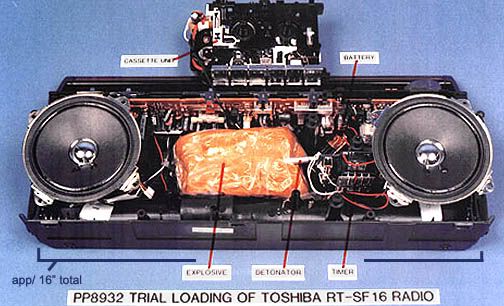
Consider the sample loading of the alleged bomb (below) in a normally-assembled RT-SF16 radio (minus its cassette assembly). The main circuit board is the one seen along the top, brown-colored component side down. This surfaces is that painted with little white markings that survived the blast of that Semtex about one inch distant. It was the inverse side, green lacquered and tracked with solder, that was blasted away. Was the board backwards?

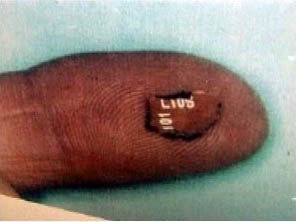
PT/30 is not alone in having its painted face survive readable and unburnt. Consider this largest portion of the earlier find AG/145 (at right). Its markings "L106" and "101" are plain as day, and only the edges are burnt a little. The smaller part of AG/145 is similarly marked, with "02." It would thus seem the terrorists allegedly scraped off all those little  components off their contacts and flipped the board backwards to fit it back in. Except that the AG/145 fragments also had nice green backsides that showed no sign of blast either, and allowed the first identification in February.

Anyway, to bring this back to Feraday, he was reportedly excited about PT/30 turning up. The radio model RT-SF16 was already identified on May 11, we hear, and this fit it just as perfectly as the AG/145 fragments did, and was noted immediately by Hayes on June 8. So Mr. Feraday reportedly waited a few months, and then in September took the thing to the evidence holding facility Dexstar to see if it could match anything there.

Later, in December, DI William Williamson sent SIO Henderson a memo describing this: "On his visit to Dexstar on 14 September 1989 Mr Feraday viewed a large number of items of circuitry which had been withdrawn for his examination; none of these items was a match for PT 30." [Leppard p 207] (note: PT 30 is just Leppard's way of writing PT/30 - space instead of slash. It's the same item)

Williamson went on to ask Henderson to look into inspecting evidence held by the Germans to see if a match could be found to Khreesat's work - particularly some alarm clocks he was known to have bought. Feraday had "on a number of occasions repeated his keen interest in any item of circuitry," Williamson explained, "or indeed in any digital clocks or other similar items which could contain a circuit board for examination and comparison at RARDE against produsction PT 30." [Leppard 207-208]

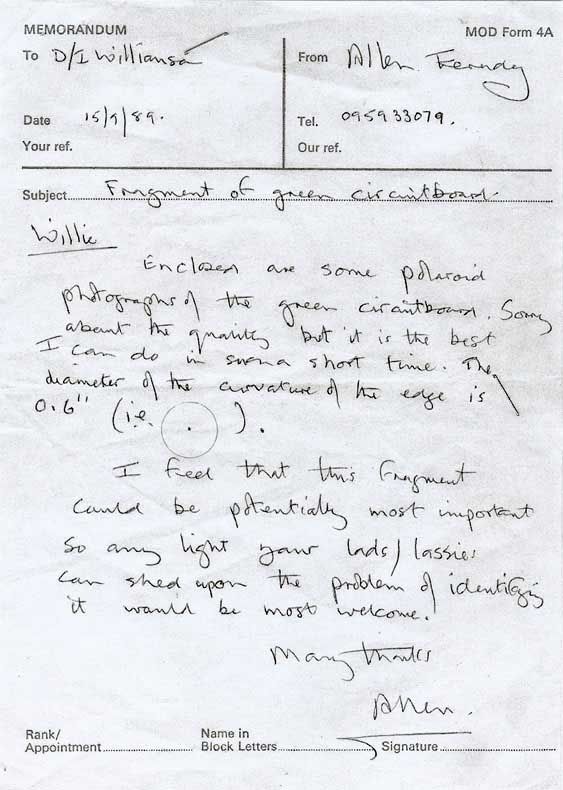
Earth to Allen, your science guy Hayes has May 11 as the date he IDd the radio, and on June 8 found that PT/30 matches it. Why the running around drama in mid-September looking for some whole other fit? The obvious answers somehow elude this blogger, but one thing I notice is the timing of this fevered search relative to a more fruitful circuitry quest: PT/35(b), the lucky corner of a Libyan MST-13 timer main board. The day after Feraday's reported inquest at Dexstar, evidencing that "keen interest" in circuit board clues, he sent a memo to the same DI Williamson cited above. This was regarding a four-month old (on paper) find by Dr. Hayes.
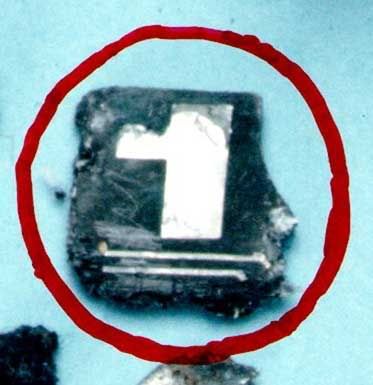
In retrospect, this memo is rather vague, not mentioning PT/35(b) by name or giving many direct clues. It could almost be about PT/30, except for the cited curve. Only the mammoth MST-13 chunk and its double-underlined #1 is large enough for that detail. By my rough measurement of a scaled MST-13 jpeg the curve at upper right has a 0.5" diameter. I'd defer to Feraday here.

So this is a letter about that amazing but yet unidentified clue PT/35(b), keenly ignored it seems until that date - four months after the paperwork shows it found. But only one day after Feraday's own foray over the already identified PT/30 (says the same Williamson months later).

Or am I just making too much out of a simple mix up? Not likely, as that memo of December 19, just ahead of the anniversary, shows Feraday behind the scenes urging yet more bogus action over the already identified circuitry. Over six months following its match-up with the known bomb radio, he was pestering Williamson to pester Henderson about trying to find a match for PT/30 over in Germany if possible.

If all these things are the true exploits of professional and even-handed investigators ... my God, what kind of MKULTRA experiments were they doing with the ventilation at RARDE? No, these "facts" must have appeared as they were convenient, with little regard for those which came before or after. It's the only sane explanation.
---
Update June 11/13, 2011
Some amazing screen grabs from Al Jazeera English's new video.

AG/145 fragments, separated and partly cleaned, hugely magnified and looking less burnt to ash than ever:
Here's the second largest fragment, placed against its spot of origin on the brown/orange, lettered, blast-ward side of the board.
And here is the backside of the larger one against the green, shielded, solder-tracked side.
It's this precise match-up, Allen Feraday said, that helped him at least narrow down the radio model by mid-February 1989. In both images, note the material - flimsy, paper-fiber-and-resin, not fiberglass.

As we can see comparing the first and third of these images, neither side of that largest bit shows any sign of blast damage (extreme heat, for example). But where on the board are these fragments from? The middle, just one inch from the Semtex supernova? Or at one of the ends, a couple of inches away? There's an image that clears that up, and they showed it as well in the video, bless them. I compared it to the assembled IED mock-up, rotated so features matched. I then indicated the rough areas for both AG/145 and PT/30.
That gives at most about 1.5 inches for the blast wave to chill-out, and nothing but the flimsy little capacitors (or ??) attached to those spots to shield the face. The left-hand one is in as good a spot as it gets to survive, but still, I can't cite the measure of the force of this blast except that it ruptured an airliner's hull at two feet distant, after being slowed by the luggage container, the suitcase, the clothing, and the radio's case. Before all of these, at 1.5 inches, tops, fresh and full-force ... No way.

Beyond that, do recall, as explained above, that Hayes found PT/30 had the wrong side - the green one - blasted away, while all of AG/145 shows damage to neither side. Another oddity is that both AG/145 at PT/30 would go about the same direction in the blast wave - out from the center in all directions. If PT/30 were blasted straight down, AG/145 should go down and to the left pretty much.

Officially PT/30 wound up wedged into the outer frame segment (IIRC) of the blue softshell on the container floor, just beneath the bomb bag - if so, why would AG/145 wind up, as Mr. Thomas Claiden testified, blasted into a fold of the data plate, on the outside of the container, halfway up its side, two feet or more above the bomb bag?
---

The Monster of Newcastleton Forest

PI/911 and its Mixed Clues
May 2 2010

last edits 1 September

Among the interesting artifacts of the Pan Am 103 crash strewn across southern Scotland, is a particular large fragment of suitcase presumed to be from the bomb bag. Its police label PI/911 designates when and where it was found, roughly; “P” means property (evidence) and “I” designates the search sector it was found in. These were lettered A-K, generally west-to east with sectors A, B and C in Lockerbie itself, and K up to the North Sea. I sector, where most suitcase debris was found, was centered on and around Newcastelton Forest. The numbers after are sequential, so PI/911 is ostensibly the 911th item found in that area.

Like the dozens of other primary suitcase pieces recovered and examined by Dr. Thomas Hayes of RARDE, it matched the construction of the control sample, a Samsonite Silhouette 4000 series hardshell case, antique copper in color. Hayes read back from his final report (Production 181) at trial in 2000. PI/911 was the first item described in the report, and he concluded in part:
“This is a distorted and severely heat-affected irregularly shaped fragment of rigid plastics sheet. When examined, it was found to have a twin plastics layer construction [...] with a thickness of 2.5 millimetres. It consisted of an outer skin of bronze-coloured plastics with a simulated leather patterned finish covering a thicker underlayer of grey plastics having a smooth finish.”
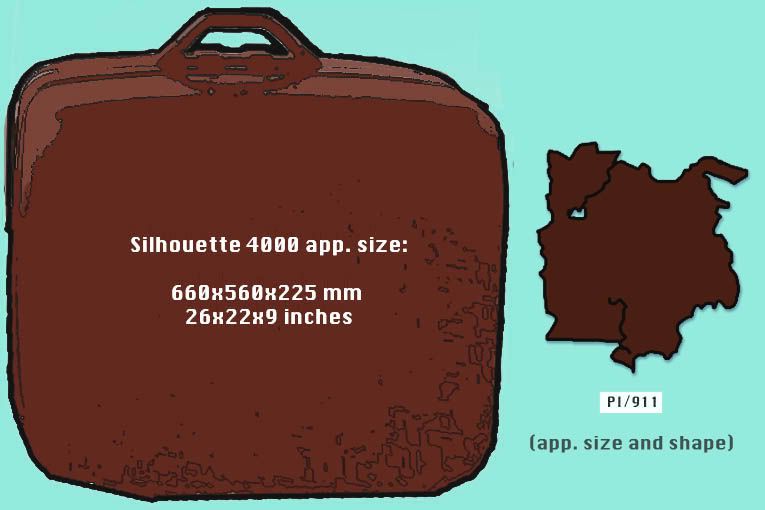
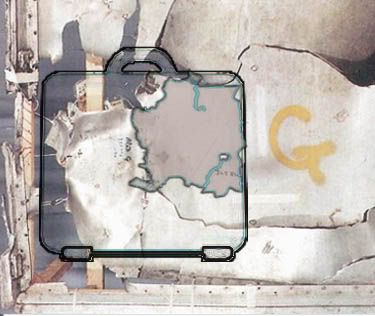
The main distinction of this fragment is its size; the largest found at “approximately 280 millimetres by 260 millimetres,” or about 10.5 by 11 inches. That’s nearly one fourth of a whole side of the 22x26x9 inch case. Just from the size one might wonder if this even could be from the primary suitcase, no more than a few inches from a Semtex blast of probably more than 500 grams power.
PI/911 shape traced off of a Corbis photo (that's probably not allowed either). Sized to scale rel to the control case. That's a big old chunk and, as that photo shows, it's not the only one.

Other clues strengthen the impression; Hayes also noted “the smooth inner surface was lined in one area with the partially charred remains of a brown woven fabric which had a cream-coloured thin reticulated plastics foam underlay.” A nanosecond later, two feet away, the weakened blast was removing airplane skin from its rivets. The Crown’s Mr. Campbell, to his credit, turned to Dr. Hayes’ earlier examination notes (Production 1497) and revealed further doubts this was the primary case.
Q …were these written by you as you carried out your examinations?
A Yes, they were, sir.
Q And we see that you have made notes and made a sketch of the item.
A Yes, sir.
Q And was that the way in which you generally approached the exercise?
A Yes, it was, sir.
Q And we see a date at the top right-hand, which is 21 -- 26, rather -- 1/89?
A Yes, sir.
Q And this is a note of your examination of PI/911. And could I draw your attention to the writing that we see to the right-hand side of the drawing, where you describe the article as: "A severely distorted irregular-shaped sheet of rigid plastics," and go on to say: "Apparently the lower side of a suitcase, compressed and fractured in a manner suggesting it was in contact with a luggage pallet's base and subjected to explosive forces from above."
Now, is that an observation that you made when you were examining this article in January of1989?
A Yes, it was, sir.
Q And was that at quite an early stage in the course of examining articles?
A Yes, it was.
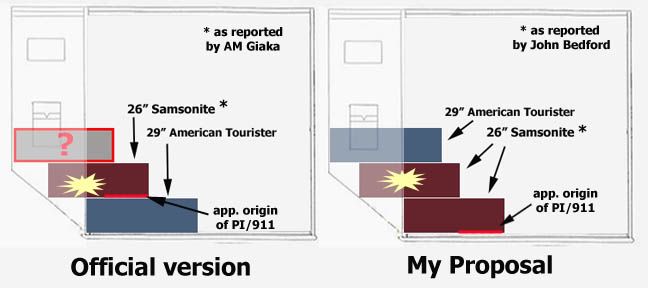
This is an amazing insight. Elsewhere we’ve learned, from official findings that this blogger agrees with, that the primary case was not in contact with the base but laid flat on another flat-laid case in contact with and protecting the floor, putting the blast center around ten inches up. There is also reason to wonder about two suitcases of about the primary style, reported by John Bedford very near that corner of the container. If these had been stacked up one such case could have detonated while the other shielded the floor.

And here’s lead scientist Hayes suspecting this one was in contact with the floor and had a blast above it. Mr. Campbell further questioned Hayes on his reasoning for this:
Q What was it about the item that suggested to you that it was in contact with the luggage pallet's base and subjected to explosive forces from above?
A On the assumption that it might have been part of the suitcase containing a bomb, firstly the residual size of the fragment, which is quite large, and also the fact it appeared to have been supported in some substantial way by a relatively immoveable surface.
The wording is a little ambiguous – if we read that as starting "on questioning the assumption..." it makes more sense and fits with my own thoughts. Otherwise, much here is lining up; other large chunks of ten inches or more on a side, and a 20-inch uninterrupted span of lining material (more coming), suggest one whole side of a suitcase just like the bomb bag broke up very unlike how the bomb bag would. Almost as if there were two bag of the same type, one on the floor and another with a bomb on top of it.

But Hayes had one other clue, in the final report if not his exam notes, that changes all of that:
“Small flecks of a blue foamed plastics material with a cross-hatch-patterned blue plastics skin were found strongly adhering to the simulated leather surface. This finding indicates that at the moment of detonation of the explosive device, this bronze suitcase was in direct contact with one containing a foamed blue plastics material. The items recovered from PI/911 were removed and raised collectively as item PT/42. “
Blue foamed plastic pressed into copper-brown material should have been readily visible to Dr. Hayes, and a tip-off that side of PI/911 wasn’t in contact with the aluminum container base. Therefore, his January decision is curious, unless the blue stuff only appeared later. Now that it’s there, this must be the bomb bag, matching its style, and on the second level up from the floor after all, above a blue case says Hayes… He explained away the discrepancy to Mr. Campbell
Q If you assume that the -- this suitcase was not on the floor of the pallet but was on the next level up -- that is to say, on top of other luggage -- are you able to explain what you see here on that basis?
A Yes, I am. Quite satisfactorily, to my own mind.
Q How would you do that?
A By considering that if a suitcase had resided beneath this one, then the surface of that suitcase, whether of a soft material or a hardshell material, could have similarly acted as a relatively immoveable surface if it, in turn, had been supported beneath, and in view of the tremendous speed of the detonation shock front.
A solid suitcase behaving enough like a floor to mimic this effect is, indeed, credible - if not obvious or necessarily true. The size of a fragment in turn could be affected by the flexibility of its support. But a soft case is unlikely to hold up like a metal floor, and all this still fails to explain the survival of so much inner lining of the case. Nor does anything yet revealed explain away the two bags Bedford saw on 'level one' of container 4041; they had to go somewhere, and these two Samsonites, on levels one and two of the container, had to come from somewhere.
---
Updates, 1 Sept: PT/42 was given above as "small flecks of a blue foamed plastics material with a cross-hatch-patterned blue plastics skin." I checked in the final report (signed by both Hayes and Feraday) for PT/42, the number given to all debris removed from PI/911. Strangely, PT/42(a) is described as a singular "fragment of black plastics sheet bearing a diamond-shaped embossed pattern on one face.” This type of fragment, of which there are several, is distinct from the very few pieces of soft blue outer plastic or foam underlay. While it is “similar to that present on the fragment(s) of American Touristster suitcase,” and is duly listed as a fragment of it (the only one listed from PI/911), the discrepancy between several pieces of blue materials and a single black fragment is notable.

Below for visualization purposes is what I see as RARDE's version vs. my own proposal. The American Tourister was in contact with the bomb bag, but above it. Below was its mate in Bedford's recollection, of which PI/911 is the largest known remnant. It just seems too big to be from the primary case.
21 September: I tried a scaled image comparison - PI/911 within the most likely lower-case placement, and damage to AVE 4041's floor. The placement could vary - I'm also working with other large fragments on the hunch they might all be from the same lower side of the lower case, the chunks that shielded the floor from gas pitting. Do note the size of this supposed primary case fragments is consistent with the flaps of metal torn through just after the lower case. 
 

Page 51 and its Environs

Dr. Hayes and "a Very Good Question" 
10 October 2010
last update 24 Oct

Yet another problem with the science of Lockerbie, discussed for years but never resolved, is page 51 of the examination notes from Dr. Thomas Hayes and the anomalies surrounding it. Hayes was the chief explosives experts for RARDE (Royal Armaments Research and Development Establishment), making the often lone examination of all explosives-related evidence of the Lockerbie bombing. If Hayes vouches for it, it was in the blast. Even PK/689.

Page 51 deals with his supposed 12 May 1989 examination of the pivotal tiimer fragment, PT/35(b). But the page appears to have been inserted after the fact. As Paul Foot wrote in his seminal 2000 booklet Lockerbie: Flight From Justice:
The fragment lay in a store with quantities of other material at least until May 1989 when it was examined by Dr Thomas Hayes at RARDE. Dr Hayes saw nothing specially relevant in the fragment, and apparently did nothing about it. His own note about his examination originally appeared on page 51 of his notes. The following pages were originally numbered 51-55, but the numbers were overwritten later to 52-56. Dr Hayes was never able to explain this re-numbering. [p 11]
At trial Richard Keen, for the accused, questioned Hayes about this:
Q Now, when was that change in pagination carried out, Dr. Hayes?
A I'm sorry, I have no idea.
Q Why was it carried out, Dr. Hayes?
A I agree, it's a very good question. I'm sure there is a quite innocent explanation, which I have no idea of.
To be fair, he did then offer by way of explanation that he must have misnumbered page 52 as 51, and so on for a few pages, but corrected it later. It's one possibility, and apparently a coincidence that it occurred right after this most pivotal discovery. Perhaps the contents of page 51 were so humdrum he forgot the whole thing, turned a new leaf and numbered it 51.

There is some controversy over the policy at RARDE, where bound examination books had once been the standard. But as of Hayes' work on this case, they were using loose-leaf books. Perhaps not coincidentally, this would make it easier (possible) to insert pages out-of-order.

Dr. Hayes’ examination notes were discussed in some depth at trial in 2000. The main point in questioning was to establish the unusual sequence of numbers and dates, with little or no reference to the page contents.

Page 48 is not discussed, but presumably dealt with work from 15 March, 1989, since the following page (49) starts there. What was examined isn’t clear, but the next item below it is PI/991, a damaged suitcase, exam dated exactly two months later, 15 May, suggesting a break just that long. Using a number format, it jumps from 15/3 to 15/5, so perhaps he 5 is just a goof?

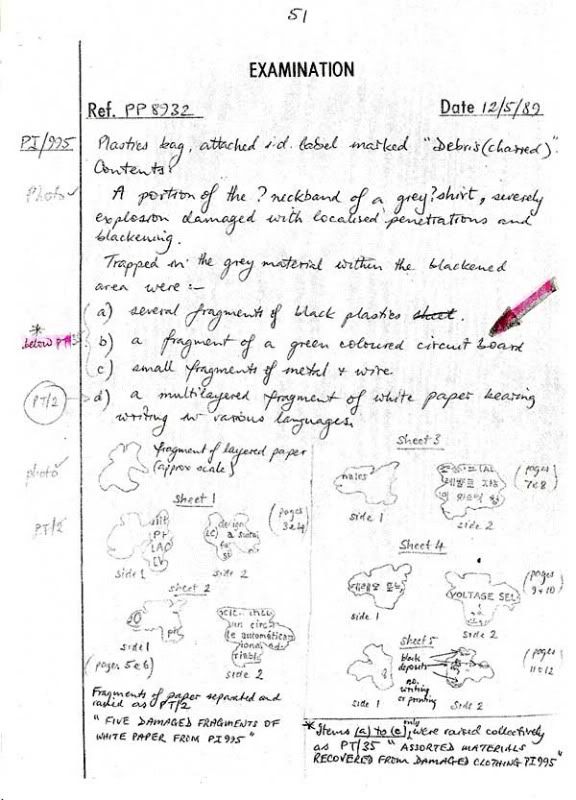
Well, the page ends there and the next page is dated 12 May. An actual two-month break just after the apparent one? (Nothing is given of page 50's contents, and we don't know what his notebook shows for the first thing(s) he looked at after vacation.) Following the incongruous page 50, the pivotal page 51 continues 12 May’s work. Below is what seems to be scan of it from court productions, posted by Edwin Bollier at one of his Mebocom pages (new window for fuller view).

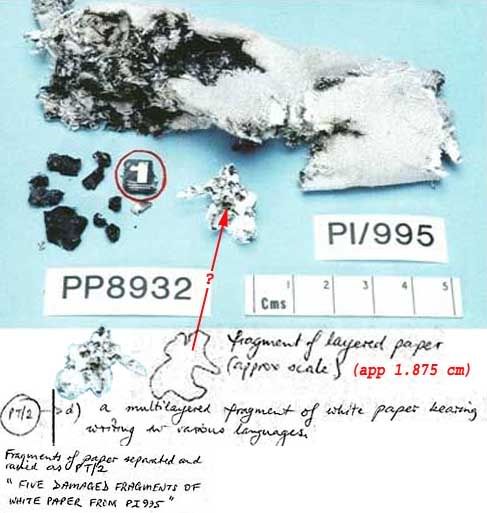
That day, the page says, a scrap of shirt collar called PI/995 is examined and yields a treasure trove of pinpoint clues. Their numbering is strange – all but one are listed under PT/35 (PT/35(a), etc...) and originally, the lump of radio manual is lettered (d), with marginal note of its (later?) designation, PT/2, far out of sequence. The control sample it was compared to, the intact manual, was first dubbed PT/1, even though PT is a prefix otherwise used for evidence found within other crime evidence, like PT/35. (PT/1 was later re-named to PR/1111 for unclear reasons, but PT/2 became official).

Note the paper bits of PT/2 are all carefully sketched, perhaps a clue to the name change (opening the way for PT/2(a), etc.) But the "green circuit board" PT/35(b) is not sketched, despite being by far the largest and most dramatic bit of electronics found anywhere in their work. "Photo" in the margin is checked, and as Rolfe reminds me in the comments, the photo of all items displayed (see below) was apparently taken just before this exam, and it shows the fragment still bunched up. But the date of that photo hasn't been proven, and the fragment was not followed up on in any other way until at least mid-September. A strange lack of recognition indeed, if this thing really was logged back on 12 May, and considering deputy Feraday's intense interest in all electronics.

Following 51 come the scored-out pages 51 52, 52 53, 53 54, 54 55, and 55 56, all dealing with the prolific 15 May. Finally the renumbering stops and a date change occurs to 16 May from pages 57 on. Thus the sequence, using "final" page numbers, runs thus:
49: 15 March / 15 May
50: 12 May
51: 12 May
52: 15 May ...

Dr. Hayes for his part explained that he had originally left the bottom half of page 49 blank, took a two month hiatus, and resumed on fresh pages 50 and 51 on 12 May, a Friday as it turns out. On Monday the 15th, he filled in the following pages with the wrong numbers, and somewhere along the way, also filled in the bottom of page 49 with some of that day's work. He didn't recall all of this, but presumed that must be what happened, as strange and unusual as that is. Because clearly he'd never destroy old pages to make room for backdated new ones.

Looked at more suspiciously, and if we take page 49 as the original start of 15 May’s work after exactly two months off, at least two things jump out. First, it would seem there was no examination 12 May as related on pages 50 and 51. Second, the 15th resumes only on page 52 (originally 51). Obviously implied is a missing original page 50 of 15 May.

The new page 51, however, didn't replace its predecessor, just re-numbered it. And the raising of pages 51-55 can’t avoid an effect on later pages – the new 56 bumps up against the old (or at least non-scored) page 57. Since the new 56 was once 55, that suggests further a missing original page 56, dealing with either 15 or 16 May.

So the appearance here is that two pages were inserted – 50 and 51 as it stands - and two pages were removed – the originals of 50 and 56. Was their replacement just to give space for the supposed work of 12 May, or did they also contain something best deleted?
---
See the comments below for further discussion.

The Political Scientists of Lockerbie: An Overview

3 November 2010

Science Well Done, Answers that Make Sense
Following the bombing and fall of Pan Am Flight 103, and the sudden deaths of 270 people, quite a a number of extremely important questions needed answered. Many of these were best addressed by the rigors of physical science - gathering and analyzing the debris of the crash to form as clear a picture as possible of just what happened to that aircraft  The aircraft debris and break-up analysis was tasked to Mick M. Charles et al. at the UK Air Accidents Investigation Branch (AAIB). I see no reason to dispute their findings or methods. (AAIB report) It showed where the initial failure occurred, petaled-out panels indicating a powerful explosion in the vicinity of cargo hold station 14L.

Container AVE4041PA, the luggage "pallet" that occupied station 14L, also showed signs of extreme blast damage and was ruled by the AAIB to have held the primary (bomb) suitcase: The container was studied in particular by Thomas Claiden at AAIB. There are some minor points of strangeness with his findings (and they're named AI/100 and AG/145), but on balance his findings seem sound. It established the approximate blast center, most likely in a case laid flat, with one case between it and the floor, at the outboard end of the container.

Likewise, the Scottish police and their allies should by default be trusted in their painstaking collection of thousands of blast-related pieces of evidence from across hundreds of square miles. And after the in-gathering, their own book-keeping should be presumed to show signs of tampering if such even conceivably happened at their end. For example, Detective Douglas Roxburgh, who headed the store house at Dexstar, would have noted debris being removed without a proper cataloging. In fact, he did report this to his superiors at the time.

At trial in 2000 he didn't seem to recall this removal being a big deal or anything nefarious. Nonetheless, there are certainly ways, from the inside or the outside, to alter the police records to accommodate evidence slipped into certain key spots. This may sound like an absurd consideration to many, but on further reading one can see why it's worth keeping in mind.

A Critical Three 
The most relevant material to determining who was responsible for the bombing also happens to be the evidence with a cloud of questions surrounding them. The accepted evidence from closest to the bomb, and three particular scientists at the heart of it - two with the UK military's RARDE agency, one a special agent with the FBI, all known for returning politically useful but scientifically questionable decisions. Hence the "political" scientists of Lockerbie.

The Royal Armaments Research and Development Establishment (RARDE), a branch of the UK military, had an explosives forensics lab (sometimes called EC3) that had helped in previous terrorism cases involving the IRA. The blast science side of the Lockerbie inquiry was assigned to EC3. Journalist David Leppard, a huge RARDE fan, wrote in early 1991:
"The Lockerbie case team was led by two men who were considered the best in Britain. They were Dr Thomas Hayes, the senior forensic scientist, and Allan Feraday, his deputy. The remarkable work which the two men were to undertake over the next two years was to provide the cornerstone of the entire investigation.” [p74]
Just who among Hayes and Feraday did what neither could recall - they both signed off on the final report of 1990, but remembered nothing specific at trial in 2000.

Part 1: Thomas Hayes
Dr. Hayes was the head investigator at EC3 during most of the time debris was being studied there. He had previously been involved in the Maguire Seven case of 1976, signing off for science that helped put away seven people for supplying the explosives used in a string of IRA bombings. On review in 1990, the basic science was found to be consciously skewed to secure the convictions, which were all overturned. It was apparently this review that led Hayes to vacate EC3's top spot, leaving his deputy Feraday to take his place.

Part 2: Allen Feraday
Mr. Allen Feraday (no PhD) headed the lab from late 1989 to RARDE's elimination in 1995. He had not a single prior case that would fall apart - he had four. A mass-murdering IRA bomb mastermind, a supplier of Syrian terrorists, a Libyan planning to supply someone for bombs, and three IRA terrorists who deserved to be shot by the SAS because they could have blown a bomb. All these opinions were later questioned or tossed out by courts. For decades Feraday served the Crown loyally and robotically, with an eye to political objectives of his superiors rather than to science and truth. In one case it seems an innocent man was targeted in lieu of a known IRA bombmaker whose prints all over the device were ignored. Feraday helping terrorists get away?

All the above cases hinged on Ferraday's supposedly vast understanding of electronics and circuitry, and he showed the same interests in the Lockerbie case. He made a project of identifying the radio model used, and months later, identifying the fragment of Libyan timer that turned up. This he personally escorted on its mid-1990 journey to the United States (see below). In these and other ways unseen he played a key role, in ambiguous collaboration with Dr. Hayes, laying the "cornerstones" of an investigation that most impartial observers recognize as horribly crooked and geared towards securing a rather ludicrous conviction.

Part 3: "Tom" Thurman 
Among the American experts brought in was FBI special agent James "Tom" Thurman, described by mainstream reports as "one of the bureau's best explosives technicians." Others have said he has no formal explosives training, but rather a degree in, literally, political science. The reality may be in the middle - I'm still sorting that out.

Agent Thurman was ordered to Scotland, along with other folks from the FBI and FAA, on the night of the crash. Starting soon after, he helped locate and assess the blast-damaged clues. There's reason to guess he might have been the guy that set off Roxburgh's alarm bells. Otherwise, I see no great reason to question his findings here. Again, it's closer to the blast center that the clues get weird.

The Scottish police handled most of the rest, and Hayes and Feraday zoomed in on the analysis of the bomb-damaged luggage. Thurman was however called on to make a second appearance in mid-1990. In June he helped identify the crucial timer fragment PT/35(b), in a remarkably short and focused quest. Upon making the link with top-secret CIA help, Thurman then had a look at the actual fragment, brought over by EC3 chief scientist Allen Feraday. Both eminent minds agreed this was a piece of a Mebo MST-13 timer, sold only to Libya in a tiny batch of 20.  Convenient.

The fragment's genuine blast origin was doubted by neither of these two supposed explosives experts, nor by Dr. Hayes. Not all scientists outside their little loop agrees, however. Consider Dr. John Wyatt, involved in tearing down Feraday's work before, who later found in a dramatic series of twenty tests that even at a fraction of the official blast power, all surviving remains were many times smaller than PT/35(b).

As the dedicated post will explain, Thurman has been widely criticized for his lack of real knowledge and lack of credentials. That I could forgive if his science was solid. But he was later drummed out of the FBI crime lab for misleading practices, which is clearly more problematic. His other cases are high-profile - including the 1989 Libyan bombing of UTA 772, and the 1995 right-winger bombing of the Murrah federal building in Oklahoma City. Potentially troubling stuff, which I also haven't got sorted out enough to comment on yet.

Allen Feraday

The Political Scientists of Lockerbie, part 2/3
First Posted 26 October 2010
last edits 29 October


Introducing Allen Feraday  
At the time of the Pan Am 103 bombing, Allen William Feraday was the top deputy to Dr. Thomas Hayes, head of the forensic explosives laboratory for RARDE, the Royal Armament Research and Development Establishment. Following Hayes’ departure in latter 1989 - to become a foot doctor - Feraday took his position as the lab‘s director. Both men were formative in the science of the Lockerbie bomb suitcase, as officially understood. Their work on that ran parallel to the shuffling about, which was apparently connected to a probe of Hayes’ involvement in the shady Maguire Seven case of 1976 (see link above).

Patrick Haseldine’s famously deleted Wikipedia page on Alan Feraday sums up nicely that he “has appeared as an expert witness at criminal trials leading to convictions in at least four high-profile cases, three of which were subsequently overturned on appeal. The appeal in the fourth case is ongoing.” [1] Of course that last is no longer pending, as of August 2009 when Abdelbaset al-Megrahi surrendered his appeal of conviction for the bombing of flight 103. I’m not entirely sure how many other cases he’s been involved in and how these turned out, but the four are interesting and I’ll opt to show the same basic bias, aside from mention of a fifth case that has been challenged but not to my knowledge overturned.

On the other side of the spectrum of opinion, David Leppard, in On the Trail of Terror, offers effusive praise for the man erroneously named in the index as “Dr. Allen Feraday.” [2] It’s been widely acknowledged he has no formal training on a doctorate level, only a Higher National Certificate in Applied Physics and Electronics that was apparently pretty old; according to Leppard, the good “doctor” had beneath his belt a solid “34 years explosives experience” as of writing in 1991 (or since 1957, by my math). [2 p74] A 2005 article by Michael Tierney and run in the Herald (Scotland) said Feraday was then “in his sixties,” and had retired a decade earlier with “42 years” experience. [3] If that’s all true, he could be born no later than 1935, and started work with bombs in 1953, at around age 18 at the oldest.

Just what he was doing there for the decades before the 1980s is unclear from available evidence. But he acts like a paranoid spook, as Leppard’s book expands:
"Not surprisingly both Feraday and Hayes were high on the IRA’s death list. ‘He’s very, very good, so obviously he’s subject to high-level security precautions,’ said a Scotland Yard Bomb Squad expert who has worked closely with Feraday on IRA cases.  
Feraday is the archetype of the secret scientist. He travels to work in a hire car which he changes every week. Even some of his closest colleagues do not know where he lives; just that he has a wife and family and they live somewhere in the south of England.” [2 p74-75]
Fighting Terrorism with Circuitry
But the phase of his career under consideration here is less about bombs than about electronics. The oldest of the high profile cases in question was only in 1983, with the prosecution of businessman John Berry, a former Royal Marine Commando. His company was selling electronic timers to the Syrian government. He didn’t seem to know what exactly they were to be used for, but it could have been anything, he and his defense argued. But the judge didn’t buy it after hearing the Crown's lone expert witness, the eminent Allen Feraday.
"I am of the opinion that they have most probably been specifically designed and constructed for terrorist purposes. I am unable to contemplate their use other than in a bombing context." [3]
As Michael Tierny described it in his amazing 2005 Herald article, Feraday’s assertion was that “the absence of safety devices in the timers prevented their use for legitimate purposes.” [3] Mr. Berry was sentenced to eight years for arming Arab terrorists, later reduced to six. He served less than four before he was released, Tierny reports, but was left legally guilty in his broken life. [3]

Another man locked up for supplying terrorists was a businessman named Hassan Assali, originally from Libya, but British for twenty years. He was accused, again, of constructing electronic timers for the sole purpose of making bombs. Almost robotically, the Crown’s sole scientific witness – Feraday – affirmed their case: "I am unable to contemplate their use in other than terrorist bombs.” [3] On 24 May, 1985, Assali was convicted based on this scientific basis and sentenced to a middling term. His appeal against conviction was rejected in 1986, and he served nearly seven years before managing an early release in 1992. [3] [1] While free, he remained legally guilty like Berry.

Neither of these cases involved any actual bombs going off and killing anyone, but Feraday's next case would ratchet up his profile and the gravity of his magic. In 1986 came a break in the four-year-old Hyde Park bombing by unknown elements of the Irish Republican Army. The July 1982 blast of a 25lb. nail bomb during a military ceremony, along with a near-synchronous sister bombing at Regents Park, took nearly a dozen lives, wounded many, killed several horses, and damaged much property. This was indeed a shocking crime the IRA claimed credit for, but the exact perpetrators remained unidentified for years.

An arms cache found in the woods was eventually found to feature a nondescript circuit board which was - according to Feraday - similar to the one used in the bomb at Hyde Park. Thus linking the cache to the bombing, attention turned to the few readable fingerprints on the intact board. These were actually on the tape used on the board, and were matched to one Danny McNamee, an electronics engineer in Northern Ireland.

McNamee was arrested on 16 August 1986, and tried at the Old Bailey in 1987, presented as the bombing’s mastermind. Aside from the fingerprints, Tierney writes, “the Crown's key scientific witness, Allen Feraday, said the two [boards] were matched in design and "artwork" and therefore made by the same master bombmaker.” [3] It seems there was no other class of valid evidence against McNamee – he denied IRA involvement, and the IRA backed him up. [4] But the board, the tape, and the prints, made it clear who had done it, the Crown maintained.

Electronics expert Michael Scott. PhD spoke in the documentary film The Maltese Double Cross (1994). The McNamee case was Dr. Scott’s first view of Feraday’s work. Invited to observe from the gallery, he was able to see the same pattern the RARDE man had used in the first two cases:
“I watched Feraday and I gradually became aware that he was giving the evidence a certain emphasis that really wasn't justified, that technically couldn't be justified. […] Allen Feraday maintained, wrongly in my view, that the electronics was intrinsically sinister. [… and in handling the board, McNamee] had to be knowingly involved in bomb construction.” [5]
Mr. McNamee, his planned wedding obviously cancelled, was sentenced to 25 years. His appeal of conviction was denied in 1991, and an attempted escape in 1994 didn’t help his chances of being cleared or freed. [6]

So in at least three cases prior to Lockerbie, old-time explosives expert Allen Feraday had been able to convince judges, with his advanced science and royal credentials, that any scrap of that newfangled electronics could be proven to show terrorist intent. Taken as indisputable science, his voodoo informed the legal realities created in all three cases. Men who would later be found innocent were made guilty.

Top of His Game: Gibralter and Lockerbie
In his 1991 book, David Leppard glossed over all three cases above, only claiming erroneously that Feraday had “helped Scotland Yard trap the IRA gang” responsible for the Hyde park bombing, and he did it in 1982. Instead, he wrote that “Feraday first came to public notice six years later, in 1988, during the inquest in Gibralter into the deaths of three unarmed IRA terrorists gunned down by soldiers from the Special Air Services (SAS).” [2 p74] It was a controversial action the SAS explained by each of the three reaching for their pockets or purse, presumably to detonate a car bomb they feared might exist nearby. There were no detonators, no bomb, no other weapons. Just dead IRA members, murdered, some said.

Leppard explains the role of Feraday’s testimony at the inquest was “giving a scientific rationale to the controversial decision.” [2 p74] The counter-argument, accepting the apparent plans to build a car bomb,  was that the three were too far from the car in question to have triggered it, and the SAS men should have known that. But Feraday claimed from his vast knowledge of such things that the device, as Tierney puts it, “could have been triggered from anywhere in Gibraltar, or even from Spain.” [3] Dr. Michael Scott was called on in this inquest, and told the Maltese Double Cross:
"Particularly my experience in the Gibralter casse, one thing that struck me then at the time, very strongly - the British government employs hundreds of people, extraordinarily well qualified, in the areas of radio communications and electronics. Alan Feraday is not qualified, yet they use him? I mean, I have to ask the question 'why?'" [5]
Leppard notes how Prime Minister Margaret Thatcher took an interest in Feraday following this favorable inquest. “Clearly grateful for his efforts, [she] arranged that he be awarded an OBE in the 1988 New Year’s honours list.” [2 p75] Tierney reports that this was in June 1989, for “the Queen's birthday honours.” [3] OBE is not a doctorate, it’s the Order of the British Empire, an elite club based on some type of chivalry, dating from World War I. Motto: For God and the Empire. [7]

At the same end of that celebrated year, Mr. Feraday OBE found himself taking a leading role in his most historic case yet. For an article already this expansive, a detailed look at Feraday’s involvement in the Lockerbie investigation would be rather excessive. In brief however, he again showed a fascination with the electronics end of things and what could be discerned from the radio parts and other circuitry recovered. Unlike his earlier cases against Berry and Assali, the apparent blast origin of these fragments show the terrorist intent in itself – unless, as I suspect, all electronics were planted to fit a master script. Feraday had to rely on the electronics evidence signed off for by Dr Thomas Hayes who, for what it’s worth, has been known to sign off for sham science in the Maguire Seven case.

At the moment, some glimpses of the insanity of Feraday’s science can be found in these existing articles:

"Lightly explosion damaged" deals at length with an apparently irrelevant sideline of nonsense - obvious explosion damage that must be something else. But Hayes’ rambling under questioning reveals much about the nature of his collaboration with Feraday that makes it often hard to pin down just where the one scientist ends and the other begins.

Timeline: Toshiba radio identification covers Feraday's convoluted assembly of clues to what radio was used. The model settled on finally was the same as his first guess, but with a black case instead of white. It would be found to suggest Libyan authorship.

The Indian Head forensic tests were held in Maryland, spring 1989, with Tom Thurman of FBI and Harry Bell of the Scottish police. These bomb tests were carried out with five devices made by Feraday, using the radio model he had identified at the time. These helped investigators rule out a Heathrow introduction.

Feraday's forensic follies, section sixty-seven looks at the confused timeline between the pivotal Libya-catching timer fragment PT/35(b) and a piece of radio circuit board called PT/30. He didn’t mention the former until four months after its alleged discovery, and the day after looking into the latter, whose identity was already known months ago.

And when PT/35(b) finally went across the pond to controversially visit agent Thurman in the United States, it was reportedly in the possession of Alan Feraday. This is a point I havem't sorted out, but some support can be found in this post.

Feraday’s 'backseat driver' Dr. Scott, cited twice above, was talking this whole time to a documentary about the Lockerbie investigation. On this core subject, he said:
“I haven’t seen the Lockerbie evidence, so I can’t comment on that directly. The involvement of Alan Feraday – Hmmm - that worries me.” [He mentions the Gibralter case here, as cited above, ending with] “yet they use him? I mean, I have to ask the question ‘why?’”

Post Lockerbie – Work Undone
Our anti-hero continued running the forensic explosives lab at RARDE through the early 1990s, all five of the high-profile cases above safe and sound as legal reality. David Leppard tried to interview Feraday for his 1991 book, but “the Ministry of Defence press office, citing national security, declined to give the author clearance to interview him.” [2 p74-75]

In 1992 his earliest victim, John Berry, was granted an appeal of his conviction. He was a free man by then, but wanted his name back. John Tierney describes his amazing appeal, with a roster of impressive experts assembled by his legal team. These names, which appear elsewhere in connection to the Lockerbie case, were listed as:
“Major Owen Lewis (retired), who served with the Royal Signals for 22 years […] Lt Colonel John Wyatt (retired; a 23-year veteran of the Royal Engineers, involved in bomb disposal and counter terrorist operations) […] Dr. Bora." [3]
These experts ridiculed Feraday’s lone assertion that Berry’s timers could only be used for explosive mayhem. They were simply timers and could easily be used for turning on the cameras or sprinklers, or a hot water heater. The Court of Appeals quashed Mr. Berry's conviction in 1993, noting that Feraday’s evidence was both wrong and “extremely dogmatic […] uncompromising and incriminating." [3]

In 1995 RARDE was re-organized into the less regal-sounding Defence Evaluation and Research Agency (DERA), and ceased to exist. Feraday capped his decades and retired with it, but his legacy would continue unraveling for at least a decade more. In September of that same year the European Court of Human Rights found that the Gibralter incident showed excessive force by the SAS men. [8] "Excessive" suggests that court rejected the previous justification - Feraday’s claim that what the killers claimed made scientific sense.

In 1998, the United Kingdom established a Criminal Cases Review Commission (CCRC), to review possible wrongful convictions that had survived the normal single appeal. This reflected the worldwide tend towards freeing innocents, largely based on the success of new DNA tests as pursued by Project Innocence in the United States. Among those to apply for review by the CCRC was Danny McNamee. After a review of his case, they approved it for another try in the court of appeals.

He was defended at different time by both Gareth Peirce and Michael Mansfield, prominent and effective defenders of the innocent. Professor Michael Scott, among others, gave evidence for the defense. [3] The nature of the electronics intent was secondary to the fingerprints in this case, but something interesting turned up there. Someone else's prints. A report from the BBC outlined it so:
Crucially, his defence was unaware that many more prints had been discovered belonging to Desmond Ellis, a self-confessed IRA member who had been extradited to the UK from Ireland to stand trial for a series of bombings. The case against Ellis collapsed when his defence successfully argued that he had already saved six years of an eight year sentence in Ireland for explosives offences relating to the bombing equipment found in Berkshire, aided by photos which showed that the equipment was indeed the same. 
The connection with Ellis was only made when Ms Pierce, who had represented him, took on Mr McNamee's case. In a submission to the Home Office, she pointed out because there were so [few] of McNamee's prints on the equipment, there were no grounds for describing him as the "master bombmaker." [9]
How on earth did the best terrorism experts at RARDE miss the flurry of prints from Ellis in order to go after the one with only a couple? He was serving time for the same equipment McNamee was later convicted for being the mastermind behind? I'm afraid I may just be confused at this point, as that makes no sense.

At any rate, McNamee's actual release was as a guilty man, coming on 17 December 1998. This was as part of a mass release of IRA suspected prisoners, ordered following the "Good Friday agreement." [10] His appeal was quashed apparently just after this, before the month was out, and Feraday's politically useful "dogma" took another gut shot.

No surprise that the Libyan Hassan Assali also applied to the CCRC in 1998. His legal team assembled an impressive roster of experts to counter Feraday’s work yet again. [1] Tierney lists these as Major Lewis, Lt.Col. Wyatt, and "Squadron Leader Michael Hoyes (retired; a chartered engineer who spent 22 years with the RAF).” [3] Again, their opinions varied from Feraday’s stale “inability to contemplate” what was evident to most. According to the Appeal Court judgment:
"There is no doubt that an important part of the Crown's case against the appellant [Assali] depended on the evidence of Mr Feraday . . . He examined all the devices that had been recovered. His evidence supported the Crown's case with regard to the nature of those devices." [3]
But the case was deeply and obviously flawed, and this time the judge recognized it. Assali's conviction was quashed in July 2005, triggering the epic Herald article so heavily cited here. Of Allen Feraday, Assali simply says: "he's a very, very experienced evidence giver. If his evidence managed to convince a judge, he must have been bloody good." [3] Been bloody good ... past tense. After this case, the Guardian reported, "the Lord Chief Justice [Woolf] finally ruled that Feraday should not be allowed to present himself as an expert in the field of electronics." [11] He had retired from RARDE, of course, a decade before. But this decision left his expert testimony in past cases just a legal inch from becoming well-burnt toast.

The final case in our exploration, the conviction of Libyan agent al-Megrahi, has famously not been overturned. In this instance where, perhaps not coincidentally, powerful (American) interests are at stake, trial, appeal, and the CCRC-second-appeal path all failed. He was convicted in January 2001, with his single and expected appeal rebuffed in 2002. In latter 2003 he applied Scotland's separate criminal case review commission (SCCRC), and they examined the evidence of the case in great detail for nearly four years.

The complexity came from the fact that Megrahi was convicted based on many points of dubious evidence, not just the opinions of trash witness Feraday. In fact the clearest causes for dismissing the case come from the evidence of Tony Gauci, which it turns out absolutely does not implicate Megrahi as the purchaser of clothing inside the bomb case. Their full findings are still secret, but the Commission did announce in June 2007 that they had found a conservative six grounds for a possible miscarriage of justice - four concerning Tony Gauci and two secret points.

The SCCRC referred his case to the appellate courts, which Megrahi pursued fruitlessly for two years before abandoning his appeal. This unprecedented move has still not been adequately explained by anyone involved and remains another mystery of the Lockerbie case, like his contemporaneous release on apparently flawed medical advice.

We do know the cause of his innocence has attracted the support of many thousands worldwide, including some of the solicitors and experts listed above. Gareth Peirce and Michael Mansfield have both made statements about the farce of Megrahi's conviction (see the big quotes post). Major Owen Lewis has publicly criticized the timer evidence (although he did so poorly), as has Lt. Col. Wyatt (brilliantly, with his twenty bomb tests). Presuming this is the same person as "Dr. John Wyatt," his tests are covered on this blog, in one post covering the BBC Newsnight episode about them, and another on a follow up article with more details.

If the legal process had ben allowed to unfold, it seems undeniable the world’s view of Megrahi would at least be rather confused, as opposed to the certainty of his guilt still held by millions. The mainstream masses have been deeply imprinted with the fantasy image based on evidence vouched for, in part, by Allen Feraday. And as we can see, he is in fact “really, really good,” even "bloody good," at being “unable to contemplate” anything but the case the Crown wants to make. For God and the Empire, against all enemies – the Irish, the Arabs, and especially the truth.
---
Sources:
[1] The Lockerbie Case: Alan Feraday and Wikipedia. http://lockerbiecase.blogspot.com/2009/06/alan-feraday-and-wikipedia.html
[2] Leppard, David.On the Trail of Terror: The Inside Story of the Lockerbie Investigation. London, Jonathan Cape . 1991. 221 pages.
[3] Tierney, Michael “So Could the Lockerbie Bomber be Freed Next?” Herald (Scotland). 26 November 2005. Awkward url
[4] Danny McNamee Wikipedia entry. http://en.wikipedia.org/wiki/Danny_McNamee
[5] The Maltese Double Cross. (1994) On-site video embed - Interview with Michael Scott, in segments starting at 59:15
[6]http://news.bbc.co.uk/2/hi/uk_news/236912.stm
[7] http://en.wikipedia.org/wiki/Order_of_the_British_Empire
[8] Mills, Heather, Colin Brown, and David McKittrick. "Tory anger as European Court condemns Gibraltar killings" The Independent. 28 September 1995. http://www.independent.co.uk/news/tory-anger-as-european-court-condemns-gibraltar-killings-1603179.html
[9] http://www.bbc.co.uk/politics97/news/07/0703/mcnamee.shtml
[10] http://news.bbc.co.uk/2/hi/uk_news/236912.stm
[11] http://www.guardian.co.uk/uk/2007/jun/17/politics.lockerbie1

Thomas Hayes

The Political Scientists of Lockerbie, part 1/3
22 October 2010

last edits 29/10

At the time of the Lockerbie investigation of 1988-1990, Dr. Thomas Hayes was head of the Forensic Explosives Laboratory at the Royal Armaments Research and Development Establishment (RARDE), at Fort Halstead, in Kent. Having worked at RARDE since June 1974, Hayes was promoted to head the lab, also called EC3, in 1985. David Leppard, in his 1991 book On the Trail of Terror, caled Hayes “probably one of the best forensic explosives experts in the world.” [p 74] Not everyone agrees.

Among the dirt dug up by those who've come before me is only one high-profile case later overturned that he was involved in, but resulting in seven convictions. This was of course the "Maguire Seven" - arrested in 1974 based on supposed IRA connections, a series of pub bombing using nitroglycerine bombs, and a finding from RARDE that Mrs. Maguire's gloves had kneaded nitro. The Guildford Four were convicted under the most unsafe of circumstances for carrying out the bombings and sentenced to life. The Maguire family of four and three friends were convicted in 1976 for supplying the explosive.

Alastair Logan, the Solicitor for the Maguire family, spoke to the Maltese Double Cross and explained Hayes' involvement in the case:
"The evidence was entirely forensic in nature. There was no other evidence at all. They made no confessions. In fact they consistently denied any involvement in any terrorist activity ... Dr. Hayes had carried out a test on gloves belonging to Mrs. Maguire on a second occasion, and detected the presence of nitroglycerine on that test. ... his role during the course of the trial as a qualified chemist ... was to reinforce what was being said [by others less qualified] and to provide the explanations that the court needed in order to be able to comprehend case against these people." [1:00:35]
Mr. Logan's view from the vantage of the mid-90s, following the convictions' annulment, was rather unsparing.
"[The expert witnesses] were all saying the same thing. They were all saying that the test was specific .They were all saying that there wasn't enough sample to run a second test. They were all saying there was no other substance known to them that could be confused with nitroglycerine. And I frankly do not believe that all of them could have been saying that if they hadn't put their heads together to say it. Because all of them were saying something that they knew and must have known was a lie. ... The only logical explanation for the pattern of conduct in not revealing all of these things that should have been revealed, including the tests that they had secretly carried out in their laboratory in order to determine their theories, which had in fact been supportive of the defense case and not their own - is that they were engaged in a giant conspiracy, which resulted in these people being convicted." [1:01:52]
They were sentenced to between four and 14 years, and had their first appeals denied. The eldest among them, Guiseppe Conlon, died in prison in 1980. The rest served their sentences through the 1980s, despite widening public pressure to review the case against all eleven imprisoned for the bombings. This would achieve a popular public inquiry that finally in 1991 quashed all convictions. But that phase of the Maguire saga had yet to unfold as Pan Am 103 was torn down on 21 December 1988, on Dr. Hayes' watch at the top of RARDE's forensic science establishment.

A Career Ends
Having covered the period before Hayes' work on Lockerbie, let's skip over it for now and turn to the period just at the other end of it. The exact date he left as head of EC3 wasn't pinned down at trial. At one point he said “the exact date of my leaving is a little circumspect, but I believe it was in 1990.” Later the cross-examination got more specific.
Hayes: I have the dates recorded. I don't have the date in my memory.
Keen: Would that be sometime in the course of 1989?
A It would, sir.
Q But did you continue to work on as a consultant working on the Lockerbie case?
A Yes, sir, I did, for approximately three months, initially.
Q And was that extended?
A It was.
Q And did it continue until the summer of 1990?
A I believe that is correct.
So he left during the course of this most important investigation, but remained on only unofficially as his deputy Allen Feraday took things over from late 1989 and on. What amazing opportunities called Hayes away? Dr. Ludwig de Breackeleer has an interesting piece on the end of his career at RARDE, which segued into a new career as a chiropodist (otherwise known as a foot doctor, or podiatrist as we say in the States). Further, the timing is interesting, as this portion of the questioning shows.
“KEEN. Dr Hayes, you told us in your earlier evidence that you were head of the Forensics explosives laboratory at RARDE until 1989? And your change of career from forensic scientist to chiropodist would appear to coincide in point of time with the decision of the Home Secretary to appoint Sir John May to inquire into the trial of those known as the Maguire Seven. Is that true?
HAYES. I believe so. I don’t recall clearly.”
On two occasions Hayes was called to give evidence to that inquiry, which was first announced on 19 October 1989 and holding hearing some time after. The first time he was called by virtue of being one of the involved scientists. The second time was after Sir May had a chance to look at his RARDE notebooks and found numerous things not disclosed either at trial or in Hayes' first appearance. The final report of the commission reflected the second interview and was discussed in the Camp Zeist trial transcripts, [day 16, June 6 2000] - the report was entered as evidence for the second accused (Fhimah). Some highlights:
"It is clear from the notebooks that when hand kits were tested RARDE was not looking for PETN. The explanation advanced to me for this exclusion of PETN by [then EC3 head] Mr. Higgs and Dr. Hayes was that in the context of IRA terrorism they believed it to be irrelevant. I accept as genuine. It was nonetheless improper for the scientists to presume in that way to exclude it. At the time the material tests were carried out and reported on, the failure to report the confusion of nitroglycerine with PETN was honest but mistaken. However, before long an element of calculation crept into the continuing failure. When Mr. Higgs prepared a list for the consultation on the 13th of January 1976 which purported to exclude all substances which might mimic nitroglycerine by reference to three criteria, he deliberately left out PETN, which could not be so excluded."  
"Inspection of the RARDE notebooks also shows that positive results were recorded on several occasions despite wider parameters than given in evidence at trial, or to me. For instance, in one case at which the inquiry looked quite closely, a positive finding was recorded and reported to the police where the Rf value was as much as 0.12 lower than the standard. Dr. Hayes, who had confirmed the results, was unable to give an explanation so long after the event."  
"The whole scientific basis on which the prosecution [...] was founded was in truth so vitiated that on this basis alone, the Court of Appeal should be invited to set aside the conviction."
The Juicy Middle: 1989
Now that we've given it a nice frame relating to the Maguire case, let's turn to the pinnacle of Hayes' career, the largest mass-killing on Great Britain, and a case that still hasn't been overturned.  For this, Hayes' contribution cannot be fully untangled from that of his ambitious deputy, Allen Feraday (see part two). The contributions of both weave together sometimes imperceptibly, but here well try to isolate Hayes' own calls on  the science that led to Libya being blamed and Abdelbaset al-Megrahi being convicted for bombing Pan Am 103.

The previous sources dishing on Dr. Hayes' involvement latch onto one obvious red flag - his apparently inserted page 51. This is the standard old hat by now, and at this site I’ve documented numerous strange cases so far. Starting with that one, it seems to me the examination notes have two pages missing (the original pages 50 and 56) and two pages inserted – the famous page 51 and the one before it, both detailing the work of 12 May that it seems he never performed (at that time). And of course the point to take from this is the same as before - page 51 detailed the finding of the crucial PT/35(b), the Libyan timer fragment, and the point where it was vouched for as originating from the blast evidence.

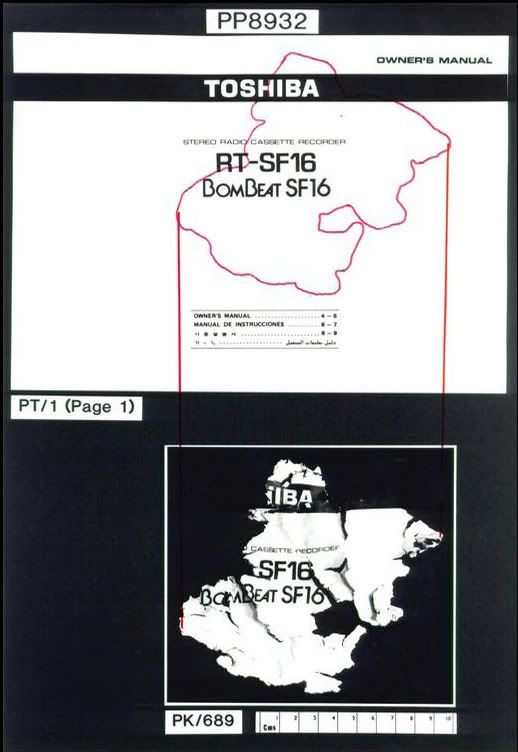
Hayes examined Toshiba manual cover PK/689 (left, bottom) on 16 May 1989 (by the lab notes) and decided "that the two-page fragment of paper appears to have survived a close-range explosion involvement." [p 2544] He fails to specify if he meant a small firecracker type of explosion, or a high explosives rupturing an airliner sort. But context makes it seem he accepts this as a genuine article from within the primary suitcase, as taken elsewhere, just a couple of inches from the blast center. Its not but torn and lightly singed at the edges, and was reportedly in even better shape before RARDE got hold of it. That's not a normal conclusion. Others can believe it only because they want to and because Dr. Hayes said so.

Then there's the strange evasiveness on his and Feraday’s part over damage to a "purple coloured holdall." Being of London origin and apparently from the neighboring container AVN 7511, it was likely damaged by whatever punched the hole in that fiberglass container. But the duo from RARDE insisted in their report it was damaged some way other than the blast. I can see no reason to be so adamant about that, aside from maintaining the dogma that all blast-damaged luggage was inside container 4041. It's not clear why exactly they couldn't just admit one piece in the next container over also was damaged. The dissembling and rambling amnesia of Hayes confronted with his insane work is evident here, as are some underlying dynamics of the method Hayes and Feraday used in their collaboration. (see "purple" link)

On the other hand, some of Hayes' conclusions on the evidence are apparently honest and potentially extremely relevant, until overridden. A one-foot square piece of hard-shell suitcase dubbed PI/911 is perhaps a smoking gun for what actually happened (see The Monster of Newcastleton Forest). By the examination notes of January 1989, Hayes felt the fragment's size and condition suggested it was the underside of a case beneath the bomb bag, resting directly on the container floor. By the time of the final report he co-signed with Feraday, flecks of blue plastic on it had changed that to the primary case, resting atop a blue soft-shell suitcase from Frankfurt.

This decision may have been crucial to the whole case, given the evidence of John Bedford and one or two brown hard-shell Samsonites, which, if stacked one on the floor and the other upon the first, would explain the explosion with eerie precision. Officially, the science has ruled this out - this had to be a second (or third) such case, coming in from Malta. The first one (or two) simply never turned up.

Blue Babygro Controversies

July 8 2010
(incomplete)
last update Oct 31


The “blue babygro” is a relatively famous piece of evidence in the Lockerbie case. It was originally a full-body pajama-type suit, perhaps of stretch material (hence “gro”), with foot covers built in. It bore a lamb motif in fluffy material across the chest. Bits and fibers of it were found everywhere in the blast-damaged luggage, suggesting it was in the bomb bag and perhaps wrapped around the bomb radio. It stands out as a morbid reminder that the plotters knew children might be killed, depending on the investigative phase a poignant in reflecting either Gaddafi’s infant daughter terminated by American bombs in 1986, or of the many children on Iran Air 655 more recently sent into the Persian Gulf by a Navy warship.

Among the numerous fragments of the item is the tiny body suit’s tag (left, from a video screen capture, "fire" line enhanced). Dubbed PK/669, it remained to show it was made in Malta (bottom line), spurring an early and fruitless visit to the island in the spring of 1989. On a second try in September spurred by the Frankfurt printout, investigators found that it was one of the more memorable items (along with the umbrella) that shopkeeper Tony Gauci recalled selling to the “mystery shopper” some weeks prior to the bombing. It was a breakthrough.

The following article from 2005 discusses arguments that Megrahi's lawyers were making to the Scottish Criminial Case Review Commission. The SCCRC was in the middle of a three year probe that resulted in a 2007 recommendation for a second appeal). Props to Buncrana at JREF for the tip.
Forensic mix-up casts fresh Lockerbie doubt
Tony Thompson
The Observer, Sunday 9 October 2005
http://www.guardian.co.uk/business/2005/oct/09/theairlineindustry.libya
Dramatic new evidence of forensic errors could see the man accused of planting the Lockerbie bomb win a new appeal against his conviction, The Observer has learned. Lawyers acting on behalf of Abdelbaset Ali Mohmed al-Megrahi are said to have uncovered anomalies suggesting vital evidence used to convict their client came from tests conducted months after the terror attack.
This refers to the Indian Head Forensic Tests, run largely by RARDE's Allen Feraday, a notorious manipulator of evidence. He oversaw the low end test and did not keep notes detailing the results and debris, relying instead on the notes of Scots policeman Harry Bell.

"Megrahi's lawyers now believe material produced during these tests was mistakenly presented to the court as if it were the original suitcase. One source told The Observer: 'To say that the evidence recovered from the ground at Lockerbie and the material produced during the tests became mixed up would be something of an understatement. They became thoroughly confused.

'It casts serious doubts over the prosecution case because certain items that should have been destroyed if they were in the case containing the bomb are now known to have survived the blast.'

In one instance a charred Babygro was produced as evidence that it had been used to wrap the bomb. However, new evidence has emerged which suggests the garment was completely undamaged when it was found. Instead, a similar Babygro used during the explosive tests was presented to the court.
[...]
Further tests are now set to be conducted to see how the mix-up happened.
The "new evidence" has never been explained that I know of, but it might be quite good. It's not clear what sort of "test"could find out why Allen Feraday might have slipped his test debris into the crash debris. If this mix-up happened, a "mistake' is one theory, but not the best.

SCCRC Findings:
At the time it may have seemed the SCCRC would follow such clues of frame-up, but in the end they denied all planting evidence allegations, their four public grounds (out of six total, two secret) all dealt with Tony Gauci's "identification"of Megrahi.

SCCRC news release, 28 June 2007
(PDF link)
"Main grounds that were rejected by the Commission [...] do not form part of the grounds of referral." The defense had "sought to challenge the origin of various items which the trial court accepted were within the primary suitcase,” including “a babygro” as well as the Slalom shirt, Yorkie trousers, and Toshiba manual.
“Underlying each of them was a suspicion about the conduct of the investigating authorities who, it was alleged, had manipulated, altered or fabricated statements, productions and other records in order to make out a case against the applicant. The Commission conducted extensive investigations into each of the allegations and is satisfied there is no proper basis for any of them. The allegations were further undermined by records recovered by the Commission from the Forensic Explosives Laboratory."
They presumably trusted the documents, so the finding is less than ideal. They did good by questioning Gauci's evidence, but get weak-kneed when it comes to active fabrication of evidence. How they could look at PK/689, hear Mrs. Horton's recall of it being even less vaporized when she found it, and still decide it really was in the bomb bag is beyond me, unless they were determined to avoid such a charge, to the point of being willfully obtuse.

Intact Discovery
I'll return when I've found the best sources that support the allegation the babygro was found in one piece at first.

Lab Notes
(Perhaps what the SCCRC looked at)
also forthcoming.

Timeline: Toshiba Radio Identification

June 4/5 2010

The following is a detailed timeline of the establishment of the radio model used for the IED that took down Flight 103. Led by Mr. Allen Feraday and Dr. Thomas Hayes of RARDE in 1989, the model they decided on was a black Toshiba BomBeat RT-SF16, was sold largely (76%) to a Libyan company. Thus, the very radio model became another clue of Libyan guilt, and like the rest became full of strange inconsistencies suggestive of a fraudulent investigation.

The dates are as given. Fudging and backdating cannot always be ruled out. There is in fact a serious and obvious insertion of pages within pages and apparently a missing original page 50 (a new twist on an old anomaly, to be explained soon). This affects the alleged timeline May 12-15. Emphasis is on radio case plastics, main circuit board, and user's manual. Speaker mesh, speaker magnets, a screw, some wires, and other bits appear sporadically but not worth this level of dredging for you or for me.

Note on evidence labeling: In example item PI/995, the "P" means property (evidence), the “I” indicates search sector it was found in (sectors ran A-K), and the number should mean the 995th item found or logged in I sector. PT however means evidence removed from other items (PT/35 was found inside PI/995, for example). Again, the numbers within the PT category are supposed to be sequential – PT/35 should be found right after PT/34. Such a label is often attached to all debris found within a piece, subdivided by letter (ex: PT/35(a), PT/35(b), etc.)
---
  • Late Dec and into 1989: Dr. Hayes’ examinations work (mostly) alphabetically, from PA/ to PB/ etc. It will take a while to get to PH/, PI/ and PK/ where the bomb damaged material and radio remains will be concentrated.
  • mid-Jan (date not noted): Thomas Claiden at AAIB finds a lump of materials, trapped in a fold of a data plate for container AVE4041. He hands it back to the police.
  • Jan 17: This is received by RARDE, and designated evidence AG/145. The largest fragment (left) is app. 10x6 mm, and another marked “02” was about 5mm sq.
  • Jan 17-22: Feraday: "very early on, I thought we'd probably got a white case, because I'd got white fragments with that AG/145 fragment." No others would surface ever.
  • Jan 23-25: Mr. Feraday takes a trip to Germany “to compare the Lockerbie circuit board fragments (AG/145) with the radio/cassette device recovered in Germany [Khreesat’s BomBeat 453].” No match. For one, Khreesat’s was black.
  • Feb 2: Feraday goes to Toshiba UK headquarters at Camberley, Surrey. He examined “over 130” service data sheets and found the AG/145 pattern “was tentatively identified as originating from a Toshiba brand portable radio/cassette player, model number RT-8016.” A same-day physical examination of that model supported that.[3023-24]
  • Feb 3: Feraday sends a memo to Senior Investigating Officer John Orr: “I am completely satisfied that these fragments originate from a Toshiba brand radio stereo cassette recorder types RT-8016 or RT-8026 […with] a white plastics case.”
  • March 15: last entry in Dr. Hayes’ examination notes for two months - next entries are in mid-May.
  • April 18-21: Indian Head forensics tests, Maryland. Five blasts in luggage containers are set up by Feraday. He prepares all the devices, using the RT-8016 in all. He personally oversees the low-end test, using 360 grams Semtex-H. He makes no detailed report, relying on DCI Bell’s police report, which he’s not even sure RARDE got a copy of.
  • April 23-May 1: Feraday visits Toshiba HQ, Japan, learns the board he’s looking at was put in seven different models. One and only one of these is, surprisingly, given the BomBeat title - the RT-SF16. Identical to the 8016 except for the black case. And it had its Libya links
  • ??: Control sample PR/105 is obtained – RT-SF16 new in its box. The owner’s manual is “removed” from this “evidence” and dubbed PT/1. PT otherwise means actual blown-up evidence removed from other real evidence. Here they emphasize the “removal “ of PT/1 from “evidence” PR/105. 
  • May 11: radio manual cover PK/689 is received at RARDE. Supposedly from the bomb and found in a field in K sector near the North Sea, it’s ripped but can be read to announce “..Hiba … o cassette recorder … SF16 … BomBeat SF16.” It matched the control PT/1. Gosh, why didn't they call this in earlier? Afterwards, items are said to be from the RT-SF16. However, see June 30.
  • May 12 (by lab notes): “PT/2” is discovered – five crumpled bits of paper, consistent with same spot on most pages of PT/1. Found in clothing PI/995, along with (but not included in) PT/35. PT/35 included 11 bits of black plastics PT/35(a), the famous PT/35(b) (non-radio), and speaker mesh PT/35(c).
  • May 15: Hayes discovers black case plastics PT/41(a), and PT/42(c). 
  • May 16: Hayes examines PK/689 (above, left). “And I've concluded there that the two-page fragment of paper appears to have survived a close-range explosion involvement.” Hayes discovers case plastics PT/34(b), manual papers PT/34(c).
  • May 18: Hayes discovers case plastics PT/38(b), PT/40(b), PT/48(b), PT/78. Manual PT/40(c)
  • Mid-May, presumably (dates unavailable) – Hayes discovers case plastics PT/32(b), PT/33(b), PT/36(d), PT/37(a), PT/53(a), PT/56(a), and PT/61(b).
  • May 22: Hayes finds manual scraps PT/56(c).
  • June 1: Hayes finds PT/31, ten tiny bits of RT-SF16 manual, examining the 'blue Babygro' PK/2209.
  • June 8: Hayes discovers tiny radio circuit board fragment PT/30 embedded in suitcase fragment PK/2128. It’s about 4mm square.
  • June 18: DI Williamson claims in a letter to SIO Henderson that Feraday discovered the ”potentially most important” PT/30 this day examining PK/2128 [Leppard 207] Either way, it was shown to fit the same Toshiba board as AG/145 did (all labeled together in a prosecution photo). Clearly RT-SF16.
  • June 30: Feraday notes: "On the 30th of June 1989, some explosively damaged paper fragments [PK/689] were received at this laboratory, thus conclusively establishing which of the seven models of the Toshiba radio had been employed in the Lockerbie bomb.” He meant May 11. “It's a mistake that I made when I wrote the reports," he explained under questioning, "because sometimes items would come and go to the laboratory several times.”
  • July: Feraday attends a second set of four blast tests in the U.S., again using RT-8016 radios.“Mr. Feraday, you referred earlier in your evidence to having taken part in explosion trials in the United States in April and July of 1989 … nine in total…”
  • Aug 17: Dr. Hayes does an examination on AG/145. (first ever?) "A small quantity of aggregated partly carbonised material from which many fragments were recovered."
  • September 14: Feraday visits Dextar looking for matches to PT/30 (no luck) [Leppard 208] See also, Forensic Follies.
  • Late 1989 (date unclear): Dr. Hayes retires from RARDE. His slot as head of the explosives division is taken by Mr. Feraday. Hayes continues unofficially as a "consultant" for three month, then extended.
  • Nov 12, 13 1989: FBI interview with Marwan Khreesat in Jordan – the RT-SF16 has been decided on. Khreesat says he’d never use such a radio, is absolved of suspicion.
  • Dec 19 1989: date of DI Williamson’s letter regarding PT/30 cited above. He’s asking for more evidence from Germany – alarm clocks - to see if it can match up with PT/30. [Leppard 207]
  • ... 1990 ... 1991 ...
  • Nov 15 1991 - Indictments read out against Megrahi and Fhimah, using the identified RT-SF16 as part of its evidence. The rest is history.
---
Sources:
Leppard, David.On the Trail of Terror: The Inside Story of the Lockerbie Investigation. London, Jonathan Cape. 1991. 221 pages.
Testimony of Allen Feraday and Thomas Hayes, Camp Zeist NL. Days 16-21, June 6-15 2000. Too varied to cite individually.
Others explained at provided links

Lightly Explosion Damaged

Two Scientists, a Purple Bag, and a Possible Clue
Adam Larson / Caustic Logic
First posted Nov 29 2009
re-posted here March 23 2010


Going through the court transcripts of the Lockerbie trial at Camp Zeist, one point of interest that I ran across concerns the testimony of RARDE scientist Allen Feraday. This was on June 15 2000, day 21 of the trial (read the LTBU daily report in .doc format, outlining some of the controversies). The witness himself reportedly has little in the line of formal qualifications, citing a “higher certificate in applied physics” as his qualifications; He’s still conceivably capable of brilliant professional work; but judging by some previous high-profile anti-terrorism cases he’s been involved in, he could be seen as more of a “manager” of evidence than a reasonable assessor of it.

Feraday’s scientific findings relating to the Lockerbie investigation are inextricably linked and confused with those of his underling, Dr. Thomas Hayes, who has a proper PhD. I don’t know the arrangement, but Ferraday mentions analysis of the luggage and clothing that “was essentially done relatively early on, by Dr. Hayes, and then, obviously, checked by me.” (p 3328) The two are more famous for their handling of the miraculous timer fragment PT/35(b); Hayes found it in a shirt collar and alerted Feraday, who passed the news on to Williamson, and thence to Henderson, Marquise, Thurman, “Orkin” and the history books. In testimony Feraday also clarified the interchangeable nature of their collaboration “I did not always, when I was looking at [evidence], make any difference between myself and Hayes” (p. 3332)

The prosecution generally seemed to feel the same way; their habit of asking questions of Feraday better suited for the earlier witness led Mr. Keen to lodge for private audience with the judges. Once Feraday was sent from the room, Keen argued in part:
According to the evidence of this witness, he prepared the final report on the basis of his examination of certain matters, and by considering Dr. Hayes' notes. What my learned friend appears to be inviting is hearsay evidence […] I object to the Crown canvassing hearsay evidence, even in the context of what is referred to as a joint report, in respect of such a matter. If they wish to take direct evidence on this issue, then they had ample opportunity of doing so with Dr. Hayes. And in my submission, it is not competent for them to take hearsay evidence on this matter from Mr. Feraday. (pp 3215-3216)

Nonetheless the questioning continued in a similar line, a hundred pages later coming to my point of interest, the unusual collaboration on another piece of evidence: a damaged piece of luggage, described as “a purple-coloured holdall” and labeled PH/137. This bag, Feraday had wrtten in his final report of 1989, had within it two metal fragments “which both originate from the primary IED suitcase,” so it should be of some interest. Mr. Keen for the Defense addressed Dr. Hayes' draft report during his questioning of Feraday. He cited page 23 as listing categories including "Likely Explosion Damaged Luggage,” and noted that one item listed in that heading is PH/137. Feraday confirmed these facts while comparing with his own copy.
Q So from Dr. Hayes' draft report -- and I think you just told us he prepared this part of the report -- we can see that he designated this as explosion-damaged luggage?
A I think it was lightly --
Q Lightly explosion-damaged luggage?
A Yes.
(pp 3330-3331)

This attitude would help explain Feraday’s own notes, Production 1498, in which Keen noted “that nowhere in the index” and in fact “nowhere in your examination notes does the item PH/137 appear.” The witness confirms to both “that's correct, sir. Yes.” Of course lightly blast-damaged was a fudging statement and further probing shows him to believe it wasn’t in the explosion damage at all. Next Mr, Keen pulled up a photograph of this item. (Production 181, photograph 91)
Q It is apparent, is it not, Mr. Feraday, that you have not signed the label as it is photographed in photograph 91?
A That's correct, sir. Yes.
Q But your signature now appears on the label PH/137 in court?
A Yes, sir.
Q When did you sign that label, Mr. Feraday?
A When I had the bag back to write this -- the final report.
Q And what date was that, Mr. Feraday?
A I can't tell you without looking it up again on a list, I'm afraid.
Q Are you saying that that was before December 1991?
A I think it must be, yes. I finished the report by then, so yes.
Q And are you saying that you examined PH/137 before you finished the report?
A Yes, sir.
Q Where are the notes of that examination, Mr. Feraday?
A Well, there aren't any, because as I said, I did not always, when I was looking at them, make any difference between myself and Hayes -- although in this instance I did, and I told him so, that in my opinion you couldn't necessarily put that in the explosion damage. I couldn't convince myself that it was explosion damage. Prior to that, Hayes had written this preliminary report for another purpose -- I think the Fatal Accident Inquiry --
(pp 3331-3333)

So if I’m reading this right, he disagrees with the actual PhD scientist, but did no detailed, documented, admissible examination of his own to back this up. He couldn't recall when he made his divergent inspection, but did immediately recall that he made no notes for it. His lack of notes in turn is justified "because" they agree on things, "although" not in this case. Got it.

Notes or not, the reason for Feraday’s divergence seems to be an unexplained lack of conviction, with which Hayes lodged no disagreement:
Q And you recall --
A Sorry, I'm waiting for the --
Q I don't think you had finished, Mr. Feraday, so do finish your answer if you wish.
A Sorry. I came to the conclusion that I couldn't myself put it in the explosion – necessarily in the explosion-damaged baggage. I'm not saying it isn't, but I couldn't convince myself. And I still can't. And for that reason, I had a word with Hayes, and we agreed to put it in the second section.
Q So you -- you recall discussing this with Dr. Hayes, do you?
A At some stage I discussed it with Dr. Hayes, but I can't remember exactly when or if, in fact, it was when the -- I wrote the final report. And then Hayes certainly came in, obviously, and read it all and then signed, and we went through each item then. We through the report, if you like, line by line.
Q Line by line, Mr. Feraday?
A Well, he read through it, obviously, line by line.
(pp 3333-3334)

This implies no disagreement; Hayes was able to check Feraday’s findings and found no problem with the exclusion of PH/137 that Feraday had already decided on and reported. Next, Mr. Keen turned to Feraday’s given reasoning, in that report, to support his agnosticism.
Q If you would like to turn for a moment, Mr. Feraday, to your report 181 at page 51.
A Yes, sir.
Q Now, we can read this section for ourselves, but I'd like to look in particular at the third paragraph on that page, which you corrected during your examination in chief chief [a meeting just before his questioning - ed] by proposing the insertion, after the fourth word in the first line, of the word "other"?
A Yes, sir.
Q Now, taking the paragraph, of course, in its context, can we read that corrected paragraph. It states: "As there are no other penetration holes in either the holdall or the plastics bag, it appears most likely that these two fragments, which both originate from the primary IED suitcase, were picked up and placed inside the plastics bag, which was then itself
placed inside the purple holdall for convenience of carriage."
A Yes, sir.
Q Now, I have to suggest, Mr. Feraday, that if you insert the word "other" into that paragraph in the context of this section, the paragraph is deprived of sense or content.
A Is ... ?
Q Deprived of any sense or content. It tells us absolutely nothing if you correct it in that way. What do you say to that?
A I am not sure what you mean. But what it would then say is as there are no other penetration -- at the top of the page, I am talking about the ragged horizontal cuts which, obviously, one can see as penetrations. I see them as cuts. Now, in dealing with, first of all, the holdall, there are no other penetration holes in it, other than those that I've already said about the cuts. And in the plastics bag, there were none, the plastics bag which contained the two fragments of metal from the suitcase. So I was left scratching my head as to how they can get inside there, in a plastics bag, if they didn't come through any part of the bag.
Q Do you --
A I can't convince myself they come through the ragged cuts.
Q You recollect the label attached to the plastics bag, Mr. Feraday, having said "two pieces of metal, charred, found within baggage."
A Yes, I do, sir.
Q And you recollect finding penetrations in the side of the bag that went right through to the interior of the bag?
A Horizontal cuts, yes, sir.
Q But you felt it pertinent to remind us that there were no other penetrations in the bag, Mr. Feraday; is that right?
A Not big enough for the -- for anything to do with the two pieces of metal. That's correct, sir, yes.
Q But the penetrations you'd already found were big enough for the penetration of the two bits of metal?
A Oh, yes, sir.

Q Well, that might be an appropriate point, My Lords, if there is to be a short adjournment.
LORD SUTHERLAND: Yes, very well. We'll adjourn for 15 minutes.
(3334-3336)


I can only paraphrase Michael Palin in The Holy Grail “what a strange person.” Mr. Feraday’s stated reasoning then seems to be that even though these shards could fit through the penetrations if explosively hurled there, he couldn't convince himself this was what happened and chose to think of them as surface "cuts." Who knows what caused these cuts - perhaps the hold-all fell through a tree before landing. And the two unrelated IED suitcase bits were found elsewhere and simply put in the bag far carrying, with no note about being found elsewhere. His report first supported this saying there were "no penetrations" in the bag, corrected only in his examination in chief (a meeting just before his questioning) to "no other pentrations," aside from the "cuts" that they probably did enter through.

His references to the plastic bag is curious. This would clearly seem an ad hoc evidence bag (probably not a proper one or he’d teerm it as such), into which the shards were placed after being found. This would be a careless and illogical move, but I don't see anything else making sense. Transferring these also into a bag they weren’t found in makes this faux pas worse – something Mr. Feraday should have reported rather than just using it as he did to remove the explosion from PH/137. A lack of damage to this evidence bag is also cited as a clue these didn't fly in thru the cuts: “[T]here are no other penetration holes […] in the plastics bag […] which contained the two fragments of metal from the suitcase. So I was left scratching my head as to how they can get inside there, in a plastics bag, if they didn't come through any part of the bag.” This in particular is a ridiculous non-sequitur, but another clue to Feraday this was not explosion damage.

In the most rational explanation for this thought process, perhaps he just meant, "obviously, the bomb didn't put these metal shards in the plastic bag, one of our people did. Therefore, they probably got the scraps from somewhere else, but threw them in there instead." And perhaps if we could see the evidence we'd see why he felt the shards did not just enter through the tears. But for whatever intention, he effectively erased this piece of evidence from the bomb site picture – where Dr. Hayes had already placed it - based on his unexplained solution.

Although he comes across looking incompetent – nearly always looking at the wrong exhibit and frequently befuddled - I suspect Feraday is not actually an idiot. Therefore, if he seems like one, he may be playing dumb and that's often a clue. However I simply don't have the information to know just what this might mean. Detailed information on loading procedures at Heathrow could tip us off to where this bag might have wound up. Was the location of this item relative to, say, the Bedford suitcase, troubling in some way? Considering Feraday's strained logic over this issue, I suspect we may be looking at a valuable clue, if just another on the pile indicating he was not playing on the level with this investigation.