
Showing posts with label Norrie C. Show all posts

Explosives Revisionism and "No One Did It" Theories

18 September 2010
last update Feb. 13 2011

I recently asked for help with the contents of this site, soliciting input from the community, and as expected the most interest came from those I'm least inclined to agree with. I'd like to expand the voice of the Divide, but there are some things I just can't bring myself to support with publication here. Where the different theories fall relative to each other and what I accept and why is explained in part here.

Two groups of claims questioning what happened on the plane have become mixed together in my mind and jointly ignored until now. Those who propose a drastically different bomb detonation than alleged took down Flight 103, and those who say it wasn't a detonation at all, but an accident.


Inherently I agree the explosive force as stated is not necessarily correct, although I do suspect it's reasonably close. First, it's not clearly decided anywhere. The Zeist judges wound up taking away a median of 400 grams of Semtex-H, give or take 50, so 350-450. But the Indian Head forensic tests of 1989 found the container damage observed was consistent with the blasts done using between 454-680 grams, and not the lower amounts. There is reason to believe the higher end of that is closer to reality.

And more recently Dr. John Wyatt's unusual tests say that only a blast as low as 150 grams or less might possibly have have left the electonics remains investigators found. And to make PK/689 legitimate evidence, the bomb might have to be more like 20 grams.

I'm not going to argue the bomb was so small it couldn't rupture a suitcase - the clear solution to this is to suspect the poorly fitting evidence was planted poorly. But clearly there is a lot of room for fudging between the intact paper and the ruptured cargo pallet and plane.

As I recall, there are also some genuine-sounding mysteries over residue testing that seemed to suggest a different explosive than Semtex-H (or in addition to?) was responsible. If anyone is excited to explain this a bit better, feel free to do so in the comment section below. I'll try and dredge it up myself if and when time allows.

The rest of this post, however, is stuff just I don't buy. Partly because I don't trust these theories or theorists to get it straight for me, and partly because I don't know the science to be sure myself, I must call these theories worthy of discussion - in the comments section below and nowhere else on my blog (until further notice anyway).

John Parkes on the bomb's power
As reported in Scottish lawyer's magazine the Firm, August 2006.
John Parkes, an explosives engineer present at the crash site in December 1988, who reported damage indicating the carriage of munitions on the plane. Parkes helped in the rescue operation when the Boeing 747 came down on part of the town, killing 259 on board and 11 on the ground. He claims wounding he observed on three bodies recovered from the crash site, and on one young female victim in particular, were not caused by Semtex-based explosives as claimed in the trial.

"Every munitions or explosives device has its own characteristic signature," Parkes says. "The signature I saw was not consistent with the device they maintained was used. There was not enough power or heavy material around that device to have gone through the luggage and floor and through the back of an aircraft seat to inflict these wounds."

[Dr. Jim] Swire has asked the Crown Office to explain why this testimony was not included in the Air Accident Investigation Board report, asking "whether the AAIB gave any reason for rejection of Mr Parkes's ideas, and if so what that reason might have been".

I have great respect for Dr. Swire, but sometimes...

Well, just off the top of my head, Parkes reported the injuries to a girl he felt were consistent only with explosives coming up through her seat, injuring her feet and backside. First, it's unfortunately gruesome and sad as a "smoking gun," and for obvious reasons unverifiable. Second, I'm not convinced Parkes knows what to look for in such an unusual case, and could just be confusing a tree impact after the fall with shrapnel tears from before.

We could check by looking at damage to the floor panels this shrapnel would have to tear through. I had imagined most of this would have been found, perhaps warpedby he overpressure, but not torn up. But according to the AAIB report, many floor beams were fractured and none of the panels in the immediate blast area were recovered (that they admit!). So we can't say one way or the other.
The cabin floor structure was badly disrupted, particularly in the general area above the explosion, where the floor beams had suffered localised upward loading sufficient to fracture them, and the floor panels were missing. Elsewhere, floor beam damage was mainly limited to fractures at the outer ends of the beams and at the centreline, leaving sections of separated floor structure comprising a number of half beams joined together by the Nomex honeycomb floor panels.
Admittedly, that sounds worse than I'd expect, but then again, those beams can't be too solid. Planes rely on lightness, and simple gas over pressure might break up some beams and tear some flooring loose, without ripping through it with shrapnel. To send material tearing up through several filled suitcases, the container top. bay liner, cabin floor, and the seat structure to just stop at injuring this girl - rather than slicing through her - would require a truly massive explosion with supreme control. The focused 20-inch fuselage hole just two feet from the explosion cannot be consistent with such a blast, nor the luggage container or anything in it. I can't buy that's all faked.

Different bomb location
The above theory may also imply a different location even than the missing panels, depending where the girl was seated. I don't think this was ever sorted out, as she was to my knowledge never identified to Parkes.

Then there's temper tantrum Blogger Charles Norrie and his CIA bomb on top of an Iranian one. He cites a statement from Parkes, perhaps reflecting the seating issue above, that "a minimum of two high explosive events took place inboard Pan Am 103." Norrie also points to the twin debris fields, north and south, which could have many explanations in a complex breakup like that of Flight 103,even without another bomb.
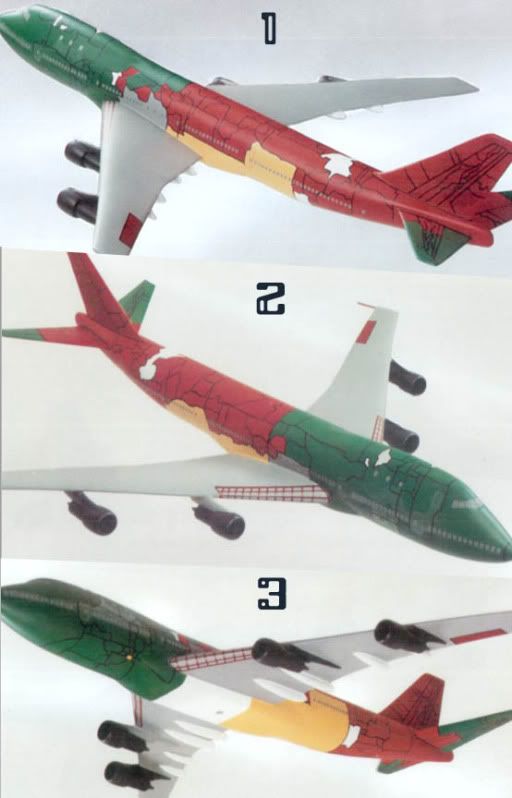
For the location of the second blast, Norrie cites a missing section near the rear cargo area which must have been all vaporized by a "brisant explosion." See the image at left (new window for larger view), of the AAIB's painted model. Those sections coded in white were never recovered. Charles would be referring to the section on the lower rear of the craft (seen in view 3). But many other sections at random spots were missing as well, in at least seven apparent "brisant explosions" all over the plane. For whole panels of aluminum to disappear in Scotland might seem odd, but there are a lot of lochs that maybe weren't fully dredged, and the North Sea's not that far off for high-drag items. Perhaps a few still linger in private collections, bought from enterprising rural Scots.

But more prominently, a number of experty people have made themselves quite sure that mathematics prove the bomb was just a foot away from where it was reported, just outside container AVE4041, rather than inside it. These include onetime AAIB investigator named Protheroe, who now says the "mach stem" effect was calculated wrongly, suggesting 25 inches was between the bomb and the airplane skin. This distance, which fits with the physical evidence of the luggage container, is supposedly trumped by his new numbers saying 12 inches. This would mean the container evidence must be faked to appear the bomb was inside it. It also suggests someone planted the device directly in the plane, rather than remotely in luggage, as generally accepted. No explanation, Just math.

Edwin Bollier started trying to sell Libyan clues to the CIA within days of the bombing, was listed as one of the three important witnesses at Camp Zeist against Megrahi. Now he champions Libya and Megrahi as "wrongly accused," with mostly bogus claims, and he supports Protheroe's 12" revisionism.

I had thought further support could be found from Canadian researcher Ludwig de Breackeleer, but thankfully not, on closer look. Most of his other work on the issue is great, and as a science guy at heart (physics), the contribution he's most qualified for questions the official blast size, which is valid. He concludes, based on actual shown math and presumptions I haven't double-checked:
As the explosion of one pound of SEMTEX H inside the luggage container does not generate a blast wave sufficiently powerful to fracture the skin of the fuselage, we have little choice but to conclude that the verdict appears scientifically implausible.
One pound being about 450 grams, that's the upper edge of what's officially accepted. Dr. Ludwig's science fits with what I already observed at the top - something significantly over that seems a better fit with the most believable physical clues. (though I'd wager not enormously higher - perhaps 150-200% of that). I'm heartened to learn this.

No One Did It
The accident theory has two variations. The first proposes an unintended detonation of military munitions being carried secretly on the plane. This is advanced by one "Robbie the Pict" in the UK.

The other proposes no explosives at all, but a failure-induced decompression, and is advocated by a John Barry Smith in the US and also I believe this was the thesis of Carl Davies, proprietor of the Plane Truth website.

Further commentary for and against these theories can be submitted in the comments form below. Any highlights I feel worthy I may pull up and include in the post.

(more text, links, etc. forthcoming)
---
Update 2/13/11: I have some gripes from Robbie the Pict, which I still need to address re: the above and see if he's got a point. Otherwise, I have to revise my above take on deBraeckeleer. I hear he's been incommunicado for a couple of years now, but I didn't realize that as I tried to e-mail him recently as follows:

Dear. Dr. deBreackeleer,

Greetings. Adam Larson aka Caustic Logic of the Lockerbie Divide here. I've been appreciating your works for quite some time now, especially the interviews and original quotes. Some great work on the Khreesat and Autumn Leaves angles. I've been meaning to get in touch with you, just to see what that might yield.

I'm most interested in where your expert credential are most relevant, with your analysis of the force required to rupture the plane's hull in the first place, as explained in this article: http://www.canadafreepress.com/index.php/article/8920

I have in the apparently misunderstood that article twice now, in two different ways. I just reviewed it again prior to writing, and decided I should just ask you directly what's unclear to me here. The abstract says location is the issue, and that's an issue I have some problems with.

Unfortunately for the stated goal of reaching the masses with simplicty, I have a hard time following it. Positive impulse? Critical time, wavelength, greek letters... Perhaps I should go study up on this, but actually, cutting to the last portion seems adequate for my purposes.
The outside wall of the AVE 4041 container was located at 16 inches from the skin of the plane. At this closest possible distance in the light most favorable to the original investigators, experimental data indicate that one pound of explosive will generate a positive impulse of less than 20 psi-ms against the fuselage. [27]
So from this it seems the force on the skin would be dependent on original power and distance. Correct? The force you've taken is 450 grams, which is the upper end of the range the judges accepted: 400 grams, give or take 50. Since "at this closest possible distance" is the qualifier for the inadequacy.
As this value is well below the critical impulse calculated above, namely 50 psi-ms, we have little choice but to conclude that the Lockerbie verdict is scientifically implausible.
And the AAIB decided on 25" from the hull, not 16, strengthening the point. I'd defer on what I can't verify, and concur in general. But I have a hard time seeing the blast being much closer. The luggage container appears to be blown outward in all regards, and that's one piece of evidence I tend to accept. In fact, I've never seen anyone come out and argue or allege it was faked, even as it's been implied over and over, including by an AAIB scientist himself, no less.

I'm not trying to get you endorse any theory or another, but in your scientific opinion, is it possible that the location is about as reported but the blast force was simply higher than reported? Could a wave emitted from, say, 700 grams (or maybe 900?), but from the AAIB's rough placement well inside the container, make it plausible by these same methods?

I do have some reason from other quarters to suspect the blast weight was fudged way down, in part I surmise to half-explain the manual cover and other - erm - dubious clues. The primary suitcase we've been shown might not be that at all, for one thing...
V—ADDITIONAL COMMENTS
In the immediate aftermath of the tragedy, researchers at the Center for Explosives Technology Research in Socorro, New Mexico, estimated that up to 30 pounds of explosive was needed to destroy a Boeing 747 if the explosion had occurred in the container. [28] We agree with that estimate.
30 pounds? If I could decipher it, I'd ask to see the math on that. Investigators got it wrong by a factor of 30? I would have suspected a factor of maybe 2 or 3, so as to not appear amazingly ridiculous to other scientists like yourself. Did their models have it placed in the relevant spot, or stuffed in the middle of the container, or the upper corner?

Clearly your point here is to suggest that it was not in the luggage container, but isn't that a bit hyperbolic? Maybe unwarranted?

Beyond that, if you're at all inclined after that, I'd be interested in interviewing you by e-mail for my blog. It might increase your profile a bit, give you a few new viewers. I have Slovenian viewers out my ears all of a sudden. And either way, kudos on some very valuable contributions to a worthy field.

Best,

Adam.
---

Charles McKee's Suitcase

17 September 2010
(incomplete)

In the recent murder trial of two Libyans for the Lockerbie bombing, reference was made to the fact that a suitcase belonging to Major Charles McKee, a senior CIA agent who had been involved in the negotiations for the release of hostages in Beirut, had been mysteriously carried away from the piles of wreckage left by the crash and even had a large hole cut into it before it was returned to the investigators. The specific intention of cutting the hole, it was agreed, was to inspect the contents of the suitcase long before its evidential value could be established.
- Paul Foot, Flight From Justice, page 9

The enigmatic major McKee is central to the discredited drug swap theory - the main target, in fact, for planning to rat out the CIA protection of a terrorist heroin pipeline. This was supposed to be related to freeing the hostages in Lebanon, which McKee was also working on in a high-level manner. McKee's targeting by the CIA is also central, in a different way, to Charles Norrie's theory; as his book A Tale of Three Atrocities explains:
The explanation came to me very quickly indeed. Poor McKee was killed by his colleagues. Unknown to him, his last duty was to help them locate baggage container AVE4041 PA among the debris, by using the transpondered suitcase he was carrying. [...] Transpondered suitcases must have a basis in fact since they appear frequently in fiction, for example in recent film No Country for Old Men.
As for why, he writes:
Once the CIA had used McKee's suitcase transponder to locate it, it must have been easy to determine which baggage container was AVE4041 PA. [...] In the remains of AVE4041 PA, the CIA placed a pre-blown suitcase, the remains of a Toshiba cassette recorder and various miscellaneous items. They hoped that, when the Lockerbie investigation team found the suitcase, they would follow the concocted evidence to a suitable CIA selected target, which would become Libya.
Norrie believes the CIA approved this operation, so it might have been better to include pre-blown materials in a suitcase to be placed right next to the bomb. Done. This tromping around in the open after the fact seems to me incompatible with someone who was in on the set-up.

More to the point, there was no intact "luggage container" near McKee's bag. Pieces of AVE4041 were scattered across many square miles. Likewise the suitcase fragments would have to planted across H, I, and K sectors - a wide swathe indeed. McKee's suitcase is described as item PD/889, suggesting it was found in D sector, near Lockerbie itself and miles west of the Samsonite remains.

All you'd need a transponder for is to locate a bag with sensitive (???) you didn't expect to become compromised. But you were prepared for the unexpected - you follow the bag's signal, remove and conceal the sh*t, then put it back before anyone notices, if possible. In fact, it seems that's what happened, except for the part about not being noticed. For one, they didn't just open the bag, they cut it open in a way that was clearly not from the explosion, nor likely there before. The scientific report from RARDE, signed by Hayes and Feraday noted:
PD/889. This is a partially disrupted grey hardshell suitcase. The suitcase measured 685 millimetres by 510 millimetres by 190 millimetres and was constructed from a rigid dark grey sheet plastics with a simulated leather finish, lined with a woven cream-coloured material backed with a white fibrous material which adhered to the grey plastics skin. The suitcase was fitted with a rigid plastics handle, bright metal trim and locks, which were devoid of any proprietary or owner's identification. A rectangular hole had been cut in the hard shell above the handle.


The left-hand edge of the suitcase showed evidence of having been damaged by an explosion, with disruption and blackening of the outer skin and bright metal body frame.

This had come up in a JREF discussion of Norrie's theory. Therein a notion was mentioned that the cutting was "to remove a secondary security lock that incorporated some kind of anti tamper device that would destroy the contents if activated." That would be a better explanation that removal of the transponder, which would only require the lock picked or opened with the known combination. Such a special lock mechanism would require special manufacture, perhaps by a CIA proprietary company. This then could explain the removal of all identifying markings (why a secret company's labels would ever be there is, however, left un-answered).

RARDE Dr. Thomas Hayes gave interesting details about the bag in his evidence at Camp Zeist in 2000 (day 16, pp 2637-2641).

Q Now, I would just like to examine your contemporaneous note of this case a little further, Dr. Hayes. If we look to the right of your diagram, we see the reference "Unidentified suitcase"; is that right?
A Yes, it is.
Q And then the entry "Labels, name tag, brand name apparently removed."
A Yes.
Q All of these items had been removed from the suitcase. And then, if we look to the left at the diagram, we can see the notation "Hole cut"?
A Yes, we can.
Q Do you recollect this case and its examination, Dr. Hayes?
A No more clearly than any other examination, I'm afraid.
[...snip - discussion on whether "sawn" or "cut" was the better word for the obvious rectangular hole...]
Q Taken together with the removal of all labels, name tags, brand names, would that perhaps attract your attention, Dr. Hayes?
A Yes, it would.
Q And if we go on in your notes, after you record "clear indications of explosives involvement", do we see in the margin towards the bottom of the page "PD/889 attached above"?
A Yes, we do.
Q And then plastics bag and contents with attached ID label marked "Contents of grey suitcase belonging to Charles McKee."
A Yes, I see that.
Q Was it disclosed to you that Charles McKee referred to there was in the service of the United States government?
A No, it wasn't.
Q Or that this case had been returning from Beirut?
A No.
Following this, he was asked about his description of the case's contents.

Q I see. You then make this entry: "Contents: Assorted clothing with [sic] unlike the suitcase from which it was supposedly taken showed little evidence of explosives involvement."
A Yes, I did.
Q Now, I see the use of the word "supposedly" employed by you, Dr. Hayes. And I take it you chose that word with care?
A Yes, I did.
Q And was that intended to convey that in your own mind the assorted clothing which had been passed to you labelled as the contents did not appear on the face of it to represent the contents of the suitcase which had been damaged in the way already described?
A Yes, that's certainly one interpretation.
Q Indeed, looking to this case and the examination note on page 22 as a whole, the reasonable inference, is it not, is that some party has interfered with the case following the disaster and prior to it being made available to you for forensic examination?
A That is an inference that could be drawn.
---
This is certainly an interesting story in its right, but I for one suspect it's no clue to the attack itself or the larger cover-up. More likely it's simply a nexus of two separate paths of clandestine mystery, and until I change my mind on that, the subject probably won't come up much around here. McKee's unusual profile make him useful to attach new fictions to - reminiscent in fact of Abdelbaset al Megrahi's clandestine  appearance on Malta earlier that day.

A Tale of Three Atrocities

A Decidedly Different Take
20 August 2010 (incomplete)
last edits 27 August

A tale of three atrocities is the name of an unusual little book written by an interesting acquaintance, Mr. Charles Norrie, as of recently available in an on-line form. Mr. Norie is an English family member of an alleged Libyan atrocity, having lost his brother to the 1989 bombing of UTA 772 over Niger.

While he does accept Libyan guilt in that attack, Norrie has taken a major interest in the lack of a case for Libyan guilt in a second atrocity, the Lockerbie bombing. His unusual position has brought him to sign, along with myself and others, the most recent petition of the Justice For Megrahi campaign.

First, I’m one of the few people Charles has blessed with a hard copy of the mythic "green ATOTA," and I think I’ve read all of it by now, but never all at once. It's a neat little book, slick design, size and shape like a small company's annual report. The layout is tasteful, with full color photographs and glossy finish. (see image at left, atop my small Lockerbie library).

That's what you can't see in the Blogspot posting, but the text is the same (I presume) and can finally be seen by a wider audience. The writing is decent, with spots of genius and others of just cleverness. The actual ideas, the methodology and presumptions behind them, are more problematic for me. I’ll attempt to summarize a bit clumsily from my half-understanding.

Much of what’s in ATOTA is well-reasoned - especially when it comes to spotting problems with the official story against Megrahi, or with linking the 103 bombing to the third "atrocity" of the title. Along with myself and many others, Norrie believes the cause of Lockerbie to have been the 1988 downing of Iran Air Flight 655. While he suspects the associated PFLP-GC clues were just as fake as the Libyan ones (they were the original "scapegoat"), his concept of the “Qesas” revenge code is compelling. This would mean an Iranian hand was required to “pull the trigger,” perhaps a family member of an IA 655 victim.

London is the place this was done, apparently for operational security reasons. Would terrorists be so daft as to introduce their bomb two airports away and trust fate to pass it through each screening? I happen to agree on London introduction, in part for the same reason, and Iran Air’s terminal was in Terminal three at Heathrow, not far from where the bomb was finally loaded, via container AVE 4041.

The technical details ATOTA proposes are what get confusing. It  seems he’s saying the bomb was not inside of luggage at all, but rather attached/built into the luggage container to resemble a repair patch. To not stand out, he agrees it would have to be, at most, one inch thick, this explosive device with an ice cube timer, and faced in rough aluminum. He reasons "if the bomb was in a suitcase it would have been spotted on the morning of 21st December by Heathrow baggage handlers." Well, it was, apparently as part of a  matching set.

It almost seems Norrie is adding a shape-charge aspect to the 1/2” thick bomb notion. As he explains:
The official explanation for Lockerbie is that a bomb was concealed in a suitcase. Yet a bomb in a suitcase would explode in all directions. In contrast, the hole in the side of the plane seemed to indicate a unidirectional explosion. This makes sense if a bomb was attached to the side of a luggage container, slightly above the bottom.
Actually, the blast that’s alleged would be fairly uni-directional, relative to the nearest hull metal - inside pointing out. In fact, being inside the container and a bit lower than shown (at left, from AAIB report) could explain the low cut-off of damage (red hatching). It could be cut off by the layer of bags above.

This supporting passage has me scratching my head still:
Peter Claydon told the court the bomb created an 8-inch square hole in AVE4041 PA and a 20-inch square hole in the skin of the aircraft.
I’ve read Mr. Claiden’s testimony and found no such statement. This would have to be a very unidirectional explosive device to leave a square hole after detonating, and the same size as the 8” square repair patch he shows in a photo on page 13. In fact, the damage to the outboard panels was measured in feet.

The closest thing I can see to an 8-inch hole is the opposite - a chunk of metal about that size that Claiden felt was from the middle of a huge span of completely missing metal (labeled "e" at right, from AAIB report). This was at almost exactly the bomb position, and his hunch that this intact metal is from there remains bizarre and inexplicable.

Norrie’s theory also goes deeper than Iranian involvement, suggesting the Americans were involved in the plot as well - to ensure its success. The primary evidence he cites for this is the second explosion, at the other end of the plane and triggered 14 seconds later, it had to be an independent device that proves "Megrahi cannot be guilty."
I now believe the cause of the additional blast was a CIA 'insurance bomb'. Its purpose was to guarantee no one survived the bombing, ensuring the Iranians would be completely satisfied with the operation, and the Qesas condition fulfilled.
I think this was to deflect wider promised attacks.


To support the second bomb theory, he cites an unsupported statement from apparently loon John Parkes that "a minimum of two high explosive events took place inboard Pan Am 103." And he points to the twin debris fields, north and south, as pre and post-second bomb. I'm not certain of the right answer to there being two fields, but I should think it could have many explanations in a complex breakup like that of Flight 103, even without a second detonation. 

For the location of the second bomb, Norrie cites a missing section near the rear cargo area which must have been all vaporized by a "brisant explosion." See the image at left (new window for larger view), of the AAIB's painted model. Those sections coded in white were never recovered. Charles would be referring to the section on the lower rear of the craft (seen in view 3). But many other sections at random spots were missing as well, in at least seven apparent "brisant explosions" all over the plane. For whole panels of aluminum to disappear in Scotland might seem odd, but there are a lot of lochs that maybe weren't fully dredged, etc...


---
more perhaps forthcoming ...

I give Charles Norrie the comments section below to help us grasp what he’s got here.

Note 3 Sept. - he opted not to use that much, but took it to the JREF and, at Rolfe's invitation, proceded to ...  well to fail, for one.

Note 19 September: I've decided to breach e-mail confidentiality to confirm that  Charles'  ridiculous behavior at the JREF was part of a strategy to accrue yet more"suppression"of the the ype he's encountered at Wikipedia and now at Prof.Black's blog (first ever banning there I know of).