
last edits 9 Nov
The post PT/35(b) move claims covered the 2008 interviews revealed in Tegenlight: Lockerbie Revisited, which showed a contradiction in whether the fragment of circuit board, PT/35(b) was taken to the United States. FBI SCOTBOM chief Richard Marquise and identifying FBI special agent James “Tom” Thurman both told interviewer Gideon Levy that the fragment was brought to Washington and examined there. Conversely, British authorities and Marquise (after a short-lived change of memory) refuted the claim, insisting it stayed in the UK.
It appears now that it did indeed cross the pond, without proper documentation. While this unacknowledged movement is unusual, the ultimate relevance of it remains unclear. Some have speculated the thing might have been "tampered with" or altered while in America. But I for one suspect the worst that was done with PT/35(b) was when it was planted in the evidence chain the previous year.
What we have in Thurman's case, with or without the actual piece of evidence, was the crucial identification. And one point that's consistent throughout is that he held a photo only when he found the match. The question at hand is how long it took him to find it and to determine its meaning vis-a-vis who carried out the bombing.
Tom Gets a Green Light
On the 10th of January 1990 new Senior Investigating Officer Stuart Henderson (who replaced John Orr) presented at a meeting of investigators in the UK. He did not openly mention the circuit board fragment PT/35(b), an amazing find UK investigators had been puzzling over for four months. But off to the side, he told FBI chief investigator Richard Marquise about it, Marquise says in his 2006 book SCOTBOM. [1 p58] He expressed interest in helping find a match, but Henderson insisted on going it alone. “This decision cost us six months,” writes Marquise.
It was at a later conference in Virginia, on 11 June, when Marquise relates how the Scots finally made their puzzlement known to all, having blindly checked 55 companies to no avail. Given the opening, special Agent Thurman “approached Henderson and asked if he could take photographs of PT-35 and attempt to identify it. Henderson, who believed the Scots had done all they could do, agreed.” [1, p60] This passage is crucial to move claims, and rather ambiguous. It seems to read that Thurman, in Arlington, was allowed to snap a pic of evidence SIO Henderson had there with him. Then perhaps it means he took some of the prints they had brought.
Either way, he walked away with a picture or pictures of this crucial and curious evidence, a half-inch square, perfectly readable, mammoth of implausibility. The "forensic explosives expert" didn't balk at it, just ran with it. Or crawled, as he suggests.
"Months, Literally" or 2-4 Days?
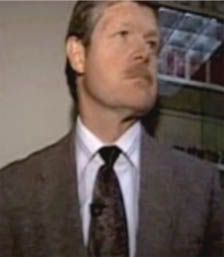 A 1991 Miami Herald article, based on interview with Thurman (left, from a 1991 video), reported that he had “meticulously compared the picture of the fragment to hundreds of other devices,” a lengthy-sounding process. [2] Affirming this, Thurman himself told the adoring program Air Crash Investigation in 2008:
 “I spent, uh, months, literally, looking through all about the files of the FBI on other examinations that we had, uh, conducted over many many many years. […] After a period I just ran out of leads. And at that point I said, okay now we need to go outside the physical FBI laboratory.” [3]And it was there, in a CIA facility, that he found the long-sought answer.
But Marquise said “what Thurman did yielded fruit within two days. […] Henderson and his colleagues were on an airplane headed back to Scotland” when Thurman set to work. They had barely settled back in at home before his efforts “would turn Henderson around quicker than he ever imagined,” putting him back stateside, along with electronics fiend Allen Feraday, within 24 hours of the discovery. [1 p60]
Further evidence against Thurman’s "months" claim is his own well-memorized “day that I made the identification,” recalling it as one would a wedding anniversary: June 15 1990. He had four days tops to get this grueling season of cross-checking out of the way after the 11 June conference (perhaps a multi-day event) where Marquise has him first learning of the thing.
Who He Ran To
What Thurman did, Marquise sums up, is know where to look. He took the photo to a CIA explosives and timers expert code-named John Scott Orkin (real name unknown - he testified under this name at Camp Zeist). [1 p60] Thurman mentions him only as an unnamed "contact" in the 2008 ACI interview. [3] From the vast photo files on hand, "Orkin" helped locate an obvious fit with the blow-up of PT/35(b). If you were Tom Thurman and knew about John Orkin, would you waste even one afternoon scrounging in the FBI's files, or go right to him?
Nothing I've seen specifies this match-up was achieved in only one visit on a single day, but that makes the most sense, as does starting right there. That would give us no more than "hours, literally" to describe the search duration. And either way we're at the point of days at most.
The matching circuit board was found in a timer confiscated in the African nation Togo in 1986. This device, assembled in a small plastic case, was physically available for Thurman to look at. He was given permission to take it apart and examine the main board inside. Upon confirming again the obvious similarities, “within a few minutes, literally, I started getting cold chills,” he told Air Crash Investigation. [3] He's also described as declaring "I have you now!" [1 p60] and other variations. In a 2010 interview, he said "I could not believe it under any circumstances, and it was there." [4]
That he got these chills only after getting access to the CIA’s special stores is noteworthy, and the Agency is right to claim much of the credit, as they have in places. An AFIO newsletter from just after the Zeist verdict purred that “the CIA’s most important contribution in helping secure the conviction” was “when a CIA engineer was able to identify the timer […] shifting the focus of the probe from a Palestinian terrorist group to Libya.” [5] (This report's oblique reference to the CIA's less brilliant offering, Giaka, is also worth a read.)
As the overall story tells it, this was clearly a collaborative CIA-FBI effort, via Thurman and "Orkin", that neither side can claim sole credit for. And without this coming together, we're to infer, the naming of this planted piece of Libyan black magic would be delayed or impossible for both Scottish and American investigators. The power of cooperation, between intelligence and law enforcement, and across the Atlantic - a running theme of the 103 investigation - is nicely illustrated here.
The Slow Link to Mebo
Besides the Togo unit, the CIA knew about a 1988 French seizure of two MST-13s found in Senegal, in possession of Libyan operatives. (If I'm not mistaken, one of the Senegal timers held in Paris had gone missing by this time) But Thurman at the CIA facility makes it seem like this was a mystery device he had to analyze from scratch.
A smaller circuit board within the Togo timer's box featured four partially scratched-out characters. Thurman explained to ABC News in 1991, just after the indictments were issued, how he and others labored over this, contacting numerous manufacturers trying to identify “M580” for some time. [6] They finally accepted that it said MEBO, the name of a known Swiss firm supplying timers to rogue governments, including Libya. Thurman told ABC they had “some inkling that’s what it was from the beginning, but we didn’t want to say okay, it’s Mebo’s exclusive, anything else, until we were absolutely certain." [6] Then they decided it was definitely Mebo’s exclusive for Libya only and only usable by Libyans and unable to fall into anyone else’s hands. Except the CIA and their French counterparts, obviously.
And we're to believe the CIA hadn't already managed to trace these African timers to their Swiss makers? A company suspected of their own CIA links, and documented as trying to implicate the Libyans to them since January 1989? Thurman was left to puzzle over those four characters himself? Sorry, but I don't believe that. Mr. "Orkin" could surely have told him these African timers were made by Mebo and supplied by Libya. This "M580" search is quite likely a made-up story, full of needless rigor and theatrics, and again suggestions of long expanses of time.
On top of the fictional months-long search at FBI before turning to the CIA, this little final touch of reported caution belies the focus and speed beneath the whole June transaction. Nine month of dead-end searches in Scotland were trumped within four days by Thurman's knowledge of just the man to talk to. It also goes against the hint he gave in his ABC interview, commenting upon his discovery: "I knew at that point what it meant. Because, if you will, I'm an investigator as well as a forensic examiner. I knew where that would go." [6] The whole country had just learned that it went right to Tripoli.
More to the point, he's a political scientist rather than a scientific one. His main skill here is knowing people, CIA types. One can be excused for wondering if Special Agent Thurman knew where it would go even before Orkin told him, or before he got his hands on a that picture to bring over.
---
Sources:
[1] Marquise, Richard. SCOTBOM: Evidence and the Lockerbie Investigation, Algora Publishing. Sept. 1, 2006. 268 pages. Mostly page 60. Google books link.
[2] Roser, Ann. “'Nuts and Bolts’ Work Pays Off in Lockerbie Probe.” The Miami Herald. Published November 30, 1991. Link.
[3] Air Crash Investigation: Lockerbie. Season 6, ep one, aired 2008. Hosted video page. Skip to part four, halfway in.
[4] Sent Home To Die. STV documentary, aired August 2010. Youtube link.
[5] Association of Former Intelligence Officers. Weekly Intelligence Notes, February 2001. http://www.afio.com/sections/wins/2001/2001-06.html
[6] The Maltese Double Cross - Lockerbie. Film, Hemar Enterprises, 1994, 156 minutes. Written, produced, and directed by Allan Francovich. Hosted video page. (1hr, 6 min in)


