Showing posts with label Bell H. Show all posts

Harry Bell's Eight Reasons

December 27 2010

(Props to "Pete" for bringing this to my attention)

DCI Harry Bell, head Scots police investigator on Malta, made an important entry in his police diary on February 15 1991, the day of Tony Gauci's selection of Abdelbaset al-Megrahi's photo. In it, he says that his boss, Senior Investigating Officer (SIO) Staurt Henderson, "agrees we have a partial identification on the person named Abdelbaset considering all of the circumstances," which he then lists. These eight reasons, in support of Gauci's point, suggested to him that Megrahi was in fact the buyer of the clothes that wound up in the bomb suitcase. [Source: Grounds of Appeal PDF, p 42/43 - unearthed by the Scottish Criminal Cases Review Commission (SCCRC) and supplied to Megrahi's defense]
(1) He arrived in Malta on 7th December '88. This was the date of the purchase of the clothing.
This is a whopper of a point to begin with, considering the date of sale is almost certainly November 23, based on Gauci's best evidence. Tony described a Wednesday a few weeks before the bombing, before the Christmas lights went up, at about 6:50 pm during a light shower, with his brother watching a football game at home. All that fits only one day - November 23, and Megrahi wasn't even on Malta that day.

Even an official Scottish legal review by the SCCRC agreed in 2007 that "there is no reasonable basis in the trial court’s judgment for its conclusion that the purchase [...] took place on 7 December." The judges had accepted it, but that decision has been criticized by serious professionals.

Consider also that in 2006 Bell himself admitted to the SCCRC just how the other date was selected despite the evidence. He ignored the lights and rainfall, focused on the less-conclusive football schedules, and got "confused."
DI Bell SCCRC interview (25-26/7/06)
"...The evidence of the football matches was confusing and in the end we did not manage to bottom it out..."
"...I am asked whether at the time I felt that the evidence of the football matches was strongly indicative of 7th December 1988 as the purchase date. No, I did not. Both dates 23rd Nov & 7th Dec 1988 looked likely."
"It really has to be acknowledged how confusing this all was. No date was signficant for me at the time. Ultimately it was [Megrahi’s] presence on the island on 7th December 1988 that persuaded me that the purchase took place on that date."
[same link as above, p 229]
It wasn't the evidence (no rain all day, different game time, lights glowing across town) but Megrahi's presence that made it the day. If that's not dishonest, it is evidently wrong to then make the circular claim, as Bell did in his diary, that the established date is a separate support for Megrahi's guilt.

(2) He resided at the Holiday Inn Hotel, Sliema, which is within several hundred yards of the shop premises.
Extension of point one. He stayed there on December 7, not the day the clothes were bought.

(3) He travelled to Switzerland on 9th December 1988. He is known to Bollier, the person who supplied the IED timer.
This isn't immediately relevant to the bombing; the trial court dismissed any direct link between Megrahi and the timers. However, Mebo founder Edwin Bollier's acquaintance might be material, in that he was the first person to suggest the CIA should blame Libya, and helped them greatly in brining false charges against al-Megrahi into 1991 (see below). His information then and since is often bizarre and usually unreliable.

While the Lockerbie timer fragment is itself questionable, whether or not DCI Bell should have suspected that at the time is another story. But even if he believed these other clues, it's no excuse for mangling the date of purchase evidence like that.
(4) He was involved in the company known as ABH on behalf of the Libyans. This company was set up to deal with contact with the MEBO company, Mr Bollier's firm.
Same as above. This is an irrelevant extension of a tagential connection that doesn't prove anything about how the bombing was done.
(5) He has a resemblance to the original photo fit and artist's impression.
In the sense they both have faces with two eyes and so on, this is a good point. Otherwise, the resemblance is uncanny in its inability to match up. Five inches too short, 14 years too young, too light, too slight, with a different face and hair, and far away from there when the clothes were bought. Point five is way off mark. If the other clues support the guy, a bad sketch is no problem to ignore - they're well-known to be unreliable. But to actively cite it as a support when nothing else really sticks is deceptive.
(6) ...
We don't know what this point was or why it was apparently redacted.
(7) The SIO advises that Bollier has now been shown the photofit and he states that if the hair was shorter then it would indeed look like Abdelbaset, also if it was 10 to 15 years older.
Strangely, this is exactly the description Gauci gave of the "Czech photo" of Megrahi: 10-15 years older, with shorter hair, and he'd look like the buyer. But this is about the Photofit image, which Tony felt looked like his 50-year-old buyer (see last link). Bollier says "if it was 10 to 15 years older" it would look like the 36-year-old Megrahi. Or perhaps Bell is mixed up here.
(8) The SIO also advises that the photograph we have of Abdelbaset is in fact 12 years old. ...
Confirmation that the photo's dating served in a bait-and-switch operation on the age discrepancy. A 12-year old photo, of a man who'd have to look older by just about that, would make it a fit. But Tony still insisted the man was around 50 at the time of sale, while Megrahi was 36 at that time, so something was twisted out of form here. (That's explained a little better at the "Czech photo" link). Point 8 continues:
He is a smart dresser, plenty of jewellery and there is no recollection of the watch according to Bollier and he is taller than Bollier at 5 foot 9 inches. Gauci thinks 6 foot tall.
These fashion points are obviously weak as evidence, but the part on height is interesting. Gauci is famously short (5'3"), so Bollier is cited as a man also shorter than this tall-ish Arab, at a decent 5,8". Here that's fudged up a modest one inch and stated as taller than someone else, and it perhaps seems reasonable for stubby Tony to recall "Baset" as towering 6 feet up there, or maybe ten feet.

The wording is ambiguous enough, on review, that one who didn't know the subject's true height might conclude that a 5'9" man had reported "Baset" as taller than himself, and another had said Megrahi was six feet tall. That's important when that same man said the buyer, who the police knew could not be Megrahi, was six feet or more in height. That's one of the reasons it can't likely be Megrahi.

And that's all of the reasons he wrote down, except the missing one, and the fact of the "identification" earlier that day. Not encouraging stuff to be finding in police records, is it?

Gauci and the Czech Photo

24 November 2010
last edits 26 December

Just What was Identified
From the revived JREF discussion thread Tony Gauci and the Mystery Shopper comes a very interesting nexus of questions surrounding critical images of "Lockerbie bomber" Abdelbaset al-Megrahi. In later pages there, Rolfe, Buncrana, Pete2, and myself are re-considering the image by which shopkeeper Tony Gauci linked al-Megrahi to the wreckage of PA 103 with his "identification" of the Libyan as the buyer of a certain set of clothes.

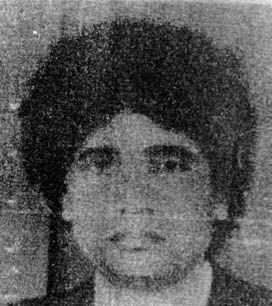
Although Tony had been talking to the police since September 1989, this historic fingering only happened on 15 February 1991, when Mr. Gauci was shown another spread of 12 faces. According to his statement, he at first felt all were too young to be the buyer, and selected none of them. The police refused to take no for an answer, and asked him to again "look at all the photographs carefully and to try and allow for any age difference." [Gauci 15/2/91] On the second pass he pointed to picture number 8 from the left. This was an image of al-Megrahi obtained by investigators from Czechoslovakia. For those unfamiliar, the undated big-hair image used for the slot in question is shown below.


Now, what Tony said pointing at this notably low-quality image and its obscuring noise, is less than amazing. His police statement following the session records it as:
“...similar to the man who bought the clothing. The hair is perhaps a bit long. The eyebrows are the same. The nose is the same, and his chin and shape of face are the same. The man in the photograph is in my opinion, in his thirty years. He would perhaps have to look about ten years older, and he would look like the man who bought the clothes. It's been a long time now and I can only say that this photograph resembles the man who bought the clothing, but it is younger.”
Back in 1989 he had given the buyer as a burly six-foot-plus Libyan, aged approximately 50 years. Our 5'8" villain al-Megrahi was but 36 at the time of purchase. And instinctively, this photo looks to me quite young, taken perhaps a decade before the 1988 purchase. He looks almost too young, with the apparence of baby fat on those long al Megrahi cheeks... and with the cheeks and nose actually seeming shorter... the lips and nose look different...

In fact, the image used is highly unusual, bearing such little resemblance to Megrahi one could be excused for wondering, as I have, if this really is him. The Lockerbie case is so special, I can't see ruling out such a simple thing as a misattributed photograph. However, there's a certain logic to presuming the image is genuine - it would be a massive risk that the picture could be proven to be of some other person, or even altered.

I remain convinced by an earlier experiment I did with photo comparison that I don't think I documented. Even with the apparent facial differences, this could well be Megrahi, taken a bit "chin-up," showing nostrils, more upper lip, shortening the face and nose as seen. Nothing in the overall proportions ruled out the same face. The hair obviously is unlike anything else we've seen him wearing, which when long is more like in the photo shown below.

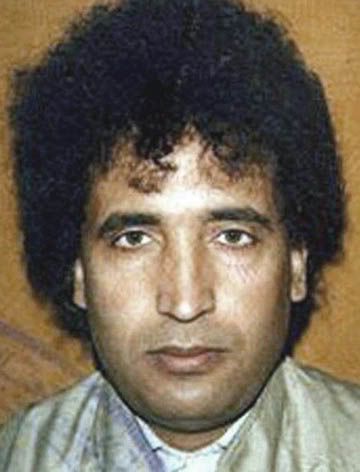
The image at left was taken for the false passport in the name "Abdusamad" issued by Libyan authorities in mid-1987, age 35. It was used on a few occasions, including a now-famous trip to Malta on 20-21 December 1988. As I've explained elsewhere, this is a legitimate clue - if not for Megrahi's guilt, then for why he was selected for framing.

The image itself is the most widely seen photo of the accused from the 1990s onward. It's not unlike the others taken since then as the man gained new fame as the accused - and then convicted - "Lockerbie bomber." This verifiable likeness is very unlike the photo Tony pointed to, and to which we now return.

The Hair
What Megrahi looked like before and after the Abdusamad photograph is unclear. Whether the raging afro seen in the Czech photo was chopped down before the above or grew in after it can't yet be established (but most clues point to some time before). However, one thing we know it does, among all images of al-Megrahi, is bring him close to matching the plumage style of Gauci's buyer. 

At left is the police artist's sketch based on Tony's description of the mystery shopper, 13 September 1989. The likeness is uncanny in its near-exclusion of Megrahi. It just doesn't look a lick like him, especially with this intense, angular, face, compared to Megrahi's soft features he later pointed to. And all this on a "large head" atop a 6-foot-plus frame to Meegrahi's 5'8" and Tony Gauci's 5'3".

One main feature to note is the dense afro-style haircut atop a clear expanse of forehead. The tightness of the curl is different by a long shot from any photo of Megrahi I've seen. His dangling ramen-wiggle expanses seem incapable of the tightly spherical sculpted look of the artist's sketch.


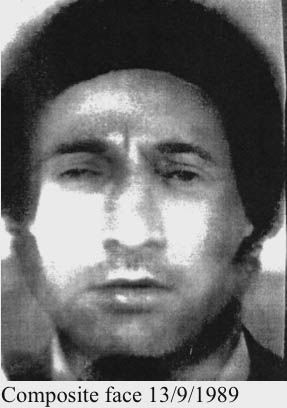
And here is the "Photofit" or "composite face" image compiled from Gauci's descriptions, given the same day as the above. They share the same basic hair, here a bit longer and fuzzier at the top. Otherwise, the two look drastically different from each other in the lips, chin, eyes, eyebrows, nose, and cheeks.

Tony did specify the sketch was a better likeness than the photo-thing, but agreed both resembled the buyer quite a bit. This almost seems to say "if you can find a photo of anyone with this kind of mid-sized 'fro that I think you guys want to prosecute, I will say it looks like the man." 

Prior to al-Megrahi, Tony had selected others as a match for the buyer, like Mohammed Abu Talb, famously in December 1989. Abu Talb didn't really fit by hair; his appeal was more from the word "bomber" across the corner of his face.  And Tony once pointed out  Mohamed Salam - a pretty good likeness of the sketch in both hair and face - on a less famous occasion. Like al-Megrahi, both of these men were at least a decade  too young. 

Perhaps Megrahi's undated fro was an earlier thing, from his 20s. But other than the Czech photo, we've only seen Megrahi with less hair and apparently more hair product. Buncrana found a photo of Megrahi at about age 19 - a student visa is from when he was studying in Wales, around 1971 (first revealed by the Sun back in August). We can here recognize al-Megrahi's longish features as a stylish young man. A little quiet-looking, but with a wild frontal swoop, almost a bouffant, coming halfway to his eyebrows. Quite unlike Tony's buyer, the Megrahi images show nary a clear forehead, especially in the questionable Czech photo.  And unlike that photo, this one actually looks like the guy it's supposed to be. 

Czech Photo Origin, Age, and Effects 
What was shown was not that Megrahi was or even actually resembled the buyer. All we learned on 15 February was that, among a selection of 12 pictures, Megrahi's could be made to be reported as the one most resembling the buyer, so long as you pick one that doesn't really look like him, while giving him something like the right hair.

This highly useful image was supplied to the investigation by intelligence from Czechoslovakia, says lead FBI investigator Richard Marquise. [see Sent Home to Die, Youtube posting 17:48] In his 2006 book he gave no explanation I could find about when the investigation got this picture, why it's of such poor quality, and what info came with it.  He acknowledge that "no one could positively date the photograph shown to Gauci." [SCOTBOM p. 127 - Google Books link] This may be of key importance below.

Marquise and his faux-witness Abdul Majid Giaka agree the photo Tony pointed to showed a young man, who was Meagrahi. "Giaka had looked at the Czech passport picture identified by Gauci. He said it was Megrahi when he was much younger." [p 142 ] Gauci's own feeling was of a man "in his thirty years," (30s) which Megrahi then was. But this could be chalked up to the lack of clarity and the fact that nearly all men Tony had been shown were in their 30s. DI Scicluna, Maltese police, gave his own account of the 15 February ID with slightly different details.
“.. Gauci started examining the photographs and the first thing he said was that they are all too young. It was explained to him to allow for age discrepancy as the man he saw could be 10-15 years older. [...] Gauci then looked through them and again stopped at Baset’s photo and indicating it he said ‘This is similar, but it is maybe 10-15 years younger.” [Grounds of Appeal doc]
Somewhere in his 30s, plus fifteen years is close enough to a match with the 50-year old man he described. But Marquise, Bell, and Scicluna and crew didn't know how old the photo was. All they had to do, and perhaps did,  was presume the picture itself was 10 years old, and add 10 years per what Gauci said, and you've got Megrahi's age, even though it's still 14 years below what Gauci first estimated.

Further, the quality of the Czech photo is worth wondering about. If the other 11 pictures he was shown that day were all normally clear and this one only looked strange, might that itself be leading? Might Gauci think it was included for some special reason? Might he think this is some super-elusive Mullah Omar character the cops can only get a crappy picture of? Might that make him feel it's more fruitful to point at then the others?

In fact, it seems the other images were altered to lessen the difference, but a professional who reviewed the effects in 2008 felt it was insufficient and the Czech photo still stands out as the gritty, mysterious one. [see Valentine report, page 40]

And There They Stopped
However exactly he was tricked into it, this was the final identification. Tony Gauci had been picking men out of photo lineups sporadically since September 1989, at different times having picked out at least three other men as similar to the buyer, but younger. But after 15 February the exercises abruptly stopped, and investigators were somehow sure they had their man. An identified buyer of the clothes, a Libyan agent comporting with the by-then identified timer, and there as Abdusamad on the day of the bombing. Never mind that he was about five inches too short, too slight of stature and light of skin, 14 years too young, and nowhere near the island of Malta on the day the clothes were purchased.

Marquise related how, at a mid-1991 conference, Senior Investigating Officer Stuart Henderson "discussed the photo spread leading to the Gauci identification of Megrahi. Although no one could positively date the photograph shown to Gauci, he was reluctant to show any more photos without fear of tainting what he had already provided." [127-8]

Something tells me it wasn't so much "tainting" as "spoiling the moment" Henderson was worried about.  As we've seen there was a special and delicate magic about how this supposed selection of al-Megrahi was materialized. It's also clear that the other photos available, with al-Megrahi's usual hair styles and better clarity, would show Tony how unlike the buyer this Libyan was. It could conceivably screw up the ID they had and wanted to keep.

So the big-hair Czech photo remained the only one of the chosen suspect that Tony saw until the better likenesses started appearing in the news a few months later as the "Lockerbie bomber." By then the whole world knew just what the guy looked like, removing all the cahallenge from arranging the later touted pointings-out in 1999 and 2000, just before Tony helped land a conviction and his $2 million prize.
---
Updates 12/26: In fact, Harry Bell noted in his police diary the day of this charade that this was the only photo the Scottish police had of "Abdelbaset" and they had to use it for fear they could never find another.
"meeting with Special Agent Reid. He tried to imply that we were rushing showing the photograph spread. ....they were the ones that wanted it done before Bollier left the USA.  Also if Baset was identified, Bollier would be the last person to be told as we know he is still in contact with the Libyans. Reid has been worried in case there is no identification made by the witness because [the photo]of Baset we have is too young. I explained that as we have no other and no indication that we will ever get one, then we can only proceed with what we have. If no identification is made and we later get a better photograph showing his true age and appearance in December '88, then the Lord Advocate may
accept an argument for showing this to the witness.

The differences in any photos can be noted while accepting that to some degree it will weaken the identification at any trial."

Then, among the eight points why Megrahi was the buyer, he wrote:
(7) The SIO [Stuart Henderson] advises that Bollier has now been shown the photofit and he states that if the hair was shorter then it would indeed look like Abdelbaset, also if it was 10 to 15 years older.
They got the same response from Bollier, but apparently in reference to the Photofit, not the Czech photo, if it was older (??). Bollier claims in comments below that he was never shown the Czech photo, and had still never seen it for 20 years of highly public study, until this blog post.

(8) The SIO also advises that the photograph we have of Abdelbaset is in fact 12 years old.
This confirms the suspicion. A twelve year old photo of Megrahi would be of a man aged 26, circa 1979. Gauci thought it was of a man in his 30s, and never actually retracted his belief the man was "around 50." This looks a hell of a lot like a shell-game or three-card-trick, designed to fit Megrahi in. [See: Grounds of Appeal doc, page 42/43]
---
Information continues in the excellent comments below.

Video: Gauci on al-Megrahi

"A Little Bit Like Exactly" Like a Non-Identification
December 13 2010

last update 15 December

I'm just wrapping up a video on Tony Gauci's evidence in toto. Including credits, it's about 12 minutes, split in two halves on Youtube, embedded below.

Part One:

Introduces the relevance of Mr. Gauci, the physical discrepancies between his buyer and Megrahi, and the date of purchase issue. Some pretty damning stuff.


Part two:

The actual identification session, Gauci's other IDs, his amazing fudging of all discrepant points at trial, the $3 million plus paid out to the Gauci brothers following the verdict, the SCCRC's findings, second appeal, conclusion, and credits.

Comments:
This production is a little rushed. I didn't re-do the narration enough times, adjust all the levels, make the best slides or animations. I thought I could rush this through in time for the Dec 7 anniversary of the alleged sale to Megrahi, but the assembly and rendering process didn't agree. Then I just wanted it done by Monday (today), and only managed to meet that deadline with part one.

Anyone who'd like to see more of the information this is based on, all my blog posts about Tony Gauci's evidence are at one or both of the links Tony Gauci's "Identification" of Megrahi and all posts tagged Gauci T.

What Did The Germans Know?

The Scots-German War Over Airport Security, part 2 of 2
June 23 2010

last edits 21 November

The following is part-essay, part compilation of long quotes. Two early books are drawn from throughout:
[E+D] Emerson, Steven and Brian Duffy “The Fall of Pan Am 103: Inside the Lockerbie Investigation” New York, G. P. Putnam’s Sons. April 1990. 283 pages.
[L] Leppard, David.On the Trail of Terror: The Inside Story of the Lockerbie Investigation. London, Jonathan Cape. May 1991. 221 pages.
The views expressed by those writers are not necessarily shared by this blogger – the exercise is to gather facts and attitudes, the zeitgeist, of this minor 1989 struggle of wills between two erstwhile allies in a major investigation.

---
Vehement Vengeance
Part one explained the unfounded British decisions to rule out London origin for the bomb while repeatedly insisting it must have come in from Frankfurt. “Smarting from the accusation that sloppy West German security had allowed this terrible act of terrorism,” Emerson and Duffy explain, “Germany would begin to strike at the British with a vengeance.” [E+D161] It was the first of January 1989, the day after the inflammatory Times story (Disaster Bomb placed on Jumbo in Frankfurt), that the first response was heard. As the book explains:
“West German Interior Ministry spokesman Michael Andreas Butz was convening a news conferencet to respond to the Times account of the day before. “There is no indication,” Butz declared stiffly, “that the explosives could have been put on board at Frankfurt airport.” In fact, he added ominously, “there is evidence which is contradictory.”

What did the Germans know that the Americans and the Scots didn’t?”

Butz went on to assert, with some vehemence, that German agents had determined that the “Disaster Bomb” had been smuggled aboard the 103 in London. The German agents had proof of it, Butz said."
[E+D161]
Five days later, it seems the Germans were ready to show what they knew or didn't know. Reuters in London, citing “West German security sources,” reported on January 6 that “an airport worker at Heathrow had planted the bomb in the forward luggage hold of the 103.” A bizarre explanation followed:
"According to the sources quoted by Reuters, investigators had arrived at the Heathrow link because of the “fact” that the bomb that had blow up the 103 weighed “at least sixty-six pounds.” Luggage restrictions limited carry-on bags to seventy pounds, but the sources cited in the Reuters account said that the bomb was loaded aboard by an airport worker. What the sources evidently didn’t say is why the airport worker couldn’t have been in Frankfurt instead of London." [E+D165-66]
That explanation fails to make sense in numerous ways (the bomb likely weighed less that 66 ounces, for one), and doesn’t sound like what any thinking German would really say. But this wasn’t their only counter-charge passed on in The Fall of Pan Am 103:
“In a matter of days, news stories began to leak from Bonn and Frankfurt that security at Heathrow was far worse than at Frankfurt. British authorities were outraged. For days and weeks, as the families of those killed on the 103 watched this ugly game of diplomatic Ping-Pong, Britain and Germany fought a nasty proxy war through their TV networks and newspapers. Clearly, the feud was based on more than a technical dispute among forensic specialists. Some went so far as to assert that the bitterness of the dispute showed the extent to which the age-old cultural animosities between the two nations had still not abated after two world wars.” [E+D 161]
The authors Emerson, Duffy, and Leppard have the Germans trying to deny both a Khreesat bomb (their botched police work) and the German bomb infiltration (their airport security failure), often confusing and conflating the two drives. On the other side, it’s clear that the Scots and Americans tried at every juncture to put all failures in Germany. David Leppard writes “the bitter argument […] persisted throughout the long hot summer of 1989” [135] and “the German BKA were to spend more than a year publicly claiming that the bomb must have been put aboard at London.” [60]

So Just What Did They know?
Such persistent denial could be motivated, as the Brits and Americans charged, by German fear of accepting the horrible truth about their epic shortcomings. But to be fair, the Germans in fact knew some actual evidence supporting their claims, and should have been given more credit.

Emerson and Duffy’s telling shows hardly a hint of this, with its cited argument that a 66-pound bomb somehow implies Heathrow origin. But the West Germans had to have noticed the lucky bag placement within the container, that could only have been more than luck if it was placed in London. They probably did not know of John Bedford’s story of suitcases matching the IED style seen at about that spot of that container - well before the 727 arrived from Frankfurt. Had they known, they likely would have said so.

The break-in at Heathrow’s Terminal Three the morning before the bombing was surely concealed from German ears as it was from the whole world up to and including the Zeist trial in 2000. On top of the generally lax security at Heathrow, this additional bit of information could only have added to the German resistance against the first script changes.

It was enough at first to know that both alleged German failures - a Khreesat bomb and Frankfurt ingestion - could not be true at the same time as the Yanks and Brits insisted. At least, not without a fair amount of speculation.

The German BKA actually did some work along these lines to help their colleagues understand, as David Leppard shares in some detail. They knew the Khreesat altimeter bomb better than anyone, having overseen the raid that caught only one of five, having had another one later kill one of their bomb technicians, just before they destroyed yet another in revenge. Leppard rails along with the Scots at these scientific losses and such fatal sloppiness. But he also misrepresents the number of samples they once held (it was four, not three), and the readable remains they had at the end of the explosions (three partial and two complete samples, not one). These were, however, studied as far as possible.
“In May the Germans decided to prepare a detailed scientific rebuttal of RARDE’s theory that the bomb had been made by Khreesat […] and put aboard at Frankfurt. The BKA asked its forensic section, ST33, to prepare a report on the three Khreesat bombs so far recovered.” [L142]
They shortly issued a final report called "Comment on the ignition Devices,” which said their remit was “to test and report if [Khreesat bombs] were suitable for surviving the flight from Frankfurt to London […] and exploding 38 minutes after take-off in London.” [L142] The answer, delivered with “bland Teutonic logic,” was No. Rather, they realized and explained one of the best London-origin clues. 
“The rundown of the functioning on the ignition devices … can be brought into line very well with the circumstances during take-off and pahse 1 of flight PA103 London to New York.
[…]
Presupposing that an explosive device of the same construction was used in the attack, then it must have been taken board for the first time in London, or at least made acute [armed -ed] by insertion of the master switch.”
[L145]
Leppard dismisses the report as "a compendium of fudge and obfuscation." They had “only one [sic] fully functioning example of Khreesat's bombs,” Leppard complained, “but this did not prevent them concluding all three bombs had a time delay of between 30 and 45 minutes." The reality is in fact a little more complex it seems than the BKA’s report lets on, but the noted similarity of the timing style is still completely valid. The 38-minute detonation after leaving there really does look a lot like a Khreesat device loaded there.

War’s End
Upon seeing that insolent ST33 report, SIO John Orr “was furious,” writes Leppard.
“As the Kamboj episode showed, there had always been the outside chance that a bag had been smuggled into the container at Heathrow. That possibility aside, Orr had effectively ruled out Heathrow within three weeks of the bombing. Much to the relief of British security chiefs, the Met’s Special Branch had long since stopped investigating the Heathrow theory. Now the Germans were suggesting they were all wrong.” [L145]
They launched back in June with a rebuttal. “Harry Bell was tasked with getting RARDE to research a reply” to this ST33 report, writes Leppard. “It took five weeks to come up with a convincing response.” Finished before June was out, it mostly poked holes the uncertainties of the report, like using “only one working device” to decide the time delay. It offered no solid alternative, quibbled over climb rates, postulated a simple electrical error, and closed condescendingly:
“In conclusion the ST33 report deals with presumptions and presuppositions and it is respectfully pointed out that only factual evidence will be acceptable in the furtherance of the inquiry to bring to justice the bombers of Flight PA103.” [L146-48]
The Scots and Americans, on the other hand, were never able to shake the fact that London was always the far better fit for just the bomb style that everyone first suspected. And they could show no support for what they insisted on: a Khreesat bomb loaded and triggered in Germany but with a speculated two-hour timer to carry it just past London.

In short the authorities and investigators of the West German Federal Republic knew some of the same clues their counterparts across the channel did. They could see the general logic of London introduction, the detonation timing, and the expected British ass-covering. After all, as Leppard put it:
“Certainly, if Heathrow had been to blame, the ramifications would have been severe […] Fortunately for the British, no such evidence was ever uncovered. All the political embarrassment would fall on the Germans.” [p 60]
The embarrassment would then somehow shift off of them onto Malta and thence Libya, in a fascinating leapfrog action. But early on, we can see the Germans had circumstantial clues - if only half as many as the Brits held - that the bomb actually started in London. They could be called jumpy or defensive to leap to the conclusions they did so fervently based on such limited information. But now, with more information, we can see that they were probably right all along.

Evidence Reconsidered: Date of Clothing Purchase

First Posted January 17 2010
last updates Jan 5 2011

Among other points raised in a letter re-posted by Victims of Pan Am 103 Inc., Richard Marquise mused: “It was strange that of all the people in the world, Mr. Megrahi was in Malta the same day the clothing was purchased and was there the same day the bomb left on its fateful journey.” (emphasis mine)

I reminded him of the statement in the comments section at Professor Back’s blog, and posed the following five questions to him. Apparently he never caught them, as he never offered an answer. My own answers follow.
1) Is it not strange that of all the days in the subset November 23 and December 7 you and the investigation had to pick the latter as the best fit for the purchase, even though that choice requires badly misreading the actual evidence?
2) What did the SCCRC find about the Christmas light going up?
3) What do local weather records say for rainfall on Dec 7 vs. Nov 23?
4) What do football schedules (Rome-Dresden) say about Paul’s absence at 6:50 pm? What does Paul say?
5) Why doesn’t November 23 work again, aside from Megrahi not being there?
---

1) A Choice of Two Days
Tony Gauci's initial recall of the date of purchase was vague - late November or perhaps early December, or a few weeks before the bombing. It was a football game played on the day (see below) that really narrowed it down to 23 November or 7 December 1988. He recalled the purchse as on a weekday, and specifically "mid-week." In his 2000 testimony, Gauci clarified this meant, exactly, Wednesday. [Day 31, pp 4820-21] Both possible dates were Wednesdays, so that's no help, but the distinction is crucial; as Marquise points out, Megrahi was on Malta on the 7th and so could possibly be the buyer (or to some minds, he clearly is).

If, on the other hand, this supposed purchase occurred two weeks earlier, it had to be someone else; Maltese immigration records and all sources on all sides agree Megrahi had a solid alibi for 23 November. We know the official decision - the purchase happened the 7th. And we know how that helps the prosecution case. But what does the actual evidence offered by Tony, and his brother Paul for that matter, and others, actually say on the subject?

2) Christmas lights
Paul Foot's amazing 2000 booklet "Lockerbie: The Flight From Justice" reports:
On 19 September, 1989, Gauci asserted in a statement to police: “At Christmas time we put up the decorations about 15 days before Christmas. The Christmas decorations were not up when the man bought the clothes.” On 10 September, 1990, Mr Gauci told DCI Bell of the Scottish police: “I’ve been asked to try again and pinpoint the day and date I sold the man the clothing. I can only say it was a weekday; there were no Christmas decorations up, as I have already said, and I believe it was at the end of November.” [p 21 - emphasis mine]
But ultimately another day was needed, a day by which the town would normally have its halls partly decked. By the time Mr. Gauci made it to trial in 2000, judging from the stretches of Q and A I’ve been going over, he was taking every opportunity to fudge the two versions closer together, on this issue and others. The Court’s summarized final opinion document (31/1/01) stated:
“In his evidence in chief, Mr Gauci said that the date of purchase must have been about a fortnight before Christmas. He was asked if he could be more specific under reference to the street Christmas decorations. Initially he said “I wouldn’t know exactly, but I have never really noticed these things, but I remember, yes, there were Christmas lights. They were on already. I’m sure. I can’t say exactly.” [paragraph 56]
Of course among the first things he remembered, that helped mark the memory, was the decorations “were not up when the man bought the clothes.” After this contradiction “had been put to him” by the defense, the Court continued, “he said “I don’t know. I’m not sure what I told them exactly about this. I believe they were putting up the lights, though, in those times.” [para 56]

Clearly the earlier version, before he became muddled with an awareness of contradiction, is more trustworthy, and the Scottish Criminal Case Review Commission, announcing a possible “miscarriage of justice” in 2007, found support for this. Among other alarming problems, they unearthed additional specific evidence giving a start date for the Christmas light erection – the 6th of December:
New evidence not heard at the trial concerned the date on which the Christmas lights were illuminated in the area of Sliema in which Mary’s House is situated. In the Commission’s view, taken together with Mr Gauci’s evidence at trial and the contents of his police statements, this additional evidence indicates that the purchase of the items took place prior to 6 December 1988. In other words, it indicates that the purchase took place at a time when there was no evidence at trial that the applicant was in Malta.


3) Weather records vs. Gauci's evidence
Gauci’s first statements to the police cited the weather as a clue to the day of the purchase. When the mystery shopper came in, it was raining enough for him to buy, in addition to the memorably random assortment of clothing, a single item of utility; an umbrella. From his first statement, 1 September 1989:
“I even showed him a “Black coloured (umbrella?) and he bought it. … The man said he had other shops to visit and he picked up the “umbrella” and he said he would come back shortly … [and] walked out of the shop with the “Umbrella” which he opened as it was raining.”

Remnants of a black umbrella were found in Scotland and presumed to be from the bomb bag. This looks like a good connection, but the items bought are covered in a separate post. For this post it establishes that Gauci’s story, however true or relevant it really was, featured significant rainfall.

During the 2000 trial, the issue was raised by defense for the first accused (Megrahi). They called as a witness one Major Joseph Mifsud, a Maltese meteorologist who gave evidence on 5 December 2000. He discussed rainfall records kept at the airport. Every three hours (usually), there was a measurement taken, entered in the "Rainfall" on the charts, showing as some entries discussed:
6 Dec 21.00 GMT - "Nil"
7 Dec 00:00 GMT – “Nil”
7 Dec 06.00 GMT – “Nil”
7 Dec 09:00 GMT – “T/R” Mifsud explained the mark “TR” as “a trace of rainfall, less than 0.5 of a millimetre.” This reading refers apparently to a one minute light shower recorded from 8:44 to 8:45 am GMT, ten hours prior to the alleged December 7 purchase. The closest time to that, for 18.00 GMT, Mifsud clarified, showed “a nil entry” for the airport. [Transcripts, Day 76, p 9192-93] All other samples aside from 09:00 were equally dry.
Above: Police records for Malta, December 1988. From Foot, Flight from Justice, p21. Maj. Mifsud testified to records the airport at Luqa (highlighted) and recorded TR (trace rainfall) Dec 7. Rain in Silema (highlighted) Dec 7 is the issue and it, like all others aside from the airport, was left blank. December 6 is similarly dry-looking - these blanks mean either “nil," or everyone else just took these day off.

Note in the chart how these are daily totals, and do not reflect changes in rainfall at points during the day, so the “TR” at Luqa could be used to argue for light rain at Silema around 7pm, even though its daily total shows as blank, or nil. In fact, Foot noted how some did argue “the blank referred to the period from noon on the previous day (6 December) to noon on the 7th. So it could still have been raining at the time the clothes were sold – at about 6.30pm on the 7th.” But this is obfuscation. The As foot noted, Mifsund was quite clear on what the hourly returns meant:
"Q. Just confirm with me, please, apart from the trace of rain that we discussed that fell or was measured at 9.00 in the morning of Wednesday December 7, did any rain fall at Luqa?
A. No, no rain was recorded. No, no rain was recorded.
Q. Up to midnight?
A. Up to midnight."
[Day 76, p 9201]

The prosecution asked the witness it could rain in Silema, which is right on the coast, but not the airport, approximately four miles inland (southwest). He admitted “I do not altogether exclude the possibility that there could have been a drop of rain here and there,” and estimated “the possibility that there would be some drops of rain, about ten per cent possibility.” [Foot 21] It’s precipitously less likely to have been enough to warrant buying an umbrella, and only a major screw-up in records-keeping could explain such a rain on the 7th not being recorded.

It can’t be ruled out that Gauci was eventually made aware of this disconnect and pressured to shift his story. One can observe subtle changes in the witness' recall of rainfall over subsequent statements made to DCI Harry Bell, who was leading the Scottish police effort on Malta and was Gauci’s usual contact. Two of these later read in court include:
21 February 1990: “I have been thinking about the day the man bought the clothes, November, December 1988. He left the shop after having made the purchases and turned right down Tower Road. At that time, he had the umbrella raised and opened. When he returned to the shop, he came from the same direction, but the umbrella was down because it had almost stopped raining, and it was just drops coming down.” [p 4815]

10 September 1990: “I have been asked about the weather conditions that night the man made the purchase of the clothing. Just before the man left the shop, there was a light shower of rain just beginning. The umbrellas were hanging from the mirrors in the shop, and the man actually looked at them, and that is how I came to sell him one. He opened it up as he left the shop, and he turned right and walked downhill. There was very little rain on the ground, no running water, just damp.” [emphasis mine] [p 4817]

A decade later Gauci tried valiantly to minimize rainfall further in his pivotal trial testimony. The Court summarized his take into this finding, from paragraph 56 of their final opinion: [OoC 56] “When asked about the weather he said “When he came by the first time, it wasn’t raining but then it started dripping. Not very -- it was not raining heavily. It was simply dripping...” What the actual transcripts show is a little weirder. It was delivered in his native Maltese, and translated for the court.
”Q Do you remember what the weather was like when the man came to the shop?
A When he came by the first time, it wasn't raining, but then it started dripping. Not very -- it was not raining heavily. It was simply -- it was simply dripping, but as a matter of fact he did take an umbrella, didn't he? He bought an umbrella.”
[Day 31, P 4741]

“Q … on the 1st of September of 1989 your memory was that the man purchased the umbrella, he didn't leave it for you to bundle up with the other things he had bought in the shop, but he left with the umbrella and put it up outside the door of the shop because it was raining?
A Exactly.”
[p 4815]

"A It wasn't raining. It wasn't raining. It was just drizzling.
Q We'll come to --
A I can't remember the dates. I don't want to say -- I don't want to give out dates if I am not that sure, sir.
Q Indeed. What I am endeavouring to do, Mr. Gauci, with your help, is to illustrate --
A I always thank you, sir. I am here to help you, sir."
[p 4816]

"A I don't want to cause confusion. I don't know dates." [p 4820]

It was barely raining, had just started, just stopped, drizzling, ground barely wet, etc. None of it fits well with December 7, when rain on Silema would be described as “maybe a few drops, but not that I noticed.” The records for November 23, not surprisingly, are a direct fit for his freshest memories. Major Mifsud, again, from the transcripts: [Day 76, Pp 9207-09] “Light intermittent rain at noon” was recorded, a condition that “persist right down the column until 16.15,” onto the next page to at least 18.00 GMT, 19:00 local, almost the minute of any alleged 6:50 purchase that day. This slot measurement shows .6 of a millimeters of rain was taken at the airport.

Results in Silema, a bare four miles distant, were likely the same - light but notable. And the buyer noticed enough to buy and use an umbrella. What this evidence shows then, is the unknown purchaser of 23 November, if he really existed, was a bit of a pansy regarding rain.

4) Football games and Paul’s absence at 6:50 pm
Tony Gauci's first statement of 1 September 1989 offered as a clue of the date “I had been working alone in the shop. It was about 6:50 pm just before closing time at 7pm." He was alone because his football fanatic brother had skipped out to watch a game at home. A portion of his first statement, read back in court, said:
“I cannot remember the day or date that I met this man. I would think it was a weekday, as I was alone in the shop. My brother Paul did not work in the shop that afternoon, as he had gone home to watch a football match on television. He may be able to recall the game, and this could identify the day and date that I dealt with the man in the shop.” [Day 31 pp 4792/93]

Indeed. Paul was spoken to and recalled the match he took an evening off early to watch - it was Rome vs. Dresden. It can be surmised he was rooting for Rome. “Paul Gauci was duly listed by the prosecution as a witness,” wrote Foot, but “was not called to give evidence” at the trial, that had just finished as he wrote [Foot p 21]. [Note: There was a separate Paul Gauci (one presumes) called, in connection with his company Big Ben (of Malta) manufacturing the "blue babygro" of the type found at Lockerbie, and selling some to the other Gaucis at Mary's House] In fact, Paul had the contents of his police records selectively ignored, it seems. Private Eye, the publishers of Foot’s booklet, obtained copies of these reports and shared part of one from 19 October, 1989. This recorded a meeting with DCI Harry Bell that made it clear why, despite his specific and useful memory, “Paul Gauci was not called to give evidence for the prosecution.” Paul stated that day, in support of Megrahi’s 7 December shopping spree:
“I was shown a list of European football matches I know as UEFA. I checked all the games and dates. I am of the opinion that the game I watched on TV was on 23 November, 1988: SC Dynamo Dresden v AS Roma. On checking the 7th December 1988, I can say that I watched AS Roma v Dynamo Dresden in the afternoon. All the other games were played in the evening. I can say for certain I watched the Dresden v Roma game. On the basis that there were two games played during the afternoon of 23 November and only one on the afternoon of 7th December, I would say that the 23rd November 1988 was the date in question.” [Foot p 21]

Despite Paul's, and his opinion's, absence from the trial, the issue of game timing was not ignored. Television records were called on, and they tell the same story but without stating an opinion on "the day in question."
- 23 November. Dresden and Roma. The broadcast was ... 16.55.45 to 18.44.00 hours local time.
- 7 December. Roma and Dresden. The broadcast was ... 12.55.30 to 14.53 hours local time.
The purchase Paul missed out on was about 1850 local, just as the November game had ended, or four hours after, if on December 7. On its own, that's not conclusive; he could have just gotten lazy and skipped the chance to help Tony for the last hours and for closing. But all things considered, Gauci himself felt the November game was the one that made him miss the fateful purchase.

5) Why doesn’t November 23 work again, aside from Megrahi not being there?

I almost left this section blank, to emphasize that I’ve seen no reasonable excuse yet offered as to how these clues add up to 7 December. Paul Foot’s 2000 booklet brilliantly outlined the evidence for 23 November, which I've drawn heavily from, and summarized:
But this evidence was no use at all to the prosecution of Abdelbasset Megrahi, who was certainly not in Malta on 23 November. Was there any other day he was in Malta and could have bought the clothes? Yes, he was staying in the Holiday Inn in Sliema on 7 December, 1988. So the thrust of the prosecution inquiries about the sale of clothes shifted from 23 November to 7 December. [p 21]
This may sound cynical, but in point of fact, DCI Bell, head of the Scottish police investigation in Malta, tacitly admitted as much in a 2006 interview. Speaking with the Scottish Criminal Case Review Commission, these excerpts were found in the Megrahi defense team’s grounds of appeal [pdf link  - p 229]
DI Bell SCCRC interview (25-26/7/06)
"...The evidence of the football matches was confusing and in the end we did not manage to bottom it out..."
"...I am asked whether at the time I felt that the evidence of the football matches was strongly indicative of 7th December 1988 as the purchase date. No, I did not. Both dates 23rd Nov & 7th Dec 1988 looked likely.
"...It really has to be acknowledged how confusing this all was. No date was signficant for me at the time. Ultimately it was the applicant's [Megrahi’s] presence on the island on 7th December 1988 that persuaded me that the purchase took place on that date. Paul specified 7th December when I met with him on 14th December 1989 and I recorded this..."
“Applicant” here refers to Megrahi, applying for his second try at appeal, which the SCCRC wound up granting. Note two aspects of his citation of Paul's 12/89 statement: it's mentioned immediately after the admission that it was Megrahi that decided it, as a supporting afterthought. Also this being an oral interview, he had the date of that meeting memorized, ready to call up. This is interesting, but inconclusive, evidence of a memorized and rehearsed spin. Paul’s “specifying” the 7th on that particular day conflicts with his own words, from two months earlier, that "the 23rd November 1988 was the date in question.” Do note that Mr. Bell deceptively places the days as equals, creating some unwarranted “confusion,” when the 23rd is clearly the better fit in all the regards addressed above. But whatever “fog of war” effect he may have suffered on the investigative front lines, Bell admitted he saw no good reason, aside from Megrahi’s absence and one mention by Paul, to dismiss the earlier purchase. And he and the investigation and ultimately the Zeist Court all dismissed the earlier purchase.

Further, Paul's apparent story change between mid-October and mid-December hints at - but far from proves - an intention somewhere to shift the scope onto Megrahi (and thus the date to 7 December), an intention that had somehow influenced Paul to report the other day despite everything.

Additions, Jan 5 2011
6) The Last Pajamas
This is a point I at first glossed over, mentioned by Edwin Bollier ("ebol" in comments, NOT "Ebol"). But it was also argued at trial, and to that I turn. The Opinion of the Court summarized it thus:
[66] Counsel for the first accused drew our attention to evidence which Mr Gauci gave that according to an invoice which he received, dated 25 November 1988, he purchased eight pairs of pyjamas about that time. Pyjamas sold well in winter and he used to buy stock “when it finished”. According to a previous invoice dated 31 October 1988 he had at that time bought sixteen pairs. Since the purchaser of the clothing had bought two pairs of pyjamas and Mr Gauci had renewed his stock around 25 November 1988, counsel asked us to infer that the purchase of the two pairs must have been made on 23 November 1988...
Being the last pairs, by coincidence, helps set an approximate date. Just before November 25 is consistent with one date and not the other. The inference is clear. There was most likely a sale of these pajamas shortly before the order, and the buyer of November 23 was recalled as buying some. Not a break one would expect, but again, it's there.

The judges were faced with further corroboration, in quadruplicate now, of the day they refused to see. So they found a reason to dismiss this one too, and continued their paragraph 66:

...We are unable to draw this inference. In the first place it was not put to Mr Gauci in evidence that this may have been the sequence of events. Secondly, Mr Gauci was not asked what the state of his stock of pyjamas was on or about 7 December 1988.

If it had been put to him, he would most likely have fudged it to support 7 December. On the second, he would have said that, but awkwardly, again contradicting his own better statements from a decade earlier. Thirdly, unmentioned, there was no documentary evidence for or against a December re-order that might, by luck, illustrate another sale of the last pairs on December 7. I don't see a reason to suspect there would be - Tony doesn't seem to specify the pajamas were the last in stock. But it would have been on the prosecution to show that. As Megrahi's counsel William Taylor put it:
Perhaps it's useful to look at it this way: It was open to the Crown to prove the next invoice;
they did not do so. They were alive to the point. And I can address you as judges rather
than as the tribunal of fact, just as the Advocate Depute did: If the Crown had led evidence,
it would not have created an inference as to the 7th of December.
The prosecution's (Crown's) failure to locate any mid-December re-order indicates there wasn't one, leaving one wondering why the judges left themselves wondering about one.

7) Harry Bell's First Reason
Considering the quote above by DCI Harry Bell, the date 7 December was clearly chosen to fit Megrahi. One must presume this decision was made prior to his citing it, in his police diary, as reason #1 to identify Megrahi. On the day of Tony's "ID," February 15 1991, Bell wrote in support that "He arrived in Malta on 7th December '88. This was the date of the purchase of the clothing." Nabbed. Bell that is, using criminally circular logic he thought would never be exposed. (This is explained in a separate post.)

---

The Indian Head Tests

Forensic Elimination of the Bedford Suitcase(s) part 2
completed Feb 22 2010


Blogger “Baz” first brought to my attention how there was a supposed logical elimination of the Bedford suitcase(s) that was supported by forensics tests in the United States. Interestingly, these were also overseen by two of my favorite Lockerbie frame-up characters, FBI’s J. “Tom” Thurman and Alan Ferraday of the UK Royal Armament Research and Development Establishment (RARDE). This information was found by Baz in David Leppard’s 1991 book On the Trail of Terror, which I finally own and can share some more details.

Leppard, a Sunday Times reporter and early investigation insider, called the tests “all-important,” “critical to the entire Lockerbie investigation,” and “unequivocal” in their indication the bomb came in from Frankfurt. They proved, he and others feel, that “the mysterious brown Samsonite reported by [Bedford] … could be ruled out; it was not the bomb bag. Kamboj was in the clear.” [p 141] This was done, in essence, by simply proving a fairly evident point that the suitcase wasn’t in direct contact with the main floor of container AVE4041. But Leppard’s own set up hints at the difficulty of being certain about anything here: “An inch either way could mean the difference between Frankfurt and London,” he wrote, without even noting that no one could be sure where to draw that line when moveable luggage is involved. [p 138]

The FBI arranged for these tests in early 1989; eventually coming under joint control of FBI, RARDE, and the Federal Aviation Administration (FAA). Senior Investigating Officer John Orr sent RARDE scientist Alan Feraday and Scots police DCI Harry Bell to participate, gathering with their American counterparts in mid-April at a little known center for blowing things up called the “US Naval Explosive Ordnance Disposal Technology Center” at Indian Head, Maryland. Tom Thurman represented the FBI and Walter Korsgaard was there from FAA. “Pointedly, the Germans were not invited,” Leppard noted, one might guess on account of their stubborn insistence the bomb had to have come on at London. [p 138]

The rigid, "Teutonic" Germans were supposedly shown wrong by the following five tests; five IEDs made by Ferraday were used, each contained in Toshiba RT8016 model radios, with differing amounts of Semtex-H. Each was packed similar to how the primary suitcase was thought packed – hardsided Samsonites stuffed with clothes “sprayed with a distinctive colour of paint for ease of identification.” These were then packed into containers with 45-54 pieces of “unclaimed passenger luggage obtained from the FAA’s central storage depot in Washington.” Each event was video-recorded using high-speed 16mm cameras. [p 139]

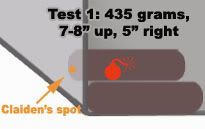
The first test on Tuesday 18 April was overseen by agent Thurman; it used 435 grams of explosive, with the suitcase placed second layer up from the floor, outboard end, “to the left of the door opening.” The center of explosion given was 7-8 inches from the floor, five inches “to the right of the first upright frame member.” [p 139] The inset here is based on my guess what that means, the door edge basically. Keeping close in line with the center of the real explosion, it should be near the (loading) front of the container, on that outboard end, and about this low. This center is about seven inches inboard (right) of the center identified by Claiden (see part 1), which I consider pretty accurate.

The second test was done the next day, 19 April, overseen by Feraday. This time a 360-gram bomb in its case was placed “on the second row of cases, to the left of the door opening – being on top of a 9” thick case (yet “four iches from the floor,” Leppard writes) and 2” to right of the first upright. [140] It would be like the above then except a bit higher and 3" further outboard (left)

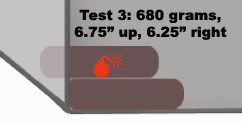
The third test was carried out the “following day,” so 20 April, and overseen by FAA’s Korsgaard. A whopping 680 grams was used this time, with the suitcase in “same location as in the second test,” in being on the second layer, but 6.75” up and 6.25” to the right of the upright. [p 140]


The fourth test was again “the following day, Thursday 20 April,” which would indicate Leppard got mixed up somewhere. This one shook up the formula so as to “evaluate the effects of placing the IED directly on the container floor.” The real question at hand - could it have been the Bedford bags? 400 grams were used, placed on the bottom layer to the left of the door. Leppard writes:
“Unfortunately, the explosion partly destroyed the evidence; ‘Due to an uncontrollable fire caused by the detonation,’ a secret report by Harry Bell stated, ‘results were not easily recordable as during previous tests.’

Nevertheless, it was the fourth test which provided the critical clue the investigators were watching for. ‘Results of Test number 4 clearly indicate that the case containing the IED was not in direct contact with the container floor. That is, the the device was not in in a suitcase directly in the bottom layer of passenger baggage.’”
[p 140]  

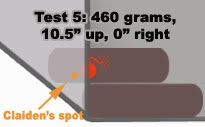
Having gotten what it seems they came for - something they could call absolution for London origin theory - they wrapped it up with the fifth test, with a 460-gram IED “placed this time among the second row up from the bottom of the on the left side of the door opening.” The one difference is this one was set “in line with the first upright,” the first bomb set zero inches or less to the right of the upright, when the real blast damage shows a center a bit to its left (Claiden’s spot). In fact, in getting closer to what happened, the team found:
“The IED configuration and location used in Test number 5 are the most consistent of the five tests conducted compared to the actual damage indicated by the recovered components of AVE4041PA.” [p 141]

These findings “confirmed RARDE’s initial assessment,” Leppard writes, “that the bomb had contained about 400 grammes of Semtex high explosive – less than a 2lb. Bag of sugar.” Yet he summed up the conclusions as showing “the explosive charge used to bring the plane down was ‘in all probability’ about 454 to 680 grammes or 1 to 1 1/2 pounds of Semtex.” [p 141] 454-680 grams is drastically higher than usually reported (a range roughly 300-400), with a low end well above RARDE’s suspected 400, a median weightt of 567, and topping out at nearly twice the amount usually reported.

The basic position of the IED - lower levels, aft outboard quarter (in plane) - was presumed and used in all but the fourth test. This is roughly the position of either a Frankfurt bag placed on top of another Frankfurt bag in that corner, or on top of a different (re-arranged) Heathrow bag. Or in the simplest solution, with the least re-shuffling required, it could be the right-hand Bedford suitcase moved to on top of the left hand case, both rotated 90 degrees counter-clockwise,  and slid left as far as they'd go. In all the illustrations above, those are the two brown Samsonites shown; it makes sense for making space, and fits the evidence fine, if one accepts that two bags obstructing the part you step into to reach the back could ever be stacked and scooted to make space.

So in short, these tests showed nothing new or conclusive regarding where the primary case came from. But it was expensive, visual, presumably fun, "guy" stuff (a blast), vigorous yet "scientific" anti-German Anglo-American bonding time, to strengthen the team commitment to what we now know was a massive sham of mis-investigation.

---
Source: Leppard, David. On the Trail of Terror: The Inside Story of the Lockerbie Investigation. London, Jonathan Cape. 1991. 221 pages.