Showing posts with label Toshiba radio. Show all posts

Toshiba RT-SF 16 Radios and Libyan Guilt

Undated
last edit March 1 2011

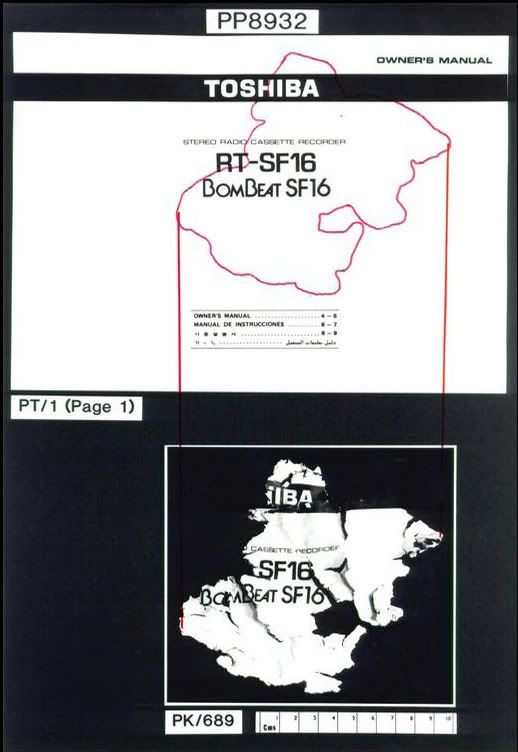
It was forensically determined that the model of radio carrying the bomb that brought down PA103 was a Toshiba RT-SF16 BomBeat radio cassette player, a small black-cased unit with twin-speakers. The radio was identified, in an often bizarre process as it's recorded, by fragments of circuit board and melted case plastics found blasted into surrounding clothes and luggage. And it was confirmed by fragments from the paper user's manual, one a full sheet pronouncing the model plain as day, torn up badly by the thousands-degree Semtex supernova a few inches away (below, left).

That last find, called PK/689, is just too much. Decky Horton thought it had been completely intact when she turned it in, and said so under oath at Camp Zeist. It's been explained the damage to the sheet might have been from forensics testing, and the bomb, apparently, did just about nothing to it.

The science was said to find the manual was not folded at the time of blast, meaning it was outside its narrow box, perhaps way out amongst the clothes. That becomes a bit more plausible. But then why were other bits of the same manual blasted into the blue babygro thought to be wrapped directly around the bomb radio box? Of all the fishy clues that suggest planting, this fishy plant would surely grow the most fish if planted.

These clues appeared to me before the context. I was asking why it had to be the RT-SF16 that wound up in the rubble, to necessitate something so obviously foul? The answer I found is put forth by, for example, the esteemed Richard Marquise, onetime overseer of the FBI's investigation. In a "letter to" Lucy Adams, Marquise pointed out how the model of radio itself indicates Libyan guilt:
"It was a senior Libyan official who had ordered the majority of all the Toshiba radios similar to that which carried the bomb. This official also talked in 1986 about putting a bag on a British or American flight from Malta. Ask why?"
As for the talk of bombing planes, Mr. Marquise will be aware that was a dubious claim of desperate defector A.M. Giaka. The official referred to is Said Rashid, head of JSO operations section, who "asked" Giaka himself - a driver for the JSO - to write a report about bombing planes. It's clearly a rubbish claim, among those first offered on the FBI's boat in mid-1991 in order to win witness protection for him and his wife and impending baby. It was dismissed by the Zeist judges, along with Giaka in general, and virtually everything else he said.

As for Rashid's company's purchase of the radios in question, another unbiased expert, Lord Advocate (prosecution) for the Scottish Crown at trial, Lord Colin Boyd, said in remarks on 28 August 2001:
"As if in confirmation of Libya's involvement during the preparation for the trial evidence was obtained from Toshiba which showed that during October 1988 20,000 black Toshiba RT-SF 16 radio cassettes, the type used in the Pan Am bomb, were shipped to Libya. Of the total world-wide sales of that model 76% were sold to General Electric Company of Libya whose chairman was Said Rashid.

Accordingly, its clear that the move of interest by investigators away from the PFLPGC and towards Libya was as a result of the evidence which was discovered and not as a result of any political interference in the investigation."
October 1988, just two month before the bombing, they made sure to conspicuously corner the market on the exact radio they'd turn into a bomb. Not wise, unless you're framing yourself. Some confirmation of the Libyan BomBeat connection did come from the trial:
"Two employees of Toshiba confirmed in their evidence that their company had supplied 20,000 Toshiba RT SF 16 Bombeat radio cassette recorders to Libya in October 1988. It is alleged that the bomb was contained within such a cassette recorder." LTBU daily report, 26 July 2000
Well that certainly depends on how pure the evidence itself was to begin with. But if we accept this claim, there would seem to be a rough correlation - all things being equal - that if you find a SF-16, it's about 76% likely to be JSO-owned, at least until it was stolen from them. That still leaves a 24% rate of non-JSO probability, and of course all things are not equal.

So the allegation per Lord Boyd is that the Libyans first branded this one radio model - and its amazingly durable manuals - as JSO material. And then they made one of those, of all the models on Earth they could have chosen, into a bomb for such a major operation. And they'd do this using a highly-identifiable and exclusive timer set so it would blow up over land and leave the clues to find. Including the conspicuously purchased Maltese clothing tied right to Megrahi. Packed in the case the Giaka "saw" Megrahi holding the day before the bombing. Sent through three airports unaccompanied but without a single trace at the one airport of them that had excellent security and delivered all their evidence.

It's an insane plot, and standard fare for this investigation. Another stupid move by the villains or, depending on your point of view, another sign of frame-up, with no opportunity to lost to emphasize the direction. Libyan-exclusive everything. I don't think that's normally how terrorists work when they're writing their own script.

Primary Evidence: Toshiba Owner's Manual

(incomplete)
last update 23 October

Dedicated posts: 
Toshiba RT-SF 16 Radios and Libyan Guilt - why this is a clue at all
Timeline: Toshiba Radio Identification - Just try to make sense of this detailed chronology
Decky Horton and Her Find Details on that unusual evidence PK/689 (see below) and the possibility it is  other than what was  found after the crash.

Debris in Detail
Following are direct quotes, with minimal notes, from the trial transcripts. Testimony of Dr. Thomas Hayes and Mr. Allan Feraday, variously questioned by prosecution and defense. Primarily they are reading from their examination notes.

Overview of manual fragments from Feraday’s final report, read out:
"Many fragments originating from the owner's manual of a Toshiba RT-SF16 radio/cassette recorder have been recovered. These fragments, which are detailed below, are damaged consistent with their close involvement in a powerful explosion. They have been identified by a detailed comparison with the control sample of the owner's manual PT/1 (PR/111) which was removed from the box containing the sample Toshiba RT-SF16 radio/cassette recorder (PR/105). The original positions of the fragments upon each page clearly indicate that the manual was not folded at the moment of explosion, apart from at its original stapled centre fold." [transcripts, day 20, pp 3093-3094]

"These sheets appeared to have been violently impacted and disrupted and bore localised areas of blackening and scorching consistent with their close explosives involvement." [p 3098]
Control: PT/1 (PR/1111): Feraday's report, read out:
This consists of the owner's manual extracted from the Toshiba RT-SF16 radio/cassette recorder marked as item PR/105 (above). This manual, shown in photograph 236, was originally included with the radio inside its packing box and was extracted for investigational reasons and given the productions number PT/1."
[...] "The item was later renumbered by the Lockerbie police as Production No. PR/111."
[...] "The manual consists of a white paper booklet measuring 26 centimetres by 19 centimetres and incorporating three complete sheets of paper which are folded and stapled together in the centre to produce a booklet of twelve sides of paper. This booklet contains user instructions and diagrams in several different languages. The front cover of the booklet bears the title `Owner's Manual, Toshiba stereo radio/cassette recorder, RT-SF16 BomBeat SF16.' The manual was originally contained, together with the black mains lead, within a polythene bag inside the proprietary packing box of item PR/105."
[day 20, p 3079]
Ferraday's science guy, Dr. Thomas Hayes, carried out what little actual forensics work was done. He testified, under questioning by Mr. Keen for the defense on day 17, about some of the manual fragments he studied. [pp 2687 and onward]

- PK/689: Recieved RARDE 11 May, examined by Dr. Hayes 16 May by examination notes.
"When originally received at this laboratory, this item was apparently an irregularly shaped single fragment of paper, shown in photograph 266, which measured approximately 135 millimetres by 125 millimetres. Detailed examination revealed the fragment to consist of two overlaid sheets lightly adhering together, having the same irregular shape.

On the upper surface of the two sheets, shown in photograph 267, were depicted (a) the legend "... Hiba ... O cassette recorder ... SF16 ... BomBeat SF16" and (b) apparent sets of operating instructions printed in several languages."
[p 3079]
""... the two-page fragment of paper appears to have survived a close-range explosion involvement." [p 2544]

Above: PK/689 (bottom) compared to control model PT/1. RARDE photo, undated...
[alternate image source: Conspiracy Files, 38:41]
"Q What it is saying there is that this item was received at RARDE on 11/5/89, and then passed to a DC Jordan on the same date for non-destructive fingerprints, and then returned to RARDE on 16th May, passed to DC Jordan on 16th May for chemical treatment after photography –
A [Hayes] It does say all of that, yes, sir.
Q And would that chemical treatment, rather than chemical analysis, be a means of preserving the piece of paper? Perhaps I should simply ask, Dr. Hayes, do you know what is meant there by "chemical treatment"?
A I'm guessing, so I really can't answer your question, I'm afraid.
Q But it is in your hand?
A Oh, yes. Yes, I wrote it."
[p 2687]
On its discovery by Decky Horton and her Zeist testimony. It was completely intact when she turned it in. See also "Conspiracy Files" link above.

Another possible inconsistency from On the Trail of Terror (1991) by David Leppard:
"Incredibly, none of the search teams had noticed a partly burnt Toshiba radio instruction manual for a Bombeat SF 16 which had been recovered from the crash site. It was to be left lying in Superintendent Roxburgh's property store at the Dexstar warehouse for months. [...] Details had been logged on to the HOLMES computer, but were left forgotten, buried in a mass of data until August." [p 81]
Leppard is known to make both frequent mistakes and, on occasion, obliquely ingenious observations. Considering Hayes' record of examinations in May, the claim that PK/689 was at Dexstar until is August could be interesting. Proper paperwork suggests a third date yet between the two for reciept of an item that could only be PK/689:

"Q [Keen] If we look at page 107, halfway down, we see that what the report tells us is that "on 30th June 1989 some explosively damaged paper fragments which bore indications that they originated from the owner's instruction manual for a Toshiba were received at this laboratory, thus conclusively establishing which of the seven models of the Toshiba had been employed in the Lockerbie bomb. 

[…] 
Q But we know that all of the dates predate the 30th of June. We've just looked at them, Dr. Hayes. 
A [Hayes] In which case we might reasonably assume that the date listed in this report is in error.
[…] 
Q Well, there appear to be two alternatives, do there not, Dr. Hayes? One, page 107 of the report is referring to different fragments to those which you found during your forensic examination.
[…]
Q The alternative is that the -- this part of the report is simply completely erroneous in ascribing to the 30th of June the receipt of any fragments of the Toshiba owner's manual?
A It could be the date is in error, yes, sir." [p 2692-2697]

- PT/2: 12 May
For what it's worth, the exam notes show other remains of the manual appearing in the following days of May. But the next one is featured on the famous page 51, and that page seems clearly to have been inserted after the fact. By the scan of that page we can see this item was originally and more logically dubbed PT/35(d). Why it was changed is unclear, but it makes two totally different classes of evidence - a control sample and a surprise find from afield - end up numbered PT/1 and PT/2. It works as a nickname, and seems to have no relevance of its own, but the oddity is noteworthy. Perhaps that's a clue to the unusual re-classification of the manual, eventually changed to PR/1111.
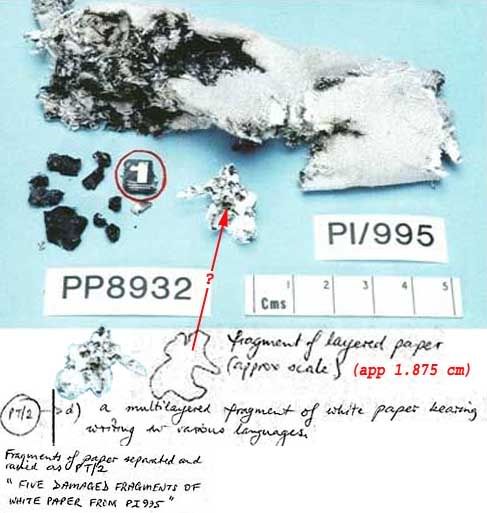
"PT/2, fragments of white paper with writing in various languages. "This fragment was recovered from item PI/995 (a fragment of grey-coloured `Slalom' brand shirt (section 5.1.3)), together with other fragments identified as being of particular explosives significance.

"Photograph 273 shows what originally appeared to be a single fragment of paper (encircled) after its extraction from item PI/995. Detailed examination showed that the fragment consisted of five overlaid sheets of paper lightly adhering together. The five sheets appeared to have been violently impacted together and disrupted and bore localised areas of blackening and scorching consistent with their close explosives involvement."
[3098-99]
The above image superimposes Hayes' famous page 51 notes for PT/2 before being separated. It's a match for size and shape with the lump in the photo. However accurate the lab entry's date, the photo was apparently taken before the lump was spread out into numerous sheets of type matching the manual in control sample PT/1 perfectly.

- PT/34: 16 May - “includes … pieces of paper … later thought to be parts of a Toshiba owner's manual” Same day the examination of PK/689 is recorded by Hayes. (I chose its earliest noted received date so it could start us off with a bang)

- ???: 18 May? "One small fragment of white paper bearing black printing" found in "the same blue and white Slalom shirt" PH/999 from which PT/40(b) was pulled. [day 20 p 3116] This would presumably be PT/40(something), and I don't have the time to figure out why I didn't figure this one out before.

- PT/56: 22 May
Feraday: "This consists of two very small blackened fragments of paper bearing a black printed legend. The fragments were recovered from a small fragment of the blue Babygro (item PI/1421, Section 5.1.8) and were identified as most probably having originated from the owner's manual for the Toshiba RT-SF16 radio." [day 20 p 3110]

- PT/31: 1 June 1989
"These ten small fragments of paper were separated from a fragment of the blue Babygro (item PK/2209, Section 5.1.8) along with other fragments of explosives significance, as shown in photograph 281. The ten fragments of paper are all approximately 2 millimetres square and appear to have been violently impacted and disrupted, bearing localised areas of blackening and scorching consistent with their close explosives involvement." [day 20 p 3105-06]
Three of these bore printing that, ittle surprise, also matched control sample PT/1 (PR/1111). Bits of the polythene bag were also found stuck to some of these fragments.

Zeist Judges on the Toshiba manual
forthcoming (volunteers? Opinion of the Court will do - check for reference to the cover PK/689.)

On Planted Evidence

14 September 2010

The possibility of planted physical evidence is a divisive issue among Lockerbie researchers, and one the Lockerbie Divide so far has had no problem promoting. That might be a problem, but it's natural when the blog's voice is almost exclusively my own. Physically inserted clues to implicate Libya suggests active investigative malfeasance many would rather not consider. A sort of mix-up is acceptable to some,  spurred by denying the best clues but needing to nab somebody. A few coincidences that suggested Libya that took on a life of their own, or some witnesses leaned on, seem plausible.

But in at least a few cases, planting is a more rational explanation than the official one. Consider PK/689, the nearly-intact cover of the bomb-radio's paper manual, made "a bit tatty around the edges" by the Semtex blast just a few inches away, and torn to shreds by forensic tests. Still says almost completely "Toshiba stereo radio/cassette recorder, RT-SF16 BomBeat SF16," a model that could be traced primarily to Libya. Consider also the problems with PT/30 and AG/145, 4-6 mm fragments from the Toshiba radio's main circuit board. Which side, if any, of the board experienced even the slightest explosive blast? The wrong side on PT/30 and neither on AG/145. Both of these show a high convenience-to-plausbility ratio, the key measure of how likely something is to be a work of fiction rather than physics.

And then the pivotal timer fragment PT/35(b), four times the size of the radio board bits listed above. Nearly one cm square, it was from the most identifiable corner of a super-traceable timer made by Swiss swindlers Mebo, and traceable to Libya of course. A Libyan timer set to blow up over land and leave such a lucky fragment is stupid for a Libyan terror plot, excellent if short on subtlety for a frame-up. Papers altered, exam log clearly backdated, no explosive residue testing, bizarre timeline unless it appeared four months later than recorded.

The issue came to the forefront most recently about a week ago when more details were revealed about the tests of Dr. John Wyatt. Professor Robert Black was so kind as to re-type much of a print-only version of an article about the tests and their suggestion that the pivotal timer fragment  was planted. The findings are to be part of Megrahi's upcoming book, and I think they solidly indicate a frame-up of Libya. The new article adds some technical detail to what he told the BBC for a January broadcast.

What's new, briefly, is that the 10mm square PT/35(b) is hundreds of times larger than it should be by his tests. Only at about 150 grams of Semtex-H was he able to recognize circuit board fragments - under a microscope but not with the naked eye. This is less than half the alleged explosive force used on Flight 103 (350-450 grams or as high as 680 by the Indian Head tests, or higher yet minus the small radio presumptions there that topped the testing off at 680, as all a RT-SF16 could hold). At any of these levels of force, nothing remotely like the radio fragments, timer fragment, or manual would survive. It's doubtful so much would survive of the Maltese clothes or perhaps the suitcase itself, as what we were presented with. In short, this body of findings suggests a lot of planting.

Again as before, this 150 gram threshold of plausibility is anecdotal, based on Dr. Wyatt's own characterizations. No detailed report has been released.  We still don't know how he came to do these tests or why - although it was apparently 2008 or earlier, and most likely at the Megrahi team's request,for the second appeal that was never heard.

The story also featured an interview with Lockerbie trial "architect" Robert Black who expressed disinterest in commenting on or promoting this development:
Last night, Robert Black, Professor Emeritus of Scots Law at Edinburgh University ... said: "I have decided to stop commenting on new evidence because, interesting as it may be, it takes the eye off what really matters, namely, that he should never have been convicted in the first place on the flimsy evidence before the court."
There are good reasons to gloss over this evidence. Even if what Wyatt says is totally true, it's something most people can't accept, and so a distraction from whatever more digestible points showing the verdict unreasonable. No need to start off telling novices the science was dishonest too - at least not until they're ready. That's ideally well after the notion of his innocence has been broached and all but proven by a careful look at the facts over the myths. Dissolve the Malta link, explain the alternative actors who make more sense, and cover the testimony of Giaka and Gauci, under the DoJ's money for misinformation program. Any closer look at the securing of the G-guys' testimonies suggests willful intent and frame-up, and from there, some convenient circuit board doesn't seem so outlandish.

But sometimes people will counter, whether they've been mentally prepared or not, "well, there was forensic evidence implicatiing Libya..." At that point, their belief in the science they've heard is the distraction from coming around to the bigger picture. Those of us who seek to reach the fuller truth, or want an answer to that science, will have to consider whether or not this Libyan-linked timer really was involved and left such a huge and recognizable fragment. And at that point there are Dr.Wyatt's tests, complete with the uncertainties noted above. And there is common sense, which suggest about what the tests are said to show - if the plane was ripped open, the radio would be vapor and dust. The things we were shown came from somewhere else.

Commentator "Pete" put it well in the comments section beneath Black's post.
Re that 'bloody timer fragment':
Certainly it would be easier to persuade those with the power to launch a new inquiry if we don't stress the implication that it might expose malfeasance on the part of our agencies and those of our allies.
However... firstly, it could be argued that the BTF was ultimately responsible for Megrahi's conviction. The implication of the Opinion of the Court is that the judges took the BTF to be absolutely conclusive proof of the Libyan origin of the bomb. Forensic evidence is scientific and as such outweighs all else (cf. the conviction of Barry George.) It was Libya what done it; Megrahi is Libyan; therefore Megrahi done it. Hence the perverse interpretation of all the other evidence. Science has spoken.
Secondly, while the BTF remains unchallenged, any exoneration of Megrahi is likely to be painted by Marquise, Duggan et al as 'technicalities'.
Thirdly, isn't it likely that if the investigation is ever reopened, even with Megrahi out of the frame,
McKnacker will restrict the scope to Libya unless there is some reason to doubt the clear implication of the BTF?
Damned if that's not a clear-eyed view. Science has spoken, and judges seem unwilling to question it. But what it said doesn't make sense. We can call science out when it lies, and we should. A fully documented, transparent, non-Libyan-sponsored study would be ideal now to compare with what Wyatt says he's got. Science can, if it hasn't already, allow us to see which is correct here: common sense, or those who accept miracle after miracle as their natural right in chasing Libya.

Further thoughts in comments section.

Decky Horton and Her Find

Posted June 17 2010
last edit July 14

This post will gather the evidence of Gwendoline "Decky" Horton regarding her find of a piece of paper, alleged to have been evidence PK/689 (below, compared to a control sample, PT/1). This was alleged to be the cover off the manual for the bomb radio, which had obviously been near a powerful Semtex explosion, since it's - ripped up a bit. The clearly readable model name identified the model used for the bomb (??) as one sold primarily to a Libyan company.
Mrs. Horton and her husband Robert Geoffrey Horton (or Jeff) had been credited as turning the miracle find in to police in Late December, from their farm near the North Sea. The main controversy about this surfaced at trial in 2000 where Decky but not Jeff testified.


Trial testimony
Camp Zeist, day 6 May 10 2000
Witness number 334, Gwendoline Horton
Transcripts pp 962-966


In her remarkably brief questioning, she re-told of finding "what we thought was just debris, possibly from a passing car or something," on the morning after the crash. Soon they heard there was debris everywhere, and a neighbor told them "she understood it was from the plane that had crashed, and that all the local farmers were collecting it in the fields." So Jeff and Decky headed out to gather what they could in case it had any value. From there her testimony runs:
Q And did you hand material in to the police on that day?
A I can't remember if it was that day or the following day.
Q How many times did you hand material in to the police?
A Twice.
 Q And how did you carry this stuff once you'd gathered it?
A Just in a carrier bag, I think, at the time.
Q I would like to ask you about one item in particular. Do you remember coming upon a document of some sort that made reference to a radio cassette player?
A Yes, I do.
Q Can you describe what that item was like?
A Well, from what I remember, it was possibly about -- I know I'm supposed to say it. * About that kind of size, you know, about possibly eight by eight, or something like that, inches.
* This apparently refers to the usual instruction to speak out sizes, directions, etc. rather than gesturing.

Q Could you see writing on it?
A I could see writing, because I remarked to my husband, "This appears to be from a cassette player," or something like that. I do remember it was something electrical.
Q And did you hand that item in to the police?
A Yes, that went into the bag as well.

Q Right. I wonder if you would look, please, at Label 24. You'll see there is a bag which contains items there. Do you recognise anything?
A Well, not in its present state. I'm sure when I handed it in, it was in one piece.
Q Yes.
A Yes.


Q Perhaps -- I wonder if it could be put on the document imager, to see if we can see it. You can see within the police plastic bag, I think as you've described, more than one piece of a document.
And you can at least see writing on it?
A Yes.
Q Do I understand you to say that when you handed it in, it was in one piece?
A It was in one piece, sir. I am practically sure of that, yes.
Q But apart from that, you recognise the item?
A Yes. Uh-huh.


Q Whereabouts did you find that item?
A In the fields -- we are a private house on the roadside. In the field opposite, they are known as the glebe fields, and it was in the bottom glebe field, down beside the burn, down in the bottom. In the dean.
Q Thank you very much.

[...]
LORD SUTHERLAND: Thank you, Mrs. Horton. You are free to go. Thank you for coming.
THE WITNESS: Thank you.

2008 Media interest
Following the 2007 SCCRC findings that Megrahi deserved a second appeal, and coming on the 20 year anniversary of the attack, 2008 brought attention to the whole case including the Hortons. The trial controversy had the crew of BBC Conspiracy Files visit the farm and get Decky's story on camera.
BBC Conspiracy Files, 2008:
http://lockerbiedivide.blogspot.com/2010/01/video-conspiracy-files-lockerbie.html (Starting around 37:30)
"I was taken into court by the usher, and I had to swear the oath. And then I was shown a plastic bag with this ... piece ... of paper in it. But at the time I was asked is this what I had found. And I said well when I found it, it was in one piece. But in the bag there were several pieces, and the name Toshiba was only just discernable by then."
[...]
"When I found the piece of paper it was more or less intact - a bit tatty around the edges but it definitely had Toshiba written across And it was in one piece, where this is in several pieces."
Narrator: "The police say the evidence had become degraded because it had undergone hundreds of forensic tests."

> Contemporaneous article, The Sunday Sun (UK)
Geoff and Decky Horton found a key piece of evidence after wreckage was strewn over their farm, located 60 miles from the crash site. But the piece of paper — believed to be from the package which contained the bomb that blew up Pan Am Flight 103 — was damaged after it was handed over to investigators.
[...]
Police said the paper was damaged following a battery of forensic tests.
But the documentary says: “Why was the piece of paper so altered from when the Hortons found it? Was it proof of a conspiracy or careless handling by the police? The mystery remains.”
Conspiracy theorists believe key evidence was tampered with to implicate Libya in the bomb plot.
http://www.sundaysun.co.uk/news/north-east-news/2008/08/31/lockerbie-evidence-called-into-question-79310-21640187/

...

Analysis:
Mrs. Horton didn't independently recall any specific wording, including Toshiba, at trial. All she said before being shown the item was "I remarked to my husband, "This appears to be from a cassette player," or something like that. I do remember it was something electrical." In 2008 she claims to have remembered it saying "Toshiba" in its entirety. This could be a false memory. Nonetheless, I suspect it did say Toshiba. The reason being, this fragment appears to be a plant, one designed to exploit an actual memory.If the fragment had said something else, like Panasonic, she might remember that and cry foul when it later said Toshiba. That would be risky. I doubt she would or should recall the tedious model number, be it RT-SF16 or otherwise. The "BomBeat" or lack it might stand out, but it doesn't seem to have.

I also challenge Mrs.Horton's "several pieces" categorization. It can appear that way, but it's described in eaminations, and is, a single sheet of paper, nearly torn through in spots. THE BBC's coverage of this tricked me at first - the question is whether investigators tore up the paper Decky found on purpose. The real question is whether this was the piece she found at all. If so, it was nowhere near the bomb, and then what a coincidence it's for this model, sold primarily in Libya.

Again, it was allegedly torn through from being inches from an explosion that ruptured a plane's hull at over two feet. Or rather, if one trusts both RARDE and Mrs. Horton, one needs to accept that the manual cover (and no other page) was made "a bit tatty around the edges" by that blast, and torn to nearly to shreds by later forensic testing.

These tests were discussed at the Zeist trial. PK/689 was listed as first received at RARDE on both May 11 and June 30 1989. [link] Dr. Hayes' notes said (paraphrased) "this item was received at RARDE on 11/5/89, and then passed to a DC Jordan on the same date for non-destructive fingerprints, and then returned to RARDE on 16th May, passed to DC Jordan on 16th May for chemical treatment after photography." Jordan, by Hayes' recollection, was with either the Metropolitan police or Scotland Yard. [Zeist trial, day 18]

That's all I can find, and no mention of explosives residue testing. It hardly seems worth the hassle, of course, being so clear on the face of it. In fact, I'm half surprised they didn't claim Megrahi's prints from this find.
...

Timeline: Toshiba Radio Identification

June 4/5 2010

The following is a detailed timeline of the establishment of the radio model used for the IED that took down Flight 103. Led by Mr. Allen Feraday and Dr. Thomas Hayes of RARDE in 1989, the model they decided on was a black Toshiba BomBeat RT-SF16, was sold largely (76%) to a Libyan company. Thus, the very radio model became another clue of Libyan guilt, and like the rest became full of strange inconsistencies suggestive of a fraudulent investigation.

The dates are as given. Fudging and backdating cannot always be ruled out. There is in fact a serious and obvious insertion of pages within pages and apparently a missing original page 50 (a new twist on an old anomaly, to be explained soon). This affects the alleged timeline May 12-15. Emphasis is on radio case plastics, main circuit board, and user's manual. Speaker mesh, speaker magnets, a screw, some wires, and other bits appear sporadically but not worth this level of dredging for you or for me.

Note on evidence labeling: In example item PI/995, the "P" means property (evidence), the “I” indicates search sector it was found in (sectors ran A-K), and the number should mean the 995th item found or logged in I sector. PT however means evidence removed from other items (PT/35 was found inside PI/995, for example). Again, the numbers within the PT category are supposed to be sequential – PT/35 should be found right after PT/34. Such a label is often attached to all debris found within a piece, subdivided by letter (ex: PT/35(a), PT/35(b), etc.)
---
  • Late Dec and into 1989: Dr. Hayes’ examinations work (mostly) alphabetically, from PA/ to PB/ etc. It will take a while to get to PH/, PI/ and PK/ where the bomb damaged material and radio remains will be concentrated.
  • mid-Jan (date not noted): Thomas Claiden at AAIB finds a lump of materials, trapped in a fold of a data plate for container AVE4041. He hands it back to the police.
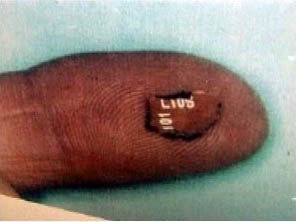
  • Jan 17: This is received by RARDE, and designated evidence AG/145. The largest fragment (left) is app. 10x6 mm, and another marked “02” was about 5mm sq.
  • Jan 17-22: Feraday: "very early on, I thought we'd probably got a white case, because I'd got white fragments with that AG/145 fragment." No others would surface ever.
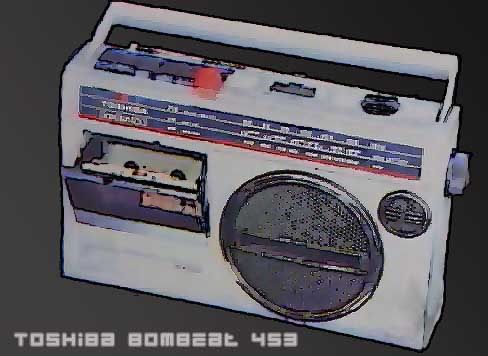
  • Jan 23-25: Mr. Feraday takes a trip to Germany “to compare the Lockerbie circuit board fragments (AG/145) with the radio/cassette device recovered in Germany [Khreesat’s BomBeat 453].” No match. For one, Khreesat’s was black.
  • Feb 2: Feraday goes to Toshiba UK headquarters at Camberley, Surrey. He examined “over 130” service data sheets and found the AG/145 pattern “was tentatively identified as originating from a Toshiba brand portable radio/cassette player, model number RT-8016.” A same-day physical examination of that model supported that.[3023-24]
  • Feb 3: Feraday sends a memo to Senior Investigating Officer John Orr: “I am completely satisfied that these fragments originate from a Toshiba brand radio stereo cassette recorder types RT-8016 or RT-8026 […with] a white plastics case.”
  • March 15: last entry in Dr. Hayes’ examination notes for two months - next entries are in mid-May.
  • April 18-21: Indian Head forensics tests, Maryland. Five blasts in luggage containers are set up by Feraday. He prepares all the devices, using the RT-8016 in all. He personally oversees the low-end test, using 360 grams Semtex-H. He makes no detailed report, relying on DCI Bell’s police report, which he’s not even sure RARDE got a copy of.
  • April 23-May 1: Feraday visits Toshiba HQ, Japan, learns the board he’s looking at was put in seven different models. One and only one of these is, surprisingly, given the BomBeat title - the RT-SF16. Identical to the 8016 except for the black case. And it had its Libya links
  • ??: Control sample PR/105 is obtained – RT-SF16 new in its box. The owner’s manual is “removed” from this “evidence” and dubbed PT/1. PT otherwise means actual blown-up evidence removed from other real evidence. Here they emphasize the “removal “ of PT/1 from “evidence” PR/105. 
  • May 11: radio manual cover PK/689 is received at RARDE. Supposedly from the bomb and found in a field in K sector near the North Sea, it’s ripped but can be read to announce “..Hiba … o cassette recorder … SF16 … BomBeat SF16.” It matched the control PT/1. Gosh, why didn't they call this in earlier? Afterwards, items are said to be from the RT-SF16. However, see June 30.
  • May 12 (by lab notes): “PT/2” is discovered – five crumpled bits of paper, consistent with same spot on most pages of PT/1. Found in clothing PI/995, along with (but not included in) PT/35. PT/35 included 11 bits of black plastics PT/35(a), the famous PT/35(b) (non-radio), and speaker mesh PT/35(c).
  • May 15: Hayes discovers black case plastics PT/41(a), and PT/42(c). 
  • May 16: Hayes examines PK/689 (above, left). “And I've concluded there that the two-page fragment of paper appears to have survived a close-range explosion involvement.” Hayes discovers case plastics PT/34(b), manual papers PT/34(c).
  • May 18: Hayes discovers case plastics PT/38(b), PT/40(b), PT/48(b), PT/78. Manual PT/40(c)
  • Mid-May, presumably (dates unavailable) – Hayes discovers case plastics PT/32(b), PT/33(b), PT/36(d), PT/37(a), PT/53(a), PT/56(a), and PT/61(b).
  • May 22: Hayes finds manual scraps PT/56(c).
  • June 1: Hayes finds PT/31, ten tiny bits of RT-SF16 manual, examining the 'blue Babygro' PK/2209.
  • June 8: Hayes discovers tiny radio circuit board fragment PT/30 embedded in suitcase fragment PK/2128. It’s about 4mm square.
  • June 18: DI Williamson claims in a letter to SIO Henderson that Feraday discovered the ”potentially most important” PT/30 this day examining PK/2128 [Leppard 207] Either way, it was shown to fit the same Toshiba board as AG/145 did (all labeled together in a prosecution photo). Clearly RT-SF16.
  • June 30: Feraday notes: "On the 30th of June 1989, some explosively damaged paper fragments [PK/689] were received at this laboratory, thus conclusively establishing which of the seven models of the Toshiba radio had been employed in the Lockerbie bomb.” He meant May 11. “It's a mistake that I made when I wrote the reports," he explained under questioning, "because sometimes items would come and go to the laboratory several times.”
  • July: Feraday attends a second set of four blast tests in the U.S., again using RT-8016 radios.“Mr. Feraday, you referred earlier in your evidence to having taken part in explosion trials in the United States in April and July of 1989 … nine in total…”
  • Aug 17: Dr. Hayes does an examination on AG/145. (first ever?) "A small quantity of aggregated partly carbonised material from which many fragments were recovered."
  • September 14: Feraday visits Dextar looking for matches to PT/30 (no luck) [Leppard 208] See also, Forensic Follies.
  • Late 1989 (date unclear): Dr. Hayes retires from RARDE. His slot as head of the explosives division is taken by Mr. Feraday. Hayes continues unofficially as a "consultant" for three month, then extended.
  • Nov 12, 13 1989: FBI interview with Marwan Khreesat in Jordan – the RT-SF16 has been decided on. Khreesat says he’d never use such a radio, is absolved of suspicion.
  • Dec 19 1989: date of DI Williamson’s letter regarding PT/30 cited above. He’s asking for more evidence from Germany – alarm clocks - to see if it can match up with PT/30. [Leppard 207]
  • ... 1990 ... 1991 ...
  • Nov 15 1991 - Indictments read out against Megrahi and Fhimah, using the identified RT-SF16 as part of its evidence. The rest is history.
---
Sources:
Leppard, David.On the Trail of Terror: The Inside Story of the Lockerbie Investigation. London, Jonathan Cape. 1991. 221 pages.
Testimony of Allen Feraday and Thomas Hayes, Camp Zeist NL. Days 16-21, June 6-15 2000. Too varied to cite individually.
Others explained at provided links

PFLP-GC Radio Recycling and the Khreesats' Luggage

Coincidences, or Clues of a frame-Up?
May 28 2010


Onetime suspect in the Lockerbie bombing, Jordanian double-agent Marwan Khreesat, has quite a fascinating tale, laid out in an 1989 interview with FBI special agent Edward Marshman [PDF download] and other sources. Two minor but interesting threads of the story are a curious set of five recurring Toshiba radios, and a matching set of luggage that eerily resembles another I’ve been wondering about.

The Toshibas originated when Khreesat was summoned to Damascus in 1985 and tasked with building five hidden altimeter bombs to show to PFLP-GC leader Ahmed Jibril. Khreesat says he bought five of the same model radio-cassette player - the aptly-named BomBeat 453 – on “Smuggler’s row” in Syria. [p 10] (model at left, but Khreesat's were black) He also secured his own timers and altimeters - four of each - but the pivotal and pricey detonators were apparently provided. [p 32] Khreesat left one bomb radio absent its altimeter and timer, two ready but for loose wires needing soldered, and two fully ready to go. A pin pushed in would arm them, and a sustained climb past a certain altitude would cause the detonation. [p 10]

After Khreesat built these devices, they were shown to Ahmed Jibril, who approved them. Khreesat then disassembled the devices (aside from one shown in 1987 to Jibril’s nephew Abu Elias) “and the components were taken back to the PFLP-GC office,” the report states. [p 10] “The radios themselves were left in Khreesat's cousin's house.” Compared to America’s culture of disposable electronics, these five boom boxes were treated like golden heirlooms passing from hand to hand. Someone was later sent to retrieve them, but the cousins were allowed to keep one and “only four were picked up.” Of these, Khreesat insists he “saw one in an office in Syria being used as a regular radio.” [p 10] The one kept by Khreesat’s cousins “stayed upstairs at the house,” the report continues, until “Khreesat's wife later reclaimed this radio.” [p 10]

Now when he arrived in Neuss, West Germany in mid-October, Khreesat brought his wife with him; he explains that she wanted to visit her brother in prison there, a wish Dalkamouni granted. [p 5]. David Leppard in On the Trail of Terror (1991) reported that they brought a matching luggage set – two brown hardshell Samsonites - and inside Khreesat’s case was a black BomBeat 453. “He had brought it from Damascus,” Leppard writes. [p 6]

But by Khreesat’s story to agent Marshman, it was the wife who had brought this radio from Jordan, after reclaiming it from Syria, “to give to her brother, who was in prison” in Germany. She was reportedly “unable to give this radio to her brother, and this radio was left in Hashem Abassi's house,” where they stayed while in Neuss. “This radio was clean,” Khreesat advised, and he “assumes that it was seized by the Germans.” [p 10] There is a Yaesu FT-211RH that was seized but found to be unmodified [Zeist trial, day 72, pp 8829-31], but I’ve seen no mention of a clean 453 found.

The only sample of that familiar model the BKA are known to have seized was rigged for altitude-based killing and in the trunk (boot) of Dalkamouni’s car when he and Khreesat were arrested on October 26. This was the unit studied by BKA scientists, with Dr. Rainer Gobel measuring time delays between 35 and 45 minutes after the pressure switch.

Leppard seems to have decided that was the BomBeat that Khreesat brought in his case, but the bomb maker’s own story conflicts with that. He says it was yet another of his omnipresent 1985 radios. On October 18 or 19, on returning to his room at Abassi’s place, he found all his supplies laid out across the bed, including his original timers and altimeters, and that Toshiba. [p 17] He didn’t know how any of this got there, but it was presumably brought by Dalkamouni, who handled all his supplies. All the timers and altimeters were the same he used in 1985 [p 32] and the radio “was one of these five radios that he worked on in 1985,” [p 10] while he and his wife just happened to have another of the five there with them.

It’s not clear what this might mean, but for one thing we should wonder if it’s completely accurate. Was Khreesat more involved than he lets on, and brought his own 453 radio to modify? And if his wife really brought one, did he really just leave it in the Abassi home, or did it disappear, say, along with Abu Elias?

And then there are the suitcases – what if these were stolen and used for the bombing? Here we have the bombmaker with brown, hardshell Samsonite suitcases, forensics on the other end suggesting the 103 bomb was in such a case, and between them one credible report - John Bedford’s story - widely noted as seeing one such case quite near the blast area of fateful container 4041. However, few realize he describes two such cases, apparently a matching set. Like the Khressats' (per Leppard). This must be either a fairly steep coincidence, an error by Leppard, or a clue of something else. Khreesat doesn’t mention any missing luggage, and Leppard reports clues that the wife took her bag when she returned home on the 22nd, which of course makes sense.

But other clues point to the infiltrator being essentially framed by the PFLP-GC. Khreesat didn’t even build the bomb that may have done in 103; at least by his own telling, all four of his  own products were (eventually) taken in by the BKA. The fifth device that Abu Elias escaped with was apparently of his own making, and not a black BomBeat 453 (Khreesat thinks it was a bronze Toshiba RT-F423). [p 37] Its modifications were apparently mimicked based on earlier study (1987) of the master's work, and Dalkamouni only had Khreesat do a token finish on this unit (solder two wires) before taking it back to its maker, perhaps just passing it through the Jordanian’s workshop to get his “fingerprints” on it.

Such co-option is one way to respond to an infiltrator in their midst, if they had found that out. If so, Abu Elias might also have secured his own copy of the double-agent’s double Samsonites and put his “Khreesat bomb” in one. It would also do to snag the extra 453 unit (if there indeed was one) to put in the other case.

Even without awareness of this spooky suitcase match, I can imagine how investigators would be apoplectic seeing BomBeat 453 debris at Lockerbie after the famous Khreesat bust weeks earlier. There’s no evidence of such debris and I’m not arguing for this. However, it's an interesting thought, and  if it had been there it would be reflexively covered up with rigor. And otherwise the possibility stand that a clever PFLP-GC worked right around Khreesat, doing the bombing themselves but making it appear like the West's agent had done it.  Embarrassment upon embarrassment as cover, and no surprise, it wasn't looked into.
---