Showing posts with label Gauci T. Show all posts

Harry Bell's Eight Reasons

December 27 2010

(Props to "Pete" for bringing this to my attention)

DCI Harry Bell, head Scots police investigator on Malta, made an important entry in his police diary on February 15 1991, the day of Tony Gauci's selection of Abdelbaset al-Megrahi's photo. In it, he says that his boss, Senior Investigating Officer (SIO) Staurt Henderson, "agrees we have a partial identification on the person named Abdelbaset considering all of the circumstances," which he then lists. These eight reasons, in support of Gauci's point, suggested to him that Megrahi was in fact the buyer of the clothes that wound up in the bomb suitcase. [Source: Grounds of Appeal PDF, p 42/43 - unearthed by the Scottish Criminal Cases Review Commission (SCCRC) and supplied to Megrahi's defense]
(1) He arrived in Malta on 7th December '88. This was the date of the purchase of the clothing.
This is a whopper of a point to begin with, considering the date of sale is almost certainly November 23, based on Gauci's best evidence. Tony described a Wednesday a few weeks before the bombing, before the Christmas lights went up, at about 6:50 pm during a light shower, with his brother watching a football game at home. All that fits only one day - November 23, and Megrahi wasn't even on Malta that day.

Even an official Scottish legal review by the SCCRC agreed in 2007 that "there is no reasonable basis in the trial court’s judgment for its conclusion that the purchase [...] took place on 7 December." The judges had accepted it, but that decision has been criticized by serious professionals.

Consider also that in 2006 Bell himself admitted to the SCCRC just how the other date was selected despite the evidence. He ignored the lights and rainfall, focused on the less-conclusive football schedules, and got "confused."
DI Bell SCCRC interview (25-26/7/06)
"...The evidence of the football matches was confusing and in the end we did not manage to bottom it out..."
"...I am asked whether at the time I felt that the evidence of the football matches was strongly indicative of 7th December 1988 as the purchase date. No, I did not. Both dates 23rd Nov & 7th Dec 1988 looked likely."
"It really has to be acknowledged how confusing this all was. No date was signficant for me at the time. Ultimately it was [Megrahi’s] presence on the island on 7th December 1988 that persuaded me that the purchase took place on that date."
[same link as above, p 229]
It wasn't the evidence (no rain all day, different game time, lights glowing across town) but Megrahi's presence that made it the day. If that's not dishonest, it is evidently wrong to then make the circular claim, as Bell did in his diary, that the established date is a separate support for Megrahi's guilt.

(2) He resided at the Holiday Inn Hotel, Sliema, which is within several hundred yards of the shop premises.
Extension of point one. He stayed there on December 7, not the day the clothes were bought.

(3) He travelled to Switzerland on 9th December 1988. He is known to Bollier, the person who supplied the IED timer.
This isn't immediately relevant to the bombing; the trial court dismissed any direct link between Megrahi and the timers. However, Mebo founder Edwin Bollier's acquaintance might be material, in that he was the first person to suggest the CIA should blame Libya, and helped them greatly in brining false charges against al-Megrahi into 1991 (see below). His information then and since is often bizarre and usually unreliable.

While the Lockerbie timer fragment is itself questionable, whether or not DCI Bell should have suspected that at the time is another story. But even if he believed these other clues, it's no excuse for mangling the date of purchase evidence like that.
(4) He was involved in the company known as ABH on behalf of the Libyans. This company was set up to deal with contact with the MEBO company, Mr Bollier's firm.
Same as above. This is an irrelevant extension of a tagential connection that doesn't prove anything about how the bombing was done.
(5) He has a resemblance to the original photo fit and artist's impression.
In the sense they both have faces with two eyes and so on, this is a good point. Otherwise, the resemblance is uncanny in its inability to match up. Five inches too short, 14 years too young, too light, too slight, with a different face and hair, and far away from there when the clothes were bought. Point five is way off mark. If the other clues support the guy, a bad sketch is no problem to ignore - they're well-known to be unreliable. But to actively cite it as a support when nothing else really sticks is deceptive.
(6) ...
We don't know what this point was or why it was apparently redacted.
(7) The SIO advises that Bollier has now been shown the photofit and he states that if the hair was shorter then it would indeed look like Abdelbaset, also if it was 10 to 15 years older.
Strangely, this is exactly the description Gauci gave of the "Czech photo" of Megrahi: 10-15 years older, with shorter hair, and he'd look like the buyer. But this is about the Photofit image, which Tony felt looked like his 50-year-old buyer (see last link). Bollier says "if it was 10 to 15 years older" it would look like the 36-year-old Megrahi. Or perhaps Bell is mixed up here.
(8) The SIO also advises that the photograph we have of Abdelbaset is in fact 12 years old. ...
Confirmation that the photo's dating served in a bait-and-switch operation on the age discrepancy. A 12-year old photo, of a man who'd have to look older by just about that, would make it a fit. But Tony still insisted the man was around 50 at the time of sale, while Megrahi was 36 at that time, so something was twisted out of form here. (That's explained a little better at the "Czech photo" link). Point 8 continues:
He is a smart dresser, plenty of jewellery and there is no recollection of the watch according to Bollier and he is taller than Bollier at 5 foot 9 inches. Gauci thinks 6 foot tall.
These fashion points are obviously weak as evidence, but the part on height is interesting. Gauci is famously short (5'3"), so Bollier is cited as a man also shorter than this tall-ish Arab, at a decent 5,8". Here that's fudged up a modest one inch and stated as taller than someone else, and it perhaps seems reasonable for stubby Tony to recall "Baset" as towering 6 feet up there, or maybe ten feet.

The wording is ambiguous enough, on review, that one who didn't know the subject's true height might conclude that a 5'9" man had reported "Baset" as taller than himself, and another had said Megrahi was six feet tall. That's important when that same man said the buyer, who the police knew could not be Megrahi, was six feet or more in height. That's one of the reasons it can't likely be Megrahi.

And that's all of the reasons he wrote down, except the missing one, and the fact of the "identification" earlier that day. Not encouraging stuff to be finding in police records, is it?

Sent Out to Lie

Review: The Loockerbie Bomber: Sent Home to Die
finished 3 October 2010
last edit 4/10

Production company: STV, Scotland.
Air date: August 2010
ex prod: Gordon MacMillan
prod: Donald John MacDonald, David Cowan
STV Youtube posting (embedding disabled)
---
I’m a little late to watch and review this video, which might just be the most strategically deceptive thing I’ve yet seen or on the subject of Megrahi’s guilt. Most of its lies are of the omission type, like ignoring the hundreds of credible critics of the official story on Pan Am 103. The lone voice they present for the other view, Dr. Jim Swire, told the crew he felt “the circumstances of my daughter’s murder have become wrapped up tissue of lies. Something terrible is being covered up.” (32:17) The video that abuses and dismisses his position at every turn is clearly a continuation of that same fabric, hoping to wrap up all his - and many others’ - outstanding questions and chuck them forever in the dust bin.

The 46 minute video is tightly–paced and split into four parts. The first covers the horror, the scale, and the loss of the bombing over and in Lockerbie. Part two relates the popular mythology of how Libya’s guilt, via Megrahi, was discovered. The investigation, indictments, sanctions (nearly a decade glossed over in two sentences), and everything up to the trial at Camp Zeist are packed in there. Part three briefly mentions the 9-month trial and then tries way too hard to clear up the continuing doubts about Megrahi’s conviction there. This is supposed to wipe the slate for the pivotal part 4, which explains how the “Lockerbie bomber” was sent home to die, but then didn’t.

The intro starts by noting the disastrous "compassionate release" all the way to Tripoli was "against the wishes of the most powerful country in the world," as if the power of those who disagree should matter. I didn't know China much cared, but the producers will have you know the SNP has made powerful enemies for the British with its stupid (or...???) decision.

The actual video opens with a long stretch on the horror of the crash, which, again, the best (discarded) evidence suggest was done by the PFLP-GC, for Iran, using a Khreesat-style altimeter bomb loaded in London. The amount of pain or fire doesn't in itself add anything to who's guilty, just to how mad you should be, at how horrible this mass murderer’s act was. Then for a change, it goes to how tragic loss of so many wonderful people was, so you can get sad before getting mad again. It’s a well done and touching segment, to be honest. Mentally, however, it’s counterproductive to thinking straight, and only primes the audience for the coming barrage of deception.

About 12 minutes in the PFLP-GC and Iran Air 655 as possible motive are mentioned, and FBI chief investigator Richard Marquise admits that sounds like a logical assumption. But the notion is here first framed as something the CIA had tried to say once, with "no evidence" of an Iran-PFLP-GC link ever found. It could be fairly said there was no proof, but much evidence exists, a bit of it presented in the preceding minute of this very video. There was not one but four radio bombs found, and a fifth that never turned up - unless it did. These were set by altimeter and a crude "timer" set to blow 35-45 min. after takeoff (that's the simple version - deeper here). PA103 blew up 38 minutes after leaving Heathrow, officially a coincidence of poor Libyan timing.

On forensic findings
Finally at 14:24, after discussing the "fortunate"bomb placement that actually best supports a London introduction, the video gets to the specific evidence that would matter for convicting Megrahi. In thirty seconds it says a lot that leaves out a lot:
Forensic scientists decided the Lockerbie bomb had been hidden inside a different radio cassette player from the one used by the Palestinians. Packed into the Samsonite suitcase, it exploded in the plane’s forward hold, close to the skin of the fuselage. Charred fragments of clothes from the suitcase took the inquiry in a completely new direction. This label from a babygro [“made in Malta”] was the first connection to the island of Malta. Then a distinctive logo [“Yorkie”] led to the firzsst major breakthrough.
This is the one of the parts where they tell you that science has spoken, but as I’ve noted elsewhere, what it said doesn’t make any sense. The PFLP-GC link was weakened by the identification, from scattered fragments, of a different radio than the “one” the PFLP-GC used (actually 3 different models and a computer monitor). First, I invite anyone to closely examine how this other radio – Toshiba BomBeat RT-SF16 - was identified. Consider the chronic inconsistencies in this detailed timeline, reconstructed from trial transcripts. Secondly, Dr. John Wyatt's tests suggest an explosion of the scale needed wouldn't leave any such readable debris, meaning investigators would really have no clue what radio - if any - was used.

And thirdly, even if Wyatt is far off, the clearest "proof" of the radio model is this, PK/689, the paper manual cover. You know it was inside the box 2" from the blast center not because it was reduced to ash, but because it's lightly singed, torn, and says, plain as day, "BomBeat." The lady that turned in PK/689 said the paper she saw was fully intact when she found it, and that hasn't been challenged. Officially then, it was made "a bit tatty around the edges" by the semtex blast, and ripped nearly to shreds by forensics tests.

The radio model thus established not only pointed away from the Iran line, but also suggested Libyan authorship. Convenient.

The scorched clothing - blue babygro, Yorkie trousers, black umbrella, slalom shirt, and others - is also challenged by Dr. Wyatt’s findings. Being at least outside the radio's cardboard box, it's to a lesser degree than the radio and timer, and I for one am agnostic on whether they’re authentic. But they were convenient also, pointing to Malta and, by extension, to Libya.

To Malta and Gauci
The story of the clothes’ identification and tracing to Malta seems to be conveyed fairly, although the details, relying on the recall of detective John Crawford, are a bit fuzzy. The trousers in particular led them to the Yorkie clothing factory on the tiny island nation, who had the papers to show the very few pairs of that batch were sold to one shop only – Mary’s House in Silema, run by the Gauci family. One fateful pair was apparently bought there brand new by someone linked to the bombing and f*****g stupid. The clarity of the lead was the "stuff of detective novels," says George Esson, Chief Constable of Dumfries and Galloway Police in 1991. It was all "fantastic," "almost unbelievable." Why "almost," George?

Starting at 15:45 they discuss the pivotal witness Tony Gauci, the shopkeeper on duty at Mary's House when those clothes were sold, and his supposed identification of Megrahi as the bird-brained buyer. As the video later notes, Gauci's reliability remains hotly contested, and he “has never said with absolute certainty that al Megrahi was the man" who bought the trousers and babygro.

In fact he’s never said he was the man at all, who he says was at least 4 inches taller and 14 years older than our villain. Just going on faces, he pointed at a photo of Megrahi in 1991 and said it was "similar to the man ... He would perhaps have to look about ten years older,” which he didn’t. Later in 1999 at Camp Zeist in the Netherlands, he pointed to the by-then famous “Lockerbie bomber” in person and said "“not exactly the man I saw in the shop.” Clearly Detective Crawford’s take “when he got to number 8, he said “that’s the man,” is misleading. (18:10)

At 17:29, Richard Marquise says again that Megrahi "had been in Malta the day the clothing purchase was made, December 7." This is a big lie and he’s had that pointed out to him prior to this interview. Note he emphasizes “actual immigration records,” as if that's the issue. In fact, the top Scot on Malta, Harry Bell, essentially admitted in 2007 that Megrahi's presence on December 7 was the reason the date of purchase was changed. Gauci clearly describes November 23, when Megrahi has an alibi, but there was a very slim case for it being December 7, and that’s what it became. Gauci can be observed at trial being more vague on all the points that conflict between the two days. But the judges seem to have missed that (see link for details).

And the money situation ... we'll return to that one.

A bomb from Malta
Having "established" Megrahi’s link to the clothing, at 22:07 crown prosecutor John Logue cogently relates the official story of the unaccompanied bag from Malta. The tight and coherent evidence from Air Malta's end says clearly there was no such suitcase on KM180, and opposing it we have wishful thinking plus one unusual record from Frankfurt, with all supports and comparison records somehow  vanished with no clear explanation. If it weren’t for the fluke of the computer printout for PA103A, salvaged from an airport employee's locker, investigators would have no record at all of what happened at Frankfurt that day. Air Malta had everything and it was in order, but it differed from what the locker-paper said, so was pushed aside by investigators, by Scottish judges, and certainly by crown prosecutors in between them.

After ignoring these troubles with the notion of a bomb from Malta getting onto 103, the video turns to the evidence that Megrahi was at the airport on Malta December 21 - under a false name. This seems to be solid, and at 22:25 he is caught in a lie to a journalist, denying his presence there. This secrecy probably was related to the false passport and the secret mission he was likely on for Tripoli, and it was unwise to continue denying at the time of that interview in 1992.

But as far as we can tell, Megrahi's unrelated secret mission on that day is precisely why he was chosen as the route to frame Libya, and why evidence pointing to Malta was concocted. It could also explain why Mohammed Abu Talb was chased for a while, but that's too esoteric for most. At any rate, the missing context is the lack of any good evidence his mission was to blow up a plane, and the presence of any bomb on Malta that morning is what’s solidly in question here.

The locker-paper from Frankfurt had suggested (but far from proved) an unaccompanied item from Malta getting onto the doomed 747, but not what kind it would be. This was previously filled in by a witness who said he saw Megrahi with a brown hard-shell Samsonite - like the bomb was packed in - the day before the bombing, on his arrival from Tripoli. Unfortunately, the witness, Abdul Majid Giaka, made this story up for the FBI only in 1991, after learning what type of case he needed to "remember." (And after being given no choice but to come up with something just like that.) The judges dismissed this point of evidence, as well as the rest of what Giaka had to say (and it was a lot) at trial in 2000. As far as I can tell, Giaka and his claims are entirely absent from this video, as if he never existed - another lie of omission, and a rather glaring one.

On the timer fragment 
(18:40) The video's approach is standard and brief. A piece of circuit board dubbed PT/35(b) was discovered, and later matched to a timer called MST-13, made by Mebo, a company with links to Libya. This information was obtained from the CIA, who held a comparison model. Identifying FBI agent, "Tom" Thurman, related again his 1990 epiphany comparing a photo to something under a microscope (there are many versions he's told). He explained "I could not believe it under any circumstances, and it was there," so he believed it and so did everyone else.

Myriad logical problems and questions plague this alleged timer (see PT/35(b) link). Why was it set so early, when a couple more hours would safely bury the evidence at sea? Why is the corner they found the only one so distinctly recognizable? The narrator starts by describing the prominent 1/2"square fragment as "tiny," and Marquise later implies that contrary to what critics say, it was not too small to have been found - because it was found, duh!

In fact the key problem for this item is that it's far too large to have been inside the bomb, maybe 2 inches from at least 450 grams of semtex. Dr. Wyatt's tests cited above in relation to the radio itself, were publicized in January 2010 in connection with this crucial evidence more than with the radio. As his work strongly suggests, this thing was put into the wreckage by something (or someone) other than the bomb. Therefore, its ability to implicate Libya might be better evidence for a frame-up than for a bombing.

On the conspiracy theorist
Part three starts with the trial’s end (around 24:15). Megrahi was now ruled guilty, and his accomplice Fhimah was somehow found not guilty. To mention why would require bringing in Giaka, and raise troubling questions. The video does not mention why he was found not guilty, probably some technicality.

"But not everyone was convinced," the narrator ominously intones, turning to Dr. Jim Swire. He's not only a critic of the official story, but feels Libya and Megrahi were consciously framed by the US and UK governments. This blogger agrees that, politically correct or not, tha' the most logical explanation for what happened. The editors selected a video of Swire solitarily approaching a podium on the court's expansive plaza, and then mentioned no one else who holds views like his. With both of these choices, the video creates the impression that Swire is the only one who needs convincing and what the hell's wrong with him?

Just before introducing the loner, US family member Bob Monetti said “if you follow it every day and have an open mind, it became overwhelmingly obvious that Megrahi was guilty.” But Swire insists it was close attention to the trial that solidified his doubts about Libya’s guilt. Having read much of it myself by now, I agree with him, and I suspect Mr. Monetti did not follow as open-mindedly as he claims.

Further, Dr. Swire’s lone claims "infuriate" the leaders of the investigation that led to Megrahi being blamed. Top Scot, SIO Stuart Henderson, says at 26:21:
"I’m sick and tired of saying this. What - is - in - it - for me to try and fit somebody up to go behind bars for forty years. You must be joking. Anybody that makes suggestions like that has got to be rather twisted. Because we were being watched on a daily basis. The whole world was watching us."
I can't say what's in it for anyone in particular, nor do I have reason to suspect Henderson himself took part in the most important bits of dishonesty. But the whole world was not watching them. I don't recall seeing the live footage at RARDE’s laboratories showing all comings and goings, or transcripts of the first police interactions with Mr. Gauci. There’s no audio tape of agent Tom Thurman’s meeting with Orkin, or secret video of the session where PT/35(b) was cut, scratched up, and burnt to look realistic enough to plant. But Henderson would have us believe all these things would be known if they happened, so they must not have happened. It's a poor argument to say the least.

Lawyers are then called on – even those who support Megrahi’s innocence – to strengthen the stance that there was no conspiracy here. As expected, they won’t admit, for reasons of being lawyerly, that fakery and framing are bleeding obvious. Megrahi’s counsel Tony Kelly argues that his client is innocent and wrongly charged, but apparently on accident. He didn't see “any major conspiracy, or attempt to frame a particular person.” (26:42) "Megrahi's own lawyer rejects the conspiracy theories," the narrator can triumphantly say, and even his more banal protests could just be invented to justify his paycheck. Swire's looking pretty lonely now.

Kelly further emphasizes that “it’s the legal process that matters,” not theorizing about what might have really happened. I take his point that legal truth does decide things here on Earth, even if it's unjust in its mechanics, like at Camp Zeist, and on Megrahi's first appeal. Call me old fashioned, but I say truth matters more than this fickle legal process – at least in some abstract way that should matter more.

On the Official Review
One bright point where the legal process and revealing truth partially merge is Scottish Criminal Case Review Commission (SCCRC), covered in the video at 25:40. They looked at the case for almost four years and, like Kelly, said they found no sign of evidence being planted (rather I suspect they didn’t look for any). But they did find in mid-2007 reason to conclude Megrahi might have suffered a miscarriage of justice, again presumably by accident.

They referred it, on a conservative six grounds, to the appeal court. A spokesman, Gerard Sinclair, told the film that research suggests “there's about a 64% chance of that being successful" once they’ve sent it back to the courts. This statistic is presented as ominous, spliced with secret video of a jubilant Megrahi, alerted of the commission’s finding.

To its credit, Sent home to Die does acknowledge the finding that the Maltese clothes were bought "when Megrahi wasn't on the island." It's obvious to anyone who reads the evidence with clear eyes, and kind of proves that Marquise lied to the camera at 17:29, but the video already accepted that untruth as a basis for presenting the conviction as sound.

The SCCRC’s findings of American payouts to Tony Gauci of at least $2 million is mentioned (but the further $1 million or more to his brother Paul is neglected). No one will flat deny that such money was dished out to the brothers following the verdict, but on the question of what they knew before that remains hotly debated, for obvious reasons. The promise of money for a conviction against the man in photo #8 has the manifest potential, at least, to alter Gauci’s evidence. And as noted above, he altered his evidence in ways that seem not so much random as strategized to help convict Megrahi.

Marquise fudges, in a way that's effectively a lie (30:00). "Not one witness was ever promised money or did they ask for money in exchange for saying anything." The contrary evidence can be read right from Scottish police records here. Money concerns are there from day one, first seeded by the Americans in 1989 (“endless money” offered, $10,000 upfront) and couched in indirect language elsewhere. Tony himself usually kept mum, but his brother Paul was noted as a money-grubber. Behind the scenes, the ongoing quest for cash was clearly an open secret, gutting Stuart Henderson's ridiculous rebuttal. He told the crew that Tony was not only unaware of the coming reward, he was in fact "well aware that there was no such thing as a reward being handed to him ... Didn't enter his head."

Sent Home to Die gives the commission a semblance of respect in its filming and mention of the more important findings. But ultimately, it brushes their work aside as niggling questions surrounding a rock-solid conviction that had been assembled by solid men like Henderson and Marquise, and accepted by eight judges. However, between the Zeist verdict and the SCCRC’s review, only one has been legally ruled a “possible miscarriage of justice,” and the other is clean as a whistle.

On the appeal/Conclusion
The respect shown to the SCCRC is carried over into the results of its process, Megrahi’s second appeal. It’s a solemn process the prisoner is entitled to, to be looked at by five more judges. It’s acknowledged that this moved rather slow, and then somehow it was buried under the noise of imminent release.

The prisoner transfer agreement is raised first, emerging as it did in 2007 and part of a lucky streak along with the SCCRC review. But as a less-lucky terminal case of cancer entered the picture in 2008, so did compassionate release, and a second way home. Both routes are mentioned, with few details, and it fell to justice secretary MacAskill to chose, and he met the prisoner at the jail.

Then, the narrator says, “just days before MacAskill announced his decision, Megrahi gave up his appeal.” Margart Scott, QC, is shown passing along his officially inexplicable “belief that these instructions to abandon his appeal will assist in the early determination of those [release] applications.” The move is not explained or dwelled over any. Maybe he thought he or his successor would lose the appeal. Again, the Crown prosecutor John Logue is called on (32:00)
We were ready, willing, and able to defend Mr. Megrahi's conviction in the appeal court, and would have done so had that appeal continued. We were confident in the conviction, and confident that we were able to defend it during the appeal.
Logue is just parroting the bluff of departing Lord Advocate Elish Angiolini. The Crown was not ready or able to defend the case, at least not by normal evidentiary means. Consider this recent assessment of a renowned defense layer:
Michael Mansfield QC, one of the country's best-known defence lawyers, said a full judicial inquiry was required to settle the doubts over the case. Mansfield said he had no doubt that the evidence given to secure Megrahi's conviction was "entirely unsustainable". [source]
But part three ends with “20 years after Pan Am 103 fell from the sky, Megrahi’s legal battle was over. Only one question remained – where would the Lockerbie bomber be allowed to die?” The following part four is interesting in its own right, but I’ll leave it be as based on a false premise, as there are far more, and more relevant, questions than that one, as another prominent lawyer recently noted. Citing the SCCRC’s doubts about the case, the head of the Scottish human rights commission professor Alan Miller said [per the Guardian]:
The row over Megrahi's medical status was an "undignified and unhelpful distraction" from the more important issue of addressing unresolved questions about his guilt.
The situation that needs resolved in 2010 is the continued denial of truth and thus justice while nearly everyone turns a blind eye and maintains the charade. In pushing the groundless presumption that Megrahi actually is the bomber, Sent Home to Die cannot be of any use in that resolution. It might just do for someone’s political agenda, but that’s no surprise – Lockerbie has always been taken for all its worth to advance unstated aims.

Yes, Millions to Malta

Who Says Tony Got $2 Million.
July 19 2010

last update 27 September (see bottom)

Who Says?
The primary witness that mattered in convicting Abdelbaset al Megrahi for the Lockerbie bombing was, of course, Maltese shopkeeper Anthony "Tony" Gauci. Gauci provided the only link between al Megrahi and the primary suitcase, "identifying" the Libyan as the purchaser of clothes ruled to be inside when the bomb went off. Gauci's evidence and its reliability has come under withering critique from different quarters, and among the more repeated charges in recent years is that Tony was paid - and more importantly offered in advance - $2 million by U.S. authorities for delivering his testimony. The earliest reference I can find is from The Guardian, October 3, 2007:
"The key prosecution witness in the Lockerbie bombing trial was allegedly offered a $2m reward in return for giving evidence, raising fresh doubts about the safety of the case." [source]
This was referring to documents held by Megrahi’s leagal team, first uncovered by the Scottish Criminal Case Review Commission in its four year investigation. In the end they found six grounds of possible miscarriage of justice to refer the case back for appeal. Four of these were publicized, all dealing with aspects of Gauci's evidence, and two remain secret to this day. The SCCRC's public announcement (PDF)  of June 2007 in itself makes no mention of reward concerns, but that might have been one of its secret points. However well-supported, the story was widely repeated in credible reports as an explosive allegation.

Consider this audio discussion from September 7 2009, between Scotish politician/activist George Galloway and Frank Duggan, president of the US families group Victims of Pan Am 103 Inc. Not himself a family member of a PA103 victim, Duggan was a political appointee to liase with them from 1989 on. He wasn't able to cite the number of families he represented in 2009, but was quite clear in stating their unanimity about Megrahi's guilt among that unknown number. "There’s no difference of opinion as to the guilt of Mr. Megrahi."

On Tony Gauci, Duggan said “I don’t know anything about the man. I think he’s an honorable guy just trying to do what he thinks is right,” but admits “I’m not that familiar with what he said.” He also said “Dr. Swire doesn’t believe him and I’m sorry about that, but everyone else seems to believe him who’s looked at this case,” notably the "eight judges" that reviewed the case at trial and appeal. Indeed, they accepted what Gauci said, aside from small details like the buyer’s build and height, his age, and the date of purchase. (see first link).

Duggan correctly notes that Gauci’s "inconsistencies" are the subject of the SCCRC’s publicized grounds of appeal, while incorrectly citing “three or four” grounds total. He chalks up their quibbles to "natural" variation from one interview to the next, while admittedly not knowing what was said. And he misunderstands how many interviews were really done with Tony by the same Scots-Maltese team – at least 23, only indicating Megrahi near the end. Duggan seems to feel each nation was only allowed one interview, and 19 involved nations made 19 interviews.

When Mr. Galloway asked the simple question “why did the US government pay him several million dollars?” Duggan about snapped.
“They never did. Who said that? Dr.Swire? Let me tell you one thing. And forgive me if I raise my voice, ‘cause I really get angry. We keep hearing about witnesses being bribed, witnesses who have new evidence, all sorts of things that are just not true. Who said we paid the man two million dollars? It’s preposterous." 
Galloway: “it’s a matter of public record … it’s a commonplace.”
Duggan: “No it’s not. No - it’s - not. … Who said that? Who said that? Who said that? … That’s not so. That’s - not - so.”

Sorry, Frank. I noticed that George said "several million,"and you said "two million," so I know you've heard this before. And yet all you can do in return is call it "preposterous" to pay this witness $2 million. And you’d likely find it crazier yet to pay his brother - who wasn’t even a witness - another $1 million. It would be highly troubling, wouldn’t it? And it happened. Galloway didn't know who to cite, but the SCCRC and Scottish police and US DoJ personnel say so. The two brothers also reportedly moved to Australia in a witness protection plan. That's an aside for the moment, but it gives an idea of the scope of this.

These People Say.
It wasn't until about two weeks after this interview that further support of the two-year old charge became available. After Megrahi’s mysterious release and abandonment of his appeal, he controversially published this information on a website in mid-September. The Grounds of Appeal cite the SCCRC’s findings, based on documents they looked at. The appeal had stuck to the Gauci issue by and large as referred, and it seems the pay-out was one of their areas of great interest: 
There is significant evidence regarding the credibility of the witness Tony Gauci in respect of his having a financial interest in, and his having received substantial monetary payment for giving evidence. This interest and payment was not disclosed at trial and the various documents which indicate same were not disclosed at trial.

The SCCRC has recovered undisclosed material which indicates that:
(a) The witness Tony Gauci had, at an early stage, expressed an interest in receiving payment or compensation for his co-operation in giving evidence, and that this interest persisted until after the trial
(b) that the witness Paul Gauci had " a clear desire to gain financial benefit" from his and his brothers co-operation and that Paul Gauci exercised considerable influence over his brother
(c) that the U.S. authorities offered to make substantial payments to the witness Tony Gauci from an early stage
(d) that an application for reward monies was made on behalf of the SIO of the investigation team of the Scottish police to the U.S. Department of Justice, after the trial, and that substantial payments were received by both Tony (in excess of $2m) and Paul Gauci (in excess of $1m) after the appeal.
Following are some of the source materials they called on to make these startling (to some) conclusions. This list is more than most people will need.
Extract from DCI Bell Diary (HOLMES version) (28/9/1989) [SCCRC Appendix: chapter 23/3] which indicates that on 28th September 1989 the FBI discussed with the Scottish Police an offer of unlimited money to Tony Gauci, with $10,000 being available immediately. Thereafter there is a comment about challenging Murray as to what he thought Gauci could give in return that he was not already giving.
They had only been speaking with him since September 1, and before the month was out they were discussing money for different/better information. The next is from February 21 1991, six days after Tony had first pointed to a photo of Megrahi and said he was similar to the buyer, but younger.
Memo from DCI Bell to DSIO Gilchrist (21/2/91) [SCCRC Appendix: chapter
23/1] which states that Tony Gauci had expressed an interest in receiving money in recent meetings and that "if a monetary offer was made to Gauci this may well change his view and allow him to consider a witness protection programme as a serious avenue"
It was clearly a service they were grateful for, and the endless visits likely petered off once they had an "ID" that fit with the other new clues. By the end of 1991, a US Grand Jury had looked at the screened evidence of Gauci, Libyan defector Abdul Majid Giaka, and various other circumstantial clues. The result was the indictment of Megrahi and his "accomplice" Fhimah on 14 November, a major goal of U.S foreign policy that would be leveraged into a massive embargo of Libya. The Gaucis thought they deserved something for their important part in that. From DCI Harry Bell's diary, January 8 1992:
“The manuscript version states "Bhiel states DOJ(Department of Justice) will give Magid [Abdul Majid Giaka] $2 million dollars. Advised of our concern." The dictated version has the same first sentence but continues "He was immediately advised of our concern regarding this. I also clarified with him about the Gauci reward and the response was only if he gave evidence." (This last comment is also unredacted in more recently disclosed manuscript version)
So as far back as January 1992 the standard $2 million amount was given to liar for hire Giaka, and also for Tony, but only in the future, after some possible, far-off trial. They already had all they needed at the moment, having secured the indictments.

The trial wasn't supposed to happen, but somehow the US was presuaded to agree to a third-couuntry compromise in 1998, and the two accused were flown to the Netherlands and turned themselves in as prisoners awaiting trial. In the run-up to his testimony at Camp Zeist, Tony had concerns, capture in a Strathclyde Police Witness Protection Report of June 10, 1999, which had addressed:
(a) the frustration of Tony Gauci that he will not be compensated
(b) that in respect of Paul Gauci "It is apparent from speaking to him for any length of time that he has a clear desire to gain financial benefit from the position he and his brother are in relative to the case. As a consequence he exaggerates his own importance as a witness and
clearly inflates the fears he and his brother have. He is anxious to establish what advantage he can gain from the Scottish police. Although demanding, Paul Gauci remains an asset to the case but will continue to explore any means he can to identify where financial advantage cane be gained."
(c) that the Gauci family had financial problems

Yet his Crown Precognitions of March 18 and August 25 1999 were clear "that Tony Gauci has never at any stage sought to benefit but that Paul Gauci whilst not "openly" seeking a reward has been "more alive to the possibility of receiving substantive assistance" SIO Henderson wrote to Maltese police security branch in August 1999 to say that Paul & Tony had been accepted onto the witness protection program, and have “expressed some dissatisfaction at the Scottish response to their particular circumstances”.

Then the trial, Tony's disastrous testimony, the judges' mysterious acceptance of the Crown reading of it, and the surprise conviction of Megrahi at the end of January 2001. Another piece can be seen in a letter of 1 February from SIO McCulloch to PF Brisbane. On the day after the guilty verdict, he was double-checking with the Crown before applying for the Gaucis' reward money. An enclosed report from McCulloch gave the reasons it should go ahead:
(a) " the issue of financial remuneration has not been discussed in detail with the witnesses and no promises exist"
(b) " It is considered that the witnesses may harbour some expectation of their situation being recognised, however
whilst proceedings are still 'live' they displayed a clear understanding that such matters could not be explored"
(c) " The conduct of the Gauci brothers reflects both their own integrity and their response to the manner with which the police have dealt with them. It is therefore vital that they continue to perceive that
their position is recognised and they continue to receive the respect that their conduct has earned."
The final justification accompanying payment (date redacted, unknown) the reasons for approving were about the same. Here Paul's role and reward were again affirmed.
“In relation to Paul Gauci, it was a decision of the Crown not to call him to
give evidence and agree a joint minute for elements of his evidence. His evidence was important as it related to the identification of the clothing. However, it should never be overlooked that his major contribution has been
maintaining the resolve of his brother. Although younger, Paul has taken on the role of his father (died 7 years ago) with regard to family affairs. His influence over Anthony has been considerable (It is considered critical that the contribution of Paul is recognised in order to preserve their relationship and prevent any difficulties arising in the future).”

How much resolve does it take to simply recall what happened and describe it to the police? How many meeting and how many years should it take? It took a team effort deemed to be worth at least three million. In fact, the authorities were never averse to paying the Gaucis whatever they wanted - they only afraid of being seen doing it. And Paul clearly did more than help his brother's mood, judging by how Tony works on his own (trial testimony):

Yes, [the police] came a lot of times. They used to come quite often, didn't they. […] I don't know exactly when they used to come, but I did not take notes when they used to come. But they used to come quite often to see me. They used to come and ask questions, and they used to take me to the depot and things like that.

Yes, yes, and the ice cream. I'm sure he loved that. But he knows money too, and he still wasn't getting it after the conviction. There was an appeal to be heard first. After this was dismissed for its own complex reasons, on April 19 2002 a letter "records a meeting held with the US Department of Justice where the reward was discussed and supported by the FBI and refers to a suggestion made at the meeting that the sums applied for - $2m for Tony Gauci and $1m for Paul Gauci could be increased."

The SCCRC states that at some time after the appeal the two witnesses were each paid sums of money under the "Rewards for Justice" programme adminstered by the U.S. Department of Justice [SCCRC Reference at 23.19]

Concerns surfaced among investigators in 2007 about how this would look if the SCCRC publicized the heretofore secret facts:
Briefing Note D12915 DI Dalgleish to ACC Graham (16/5/07) Refers to the
“expectation that the SCCRC’s statement of reasons, which will be furnished to Mr Megrahi and his defence team, is likely to question the integrity of Anthony Gauci’s evidence and also reveal that he and his brother have received substantial payments from the American authorities. [...] there is scope for distorted or malicious reporting of the facts and a real danger that if SCCRC’s statement of reasons is leaked to the media, Anthony Gauci could be portrayed as having given flawed evidence for financial reward [...] Providing these witnesses with the financial ability to leave the island whenever they wished to avoid media or other unwanted attention was a significant factor in the nomination being made to the Rewards for Justice programme in the first place...
The concern about "distorted reporting" is ironic, given the distortion caused by years of keeping these payments secret. And the last bolded suggests it was partly hush-up and get out of town money. Go somewhere where you're not recognized and take new names under witness protection. As fragile a thing as Gauci's evidence cannot handle sneaky press inquiries, which are inevitable when something is this fragile. Clearly the best move is effectively disappear the men, as they did Giaka.

Now Mr. Duggan can take back his claim this is a ludicrous event, and craft an argument as to why it's all perfectly natural, normal, and expected, not to mention open and well-known from day one.
---
Postscript - further notable denials:
The August 2010 STV video Lockerbie bomber: Sent home to die features fresh affirmations, from investigators themselves, that money had not a lick to do with the case. Around 29:30 in, the $2 million payment - and Gauci's pre-trial pursuit of such - is mentioned. FBI SCOTBOM chief Richard Marquise issued the usual 'no money was promised or asked for,' meaning no money was relevant to what anyone said, but allowed for payment afterwards ("not allowed to comment" means yes, and so he's not a total liar). Scottish Senior Investigating Officer Stuart Henderson immediately followed with this (at 30:02):
"When we extracted the evidence and information from Gauci, he was well aware that there was no such thing as a reward being handed to him and he certainly didn't get any remote thoughts from us that he would get anything. Didn't enter his head. He had such a good relationship with our officers he really tried hard to help us."
It could be said he and Paul were left hanging, and unsure if they'd get a reward, or how large it would be. But to say it was made clear there would be nothing is absolutely not illustrated by the evidence shown above, and would have been a lie. Henderson's claim to know what did and didn't enter Tony's head is classic appeal to authority. And finally, note how the witness' compliance is attributed to the "good relationship" he held with the police. As shown above, good feelings are always put forth when money delayed enters the frame. For example as the application for reward was put in by Henderson's successor as SIO:
"[T]he issue of financial remuneration has not been discussed in detail with the witnesses and no promises exist ... It is therefore vital that they continue to perceive that their position is recognised and they continue to receive the respect that their conduct has earned."

Rewards and Bribery

1 October 2010

This is the title over an excellent new post by "Rolfe" at the JREf forum. It covers some of the issues in my own post Rewards for Injustice, but goes beyond that with new information and thoughts in quite a sharp package.

The post, with slight edits, is as follows:
---
There's been more stuff today about the matter of the bribery of witnesses by the US Department of Justice in the Lockerbie case. [...] How comfortable are those who believe in Megrahi's guilt with the amount of bribery that was going on?

Rewards for information are a recognised part of crimefighting. They're often aimed at people in the underworld themselves, or on the fringes of it. If people with that sort of inside knowledge see more benefit to themselves from turning "grass" than from their criminal activities, they may squeal.

That sort of information has to be taken with a huge health warning of course. Petty jealousies and feuds may easily lead criminals to invent false allegations against their colleagues. So it has to check out. Give us the information, yes, but be prepared for it to be scrutinised and verified and corroborated before you'll see a penny.

Ordinary members of the public might get such a reward too, but what for? Not for simply telling the truth about what they know after the police have approached them about a matter. In that case, you'll be lucky to get your bus fare to court and a limp sandwich for lunch. These rewards are for crucial information the police hadn't found out for themselves, and which leads on to the Big Breakthrough.

And again it has to be corroborated and verified. Nobody gets millions of dollars or pounds for simply making stuff up to suit what the police want them to say.

Or do they? What really happened in the Lockerbie case?

Regarding the Gauci brothers, it's a matter of public record that they eventually received (probably more than) $3 million. This is not in respect of approaching the police with any new or valuable information, but simply for giving an account of a clothes purchase Tony recalled, after the police had identified them as the vendors of the clothes by independent means.

It has been hotly denied that this was ever promised in advance, and indeed there was probably no actual promise. However the documents now available show a lot of evidence that Paul in particular was very much interested in receiving money for giving evidence, and that heavy hints were dropped. Start at page 90 of the pdf, page no. 149 of the document. A couple of extracts.

on 28th September 1989 the FBI discussed with the Scottish Police an offer of unlimited money to Tony Gauci, with $10,000 being available immediately.

And later, in relation to a luxury holiday in Scotland that was given to Tony and his father in 1991.

He wondered how he would explain the cost of such a trip. He was told [by Godfrey Scicluna] to suggest the National Lotto as having won a prize!

How is this possibly be justifiable, if the only interest is in ensuring the witness gives as accurate an account of what he saw as possible?

And Tony wasn't the only one having hints about large sums of money dangled in front of him. At Zeist, Fhimah's business partner Vincent Vassallo gave evidence. He knew Fhimah very well, but only met Megrahi on 20th December 1988. He was pressed on a number of matters, including whether either of them had a bronze Samsonite suitcase with them that day. If he had chosen, he could have "remembered" stuff that would have been highly incriminating. Here's part of the transcript.
Q Mr. Vassallo, do you recollect that in April 1991 you were approached by a number of police officers at Luqa Airport in Malta?
A Yes.
Q And in particular, a number of Scottish police officers, including a Mr. Bell?
A Yes.
Q And do you recollect being interviewed by those police officers at Luqa Airport on 18th April 1991? [7642]
A I do not remember the exact date, but that they had met me the first time at Luqa Airport, I do remember.
Q And do you recollect them discussing Lamen Fhimah when they interviewed you?
A Yes.
Q And do you recollect them referring to Mr. Baset [Megrahi] when they interviewed you?
A I don't remember.
Q Do you recollect if the subject of a reward or money was raised with you?
A What I remember is that when they came to my office, Harry Bell asked me -- he said "Try and remember well. You know there is a large reward, and if you wish to have more money, perhaps go abroad somewhere, you can do so."
I am not saying, to be clear, that Harry Bell was offering me something. He was simply telling me what the conditions were; that for information that I might be able to give, there is a large reward. And I also read it, and I also heard it on the news.
To be clear, he didn't say "Here, this is the money," to give the wrong interpretation. He only said "There is a reward, and if you for any reason wish to be more relaxed with money, we would not find any [7643] difficulty, even if you do not wish to give us information here"; that is, in Malta.

Oh sure, this isn't a policeman offering a bribe to a witness to invent incriminating evidence against a suspect. Of course it is. If Vassallo had been greedy enough, and clever enough to take the hints he was offered about what sort of things the police would like him to "remember", he could have joined the Gaucis in Australia and never worked again.

And then there was Giaka. There's tons about that in the records. I'll post Paul Foot's version of it, which I think is accurate.
It was obviously important for Giaka to impress his CIA contacts. He depended on them for money – he got a thousand dollars a month rising to $1500. The CIA showered him with gifts of clothing and radio sets, and even arranged for sham surgery to his arm. [To avoid conscription into the Libyan army.] But in spite of this largesse the CIA handlers in Malta got increasingly fed up with Giaka’s prevarications, and started to conclude he was not worth the money. By December 1990, their cables decribed Giaka as “desperate”. Somehow he managed to keep the CIA’s confidence all through the Gulf War but by July 1991 his situation seemed to be even worse.
The CIA contacted him in Libya, and he returned to Malta to meet them. He was told that a meeting had been set up with officials from the US Department of Justice, and that his future depended on what he disclosed at that meeting. Almost at once he started to barter with his handlers, only to be met with a threat that unless he could come up with something about his former colleagues in the JSO [Megrahi and Fhimah] that might incriminate them in the Lockerbie bombing, he would be abandoned in Malta and cut off without a penny.

Not a single statement about having any information about Lockerbie until 1991, despite much questioning. Then when he's threatened with loss of his income (not even getting his fare back to Tripoli) if he doesn't come up with something, he "remembers" a bunch of fairy-tales.

Transcripts, via Paul Foot:
[William Taylor, QC for Megrahi] “You see the documents speak for themselves. They build up to a crescendo as I’ve described. It’s not me that is doing it. It’s the documents that are doing it. And lo and behold the deafening silence (about Lockerbie) ends the very next day, when you come up with a brown Samsonite suitcase and this rubbish about Customs. The very next day is the first mention by you, Giaka, of these matters. What do you have to say about that?”
Giaka could only stammer: “When I met with the representatives of the Department of Justice, they are very good investigators, and they can distinguish truth from lies. One way or another, they can obtain what they want.”

Giaka was immmediately, that very day, spirited out of Malta and en route for the USA where he was given a luxurious new life in the witness protection programme.

Giaka's evidence was actually the main basis of the indictments issued later that year. Tony's tentative "well he looks a bit like the purchaser" would never have been enough. It was entirely down to Giaka that Megrahi and Fhimah were charged at all. And we must remember what happened after that. Libya tried to adhere to the terms of the international convention whereby their own nationals were entitled to be tried in their own courts. The USA refused to hand over the evidence Libya would have needed to try them, and insisted on the accused being handed over instead. Stalemate, the result of which was a 10-year international blockade of Libya, keeping out essential goods and medical supplies, and resulting in thousands of preventable deaths.

All because of Giaka, and the evidence given under the circumstances outlined above.

And then, in court, the prosecution fought tooth and nail to conceal from the defence the evidence showing that Giaka had just made it all up for money - up to the point where the Lord Advocate blatantly lied to the court.

Is any of this something people are comfortable with? Note, it's not "I have a new lead that will lead you to the Lockerbie bombers". It's bare-faced solicitation to witnesses to invent details such as the possession of a brown Samsonite suitcase, that will implicate the suspects the police have already decided they want to charge.
[...]
I ask again, is anyone comfortable with this?

Rolfe.
---

Gauci and the Czech Photo

24 November 2010
last edits 26 December

Just What was Identified
From the revived JREF discussion thread Tony Gauci and the Mystery Shopper comes a very interesting nexus of questions surrounding critical images of "Lockerbie bomber" Abdelbaset al-Megrahi. In later pages there, Rolfe, Buncrana, Pete2, and myself are re-considering the image by which shopkeeper Tony Gauci linked al-Megrahi to the wreckage of PA 103 with his "identification" of the Libyan as the buyer of a certain set of clothes.

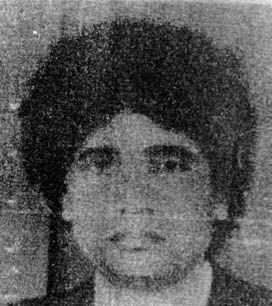
Although Tony had been talking to the police since September 1989, this historic fingering only happened on 15 February 1991, when Mr. Gauci was shown another spread of 12 faces. According to his statement, he at first felt all were too young to be the buyer, and selected none of them. The police refused to take no for an answer, and asked him to again "look at all the photographs carefully and to try and allow for any age difference." [Gauci 15/2/91] On the second pass he pointed to picture number 8 from the left. This was an image of al-Megrahi obtained by investigators from Czechoslovakia. For those unfamiliar, the undated big-hair image used for the slot in question is shown below.


Now, what Tony said pointing at this notably low-quality image and its obscuring noise, is less than amazing. His police statement following the session records it as:
“...similar to the man who bought the clothing. The hair is perhaps a bit long. The eyebrows are the same. The nose is the same, and his chin and shape of face are the same. The man in the photograph is in my opinion, in his thirty years. He would perhaps have to look about ten years older, and he would look like the man who bought the clothes. It's been a long time now and I can only say that this photograph resembles the man who bought the clothing, but it is younger.”
Back in 1989 he had given the buyer as a burly six-foot-plus Libyan, aged approximately 50 years. Our 5'8" villain al-Megrahi was but 36 at the time of purchase. And instinctively, this photo looks to me quite young, taken perhaps a decade before the 1988 purchase. He looks almost too young, with the apparence of baby fat on those long al Megrahi cheeks... and with the cheeks and nose actually seeming shorter... the lips and nose look different...

In fact, the image used is highly unusual, bearing such little resemblance to Megrahi one could be excused for wondering, as I have, if this really is him. The Lockerbie case is so special, I can't see ruling out such a simple thing as a misattributed photograph. However, there's a certain logic to presuming the image is genuine - it would be a massive risk that the picture could be proven to be of some other person, or even altered.

I remain convinced by an earlier experiment I did with photo comparison that I don't think I documented. Even with the apparent facial differences, this could well be Megrahi, taken a bit "chin-up," showing nostrils, more upper lip, shortening the face and nose as seen. Nothing in the overall proportions ruled out the same face. The hair obviously is unlike anything else we've seen him wearing, which when long is more like in the photo shown below.

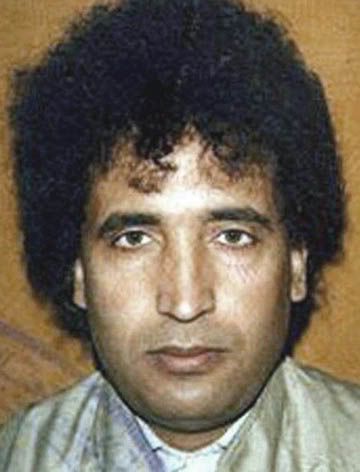
The image at left was taken for the false passport in the name "Abdusamad" issued by Libyan authorities in mid-1987, age 35. It was used on a few occasions, including a now-famous trip to Malta on 20-21 December 1988. As I've explained elsewhere, this is a legitimate clue - if not for Megrahi's guilt, then for why he was selected for framing.

The image itself is the most widely seen photo of the accused from the 1990s onward. It's not unlike the others taken since then as the man gained new fame as the accused - and then convicted - "Lockerbie bomber." This verifiable likeness is very unlike the photo Tony pointed to, and to which we now return.

The Hair
What Megrahi looked like before and after the Abdusamad photograph is unclear. Whether the raging afro seen in the Czech photo was chopped down before the above or grew in after it can't yet be established (but most clues point to some time before). However, one thing we know it does, among all images of al-Megrahi, is bring him close to matching the plumage style of Gauci's buyer. 

At left is the police artist's sketch based on Tony's description of the mystery shopper, 13 September 1989. The likeness is uncanny in its near-exclusion of Megrahi. It just doesn't look a lick like him, especially with this intense, angular, face, compared to Megrahi's soft features he later pointed to. And all this on a "large head" atop a 6-foot-plus frame to Meegrahi's 5'8" and Tony Gauci's 5'3".

One main feature to note is the dense afro-style haircut atop a clear expanse of forehead. The tightness of the curl is different by a long shot from any photo of Megrahi I've seen. His dangling ramen-wiggle expanses seem incapable of the tightly spherical sculpted look of the artist's sketch.


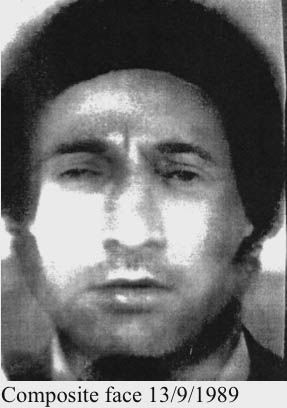
And here is the "Photofit" or "composite face" image compiled from Gauci's descriptions, given the same day as the above. They share the same basic hair, here a bit longer and fuzzier at the top. Otherwise, the two look drastically different from each other in the lips, chin, eyes, eyebrows, nose, and cheeks.

Tony did specify the sketch was a better likeness than the photo-thing, but agreed both resembled the buyer quite a bit. This almost seems to say "if you can find a photo of anyone with this kind of mid-sized 'fro that I think you guys want to prosecute, I will say it looks like the man." 

Prior to al-Megrahi, Tony had selected others as a match for the buyer, like Mohammed Abu Talb, famously in December 1989. Abu Talb didn't really fit by hair; his appeal was more from the word "bomber" across the corner of his face.  And Tony once pointed out  Mohamed Salam - a pretty good likeness of the sketch in both hair and face - on a less famous occasion. Like al-Megrahi, both of these men were at least a decade  too young. 

Perhaps Megrahi's undated fro was an earlier thing, from his 20s. But other than the Czech photo, we've only seen Megrahi with less hair and apparently more hair product. Buncrana found a photo of Megrahi at about age 19 - a student visa is from when he was studying in Wales, around 1971 (first revealed by the Sun back in August). We can here recognize al-Megrahi's longish features as a stylish young man. A little quiet-looking, but with a wild frontal swoop, almost a bouffant, coming halfway to his eyebrows. Quite unlike Tony's buyer, the Megrahi images show nary a clear forehead, especially in the questionable Czech photo.  And unlike that photo, this one actually looks like the guy it's supposed to be. 

Czech Photo Origin, Age, and Effects 
What was shown was not that Megrahi was or even actually resembled the buyer. All we learned on 15 February was that, among a selection of 12 pictures, Megrahi's could be made to be reported as the one most resembling the buyer, so long as you pick one that doesn't really look like him, while giving him something like the right hair.

This highly useful image was supplied to the investigation by intelligence from Czechoslovakia, says lead FBI investigator Richard Marquise. [see Sent Home to Die, Youtube posting 17:48] In his 2006 book he gave no explanation I could find about when the investigation got this picture, why it's of such poor quality, and what info came with it.  He acknowledge that "no one could positively date the photograph shown to Gauci." [SCOTBOM p. 127 - Google Books link] This may be of key importance below.

Marquise and his faux-witness Abdul Majid Giaka agree the photo Tony pointed to showed a young man, who was Meagrahi. "Giaka had looked at the Czech passport picture identified by Gauci. He said it was Megrahi when he was much younger." [p 142 ] Gauci's own feeling was of a man "in his thirty years," (30s) which Megrahi then was. But this could be chalked up to the lack of clarity and the fact that nearly all men Tony had been shown were in their 30s. DI Scicluna, Maltese police, gave his own account of the 15 February ID with slightly different details.
“.. Gauci started examining the photographs and the first thing he said was that they are all too young. It was explained to him to allow for age discrepancy as the man he saw could be 10-15 years older. [...] Gauci then looked through them and again stopped at Baset’s photo and indicating it he said ‘This is similar, but it is maybe 10-15 years younger.” [Grounds of Appeal doc]
Somewhere in his 30s, plus fifteen years is close enough to a match with the 50-year old man he described. But Marquise, Bell, and Scicluna and crew didn't know how old the photo was. All they had to do, and perhaps did,  was presume the picture itself was 10 years old, and add 10 years per what Gauci said, and you've got Megrahi's age, even though it's still 14 years below what Gauci first estimated.

Further, the quality of the Czech photo is worth wondering about. If the other 11 pictures he was shown that day were all normally clear and this one only looked strange, might that itself be leading? Might Gauci think it was included for some special reason? Might he think this is some super-elusive Mullah Omar character the cops can only get a crappy picture of? Might that make him feel it's more fruitful to point at then the others?

In fact, it seems the other images were altered to lessen the difference, but a professional who reviewed the effects in 2008 felt it was insufficient and the Czech photo still stands out as the gritty, mysterious one. [see Valentine report, page 40]

And There They Stopped
However exactly he was tricked into it, this was the final identification. Tony Gauci had been picking men out of photo lineups sporadically since September 1989, at different times having picked out at least three other men as similar to the buyer, but younger. But after 15 February the exercises abruptly stopped, and investigators were somehow sure they had their man. An identified buyer of the clothes, a Libyan agent comporting with the by-then identified timer, and there as Abdusamad on the day of the bombing. Never mind that he was about five inches too short, too slight of stature and light of skin, 14 years too young, and nowhere near the island of Malta on the day the clothes were purchased.

Marquise related how, at a mid-1991 conference, Senior Investigating Officer Stuart Henderson "discussed the photo spread leading to the Gauci identification of Megrahi. Although no one could positively date the photograph shown to Gauci, he was reluctant to show any more photos without fear of tainting what he had already provided." [127-8]

Something tells me it wasn't so much "tainting" as "spoiling the moment" Henderson was worried about.  As we've seen there was a special and delicate magic about how this supposed selection of al-Megrahi was materialized. It's also clear that the other photos available, with al-Megrahi's usual hair styles and better clarity, would show Tony how unlike the buyer this Libyan was. It could conceivably screw up the ID they had and wanted to keep.

So the big-hair Czech photo remained the only one of the chosen suspect that Tony saw until the better likenesses started appearing in the news a few months later as the "Lockerbie bomber." By then the whole world knew just what the guy looked like, removing all the cahallenge from arranging the later touted pointings-out in 1999 and 2000, just before Tony helped land a conviction and his $2 million prize.
---
Updates 12/26: In fact, Harry Bell noted in his police diary the day of this charade that this was the only photo the Scottish police had of "Abdelbaset" and they had to use it for fear they could never find another.
"meeting with Special Agent Reid. He tried to imply that we were rushing showing the photograph spread. ....they were the ones that wanted it done before Bollier left the USA.  Also if Baset was identified, Bollier would be the last person to be told as we know he is still in contact with the Libyans. Reid has been worried in case there is no identification made by the witness because [the photo]of Baset we have is too young. I explained that as we have no other and no indication that we will ever get one, then we can only proceed with what we have. If no identification is made and we later get a better photograph showing his true age and appearance in December '88, then the Lord Advocate may
accept an argument for showing this to the witness.

The differences in any photos can be noted while accepting that to some degree it will weaken the identification at any trial."

Then, among the eight points why Megrahi was the buyer, he wrote:
(7) The SIO [Stuart Henderson] advises that Bollier has now been shown the photofit and he states that if the hair was shorter then it would indeed look like Abdelbaset, also if it was 10 to 15 years older.
They got the same response from Bollier, but apparently in reference to the Photofit, not the Czech photo, if it was older (??). Bollier claims in comments below that he was never shown the Czech photo, and had still never seen it for 20 years of highly public study, until this blog post.

(8) The SIO also advises that the photograph we have of Abdelbaset is in fact 12 years old.
This confirms the suspicion. A twelve year old photo of Megrahi would be of a man aged 26, circa 1979. Gauci thought it was of a man in his 30s, and never actually retracted his belief the man was "around 50." This looks a hell of a lot like a shell-game or three-card-trick, designed to fit Megrahi in. [See: Grounds of Appeal doc, page 42/43]
---
Information continues in the excellent comments below.

Tony Gauci's "Identification" of Megrahi

posted Jan 17 2010
last update 23 December


Maltese shopkeeper Anthony "Tony" Gauci's supposed identification of al Megrahi (as the buyer of clothes found in the bomb suitcase) is a key plank of the Libyan's conviction for the bombing of PA103. In fact, it's the only evidence that the Zeist judges actually accepted that explicitly ties him to the physical evidence in any way.  After the fanciful tales of "star witness" Giaka were dismissed, Gauci's evidence became of crucial importance at the 2000 trial - he became "the real star witness," as the BBC's Conspiracy Files put it.

He is not to be confused with the great Maltese singer Tony Gauci, L-Kampanjol, who passed away in March of this year.

The fallibility of eyewitness evidence is well-enough known, and many others have done a splendid job exposing the incredible weakness of Gauci's fingering of Megrahi. A standard internet search will do well enough on this issue, without my needing to offer but a few special links. One would be this re-posting of the Gauci sections from Paul Foot's Lockerbie: Flight from Justice (2001). So I needn't reinvent the wheel altogether here, but I will briefly outline the problems with Gauci's evidence for those unfamiliar and link to my few detailed posts along the way.

The Basics and Prosecution’s Case
Tony Gauci is the son of Edward Gauci, proprietor of clothiers Mary's House in Silema, Malta. His sons Tony and his brother Paul usually ran the shop, with Tony working alone December 7 1988. He says a strange Libyan man came and bought most of the items found bomb-damaged shortly after around Lockerbie. He later identified Megrahi in a photo lineup as most resembling the buyer, and did the same in a physical lineup in court.

Problems with the Evidence
1 - The Alleged Logic of Megrahi's Purchase
There are many, and cheap, and anonymous ways for an Arab agent and terrorist mastermind to secure clothing to stuff a bomb case. Going to Mary's House when and how the mystery shopper did, is not a very smooth one. Rolfe explains this point quite well throughout this JREF forum thread. This is an important consideration but in itself doesn't prove a darn thing. Megrahi could make really bad tactical choices and still be guilty. So, moving along...

2- Weakness of Libyan identification
Gauci's first statement to Scottish police, 1 September 1989:
He was speaking "Libiyon" to me. He was clearly from Lbiya. He had an Arab appearance and I would say he was in fact a "Libyon" I can tell the difference between "Libyons" and "Tunisians" when I speak to them for a while. Tunisians often start speaking French if you start talking to them for a while.
There is of course no Libyan language - it's Arabic. The only specific clue he cites is that he heard no French so the guy was probably not Tunisian. It would be a good guess, as Libyans were the most common Arabic speakers on the island, but as evidence it doesn't count for even a penny rounded up. 

3 - Gauci was non-specific, and that's putting it generously
For having identified this man as THE buyer, Gauci's statements are surprisingly devoid of anyhthing as simple as "that's the man." On seeing Megrahi's photo in February 1991, in the news as "Lockerbie bomber," a photo spread was hastily called where Gauci found the same photo in a lineup of others was most:
“... similar to the man who bought the clothing. The hair is perhaps a bit long. The eyebrows are the same. The nose is the same, and his chin and shape of face are the same. The man in the photograph is in my opinion, in his thirty years. He would perhaps have to look about ten years older, and he would look like the man who bought the clothes. It's been a long time now and I can only say that this photograph resembles the man who bought the clothing, but it is younger.”
Wow. Did you catch the whole subtext where he's comparing two different men? In ten years he'll look like the guy I saw is what he said. After the witness parade April 13 2000:
not exactly the man I saw in the shop. Ten years ago I saw him, but the man who look a little bit like exactly is the number 5 [Megrahi]”
http://www.mathaba.net/news/news1/lockerbie/gauci.htm

4 - Physique, complexion, age
The buyer was "about six foot or more in height," "well-built" and big in the chest for the 42" jacket he bought, 36" waist, 16-17" collar, Gauci first said. Mr. al-Megrahi was 5'8" tall, and average-slight build. Gauci first said the man seemed to be around 50 years of age. Megrahi was 36 at the time. The man was dark complected, with a tight afro. Megrahi had long wavy hair and was fairer. At trial, Gauci fudged each of these closer to the man in the dock with mantra-like repetition. "I'm not an expert on these things. I think he was below six feet. I'm not an expert on these things." [on age] "I said before, below six -- under 60. I don't have experience -- I don't have experience on height or age." [trial transcripts, p 4752-53] Baloney. He was a clothier. He measured people for a living. The mixing up of "below six" and "under sixty" is interesting, joined with a double renunciation of age AND height expertise. It suggests a mantra he was remembering to stick to. 

5 - He Identified Abu Talb, too
Mohammed Abu Talb (or just Abu Talb) is a PFLP-GC connected suspect found to possess some clothes from Malta and share links with those busted in the Autumn Leaves op. Arrested in Sweden and considered suspect no. 1 for a while. Gauci enthusiastically fingered this man as the buyer. He had a return plane ticket that might have gotten him to Malta for free that day, but no evidence he used it. Abu Talb is himself even younger than Megrahi, and has a plausible alternate story for how he got those clothes (including many at home that matched none of Gauci's story). This blogger doubts either of the men Gauci identified was the clothes buyer, and I'm not convinced that Tony's story of one discrete buyer is even true. [See: Abu Talb and Tony Gauci]

6 - He Had Two Million Reasons to Fudge it
Mr. Gauci was eventually paid $2 million by the US government, following the trial, and given a new life and identity in Australia. His brother Paul Gauci was never called to testify, despite being an assett to the investigation." (note: not to be confused with the Maltese clothing maker Paul Gauci who did testify at Zeist) He's been suspected of helping coach his dim brother into affirming the police story, but whatever his role, it earned him a million of his own and a slot next to Tony among the Aussies. (Detailed post on the payments aspect)

The prize was no surprise - money talks happened from the beginning, with the Gaucis' mentioning the danger they were in by exposing Libya's plot, and Scots police acknoweldging large payments might help grease the story along. Wouldn’t a huge cash reward and the weight of a world-class terror investigation be expected to crush the reliability from his fragile memories? Sure, but the thing to focus on is what's crushed in.

7 - Photo Spread / Lineup Procedures and Tainted Memory
Most famously, Mr.Gauci was shown a photo of Megrahi, in a news magazine, as Lockerbie suspect. Days later he pointed straight to al Megrahi after traveling to Camp Zeist. But beyond this, there are some great observations of lineup procedure contained in reports commissioned for the convict's second appeal. These are available at Megrahi My Story [Valentine and Clark reports]. The details I haven't studied, but it seems on several fronts, both the 1991 photo lineup and 2000 in-person version at camp Zeist, there was a leading arrangement notably regarding subject ages. Recall that Megrahi at the time was about 15 years younger than Gauci's buyer (36 compared to app.50).

Anthony Gauci testimony, Camp Zeist, day 31, July 11 2000
Statement to police, 15 Feb 1991:
The first impression I had was that all the photographs were of men younger than the man who bought the clothing. I told Mr. Bell this. I was asked to look at all the photographs carefully and to try and allow for any age difference. I then pointed out one of the photographs, and I later counted the photographs from the left as number 1 to the photograph at number 8."
Tony usually sounds like an idiot, but this is clarity in action – a textbook description of a slanted line-up. Witness to young? Compare him to men younger yet, and have the witness pick the closest one. This is just how the pivotal September 15 "identification" of al-Megrahi was achieved. He was photo number 8, an unusual picture, in part, for looking almost nothing like al-Megrahi. [See: Gauci and the Czexh photo]

8 - Discrepancies, uncertainties in sold items recall
Gauci initially gave authorities a reportedly perfect list of items recovered - tied up with a bow and cash totals tendered, tax, minor discount and change returned. The only discrepancy I'm recalling at the moment is that he first insisted no shirts were in the order. This was a problem, as at least one piece of "Slalom" shirt collar had contained the miraculous timer fragment PT/35(b).

No problem, they could just say Megrahi bought a few of the items elsewhere, but too late. Mr. Gauci changed his story to reflect the sale of said shirt (as well as I believe one or two other shirts that had turned up), and revised all the neat math to reflect the new total. The second time, after marinading a while in close proximity to police evidence, is more accurate, we are to believe.

Also, one must wonder how they got Gauci's memory rolling in the first place without mentioning at least some of the items he needed to remember. I hear that dozens of police chats/interviews were either not recorded or had the records lost, including the first talks where Gauci initially decided on the laundry list. But then again, if he were coached, why wouldn't the Slalom shirt be included in the first list he came up with?

9 - Date of Purchase - Best Evidence that Gauci's Testimony specifically Ruled out Megrahi before it implicated him
Eyewitness evidence is never very solid to begin with, but here we have the most reliable (early) memories sidelined when convenient. Tony Gauci's initial identification evidence – before he was just pointing at faces and still giving details - rainfall, the Christmas lights, and the football game his brother Paul was watching at home - pointed to a purchase on November 23, 1988. I mean, clearly and with no room for doubt, pointed at the 23rd.

Megrahi was simply not on Malta at all that day. Investigators and the Gaucis instead have fudged things to fit an alternated date of December 7, when their villain was nearby. The mental gymnastics required to do so are astounding. This is the one point I felt is strongest in indicating Megrahi's innocence of this on solid link to the crime. And since this post is long enough, that explanation will reside in this long post of its own.
---