Showing posts with label Iran. Show all posts

Iran Air 655 - Casus Belli Behind Lockerbie?

Caustic Logic
15 March 2010
Last update July 3, 2011

Note, July 3, 2011: I'm simply bumping this post to the top to mark the 23rd anniversary today of this horrific and dubious incident that seems to have sealed the fate of Pan Am 103.

The USS Vincennes and the Downing of IA655:
Iran Air Flight 655 was a scheduled 28-minute flight from Bandar Abbas airport to Bahrain, on July 3 1988. An Airbus A300B2 flown by Capt. Mohsen Rezaian, IA655 left the ground at 10:17 am local time to cross the Straits of Sidra. It seems the plane was talking normally with ground control on open frequencies, was listed in flight registries, flying well within an established civilian air corridor, and transmitting the right civilian transponder code that clearly means something like the car window sign "Baby on Board." [1]

As IA655 steadily climbed to cruising altitude (14,000 feet for this short journey), it was suddenly struck with two powerful SM2 missiles fired from an American ship in Iranian waters below. The 290 passengers and crew (including 66 children) were all killed, either in the explosion and breakup, or after a three mile fall to the Persian Gulf below.

Officially, the crew of the USS Vincennes, which had opted to fire the missiles at that plane, had simply gotten confused in the thick of a separate naval battle they'd gotten into. After missing IA655's listing in the 'do not shoot' registry, misreading its transponder code as of military origin, and erring on its speed, heading/location, and altitude profile, the crew had decided the airbus was a fighter jet swooping down towards them for the attack, as all their misreadings jointly suggested. [2]

The troubling details and explanations of this bizarre accident are worth covering elsewhere, but ascribing the best intentions, the Vincennes fired in what seemed clear-cut self-defense, while they happened to be within Iranian waters. As such they fully earned their later commendations, like the responsible air-warfare coordinator, who won a navy medal for "heroic achievement [...] under fire." [3]

End of the War
At the Iraq-Iran war's commencement in 1980, the United States had sanctioned the bloodshed, so long as Iraq was on top. By the latter 1980s, the situation had shifted. Increased U.S. assistance and even direct shooting reflected fears that Iraq might lose forever the territory Iran was gaining. By the end of 1987, “we became,” a senior U.S. officer told ABC News, “forward air controllers for the Iraqi air force.” [4]

Operation Praying Mantis responded to Iranian mining of the Gulf with escalated U.S. attacks on Iranian gunboats, oil platforms, and tankers in April. [5] Immediately, protection of "neutral shipping" was also expanded; it was to enforce this protection that the Vincennes had been called to the Gulf. 

At the same time, Washington and thence the UN Security Council was calling, with Resolution 598, for the war to simply end with past borders restored. Both sides had to see the benefit of an end to the grueling war, but after their own heavy sacrifices had improved their odds, Iran was reluctant to concede on the West's terms and timetable.

Along with a renewed Iraqi air and chemical offensives into Iran's cities in the spring and summer of 1988, the bizarre accident of IA655 had to have hastened  Iran’s effective surrender a few weeks later. The precise role it played – minor, major, or peripheral - cannot be known for sure. However, an Iranian scholar stated at a conference hosted by the Woodrow Wilson Center [paraphrased]
"A turning point in Iran's thinking came with the shooting down of an Iranian passenger plane in July 1988 by the American cruiser USS Vincennes. That incident apparently led Ayatollah Khomeini to conclude that Iran could not risk the possibility of U.S. open combat operations against Iran and he decided it was time to end the conflict." [6]
There is every reason to believe that’s just what the Americans wanted to get across, after the tragedy if not shortly before as well. Aside from unapologetic "regret” over the loss of innocent life, and blaming Iran for the warship's mistakes, the American message was best put by White House media handler Marlin Fitzwater in putting the accident in context:
Only an end to the war, an objective we desire, can halt the immense suffering in the region and put an end to innocent loss of life. Our goal is peace in the Gulf and on land. We urge Iran and Iraq to work with the Security Council for an urgent comprehensive settlement of the war pursuant to Resolution 598. Meanwhile, United States forces will continue their mission in the area, keenly aware of the risks involved and ready to face them. [7] 
That is, as the Iranians likely read it, "we’ll keep on shooting at anything that might possibly be a threat as long as we “have to” hang around there, which is until Iran surrenders." About seven weeks after IA655 was torn down, an agreement was reached and hostilities between Iraq and Iran were officially and physically ended on August 20 1988. No territory was lost, but nearly a million people were. 

But even after the cease-fire, one more battle loomed. It would be just as one-sided as the battle of IA-655, just about as deadly, and just as unacknowledged. Again, the perpetrators would go unpunished as innocents paid the price for others' crimes.  

Revenge Pronouncements / Connective Tissue
Only in 1996 was a comprehensive legal agreement over the incident settled between Iran and America. Officially Iran accepted the accident story and took a small settlement $132 million and no acceptance of any guilt, exactly as offered by the US eight years earlier. [8] "Official" acceptance doesn't always mean that much; especially when the blood was fresh and tempers hot, Tehran never bought the bland American statements that the shoot-down was purely accidental. It's not even an unreasonable suspicion on their part - it's their apparent response I can't agree with.

Researcher Ludwig De Braeckeleer has assembled a useful compendium of Iranian death threats following the supposed accident. By this, various officials and ambassadors accused the United States of ''a barbaric massacre'' and an "act of terrorism." They pledged to launch "an appropriate response," to the "American crime," to "avenge the blood of their martyrs," and mete out "punishment to prevent further occurrence or recurrence of such unfortunate incidents." Most pointedly, hardliner Ali Akbar Mohtashemi (alt Mohtashemi-Pur), widely believed to have headed up the "appropriate response" planning, publicly "swore that there should be a "rain of blood" in revenge." [9]


This wasn't just hardcore posturing for the Iranian street, but something representing a real danger; everyone in the know expected retaliation, and likely in-kind - the Iranians would seek to now kill American civilians on an airplane and see how we liked it.  While uncertainty persists with no adequate investigation, the supposed payment was $10 million to the Ahmed Jibril's PFLP-GC. An early 1991 report, prepared by the National Security Agency for Gulf War intelligence use, stated:
"Mohtashemi is closely connected with the Al Abas and Abu Nidal terrorist groups. He is actually a long-time friend of Abu Nidal. He has recently paid $10 million in cash and gold to these two organizations to carry out terrorist activities and was the one who paid the same amount to bomb Pan Am Flight 103 in retaliation for the US shoot-down of the Iranian Airbus." [10]
The revenge moved swiftly, it seems, perhaps starting before the cease-fire even. It was in early October that the GC cell in Neuss, West Germany was set up, October 13 that bomb maker Khreesat arrived and set to work, and October 26 when the cell was busted up in Operation: Autumn Leaves. Most have always suspected their goal had been to destroy an American airliner on Iran's instruction and with support from Syria, using the type of radio-disguised altimeter bomb found in the car with Khreesat.

Three other such bombs were missed in the first raid and only found later, and one bomb at least was never intercepted. Vincent Cannistraro, who headed the CIA's Lockerbie probe, was interviewed for a program Shadow Over Lockerbie:
"[Cannistraro] says authorities focused on the likelihood that Marwan Khreesat's fifth bomb had blown up the Pan Am 747 over Lockerbie. "The immediate feeling was: we've missed someone. That someone in that cell had escaped with one of the explosive devices and succeeded in planting it on Pan Am 103." [11]  
In other words, the terror tree was shaken and the "Autumn Leaves" had fallen and scattered, but they weren't all raked up neat. One may have drifted into the belly of PA103.

Obvious, Then Nothing
When the other shoe fell, the horror and carnage clearly mirrored IA655 with a mid-air explosion leaving 259 to deal with five miles of pure gravity however they did before dying against the cold winter soil of Scotland. To clarify the issue, just hours after the attack, two phone calls were placed from London to the Associated Press and UPI declaring in broken English:
"We, the Guardians of the Islamic Revolution, are undertaking this heroic execution in revenge of blowing the Iran Air plane by America a few months ago." [12]
A CIA memo of the following day listed this first among a short list of responsibility claims. Among Islamic Jihad, the Ulster Defense League, and Mossad, the report said "we consider the claim from the Guadians of the Islamic Revolution as the most credible; previous attacks claimed by this group suggest it is pro-Iranian." It then listed several, with responsibility usually called in by an anonymous man: two assassination attempts on exiled Shah era leaders in exile, a plane hijacking a plane to secure the release of said assassins, and killing by car bomb a German businessman accused of selling missiles to Iraq while the war was on. [source]

Avenging the killing of 290 innocent Iranians by a US gunship seems in-line with the Guardians' philosophy, or perhaps some other Iranian agency, and most likely with technical help of the altimeter-triggered kind. Investigators, media reports, and the whole public mind went that way at first for at least a year, from no later than this ABC News broadcast of Feb 16 1989. Behind the suspicions of the PFLP-GC cell and its Khreesat bomb "a senior source overseeing the investigation" revealed that  "some hard-line members of the Iranian revolutionary guard" may have arranged for the attack through these suspects. "Revenge for the shooting down of the Iranian Airliner by the USS Vincennes in the Persian Gulf last summer was their motive," said reporter Brian Dunsmore in Lockerbie.  [13]

And still in early 1990 Steve Emerson and Brian Duffy wrote in The Fall of Pan Am 103 how sponsorship ran with Syrian supports up to Tehran, driven by revenge for IA655, "shot down for the Fourth of July holiday, the Mullahs believed, to celebrate America's independence." [14] To repay these expensive 4th of July fireworks with an early Black Christmas present, followed by a Body Boxing Day and a few more, might be a potent signal.

Officially, Iran denies involvement in the bombing, but some, like suspected mastermind Mohtashemi, have claimed a leading role on candid occasions. In 1995, an Iranian magazine ran an interview where "Mohtashami-Pur said that he would soon reveal the "Lockerbie files" to the readers." The report was quashed from above and the magazine closed down. [15] Former Iranian president Abdulhassan Bani Sadr also has admitted proudly, in the 1990s, that “Iran ordered the attack and Ahmed Jibril carried it out,” [16] a claim he repeated to deBraeckeleer in 2008. [17]

As these statements were made and as of late 1991 the U.S. was officially and exclusively pursuing Libya for the crime, freeing some Persian tongues to confess with impunity, it seems. And yet, the U.S. says, there was no Iranian revenge. The faint possibility of Tehran's involvement in Libya's atrocity has been whispered, but never clarified or pursued in the slightest. [see: Iranian vs. Libyan Role in the Lockerbie Bombing]

Iranian leaders had planned to take down an American plane (at least one), had paid for it and had bombs built and ready to go. With hard cash, glory, and blood vendetta driving them, Mohtashemi and and his contractors must have given up after the Germany bust. This is just what the FBI, CIA, USG, Scottish Police, Camp Zeist judges, and others claim to find most likely. And then just as precisely as item 8849 from Malta replaced the Bedford suitcases in the luggage container's deadliest corner, the Libyans took their own incidentally identical revenge at just that time. 

It's never been decided which motive drove the Libyans, but it's widely presumed to be the nearly three-year-old Operation: Eldorado Canyon bombings by U.S. forces. For the death of his adopted toddler daughter and a few dozen other Libyans, he ordered the Lockerbie bombing, while the level-headed Iranians waited for the court settlement and reparations after IA-655.  


At least, that's what the FBI's SCOTBOM evidence strongly illustrates. A desperate defector, an amazingly resilient timer fragment, a bizarre unverifiable printout, and a pliable soon-to-be-millionaire witness, all prove the Libyans did it through Malta, however much sense that makes. And nothing solid implicating Iran or Syria or the PFLP-GC was found anywhere in there. Move along, nothing to see here - the real Lockerbie bomber was behind bars for a while.  
---Sources: 
[1] Ghasemi, Shapour. “Shooting Down Iran Air 655 [IA655]” Iran Chamber Society: History of Iran. 2004. http://www.iranchamber.com/history/articles/shootingdown_iranair_flight655.php
[2], [3] Charles, Roger. "Sea Of Lies: The Inside Story Of How An American Naval Vessel Blundered Into An Attack On Iran Air Flight 655 At The Height Of Tensions During The Iran-Iraq War-And How The Pentagon Tried To Cover Its Tracks After 290 Innocent Civilians Died." Newsweek. July 13 1992. http://www.newsweek.com/id/126358
[4]  "The USS Vincennes: Public War, Secret War" ABC Nightline, Aired July 1 1992. Full Transcript, with extensive notes. ...
http://homepage.ntlworld.com/jksonc/docs/ir655-nightline-19920701.html
[5] Operation Praying Mantis. Wikipedia. http://en.wikipedia.org/wiki/Operation_Praying_Mantis
[6] Steinberg, Dana. "The 1980-1988 Iran-Iraq War: A CWIHP Critical Oral History Conference." http://wilsoncenter.org/index.cfm?fuseaction=news.print&news_id=90411&stoplayout=true 
[7] See [1]
[8] Wikipedia. Iran Air Flight 655. http://en.wikipedia.org/wiki/Iran_Air_Flight_655
[9] DeBraeckeleer, Ludwig. "Tehran: 'The Blood of Our Martyrs Will Be Avenged' [Diary of a Vengeance Foretold] Part 2." Oh My News International. July 4 2008.
http://english.ohmynews.com/articleview/article_view.asp?menu=c10400&no=383015&rel_no=1
[10], [15], [17] DeBraeckeleer, Ludwig. "Former Iranian President Blames Tehran for Lockerbie." http://www.thetorah.tv/misc/Former%20Iranian%20President%20Blames%20Tehran%20for%20Lockerbie.htm
[11] Biewen, John and Ian Ferguson. Shadow Over Lockerbie. 2000, American Radio Works. http://americanradioworks.publicradio.org/features/lockerbie/story/printable_story.html 
[12]  Emerson and Duffy p 56
[13] ABC News. Feb. 16, 1989: Pan Am 103 Flight Investigation. "A bomb hidden in a cassette player brought down Pan Am 103 in December 1988." Anchor, Ted Koppel. Reporter, Barry Dunsmore, Lockerbie. Video currently viewable at:
http://abcnews.go.com/video/playerIndex?id=9443717 
[14] Emerson and Duffy, p 59.
[16] The Maltese Double Cross. Produced, written, and directed by Allan Francovich, Hemar Enterprises, released November 1994. 2 hours, 36 minutes. Quote at 34:00 mark. Google Video 

An Iranian in London: The Strange Case of Parviz Taheri

Helsinki Warning Re-Considered, pt 5
April 14 2011


The last installment in this series, many months ago, questioned whether Finnish Palestinian sad sack Samra Mahayoun actually placed the “Helsinki warning” phone call in December 1988. His record of prank calls from Finland about fake terror attacks might well have become known around, and so I speculated an Iranian caller, linked somehow to the plot against american air traffic, using Mahayoun’s phone line to launder their message about an upcoming airliner bombing.

Exactly why they would do this isn’t entirely obvious, but it’s worth thinking about. With the evidence now available and despite legal conventions, it’s fairly clear the plot that destroyed Pan Am Flight 103 was Iranian in grievance, and executed with a certain known style of bomb. We can bet that this device was first loaded in London, rather than via the feeder flight 103A in Frankfurt as first decided, or Malta as set by 1990. If the call was a real warning of the real Flight 103 plot, it might specify London, but instead pointed to Frankfurt, from which the bomb they had readied would not have worked.

Aside from a non-informed hoax, simple misdirection from insiders is one possible explanation. It's the one I'll proceed on for now.

Named by the Defense
Another potential point of Frankfurt implication is an Iranian exile named Parviz Taheri, who already stands out for his own reasons, and may also have a link to that prophetic call (explained below). The resident of Sweden had an odd enough story to be named in 2000 by Megrahi’s defense team in their “special defense of incrimination.” He was one of a few alternate suspects in the narrative where Iranians – not Libyans - were behind planting the bomb. And it was inserted in London, not Malta.

Taheri was however called as a prosecution witness (number 996), which gave him immunity from any related charges. By the time of closing statements in January 2001, even the defense seemed to have abandoned trying to witness 996 to anything directly. Which isn’t to say there’s not a possible link, just that there wasn’t one the defense chose to put any weight on.

(fuller testimony excerpts, fascinating reading - source throughout for Taheri quotes)

Mitigating against Taheri’s involvement with the Iranian plot is his history, leaving little obvious room for sympathy with the Mullahs. He testified at the Lockerbie trial in Kurdish, having been born in Mashabad, Iranian Kurdistan. He “served in the Iranian army for two years,” he said (translated of course), “with six months training in arms and ammunition.” After this he became a teacher in the villages, and in 1983 came under suspicion of disloyalty and fled to Turkey. He arrived in Germany at the end of 1983, and moved to Frankfurt a year later.

On the other hand, this same fact would make Parviz an excellent “clean-skin” operative for a Tehran plot, hypothetically. He might be tacitly co-opted in any number or combination of ways, carrot or stick, or even maneuvered into helping unconsciously. The destruction of Iran Air 655 (IR655), the known motive for Iranin's known plot, was an unusual circumstance. Here, we cannot rule out even a long-estranged Kurd like Taheri being just as infuriated as anyone at the Yankee war crime. Nor can we rule out pressure against this diaspora Iranian in Frankfurt, Europe’s busiest air hub and the place their contractors would work on the weaponry for that revenge job (see below).

There’s certainly no obvious link so far, just a possible one I ask the reader to hold lightly in mind as we proceed.

A PFLP-GC Link?
In 1980s Frankfurt, Taheri worked at a “publishing house,” he testified, and “in the council of Frankfurt” (city council?). But he also sought out, in 1987 and ’88, store locations for more blue-collar work, with vague ambitions of selling newspapers, or running a catering or take-away business. One of the few dozen addresses he wrote down in a notebook was Sandweg 28. When asked about this at trial, he only said “I can't remember precisely where that is, but we looked for several places in Frankfurt, but I can't remember all the places.”

This exact piece of real estate was the same one chosen by the PFLP-GC, in September 1988, to house a terrorist cell, fronted with a catering business. This wasn’t any old group, but the very one, led by Hafez Dalkamouni, tasked with building the altimeter bombs to get revenge for IR655. The Sandweg address was for Dalkamouni's HQ, where a massive cache of weapons was held and many stayed.  Marwan Khreesat built the actual airplane bombs at a separate flat in nearby Neuss. With Khreesat’s handiwork, the cell produced five altitude-senstive bombs before four of them were seized and the cell busted in late October. Many informed observers still believe the missing fifth device was used on Flight 103 two months later.

Taheri had popped out of country briefly at the time of the bombing (see below), but was intercepted on his return, Christmas day, by inspector Jurgen Fuhl of the federal Bundes Kriminal Amt (BKA). They met at the airport, and Fuhl found the notebook with the PFLP-GC address he recognized on the spot. At the 2000 trial he explained “I was aware that the same address was a place where weapons and explosives had previously been found.”

So, Mr. Taheri had the address of the PFLP-GC’s base HQ in West Germany, among others, written down in his personal papers. In itself, that doesn't prove anything, but ...

A Flight 103 Link to London
Where it gets strange is Mr. Taheri then carrying that notebook, with that address, on feeder flight Pan Am 103A on December 21, Frankfurt to London. This is the same plane that, officially, the bomb arrived in London inside of. He was sitting up top along with about 25% of the passengers who would carry on to the United States but die first. There are two somewhat different accounts of Taheri's boarding in Germany, the first emerging in this defense questioning of him:

Q ... When you checked in on the 21st of December of 1988 through Pan Am employee Irene Reijheus, did you tell her that you had visited London often and did not require a visa? It's a simple question, Mr. Taheri. Did you tell her?
A I can't remember if I had told anything to her, because I travel in a normal way. You just check in, and you show your documents if required.
...
Q Well, if Ms. Reijheus felt so alarmed by what she saw that she called up her colleague, Jasmine Sadiq, to help her with you ... If Ms. Sadiq, Jasmine Sadiq, who was also an employee of Pan Am, remembered seeing you at the check-in, and indicated that you looked very nervous, can you explain why she would have that view, if this was a perfectly normal check-in by you, Mr. Taheri?
A Yes. People usually get upset if they have a fight, but I was very happy and pleased. I was not upset at all, and I was looking forward to arrive to London to meet my friends and my future wife. There was no disturbance at all.
He apparently had his papers anyway, was allowed to fly, and at Heathrow parted ways with many co-passengers who would transfer to the trans-Atlantic 103. We can be sure that his luggage did not contain the explosive device, as he had no checked bags at all to carry on after him and rupture the luggage hold. That must be remembered as the red flags pile up. Nonetheless, at about the same time Taheri and his notebook were hailing a cab into London, a 30-minute Khreesat bomb made by that cell based on Sandweg was loaded beneath 259 people out on the tarmac.

Taheri returned to Frankfurt only on Christmas day, after a few days with his fiancee, there with her parents. He’d become engaged to her that year, and they all usually lived in Sweden. But for unclear reasons they were visiting the UK and Parviz was going to visit them there. And for this half-week family gathering he took no checked luggage, and only one small carry-on bag. That’s unusual, but it does help clarify, again, no matter how strange this gets, he did not check in the bomb suitcase.

And that becomes important when we see the different story emerging from Ms. Siddique’s own testimony.

An American Link?
Yasmin (Arabic and/or Persian for Jasmine) Siddique testified in November 2000, a month after Taheri. In December 1988 she was not, in fact,  a Pan Am employee at all. She managed a McDonald’s restaurant, but was a Frankfurt-to-London passenger on 103A (she was going to visit her Mother). And she was standing just behind Taheri in the passport cue. Siddique still recalled noticing his behavior first – unsettled, apprehensive, turning his head frequently, eyes darting about as if watching for someone.

When he got up to “the passport man,” the suspicious young man was slow to produce the passport and the inspector was slower yet to examine it carefully. Taheri “did not look at the policeman or passport control officer;” she recalled, but rather, mostly, “at his feet.”

She was close enough to see his passport and “It was a small blue American passport.” She clarified this means issued by the United States, like the ones held by some of her family who already lived there at the time. Mr. Taylor then described the man this way:
Q Now, we know that the man that you have described was, in fact, a through passenger carrying on to the United States?
A Yes.

Q On a journey of seven hours and 40 minutes after [the 1.5-hour first leg]?
A Uh-huh.


But he got off in London, to meet his fiancée, he later said. This “fact” of full booking on the doomed half of the flight as well could be an inference from his US passport and the general impression that people return home at that time of year, as she was. There was nothing else read out (that I can find) showing this booking, but Taylor and Siddique somehow agreed it was the case. She thought he carried no luggage at all as he stood in line, and found it odd considering the long flight ahead.

Either way, the American passport is unexpected and not explained by anything else I know of. He lived in Germany and, sometime in 1989, move to Sweden, where inspector Fuhl had to hunt him down for further questioning. (Oddly, alternate suspects Mohammed Abu Talb and Abu Elias both have links in Sweden as well). Taheri was still a resident of Sweden when he testified.

A Helsinki Link, Phone Work?
The Guardians of the Islamic Revolution placed a call from London later the evening of the 21st claiming responsibility for the bombing. "We, the Guardians of the Islamic Revolution, are undertaking this heroic execution in revenge of blowing the Iran Air plane by America a few months ago." It was considered the most credible claim to the CIA in those first days [see here], and absent any Libyan admission ever, remains the most credible to this day.

There’s no particular reason to suspect Taheri of links to the Guardians, or of placing that call, other than the previous clues, the musing below, and that he was a Iranian in London at the right time.

But what if Taheri had a history of phone calls related to the 103 bombing? Like the Helsinki warning? It can be inferred from the following defense questioning that he said a very peculiar thing to Inspector Fuhl somewhat to that effect and worse. He knew nothing of the bombing, he had said, but one might find answers by calling Iranians, at an embassy, in Helsinki.
Q Now, I think the West German police said to you that if you were not involved in the tragedy that happened to Pan Am 103, did you, with your connections, have any idea who might be involved; is that right? They asked you that question?
A Yes, it is correct.
Q And you told them to look somewhere in particular, didn't you?
A I don't know what you are referring to.
Q Well, let's see if I can jog your memory. Did you direct their attention to the Iranian embassy in Helsinki?
A No, I haven't contacted Iranian embassy at all. I had been to Helsinki just as a tourist. [...] I was not asked about the Iranian embassy in Helsinki by the German police, but they only asked my point of view regarding that incident. And I said I don't know.
Q My Lord, that's all I ask.
He later denied saying that, but it seems at one point he made this ominous reference and still admits being there (in case there was supporting evidence?). But this was only as a tourist, not as the guy who broke into Samra Mahayoun’s flat and seeded that strangely prophetic warning about the bombing of an American flight from Frankfurt two weeks later. Because two weeks later, by chance, Taheri himself flew on an American flight from Frankfurt which then blew up.

Inspector Fuhl, questioned by Davidson, on what Taheri said about the bombing:
Q Do you recall him telling you where you might look for further information on that matter?
A I can't remember him giving me information about where I could look further. [...] If I can jog your memory, could he have mentioned to you an embassy in Helsinki in Finland?
A It's possible.
Q In particular, the Iranian embassy in Helsinki?
A I can't remember the details any more. The whole thing is, after all, 12 years ago. [...] It must all be in the paperwork.
So we have here no physical connection to the bomb, but an amazing shadowing of it that can only possibly be sheer coincidence. In fact, it reeks of coordination, lack of pay stubs notwithstanding.

To be sure, carrying such a clue as the Sandweg address, if it were operational information and he was knowingly on a related flight, would be a major blunder. But it’s also possible that was the point: Taheri's Iranian origins and the flight he was on, his needless odd behavior, the address, and this Helsinki hinting, collectively suggest an attempt to appear involved rather than actually being (physically) involved. The strange case of Parviz Taheri looks a hell of a lot like a sort of a lightning rod or decoy operation.

My next notion that he might have been involved with the "hoax" call follows on the above points, and on their shared effect. Both aimed to keep attention on weird things out of Frankfurt, as opposed to the concise operation set for Heathrow airside. And both carry clues so parallel to the reality as to be chilling, yet are in actuality inaccurate, misleading, and potentially (officially, of course) pure coincidence. Again. 

Once Upon a Time, there was Lockerbie

Spot the Problem
By Robert Forrester,

Secretary, Justice For Megrahi Campaign 
Special to The Lockerbie Divide
March 28 2011


In 1958 President Eisenhower was so concerned about the prevailing hatred for the United States amongst the peoples of the Middle East that he commissioned a report in the hope that better minds than his could explain what seemed to have flummoxed him. In 1953, Eisenhower, supported by Churchill and later Eden, sanctioned Operation Ajax. Operation Ajax was regime change at its cheapest and most effective. It cost a mere $1,000,000 to run, involved buying off the Iranian military and employing gangs of Teherani thugs to create civil disorder and achieved its desired result of overthrowing the popular Iranian prime minister Mohamed Moussadeq. Why did he do this? Because Moussadeq was showing unfortunate socialist tendencies whilst at the same time as sitting on some rather desirable oil supplies. In fact, the man actually had the gall to suggest that Iran should be controlling its own mineral wealth and selling at prices the Iranian people felt appropriate, not those which the UK and USA felt like paying. Happily, everything went according to plan. Moussadeq ended up under house arrest for the rest of his days, the Iranians were subjected to thirty years of murder, torture and political repression by the West’s man of the hour, Shah Mohammad Reza Pahlavi, and we got the fuel to fund our casino economies at our prices, at least until Ayatollah Khomeini flew home to roost. Eisenhower’s National Security Council, in its report to the president, explained that the people of the Middle East seemed to have run away with the bizarre notion that the US is only interested in supporting tyrannical despots in their region who are willing provide cheap mineral resources. It is tempting to ponder whether Eisenhower’s illuminating report cost more than Operation Ajax.

Saddam Hussein proved to be a tad more awkward to deal with however. But once he had gone past his sell by date (he never did manage to club those dashed mullahs over the border despite all the help we gave him), and despite the weaponry we’d supplied him with, he really didn’t stand a chance. All that was needed was to await a convenient source of outrage, in his case the Al Qaeda attack on the World Trade Centre, to creatively stitch him into, trample all over the UN, then let him have it. Abracadabra. Ignoring the appalling cost in lives, a country that was once an example to the region in terms of its social services and state run enterprises was bombed back into surviving in open sewers. But hey, they got democracy, plus, the oil was free again, just like the 1920s.

So now it’s Libya’s turn. Gaddafi stands even less of a chance than Saddam. It’s hard to imagine the bookies taking bets on anything other than the precise hour and minute of when the rope will go round his neck. How can the rebels lose? They have copious amounts of the very best that modern air power, intelligence gathering and command and control can provide taking out any and all opposition they would otherwise have fallen victim to. They simply have to pick up the pieces, follow the instructions and keep shambling on towards Tripoli. Neither the Chinese nor the Russians have shown any real signs of stepping in. Even the US has estimated that it really doesn’t need to take such a prominent role in affairs and handed it all on to NATO. In any case, the US already has enough on it’s plate what with commitments in Iraq and Afghanistan, whilst at the same time having to keep a weather eye on other developments in the region: not least on the fact that Syria is getting a little frayed round the edges, and, although Israel is doubtless smiling, it won’t be sleeping. Furthermore, oil is marginally less of a lure to the States where Libya is concerned. Not so however with the UK. Let’s not forget Tony Blair’s ‘Deal in the Desert’, the BP contract and all the embarrassing mud that is sticking over the revelations that have come out concerning Gordon Brown’s government’s attempts to help Tripoli negotiate the legal hurdles of Mr al-Megrahi’s repatriation.

Despite the distress caused to anyone directly connected to the Pan Am 103 incident,
it almost seems wrong to draw a spotlight on to the Lockerbie/Zeist case at a time when Libya is being torn apart by civil war. Nevertheless, David Cameron has chosen to do just that recently in seeking to justify his belligerence by saying of Muammar al-Gaddafi: "The people of Lockerbie know what this man is capable of." (David Cameron - 21/3/2011). Justice Secretary Ken Clark is also now playing the Lockerbie card by saying that we have to bring Gaddafi down to prevent him from seeking another Lockerbie in revenge for the UK’s support of the rebels.

It is always much healthier if you can draw on some moral high ground to justify your cause in the public eye. We tried it on in Afghanistan with how we were lifting the Afghans out of their feudal political system by waving our magic wand of democracy over them. Now, with Libya, it is Lockerbie and terrorism. Ever since Libya’s ex justice minister, Mustafa Abdel-Jalil, set himself up as leader of Eastern Libya in February with claims that he had proof that Gaddafi was behind Lockerbie, this has provided the opportunity to indulge in a bit of sleight of hand and massaging of public opinion. Lockerbie combines public ignorance, terrorism, fear and righteousness, and, it sells papers into the bargain. Abdel-Jalil’s claims are simply that, claims. After a month, he has yet to produce one iota of substance. Is he saying that he was negligent enough to leave the documents back in Tripoli? Once Tripoli falls and no documents are produced, are we then going to hear that Gaddafi must have destroyed them? Perhaps though, documents will be produced, however, we all know what is said about truth and the fog of war. Even today, and despite the payments the Telegraph had to make to George Galloway concerning the documents that were allegedly found in Baghdad proving his complicity with Saddam’s government, their origin is still not settled. In any case, it surely comes as no surprise to anyone that Gaddafi would have been behind an action such as Lockerbie if one of his countrymen had carried it out. But, did Abdelbaset al-Megrahi do it? Therein lies the rub.

To say that the case against Mr al-Megrahi has one or two problems would be arch understatement.

  • There was a break in to Heathrow airside giving access to Pan Am 103’s loading bay area shortly before take off. This incident was reported to the Heathrow authorities at the time but not made public until after the verdict was passed twelve years later.
  • There is no evidence of any unaccompanied luggage leaving on flight KM180 from Malta’s Luqa airport.
  • There are question marks over the provenance of documentary evidence provided by Frankfurt Airport ( the transit point from Luqa to Heathrow).
  • Along with other alleged inducements, the Crown’s star witness, Mr Tony Gauci (the proprietor of a Maltese clothes outlet) and his brother, Paul, are accused of having been in receipt of payments of $2,000.000 and $1,000,000 respectively under an American rewards for justice scheme for their testimony (a practice understandably alien to Scots Law, and presumably sufficient to dismiss both Tony and Paul Gauci as witnesses. The US authorities have yet to deny this deal). Tony Gauci’s testimony falls considerably short of being conclusive in terms of his eye witness account, which attempts to match up the identity of the purchaser of clothes from his shop, on account of key discrepancies with regard to the date of the purchase and the height, weight, age and build of the purchaser. Even though he had been prompted by numerous photo spreads containing pictures of Mr al-Megrahi and privy to media photographs of the accused prior to the trial, Mr Gauci could do little better than say that the man in the dock “resembled” the purchaser of the clothes.
  • Serious doubts also arise over the provenance of the fragment of circuit board alleged to have been part of a triggering device for a bomb which brought down pan Am 103. How did it (along with a sample of Mr Gauci’s clothes) survive temperatures of around 4,000ºC at the heart of a Semtex explosion? Why was it not tested for explosive residue? Why was forensic testimony accepted from representatives of the Royal Armament Research and Development Establishment (RARDE), who had in previous terrorist trials been pilloried for the nature and standard of their testimony? Why were alterations to the discrepancies in the notebooks of the RARDE forensic witnesses not made more of in the trial? Why was the fact that a Crown witness, Mr Ulrich Lumpert, signed a sworn affidavit in 2007 retracting his Zeist testimony relating to the fragment of circuit board as effectively being a pack of lies not pursued? Why was the fragment sent to the US and allowed to leave Scottish jurisdiction, surely this would disqualify it as evidence?
  • Suspicions are also rife concerning what influence the FBI and the US Department of Justice had over the Scottish led police investigation and the trial under the auspices of the High Court of Justiciary.


The above simply serve to illustrate some of the more prominent worries over the safety of the conviction. To compound this, the judges chose to believe a tale of how the bombing was carried out that defies what any normal person could accept as credible, namely: that Mr al-Megrahi contrived to place an unaccompanied luggage item on to flight KM180 from Malta which was then subsequently transferred at Frankfurt to a feeder flight to Heathrow, again unaccompanied, where it was finally loaded on to Pan Am 103, unaccompanied. Thus defying three security regimes in three separate countries, and the bomb still managed to blow up its target and not either one of the first two flights despite the inevitability of delays etc which would have been par for the course around Christmas time. It is truly hard to believe that 15 lay Scottish jurors could reach anything other than a not guilty verdict in such circumstances. Although impeccably qualified as judges, their Lordships, MacLean, Sutherland and Coulsfield, in arriving at their guilty verdict, displayed an absence of experience when it comes to the role of being a juror. Indeed to give credence at all to the story of the Luqa-Frankfurt-Heathrow connection, especially as it was presented at Zeist, demonstrates a complete inability to imagine how paramilitaries operate.

It also cannot be ignored that the structure of trial itself could well have contributed to the conviction in that the Crown played the role of prosecutor, judge and jury. The litany goes on.

Mr al-Megrahi’s first appeal failed, this is true. However, in their judgement, the judges were at pains to point out that they took no account of the sufficiency of evidence since the defence did not require them to do so. The Scottish Criminal Cases Review Commission (SCCRC) then referred the case back to the Court of Appeal on six grounds suggesting that no reasonable court would have reached a guilty verdict on the basis of the evidence laid before the Crown by the prosecution. This appeal was then, unnecessarily, dropped by Mr al-Megrahi in his attempt to gain compassionate release. There has been much speculation regarding the possibility that he may have come under pressure to do so even though the terms of compassionate release do not require an appeal to be dropped to become a beneficiary of it. The long and the short of it is, therefore, that this conviction has not yet been fully tested in law in the interests of justice. The best that the Crown, in the form of the Lord Advocate, Elish Angiolini, has been able to offer as a counter to these concerns is a mind-boggling merry-go-round of circular polemic which amounts to little more than: he was convicted, therefore, he did it. So parlous are the arguments offered up by the Crown that one almost feels bound to ask what qualifications are required for the job of Lord Advocate. To reassure us all that the Crown and the police are still taking the Lockerbie Zeist affair seriously though, even at a point ten years after the conviction, Angiolini also claims that the Dumfries and Galloway police are conducting an on-going review of the investigation. It, in fact, transpires that this is being carried out by one sole officer. In the words of Christine Grahame MSP, this constitutes little better than “file management.”

Recently, on Auntie Beebs weekly vox pop mainstay, Question Time (broadcast from Edinburgh on the 10th of March) we were again treated to the predictable and tedious question of how Mr al-Megrahi must be laughing now that he is back in Libya. I imagine the member of the public who posed the question will be reduced to stitches if he ever contracts a malignant carcinoma. In order to kick the SNP bashing off, Douglas Alexander was straight in with claims that Mr al-Megrahi was currently being chauffeured around Tripoli in a Lamborghini (presumably to make him a more awkward target for the coalition missiles). Annabel Goldie took the biscuit though in bemoaning the damage that the compassionate release had done to the good name of Scottish justice, completely ignoring the profound and legitimate concerns over the safety of the conviction. Clearly, a potential miscarriage of justice does no harm at all.

There are of course differences between the histories of Iran and Libya, however, the salient threads of Western foreign policy run through both. In the case of Libya, we have the Italian genocide of the late 20s and early 30s (accounting for upwards of 50,000 deaths in camps), the Second World War, and then a monarchy (supported by Italy, the UK and the US) that pocketed Libya’s wealth until overthrown by Gaddafi. Much like Khomeini was viewed later in Iran, Gaddafi was seen in the late 60s as someone who would stand up to Western depredations. The surprising thing is that he managed to survive being a thorn in the side of the West for as long as he has: Reagan’s bombs, sanctions and all the rest. In pitting himself against such power, he, of course, subjected his people to his own brand of Gestapo for decades. Ex justice minister Abdel-Jalil’s claims, therefore, should be seen in this light. Anyone who managed to negotiate the perils to attain such a position under such a tyrannical regime is bound to have washed his hands in the people’s blood on a fairly regular basis. To that extent he doubtless has every reason to make the types of claims he is making in the hope of protecting his own skin.

It is hard to see Gaddafi going anywhere now except to follow Saddam to the gallows. The West will do what it knows best and install someone who is suitably on message until the oil runs out. Who knows what may become of Mr al-Megrahi? A one way ticket to the US’s Guantánamo rest home perhaps? Whatever transpires, it will make no difference to the case being put before the Scottish parliament by justice campaigners. No amount of dissembling mendacity claimed by politicians and others can ever change the documented historical fact of what took place at Zeist. This conviction simply does not stack up, no matter how good your gas mask.

Helsinki Warning Re-Considered, pt 4

14 October 2010


<< See part 3: effective warning?

Can we be sure it was a coincidental hoax?
The official word was that the 5 December call, warning of an American (Pan Am) flight from Frankfurt being bombed within 14 days, was just an unrelated hoax with an unsettling similarity to the bombing that happened 16 days later. While such near-synchronicity is indeed possible all on its own, it was naturally difficult for some to just let it go at that. Paul Hudson, whose daughter was killed in the officially coincidental bombing, spoke up at a 1989 House subcommittee hearing.
“I for one cannot take this statement any longer at face values. […] There is a position that has been conveyed tat the threat was a hoax. But when I asked the number two person at the FBI whether that person who committed this hoax had ever been arrested, or charged […] the answer I was given is no […] with all due respect, I cannot accept the bare assertion that this was a hoax without proof. And we have not seen any proof.” [Gerson and Adler, p 56]
It was a good point then, and remains so today.

First, there’s nothing we can really know for sure about this call. No recording was made at the embassy end, with notes only. Further, there should have been recording from this on the Finnish end, as their feds were tapping the line it came in on. But to my knowledge no one has heard of such a tape, and there is no known recording to go back to as a primary source. It’s all from agent Luzzi’s notes and memory, as stated.

But via Luzzi we do have a set of details that became its official content, as related in part one. Recall that Abu Nidal terrorist Samir Kadar was cited, by a little-known pseudonym, playing on fears of his survival despte his apparent death six months earlier. Frankfurt airport was cited as the origin point for the bomb, just weeks after its PFLP-GC cell was busted with airliner bombs. Anyone who watches the news could possibly assemble all that, but insider information, designed to perk the interest of intelligence types, could explain it at least as well.

From what we hear, and on the surface of it, a hoax does seem most likely. Finnish police, while not getting a tape, had reportedly tapped Mahayoun’s phone due to his repeated hoaxing in the same period of weeks. [Emerson and Duffy 54] That one fiction among many would wind up resembling a real attack is not unthinkable. And there's no reason to suspect this failed student with girl problems would have any relevant info about attack plans, Iranian, Libyan, or otherwise.

However, it’s worthy to ask if the simple fact of the phone line used is proof of much. What if Mahayoun wasn't really the caller?

With just a bit of imagination, we could speculate an Iranian insider, say from the embassy in Helsinki, who wanted to feed the CIA a lead of one kind or another. He might poke around and learn of Mahayoun’s pranking, and decided to use it to launder the lead. He could sneak into the man's apartment one night when he’s known to be away, preferably with a weak alibi, perhaps some engineered distraction young Samra could neither refuse nor verify. Once inside, the insider simply take the US embassy's number out of his pocket and place exactly the call he wants. Ideally it would have whatever immediate or long-term effect was desired, but then appear to be another prank and obviously or arguably coincidental, leaving the seeder unseen.

Interestingly, the lack of any recording complicates things by being unable to help rule this out. Investigators could have compared Mahayoun's voice with that on the tape and found it either a match with the "guttural, Arab" one Luzzi heard, or not a match. As it stands, we can't be sure either way.

Just what any insider would hope to achieve in such a scenario is less clear. Many possibilities could be speculated, but my own unique hunch will be the subject, eventually, of part five.

Of Grasshoppers and Skyscrapers

Some Thoughts on Truth, Belief, and Stakes
5 October 2010

last edits 1 November

No Bee Whisperer/What If?
Those who follow this site will know I posted a “debate call” recently to anyone who could defend the official story in a detailed, evidence-based way. As of yet, I’ve gotten no response from across the divide of the kind I was hoping for.

For one thing, my often caustic and provocative style is apparently not effective at scaring up debate or discussion. Recently I had it suggested to me, by U.S. family member of a PA103 victim (posting as Bunntamas) that I’d catch more bees with honey than with vinegar. It's a worthy point, but I'm not sure what "honey" would be in this situation. So far I've been less than sure anything would catch the bees that most need caught, and here's why: in short, the stakes are enormous.

What I've written up below is perhaps not honey, but something I hope is useful. For this I’ll need (from a few readers I hope) another or a first act of imagination. Carefully consider the notion that Libya – or at least Megrahi - was in fact wrongly pursued while the real killers were left free. It might be difficult, but really try to approach it with an open mind.

Let’s imagine it was just proven by the most believable panel of experts and they explained it all to your satisfaction in a detailed 60-minute TV program. Everyone in the world has hailed it as amazing and is convinced. The following would be the next things to think about.

The cost to Libya
The case that emerged against Megrahi and Fhimah could hardly happen wrongly by accident, and a conspiracy is strongly implied. The actual cabal to sex-up or fake evidence needn’t be massive, but the cover-up and/or conspiracy of silence would be titanic. Call it unlikely if you will, but for a moment call it possible that some number of people decided where to lead the case with faked evidence to follow. Others followed up on it compliantly, and no one had officially recognized anything untoward along the way, until this amazing commission and its TV show we're imagining.

No one should disagree that the material effects on Libya were severe. Following the indictments in 1991, US and UN sanctions reportedly killed thousands, and cost many billions in lost revenue. The hard-won trial that allowed this to start ending was a gargantuan operation that took years to arrange and carry out, with hundreds of witnesses flown in to a specially-built complex for the 9-month proceedings. And, in this what-if scenario, it led to two men being wrongly imprisoned for nearly two years, one of them, as a convicted mass murderer, for a further eight. An additional $2.7 billion was paid out by Libya to family of the victims in compensation, on false pretenses as we’re imagining it.

Do you pay them back, or what? How much?

The real killers
And if we knew the Libyans weren't responsible after all, and wanted to punish those who really did it, we’d have to extract the punishment all over again. This would most likely, on examination, be from elements in the Iranian regime at the time, and certain Arab terrorist leaders. It would acknowledge and perhaps continue a once-declined tit-for-tat that started with the bizarre USS Vincennes incident and the sinking of Iran Air 655. It's an ugly scene. We might have to hunt down and bring to trial suspects who currently reside under state protection in places like Damascus, Syria and Reston, Virginia.

In this scenario, all the cynical misdirection towards Tripoli was undertaken to fake a search for justice. And at that, for one of the most heinous terrorist attacks ever against English-speakers, with 270 killed under horrifying circumstances. All the costs of the blame-Libya line would be underwritten by a further sacrifice of true justice on that scale, with the real killers consciously allowed to go free (or to be gotten back some other way, but not the right way).

Who, if anybody, decided to make these trade-offs? How many could or should sense the injustice happening? Did they not see, or just not say? It’s preposterous, on the face of it. A normal person’s “what-if” should have worn off by now. Usually, of course, it does.

I've been wrong before...
For what it's worth, I should remind my readers - and myself – that I was once a “9/11 Truther.” For years I half-suspected an inside job behind the attacks on New York and Washington, perhaps with remote control and demolitions. Either way, I was fairly certain the government at least allowed the outside attack to happen for the very advantages I saw them brazenly capitalizing on.

The uneasy feeling about the event and its abuse remains, but the supposed facts that once suggested so much so clearly have nearly all melted away after scrutiny that first came from others. In that case, I was embarrassed but ultimately relieved, and I know what it’s like to see a reality I believed fall apart and leave me wondering what the hell I was thinking.

Perhaps these more recent conclusions I’ve reached about Pan Am 103 are just as wrong. There’s a precedent for it, anyway. Inherent distrust and ego-driven desire to be right when everyone else is wrong, some skewed understandings, ignored counterpoints, making connections that only seem to be warranted, plus group reinforcement. All can lead to false certainty that can be amazingly convincing when you're on the inside of it.

It’s possible that the bomb that killed Bunntamas' father and so many others really did travel on KM 180. The records of Air Malta contradicting that might have been altered to do so, and all the strangeness around the Frankfurt data might be just plain irrelevant. That would suggest Megrahi, in a way, except that he was busy boarding another flight as the loading happened. Maybe Fhimah really did manage the actual bomb placement as alleged, despite no evidence and his being found not guilty.

Maybe in fact the timer and radio fragments and manual cover found on land are really from the blast, despite tests that confirm what seems to me common sense. Science is complex, and these items do point pretty clearly to Libya. It could be that the Libyan plotters really did set their MST-13 timer for 7:03 pm, less than an hour after scheduled takeoff, not caring if their clues survived the blast and fell on land. And I can't rule out that that this stupid plan  just happens to mimick the PFLP-GC's known bomb style if one were loaded at London.

It's not unthinkable that Tony Gauci’s recall of the buyer and day of purchase really did start out confused and fuzzy in 1989 but got sharper at trial 11 years later, nabbing Megrahi on the 7th of December. It’s even possible that Abdul Majid Giaka’s clues weren’t made up, or the facts they convey happen to be true despite the carrier. That could mean any of the following is true: Megrahi commissioned a report on bombing a plane (and had Giaka himself write it), both accused handled explosives at the airport (which Giaka was allowed to see), and they brought a suitcase of the style used for the bomb from Tripoli to Malta the day before the bombing, again right in front of the blabbermouth. Any one of those would be pretty convincing if I were more inclined to believe it.

I can even see all or most of these being true at the same time, as the investigation had at one point decided. It's a logical possibility, though it’s obviously distant and hard for me to credit at the moment. That’s the part I’d need some help with.

... but it's less likely now.
I am a better conspiracy theorist now for the 9/11 Truth experience, and less inclined to leap on something just because it makes a certain kind of sense. I received much of my debunking at the JREF forum's conspiracy theory section (learning from others’ mistakes more than my own). The epic nemesis of 9/11 Truthers and other CT nutters, full of government agents to hear the latter speak, helped me learn the rational and rigorous approach more in line with my older half-ass training as a historian. Having come full-circle, I now consider myself part promoter and part debunker of conspiracy theories, trying to get each side to consider the other a little more.

But that forum has been unable to say much against what I, along with Rolfe, Buncrana, and many others see in the Lockerbie case. All things considered, over perhaps two dozen threads and hundreds of thousands of words, we’re debunking the official story. Its alleged machinations and miracles fail to rise past the lower threshold of plausibility. Nothing aside from legal technicalities and conventional belief supports it.

Or so it seems, and if this is wrong, I’ll be unable to shake it on my own. And my growing circle of fellow thinkers won’t be any help, nor likely my adversaries; no one else at that esteemed forum of rationality nor anywhere else has pulled together any convincing debunk. Ignorant or self-serving repetitions from on high that the the guy was convicted so he's guilty are sliding off of us. Details will be required.

A Big Lie?
Finally, I return to one of the stumbling blocks to directly confronting the strong case for something wrong. There's still that temptation to rule the whole thing too ridiculous to contemplate. Just how have the mainstream media, multiple governments and hundreds of investigators, and the public at large, all at the same time, failed to “figure it out” yet?

Perhaps the failures aren't as separate as they might seem, and the governments' decisions informed the media's (compliant) ignorance, which of course shaped the public's? Is it that simple?

Further, we could be seeing the "Große Lüge” or Big Lie effect, as Hitler outlined in Mein Kampf. A deception so enormous that ordinary people could perceive it about as much as a grasshopper could grasp what's inside a skyscraper. It's only the logical extension of my theory of what happened, that continued failure to see can best be explained that way. There are precedents, anyway.

So in short, the vast mainstream mind may just be failing to see a very large and smelly pachyderm filling most of the room. Now that that charge is on the record, how is anyone going to respond to it? By simply insisting again that it's been legally established there is no stinking elephant?

To be sure, no matter how much debating and convincing anyone does, the legal-political status quo will try hard not to change - legal reality will stay what it is and the ineffectual "cranks" will remain just that. But physical reality is what it is, and the evidence from the 3-D world contests the official story at every major juncture. Much of it is actually documented and can be seen in black and white. Lawyers and experts and family members will continue mentioning this for some time, and history is sure to get it right eventually. But barring some major change in the halls of power, don’t expect the change anytime soon.

My aim here, especially when I get provocative, is not to up and win this thing and convince anyone with mere ("supposed") facts, but to help get it really started. It will be an epic struggle for the throne of legal truth and I urge as much calm and patience as possible on all sides. But it needs to happen. One very large body of people or another has a lot of learning to do.

A Tale of Three Atrocities

A Decidedly Different Take
20 August 2010 (incomplete)
last edits 27 August

A tale of three atrocities is the name of an unusual little book written by an interesting acquaintance, Mr. Charles Norrie, as of recently available in an on-line form. Mr. Norie is an English family member of an alleged Libyan atrocity, having lost his brother to the 1989 bombing of UTA 772 over Niger.

While he does accept Libyan guilt in that attack, Norrie has taken a major interest in the lack of a case for Libyan guilt in a second atrocity, the Lockerbie bombing. His unusual position has brought him to sign, along with myself and others, the most recent petition of the Justice For Megrahi campaign.

First, I’m one of the few people Charles has blessed with a hard copy of the mythic "green ATOTA," and I think I’ve read all of it by now, but never all at once. It's a neat little book, slick design, size and shape like a small company's annual report. The layout is tasteful, with full color photographs and glossy finish. (see image at left, atop my small Lockerbie library).

That's what you can't see in the Blogspot posting, but the text is the same (I presume) and can finally be seen by a wider audience. The writing is decent, with spots of genius and others of just cleverness. The actual ideas, the methodology and presumptions behind them, are more problematic for me. I’ll attempt to summarize a bit clumsily from my half-understanding.

Much of what’s in ATOTA is well-reasoned - especially when it comes to spotting problems with the official story against Megrahi, or with linking the 103 bombing to the third "atrocity" of the title. Along with myself and many others, Norrie believes the cause of Lockerbie to have been the 1988 downing of Iran Air Flight 655. While he suspects the associated PFLP-GC clues were just as fake as the Libyan ones (they were the original "scapegoat"), his concept of the “Qesas” revenge code is compelling. This would mean an Iranian hand was required to “pull the trigger,” perhaps a family member of an IA 655 victim.

London is the place this was done, apparently for operational security reasons. Would terrorists be so daft as to introduce their bomb two airports away and trust fate to pass it through each screening? I happen to agree on London introduction, in part for the same reason, and Iran Air’s terminal was in Terminal three at Heathrow, not far from where the bomb was finally loaded, via container AVE 4041.

The technical details ATOTA proposes are what get confusing. It  seems he’s saying the bomb was not inside of luggage at all, but rather attached/built into the luggage container to resemble a repair patch. To not stand out, he agrees it would have to be, at most, one inch thick, this explosive device with an ice cube timer, and faced in rough aluminum. He reasons "if the bomb was in a suitcase it would have been spotted on the morning of 21st December by Heathrow baggage handlers." Well, it was, apparently as part of a  matching set.

It almost seems Norrie is adding a shape-charge aspect to the 1/2” thick bomb notion. As he explains:
The official explanation for Lockerbie is that a bomb was concealed in a suitcase. Yet a bomb in a suitcase would explode in all directions. In contrast, the hole in the side of the plane seemed to indicate a unidirectional explosion. This makes sense if a bomb was attached to the side of a luggage container, slightly above the bottom.
Actually, the blast that’s alleged would be fairly uni-directional, relative to the nearest hull metal - inside pointing out. In fact, being inside the container and a bit lower than shown (at left, from AAIB report) could explain the low cut-off of damage (red hatching). It could be cut off by the layer of bags above.

This supporting passage has me scratching my head still:
Peter Claydon told the court the bomb created an 8-inch square hole in AVE4041 PA and a 20-inch square hole in the skin of the aircraft.
I’ve read Mr. Claiden’s testimony and found no such statement. This would have to be a very unidirectional explosive device to leave a square hole after detonating, and the same size as the 8” square repair patch he shows in a photo on page 13. In fact, the damage to the outboard panels was measured in feet.

The closest thing I can see to an 8-inch hole is the opposite - a chunk of metal about that size that Claiden felt was from the middle of a huge span of completely missing metal (labeled "e" at right, from AAIB report). This was at almost exactly the bomb position, and his hunch that this intact metal is from there remains bizarre and inexplicable.

Norrie’s theory also goes deeper than Iranian involvement, suggesting the Americans were involved in the plot as well - to ensure its success. The primary evidence he cites for this is the second explosion, at the other end of the plane and triggered 14 seconds later, it had to be an independent device that proves "Megrahi cannot be guilty."
I now believe the cause of the additional blast was a CIA 'insurance bomb'. Its purpose was to guarantee no one survived the bombing, ensuring the Iranians would be completely satisfied with the operation, and the Qesas condition fulfilled.
I think this was to deflect wider promised attacks.


To support the second bomb theory, he cites an unsupported statement from apparently loon John Parkes that "a minimum of two high explosive events took place inboard Pan Am 103." And he points to the twin debris fields, north and south, as pre and post-second bomb. I'm not certain of the right answer to there being two fields, but I should think it could have many explanations in a complex breakup like that of Flight 103, even without a second detonation. 

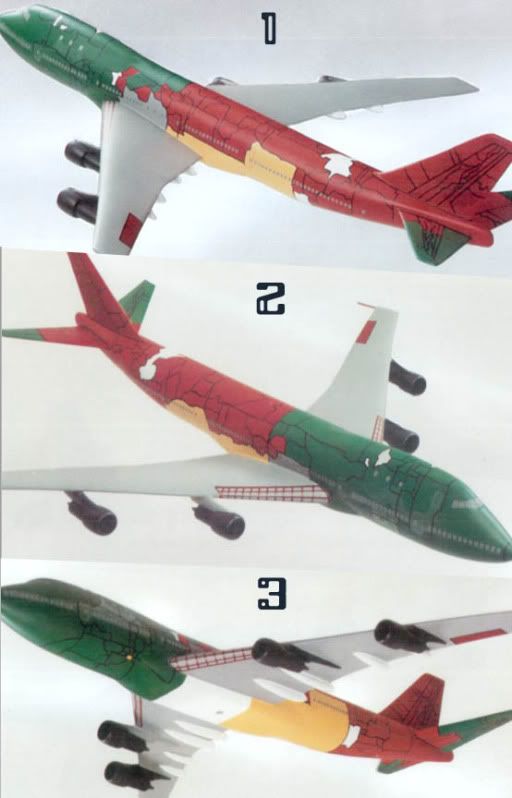
For the location of the second bomb, Norrie cites a missing section near the rear cargo area which must have been all vaporized by a "brisant explosion." See the image at left (new window for larger view), of the AAIB's painted model. Those sections coded in white were never recovered. Charles would be referring to the section on the lower rear of the craft (seen in view 3). But many other sections at random spots were missing as well, in at least seven apparent "brisant explosions" all over the plane. For whole panels of aluminum to disappear in Scotland might seem odd, but there are a lot of lochs that maybe weren't fully dredged, etc...


---
more perhaps forthcoming ...

I give Charles Norrie the comments section below to help us grasp what he’s got here.

Note 3 Sept. - he opted not to use that much, but took it to the JREF and, at Rolfe's invitation, proceded to ...  well to fail, for one.

Note 19 September: I've decided to breach e-mail confidentiality to confirm that  Charles'  ridiculous behavior at the JREF was part of a strategy to accrue yet more"suppression"of the the ype he's encountered at Wikipedia and now at Prof.Black's blog (first ever banning there I know of).

Parviz Taheri, Testimony

Day 57, October 7 2000 pp 7720-7759


Extended excerpts in italics. 

Introduction:
Prosecution witness, number 996 on the list, Parviz Taheri, gives evidence in Kurdish. 

Before he is brought in, might I remind Your Lordships that he is one of the persons  mentioned in the special defence  lodged on behalf of each accused.  I don't suggest  to Your Lordships that he should be given a warning, but I remind Your Lordships of his status.
LORD SUTHERLAND:  As he is being used as a Crown witness, he would have immunity  anyway.

Bio up to 1988:
At testimony, Mr. Taheri was 42 years old, lived in Sweden, married with a son, and drove a taxi for a living. He was born in Mahabad, Iranian Kurdistan, all relatives still there, except a brother and a sister who live in Sweden.

Before leaving Iran in 1983, he was "a teacher in the villages on the suburbs of Mahabad." "After the collapse of the Shah, Iran, there were two parties, one called Democrat of Iran and the other one Komola." He says he was suspected of fundraising and organizing for the latter, "so I went via Turkey to Germany."

He arrived on 23 December, 1983, lived in Darmstadt in Germany; then Frankfurt in the early 1985. After a year as a student, he "started working in the council of Frankfurt, then in a publishing house of Frankfurt for a few years."

Q  In 1988, did you become engaged to be married?
A  Yes.  
Q  And in 1988, where did your future wife live?
A  In Sweden, because I had moved -- they had moved to Sweden for a year.

Entrepeneur
"Because I had no constant job, I was using -- I was intending to buy a place with some friends, like a restaurant, or a shop for selling sweets or newspapers.  That was my intention. ... When I moved to Frankfurt in '85, I started thinking of setting up a business ... From '85 to '88. ... I was working from '87 to '88 in -- looking for advertisements in the newspapers.  There was -- then I started looking for auctions or agents for shops.  ... We looked at several places, but it was either because it was unaffordable or because we didn't like the place."

Q  Where did you keep the notes that we've just spoken of?
A  In a notebook which I kept with me.
Q  How many premises did you go to look at?
A  Because it has been for quite a long time since that happened, but as far as I remember -- but I can say that we viewed a place per week. ... I can say in approximately between 40 to 50 places.

Sandweg 28
Q  Did you ever see an advert for premises at Sandweg 28 in Frankfurt?
[...a headquarters of the PFLP-GC cell busted in October, building altimeter bombs like may have downed Flight 103...]
A  I can't remember precisely where that is, but we looked for several places in Frankfurt, but I can't remember all the places.  Even if I was taken to Frankfurt, I might not be able to point out the places -- all the places that we had viewed.
Q  All right.  Does that address mean anything to you now, then?
A  Which address are you referring to?
Q  Sandweg 28 in Frankfurt.
A  It doesn't ring a bell in my recollection.  The only thing that I remember in Frankfurt is my old address and some old addresses that I still keep in contact with them.  Apart from that, I can't remember any other addresses.

21 December, Frankfurt Airport
(cross examination)
Q  ... When you checked in on the 21st of December of 1988 through Pan Am employee Irene Reijheus, did you tell her that you had visited London often and did not require a visa?  It's a simple question, Mr. Taheri.  Did you tell her?
A  I can't remember if I had told anything to her, because I travel in a normal way. You just check in, and you show your documents if required. 
...
Q  Well, if Ms. Reijheus felt so alarmed by what she saw that she called up her colleague, Jasmine Sadiq, to help her with you ... If Ms. Sadiq, Jasmine Sadiq, who was also an employee of  Pan Am, remembered seeing you at the check-in, and indicated that you looked very nervous, can you explain why she would have that view, if this was a perfectly normal check-in by you, Mr. Taheri?
A  Yes.  People usually get upset if they have a fight, but I was very happy and pleased. I was not upset at all, and I was looking forward to arrive to London to meet my friends and my future wife.  There was no disturbance at all.

Catering 
Q  Now, just two final matters.  Your intention was to work in the catering industry; is that right?
[...]
A  Yes.  In English it's called take-away. I was, yes, in such a place.
Q  Where did you get that idea, as a teacher, that you would move into catering?
A  I tried to work in my specialization, but I couldn't find any job.  I followed some courses, but it was very difficult to find the job that I wanted.  Therefore, I started thinking of finding some other job with a -- more profit.
Q  Did the German police tell you that that was another coincidence in your account? Because the individuals who were arrested in connection with the possession of arms, ammunitions, and explosives, at the address you had in your notebook, were also concerned in the catering industry, which they used as a convenient front for their activities. So here we've got another coincidence, Mr. Taheri.  Now, these may be coincidences, but there is now four of them.

Training
A  Yes, I was asked by the German police regarding these matters and if I came across  anything to do with ammunition.  Yes, I said I had served in the Iranian army for two years, and in the first six months, I was trained in arms and ammunition in Iran.
Q  There is maybe a fifth coincidence coming along, Mr. Taheri.  You are a trained individual in weapons?
A  Yes, this is correct, because I had a training in my military service, and then after I finished my military service, I worked as a teacher in the villages in Iran.

Helsinki
Q  Now, I think the West German police said to you that if you were not involved in the tragedy that happened to Pan Am 103, did you, with your connections, have any idea who might be involved; is that right?  They asked you that question?
A  Yes, it is correct.
Q  And you told them to look somewhere in particular, didn't you?
A  I don't know what you are referring to.
Q  Well, let's see if I can jog your memory.  Did you direct their attention to the Iranian embassy in Helsinki?
A  No, I haven't contacted Iranian embassy at all.  I had been to Helsinki just as a tourist.
Q  We are at cross purposes.  When the German police asked you if you could help them by giving advice on who might be responsible, did you say to them that they should look at the Iranian embassy in Helsinki?
A  No, I was not asked about the Iranian embassy in Helsinki by the German police, but they only asked my point of view regarding that incident.  And I said I don't know.
Q  My Lord, that's all I ask.
LORD SUTHERLAND:  Mr. Keen.
MR. KEEN:  No questions.


LORD SUTHERLAND:  Advocate Depute. 
MR. TURNBULL:  I have no re-examination. Thank you, My Lords.
LORD SUTHERLAND:  Thank you.  That's all.