Showing posts with label Al Megrahi. Show all posts

Gauci and the Czech Photo

24 November 2010
last edits 26 December

Just What was Identified
From the revived JREF discussion thread Tony Gauci and the Mystery Shopper comes a very interesting nexus of questions surrounding critical images of "Lockerbie bomber" Abdelbaset al-Megrahi. In later pages there, Rolfe, Buncrana, Pete2, and myself are re-considering the image by which shopkeeper Tony Gauci linked al-Megrahi to the wreckage of PA 103 with his "identification" of the Libyan as the buyer of a certain set of clothes.

Although Tony had been talking to the police since September 1989, this historic fingering only happened on 15 February 1991, when Mr. Gauci was shown another spread of 12 faces. According to his statement, he at first felt all were too young to be the buyer, and selected none of them. The police refused to take no for an answer, and asked him to again "look at all the photographs carefully and to try and allow for any age difference." [Gauci 15/2/91] On the second pass he pointed to picture number 8 from the left. This was an image of al-Megrahi obtained by investigators from Czechoslovakia. For those unfamiliar, the undated big-hair image used for the slot in question is shown below.
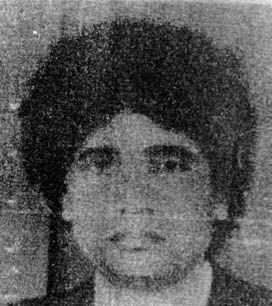

Now, what Tony said pointing at this notably low-quality image and its obscuring noise, is less than amazing. His police statement following the session records it as:
“...similar to the man who bought the clothing. The hair is perhaps a bit long. The eyebrows are the same. The nose is the same, and his chin and shape of face are the same. The man in the photograph is in my opinion, in his thirty years. He would perhaps have to look about ten years older, and he would look like the man who bought the clothes. It's been a long time now and I can only say that this photograph resembles the man who bought the clothing, but it is younger.”
Back in 1989 he had given the buyer as a burly six-foot-plus Libyan, aged approximately 50 years. Our 5'8" villain al-Megrahi was but 36 at the time of purchase. And instinctively, this photo looks to me quite young, taken perhaps a decade before the 1988 purchase. He looks almost too young, with the apparence of baby fat on those long al Megrahi cheeks... and with the cheeks and nose actually seeming shorter... the lips and nose look different...

In fact, the image used is highly unusual, bearing such little resemblance to Megrahi one could be excused for wondering, as I have, if this really is him. The Lockerbie case is so special, I can't see ruling out such a simple thing as a misattributed photograph. However, there's a certain logic to presuming the image is genuine - it would be a massive risk that the picture could be proven to be of some other person, or even altered.

I remain convinced by an earlier experiment I did with photo comparison that I don't think I documented. Even with the apparent facial differences, this could well be Megrahi, taken a bit "chin-up," showing nostrils, more upper lip, shortening the face and nose as seen. Nothing in the overall proportions ruled out the same face. The hair obviously is unlike anything else we've seen him wearing, which when long is more like in the photo shown below.
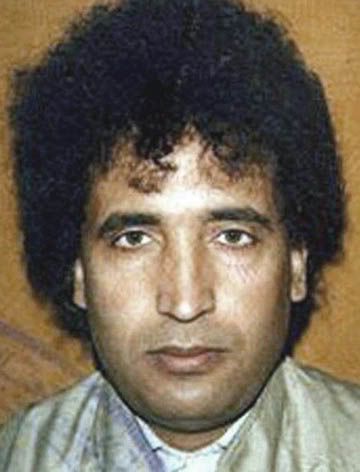
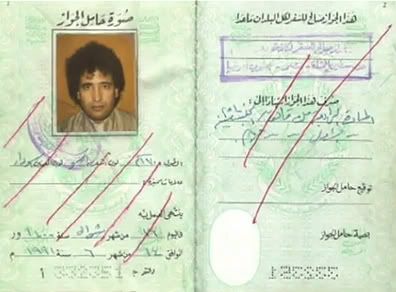
The image at left was taken for the false passport in the name "Abdusamad" issued by Libyan authorities in mid-1987, age 35. It was used on a few occasions, including a now-famous trip to Malta on 20-21 December 1988. As I've explained elsewhere, this is a legitimate clue - if not for Megrahi's guilt, then for why he was selected for framing.

The image itself is the most widely seen photo of the accused from the 1990s onward. It's not unlike the others taken since then as the man gained new fame as the accused - and then convicted - "Lockerbie bomber." This verifiable likeness is very unlike the photo Tony pointed to, and to which we now return.

The Hair
What Megrahi looked like before and after the Abdusamad photograph is unclear. Whether the raging afro seen in the Czech photo was chopped down before the above or grew in after it can't yet be established (but most clues point to some time before). However, one thing we know it does, among all images of al-Megrahi, is bring him close to matching the plumage style of Gauci's buyer. 

At left is the police artist's sketch based on Tony's description of the mystery shopper, 13 September 1989. The likeness is uncanny in its near-exclusion of Megrahi. It just doesn't look a lick like him, especially with this intense, angular, face, compared to Megrahi's soft features he later pointed to. And all this on a "large head" atop a 6-foot-plus frame to Meegrahi's 5'8" and Tony Gauci's 5'3".

One main feature to note is the dense afro-style haircut atop a clear expanse of forehead. The tightness of the curl is different by a long shot from any photo of Megrahi I've seen. His dangling ramen-wiggle expanses seem incapable of the tightly spherical sculpted look of the artist's sketch.
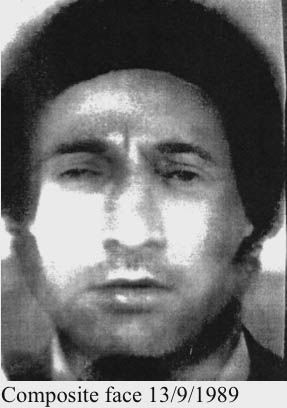

And here is the "Photofit" or "composite face" image compiled from Gauci's descriptions, given the same day as the above. They share the same basic hair, here a bit longer and fuzzier at the top. Otherwise, the two look drastically different from each other in the lips, chin, eyes, eyebrows, nose, and cheeks.

Tony did specify the sketch was a better likeness than the photo-thing, but agreed both resembled the buyer quite a bit. This almost seems to say "if you can find a photo of anyone with this kind of mid-sized 'fro that I think you guys want to prosecute, I will say it looks like the man." 

Prior to al-Megrahi, Tony had selected others as a match for the buyer, like Mohammed Abu Talb, famously in December 1989. Abu Talb didn't really fit by hair; his appeal was more from the word "bomber" across the corner of his face.  And Tony once pointed out  Mohamed Salam - a pretty good likeness of the sketch in both hair and face - on a less famous occasion. Like al-Megrahi, both of these men were at least a decade  too young. 

Perhaps Megrahi's undated fro was an earlier thing, from his 20s. But other than the Czech photo, we've only seen Megrahi with less hair and apparently more hair product. Buncrana found a photo of Megrahi at about age 19 - a student visa is from when he was studying in Wales, around 1971 (first revealed by the Sun back in August). We can here recognize al-Megrahi's longish features as a stylish young man. A little quiet-looking, but with a wild frontal swoop, almost a bouffant, coming halfway to his eyebrows. Quite unlike Tony's buyer, the Megrahi images show nary a clear forehead, especially in the questionable Czech photo.  And unlike that photo, this one actually looks like the guy it's supposed to be. 

Czech Photo Origin, Age, and Effects 
What was shown was not that Megrahi was or even actually resembled the buyer. All we learned on 15 February was that, among a selection of 12 pictures, Megrahi's could be made to be reported as the one most resembling the buyer, so long as you pick one that doesn't really look like him, while giving him something like the right hair.

This highly useful image was supplied to the investigation by intelligence from Czechoslovakia, says lead FBI investigator Richard Marquise. [see Sent Home to Die, Youtube posting 17:48] In his 2006 book he gave no explanation I could find about when the investigation got this picture, why it's of such poor quality, and what info came with it.  He acknowledge that "no one could positively date the photograph shown to Gauci." [SCOTBOM p. 127 - Google Books link] This may be of key importance below.

Marquise and his faux-witness Abdul Majid Giaka agree the photo Tony pointed to showed a young man, who was Meagrahi. "Giaka had looked at the Czech passport picture identified by Gauci. He said it was Megrahi when he was much younger." [p 142 ] Gauci's own feeling was of a man "in his thirty years," (30s) which Megrahi then was. But this could be chalked up to the lack of clarity and the fact that nearly all men Tony had been shown were in their 30s. DI Scicluna, Maltese police, gave his own account of the 15 February ID with slightly different details.
“.. Gauci started examining the photographs and the first thing he said was that they are all too young. It was explained to him to allow for age discrepancy as the man he saw could be 10-15 years older. [...] Gauci then looked through them and again stopped at Baset’s photo and indicating it he said ‘This is similar, but it is maybe 10-15 years younger.” [Grounds of Appeal doc]
Somewhere in his 30s, plus fifteen years is close enough to a match with the 50-year old man he described. But Marquise, Bell, and Scicluna and crew didn't know how old the photo was. All they had to do, and perhaps did,  was presume the picture itself was 10 years old, and add 10 years per what Gauci said, and you've got Megrahi's age, even though it's still 14 years below what Gauci first estimated.

Further, the quality of the Czech photo is worth wondering about. If the other 11 pictures he was shown that day were all normally clear and this one only looked strange, might that itself be leading? Might Gauci think it was included for some special reason? Might he think this is some super-elusive Mullah Omar character the cops can only get a crappy picture of? Might that make him feel it's more fruitful to point at then the others?

In fact, it seems the other images were altered to lessen the difference, but a professional who reviewed the effects in 2008 felt it was insufficient and the Czech photo still stands out as the gritty, mysterious one. [see Valentine report, page 40]

And There They Stopped
However exactly he was tricked into it, this was the final identification. Tony Gauci had been picking men out of photo lineups sporadically since September 1989, at different times having picked out at least three other men as similar to the buyer, but younger. But after 15 February the exercises abruptly stopped, and investigators were somehow sure they had their man. An identified buyer of the clothes, a Libyan agent comporting with the by-then identified timer, and there as Abdusamad on the day of the bombing. Never mind that he was about five inches too short, too slight of stature and light of skin, 14 years too young, and nowhere near the island of Malta on the day the clothes were purchased.

Marquise related how, at a mid-1991 conference, Senior Investigating Officer Stuart Henderson "discussed the photo spread leading to the Gauci identification of Megrahi. Although no one could positively date the photograph shown to Gauci, he was reluctant to show any more photos without fear of tainting what he had already provided." [127-8]

Something tells me it wasn't so much "tainting" as "spoiling the moment" Henderson was worried about.  As we've seen there was a special and delicate magic about how this supposed selection of al-Megrahi was materialized. It's also clear that the other photos available, with al-Megrahi's usual hair styles and better clarity, would show Tony how unlike the buyer this Libyan was. It could conceivably screw up the ID they had and wanted to keep.

So the big-hair Czech photo remained the only one of the chosen suspect that Tony saw until the better likenesses started appearing in the news a few months later as the "Lockerbie bomber." By then the whole world knew just what the guy looked like, removing all the cahallenge from arranging the later touted pointings-out in 1999 and 2000, just before Tony helped land a conviction and his $2 million prize.
---
Updates 12/26: In fact, Harry Bell noted in his police diary the day of this charade that this was the only photo the Scottish police had of "Abdelbaset" and they had to use it for fear they could never find another.
"meeting with Special Agent Reid. He tried to imply that we were rushing showing the photograph spread. ....they were the ones that wanted it done before Bollier left the USA.  Also if Baset was identified, Bollier would be the last person to be told as we know he is still in contact with the Libyans. Reid has been worried in case there is no identification made by the witness because [the photo]of Baset we have is too young. I explained that as we have no other and no indication that we will ever get one, then we can only proceed with what we have. If no identification is made and we later get a better photograph showing his true age and appearance in December '88, then the Lord Advocate may
accept an argument for showing this to the witness.

The differences in any photos can be noted while accepting that to some degree it will weaken the identification at any trial."

Then, among the eight points why Megrahi was the buyer, he wrote:
(7) The SIO [Stuart Henderson] advises that Bollier has now been shown the photofit and he states that if the hair was shorter then it would indeed look like Abdelbaset, also if it was 10 to 15 years older.
They got the same response from Bollier, but apparently in reference to the Photofit, not the Czech photo, if it was older (??). Bollier claims in comments below that he was never shown the Czech photo, and had still never seen it for 20 years of highly public study, until this blog post.

(8) The SIO also advises that the photograph we have of Abdelbaset is in fact 12 years old.
This confirms the suspicion. A twelve year old photo of Megrahi would be of a man aged 26, circa 1979. Gauci thought it was of a man in his 30s, and never actually retracted his belief the man was "around 50." This looks a hell of a lot like a shell-game or three-card-trick, designed to fit Megrahi in. [See: Grounds of Appeal doc, page 42/43]
---
Information continues in the excellent comments below.

Video: Gauci on al-Megrahi

"A Little Bit Like Exactly" Like a Non-Identification
December 13 2010

last update 15 December

I'm just wrapping up a video on Tony Gauci's evidence in toto. Including credits, it's about 12 minutes, split in two halves on Youtube, embedded below.

Part One:

Introduces the relevance of Mr. Gauci, the physical discrepancies between his buyer and Megrahi, and the date of purchase issue. Some pretty damning stuff.


Part two:

The actual identification session, Gauci's other IDs, his amazing fudging of all discrepant points at trial, the $3 million plus paid out to the Gauci brothers following the verdict, the SCCRC's findings, second appeal, conclusion, and credits.

Comments:
This production is a little rushed. I didn't re-do the narration enough times, adjust all the levels, make the best slides or animations. I thought I could rush this through in time for the Dec 7 anniversary of the alleged sale to Megrahi, but the assembly and rendering process didn't agree. Then I just wanted it done by Monday (today), and only managed to meet that deadline with part one.

Anyone who'd like to see more of the information this is based on, all my blog posts about Tony Gauci's evidence are at one or both of the links Tony Gauci's "Identification" of Megrahi and all posts tagged Gauci T.

Abdusamad on Malta

"The Biggest Lie" They Could Find
8 November 2010
last edits 14 Nov

It's no longer a secret that "Lockerbie bomber" Abdelbaset Ali al Megrahi was on the island nation of Malta on 20 and 21 December, 1988. But his passing through Luqa airport there on the morning of the bombing of Pan Am 103 was a secret at the time, since he was traveling under a false identity created by the Libyan government - Ahmed Khlaifa Abdusamad. (see passport below).

We can thus presume that Megrahi was on a secret mission of some sort, on behalf of Tripoli, and likely something illegal. No one can be certain just what his mission was, and there's been to this day no satisfactory explanation from the Libyan side.

It's not sure just who first learned that Abdusamad and Megrahi were the same person, nor when this happened. But if it was found out early enough, and by the CIA, it could well have been the deciding factor to drag the Libyan into the spotlight of suspicion, his hated nation training behind.

In their 2001 Opinion of the Court accompanying Megrahi's conviction, the Zeist judges explain the false identity's origin and early use:
On 15 June 1987 the first accused was issued with a passport with an expiry date of 14 June 1991 by the Libyan passport authority at the request of the ESO who supplied the details to be included. The name on the passport was Ahmed Khalifa Abdusamad. Such a passport was known as a coded passport.  There was no evidence as to why this passport was issued to him. It was used by the first accused on a visit to Nigeria in August 1987, returning to Tripoli via Zurich and Malta, travelling at least between Zurich and Tripoli on the same flights as Nassr Ashur who was also travelling on a coded passport. It was also used during 1987 for visits to Ethiopia, Saudi Arabia and Cyprus.  [paragraph 87]
The earlier indictments of Megrahi and Fhimah, issued November 1991, gave different uses of the identity. On 22 August, 1987, "Abdusamad" flew from Zurich to Malta, stayed at the Holiday Inn there, and returned to Tripoli the next day. This trip was made "along with the said Nassr Ashur, who was then using a passport in the false name and using the false identity of Nassr Ahmed Salem." [points (e) (m)]

And then after a long break, he went out as Abdusamad only once in 1988 - on 20 December, when he flew with Fhimah from Tripoli to Malta, and again the next morning for the return trip, this time with Mohammed Abouagela Masud. [point (p)] The Zesit judges agreed that "the only use of this passport in 1988 was for an overnight visit to Malta on 20/21 December, and it was never used again." [para 87]

A supposedly key piece of evidence for Megrahi's guilt occurred only some days after the 14 November public announcement of the indictments. In a November 1991 interview with Pierre Salinger (I can't pin down the date), Megrahi denied being Abdusamad or being on Malta the day of the bombing. This was presented, for one, in the recent STV documentary Lockerbie Bomber: Sent Home To Die [23:18]
"You accuse me falsely. ... On 20 December and 21, at that time I wasn't there. Believe me, I was here in Tripoli with my family."
The editors had FBI lead investigator Richard Marquise follow the clip by saying "I realize that being a liar doesn't make you a terrorist murderer. But I think, again, it adds credibility to all the other factors that we led up to at that point." And Marquise is quick to offer up this lie, as one of his two or three points, nearly every chance he gets. This repeat play is itself a sign that he knows "all the other factors" need all the help they can get. At least once, he's called this "the biggest lie" the Libyan had told.
Megrahi denied being a member of the Libyan Intelligence Service; he did not know Abdusamad; and he did not know MEBO. All were proven at trial to be lies. However, his biggest lie was his claim that on December 20-21 he had not been in Malta: "I was here in Tripoli with my family believe me." Why should anyone believe any of his claims today after his lies in 1991? [source]
This early repudiation has been a verbal rope used by Marquise and many others, time and again over the years, to tie Megrahi to the bombing. In retrospect, he should probably have come clean as much as possible, but bare days after the shocking announcement, and revelation of his secret presence, that didn't happen. It seems cover-up won, at least for a moment. Perhaps it was reflexive on Megrahi's part, not grasping the reality of the charges against him, or a firm order from callous superiors despite Megrahi's own pleas. Either way, it was an unfortunate move on the part of the accused to say these words to a watching world, and one of the few things he actually did that contributed to his conviction.

The Zeist judges, considering in 2000 and 2001, referred to the 1991 interview in lieu of live testimony, which both accused declined to offer (they felt it was wiser to let the lawyers do the talking henceforth). Referring to the crucial visit, the judges mused:
It is possible to infer that this visit under a false name ... was a visit connected with the planting of the [explosive] device. Had there been any innocent explanation for this visit, obviously this inference could not be drawn. The only explanation that appeared in the evidence was contained in his interview with Mr Salinger, when he denied visiting Malta at that time and denied using the name Abdusamad or having had a passport in that name. Again, we do not accept his denial. [paragraph 88]
He was of course no longer denying his presence at the time, his representatives having surrendered to the Crown the passport with his photo and stamped 20 December, Malta. But Megrahi's, his counsel's, and his government's continued silence over this mission, presumably not bombing-related, allowed this inference that it was bombing-related to be possible (or does simple imagination do that? See comments below).

Besides pretending to genius status for rejecting a moot denial made to someone else a decade ago, the judges managed to bolster it with the other weak points to collectively sort-of-justify saying "guilty." An act of imagination, and otherwise it was down to the evidence that he actually was planning a bombing at the time.

And it's this class of clues, as Mr. Marquise likely knows, that needs some help. He called on the same imaginative reading of "Abdusamad" as support for the evidentiary case. But in reality there's much to suggest the oppposite - the hard evidence may have been planted and bribed into being in order to support the fabricated case against that suspicious-looking Megrahi and his false passport.

A Three-Year Test Drive, Parked 8 Years, and then a High-Speed Crash, pt 1

A.M. GIAKA'S SKELETON OF FANTASY 
written January 22 2010
re-posted September 20 


 Note: what follows is the first half of a looong working essay I just had to see up even before it's done. It covers from Giaka's defection to the start of trial preparations in 1999. Part two will be long-delayed, but will call on Giaka's direct testimony via trial transcripts. This was previously (also) posted at a separate blog. 


A Missing Link
Among the sources collecting the evidence against Abdelbaset al Megrahi (and/or his accused accomplice Lamin Fhimah), most mention the same three “keys to the solution of the case” given by the FBI’s lead investigator on the SCOTBOM case, Richard Marquise, in his 2006 book. He gives these as Tony Gauci, “the Mebo chip,” and the souvenir printout of the Frankfurt luggage records taken by Bogomiras Erac, which was strangely “the only record” anyone could find of this vital information. [Marquise p 210] There are other peripheral clues of importance, but few with the resonance, clarity, and specificity of these three as indicators of Libya’s guilt, via the two accused.

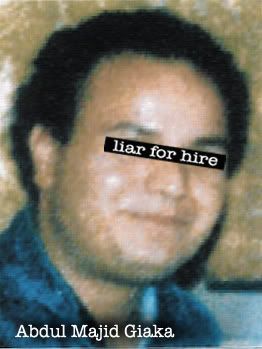
 But missing from such formulations is a fourth and most important key – Abdul Majid Giaka [different spellings have been used], a Libyan intelligence defector turned intelligence asset for the U.S. side of the investigation. In fact, in coming on board four months before the Lockerbie bombing, Giaka’s connections with Malta, Luga Airport, and Libyan intelligence put him in a prime position to be the first to mention both accused - to his CIA handlers - in the first place. The majority of everything he said has by now been discredited and shown to be fabrication – at best enabled and at worst demanded by his American friends.

Giaka’s intelligence was transformed to evidence with some CIA/FBI alchemy, tying several loose ends together and, in essence, providing the skeleton for the ‘Libyan villains’ case to stand on. The defector’s tales underpinned the US/UK joint indictment, the years-long extradition wrangle, and was finally brought as far as the Scottish Court as Camp Zeist in 2000. But as we’ll see, it went no further and has been mentioned as little as possible since.

Effective Defector Detected
Abdul Majid started this journey as a self-described disaffected Libyan perturbed by Tripoli’s terroristic ways and Gaddafi’s Masonic schemes. A low-level intelligence agent with the JSO, and stationed on Malta, he approached the US embassy there in August 1988 offering his services. Paul Foot’s seminal 2000 booklet Lockerbie: Flight From Justice explains how this started a “long series of meetings with American intelligence officials in Malta,” 41 secret meetings total, spanning almost three years from “September 1988, the same month he started getting regular payments from the CIA.” [Foot]

For $1,000 US per month, rising to $1,500, he wasn't a huge payback at first. “His information was patchy and unreliable,” Foot reported. “He pretended he was a senior official in the Libyan intelligence organisation JSO though in reality (as the Americans quickly realised) he was a former garage mechanic who helped to maintain JSO vehicles.” The BBC Conspiracy Files program in 2008 treated this subject fairly, and summed up “not so much double-oh-seven, more WD40.” [CF 44:20] He had however “graduated to the exalted position of assistant station manager for Libyan Arab Airlines,” Foot concedes, work carried out at Luqa International Airport, on the island's near-south side.

Giaka was given the code-name "puzzle piece" by his CIA handlers, [CF, 43:29] at least one which also worked at the airport, under cover as a baggage handler. [LTBU 8/29] The agent kept tabs on him, writing cables back to the CIA that named the subject in code as “P/1” (and referred to the JSO as ESO). P/1’s job there involved aircraft security, “but he is also obliged to assist ESO operatives transitting or on missions to Malta,” according to a copy shown on the Conspiracy Files. That’s a reasonably rich source for intel reports, but the agent noted Giaka “has been a “shirker” while in Malta, generally dodging ESO assignments since his Luqa appointment.” [CF 44:12]

Whatever the defector’s shortfalls, in October 1988 he reported his first big lead – Lamin Fhimah, a “JSO agent” also working at the airport, kept eight pounds of TNT in a locked desk drawer of an office. Paul Foot again relates how two months later in December (whether before or after the Lockerbie bombing is unclear) “he was asked about the movements of JSO officials through Luqa airport. He replied that a man he regarded as a senior JSO officer, Abdelbasset Ali Mohamed Al Megrahi, had passed through Luqa airport on 7 December.” [Foot] The names may not have meant much at first among Giaka’s other intelligence, but as soon as investigators were willing to consider a Libyan link, and it was found that both were also present on Malta December 20, the eventual suspects were clearly on file and ready to drop in place even before 1988 had closed.

Giaka and America Rescue Each Other
By the beginning of September 1989 the investigation’s scope was narrowing in, of all places, on Malta. The oddly-delayed Frankfurt printout revealed in mid-August an unaccompanied bag from Malta had apparently gone onto PA103A. At the same time, the tattered Maltese clothes from inside that bag had led to Maltese shopkeeper Tony Gauci, who gave his first statement about the buyer on September 1. But Giaka was probably not told these things as, on September 4th Foot maintains, “his CIA handlers in Malta told Giaka he was “on trial” until the next New Year (1990).” [Foot]

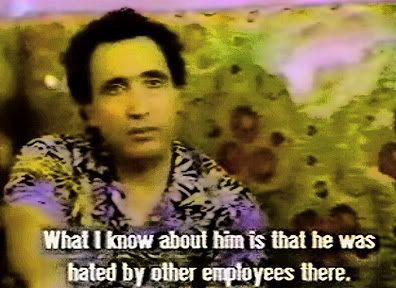
The informant likely grew nervous as his bridges to America became more precarious, his bridges on Malta stood burned, and his bridges back to Libya were threatening. The 1994 film The Maltese Double Cross featured interviews with both accused, who indeed knew Giaka, at least in passing. Megrahi confirmed he did security work there, and “he was hated by other employees there.” Fhimah added “He behaved badly towards the employees working with us, in dealing with passengers. The Maltese airport authorities know this.” [MDC 1:28:10-1:31:28] Some bias might be expected of course, but others interviewed for the film vouched that he was irresponsible, a partier and amasser of debts. And he wasn’t going to be getting any more popular trying to sell intelligence to the CIA.

One anonymous Libyan related for the film how Giaka was put up for transfer at some point: “they asked him to return back to Libya because his contract finished, for his staying in Malta.” Apparently desperate to maintain his situation there and his possible ticket away from Libya, Giaka asked the CIA to pay for a surgery to injure his arm so he wouldn’t be called away to serve in the Libyan Army. [Foot] They apparently consented and “after a few days,” the anomymous source said “[Giaka] came here after the hotel and he had a plaster on his hand” which he said was from falling down the stairs. This seemed to help him “get an extension of around three or four months to stay here.” [MDC 1:31:15]

By 1991, the regular cables were describing P/1 as “a shattered person” who “does not want to be part of the security apparatus and is certainly milking any of his contacts, including us, for whatever he can get.” [NYT] The Americans were ready to milk back - the fruit was ripe and dripping with urgent ‘get-me-outta-here’ intel possibilities. Perhaps realizing that Giaka really was the best they were going to get, the decision was made by July 11, when the Department of Justice told Mr. Giaka they would “accept or reject him" as a witness "based on his response to their Inquiries,” which would be done at leisure within the United States. The very next day, Foot writes,
“Giaka, to his intense gratification, was taken off Malta by an American warship, and interrogated there by an FBI officer, Hal Hendershot. Before long he was safe in the US where he was later joined by his wife. He was paid a regular salary in exchange for constant interrogations by the CIA and the FBI. What he told them plainly satisfied them. In October, in conditions of great secrecy, he gave evidence to a US Grand Jury. The result, in November 1991, was a detailed indictment charging Megrahi and Fhimah with murder by planting a bomb in a suitcase on a flight from Malta to Frankfurt and thence to London – and the explosion over Lockerbie.” [Foot]
The World Dances to the Fantasist Tune (Played Real Loud) The United States government for this point forward until now, without interruption, has accepted the core of this indictment as unassailable truth. The findings of Libyan guilt via al Megrahi and Fhhimah and others not named, the findings found primarily in Giaka’s words, has been the basis of economic sanction, diplomatic pressures, approval of clandestine operations, public vilification of Libya allowing more of the same to pass, and so on.

Most of the world was rather surprised at the turn of events, running counter to all the old evidence that made more sense and involved no Libyans. And was, of course, highly inconvenient for the Americans. Naturally, suspicions of cover-up flourished, especially in the UK. This was primarily channeled into an intriguing “CIA drug-running” cluster of theories (which this author considers a huge distraction) that got its biggest boost with an April 1992 cover story in Time magazine.

A Department of State press release from the same month sought to counter growing confusion at home and abroad by calmly laying out the facts in a press release. The Suitcase itself, fairly non-descript and not directly accounted for anywhere in the luggage records of three airports, was prime evidence at the time, thanks to Giaka’s incredible contributions.
“Forensic analysis has identified the bag that contained the Pan Am 103 bomb as a brown, hard-sided Samsonite suitcase. The following evidence links Al-Megrahi and Fhimah to the suitcase: -- Al-Megrahi, traveling in alias, arrived in Valletta with Fhimah from Libya on the evening of 20 December 1988--the day before the bombing. Fhimah, the former manager of the LAA office in Valletta, retained full access to the airport. Al-Megrahi and Fhimah brought a large, brown hard-sided Samsonite suitcase with them into Malta on that occasion. [DoS]
They make it sound like the Fact they had such a suitcase is evidence they planted the bomb, but in reality, Giaka’s intelligence was the only evidence they had such a suitcase. This emerges chronologically, below. That his stories wound up matching the emerging evidence at the scene is highly troubling – the similarities are from neither truth (as we’ll see) nor likely from coincidence. It seems Mr P/1 served as a two-way intelligence conduit - milking the CIA so they could re-milk him – helping them launder propaganda into intelligence and, via FBI acceptance of that, into evidence ready for trial.


The top man who promoted Giaka as evidence, and the most likely to be fully aware of such unethical activities, would have been Vincent Cannistraro, senior director of the CIA’s own Lockerbie investigation until October 1990 [Ashton] . He continued promoting the story line he'd helped write in the years between indictment and trial. For a 1995 BBC program, he described the case modestly as:
“… overwhelming … conclusive … tremendous amount of evidence … mind boggling amount of detail … that will allow the prosecutors to present the chronology of the operation from its very inception … describe and in almost excruciating detail exactly how they made the bomb, how they secreted it, how they got it on board the aircraft, and I think that's a fairly strong case.” [FS]
His favorite part that he singled out for emphasis in that interview was “they have a live witness for one thing, who would be presented in a court of law.” [FS] Cannistraro bravely spoke to The Maltese Double Cross, again pimping Giaka, just not yet by name: “a former member of the Libyan Intelligence Service who has defected” into Justice Department witness protection, “so he would be used in a trial of Fhimah and Megrahi.” [MDC, 1:28:25]

Such a trial was demanded, in the US or Scotland, based the much-hyped amazing case. The demand was repeated often, and with force, befitting a mighty nation’s drive for truth and justice for the 270 dead. Faced with such confidence, people and whole nations started falling for it. Those comprising the UN Security Council at the moment, in particular, were collectively convinced enough to enforce the indictment with sanctions.

In 1992 and 1993, Security Council resolutions 748 and 883 imposed and tightened embargoes, diplomatic restrictions, and various other punishments. Aircraft equipment and supplies in particular were squeezed on, putting al Megrahi to work on the gray market (the likely cause behind his "suspicious" Zurich office and Swiss bank account). It was under this prolonged duress that Libya eventually relented to a compromise solution. By late 1998 the framework of a trial was established, and in April 1999 the accused were flown to the special Scottish court in neutral Netherlands. Megrahi and Fhimah were arrested at “Camp Zeist” and set to await their trial. Sanctions were immediately suspended, under threat of re-enforcement.

All this was based on an alarming mass acceptance of the American/Scottish case, in turn largely built up on “accepting” Giaka’s intelligence as evidence. The suspects, the suitcase, the materials, the plans, and the evil behind the Pan Am 103 plot were all attested to by a desperate defector, in trade for a steady paycheck, a maimed hand, and a new life in America. It had all wowed the grand jury and secured the indictment, but now that Cannistraro’s dares had paid off, it would be challenged for once, and before the whole world at that. At stake were these claims, in "job resume" format. Most of these were unknown to the public at the time, but about to see the light of day:

 - Giaka’s own credentials/authority: JSO agent, high-level, secret files department – related to former King Idriss - hates Gaddafi - aware of Masonic plots between Libya and Malta.

 - Has a long-standing friendship with Ezzadin Hinshiri, director of the central security section, JSO (allegedly involved in buying the MST-13 timers as used in the bombing, including an order placed for 40 more just two days before the bombing!)

 - Long-standing friendship with Said Rashid, head of the operations section, JSO (also involved, allegedly, in timer acquisition and other wickedness)

 - Acquaintance with Abdullah Senussi, the head of operations administration for the JSO. (convicted in absentia in 1989 for using that role to blow up an airplane (not 103). Also, Gaddafi's brother-in-law.)

 – Can describe the high-level JSO connections of the accused – worked directly under the first accused – hated his boss - can testify to their movements at the airport – able to read clues from them, ranging from subtle to fictitious, revealing their plot.

 - Was asked by Said Rashid, in 1986, to write a report on whether a bomb cold be put on a British plane - had someone else look, who said yeah so he wrote the report saying so. The upper levels mulled the idea over...

 - Turned said report in via his boss, “Lockerbie bomber” Megrahi, who definitely saw it. Megrahi later mentioned the idea back to Giaka and said “don’t rush things.”

 - Can testify to Fhimah’s personal handling of explosives, in his desk, which were overseen by Megrahi, for the JSO.

 - Was invited to the final plotters’ meeting as Megrahi and Fhimah met at Luqa airport on the day of the Lockerbie bombing, with a suitcase just like the one that would do that explosion hours later, after having come in from Malta (other evidence covered that, obviously). That’s the clincher for sure.

 - Has defected safely from the murderous regime, after a grueling three-year initiation, and can therefore finally reveal the secrets he held of the devious, random, and surprisingly unselfconscious scheming that climaxed five miles above Scotland four days before Christmas. That - is - evil. Thank God they've got a witness who saw it all, ready to go before the judges...
 ---
Sources: [Ashton] http://www.copi.com/articles/lockerbie.html [CF] "The Conspiracy Files: Lockerbie." Prod/Dir Guy Smith, Ex Prod Sam Anstiss, Narr Caroline Catz. BBC Two. First Aired 31 August 2008. http://video.google.com/videoplay?docid=-327765978162851498&hl=en# [Foot] Foot, Paul, Lockerbie: Flight From Justice. Published 2000 by Private Eye. https://secure2.subscribeonline.co.uk/PEYE/digital_downloads.cfm [FS] Frontline Scotland: "Silence Over Lockerbie" Reporter: Shelley JofreProducer: Murdoch Rodgers. Aired 1995. Transcript accessed at: http://plane-truth.com/Aoude/geocities/silence.html [LTBU 8/29] Connelly, Clare. "Controversy Over CIA Cables Continues." 29 August 2000. Lockerbie Trial Briefing Unit. .doc link: http://www.gla.ac.uk/media/media_78571_en.doc [MDC] The Maltese Double Cross. Produced, written, and directed by Allan Francovich, Hemar Enterprises, November 1994. http://video.google.com/videoplay?docid=7160854996287567609&ei=EAtQS8iUNYOYqQPjnaka&q=Maltese+Double+Cross+&hl=en [Marquise] Marquise, Richard. SCOTBOM: Evidence and the Lockerbie Investigation, Algora Publishing. Sept. 1, 2006. 268 pages. http://books.google.com/books?id=JKLT360G_zAC&pg=PA119&lpg=PA119&dq=Marquise+SCOTBOM&source=bl&ots=WGsIBNTRDo&sig=ZkD5iwHr [NYT] McNeil, Donald, Jr. “Defense in Lockerbie Trial Undermines a Key Witness.” New York Times. September 28, 2000. Accessed at: http://plane-truth.com/Documents/Defense%20in%20Lockerbie%20Trial%20Undermines%20a%20Key%20Witness.htm