Showing posts with label Cannistraro. Show all posts

David Leppard on Abu Elias

February 13 2011
slight edits 2/15

I’m delighted to add a very strange new point to the body of knowledge and/or lore surrounding “Abu Elias,” the apparent builder and controller of the Lockerbie bomb. (see: all threads about Abu Elias) This latest is from David Leppard’s highly interesting riddle of a book On the Trail of Terror (April 1991). It was among the first privileged works allowed to announced the turn to Libya in detail, months ahead of the sanctions. It drew on insider sources and related - in great detail - all the relevant clues that didn’t specify al-Megrahi or Fhimah - the Frankfurt printout, the Maltese clothes, the timer fragment, etc.

In fact, the original lead from 1988-1990, the Iranian-backed plotting of the Syririan-based PFLP-GC (Jibril network), is still tied in here. That's good for Leppard because he earned his spots reporting on just that lead in 1989 and '90. After he “changed his spots,” as Paul Foot put it, Leppard’s take became the same as that proposed by CIA Lockerbie chief Vincent Cannistraro in the early 1990s. It was the same Iranian-backed PFLP-GC plot everyone had, with good reason, suspected, just taken over by Libyan intelligence following the October 1998 "Autumn Leaves" bust.

In this series of raids, the bomb-making PFLP-GC cell near Frankfurt, their massive weapons cache, and tangle of targets, was disrupted by German feds who then set almost everyone free. Only the cell's weapons master Ghadanfar and its ring-leader Dalkamouni were kept in lock-up. The bomb-maker, Marwan Khreesat, was a double agent and flew back to his bosses in Amman, Jordan.

This version, where the Libyans picked up the slack, modified the rogue bomb with one of their timers, and arranged for the Malta plot to send it on to PA103, was the insider’s favorite for a while. But after some time, the original portion withered and fell off for lack of official recognition or further repetition (this part, if not the whole shift, can be chalked up to Gulf War-era re-orientation). Lockerbie gradually became a Libyan plot alone, presumably motivated by the nearly three-year-old U.S. air raids on Libya. As President Bush put it in 1992 or so (from memory), the original suspects “took a bum rap” in ever being suspected.

And all this despite the Autumn Leaves bust being quite possibly irrelevant to the original plot. One of the five bombs and one of the plotters escaped the raids entirely, together it seems and moving towards something. No one has ever explained what stopped them, or what they needed any Libyan help for. All that really needed done from there was likely carried out, by whom exactly we don't know, at terminal three Heathrow between 0:00 and 17:00 on December 21.

I thought I’d already checked Leppard’s book for reference to airport security expert Abu Elias, but missed this sole entry until just the other day. In its last three pages, the book concludes with its only mention of this highly relevant fugitive, as a part of the “Libyan connection.”
One final question mark for the Lockerbie team is the identity of the man Jibril asked to liaise with the Libyans in the eight weeks between Operation Autumn Leaves and the night of the bombing. The Scots, the Germans, and the Americans now believe that after 26 October 1988, with Dalkamouni in prison, another leading Jibril operative, called Abu Elias, may have played an important role in arranging the tie-up with Libyan agents and directing at least part of the Maltese end of the conspiracy.
There’s been no other mention of, nor evidence for, this notion of Abu Elias meeting with Libyans. At least, not that I’ve run across yet. It’s a very strange way to end a book to fuse the new direction with perhaps the best lead of the old, this young relative of Ahmed Jibril’s who apparently didn't trust Khreesat. Leppard adds some details consistent with other reports that would emerge:
The FBI have a photofit picture of Elias which shows the handsome features of a blond 25-year old Palestinian who heads the PFLP-GC’s military section in Damascus.
25 years old is new to me - nothing I'd seen before gave an age. This almost certainly refers to the Jordanian GID's sketch, apparently made after Khreesat's first (and, I think, only) meeting with the mysterious operative in 1985. As the 1989 report by FBI agent Marshman says:
The GID officers produced a composite sketch of Abu Elias that was done by Khreesat some time ago. Khreesat examined the composite and affirmed that the likeness was that of Abu Elias who he met in Damascus, Syria. This composite is attached to this FD302. [source: trial transcripts]
If he were a bare 25 years of age in 1985, to head the military section in Damascus (as others report) even by 1988 is clearly young. It's a bit too young to be Basel Bushnaq of Virginia, read literally. He's allegedly the same person as Abu Elias, but his records show he was born in late 1955, making him 29 or 30 at the time of any 1985 meeting. But if that’s not his original name, as Christine Grahame MSP alleges, it’s probably not his real birth date or even year.

And perhaps the 25-year-old estimate, whoever's it was, was erred on that end. This age addition is close enough to be consistent with the other disturbing clues that Ms. Grahame might be right, but is not apparently much of a clue in itself.

Leppard continues:
Dalkamouni admitted in his prison interviews that he had met Elias at the Front’s offices in Damascus. But he has denied seeing him in Germany.
Ah! Khreesat says he never saw Abu Elias in Germany, but that Dalkamouni did, something he was told of repeatedly. Abu Elias had studied Khreesat’s work in 1987, and could perhaps spot a fake, like he was instructed by Amman to build. He might inspect the work being done for the big Iranian job.

And Khreesat says that of the five armed “Khreesat bombs” made under this threat, one was not his at all, and only appeared at the same time Dalkamouni said Abu Elias had arrived. Khreesat was asked to finish it by soldering two wires, and then it disappeared again, presumably back to whoever had brought it.
Nevertheless, the BKA surveillance report on Dalkamouni’s prison meeting with his sister-in-law in July 1989 contains a dascinating reference to Elias. After denouncing Kkhreesat as an informer for the West, Dalkamouni was overheard telling Somaia about Abu Elias. ‘He [Dalkamouni] only gave Khreesat the name Abu Elias once. When referring to this name it concerns a “Phantom” name, and only Khreesat could therefore reveal this name.’ Dalkamouni’s comments suggest that Elias played an important, although unspecified role, which Dalkamouni regretted revealing to Khreesaat., the suspected double agent. ‘It is not a bad guess to say that Abu Elias has played a role,’ said one senior Western intelligence official. But that role is remains a mystery.
That part is interesting, and may refer to a real conversation that Dalkamouni probably knew was being recorded. I’m not sure what to make of it. But investigators still felt Abu Elias was involved, or told Leppard they did, right up to the eve of the indictments, after which he vanished again. They were puzzling over his role, it’s said, but if he had one at all, it didn’t involve Libyans or Malta. That’s all 1990’s cartoon nonsense.

Whatever happened between October 26 and December 21, the bomb clearly left the ground at London. We have real evidence for that, not “intelligence sources now believe” crap. All along, they "now believed" whatever helped shift us gradually from one evidence-led track to another, led by new and more politically convenient evidence, generally oozing from Vincent Cannistraro's end of things and into media reports. And all along the real evidence, partly known to us and partly covered-up, has remained just the same. That is because the murder of those 270 people still happened the same way it actually happened. That can only be re-written on paper.
---

"As the layers are peeled away..."

AFIO and Poteat on Megrahi's Release
31 August 2010

last edit 1 September

Leading up to, upon, and following the 20 August anniversary of Abdelbaset al Megrahi's release from Scottish prison, and with the man still stubbornly surviving, calls went up on both sides of the Lockerbie divide. Last week, former FBI SCOTBOM chief investigator Richard Marquise spoke with a writer for the Christian Science Monitor (critique link). The self-serving result, to the effect that they got the right man, joined a chorus of media reports obediently repeating the Libyan guilt storyline without regard to the other side.

From that other side comes Dr Swire's story on stage in Scotland, JFM's petition to Scotland putting Salmond "on the spot," Michael Mansfield QC repeating his conviction that the conviction was "entirely unsustainable," plus a steady show of support from the UK public for the "bomber's" release, and generally for his innocence. Even in the states, Time's article on "five big questions" conveys with some conviction the "british"position. Americans, previously assured their reality was the real one, were in danger of growing confused amid these mixed messages.

"During the 1970s the Intelligence Community was buffeted by a number of leaks and revelations, culminating in the Church and Pike Congressional investigations. CIA officer David Atlee Phillips took early retirement in 1975 to respond to the growing sentiment that the CIA was a “rogue elephant.” As part of this effort, Phillips founded this organization, known then as the Association of Retired Intelligence Officers (ARIO). Although much attacked at the time when many people called for the dismantlement of the CIA, Phillips toured the world to speak out in favor of the need for a strong intelligence community. He was subsequently personally accused of being a participant in the Kennedy and Letelier assassinations... " Source: AFIO - About AFIO
Quickly on the heels of the Monitor-hosted FBI re-affirmation came a similar show of solidarity from the intelligence community, via their trusted affiliate, the Association of Former Intelligence Officers (AFIO - see box at right for more). With a membership drawn about one fourth from former CIA agents, the group's president Gene Poteat spoke with Jeff Stein of the Washington Post's "blog" Spy Talk (27 August). The column also mentions an AFIO statement (which I cannot find elsewhere) supporting recent moves by members of the Senate to investigate Mr. al-Megrahi's release. Poteat explained "the families of the murdered intelligence officers – and indeed all of the families – deserve no less than a full airing of the facts..."

Unfortunately, the sentence ended "...around Mr. al-Megrahi’s release." Silently, he affirms in the negative, a full airing of the circumstances behind Megrahi's framing for the bombing is not worthy of the same scrutiny.

This is suspected by most observers who are informed, but not implicated in an operation that was apparently headed by the CIA more than any other party. Their investigation into the bombing fell to counter-terrorism director Vincent Cannistraro, one of Reagan's experts on blaming and smearing Libya for political reasons. It's only to be expected from Cannistraro and his colleagues to defend the case that sanctioned Libya and put Megrahi away, and even to go on the offensive as a show of confidence against  any undue leniency.
In its statement, AFIO expressed strong support for the Senate committee’s investigation and called on “the UK and Scottish Governments to launch independent inquiries into the release of Mr. al-Megrahi to ensure that commercial and/or political interests did not lead to Mr. al-Megrahi’s freedom. ... CIA Director Leon Panetta, NSA Director Keith Alexander, Secretary of State Hillary Clinton, and Attorney General Eric Holder [should] direct their staffs to fully cooperate with the Senators’ investigation.”

Obviously the foreign governments are requested to explain what they already have in letters and statements, so far refusing to come in person. As I've said before, I can see their annoyance at American ignorance and presumptuousness, and the principle behind not "crawling" to Washington. But however justified, this stance is counterproductive and really is strengthening stand-offishness over here, as Mr. Poteat and the AFIO have just shown.

At least as noteworthy is the association's suggested "narrow focus" for this desirable investigation:
AFIO "also called for U.S. government agencies “to assist in providing minimally redacted operational cables and intelligence reports to cleared Senate staff in a secure environment. All documents should be narrowly focused on al-Megrahi’s release in order to protect sources and methods of collection.”
Whatever light the US government could shed on the decision by Scotland's justice secretary is minimal, and that lack of relevant sources is quite protective of anything relevant. And in case anyone was confused, the Association of "Former" Intelligence Officers recommends you be careful to avoid accidentally requesting information on the "sources and methods of collection” behind the bullsh*t story that put Megrahi away in the first place. They're all surely just as unanimous on the justness of the conviction as they are on the unjustness of his release, as Poteat put it:

“There have been few clear-cut issues where so many of us agree as we do on this one ... The decision triggering al-Megrahi’s release was a shock, and had a strong whiff of manipulation and back-room deals.”

The only back room - or rather prison cell - deal that I've sensed lurking in the release decision was the indirect way by which Megrahi's appeal of conviction and his return to Libya were linked, and that's almost surely not the same scent they're onto. Rather, its more likely something like the deals some former intelligence officers arranged in 1989-91, that made the latter batch necessary (kill the appeal to obscure the frame-up). The most informed among the AFIO's members would know there are secrets just beneath the surface that are better left there, and one would almost expect more discretion that calling for an investigation of Lockerbie anything.

The apparent CIA personnel scouring the Scottish countryside from day one could be explained by normal, uptight, agency protocol - secure all secrets.  But the 2 February 1989 news report citing an "American" source, suggesting Libyan operatives at Frankfurt carried out the bombing - is harder to explain. Quite likely from Cannistraro or a like-minded colleague, this would be based on no evidence that ever was mentioned again (ie, made up), but did help prepare the field for the replacement story that would evolve.

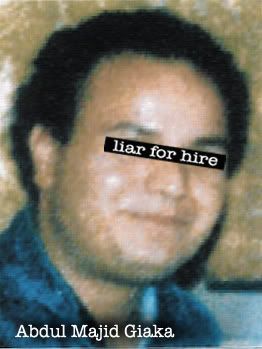
The first key to the eventual Libyan narrative was the identification on Malta of Libyan agent al-Megrahi, aka Khalifah Abdusamad. It's unclear just when his presence there on December 21, under the alias, was known to the CIA. But it was by early 1989 most likely and they'd be the first to know. Since even before the bombing they were getting original tips from liar for hire Abdul Majid Giaka, who was recieving $1500 a month from the agency for his slim, low-level info. On the CIA's urging,  this onetime literature student was accepted by DoJ as a witness, just after he fabricated a major portion of the evidence in the 1991 indictments - all the really specific stuff. He was apparently paid $2 million in 1992 for his efforts as well as being resettled with his family in the US.

Among a handful of other allegations lodged against the CIA, one of interest is how their bomb timer expert "Orkin" helped FBI's "Tom" Thurman identify the suspicious PT/35(b), under mysterious circumstances. It was found to be from a MST-13 timer, made by Mebo, whose founder Edwin Bollier first stepped up in a January 1989 note to the CIA offering to blame Libya for money. His clues were bizarre, but he had supplied the highly specific and identifiable timers, like the one months later "found at Lockerbie." The later yet ID seems to be accurate, but something fishy abides in that transaction and perhaps others unseen. Thurman was physically there on the scene and behind the scenes at the beginning and frequently thereafter, for example. And the fragment is forensically almost certain to have been involved in no such explosion. The timer fragment also was reportedly the subject of a document -requested by Megrahi's defense - that was sealed by the UK government to protect the interests of an unnamed friendly nation.

But the vital heart of the provable intelligence frame-up was Giaka; even after leaving the agency, Vincent Cannistraro continued into the 1990s with ignorant or dishonest public pimping of the secret witness and his amazing ability to bust the case open. The agency's ignorance or dishonesty (as with the Scottish Crown) continued into insisting to the Zeist judges in 2000 that the witness was credible, and that the redacted parts of CIA cables held no secrets. In fact, they revealed that the agency knew Giaka's was a bogus story. They had already chosen to push it anyway, to create a false reality by which crippling and deadly sanctions on Libya were justified.

Mr. Poteat further prophesized to Stein, "As the layers are peeled away, we will see what was at the center of the early, and unexpected release, of this malingering convicted terrorist.” These professionals will surely know just when to stop peeling that onion and it'll be well before the rotten center. Just beneath the surface is not faked cancer, but Megrahi's assassinated second appeal. Just beneath that is evidence that the CIA, among others, manipulated the investigation to fit the crime to the selected villains.

The AFIO's origin was as a public relations face to help "explain" CIA excesses of the Cold War. They served to counter criticism of coups, cover-ups, operations gone sour, deception and disinformation. The AFIO is therefore a less than credible source when it comes to another apparent CIA cover-up - Vincent Cannistraro's brainchild, the Libya did it story line. If indeed the best-informed among them were involved in this almost mind-bogglingly bold confidence scheme, we can take no comfort that their public face at the AFIO is publicly expressing confidence in the operation.

Libya Blamed by "American" Six Weeks After Bombing

June 28 2010
updates/edits/links 6/30


Early 1989 was a time of intense recrimination between German authorities and their British and American counterparts over whose airport security failed on December 21 1988. One of the lesser charges hurled at the time also bears a then-oddball but now-familiar stamp of blame. On February 3 1989, based on what someone had told them, CBS News reported that Libyans may have been behind the whole thing. The Herald (Scotland) reported on this, and I thank to JREF forum member Spitfire IX for the tip.

Libyan link to Lockerbie blast
3 February 1989
“INVESTIGATORS believe that employees of Libyan Arab Airways in Frankfurt planted the bomb which destroyed a PanAm Jumbo jet four days before Christmas, killing 270 people in and around Lockerbie, according to the American television network CBS News.”

This is far too early for any of the bogus clues against Megrahi to have emerged. It’s also far too early to be motivated by Gulf War alliances mandating a blind eye to Syria, as some assess the motive. It doesn’t appear to be based on any evidence (see below), but it must have been based on something or it wouldn’t have been said.

“CBS said that at least 100 Libyan airline employees are intelligence operatives under the command of Abdullah Senoussi, who is related to the country's leader Colonel Muammar Gaddafi. Senoussie reportedly has a printing plant which produces forged luggage tags, among other documents.”

That certainly would not explain accused Fhimah’s later plot to flat steal Air Malta tags for the bombing, a "clue" that wouldn’t emerge for over two years. In fact, these sounds like hollow points of speculation, maybe just a handy occasion to again draw attention to Frankfurt while floating a novel solution to the embarrassing truth. Of course, only a few people would know this soon just how embarrassing that would be.

“The bomb, said by CBS to contain 20lbs of plastic explosives, was in a suitcase falsely labelled to fly to New York, via London, on flight 103. It was not searched, x-rayed, or even weighed-in at Frankfurt airport, where it was smuggled in through a ''back door,'' the TV report said, citing an American source.

CBS said the device was believed to be identical to a suitcase bomb found by West German police, in the days before the Lockerbie disaster, when they arrested 14 members of Jibril's Popular Front for the Liberation of Palestine - General Command.”


There is no likeness, "identical" or otherwise, implied in the given description. Mot obviously, the ones seized were designed to blow up within 30-45 minutes or an hour (it's complicated) of leaving the ground, which has never fitted with an origin at Frankfurt or further out. Not with the blast 38 minutes after leaving London. Further, the only one of the PFLP-GC devices known of at the time contained 312 grams of Semtex-H, or well under one pound. Three found later were comparable, and the bomb used on 103 was at least that weight, and perhaps as high as 680 grams, based on the container damage. Again nowhere near this alleged 20 pound Libyan monster.

In fact, such small amounts of explosive could only work as fatally as happened on Soltice ’88 with the choicest placement within the luggage container - against the sloping outboard floor panel just two feet from the plane's skin. This is entirely possible by random baggage loading, but far less than a 50/50 shot. There’s still no guarantee, but at least a good 50/50, if the luggage is actually arranged by a terrorists who knows of the sweet spot. Someone else could then move it, or not move it. And of course that could only happen at Heathrow where the container was loaded, hundreds of miles from those dastardly Libyans at Frankfurt and their "back door" antics that still have never been elaborated.

That unspecified “American source” would have presumably been someone involved in an investigation. And we know the CIA’s probe into 103 was headed by Vincent Cannistraro, head of Agency’s counter-terrorism center. Previously, Cannistraro was one of Reagan’s make-s***-up-about-Libya men (See Maltese Double Cross – 42:40 mark). Along with Ollie North and Howard Teicher at the NSC, he used input from CIA and Deprtment of Defense to seed disinformation in the media to justify a policy of covert U.S. harassment of Col. Gaddafi up to coup plans and attempted assassination by Cruise missile, in 1986.

I’d bet money that Vincent Cannistraro was the source for this allegation. He’s friendly with the press, and always eager to tell them whatever’s convenient at the moment with some flair and no compunctions. The story had Libyan intel agents working through LAA at an airport connected to the Lockerbie bombing. The CIA at that time had Abdul Majid Giaka’s stories on file, mentioning both Megrahi and Fhimah as just such agents, but attachedto LAA at Luqa airport on Malta.

Of course, no further moves were made for quite a while, as investigators spent all of 1989 and 1990 at least publicly pushing the PFLP-GC leads - and increasingly Malta leads. Even the suspicious, possibly backdated evidence pointing at Libya was dated around May ’89 and not generally understood for around a year. If this is indeed an early stirring of Vince’s Libya solution, it was too early after waking from the haze of no leads that can be pursued. Libyan guilt rather than PFLP-GC/Syria/Iran probably did look nice and comforting passing through the national news, but just six weeks after the bombing, it was clearly something to come back to after a cup of coffee and a fistful of planted clues.

A Three-Year Test Drive, Parked 8 Years, and then a High-Speed Crash, pt 1

A.M. GIAKA'S SKELETON OF FANTASY 
written January 22 2010
re-posted September 20 


 Note: what follows is the first half of a looong working essay I just had to see up even before it's done. It covers from Giaka's defection to the start of trial preparations in 1999. Part two will be long-delayed, but will call on Giaka's direct testimony via trial transcripts. This was previously (also) posted at a separate blog. 


A Missing Link
Among the sources collecting the evidence against Abdelbaset al Megrahi (and/or his accused accomplice Lamin Fhimah), most mention the same three “keys to the solution of the case” given by the FBI’s lead investigator on the SCOTBOM case, Richard Marquise, in his 2006 book. He gives these as Tony Gauci, “the Mebo chip,” and the souvenir printout of the Frankfurt luggage records taken by Bogomiras Erac, which was strangely “the only record” anyone could find of this vital information. [Marquise p 210] There are other peripheral clues of importance, but few with the resonance, clarity, and specificity of these three as indicators of Libya’s guilt, via the two accused.

 But missing from such formulations is a fourth and most important key – Abdul Majid Giaka [different spellings have been used], a Libyan intelligence defector turned intelligence asset for the U.S. side of the investigation. In fact, in coming on board four months before the Lockerbie bombing, Giaka’s connections with Malta, Luga Airport, and Libyan intelligence put him in a prime position to be the first to mention both accused - to his CIA handlers - in the first place. The majority of everything he said has by now been discredited and shown to be fabrication – at best enabled and at worst demanded by his American friends.

Giaka’s intelligence was transformed to evidence with some CIA/FBI alchemy, tying several loose ends together and, in essence, providing the skeleton for the ‘Libyan villains’ case to stand on. The defector’s tales underpinned the US/UK joint indictment, the years-long extradition wrangle, and was finally brought as far as the Scottish Court as Camp Zeist in 2000. But as we’ll see, it went no further and has been mentioned as little as possible since.

Effective Defector Detected
Abdul Majid started this journey as a self-described disaffected Libyan perturbed by Tripoli’s terroristic ways and Gaddafi’s Masonic schemes. A low-level intelligence agent with the JSO, and stationed on Malta, he approached the US embassy there in August 1988 offering his services. Paul Foot’s seminal 2000 booklet Lockerbie: Flight From Justice explains how this started a “long series of meetings with American intelligence officials in Malta,” 41 secret meetings total, spanning almost three years from “September 1988, the same month he started getting regular payments from the CIA.” [Foot]

For $1,000 US per month, rising to $1,500, he wasn't a huge payback at first. “His information was patchy and unreliable,” Foot reported. “He pretended he was a senior official in the Libyan intelligence organisation JSO though in reality (as the Americans quickly realised) he was a former garage mechanic who helped to maintain JSO vehicles.” The BBC Conspiracy Files program in 2008 treated this subject fairly, and summed up “not so much double-oh-seven, more WD40.” [CF 44:20] He had however “graduated to the exalted position of assistant station manager for Libyan Arab Airlines,” Foot concedes, work carried out at Luqa International Airport, on the island's near-south side.

Giaka was given the code-name "puzzle piece" by his CIA handlers, [CF, 43:29] at least one which also worked at the airport, under cover as a baggage handler. [LTBU 8/29] The agent kept tabs on him, writing cables back to the CIA that named the subject in code as “P/1” (and referred to the JSO as ESO). P/1’s job there involved aircraft security, “but he is also obliged to assist ESO operatives transitting or on missions to Malta,” according to a copy shown on the Conspiracy Files. That’s a reasonably rich source for intel reports, but the agent noted Giaka “has been a “shirker” while in Malta, generally dodging ESO assignments since his Luqa appointment.” [CF 44:12]

Whatever the defector’s shortfalls, in October 1988 he reported his first big lead – Lamin Fhimah, a “JSO agent” also working at the airport, kept eight pounds of TNT in a locked desk drawer of an office. Paul Foot again relates how two months later in December (whether before or after the Lockerbie bombing is unclear) “he was asked about the movements of JSO officials through Luqa airport. He replied that a man he regarded as a senior JSO officer, Abdelbasset Ali Mohamed Al Megrahi, had passed through Luqa airport on 7 December.” [Foot] The names may not have meant much at first among Giaka’s other intelligence, but as soon as investigators were willing to consider a Libyan link, and it was found that both were also present on Malta December 20, the eventual suspects were clearly on file and ready to drop in place even before 1988 had closed.

Giaka and America Rescue Each Other
By the beginning of September 1989 the investigation’s scope was narrowing in, of all places, on Malta. The oddly-delayed Frankfurt printout revealed in mid-August an unaccompanied bag from Malta had apparently gone onto PA103A. At the same time, the tattered Maltese clothes from inside that bag had led to Maltese shopkeeper Tony Gauci, who gave his first statement about the buyer on September 1. But Giaka was probably not told these things as, on September 4th Foot maintains, “his CIA handlers in Malta told Giaka he was “on trial” until the next New Year (1990).” [Foot]
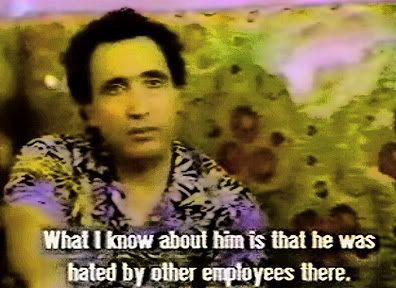
The informant likely grew nervous as his bridges to America became more precarious, his bridges on Malta stood burned, and his bridges back to Libya were threatening. The 1994 film The Maltese Double Cross featured interviews with both accused, who indeed knew Giaka, at least in passing. Megrahi confirmed he did security work there, and “he was hated by other employees there.” Fhimah added “He behaved badly towards the employees working with us, in dealing with passengers. The Maltese airport authorities know this.” [MDC 1:28:10-1:31:28] Some bias might be expected of course, but others interviewed for the film vouched that he was irresponsible, a partier and amasser of debts. And he wasn’t going to be getting any more popular trying to sell intelligence to the CIA.

One anonymous Libyan related for the film how Giaka was put up for transfer at some point: “they asked him to return back to Libya because his contract finished, for his staying in Malta.” Apparently desperate to maintain his situation there and his possible ticket away from Libya, Giaka asked the CIA to pay for a surgery to injure his arm so he wouldn’t be called away to serve in the Libyan Army. [Foot] They apparently consented and “after a few days,” the anomymous source said “[Giaka] came here after the hotel and he had a plaster on his hand” which he said was from falling down the stairs. This seemed to help him “get an extension of around three or four months to stay here.” [MDC 1:31:15]

By 1991, the regular cables were describing P/1 as “a shattered person” who “does not want to be part of the security apparatus and is certainly milking any of his contacts, including us, for whatever he can get.” [NYT] The Americans were ready to milk back - the fruit was ripe and dripping with urgent ‘get-me-outta-here’ intel possibilities. Perhaps realizing that Giaka really was the best they were going to get, the decision was made by July 11, when the Department of Justice told Mr. Giaka they would “accept or reject him" as a witness "based on his response to their Inquiries,” which would be done at leisure within the United States. The very next day, Foot writes,
“Giaka, to his intense gratification, was taken off Malta by an American warship, and interrogated there by an FBI officer, Hal Hendershot. Before long he was safe in the US where he was later joined by his wife. He was paid a regular salary in exchange for constant interrogations by the CIA and the FBI. What he told them plainly satisfied them. In October, in conditions of great secrecy, he gave evidence to a US Grand Jury. The result, in November 1991, was a detailed indictment charging Megrahi and Fhimah with murder by planting a bomb in a suitcase on a flight from Malta to Frankfurt and thence to London – and the explosion over Lockerbie.” [Foot]
The World Dances to the Fantasist Tune (Played Real Loud) The United States government for this point forward until now, without interruption, has accepted the core of this indictment as unassailable truth. The findings of Libyan guilt via al Megrahi and Fhhimah and others not named, the findings found primarily in Giaka’s words, has been the basis of economic sanction, diplomatic pressures, approval of clandestine operations, public vilification of Libya allowing more of the same to pass, and so on.

Most of the world was rather surprised at the turn of events, running counter to all the old evidence that made more sense and involved no Libyans. And was, of course, highly inconvenient for the Americans. Naturally, suspicions of cover-up flourished, especially in the UK. This was primarily channeled into an intriguing “CIA drug-running” cluster of theories (which this author considers a huge distraction) that got its biggest boost with an April 1992 cover story in Time magazine.

A Department of State press release from the same month sought to counter growing confusion at home and abroad by calmly laying out the facts in a press release. The Suitcase itself, fairly non-descript and not directly accounted for anywhere in the luggage records of three airports, was prime evidence at the time, thanks to Giaka’s incredible contributions.
“Forensic analysis has identified the bag that contained the Pan Am 103 bomb as a brown, hard-sided Samsonite suitcase. The following evidence links Al-Megrahi and Fhimah to the suitcase: -- Al-Megrahi, traveling in alias, arrived in Valletta with Fhimah from Libya on the evening of 20 December 1988--the day before the bombing. Fhimah, the former manager of the LAA office in Valletta, retained full access to the airport. Al-Megrahi and Fhimah brought a large, brown hard-sided Samsonite suitcase with them into Malta on that occasion. [DoS]
They make it sound like the Fact they had such a suitcase is evidence they planted the bomb, but in reality, Giaka’s intelligence was the only evidence they had such a suitcase. This emerges chronologically, below. That his stories wound up matching the emerging evidence at the scene is highly troubling – the similarities are from neither truth (as we’ll see) nor likely from coincidence. It seems Mr P/1 served as a two-way intelligence conduit - milking the CIA so they could re-milk him – helping them launder propaganda into intelligence and, via FBI acceptance of that, into evidence ready for trial.


The top man who promoted Giaka as evidence, and the most likely to be fully aware of such unethical activities, would have been Vincent Cannistraro, senior director of the CIA’s own Lockerbie investigation until October 1990 [Ashton] . He continued promoting the story line he'd helped write in the years between indictment and trial. For a 1995 BBC program, he described the case modestly as:
“… overwhelming … conclusive … tremendous amount of evidence … mind boggling amount of detail … that will allow the prosecutors to present the chronology of the operation from its very inception … describe and in almost excruciating detail exactly how they made the bomb, how they secreted it, how they got it on board the aircraft, and I think that's a fairly strong case.” [FS]
His favorite part that he singled out for emphasis in that interview was “they have a live witness for one thing, who would be presented in a court of law.” [FS] Cannistraro bravely spoke to The Maltese Double Cross, again pimping Giaka, just not yet by name: “a former member of the Libyan Intelligence Service who has defected” into Justice Department witness protection, “so he would be used in a trial of Fhimah and Megrahi.” [MDC, 1:28:25]

Such a trial was demanded, in the US or Scotland, based the much-hyped amazing case. The demand was repeated often, and with force, befitting a mighty nation’s drive for truth and justice for the 270 dead. Faced with such confidence, people and whole nations started falling for it. Those comprising the UN Security Council at the moment, in particular, were collectively convinced enough to enforce the indictment with sanctions.

In 1992 and 1993, Security Council resolutions 748 and 883 imposed and tightened embargoes, diplomatic restrictions, and various other punishments. Aircraft equipment and supplies in particular were squeezed on, putting al Megrahi to work on the gray market (the likely cause behind his "suspicious" Zurich office and Swiss bank account). It was under this prolonged duress that Libya eventually relented to a compromise solution. By late 1998 the framework of a trial was established, and in April 1999 the accused were flown to the special Scottish court in neutral Netherlands. Megrahi and Fhimah were arrested at “Camp Zeist” and set to await their trial. Sanctions were immediately suspended, under threat of re-enforcement.

All this was based on an alarming mass acceptance of the American/Scottish case, in turn largely built up on “accepting” Giaka’s intelligence as evidence. The suspects, the suitcase, the materials, the plans, and the evil behind the Pan Am 103 plot were all attested to by a desperate defector, in trade for a steady paycheck, a maimed hand, and a new life in America. It had all wowed the grand jury and secured the indictment, but now that Cannistraro’s dares had paid off, it would be challenged for once, and before the whole world at that. At stake were these claims, in "job resume" format. Most of these were unknown to the public at the time, but about to see the light of day:

 - Giaka’s own credentials/authority: JSO agent, high-level, secret files department – related to former King Idriss - hates Gaddafi - aware of Masonic plots between Libya and Malta.

 - Has a long-standing friendship with Ezzadin Hinshiri, director of the central security section, JSO (allegedly involved in buying the MST-13 timers as used in the bombing, including an order placed for 40 more just two days before the bombing!)

 - Long-standing friendship with Said Rashid, head of the operations section, JSO (also involved, allegedly, in timer acquisition and other wickedness)

 - Acquaintance with Abdullah Senussi, the head of operations administration for the JSO. (convicted in absentia in 1989 for using that role to blow up an airplane (not 103). Also, Gaddafi's brother-in-law.)

 – Can describe the high-level JSO connections of the accused – worked directly under the first accused – hated his boss - can testify to their movements at the airport – able to read clues from them, ranging from subtle to fictitious, revealing their plot.

 - Was asked by Said Rashid, in 1986, to write a report on whether a bomb cold be put on a British plane - had someone else look, who said yeah so he wrote the report saying so. The upper levels mulled the idea over...

 - Turned said report in via his boss, “Lockerbie bomber” Megrahi, who definitely saw it. Megrahi later mentioned the idea back to Giaka and said “don’t rush things.”

 - Can testify to Fhimah’s personal handling of explosives, in his desk, which were overseen by Megrahi, for the JSO.

 - Was invited to the final plotters’ meeting as Megrahi and Fhimah met at Luqa airport on the day of the Lockerbie bombing, with a suitcase just like the one that would do that explosion hours later, after having come in from Malta (other evidence covered that, obviously). That’s the clincher for sure.

 - Has defected safely from the murderous regime, after a grueling three-year initiation, and can therefore finally reveal the secrets he held of the devious, random, and surprisingly unselfconscious scheming that climaxed five miles above Scotland four days before Christmas. That - is - evil. Thank God they've got a witness who saw it all, ready to go before the judges...
 ---
Sources: [Ashton] http://www.copi.com/articles/lockerbie.html [CF] "The Conspiracy Files: Lockerbie." Prod/Dir Guy Smith, Ex Prod Sam Anstiss, Narr Caroline Catz. BBC Two. First Aired 31 August 2008. http://video.google.com/videoplay?docid=-327765978162851498&hl=en# [Foot] Foot, Paul, Lockerbie: Flight From Justice. Published 2000 by Private Eye. https://secure2.subscribeonline.co.uk/PEYE/digital_downloads.cfm [FS] Frontline Scotland: "Silence Over Lockerbie" Reporter: Shelley JofreProducer: Murdoch Rodgers. Aired 1995. Transcript accessed at: http://plane-truth.com/Aoude/geocities/silence.html [LTBU 8/29] Connelly, Clare. "Controversy Over CIA Cables Continues." 29 August 2000. Lockerbie Trial Briefing Unit. .doc link: http://www.gla.ac.uk/media/media_78571_en.doc [MDC] The Maltese Double Cross. Produced, written, and directed by Allan Francovich, Hemar Enterprises, November 1994. http://video.google.com/videoplay?docid=7160854996287567609&ei=EAtQS8iUNYOYqQPjnaka&q=Maltese+Double+Cross+&hl=en [Marquise] Marquise, Richard. SCOTBOM: Evidence and the Lockerbie Investigation, Algora Publishing. Sept. 1, 2006. 268 pages. http://books.google.com/books?id=JKLT360G_zAC&pg=PA119&lpg=PA119&dq=Marquise+SCOTBOM&source=bl&ots=WGsIBNTRDo&sig=ZkD5iwHr [NYT] McNeil, Donald, Jr. “Defense in Lockerbie Trial Undermines a Key Witness.” New York Times. September 28, 2000. Accessed at: http://plane-truth.com/Documents/Defense%20in%20Lockerbie%20Trial%20Undermines%20a%20Key%20Witness.htm

"Ramzi Diab"

Posted April 5 2010

Role in the Bomb Plot
Ramzi Diab, as he’s known and called herein, is actually an alias for Salah Kwikas [1], born 24 Sept. 1959, Nazareth [2], and in 1988 a terrorist connected to the Popular Front for the Liberation of Palestine, General Command (PFLP-GC). Diab was one of over 1,000 Palestinian prisoners released in exchange for three Israelis in 1985 - an agreement negotiated by PFLP-GC veteran Hafez Dalkamouni. [3] In the fall of 1988, he converged with other GC players, under Dalkamouni’s leadership, in Neuss and Frankfurt West Germany for the plot to destroy American airliners with altimeter bombs.

David Leppard writes how cell ringleader Dalkamouni, after his arrest, told BKA police “he was given the second Toshiba on about 18 October by a man called Ramzi Diab in Frankfurt. It also contained two pressure boxes, two clocks and two platinum plates. Diab, Dalkamouni said, was a member of the military section of the PFLP-GC.” [4] Ludwig DeBraeckeleer writes that on October 22, the day Khreesat started his bomb-making work with that radio and four other units, “Dalkamoni and Khreesat travel to Frankfurt […] At 2pm, they meet Ramzi Diab,” for uncertain reasons. [5] The same author notes the earlier meeting, October 18 at 5:10 PM.
In his early thirties, Diab is a member of Jibril PFLP-GC. After their meeting, Diab left in a car that belongs to Bassam Radi, a member of Adnan Younis terrorist cell. Younis, aka Abu Tarek, is also a member of the PFLP-GC. [6]
Dalkamouni later identified Diab as “a key player in the Lockerbie operation,” wrote Emerson and Duffy. “a courier of some of the bomb-making materials.” [7] Two witnesses, Diab’s flatmate Angelika Berner and his “German instructor, a kindly man named German Hoch” recalled a trip to Vienna Austria that Diab said he took in about mid-October. Both later told Emerson and Duffy that the BKA left them with a feeling Diab was thought to have “transported … the materials … to make the bombs,” or “transported the explosive material … of the type that exploded at Lockerbie.” [8]

Arrest, Release, Flight
When the mass arrests happened on October 26, Ramzi Diab was found at his house on Querstrasse 4, Frankfort-Main. [9] His documents were deemed fake, and there was no information on his arrest report other than birthdate. [10] “Under questioning by the BKA, Diab adamantly denied knowing Dalkamouni or being a member of the PFLP-GC,” wrote Emerson and Duffy in 1990. He then recalled meeting the boss, in passing, when presented with photos of him with Dalkamouni. [11]

He was released the very next day, along with most of those hauled in, for “lack of evidence.” The guns and bombs and any plots were all decided to be on Dalkamouni, Khreesat, and Ghadanfar alone. Like so many others, he fled upon release; Leppard cited a later BKA report that Diab “left the Federal Republic of Germany a few days after being released, present whereabouts unknown, possibly Austria.” [12]

This flight was probably guessed from the stories of Diab’s acquaintances Berner and Hoch, testifying to an earlier trip thataway. “One witness, a student called German Hock,” Leppard fumbled, “said he had seen Diab leaving Frankfurt on a train to Vienna. Under his arm was a Toshiba radio.” [13] That’s rather a twist, and unclear if this was the pre-arrest trip or his flight after. At trial, BKA officer Anton Van Treek was asked “when [Diab] was released, was he in possession of a radio/cassette recorder?” and responded simply “I am unable to say anything on that.” [14] The transcripts also offer a full list of October 26 arrestees, including Diab, released the following day, and, interestingly, his teacher friend German Hoch was among those hauled in, also released on the 27th. [15]

Diab is sometimes cited as the man who brought in one radio for modification and slipped away with one armed – both tasks also attributed to “Abu Elias.” An anonymous online comment says “one of Khreesat's bombs however, had been smuggled out of the West German apartment by the PFLP-GC terrorist Ramzi Diab.” [16] In his 1989 series of articles in the Sunday Times, David Leppard explained that the missing fifth bomb made by Khreesat “was smuggled to Malta by a known PFLP-GC terrorist called Ramzi Diab, and handed over to a Palestinian cell there.” [17] This whole theory died in its infancy, but not before spawning a TV movie.

Wherever he got away to and whatever with, as Emerson and Duffy wrote in early 1990 “Lockerbie investigators would like to find Diab, but they have been unable to do so.” But he wasn’t universally considered a villain; “some senior officials” had suspected that Diab called in the BKA raid, and “the Germans were told by Diab’s handlers that everything was under control” with the one bomb seized. “If Ramzi Diab was the second informant, as some investigators believe, he may not have known about Khreesat’s other four bombs, and if that is so, German authorities would would have been using Diab’s partial truth to confirm Khreesat’s wholesale lie.” [18] Further, the writers mused:
“For whom was Diab really working? Again, as with Marwan Khreesat, American investigators are not sure. Some believe that he had convinced the Germans that he was genuinely working for them. Others believe he may have been an informant for Israel. Some intelligence officials believe that, in an even stranger twist, there were Syrian informants in or connected to Dalkamouni’s network … just in case [Jibril] was not as forthcoming as he had promised.”[19]
David Leppard’s slightly later work On the Trail of Terror stated “the CIA had discovered that the other ‘mole’ inside Dalkamouni’s cell was Ramzi Diab.” The Agency, via lead investigator Vincent Cannistraro, believed Diab may have secured Khreesat’s fifth bomb and “may have taken it back to Syria.” It didn’t go well if so - on his return, Leppard writes, “Jibril is understood to have held a tribunal: he wanted to know how the BKA had managed so comprehensively to wind up his European network” Though Dalkamouni blamed Khreesat, “Jibril drew his own conclusions. Ramzi Diab was executed shortly afterwards.” [20] DeBraeckeleer says “the tribunal established that Diab was a mole for the MOSSAD.” [21] It was after this execution, Cannistraro told Leppard, that Jibril contracted with the Libyans to finish the job. [22]
---

Sources:
[1, 3, 10, 11] Emerson and Duffy. pp 134-135
[2, 4, 9] Leppard, David. pp 10-11
[5] De Breackeleer, Ludwig. “Abu Elias Arrives in Germany: Diary of a Vengeance Foretold, part 112.” Canada Free Press. October 22 2008. http://www.canadafreepress.com/index.php/article/6194
[6] De Breackeleer, Ludwig. “What a Tragedy, What A Mess… Diary of a Vengeance Foretold, part 108.” Canada Free Press. October 18 2008.
[7] Emerson and Duffy p 262
[8] E+D pp 209-211
[12, 13] Leppard 13
[14] Day 76, p 8718
[15] p 9358
[16] http://scotlandonsunday.scotsman.com/ViewArticle.aspx?articleid=3298349
comment 29.
[17] Foot, p 6
[18, 19] Emerson and Duffy p 262
[20, 22] Leppard pp 211-212
[21] PFLP-GC Tribunal Sentences Ramzi Diab to death. Part 124 – NOVEMBER 3 1988
http://canadafreepress.com/index.php/article/6746

Iranian vs. Libyan Role in the Lockerbie Bombing

(incomplete)

Critical Americans Speak in Whispers
Now-famous retired CIA guy Robert Baer is one who's always suspected Iranian involvement, with little if any help from Libya. Alan Gerson and Jerry Adler's 2001 book The Price of Terror mentions a meeting Baer had with PA103 families leader Victoria Cummock, in which he expressed his concern that Iran's role was minimized. Cummock, who lost her husband in the boombing, told the book:
"He voiced what Paul Hudson and I had been saying to each other all thhrough the end of 1990 and into 1991. We were getting the State Department briefings, and we both noticed there was less and less in them about Syria and the Iranians. Then we stopped hearing anything about them." [p 91]
This was all just "intelligence," as Marquise would call it, and "whispers" per Gerson and Adler, easily trumped by "evidence." This would seem so, but the intelligence was good and had some evidence of its own, and the evidence that replaced it pointing to Libya (alone or at all) is rotten down the line.

Official Takes
John Biewen and/or Ian ferguson wrote in 2000:
"Nonetheless, Cannistraro says he is persuaded that the Libyans are guilty. He says Qadhafi's government was in touch with the PFLP-GC and had, in fact, subsidized the group. But Cannistraro says he's convinced Qadhafi's men were hired to finish the Pan Am bombing only after the West German police broke up the PFLP-GC's operation. "I do think the Libyans carried it out. But I believe more it was a hand-off from the PFLP-GC after their own operational cell was compromised."

So, who conspired to bomb Pan Am 103? Iran, Syria, the PFLP-GC, or the Libyans? Cannistraro's answer is: maybe all of the above."
[1]

Alan Gerson and Jerry Adler, The Price of Terror, 2001:
"The French claimed to have information that both the UTA [772] and Pan Am [103] bombings were decided on at a meeting in Tripoli in September 1988. If true, that would tend to exonerate Jibril and Iran in the Pan Am bombing, because it implies Libya was planning the attack even before the PFLP-GC cell in Germany was rounded up; Jibril would have had no reason to hand off the job to the Libyans until after the arrests, in October. But American investigators never confirmed this September meeting." [p 98]

See also: Libya's "Admissions of Guilt" including a strong dose of Iranian initiative and the same motive. Cited there, an alleged confession by Gaddafi to an American journalist saying in part:
"We knew it would be comparable retaliation for the Iranian Airbus, but we were not told what the specific objective was [...] If we had initiated the plot, we would have made sure the accusing finger was pointed in the other direction and we would have picked Cyprus, not Malta, where some of the organization was done. The others picked Malta presumably to frame us." - Moammar Gaddafi, attributed by Arnaud de Borchgrave, Summer 1993 [2]

Biewen and Ferguson:
"But the Lockerbie indictment of 1991 pointed the finger only at the Libyans. In a comment shortly after the indictment, President Bush explicitly exonerated Damascus. "The Syrians took a bum rap on this," Bush said."
International Herald Tribune, Jan 13 1994
[see also Gerson and Adler, p 92]
"Libya Still Only Suspect in Bombing
LONDON (AP)


There is no evidence that any country other than Libya was involved in the bombing of a Pan Am jumbo jet over Scotland in 1988, but the inquiry into the matter remains open, Prime Minister John Major said Wednesday.

Mr. Major was asked in the House of Commons about reports suggesting that Syria and Iran might have been involved in the bombing, which killed all 259 people on board the New York-bound flight and 11 people on the ground in Lockerbie, Scotland.

Britain and the United States have named two Libyans as suspects in the bombing, and the United Nations has imposed sanctions against Libya because it has refused to extradite the suspects."
[3]
"Robert Mueller, U.S. Assistant Attorney General] We have no evidence to implicate another country in this disaster.
[Douglas Hurd, British Foreign Secretary] I understand the investigation has revealed no evidence to support suggestions of involvement by any other countries."
[4]
6 March 1995: Mr. Douglas Hogg: "The Lockerbie investigators have given exhaustive consideration to all information relevant to the Lockerbie bombing. The possible involvement by nationals of a number of countries has been very closely investigated. Despite the unprecedented scale of the investigation, the available evidence does not support charges against the nationals of any country besides Libya. But the investigation remains open and any relevant new information will be considered." [5]
---
Sources:
[1] Biewen, John and Ian Ferguson. "Mass Murder Over Scotland." Shadow over Lockerie series. American Radio Works, 2000.
http://americanradioworks.publicradio.org/features/lockerbie/story/printable_story.html
[2]
[3] http://www.psychedelic-library.org/lockerbie.htm
[4] http://www.american-buddha.com/francovich.maltesetran.htm
[5] http://www.publications.parliament.uk/pa/cm199495/cmhansrd/1995-03-06/Writtens-1.html