The Soft, Blue and Maroon Case
Below is a screen capture from al Jazeera's new video, of a severely blasted suitcase, gathered back together for investigator's cameras following the bombing of PA103. This piece of luggage was listed in the examination notes of Dr. Hayes as item 4.2.14, a blue soft-shell American Tourister case.

I recognized the photo even without a label from the description given of the unique remains in the trial transcripts, and the readable item numbers support that call. This case had always sounded supremely blast-damaged and largely unaccounted-for, and this elusive photograph 76 shows about what I expected, if even more so. The examination notes (culled as read-back from transcripts) explain:
The case had been supported by a simple wire frame, with flexible plastic of blue, maroon, and black filling it in the body and trim. TSH/346 is the large piece wrapping around the outside, essentially the whole middle band of the case. It was said to have been blasted at least partly into the neighboring container, AVN 7511, along with some pieces of the container and of the primary suitcase."The following 27 items, the larger fragments of which are collectively shown in photograph 76, were identified as component parts of a blue American Tourister brand softshell suitcase. The severe overall damage to the identified component parts is consistent with this suitcase having been located in contact with the suitcase that contained the improvised explosive device at the moment of explosion."
There are only about ten further pieces not shown, all very small. As can be seen, the majority of that base material didn't turn up, left in the tiniest tatters lost to wind, sea, and mud if not to the fireball of the explosion itself.
The Hard, Antique Copper One
 Here, at left, is what was assembled and called the primary suitcase. It was a different type entirely, a brown or antique copper colored hard-shell Samsonite, Silhouette 4000 series. Given in the report as luggage item 4.1.2, its remains were described thus:
The following 56 items were examined and identified as the component parts of one of the hardshell Samsonite brand suitcases from the Silhouette 4000 range. It was also established beyond any doubt that this item of luggage had been subjected to a violent internal explosion and thus had originally contained an improvised explosive device. Except where noted, all of the items examined below are collectively shown in photograph 49.The bolded part is the one I here contend. Very similar damage, considering the material differences, had the American Tourister declared as just beneath the bomb. Here, Hayes seems a little too certain for comfort that this extremely splintered suitcase was wrapped around the explosion itself.
As with the other case, the pieces not shown are the smallest ones, especially the many fragments of the cardboard divider from the middle of the suitcase, closest to the alleged bomb (PT/68 in the lower corner is the one sample of that shown).
The delicate suitcase lining fabric not much further away is represented by one nearly-complete side of the stuff - the giant 22-inch PK/1310A, stretched across the middle of the photo. The combined effect of this gauze, the surviving cardboard, and the other very large fragments of shell plastic, is that this case experienced a very asymmetrical blast involvement, with one whole side - and even the middle, it seems - shielded by something - like the upper half of the case and half the primary case and its contents above that.
Among this possible lower half, PI/911 in the upper left is nearly a foot square, and at one point (January 1989) Dr. Thomas Hayes of RARDE had concluded it was from was from "the lower side of a suitcase, compressed and fractured in a manner suggesting it was in contact with a luggage pallet's base and subjected to explosive forces from above." This means beneath the bomb suitcase, which was on level two and blasted from within, not above. (see: the Monster of Newcastelton Forest)
That opinion changed at some uncertain later point - by the time of the final report in 1990, PI/911 was said to have flecks of blue plastic stuck to it, suggesting it had rested on the American Tourister, not the container's floor.
Two Brown Hard-Shells?
This all has direct relevance to the story of John Bedford, the luggage loader at Heathrow now famous for seeing and reporting a brown hard-shell Samsonite case - or perhaps two - inside the container's lower corner. In part, he told police in January 1989:
“They were [both] hard cases, the type Samsonite make. One was brown in color and the other one, if it wasn't the same color, it was similar.”No passengers on Flight 103 carried any such luggage and only the one shown above was recovered after. Yet here is at least one, and possibly two, such cases confirmed in the container before a second or third such case came in from Malta on the German feeder. This was around two hours after Bedford's sighting, and officially, it was set on top of the Coyle case, in the same exact spot the Bedford bag(s) just vanished from, never to be seen again. Officially, that's what happened.
If he described two cases of the same exact color and style, where did the other one go when only the remains of one turned up?
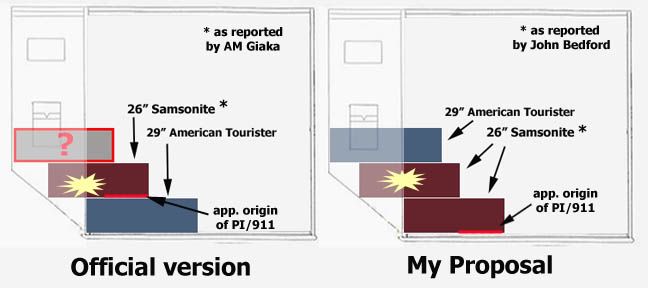
I had backed off a bit on the idea of two matching cases, for the sake of simplicity. But this new image of suitcase 4.2.14 changes things, showing me that both of the suitcases in question are comparable for extreme damage. Below I've placed both images, fragments in silhouette, side-by-side to approximately the same scale. Seeing them together like this, it's hardly obvious the left one is the most obliterated. Soft-shell vs. hard-shell construction will give different results, and the total number of recovered fragments - 56 compared to 27 - suggests that, in fact, more of Ms. Coyle's less durable case material was lost to the explosion and the elements than were lost from the primary case that should have seen by far the worst of it.
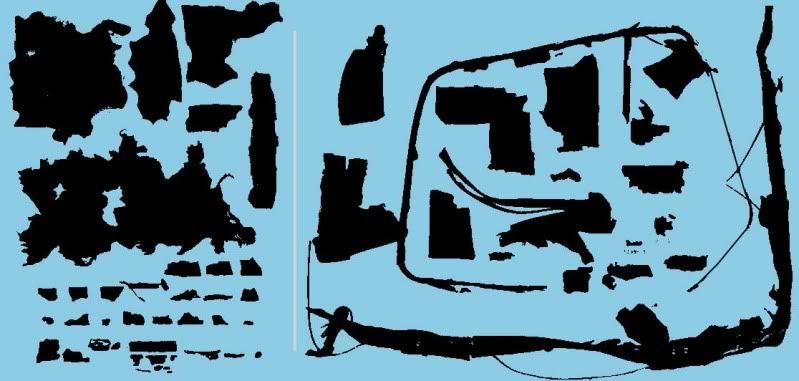
Really, seeing this image re-affirms to me the idea that these are both cases that had been situated next to the primary one, which was presumably the other Bedford suitcase, worse off yet - gone into dust, along with everything in it. This would mean the clothes, the bomb radio, timer, umbrella, everything deemed to be from the primary case, were either from one of the neighboring cases, or were planted. Considering how neatly they pointed to Libya and Megrahi, and how plagued they are with plausibility issues and handling anomalies, I'm going with planted.