Showing posts with label Air Malta. Show all posts

Primary Evidence: Frankfurt Airport Records

First Posted 20 January 2010
last edits June 25, 2011


The System
[Analysis by Caustic Logic, based on wide but uncited skimming - may not be 100% accurate, but intended only to help understand the records below]

Frankfurt Airport in 1988 was the busiest air hub in Europe, serving many thousands of flights a day between Europe, the near east, nort Africa, and North America. The baggage handling system in 1988 was both state of the art and sloppy. Its workings can be understood as broken down to two parts, loosely termed outer and inner.

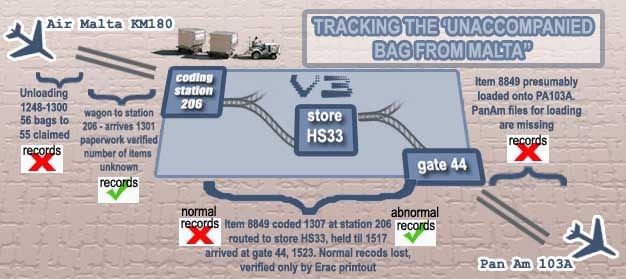
The outer portion was where luggage arrived at and left from the airport - a zone of tarmac and taxiing aircraft, wagons and luggage containers. From the planes, luggage was carted to a coding station, where items were placed on bar-code numbered trays (containers), one item per tray, and fed into the inner portion. Hard paperwork was apparently normally kept for transactions between aircraft and coding stations, both inclusive.

The Zeist Court explained “baggage for most airlines was handled by the airport authority, but PanAm had their own security and baggage handling staff.” Thus the airport and the airline each would then have responsibility for keeping track of their own efforts, and both should be called on in the investigation. The Frankfurt Airport Group would be in charge of unloading KM180, and Pan Am's people would handle loading and screening of luggage coming onto the outbound feeder flight.

The inner portion then is what the Court described as “a computer controlled automated baggage handling system” running beneath the airport. This vast electro-mechanic system automatically routed coded items along roller conveyors and through switching stations, at key spots scanned and logged. This system connected coding stations to the various stores, where luggage circulated until needed, and apparently up to loading gates. After this, they re-emerged topside and then to the connecting aircraft’s hold, where again, a record would be kept of loading procedures.

Primary Evidence
The relevant central computer data was produced, if under questionable circumstances, showing one particular item was coded at 13:07 into container no. 8849. It was then routed down to store for two hours until moved at 15:17 to gate B044, from which 103A loaded before its 16:53 departure. No passenger transferred from the air Malta flight to the PanAm one, so the bag thus illustrated was of the dreaded “unaccompanied” variety.

Apparently, no direct record of PA103A's loading was available to corroborate this. The unloading records for the Air Malta flight (KM180) that bag apparently came from, likewise do not figure in the evidence. And the mammoth central computer file aside from the items sent to 103A is missing without explanation. But the arrival of each flight at the airport, and the coding of one's luggage, were presented, aside from the crucial and curious "Frankfurt printout." Below are all available documents relevant to the claim of an unaccompanied bag, from flight KM180, being sent on to Flight 103A at Frankfurt. These will be given by the "production number" assigned them as evidence during the trial, and briefly explained. All images were originally found at Mebo pages, but seem to be genuine and unaltered. (see "Sources" at end)

Production 1068: The Opinion of the Court's paragraph 29 denotes this for “the evidence of Joachim Koscha, who was one of the managers of the baggage system at Frankfurt in 1988” It was his evidence that established KM180’s arrival and unloading time, 12:48-13:00. They do also cite a “record,” but provided no direct citation.

Production Null: This is the designation – none – given to KM180 unloading papers in the trial. Denis Phipps, former head of security, British Airways, has closely inspected the primary records of different airlines and airports connected to the disaster. He said in The Maltese Double Cross [video, 1994] “the records from Frankfurt were by no means complete." Among his concerns:
“There was no record of who unloaded that flight KM180 when it arrived at Frankfurt. We don't know who the loaders were. There was no record of the number of bags that were actually unloaded from that flight. There were no records that I could find.” 

It isn’t entirely clear if paperwork normally was kept for this – it might have been a policy to determine the number of bags from the computer system, which could count the number of items coded at a certain station and time and take that as the number from the flight coded then. It would be a grossly imperfect system, considering the reliability of this method, as mentioned above. But it would line up with the known laxness of procedure there, and mean one less suspiciously missing record.

Production 1092: This is an “interline writer’s sheet” filled out by Andreas Schreiner, who was in charge of monitoring the arrival of baggage at V3 That bears to record one wagon of baggage from KM180 arriving at V3 at 13:01.Within V3 are seven coding stations, where luggage is placed into bar-code numbered trays to enter bottomside. They cite the sheet’s contents in table form and it seems like they had these records at hand. No number of bags in that wagon is given.
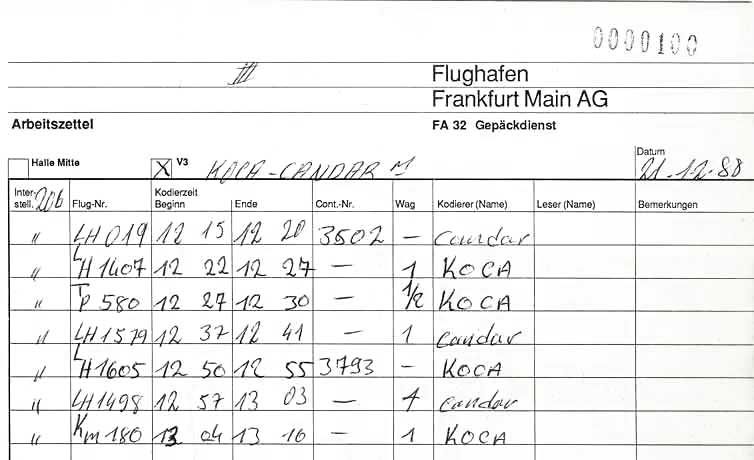
This brings us to the reliability of coding station logs in determining where a particular item really came from. The Zeist judges heard testimony that “luggage was always delivered from one flight only” at any given time." [Opinion of the Court, para 29] Taking this literally would mean a station's log saying flight X was handled from 1:00-1:05 means an item shown in the computer system as coded there at 1:01 is clearly from flight X. 

But this is not completely sound. Dennis Phipps noted the unreliability of these logs in the Maltese Double Cross, and it's been widely noted that lapses of stray bags being inserted during another flight's coding are not only possible but recorded, and common sense itself suggests such a presumption is, at the least, not guaranteed to be right. The degree of correlation between coding time and flight number is certainly higher than zero and less than 100%, and debatable from there. A separate post, Coding Station Reliability, will address this controversy, but generally below it should remain an open question.

Production 1061: This document (above) was identified by witnesses Mr Schreiner and Mr Koscha “as a work sheet completed by a coder to record baggage with which he dealt.” The name of the coder in question was Koca, who was not called as a witness.” Pity, since the document shows us little detail. The signatures alternate Koca and Candar, listing either container numbers or numbers of wagons of luggage, the flight number it’s from, time they started coding, and stop time. The relevant line is the last one – one wagon of luggage from KM180 started coding at 13:04, and ended at a time disputed as 13:10 or 13:16. (13:10 yields a time closer to those previously noted, and it's what the Court decided. The difference is six minutes of time, which could have increased the likelihood of a stray bag being introduced. Again, refer to the post on coding station reliability.

Production 1062: This is the court’s code for some unspecified “documentary evidence” that “the aircraft used for PA103A arrived from Vienna (as flight PA124) and was placed at position 44, from which it left for London at 1653.”
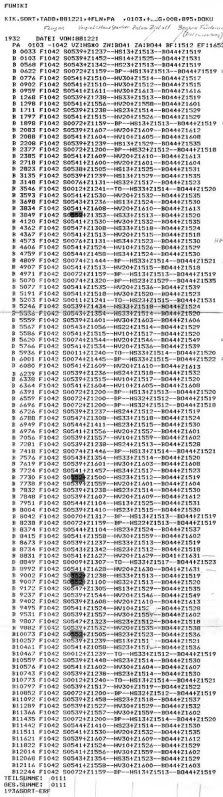
Production 1060 (at left - r-click/new window for readable view) This is the famous computer printout, the single document that allows “the inference," drawn by the Scottish Judges, "that an item which came in on KM180 was transferred to and left on PA103A.” It's a list of items routed to PA103A, taken by airport employee Bogomira Erac for personal reasons and handed over to investigators only a month after the disaster.

It was the first time they'd seen it. What's highly unusual about this evidence is that the German federal police (BKA) were unable to secure their own copy, right off the computer, in the days after the crash. In the end, we had to rely on a memento copy from someone’s locker, which existed only by sheer luck. It was that close to having a whole airport's luggage records go completely missing, right after such a massive event demanded that information. The troubling case of the missing records is worthy of a detailed stand-alone post. Another interesting question is why the BKA then made the official investigators in Scotland and Washington wait another six months before sharing it with them. It wasn't until mid-August 1989 that Scottish police were able to see this pivotal record that wound up turning the investigation around to Malta and thence Libya.

Whatever the book got wrong, Trail of the Octopus is helpful on this issue.
"On 17 August 1989, eight months after the disaster, Chief Detective Superintendent John Orr received from the BKA what was said to be a computer print-out of the baggage-loading list for Pan Am Flight 103A from Frankfurt to London on the afternoon of 21 December 1988. Attached to this were two internal reports, dated 2 February 1989, describing the inquiries that BKA officers had made about the baggage-handling system at the airport. Also provided were two worksheets, one typewritten, the other handwritten, that were said to have been prepared on 21 December by airport workers at key points on the conveyor-belt network." [Coleman/Goddard]

Mrs. Erac' testimony at Camp Zeist in 2000 clarified that the printout was not taken to the BKA until approximately the last week of January, so a 1 February foray is a perfect match for being spurred by the printout. Any records of any earlier efforts, fruitful or not, remain under wraps. Upon getting the papers in August, Orr and his men quickly investigated the airport themselves, and also got more serious about previous clues leading to Malta.

What the printout shows, briefly, is 111 items listed numerically by container number. The relevant portions are highlighted in the condensed version below. PA103A is referred to herein as F1042. The relevant item 8849 was coded at station S0009, which it’s been determined means station 206, at 1307. That is a fit with KM180’s load. It then goes to Gate B044 at 1523, the same few-minute span most of 103's luggage arrived. What happened from there is outside the computerized system and not recorded here. But according to this, two late-coded items were sent to a separate gate B041, and curiously, these two items bracket the apparent bomb bag, numerically speaking, and so are visible below. All 108 items not shown here were sent to gate 44.
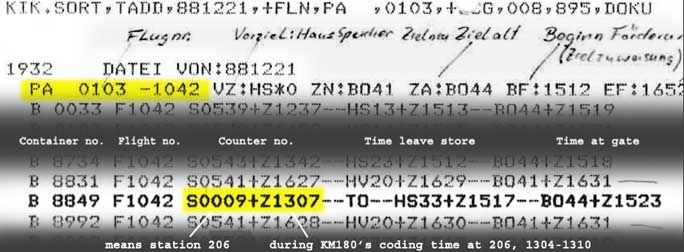
So broadly there are three possibilities:
- If it could be certain that station 209 at 1307 means KM180 and nothing else, this would be solid evidence of a bag from that flight.
- It could have been an item of another origin passing through there at just the right time to appear as from KM180. This does require a certain acceptance of coincidence, but cannot be ignored.
- The data could clearly mean to say KM180, but itself be fraudulent. This would explain the printout's appearance and the primary data's disappearance. Perhaps the two were not really unrelated bad and good luck, but two halves of a bait-and-switch routine, perhaps carried out by the BKA for uncertain reasons.

Production Null: The normal, official, system-wide, right from the computer luggage records.
As has been mentioned, for some reason the primary data of luggage movements was lost, but avoided making a big noise once a copy was luckily found. So it was no loss, we might presume. But how would we know?

There may never be answers to the riddle of the lost computer data, but a dedicated post is warranted to explore what we do and don't know about it.

Production Null: PanAm’s loading records for flight 103A.


---
Sources:
Image: Prod 1092
Image: Prod 1060
(other images by Caustic Logic)
[Coleman/Goddard] TRAIL OF THE OCTOPUS -- FROM BEIRUT TO LOCKERBIE -- INSIDE THE DIA. Chapter 7. Online posting.
[Opinion of the Court] PDF download link

Harry Bell's Eight Reasons

December 27 2010

(Props to "Pete" for bringing this to my attention)

DCI Harry Bell, head Scots police investigator on Malta, made an important entry in his police diary on February 15 1991, the day of Tony Gauci's selection of Abdelbaset al-Megrahi's photo. In it, he says that his boss, Senior Investigating Officer (SIO) Staurt Henderson, "agrees we have a partial identification on the person named Abdelbaset considering all of the circumstances," which he then lists. These eight reasons, in support of Gauci's point, suggested to him that Megrahi was in fact the buyer of the clothes that wound up in the bomb suitcase. [Source: Grounds of Appeal PDF, p 42/43 - unearthed by the Scottish Criminal Cases Review Commission (SCCRC) and supplied to Megrahi's defense]
(1) He arrived in Malta on 7th December '88. This was the date of the purchase of the clothing.
This is a whopper of a point to begin with, considering the date of sale is almost certainly November 23, based on Gauci's best evidence. Tony described a Wednesday a few weeks before the bombing, before the Christmas lights went up, at about 6:50 pm during a light shower, with his brother watching a football game at home. All that fits only one day - November 23, and Megrahi wasn't even on Malta that day.

Even an official Scottish legal review by the SCCRC agreed in 2007 that "there is no reasonable basis in the trial court’s judgment for its conclusion that the purchase [...] took place on 7 December." The judges had accepted it, but that decision has been criticized by serious professionals.

Consider also that in 2006 Bell himself admitted to the SCCRC just how the other date was selected despite the evidence. He ignored the lights and rainfall, focused on the less-conclusive football schedules, and got "confused."
DI Bell SCCRC interview (25-26/7/06)
"...The evidence of the football matches was confusing and in the end we did not manage to bottom it out..."
"...I am asked whether at the time I felt that the evidence of the football matches was strongly indicative of 7th December 1988 as the purchase date. No, I did not. Both dates 23rd Nov & 7th Dec 1988 looked likely."
"It really has to be acknowledged how confusing this all was. No date was signficant for me at the time. Ultimately it was [Megrahi’s] presence on the island on 7th December 1988 that persuaded me that the purchase took place on that date."
[same link as above, p 229]
It wasn't the evidence (no rain all day, different game time, lights glowing across town) but Megrahi's presence that made it the day. If that's not dishonest, it is evidently wrong to then make the circular claim, as Bell did in his diary, that the established date is a separate support for Megrahi's guilt.

(2) He resided at the Holiday Inn Hotel, Sliema, which is within several hundred yards of the shop premises.
Extension of point one. He stayed there on December 7, not the day the clothes were bought.

(3) He travelled to Switzerland on 9th December 1988. He is known to Bollier, the person who supplied the IED timer.
This isn't immediately relevant to the bombing; the trial court dismissed any direct link between Megrahi and the timers. However, Mebo founder Edwin Bollier's acquaintance might be material, in that he was the first person to suggest the CIA should blame Libya, and helped them greatly in brining false charges against al-Megrahi into 1991 (see below). His information then and since is often bizarre and usually unreliable.

While the Lockerbie timer fragment is itself questionable, whether or not DCI Bell should have suspected that at the time is another story. But even if he believed these other clues, it's no excuse for mangling the date of purchase evidence like that.
(4) He was involved in the company known as ABH on behalf of the Libyans. This company was set up to deal with contact with the MEBO company, Mr Bollier's firm.
Same as above. This is an irrelevant extension of a tagential connection that doesn't prove anything about how the bombing was done.
(5) He has a resemblance to the original photo fit and artist's impression.
In the sense they both have faces with two eyes and so on, this is a good point. Otherwise, the resemblance is uncanny in its inability to match up. Five inches too short, 14 years too young, too light, too slight, with a different face and hair, and far away from there when the clothes were bought. Point five is way off mark. If the other clues support the guy, a bad sketch is no problem to ignore - they're well-known to be unreliable. But to actively cite it as a support when nothing else really sticks is deceptive.
(6) ...
We don't know what this point was or why it was apparently redacted.
(7) The SIO advises that Bollier has now been shown the photofit and he states that if the hair was shorter then it would indeed look like Abdelbaset, also if it was 10 to 15 years older.
Strangely, this is exactly the description Gauci gave of the "Czech photo" of Megrahi: 10-15 years older, with shorter hair, and he'd look like the buyer. But this is about the Photofit image, which Tony felt looked like his 50-year-old buyer (see last link). Bollier says "if it was 10 to 15 years older" it would look like the 36-year-old Megrahi. Or perhaps Bell is mixed up here.
(8) The SIO also advises that the photograph we have of Abdelbaset is in fact 12 years old. ...
Confirmation that the photo's dating served in a bait-and-switch operation on the age discrepancy. A 12-year old photo, of a man who'd have to look older by just about that, would make it a fit. But Tony still insisted the man was around 50 at the time of sale, while Megrahi was 36 at that time, so something was twisted out of form here. (That's explained a little better at the "Czech photo" link). Point 8 continues:
He is a smart dresser, plenty of jewellery and there is no recollection of the watch according to Bollier and he is taller than Bollier at 5 foot 9 inches. Gauci thinks 6 foot tall.
These fashion points are obviously weak as evidence, but the part on height is interesting. Gauci is famously short (5'3"), so Bollier is cited as a man also shorter than this tall-ish Arab, at a decent 5,8". Here that's fudged up a modest one inch and stated as taller than someone else, and it perhaps seems reasonable for stubby Tony to recall "Baset" as towering 6 feet up there, or maybe ten feet.

The wording is ambiguous enough, on review, that one who didn't know the subject's true height might conclude that a 5'9" man had reported "Baset" as taller than himself, and another had said Megrahi was six feet tall. That's important when that same man said the buyer, who the police knew could not be Megrahi, was six feet or more in height. That's one of the reasons it can't likely be Megrahi.

And that's all of the reasons he wrote down, except the missing one, and the fact of the "identification" earlier that day. Not encouraging stuff to be finding in police records, is it?

"Take Taggs From Air Malta"

The Case Against Fhimah, part one
May 30 2010

edits June 5

Everyone who accepts Abdelbaset Ali al Megrahi's guilt for the PA103 bombing agrees he couldn't have acted alone. Speculation runs primarily upward to Col. Gaddafi, but also sidewise to his imagined ground level accomplices. Only one was ever clearly fingered, originally as a JSO (Libyan intelligence) operative: Lamin Khalifah Fhimah. It was decided he was working with Libyan Arab Airlines at Malta’s Luqa airport only as cover for his JSO plotting with Megrahi on Malta.

The 1991 indictments against both accused are based on Fhimah penetrating the airport system, up to and including getting the bomb case onto Air Malt flight KM180. As of the 2000 trial, the final Opinion of the Court says, “the Crown no longer suggest that the second accused was a member of the Libyan Intelligence Service,” though his LAA "cover" employment was still acknowledged. Aside from this curious reversal, the Crown maintained a string of “inferences” regarding Fhimah’s December 1988 activity. The Zeist judges considered these claims and rightly dismissed them as “speculation rather than inference.”

These supporting points will be dealt with separately, with this article focused on what the judges called “the principal piece of evidence against [Fhimah],” being the clues read from “two entries in his 1988 diary.” One of these pages is shown below.

It was in April 1991 that Scottish police retrieved Fhimah’s work diary “from the offices of Medtours, a company which had been set up by the second accused and Mr Vassallo.” with the best quote miners around, the investigation managed to glean these two entries, described in the final opinion's paragraph 84:
At the back of the diary there were two pages of numbered notes. The fourteenth item on one page is translated as “Take/collect tags from the airport (Abdulbaset/Abdussalam)”. The word ‘tags’ was written in English, the remainder in Arabic.

On the diary page for 15 December there was an entry, preceded by an asterisk, “Take taggs from Air Malta”, and at the end of that entry in a different coloured ink “OK”. Again the word ‘taggs’ (sic) was in English.
These were taken as a careless plotter jotting down clues of his plot in a diary he kept. He even wrote “tags” in English lettering to make sure the Brits he was targeting could come back and read it easily. The judges explain further:
The Crown maintained that the inference to be drawn from these entries was that the second accused had obtained Air Malta interline tags for the first accused, and that as an airline employee he must have known that the only purpose for which they would be required was to enable an unaccompanied bag to be placed on an aircraft.
The three Scottish judges rightly dismissed the bolded assertion: "it would be going too far to infer that he was necessarily aware that they were to be used for the purpose of blowing up anaircraft." Finally, they summarized their opinion on this evidence and inferences in paragraph 85:
There is no doubt that the second accused did make the entries in the diary to which we have referred. In the context of the explosive device being placed on KM180 at Luqa in a suitcase which must have had attached to it an interline tag to enable it to pass eventually on to PA103, these entries can easily be seen to have a sinister connotation, particularly in the complete absence of any form of explanation.
[…]
Had it been necessary to resolve this matter, we would have found it a difficult problem.
However due to a lack of any single clear outside clue, they could not read much into it. Giaka had stories, but the judges didn’t believe them, and otherwise it was nothing but Crown speculation:
While therefore there may well be a sinister inference to be drawn from the diary entries, we have come to the conclusion that there is insufficient other acceptable evidence to support or confirm such an inference, […] In these circumstances the second accused falls to be acquitted.
If the judges had sufficient clues before forcing them back to consider these entries, it sounds like they could well have accepted his guilt; they cite the entries as fairly suspicious given the “absence of any form of explanation.” But that’s a silly thing to expect – these are quick notes by Fhimah to Fhimah, to access his own brain. Of course he’s not going to explain the background of each note.

But some clues could be gathered by snooping around a bit, as famed reporter Ed Bradley did for a 60 Minutes segment in 1999 [transcript]. After explaining the supposed importance of the diary entries, and covering the lack of evidence for any suspicious suitcase coming from Malta, Bradley returned to those odd entries.
People here who knew Fhimah say he wanted to get his airline’s [Libyan Arab Airlines] baggage tags printed in Malta for less than it cost to print them in Libya. That way he could make a commission on the deal. They say he wanted the Air Malta tags as a sample to show the printer. And there are other notations in this diary that support that story. On December 10th Fhimah wrote “go to the printer.” Another note in the back of the diary says “contact the printer.”
It’s not jotted down right next to his alleged slip-up, but the non-terrorist explanation is to be found. The unusual lettering might suggest he was going to an English-speaking printer on Malta (Maltese and English are the official languages there). This distinct possibility lessens the clarity and importance of the central alleged clue. The other supporting guesses were weaker yet as evidence, and clearly it was no mere technicality that Fhimah was acquitted. There really was “no case to answer” as he plead. A little known fact is that Scots law allows judges three rulings: guilty, not guilty, and not proven (meaning likely guilty but not clear enough to say so). The judges chose the clearer statement “not guilty.”

And if Megrahi’s necessary airside accomplice were truly innocent of the charges, that leaves us with nothing but speculation as to who did assist the bomber. Because Megrahi couldn’t have acted alone, if he acted at all.

Star Witness Giaka

(incomplete - last edit 9 Nov 2010)

Basics and Prosecution Case
It seems the first faint outlines of the Megrahi/Fhimah plot "proven" at Camp Zeist was first sketched out by Libyan defector turned CIA/FBI informant/fabricator. Named Abdul Majid Giaka, he had first made contact with the CIA a few months before Lockerbie, and soon proved useful in pinning the blame on Libya. Giaka entered DoJ witness protection in mid-1991, and his evidence given to a grand jury a few months later sealed the deal for an indictment in mid-November, leading to UN sanctions, more sanctions, and later the Camp Zeist trial and Libya's "admission of responsibility."

There are plenty other sources out there on Giaka, but one of my own can be read here:
A Three-Year Test Drive, Parked 8 Years, and then a High-Speed Crash, pt 1 A detailed article I wrote in January, chronicling his emergence from a CIA informant to FBI witness.
I still haven't done part 2, which would cover his credibility being thrashed at trial in 2000. His own late-appearing fantastical stories and the CIA's embarrasing revealed admissions that they didn't trust him either both contributed to this. Nearly all his testimony was discarded, aside from his identifying Megrahi as an agent of Libya's JSO intelligence agency. The reason given for dismissing the "star witness" are essentially as follows:
"It is also in our view clear that whatever may have been his original reason for defection, his continued association with the American authorities was largely motivated by financial considerations. […] Information provided by a paid informer is always open to the criticism that it may be invented in order to justify payment, and in our view this is a case where such criticism is more than usually justified." [para 42]
And yet they seem to accept he was doing the inventing all on his own, or that no one else on the prosecution side had the same thought and just naively assumed his info was genuine. The judges seem to take in good faith that the Crown and its associates were not farming Giaka for framing Megrahi, and that no "Contempt of Court" had occurred in this probable con operation. The Judges' decision then considered the following evidence of most importance.

- They didn't even know about his $2 million payment from the Department of Justice, covered, along with payments to the Gaucis, in the post Rewards for Injustice, and covered better yet by "Rolfe" in the post Rewards and Bribery.

- The CIA's central role in framing al Megrahi centers on their use of Giaka, an issue explored in the essay "As the layers are peeled away..." The context there is former CIA personnell urging a "narrow" inquiry into Megrahi's release - nothing earlier than that should be looked at at all.

- A further unusual post collects the responses of many to Richard Marquise's lame insistence, in 2010, that Giaka was telling the truth.

VIDEO: Why Lockerbie?/Tragedy of Pan Am 103

Posted by Caustic Logic
(incomplete)

The first I heard about this program was in Allan Frankovich’s 1994 film The Maltese Double Cross: “In 1993, Air Malta wins its libel suit against Granada television. Granada, in a docudrama, had claimed the bomb had been placed in an unaccompanied bag on an Air Malta flight.” [MDC 1:24:45] A fuller explanation, describing its provocative Malta link, can be found in Paul Foot's Lockerbie: The Flight From Justice:
"The programme focused on a bakery in Malta and a Palestinian cell based there. The programme made the same connection as the Sunday Times had done a year earlier – between the fact that the clothes in the bomb suitcase were bought in Malta and the less certain fact that an unaccompanied bag from Malta was loaded onto a Pan Am feeder flight from Frankfurt to London and thence to Pan Am 103. To illustrate this hypothesis, the programme showed a sinister-looking Arab checking in a bag at Malta airport and then sliding surreptitiously away while the plane took off.

This was too much for Air Malta, who sued Granada for libel. Norton Rose, the London commercial solicitors, compiled a huge dossier detailing almost everything about the flight from Malta to Frankfurt on the day of the Lockerbie bombing and proving that all 55 bags checked in on the flight could be ascribed to passengers, none of whom travelled on to London. The evidence was so powerful that Granada settled the action before it got to court. They paid Air Malta £15,000 damages and all the costs of the case. The only time these matters had been tested in a legal action, the Maltese connection to the bomb suitcase was comprehensively demolished."
[Foot p 7]

One should note that the Malta link was not new to this film, but aired a year earlier in the Sunday Times, presumably David Leppard's fabled late-1989 series. From what I hear around, that managed to fuse popular assumptions of guilt and "the old direction" with bits of the emerging Libya narrative, which he would write in book form in 1991. The evidence that had first pointed to Malta was the clothing, discovered during the winter and beyond, and in August the Frankfurt printout pointing there again, followed swiftly by talks with the Gauci family who sold the clothes. Leppard seeded this crucial mental picture - an origin on little old Malta - widely by the end of 1989, and within a year Granada had made a movie version.

On further inspection the program was produced in 1990, jointly, by Granada Television for the ITV network, HBO for America's audiences, and Zweites Deutsches Fernsehen (for German airing?). First screened in UK as TV movie "Why Lockerbie?" 26 November 1990, then in the US by HBO as "The Tragedy of Flight 103: The Inside Story." [source: wikipedia] There is currently a trailer for the the HBO version viewable online (screen caps throughout). External link (too unreliable to embed):
http://www.videodetective.com/titledetails.aspx?PublishedID=18490
Director: Leslie Woodhead
Writer: Michael Eaton
Starring: Ned Beatty as C. Edward Acker, Peter Boyle as Fred Ford, Sean Pertwee as Oliver Koch, Vincent Gardenia as Harry Pizer, Michael Wincott as Ulrich Weber, and Sasson Gabai as then-popularly-suspected bomb-maker Marwan Khreesat. Other featured characters include Ali Akbar Mohteshemi, Hafez Dalkomoni, and Abu Talb. No Libyans are involved. There is a "Maltese shopkeeper," presumably of the bakery Leppard was on about, and not Tony Gauci. Runtime: 86 minutes.
[source: IMDB]

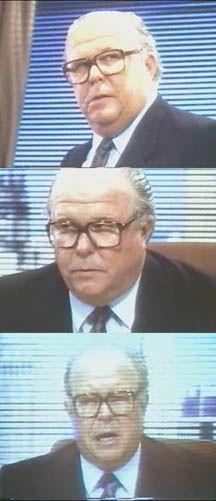
In the trailer, Pan Am CEO C. Edward Acker (Beatty, right) is usually backed with prominent slat blinds (metaphorical? Subtle?) I'm not an expert on Pan Am's history, but it seems Acker ran the company from the early 1980s, apparently on promises of revitalizing it and making it profitable again. He was replaced in early 1988, so only set up the culture of "mismanagement" and "cosmetic" security changes (according to the trailer) leading to their alleged failure at Frankfurt Airport. When guys in suits are the villains, the motive is always money, and no exception here; a drive for profits led to their selective, perhaps criminal, and deeply tragic security blindness.

Some controversy was aired early on about the curious "Helsinki Warning" of early December being buried and somehow missed by Ulrich Weber, Frankfurt Airport Security administrator, until Dec 22. In the film, the narrator explains the response: "Other than screening Finnish passengers, Pan Am's procedures at Frankfurt Airport remained unchanged. There was no briefing of security personnel to update them on threat information." Mr. Weber is further quoted in the film dismissing a larger threat yet, the October discovery of multiple altimeter bomb radios, in existence, in Germany. He's challenged by an underling, Oliver Koch (Pertwee), who is prophetically worried about "that cell and terrorist setup in Neuss. Something about bombs in tape recorders."
"Ulrich Weber: Pan Am didn't expect us to do anything special with that one.
Oliver Koch: I recommend it should be on today's agenda.
Ulrich Weber: You are going beyond your competence, Koch! This is not in your job description!
Oliver Koch: I recommend that we take the batteries off of every single radio cassette player we find, okay?
Ulrich Weber: We tell our people to go loose on the passenger's private property and smash half the things they touch? We'd go broke paying the damage claims.
[...]
Ulrich Weber: Oliver, you've got to lighten up, pal. It's almost Christmas. When all is said and done, air travel is still safer than crossing the road."
[source: IMDB]

Some clips featuring Michael Wincott as Weber were posted on Youtube, by a fan of the actor, apparently. Here, he shows great confidence and a greasy pony tail that usually indicate "confidence artist." He's arrogant, and tragic in his swagger. He should worry more, a lot more... dun dun.... Recall these were real people, then on trial in more ways than one over their culpability in the massive tragedy. That's not to dismiss any failures or malfeasance they were guilty of, but this movie seems like a cheap shot at a target too bogged down trying to survive to fight back like Air Malta did. It doesn't help that this "inside story" chronicles failures at Frankfurt, when the most coherent evidence actually indicates an introduction 400 miles away in London. Ulrich Weber's alleged arrogance and Koch's alleged urgency had nothing to do with the suitcase John Bedford saw.

pt 1 http://www.youtube.com/watch?v=Y63KoLUkTW0
pt 2 http://www.youtube.com/watch?v=tI8HPMbQQuo
pt 3 http://www.youtube.com/watch?v=rV7Z3v0m5U0

Release Timing
The film’s airing in the UK and US in late November and early December 1990 is interesting. As noted above, it helped further ingrain a year-old idea of a Maltese bomb bag slipping through three airports. It was released approximately one year after several lines of questionable intelligence had converged overwhelmingly on Malta in late 1989 – 16 months after the printout showed it as item 8849, 15 months after starting a dialog with Tony Gauci. 12 months after Paul Gauci first changed stories and suggested a December 7 purchase was likely. Six months after Thurman’s identification of a Libyan timer fragment. One year before a formal indictment would be issued of agents not even hinted at in this portrayal.

Also, the release happened to lines up well with the announcement to all international investigators, in the run-up to the second anniversary, that US and UK investigators had decided that Maltese bag was their big lead, and it pointed to Libya, not Syria, not Iran, not any Palestinians. In his 2006 memoir, Marquise writes of an early December 1990 conference (apparently on the 6th?) of investigators in Sweden, bringing Swiss police in for the first time.
“The night before the formal conference, Henderson and I convened the other police officials in a private room above the main dining area. The Swiss were introduced and the new direction of the investigation was discussed. Because the formal agenda had been drawn up in advance, much of it was devoted to the PFLP-GC cell in Germany. However, we had always said evidence would drive the investigation, not speculation. Now the evidence had pointed away from Dalkamouni and his PFLP-GC cell. Everything we saw pointed directly at Libya.” [Marquise, p 73]
The Germans were “relieved,” Marquise recalled, but the Maltese “were not as ready to accept the new scenario,” and “adopted the same philosophy which the Germans had employed for a time.” He writes that the "evidence that “the bomb bag … had originated in Malta ... had not yet been proven to the satisfaction of Maltese officials.” But the next day’s conference went smoothly enough, and “not one word of what was discussed at the meeting was ever leaked to the media, proving that this group of law enforcement officials was trustworthy."

Three days later, however, HBO would re-air half of that new direction, the bag that Maltese authorities still couldn't see even after the first UK airing of Why Lockerbie? just days before the conference. Air Malta would of course take the issue to court as we started out, but Maltese investigators just acquiesced; on December 10, the day after the American re-broadcast in case that matters, "Henderson reported the Maltese were ready to let us back in to work, possibly as soon as December 17." [Marquise, p 73]
---