Showing posts with label Bollier. Show all posts

Explosives Revisionism and "No One Did It" Theories

18 September 2010
last update Feb. 13 2011

I recently asked for help with the contents of this site, soliciting input from the community, and as expected the most interest came from those I'm least inclined to agree with. I'd like to expand the voice of the Divide, but there are some things I just can't bring myself to support with publication here. Where the different theories fall relative to each other and what I accept and why is explained in part here.

Two groups of claims questioning what happened on the plane have become mixed together in my mind and jointly ignored until now. Those who propose a drastically different bomb detonation than alleged took down Flight 103, and those who say it wasn't a detonation at all, but an accident.


Inherently I agree the explosive force as stated is not necessarily correct, although I do suspect it's reasonably close. First, it's not clearly decided anywhere. The Zeist judges wound up taking away a median of 400 grams of Semtex-H, give or take 50, so 350-450. But the Indian Head forensic tests of 1989 found the container damage observed was consistent with the blasts done using between 454-680 grams, and not the lower amounts. There is reason to believe the higher end of that is closer to reality.

And more recently Dr. John Wyatt's unusual tests say that only a blast as low as 150 grams or less might possibly have have left the electonics remains investigators found. And to make PK/689 legitimate evidence, the bomb might have to be more like 20 grams.

I'm not going to argue the bomb was so small it couldn't rupture a suitcase - the clear solution to this is to suspect the poorly fitting evidence was planted poorly. But clearly there is a lot of room for fudging between the intact paper and the ruptured cargo pallet and plane.

As I recall, there are also some genuine-sounding mysteries over residue testing that seemed to suggest a different explosive than Semtex-H (or in addition to?) was responsible. If anyone is excited to explain this a bit better, feel free to do so in the comment section below. I'll try and dredge it up myself if and when time allows.

The rest of this post, however, is stuff just I don't buy. Partly because I don't trust these theories or theorists to get it straight for me, and partly because I don't know the science to be sure myself, I must call these theories worthy of discussion - in the comments section below and nowhere else on my blog (until further notice anyway).

John Parkes on the bomb's power
As reported in Scottish lawyer's magazine the Firm, August 2006.
John Parkes, an explosives engineer present at the crash site in December 1988, who reported damage indicating the carriage of munitions on the plane. Parkes helped in the rescue operation when the Boeing 747 came down on part of the town, killing 259 on board and 11 on the ground. He claims wounding he observed on three bodies recovered from the crash site, and on one young female victim in particular, were not caused by Semtex-based explosives as claimed in the trial.

"Every munitions or explosives device has its own characteristic signature," Parkes says. "The signature I saw was not consistent with the device they maintained was used. There was not enough power or heavy material around that device to have gone through the luggage and floor and through the back of an aircraft seat to inflict these wounds."

[Dr. Jim] Swire has asked the Crown Office to explain why this testimony was not included in the Air Accident Investigation Board report, asking "whether the AAIB gave any reason for rejection of Mr Parkes's ideas, and if so what that reason might have been".

I have great respect for Dr. Swire, but sometimes...

Well, just off the top of my head, Parkes reported the injuries to a girl he felt were consistent only with explosives coming up through her seat, injuring her feet and backside. First, it's unfortunately gruesome and sad as a "smoking gun," and for obvious reasons unverifiable. Second, I'm not convinced Parkes knows what to look for in such an unusual case, and could just be confusing a tree impact after the fall with shrapnel tears from before.

We could check by looking at damage to the floor panels this shrapnel would have to tear through. I had imagined most of this would have been found, perhaps warpedby he overpressure, but not torn up. But according to the AAIB report, many floor beams were fractured and none of the panels in the immediate blast area were recovered (that they admit!). So we can't say one way or the other.
The cabin floor structure was badly disrupted, particularly in the general area above the explosion, where the floor beams had suffered localised upward loading sufficient to fracture them, and the floor panels were missing. Elsewhere, floor beam damage was mainly limited to fractures at the outer ends of the beams and at the centreline, leaving sections of separated floor structure comprising a number of half beams joined together by the Nomex honeycomb floor panels.
Admittedly, that sounds worse than I'd expect, but then again, those beams can't be too solid. Planes rely on lightness, and simple gas over pressure might break up some beams and tear some flooring loose, without ripping through it with shrapnel. To send material tearing up through several filled suitcases, the container top. bay liner, cabin floor, and the seat structure to just stop at injuring this girl - rather than slicing through her - would require a truly massive explosion with supreme control. The focused 20-inch fuselage hole just two feet from the explosion cannot be consistent with such a blast, nor the luggage container or anything in it. I can't buy that's all faked.

Different bomb location
The above theory may also imply a different location even than the missing panels, depending where the girl was seated. I don't think this was ever sorted out, as she was to my knowledge never identified to Parkes.

Then there's temper tantrum Blogger Charles Norrie and his CIA bomb on top of an Iranian one. He cites a statement from Parkes, perhaps reflecting the seating issue above, that "a minimum of two high explosive events took place inboard Pan Am 103." Norrie also points to the twin debris fields, north and south, which could have many explanations in a complex breakup like that of Flight 103,even without another bomb.
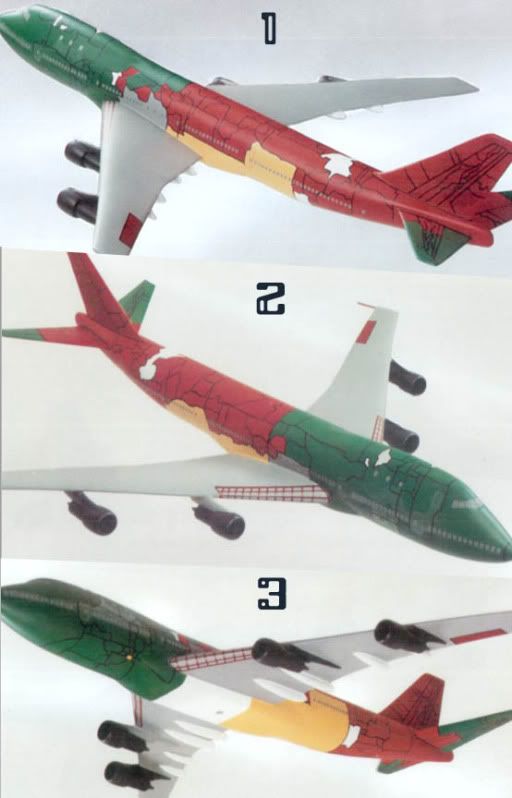
For the location of the second blast, Norrie cites a missing section near the rear cargo area which must have been all vaporized by a "brisant explosion." See the image at left (new window for larger view), of the AAIB's painted model. Those sections coded in white were never recovered. Charles would be referring to the section on the lower rear of the craft (seen in view 3). But many other sections at random spots were missing as well, in at least seven apparent "brisant explosions" all over the plane. For whole panels of aluminum to disappear in Scotland might seem odd, but there are a lot of lochs that maybe weren't fully dredged, and the North Sea's not that far off for high-drag items. Perhaps a few still linger in private collections, bought from enterprising rural Scots.

But more prominently, a number of experty people have made themselves quite sure that mathematics prove the bomb was just a foot away from where it was reported, just outside container AVE4041, rather than inside it. These include onetime AAIB investigator named Protheroe, who now says the "mach stem" effect was calculated wrongly, suggesting 25 inches was between the bomb and the airplane skin. This distance, which fits with the physical evidence of the luggage container, is supposedly trumped by his new numbers saying 12 inches. This would mean the container evidence must be faked to appear the bomb was inside it. It also suggests someone planted the device directly in the plane, rather than remotely in luggage, as generally accepted. No explanation, Just math.

Edwin Bollier started trying to sell Libyan clues to the CIA within days of the bombing, was listed as one of the three important witnesses at Camp Zeist against Megrahi. Now he champions Libya and Megrahi as "wrongly accused," with mostly bogus claims, and he supports Protheroe's 12" revisionism.

I had thought further support could be found from Canadian researcher Ludwig de Breackeleer, but thankfully not, on closer look. Most of his other work on the issue is great, and as a science guy at heart (physics), the contribution he's most qualified for questions the official blast size, which is valid. He concludes, based on actual shown math and presumptions I haven't double-checked:
As the explosion of one pound of SEMTEX H inside the luggage container does not generate a blast wave sufficiently powerful to fracture the skin of the fuselage, we have little choice but to conclude that the verdict appears scientifically implausible.
One pound being about 450 grams, that's the upper edge of what's officially accepted. Dr. Ludwig's science fits with what I already observed at the top - something significantly over that seems a better fit with the most believable physical clues. (though I'd wager not enormously higher - perhaps 150-200% of that). I'm heartened to learn this.

No One Did It
The accident theory has two variations. The first proposes an unintended detonation of military munitions being carried secretly on the plane. This is advanced by one "Robbie the Pict" in the UK.

The other proposes no explosives at all, but a failure-induced decompression, and is advocated by a John Barry Smith in the US and also I believe this was the thesis of Carl Davies, proprietor of the Plane Truth website.

Further commentary for and against these theories can be submitted in the comments form below. Any highlights I feel worthy I may pull up and include in the post.

(more text, links, etc. forthcoming)
---
Update 2/13/11: I have some gripes from Robbie the Pict, which I still need to address re: the above and see if he's got a point. Otherwise, I have to revise my above take on deBraeckeleer. I hear he's been incommunicado for a couple of years now, but I didn't realize that as I tried to e-mail him recently as follows:

Dear. Dr. deBreackeleer,

Greetings. Adam Larson aka Caustic Logic of the Lockerbie Divide here. I've been appreciating your works for quite some time now, especially the interviews and original quotes. Some great work on the Khreesat and Autumn Leaves angles. I've been meaning to get in touch with you, just to see what that might yield.

I'm most interested in where your expert credential are most relevant, with your analysis of the force required to rupture the plane's hull in the first place, as explained in this article: http://www.canadafreepress.com/index.php/article/8920

I have in the apparently misunderstood that article twice now, in two different ways. I just reviewed it again prior to writing, and decided I should just ask you directly what's unclear to me here. The abstract says location is the issue, and that's an issue I have some problems with.

Unfortunately for the stated goal of reaching the masses with simplicty, I have a hard time following it. Positive impulse? Critical time, wavelength, greek letters... Perhaps I should go study up on this, but actually, cutting to the last portion seems adequate for my purposes.
The outside wall of the AVE 4041 container was located at 16 inches from the skin of the plane. At this closest possible distance in the light most favorable to the original investigators, experimental data indicate that one pound of explosive will generate a positive impulse of less than 20 psi-ms against the fuselage. [27]
So from this it seems the force on the skin would be dependent on original power and distance. Correct? The force you've taken is 450 grams, which is the upper end of the range the judges accepted: 400 grams, give or take 50. Since "at this closest possible distance" is the qualifier for the inadequacy.
As this value is well below the critical impulse calculated above, namely 50 psi-ms, we have little choice but to conclude that the Lockerbie verdict is scientifically implausible.
And the AAIB decided on 25" from the hull, not 16, strengthening the point. I'd defer on what I can't verify, and concur in general. But I have a hard time seeing the blast being much closer. The luggage container appears to be blown outward in all regards, and that's one piece of evidence I tend to accept. In fact, I've never seen anyone come out and argue or allege it was faked, even as it's been implied over and over, including by an AAIB scientist himself, no less.

I'm not trying to get you endorse any theory or another, but in your scientific opinion, is it possible that the location is about as reported but the blast force was simply higher than reported? Could a wave emitted from, say, 700 grams (or maybe 900?), but from the AAIB's rough placement well inside the container, make it plausible by these same methods?

I do have some reason from other quarters to suspect the blast weight was fudged way down, in part I surmise to half-explain the manual cover and other - erm - dubious clues. The primary suitcase we've been shown might not be that at all, for one thing...
V—ADDITIONAL COMMENTS
In the immediate aftermath of the tragedy, researchers at the Center for Explosives Technology Research in Socorro, New Mexico, estimated that up to 30 pounds of explosive was needed to destroy a Boeing 747 if the explosion had occurred in the container. [28] We agree with that estimate.
30 pounds? If I could decipher it, I'd ask to see the math on that. Investigators got it wrong by a factor of 30? I would have suspected a factor of maybe 2 or 3, so as to not appear amazingly ridiculous to other scientists like yourself. Did their models have it placed in the relevant spot, or stuffed in the middle of the container, or the upper corner?

Clearly your point here is to suggest that it was not in the luggage container, but isn't that a bit hyperbolic? Maybe unwarranted?

Beyond that, if you're at all inclined after that, I'd be interested in interviewing you by e-mail for my blog. It might increase your profile a bit, give you a few new viewers. I have Slovenian viewers out my ears all of a sudden. And either way, kudos on some very valuable contributions to a worthy field.

Best,

Adam.
---

Rewards for Injustice

A Shocking Trail of Witnesses Paid Millions for Misinformation
July 25 2010
last edits July 30


The early release from Scottish prison of “Lockerbie bomber” Abdelbaset al Megrahi has been getting much airplay and page space the last three weeks. A myth that he might live for decades more, and the “news” that Gulf-despoilers BP (British!) had also lobbied for the “bomber’s” release back in 2007, stuck together for indignorant Americans. This spurred a flurry of commentary and Congressional calls for investigations, summoning foreign CEOs and ministers to explain themselves, as the Brtis say with annoyance, like naughty schoolchildren before the headmaster.

This will surely settle down before long, and amid the furor, one crucial issue will still lie in the dust, unseen by most. And that is the assassination of Megrahi’s hard-won second appeal of conviction. Many informed commentators have been bringing up the appeal in a more recent backlash, but so far It’s hardly even a side note in the US - just a trifle the “bomber” was “allowed to drop” right before going home to live way more than three months.

Three Important Witnesses
And so the appeal’s secrets were buried, for the moment The central point of the surrendered challenge, soon submitted to the court of public opinion, was the reliability and credibility of eyewitness Anthony “Tony” Gauci. The scope of this article will be wider and consider two other witnesses who share three key features with Gauci.

Upon finding Megrahi guilty for the bombing on January 31, 2001, the three judge panel ruling at Camp Zeist issued an 87-page Opinion of the Court (PDF link) to explain their thinking. Among the points in setting up the evidence against Megrahi was this short list:
“In relation to the first accused, there are three important witnesses, Abdul Majid, Edwin Bollier and Tony Gauci.” [paragraph 41]
To those who know enough about the case, that line is itself hilarious, the punch-line to a sick joke. To those who don’t know enough (and that’s who this article is for), it take a little explaining. Besides being the only three with anything truly incriminating to say against Megrahi, each of these has in common two further points:
1) The evidence they provided is questionable in many cases, and unquestionably fraudulent in others.
2) They were all offered (or have said they were offered) millions of dollars, and at least two apparently collected.

“Abdul Majid”
Abdul Majid Giaka (an alias, true name unknown, called ”Abdul Majid” by the Zeist judges) was a Libyan intelligence agent with the JSO, Libya’s CIA. He was very low level and knew almost nothing, but from August 1988 he had been able to draw money from the CIA ($1,000 a month, increased to $1,500) selling them small tidbits. The CIA called Giaka code-name “Puzzle Piece.”

The defector was stationed at Luqa airport on Malta, where the JSO and Libyan Arab Airlines mingled. At some point after Pan Am 103 fell to Earth in December, two of the people he’d named as high JSO agents working on Malta – Megrahi and his “accomplice” Fhimah – came to the center of suspicion. Strange clues emerged suggesting Libyan authorship, and a Malta link that pointed right to Megrahi. By early 1991, the other puzzle pieces (including Gauci and Bollier) were all in place, and they needed a witness closer to the perps.

It seems the Libyans were by then tired of Abdul Majid’s strange behavior on Malta and ready to call him back to Tripoli. The CIA threatened to cut him off and let him go unless he said something good, and if it was good enough, he might say it to the FBI. So in the summer, he met with agent Hal Hendershot and laid down a whole new version of the previous years in which Megrahi and Fhimah had plotted the bombing in the open and he saw half of it himself.

Hendershot liked what he heard, and Giaka went straight to Washington, with his pregnant wife fetched from Malta soon after. He testified to a grand jury in October 1991, telling of the brown Samsonite case he’d seen the Libyans with on December 20, of the report he (Giaka) was asked to write about bombing a “British plane,” the TNT they kept in a desk at the airport…

As the indictments were sealed and put in place on November 14, the defector Giaka was re-settled somewhere under a new name and witness protection, and paid handsomely. Megrahi’s appeal documents reveal, from DCI Harry Bell's diary, January 8 1992: “Bhiel states DOJ (Department of Justice) will give Magid [Giaka] $2 million dollars. Advised of our concern." This seems to have been dispensed under a US DoJ “Rewards for Justice Program."

When the millionaire was presented as the star witness at Camp Zeist in 2000, it was an unprecedented event – the first time a CIA asset had testified in open court (his voice was disguised and he was hidden behind a screen). The judges were not told about the $2 million, but they did know of his CIA paychecks, other arrangements and efforts to secure money, and his relocation to America, which was clearly of immense value to the witness. They noted how Abdul Majid’s best stories about late 1988 only appeared in mid-1991, and learned along the way that the CIA themselves didn’t believe his information, and had tried to conceal that fact. Therefore, they explained, rather timidly:

“Information provided by a paid informer is always open to the criticism that it may be invented in order to justify payment, and in our view this is a case where such criticism is more than usually justified […] we are unable to accept Abdul Majid as a credible and reliable witness on any matter except his description of the organisation of the JSO and the personnel involved there.” [para 42, 43]

This is an embarrassing rebuke - the most crucial witness to the whole Libyan plot was found to be almost entirely a fraud. It was this loss that led to a total lack of Fhimah clues and the judges having to find the “accomplice” not guilty. And then there was the $2 million they didn’t even know about, as the Crown either didn’t know or didn’t pass it on. And Giaka wasn’t the only witness considered at Zeist who was given this princely sum and had the fact successfully concealed.

Tony (and Paul) Gauci
This now-famous refugee shopkeeper from Malta, clearly a man of simple intellect, was able to recall the exact sale (in different exact versions) of some odd clothes that were later “found at Lockerbie.” Anthony Gauci's original performance recalling the sale was convincing enough, and it seems likely, barring a very elaborate set-up, that he really did sell these clothes to some particular man, on November 23 1988, and they wound up in the bomb bag.

But Megrahi was not on the island that day, so the second-best fit of December 7 (a distant second) was chosen by investigators as what the man meant to describe. By “six feet or more in height,” he meant 5’8” like Megrahi. By around 50, he meant 36. By raining enough to warrant an umbrella, he meant no rain. Etc. But Gauci is touted as identifying a photo of Megrahi, on February 1991, as “similar” to the buyer but ”ten years” too young. Even Tony himself noted the obvious slant of the lineup in question. “The first impression I had was that all the photographs were of men younger than the man who bought the clothing.” With the police’s help, he picked the oldest one shown – Megrahi.

Payments to Mr. Gauci, and to his brother Paul, who assisted somehow behind the scenes, are covered in detail elsewhere, but Megrahi’s appeal documents note the earliest American mention of money is from September 28, 1989, just weeks after the brothers were first approached. “The FBI discussed with the Scottish Police an offer of unlimited money to Tony Gauci, with $10,000 being available immediately." It's not clear if any of this ever came through, but as Giaka was being put up for a reward in 1992, the Scottish police lobbied for Tony to get the same. "I also clarified with him about the Gauci reward and the response was only if he gave evidence."

Tony had his chance to give evidence in mid-2000 and he performed well, considering, fudging everything possible. Under 6 feet, under 60, I don't know, raining a little, not really, no, maybe. Mysteriously, the Judges bought it and Megrahi’s fate was sealed.

The day after the verdict, February 1 2001, the Scottish police started the application for the brothers’ rewards – they had realized specific arrangements couldn’t be discussed until after the judgment, had no explicit promises, had delivered well, and deserved their money now. Paul’s assistance upholding his brother’s “resolve” was noted - but so was his evident desire for money. For some reason they had to wait until the appeal was over as well, and only in April 2002 was “a meeting held with the US Department of Justice where the reward was discussed and supported by the FBI,” say the appeal papers. Further, a suggestion was made there “that the sums applied for - $2m for Tony Gauci and $1m for Paul Gauci - could be increased."

The Scottish review board found all this, and that at some time after the appeal (date redacted) the two were paid some amount under the US DoJ "Rewards for Justice" program. And that is why the appeal they authorized had to be killed.

Edwin Bollier
The third witness is a Swiss electronics merchant, supposed supplier to Libyan JSO of the only 20 MST-13 timers ever made. When an implausibly large chunk of one was “found at Lockerbie” and identified in mid-1990, Bollier’s 18-month-old campaign to sell evidence to the CIA paid off. Much of what he said before and during the trial was dismissed as an obvious bunch of rubbish, but the 1991 indictments did feature his info for points (a), (b), and (j).

Bollier is quite different from the other two “important witnesses.” First, he has not disappeared as a protected witness and made silent. Quite the contrary; He has continued to claim a leading role in the fight to clear Megrahi (comments as "ebol"), and claimed in a 2008 interview that this is to secure a $200 million prize from Libya. [Video, 41:10]. Mr. Bollier reminds me (see comments below) the BBC cut out Q: "Will Libya pay you for your work in the Lockerbie case?" A: "No, if we win the case and the compensation for the victims (US$ 2.7 billion) is refunded I will get a success honorary of US$ 200 million." If the victims pay Libya back, Bollier says he gets almost 8%. To this end, he uses illogical or unsupported claims and exclamation marks, and hasn’t even bothered learning to write in English for a campaign this ambitious.

And unlike Giaka and Gauci, there is no evidence I’m aware of that Bollier was ever paid by investigators for his own evidentiary offerings. He does claim a measly 1% of Libya’s later offering, $2 million - was offered to him in January 1991 by a FBI legal attaché in Switzerland named Fanning. This sounds entirely plausible, actually. But in the same interview linked above [33:35], he says FBI chief Richard Marquise personally doubled the offer just a couple weeks later, “up to $4 million and a new identity” merely to say that this fragment was from a Libyan timer. But they already knew this, and he says he refused anyway (Marquise firmly denies this offer).

Bollier’s oddball account isn’t to be trusted, and he hasn’t been. But he’s served a useful role since the conviction, as a lightning rod to safely channel revisionist thought down blind alleys. Someone really should pay him if they haven't yet.

A Tentative Tally
So far it appears the Scots-CIA-FBI Lockerbie witness pipeline brought in all three “important" but unreliable witnesses against Megrahi. The DoJ payout was at least $5 million to Giaka and the Gaucis plus possible money to Bollier that we just don’t know of. There would be administration, manpower, paid dinners, car rentals and air travel, and assorted overhead for arranging all this, some under FBI, others under CIA or Scottish police. All told, we’re dealing with at least $8 million for just this aspect of what seems like an intelligence operation masquerading as a criminal investigation. The whole case was bigger than this but no squarer, and the other, wider costs of the resulting miscarriage of justice will defy all efforts at calculation.

Why Bollier Suspected the Libyans

The MEBO Files, part 2
July 4 2010
last updates/edits July 10


In the early 1990s, long before he came out of the closet as a Libya-Megrahi supporter with reams of accusations against Scots-American investigators, Swiss merchant Edwin Bollier sneakily told these same authorities that he actually believed the Libyans were behind the bombing. Now, he had said just that in early 1989 with his semi-famous “catch-letter,” but that was only because a shadowy CIA man had told him to do it.

But his continuing charade, as he explains his helpful phase, went beyond the terms behind that note and raises questions. For example, was it the same agent’s nefarious demands each time he spoke up, or was there a whole team steering the poor man towards implicating Libya? Or was he, as the rest of this article presumes, more self-motivated than all that?

In a January 14 1991 interview with the FBI and Swiss authorities, Bollier said he had written that letter two years earlier to get the investigators “away from the wrong track and to bring them onto the Libyan track." It goes beyond giving the mystery man what he demanded; Bollier says (up to 2000 anyway) that on Jan 5 he himself felt that Libya was the right track to investigate.

Something Was Going On
It was a gut-feeling Swiss suspicion, or “Swisspicion” as it will now be called, that prompted a phone call to his acquaintance Abdelbaset al Megrahi, somewhere around Christmas (see below). He was driven partly by an odd “impression that something was going on,” he recalled at trial a decade later, and cited two powerful clues while apparently meaning to cite only one. “[W]hen this mystery man came along -- or when I found that the timer had been programmed, we ourselves,” meaning he and Mebo co-founder Erwin Meister, “believed that the Libyans were involved.”

The reason he started giving was the mystery man and his alleged visit on the morning of December 30, which was of course after the call in question. The man, who perhaps didn’t exist, had started by telling Edwin that he’d been selling timers to Tripoli for years, and had just been there to sell more right as Lockerbie happened. Chilled to the bone to realize the CIA was monitoring arms sales to Libya, Bollier was then told, as he recalled at trial, “and I can tell you that the Libyans are connected with this attack." All he needed Edwin to do was write a fabricated letter to the CIA telling them what they were already sure of. And this he finds convincing?

No, he had cut himself off, remembering it was the timer re-set, not the CIA man’s statement, that had sparked up his swisspicion. This requires some explaining.

The Olympic Clue
Around December 1, Bollier says (unconfirmed as far as I know) the Libyans told Mebo they wanted 40 more MST-13 units like the ones thay had bought 20 of in 1985. He didn’t have any handy and couldn’t make any more soon enough, so he bought 40 Olympus timers (sometimes translated as “watches” during the trial) on the open market. As he was getting this story on record with the FBI in January ’91, Bollier said “prior to my departure, I did a final check on all timers and reset them to zero."

As he flew out December 18, Bollier brought these fully blank timers in his carry-on luggage (his checked luggage being its own story). He tried to sell them to the Libyans, marked up too much. They wanted MST-13s, these were too expensive, they would keep them anyway, and Abdelbaset al Megrahi would hand over the money, he was told (this allegation will also be addressed separately). He left the timers with alleged Libyan bigwig Ezzadin Hinshiri the 19th, but then had Megrahi flake out on the money meeting. Not having been paid, Bollier says he collected the timer/watches back from Hinshiri in the morning, and wound up bringing back home in failure on December 20, the day before Lockerbie.

Within a few days after this trip, Bollier told investigators, he had looked at one of these fully blank units handled by Hinshiri and found its screen showed a peculiar setting: “Wednesday,” being December 21, and a time - 7:30 pm - exactly 27 minutes after the detonation on board PA103. This could only come from Hinshiri’s hands, connected to his brain, and his brain to the bombing plot, Bollier apparently deduced.

At trial in June 2000 (Day 26) Edwin still swore by this find; “That is true. Yes. That the timer was programmed; that is true.” He says he removed the battery and told his partner, Mr. Meister about the unusual setting but did not show it to him. Meister, however, had already recalled at trial (Day 22) Bollier actually showing him the timer with its setting, which he agreed said Wednesday and 7:30. As the Zeist judges summarized in their Opinion of the Court, paragraph [46]:
We do not accept the evidence of either of these two witnesses about this alleged discovery. It was established, and Mr Meister was forced to accept, that the Olympus timer was incapable of showing a date. Moreover, the evidence of both witnesses about what they claimed to have seen and the circumstances in which they claimed to have made the discovery was so inconsistent that we are wholly unable to accept any of it.
---
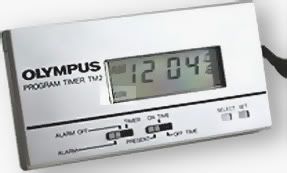
Update July 7: Bollier alerts me the Zeist judges were wrong to dismiss this clue. He sent me a low resolution picture (inset, cleaned up a bit) of the model in question, TM2. There is no date display as in 21/12, but that not what He and Meister said. It was the day name Wednesday. Bollier cites: "LC Display Window ; Display selector switsch; Mode selector; Select button; Set button; Hours>>Minutes (: Seconds); ON Time, Off Time; AM > PM; At the bottom left hand corner > Day of the week = ( SUN > MON > TUE >WED >THU >FRI > SAT" Indeed. The one shown seems to say "SUN" (highlighted). So, Bollier stands by his claim of what he saw, that someone other than him entered this day/time - and not necessarily a Libyan (see comments below)
---
This was therefore not accepted as evidence against the Libyan Hinshiri, but it wasn’t for a lack of trying on Mebo’s part. Now if they had accepted it as consistent, it might seem a fair reason for Bollier to suspect Libyan involvement, ring them up suspiciously, and then compliantly write a letter on his imaginary friend’s advice. (The judges do also dismiss the “mystery man” as fiction of the “spy thriller” sort). Just what that clue would mean, if accepted, is a little less promising. All I can see in it is one of four possibilities:

A) It was coincidence based on the visit’s timing; Hinshiri wanted to see if it could be set for, say, two days from now – which just happened to be the day that PA103 blew up. (the time mismatch would support this)

B) Hinshiri, a PA103 plotter, was practicing to see if this Olympus timer/watch would work for the bombing two days away, but then let it go as too expensive for the destruction of an American airliner. And just forgot to re-set it to zero.

C) Less directly, he was just typing the bombing time into unrelated electronics at random to make sure he has it memorized (he didn't - 27 minutes off), or something to that effect. And again, he just forgets to re-set it to zero before he hands it back, knowing the bombing will shock the world two days later.

D) As Bollier now says (see comments below) "someone else" aside from a Libyan, might have put that data there for him to see.

I’m unsure if he was trying to imply option B) or C) above, but Bollier would apparently have the Judges believe that Hinshiri had just handed him a major clue to sell to the Americans. I rather prefer the version where he counterfeited this bill of exchange from thin air.

Something Had Happened
Set ablaze by his timer discovery, Bollier says, he placed unusual phone calls (unverified) to both Ezzadin Hinshiri and the man he knew as Abdelbaset, perhaps one week after the Lockerbie bombing. He emphasizes at trial that he was calling to complain about not being paid – for the timers he had brought back with him. But he had complex reasons for these calls, he told Swiss authorities, including:
“I had a feeling that there was a connection between Libya and the crash of Pan Am 103. I wanted to hear them. Experience has shown me that people can no longer be reached when something has happened. This was certainly the case after the American air strike on Libya.”
Or, conversely, after a hypothetical Libyan air strike against America. He couldn’t recall the exact date, but it was “between the 21st -- or between Christmas and New Year,” but prior to the mystery man, so December 29 at the latest. On the call to Megrahi, he said “I telephoned, and he wasn't there. Somebody took the telephone off the hook. But I cannot confirm 100 percent whether it was Mr. Abdelbaset's voice. Anyway, I was told that he was not there.” Well, if people can’t be reached after something has happened, it would seem that something had happened - some unknown event involving timers and December 21 and, apparently, both Hinshiri and Megrahi.
---

The MEBO Files

1988-91: Eine Intrige in den Studien der Lockerbie-Tragödie!
July 16 2010 (incomplete)


Me ("Caustic Logic"): So you agree, you "know" a bunch of "facts" suggesting the Libyans you knew were up to something at the time of the bombing, involving Libyan Army/JSO, Malta, suitcases, MST-13 timers, the approximate bombing day and time, a blue baby suit, other mixed clothes, Abdelbaset, Badri (left at the end of 1988 mysteriously, you say!), Ezzadin, and what else again?


Edwin Bollier ("ebol," translated): That is the result after 18 years private investigations into and around the Lockerbie Affair, begun after the visit of the 'Third Man' with MEBO, on Friday 30th December 1988 approximate at 10 o'clock A.M. 
Libya and Abdelbaset Al Megrahi are definitely not involved in the Pan Am 103 Lockerbie Tragedy ...
(Source (comments))

---
Find below the gathered exploits of Herr Edwin Bollier, electronics seller extraordinaire, co-founder of Swiss firm Mebo, and would-be intriguer. Ever since one of Bollier's timers (MST-13) was identified as setting off the bomb on Pan Am 103, the man and his knowledge of Libyan players seemed of great importance. In recent years, he's championed al Megrahi and his nation as victims of a frame-up, but at first, from 1988-1991, he was mumbling a different story and may have had a fairly important role in bringing the case "onto the Libyan track."

> Prelude: From Zurich to Malta to Tripoli to Malta to...
An older piece from my first blog, written last year. Starts to address the issues below, with a side-emphasis on Bollier's theory that the plotters tried to implicate him in the plot by routing him through Malta the day before the bombing.

> Part One: Bollier's "Catch-Letter"
July 1. The story behind the first suggestion to frame Libya, from the man who would become the champion of poor framed Libya. Dateline, Jan 5 1989. A typewriter with Spanish keyset, a letter to the CIA mentioning secret meeting in Libya, a request for payment. The CIA made him do it, with the old "mystery man" device.

> Part Two: Why Bollier Suspected the Libyans.
July 4. Even before the mystery man tasked him with that letter, Bollier had his hunches. Enough to call "Lockerbie bomber" al Megrahi to see if "something had happened." It's got an illogical order for timers, the bombing time entered on one, shuttling between Libya and Europe, prank calls, police interviews, pretending to help in a ceaseless quest to find out who was behind it all.

> Part Three: A Suitcase for Hinshiri
July 6. A brown suitcase, a blue baby suit, a note at the airport, favors for friends, more "favors for friends." Allegations of blackmail. Bollier being "helpful."

> Part four: (No) Money from Megrahi (forthcoming)

> Part Five: Unsure

> Etc...  

A Suitcase for Hinshiri

The MEBO Files, Part 3 
July 6 2010

Note: This post is longer than the others, more rambling and with more loose ends. Apologies, it's just a lot to figure out and organize.
Cited throughout: Camp Zeist trial transcripts, days 25 and 26, June 21/22 2000.

A Letter to Hinshiri
Mebo co-founder and Libya-implicator Edwin Bollier started giving – or trying to give - bogus intelligence about the Lockerbie bombing to American investigators at the beginning of 1989. He didn’t become important, however, until the discovery in June 1990 that a Mebo timer (MST-13) was amongst the wreckage from Lockerbie. Before the year was out and well into 1991 Edwin went “on the record” with a string of stories about the timers and his dealing with Tripoli. One Bollier-FBI meeting occurred in Zurich on January 14 1991 and, among other things, helped set in motion the “fact” (a fact Bollier later renounced) that his MST-13 timers were sold only to Libya. But at the time, this important distinction helped tighten the noose. That fragment really does 99% prove Libyan authorship, as Bollier had told them from the beginning.

Shortly after this, on Feb. 6 1991 the Swiss jabberjaw wrote a letter to his friend Ezzadin Hinshiri of the Libayn JSO intelligence agency. At the Zeist trial in 2000 he explained this was “to make it clear to these people what was going on, what was happening, because our timer was in question.” Mr. Turnbull for the Crown questioned Bollier about this letter:

Q Was this in any sense designed to be a threat to Mr. Hinshiri?
A No. No. We simply wanted to inform him that something big was coming towards us, and that also the Libyan military security might be involved. We just wanted to inform him.

Q But, you see, the first thing that you explained to him in the letter is that you'd been spoken to by the police. And then you go on to tell him that you told the police that [the 20 MST-13s] had been sold to a gentleman in Beirut. Is that correct? Is that what you said in the letter?
A That is correct. Yes.

Q Was that true, what you said in the letter?
A No. We haven't sold any to Beirut. I remember now. This letter also was about telling people and that they wouldn't think that we were testifying against them, because at the time the matter was being covered in the media. We just wanted to explain to them that something was in the offing that might be of interest to them, and simply they were our business friends, after all.

Q Was it designed to be a warning to Mr. Hinshiri?
A No. I just wanted to orient him.

Q You see, because after telling him the lie about saying to the police you'd sold timers to Mr. Khouri in Beirut, you went on in the letter to give Mr. Hinshiri some more information […] about the suitcase that you had taken to Libya for Badri Hassan.”
A That is correct. Yes. […] We informed him briefly what was happening. And this is precisely what we wrote.
It was neither warning nor threat, just a friendly tip-off that they were in the process of being framed by someone. The additional about a certain suitcase read, in part: "I remembered myself that this suitcase was brought by Mr. Badri to our office, and he asked me to take it to Tripoli. He mentioned the suitcase contains clothes for a friend."

Under Crown questioning in 2000, Bollier explained “I wrote to him that the police had asked about that suitcase. […] I just wanted to explain to him, and tell him what the police had asked about.” Mysteriously, he managed to squeeze this in before being cut off again:
"The police told me that if I were to go to Libya, I was not actually going on orders of the police to Libya. And this is why I mentioned it in the letter, so that they wouldn't think that we had made up the story in order to accuse the Libyans. That was the reason for the letter.”

The Case, its Contents, and Journey
Having cleared that up, we turn to the suitcase itself. Bollier says he first saw it on December 17, 1988, in the hands of “Mr. Badri,” or Badri Hassan - a business associate of his and of al Megrahi’s. Bollier was leaving in the morning to take a batch of Olympus timers to Tripoli, and Hassan, who shuttled back and forth himself routinely, wanted the Mebo boss to take this case with him. “He brought it to the MEBO firm premises,” Bollier explained at Camp Zeist. “It stayed there over the night, and in the morning I took it with me on my trip.”

Just as he was careful to re-set all his brand-new timers to zero before leaving, he says he took stock of this suitcase. As he said at trial, “one should always inspect luggage one is taking for somebody else into a plane […] because something dangerous may be contained in the luggage.” Nothing dangerous was inside – nothing but an odd assortment of men’s women’s and children’s clothing like Hassan said. “Badri told me they were new children's clothes which he wanted to send to a friend who owned a boutique in Libya.” Elsewhere he says it was for a friend with a family, or “was to be for a wedding.” After the Libyan had left into the Zurich evening, Bollier “opened the case and checked what was in it. It was not locked,” he explained. “It was a brown leather suitcase with an additional leather security strap.”

Knowing Bollier’s style and seeing lines like “I didn't know what was finally going to happen to the suitcase” suggest he was going to call it a brown hardshell Samsonite. But he says it was a leather case instead, which is a relief – unless he were to recall it only had a brown leathery surface but was made of hard plastic. That in fact sounds like the kind of thing Herr Bollier might suddenly remember somewhere. But he did manage to faintly tie its content to the bombing (see below).

In his December 17 1990 interview, records relating to his travels were referred to:
Q … it can be seen that you checked in a piece of luggage weighing 19 kilos. What was this?"
A I took my personal luggage into the cabin with me as hand luggage in a large briefcase, including the timers. The case in question which I checked in was a suitcase with new children's clothes, which I was taking to Tripoli […] Badri Hassan […] asked me to deliver the suitcase and its contents to Ezzadin [Hinshiri]'s office in Tripoli.
At the airport, he was handed an additional note before leaving Zurich. It was from Mr. Hassan to Mr. Hinshiri, “and at the front of the letter there was an address, to which the suitcase was to be brought.” Unsealed, of course, it was written mostly in Arabic, but with a section in English he could read, more or less, to say “that it was for a friend – that these garments were for a friend, something like that.”

As instructed, Bollier left the case and the note with “the driver, Mr. Ali,” he explained at trial. It was understood tat Mr. Ali would deliver it to Hinshiri. Elsewhere, “I had to take the suitcase along, and that the suitcase was then deposited in [Hinshiri’s] office. And later on the driver took it again. This is the only link.” The last two lines are ambiguous, but this does suggest a link he was allowed to see in detail – the clothes for the bomb bag, and perhaps the bomb bag itself, sent via a talkative Swissman.
Q I see. Now, over the years since you've been explaining your involvement in this incident to people, has there grown some confusion about one of the items that was in the suitcase?
A No. Later on, it was quite clear that there was no umbrella in that suitcase. We compared that, because there's another suitcase involved in the Lockerbie case, and the question arose as to whether the garments have anything to do with this. And that is why one dealt with that suitcase as well.
Q Well, was there a child's suit in the suitcase, Mr. Bollier?
A There was no child's suit in the suitcase…

The Blue Baby Suit
The “blue babygro” is a relatively famous piece of evidence in the Lockerbie case. It was originally a blue full-body pajama-type suit, perhaps of stretch material (hence “gro”), with foot covers built in, and a lamb design on the front. Bits and fibers of it were found everywhere in the blast-damaged luggage, suggesting it was in the bomb bag. It stands out as a morbid reminder that the plotters knew children might be killed.

Enough of the tiny body suit’s tag remained to show it was made in Malta, and it was one of the more memorable items (along with the umbrella) that shopkeeper Tony Gauci recalled selling to the “mystery shopper” some weeks prior to the bombing. Bollier claims he was the source of this item, or at least of one remarkably similar.

A ... What I did was to add a blue baby's overall for the driver, Mr. Ali.
Q So was that a present from you?
A That was a present for Mr. Ali and, in fact, for his son. He asked me for it.
Q He asked you for it?
A That is correct. Because a year before, I already gave him such a little suit, which was apparently too small. So he asked me to bring another one, and cigarettes.
[...]
Q All right. Now, over the years that you've been discussing your involvement in this incident, have you become a bit confused sometimes about how the child's suit got to Tripoli?
A Yes. I would say yes. This is the second mysterious story, and I need to explain it to you.

Seems like a good cut point to explain in his interview of Jan 14 1991 he said "the suitcase contained new ladies' and men's clothes from the Jemoli store. […] Specifically, I can only remember a blue children's suit and Jemoli labels."” (Jemoli is a department store in Zurich) He’s saying here it was among the items he saw inside the case after opening it. It was the one that stood out, among the items he did not buy.

At Zeist he stammered “perhaps I put the baby overall in Badri's suitcase when I went to Tripoli.” That really doesn’t explain his statement. He says investigators sent him a “film” to explain how the blue baby suit was supposed to be bought on Malta, not at Jemoli. And the “second mysterious story:”
“[T]his testimony that most likely I had put the suit into the suitcase all the way to Tripoli wasn't left and corrected, but instead it was deleted on the computer. Sometimes I would make a mistake when a record was being taken, and each and every time the sentence was left standing and was typed again. But that time they didn't even want to know it. They deleted that sentence. And this was the third mysterious story in this whole Lockerbie incident.”
Oops, sorry, missed a mystery. But one allegedly missing sentence out of hundreds - of complete bulls*** - is not a compelling clue of cover-up. Bollier was then confronted with the earlier statement that he first saw it clearly standing out amongst the clothing Hassan had sent – he agreed he had said it, and signed it, but disagreed that it was true.
A No. That is not true. We corrected that later on. This is what is so mysterious. I was then being asked whether I didn't just see that on the film, and I was being sent by the federal police a film about Lockerbie so that I could see that there was no blue children's overall -- or that a blue overall was being bought in Malta. And I was convinced of something else then.

Q We understand that you think there is a mystery, but what I am asking you is simply – the question I asked.

Ever So Helpful
In a previous post, I mentioned Bollier’s “helpful phase” regarding the Lockerbie investigation. He responded “My helpful phase of support for Libya in the Lockerbie Case, from February 1991 till now and is to prove that Libya and Abdelbaset Al Megrahi do not have anything to do with the Lockerbie-Tragedy.” Why Febrruary? “After the visit of the Swiss federal police (BUPO) with MEBO, I informed Libya of the investigation against Libya in the case of Lockerbie (MST-13 timer). See Kamp van Zeist, Prod. 291, this letter is written in February 1991, and the date is February the 6th.”

Authorities had been speaking with him about the case for at least three months by then, and his first tip-off to Tripoli is the letter this article opened with. In this case his help consisted of alerting Mr. Hinshiri that police were asking about the timers and also about “that suitcase,” presumably because he had told the police about it in the first place.

I would presume there was never any response, and like his earlier phone calls to Hinshiri and Megrahi, Herr Bollier probably took the silence as alarming. He probably hoped the investigation – to which he sent a copy of the letter - would find it just as suspicious. Perhaps they did, but being a Bollier lead, it was apparently too kooky to follow up on.
---
Postscript: From the archives, referring to Meister's, not Bollier's, testimony.
http://plane-truth.com/Aoude/geocities/week8.html


The defence also accused Mr Meister and Mr Bollier of trying to blackmail one of their Libyan business contacts, Ezzadin Hinshiri, in February 1991 after they had received a visit from the Swiss police about the Lockerbie affair. Mr Meister acknowledged they wrote a letter informing Hinshiri of the police inquiries and offering to tell the authorities the timers were sold to someone in Beirut, not Libya. They ended the letter asking if any more business was possible with Libya.

"Wasn't this a blatant attempt to extract business, lucrative business, in exchange for telling lies?" Mr Burns asked. Mr Meister denied this, saying they had only written the letter to placate Mr Hinshiri since they feared for their safety.

Meister did admit that MEBO was in the process of arranging loans from Libya during the time of the early investigations into the crash. Challenged by the defence that he and MEBO had offered to cover for Libya by stating that they had sold timers to an extremist group in Beirut, Meister denied this.

Bollier's "Catch-Letter"

The MEBO Files, part 1
July 1 2010
last edits 28 September


(Trial transcript cited throughout is from Day 26, June 22 2001, p 4045 - 4204)

"Catch letter," in English usage, is a term for the enlarged, often decorated capital at the beginning of a book or chapter (like the C here). It catches your attention and draws you into the emerging storyline. It’s also a phrase used by Swiss electronics merchant Edwin Bollier to describe a paper letter he sent to the CIA in January 1989, blaming Libya for the bombing of Pan Am 103. The term he used in German is “Fang-Briefes,” so it doesn’t have the double-meaning to him. Nonetheless, it’s an apt metaphor; this memo and some later information on various Libyans Bollier blamed, named, or drew attention to, are likely important factors in the early emergence of the blame-Libya and blame-Megrahi notions.

Most mainstream sources take Bollier at his word that his drive now is to exonerate Libya and al Megrahi, hoping for a $200 million payout [see video, 41:00], that he earns by spouting nonsense about his timers and ignoring the best evidence, like that which this blog publicizes for free. But before the 2001 conviction and especially before the 1991 indictments, in the time when his help was most needed, Bollier’s involvement with the case was more ambiguous (to say the least).

Bollier’s unusual firm Mebo, with true Swiss neutrality, sold electronics to rogue nations for military uses while also allegedly maintaining links to the CIA. In the mid-1980s they managed to do some business in Libya – selling 20 units of MST-13 timer, a fragment of which would later be “found” near Lockerbie.

Well before this turn, he explains, a mysterious CIA man met him on 30 December 1988 and compelled him to write the letter in question. Threats were attempted, but fearless Bollier says he was driven only by curiosity to know who was manipulating him into blaming Libya. (see below on motive) So he blamed away.

The letter was mentioned on 22 June, 2000, during Bollier’s multi-day questioning, with a copy shown as production 323. It was typed up on a hotel stationery, using a typewriter with a Spanish keyset. This he had to buy, on order of the mystery man for mystery reasons. Bollier repeats endlessly how the contents were nonsense he was allowed to make up as filler – so long as it blamed Libya for the Lockerbie disaster. "This gentleman just told me that I had to indicate Gadhafi and [JSO chief] Senussi in that letter," and do so using a machine that could type "jalapeño" properly. [4086]

After he finished the ad libs exercise on January 5th, Bollier says he delivered it on the 19th to the US embassy in Vienna, from where it made its way to the CIA. Bollier told me – roughly translated:
Today we know that "Instruction [Befehl],” attribute a letter to the Chief of the CIA, came from western security service agents! The letter was then converted by me after long consideration into the form of a catch-letter [fang-briefes]. […] The catch letter was very successful: the security service, name of the future contact person [ansprech], address, which became telephone and fax number and communication frequency.” [source]

He was on the right frequency indeed. When the case amazingly turned from the tenfold embarrassing truth onto Libya, Bollier became important. Edwin was a key prosecution witness at the Camp Zeist trial in 2000; the judges wrote in their final opinion, in the case against Megrahi “there are three important witnesses, Abdul Majid [Giaka], Edwin Bollier and Tony Gauci.” [Opinion of the Court, para 41] However, they rejected that he ever met this "mysterious stranger," a story that "belongs in our view to the realm of fiction where it may best be placed in the genre of the spy thriller.” [para 47] In the period leading up to the 1991 indictments, he was more useful yet – starting with his “fang-briefes.”

The Letter’s Contents
Sadly, the CIA's probe under Cannistraro was all too capable of accepting fantasy as inspiration or even as fact. Therefore, nonsense or not, the letter needs to be examined as closely as the transcripts will allow. Under prosecution questioning (they had considered charging his as an accomplice in the bombing, BTW), much of the letter was read out or summarized. It was explained that Bollier’s line to the CIA “suggests that there can be contact between you, using a code name, and sets out how that contact can be initiated.” After this, it covered "the first short information concerning the Pan Am Flight 103." The Crown’s Mr. Turnbull then summarized:
Q And then there is some information. And perhaps we could see the next image. And more information is then given on the second page; is that right?
A Correct.
Q And reading the matter shortly, does it indicate that Libya and the people mentioned in the letter have an involvement in the bombing of Pan Am 103?
A That is correct.
At the bottom of page one Col. Gaddafi was duly mentioned as having called for a secret conference that Bollier pretended to know of, and that presumably led to the plot against 103. An “Ibrahim Senussi” is mentioned, whom Bollier clarified meant Abdullah Senoussi, head of Libya’s CIA, the JSO. When asked to read the part where he explained the bomb’s location, he first said "I wrote that this was in an office close to Senussi.” Getting more specific, he read back "bundles of dollars would have been put in the suitcase, together with explosive material."

So the Libyans had a bomb in a suitcase, that was also full of cash. At trial he explained “I made it up. I had heard that a suitcase had been found in Lockerbie with timers; and that influenced me at that time. There was a suitcase found with lots of money, I think, or there was money from a suitcase, or money had fallen out of a suitcase. That is what I included in the letter.”

And he mentioned how this suitcase was introduced to the air system: "On December 20th, 1988 they checked in at the Tarabulus Airport [Libya], Karl Heinz, and the suitcase with explosives to Zurich in Switzerland on an early flight.” This was made up on Bolllier’s own travels – he returned from a failed deal in Tripoli for Zurich on the day before the bombing.

It’s not clear just who “they” are, but his acquaintance and eventual convict al Megrahi, whom Bollier calls Abdelbaset, isn’t named that I’ve seen. He says he placed an odd phone call to Megrahi – whom he hadn’t spoken to in a year – around Christmas, or between the bombing and the unlikely CIA visit. This will form part of a separate post. The CIA had Giaka's mention of Megrahi at this time, but not Bollier's just yet (at least not via this letter).

Why He Wrote it
Another interesting line from the letter I will hold off for the final point on the list below. In brief outline form, these are the varying reasons that may or may not have motivated Bollier in writing such a letter just two weeks after Lockerbie.
  1. - He was threatened: The mystery CIA man said, as Bollier recalled at trial, he would write the letter, “otherwise you will have to suffer the consequences. Well, you'll see the consequences in the media, et cetera." He doesn’t seem to have been motivated by fear, however.
  2. - Plucky curiosity. “I was flying a kite,” he said at trial. “I wanted to find out who was behind all of this.” The best way to do that, he reasoned, was to give them what they wanted, but take it to the bosses.
  3. - He wanted to throw investigators off. An official LTBU trial summary for the day stated that Bollier “had explained this letter to the CIA as something "to put the investigators on the wrong tracks.”” [source] This has been repeated elsewhere, but appears to be a misreading. See next point.
  4. - In a 1991 interview with Swiss authorities he said he pointed to Libya in order “to get the investigators away from the wrong track and to bring them onto the Libyan track." It may have worked. At trial he insisted it was because the mystery man made him do it (with curiosity, not threats), and he was “just pretending” to be helpful in 1991. This aspect of his possible motives deserves and will receive its own post to explore a little.
  5. - The January letter had mentioned, in passing, “We've heard that you will pay for classified information. Your payment, after success only, covered on a later date." Regarding this, a 1991 FBI interview summary stated: "Bollier put the information about payment on delivery to show that he was not a conman." Conmen usually have ways of doing just that. That document further stated "Bollier sees three possibilities for Bollier to receive money from the United States government." These were listed as making electronics for the U.S., becoming a “covert operative” for them, or simply getting an appropriate chunk of the “reward money for providing information” about the recent bombing. Such a fund would eventually exist, but Bollier denies begging or even asking for money. In fact, the FBI tried to force him to accept $4 millions to lie, he said in 2008, but he refused. [see video 33:45]  

Two weeks more after the bombing...
Someone who was likely Vincent Cannistraro of the CIA's Lockerbie probe told CBS News, who told the country, that "investigators believe" Libya was behind the bombing. The details do not line up with what Bollier said in his "catch-letter," but this mutant whisper of the future fundament was perhaps emboldened by the knowledge that Edwin Bollier was out there, and was willing to make s*** up about Libya just as they were ready to do so as well.
---
Comments from Mr. Bollier (ebol) can be expected below. He's on the internet, and we're on good terms, considering.

Evidence Reconsidered: The Timer Fragment

(incomplete)
last edits 13 November 2010 

The Basics and Prosecution’s Case
One of the key forensic clues that pointed to Libyan orchestration in the Lockerbie investigation was a small piece of circuit board from a specific model of timer called MST-13, a very special product of Swiss firm Mebo. The remnant was recorded as being first discovered by RARDE scientist Dr. Thomas Hayes in May 1989, within a previously logged, explosion-damaged piece of cloth. This "fragment of green circuit board" was deemed to be from within the bomb-radio that ruptured the plane (radio case and user's manual debris was also found in the same piece of cloth).

It took another year from that point for American FBI special agent James "Tom" Thuman to match it up with a CIA-held sample of a MST-13 confiscated from Libyan agents.From there the manufacturer, Mebo ltd. of Zurich Switzerland, was decided and contacted. Sure enough, they sold 20 of these units - the only 20 ever made - to Libyan intelligence JSO in the mid-1980s. Mebo founders Meister and Bollier became prime prosecution witnesses as "JSO agent" Megrahi, who had separate connections to Mebo, by the way, was decided to have held a bomb containing one of these, and sent it off to PA103 on December 21 1988.

Problems with the Evidence
The problems with this fragment are absolutely epic.

1) discovery discrepancies
First there are controversies with the discovery and labeling of damaged shirt collar PI/995, most notably "Cloth (charred) being written over with "Debris (charred)." This may or may not be a clue, but is covered in the post PI/995 Label Issues
Dr. Hayes' notebook page 51: On this apparently backdated page, Hayes tells how the various radio materials were separated out and "raised" as PT/35, "assorted materials recovered from damaged clothing PI/995," with the timer fragment raised as (b) of that set.
See: PT/35(b) Papers, Photos, details

2) Handling of evidence
Various reasons have been given for the lack of explosive residue testing carried out on the fragment. Its small size, the relative cost and effort involved, the obvious explosion involvement (it was found inside bomb damaged clothes) have all been cited. Having skimmed Alan Feraday's testimony in 2000, it seems a nexus of all three convinced him not to bother.

The fragment's movements to Germany (forensic cutting), and US (comparison to a CIA model, done by agent Thurman), were not properly documented. This seems to me a fairly minor point, but to some others, it's seemed a big deal, so perhaps it is.

(more forthcoming in this section)

3) Illogical timing for a timer
A fairly obvious tactical problem arises with the Anglo-American answer. The Libyans were thought to be hiding their role, not broadcasting it, yet the clues like the timer were found in the hills of Scotland. If a flexible timer was used to target PA103, and its schedule would be known, and they had a several hour window over the Atlantic, why not bury the evidence at sea and prevent such finds?

The delayed-flight theory so widely cited simply doesn't cut it. PA103 was off only about 15 minutes behind schedule, depending how one defines it. It was at least that far short of the coastline (probably more like 30 min, by planned flight path) at detonation. This would meaning the alleged planners had deliberately set the timer for just short of the coastline. Even if they meant to aim right at the shore or a bit past, considering further possible delays at London or anywhere, prevailing easterly winds in the area, and that the best  bomb evidence would scatter first and farthest, this would not count as an attempt at burial at sea. Setting the timer for 7:03 PM instead of, say, midnight, was an a major blunder. They either failed to realize any evidence would survive, or they wanted to get caught.

Or...

4) Risky for Libyans
The MST-13 had been encountered at least twice by the CIA, both times in Africa, and it had been classified as coming from Libyan intelligence. (another post I've been meaning to do for months). The Libyan authorities likely knew this, or at least that some of their hardware was unaccounted for. There were supposedly only 20 of these things on the planet, highly specialized and incredibly traceable back to them.  So they decided to use one in this bombing they've planned over Scotland. Indeed, knowing their own technology was likely known, with a world of other options, they used the MST-13 and set it so early that any surviving fragment would fall to rare earth rather than anywhere on the enormous Atlantic Ocean.

Or...

5) Unlikely to Exist if Genuine
The first and foremost point this blog supports about PT/35(b) is that, given the official explosion of at least 450 grams of Semtex-H set less than two inches from the timer, a piece so big (1cm sq) is highly unlikely to have survived. Simple common sense was recently backed up by repeated tests by explosives expert Dr. John Wyatt. (see IED fragment survivability tests and this follow-up with more detail)


The fact that it turned up itself indicates PT/35(b) was planted outright. If the bomb had put it there, it'd be in unreadable slivers or dust. This conclusion is obviously controversial within the skeptic community, but I see no reason to dispute what Dr. Wyatt says he's found.

The investigators say nothing on the issue except, implicitly, that they do believe it's from the bombing. Obviously. If it's a statistical miracle, well, they'll claim that as their natural right. There are many other "miracles" in this case.

Or, if it's not a miracle...

6) Most Recognizable Part of the MST-13
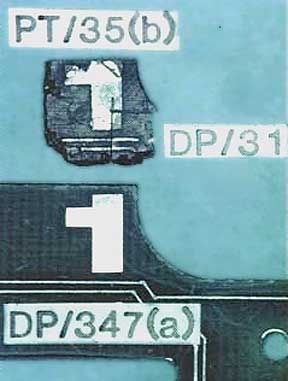
That the miraculous surviving bit would also be just the corner of the board with a meaningful symbol (the number one, and double-underlined at that), sttill readable and making it astonishingly recognizable, must rank as a further bizarre coincidence.

Or...

7) Mebo, the board's makers
After providing useful evidence against the accused, while asking for money, Mebo co-founder Edwin Bollier has turned over a new leaf and is now pushing his own implausible version of a frame-up of Megrahi. His most qualified area, the alleged MST-13 fragment, he disputes with charges of substitution of one planted MST-13 fragment with a nearly exact duplicate, apparently based in part on being color-blind. Naturally, this hasn't gone much of anywhere, despite the ridiculous affidavit his subordinate swore to that effect (see link). 

Back-Up Arguments Addressed

Other sources besides Libya
Some have argued that Mebo had also supplied MST-13 boards to the East German Stasi. And the Stasi sometimes supplied terrorists, like maybe the PFLP-GC, who seem to have been involved in Lockerbie.  That's quite a stretch for a few reasons. One, the allegation of a Stasi MST-13 link is based on things said by Bollier, who's not reliable. Second, even that only has two handmade prototypes delivered, on brown board. For the green machine-milled one we see, the Stasi would have to have made their own copies first. Third, the issues of timing relative to the ocean, as addressed above, apply to anyone using a flexible timer like this. And the question of fragment survivability is the same. 

It says Libya and that's it
Don't be stupid. Review the above. It's bad evidence. It's key to the case. That's a bad case.

From Zurich to Malta to Tripoli to Malta to...

A DECEMBER DANCE OF ACCUSER AND ACCUSED
Adam Larson / Caustic Logic


Note: this was first posted November 16 2009 at my previous blog. It's one of the more opinion-oriented pieces that gets at the heart of my distrust of Bollier and Mebo, despite their claims of sympathy with the framed Libyans.
---
One of the stranger patterns I’ve seen recently in connection to the Lockerbie case is the tight web of alleged movements of the two accused - and of Mebo co-founder Edwin Bollier - in the days preceding the PA103 attack. To start with, the close connection between the first accused, al Megrahi, and Mr. Bollier’s company is no secret. From the Camp Zeist Opinion of the Court [hereafter "verdict", paragraphs 54 and 88]:
[54] We also accept Mr Bollier’s evidence, supported by documentation, that MEBO rented an office in their Zurich premises some time in 1988 to the firm ABH in which the first accused and one Badri Hassan were the principals. They explained to Mr Bollier that they might be interested in taking a share in MEBO or in having business dealings with MEBO. …
[88] [Megrahi] also appears to have been involved in military procurement. He was involved with Mr Bollier, albeit not specifically in connection with MST timers, and had along with Badri Hassan formed a company which leased premises from MEBO and intended to do business with MEBO.

The questionable choreography begins when the Libyans had just finished employing the Mebo MST-13 in a carefully packed Malta-themed gift bag they had set to drop bits all across western Great Britain. In case the trail wasn’t obvious enough, they decided then to bring the talkative Mr. Bollier back to remind him with a new attempt to purchase a double order of the same nifty gadgets. The court cited Bollier’s evidence that Badri Hassan, Megrahi’s partner in ABH, “came to MEBO’s offices in Zurich at the end of November or early in December 1988 and asked the firm to supply forty MST-13 timers for the Libyan Army.” [verdict, para 46] Megrahi was apparently on a visit to Zurich at the same time, and from there the dance begins. Below is a timeline, compiled from a variety of sources, to illustrate how strange the patterns are.

- Nov 20 – Dec 20 Megrahi and Fhimah “did between 20 November and 20 December 1988, both dates inclusive, at the said premises occupied by MEBO AG, in Zurich aforesaid, … order and attempt to obtain delivery of 40 further such timers from the said firm of MEBO AG [indictment, para J]
- Around Dec 1 – Hassan’s order, in Zurich, for forty MST-13 timers. [Verdict, para 88]
- Early December - Megrahi had “traveled to Zurich in early December.” [Wallace]
- Dec 7-9 - Megrahi stays at the Holiday Inn in Silema, Malta. December 7 is the date the court decided he bought the Maltese clothes from talkative shopkeeper Tony Gauci at nearby Mary's House. [verdict, para 88]
- Dec 5 and 15 – Having no MST-13 timers on hand, Bollier buys 40 of the Olympus make instead, in two batches, on the open market. [verdict, para 88]
- Dec 15 – Fhimah diary entry “Abdelbaset coming from Zurich” [Lockerbie.ch]
- Dec 16 Bollier books a flight to Tripoli to bring the wrong timers [Verdict, para 88]
- Dec 17 – Megrahi returns to Malta on the 17th “and then on to Tripoli Libya, where Lamen Fhimah joined him.” [Wallace]
- Dec 18 - Bollier flies to Tripoli, meets no one, leaves timers at office of one Ezzadin Hinshiri [Verdict, para 88]
- Dec 19 - Hinshiri said that he wanted MST-13 timers and that the Olympus timers were too expensive. “Nevertheless, he retained the timers and directed Mr Bollier to go to the first accused’s office in the evening in order to get payment for them. From about 6.00pm Mr Bollier sat outside that office for two hours,” but “did not see the first accused,” being of course Megrahi. [Verdict, para 88]
- Dec 18-20 “in Tripoli aforesaid, and elsewhere in Switzerland and Libya,” Megrahi and Fhimah did “order and attempt to obtain delivery of 40 further such [MST-13] timers from the said firm of MEBO AG.” [indictment, para J]
- Dec 18-20 “we accept that Mr Bollier visited Tripoli between 18 and 20 December in order to sell timers to the Libyan army, because that is substantially vouched by documentary evidence and it was not challenged in evidence.” [Verdict, para 88]
- Dec 20 – “Al Megrahi was instructed by his boss Ibrahim Bishari to travel to Malta on December 20, 1988 for a security order (not in connection with the bombing of PanAm 103)” [Bollier]
- Dec 20 – “Abdel Baset and Lamen Fhimah returned to Malta on 20 December” with an alias for Megrahi and the bomb suitcase. [Wallace]
- Dec 20 – After a final dispute with Hinshiri, Bollier returns home with his Olympus timers, “flying by direct flight to Zurich rather than via Malta (as he had expected) where he would have had to spend that night.” [Verdict, para 88]
- Dec 20 (presumably) – “On his return to Zurich Mr Bollier claimed to have discovered that one of the timers had been set for a time and a day of the week which were relevant to the time when there was an explosion on board PA103.” Herr Meister confirmed this to the court. Libyans had been fiddling with them, absent-mindedly… the court dismissed Mebo’s claims as “so inconsistent that we are wholly unable to accept any of it.” [verdict, para 46]
- Dec 20: Upon returning to Zurich, Bollier is said to have testified in 2000 "a suitcase which had been in the Mebo office prior to Mr Bollier's departure, which the witness understood belonged to Mr Badri Hassan, was not seen again after Mr Bollier left on this trip." [LTBU]
- Dec 20: [indictment, (m)] (both accused) “did on 20 December 1988 at Luqa Airport, Malta enter Malta” with Megrahi under alias Abdusamad, and both “did there and then cause a suitcase to be introduced to Malta.”
- Dec 20-21: [Indictment, (n)] Megrahi “did on 20 and 21 December 1988 reside at the Holiday Inn, Sliema, aforesaid under the false identity of Ahmed Khalifa Abdusamad.


Bollier has added to this tight web of movements across the Mediterranean in those fateful days, in response to recent comments by myself and others at Professor Black’s Lockerbie case blog (this post, in comments beneath). His messages there are a complex mix of German and mixed English; one relevant part in German renders roughly as “today we know that the new order at the end of 1988 "to produce for the Libyan army, immediately further 40 pieces of MST-13 timers from a person; H.B." on behalf same western security services one made!” H.B. could be Badri Hassan, but this seems to imply that a Western agency placed the order (through him?). Perhaps these were the same folks who compelled Hinshiri or whoever to program PA103’s explode time into one of his Olympuses. And what ever DID happen to that suitcase, Mr. Bollier?
Documents indicate that originally the CIA and an other western intelligence service planned also to involve Edwin Bollier (MEBO Ltd.) together with Mr. Abdelbaset Al Megrahi into the PanAm 103 plot!

Edwin Bollier was told at the check-in at Tripoli airport that his already booked direct flight with Swissair to Zurich on December 20,1988 was fully booked and he should travel via Malta to Switzerland on the same day - the same flight on which Abdelbaset Al Megrahi was booked (*flight KM 107, on December 20, 1988 from Tripoli to Malta). According to a new statement Megrahi did not know that Bollier was planned to travel on the same flight as he was !

Bollier was suspicious because he didn't see many people on the airport and went to the Swissair Station Manager who told him that there were many empty seats on the Swissair flight to Zurich. So he took the direct flight to Zurich on December 20, 1988. Only Abdelbaset Al Megrahi (alias Ahmed Khalifa Abdusamad) traveled with flight KM 107 from Tripoli to Malta on December 20, 1988.

Therefore Bollier was not in Malta on the same day as Abdelbaset Al Megrahi. The CIA was confronted with a new situation and the same intelligence people decided to involve the station manager of 'Libyan Arab Airways' , Mr. Lamin Khalifa Fhimah, into the complot.

*Al Megrahi was instructed by his boss Ibrahim Bishari to travel to Malta on December 20, 1988 for a security order (not in connection with the bombing of PanAm 103) ...
On September 14, 1997 former foreign minister, Ibrahim Bishari, died in a car crash in Egypt ...
[Bollier]

Strangely for someone so nearly “framed” in the web set for Libya, Bollier was the first to try implicating Libya for the bombing of Flight 103 at all, with a letter delivered to American authorities in January 1989, well before they started finding any clues pointing that way. [see for example, verdict, para 47] This he claims he was compelled to write by - gasp! - Western agencies acting then through him to implicate Libya, a claim he’s made before and elaborates on in the same comments (worth a read for serious scholars). This letter and the claims around it will deserve their own post eventually, but something is entirely not level here, and Bollier is entirely too at the center of it. Somehow this whole byzantine Mediterranean waltz leaves me with the words and mood of the 80s poets Wham in Careless Whispers:
"Now I'm never gonna dance again, guilty feet have got no rhythm. Though it's easy to pretend, I know you're not a fool..."

---
Sources:
[verdict]
[Wallace] Rodney Wallace Lockerbie the story and the lessons 2001 page 62
[Lockerbie.ch]
[Indictment] Actually I think that's a verdict http://www.terrorismcentral.com/Library/Legal/HCJ/Lockerbie/TheIndictment.html
[Bollier]
[LTBU] Lockerbie Trial Briefing Unit: report 78554 - 16th June 2000. Original site:
http://www.gla.ac.uk/departments/schooloflaw/news/lockerbietrialbriefingunit/
text doc direct link: http://www.gla.ac.uk/media/media_78554_en.doc