Showing posts with label London. Show all posts

Thirty-Eight Minutes

The Bomb-Timing Clue for London Intro
First posted March 28 2010

Completely re-written Jan. 18 2011

Five Altimeter Bombs
It was a well-placed bomb detonation in the forward hold of PA103 that sealed the fate of 270 people on the evening of December 21, 1988. To be precise, the UK Air Accidents Investigation Branch (AAIB) decided it had detonated at 19.02:50 (7:03pm) – almost exactly thirty-eight minutes after it left the ground from London’s Heathrow Airport at 6:25.

This time span, officially decided on by Libyan plotters for unclear reasons, is an uncanny fit with another technology, controlled by another group entirely – Ahmed Jiibril’s PFLP-GC. To recap, Marwan Khreesat is a Jordanian intelligence operative and long-practicing maker of airliner-killing bombs for Jibril (with exact allegiance unclear in a chicken-and-egg sort of way). Khreesat’s bombs were triggered by altitude (air pressure) and hidden inside consumer electronics – usually radio-cassette players. In the fall of 1988 he was called in again by the PFLP-GC on a mission for Iran – avenge the US destruction of Iran Air flight 655 by destroying an American airliner themselves.

Khreesat was hired to make or modify five bombs, and contrary to GID orders (as we've heard them), compelled to make them fully armed. Only one radio-IEDs of the five was intercepted on the arrest of Khreesat and the whole cell on October 26 1988. Three more of these were found later by German authorities and studied, given the numbers below. All seized Khreesat devices, in order of discovery:

1) Toshiba BomBeat 453 radio-cassette
2) Sanyo computer monitor
3) Ultrasound radio
4) Ultrasound radio

The fifth device, which Khreesat says he only soldered two wires on after someone else constructed it, was a different Toshiba radio (not the BomBeat seized nor the Libyan BomBeat SF-16 officially accepted). The someone else who made it was likely "Abu Elias," a relative of Jibril’s and a senior PFLP-GC operative. Khreesat thinks Abu Elias worked by copying his own work, perhaps recycling some parts from the fifth test model he made for Jibril back in 1985.

This one hasn’t been studied, as it officially never turned up. Many, however, still suspect it did surface – on Pan Am flight 103. So we’ll return to it at the end, after grasping the four that were definitely never used.

Gobel and Khreesat explain the time aspect
[Note: a separate post details the hardware end of these bombs in a little more detail.]
David Leppard’s curious 1991 book On the Trail of Terror describes the work done by German investigators on the four bombs found in Germany, and summarized the findings of BKA scientist “W. A. Gobel." This looked at how the altimeter and time delay modifications worked. Here he refers only to unit 1, the seized BomBeat 453:
“Gobel had tested the performance of the pressure pick-up gauge in a vacuum chamber. The circuit would close at a pressure between 940 and 950 milibars - equivalent to an altitude of about 2,400 feet. The contact point was connected by a wire to a condenser which acted as a time delay switch. The condenser was an insulator, absorbing the electrical charge until it fired. At this point the circuit closed, detonating the bomb.”
The condenser here is what’s elsewhere called an ice-cube timer – a simple metal circuit, coiled-up, I believe, and encased in a cube of translucent resin (looks like an ice-cube made with dingy water).
"When the necessary operating height has been reached the fall in pressure connected with it will start the timing mechanism, and when the delay period has elapsed the detonator will be activated. […] The time delay of the electronic component fluctuates over a wide margin since the structure of the circuit is relatively simple. Time delays between 35 and 45 minutes were measured." [p 11-12]
This 35-45 minute range is often cited, wrongly I think, as the range of times to be expected in field usage. But a passage from Khreesat's interview with the FBI in November 1989 explained that the variability comes from repeated tests on the circuit in a lab setting:
"Khreesat advised that the times are not exact and the time changes depending upon how long the timers have been tested after last being used. They usually reset to zero after a day. He used to test the timers three times in a row before installing the timer in a device. He found that in each test the time decreased. When this happened, he put the timers aside, and the next day when he tested them, they would run for the same time as when he had first started them." [Marshman report, page 32, PDF p 19]
The variability then, with repeated testing, is downward from a long baseline time. Absent repeated tests, which might be unwise in an assembled explosive device, the timers would all have, as the designer described them as having, one set time each, and it would be the long time. So in use, the device Gobel analyzed would detonate about 45 minutes after triggering. This would be more than 50 minutes, not 38, from takeoff.

That certainly doesn’t mean it’s not a fit. Khreesat also told the FBI that the timers were not the same from one unit to the next:
"One of the timers was a half-hour timer, one was for three-quarters of an hour, and one was for one hour. Khreesat does not recall what time the fourth timer was set for. None of the timers were for more than one hour."  [Marshman report, p 32]
These seem to go in nice 15-minute increments - 30, 45, 60. His early bombs in 1970 and 1972 blew up too early - about 15 minutes after triggering - leaving two of three planes able to safely re-land. Thus for "stronger medicine" in the 1980s, he went for increments at or higher than 30 minutes. By deduction, the fourth unit was a repeat of one of the other three.

Three more to consider
Herr Gobel at the BKA, as we’ve seen above, made a close study of Khreesat device number 1, apparently housing the (or a) 45-minute ice-cube timer. He also looked at number two, the IED hidden inside a Sanyo computer monitor. This was armed with Semtex-H like the others, and rigged with the same basic altimeter-timer arrangement. “Calculated on the basis of the values of the built-in components,” Gobel wrote, “the delay time is put at between 30 and 35 minutes.” [Zeist transcripts p 8769] It's unclear if he means test variability or range of estimates for its one field-use time.

Leppard bemoans the German’s presumptions based on only one bomb sample to study, but they had units 1 and 2 and also, at one point, two other such devices. Numbered 3 and 4, these were both housed in Ultrasound radios, both found after the Sanyo monitor in a third raid, and were both destroyed under grim circumstances.

In April 1989, one of the Ultrasound IEDs inexplicably detonated while in the hands of a highly experienced BKA bomb technician, killing him and maiming an assistant. The other of the two (it’s not clear which is 3 and which is 4) was then destroyed rather than be studied, for obvious safety and psychological reasons.

But despite the British alarm over this German “sloppiness,” it wasn’t a complete scientific loss. Aside from what was missing in the rubble, which was safe enough to examine, the BKA’s forensics section ST33 noted on what remained from one the two:
“[T]he accompanying capacitor is of is of the same value as in 1 and 2, but has however, jumped out of circuit. […] it can be assumed from the remains of the circuit that the time delay was in the same region as 1 and 2." [p 144]
From four intercepted IEDs, we have three capacitors, all apparently of the vague 30-45 minutes “region.” This comports reasonably with Khreesat’s list of 30, 45, 60, and one repeat. It seems to be lacking anything with a longer time like one hour, but one device, likely the one that killed a bomb tech, was not studied like this. Perhaps that was the one-hour unit.

The results are not 100% conclusive with the information I have, but it remains consistent enough between Khreesat and the Germans to say we have a double-corroborated explanation, more-or-less, of what to expect with each of the four seized devices.

And the Fifth?
Khreesat felt that all four bombs he was tasked with re-used the timers and altimeters from his 1985 test run. But that involved five radios, one of which he says was kept intact by Jibril to study. It’s worth wondering if these same parts, fitting the same patterns, were later used to build Abu Elias’ fifth device. But wondering aside, we can’t be certain.

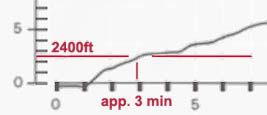
We can examine the facts of December 21 to see whether or not it’s compatible. Below is a graphic from the AAIB's report on the bombing, based on Flight 103’s data recorder. The key line here is altitude, of course labeled “ALT.” The other is some measure of airspeed. The left bar gives feet above sea level (add three zeroes) and the bottom gives time in minutes from data start.
In the marked-up detail at left, note that the altitude doesn’t change for the first minute – takeoff is at minute one, not zero. We can see here that 2,400 feet, the outside pressure that would trigger the timer, is really not very high, and was reached about two or three minutes in. If this pressure decided things for the 38-minute detonation, we’d be looking at a 35 or 36-minute timer, something not within the Khreesat arsenal.

But inside the plane, where the suitcases were, the pressure is controlled and drops more slowly. The work of Rainer Gobel, as related by Leppard, is also confirmed by Paul Foot, writing in 2001 in Lockerbie: The Flight from Justice, as addressing the expected rate where it matters:
"A clearer description of this ice-cube timer was given the same day by Rainer Gobel, physicist for the German police, the BKA. He had a remarkable insight into how long such a timer would take to set off an explosion. “Pressure change in the cabin,” he said, “is regulated automatically. It happens more slowly than the drop of pressure in the air through which the plane is flying, which means, according to the documents which were provided to me, in a plane of the aforementioned class, about seven minutes after take-off the pressure within the cabin will have dropped to such an extent that 950 millibars or hectopascals will have been reached at which the barometric gauge would be involved and a circuit, a current, would be activated.” [p 19]
Some would protest, and fairly I think, that we can't be certain that even if the PFLP-GC's bombs were involved, that this one used the same altimeter setting, or altimeter, or even timer style, as the units examined. But considering the group's reliance on Khreesat’s formula and available materials (the fifth device from 1985), it seems possible enough that it would. And Gobel's "about seven minutes" is quite a nice fit with the roughly eight required to make this fit into Khreesat’s 30, 45, 60 framework. Thus the strong possibility that cannot be reasonably discounted here is that Flight 103’s ascent triggered another ice-cube timer, of the 30-minute size, about eight minutes after wheels-up.
---

Germans link Heathrow with Lockerbie bomb

... back in '89
The Scots-German War over Airport Security, part 3 of 2 (addendum)
April 5 2011


Below is an article I would have found important in the two-parts of the Scots-German War over Airport Security (part one), but only heard of it later. Props to Patrick Haseldine mentioning it, and to "Buncrana" for finding me the article.  It's not factually acurate in the numbers-based finer points, which I've flagged in red, with corrections in [brackets]. But the general idea is still spot on, and his background facts are as accurate as any account I've read. Barring the Bedford suitcase story (apparently unknown to the world until David Leppard's 1991 book) and the Heathrow break-in (unknown 'til Ray Manly's revelation in 2001), the 38 minute "coincidence" referred to here, with a different number of minutes, is the best evidence to call on for a London origin for the bomb. Hat's off to Mr. Pallister for an excellent article from the archives
---
Germans link Heathrow with Lockerbie bomb
By DAVID PALLISTER

The Guardian (London)
November 9, 1989

WEST German forensic experts have discovered evidence which suggests that the bomb which brought down Pan Am flight 103 over Lockerbie last December could have been loaded at Heathrow.
The evidence comes from an examination of three other bombs made by the Palestinian group believed to be responsible for the attack. It casts serious doubt on the theory that the bomb was placed on an earlier connecting flight.

All three devices were identically constructed, with electronic timers set to detonate the Semtex explosive within 43 to 46 minutes of being activated by a barometric pressure trigger at about 3,000 feet. [see more correct version here - each one was different] The West German police believe they were destined for El Al planes or flights to Tel Aviv.

If the Lockerbie bomb was the same, it would have had to have been placed on board the jumbo at Heathrow, rather than at Frankfurt, Malta or Cyprus - the three possibilities so far publicly canvassed.

The bombs have been connected with the terrorist cell run in West Germany by the Popular Front for the Liberation of Palestine-General Command. The first was found in October 1988 in a radio cassette player in a car driven by Hafez Dalkamoni, who has been identified as a senior member of the PFLP-GC. He is awaiting trial in Frankfurt for a bomb attack on a railway in Lower Saxony in August 1987.

The discovery of the cassette bomb led to warnings from the West Germans to airlines and other western governments in November.

In April this year West German police found three more devices in the basement of a house owned by one of Dalkamoni's relatives in the town of Neuss. One exploded at the Wiesbaden headquarters of the BKA, the federal criminal investigation agency, killing a bomb disposal expert.

The three unexploded devices were all made by the same man. The BKA thinks he was the man arrested with Dalkamoni, Marwan Khreesat, who was mysteriously released without charge two weeks later, along with 12 other Palestinians arrested in October. Khreesat, it has been alleged, was probably an agent working for either Jordanian or West German intelligence, or both.
[all correct, but the fifth device is unmentioned]

The forensic experts, working for the BKA, believe the devices were designed to withstand examination by El Al's pressure chambers which are used to screen baggage.

Dr Jim Swire, the spokesman for the UK Families-Flight 103 group, believes the findings could point to the Lockerbie bomb, which was also in a cassette player, being loaded at Heathrow.

The plane took off at 6.25pm and disappeared off the radar screens between 53 and 54 minutes later [38 minutes later, of course, at 7:03]. It takes between seven and 10 minutes to climb to 3,000 feet [I have about 7 minutes and 2,400 feet - see again this link], which fits in precisely with the timing system on the other bombs. [it would fit perfectly if it were a 30-minute timer, which was among those used - 30, 45, and 60 minutes. see again this link.]
---

After the Break-In

Connecting Manly's and Bedford's evidence with a two-phase operation
January 17 2011
last update Feb. 10

Note 2/6: See the comments below, which address half of "the middle part" below. Rolfe has soundly debunked the build-up introduction theory and its implied conspiracy. There is, however, the option of re-positioning of the cases at that location, by the same intruder, after their introduction at Interline. I've left the text alone however, so the article and comments become a continuous learning experience.

The Defense's "Missing" Link
I’ve previously explained the security breach at Heathrow airport’s terminal three, found and reported by guard Ray Manly in the first minutes of December 21. A lock to the secured airside area was broken, leaving the way open, perhaps, for a terrorist to place an explosive device amongst the luggage out there. There was no police intervention before the bombing of Flight 103 several hours later, and Manly’s police statement about it “disappeared” afterwards.

As noted in that article, the break-in is not some lone clue floating without any context. It is in fact central to the increasingly clear London origin theory. The explosion time – 38 minutes after leaving the airport – matches with the known altimeter-based weaponry of the most logical villains aside from Libya, if it were loaded at Heathrow. Before that, but following the break-in, a pair of suitcases eerily like the one that blew up were seen around 4:40 PM. Well before the investigation’s bomb in the same case could have arrived from Malta, these appeared mysteriously within the doomed luggage container AVE 4041.

And of special interest here is the fact that Heathrow is the most logical place to load a bomb onto a London-to-NY flight. A remote loading gives numerous chances for interception, and no control over final bomb placement within the container. The bomb did wind up in the only spot of AVE 4041 from which it could do its job (lower outboard corner – see graphics below), by sheer bad luck we’re told. But in fact we have good reason to suspect intelligent terrorist hands undercover at Heathrow airside, perhaps contravening normal rules of loading.

But these are more circumstantial points. It’s in connecting Ray Manly’s report of a break-in at terminal 3 and John Bedford’s report of what could well be the primary suitcase, that the defense case, and the London theory as argued on appeal in 2002, was based. As the appeal court judges considering this at one point put it, “the appellant [Megrahi] sought to link the damage to the padlock with the Bedford suitcases” [242]

[To clarify a side-point, I proceed here on a different assumption from most. A careful reading of Bedford suggests both mystery cases he saw were the same color and style. As he said: “They were hard cases, the type Samsonite make. One was brown in color and the other one, if it wasn’t the same color, it was similar.” This plus their appearance at the same time suggests – though it doesn’t prove - a matching set from one owner, and thus both suspicious. Somehow no one else seems to read him the same way, and focuses on one of the two (which one?) that matches the official style. But I go with what I see, causing the occasional disconnect between singular and plural forms below. [also: If the case(s) were bombing-related as many suspect, it’s possible that both contained bombs (one of which didn’t fully detonate?), or more likely one was a filler, added for realism, etc. I have good reason to suspect the “one case recovered” (actually less than half a case worth of fragments) was not the bomb bag, but on the floor, beneath it - Dr. Hayes once said so.]

In connecting the ‘round midnight report of the broken lock and the late afternoon suitcase sighting by Bedford, There is the problem of elapsed hours, as brought up by the prosecution and favored by the appeal judges. Why break in, plant a bomb bag among the luggage, and then leave, only to have it loaded to the last flight of the day about 17 hours later?

It’s a fair question but not a slam-dunk. If some would-be Lockerbie bomber were on the ground cutting locks at midnight, might he not be willing to come back for a second penetration? Below is a two-phase operation scenario that I think accounts for everything as well as everything can be accounted for. It’s about what I might try for if I knew as much as I imagine this guy knew, and was evil enough to carry out such a thing. I feel that it answers all the major problems pointed out during the appeal, which I will go over for comparison following the plot outline.

Phase one: Getting the bomb to the luggage place
We start around 11:45 PM on December 20, with the terrorist mastermind - Arabic in appearance, or Persian, or blond-haired and blue-eyed, depending. He's at terminal three, standing in front of door T32a, with no one else nearby. To force open a padlock, in general your options would be:
- Sledhehammer (Loud, ineffective against rubber doors like these.)
- Hacksaw (loud and slow)
- Crowbar (loud, crude, unsure)
- Powerful (long-handled) bolt cutters.
- Other (I’m not a tool guy really)

Bolt cutters seem the quickest and quietest – a polite cough might conceal the snip from anyone down the way. Heathrow was under serious maintenance in those days, with workers coming and going all over, according to airport employees speaking at trial. So a maintenance worker could be a good costume to explain the bulky tool, the work gloves (leaves no fingerprints), and the oversize toolbox that he wouldn’t want searched. So long as he isn’t caught in mid-snip, he’d be airside in the December dark within seconds.

He could then empty his toolbox at any number of spots – one he either planned out or picks at the time. Maybe some out-of-the-way spot around a corner from a corner, the kind of place you could sneak a pee with little chance of being seen, even in the day. And behind something else within that spot - an air vent cover, or a large machine with an accessible cavity. Or anywhere that two good-sized suitcases could hide unseen for half a day in a place only he knows.

They would be fully loaded, tagged for PA103, and ready to be smuggled among the outgoing luggage. But they weren’t to be placed yet. That’s too important to be left to chance.

In court, Ray Manly said of the break-in "if somebody had done their job then maybe, maybe [the bombing] may not have happened." But in this scenario, the police would not likely find anything even if they did show up and search the airside area. The whole place would have to be almost disassembled, and all the luggage out there double-checked for purity to be sure nothing untoward was there. At the point these activities were undertaken, the bombing may, sadly, have been unstoppable under normal circumstances.

At  least, until the cases re-surfaced and ran a chance of looking odd to eyes put on the alert....  

Phase Two: Turning the bomb into luggage
Phase one accomplished and no tracks left, the bomber would calmly depart the scene, ditching the empty toolbox and bolt-cutters, but not the gloves. In case this lock-cutting was reported and then caused an alarm (it didn’t), he might give them all day to relax again when nothing happens. He’d get some sleep and allow for at least one shift change at terminal three. He’d even have time to sleep in and have a nourishing brunch of brain food in the hotel lobby, with only one other thing planned for the day.

And that would be at the airport again, coming back in the early afternoon. He’d dress in a black-market Pan Am jumpsuit for a luggage-handling disguise. And he’s carrying nothing but his black-market airside pass (hundreds were missing), appropriate fake ID in a wallet with some cash, and perhaps a pocket-knife if that’s allowed and recovery will require un-screwing. He’s carrying no bags to search. No bombs. He's waved into the secured area where he's got his bomb hidden and ready to make-believe it's someone's matching suitcases.

Upon re-entry, he’d slide over to his hiding nook to retrieve them, maintaining supreme alertness to manage it unseen. Now in a new costume, Pan Am worker bee carrying two (misrouted, if anyone asks) copper Samsonites, he’d emerge on the tarmac and just blend in.

If possible, and in general, the next thing he’d do is manually place them in the lower outboard corner (see below) of a Pan Am container, hoping for the best from there (he may have gotten it).

The middle part: Interline or Build-Up?
The middle part, just where the container would ideally be when he made his move, is more “choose-your-own-adventure,” based on some uncertainty on my on part. It’s a little complicated, and most readers can just be skip to the last paragraph here.

My previous, almost gospel, interpretation, takes John Bedford’s amazing account as literally true. This has the suitcases introduced at the interline shed, the place for processing luggage from non-Pan Am connecting flights. He says his co-worker with Alert security, the ones who x-ray the bags, had placed the matching brown Samsonites in his brief absence, although the co-worker, Sulkash Kamboj, denies this.

In this version, the Lockerbie bomber at Heathrow would have Mr. Kamboj and his x-ray to deal with, which could be dealt with in at least two ways. He could just stand outside, put the Samsonites on the belt running into the shed like any luggage, let Kamboj scan them unseen by him, and just hope they pass and are placed by luck in the right corner. He could also Step into the shed, pay the x-ray man a wad of cash to ignore his job, suggest it’s drugs in there, not bombs, and try to place them himself in the right corner. The latter would offer a better chance of success, but still has its obvious dangers – like the guy taking the cash and then removing the bags for scrutiny anyway once the intruder was gone.

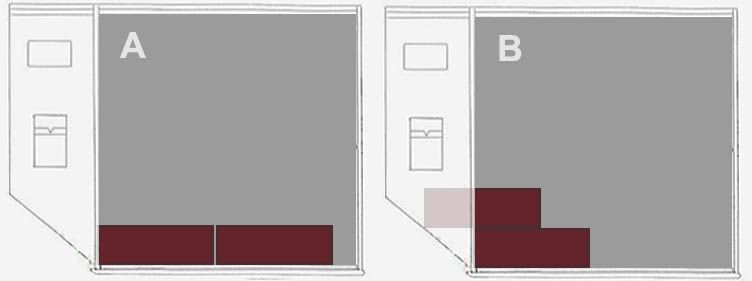
Another problem is the suitcase positions Bedford reported – position “A” in the image below, flat across the floor. The bomb was in a case of just this type, but by the evidence (and officially) in the upper of the two as shown in “B.” Both cases in B are ideally placed, against the sloped floor panel, which winds up nearest the curve of the airliner’s hull. This would only require a stacking of the two cases in “A”, nothing too extreme, really. However, that would make the one on the right in “A” the most likely to be holding the bomb (if there was only one). This is clearly not an ideal placement, suggesting the terrorist was unable to arrange them himself at interline.
An alternate narrative involves the same two cases actually being inserted at the baggage build-up area. Here baggage from Heathrow-originating passengers was consolidated into containers, and occasionally a container started at interline would be topped off or await an incoming flight here. AVE4041 was one of those. If the cases were first spotted here, that might leave Bedford’s story both literally untrue and still relevant, in a cynical but plausible situation like this:

Peter Walker, who was in charge of the build-up area, goes to take AVE 4041 out to meet the German feeder flight to be filled. But as he steps to it, he sees and makes note of the two “Bedford suitcases,” which weren’t there when Bedford dropped it off. And they’re stacked against the outboard panel as shown in “B” above.

He sees this after sitting inside for around 40 minutes, never watching the container for a moment. No one else was guarding it, and it sat unattended and wide open for most of an hour. Perhaps for fear of causing trouble he ignores the anomaly and lets it slide. (There’s probably a good reason. It’s not like we’re on high alert following a break-in or anything.) It’s taken out to K16, and filled up with items from Frankfurt, none of them holding any explosives, and then is loaded onto 103.

But after the news of what happened less than an hour later, he’d put it together. Even the placement was a clue - the bomb was in one of those cases, ideally placed nearest the hull. So he compels someone else (Bedford) to say he saw them, way over there at interline, and that Indian guy “Camjob” (as Bedford calls him) is the one who placed them. They’d be x-rayed, one would presume. (But if not, hey… it was him, not either of us.) And further, they were reported by Bedford as flat on the floor, not stacked in that optimal way.

This is a rather convoluted thing to suspect, and requires some conspiracy, but it does explain a number of things. It should be noted that Walker provided Bedford’s alibi (a tea break together) for being absent when Kamboj placed the bags. And besides the Bedford/Kamboj disagreements, there are serious inconsistencies in Walker’s statements. To police in 1989 he swore he never saw or was aware of the container at all, contradicting Bedford. In 1990, he fixed this and confirmed that Bedford had brought it over, as they had agreed to over tea. At trial in 2000 he admitted the change in stories is strange, but he said for whatever reason, "I can’t explain it."

In this scenario, the suitcases memory in Bedford’s story is accurate enough to be a clue, even if it’s not his own memory, but transferred from one mind to another. It also allows for the flat position to be an additional fudging, so that not even Kamboj facilitated their potent stacking. (That was apparently someone later down the line, if it's decided that happened at all.)

Both options involve the danger of Kamboj, Walker, Bedford, or someone else reporting or removing the bags. Every London option has that danger, and that risk is tripled in the official story through three airports, making this still preferable. Logic says they’d choose Heathrow, and less clearly it suggests the bomber would choose build-up. But Bedford suggests he chose interline. Either way, the reference to brown, hard-shell Samsonites in the deadly corner of AVE4041 shouldn’t just be presumed to be a coincidence.

Appeal judgment addressed:
Following are some excerpts from the second “Opinion of the Court” from Camp Zeist, following the appeal of Feb. 2002.

"[244] ...Moreover, although readily discoverable evidence of the break-in had been left behind in the form of the damaged padlock, the hypothesis involved that the case was not introduced into the interline shed until some fifteen hours later..."
True, but it’s no problem for the two-phase explanation - it’s the basis of it. In fact, the build-up version involves an even longer span, by as much as an hour, than the one the judges half-considered.

"...Unless the risk of opening the case airside to set the timer was to be undertaken, the timer would have had to be set before the break-in..."
Ice-cube timers that blow around 38 minutes after takeoff don’t need to be set, of course. So this point doesn’t apply to my version, nor, I think, to the case made by the defense.

"... No method of arranging for the bag to pass through the system to the interline shed had been identified..."
Perhaps not by the defense, but I propose the method was manual placement supported by psychological deception.

"... The intruder would have required either to wait for fifteen hours himself, or to have the assistance of an accomplice..."
Either works. I’m betting on one well-trained operative with the requisite patience.

"... No place of concealment for the intruder or the suitcase had been identified..."
No place identified? I suspect the intruder was an out-of-towner, and concealed himself at a hotel for that time. As for the bomb suitcases, no one has shown any reason to rule out all potential hiding spots, like those mentioned above or a dozen others. Do they imagine there would be no suitable spots? Aren't they presuming they were "hidden" right inside the interline shed?

"... There was nothing in the evidence to explain why a suitcase, brought through T3-2A between 2205 and 0030 hours, would not be placed in the interline shed in time for either of the two earlier PanAm flights. On the hypothesis under examination, the suitcase had been tagged for flight PA103, although there were two earlier flights that would have involved a shorter period of concealment of a suitcase containing an armed explosive device... "
Again with "armed" and time spans. Unless the airport suddenly levitates a few thousand feet, the bomb is stable. Remember, it's altimeter-triggered, in this non-Libyan plot. If the bomb is concealed and ready for a phase two, no one but him will put it in the shed, on no timeline other than his own. There’s no need to rush things; even doing it the same day is unnecessary. And besides, they may have been targetting Flight 103 itself for some specific reason.

"... Yet there was no evidence that there was anything about flight PA103 or its passengers that singled it out as the target."
This is widely disputed, but for my part I take no stock in certain individuals (Charles McKee, etc.) being targeted. But here are other reasons I could see why they might choose to wait for this one, depending what they knew from advanced research:
- the plane’s age (it was one of the oldest around) and its brittle skin. (see this frightening video)
- its inhabitant’s average youth, to maximize the sense of loss.
- its lateness, last flight of the day. As explained above, giving time for security to relax, for sleep, and for a costume change.

"...Moreover, if an accomplice with airport identification, genuine or false, was involved, there was no need to break in to airside..."
Except to have no friggin' bomb on him when he showed his pass and perhaps was subjected to search prior to entering a secured area… which of course was not secure at this point, and he may have had a bomb waiting for him inside.

"...All that was required was to smuggle the components of the explosive device through an access point, such as T3-2A, where persons with appropriate identification were not searched..."
Even the  stray suitcases they're bringing in aren't searched? I don't know - I imagine a ready-made bombs aren't smart to bring through, and the judges agree, speculating "component parts" being smuggled and then assembled out on the tarmac somewhere. (???) For the bomb’s entry behind the perimeter, where worker-looking people are generally trusted, I think an unacknowledged sneak-job of the ready package would be wisest. A break-in at midnight would be genius.

"... The effect of all these points, the Advocate depute submitted, was to show that the hypothesis that the break-in at T3-2A was the means of infiltrating one of the Bedford suitcases was so weak and flawed that the additional evidence could not pass the Cameron test..."
My theory has it introducing both of them. I didn't read just what "the Cameron test is," but it's from a case involving someone named Cameron, and probably means a point doesn’t hold up under scrutiny, compared to something else already "established." At least, not when the scrutiny is as skewed as their Lordships' is. When they say “the Advocate depute submitted” they also seem to be saying “we think.” But the A.D.’s job is to argue his case, however unsupported, and their job is to judge fairly, not just agree with the one line of argument as if it were a self-evident truth.

"[251] In our view the Advocate depute was right in submitting that the additional evidence did not demonstrate any link between the break-in at T3-2A and the Bedford suitcases..."
Perhaps not, but now I have. A potential one at least.

"... It might be said that there was a temporal link, in the sense that the break-in occurred some fifteen hours before the Bedford suitcases appeared in the interline shed..."
Yes. In a 17-year career, the worst security breach Manly ever saw, and the worst terrorist bombing in UK history, happening within the same 17-hour span, is definitely a temporal connection.

"... It seems to us, however, that that interval of time, so far from pointing to a connection between the two events, casts considerable doubt on whether they can have been connected..."
"Can have been connected?" Wow. No imagination at all.

"...The lapse of time after a readily detectable break-in, creating a period during which the infiltrator and the case (or, if there was an accomplice, the unaccompanied case) would require to be concealed in the airside area, points away from a connection..."
Again, the lapse of time after the detectable event is explained by me as a cool down period in case the detection raised an alarm. Sixteen or so hours is, if anything, a bit short for this purpose, but it apparently worked.

"...Moreover, any attempt to link the Bedford suitcases with the break-in raises unanswered questions as to why the infiltrator ignored the baggage build-up area, and introduced the cases into the considerably more remote interline shed..."
Any attempt? Not my variation where the bomb is introduced at build-up. They're the same suitcases then, just the "Walker suitcases" instead of the Bedford ones.

In addition, given the evidence as to the ability of a person with airport identification to pass through T3-2A during the day without being subjected to search, and given the evidence led at the trial and mentioned by the trial court in para [24] about the substantial number of such passes unaccounted for, it is not clear why a break-in would have been seen as necessary, since the components of the explosive device could have been smuggled through an access point.
Repeated just to emphasize the bolded, to remind the reader how easy it would be for a terrorist to sneak back into the airside area where he'd earlier hidden the bomb he meant to get onto Flight 103.

Addendum: Completely unaware of the break-in that changes the whole scene for the imagine Heathrow intruder, the Zeist judges put the situtation pretty well in their paragraph 24 (in its entirety)
[24] It emerges from the evidence therefore that a suitcase which could fit the
forensic description of the primary suitcase was in the container when it left the interline shed. There is also a possibility that an extraneous suitcase could have been introduced by being put onto the conveyor belt outside the interline shed, or introduced into the shed itself or into the container when it was at the build-up area. To achieve that, the person placing the suitcase would have had to avoid being detected, but the evidence indicates that a person in possession of a pass for the airside area would not be likely to be challenged, and there were a very large number of passes issued for Heathrow, a substantial number of which were not accounted for. The person placing the suitcase would also have required to know where to put it to achieve the objective.
---

The London Origin Theory

The First Causualty of the Investigation was Truth
(incomplete)
last update July 30 2010


“I want to know when the bomb was placed on the plane and by whom. We have to look more closely into the "London theory" – that the bomb was placed on the plane at Heathrow and not in Malta.” - Hans Köchler, independent UN observer at Zeist trial, 21 Aug 2009 (Source)


"If I was determined to bring down an airplane, I would have put [the bomb] on in London." - Robert Baer, 'former' CIA agent and weapons expert, who doesn't buy the Libyans-did-it story line.

The London Origin theory has emerged as the most logical explanation for what happened to Pan Am 103 on December 21 1988. The official story, all the most widely-seen revisionist arguments, and even Megrahi's defense team's curious "special defense of incrimination" drew on elements of the drug swap theory, with the bomb coming in from Germany or further afield. Megrahi's counsel William Taylor QC did however give reasons to suspect a  London origin (some below) to the trial judges and summarized at trial's end in 2001:
“My submission is that all of the above render the choice of Heathrow a much more likely one [than Malta]. And when that possibility is considered, one finds that there is a compelling body of evidence that points to Heathrow as being the point of ingestion.” [day 82 p 9862]

But in the earliest days of the investigation, January and February 1989, British investigators labored to clear Heathrow Airport of any lapses and ensure that the bomb's origin would have to be found elsewhere. Years of confusion ensued... (see "Counter-Arguments" below for more on the dismissal of the London theory).

Direct Evidence For the Theory
Among the first clues came from finding where the plane failed, and what luggage container the blast originated in. Container AVE4041 in forward left cargo hold, position 14L, was decided within a few days. The container's blasted out remains were found and reassembled enough to show the blast was down at the bottom of the container, in the aft outboard corner. It had been in the spot closest to the hull, only 25" from the thin and aged skin of Maid of the seas.

Unfortunately, the exact placement, origin, or even number of suitcases in that box was hard to pin down. Records and witnesses helped decide 4041 was loaded with a few bags (6-8 or so) of (apparently) interline luggage, then filled up with a few dozen cases from the feeder/first leg flight 103A out of Frankfurt. But within this generally imprecise body of memories, one stands out as of amazing possible significance.

The Bedford Suitcase(s)
This was always the hard part to get around in order to reject the initially obvious Heathrow introduction theory. A Pan Am worker mentioned to police right after the attack said he saw two brown hardshell samsonite suitcases, placed on the floor of container 4041. The position of these was side-by-side from the far left of the floor, at the (loading) front of the container. If the bags had been later stacked one on the other and the top bag slid a few inches left, it would be in the perfect spot to match the explosion center - aft outboard corner, second suitcase from the bottom - where just such case detonated.

An amazing lead, investigators almost seem to have tried to not follow this one.  Since the cases Bedford saw were on the floor when he saw them, and the blast seemed to have happened one layer up from that, they decided these cases were a coincidence. They must have been moved across the container, and replaced in that lower corner with an identical case from Germany, on top of some other damaged Frankfurt-originating luggage. The leaps of faith here are simply alarming.

The Bedford story is covered in great detail at this site, with the works so far compiled at the link above.

> Break-in Reported
A security Guard at heathrow Airport reported a break-in at terminal 3 around 12:30 am on  December 21. Ray Manly's report, of a padlock on the floor "cut like butter" was covered up for over a decade. Even at trial in 2000, the defense was not allowed to know of this. Manly came forward in 2001 with the story, soon verified by the long-suppressed police reports. A post is up but empty - anyone care to help? I'll get to it later.

Mentioned in: Appeal Court Dismissal of the Heathrow Theory

Circumstantial Evidence For the Theory


The 38-Minute Coincidence
Aside from its crew and perhaps some cargo that (probably) doesn't matter here, the 747 Clipper Maid of the Seas landed empty at London's Heathrow airport mid-day December 21, 1988. There the plane took on a load of 243 passengers and their luggage, and took off at 6:25 PM for New York as Pan Am Flight 103. Clearly, the bomb went on the plane at London, but the question that comes quickly behind it is where did it come from before that? A van in the parking lot, or another plane?

Such clues were vital to tracking down the perpetrators, and should be embraced when they're found. The time of explosion itself is a valuable clue - 38 minutes after leaving the ground - is a known hallmark of the altimeter bombs made just weeks earlier by terrorist bomb-maker and "double agent" Marwan Khreesat. He had produced four altimeter-triggered, radio-disguised bombs, set to detonate less than an hour after takeoff. Each of the others was a bit different, but the one that was captured and tested thoroughly would have blown up about 45-50 minutes after takeoff.  

The timing compatibility with a Khreesat bomb loaded at London notwithstanding, it's been officially decided and legally established that was a Libyan-ordered and set MST-13 timer that told the bomb to go off over Lockerbie. Officially, legally, by the evidence led at trial, it's an asbolute coincidence the timing so resembles the method first suspected. 

> Operational Security
When confronted with the official story of a Malta-Germany-London, the most obvious averse reaction of those who know air travel operations is to ridicule the notion that an airline bomb would make any sense being trusted to so many switches. Any functional security screen or time delay along the way coulld screw up the whole operation with a timer-based device as alleged. A trip from Frankfurt only is often suggested to replace this, but it too has one too many stops for a Khreesat bomb, and still a high chanced of the bomb being delayed or intercepted. If one could pierce security at any of the three airports, and it obviously happened at one of them, Heathrow would give one the best chance for success and the only way for a Khreesat bomb to have done what happened.  

Former head of security for British Airways, Denis Phipps, Maltese Double Cross:
“If a device had been infiltrated into the system at Malta, it would have been necessary for that device to have been carried in an aircraft in the sector from Malta to Frankfurt, to have gone through a handling process, been carried on an aircraft through the sector from Frankfurt to Heathrow, and then timed to detonate during the final sector, Heathrow to New York, presumably whilst the aircraft was over the ocean to avoid discovery of forensic evidence …  one has to say, um, are - terrorists  - idiots? Don’t terrorists plan to have a reasonable degree of success?"  

> Explosive Efficacy
If one places a device at the airport the target leaves from, rather than remotely through multiple flights, a new ppossibility is opened up - depending on the nature and depth of his penetration, a determined terrorist could place the bag himself and chose where in the container it went. As it happened, the bomb in PA103 was placed in the best spot (for the terrorists), and one of the few that could have even worked - the lower outboard quadrant, more or less on the sloping floor nearest the hull. Figure F13 (below) of the AAIB's report shows the deduced center of explosion that officially was achieved by accident. Considering even there, all that was blows from the hull was a chunk the size of a dinner plate. That's all it took, but it wouldn't happen at all if the bomb had wound up in the upper inboard corner, or even in the middle.

It is true, as some have pointed out, that there'd be no guarantee any cases placed in that deadly corner would stay there. But terrorists simply can't wait for guarantees. Certainly having it in the right spot, for sure, at one point, is better than relying on pure chance. Perhaps with this in mind, famous former CIA agent Robert Baer, who may have direct experience in this for all we know, has said:
"I used to teach explosives. The last thing you want to do is put a bomb on in a place like Malta and have two stops along the way ... you couldn't count on this thing hitting its target. ... Malta would not have been my first choice. It would have been London. If I was determined to bring down an airplane, I would have put it on in London." Flight into Darkness video, part two, 5:25

Counter Arguments Addressed
Forensics and the Frankfurt Link to the Rescue
UK and Germany had both been unsettled by the possibility their security forces had allowed the horror of Lockerbie to pass through. Some of their early wrangling is addressed in the post "What did the Germans Know?" British investigators decided the blast - 10 inches above the container floor - was above any possible non-Frankfurt luggage and therefore had to be some other brown, hardshell Samsonite from the one(s) Bedford described, that must have been from the feeder 103A. It was unsound reasoning and wishful thinking until the Erac printout emerged months later, showing an item apparently coming from Malta, to PA103, via Frankfurt.

The Malta Link to the Rescue
The Erac printout, emerging months after the attack from an employee's locker after all official copies somehow disappeared, sealed the deal for Malta origin. But the tiny island nation had already been mentioned in the evidence, as the place of manufacture for some of it. As it so happened, the Erac (Frankfurt) printout in August 1989 spurred a closer look, and the clothes were traced to a store on Malta where Tony Gauci was found...

Malta-based Libyan defector Abdul Majid Giaka was already on file with the culprits - Megrahi and Fhimah - that some hoped Tony saw one of. By late February 1991, they had a sort of identification of Megrahi from the shopkeeper.  A few months later, Giaka was finally removed to safety and first mentioned the suitcase - possibly the same model Bedford reported - seen on Malta the day before it reappeared on that dubious printout leaving there. The story is clearly false, but formed one basis of the U.S. indictment against Megrahi and Fhimah in November 1991.

And finally, Air Malta has airtight records that the 55 bags on flight 180 were all claimed by its 39 passengers. They've shown this in court, like in their libel suit against Granada television. How the bomb was sneaked around Air Malta's system was never explained or substantiated even back when Fhimah was accepted as an accomplice. Investigators tried to find evidence of Maltese collusion or corruption or incompetence, but came up only with 'well, they must have done it somehow.' After the dismissal of Giaka's Malta stories, the Zeist judges  found that accomplice not guilty, further complicating the feat for Megrahi. They admit it's hard to see just how he did it, but he must have. Guilty.

See also: JREF Forum discussion thread on the London Evidence - great discussion