Showing posts with label Zeist trial. Show all posts

Once Upon a Time, there was Lockerbie

Spot the Problem
By Robert Forrester,

Secretary, Justice For Megrahi Campaign 
Special to The Lockerbie Divide
March 28 2011


In 1958 President Eisenhower was so concerned about the prevailing hatred for the United States amongst the peoples of the Middle East that he commissioned a report in the hope that better minds than his could explain what seemed to have flummoxed him. In 1953, Eisenhower, supported by Churchill and later Eden, sanctioned Operation Ajax. Operation Ajax was regime change at its cheapest and most effective. It cost a mere $1,000,000 to run, involved buying off the Iranian military and employing gangs of Teherani thugs to create civil disorder and achieved its desired result of overthrowing the popular Iranian prime minister Mohamed Moussadeq. Why did he do this? Because Moussadeq was showing unfortunate socialist tendencies whilst at the same time as sitting on some rather desirable oil supplies. In fact, the man actually had the gall to suggest that Iran should be controlling its own mineral wealth and selling at prices the Iranian people felt appropriate, not those which the UK and USA felt like paying. Happily, everything went according to plan. Moussadeq ended up under house arrest for the rest of his days, the Iranians were subjected to thirty years of murder, torture and political repression by the West’s man of the hour, Shah Mohammad Reza Pahlavi, and we got the fuel to fund our casino economies at our prices, at least until Ayatollah Khomeini flew home to roost. Eisenhower’s National Security Council, in its report to the president, explained that the people of the Middle East seemed to have run away with the bizarre notion that the US is only interested in supporting tyrannical despots in their region who are willing provide cheap mineral resources. It is tempting to ponder whether Eisenhower’s illuminating report cost more than Operation Ajax.

Saddam Hussein proved to be a tad more awkward to deal with however. But once he had gone past his sell by date (he never did manage to club those dashed mullahs over the border despite all the help we gave him), and despite the weaponry we’d supplied him with, he really didn’t stand a chance. All that was needed was to await a convenient source of outrage, in his case the Al Qaeda attack on the World Trade Centre, to creatively stitch him into, trample all over the UN, then let him have it. Abracadabra. Ignoring the appalling cost in lives, a country that was once an example to the region in terms of its social services and state run enterprises was bombed back into surviving in open sewers. But hey, they got democracy, plus, the oil was free again, just like the 1920s.

So now it’s Libya’s turn. Gaddafi stands even less of a chance than Saddam. It’s hard to imagine the bookies taking bets on anything other than the precise hour and minute of when the rope will go round his neck. How can the rebels lose? They have copious amounts of the very best that modern air power, intelligence gathering and command and control can provide taking out any and all opposition they would otherwise have fallen victim to. They simply have to pick up the pieces, follow the instructions and keep shambling on towards Tripoli. Neither the Chinese nor the Russians have shown any real signs of stepping in. Even the US has estimated that it really doesn’t need to take such a prominent role in affairs and handed it all on to NATO. In any case, the US already has enough on it’s plate what with commitments in Iraq and Afghanistan, whilst at the same time having to keep a weather eye on other developments in the region: not least on the fact that Syria is getting a little frayed round the edges, and, although Israel is doubtless smiling, it won’t be sleeping. Furthermore, oil is marginally less of a lure to the States where Libya is concerned. Not so however with the UK. Let’s not forget Tony Blair’s ‘Deal in the Desert’, the BP contract and all the embarrassing mud that is sticking over the revelations that have come out concerning Gordon Brown’s government’s attempts to help Tripoli negotiate the legal hurdles of Mr al-Megrahi’s repatriation.

Despite the distress caused to anyone directly connected to the Pan Am 103 incident,
it almost seems wrong to draw a spotlight on to the Lockerbie/Zeist case at a time when Libya is being torn apart by civil war. Nevertheless, David Cameron has chosen to do just that recently in seeking to justify his belligerence by saying of Muammar al-Gaddafi: "The people of Lockerbie know what this man is capable of." (David Cameron - 21/3/2011). Justice Secretary Ken Clark is also now playing the Lockerbie card by saying that we have to bring Gaddafi down to prevent him from seeking another Lockerbie in revenge for the UK’s support of the rebels.

It is always much healthier if you can draw on some moral high ground to justify your cause in the public eye. We tried it on in Afghanistan with how we were lifting the Afghans out of their feudal political system by waving our magic wand of democracy over them. Now, with Libya, it is Lockerbie and terrorism. Ever since Libya’s ex justice minister, Mustafa Abdel-Jalil, set himself up as leader of Eastern Libya in February with claims that he had proof that Gaddafi was behind Lockerbie, this has provided the opportunity to indulge in a bit of sleight of hand and massaging of public opinion. Lockerbie combines public ignorance, terrorism, fear and righteousness, and, it sells papers into the bargain. Abdel-Jalil’s claims are simply that, claims. After a month, he has yet to produce one iota of substance. Is he saying that he was negligent enough to leave the documents back in Tripoli? Once Tripoli falls and no documents are produced, are we then going to hear that Gaddafi must have destroyed them? Perhaps though, documents will be produced, however, we all know what is said about truth and the fog of war. Even today, and despite the payments the Telegraph had to make to George Galloway concerning the documents that were allegedly found in Baghdad proving his complicity with Saddam’s government, their origin is still not settled. In any case, it surely comes as no surprise to anyone that Gaddafi would have been behind an action such as Lockerbie if one of his countrymen had carried it out. But, did Abdelbaset al-Megrahi do it? Therein lies the rub.

To say that the case against Mr al-Megrahi has one or two problems would be arch understatement.

  • There was a break in to Heathrow airside giving access to Pan Am 103’s loading bay area shortly before take off. This incident was reported to the Heathrow authorities at the time but not made public until after the verdict was passed twelve years later.
  • There is no evidence of any unaccompanied luggage leaving on flight KM180 from Malta’s Luqa airport.
  • There are question marks over the provenance of documentary evidence provided by Frankfurt Airport ( the transit point from Luqa to Heathrow).
  • Along with other alleged inducements, the Crown’s star witness, Mr Tony Gauci (the proprietor of a Maltese clothes outlet) and his brother, Paul, are accused of having been in receipt of payments of $2,000.000 and $1,000,000 respectively under an American rewards for justice scheme for their testimony (a practice understandably alien to Scots Law, and presumably sufficient to dismiss both Tony and Paul Gauci as witnesses. The US authorities have yet to deny this deal). Tony Gauci’s testimony falls considerably short of being conclusive in terms of his eye witness account, which attempts to match up the identity of the purchaser of clothes from his shop, on account of key discrepancies with regard to the date of the purchase and the height, weight, age and build of the purchaser. Even though he had been prompted by numerous photo spreads containing pictures of Mr al-Megrahi and privy to media photographs of the accused prior to the trial, Mr Gauci could do little better than say that the man in the dock “resembled” the purchaser of the clothes.
  • Serious doubts also arise over the provenance of the fragment of circuit board alleged to have been part of a triggering device for a bomb which brought down pan Am 103. How did it (along with a sample of Mr Gauci’s clothes) survive temperatures of around 4,000ºC at the heart of a Semtex explosion? Why was it not tested for explosive residue? Why was forensic testimony accepted from representatives of the Royal Armament Research and Development Establishment (RARDE), who had in previous terrorist trials been pilloried for the nature and standard of their testimony? Why were alterations to the discrepancies in the notebooks of the RARDE forensic witnesses not made more of in the trial? Why was the fact that a Crown witness, Mr Ulrich Lumpert, signed a sworn affidavit in 2007 retracting his Zeist testimony relating to the fragment of circuit board as effectively being a pack of lies not pursued? Why was the fragment sent to the US and allowed to leave Scottish jurisdiction, surely this would disqualify it as evidence?
  • Suspicions are also rife concerning what influence the FBI and the US Department of Justice had over the Scottish led police investigation and the trial under the auspices of the High Court of Justiciary.


The above simply serve to illustrate some of the more prominent worries over the safety of the conviction. To compound this, the judges chose to believe a tale of how the bombing was carried out that defies what any normal person could accept as credible, namely: that Mr al-Megrahi contrived to place an unaccompanied luggage item on to flight KM180 from Malta which was then subsequently transferred at Frankfurt to a feeder flight to Heathrow, again unaccompanied, where it was finally loaded on to Pan Am 103, unaccompanied. Thus defying three security regimes in three separate countries, and the bomb still managed to blow up its target and not either one of the first two flights despite the inevitability of delays etc which would have been par for the course around Christmas time. It is truly hard to believe that 15 lay Scottish jurors could reach anything other than a not guilty verdict in such circumstances. Although impeccably qualified as judges, their Lordships, MacLean, Sutherland and Coulsfield, in arriving at their guilty verdict, displayed an absence of experience when it comes to the role of being a juror. Indeed to give credence at all to the story of the Luqa-Frankfurt-Heathrow connection, especially as it was presented at Zeist, demonstrates a complete inability to imagine how paramilitaries operate.

It also cannot be ignored that the structure of trial itself could well have contributed to the conviction in that the Crown played the role of prosecutor, judge and jury. The litany goes on.

Mr al-Megrahi’s first appeal failed, this is true. However, in their judgement, the judges were at pains to point out that they took no account of the sufficiency of evidence since the defence did not require them to do so. The Scottish Criminal Cases Review Commission (SCCRC) then referred the case back to the Court of Appeal on six grounds suggesting that no reasonable court would have reached a guilty verdict on the basis of the evidence laid before the Crown by the prosecution. This appeal was then, unnecessarily, dropped by Mr al-Megrahi in his attempt to gain compassionate release. There has been much speculation regarding the possibility that he may have come under pressure to do so even though the terms of compassionate release do not require an appeal to be dropped to become a beneficiary of it. The long and the short of it is, therefore, that this conviction has not yet been fully tested in law in the interests of justice. The best that the Crown, in the form of the Lord Advocate, Elish Angiolini, has been able to offer as a counter to these concerns is a mind-boggling merry-go-round of circular polemic which amounts to little more than: he was convicted, therefore, he did it. So parlous are the arguments offered up by the Crown that one almost feels bound to ask what qualifications are required for the job of Lord Advocate. To reassure us all that the Crown and the police are still taking the Lockerbie Zeist affair seriously though, even at a point ten years after the conviction, Angiolini also claims that the Dumfries and Galloway police are conducting an on-going review of the investigation. It, in fact, transpires that this is being carried out by one sole officer. In the words of Christine Grahame MSP, this constitutes little better than “file management.”

Recently, on Auntie Beebs weekly vox pop mainstay, Question Time (broadcast from Edinburgh on the 10th of March) we were again treated to the predictable and tedious question of how Mr al-Megrahi must be laughing now that he is back in Libya. I imagine the member of the public who posed the question will be reduced to stitches if he ever contracts a malignant carcinoma. In order to kick the SNP bashing off, Douglas Alexander was straight in with claims that Mr al-Megrahi was currently being chauffeured around Tripoli in a Lamborghini (presumably to make him a more awkward target for the coalition missiles). Annabel Goldie took the biscuit though in bemoaning the damage that the compassionate release had done to the good name of Scottish justice, completely ignoring the profound and legitimate concerns over the safety of the conviction. Clearly, a potential miscarriage of justice does no harm at all.

There are of course differences between the histories of Iran and Libya, however, the salient threads of Western foreign policy run through both. In the case of Libya, we have the Italian genocide of the late 20s and early 30s (accounting for upwards of 50,000 deaths in camps), the Second World War, and then a monarchy (supported by Italy, the UK and the US) that pocketed Libya’s wealth until overthrown by Gaddafi. Much like Khomeini was viewed later in Iran, Gaddafi was seen in the late 60s as someone who would stand up to Western depredations. The surprising thing is that he managed to survive being a thorn in the side of the West for as long as he has: Reagan’s bombs, sanctions and all the rest. In pitting himself against such power, he, of course, subjected his people to his own brand of Gestapo for decades. Ex justice minister Abdel-Jalil’s claims, therefore, should be seen in this light. Anyone who managed to negotiate the perils to attain such a position under such a tyrannical regime is bound to have washed his hands in the people’s blood on a fairly regular basis. To that extent he doubtless has every reason to make the types of claims he is making in the hope of protecting his own skin.

It is hard to see Gaddafi going anywhere now except to follow Saddam to the gallows. The West will do what it knows best and install someone who is suitably on message until the oil runs out. Who knows what may become of Mr al-Megrahi? A one way ticket to the US’s Guantánamo rest home perhaps? Whatever transpires, it will make no difference to the case being put before the Scottish parliament by justice campaigners. No amount of dissembling mendacity claimed by politicians and others can ever change the documented historical fact of what took place at Zeist. This conviction simply does not stack up, no matter how good your gas mask.

Rewards for Injustice

A Shocking Trail of Witnesses Paid Millions for Misinformation
July 25 2010
last edits July 30


The early release from Scottish prison of “Lockerbie bomber” Abdelbaset al Megrahi has been getting much airplay and page space the last three weeks. A myth that he might live for decades more, and the “news” that Gulf-despoilers BP (British!) had also lobbied for the “bomber’s” release back in 2007, stuck together for indignorant Americans. This spurred a flurry of commentary and Congressional calls for investigations, summoning foreign CEOs and ministers to explain themselves, as the Brtis say with annoyance, like naughty schoolchildren before the headmaster.

This will surely settle down before long, and amid the furor, one crucial issue will still lie in the dust, unseen by most. And that is the assassination of Megrahi’s hard-won second appeal of conviction. Many informed commentators have been bringing up the appeal in a more recent backlash, but so far It’s hardly even a side note in the US - just a trifle the “bomber” was “allowed to drop” right before going home to live way more than three months.

Three Important Witnesses
And so the appeal’s secrets were buried, for the moment The central point of the surrendered challenge, soon submitted to the court of public opinion, was the reliability and credibility of eyewitness Anthony “Tony” Gauci. The scope of this article will be wider and consider two other witnesses who share three key features with Gauci.

Upon finding Megrahi guilty for the bombing on January 31, 2001, the three judge panel ruling at Camp Zeist issued an 87-page Opinion of the Court (PDF link) to explain their thinking. Among the points in setting up the evidence against Megrahi was this short list:
“In relation to the first accused, there are three important witnesses, Abdul Majid, Edwin Bollier and Tony Gauci.” [paragraph 41]
To those who know enough about the case, that line is itself hilarious, the punch-line to a sick joke. To those who don’t know enough (and that’s who this article is for), it take a little explaining. Besides being the only three with anything truly incriminating to say against Megrahi, each of these has in common two further points:
1) The evidence they provided is questionable in many cases, and unquestionably fraudulent in others.
2) They were all offered (or have said they were offered) millions of dollars, and at least two apparently collected.

“Abdul Majid”
Abdul Majid Giaka (an alias, true name unknown, called ”Abdul Majid” by the Zeist judges) was a Libyan intelligence agent with the JSO, Libya’s CIA. He was very low level and knew almost nothing, but from August 1988 he had been able to draw money from the CIA ($1,000 a month, increased to $1,500) selling them small tidbits. The CIA called Giaka code-name “Puzzle Piece.”

The defector was stationed at Luqa airport on Malta, where the JSO and Libyan Arab Airlines mingled. At some point after Pan Am 103 fell to Earth in December, two of the people he’d named as high JSO agents working on Malta – Megrahi and his “accomplice” Fhimah – came to the center of suspicion. Strange clues emerged suggesting Libyan authorship, and a Malta link that pointed right to Megrahi. By early 1991, the other puzzle pieces (including Gauci and Bollier) were all in place, and they needed a witness closer to the perps.

It seems the Libyans were by then tired of Abdul Majid’s strange behavior on Malta and ready to call him back to Tripoli. The CIA threatened to cut him off and let him go unless he said something good, and if it was good enough, he might say it to the FBI. So in the summer, he met with agent Hal Hendershot and laid down a whole new version of the previous years in which Megrahi and Fhimah had plotted the bombing in the open and he saw half of it himself.

Hendershot liked what he heard, and Giaka went straight to Washington, with his pregnant wife fetched from Malta soon after. He testified to a grand jury in October 1991, telling of the brown Samsonite case he’d seen the Libyans with on December 20, of the report he (Giaka) was asked to write about bombing a “British plane,” the TNT they kept in a desk at the airport…

As the indictments were sealed and put in place on November 14, the defector Giaka was re-settled somewhere under a new name and witness protection, and paid handsomely. Megrahi’s appeal documents reveal, from DCI Harry Bell's diary, January 8 1992: “Bhiel states DOJ (Department of Justice) will give Magid [Giaka] $2 million dollars. Advised of our concern." This seems to have been dispensed under a US DoJ “Rewards for Justice Program."

When the millionaire was presented as the star witness at Camp Zeist in 2000, it was an unprecedented event – the first time a CIA asset had testified in open court (his voice was disguised and he was hidden behind a screen). The judges were not told about the $2 million, but they did know of his CIA paychecks, other arrangements and efforts to secure money, and his relocation to America, which was clearly of immense value to the witness. They noted how Abdul Majid’s best stories about late 1988 only appeared in mid-1991, and learned along the way that the CIA themselves didn’t believe his information, and had tried to conceal that fact. Therefore, they explained, rather timidly:

“Information provided by a paid informer is always open to the criticism that it may be invented in order to justify payment, and in our view this is a case where such criticism is more than usually justified […] we are unable to accept Abdul Majid as a credible and reliable witness on any matter except his description of the organisation of the JSO and the personnel involved there.” [para 42, 43]

This is an embarrassing rebuke - the most crucial witness to the whole Libyan plot was found to be almost entirely a fraud. It was this loss that led to a total lack of Fhimah clues and the judges having to find the “accomplice” not guilty. And then there was the $2 million they didn’t even know about, as the Crown either didn’t know or didn’t pass it on. And Giaka wasn’t the only witness considered at Zeist who was given this princely sum and had the fact successfully concealed.

Tony (and Paul) Gauci
This now-famous refugee shopkeeper from Malta, clearly a man of simple intellect, was able to recall the exact sale (in different exact versions) of some odd clothes that were later “found at Lockerbie.” Anthony Gauci's original performance recalling the sale was convincing enough, and it seems likely, barring a very elaborate set-up, that he really did sell these clothes to some particular man, on November 23 1988, and they wound up in the bomb bag.

But Megrahi was not on the island that day, so the second-best fit of December 7 (a distant second) was chosen by investigators as what the man meant to describe. By “six feet or more in height,” he meant 5’8” like Megrahi. By around 50, he meant 36. By raining enough to warrant an umbrella, he meant no rain. Etc. But Gauci is touted as identifying a photo of Megrahi, on February 1991, as “similar” to the buyer but ”ten years” too young. Even Tony himself noted the obvious slant of the lineup in question. “The first impression I had was that all the photographs were of men younger than the man who bought the clothing.” With the police’s help, he picked the oldest one shown – Megrahi.

Payments to Mr. Gauci, and to his brother Paul, who assisted somehow behind the scenes, are covered in detail elsewhere, but Megrahi’s appeal documents note the earliest American mention of money is from September 28, 1989, just weeks after the brothers were first approached. “The FBI discussed with the Scottish Police an offer of unlimited money to Tony Gauci, with $10,000 being available immediately." It's not clear if any of this ever came through, but as Giaka was being put up for a reward in 1992, the Scottish police lobbied for Tony to get the same. "I also clarified with him about the Gauci reward and the response was only if he gave evidence."

Tony had his chance to give evidence in mid-2000 and he performed well, considering, fudging everything possible. Under 6 feet, under 60, I don't know, raining a little, not really, no, maybe. Mysteriously, the Judges bought it and Megrahi’s fate was sealed.

The day after the verdict, February 1 2001, the Scottish police started the application for the brothers’ rewards – they had realized specific arrangements couldn’t be discussed until after the judgment, had no explicit promises, had delivered well, and deserved their money now. Paul’s assistance upholding his brother’s “resolve” was noted - but so was his evident desire for money. For some reason they had to wait until the appeal was over as well, and only in April 2002 was “a meeting held with the US Department of Justice where the reward was discussed and supported by the FBI,” say the appeal papers. Further, a suggestion was made there “that the sums applied for - $2m for Tony Gauci and $1m for Paul Gauci - could be increased."

The Scottish review board found all this, and that at some time after the appeal (date redacted) the two were paid some amount under the US DoJ "Rewards for Justice" program. And that is why the appeal they authorized had to be killed.

Edwin Bollier
The third witness is a Swiss electronics merchant, supposed supplier to Libyan JSO of the only 20 MST-13 timers ever made. When an implausibly large chunk of one was “found at Lockerbie” and identified in mid-1990, Bollier’s 18-month-old campaign to sell evidence to the CIA paid off. Much of what he said before and during the trial was dismissed as an obvious bunch of rubbish, but the 1991 indictments did feature his info for points (a), (b), and (j).

Bollier is quite different from the other two “important witnesses.” First, he has not disappeared as a protected witness and made silent. Quite the contrary; He has continued to claim a leading role in the fight to clear Megrahi (comments as "ebol"), and claimed in a 2008 interview that this is to secure a $200 million prize from Libya. [Video, 41:10]. Mr. Bollier reminds me (see comments below) the BBC cut out Q: "Will Libya pay you for your work in the Lockerbie case?" A: "No, if we win the case and the compensation for the victims (US$ 2.7 billion) is refunded I will get a success honorary of US$ 200 million." If the victims pay Libya back, Bollier says he gets almost 8%. To this end, he uses illogical or unsupported claims and exclamation marks, and hasn’t even bothered learning to write in English for a campaign this ambitious.

And unlike Giaka and Gauci, there is no evidence I’m aware of that Bollier was ever paid by investigators for his own evidentiary offerings. He does claim a measly 1% of Libya’s later offering, $2 million - was offered to him in January 1991 by a FBI legal attaché in Switzerland named Fanning. This sounds entirely plausible, actually. But in the same interview linked above [33:35], he says FBI chief Richard Marquise personally doubled the offer just a couple weeks later, “up to $4 million and a new identity” merely to say that this fragment was from a Libyan timer. But they already knew this, and he says he refused anyway (Marquise firmly denies this offer).

Bollier’s oddball account isn’t to be trusted, and he hasn’t been. But he’s served a useful role since the conviction, as a lightning rod to safely channel revisionist thought down blind alleys. Someone really should pay him if they haven't yet.

A Tentative Tally
So far it appears the Scots-CIA-FBI Lockerbie witness pipeline brought in all three “important" but unreliable witnesses against Megrahi. The DoJ payout was at least $5 million to Giaka and the Gaucis plus possible money to Bollier that we just don’t know of. There would be administration, manpower, paid dinners, car rentals and air travel, and assorted overhead for arranging all this, some under FBI, others under CIA or Scottish police. All told, we’re dealing with at least $8 million for just this aspect of what seems like an intelligence operation masquerading as a criminal investigation. The whole case was bigger than this but no squarer, and the other, wider costs of the resulting miscarriage of justice will defy all efforts at calculation.

Yet another Red Flag From Heathrow

The Evidence of Peter Walker
June 8 2010


Previously at this site, the various accounts of two Pan Am employees, John Bedford and Sulkash Kamboj, have been laid out. While Bedford's statements offer an invaluable clue, collectively their testimonies were riddled with inconsistencies. Both insisted they always told the truth before, even when two truths conflicted, and their memory is too hazy now to help. Recounting the events in the interline shed of terminal three - on the afternoon before Pan Am 103 fell apart upon leaving there - should have been of immense importance. But with attention drawn to points east, these and other Heathrow clues were left hanging and clouded.

Yet another red flag appears just down the way from their workplace, with Mr. Peter Walker, who ran the “baggage build-up area” at terminal three. Here baggage from Heathrow-originating passengers was consolidated into containers, and occasionally a container from interline would be topped off or await an incoming flight here. Walker was mentioned previously as Bedford’s supervisor and casual friend. By Bedford’s story, the two had tea together in the late afternoon of December 21, and Walker gave Bedford leave to go home around 5pm, telling him to bring near-empty container AVE4041 to build-up on his way out.

The main thing about this is the container just sitting there, in the open, not visible inside the build-up office, but accessible to any terrorist who could blend in. Bedford's clues point to the bomb getting in the tin back at interline, but the extra opportunity of this long unattended span (perhaps 45 minutes) must be considered by those thinking about London origin.

But my point here is an inconsistency in Walker’s testimony that eerily recalls Beford and Kamboj. JREF forum member “Buncrana” tipped me off that in this case, Walker first swore he made no such arrangement with Bedford and had no clue a container (“tin”) had been left at build-up at all. And yet a year and a half later casually claimed to recall just what Bedford had said.

[Source throughout: Camp Zeist trial transcripts. Day 43, August 24 2000.
pp 6246-6292]

(from) Production 1227; statement of Peter Walker to DC Adrian Dixon. January 10, 1988 [sic] Original reference number S2206
I have been asked about an AVE tin that came from interline to baggage build-up. I understand that a tin was brought round from interline, but I have no knowledge of who brought it round or what time this would have been. I can't recall seeing it in baggage build-up.

Earlier that afternoon, I think about 3.30 p.m., John Bedford, the loader working in interline, came to my office. This is a quiet period in interline, and he came for a cup of tea. I did not make any arrangements with John about him bringing the tin across from interline.

I again saw John Bedford at about 5.00 p.m.. He was on his way home.
I have been informed * that an AVE tin came from interline to luggage build-up and then to Kilo 16, where it was filled with Frankfurt to New York baggage. I have no knowledge of this and do not recall seeing this AVE tin.
* Q Then part of the next sentence appears to be deleted:
I have been told ... And then it goes on instead: I have been informed -- do you see that? --
A Yes.

(from) Production 1221
Transcript of the Fatal Accident Inquiry, 1990
Peter Walker testimony, page 4170


Q Did you see Mr. Bedford at any time in the course of that afternoon?
A Yes, I did.
Q What time was that at?
A Approximately 3.30, 3.45.
Q And was there any particular reason for his visit at that point?
A We had a cup of tea together.
Q It was simply a social call?
A A social call, yes.

Q Did you see him again in the course of that afternoon?
A Yes, I did.
Q And what time was that at?
A Somewhere between 5.00 and 5.15.
Q And what was the reason for his visit then?
A He brought some bags round that he had at the interline, and then he went home.
Q Were these bags which were simply lying individually, or were they in a container?
A They were in a container. 
Q Did you see the container that Mr. Bedford brought round?
A Yes, I did.
Q Where did he leave that container?
A Outside my office.
Q Did you have a clear view?
A Not clearly entirely, no.
Q Did you see how many bags were in the container?
A I was told; I didn't see them personally. I was told there was approximately six.
Q Was that information Mr. Bedford gave you?
A Yes, he did.
Camp Zeist Trial, Cross-examination by Mr. Davidson for the accused, following police statement
Q Now, did you say that to the police?
A Yes.
Q And that was the truth?
A Yes.
Q And to remind ourselves, this was on the 10th of January 1989, I think we can safely assume?
A Yes.
Q So as of that date, Mr. Bedford [sic], you are effectively saying to the police that you didn't know anything from your own knowledge about any such tin, or through any conversation with John Bedford?
A Yes.

Mr. Davidson, following FAI testimony
Q Now, do you accept that you made all these answers to these questions, Mr. Bedford [sic]?
A Yes, sir.
Q Do you accept, then, Mr. Bedford [sic], that that represents quite a significant departure from the position that you adopted when first interviewed by the police on the date already quoted -- I think it was the 10th of January 1989.
A Yes.
Q Are you able to explain for the Court's benefit, please, Mr. Walker, what it was that caused such a change of position on your part?
A I can't answer that.
Q You've already told us that you didn't have any discussion with Mr. Bedford of any significant nature about this disaster; is that correct?
A Yes.
Q And, I take it, it follows from that answer that you didn't have any discussion with him about what he could recollect about that day in relation to containers from the interline shed and when he brought it and what number of bags he told you, none of that --
A Yeah.
Q -- occurred by way of conversation with Mr. Bedford; is that so?
A Yes.
Q But, apart from that, you are not able to assist us, explain this apparent change of position?
A I can't explain it.
Q You can't. Would you accept, on the face of it, it seems a bit unusual?
A Yes.

Q So is the position this, Mr. Walker: That you did not see any container that afternoon brought around from interline shed destined for the New York flight by Mr. Bedford?
A I can't honestly remember, sir.
Q You see, when you were interviewed by the police, and you effectively told them that, you said that that was the truth that you told the police?
A Yes.
Q A matter of three weeks, perhaps, approximately, after the incident?
A Yes.
Q Is that correct? And for some unexplained reason your position changed quite radically by the time you came to give evidence --
A I can't explain that. I'm sorry, I don't know why that happened.
Q All right, Mr. Walker. Thank you.
By all accounts, Walker would have to approve Bedford going home, and even in the first, most distanced version, he admits seeing Bedford going home. He would have been aware of timetables, and that flight 103A hadn’t arrived yet, so whatever Bedford had been loading at interline wouldn’t be out on the tarmac meeting it yet and it wouldn't be left alone at interline. He swore he knew nothing of a container at build-up, but simple deduction should have left Walker suspecting one was sitting out there.

And besides the logic of his police statement, there’s Walker telling a different story, one consistent with Bedford’s, to the FAI in 1990. He says he told the truth both times, but can’t explain how that’s possible, and can’t now remember what happened at all. So we’re left on our own.

Early ’89 and late 1990 are two quite different times, and I’m inclined to favor the latter statement as more truthful. One salient difference is that in January, Walker wouldn’t know that a Heathrow origin for the bomb would be ruled out. By the later testimony, everyone knew it came in from Frankfurt with its abysmal security. So there was less pressure to disavow anything you had thought might have to do with the bomb.

We know that when he talked to the cops, Peter Walker knew more about AVE4041 and its contents than he told them. The pertinent question now is how much more did he know?
---

Decky Horton and Her Find

Posted June 17 2010
last edit July 14

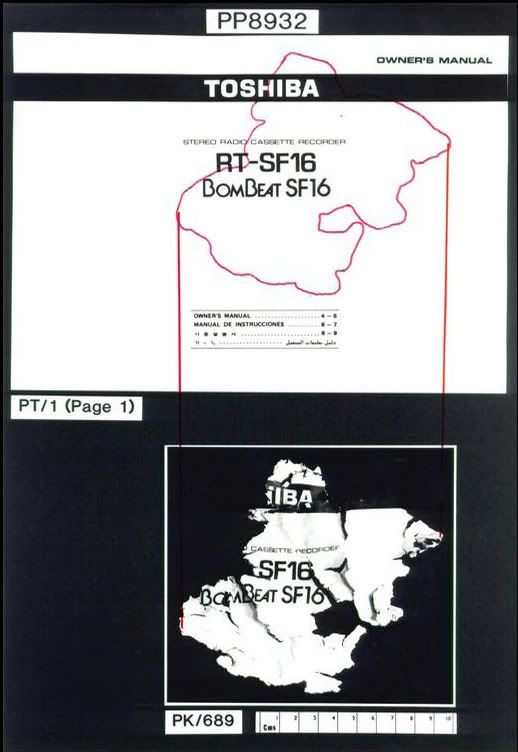
This post will gather the evidence of Gwendoline "Decky" Horton regarding her find of a piece of paper, alleged to have been evidence PK/689 (below, compared to a control sample, PT/1). This was alleged to be the cover off the manual for the bomb radio, which had obviously been near a powerful Semtex explosion, since it's - ripped up a bit. The clearly readable model name identified the model used for the bomb (??) as one sold primarily to a Libyan company.
Mrs. Horton and her husband Robert Geoffrey Horton (or Jeff) had been credited as turning the miracle find in to police in Late December, from their farm near the North Sea. The main controversy about this surfaced at trial in 2000 where Decky but not Jeff testified.


Trial testimony
Camp Zeist, day 6 May 10 2000
Witness number 334, Gwendoline Horton
Transcripts pp 962-966


In her remarkably brief questioning, she re-told of finding "what we thought was just debris, possibly from a passing car or something," on the morning after the crash. Soon they heard there was debris everywhere, and a neighbor told them "she understood it was from the plane that had crashed, and that all the local farmers were collecting it in the fields." So Jeff and Decky headed out to gather what they could in case it had any value. From there her testimony runs:
Q And did you hand material in to the police on that day?
A I can't remember if it was that day or the following day.
Q How many times did you hand material in to the police?
A Twice.
 Q And how did you carry this stuff once you'd gathered it?
A Just in a carrier bag, I think, at the time.
Q I would like to ask you about one item in particular. Do you remember coming upon a document of some sort that made reference to a radio cassette player?
A Yes, I do.
Q Can you describe what that item was like?
A Well, from what I remember, it was possibly about -- I know I'm supposed to say it. * About that kind of size, you know, about possibly eight by eight, or something like that, inches.
* This apparently refers to the usual instruction to speak out sizes, directions, etc. rather than gesturing.

Q Could you see writing on it?
A I could see writing, because I remarked to my husband, "This appears to be from a cassette player," or something like that. I do remember it was something electrical.
Q And did you hand that item in to the police?
A Yes, that went into the bag as well.

Q Right. I wonder if you would look, please, at Label 24. You'll see there is a bag which contains items there. Do you recognise anything?
A Well, not in its present state. I'm sure when I handed it in, it was in one piece.
Q Yes.
A Yes.


Q Perhaps -- I wonder if it could be put on the document imager, to see if we can see it. You can see within the police plastic bag, I think as you've described, more than one piece of a document.
And you can at least see writing on it?
A Yes.
Q Do I understand you to say that when you handed it in, it was in one piece?
A It was in one piece, sir. I am practically sure of that, yes.
Q But apart from that, you recognise the item?
A Yes. Uh-huh.


Q Whereabouts did you find that item?
A In the fields -- we are a private house on the roadside. In the field opposite, they are known as the glebe fields, and it was in the bottom glebe field, down beside the burn, down in the bottom. In the dean.
Q Thank you very much.

[...]
LORD SUTHERLAND: Thank you, Mrs. Horton. You are free to go. Thank you for coming.
THE WITNESS: Thank you.

2008 Media interest
Following the 2007 SCCRC findings that Megrahi deserved a second appeal, and coming on the 20 year anniversary of the attack, 2008 brought attention to the whole case including the Hortons. The trial controversy had the crew of BBC Conspiracy Files visit the farm and get Decky's story on camera.
BBC Conspiracy Files, 2008:
http://lockerbiedivide.blogspot.com/2010/01/video-conspiracy-files-lockerbie.html (Starting around 37:30)
"I was taken into court by the usher, and I had to swear the oath. And then I was shown a plastic bag with this ... piece ... of paper in it. But at the time I was asked is this what I had found. And I said well when I found it, it was in one piece. But in the bag there were several pieces, and the name Toshiba was only just discernable by then."
[...]
"When I found the piece of paper it was more or less intact - a bit tatty around the edges but it definitely had Toshiba written across And it was in one piece, where this is in several pieces."
Narrator: "The police say the evidence had become degraded because it had undergone hundreds of forensic tests."

> Contemporaneous article, The Sunday Sun (UK)
Geoff and Decky Horton found a key piece of evidence after wreckage was strewn over their farm, located 60 miles from the crash site. But the piece of paper — believed to be from the package which contained the bomb that blew up Pan Am Flight 103 — was damaged after it was handed over to investigators.
[...]
Police said the paper was damaged following a battery of forensic tests.
But the documentary says: “Why was the piece of paper so altered from when the Hortons found it? Was it proof of a conspiracy or careless handling by the police? The mystery remains.”
Conspiracy theorists believe key evidence was tampered with to implicate Libya in the bomb plot.
http://www.sundaysun.co.uk/news/north-east-news/2008/08/31/lockerbie-evidence-called-into-question-79310-21640187/

...

Analysis:
Mrs. Horton didn't independently recall any specific wording, including Toshiba, at trial. All she said before being shown the item was "I remarked to my husband, "This appears to be from a cassette player," or something like that. I do remember it was something electrical." In 2008 she claims to have remembered it saying "Toshiba" in its entirety. This could be a false memory. Nonetheless, I suspect it did say Toshiba. The reason being, this fragment appears to be a plant, one designed to exploit an actual memory.If the fragment had said something else, like Panasonic, she might remember that and cry foul when it later said Toshiba. That would be risky. I doubt she would or should recall the tedious model number, be it RT-SF16 or otherwise. The "BomBeat" or lack it might stand out, but it doesn't seem to have.

I also challenge Mrs.Horton's "several pieces" categorization. It can appear that way, but it's described in eaminations, and is, a single sheet of paper, nearly torn through in spots. THE BBC's coverage of this tricked me at first - the question is whether investigators tore up the paper Decky found on purpose. The real question is whether this was the piece she found at all. If so, it was nowhere near the bomb, and then what a coincidence it's for this model, sold primarily in Libya.

Again, it was allegedly torn through from being inches from an explosion that ruptured a plane's hull at over two feet. Or rather, if one trusts both RARDE and Mrs. Horton, one needs to accept that the manual cover (and no other page) was made "a bit tatty around the edges" by that blast, and torn to nearly to shreds by later forensic testing.

These tests were discussed at the Zeist trial. PK/689 was listed as first received at RARDE on both May 11 and June 30 1989. [link] Dr. Hayes' notes said (paraphrased) "this item was received at RARDE on 11/5/89, and then passed to a DC Jordan on the same date for non-destructive fingerprints, and then returned to RARDE on 16th May, passed to DC Jordan on 16th May for chemical treatment after photography." Jordan, by Hayes' recollection, was with either the Metropolitan police or Scotland Yard. [Zeist trial, day 18]

That's all I can find, and no mention of explosives residue testing. It hardly seems worth the hassle, of course, being so clear on the face of it. In fact, I'm half surprised they didn't claim Megrahi's prints from this find.
...

"Take Taggs From Air Malta"

The Case Against Fhimah, part one
May 30 2010

edits June 5

Everyone who accepts Abdelbaset Ali al Megrahi's guilt for the PA103 bombing agrees he couldn't have acted alone. Speculation runs primarily upward to Col. Gaddafi, but also sidewise to his imagined ground level accomplices. Only one was ever clearly fingered, originally as a JSO (Libyan intelligence) operative: Lamin Khalifah Fhimah. It was decided he was working with Libyan Arab Airlines at Malta’s Luqa airport only as cover for his JSO plotting with Megrahi on Malta.

The 1991 indictments against both accused are based on Fhimah penetrating the airport system, up to and including getting the bomb case onto Air Malt flight KM180. As of the 2000 trial, the final Opinion of the Court says, “the Crown no longer suggest that the second accused was a member of the Libyan Intelligence Service,” though his LAA "cover" employment was still acknowledged. Aside from this curious reversal, the Crown maintained a string of “inferences” regarding Fhimah’s December 1988 activity. The Zeist judges considered these claims and rightly dismissed them as “speculation rather than inference.”

These supporting points will be dealt with separately, with this article focused on what the judges called “the principal piece of evidence against [Fhimah],” being the clues read from “two entries in his 1988 diary.” One of these pages is shown below.

It was in April 1991 that Scottish police retrieved Fhimah’s work diary “from the offices of Medtours, a company which had been set up by the second accused and Mr Vassallo.” with the best quote miners around, the investigation managed to glean these two entries, described in the final opinion's paragraph 84:
At the back of the diary there were two pages of numbered notes. The fourteenth item on one page is translated as “Take/collect tags from the airport (Abdulbaset/Abdussalam)”. The word ‘tags’ was written in English, the remainder in Arabic.

On the diary page for 15 December there was an entry, preceded by an asterisk, “Take taggs from Air Malta”, and at the end of that entry in a different coloured ink “OK”. Again the word ‘taggs’ (sic) was in English.
These were taken as a careless plotter jotting down clues of his plot in a diary he kept. He even wrote “tags” in English lettering to make sure the Brits he was targeting could come back and read it easily. The judges explain further:
The Crown maintained that the inference to be drawn from these entries was that the second accused had obtained Air Malta interline tags for the first accused, and that as an airline employee he must have known that the only purpose for which they would be required was to enable an unaccompanied bag to be placed on an aircraft.
The three Scottish judges rightly dismissed the bolded assertion: "it would be going too far to infer that he was necessarily aware that they were to be used for the purpose of blowing up anaircraft." Finally, they summarized their opinion on this evidence and inferences in paragraph 85:
There is no doubt that the second accused did make the entries in the diary to which we have referred. In the context of the explosive device being placed on KM180 at Luqa in a suitcase which must have had attached to it an interline tag to enable it to pass eventually on to PA103, these entries can easily be seen to have a sinister connotation, particularly in the complete absence of any form of explanation.
[…]
Had it been necessary to resolve this matter, we would have found it a difficult problem.
However due to a lack of any single clear outside clue, they could not read much into it. Giaka had stories, but the judges didn’t believe them, and otherwise it was nothing but Crown speculation:
While therefore there may well be a sinister inference to be drawn from the diary entries, we have come to the conclusion that there is insufficient other acceptable evidence to support or confirm such an inference, […] In these circumstances the second accused falls to be acquitted.
If the judges had sufficient clues before forcing them back to consider these entries, it sounds like they could well have accepted his guilt; they cite the entries as fairly suspicious given the “absence of any form of explanation.” But that’s a silly thing to expect – these are quick notes by Fhimah to Fhimah, to access his own brain. Of course he’s not going to explain the background of each note.

But some clues could be gathered by snooping around a bit, as famed reporter Ed Bradley did for a 60 Minutes segment in 1999 [transcript]. After explaining the supposed importance of the diary entries, and covering the lack of evidence for any suspicious suitcase coming from Malta, Bradley returned to those odd entries.
People here who knew Fhimah say he wanted to get his airline’s [Libyan Arab Airlines] baggage tags printed in Malta for less than it cost to print them in Libya. That way he could make a commission on the deal. They say he wanted the Air Malta tags as a sample to show the printer. And there are other notations in this diary that support that story. On December 10th Fhimah wrote “go to the printer.” Another note in the back of the diary says “contact the printer.”
It’s not jotted down right next to his alleged slip-up, but the non-terrorist explanation is to be found. The unusual lettering might suggest he was going to an English-speaking printer on Malta (Maltese and English are the official languages there). This distinct possibility lessens the clarity and importance of the central alleged clue. The other supporting guesses were weaker yet as evidence, and clearly it was no mere technicality that Fhimah was acquitted. There really was “no case to answer” as he plead. A little known fact is that Scots law allows judges three rulings: guilty, not guilty, and not proven (meaning likely guilty but not clear enough to say so). The judges chose the clearer statement “not guilty.”

And if Megrahi’s necessary airside accomplice were truly innocent of the charges, that leaves us with nothing but speculation as to who did assist the bomber. Because Megrahi couldn’t have acted alone, if he acted at all.

Refusing Fuisz

A Tough Sell on Capitol Hill, part three
May 21 2010


As the 2000 trial of Libyans Megrahi and Fhimah was being prepared, one controversy that surfaced and threatened was a revived claim by Dr Richard Fuisz. Reported in the Sunday Herald (Scotland), Fuisz was described as “a multi-millionaire businessman and pharmaceutical researcher,” reported by other sources to have been “the CIA's key operative” in Damascus, Syria in 1988. It was said he could “immediately resolve” the issue and name the true perpetrators of the bombing of Flight 103. None of them were Libyan.

We know of this because he deposited his story - or rather the fact that he had a story - with a Congressional Aide to Rep. Ron Wyden (D-OR). A solid liberal on the House’s blue team, Wyden’s own involvement is unclear. But according to the Herald, this aide shortly swore an affidavit regarding Fuisz’ claims. He had tried to tell the CIA about this before, but had the reports destroyed, the aide says. Further, she relates Fuisz’ assertion that:
"If the government would let me, I could identify the men behind this attack today. I could do the right thing I could go into any crowded restaurant and pick out these men I can tell you their home addresses You won't find [them] anywhere in Libya. You will only find [them] in Damascus. I was investigating on the ground and I know."
The government didn’t let him and one month after that affidavit “a court in Washington DC issued an order,” the Herald explains, “barring him from revealing any information on the grounds of ‘military and state secrets privilege’” Classic conspiracy theory fuel.

However, the paper also reported his gagging actually stemmed from another issue entirely – as part of the legal proceedings about criminal American military assistance to Iraq in its war against Iran. As a millionaire pharmaceutical researcher, that his secrets guarded the "nation's security or diplomatic relations" seems quite troubling.

Dr. Fuisz had apparently held his secret knowledge about Lockerbie for quite some time before coming out with it in late 1994. And legal proceedings being what they are (complex but largely predictable), he might just have guessed the Iraq weapons case could have him silenced any time – as happened in November. October then would be a strange time to simply tell someone, in effect, “I could name the true perps later on, except that I might be gagged.” If he wanted to tell the truth, why not just tell it outright before it’s too late?

There has been an amazing amount of apparent disinformation surrounding the Flight 103 case, and my sense of that is tingling a bit here. But I can’t see either ruling our or fully believing that Fuisz’ locked box contains a key to the case, as some have concluded. The Herald reported some unnamed UN ambassadors, alerted of Fuisz’ story and his gagging, urged the order be lifted to allow him to speak before the trial of the two Libyans. The request was of course ignored (I have the transcripts from the trial and Fuisz is not mentioned that I could find).

Now the congressional aide who had testified to Fuisz’ hints, one Susan Lindauer, was not so much ignored as attacked - albeit a decade later and over a different issue, again involving Iraq.
---
Next: Part four: Susan of Grandeur
---
Source (throughout):
MacKay, Neil. "Lockerbie: CIA witness gagged by US government." Sunday Herald. May 28 2000.
http://findarticles.com/p/articles/mi_qn4156/is_20000528/ai_n13949725/?tag=content;col1

Where in the World is "Abu Elias"?

March 24 2010
major update April 4
(props to Baz, see comments)

last edits 22 September

The Bomb Man Who Got Away
It's time to consider an amazing allegation I'd glossed over before as too complex. "Abu Elias" was a central and elusive figure in the PFLP-GC cell in Neuss tasked with downing an American airliner. The Neuss bomb-maker, Jordanian double-agent Marwan Khreesat, mentioned "Elias" in interviews with the FBI as essentially the fly in the ointment. Khreesat was supposed to keep live bombs out of terrorist hands, but this PFLP-GC higher-up was sent to inspect his work and then take possession of it and sneak it onto a plane (this is explained in detail elsewhere). One live bomb and "Abu Elias," at least, evaded the German police net just six weeks before the PA103 bombing.

For a while, he was a very wanted man. But then the Libyan villains were indicated instead, and by now, reportedly, "Abu Elias" is living safely in Washington DC with a government job and a desire to keep quiet. Below is a partial compendium of claims I haven't yet (or can't) rigorously verify. Much of this could be wrong but the picture that emerges is too amazing to miss seeing in its entirety.
Version One, 1992 - Khaisar Haddad 
No big surprise, "Abu Elias” was an alias, and and the first alleged true name attached to it was Khaisar Haddad. Most Internet postings of this simply repeat the conclusion of the Aangirfan blog (“Reportedly, Khaisar Haddad, known as Abu Elias, was an agent of the US government…”) [1] Otherwise the sources giving this name are old and of the questionable early 1990s revisionism of Juval Aviv, Lester Coleman, et al.

But these cite a clear external source, a report from Yassar Arafat’s PLO shortly after the indictments of Megrahi and Fhimah. An early mention was  Time magazine’s controversial “Why Did They Die?” cover story, in April 1992. “Last month the Palestine Liberation Organization reported that [the bomb] was built by Khaisar Haddad (a.k.a. Abu Elias).” [2] By this telling, our subject built the bomb that wound up back in his hands, perhaps after being modified by Khreesat, who apparently made the other four himself (as linked above, see this post). Coleman and Goddard discussed this report in Trail of the Octopus:
In an 80-page report leaked to the press on both sides of the Atlantic, the PLO described a number of meetings between Ali Akbar Mohtashemi, the Iranian minister of the interior, Ahmed Jibril of the PFLP-GC and other officials in the late summer of 1988 to plan a revenge attack on an American airliner. According to the PLO's sources, the Toshiba radio-cassette bomb used to destroy Flight 103 had been built by Khaisar Haddad, also known as Abu Elias, a blond, blue-eyed Lebanese Christian member of the PFLP-GC, who passed the completed device on to an Iranian contact in Beirut. [3]
One must wonder if his fair appearance was part of his tool kit for getting past European security. But here Haddad just handed it off in Lebanon, counter to what Khreesat's story suggested. By the book's implausible narrative, the bomb was then slipped into Lebanese-American Khalid Jaafar's luggage using the CIA-protected heroin smuggling system at Frankfurt Airport.

Version Two: Goben to Megrahi
The identity of "Abu Elias" again surfaced at the Zeist trial in 2000 with vague news of the supposed deathbed confessions of PFLP-GC member Mobdi Goben ("Goben Memorandum") This reportedly explains how the enigma sneaked the bomb (directly it seems) into Khalid Jaafar's luggage, using just the system alleged in Trail of the Octopus.  Beyond what the PLO's report said, Goben adds that "Elias" was a close relative of PFLP-GC founder Ahmed Jibril. [4] The defense wanted to explore it further, but Lord Advocate Colin Boyd, who was able to read the memo, blocked this as a "fishing expedition." [5]

The alleged true bomber formed part of Megrahi's 2002 appeal and the second appeal granted in 2007. The second time triggered a report from UK Sunday Express, announcing "Finger of Blame for Lockerbie Pointed at American Citizen." This "Abu Elias" sounds like the Goben version, described as a nephew of Jibril but as of summer 2007 anyway living in America and enjoying "a new identity the Sunday Express cannot divulge." [6]

The charge was repeated again by Megrahi and his legal team on the convict's compassionate release in August 2009. Again it was heralded by a story in the Express headlined "I'll Reveal True Identity of Bomber."
"The man Megrahi believes was Abu Elias now lives in a suburban neighbourhood near Washington’s Dulles airport, just a few miles from the White House and the Lockerbie memorial at Arlington National Cemetery. He even has his own Facebook social network page. ... He is the nephew of Syrian terror warlord Ahmed Jibril ... works as a schools engineer for the US government ..." [7]
The paper's team followed the name given (and hopefully more precise clues) and found him at home in suburban Washington. The man denied any involvement and asked to remain unnamed due to "the sensitivity of this matter," as he put it. But the paper reported "he has connections to at least two international terrorists,” one of which, interestingly, is Mohammed Abu Talb. Both Abus had lived in Sweden and had PFLP-GC links, and Abu Talb was the owner of some Maltese clothes similar to those inside the bomb suitcase, and onetime lead suspect for the Lockerbie bombing.

Besides these and his links to the PFLP-GC, the paper also said the Virginian had unspecified "links to the US intelligence services." He was known to the FBI and interviewed by them in August 1988, the report also says, and gives excerpts of a Megrahi appeal document that states: “The FBI had apparently investigated ‘X’ and knew he was the nephew of Ahmed Jibril ..." [8]

Poof, He's in Bush Land
Like the fictional Keyser Söze in The Usual Suspects it almost seems our Khaisar Haddad (?) walked right out of the 'police station' of suspicion as Keaton (Libya) burned for the crime. "And like that, poof. He's gone," down to the Olive Garden with the missus. On Megrahi’s release Member of Scottish Parliament Christine Grahame, who had met and campaigned for the prisoner, described the suspect as “living safely in Washington," possibly as an "intelligence asset." The man, whose new name she too knows, "must be deeply relieved that Megrahi was forced to drop his appeal and that he will never face justice for this atrocity.” [9]

However, according to the Express, Grahame was “believed to be considering naming the man in the Scottish Parliament chamber.” And two weeks later, she delivered, as this video from Channel 4 News and the official record of Scottish parliament for September 2 shows:
“Why have the US authorities not queried the true identity of Basel Bushnaq alias Abu Elias, a senior figure in the PFLP-GC at the time of the bombing and nephew of Ahmed Jibril, former head of that terrorist organisation? Basel Bushnaq currently resides in Washington DC and is in the employ of the schools division.” [10]
(See the video of her speech within this channel 4 production)

“Bushnaq” is an interesting choice of names, likely made while George W. Bush was president. It’s not the most anonymous choice. (see What's in a Name? for a closer look) More4 News in the UK contacted Mr Bushnaq about the allegations, and he replied, calling Grahame’s charges “reckless slander” and suggested "she stops this unless she has solid legal ground." [11] Speaking to the program, Ms Grahame explained “the name was presented in papers from the Scottish Criminal Case Review Commission, again as I said, evidence never seen in a Scottish court,” and will now apparently never be released. Having seen them herself, however, she was confident “the name I have given is a relevant name.” [12]

A different American Basel Bushnaq seems unlikely, as all listings of this unusual name I see give similar details – Basel or Basel A Bushnaq, of Washington DC, Herndon VA, and Franklin TN, age 53 or 54. [13] That’s the kind of variability one should expect within a slapdash record of one person rather than two getting mixed up. There is much left unknown here on how “Abu Elias” really translates to Khaisar Haddad and/or Basel Bushnaq, and Abu Elias' own true role in the bombing remains uncertain. I don’t want to be suckered into a false lead, but presuming he ever existed, Abu Elias got to somewhere, and D.C. makes a certain kind of sense. This could all be a mammoth mix-up as the suspect has said, either by goof or design of the “disinfo/distraction” type. Or it could be a genuine, festering clue of US acquisition and re-branding of the Lockerbie plot. It deserves being sorted out.

If this confusion is easily explained, Mr. Bushnaq, feel free to pop in and help us out – I’d be honored to host the death of a false lead and clear up the suspicion hovering over you if that’s easily enough done. If it is somehow more complex and sensitive than all that, I’ll take that as a sign of something but hold judgment about just what.

---
Sources:
[1] Anonymous. "Reportedly, Khaisar Haddad, known as Abu Elias, was an agent of the US government and carried out the Lockerbie Bombing." Aangirfan. August 23 2009. http://aangirfan.blogspot.com/2009/08/reportedly-khaisar-haddad-known-as-abu.html
[2] "Why Did They Dies?" Time. April __ 1992. http://www.time.com/time/magazine/article/0,9171,159523,00.html
[3] Trail of the Octopus. Online Posting, Chapter 13
[4]De Braeckeleer, Ludwig. "Dialog of a Vengeance Foretold part 107: The Goben Memorandum." Canada Free Press. October 17 2008. http://www.canadafreepress.com/index.php/article/5902
[5,6] Lambie, Derek. “Finger of Blame for Lockerbie Pointed at American Citizen.” Sunday Express. July 8 2007. http://janus.netro42.net/posts/view/12732
[7,8, 9] Borland, Ben. "I'll Reveal True Identity of Bomber." Sunday Express. August 23,2009 http://www.express.co.uk/posts/view/122299/-I-ll-reveal-true-identity-of-bomber%20UK%20NEWS
[10] Grahame, Christine (South of Scotland) (SNP). Remarks in Scottish Parliament, Official Report 2 September 2009. Col 19053 http://www.scottish.parliament.uk/business/officialreports/meetingsparliament/or-09/sor0902-02.htm
[11, 12] More 4 News. “Was Megrahi really the Lockerbie bomber?” 2 September 2009. http://www.channel4.com/news/article.jsp?id=3329697&time=181158
[13] http://www.123people.com/s/basel+bushnaq

Parviz Taheri, Testimony

Day 57, October 7 2000 pp 7720-7759


Extended excerpts in italics. 

Introduction:
Prosecution witness, number 996 on the list, Parviz Taheri, gives evidence in Kurdish. 

Before he is brought in, might I remind Your Lordships that he is one of the persons  mentioned in the special defence  lodged on behalf of each accused.  I don't suggest  to Your Lordships that he should be given a warning, but I remind Your Lordships of his status.
LORD SUTHERLAND:  As he is being used as a Crown witness, he would have immunity  anyway.

Bio up to 1988:
At testimony, Mr. Taheri was 42 years old, lived in Sweden, married with a son, and drove a taxi for a living. He was born in Mahabad, Iranian Kurdistan, all relatives still there, except a brother and a sister who live in Sweden.

Before leaving Iran in 1983, he was "a teacher in the villages on the suburbs of Mahabad." "After the collapse of the Shah, Iran, there were two parties, one called Democrat of Iran and the other one Komola." He says he was suspected of fundraising and organizing for the latter, "so I went via Turkey to Germany."

He arrived on 23 December, 1983, lived in Darmstadt in Germany; then Frankfurt in the early 1985. After a year as a student, he "started working in the council of Frankfurt, then in a publishing house of Frankfurt for a few years."

Q  In 1988, did you become engaged to be married?
A  Yes.  
Q  And in 1988, where did your future wife live?
A  In Sweden, because I had moved -- they had moved to Sweden for a year.

Entrepeneur
"Because I had no constant job, I was using -- I was intending to buy a place with some friends, like a restaurant, or a shop for selling sweets or newspapers.  That was my intention. ... When I moved to Frankfurt in '85, I started thinking of setting up a business ... From '85 to '88. ... I was working from '87 to '88 in -- looking for advertisements in the newspapers.  There was -- then I started looking for auctions or agents for shops.  ... We looked at several places, but it was either because it was unaffordable or because we didn't like the place."

Q  Where did you keep the notes that we've just spoken of?
A  In a notebook which I kept with me.
Q  How many premises did you go to look at?
A  Because it has been for quite a long time since that happened, but as far as I remember -- but I can say that we viewed a place per week. ... I can say in approximately between 40 to 50 places.

Sandweg 28
Q  Did you ever see an advert for premises at Sandweg 28 in Frankfurt?
[...a headquarters of the PFLP-GC cell busted in October, building altimeter bombs like may have downed Flight 103...]
A  I can't remember precisely where that is, but we looked for several places in Frankfurt, but I can't remember all the places.  Even if I was taken to Frankfurt, I might not be able to point out the places -- all the places that we had viewed.
Q  All right.  Does that address mean anything to you now, then?
A  Which address are you referring to?
Q  Sandweg 28 in Frankfurt.
A  It doesn't ring a bell in my recollection.  The only thing that I remember in Frankfurt is my old address and some old addresses that I still keep in contact with them.  Apart from that, I can't remember any other addresses.

21 December, Frankfurt Airport
(cross examination)
Q  ... When you checked in on the 21st of December of 1988 through Pan Am employee Irene Reijheus, did you tell her that you had visited London often and did not require a visa?  It's a simple question, Mr. Taheri.  Did you tell her?
A  I can't remember if I had told anything to her, because I travel in a normal way. You just check in, and you show your documents if required. 
...
Q  Well, if Ms. Reijheus felt so alarmed by what she saw that she called up her colleague, Jasmine Sadiq, to help her with you ... If Ms. Sadiq, Jasmine Sadiq, who was also an employee of  Pan Am, remembered seeing you at the check-in, and indicated that you looked very nervous, can you explain why she would have that view, if this was a perfectly normal check-in by you, Mr. Taheri?
A  Yes.  People usually get upset if they have a fight, but I was very happy and pleased. I was not upset at all, and I was looking forward to arrive to London to meet my friends and my future wife.  There was no disturbance at all.

Catering 
Q  Now, just two final matters.  Your intention was to work in the catering industry; is that right?
[...]
A  Yes.  In English it's called take-away. I was, yes, in such a place.
Q  Where did you get that idea, as a teacher, that you would move into catering?
A  I tried to work in my specialization, but I couldn't find any job.  I followed some courses, but it was very difficult to find the job that I wanted.  Therefore, I started thinking of finding some other job with a -- more profit.
Q  Did the German police tell you that that was another coincidence in your account? Because the individuals who were arrested in connection with the possession of arms, ammunitions, and explosives, at the address you had in your notebook, were also concerned in the catering industry, which they used as a convenient front for their activities. So here we've got another coincidence, Mr. Taheri.  Now, these may be coincidences, but there is now four of them.

Training
A  Yes, I was asked by the German police regarding these matters and if I came across  anything to do with ammunition.  Yes, I said I had served in the Iranian army for two years, and in the first six months, I was trained in arms and ammunition in Iran.
Q  There is maybe a fifth coincidence coming along, Mr. Taheri.  You are a trained individual in weapons?
A  Yes, this is correct, because I had a training in my military service, and then after I finished my military service, I worked as a teacher in the villages in Iran.

Helsinki
Q  Now, I think the West German police said to you that if you were not involved in the tragedy that happened to Pan Am 103, did you, with your connections, have any idea who might be involved; is that right?  They asked you that question?
A  Yes, it is correct.
Q  And you told them to look somewhere in particular, didn't you?
A  I don't know what you are referring to.
Q  Well, let's see if I can jog your memory.  Did you direct their attention to the Iranian embassy in Helsinki?
A  No, I haven't contacted Iranian embassy at all.  I had been to Helsinki just as a tourist.
Q  We are at cross purposes.  When the German police asked you if you could help them by giving advice on who might be responsible, did you say to them that they should look at the Iranian embassy in Helsinki?
A  No, I was not asked about the Iranian embassy in Helsinki by the German police, but they only asked my point of view regarding that incident.  And I said I don't know.
Q  My Lord, that's all I ask.
LORD SUTHERLAND:  Mr. Keen.
MR. KEEN:  No questions.


LORD SUTHERLAND:  Advocate Depute. 
MR. TURNBULL:  I have no re-examination. Thank you, My Lords.
LORD SUTHERLAND:  Thank you.  That's all.