FROM LOCKERBIE TO ZEIST (via Tripoli, Tunis and Cairo)

*Note: What follows is an article on the establishment of the Camp Zeist Trial written by Professor Robert Black. It was previously published in a Maltese book edited by Joe Mifsud - Lockerbie: Qabel il Verdet (Before the Verdict), released in 2000.  It was sent in to me by Robert Forrester, and with Prof. Black's express permission, here it is, and interesting broad-sweep view of a years-long campaign to implement the trial the Americans had been demanding. (- C.L. March 2 '10)*

FROM LOCKERBIE TO ZEIST 
(via Tripoli, Tunis and Cairo)
by
Robert Black QC
Professor of Scots Law
The University of Edinburgh

"Call the diet: Her Majesty's Advocate against Abdelbaset Ali Mohmed al-Megrahi and Al Amin Khalifa Fhima."  

It was with those words that on Wednesday 3 May 2000 the long-delayed Lockerbie trial opened in the High Court of Justiciary sitting at Kamp van Zeist near Utrecht in the Netherlands.  There were those who predicted that this trial would never take place and there were those who worked tirelessly, but ultimately unsuccessfully, to try to ensure that it would not.  My purpose in this paper is to give you an account of my part in attempting to secure, over some rather powerful opposition, that there would in fact be a trial.

The Event
On Wednesday, 21 December 1988 at 7:03 pm GMT a Boeing 747 airliner owned and operated by Pan American World Airlines and cruising at 31,000 feet exploded above the small town of Lockerbie.  Pan Am Flight 103 had taken off from London Heathrow some 38 minutes before and was en route to JFK Airport in New York.  Aboard the aircraft were 243 passengers and a crew of sixteen.  None survived.  The vast majority of those on board were United States citizens, but other nationalities represented included British, French, Israeli, Hungarian, Canadian, German, Spanish, Belgian and Norwegian. Although the disaster occurred only four days before Christmas and every other transatlantic flight was fully booked, this particular aircraft was more than one-third empty, only 243 out of 412 seats being occupied.

Debris from the explosion completely demolished three houses in Sherwood Crescent, a small street of privately owned detached houses, and eleven townspeople were killed instantly.

The Investigation
Within a week it had become apparent to the joint team of British and American investigators that this had been no accident and that the cause of the destruction of the aircraft had been a bomb.  There then followed the most extensive criminal investigation ever conducted in Scotland -- or, it seems probable, anywhere else -- into an act of terrorism.  The investigation was under the control of the Dumfries and Galloway police -- the smallest force in Scotland.  Also closely involved in the investigation were other United Kingdom police forces and personnel from the British, United States, and west German intelligence services.

Around and to the south of Lockerbie some 845 square miles of land were combed for debris.  Over a period of several years more than 15,000 people were questioned; information and evidence were sought in more than 30 different countries.  The aircraft had been some thirty minutes late in leaving Heathrow.  Had it been on schedule, the bomb (assuming that it was detonated by a timing mechanism) would have exploded over the Atlantic Ocean, sparing the town of Lockerbie but making investigation of the accident and recovery of physical evidence very much more difficult.

In mid-1990 it was reported (in the Washington Post and the London Times among other places) that sources within the US Central Intelligence Agency were indicating that the evidence pointed towards the atrocity's having been committed by Ahmed Jibril's Syrian-backed Popular Front for the Liberation of Palestine-General Command (PFLP-GC).  The theory was that this group had been commissioned and paid by Ayatollah Khomeini to destroy an American airliner in revenge for the American warship Vincennes shooting down in the Persian Gulf an Iranian Airbus containing pilgrims to Mecca on 3 July 1988 resulting in the death of all 290 people on board.

Libya Enters the Frame
It will therefore be appreciated that it came a something of a surprise when on 14 November 1991 the prosecution authorities in Scotland and the United States simultaneously announced that they had brought criminal charges against two named Libyan nationals who were alleged to be members, and to have been acting throughout as agents, of the Libyan intelligence service.

According to the Scottish and American prosecutors, what had happened was this.  The two Libyans had manufactured a bomb using a Toshiba cassette recorder, Semtex explosive and a digital electric timer (supplied and manufactured by a Swiss company, MeBo AG).  The device had been placed in a brown Samsonite suitcase in Malta, along with items of clothing purchased for the purpose from a particular shop (Mary's House) in Sliema.  Using stolen Air Malta luggage tags, the Libyans (one of whom had occupied the post of station manager for Libyan Arab Airlines in Malta) introduced the suitcase into Luqa  airport's inter-line baggage system as unaccompanied luggage on Air Malta Flight KM 180 from Malta to Frankfurt, with directions for its onward transmission (first) on to a feeder flight (PA  103A)  to Heathrow and (second) on to Pan Am Flight 103 from Heathrow to JFK in New York.

On 27 November 1991 the governments of the United Kingdom and the United States each issued a statement calling upon the Libyan government to hand over the two accused to either the Scottish or the American authorities for trial.  Requests for their extradition were transmitted to the government of Libya through diplomatic channels.  No extradition treaties are in force between Libya on the one hand and United Kingdom and the United States on the other.

Libyan internal law, in common with the laws of many countries in the world, does not permit the extradition of its own nationals for trial overseas.  The government of Libya accordingly contended that the affair should be resolved through the application of the provisions of a 1971 civil aviation Convention concluded in Montreal to which all three relevant governments are signatories.  That Convention provides that a state in whose territory persons accused of terrorist offences against aircraft are resident has a choice aut dedere aut judicare, either to hand over the accused for trial in the courts of the state bringing the accusation or to take the necessary steps to have the accused brought to trial in its own domestic courts.  In purported compliance with the second of these options, the Libyan authorities arrested the two accused and appointed a Supreme Court judge as examining magistrate to consider the evidence and prepare the case against them.  Not surprisingly, perhaps, the UK and US governments refused to make available to the examining magistrate the evidence that they claimed to have amassed against the accused, who remained under house arrest until they were eventually handed over in April 1999 for trial at Kamp van Zeist.

The United Nations
The United Nations Security Council (of which the UK and the USA are, of course, permanent members) first became involved in the Lockerbie affair on 21 January 1992 when it passed Resolution 731 strongly deploring the government of Libya's lack of co-operation in the matter and urging it to respond to the British and American requests contained in their statements of 27 November 1991.  This was followed by Security Council Resolution 748 (31 March 1992)  requiring Libya to comply with the requests within a stipulated period of time, failing which a list of sanctions specified in the Resolution would be imposed.  Compliance was not forthcoming and sanctions (including trade and air transport embargos) duly came into effect in April 1992.  The range and application of these sanctions was  extended by a further Resolution passed on 11 November 1993.  The imposition of sanctions under these last two Resolutions was justified by the Security Council by reference to Chapter 7 of the Charter of the United Nations on the basis that Libya's failure to extradite the accused constituted a threat to world peace.

An Attempt to Resolve the Impasse
I first became involved in the Lockerbie affair in early 1993.  I was approached by representatives of a group of British businessmen whose desire to participate in major engineering works in Libya was being impeded by the UN sanctions.  They asked if I would be prepared to provide (on an unpaid basis) independent advice to the government of Libya on matters of Scottish criminal law,  procedure and evidence with a view (it was hoped) to persuading them that their two citizens would obtain a fair trial if they were to surrender themselves to the Scottish authorities.  This I agreed to do, and submitted material setting out the essentials of Scottish solemn criminal procedure and the various protections embodied in it for accused persons. 

In the light of this material, it was indicated to me that the Libyan government was satisfied regarding the fairness of a criminal trial in Scotland but that since Libyan law prevented the extradition of nationals for trial overseas, the ultimate decision on surrender for trial would have to be one taken voluntarily by the accused persons themselves, in consultation with their independent legal advisers.  For this purpose a meeting was convened in Tripoli in October 1993 of the international team of lawyers which had already been appointed to represent the accused.  This team consisted of lawyers from Scotland, England, Malta, Switzerland and the United States and was chaired by the principal Libyan lawyer for the accused, Dr Ibrahim Legwell.  The Libyan government asked me to be present in Tripoli while the team was meeting so that the government itself would have access to independent Scottish legal advice should the need arise.  However, the Libyan government expectation was clearly that the outcome of the meeting of the defence team would be a decision by the two accused voluntarily to agree to stand trial in Scotland.

I am able personally to testify to how much of a surprise and embarrassment it was to the Libyan government when the outcome of the meeting of the defence team was an announcement that the accused were not prepared to surrender themselves for trial in Scotland.  In the course of a private meeting that I had a day later with Dr Legwell, he explained to me that the primary reason for the unwillingness of the accused to stand trial in Scotland was their belief that, because of unprecedented pre-trial publicity over the years, a Scottish jury could not possibly bring to their consideration of the evidence in this case the degree of impartiality and open-mindedness that accused persons are entitled to expect and that a fair trial demands.  A secondary consideration was the issue of the physical security of the accused if the trial were to be held in Scotland.  Not that it was being contended that ravening mobs of enraged Scottish citizens would storm Barlinnie prison, seize the accused and string them up from the nearest lamp posts.  Rather, the fear was that they might be snatched by special forces of the United States, removed to America and put on trial there (or, like Lee Harvey Oswald, suffer an unfortunate accident before being put on trial).

 The Libyan government attitude remained, as it always had been, that they had no constitutional authority to hand their citizens over to the Scottish authorities for trial.  The question of voluntary surrender for trial was one for the accused and their legal advisers, and while the Libyan government would place no obstacles in the path of, and indeed would welcome, such a course of action, there was nothing that it could lawfully do to achieve it.

An Innocent Abroad
My journeys to and from Tripoli in October 1993 were interesting.  Because of UN sanctions, air travel to Tripoli was out of the question.  The normal procedure at that time was to fly from Europe to the nearest Tunisian airport on the holiday island of Djerba and then travel by car along the coast road to Tripoli, a frightening five-hour journey at the best of times but especially so when being driven at breakneck speed in a Libyan government black Mercedes whose driver clearly regarded it as the duty of every other road user to get out of the path of his vehicle and refused to concede even the possibility that any  road user, Tunisian or Libyan, might fail to do so. 

On my return journey I was unable to get a flight from Djerba to any European airport and so took an internal flight from Djerba to Tunis in the naive belief that flights to European destinations would be more frequent from the Tunisian capital.  On arrival in Tunis at 5pm I discovered that there were no further flights to any European destination that day.  I made a booking for an early flight to London the following morning and proceeded to try to find accommodation for the night.  It was only then that I discovered that a meeting of the Council of the PLO was taking place in Tunis and that there was accordingly not a single room to be had in any of the major hotels in the city.  Eventually, however, my taxi driver indicated that he had a friend who ran a small hotel and that he was sure that I would be able to find accommodation there.  He was indeed correct, though I suspect that I am the only guest in the history of the establishment who has ever paid for a room there other than by the hour.

The Neutral Venue Proposal
Having mulled over the concerns expressed to me by Dr Legwell in October 1993, I returned to Tripoli and on 10 January 1994 presented a letter to him suggesting a means of resolving the impasse created by the insistence of the governments of the United Kingdom and United States that the accused be surrendered for trial in Scotland or America and the adamant refusal of the accused to submit themselves for trial by jury in either of these countries.  This was a detailed proposal, but in essence its principal elements were: that a trial be held outside Scotland, ideally in the Netherlands, in which the governing law and procedure would be that followed in Scottish criminal trials on indictment but with this major alteration, namely that the jury of 15 persons which is a feature of that procedure be replaced by a panel of judges who would have the responsibility of deciding not only questions of law but also the ultimate question of whether the guilt of the accused had been established on the evidence beyond reasonable doubt.

In a letter to me dated 12 January 1994, Dr Legwell stated that he had consulted his clients,  that this scheme was wholly acceptable to them and that if it were implemented by the government of the United Kingdom the suspects would voluntarily surrender themselves for trial before a tribunal so constituted.  By a letter of the same date the Deputy Foreign Minister of Libya stated that his government approved of the proposal and would place no obstacles in the path of its two citizens should they elect to submit to trial under this scheme.

The UK Government's Initial Attitude
On my return to the United Kingdom I submitted the relevant documents to the Foreign Office in London and the Crown Office (the headquarters of the Scottish prosecution service) in Edinburgh.  Their immediate response was that this scheme was impossible, impracticable and inherently undesirable, with the clear implication that Professor Black had taken leave of what few senses nature had endowed him with. That remained the attitude of successive Lord Advocates and Foreign Secretaries for four years and seven months.  During this period the British government's stance remained consistent: United Nations Security Council Resolutions placed upon the government of Libya a binding international legal obligation to hand over the accused for trial to the UK or the US authorities.  Nothing else would do.  If Libyan law did not currently permit the extradition of its own nationals to stand trial overseas, then Libya should simply alter its law (and, if necessary, its Constitution) to enable it to fulfil its international duty.

Over the years British government sources put forward six specific objections to my proposal.  There was no merit in any of these objections, as I think I have conclusively demonstrated in an article published in November 1997: see “The Lockerbie Proposal”  1997 Scots Law Times (News) 304.

Delay
For almost five years successive governments of the United Kingdom (of both old Conservative and New Labour political persuasions) consistently and fervently maintained that the "neutral venue" scheme which I had proposed and which had been accepted by the Libyan government and defence lawyers in January 1994, was totally and absolutely unsatisfactory and could provide no resolution to the Lockerbie impasse.  For a flavour of the vehemence of  government opposition to the scheme, as recently as early 1998, reference may be made to the article by the then Lord Advocate,  Lord Hardie “The Lockerbie Trial” 1998 Scots Law Times (News) 9, to the statement made in the UN Security Council on 20 March 1998 by the UK Permanent Representative, Sir John Weston (see www.britain-info.org/bistext/ukmis/speeches/20mar98.stm) and to the  statement in the House of Commons on 29 April 1998 by Foreign Office Minister Derek Fatchett (see HC Hansard, 29/04/1998, cols 299-302).

President Nelson Mandela of South Africa expressed his strong support for the proposal during his attendance at the Commonwealth Heads of Government Conference in Edinburgh in October 1997.  But that seemed to cut no ice with Robin Cook, the new Foreign Secretary who, admittedly, probably had other more personal matters on his mind at the time.  

Not surprisingly, Libyan patience at the refusal of the United Kingdom and the United States even to contemplate the “neutral venue” solution eventually began to wear thin.

In April 1998 Dr Jim Swire (the spokesman for the relatives group UK Families Flight 103) and I had a meeting in Cairo with the Secretary-General of the League of Arab Nations, Dr Esmet Abdul Majid, and were informed that in the light of more than four years of British and American intransigence the Libyans were seriously considering announcing withdrawal of their support for the proposal.  It was suggested to us by Dr Majid that it might be appropriate for us, if we wished to avoid this outcome, to make yet another trip to Tripoli.  This we did, and in a meeting with Dr Ibrahim Legwell were assured that it remained the position of the suspects that they would surrender for trial if such a court were established.  It was the Libyan government that was apparently, because of British and American procrastination, having second thoughts about permitting its citizens to leave the country to stand trial voluntarily before such a tribunal. 

The Libyan Foreign Ministry committee, with whom all of my previous dealings had been, arranged for Dr Swire and me to have a meeting with Colonel Gaddafi and this took place on 20 April 1998 at his reinforced concrete tent on the outskirts of Tripoli.  The meeting was initially a frosty one, with the Colonel refusing to make eye contact but instead staring straight ahead with his arms folded and making lengthy pronouncements about the inflexibility and intransigence over more than four years of the British government.  When eventually he interrupted his monologue to take breath, we were able to dive in with comments to the effect that the Labour government had been in office for less than a year, was still finding its feet in foreign affairs and that it was possible to detect some signs that its position over the Lockerbie issue might just be somewhat more flexible than that of its Conservative predecessor.  Gaddafi then made a few highly complimentary remarks about Tony Blair, and the remainder of the meeting was held in a much more friendly atmosphere.  After about an hour, we departed with the reassurance that the Libyan government’s policy in relation to a “neutral venue” trial would remain unchanged for at least a further six months.  As we were leaving Gaddafi's compound the then Libyan Foreign Minister, Omar al-Muntasser, who had been present at the meeting, said to us: "You made the Leader laugh three times!  Someone will pay for that!"  I think he was joking.

The Volte-face
From about late July 1998, there began to be leaks from UK government sources to the effect that a policy change over Lockerbie was imminent, and on 24 August 1998 the governments of the United Kingdom and United States announced that they had reversed their stance on the matter of a "neutral venue" trial.  In a letter of that date to the Secretary-General of the United Nations, Kofi Annan, the British and American Acting Permanent Representatives to the UN stated:

 "....  in the interest of resolving this situation in a way which will allow justice to be done, our Governments are prepared, as an exceptional measure, to arrange for the two accused to be tried before a Scottish court sitting in the Netherlands.  After close consultation with the Government of the Kingdom of the Netherlands, we are pleased to confirm that the Government of the Kingdom of the Netherlands has agreed to facilitate arrangements for such a court.  It would be a Scottish court and would follow normal Scots law and procedure in every respect except for the replacement of the jury by a panel of three Scottish High Court judges.  The Scottish rules of evidence and procedure, and all the guarantees of fair trial provided by the law Scotland, would apply."

The details of the arrangement -- the fine print -- are to be found in two documents: a British Order in Council (SI 1998 No 2251), made on 16 September 1998, conferring the necessary legal authority for Scottish criminal proceedings against the two Libyan suspects to be conducted in the Netherlands, and an international agreement between the Government of the Kingdom of the Netherlands and the Government of the United Kingdom, concluded on 18 September 1998, making the diplomatic arrangements necessary for the "neutral venue" trial to take place.  The scheme set out in these two documents differs in detail from that which I proposed, and to which I had obtained Libyan assent, in January 1994; but the framework is the same.

Pitfalls along the Route
Although the British proposal was announced in late August 1998, it was not until 5 April 1999 that the two suspects actually arrived in the Netherlands for trial before the Scottish court.  Why the delay?  The answer is that some of the fine print in the two documents was capable of being interpreted, and was in fact interpreted, by the Libyan defence team and the Libyan government as having been deliberately designed to create pitfalls to entrap them.  And since the governments of the United Kingdom and United States resolutely refused to have any direct contact with either the Libyan government or the Libyan defence lawyers, these concerns could be dealt with only through an intermediary, namely the Secretary-General of the United Nations. 

Between 20 and 22 September 1998, Dr Swire and I were again in Tripoli and were able to provide to the Libyan government and the Libyan defence team a measure of reassurance regarding some of the issues that concerned them.  However, it was we  who (having received the information hot off the presses from a journalist in The Hague) had to inform the Libyan government that the chosen location in the Netherlands for trial was Kamp van Zeist, a former NATO base to which the air force of the United States still had extant treaty rights of access.  I anticipated that this information would cause the Libyans to renounce the "neutral venue" concept in high dudgeon and complain of the lack of good faith demonstrated by Her Majesty's Government in selecting, or agreeing to, such a site.  But they did not do so.  This, more than anything else, convinced me that the Libyan government and the Libyan defence lawyers genuinely wished a trial to take place and that the concerns they had expressed regarding details of the scheme now on offer were genuine concerns, not merely a colourable pretext for evading their earlier commitment to such a solution.

On 22 September we had a further meeting with the Leader of the Revolution.  On this occasion the meeting took place not in Tripoli but 400 kilometres to the east in a genuine (not reinforced concrete) Bedouin tent in a desert location inland from the town of Sirte.  Surrounded by sand dunes and noisily ruminating camels, Colonel Gaddafi, Dr Swire and I  discussed the details of the British scheme.  He accepted my assurance that at least some of the concerns that Libyan government lawyers had raised were unwarranted and that it would be worthwhile to continue to seek clarifications and reassurances through the office of the Secretary-General of the United Nations regarding the remaining issues. 

Incidentally, this meeting with Gaddafi was held on the day that President Clinton's deposition in the Monica Lewinsky case was televised.  In the course of the pleasantries that took place before we all got down to business, Gaddafi informed us that he had spent the morning watching the President's performance on CNN television.  What most shocked him, he said, was the revelation that on occasions while Miss Lewinsky was dutifully serving her President, the latter was speaking to foreign Heads of State on the telephone.    Gaddafi's comment  was that he thought that the President should have it cut off.

Conclusion
Although many within the governments of Britain and the United States and within the media were sceptical, the suspects did eventually, on 5 April 1999, surrender themselves for trial before the Scottish court at Kamp van Zeist.  That trial, after lengthy delays necessitated by the defence's need for adequate time to prepare, started on Wednesday 3 May 2000. 

I feel a distinct measure of pride in the part that I, a Lockerbie boy born and bred, and a simple professor of law, played in bringing it about.  I have reason to suspect, however, that my government feels  no  sense of gratitude towards me.   And I feel no pride whatsoever in the outcome of the proceedings.  The conviction of Abdelbaset al-Megrahi on the evidence led at the trial constitutes, in my view, a flagrant miscarriage of justice, and one that I hope to live to see rectified.

The Magnitude And Firstness of the Lockerbie Bombing

Adam Larson/Caustic Logic
March 9 2010
last edit March 10 2am


This post is for those too young to remember or too unclear or numbed to understand or feel the significance of the bombing of Pan Am 103 and the geopolitical maneuvers following it. At 7:00 PM on December 21, 1988, the darkest day of the year, Pan Am flight 103 was just reaching cruising altitude nearly six miles above southern Scotland. The Boeing 747 was carrying 243 passengers and a crew of sixteen, mostly returning home for Christmas. 38 minutes after they had left from London’s Heathrow airport to New York’s JFK, at a hair before 7:03, a bomb detonated in the forward cargo hold and ruptured the hull. What followed can best be understood by viewing this amazing and probably quite accurate animation:

Prior to the 9/11 attacks in New York and Washington, the bombing of Pan Am 103 had stood as the deadliest ever terrorist attack on American civilians, and it still holds a distant second place. 270 people died in the attack, 189 of them Americans, including many military service members, college students, and young children. Eleven residents of Lockerbie, Scotland were killed when the main part of the plane plowed into the Sherwood Crescent neighborhood.

What followed the crash was “the largest mass murder trial in British history,” first covering the 800 sq. miles of debris and later the global mazes of a cross-border plot. [NYT] Naturally, the Scottish police backed by the American FBI and other US and UK agencies led the investigation.

The responsible airline, Pan American Airways, had been until the 1980s an American giant of aviation, the World Trade Center of the skies. After Lockerbie, they were vilified, bankrupted and destroyed by a string of lawsuits filed over their egregious security breaches at Frankfurt Airport. This doesn’t even count the still unacknowledged security breach at Heathrow that allowed the bomb to slip onto PA103 there.

The actual perpetrators were also pursued; “Lockerbie was perhaps the first truly global terrorism investigation.” [Time] This gave American and British authorities more people than usual to tell how things are. Germany, Malta, Jordan, Switzerland, and Sweden especially had significant roles in forming or following the investigation’s course. This had led to Libya with the joint Scots-American indictments of al Megrahi and Fhimah in November 1991.

After that the case moved to another level and witnessed, in 1992, the United Nations Security Council demanding the two accused be handed over for trial in the U.S. Sanctions were imposed when the demand was (inevitably) refused. “This is the first time the Security Council has ever demanded the extradition of citizens of one country to stand trial in another or implicitly accused a member government of involvement in terrorism.” [NYT] When the two accused were eventually handed over in 1999 for a compromise trial the Americans had prevented for years, obviously it was the first time such a demand was honored.

Alan Gerson was involved with pressing lawsuits against Libya for victims’ families, wrote a book with Jerry Adler (The Price of Terror, 2001) that explained a massive first - the unprecedented rulings and Congressional act establishing that a “rogue state” like Libya was exempt from the coverage of the Foreign Sovereign Immunities Act, “a much bigger change than the families had ever sought, or perhaps needed.”
“Early on, Gerson and Zaid had intended merely to carve out the narrowest possible exception to the rule of sovereign immunity. […] they never sought to achieve a new world order based on the rule of law […] Instead the government got the FSIA amendment, which […] opened the doors for individuals to take on foreign governments for a much wider range of offenses, with consequences no one quite anticipated.” [p 295]
The way to suing foreign governments for alleged violence against Americans opened by these Lockerbie-led rulings has since been used in cases against Iran, Cuba, and other unloved nations, besides Libya.

The trial of Megrahi and Fhimah itself was held at “Kamp van Zeist” in “neutral” Netherlands. It was “the first time a patch of overseas soil has been designated Scottish to allow such an event.” [NYT] It was also perhaps the first time such a trial had been held in “a former NATO base to which the air force of the United States still had extant treaty rights of access.” [Robert Black]

Assorted firsts of the Lockerbie trial at Camp Zeist:
“… the first time a Scottish court has sat on foreign territory. Unusually, there was no jury.” [BBC]
“…the first Scottish murder trial to use judges instead of a jury. […] the first time a trial in what is nominally Britain has attracted the wide attention usually associated with the American courts." [NYT]
"'In many senses this trial is unique,' said John P. Grant, who leads a team of law professors from the University of Glasgow studying the trial and helping journalists understand Scottish law. 'It may become the longest trial in British history. It certainly will be the most expensive.'" [NYT]
“...the first time that LiveNote software has been used in a Scottish court to produce simultaneous transcripts; […] the most expensive and possibly the longest trial in Scottish legal history, employing the largest prosecution and investigation team without even including US Department of Justice personnel; […] held in what is quite possibly the most secure and most high-tech courthouse ever built." [Jurist]
The testimony of Libyan defector, CIA asset, FBI star witness, and obvious fabricator "Abdul Majid Giaka" was another first. As Gerson and Adler put it, “never before had the CIA permitted one of its intelligence sources to testify in open court about his work, and his testimony quickly showed why.” [p 282-83] The judges were forced to dismiss the tales that originally provided the skeleton of the case against Libya, while accepting the boneless mass that remained.

Following the guilty/not Guilty verdict of January 31 2001, Libya eventually negotiated a settlement with victims’ families – eventually settled in 2003 at $2.7 billion plus an admittedly hollow statement of “responsibility” for things Libyan agents actually do. Jim Kriendler of law firm Kriendler & Kriendler (New York), who represented some of the victim’s families (none too well says Gerson), called it “the first time that any of the states designated as sponsors of terrorism have offered compensation to families of terror victims." [UNWire] When Americans and the BBC use that agreement and mammoth settlement as evidence that the Libyans really did it, obviously that’s the first time such an original gesture was twisted in such a way.

In these and other ways, long before the controversial release and "Hero's welcome" granted to the "convicted bomber" in 2009, this Lockerbie attack and its long fallout are highly relevant and worthy of careful scrutiny. Considering the case underpinning all of the above is so full of questions, it becomes doubly so. It may stand nowhere near first among issues of global justice that demand action, but it's certainly one among many and a fascinating one at that.
---

Professor Black's Reward

Professor Black's Reward
The Lockerbie Divide 

15 March 2010

I'd like to address a minor controversy that arose recently, and may arise again, about Scots Law Professor Robert Black's negotiation of the framework for the trial that resulted in Megrahi's conviction in 2001. I recently re-posted Professor Black's 2000 article From Lockerbie to Zeist (via Tripoli, Tunis and Cairo), outlining his journey in the late 1990s to get the trial agreed to by all sides.  An anonymous reader posted a comment there reading in full:
Some observations and questions:

1)“It came of some surprise when on 14 November 1991 the prosecution authorities in Scotland and the United States simultaneously announced that they had brought criminal charges against two named Libyan nationals who were alleged to be members, and to have been acting throughout as agents, of the Libyan intelligence service”

Why would it come as such a surprise? Surely Pr. Black was well aware of Libya’s involvement and support of terrorist activities; including the Abu Nidal Organization and the Popular Front for the Liberation of Palestine-General Command – some of whom were arrested in the Autumn leaves sting in Germany, where bomb making equipment was siezed. Said equipment had many similarities (outside of the timing device) to the PA103 bomb.

2)Who exactly were the group of British businessmen who approached Professor Black and what exactly were their desired “major engineering works in Libya” ? Oil springs to mind. BP perhaps? Smacks of a deal in the desert… Oh what a wicked web…

3)Pr. Black insults the reader by insinuating that anyone in their right mind would believe that he (Pr. Black) would, on an unpaid basis, endure traveling to Libya against sanctions, and risk being kidnapped or killed at that time. But then again, perhaps Black defies the definition of “right mind”, and/or "unpaid".

March 9, 2010 2:19 PM
My limited experience and gut instinct say it's Richard Marquise, but at any rate likely an American with a deep connection to the case and a gripe against Black. Did the Professor just help arrange the trial to help end sanctions and make millions in oil kickbacks?  I had first agreed that oil was the most likely business to have sent people to the seek his help, and conceded that possibly "he got paid indirectly, or secretly, or what have you." I strongly suggested the commenter was involved in spinning the investigation, and asked how much he was paid, and closed with this ponderable:
If "unpaid basis" means literally that, in all way shape or form, I take his word. The point is, it doesn't change the fact that he arranged the framework for a trial where the Libyans WERE handed over to Scottish jusrisdiction as demanded. Megrahi was then convicted. The US maintains its sanctions though the UN does not.
You act as if this is a bad thing, helping arrange Camp Zeist. Why would one be upset and look to discredit such work? 
A concerned reader suggested I remove the comment, and maybe my responses, as being "over the mark" and plain offensive. Yeah, but it was on-topic, and a question people will only naturally wonder about. I was concerned enough to ask Professor Black himself. In his South Africa season at the moment, it took a day or so to hear of his lack of worry, and a clarification that will likely fail to satisfy Anonymous:
"I wasn't paid -- either by the businessmen or the Libyans. Indeed, the fact that no fee was involved was one of the main reasons why the Dean of Faculty (the leader of the Scottish Bar) recommended to the businessmen that they should approach me rather than any other member of the Scottish Bar. The businessmen in question were not involved in the oil industry: their field was civil engineering and construction."
- e-mail, March 13, 2010 11:13 PM
Was it oil-related engineering? Oh, give it a rest...

Robert Black helped change history a little, and to some people, this alone could be plenty reward for such works. Aside from that, if one is too cynical to accept hunger for Justice or the Common Good as motives, or a reward in the afterlife, we might also consider bragging rights as the "architect of the Lockerbie trial," or the position from which to publish a book on the adventure. He wouldn't be the first.

I'm just savvy enough to suspect multiple motives, and if money had been in there, I personally would see no ethical issues with it. That said, the professor wasn't paid. I'm ready to move on.  Let this post serve as the spot to discuss this issue any further, and leave From Lockerbie to Zeist for discussing that paper's content.

Iranian vs. Libyan Role in the Lockerbie Bombing

(incomplete)

Critical Americans Speak in Whispers
Now-famous retired CIA guy Robert Baer is one who's always suspected Iranian involvement, with little if any help from Libya. Alan Gerson and Jerry Adler's 2001 book The Price of Terror mentions a meeting Baer had with PA103 families leader Victoria Cummock, in which he expressed his concern that Iran's role was minimized. Cummock, who lost her husband in the boombing, told the book:
"He voiced what Paul Hudson and I had been saying to each other all thhrough the end of 1990 and into 1991. We were getting the State Department briefings, and we both noticed there was less and less in them about Syria and the Iranians. Then we stopped hearing anything about them." [p 91]
This was all just "intelligence," as Marquise would call it, and "whispers" per Gerson and Adler, easily trumped by "evidence." This would seem so, but the intelligence was good and had some evidence of its own, and the evidence that replaced it pointing to Libya (alone or at all) is rotten down the line.

Official Takes
John Biewen and/or Ian ferguson wrote in 2000:
"Nonetheless, Cannistraro says he is persuaded that the Libyans are guilty. He says Qadhafi's government was in touch with the PFLP-GC and had, in fact, subsidized the group. But Cannistraro says he's convinced Qadhafi's men were hired to finish the Pan Am bombing only after the West German police broke up the PFLP-GC's operation. "I do think the Libyans carried it out. But I believe more it was a hand-off from the PFLP-GC after their own operational cell was compromised."

So, who conspired to bomb Pan Am 103? Iran, Syria, the PFLP-GC, or the Libyans? Cannistraro's answer is: maybe all of the above."
[1]

Alan Gerson and Jerry Adler, The Price of Terror, 2001:
"The French claimed to have information that both the UTA [772] and Pan Am [103] bombings were decided on at a meeting in Tripoli in September 1988. If true, that would tend to exonerate Jibril and Iran in the Pan Am bombing, because it implies Libya was planning the attack even before the PFLP-GC cell in Germany was rounded up; Jibril would have had no reason to hand off the job to the Libyans until after the arrests, in October. But American investigators never confirmed this September meeting." [p 98]

See also: Libya's "Admissions of Guilt" including a strong dose of Iranian initiative and the same motive. Cited there, an alleged confession by Gaddafi to an American journalist saying in part:
"We knew it would be comparable retaliation for the Iranian Airbus, but we were not told what the specific objective was [...] If we had initiated the plot, we would have made sure the accusing finger was pointed in the other direction and we would have picked Cyprus, not Malta, where some of the organization was done. The others picked Malta presumably to frame us." - Moammar Gaddafi, attributed by Arnaud de Borchgrave, Summer 1993 [2]

Biewen and Ferguson:
"But the Lockerbie indictment of 1991 pointed the finger only at the Libyans. In a comment shortly after the indictment, President Bush explicitly exonerated Damascus. "The Syrians took a bum rap on this," Bush said."
International Herald Tribune, Jan 13 1994
[see also Gerson and Adler, p 92]
"Libya Still Only Suspect in Bombing
LONDON (AP)


There is no evidence that any country other than Libya was involved in the bombing of a Pan Am jumbo jet over Scotland in 1988, but the inquiry into the matter remains open, Prime Minister John Major said Wednesday.

Mr. Major was asked in the House of Commons about reports suggesting that Syria and Iran might have been involved in the bombing, which killed all 259 people on board the New York-bound flight and 11 people on the ground in Lockerbie, Scotland.

Britain and the United States have named two Libyans as suspects in the bombing, and the United Nations has imposed sanctions against Libya because it has refused to extradite the suspects."
[3]
"Robert Mueller, U.S. Assistant Attorney General] We have no evidence to implicate another country in this disaster.
[Douglas Hurd, British Foreign Secretary] I understand the investigation has revealed no evidence to support suggestions of involvement by any other countries."
[4]
6 March 1995: Mr. Douglas Hogg: "The Lockerbie investigators have given exhaustive consideration to all information relevant to the Lockerbie bombing. The possible involvement by nationals of a number of countries has been very closely investigated. Despite the unprecedented scale of the investigation, the available evidence does not support charges against the nationals of any country besides Libya. But the investigation remains open and any relevant new information will be considered." [5]
---
Sources:
[1] Biewen, John and Ian Ferguson. "Mass Murder Over Scotland." Shadow over Lockerie series. American Radio Works, 2000.
http://americanradioworks.publicradio.org/features/lockerbie/story/printable_story.html
[2]
[3] http://www.psychedelic-library.org/lockerbie.htm
[4] http://www.american-buddha.com/francovich.maltesetran.htm
[5] http://www.publications.parliament.uk/pa/cm199495/cmhansrd/1995-03-06/Writtens-1.html

Frequently Un-Asked Questions

First posted 1/16/10
by Caustic Logic
lat edit 3/13/10

Recently, I started an on-line discussion to take questions from skeptics, in an attempted dialog that worked alright, considering. I started with a provocative statement that they should stop and consider if al Megrahi were really innocent. I kept arguing back instead of just taking note of the responses they gave. But I did take note, and can summarize the responses in categories. Below is a list based on that, but expanded to include more detail-oriented questions or points they should have posed.:

1) I don’t care, I don’t wan to think about it, click.
This is the ultimate stumper – aside from someone who doesn’t even hear your call or answer the phone, nothing’s more impossible to argue with. I have no rebuttal link for this one. It's your best bet if you're afraid of knowledge, and it's not too late to stop reading now.
Subsets of group 1 include those who do and don’t have strong opinions on the case despite their conscious denial of knowledge. I suppose that can't be helped.

2) Why should I care?
Dialog is now possible. This one should be easy enough to answer. 270 people were killed, and the real killers escaped unnamed as the Libyans have been harrassed for decades to distract us. Talk about "giving comfort to terrorists around the world" (to paraphrase Robert Mueller) Most of the world already knows or suspects this; it's mostly Americans who are grossly behind the curve on the issue.

3) Officials already did prove their case with evidence and a defense, and… whatever, and I see no reason to doubt their work.
There are tree sub-versions of this:
  • we have no right to question an official verdict (rare)
  • we have no reason to question the findings here (more common, often code for the above)
  • I don’t care enough to even consider reason or rights at all. (by far the most common implicit response)
The middle variant is an inherently reasonable approach to take, presuming only that one doesn’t know the specifics and knows that such proceding are supposed to be fair. However, manipulation is possible and when one finds or is presented with equally reasonable cause to suspect it, even faintly, such defense of ignorance no longer holds.

4) Do something with this other than tell me.
The "take it to the cops, kid" approach. Get off the internet and launch an investigation, prove your case in court, have a news story written in the New York Times, etc. This purports to be the most constructive offering, but also reflects an ironic anti-question stance. "I'll consider your questioning of the answers I was given by 'the authorities' as soon you've proven your one solid answer and convinced the same 'authorities' to tell me these new answers. Until it's official, it's just words." It's almost as if reality itself has no power to lend its weight to words. Either that, or we're hopelessly unable to discern that reality and must blindly rely on official decisions. Seems a depressing and almost Orwellian mindset but it seems to underpin most of the protest I've seen.

5) Circumstantial clues re: Megrahi’s activities and financing.
As the only evidence-based retort, this emerged as it had just made the news again at the moment I was asking for input. Megrahi had a mysterious business office in Zurich, and millions of dollars in a Swiss bank account. Oh, and since we know he’s a terrorist, that’s probably terrorizing money. So that proves he’s a terrorist, and his business was just a front for terrorizing. Again, a closer look reveals a different picture and shows how people's imaginations can run away with them.

6) Evidence isn't Proof
(once accepting some valid problems with the evidence and the case against Megrahi) A few problems with the evidence and the case doesn’t automatically prove (insert opponent’s assertion and/or a strawman here). Repeat process for each of the 188 points raised.

Other Questions that Might have been asked:
7) There are so many competing confusing theories but just one clear “official story.”
For whatever reason, there's been a lot of distracting noise and bad theorizing about this issue, like during the entire 1990s. CIA, drugs, ... Don't let it get you down. Simply check out the London Origin theory. It's clearer than you can imagine.

8) Okay, if Megrahi didn't do it, then who did, smart guy?
We think the "how" is addressed by the above linked London theory. There's no evidence of Libyan involvement there, nor of anyone really, in the sense of direct evidence that's been admitted. But the timing of the explosion, 38 minutes after takeoff, matched perfectly the average time delay of the airliner-altimeter bombs made just weeks earlier by Jordanian intelligence officer and "one of our guys" Marwan Khreesat.

Of course the PFLP-GC cell he was working with in West Germany (undercover, perhaps twice so) was busted in October 1988, but some members and at least one live altimeter bomb slipped away. If one of those was loaded at London, it was probably by a splinter off that PFLP-GC cell, managing to get one or perhaps two of Khreesat's devices onto PA 103, in the corner of AVE4041.

9) They had to be Libyan, because of the MEBO timer sold only to Libya.
Indeed, a chunk of a circuit board was found matching the MST-13 timer made by rather slippery Swiss company Mebo. Mebo says they made only 20 of these, on order for Libyan external intelligence (terrorism-linked) JSO. Several have been seized in two raids in 1986 and 1988 in Africa (Togo and Senegal). And then one was found at Lockerbie, say a few RARDE scientists.

Classified at PT/35(b) on its discovery in May 1989, it was only identified as a Libya-linked MST-13 a year later with held from J "Tom" Thurman and the CIA. This altered the investigation's course from a Khreesat-style altimeter bomb and allowed for multiple ascents (Malta-Frakfurt-London). And of course it pointed to Tripoli as the sponsors of the terror.

Some accept the timer bit as evidence, but look for other sources of the MST-13 to other groups: Mebo sales to others, fabrications made by the CIA or simply a knock-off company, a Western-seized copy cut up and planted in the debris? Mebo claims it handed some MST-13 handmade prototypes to East German Stasi, who in turn had backed the PFLP-GC. But this was not from a (brown) prototype but a (green-ish) machine-made board like those seized in Africa. Such speculation on alternate meanings for the MST-13 hasn't led anywhere yet.

This blogger concludes too many good reasons to discount PT/35(b) as valid evidence, and too few to accept it.
Main Post on the timer fragment PT/35(b)

10) The bomb came from Malta, which is where Megrahi was on that very day.
The bomb that brought down Flight 103 is alleged to have been introduced in Malta, sent on Air Malta flight 180 (KM180) to Frankfurt, and sent by its tags onto Flight 103. Indeed, KM180 took off from Malta at a time when Megrahi was at the airport there.

But the evidence showing this is neither decisive nor verifiable and contradicted by Air Malta's records for KM180 show no unaccompanied bags that could have been sent on to Flight 103. The evidence for such a bag came from the Frankfurt Airport end, and their computer luggage records seem to have disappeared right after the crash. A copy of the relevant part, what went onto Flight 103, surfaced by luck it seems, over a month after the bombing, but only got to Scottish police six months later, altering the investigation towards Malta in September 1989.

See: Evidence Reconsidered: The Bag from Malta

11) Tony Gauci identified the guy in a photo lineup, and a real lineup in court.
Maltese shopkeeper Anthony "Tony" Gauci was latched onto by Scottish police for having sold numerous clothing items found scorched at Lokerbie. Over many many interviews, he recalled selling enough of that assortment to a certain Libyan (he thought) on what seems November 23 1988, a day Megrahi was not on Malta. With some deep-tissue massage, this later became leading evidence of Megrahi's direct involvement in the bombing.

Gauci saw Megrahi's photo in the news just days prior to pointing to another one for police in 1990. Megrahi's face was on European news daily before Gauci again pointed in person in 1999. He was pointing to what he's described as the person most "resembling" and "like" the purchaser among the lineup shown. Aside from being 15 years younger, six inches shorter, and nowhere near the island on November 23, Megrahi could almost be the guy.

The sum total of Gauci's evidence, and the problems with it, is (or will be) covered in detail in another post.

12) Libya admitted responsibility and paid out billions of dollars!
Why would they pay up $2.7 billion and confess "responsibility," unless they knew they were guilty? Just to get out of sanctions? That's ... oh, pretty reasonable. But why won't they clearly admit guilt? Or did they? Not clear enough!
See: Libya's "Admissions of Guilt"

13) Just what is wrong with the evidence or case against Megrahi?
Pretty Much everything. Guided Tour of the Case Against Megrahi 
They've got one guy doing almost everything involved and getting caught at all of it. Then they whine about not getting the "big bosses" who had nothing left to do except "plot" the thing, and set the special timer to blow up right over Scotland, to find the miraculously resilient timer bits, etc...

14) I should know already, but… what IS the evidence against Megrahi?
Here, Wikipedia. I'll have my own post here sometime on that.

15) They couldn’t get away with a conspiracy! It would have been exposed!
Whatever happened here, it was gotten away with in spades. Please got look at what happened and then come tell me that again, buddy. Boy these people... wait, I wrote that "question." 

Marwan Khreesat: How Many Times an Agent?

Caustic Logic 
Completed March 4 2010
last edit June 1


Note, June 1: I'm leaving thispost as-is, but much of it must be qualified by later findings. The text in red below is that explained better in later posts, primarily "A Passing Magic Touch..."
---
A Suspect at Large
Iran’s non-involvement in the Pan Am 103 bombing is one of the few points Washington and Tehran can publicly agree on, while both secretly knowing better. Following the July 1988 shoot-down of Iran Air flight 655, "accident" was not accepted and vengeance was vowed. And as former Iranian president Abdulhassan Bani Sadr told The Maltese Double Cross in 1994, “Iran ordered the attack and Ahmed Jibril carried it out.” [1]

If Ahmed Jibril, leader of the Popular Front for the Liberation of Palestine – General Command (PFLP-GC), did carry out the attack, as it seems he was planning, it was through his right-hand man Hafez Dalkamouni. And Dalkamouni’s known plans to that end, operating in West Germany in October 1988, relied on the airliner-bombs made by the experienced Jordanian expert Marwan Khreesat (alt Kreeshat, Khreeshat).

Khreesat reportedly produced five improvised explosive devices (IEDs) in Germany during late October 1988. These were apparently all triggered by an altimeter and timer so that the detonation would occur once the plane was well airborne, around 35-45 minutes after takeoff. Pan Am 103 fell apart 38 minutes after taking off from Heathrow. Scottish police and FBI did reject this direct clue as they decided the bomb had first come in from Frankfurt and probably somewhere else before that, and didn’t blow up then. But Scottish police did continue to suspect that a Khreesat bomb, with some hypothesized modification, had gone aboard in Germany.

Paul Foot, in Lockerbie: The Flight from Justice (2001), cited a report compiled by the Dumfries and Galloway police in March 1989, referring to Khreesat, then living freely in Jordan after fleeing from Germany, as "a suspect” they’d like to interview. “There can be little doubt that Khreesat is the bomb-maker for the PFLP-GC," the report is quoted, "and there is a possibility that he prepared the explosive device which destroyed Pan Am 103. As such he should not be at liberty.” [2]

Off The Hook: He’s One of Ours
By now of course Khreesat has been officially absolved of suspicion and remains fully at Liberty. To be sure, he made five deadly altimeter-triggered airliner bombs on behalf of the PFLP-GC, just weeks before the bombing of Pan Am 103. But he did so undercover, for friendly Jordanian intelligence, the General Intelligence Directorate (GID). In testimony at the Camp Zeist trial on December 5 2000, FBI Special Agent Edward Marshman confirmed that Khreesat “would be what we refer to as a -- commonly as a double agent, yes.” [3]

Originally listed as Crown witness 1157, Khreesat declined the invitation to trial, and a report written by Marshman took the place of Khreesat’s testimony. Based on Scots/FBI interviews with the bomb-maker on Nov 12 and 13 1989, the report passes on Khreesat's word that "he was sent to Europe in order to infiltrate the Popular Front for the Liberation of Palestine General Command; he was sent by the GID and was acting as an agent of the GID at all times” [4]

Scots police officer John Crawford, in The Lockerbie Incident: A Detective's Tale (2002) concluded “there is little doubt that he was a double-agent working for the Jordanian Intelligence Service.” Further, Crawford spoke of “the integrity of Marwan Khreesat, who had assisted [Jordanian authorities] to help the West escape a bombing campaign in the late eighties.” [5] It's highly ironic that he did this by building five airliner bombs, one of which was possibly slipped onto Flight 103. But they were supposed to be phony. Marshman’s Report, referring to a stay in Yugoslavia prior to entering Germany, stated:
“Before Khreesat left for Yugoslavia, he met his GID case officer, who instructed him not to arm any explosive devices while in Yugoslavia. He was told to build any improvised explosive device necessary, but he was instructed to alter the device so that it would not detonate even if used against an Israeli target. Khreesat was told by his case officer that he would be protected while in Yugoslavia.”[6]
Apparently he was to assemble the bombs there ahead of delivery, but it seems the actual work was done later in Germany, and as we’ll see, they were indeed armed to the teeth. The Zeist judgment of 2001 explained: “the cell’s principal bomb-maker was one Marwan Khreesat who was in fact an agent who infiltrated the cell on behalf of the Jordanian Intelligence Service.” They also expanded the geographical scope of his ordered harmlessness: “His instructions from [GID] were that any bomb he made must not be primed.” [7]

Even tough he did arm the bombs he made, for whatever reason, it seems almost impossible to deny - if the Jordanian authorities are all in agreement and corroborated his employment and mission - then he was indeed official and undercover. So what did he do within that role?

Field Work
At Jibril’s request, Dalkamouni’s crew had gathered at Hashem Abbasi's flat in Neuss, West Germany (near Frankfurt) in early October to work on the airliner bombing plot. Khreesat first appeared at their flat on October 13 [8] German authorites watched the men for the next two weeks in Operation: Autumn Leaves. They were seen purchasing electronics and mysterious brown stuff, and meeting different people for unheard conversations. [9]

Khreesat’s history with the PFLP-GC was a key alarm; Steve Emerson and Brian Duffy wrote in 1990 “according to Israeli intelligence files, it is almost certain that Jibril, in 1970, was responsible for the very first plane bombing carried out with a barometer-triggered explosive,” and this was done by “Merwad Abd Rezak Mufti Kreeshat” AKA Marwan Khreesat. On Feb 21 1970 two flights from Europe to Israel were bombed the same day with radio-based IEDs. One crashed 15 minutes after takeoff, killing all 47 aboard, while the other was able to land. Khreesat struck again on August 19 1972, with an El Al flight, Rome to Tel Aviv, that again failed to destroy the plane in mid-flight. Khreesat’s work there was decided to be concealed in a record player. [10] [more details]

It’s not clear if he was a double or single agent at the time, but he did some more work in 1985, similarly modifying five Toshiba radios, model BomBeat 453. These were apparently just demos – Jibril was shown how they were done, then Khreesat disassembled them, according to Marshman’s report. [11] And here he was three years later, apparently doing something again. On October 19, Dalkamouni made an intercepted phone call to contacts in Syria, and Khreesat popped on the line to announce “changes in the medicine” that had so far shown a high failure rate. [12] It was like the 1985 operation but for real - five concealed live bombs that were not meant to be broken back down.

According to Marshman’s report, only on October 22nd did Khreesat get to work on building the bombs, after receiving five new electronic items, including “a Toshiba radio/cassette recorder … not in a new box.” [13] As for the model, he was later shown a catalog and decided it “looked exactly like a model RT-F423 radio/cassette recorder. It was bronze in colour just like the model in the catalogue” that he was shown.” He did specify some knob modifications in the one he saw. [14]

That same day, another player arrived in Nuess; “Khreesat never saw Abu Elias in Germany,” Marshman’s report states, “but was told by Dalkamoni that Abu Elias had arrived. (This occurred on October the 22nd, 1988)” [15] This mysterious terrorist was to link up with Khreesat’s bombs and arrange the airport security end, or how to get the IEDs onto the aircraft. [16]

It never was determined which target(s) they had in mind, but the police made their move on the evening of October 26. Khreesat and Dalkamouni were arrested on their way to meet Elias, with one altimeter bomb in the trunk of their car. It was in a black Toshiba Bombeat 453 radio cassette recorder, with an altimeter set to detonate 312 grams of Semtex-H.[17] The base apartment and another were raided and over a dozen suspects taken in, along with a huge weapons and explosives cache, the largest “ever found in the Federal Republic” [18]

All the apartment arrestees but one – eleven total – were released by a Judge for lack of evidence. Besides Dalkamouni and Khreesat, only Abdel Ghadanfar, who claimed the weapons cache (educational props, he said), remained in custody. [19] And then Khreesat made his one phone call and soon the German authorities were getting a call from Jordanian intelligence asking for their man back. And he was sent back, leaving two of fourteen.

And that's just the people. Only the altitude-triggered bomb radio in Dalkamouni’s car was recovered. As far as anyone knew, all that trouble had been to build only one deadly bomb, and that was safely in custody.

Lost in the Shuffle?
Then, less than two months after Marwan Khreesat stepped off the plane back in Jordan, another plane was destroyed just after leaving Heathrow airport in London on the Winter Solstice. The Autumn Leaves had been shaken down, raked, sorted, and bagged, it had seemed. Now one could wonder if a stray leaf had drifted across the channel and lighted in the belly of Pan Am 103. What if those Neuss bombers had made a second bomb?

Emerson and Duffy reported that unspecified U.S. intelligence officials learned “in the early part of February [1989],” that “Marwan Kreeshat had surfaced,” and was ready to help. “And this is what the man said: He had made five bomb in Germany, not one. At least that’s what the Jordanians told the U.S. officials.” [20] A sworn statement followed to clarify that's what he meant to say, stating that if they hadn’t been intercepted already, the remaining IEDs were still in the Neuss flat - the one that was raided for suspected bomb-radio-type work.

This spurred the FBI to urge the German BKA to find the remaining bombs. After initially insisting there could be no more, they finally re-checked the Abbassi home (or rather, his storage by then) and found two suspect radio tuners on April 13 [21]. In an inexplicable episode at BKA headquarters, a bomb tech named Sonntag was killed and another (Ettinger) was maimed while trying to defuse one of these on April 17 [22] Following this unusual scare, the BKA destroyed the other bomb in revenge rather than study it, and again checked Abbasi’s storage for anything electronic at all. They netted another IED, again with Semtex and altimeter, this time concealed in a computer monitor. [23]

On April 26 Hafez Dalkamouni, still in custody, was told he might be charged with the murder of Sonntag and agreed to talk. But then he said the bombs were to go back to Israel to kill Israelis in the high mountains. [24] Khreesat in Jordan was giving them details but they weren’t encouraging; if indeed there were five airliner bombs built, the tally is thus – one captured in October, three found later in Neuss, leaving a fifth one unaccounted for. Writing in early 1990, Emerson and Duffy filled in the gap with “the fifth bomb, investigators believe, blew up […] over Lockerbie.” [25] So how did, or would, this slip through the double-agent’s careful control? Marshman’s report, again from Khreesat’s own self-exculpation, said for 24 October:
“Around 2.00 p.m. Khreesat took a shower. When Khreesat was in the shower, Dalkamoni knocked on the door and said that he was leaving to go to Frankfurt. After getting out of the shower, Khreesat went back to work on the IEDs. At this time he noticed that the fifth device was no longer in the workroom. He did not pay a lot of attention to this, as he was thinking about the upcoming meeting with Abu Elias. Khreesat speculated that Dalkamoni took the fifth device with him, as only Khreesat and Dalkamoni ever went into the room. After working on the IEDs until late that evening, Khreesat went to bed." [26]
[…]
"[The following day] Khreesat told his case officer that he had prepared a device and given it to Abu Elias. Khreesat advised that he had assumed that the fifth device went to Abu Elias, as related above."
[27]
So believing Elias was already given one bomb on the 24th, and telling his handlers on the 25th, Agent Marwan went along to bring a second one on the 26th until he was intercepted by the BKA. “Khreesat told the Germans that they should have waited one more day to make the arrests,” Marshman’s report noted, “as Dalkamoni was on the way to meet Abu Elias when they were arrested.” [28] The arrest being too soon might be a good complaint if he was talking minutes and miles - they could've ambushed them right and got all three. But he said "one more day," by which time Elias might well be gone with his two bombs. Khreesat had met Elias before, in Syria he says, and was able to help the GID make a composite sketch. [29] He’s never been found.

If this is undercover work, it’s sloppy, and sloppy with bombs is no good. For whatever reason, Khreesat clearly broke the rule against making live bombs, left them lying around amongst known terrorists who wanted to use them, and waited a day before alerting anyone that one of his pieces had disappeared. Khreesat may have been working to help the West, but certainly not with any coordination to ensure a tight net collected all the bombs and runners. The German BKA had no idea of his supposed operation, and didn’t even know there were plural devices. Neither Khreesat nor the GID apparently let them know this basic fact, as a note on the way out or at any time until after the Lockerbie bombing. Such negligence could easily lead to a tragedy like that, and to charges of being a triple agent – only playing at playing the PFLP-GC.

But however murky all of this is, the FBI and the Scots agreed with Khreesat that his bombs were not responsible, and there is one overriding reason for this.

Just Not His Style
The main things that helped the case shift away from a Khreesat bomb was the physical evidence that had been involved in the explosion. Or at least said to have been. Again, the official device was probably 450-650 grams Semtex-H, triggered by a Libyan-linked MST-13 timer, set in a Libya-linked Toshiba RT-SF16 model radio. We can be sure since the whole front page of its manual survived.

The manual is what convinced the judges of the radio make, and its supposed Libya clues helped them, in small part, hand down the guilty verdict for al Megrahi. As to why they could easily brush the PFLP-GC and its bomb-maker aside, they explained:
“Moreover, while he himself did not give evidence, there was evidence of a statement given by him to FBI agents (production 1851) in which he said that he never used radio cassette players with twin speakers (such as the Toshiba RT-SF 16 had) to convert into explosive devices.” [30]
Please! He's used radios, record players, computer monitors, vacuum cleaners for all we know. But he couldn't possibly use a radio cassette player with two speakers? Near the trial’s end, the Crown’s Mr. Campbell re-explained how
“[A]n examination of the evidence makes it clear that the components available to the PFLP-GC were of a quite different variety. The radios were of a single-speaker version, and indeed the fifth device described by Khreesat was of a single-speaker type.

The timer used by the PFLP-GC was known as an ice-cube timer and was used in conjunction with a barometric device. It was a very unsophisticated and unstable device. Mr. Orkin of the CIA explained the difference between such a timer and the highly sophisticated MST-13 timer on day 71, 8804."
[31]
After discounting the possible Stasi link that some have wondered as a route to get the timers to the PFLP-GC, Campbell summarized “there is, therefore, in my submission, no evidence that would raise a reasonable doubt in Your Lordships' mind with respect to” the PFLP-GC and their friend Mr. Khreesat as suspects. [32]

Marshman’s report concluded “Khreesat advised that he does not know what type of device was used to bring down Pan Am Flight 103 “ and that “he does not think he built the device responsible for Pan Am 103, as he only built the four devices in Germany which are described herein.” [33] As Paul Foot aptly noted “‘Described herein’, however, were not four devices but five, and the missing one was disguised as a Toshiba cassette recorder.” [34] It wasn’t a RT-SF16, so that point is a bit moot, but still he admitted there was a bomb missing. DI John Crawford described a later trip to Jordan, in mid-2000. This “walking-on-eggshells job” was described thus:
“It was obvious that what was required was for him to testify that he had no part in building the bomb that blew up Pan Am 103, it was a totally different bomb than the ones he had built in the 1970s and 1980s, the timer was also much different from the ones he favoured in his bombs.” [35]
Indeed, what was found by RARDE folks like Hayes and Feraday was not Agent Marwan’s style. He did not use Libyan-linked RT-SF16s with two speakers, small spaces, and indestructiable paper manuals. He didn’t use Libyan-linked MST-13 timers to send the bomb from Malta through Frankfurt to London, by way of Libyan agents using the brown suitcase Giaka saw. His bombs had no special powers to blank out Frankfurt's luggage records, nor to replace the Bedford suitcases in their corner of AVE4041. This, in fact, makes them more real, and dangerous, and worth consideration.

There is no real disconnect between the PFLP-GC’s bomb and the one on 103 if we accept the following: one Khreesat bomb slipped away, was packed into a copper-brown hardshell Samsonite and transported by surface to London. There it was slipped into he most dangerous corner of AVE4041 two hours before the plane took off. All we need then for all the evidence to match up is to disappear the remains of that RT-F423-like radio (around 550 grams of Semtex might do that) and introduce the implausibly large timer and radio chunks that indicate Libya with such cartoonish clarity (certain RARDE operatives might do that).
---
[1] The Maltese Double Cross. Produced, written, and directed by Allan Francovich, Hemar Enterprises, released November 1994. 2 hours, 36 minutes. Quote at 34:00 mark. Google Video
[2] Foot, Paul. Lockerbie: The Flight From Justice. Private Eye, 2001. 30 pages.
[3] IN THE HIGH COURT OF JUSTICIARY AT CAMP ZEIST - Case No: 1475/99: HER MAJESTY’S ADVOCATE v ABDELBASET ALI MOHMED AL MEGRAHI and AL AMIN KHALIFA FHIMAH. Camp Zeist (Kamp van Zeist), The Netherlands, 3 May 2000 to 31 January 2000. Computerised transcription of the proceedings using LiveNote. 10,241 pages in 86 volumes. Copyright 2000, Scottish Court Service. Anonymous donation to The Lockerbie Divide. Day 76, December 5 2000. Edward Marshman, witness no. 540. p 9259
[4] ibid. p 9272
[5] Crawford, John. The Lockerbie Incident: A Detective's Tale Trafford Publishing 2002. 351 pages. Gogle Books pp 160, 163
[6] See [3], p 9273
[7] Opinion of the Court. Delivered 31 January 2001. PDF link: http://www.scotcourts.gov.uk/library/lockerbie/docs/lockerbiejudgement.pdf
[8]Emerson, Steven and Brian Duffy “The Fall of Pan Am 103: Inside the Lockerbie Investigation” New York, G. P. Putnam’s Sons. 1990. p 208.
[9] ibid. pp 128-29
[10] ibid. pp 114-115
[11] Transcripts, Day 76, pp 9275-76
[12] Emerson and Duffy, p 129
[13] Transcripts, Day 76, pp 9254-55
[14] Transcripts, Day 76, p 9268
[15] Transcripts, Day 76, p 9244
[16] Transcripts, Day 76, 9250
[17] Transcripts, Day 72 (November 20 2000), pp 8829-31, also Leppard p. 11
[18] Emerson and Duffy p 132
[19] Emerson and Duffy p 133
[20] Emerson and Duffy pp 176-77
[21] Emerson and Duffy p 206
[22], [23] Emerson and Duffy p 208
[24] Emerson and Duffy p 209-10
[25] Emerson and Duffy p 255
[26] Transcripts, Day 72 p 9258
[27] Transcripts, Day 72 p 9260
[28] Transcripts, Day 72 p 9244
[29] Transcripts, Day 72 p 9264
[30] See [7]
[31], [32] Transcripts, Day 79 (January 10, 2001), p 9525-26
[32] 9525-26
[33] Transcripts, Day 76, p 9268
[34] Foot, Paul. Lockerbie: The Flight From Justice. Private Eye, 2001. 30 pages. p 23.
[35] Crawford, p 160

PT/35(b): Altered but Not Swapped

Adam Larson / Caustic Logic
First posted October 21 2009
Edited and re-posted March 8 2010


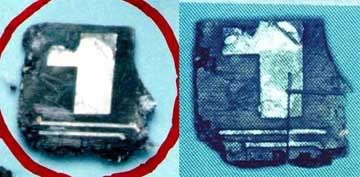
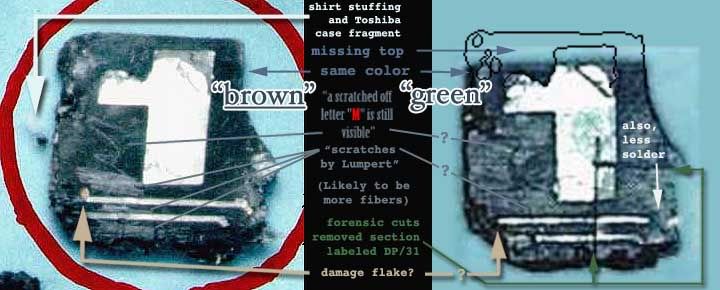
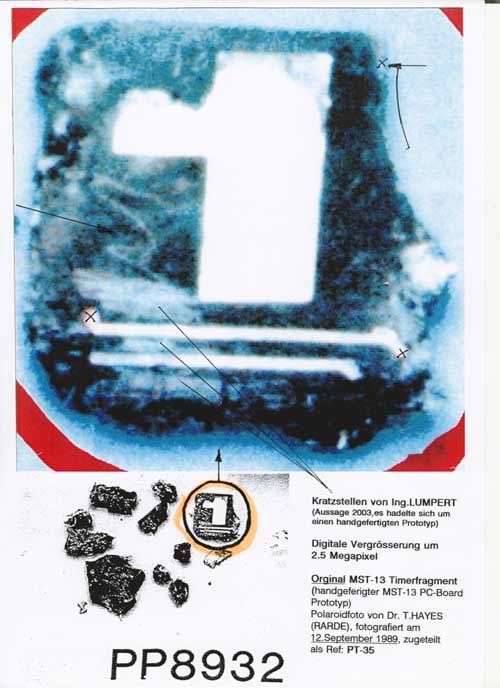
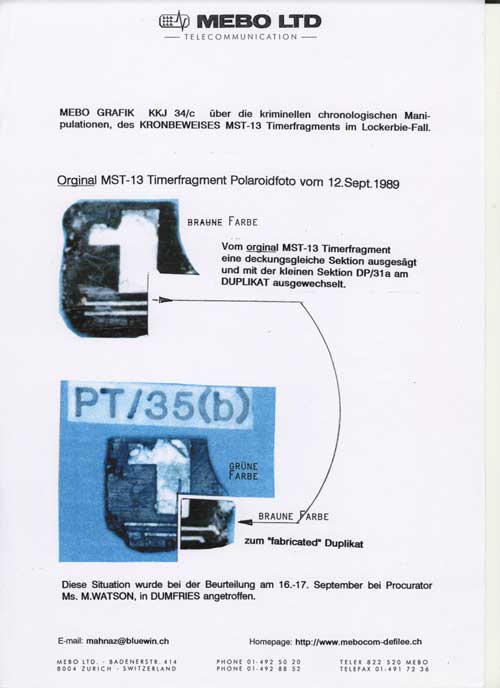
I turn my attention to false or dubious claims pushed by MEBO co-founder Edwin Bollier about the timer fragment PT/35(b) being changed or swapped-out after its discovery. His claims on the board being different colors at different times are too convoluted to fully explore here, but Bollier has been swearing lately that a brown prototype handed to Swiss authorities had been used as the evidence, somehow clearly visible in the first known photograph from 1989 (left), while the later photo (mid-1990, right) of an altered PT35(b) are of a replacement green board.

The MTS-13’s designer at Mebo, Ulrich Lumpert (alt Uelli Lumpart), apparently spawned this with his 2007 affidavit, by which he handed the brown board over to Swiss investigators who in turn gave it to SCOTBOM, who used it as evidence. The official story is of course that it’s always been the same green fragment they found in the wreckage of 103.

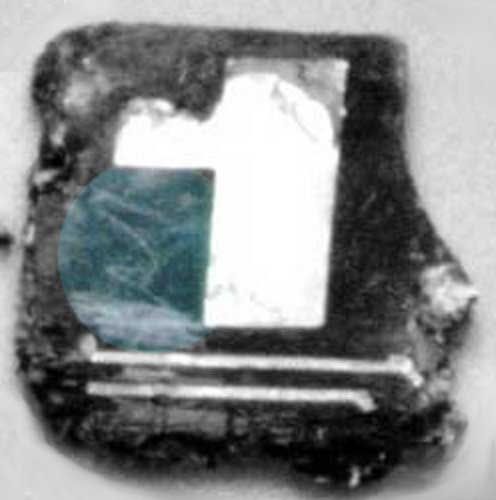
It is true that green here seems to mean blue, and the later photo is more blue than the first. However, this (as I found it online) shows clear signs of photo-tinting (blue ink on blue paper?) and once corrected, the color matches up quite well with the original – dark muted green-gray, like a green/blue board that had been burnt. It does seem possible some of the carbonized surface material has been cleaned off in the latter view, but otherwise there is no hint of brown I can see in either of these photos, and no color-based sign of meaningful alteration or replacement.

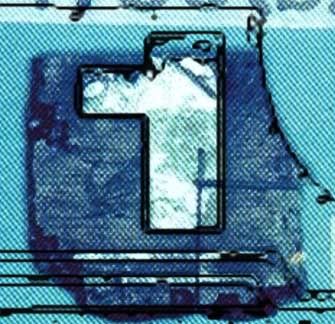
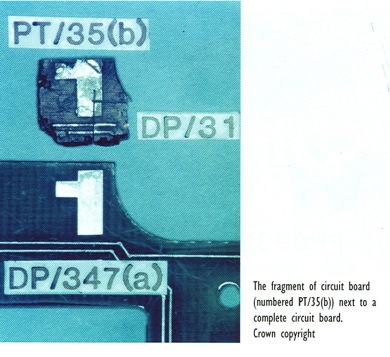
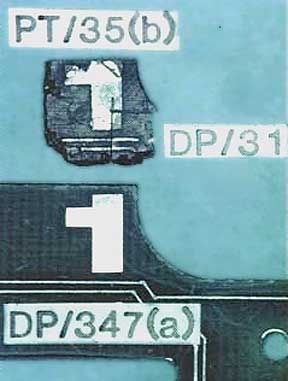
Considering comparison photos of PT/35(b) alongside an intact model board (links above), There are allegations of the curved edge not matching or the “1” touchpad and its relation to the “true edge” differing. But when the outlines are superimposed to scale (right), we find a perfect fit presuming the fragment is missing a sliver off the top. And here we can see a difference with the first photos and later ones – the top is present at first, giving it the right curve of an intact board. Later, it’s gone. Two prominent cuts at right angles also appear, apparently part of forensic examination carried out so controversially in Munich, to check the board’s layering style. This apparently severed a corner piece, put back in place and displayed as separate evidence item DP/31. But the removed top is not so displayed. It’s reasonable to surmise this tiny section – app. 1cm by 1/8cm – was simply ground off to get a profile, but mysteries remain... It's not clear how many layers were really found, but as it appears a green machine-made board, I'm guessing nine.

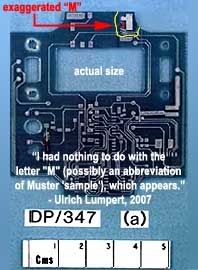
Among Mebo the clown’s most enthusiastic claims of proven forgery is how “the letter "M" was carved into” the original “brown” item sideways next to the touch pad, while “in the duplicate no. PT/35(b) (fake) it can be clearly seen that no letter “M” was carved into it!” Lumpert mentioned but disowned this in his affidavit: “I had nothing to do with the letter "M" (possibly an abbreviation of Muster 'sample'), which appears." To true scale (at left), this tiny M seems strangely small to use as a marking, nestled in next to the “1.” In reality, as JREF forum member Ambrosia showed with the enhancement below, the M casts a faint but visible shadow, and would seem to be a 3-D object, a tiny ziggy fiber of presumably shirt stitching.

Beneath this alleged etching are three small light patches bracketing the solder lines, visible above. Of these Lumpert said “I clearly recognize the scratched remnants of the soldering tracts on this enlarged digital police photograph.” A poster available online shows a blowup with German text, perhaps based on something, labeling these as “Kratzstellen von Ing Lumpert,” scratches by Lumpert. That any villains would have chosen to cut out and display as evidence just the small corner that Lumpert had marked with random micro-abrasions and could identify raises some questions.

What exactly these really are is a minor mystery – perhaps more fibers of a different kind snagged on the solder. Whatever they are they’re as gone later as the M – either the political engineers sanded these off or painted them over, or replaced the board down to he tiniest details except for these scratches, as alleged by recent Mebo pages, or they were some inconsequential surface debris since removed.

And for a preview of what lies at the bottom of this rabbit hole, realize Bollier's claiming a green replacement for a brown original fake of an alleged green Libyan timer; A 'technical report' commissioned on actual graph paper suggests for no reason I can fathom the final PT/35(b) photo is of the green replacement except the corner DP/31, which is actually a matching corner from the original Lumpert-supplied brown fake! And they didn't even use the corner with the irreplaceable "M!" (lower right corner of right view below - the part that's the same blue/green as the rest).


So to summarize, as the graphic above pretty well does, the verifiable changes were the removal of surface debris, perhaps removal of some of the charred layer, loss of a small bit of solder, an apparent flake of damaged plastic (tan under-layer?), minor changes to the touch pad surface, and the obvious cuts and/or grinding to the board consistent with cross-section analysis. Nothing else about it changed, and there’s no evidence that anything misleading was done with this after its initial fraudulent insertion into the evidence chain.

Did everyone catch that? Don’t get distracted, then, is the main point here. There are still intelligent questions to ask.