Iran Air 655 - Casus Belli Behind Lockerbie?

Caustic Logic
15 March 2010
Last update July 3, 2011

Note, July 3, 2011: I'm simply bumping this post to the top to mark the 23rd anniversary today of this horrific and dubious incident that seems to have sealed the fate of Pan Am 103.

The USS Vincennes and the Downing of IA655:
Iran Air Flight 655 was a scheduled 28-minute flight from Bandar Abbas airport to Bahrain, on July 3 1988. An Airbus A300B2 flown by Capt. Mohsen Rezaian, IA655 left the ground at 10:17 am local time to cross the Straits of Sidra. It seems the plane was talking normally with ground control on open frequencies, was listed in flight registries, flying well within an established civilian air corridor, and transmitting the right civilian transponder code that clearly means something like the car window sign "Baby on Board." [1]

As IA655 steadily climbed to cruising altitude (14,000 feet for this short journey), it was suddenly struck with two powerful SM2 missiles fired from an American ship in Iranian waters below. The 290 passengers and crew (including 66 children) were all killed, either in the explosion and breakup, or after a three mile fall to the Persian Gulf below.

Officially, the crew of the USS Vincennes, which had opted to fire the missiles at that plane, had simply gotten confused in the thick of a separate naval battle they'd gotten into. After missing IA655's listing in the 'do not shoot' registry, misreading its transponder code as of military origin, and erring on its speed, heading/location, and altitude profile, the crew had decided the airbus was a fighter jet swooping down towards them for the attack, as all their misreadings jointly suggested. [2]

The troubling details and explanations of this bizarre accident are worth covering elsewhere, but ascribing the best intentions, the Vincennes fired in what seemed clear-cut self-defense, while they happened to be within Iranian waters. As such they fully earned their later commendations, like the responsible air-warfare coordinator, who won a navy medal for "heroic achievement [...] under fire." [3]

End of the War
At the Iraq-Iran war's commencement in 1980, the United States had sanctioned the bloodshed, so long as Iraq was on top. By the latter 1980s, the situation had shifted. Increased U.S. assistance and even direct shooting reflected fears that Iraq might lose forever the territory Iran was gaining. By the end of 1987, “we became,” a senior U.S. officer told ABC News, “forward air controllers for the Iraqi air force.” [4]

Operation Praying Mantis responded to Iranian mining of the Gulf with escalated U.S. attacks on Iranian gunboats, oil platforms, and tankers in April. [5] Immediately, protection of "neutral shipping" was also expanded; it was to enforce this protection that the Vincennes had been called to the Gulf. 

At the same time, Washington and thence the UN Security Council was calling, with Resolution 598, for the war to simply end with past borders restored. Both sides had to see the benefit of an end to the grueling war, but after their own heavy sacrifices had improved their odds, Iran was reluctant to concede on the West's terms and timetable.

Along with a renewed Iraqi air and chemical offensives into Iran's cities in the spring and summer of 1988, the bizarre accident of IA655 had to have hastened  Iran’s effective surrender a few weeks later. The precise role it played – minor, major, or peripheral - cannot be known for sure. However, an Iranian scholar stated at a conference hosted by the Woodrow Wilson Center [paraphrased]
"A turning point in Iran's thinking came with the shooting down of an Iranian passenger plane in July 1988 by the American cruiser USS Vincennes. That incident apparently led Ayatollah Khomeini to conclude that Iran could not risk the possibility of U.S. open combat operations against Iran and he decided it was time to end the conflict." [6]
There is every reason to believe that’s just what the Americans wanted to get across, after the tragedy if not shortly before as well. Aside from unapologetic "regret” over the loss of innocent life, and blaming Iran for the warship's mistakes, the American message was best put by White House media handler Marlin Fitzwater in putting the accident in context:
Only an end to the war, an objective we desire, can halt the immense suffering in the region and put an end to innocent loss of life. Our goal is peace in the Gulf and on land. We urge Iran and Iraq to work with the Security Council for an urgent comprehensive settlement of the war pursuant to Resolution 598. Meanwhile, United States forces will continue their mission in the area, keenly aware of the risks involved and ready to face them. [7] 
That is, as the Iranians likely read it, "we’ll keep on shooting at anything that might possibly be a threat as long as we “have to” hang around there, which is until Iran surrenders." About seven weeks after IA655 was torn down, an agreement was reached and hostilities between Iraq and Iran were officially and physically ended on August 20 1988. No territory was lost, but nearly a million people were. 

But even after the cease-fire, one more battle loomed. It would be just as one-sided as the battle of IA-655, just about as deadly, and just as unacknowledged. Again, the perpetrators would go unpunished as innocents paid the price for others' crimes.  

Revenge Pronouncements / Connective Tissue
Only in 1996 was a comprehensive legal agreement over the incident settled between Iran and America. Officially Iran accepted the accident story and took a small settlement $132 million and no acceptance of any guilt, exactly as offered by the US eight years earlier. [8] "Official" acceptance doesn't always mean that much; especially when the blood was fresh and tempers hot, Tehran never bought the bland American statements that the shoot-down was purely accidental. It's not even an unreasonable suspicion on their part - it's their apparent response I can't agree with.

Researcher Ludwig De Braeckeleer has assembled a useful compendium of Iranian death threats following the supposed accident. By this, various officials and ambassadors accused the United States of ''a barbaric massacre'' and an "act of terrorism." They pledged to launch "an appropriate response," to the "American crime," to "avenge the blood of their martyrs," and mete out "punishment to prevent further occurrence or recurrence of such unfortunate incidents." Most pointedly, hardliner Ali Akbar Mohtashemi (alt Mohtashemi-Pur), widely believed to have headed up the "appropriate response" planning, publicly "swore that there should be a "rain of blood" in revenge." [9]


This wasn't just hardcore posturing for the Iranian street, but something representing a real danger; everyone in the know expected retaliation, and likely in-kind - the Iranians would seek to now kill American civilians on an airplane and see how we liked it.  While uncertainty persists with no adequate investigation, the supposed payment was $10 million to the Ahmed Jibril's PFLP-GC. An early 1991 report, prepared by the National Security Agency for Gulf War intelligence use, stated:
"Mohtashemi is closely connected with the Al Abas and Abu Nidal terrorist groups. He is actually a long-time friend of Abu Nidal. He has recently paid $10 million in cash and gold to these two organizations to carry out terrorist activities and was the one who paid the same amount to bomb Pan Am Flight 103 in retaliation for the US shoot-down of the Iranian Airbus." [10]
The revenge moved swiftly, it seems, perhaps starting before the cease-fire even. It was in early October that the GC cell in Neuss, West Germany was set up, October 13 that bomb maker Khreesat arrived and set to work, and October 26 when the cell was busted up in Operation: Autumn Leaves. Most have always suspected their goal had been to destroy an American airliner on Iran's instruction and with support from Syria, using the type of radio-disguised altimeter bomb found in the car with Khreesat.

Three other such bombs were missed in the first raid and only found later, and one bomb at least was never intercepted. Vincent Cannistraro, who headed the CIA's Lockerbie probe, was interviewed for a program Shadow Over Lockerbie:
"[Cannistraro] says authorities focused on the likelihood that Marwan Khreesat's fifth bomb had blown up the Pan Am 747 over Lockerbie. "The immediate feeling was: we've missed someone. That someone in that cell had escaped with one of the explosive devices and succeeded in planting it on Pan Am 103." [11]  
In other words, the terror tree was shaken and the "Autumn Leaves" had fallen and scattered, but they weren't all raked up neat. One may have drifted into the belly of PA103.

Obvious, Then Nothing
When the other shoe fell, the horror and carnage clearly mirrored IA655 with a mid-air explosion leaving 259 to deal with five miles of pure gravity however they did before dying against the cold winter soil of Scotland. To clarify the issue, just hours after the attack, two phone calls were placed from London to the Associated Press and UPI declaring in broken English:
"We, the Guardians of the Islamic Revolution, are undertaking this heroic execution in revenge of blowing the Iran Air plane by America a few months ago." [12]
A CIA memo of the following day listed this first among a short list of responsibility claims. Among Islamic Jihad, the Ulster Defense League, and Mossad, the report said "we consider the claim from the Guadians of the Islamic Revolution as the most credible; previous attacks claimed by this group suggest it is pro-Iranian." It then listed several, with responsibility usually called in by an anonymous man: two assassination attempts on exiled Shah era leaders in exile, a plane hijacking a plane to secure the release of said assassins, and killing by car bomb a German businessman accused of selling missiles to Iraq while the war was on. [source]

Avenging the killing of 290 innocent Iranians by a US gunship seems in-line with the Guardians' philosophy, or perhaps some other Iranian agency, and most likely with technical help of the altimeter-triggered kind. Investigators, media reports, and the whole public mind went that way at first for at least a year, from no later than this ABC News broadcast of Feb 16 1989. Behind the suspicions of the PFLP-GC cell and its Khreesat bomb "a senior source overseeing the investigation" revealed that  "some hard-line members of the Iranian revolutionary guard" may have arranged for the attack through these suspects. "Revenge for the shooting down of the Iranian Airliner by the USS Vincennes in the Persian Gulf last summer was their motive," said reporter Brian Dunsmore in Lockerbie.  [13]

And still in early 1990 Steve Emerson and Brian Duffy wrote in The Fall of Pan Am 103 how sponsorship ran with Syrian supports up to Tehran, driven by revenge for IA655, "shot down for the Fourth of July holiday, the Mullahs believed, to celebrate America's independence." [14] To repay these expensive 4th of July fireworks with an early Black Christmas present, followed by a Body Boxing Day and a few more, might be a potent signal.

Officially, Iran denies involvement in the bombing, but some, like suspected mastermind Mohtashemi, have claimed a leading role on candid occasions. In 1995, an Iranian magazine ran an interview where "Mohtashami-Pur said that he would soon reveal the "Lockerbie files" to the readers." The report was quashed from above and the magazine closed down. [15] Former Iranian president Abdulhassan Bani Sadr also has admitted proudly, in the 1990s, that “Iran ordered the attack and Ahmed Jibril carried it out,” [16] a claim he repeated to deBraeckeleer in 2008. [17]

As these statements were made and as of late 1991 the U.S. was officially and exclusively pursuing Libya for the crime, freeing some Persian tongues to confess with impunity, it seems. And yet, the U.S. says, there was no Iranian revenge. The faint possibility of Tehran's involvement in Libya's atrocity has been whispered, but never clarified or pursued in the slightest. [see: Iranian vs. Libyan Role in the Lockerbie Bombing]

Iranian leaders had planned to take down an American plane (at least one), had paid for it and had bombs built and ready to go. With hard cash, glory, and blood vendetta driving them, Mohtashemi and and his contractors must have given up after the Germany bust. This is just what the FBI, CIA, USG, Scottish Police, Camp Zeist judges, and others claim to find most likely. And then just as precisely as item 8849 from Malta replaced the Bedford suitcases in the luggage container's deadliest corner, the Libyans took their own incidentally identical revenge at just that time. 

It's never been decided which motive drove the Libyans, but it's widely presumed to be the nearly three-year-old Operation: Eldorado Canyon bombings by U.S. forces. For the death of his adopted toddler daughter and a few dozen other Libyans, he ordered the Lockerbie bombing, while the level-headed Iranians waited for the court settlement and reparations after IA-655.  


At least, that's what the FBI's SCOTBOM evidence strongly illustrates. A desperate defector, an amazingly resilient timer fragment, a bizarre unverifiable printout, and a pliable soon-to-be-millionaire witness, all prove the Libyans did it through Malta, however much sense that makes. And nothing solid implicating Iran or Syria or the PFLP-GC was found anywhere in there. Move along, nothing to see here - the real Lockerbie bomber was behind bars for a while.  
---Sources: 
[1] Ghasemi, Shapour. “Shooting Down Iran Air 655 [IA655]” Iran Chamber Society: History of Iran. 2004. http://www.iranchamber.com/history/articles/shootingdown_iranair_flight655.php
[2], [3] Charles, Roger. "Sea Of Lies: The Inside Story Of How An American Naval Vessel Blundered Into An Attack On Iran Air Flight 655 At The Height Of Tensions During The Iran-Iraq War-And How The Pentagon Tried To Cover Its Tracks After 290 Innocent Civilians Died." Newsweek. July 13 1992. http://www.newsweek.com/id/126358
[4]  "The USS Vincennes: Public War, Secret War" ABC Nightline, Aired July 1 1992. Full Transcript, with extensive notes. ...
http://homepage.ntlworld.com/jksonc/docs/ir655-nightline-19920701.html
[5] Operation Praying Mantis. Wikipedia. http://en.wikipedia.org/wiki/Operation_Praying_Mantis
[6] Steinberg, Dana. "The 1980-1988 Iran-Iraq War: A CWIHP Critical Oral History Conference." http://wilsoncenter.org/index.cfm?fuseaction=news.print&news_id=90411&stoplayout=true 
[7] See [1]
[8] Wikipedia. Iran Air Flight 655. http://en.wikipedia.org/wiki/Iran_Air_Flight_655
[9] DeBraeckeleer, Ludwig. "Tehran: 'The Blood of Our Martyrs Will Be Avenged' [Diary of a Vengeance Foretold] Part 2." Oh My News International. July 4 2008.
http://english.ohmynews.com/articleview/article_view.asp?menu=c10400&no=383015&rel_no=1
[10], [15], [17] DeBraeckeleer, Ludwig. "Former Iranian President Blames Tehran for Lockerbie." http://www.thetorah.tv/misc/Former%20Iranian%20President%20Blames%20Tehran%20for%20Lockerbie.htm
[11] Biewen, John and Ian Ferguson. Shadow Over Lockerbie. 2000, American Radio Works. http://americanradioworks.publicradio.org/features/lockerbie/story/printable_story.html 
[12]  Emerson and Duffy p 56
[13] ABC News. Feb. 16, 1989: Pan Am 103 Flight Investigation. "A bomb hidden in a cassette player brought down Pan Am 103 in December 1988." Anchor, Ted Koppel. Reporter, Barry Dunsmore, Lockerbie. Video currently viewable at:
http://abcnews.go.com/video/playerIndex?id=9443717 
[14] Emerson and Duffy, p 59.
[16] The Maltese Double Cross. Produced, written, and directed by Allan Francovich, Hemar Enterprises, released November 1994. 2 hours, 36 minutes. Quote at 34:00 mark. Google Video 

Primary Evidence: Frankfurt Airport Records

First Posted 20 January 2010
last edits June 25, 2011


The System
[Analysis by Caustic Logic, based on wide but uncited skimming - may not be 100% accurate, but intended only to help understand the records below]

Frankfurt Airport in 1988 was the busiest air hub in Europe, serving many thousands of flights a day between Europe, the near east, nort Africa, and North America. The baggage handling system in 1988 was both state of the art and sloppy. Its workings can be understood as broken down to two parts, loosely termed outer and inner.

The outer portion was where luggage arrived at and left from the airport - a zone of tarmac and taxiing aircraft, wagons and luggage containers. From the planes, luggage was carted to a coding station, where items were placed on bar-code numbered trays (containers), one item per tray, and fed into the inner portion. Hard paperwork was apparently normally kept for transactions between aircraft and coding stations, both inclusive.

The Zeist Court explained “baggage for most airlines was handled by the airport authority, but PanAm had their own security and baggage handling staff.” Thus the airport and the airline each would then have responsibility for keeping track of their own efforts, and both should be called on in the investigation. The Frankfurt Airport Group would be in charge of unloading KM180, and Pan Am's people would handle loading and screening of luggage coming onto the outbound feeder flight.

The inner portion then is what the Court described as “a computer controlled automated baggage handling system” running beneath the airport. This vast electro-mechanic system automatically routed coded items along roller conveyors and through switching stations, at key spots scanned and logged. This system connected coding stations to the various stores, where luggage circulated until needed, and apparently up to loading gates. After this, they re-emerged topside and then to the connecting aircraft’s hold, where again, a record would be kept of loading procedures.

Primary Evidence
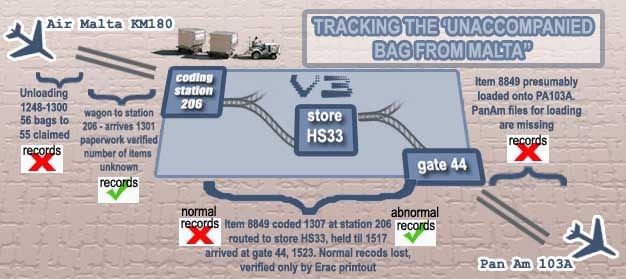
The relevant central computer data was produced, if under questionable circumstances, showing one particular item was coded at 13:07 into container no. 8849. It was then routed down to store for two hours until moved at 15:17 to gate B044, from which 103A loaded before its 16:53 departure. No passenger transferred from the air Malta flight to the PanAm one, so the bag thus illustrated was of the dreaded “unaccompanied” variety.

Apparently, no direct record of PA103A's loading was available to corroborate this. The unloading records for the Air Malta flight (KM180) that bag apparently came from, likewise do not figure in the evidence. And the mammoth central computer file aside from the items sent to 103A is missing without explanation. But the arrival of each flight at the airport, and the coding of one's luggage, were presented, aside from the crucial and curious "Frankfurt printout." Below are all available documents relevant to the claim of an unaccompanied bag, from flight KM180, being sent on to Flight 103A at Frankfurt. These will be given by the "production number" assigned them as evidence during the trial, and briefly explained. All images were originally found at Mebo pages, but seem to be genuine and unaltered. (see "Sources" at end)

Production 1068: The Opinion of the Court's paragraph 29 denotes this for “the evidence of Joachim Koscha, who was one of the managers of the baggage system at Frankfurt in 1988” It was his evidence that established KM180’s arrival and unloading time, 12:48-13:00. They do also cite a “record,” but provided no direct citation.

Production Null: This is the designation – none – given to KM180 unloading papers in the trial. Denis Phipps, former head of security, British Airways, has closely inspected the primary records of different airlines and airports connected to the disaster. He said in The Maltese Double Cross [video, 1994] “the records from Frankfurt were by no means complete." Among his concerns:
“There was no record of who unloaded that flight KM180 when it arrived at Frankfurt. We don't know who the loaders were. There was no record of the number of bags that were actually unloaded from that flight. There were no records that I could find.” 

It isn’t entirely clear if paperwork normally was kept for this – it might have been a policy to determine the number of bags from the computer system, which could count the number of items coded at a certain station and time and take that as the number from the flight coded then. It would be a grossly imperfect system, considering the reliability of this method, as mentioned above. But it would line up with the known laxness of procedure there, and mean one less suspiciously missing record.

Production 1092: This is an “interline writer’s sheet” filled out by Andreas Schreiner, who was in charge of monitoring the arrival of baggage at V3 That bears to record one wagon of baggage from KM180 arriving at V3 at 13:01.Within V3 are seven coding stations, where luggage is placed into bar-code numbered trays to enter bottomside. They cite the sheet’s contents in table form and it seems like they had these records at hand. No number of bags in that wagon is given.
This brings us to the reliability of coding station logs in determining where a particular item really came from. The Zeist judges heard testimony that “luggage was always delivered from one flight only” at any given time." [Opinion of the Court, para 29] Taking this literally would mean a station's log saying flight X was handled from 1:00-1:05 means an item shown in the computer system as coded there at 1:01 is clearly from flight X. 

But this is not completely sound. Dennis Phipps noted the unreliability of these logs in the Maltese Double Cross, and it's been widely noted that lapses of stray bags being inserted during another flight's coding are not only possible but recorded, and common sense itself suggests such a presumption is, at the least, not guaranteed to be right. The degree of correlation between coding time and flight number is certainly higher than zero and less than 100%, and debatable from there. A separate post, Coding Station Reliability, will address this controversy, but generally below it should remain an open question.

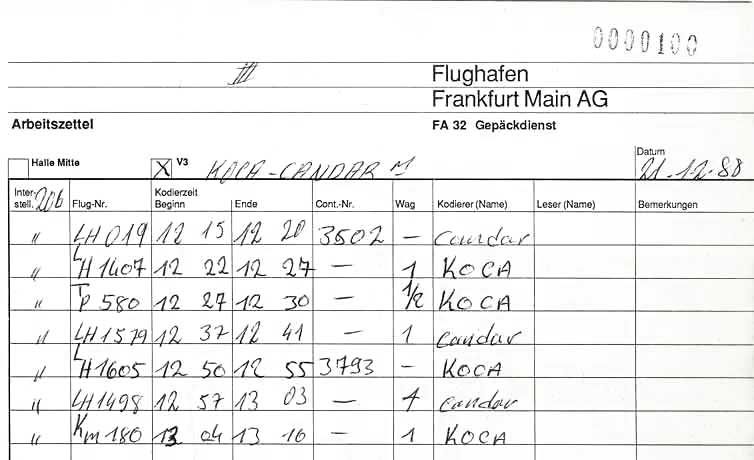
Production 1061: This document (above) was identified by witnesses Mr Schreiner and Mr Koscha “as a work sheet completed by a coder to record baggage with which he dealt.” The name of the coder in question was Koca, who was not called as a witness.” Pity, since the document shows us little detail. The signatures alternate Koca and Candar, listing either container numbers or numbers of wagons of luggage, the flight number it’s from, time they started coding, and stop time. The relevant line is the last one – one wagon of luggage from KM180 started coding at 13:04, and ended at a time disputed as 13:10 or 13:16. (13:10 yields a time closer to those previously noted, and it's what the Court decided. The difference is six minutes of time, which could have increased the likelihood of a stray bag being introduced. Again, refer to the post on coding station reliability.

Production 1062: This is the court’s code for some unspecified “documentary evidence” that “the aircraft used for PA103A arrived from Vienna (as flight PA124) and was placed at position 44, from which it left for London at 1653.”

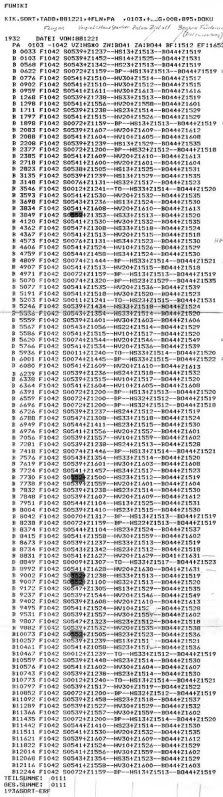
Production 1060 (at left - r-click/new window for readable view) This is the famous computer printout, the single document that allows “the inference," drawn by the Scottish Judges, "that an item which came in on KM180 was transferred to and left on PA103A.” It's a list of items routed to PA103A, taken by airport employee Bogomira Erac for personal reasons and handed over to investigators only a month after the disaster.

It was the first time they'd seen it. What's highly unusual about this evidence is that the German federal police (BKA) were unable to secure their own copy, right off the computer, in the days after the crash. In the end, we had to rely on a memento copy from someone’s locker, which existed only by sheer luck. It was that close to having a whole airport's luggage records go completely missing, right after such a massive event demanded that information. The troubling case of the missing records is worthy of a detailed stand-alone post. Another interesting question is why the BKA then made the official investigators in Scotland and Washington wait another six months before sharing it with them. It wasn't until mid-August 1989 that Scottish police were able to see this pivotal record that wound up turning the investigation around to Malta and thence Libya.

Whatever the book got wrong, Trail of the Octopus is helpful on this issue.
"On 17 August 1989, eight months after the disaster, Chief Detective Superintendent John Orr received from the BKA what was said to be a computer print-out of the baggage-loading list for Pan Am Flight 103A from Frankfurt to London on the afternoon of 21 December 1988. Attached to this were two internal reports, dated 2 February 1989, describing the inquiries that BKA officers had made about the baggage-handling system at the airport. Also provided were two worksheets, one typewritten, the other handwritten, that were said to have been prepared on 21 December by airport workers at key points on the conveyor-belt network." [Coleman/Goddard]

Mrs. Erac' testimony at Camp Zeist in 2000 clarified that the printout was not taken to the BKA until approximately the last week of January, so a 1 February foray is a perfect match for being spurred by the printout. Any records of any earlier efforts, fruitful or not, remain under wraps. Upon getting the papers in August, Orr and his men quickly investigated the airport themselves, and also got more serious about previous clues leading to Malta.

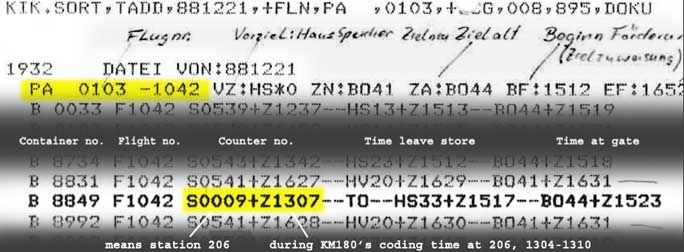
What the printout shows, briefly, is 111 items listed numerically by container number. The relevant portions are highlighted in the condensed version below. PA103A is referred to herein as F1042. The relevant item 8849 was coded at station S0009, which it’s been determined means station 206, at 1307. That is a fit with KM180’s load. It then goes to Gate B044 at 1523, the same few-minute span most of 103's luggage arrived. What happened from there is outside the computerized system and not recorded here. But according to this, two late-coded items were sent to a separate gate B041, and curiously, these two items bracket the apparent bomb bag, numerically speaking, and so are visible below. All 108 items not shown here were sent to gate 44.

So broadly there are three possibilities:
- If it could be certain that station 209 at 1307 means KM180 and nothing else, this would be solid evidence of a bag from that flight.
- It could have been an item of another origin passing through there at just the right time to appear as from KM180. This does require a certain acceptance of coincidence, but cannot be ignored.
- The data could clearly mean to say KM180, but itself be fraudulent. This would explain the printout's appearance and the primary data's disappearance. Perhaps the two were not really unrelated bad and good luck, but two halves of a bait-and-switch routine, perhaps carried out by the BKA for uncertain reasons.

Production Null: The normal, official, system-wide, right from the computer luggage records.
As has been mentioned, for some reason the primary data of luggage movements was lost, but avoided making a big noise once a copy was luckily found. So it was no loss, we might presume. But how would we know?

There may never be answers to the riddle of the lost computer data, but a dedicated post is warranted to explore what we do and don't know about it.

Production Null: PanAm’s loading records for flight 103A.


---
Sources:
Image: Prod 1092
Image: Prod 1060
(other images by Caustic Logic)
[Coleman/Goddard] TRAIL OF THE OCTOPUS -- FROM BEIRUT TO LOCKERBIE -- INSIDE THE DIA. Chapter 7. Online posting.
[Opinion of the Court] PDF download link

Two Secondary Suitcases?

June 13/14, 2011

The Soft, Blue and Maroon Case
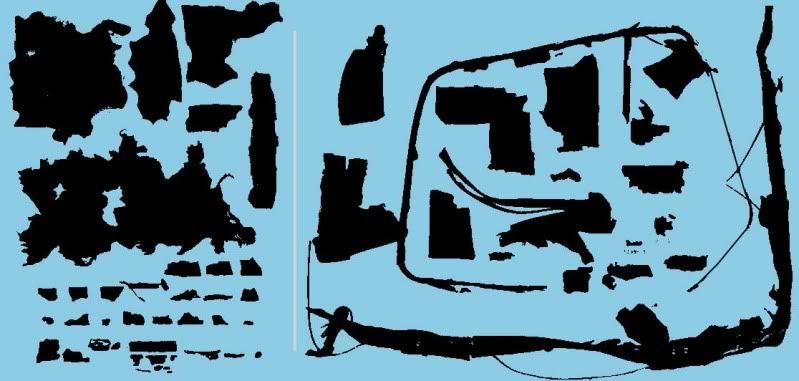
Below is a screen capture from al Jazeera's new video, of a severely blasted suitcase, gathered back together for investigator's cameras following the bombing of PA103. This piece of luggage was listed in the examination notes of Dr. Hayes as item 4.2.14, a blue soft-shell American Tourister case.

It was owned by passenger Patricia Coyle, who interlined from Germany on the feeder PA103A, which also officially carried the bomb (although other evidence suggests it was manually placed in London).  By RARDE's questionable and belated finding, it was placed just beneath the bomb suitcase, on the floor of luggage container AVE 4041. It looks just about blown-up enough to have been the primary case - the one containing the bomb. But it was what I'll call "secondary", next to and touching the primary one.

I recognized the photo even without a label from the description given of the unique remains in the trial transcripts, and the readable item numbers support that call. This case had always sounded supremely blast-damaged and largely unaccounted-for, and this elusive photograph 76 shows about what I expected, if even more so. The examination notes (culled as read-back from transcripts) explain:
"The following 27 items, the larger fragments of which are collectively shown in photograph 76, were identified as component parts of a blue American Tourister brand softshell suitcase. The severe overall damage to the identified component parts is consistent with this suitcase having been located in contact with the suitcase that contained the improvised explosive device at the moment of explosion."
The case had been supported by a simple wire frame, with flexible plastic of blue, maroon, and black filling it in the body and trim. TSH/346 is the large piece wrapping around the outside, essentially the whole middle band of the case. It was said to have been blasted at least partly into the neighboring container, AVN 7511, along with some pieces of the container and of the primary suitcase.

There are only about ten further pieces not shown, all very small. As can be seen, the majority of that base material didn't turn up, left in the tiniest tatters lost to wind, sea, and mud if not to the fireball of the explosion itself.

The Hard, Antique Copper One
Here, at left, is what was assembled and called the primary suitcase. It was a different type entirely, a brown or antique copper colored hard-shell Samsonite, Silhouette 4000 series. Given in the report as luggage item 4.1.2, its remains were described thus:
The following 56 items were examined and identified as the component parts of one of the hardshell Samsonite brand suitcases from the Silhouette 4000 range. It was also established beyond any doubt that this item of luggage had been subjected to a violent internal explosion and thus had originally contained an improvised explosive device. Except where noted, all of the items examined below are collectively shown in photograph 49.
The bolded part is the one I here contend. Very similar damage, considering the material differences, had the American Tourister declared as just beneath the bomb. Here, Hayes seems a little too certain for comfort that this extremely splintered suitcase was wrapped around the explosion itself.

As with the other case, the pieces not shown are the smallest ones, especially the many fragments of the cardboard divider from the middle of the suitcase, closest to the alleged bomb (PT/68 in the lower corner is the one sample of that shown).

The delicate suitcase lining fabric not much further away is represented by one nearly-complete side of the stuff - the giant 22-inch PK/1310A, stretched across the middle of the photo. The combined effect of this gauze, the surviving cardboard, and the other very large fragments of shell plastic, is that this case experienced a very asymmetrical blast involvement, with one whole side - and even the middle, it seems - shielded by something - like the upper half of the case and half the primary case and its contents above that.

Among this possible lower half, PI/911 in the upper left is nearly a foot square, and at one point (January 1989) Dr. Thomas Hayes of RARDE had concluded it was from was from "the lower side of a suitcase, compressed and fractured in a manner suggesting it was in contact with a luggage pallet's base and subjected to explosive forces from above." This means beneath the bomb suitcase, which was on level two and blasted from within, not above. (see: the Monster of Newcastelton Forest)

That opinion changed at some uncertain later point - by the time of the final report in 1990, PI/911 was said to have flecks of blue plastic stuck to it, suggesting it had rested on the American Tourister, not the container's floor.

Two Brown Hard-Shells?
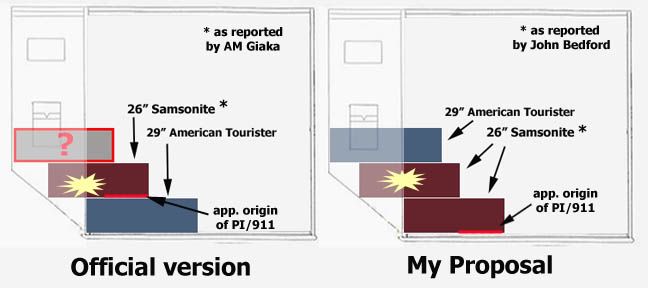
This all has direct relevance to the story of John Bedford, the luggage loader at Heathrow now famous for seeing and reporting a brown hard-shell Samsonite case - or perhaps two - inside the container's lower corner. In part, he told police in January 1989:
“They were [both] hard cases, the type Samsonite make. One was brown in color and the other one, if it wasn't the same color, it was similar.”
No passengers on Flight 103 carried any such luggage and only the one shown above was recovered after. Yet here is at least one, and possibly two, such cases confirmed in the container before a second or third such case came in from Malta on the German feeder. This was around two hours after Bedford's sighting, and officially, it was set on top of the Coyle case, in the same exact spot the Bedford bag(s) just vanished from, never to be seen again. Officially, that's what happened.

If he described two cases of the same exact color and style, where did the other one go when only the remains of one turned up?

One possibility I've aired before is the one we've seen is not the primary suitcase. Rather, it might be another secondary case, like ms. Coyle's, with the primary case having effectively vanished under the force of its own more-powerful-than-thought explosion. At right is a graphic (all to scale and accurate) that illustrates that arrangement.

I had backed off a bit on the idea of two matching cases, for the sake of simplicity. But this new image of suitcase 4.2.14 changes things, showing me that  both of the suitcases in question are comparable for extreme damage. Below I've placed both images, fragments in silhouette, side-by-side to approximately the same scale. Seeing them together like this, it's hardly obvious the left one is the most obliterated. Soft-shell vs. hard-shell construction will give different results, and the total number of recovered fragments - 56 compared to 27 - suggests that, in fact, more of Ms. Coyle's less durable case material was lost to the explosion and the elements than were  lost from the primary case that should have seen by far the worst of it.

Really, seeing this image re-affirms to me the idea that these are both cases that had been situated next to the primary one, which was presumably the other Bedford suitcase, worse off yet - gone into dust, along with everything in it. This would mean the clothes, the bomb radio, timer, umbrella, everything deemed to be from the primary case, were either from one of the neighboring cases, or were planted. Considering how neatly they pointed to Libya and Megrahi, and how plagued they are with plausibility issues and handling anomalies, I'm going with planted.

Video: Lockerbie: The Pan Am bomber

June 11 2011

This is the new documentary aired by al Jazeera English the other day, and posted by them graciously on Youtube. It's nothing short of amazing.

Feraday's Forensic Follies, Section Sixty-Seven

June 11 2010
last updates June 11/13 2011

A few days ago I posted a collected timeline of forensic finds and coclusions from RARDE's "scientists" Dr. Thomas Hayes and Mr. Allen Feraday. These were supposed to have led to the identification of a vaguely Libyan radio model holding the bomb - Toshiba BomBeat RT-SF16. The end result is bizarre, with a hundred implied complications, like those presented by a tiny bit of blasted circuit board dubbed PT/30.

This 3mm x 4mm  fragment was allegedly found on June 8 1989 by Dr. Hayes, or June 18 by Feraday, depending. Both versions match on where it was found - embedded in a piece of soft blue American Toursiter suitcase owned by victim Karen Noonan and labeled PK/2128. [Leppard p207] Its PT number is lower than the famous PT/35 found weeks earlier (on paper), as noted by the defence at trial. This would be unusual if not for all the rest being just as out of order (see PT/31, PT/56, etc...). Stranger yet, Dr. Hayes' examination notes of PT/30 read in part:
It has been partially delaminated by the blast and, hence, does not possess the expectedgreen lacquer and/or solder tracking upon its rear face as this has been ripped completely away. The upper [brown] face of the fragment bears part of the white painted characters C32 and a depiction of an electrical resistor.
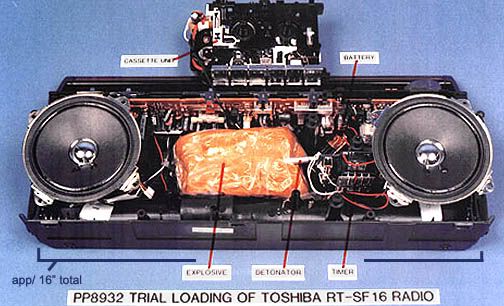
Consider the sample loading of the alleged bomb (below) in a normally-assembled RT-SF16 radio (minus its cassette assembly). The main circuit board is the one seen along the top, brown-colored component side down. This surfaces is that painted with little white markings that survived the blast of that Semtex about one inch distant. It was the inverse side, green lacquered and tracked with solder, that was blasted away. Was the board backwards?

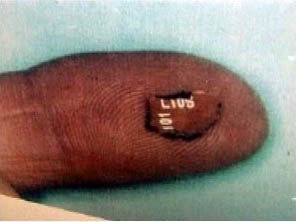
PT/30 is not alone in having its painted face survive readable and unburnt. Consider this largest portion of the earlier find AG/145 (at right). Its markings "L106" and "101" are plain as day, and only the edges are burnt a little. The smaller part of AG/145 is similarly marked, with "02." It would thus seem the terrorists allegedly scraped off all those little  components off their contacts and flipped the board backwards to fit it back in. Except that the AG/145 fragments also had nice green backsides that showed no sign of blast either, and allowed the first identification in February.

Anyway, to bring this back to Feraday, he was reportedly excited about PT/30 turning up. The radio model RT-SF16 was already identified on May 11, we hear, and this fit it just as perfectly as the AG/145 fragments did, and was noted immediately by Hayes on June 8. So Mr. Feraday reportedly waited a few months, and then in September took the thing to the evidence holding facility Dexstar to see if it could match anything there.

Later, in December, DI William Williamson sent SIO Henderson a memo describing this: "On his visit to Dexstar on 14 September 1989 Mr Feraday viewed a large number of items of circuitry which had been withdrawn for his examination; none of these items was a match for PT 30." [Leppard p 207] (note: PT 30 is just Leppard's way of writing PT/30 - space instead of slash. It's the same item)

Williamson went on to ask Henderson to look into inspecting evidence held by the Germans to see if a match could be found to Khreesat's work - particularly some alarm clocks he was known to have bought. Feraday had "on a number of occasions repeated his keen interest in any item of circuitry," Williamson explained, "or indeed in any digital clocks or other similar items which could contain a circuit board for examination and comparison at RARDE against produsction PT 30." [Leppard 207-208]

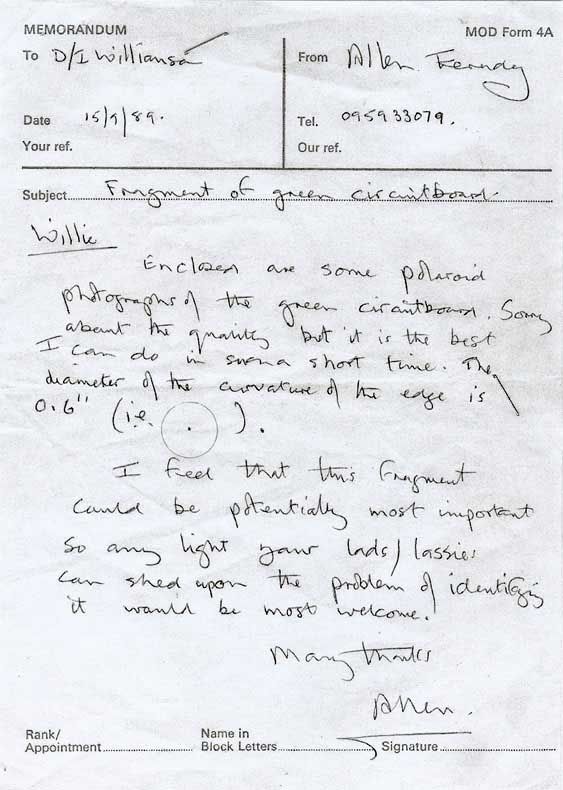
Earth to Allen, your science guy Hayes has May 11 as the date he IDd the radio, and on June 8 found that PT/30 matches it. Why the running around drama in mid-September looking for some whole other fit? The obvious answers somehow elude this blogger, but one thing I notice is the timing of this fevered search relative to a more fruitful circuitry quest: PT/35(b), the lucky corner of a Libyan MST-13 timer main board. The day after Feraday's reported inquest at Dexstar, evidencing that "keen interest" in circuit board clues, he sent a memo to the same DI Williamson cited above. This was regarding a four-month old (on paper) find by Dr. Hayes.
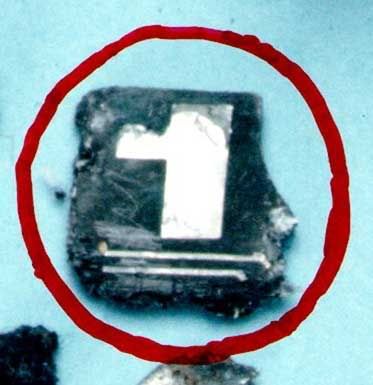
In retrospect, this memo is rather vague, not mentioning PT/35(b) by name or giving many direct clues. It could almost be about PT/30, except for the cited curve. Only the mammoth MST-13 chunk and its double-underlined #1 is large enough for that detail. By my rough measurement of a scaled MST-13 jpeg the curve at upper right has a 0.5" diameter. I'd defer to Feraday here.

So this is a letter about that amazing but yet unidentified clue PT/35(b), keenly ignored it seems until that date - four months after the paperwork shows it found. But only one day after Feraday's own foray over the already identified PT/30 (says the same Williamson months later).

Or am I just making too much out of a simple mix up? Not likely, as that memo of December 19, just ahead of the anniversary, shows Feraday behind the scenes urging yet more bogus action over the already identified circuitry. Over six months following its match-up with the known bomb radio, he was pestering Williamson to pester Henderson about trying to find a match for PT/30 over in Germany if possible.

If all these things are the true exploits of professional and even-handed investigators ... my God, what kind of MKULTRA experiments were they doing with the ventilation at RARDE? No, these "facts" must have appeared as they were convenient, with little regard for those which came before or after. It's the only sane explanation.
---
Update June 11/13, 2011
Some amazing screen grabs from Al Jazeera English's new video.

AG/145 fragments, separated and partly cleaned, hugely magnified and looking less burnt to ash than ever:
Here's the second largest fragment, placed against its spot of origin on the brown/orange, lettered, blast-ward side of the board.
And here is the backside of the larger one against the green, shielded, solder-tracked side.
It's this precise match-up, Allen Feraday said, that helped him at least narrow down the radio model by mid-February 1989. In both images, note the material - flimsy, paper-fiber-and-resin, not fiberglass.

As we can see comparing the first and third of these images, neither side of that largest bit shows any sign of blast damage (extreme heat, for example). But where on the board are these fragments from? The middle, just one inch from the Semtex supernova? Or at one of the ends, a couple of inches away? There's an image that clears that up, and they showed it as well in the video, bless them. I compared it to the assembled IED mock-up, rotated so features matched. I then indicated the rough areas for both AG/145 and PT/30.
That gives at most about 1.5 inches for the blast wave to chill-out, and nothing but the flimsy little capacitors (or ??) attached to those spots to shield the face. The left-hand one is in as good a spot as it gets to survive, but still, I can't cite the measure of the force of this blast except that it ruptured an airliner's hull at two feet distant, after being slowed by the luggage container, the suitcase, the clothing, and the radio's case. Before all of these, at 1.5 inches, tops, fresh and full-force ... No way.

Beyond that, do recall, as explained above, that Hayes found PT/30 had the wrong side - the green one - blasted away, while all of AG/145 shows damage to neither side. Another oddity is that both AG/145 at PT/30 would go about the same direction in the blast wave - out from the center in all directions. If PT/30 were blasted straight down, AG/145 should go down and to the left pretty much.

Officially PT/30 wound up wedged into the outer frame segment (IIRC) of the blue softshell on the container floor, just beneath the bomb bag - if so, why would AG/145 wind up, as Mr. Thomas Claiden testified, blasted into a fold of the data plate, on the outside of the container, halfway up its side, two feet or more above the bomb bag?
---

A Costly New Libya - Rented, Not Owned

June 5 2011

This rare update is spurred by an excellent video I just saw from Journeyman productions - not sure if they made it or who they are - it says 2003, which seems right - but it's a rare video on Libya and Lockerbie that gives real insight.


The $10 billion mentioned was never paid. It was set at 2.7 billion in 2003, and settled up by, I think, 2008 to a slightly different tune. I don't have the details handy, but lawyers got a lot of it.

The video mentions this as being no admission of guilt but rather the government's purchase of "a license" to simply be allowed back into the world economy (see 7:25). Further, Libya agreed to drop its own claims over the 1986 US bombing, by "mad dog" Reagan, of Tripoli and Benghazi, that killed around fifty innocents. This was in retaliation for another attack the Libyans have sworn they never carried out, and the effects are covered touchingly in the video. Note the contrast of the victims of that bombing in seeking justice compared to those whose case was against Libya, and who had it muscled through to amazingly painful effects for Libya, by the best of Anglo-American imperial might.

Of course, as Professor Black explains here in part, that case itself is weak and unreliable, the judgment confirming it perverse. See the rest of this site for a fuller exploration of the depth of unreliability dug out by the Lockerbie case. But they paid up anyway, because the sanctions rested on the perverse verdict and those were quite real.

Detente did follow from 2003-2011, greased along with Tripoli swearing off all terroorism, real or imagined, abandonimg all WMD programs, including a nuclear deterrent, promising reforms in Libya, and opening to foreign oil companies. But the companies weren't fully happy, the system was still too Libyan, and plots still simmered under the surface, and now ...

It's insane to think eight years later, all paid-up, the country is finally being destroyed completely anyways. At least $60 billion (perhaps more like $100 billion) in Libyan government funds - for military, civilian, and all uses - was just frozen by the US and a handful of other countries. And the NATO bombs are falling across non-rebel Libya. This is all officially based on some muddled humanitarian concern that can only be answered by Gaddafi "leaving" and taking his system - women empowerment, massive benefits for citizens at large, limited foreign control, etc. - with him. This is all being handed to us sewn together wrong, and I'm still working on fixing that, as much as I can, at my new blog The Libyan Civil War: Critical Views.

Announcement: New Blog!

April 24 2011

I've just created a new blog dedicated to the Libyan Civil War: critical views, concerns, complaints, conspiracy theories, and so on. I hope to make it very informative and possibly make it into a hub for multiple writers to organize some mental resistance. There's not much up at the moment (three posts, one a re-post from elsewhere), but there are over a dozen others in draft form and man, many others in the planning and research stages. An explanatory top-post will be up soon.

The blog is here:
http://libyancivilwar.blogspot.com/
Anyone concerned about the war should check it once now, and again in a few days. And in-between and after, feel free to submit useful articles and links to caustic_logic@yahoo.com.

Thirty-Eight Minutes

The Bomb-Timing Clue for London Intro
First posted March 28 2010

Completely re-written Jan. 18 2011

Five Altimeter Bombs
It was a well-placed bomb detonation in the forward hold of PA103 that sealed the fate of 270 people on the evening of December 21, 1988. To be precise, the UK Air Accidents Investigation Branch (AAIB) decided it had detonated at 19.02:50 (7:03pm) – almost exactly thirty-eight minutes after it left the ground from London’s Heathrow Airport at 6:25.

This time span, officially decided on by Libyan plotters for unclear reasons, is an uncanny fit with another technology, controlled by another group entirely – Ahmed Jiibril’s PFLP-GC. To recap, Marwan Khreesat is a Jordanian intelligence operative and long-practicing maker of airliner-killing bombs for Jibril (with exact allegiance unclear in a chicken-and-egg sort of way). Khreesat’s bombs were triggered by altitude (air pressure) and hidden inside consumer electronics – usually radio-cassette players. In the fall of 1988 he was called in again by the PFLP-GC on a mission for Iran – avenge the US destruction of Iran Air flight 655 by destroying an American airliner themselves.

Khreesat was hired to make or modify five bombs, and contrary to GID orders (as we've heard them), compelled to make them fully armed. Only one radio-IEDs of the five was intercepted on the arrest of Khreesat and the whole cell on October 26 1988. Three more of these were found later by German authorities and studied, given the numbers below. All seized Khreesat devices, in order of discovery:

1) Toshiba BomBeat 453 radio-cassette
2) Sanyo computer monitor
3) Ultrasound radio
4) Ultrasound radio

The fifth device, which Khreesat says he only soldered two wires on after someone else constructed it, was a different Toshiba radio (not the BomBeat seized nor the Libyan BomBeat SF-16 officially accepted). The someone else who made it was likely "Abu Elias," a relative of Jibril’s and a senior PFLP-GC operative. Khreesat thinks Abu Elias worked by copying his own work, perhaps recycling some parts from the fifth test model he made for Jibril back in 1985.

This one hasn’t been studied, as it officially never turned up. Many, however, still suspect it did surface – on Pan Am flight 103. So we’ll return to it at the end, after grasping the four that were definitely never used.

Gobel and Khreesat explain the time aspect
[Note: a separate post details the hardware end of these bombs in a little more detail.]
David Leppard’s curious 1991 book On the Trail of Terror describes the work done by German investigators on the four bombs found in Germany, and summarized the findings of BKA scientist “W. A. Gobel." This looked at how the altimeter and time delay modifications worked. Here he refers only to unit 1, the seized BomBeat 453:
“Gobel had tested the performance of the pressure pick-up gauge in a vacuum chamber. The circuit would close at a pressure between 940 and 950 milibars - equivalent to an altitude of about 2,400 feet. The contact point was connected by a wire to a condenser which acted as a time delay switch. The condenser was an insulator, absorbing the electrical charge until it fired. At this point the circuit closed, detonating the bomb.”
The condenser here is what’s elsewhere called an ice-cube timer – a simple metal circuit, coiled-up, I believe, and encased in a cube of translucent resin (looks like an ice-cube made with dingy water).
"When the necessary operating height has been reached the fall in pressure connected with it will start the timing mechanism, and when the delay period has elapsed the detonator will be activated. […] The time delay of the electronic component fluctuates over a wide margin since the structure of the circuit is relatively simple. Time delays between 35 and 45 minutes were measured." [p 11-12]
This 35-45 minute range is often cited, wrongly I think, as the range of times to be expected in field usage. But a passage from Khreesat's interview with the FBI in November 1989 explained that the variability comes from repeated tests on the circuit in a lab setting:
"Khreesat advised that the times are not exact and the time changes depending upon how long the timers have been tested after last being used. They usually reset to zero after a day. He used to test the timers three times in a row before installing the timer in a device. He found that in each test the time decreased. When this happened, he put the timers aside, and the next day when he tested them, they would run for the same time as when he had first started them." [Marshman report, page 32, PDF p 19]
The variability then, with repeated testing, is downward from a long baseline time. Absent repeated tests, which might be unwise in an assembled explosive device, the timers would all have, as the designer described them as having, one set time each, and it would be the long time. So in use, the device Gobel analyzed would detonate about 45 minutes after triggering. This would be more than 50 minutes, not 38, from takeoff.

That certainly doesn’t mean it’s not a fit. Khreesat also told the FBI that the timers were not the same from one unit to the next:
"One of the timers was a half-hour timer, one was for three-quarters of an hour, and one was for one hour. Khreesat does not recall what time the fourth timer was set for. None of the timers were for more than one hour."  [Marshman report, p 32]
These seem to go in nice 15-minute increments - 30, 45, 60. His early bombs in 1970 and 1972 blew up too early - about 15 minutes after triggering - leaving two of three planes able to safely re-land. Thus for "stronger medicine" in the 1980s, he went for increments at or higher than 30 minutes. By deduction, the fourth unit was a repeat of one of the other three.

Three more to consider
Herr Gobel at the BKA, as we’ve seen above, made a close study of Khreesat device number 1, apparently housing the (or a) 45-minute ice-cube timer. He also looked at number two, the IED hidden inside a Sanyo computer monitor. This was armed with Semtex-H like the others, and rigged with the same basic altimeter-timer arrangement. “Calculated on the basis of the values of the built-in components,” Gobel wrote, “the delay time is put at between 30 and 35 minutes.” [Zeist transcripts p 8769] It's unclear if he means test variability or range of estimates for its one field-use time.

Leppard bemoans the German’s presumptions based on only one bomb sample to study, but they had units 1 and 2 and also, at one point, two other such devices. Numbered 3 and 4, these were both housed in Ultrasound radios, both found after the Sanyo monitor in a third raid, and were both destroyed under grim circumstances.

In April 1989, one of the Ultrasound IEDs inexplicably detonated while in the hands of a highly experienced BKA bomb technician, killing him and maiming an assistant. The other of the two (it’s not clear which is 3 and which is 4) was then destroyed rather than be studied, for obvious safety and psychological reasons.

But despite the British alarm over this German “sloppiness,” it wasn’t a complete scientific loss. Aside from what was missing in the rubble, which was safe enough to examine, the BKA’s forensics section ST33 noted on what remained from one the two:
“[T]he accompanying capacitor is of is of the same value as in 1 and 2, but has however, jumped out of circuit. […] it can be assumed from the remains of the circuit that the time delay was in the same region as 1 and 2." [p 144]
From four intercepted IEDs, we have three capacitors, all apparently of the vague 30-45 minutes “region.” This comports reasonably with Khreesat’s list of 30, 45, 60, and one repeat. It seems to be lacking anything with a longer time like one hour, but one device, likely the one that killed a bomb tech, was not studied like this. Perhaps that was the one-hour unit.

The results are not 100% conclusive with the information I have, but it remains consistent enough between Khreesat and the Germans to say we have a double-corroborated explanation, more-or-less, of what to expect with each of the four seized devices.

And the Fifth?
Khreesat felt that all four bombs he was tasked with re-used the timers and altimeters from his 1985 test run. But that involved five radios, one of which he says was kept intact by Jibril to study. It’s worth wondering if these same parts, fitting the same patterns, were later used to build Abu Elias’ fifth device. But wondering aside, we can’t be certain.

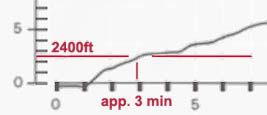
We can examine the facts of December 21 to see whether or not it’s compatible. Below is a graphic from the AAIB's report on the bombing, based on Flight 103’s data recorder. The key line here is altitude, of course labeled “ALT.” The other is some measure of airspeed. The left bar gives feet above sea level (add three zeroes) and the bottom gives time in minutes from data start.
In the marked-up detail at left, note that the altitude doesn’t change for the first minute – takeoff is at minute one, not zero. We can see here that 2,400 feet, the outside pressure that would trigger the timer, is really not very high, and was reached about two or three minutes in. If this pressure decided things for the 38-minute detonation, we’d be looking at a 35 or 36-minute timer, something not within the Khreesat arsenal.

But inside the plane, where the suitcases were, the pressure is controlled and drops more slowly. The work of Rainer Gobel, as related by Leppard, is also confirmed by Paul Foot, writing in 2001 in Lockerbie: The Flight from Justice, as addressing the expected rate where it matters:
"A clearer description of this ice-cube timer was given the same day by Rainer Gobel, physicist for the German police, the BKA. He had a remarkable insight into how long such a timer would take to set off an explosion. “Pressure change in the cabin,” he said, “is regulated automatically. It happens more slowly than the drop of pressure in the air through which the plane is flying, which means, according to the documents which were provided to me, in a plane of the aforementioned class, about seven minutes after take-off the pressure within the cabin will have dropped to such an extent that 950 millibars or hectopascals will have been reached at which the barometric gauge would be involved and a circuit, a current, would be activated.” [p 19]
Some would protest, and fairly I think, that we can't be certain that even if the PFLP-GC's bombs were involved, that this one used the same altimeter setting, or altimeter, or even timer style, as the units examined. But considering the group's reliance on Khreesat’s formula and available materials (the fifth device from 1985), it seems possible enough that it would. And Gobel's "about seven minutes" is quite a nice fit with the roughly eight required to make this fit into Khreesat’s 30, 45, 60 framework. Thus the strong possibility that cannot be reasonably discounted here is that Flight 103’s ascent triggered another ice-cube timer, of the 30-minute size, about eight minutes after wheels-up.
---

Watching the Flags

Caustic Logic
March 19 2010
last update Feb. 1 2011


reference is made throughout to veiwership as measured by Flag Counter. My current Flag Counter returns can be seen here for anyone curious.
---
March 19: I've been greatly enjoying the Flag Counter I had put on this site when it went public about two months back. As you can see (at right, "Visitors") from the hits since January 25, an average of about 88 views per day. Some days up to a third of those may be just me, obsessively editing and making a hit each time I review. But the flag counter only shows unique computers accessing the site and where they are (or show as) plugged in.

(see graphic at bottom for most recent numbers laid out on a map)

As a scholar of "false flag" events, I'm a little skeptical of these little flags, but still it's interesting to watch. It's fun to take it in like a competition. I don't follow football or sports at all, usually, but this "game" revolves around my little/big site.

Over fifty countries so far from all relevant continents have at least one viewer - One Libyan computer has been able to view The Lockerbie Divide, it says. One Jordanian, right after my Khreesat piece. One "European Union." A lot of ones. Someone with diplomatic e-mail contacts must have plugged it, since UN ambassadors is one of the few things, besides viewers of this site, most countries have just one of, from India to Iceland, Barbados to Brazil.

Few of these countries' viewers show the interest to get into the multiple views with 'horizontal seeding.' Those that do have their "gestalt" reasons I can partly guess to have at least a few people interested. Malta is a workhorse of support here, per capita. From a population under half a million, they hold steady around sixth place, once rivaling the United States (currently 47 distinct viewers). They were of course stuck with the stigma of having hosted the Libyan terror plot and failing to stop it, and had their counter-points simply brushed off. Puny Maltese! But hey, such a little country, no one can blame them letting the Libyans suborn them in ways still not explained.

I'm not sure why the 39 Belgian computers (7th) showed interest in particular, but the 23 from Netherlands (8th) have hosting the Zeist trial in their memories to stir interest. Canada (9) - I don't know. Home to a lot of Arab exile types. [Update 5/23: Three Canadian passengers died on flight 103, and they have families...] France (12) had the UTA 772 bombing and related Libya problems, were prime pushers for sanctions, etc. Sweden (no. 11) hosted the Abu Talb sideline and were thus involved in the early investigation as it started towards Malta. Australia (10) is the new home of the millionaire key-witness-and-handler duo the Gauci brothers, Tony and Paul, formerly of Malta. 10 viewers, so at least eight non-Gaucis.

The 61 viewers from the Federal Republic of Germany (5th) might be especially interested in the Autumn Leaves/Khreesat angle, where they may have hosted the makers of the bomb that brought down PA103. Some might have looked at my unusual take on the Frankfurt printout. I think Germany was in 3rd place once, but usually a bit behind South Africa (4th). Nelson Mandela, more than anyone else, helped convince both Gadhafi and the Americans to agree to the Zeist trial. Central negotiator Robert Black also "winters" there and has friends, and in other ways interest remains high enough to send 68 computers clicking here.

Early on the Brits (UK) were the leading edge of viewership here by a wide margin, with their official partners in handling the crime, the United States, trailing badly. Old Glory has stayed consistently in the top five, but barely at points (see Malta, below). A shame since Americans were targetted, were hit like never before, and then Washington led the push against Libya, the sanctions, etc. To the extent Americans remember the incident, they maintain an obsessive certainty this was all correct, and a desire to push the blame higher. And yet... they aren't googling it in droves to keep learning, even as Megrahi lingers and doubts metastasize. That's interesting.

The USA toggled around with South Africa and Germany for places 3, 4 and 5 for the first weeks. Now, with the help of my family and friends and at least Richard Marquise and a few of his, plus whoever else, my homeland has consistently held a steady third place for some weeks now. 86 computers have viewed the site, it says. Two are mine. 84 Americans is not bad for nearly two months, considering how uninteresting the evidence and details are to them. But it's still pathetic compared to the 345 computer from the UK that have hit on, over four times for a much smaller population that had a powerful, but ultimately secondary, part in shaping the outcome of the investigation.

The oddity is second place, steady and unwavering at about half of what the UK yields, and twice the US. Switzerland. A remarkable 180 computers connected, so far. I consider Mr. Bollier is there, founder of the comapny that made the Libyan timer that cracked the case, and a long-time Lockerbie info artist (mebocom pages). Bollier and his "Mission: Lockerbie" been a target of mine - not so much at this site, but previously - and yet has kindly plugged this site, asked to borrow my mountain picture and deigned to leave some comments. (as "ebol")

As a tech guy ultimately, I wonder if Bollier has got some clone army pumping up the hits for some reason. At Professor Robert Black's site, the Swiss hold a distant third (681 to USA's 2,144 and UK's 6,907). There's a deeper history there - many hundreds of those Americans probably viewed the page just once in late August '09. But still, Mebo is about all Switzerland's got connected to Lockerbie, and one way or another that has to be behind the special viewership slant for this site. I may not deliver the expected goods, since Mebo's ambiguous role has slid in importance as I learn more and more. But then I may still openly accuse him of handing over what became PT/35(b).

Mr Bollier, any comment?
(Note, Jan 26: I've since banned ebol from comments here, mostly for reasons over a decade old now).
---
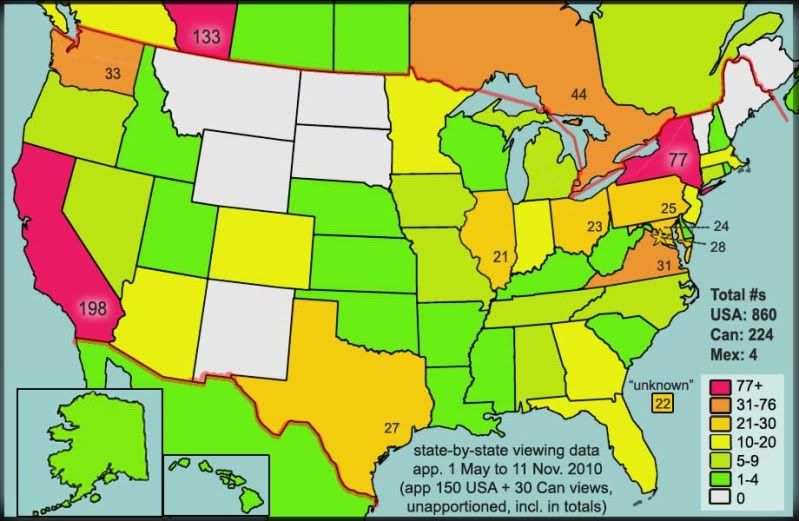
Update 5/10: Nearly 7000 page hits now. A few more nations have moved into two-view category. Pakistan suddenly shot from one to three views recently, Japan from two to five.  Libya is still at 4. Top 12 at the moment: UK up to 496, expected to hit a landmark 500 later today. You guys are awesome! Switzerland, the ol' Confederation Helvetica, up to 382 now. Where do you keep coming from? USA, up to 187! Thanks to my fellow yanks! Recently a state-by-state breakdown came online, counting since then 6 Washington viewers (most of which I probably know), 5 each in California and New York, a few from several other states, and three "unknown." The rest: South Africa in fourth (90), Germany (85), Belgium (73), Malta in seventh (50). Netherlands (43), Canada (36), Australia (18), Austria/France (13), and Sweden (11).
---
7/21: The hubbub this month about Megrahi supposedly having decades live and about evil BP having once lobbied for his release has caused a surge of news coverage in the United States, and with my frequent comments on stories, has earned the site a record run of new American viewers, my target audience. Current top 9: UK 716, Switz 631,  USA 379, Germany 137, Belgium 122, SA 102, Netherlands 79, Canada 69, Malta 64. State-by-state: 36 of 50 states + DC, top 5: CA 47, NY 24, WA 14, VA 14, PA 13. Other high points: 72 nations total now. Recent first-time visitors: Luxembourg, Romania, Ecuador, Ukraine, Cyprus, Iran just the other day. Libya and Italy long since broke the matching pattern I noted earlier. Libya just passed India at 8 viewers.
---
Aug 9: Slower then faster traffic lately. Continued worldwide media interest, getting more detailed as the anniversary of Megrahi's release approaches. Top 10 for distinct viewers: UK 868 Switz 727, US 444, Belgium passes Germany for 4th place, 144 to Germany's 142. 6 South Africa 111. 7 Netherlands, home of Camp Zeist, at 83. 8 Canada, 76. 9 Malta 66. 10 Spain, passing Australia (tied actually) at 36. India just passed Libya at 10 viewers. Hong Kong just appeared as its own country, giving me hits from 75 countries, with a total of 3,008 unique visitors. USA top four: CA 65, NY 30, WA 19, VA/PA 15.

Update Aug 18: Later in the day it became apparent August 9 was the site's record for new viewership. Based largely on my debate call to Brian Flynn (not taken up), a total of 47 new unique viewers logged in that day. My previous record was 36. 12 of these new viewers were American, and those have continued to come in thicker, now totaling well over 15% of visitors (had been about 14 before the 9th). US total = 499.

Update 13 September: It's been a good month for traffic. UK 1,168 Sw 851, US 598 Germany regains 4th, 166 to Belgium's 160 and South Africa's 136. Canada's taken a leap lately to 131, with Alberta (63 views!) leading the way over onetime clear leader Ontario (26). Neth 97, Malta 71, Aust'l 43, Sp 40, Aust 37, Fr 34 India 23, Sweden 22. Saudi Arabia took a one-day leap in late August from 2 to 9 viwers, now sitting at 10. 78 countries total, most recent: Nepal and Senegal. 3,821 unique visitors.


Update, 12 October: Blogger has added some new features, like an awesome comment-tracking tab, and a statistics one that show how many people from where are reading what posts within different time frames. Interestingly, the results there sometimes conflict with what flag counter says. I have viewers appearing from China, Venezuela, Latvia, and Moldova, nations that still appear as having no viewers at all by Flag Counter. Hong Kong and Taiwan appear, the former perhaps fudged by Blogger to read as China, which is what I'd expect, actually. But the other three are clearly their own countries, and it's a little strange. Currently 80 nations are recognized by Flag Counter, most recent Senegal, Mali, and Sri Lanka. 

I've noticed on the stats amazing spikes of pageviews from my two South Korean vieweers (as high as I think 75 views in a two-hour span), and a 17-post rampage by my unacknowledged Moldovan guest. Hey, I'm down with the grape revolution, so long as it's authentic, man. (Sadly, I never did post my small research on that at Guerillas Without Guns, but there was a color revolution planned there too, called Grape.) Italy and Ireland's near-identical flags stay tied at 15. Slovenia, home of Bogomira Erac has now sent ten viewers - impressive for such a small place. Also, one of my favorite bands, Laibach, hails from there.

Australia, Malta, Netherlands, Belgium, and even the USA have made notable gains in viewing my big-head blog in recent weeks. Top ten: UK 1,444 - Switzerland 963 - US 723 - Belgium 188 - Germany 175 - Can 174 - South Africa 144 - Netherlands 115 - Malta 90 - Australia 55.

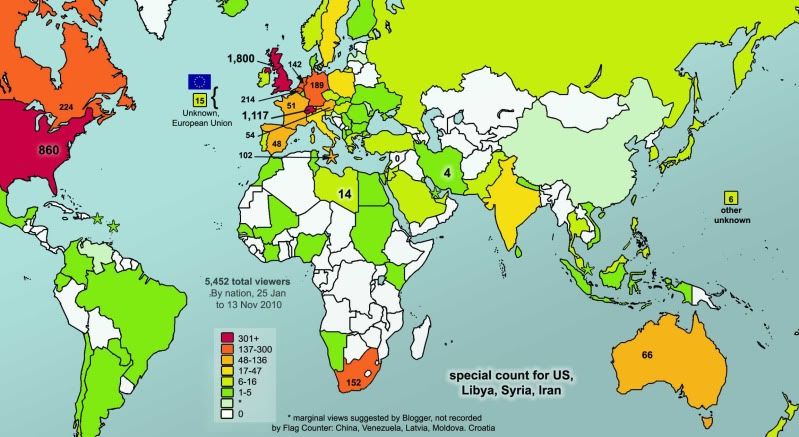
Nov 5: What the hell, Italy and Ireland? You both have the same exact flag, more or less, and get stuck side by side at 15 views for nearly two months. Then Italy pulls ahead to 16 the other day, leaving Poland between them. For one day. Then Ireland pulled up to 16 as well, and now they'll stay together for another month I suppose. Passed 5,000 unique visitors recently, now nearing 5,200. Macedonia and Sudan most recent viewers, nice climbing action from Poland (app 12 to 17) and Jordan (app 3 to 9). Canada keeps climbing, passing both Germany and Belgium comfortably. Top ten: UK 1,685 - Sw 1,064 - US 813 - Can 207 - Belg 205 - Ger 182 - SA 151 - Neth 126 - Malta 99 - Aust'l 63.  

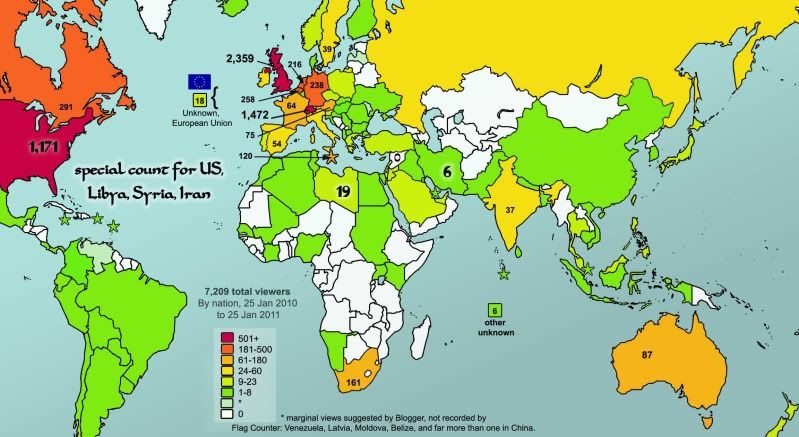
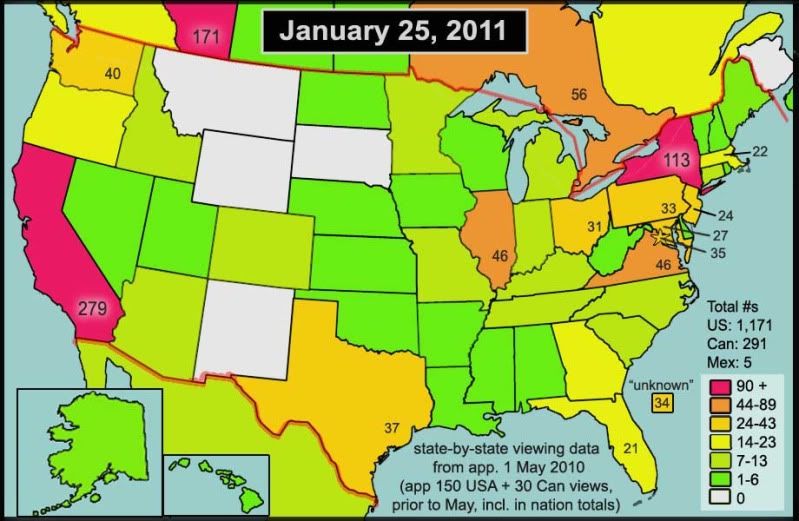
Jan 25 2011: A quick update after two month of watching but not noting. It's the one-year anniversary of the site, officially launched January 25 2010. The United States has improved its veiwership share to 16.1-16.3%. One day recently saw a new record, 16 new American viewers in a single day! Illinois in particular has taken off, now tied with Virginia for third place at 46 veiwers. (New York is comfortably past 100, and California's inching towards 300.) Top ten countries: UK 2359, Switz. 1472, US 1171, Canada 291, Belgium 258, Germany 238, Neth 216, SA 161, Malta 120, Australia 87. New countries: China, Iraq, Palestinian Territory, Algeria, Maldives, Bangladesh, Peru, Bolivia, Uruguay, Uganda, Cambodia, Panama, Puerto Rico, Costa Rica, Jamaica. Plus Guernsey and Jersey, which don't really seem like countries to me. Countries showing marked jumps include Austria, Slovenia, the Netherlands, Saudi Arabia, Russia, Colombia.  Italy and Ireland are tied again, as usual, at 26.
1/28 update: I was taunting Slovenia by putting the olive/gold threshold right above them, and they responded by shooting up from 23 to 32 viewers in less than three days, to 13th place. They'll be solid gold next update. Norway, home of many of my ancestors, also just jumped up a few slots to 17, from ... I thought it was seven just a month ago.

April 19 2011
Since the last update, Libya has entered into full on warfare with western elites giddy enough to solemnly demand Gaddafi's system finally be scrapped privatized for their own benefits. They don't say it that way, but it's clearly in store when so much is being spent on this "humanitarian" effort in such tough economic times. That we spend so much doesn't mean we care. It also costs a little money, some planning, and even caries risks ... to plan an armed robbery. The idea is it'll more than pay for itself.

Anyway, maybe it is for the best, but it annoys me how sure the world acts, when they can't even realize, at the very least, the Libyan government was framed for Lockerbie. It's been good and bad for my site. The war had Libya's internet cut off from late February, so new viewers stopped appearing. But the other day, April 16, I got my first new Libyan flag since then (21 now)! Sadly, it may be among the last ever with that cool green flag, as they're all hoping to take the flag of pre-Gaddafi Monarchist, serve Washington and Wall Street and starve-the-peasants-era Libya.

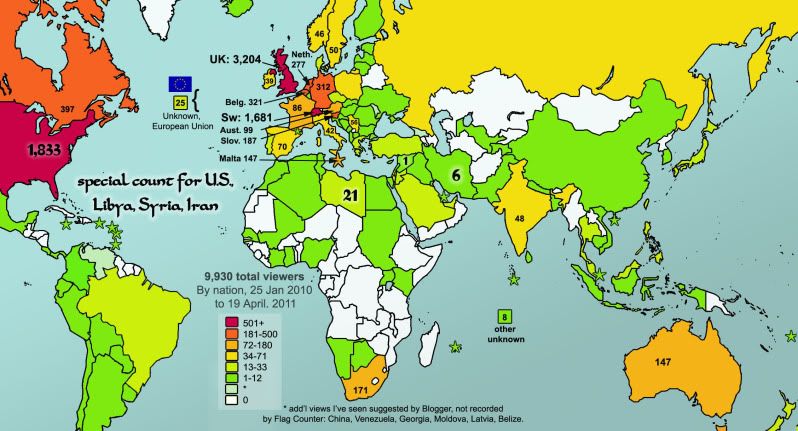
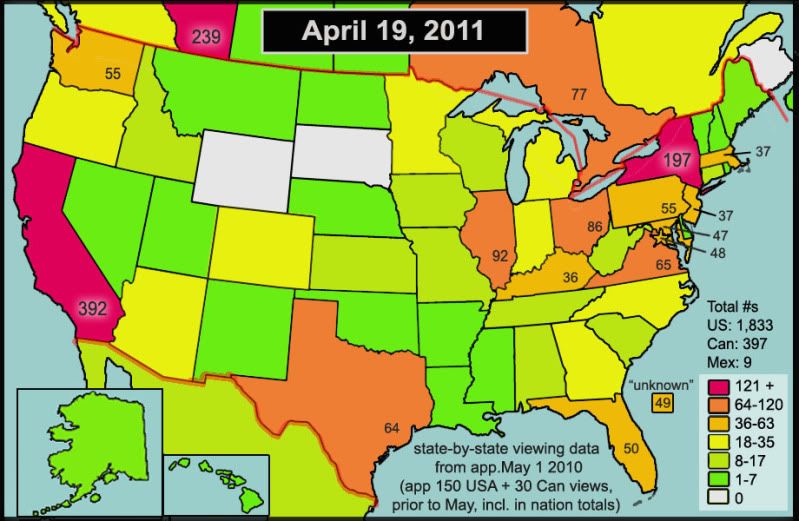
In other visitor news, the war drove record new viewers to my site, especially from the United States, always my intended core audience. 75 new computers logged on in one day on February 24, about 1/3  Americans. This helped the US later push to second place (1,833, 18.5% of total), bypassing Switzerland, whose new viewers rather suddenly slowed to a trickle. It was a nice break, but it coincided with a strange surge of Slovenian viewers, (just beginning at last update, only now slowing down a bit) from 13th at 32 viewers on Jan. 28, to 8th place at 187 in less than 3 months. Serbia's appeared and taken off some, too, but more naturally, now 15th at 56 viewers - an interest emerged there in my thru-linked article on the "al-Baida massacre" (see comments). New countries: Chile, Paraguay, Guadelupe, Trinidad and Tobago, Fiji, French Polynesia, Tajikistan, Uzbekistan, Estonia, Lithuania, Latvia, Serbia, Bosnia and Herzegovia, Croatia, Monenegro, (all of former Yugoslavia except Kosovo, the part we so excellently saved in '99) Syria (same issue - Syrian soldier also blamed for shooting their own for "refusing to shoot protesters."), Ghana, Mauritius, Botswana, Andorra.  Top ten: UK 3,204 - US 1,833 - Sw 1,681 - Canada 397 - Belgium 321 - Germany 312 - Neth 277 - Slovenia 187 - S. Africa 171 - Australia/Malta (tied) 147. Malta will now leave the top ten. :(

Updated world veiwership map:
(New window for full view with points east)
previous, Jan 25:

Current North America map:

Previous map, Jan 25
Previous map, Nov. 2010

Note California and Alberta, the deep red ones. I don't even know anyone there hardly, and they've got what seems like the overblown Switzerland effect going on. However, see comments below (by FullInquiry) on Alberta's showing. My own friends and family's what's got Washington between them as high as it is, sad as that is (40 views counted, with many others buried among the 150-ish U.S. views racked up before the state-by-state breakdown came online in May). I never expected a surge of Mexican interest, but after a full year ... 5 viewers?